
Get in Touch with Koven Air Company

Updated July 2026
Quick Specs: What This Guide Covers
| System boundary | Chilled water, refrigerant circuit, condenser water, and final heat rejection |
| Comparison basis | Same duty, rating method, temperatures, load point, and auxiliary-power scope |
| Site evidence | Load profile, water analysis, meter plan, controls sequence, tests, and service scope |
| Not covered here | Koven model specifications, supplier price tables, or project quotations |
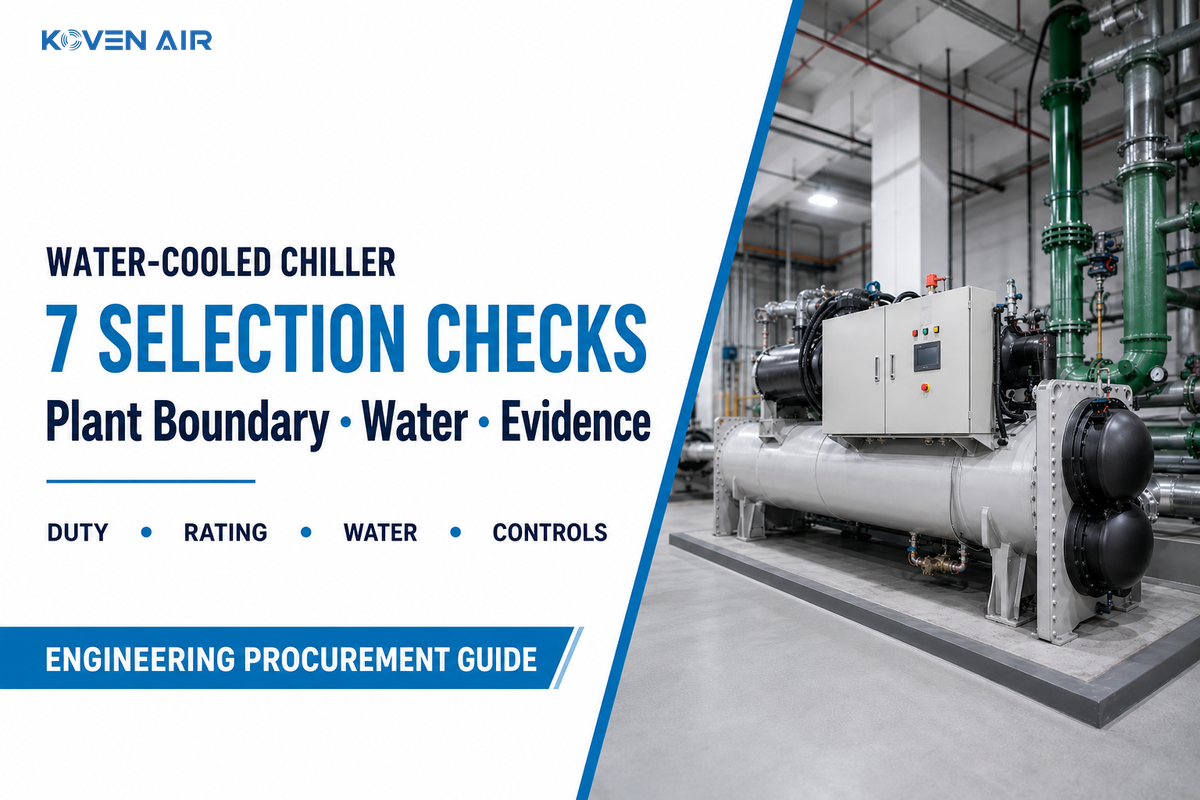
A water cooled chiller is a refrigeration machine that cools a circulating water or water-glycol loop and rejects the absorbed heat through a separate condenser-water loop. It can serve commercial HVAC or process cooling applications, but pumps, heat rejection, treatment, controls, and site operating procedures still shape plant performance.
A water-cooled chiller removes heat from chilled water through a refrigerant circuit and transfers it to a separate condenser-water loop. Choose one by comparing the complete plant for a shared duty, not by nominal capacity or one efficiency value.
- Separate the machine from external pumps, tower, treatment equipment, sensors, and supervisory controls.
- Normalize full-load and part-load data using identical water temperatures, flow, fouling assumption, and power boundary.
- Treat make-up water, blowdown, discharge, and public-health controls as design inputs.
- Require a written sequence, functional tests, and trend review so field controls can be checked after handover.
- Send commercial intent to the existing solution page while this guide remains educational and evidence-led.
ENERGY STAR’s water-side guidance distinguishes the refrigeration machine, condenser-water loop, pumps, and cooling tower. That boundary leads to the first and most useful screen in this guide: The Three-Loop Boundary Test.
1. What Is a Water-Cooled Chiller?
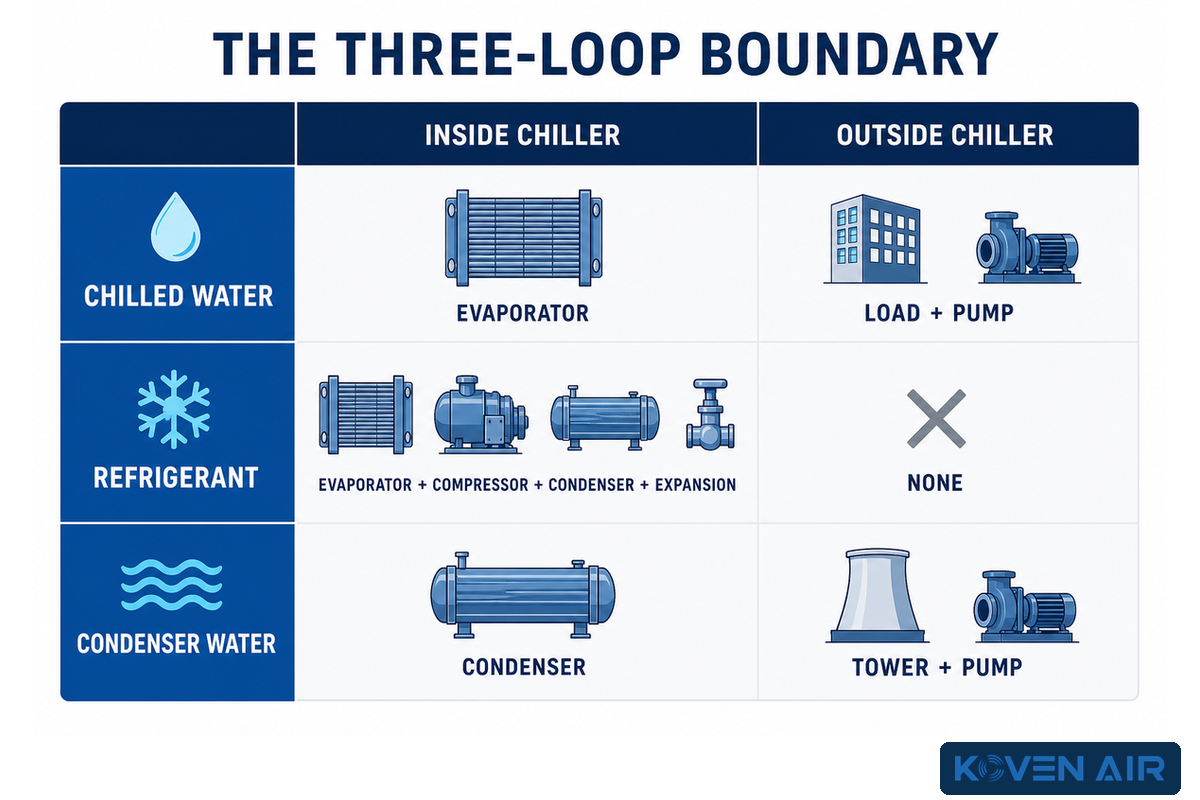
A water-cooled chiller cools water or a water-glycol mixture in the evaporator and rejects the absorbed heat through a water-cooled condenser. Refrigerant remains in its own sealed circuit, while a separate condenser-water loop carries heat to a tower or another engineered heat sink.
In project documents, the phrase “water cooled chiller design” may refer to either the packaged chiller or the entire system. Those are two different scopes. Commercial packaged chillers typically include the compressor, evaporator, chiller condenser, expansion device, refrigerant piping, safeties, and local control panel. A project may still require pumps, valves, strainers, expansion provisions, a tower, treatment equipment, metering, and BMS integration.
In water cooling for industrial and commercial facilities, the buyer is selecting a plant boundary rather than one piece of air conditioning equipment. A commercial chiller can serve a range of applications, but a split system is not a like-for-like substitute when the project needs distributed chilled water.
The Three-Loop Boundary Test
- Chilled-water or process-fluid loop: transfers thermal energy from an air-handling unit, production equipment, data center, or process to the chiller evaporator.
- Refrigerant circuit: removes heat within the hermetically sealed refrigeration system through evaporation, compression, condensation, and expansion.
- Condenser-water loop: carries heat from the condenser to a cooling tower, closed-circuit cooler, source-water arrangement, or another approved heat sink.
Each project proposal should identify which components belong to every loop and who provides them. That boundary keeps a chiller-only power value from being confused with whole-plant energy use, while revealing omitted tower, pump, sensor, or control scope before purchase.
Because omitted auxiliaries distort plant comparisons, use ENERGY STAR’s official page on water-side systems as a boundary cross-check, then document the actual project scope.
2. How Do Water-Cooled Chillers Work?
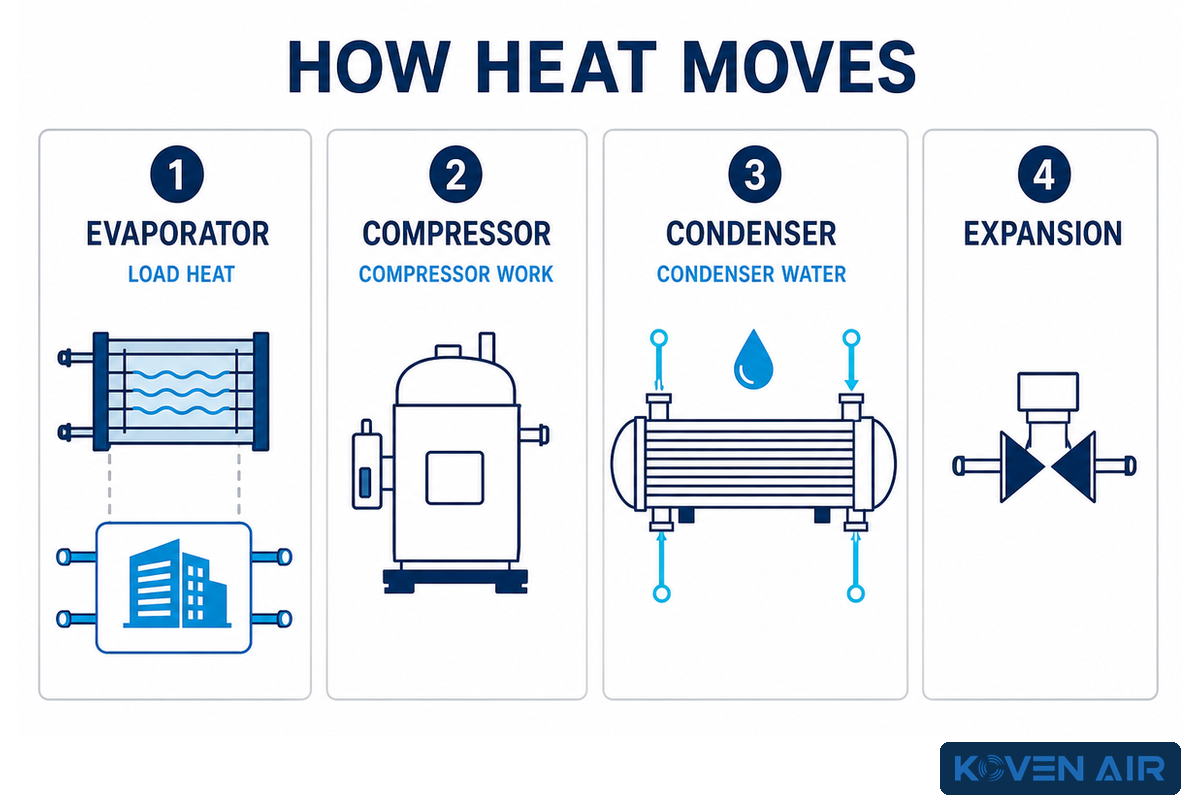
A water-cooled chiller works in four stages: the evaporator absorbs heat, the compressor raises refrigerant pressure, the condenser rejects heat to condenser water, and the expansion device lowers refrigerant pressure. Pumps keep water moving on both sides of the chiller.
Load gives up heat to chilled water → Evaporator transfers heat to refrigerant → Compressor raises pressure and temperature → Condenser transfers heat to condenser water → Heat-rejection device releases or reuses the heat.
Within the evaporator, low-pressure refrigerant absorbs heat from the chilled-water side and changes state. Compression raises refrigerant pressure and temperature. Heat then passes into condenser water, and the expansion device reduces refrigerant pressure before the cycle starts again.
Water and refrigerant remain physically separate at the heat-exchanger surfaces. Water temperature, flow, pressure, fouling, and refrigerant condition all affect heat transfer. When a project uses water and glycol, provide the concentration and fluid properties so the manufacturer can calculate capacity and pressure drop for that mixture.
The evaporator side usually operates as a closed-loop. Where freeze protection is needed, a mixture of water and glycol changes heat transfer, pumping, and selection; the exact concentration belongs in the duty schedule.
In a building application, cooled air only occurs after chilled water reaches a cooling coil and ventilation air passes over it. In factory applications, water circuits can cool tools or electronics. Other processes include horticulture, battery manufacturing, and customized industrial machinery. While a chiller’s role is to transfer heat, terminal-process requirements determine how and when cooling is delivered.
Because the two water streams do different jobs, the National Laboratory of the Rockies’ official chiller page is a useful cross-check for evaporator and condenser duties.
3. What Are the Main Components of a Chiller Plant?
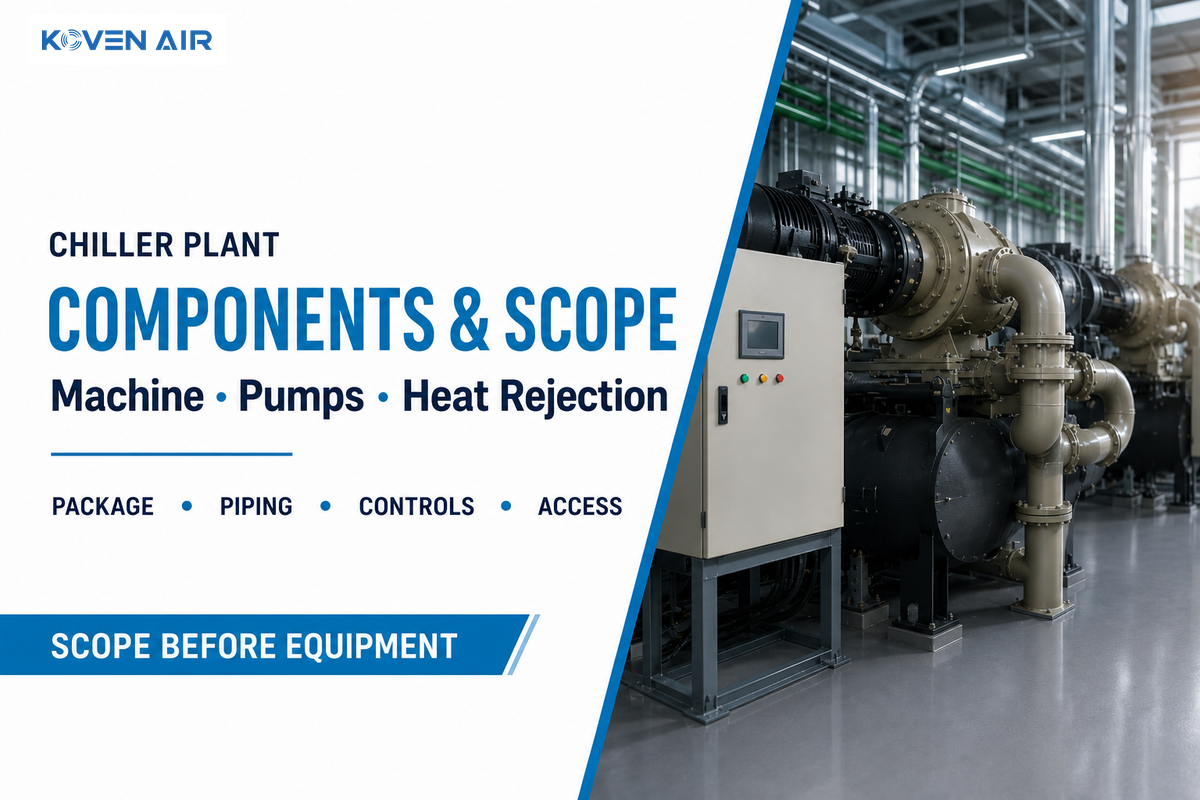
Packaged chillers contain a compressor, evaporator, condenser, expansion device, refrigerant circuit, internal controls, and safeties. Working plants add chilled- and condenser-water pumps, heat rejection, treatment, valves, sensors, electrical equipment, and supervisory controls. The written project scope must identify who supplies each external item.
| Component Type | Primary job | Typical scope question | Limitations / verification |
|---|---|---|---|
| Compressor | Raises refrigerant pressure | Screw, scroll, centrifugal, magnetic-bearing, or another arrangement? | Verify operating envelope, minimum load, staging, and service access |
| Evaporator | Cools the load fluid | Water or glycol; required leaving temperature? | Verify flow limits, pressure drop, materials, and fouling basis |
| Condenser | Rejects heat to water | What entering water range and pressure drop apply? | Verify tube material, cleaning access, and water limits |
| Expansion device | Reduces refrigerant pressure | How is stable control maintained through the load range? | Verify the operating envelope and controller integration |
| Pumps and valves | Move and isolate water | Included in package or by others? | Verify curves, control authority, redundancy, and minimum flow |
| Heat rejection | Transfers condenser heat to a sink | Tower, closed circuit, source water, or hybrid? | Verify wet-bulb basis, plume, freeze, water, and access constraints |
| Water treatment | Controls scale, corrosion, solids, and biology | Who owns chemistry, monitoring, and corrective action? | Verify site analysis, materials, records, and discharge plan |
| Electrical equipment | Supplies and protects motors and controls | Which starters, drives, disconnects, and meters are included? | Verify voltage, frequency, fault level, and single-line diagram |
| Controls and sensors | Sequence chiller units and auxiliaries | Which points and protocols cross the package boundary? | Verify calibration, alarms, safeties, trends, and overrides |
Different compressor families suit different duties and turndown needs. Koven Air separates screw and scroll chiller options from centrifugal chiller options. Those pages help identify a machine family; they don’t replace a duty-point calculation.
These types of chillers can provide higher cooling capacity or different turndown within the same plant concept, but the right cooling solution still follows the load, temperatures, utilities, and service plan.
One modular chiller arrangement can support staged capacity or redundancy. Magnetic-bearing chiller technology brings a different set of control and service questions. Compare machine types only after the load and site boundary are clear.
One common mistake is to compare compressor labels before the duty is fixed. Because Koven Air’s pages group equipment families while project selection still requires calculations, treat those links as navigation rather than proof of fit.
4. Air-Cooled vs Water-Cooled Chillers: Which Fits?
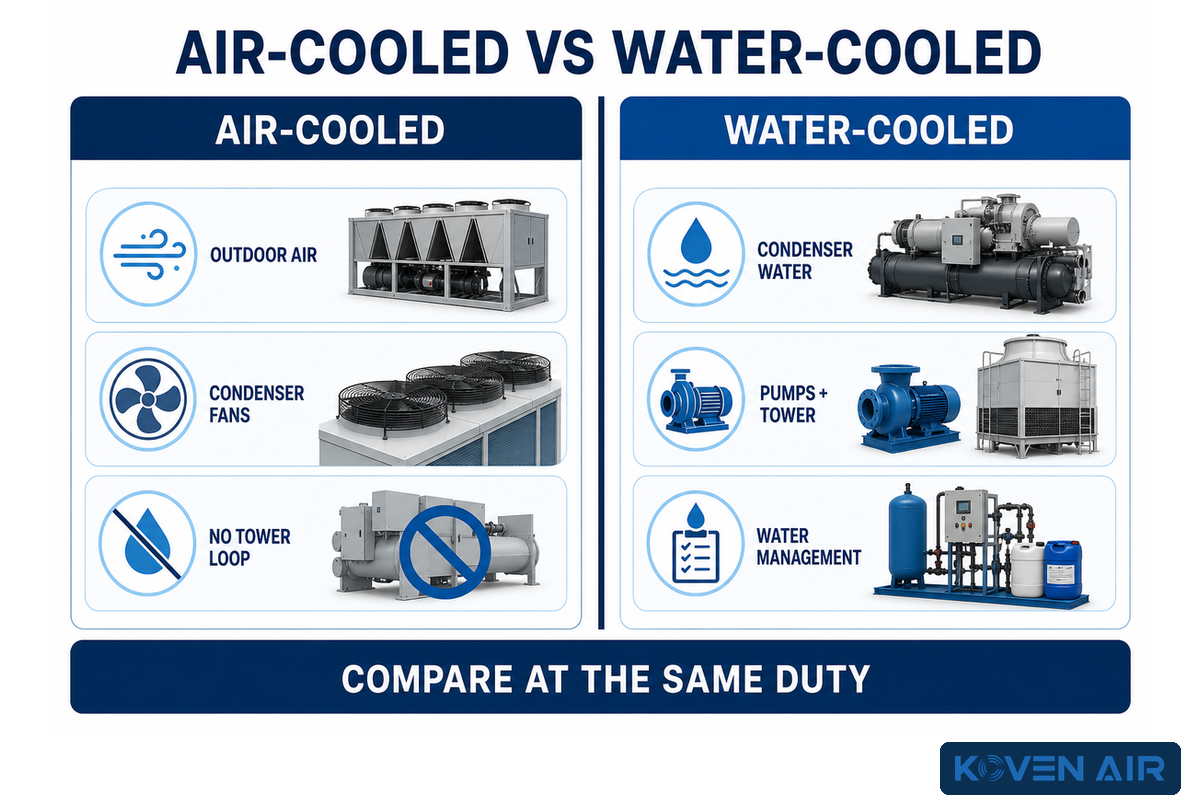
Neither architecture is universally better. Water-cooled chillers may fit sustained loads and larger central plants, but they add condenser-water piping, pumps, treatment, and water-management work. Air-cooled chillers avoid the third loop but interact directly with ambient air and outdoor condenser conditions.
| Decision factor | Water-cooled plant | Air-cooled plant | Limitations / verify |
|---|---|---|---|
| Heat sink | Condenser water plus tower or alternate sink | Outdoor air through condenser coils | Compare design wet-bulb and dry-bulb conditions |
| Auxiliaries | Pumps, tower fans, treatment, controls | Condenser fans, heaters, controls | Use the same included-power boundary |
| Water | Make-up and blowdown may be material | No open cooling-tower loop | Check source, discharge, restrictions, and utility cost |
| Maintenance | Machine plus tower, pumps, and water program | Outdoor coil condition and airflow | Match the site’s staff and contractor capability |
| Space and access | Plant room and heat-rejection area | Outdoor clearance and service envelope | Check structure, sound, plume, and lifting route |
At matched rating conditions, a water-cooled selection may show higher machine efficiency than an air-cooled alternative. That result doesn’t prove the lowest annual plant cost. Operating hours, climate, tower and pump power, maintenance, water rates, treatment, and control performance all matter. Review Koven Air’s air-cooled chiller architecture when a third water loop is impractical.
Air-cooled counterparts may reduce water-system work, but higher efficiency at one rated point does not establish lower annual energy consumption or maintenance costs.
When should you not buy a water-cooled chiller?
Don’t select a water-cooled chiller simply because its selection sheet shows a favorable compressor coefficient of performance. This architecture may be a poor fit where make-up water or wastewater discharge is constrained, tower maintenance expertise is limited, operating hours are short, or the third loop can’t be funded. Freezing risk, plume, drift, sound, structural loading, and outdoor-air concerns can also turn a seemingly simple tower into a larger site problem.
For smaller loads or intermittent demand, a system with simpler controls and fewer auxiliaries may be a better choice, especially when those devices would otherwise run at inefficient fractions of their design range. Address any local gaps in water-treatment expertise or maintenance capability before purchasing. Even an evaporative chiller or hybrid option needs a review of water cost, availability, and climate; it is not automatically an easy compromise. The best cooling system reliably delivers the required cooling under the site’s operating, maintenance, staffing, and environmental conditions.
5. How Should Water-Cooled Chiller Efficiency Be Compared?
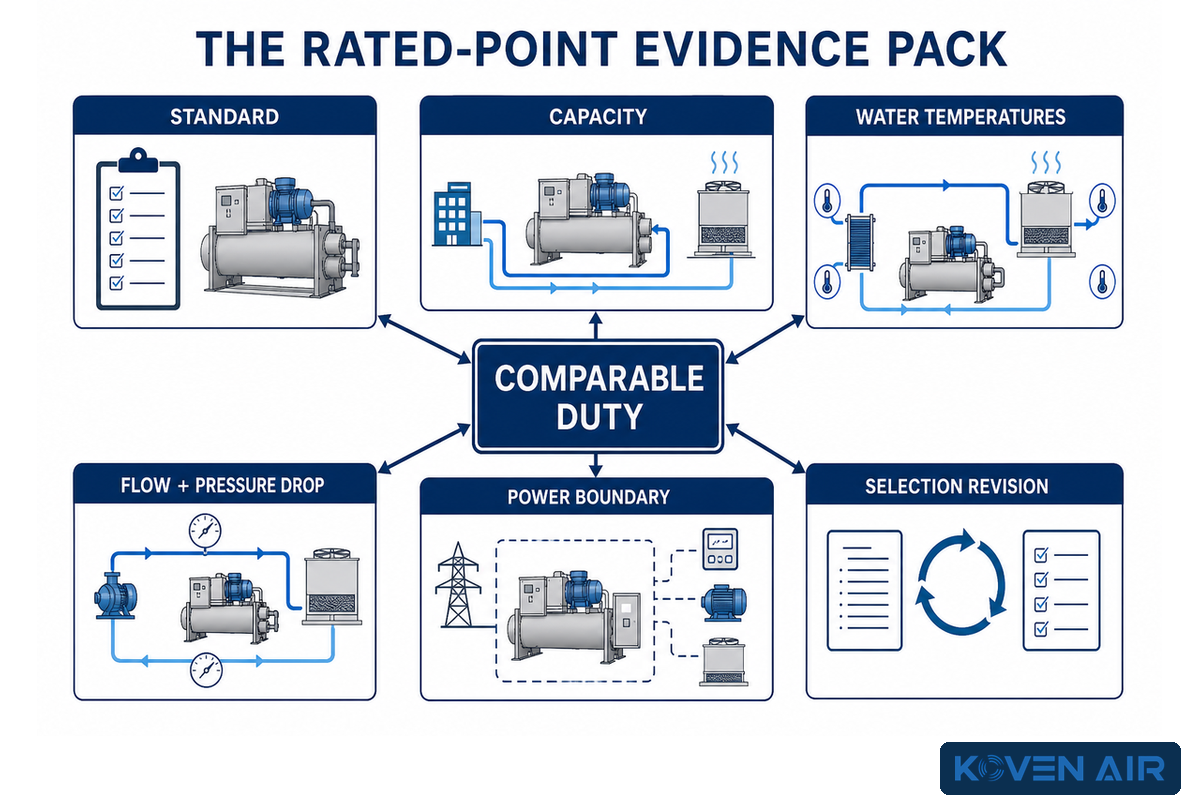
Proper apples-to-apples efficiency comparisons should match cooling capacity, load point (full load, part-load), leaving chilled water temperature, entering condenser water temperature, flow rates and pressure drops, fouling assumptions, and the inclusion of fans, pumps and other auxiliary equipment for the equipment being considered. Compare efficiencies using the same rating edition and equipment category.
AHRI’s official standard-scope page identifies covered and excluded chiller-package configurations and the relevant rating procedures. Proper submittals should state the edition and package classification used for the reported data. Any single efficiency number without those conditions is incomplete.
U.S. Department of Energy federal purchasing guidance sets efficiency criteria for both full-load and part-load conditions and directs buyers to consider life-cycle and total system energy costs. The requirements apply to U.S. government agencies, but the comparison logic is useful more broadly.
The Rated-Point Evidence Pack
- Standard, edition, equipment category, and certification or test basis.
- Net cooling capacity at the stated duty.
- Leaving chilled-water and entering condenser-water temperatures.
- Evaporator and condenser flow, pressure drop, and fouling assumptions.
- Compressor input power and any manufacturer-supplied auxiliary loads, such as pumps, fans, or controls.
- Selection-software version, date, units, and project duty identifier.
| Selection | Illustrative duty | Reported input | Decision |
|---|---|---|---|
| A | 1,000 tons at one chilled- and condenser-water condition | 0.55 kW/ton × 1,000 tons = 550 kW | Hold until conditions and auxiliaries match |
| B | 1,000 tons at a warmer condenser-water point and different load basis | 0.58 kW/ton × 1,000 tons = 580 kW | Do not rank against A as submitted |
For illustration, a fictional project register might read 44°F (6.7°C) leaving chilled water, 54°F (12.2°C) entering return water, 85°F (29.4°C) entering condenser water, 2,400 gpm (151 L/s), 20 ft (60 kPa) available pump head, 460 V, 60 Hz supply, and a 15-minute trend interval. These values show the required units and fields; replace every one with the calculated site duty and supplier selection.
That math is clear, but the apparent 30 kW discrepancy doesn’t prove annual energy savings because the points differ. Request matched selections, then model the annual load and auxiliary power. This also prevents one supplier’s high-efficiency machine claim from being compared with another supplier’s whole-plant boundary.
6. Condenser Water and Cooling Towers: What Can Go Wrong?
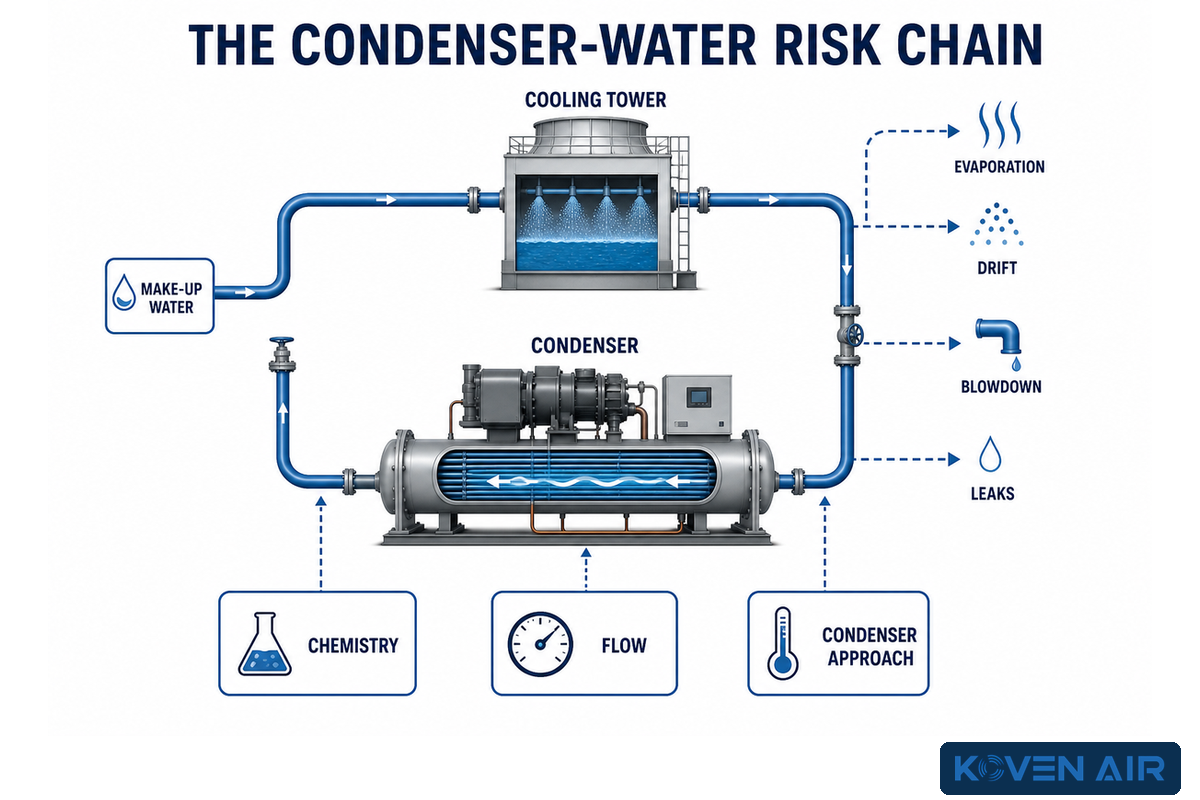
Condenser water risk links chemistry, flow, heat transfer, water consumption, discharge and public health. Scale, corrosion, sediment, biological growth, restricted flow or failed blowdown control can impact reliability even if the chiller selection was correct. Treat the whole chain as one operating risk.
The Condenser-Water Risk Chain
A water sample is not a water-management program. Connect source quality, concentration, treatment, meters, tower condition, condenser approach, cleaning records, and corrective action to the same operating history.
DOE identifies four tower loss pathways: evaporation, blowdown, drift, and leaks or overflows. Make-up water replaces those losses. Its guidance also recommends make-up and blowdown meters, conductivity control, cycles-of-concentration checks, and operating logs. Local water supply, wastewater, sewer-credit, and discharge policies still need site confirmation.
CDC guidance adds a public health boundary. Its cooling tower module covers scale, corrosion, sediment, biofilm, residual disinfectant, temperature, water age, cleaning, and aerosolization risk. Manufacturer-specified water limits don’t replace a site water management plan or qualified public health oversight.
Do
- Analyze make-up and recirculating water
- Meter make-up and blowdown flows
- Trend conductivity and condenser approach
- Document discharge and corrective-action routes
Don’t
- Copy treatment limits from another site
- Ignore drift, leaks, or overflow losses
- Treat poor water as a chiller-only fault
- Use cycles of concentration without chemistry review
Higher cycles can reduce blowdown but also concentrate dissolved solids. Safe operating points depend on make-up chemistry, metallurgy, treatment, temperature, and control performance. Ask a qualified specialist to define the program; don’t turn a general guide into a chemical-dose prescription.
7. How Do You Select an Industrial Water-Cooled Chiller?
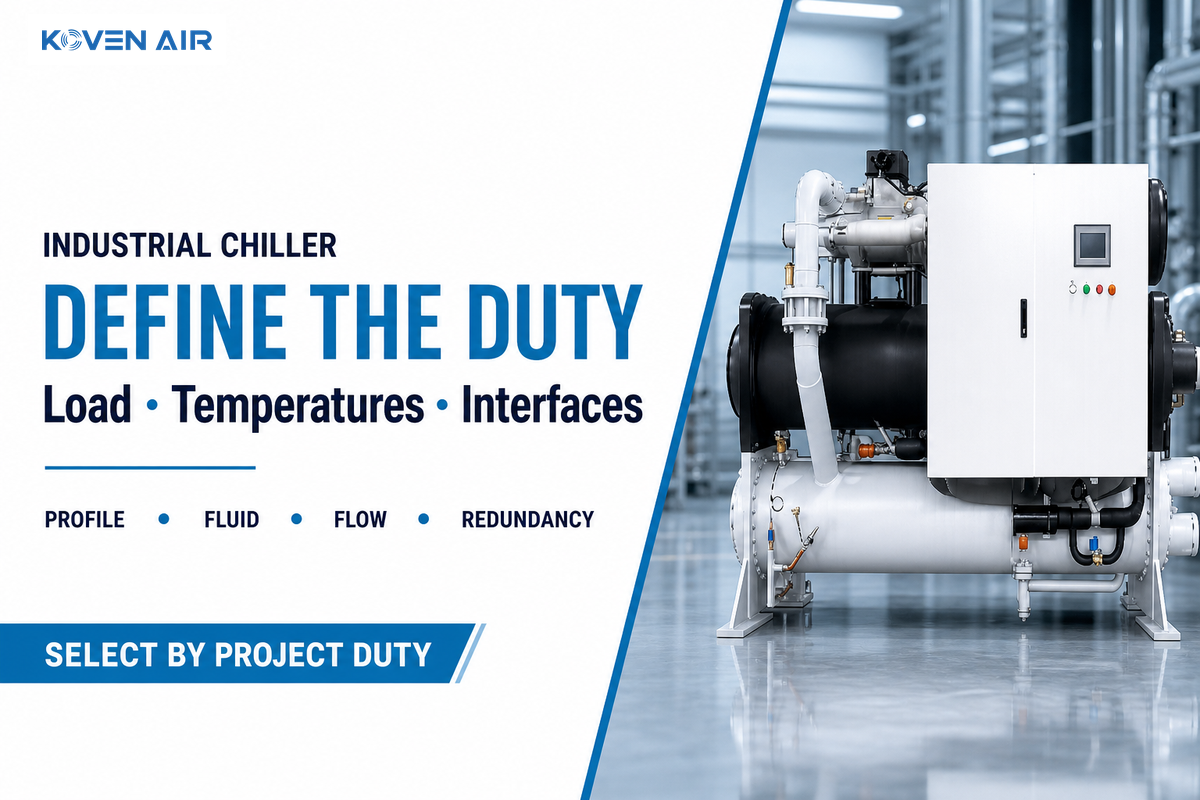
Begin with the required load and temperatures, then define fluids, flow rates, climate, operating hours, redundancy, electrical power, water availability, space, sound, controls and service. Nominal tonnage isn’t a substitute for cooling capacity at the intended duty. Confirm every input at minimum, typical, and peak load.
One defensible selection sequence has seven steps: define the duty, trace the three loops, confirm site utilities, compare matched rated points, test off-design operation, close scope gaps, and agree on acceptance documents. This sequence applies to many applications because it relies on measured or designed inputs rather than a building label.
Comfort HVAC tends to focus on annual load, humidity, air-handler temperatures, and occupant schedules. An industrial process may require precise leaving-water control, a special fluid, year-round operation, fast recovery, or redundancy. Data-center projects can add high-density loads, rapid growth, and water-governance concerns. Mushroom farms, granaries, hospitals, freight terminals, electronics manufacturing, and battery production each change the risk register; none determines a model by itself.
Industrial cooling covers a broad variety of applications, from process-fluid control to central comfort loads, so the load profile matters more than the building label.
Use the parent industrial chiller range to identify potential machine families. If the project combines heating and cooling, review the separate heat pump systems category before assuming a cooling-only machine is the correct boundary.
Every project brief needs minimum, typical, and peak load; annual hours; leaving and return temperatures; water or glycol concentration; design flow; heat-rejection condition; utility limits; future load; redundancy; controls protocol; and service location. Missing inputs should read “to be confirmed,” not a made-up number.
8. What Maintenance Protects Performance and Service Life?
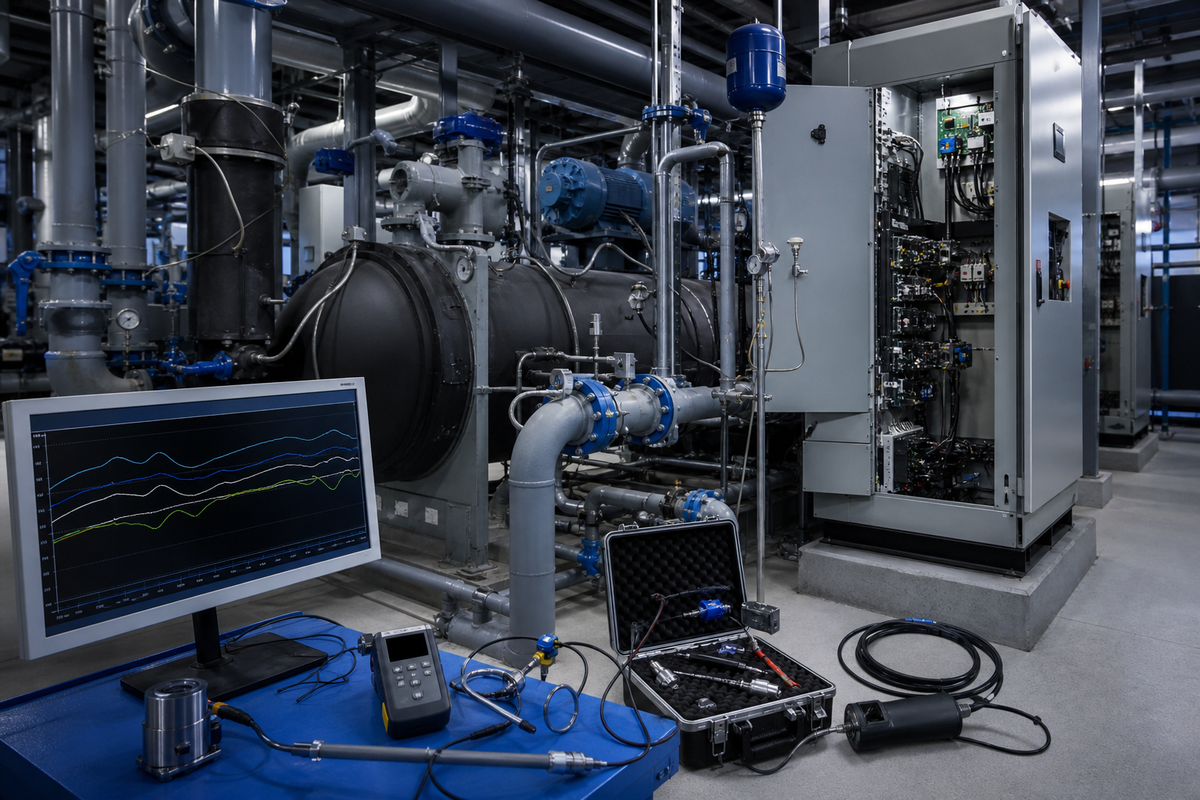
Protect performance by trending temperatures, pressures, flows, power, alarms, water data, vibration, leaks, and staging. Pair those trends with heat exchanger, pump, control, refrigerant, oil, safety and electrical inspections according to the manufacturer’s instructions and site plan. Record intervals and responsibilities before startup.
No one can reliably guarantee one life expectancy for every chiller system. Service life depends on design, load, annual hours, water treatment, environment, maintenance, control stability, and repair economics. Evidence of current condition is more useful than a ballpark year.
ASHRAE’s central chilled-water plant resources treat sensor selection, performance monitoring, sequence review, point-to-point checkout, functional testing, and trend review as connected controls and commissioning topics. Startup shows that equipment can run. Continued review checks whether the sequence keeps working as intended.
Because control performance can drift after handover, ASHRAE’s official page on central chilled-water plants supports checking sensors, functional tests, and trend data as one continuing process.
| Evidence | What it may reveal | Follow-up | Limitation |
|---|---|---|---|
| Leaving and return temperatures, flow | Load, low delta-T, bypass, or sensor issue | Verify sensors, valves, balance, and sequence | One point cannot explain a seasonal pattern |
| Condenser approach and water record | Fouling, poor flow, or treatment drift | Review chemistry and exchanger condition | Use matched load and temperature context |
| Power versus load | Staging, override, or auxiliary penalty | Compare written sequence with trends | Meter boundaries must be known |
| Alarms and manual overrides | Control drift or unresolved fault | Functional test and restore authority | Cleared alarms need retained history |
Controls drift when sensors lose calibration, setpoints change, operators hold overrides, or staging departs from the approved sequence. Review minimum-flow protection, tower and pump staging, alarm limits, and light-load behavior after handover. In a multi-chiller plant, trend data should show which chillers, pumps, and tower cells operated, and why.
9. What Evidence Should You Request Before Purchase?
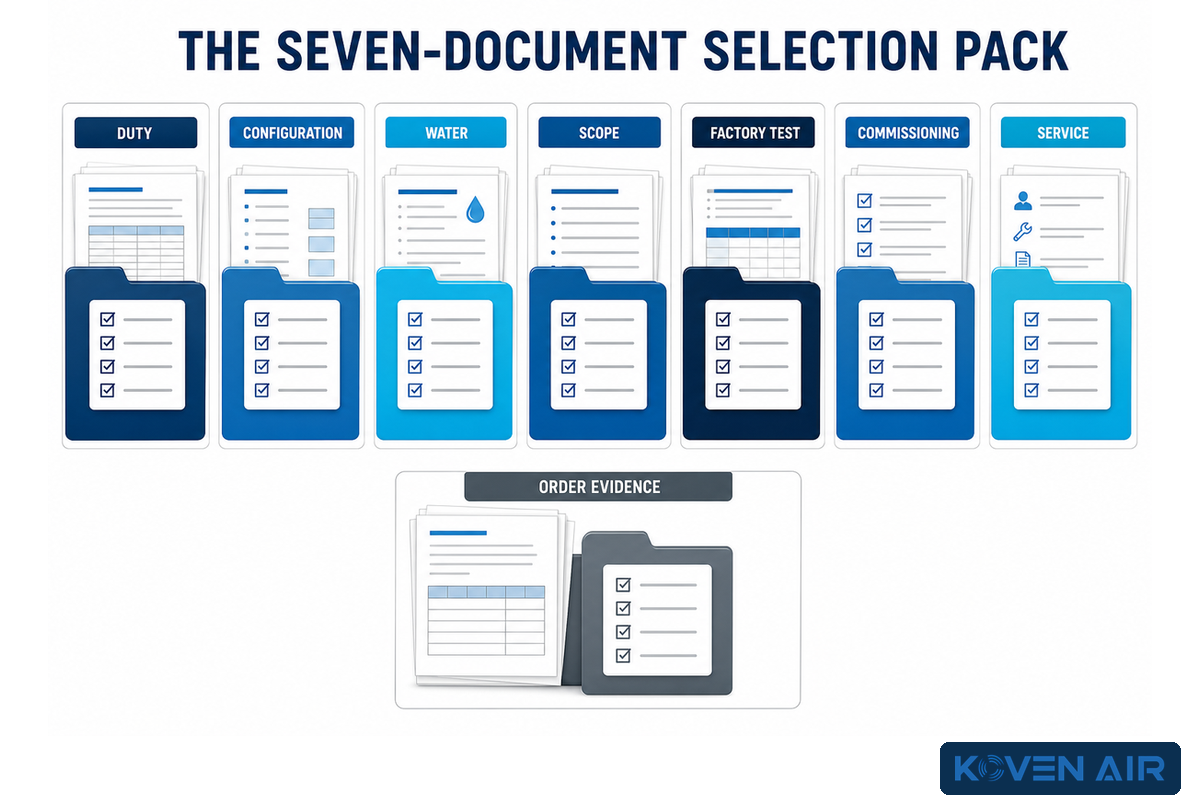
The duty match request and associated documents include a rating basis, water limits, pressure drops, scope drawing, tower water balance report, controls package, factory test results, commissioning plans, manuals, warranty bounds and service responsibilities. Tie every document to the offered machine and revision.
The Seven-Document Selection Pack
- Duty-point selection: capacity; power; water temperatures; flow rates; pressure drops; fouling basis; units; selection date.
- Configuration schedule: compressor; refrigerant; electrical; controls; materials; options; exclusions.
- Water limits and balance: fluid limits; source analysis; cycles target; make-up; blowdown; meter points; discharge routing.
- Scope drawing: chiller; pumps; tower; valves; water treatment; sensors; electrical equipment; protocols; party responsibilities.
- Factory evidence: inspection and test records tied to the offered machine.
- Commissioning package: sequence; point list; point-to-point check; functional-test procedure and acceptance criteria; trend-review period.
- For lifecycle support, request manuals, parts, training, warranty boundaries, an escalation route, and named service responsibilities.
You can copy the following register into a request for proposal. It uses “project-specific” wherever a universal recommended value would be misleading.
RFQ checklist, copy these into your quote request:
| Parameter | Recommended range | Why it matters | How to verify |
|---|---|---|---|
| Cooling load | Project minimum, typical, and peak in kW or tons | Defines capacity and staging | Load calculation and operating data |
| Chilled-water duty | Project-specific entering/leaving °C or °F and flow | Sets capacity and lift | Matched selection printout |
| Condenser-water duty | Project-specific entering/leaving °C or °F and flow | Sets heat rejection and power | Selection plus tower schedule |
| Pressure drop | Maximum project allowance in kPa, bar, or ft head | Affects pump selection | Certified selection and pump curve |
| Water management | Site analysis, target cycles, make-up and blowdown in volume/time | Defines treatment and discharge scope | Water plan, meters, and utility review |
| Controls | Approved points, protocol, minimum flow, staging, alarms | Protects stable operation | Sequence, point list, and functional test |
| Acceptance | Factory and field criteria tied to the supplied unit | Turns claims into evidence | Signed records and trend review |
| Decision | Conditions | Buyer action | Limitations |
|---|---|---|---|
| Proceed | Duty, rating, water, scope, controls, test, commissioning, and service evidence agree | Freeze the accepted documents into the order | Still subject to installation and field acceptance |
| Clarify | A material field is missing but resolvable before purchase | Issue a dated technical query and close it in writing | Do not rely on an oral assumption |
| Reject | Rating conditions are irrelevant, site limits conflict, or scope and test evidence cannot be reconciled | Do not release the order as submitted | A revised compliant offer may be reconsidered |
10. Which 2025–2026 Changes Affect Verification?
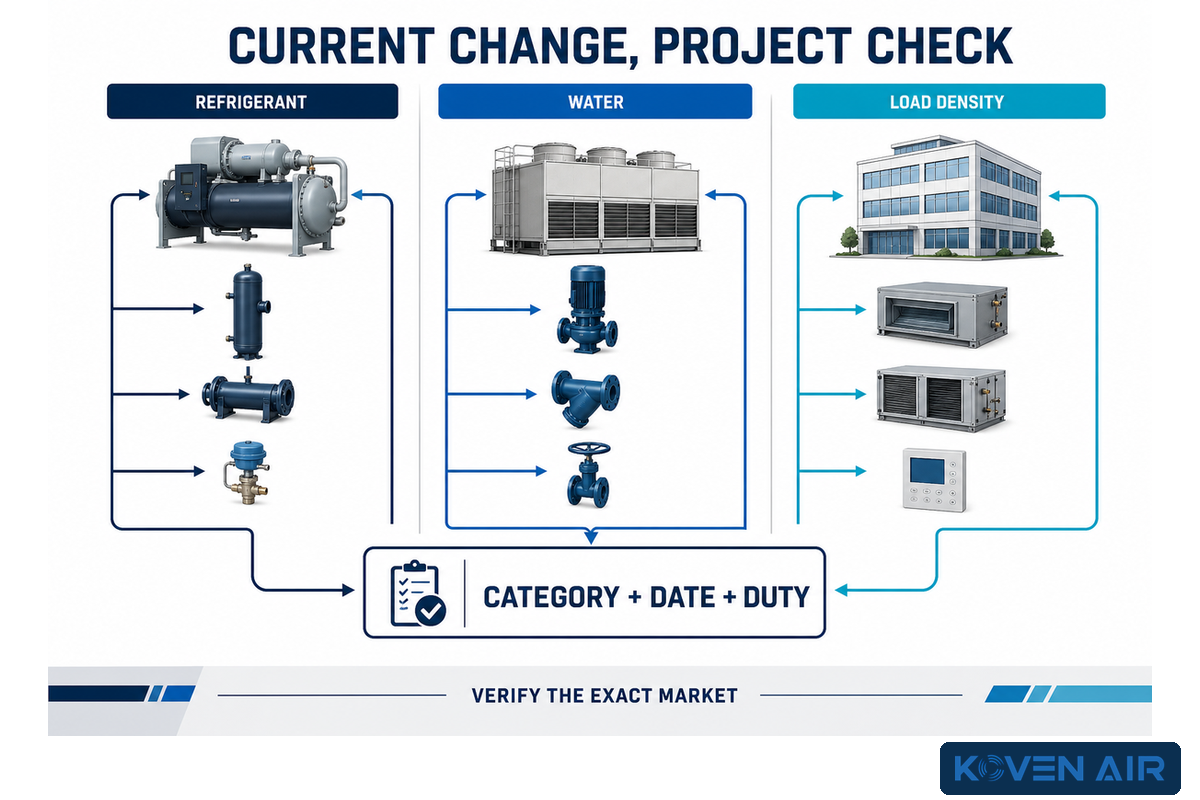
Current refrigerant rules, rating-edition changes, tighter water governance, and higher-density cooling loads all demand more precise project records. None of them makes one chiller, refrigerant, heat-rejection strategy, or design correct for every site. Verification must therefore identify the exact market, equipment class, and effective date.
For U.S. projects, EPA specifies applicable limits under the Technology Transitions Rule that identify prohibited sectors, subsectors, and/or specific products. First determine your product or system category. Then differentiate between applicable manufacture/import restrictions and sale/use or installation/project timing constraints. A generalized “2026 refrigerant deadline” is often an inappropriate generalization, even if an underlying regulation actually exists.
This logic also applies to an ultra-low GWP refrigerant claim. Refrigerant properties, leakage, equipment efficiency, operating conditions, and service practices all affect the project outcome. Compare direct and indirect emissions, then check safety classification, code implications, service availability, and the exact regulatory clause before assigning value to the label.
Recent discussions on data center cooling have also made the energy-water tradeoff more transparent: dry heat rejection may consume more electrical energy under certain conditions, while evaporative cooling uses more water. Project teams need to account for both, as no solution perfectly suits all conditions. Record water availability, discharge levels, local climate, power supply, site density, and future site development plans in a single decision document.
Check the rating edition stated in every offer. One standard page can point to several editions or unit systems. Record the required edition, units, and market in the project file instead of assuming that the newest linked document governs every procurement.
11. How Does Koven Air Support Project Verification?
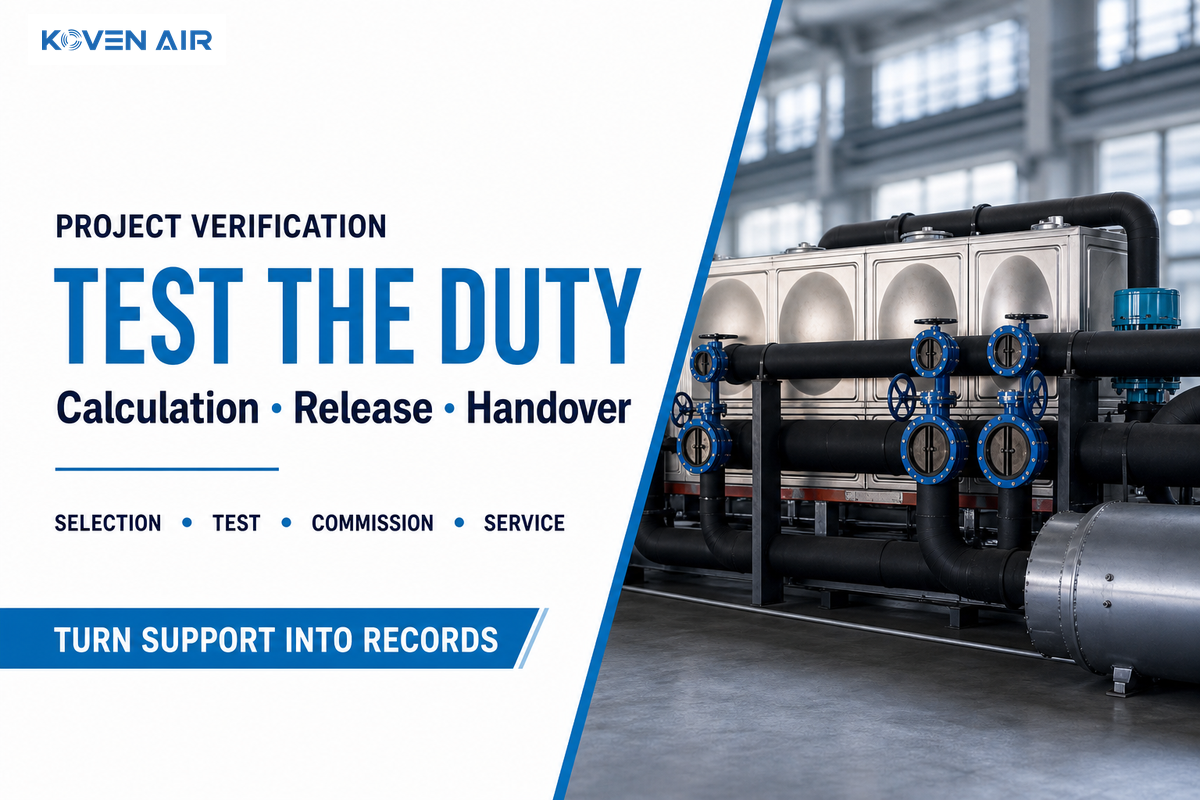
Koven Air states that its project support includes pre-sales calculation and parameter verification, production and testing before shipment, installation and commissioning guidance, warranty-period response, continuing technical guidance, and professional training. Buyers should convert each support promise into named deliverables and acceptance records.
Koven Air Environment Technology Co., Ltd. describes itself as an HVACR solutions manufacturer founded in 2007 and serving customers in 35 countries. It reports a 20,000-square-meter factory, 18 standardized production processes, 400 manufacturing-process traceability points, 36 factory inspections, a 24-hour aging test, and a chiller and heat pump testing laboratory. These are supplier-stated process facts, not independent performance results.
One useful procurement question is how those processes attach to the supplied unit. Ask for the calculation record, drawing revision, inspection and test evidence, release status, commissioning responsibility, training scope, warranty path, and technical contact named in the order. Koven Air’s company background provides first-party context; the project file should contain the unit-specific evidence.
If the duty is already defined, continue to Koven Air’s water-cooled chiller solution for a defined duty. That page owns product capabilities, customization, and quotation. This guide owns system boundaries, comparison method, water risk, maintenance, and buying evidence, so the two URLs serve different search intent.
Ready to turn the guide into a project review?
Bring the load profile, water temperatures, fluid, flow, site utilities, tower basis, controls protocol, redundancy, acceptance criteria, and service location. Koven Air can then check parameters and discuss a customized solution against the actual duty.
Frequently Asked Questions
How does a water-cooled chiller work?
It transfers load heat into a separate condenser-water loop
A water-cooled chiller cools water or process fluid in the evaporator. Refrigerant absorbs that heat, the compressor raises refrigerant pressure, and the condenser transfers heat into condenser water. Pumps move the warmer condenser water to a cooling tower or another heat sink before it returns to the machine. Water and refrigerant remain in separate circuits.
Which is better, an air-cooled or water-cooled chiller?
Neither is universally better
Water-cooled plants can fit sustained loads and central systems, but they add pumps, heat rejection, treatment, water, and maintenance. Air-cooled equipment avoids the tower loop but is affected by outdoor dry-bulb temperature and condenser airflow. Use one duty and common assumptions for climate, annual hours, power boundary, water cost, and service capability.
What is the life expectancy of a water-cooled chiller?
There is no reliable universal lifespan
Actual service life depends on compressor design, loading, annual hours, water treatment, tube condition, refrigerant and oil management, electrical quality, controls, maintenance, environment, and repair economics. Two machines of the same age can have very different condition histories. Review operating trends, tube inspections, oil and refrigerant records, vibration, alarms, electrical tests, overhaul history, parts availability, and the cost of restoring reliable operation. Request condition and service evidence rather than treating a generic number of years as a guarantee.
Does every water-cooled chiller need a cooling tower?
No, but every condenser needs an adequate heat sink
No. A tower is common, but engineered heat sinks can include closed-circuit coolers, source water, geothermal, dry, or hybrid systems. Each changes temperatures, pumping, water, permits, and maintenance; compare the relevant water-source heat pump architecture separately.
What water quality is required for a water-cooled chiller?
Use the manufacturer’s limits and a site-specific treatment plan
No single specification fits every machine. Required limits depend on heat-exchanger materials, source water, operating temperature, cycles of concentration, treatment, and fouling allowance. Compare an actual site analysis with the manufacturer’s written limits, then have a qualified specialist define monitoring, treatment, blowdown control, records, and response to an out-of-range result. Keep the site analysis, approved chemical or nonchemical program, conductivity records, make-up and blowdown readings, cleaning history, and corrective actions together. That record helps distinguish a water-side change from a refrigerant, sensor, flow, or load problem when performance shifts.
Editorial transparency: This guide combines government and standards-body pages, engineering resources, practitioner problem discovery, project search data, and supplier-stated Koven Air information. It excludes ambiguous company-history wording, unclear factory counts, model-specific claims, universal savings percentages, and unverified certification claims. Recheck regulations, ratings, water requirements, and supplier documents for the project date and jurisdiction.
References & Sources
- Consider Water-Side Economizers, ENERGY STAR
- Chillers: General Description and Uses, National Laboratory of the Rockies HVAC Resource Map
- AHRI 550/590 and 551/591 Standard Scope, Air-Conditioning, Heating, and Refrigeration Institute
- Purchasing Energy-Efficient Electric Chillers, U.S. Department of Energy
- Best Management Practice #10: Cooling Tower Management, U.S. Department of Energy
- Controlling Legionella in Cooling Towers, U.S. Centers for Disease Control and Prevention
- Fundamentals of Design and Control of Central Chilled-Water Plants, ASHRAE
- Technology Transitions, U.S. Environmental Protection Agency
- Data Center Water Use, MOST Policy Initiative





![Commercial Rooftop Unit Guide: Types, Sizing & Costs [2026]](https://kovenair.com/wp-content/uploads/2026/07/commercial-rooftop-unit-guide-featured-2-150x150.png)