
Get in Touch with Koven Air Company

Magnetic Bearing Chiller — Oil-Free Centrifugal Cooling
In a magnetic bearing chiller, an electromagnet levitates the compressor shaft, replacing the need for oil-lubricated bearings. There is no oil in the evaporator or condenser, thus the heat-transfer surfaces remain clean throughout the unit’s life. Each of the KALXCWG models below surpasses the U.S. Department of Energy’s FEMP efficiency criteria for part-load-optimized water-cooled centrifugal chillers – on both the full load and the IPLV metric.
Request a Quote →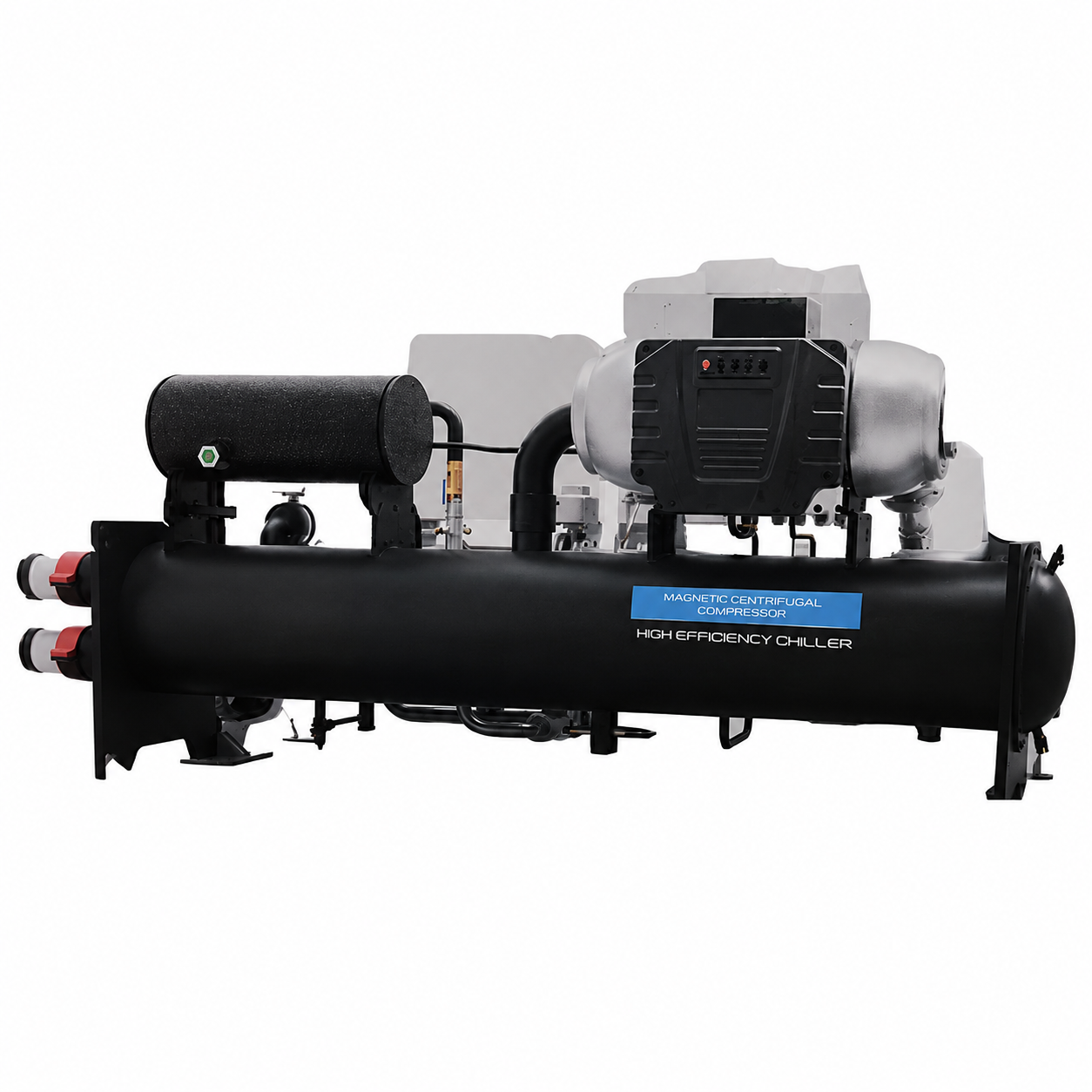
170–1,250 TR
Cooling capacity (595–4,395 kW)
6.42–6.86
Cooling COP, W/W
10.08–11.88
AHRI-IPLV, W/W (0.296–0.349 kW/ton)
10–100%
Stepless VFD capacity modulation
R-1234ze(E)
GWP 1 · low-GWP option
The Hidden Cost of Oil in a Centrifugal Chiller — and How Magnetic Bearings Remove It
Any oil-lubricated centrifugal chiller begins to lose efficiency the moment it is commissioned. Oil migrates from the compressor and forms a film on the heat-transfer surfaces of the evaporator and condenser, where it acts as a thermal insulator. Setpoint is still met, so nobody notices. But the energy meter does.
Root Cause
“ As stated by the U.S. Department of Energy, “The use of magnetic bearings allows for the compressor to be operated without the use of oil for lubrication, which reduces energy losses due to friction and increases the heat transfer efficiency of the chiller because no oil enters the evaporator or condenser.”
Eliminating the oil removes two sources of loss at once: Driveline friction losses vanish since no moving parts make contact, and heat-exchanger fouling losses never arise because there’s no lubricant in the refrigerant cycle to deposit on tubes.
What “oil-free” actually eliminates
The oil management system disappears: pump, heater, reservoir, filters, and oil separator, along with all the scheduled maintenance each requires.
Progressive loss of heat transfer never takes hold, as there’s no oil within the refrigerant cycle to foul heat-exchanger tubes. Oil-lubricated units are more likely to suffer this gradual performance decline over time.
Wear in the bearing itself has been designed out; the rotor is held in suspension in an electromagnet, thus no metal parts touch.
Harsh starting current is replaced by a gentle acceleration; the permanent magnet motor is spun up by the onboard variable frequency drive rather than directly powering it through the building’s electrical service.

These aren’t manufacturer’s boasts. A US Navy technology validation program reported 40 to 65 percent power savings against the equipment replaced; and in 2012, a US General Services Administration federal building project in Arkansas registered a 42.3 percent energy saving compared with the positive displacement water-cooled chillers it replaced.
Reported by Cx Associates, an independent commissioning-engineering firm summarising the Navy and GSA evaluations. These figures apply to the magnetic bearing chiller category and not to any individual Koven Air unit.
Names vary by region and by brand. A maglev chiller, a maglev centrifugal chiller, a mag bearing chiller, an oil-free magnetic bearing chiller, a magnetic bearing compressor chiller and a magnetic bearing centrifugal chiller all describe one architecture. Search the magnetic bearing chiller working principle and a single design sits behind every label: a centrifugal compressor supported and driven on magnetic bearings through a VFD.
Our only differentiator from market majors (Danfoss, LG, York, Daikin) is not the physics of rotor levitation. It is our publishing all of our individual models’ ratings, not relying on an aggregate, and indicating where magnetic bearing chillers aren’t a good fit.
What happens when the power fails?
What if power fails on my magnetic bearing chillers? That’s the first question everyone facility engineer asks, and it should get a direct answer, not a brochure headline. Magnetic bearing drivelines have backup bearings designed to catch the rotor in the event of a loss of levitation – an approach described in granted patents, like US 10,634,154 B2, “Centrifugal compressor and magnetic bearing backup system for centrifugal compressor.” Also, Commissioning Engineers report that due to the inherent regeneration on the drive, the unit will coast through a brief loss of power.
KALXCWG units add a protection stack above that, including high and low pressure protection, compressor overload, over/under voltage protection, reverse phase/phase sequence protection, an antifreeze switch and evaporator and condenser water-flow protection.
Working through the magnetic bearing chiller working principle for a specification? Ask our chiller engineer on WhatsApp →
KALXCWG Magnetic Bearing Chiller Range — 170 to 1,250 TR
When selecting a chiller, ultimately it comes down to one number: kW/ton at your specific condenser water temperature. Typically, getting this number from any manufacturer involves wading through a capacity range, a contact form, and waiting a week or two to receive a selection from a sales representative. Bid comparisons then weigh brochures instead of machines.
Industry Reference Asset
The 25-Model KALXCWG Spec Grid
Capacity, input power, COP, AHRI-IPLV (the kW/ton figures engineers actually spec against), motor configuration, water flow rates, connection diameters, dimensions, operating weight and sound level – for all 25 models. Of course, the lower the kW/ton, the better.
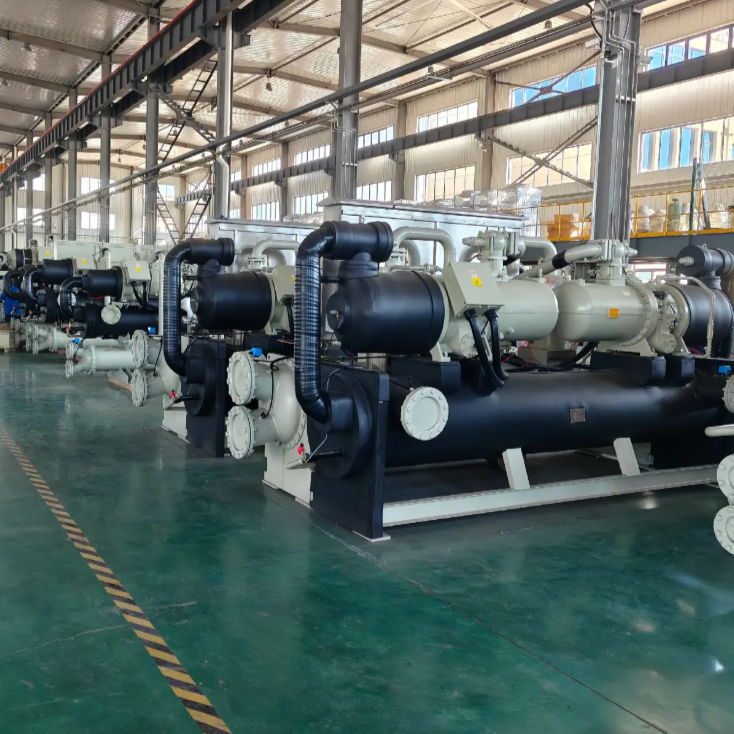
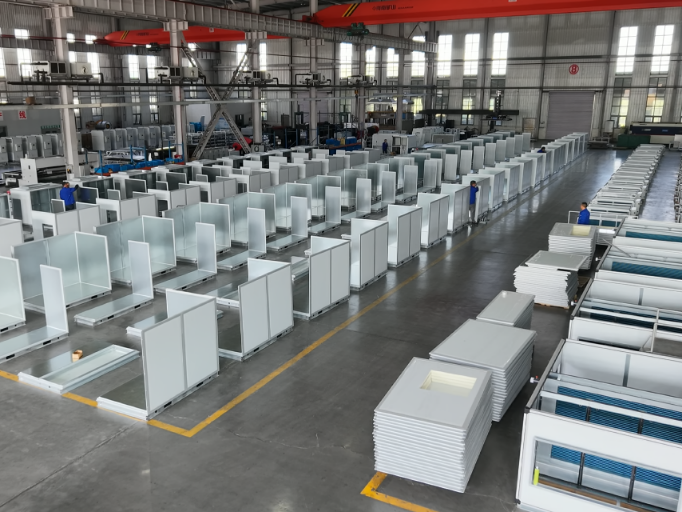
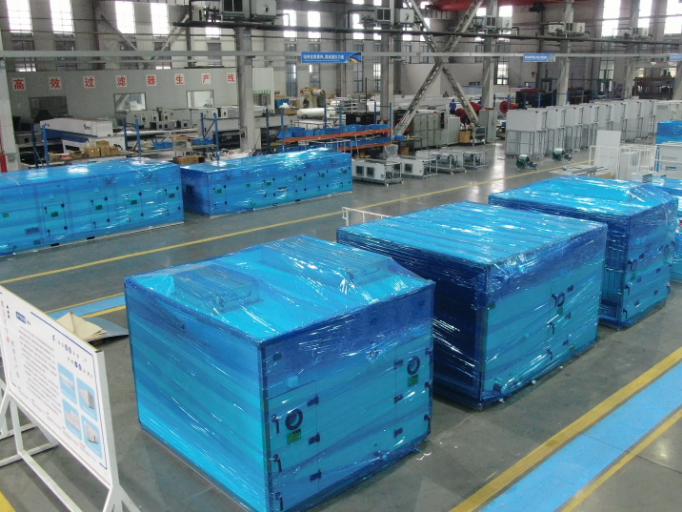
Each rating below has been measured (against the AHRI 550/590 test procedure) in our own in-house chiller and heat pump test lab under AHRI 550/590 conditions. That lab sits inside a 20,000 m² plant running 18 standardised process stages and 400 manufacturing traceability points, and every unit completes a 24-hour aging test before it ships. No competitor in this SERP publishes a per-model grid of this depth; that is the differentiation, and it is checkable.
| Model | Capacity (TR) | Capacity (kW) | Input (kW) | COP (W/W) | Full-load (kW/ton) | AHRI-IPLV (W/W) | IPLV (kW/ton) | Sound dB(A) |
|---|---|---|---|---|---|---|---|---|
| KALXCWG 170EV | 170 | 595 | 92.7 | 6.42 | 0.548 | 10.08 | 0.349 | ≤72 |
| KALXCWG 200EV | 200 | 705 | 106.8 | 6.61 | 0.532 | 10.43 | 0.337 | ≤72 |
| KALXCWG 230EV | 230 | 810 | 121.2 | 6.69 | 0.526 | 10.97 | 0.321 | ≤72 |
| KALXCWG 250EV | 250 | 880 | 133.0 | 6.62 | 0.531 | 11.21 | 0.314 | ≤72 |
| KALXCWG 270EV | 270 | 950 | 141.9 | 6.70 | 0.525 | 11.65 | 0.302 | ≤72 |
| KALXCWG 300EV | 300 | 1,055 | 159.5 | 6.62 | 0.531 | 10.57 | 0.333 | ≤74 |
| KALXCWG 350EV | 350 | 1,230 | 187.8 | 6.55 | 0.537 | 11.10 | 0.317 | ≤74 |
| KALXCWG 380EV | 380 | 1,340 | 201.4 | 6.66 | 0.528 | 11.15 | 0.315 | ≤74 |
| KALXCWG 400EV | 400 | 1,405 | 213.9 | 6.57 | 0.535 | 11.28 | 0.312 | ≤74 |
| KALXCWG 420EV | 420 | 1,480 | 225.4 | 6.57 | 0.535 | 11.33 | 0.310 | ≤74 |
| KALXCWG 450EV | 450 | 1,580 | 243.4 | 6.50 | 0.541 | 11.65 | 0.302 | ≤74 |
| KALXCWG 500EVD | 500 | 1,760 | 260.3 | 6.77 | 0.520 | 11.86 | 0.297 | ≤78 |
| KALXCWG 550EVD | 550 | 1,935 | 292.8 | 6.61 | 0.532 | 12.13 | 0.290 | ≤78 |
| KALXCWG 600EVD | 600 | 2,110 | 307.8 | 6.86 | 0.513 | 11.04 | 0.319 | ≤78 |
| KALXCWG 650EVD | 650 | 2,285 | 335.4 | 6.82 | 0.516 | 11.31 | 0.311 | ≤78 |
| KALXCWG 700EVD | 700 | 2,460 | 365.7 | 6.73 | 0.523 | 11.53 | 0.305 | ≤78 |
| KALXCWG 750EVD | 750 | 2,640 | 386.0 | 6.84 | 0.514 | 11.62 | 0.303 | ≤78 |
| KALXCWG 800EVD | 800 | 2,815 | 416.4 | 6.77 | 0.520 | 11.77 | 0.299 | ≤80 |
| KALXCWG 850EVD | 850 | 2,990 | 456.1 | 6.56 | 0.536 | 11.76 | 0.299 | ≤80 |
| KALXCWG 900EVD | 900 | 3,165 | 484.8 | 6.53 | 0.539 | 11.88 | 0.296 | ≤80 |
| KALXCWG 950EVT | 950 | 3,340 | 488.5 | 6.84 | 0.514 | 11.49 | 0.306 | ≤82 |
| KALXCWG 1000EVT | 1,000 | 3,515 | 516.5 | 6.81 | 0.517 | 11.55 | 0.305 | ≤82 |
| KALXCWG 1100EVT | 1,100 | 3,870 | 566.7 | 6.83 | 0.515 | 11.63 | 0.302 | ≤82 |
| KALXCWG 1200EVT | 1,200 | 4,220 | 624.9 | 6.76 | 0.520 | 11.69 | 0.301 | ≤82 |
| KALXCWG 1250EVT | 1,250 | 4,395 | 668.8 | 6.58 | 0.535 | 11.57 | 0.304 | ≤82 |
| Model band | Motor | Evaporator flow (m³/h) | Condenser flow (m³/h) | Water connections | L×W×H (mm) | Operating weight (kg) |
|---|---|---|---|---|---|---|
| 170EV–270EV | 150 kW | 102.8–163.3 | 128.5–204.1 | DN150 | 3,500×1,400×1,800 | 3,660–3,940 |
| 300EV–380EV | 280 kW | 181.4–229.8 | 226.8–287.3 | DN150–DN200 | 4,150×1,650×1,850 | 5,520–5,765 |
| 400EV–450EV | 280 kW | 241.9–272.1 | 302.4–340.2 | DN200 | 4,150×1,850×1,950 | 6,735–6,875 |
| 500EVD–550EVD | 2 × 150 kW | 302.4–332.6 | 378.0–415.8 | DN250 | 4,650×2,000×2,400 | 9,930–10,130 |
| 600EVD–900EVD | 2 × 280 kW | 362.9–544.3 | 453.6–680.3 | DN300 | 5,050×2,000×2,200 | 11,825–13,975 |
| 950EVT–1250EVT | 3 × 280 kW | 574.5–755.9 | 718.1–944.9 | DN300 | 5,050×2,600×2,450 | 16,340–17,585 |
Engineering Note — Condenser Water Matters More Than the Brochure Says
Field engineers comment that some magnetic-bearing machines can be very sensitive to condenser water temperature, with the chiller unable to manage the water temperature entering the unit. The same threads flag faulty dP sensors, guide vane issues, hard-to-read display panels, and dissimilar metal corrosion issues in tropical conditions on specific compressor platforms.
Tell us your cooling tower approach, condenser water temperature and worst case ambient. We’ll check the selection against the figures in the table above for flow rate and pressure drop, instead of assuming standard conditions.
Magnetic Bearing vs Oil-Lubricated Centrifugal vs Screw — The Data
Search magnetic bearing chiller vs centrifugal and most of what returns is written by whoever sells the winner. The real answer is not that “magnetic bearing is better in all applications”-it is “magnetic bearing is better for the conditions in which your facility operates”. DOE puts the trade-off plainly: a chiller “can be efficient in both full- and part-load conditions, or it might have a high full- or part-load efficiency at the expense of the other.” (DOE / FEMP)
So the magnetic bearing chiller vs screw question also has no all encompassing answer. It has an answer for your load profile, your run hours and your electricity tariff – that is why the below two columns are published together rather than the favourable one by itself.
| Criterion | KALXCWG Magnetic Bearing | Oil-Lubricated Centrifugal | Water-Cooled Screw |
|---|---|---|---|
| Full-load efficiency (kW/ton) | 0.513–0.548 | 0.577–0.634 (ASHRAE 90.1 class) | 0.603–0.633 (COP 5.56–5.83) |
| Part-load IPLV (kW/ton) | 0.290–0.349 | 0.54–0.78 | 0.451–0.517 |
| Capacity modulation | Stepless 10–100% VFD | Inlet guide vanes, limited turndown | Slide valve, stepped |
| Lubrication system | None — no oil circuit | Pump, heater, separator, filters | Pump, separator, filters |
| Heat-exchanger fouling by oil | Not possible | Progressive over service life | Progressive over service life |
| Bearing wear | Non-contact, no wear | Journal / rolling contact | Rolling contact |
| Sound level | ≤72–82 dB(A) | Medium | Medium |
| Starting current | Soft start, low inrush | High inrush | Moderate |
| Best-fit duty | Variable load, long run hours | Stable base load | Mid-capacity, budget-led |
Proven in the Field — High-Performance Cooling
A spec sheet shows you what the machine can do. A commissioned plant shows you what it did. Both configurations feature KALXCWG units in N+1 as the primary source of chilled water.
On Reliability Rumours
Practitioners note that rumors from competitors about issues regarding reliability of these units circulate freely in this category, and that a magnetic-bearing line has had its failures and successes, with manufacturers stepping up to honor warranties and continue product improvement. We would rather hand you two commissioned plants, a published grid and a source list than ask you to weigh one brand’s rumour against another’s.
2 × KALXCWG 1100EVT
Over 1,200 IT racks, 7×24 operation, cloud and government colocation workloads. The facility is configured with two 1,100 TR magnetic bearing chillers running in parallel: One machine takes the base load and both operate together at an algorithmically determined peak, and either can handle the load during maintenance.
6.83
Rated COP, W/W
11.63
AHRI-IPLV, W/W
>35%
Plant energy reduction vs conventional water-cooled scheme
>70%
Annual O&M cost reduction
0
Cooling interruptions since commissioning
2 × KALXCWG 1200EVT
68,000 m² across 16 floors, 320 rooms, a 1,200 m² column-free ballroom and a 24-hour wellness floor. The design brief was occupancy swinging from 30% to 100%, a machine room of only 180 m² one level below the lobby, and a noise ceiling that protected the rooms above.
- Machine-room sound measured 61 dB(A) at commissioning, with spring isolators under each unit and flexible stainless connections to the mains.
- Condenser heat recovery to 55 °C supplies the bulk of the hotel’s domestic hot water through the cooling season, using heat that would otherwise go up the tower.
- Either machine covers peak load under the N+1 scheme; the standby picked up full load in seconds during simulated failure testing.
- No lubricant, filter or separator consumables enter the maintenance budget across the service life, because there is no oil to change.
The Oil-Free Payback Decoder — 23-Year Life-Cycle Cost
There’s one reason why finance always reject chiller upgrades: the vendor’s savings case always come as a “percentage off a baseline” without an explanation of the methodology. How much is “40% more efficient”? It is a number you can neither measure, prove nor justify to your capital committee. Therefore, here’s the method rather than the marketing hype.
This leaves two instances in which the math makes sense for magnetic bearing chillers: when you’re buying a brand-new chiller, or replacing a machine that is past the end of its life. Go ahead and do the math yourself; it just make sense to use the federal government’s established procedure instead of ours.
The DOE / FEMP method, applied
FEMP assesses chiller life cycle costs based on 23 year service life, 2000 hours per year, and $0.099/kWh – the average US Federal Facility electricity price in July 2024. Annual energy is capacity kW/ton * operating hours.
Start With the Inconvenient Finding
Magnetic-bearing chillers are not the appropriate purchase in all circumstances. A study of GSA’s federal evaluation notes that while Cx Associates reports that GSA deemed the technology cost-effective for new construction or end-of-life replacements, it did not recommend its retrofitting existing plants as the capital cost was not justified by the energy savings. If your chiller still has another decade of useful life, your most honest answer is: don’t.
| Worked example — 600 TR plant | KALXCWG 600EVD | Baseline oil-lubricated centrifugal (ASHRAE 90.1 class, best case) |
|---|---|---|
| Full-load duty (use kW/ton) | 0.513 kW/ton | 0.577 kW/ton |
| Variable-load duty (use IPLV) | 0.319 kW/ton | 0.540 kW/ton |
| Annual energy — KALXCWG | 615,600 kWh | 382,800 kWh |
| Annual energy — baseline | 692,400 kWh | 648,000 kWh |
| Annual energy saved | 76,800 kWh | 265,200 kWh |
| Annual cost saved @ 9.9 ¢/kWh | $7,603 | $26,255 |
| Undiscounted 23-year energy saving | $174,869 | $603,865 |
Certifications, Refrigerant and Regulatory Eligibility
KALXCWG units are performance-rated at AHRI 550/590 test conditions. That is not the same thing as being AHRI-certified and listed in the AHRI Directory, and we will not blur the two. AHRI certification is available on request for projects that require a directory-searchable listing. If a specification demands certified ratings, tell us at enquiry stage and we will scope it.
Buyers discover this the expensive way: a chiller is selected on kW/ton, budgeted, and then fails compliance review because of the refrigerant inside it. Refrigerant is no longer a sustainability footnote — in the United States it is a procurement screen that disqualifies a machine before efficiency is ever discussed. Under EPA’s Technology Transitions programme, GWP limits now bite by application and by date.
CE
European conformity
ISO 9001
Quality management system
AHRI 550/590
Performance rated at these test conditions
R-1234ze(E)
GWP 1 · ODP 0
No competitor product page in this search result publishes the eligibility table below. They publish a refrigerant name. That difference matters when your specification has to survive a compliance audit.
| Application | GWP restriction | Effective | R-134a (GWP 1,430) | R-1234ze(E) (GWP 1) |
|---|---|---|---|---|
| Chillers — comfort cooling | ≥700 restricted | 1 Jan 2025 | Not eligible | Eligible |
| Chillers — industrial process refrigeration, leaving fluid > −30 °C | ≥700 restricted | 1 Jan 2026 | Not eligible | Eligible |
| Chillers — IPR, −50 °C ≤ leaving fluid ≤ −30 °C | ≥700 restricted | 1 Jan 2028 | Eligible until 2028 | Eligible |
DOE’s own guidance is blunter still: fully assembled self-contained chillers using high-GWP refrigerants “cannot be manufactured after January 1, 2025,” and systems relying on them “may not be installed after December 31, 2025.”
Specify R-1234ze(E) for U.S. projects. It carries a regulatory GWP of 1 under EPA’s GWP reference table (40 CFR 84.64) and clears every chiller threshold above. Industry literature commonly cites its GWP as under 7 on IPCC values; either figure sits far below the 700 limit, so eligibility is unaffected — but quote the regulatory number in a compliance submission.
R-134a remains available for markets and applications where it is still permitted. We will not ship a refrigerant into a jurisdiction that has closed to it.
R-1234ze(E) is classified A2L (mildly flammable) under ASHRAE 34, and it is not a drop-in retrofit for an existing R-134a machine. It belongs in equipment designed around it — which is the case here, and another reason the retrofit path rarely pays.
Regulation is in motion — EPA opened a reconsideration of parts of this rule in October 2025. Confirm current status with your compliance team at the time of purchase; this page reflects the position as of 2026.
Unsure which refrigerant your jurisdiction allows?
Ask our chiller engineer on WhatsApp →Procurement — Selection Support, Lead Time and Service Reality
There is a documented weak point in this product category, and pretending otherwise would waste your time. Engineers on practitioner forums consistently report the same pattern: reliability of magnetic-bearing machines is high, but service depth and parts support thin out sharply outside the manufacturer’s core regions.
SERVICE COMMITMENT
What We Do and Do Not Claim
We do claim: lifetime free technical service guidance; immediate problem resolution during the warranty period; and regular professional training for the engineering contractors and engineers who install and maintain our equipment.
We do not claim a resident field-service engineer and a stocked parts depot in each of the 35 countries our equipment is sold into. Ask us specifically about coverage in your country before you commit, and hold any supplier who answers that question vaguely at arm’s length.
What drives the quotation
There is no oil free chiller price list here, and no centrifugal chiller price either, because a price without a duty specification is a number without meaning. Every serious list of water cooled centrifugal chiller manufacturers quotes to a schedule, not to a web page. These are the dimensions that move it:
-
Capacity and model — which point on the 25-model grid your load calculation lands on, and whether N+1 redundancy doubles the machine count.
-
Refrigerant — R-1234ze(E) versus R-134a, governed by your jurisdiction and application per the table above.
-
Certification scope — CE and ISO 9001 as standard, plus AHRI certification if your specification requires a directory listing.
-
Power supply and controls — 380/415/460/575 V, and the depth of BMS/BA integration required.
-
Heat recovery — condenser heat recovery adds hardware but can displace a separate domestic hot water plant, as it did on the hotel project above.
-
Commissioning scope — on-site installation and commissioning guidance by our technicians, with field modification where site conditions differ from the drawings.
KALXCWG units are supplied with industrial PLC control and integrate with BMS, HVAC and building automation platforms for remote monitoring and load optimisation. Treat that connection as an IT decision, not only a mechanical one — DOE advises that IoT-enabled chillers and building control systems introduce network exposure, and that “security can almost never be networked in after the fact” (DOE / FEMP, Networked Devices). We will work to your security team’s segmentation requirements.
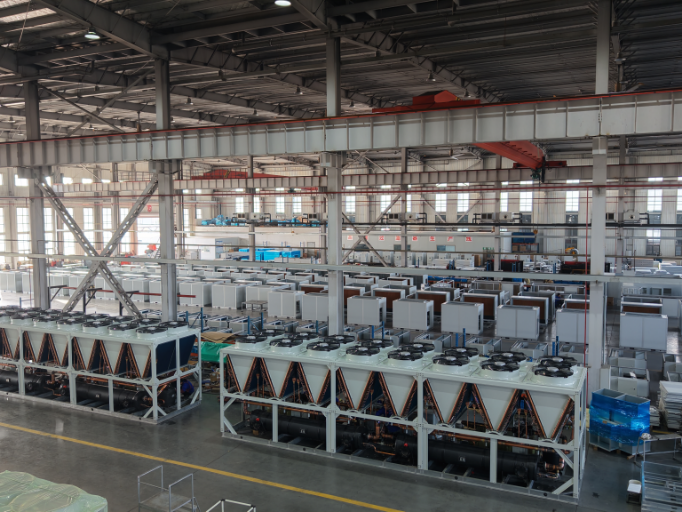
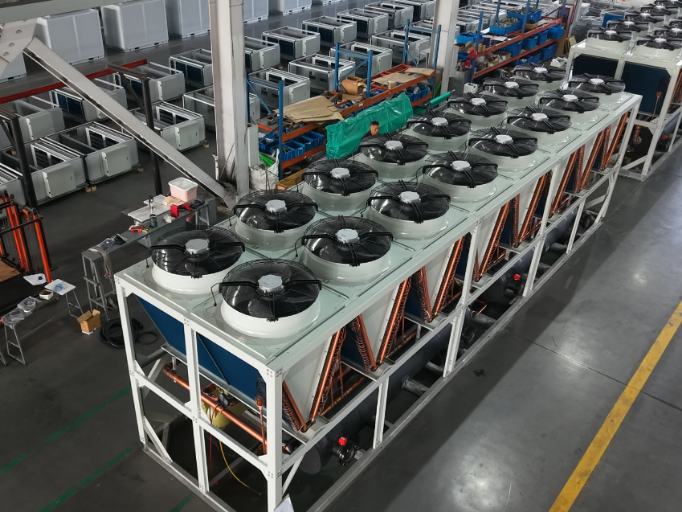
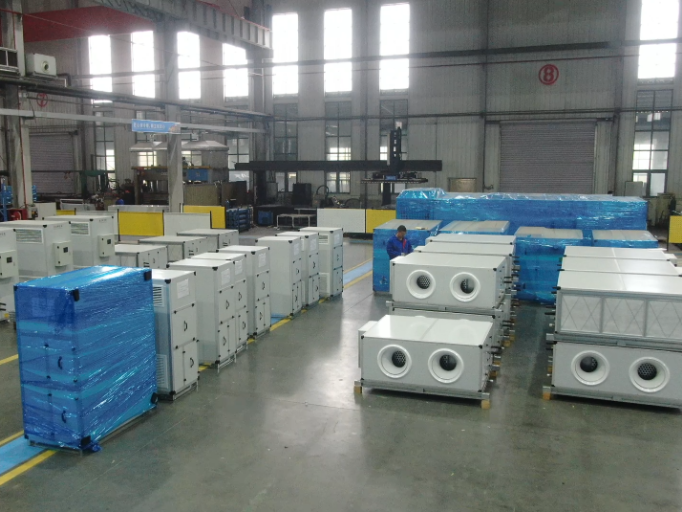
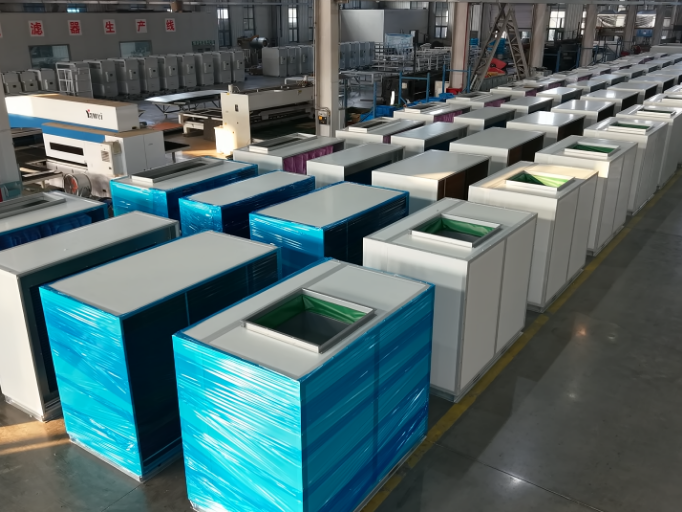
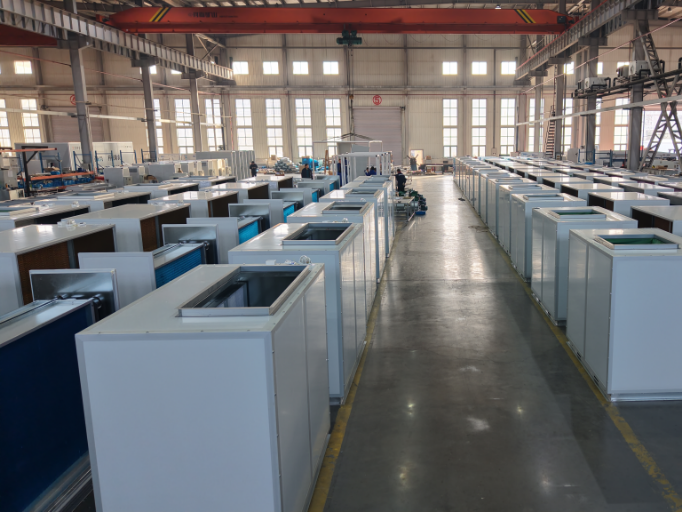
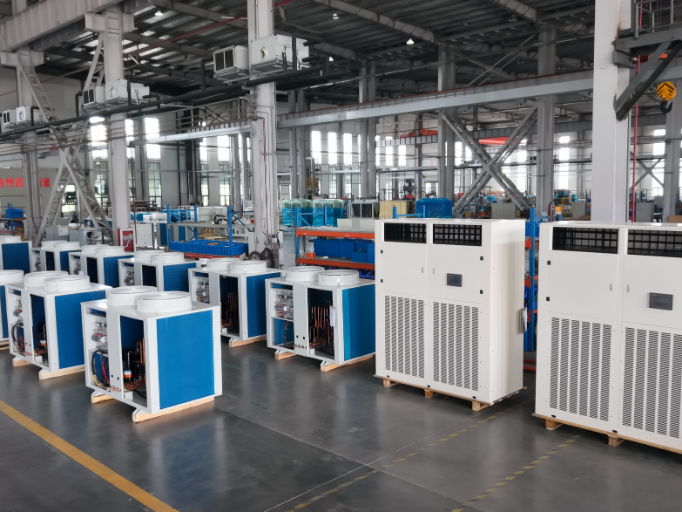
Koven Air has built chillers since its first screw machine in 2007. Production runs across a 20,000 m² plant with 18 standardised process stages, robotic modular assembly, 400 manufacturing traceability points, 36 factory inspections, a 24-hour aging test on every unit, and a dedicated chiller and heat pump testing laboratory. When you call about a serial number, someone can pull its build record.
Magnetic bearing is one platform in a wider chilled-water portfolio. Where a cooling tower is not practical, see our air-cooled chiller range. Where the plant must deliver heating and cooling from one machine, see the heat pump chiller, and for full-year plant strategy the industrial & commercial heat pump range. All are rated in the same in-house laboratory.
Magnetic Bearing Chiller Engineering Tools
Frequently Asked Questions
Do magnetic bearing chillers really eliminate oil maintenance?
Yes. The rotor is levitated in an electromagnetic field, so there is no lubricated contact anywhere in the driveline and no oil circuit to service. That removes the oil pump, heater, reservoir, separator and filters — and the maintenance intervals attached to each.
Magnetic bearing or screw chiller — which is more efficient at part load?
Magnetic bearing, decisively. KALXCWG units deliver an AHRI-IPLV of 0.290–0.349 kW/ton against roughly 0.451–0.517 kW/ton for water-cooled screw machines. That gap widens the more hours your plant spends below design load.
What COP and IPLV does the KALXCWG range deliver?
Cooling COP of 6.42–6.86 W/W and AHRI-IPLV of 10.08–11.88 W/W across 170–1,250 TR, rated at AHRI 550/590 conditions. In the kW/ton units most specifications use, that is 0.513–0.548 full load and 0.290–0.349 IPLV. Every model and rating is published in the grid above.
Are magnetic bearings reliable during a power outage?
Magnetic bearing drivelines incorporate backup bearing systems that support the rotor if levitation is lost — an approach documented in granted patents such as US 10,634,154 B2. Commissioning engineers also report that the drive’s regenerative capability lets these machines ride through brief interruptions. KALXCWG units add over/under-voltage, reverse-phase, phase-sequence and water-flow protection on top.
Is a magnetic bearing chiller worth it as a retrofit?
Often not. Reviewing GSA’s evaluation, commissioning engineers report the technology was judged cost-effective for new installations and end-of-life replacements, but was not recommended for retrofit because replacement cost outweighed the efficiency gain. If your existing machine has years of life left, the disciplined answer is to plan the replacement rather than force it.
How sensitive is the machine to entering condenser water temperature?
Every centrifugal chiller is sensitive to condenser water temperature, and practitioner reports on some magnetic-bearing machines flag this specifically. We size against your actual cooling-tower approach and condenser ΔT rather than design-day assumptions, using the evaporator and condenser flow and pressure-drop figures published in the grid. Send us the tower data with your enquiry.
What about corrosion in tropical installations?
Dissimilar-metal corrosion in hot, humid coastal environments is a real failure mode reported across this equipment category, and it is driven by materials and site conditions rather than by bearing type. Tell us the installation environment at enquiry stage so materials and coatings are specified for it. We will not claim our factory testing regime immunises a machine against an environment it was never specified for.
Can we get factory-direct supply and lifetime service?
Yes — you deal directly with the manufacturer that builds the machine, so the engineer answering your selection question is the one who signed off its test report. Lifetime free technical service guidance and contractor training are included. Confirm local field-service and spare-parts coverage for your specific country before you commit.


![Commercial Rooftop Unit Guide: Types, Sizing & Costs [2026]](https://kovenair.com/wp-content/uploads/2026/07/commercial-rooftop-unit-guide-featured-2-150x150.png)