Get in Touch with Koven Air Company

Updated July 2026.
A rotary desiccant dehumidifier is a type of dehumidifier that pulls moisture out of the air using a slowly rotating wheel instead of a refrigerant compressor, and it’s what facilities reach for once a target drops below roughly 40 percent RH or a process needs a dew point under 5°C. At that point, a conventional refrigerant-based unit runs up against physics it cannot overcome across any realistic temperature range, and the slow-moving, water-seeking wheel takes over. This guide covers how the technology actually works, where it earns its keep against other types of dehumidifiers, chillers, and general HVAC equipment for moisture control, what it realistically costs to operate, and where to go for deeper engineering selection data once you’re armed with that context.
Quick Specs
| Achievable dew point | +5°C down to below −60°C, media and system dependent |
| Common wheel materials | Silica gel, molecular sieve, silica/molecular-sieve composite |
| Regeneration air temperature | Roughly 60–200°C depending on target dew point |
| Typical wheel service life | 15–30 years with clean, filtered inlet air (varies by product and duty) |
| Best-fit range | Below ~40% RH or below ~15°C, where refrigerant units ice up or stall |
What Is a Rotary Desiccant Dehumidifier?
A rotary desiccant dehumidifier is a piece of equipment that removes moisture by passing humid air through a slow-turning wheel coated in a hygroscopic material, such as silica gel or molecular sieve, instead of cooling the air the way a refrigerant compressor does. Because it has no cold surface, it keeps drying air in conditions where a refrigerant unit would ice up and stall.
Desiccant wheels work because refrigerant dehumidifiers, as mentioned earlier, operate by cooling air below its dew point. Water condenses on coils; continue to try to lower humidity to 20% RH and those coils freeze, then the air doesn’t get any dryer, and your efforts come to naught. The rotating desiccant wheel, having no such cold surface, keeps working at humidity levels that stump a refrigerant dehumidifier.
That’s where the crossover is, really. When the space requirement is below approximately 40% RH or the process must achieve a dew point below 5°C (or thereabouts), a refrigerant coil isn’t viable and the only viable technology is the desiccant wheel — a technology the DOE’s Office of Scientific and Technical Information rates at TRL 8-9, meaning it’s fully mature and commercially proven, not an emerging or experimental approach. For all applications above that, from air conditioning to warm, humid regions, a refrigerant unit is the cheapest and simplest solution.
Imagine the failure mode: The plant is running a conventional refrigerated dehumidifier throughout a cold winter night to try to keep a storage room at 25% RH. The coil track back and forth below the freezing point, builds up frost, and the unit just shuts down without any further dehumidification when you need it most – precisely what a rotary desiccant wheel was designed to overcome because it doesn’t require a cold surface. This one potential failure is the reason why the plant that’s struggling with lithium-battery dry room conditions, pharmaceuticals storage, or winter warehouse RH “just buy a bigger refrigerant unit” isn’t considered a valid solution: under the crossover point, it’s the wrong type of machine, not just an under-specified one.
“Most of the calls we get aren’t from someone whose desiccant unit failed, they’re from someone whose refrigerant unit iced over for the third time that winter and finally asked why. Once you’re below that crossover point, no amount of extra refrigerant capacity fixes it; you need a different mechanism, not a bigger one.”
Application Engineering Team, Koven Air
How Rotary Desiccant Dehumidifiers Work
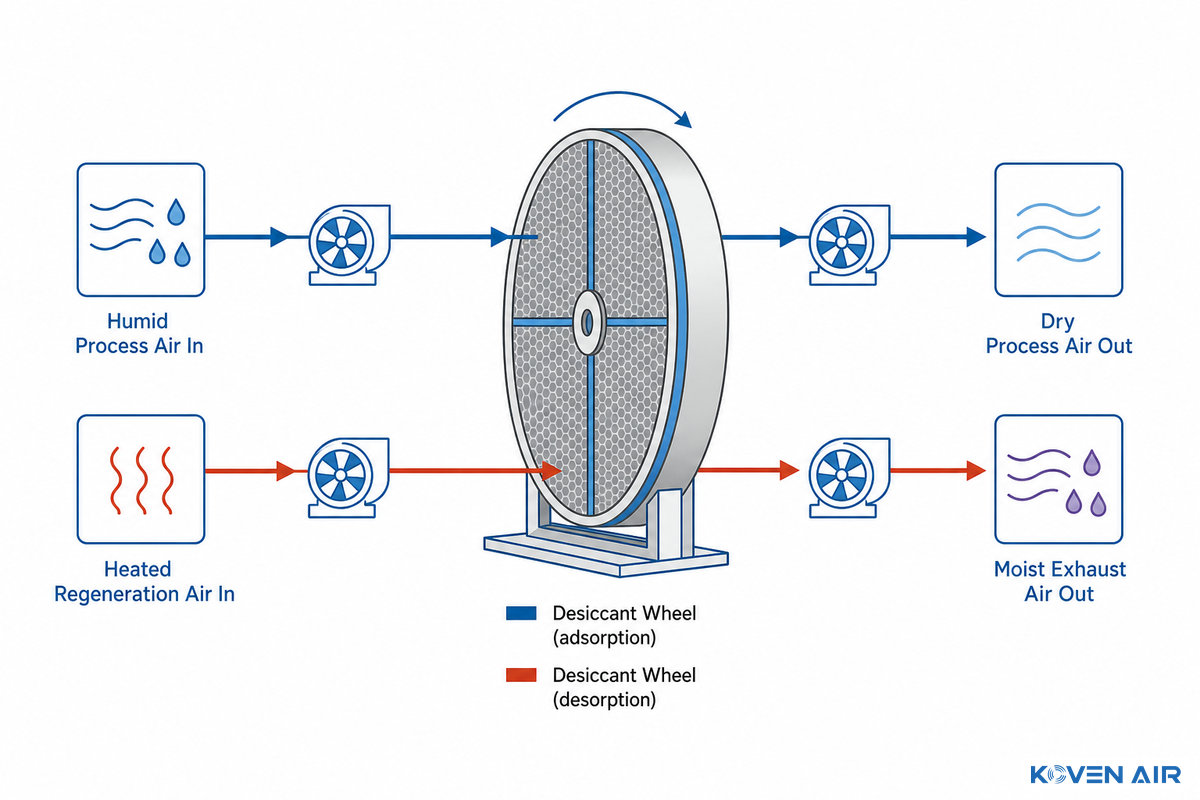
A rotary desiccant dehumidifier works by passing humid air through one half of a slowly rotating wheel coated in a moisture-absorbing material, then driving that captured moisture back out with heated air as the same wheel segment rotates into a second, smaller zone. The cycle repeats continuously, with no compressor and no defrost interruption.
How Does a Rotary Desiccant Dehumidifier Work?
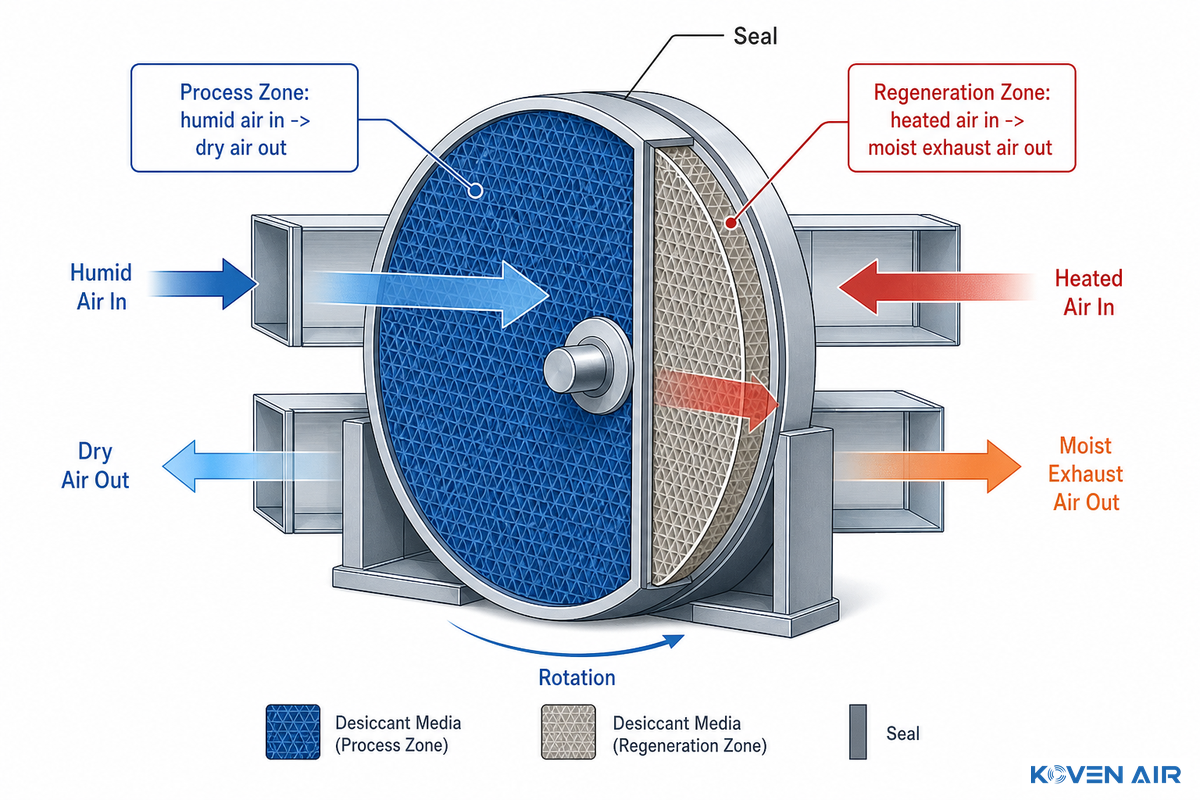
Seals divide the wheel into two zones. Moist air passes through the large “process” zone, where the desiccant material attracts moisture onto the wheel’s surface through physical and chemical adsorption, not simple filtration. As the wheel slowly rotates, the moisture-laden section enters the smaller “regeneration” zone, where heated air drives the captured moisture back out. The now-dry segment rotates back into the process airstream, ready to adsorb again, with no defrosting cycle.
The physics behind this is a vapor pressure difference on the surface of the desiccant: whenever the vapor pressure of the water held in the media is lower than the vapor pressure on the surface of the air passing by, the wheel keeps absorbing moisture from the air. That’s the process of adsorption in one sentence, and it’s exactly why the wheel is divided into two sections in the first place — a rotary dehumidifier can’t remove moisture from the air on one side and regenerate the desiccant on the other side simultaneously unless the wheel is physically split that way. In the reactivation zone, a heater raises the air temperature enough that the water vapor in the air trapped by the media gets driven back out; that exhausting moist air either vents to atmosphere or enters the condenser downstream, where it is cooled and collected as condensate. Dry, warm process air leaves through a separate air inlet and outlet than the reactivation stream — it’s actually a little warmer than the humid air that came in, because the wheel gives off the heat it captured, so an engineer sizing the system also has to plan for how that warm dry air is cooled again downstream, not just how much moisture removal the unit delivers.
Regeneration air temperature determines how dry the wheel–and thus your process air–can be. Light-duty units regenerate at about 60°C; deep-drying units can reach almost 200°C. A recent USPTO-published patent application, US20220381452A1, takes aim at controlling that temperature more granularly. The directly heated desiccant wheel design it describes uses embedded activators to switch heating elements within the wheel itself, as opposed to just controlling a central bank of external heaters. An often-unadvertised but key trade-off is the heat of adsorption: The process air that leaves is actually hotter than the air that entered–a detail that become significant when discussing the total cost below.
💡 4-Question Technology Fit Framework
Four basic questions will help you decide if a rotary desiccant wheel is even the right kind of equipment for the job before you start specifying anything:
- Will your process run below about 40% RH (or below 5°C dew point)?
- Will your space or process routinely run below 15°C, where refrigerated coils risk icing up?
- Is low-cost, readily available heat available on site–either from waste sources or through an off-peak electric rate–or will you’ve to pay full-price for electricity to achieve the desired drying level?
- Will the warmer supply air delivered by a desiccant system pose a problem, or can it be handled by post-cooling equipment?
Two or more “yes” answers to questions 1-2 suggest desiccant. Question 3 determines the operational cost. Question 4 will indicate whether you need to budget for a cooling coil to complement the desiccant system.
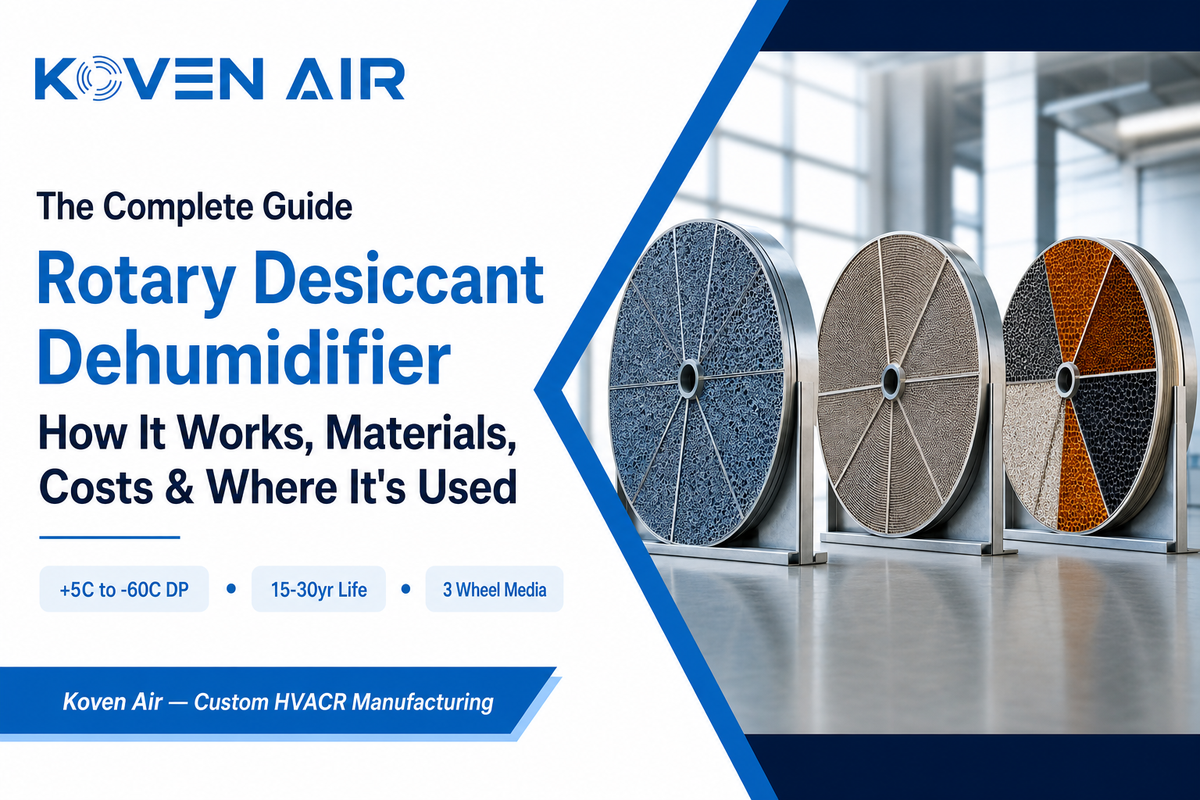
Desiccant Material Types at a Glance
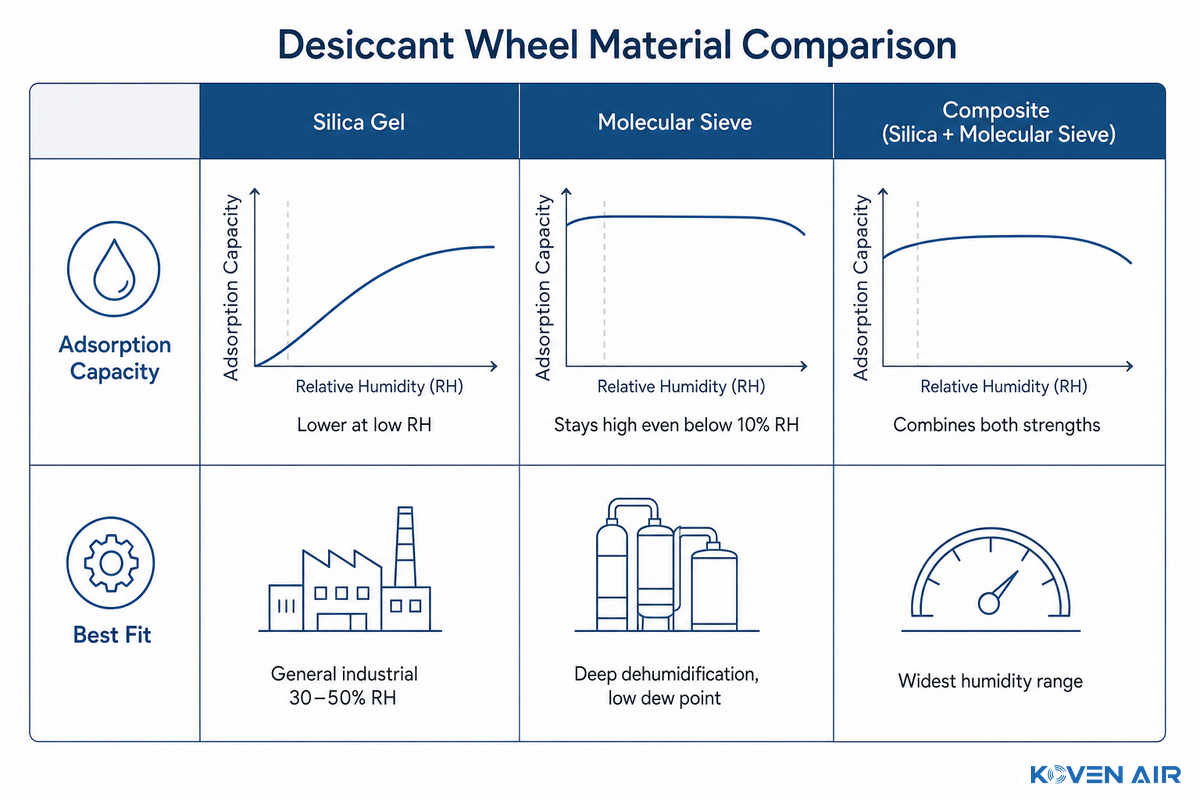
Don’t assume all wheels are created equal; the desiccant material make a huge difference, though many buyers fail to consider this carefully — a wheel is engineered equipment, not a commodity part, a distinction the DOE’s own technology-maturity assessment reinforces by treating material selection as a first-order design variable, not an afterthought. Silica gel is a common, all-around material; molecular sieve is more suitable for ultra-low humidity levels. Composite wheels use a combination to provide capacity across a wider range of humidity levels. Get this wrong, and your system won’t fail on day one. Instead, after a few months of operation, you may discover that a silica-gel wheel specified for a 45°C process target just can’t reach its target dew point and has to run continuously. Nothing is wrong with the wheel itself; it’s just not the right type of material for the application. Materials like silica gel and molecular sieve aren’t just cosmetic choices — each is a distinct heat transfer medium with its own energy efficiency and precise humidity control profile at a given regeneration temperature, which is exactly why a desiccant dehumidification system built around the wrong media wastes energy trying to increase the temperature of its regeneration air to compensate rather than switching to a media that’s actually used to dehumidify at that target in the first place.
| Material | Adsorption capacity* | Behavior at low RH | Best fit |
|---|---|---|---|
| Silica gel | ≈15% of weight | Capacity drops as humidity falls | General industrial, comfort-adjacent, 30–50% RH |
| Molecular sieve | ≈20% of weight | Stays high even below 10% RH | Deep dehumidification, low-dew-point processes |
| Silica + molecular-sieve composite | Blends both curves | High frontal capacity + deep-dry tail | Widest operating range, dry-room-class targets |
– Figures are representative values at 25°C/20% RH conditions only; actual adsorption levels vary depending on the specific material, ambient temperature and humidity levels according to its adsorption isotherm, therefore consider this a starting reference, not a specification.
That’s the type of question where a full engineering evaluation (rather than a glance at a table) makes all the difference. Koven Air’s rotary desiccant dehumidifier guide includes the complete classification of wheel materials and how they fit into the various classes of operation for units in the process. If you’re selecting the unit itself, rather than one part of a larger process that uses desiccant technology, review the Koven Air dew-point selection matrix for a comparison between our different types of desiccant dehumidification technology vs. liquid desiccant applications.
Rotary Desiccant vs. Refrigerant Dehumidifiers
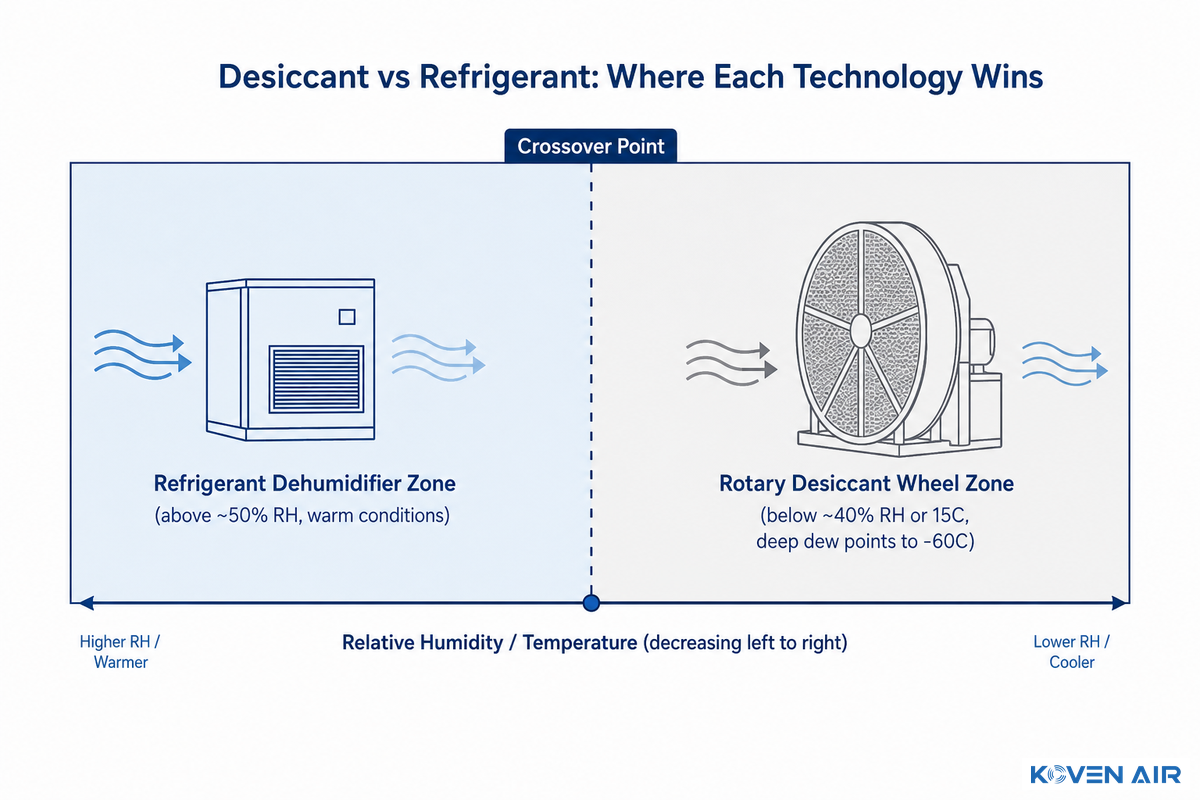
Is a Desiccant Dehumidifier Better Than a Refrigerant Dehumidifier?
Neither wins outright — refrigerant is the simpler, cheaper choice above roughly 50% RH in warm conditions, while a desiccant wheel takes over below that and especially below 15°C, where refrigerant coils start icing. Which one is “better” depends entirely on where your application falls on that scale.
The “honest” caveat that a DOE economics review of desiccant dehumidification and other industry sources frequently share is that while desiccant can be more efficient in higher-latent-load applications than refrigerant systems, its operational efficiency depend significantly on the source of heat used for regeneration. If that heat come from off-peak electricity, waste heat or natural gas rather than a simple electrical resistance heater running off a commercial-rate utility feed, it can provide the lower operating cost that defines the most effective solution. Another industrial application example illustrates the point succinctly, stating desiccant is “usually the better fit in colder spaces”-but not always the cheapest.
The Desiccant Coverage Spectrum (+5°C to Below −60°C Dew Point)
| Comfort / warm, humid air (>50% RH) | Refrigerant — simplest, cheapest to run |
| General industrial (30–50% RH) | Either, depending on temperature |
| Below ~15°C or <40% RH | Desiccant — refrigerant coils begin icing |
| Deep-dry, +5°C to below −60°C dew point | Desiccant only — the only technology that reaches this range |
✔ Advantages
- Works below freezing with no defrost cycle
- Reaches dew points refrigerant units can’t touch
- Few moving parts mean a long service life in the field if input air is well-filtered.
⚠ Limitations
- Regeneration heat drives running cost, see below
- Supply air comes out warmer, often needing post-cooling
- Not automatically the cheaper option above the crossover zone
Where Rotary Desiccant Dehumidifiers Are Used
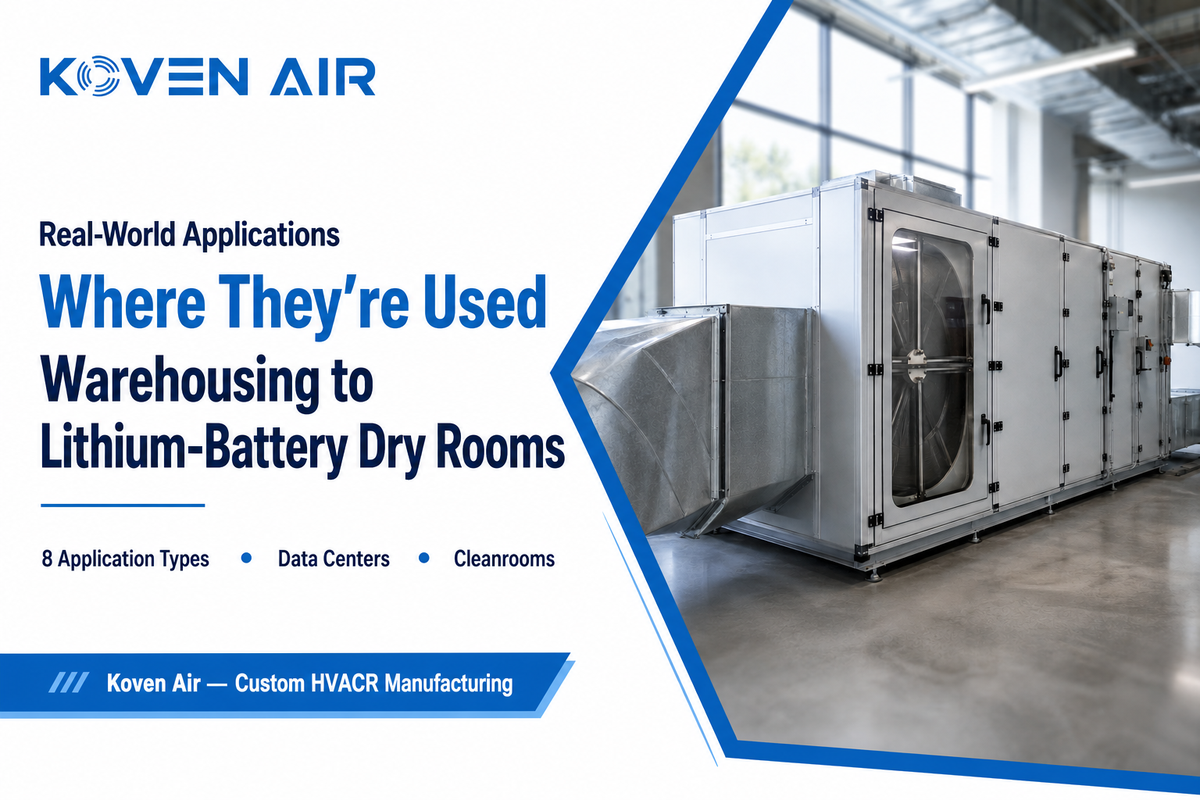
Rotary desiccant dehumidifiers are used wherever excess moisture would damage a structure, product, or production process at a humidity level a refrigerant-based system can’t reliably reach — warehousing, greenhouses, marine environments, cleanroom-adjacent pharmaceutical spaces, general commercial buildings, and lithium-battery dry rooms are the main categories, several of which a DOE technology review specifically calls out as drivers of continued adoption.
When the desired target humidity is identified and locked in, the applications naturally cluster around those few main categories-the point at which excess moisture becomes damaging to the structure, product or the production process. This typically involves situations where lower RH levels are required than a refrigerant-based system can provide reliably. Making the wrong selection – for instance, trying to achieve battery-room levels of dry air using standard warehouse desiccant – not only looks sloppy but could have significant safety consequences that impact the cell life and safety of the batteries themselves, and it’s the reason that Koven Air Engineers size every application individually rather than applying a stock “cookie-cutter” catalog model across every possible application scenario below the minimum allowable operating RH levels for refrigerant systems. Different sites converge on the same humidity control needs from different directions: some are reducing the humidity that’s already built up inside a structure, others are managing moisture from ambient air working its way in through doors and air leakage points, and others still are simply trying to stop the amount of moisture in a space from turning into mold and mildew or corroding stored goods. Koven Air’s rotary desiccant units handle all three starting points the same way, because the dehumidification process itself doesn’t care where the moisture in the air originated – only how dry the outgoing air needs to be.
| Application Category | Why moisture matters |
|---|---|
| Warehousing & storage | Caking, clumping, and corrosion of stored goods |
| Greenhouse & agricultural drying | Mold and spoilage in humid growing environments |
| Marine environments | Accelerated corrosion in salt-laden, humid air |
| Cleanroom & pharmaceutical support | Hygroscopic actives and tablet quality drift with humidity |
| General commercial / infrastructure | Bridge structures, wind-power equipment, basement storage |
| Data centers & computer rooms | Condensation and corrosion risk on electronics and server hardware |
| Semiconductor & electronics manufacturing | Photoresist and circuit boards pick up microscopic moisture, causing defects |
| Lithium-battery dry rooms | Lithium reacts with airborne moisture, cutting cell life and safety — deep enough that it deserves its own detailed guide rather than a single table row |
In situations where temperature and humidity control are both required within a confined area, it’s common to find desiccant dehumidifiers paired with our commercial rooftop units-which provide temperature control and general air conditioning for those applications.
What It Actually Costs to Run, The Regeneration Energy Reality
📐 Engineering Note
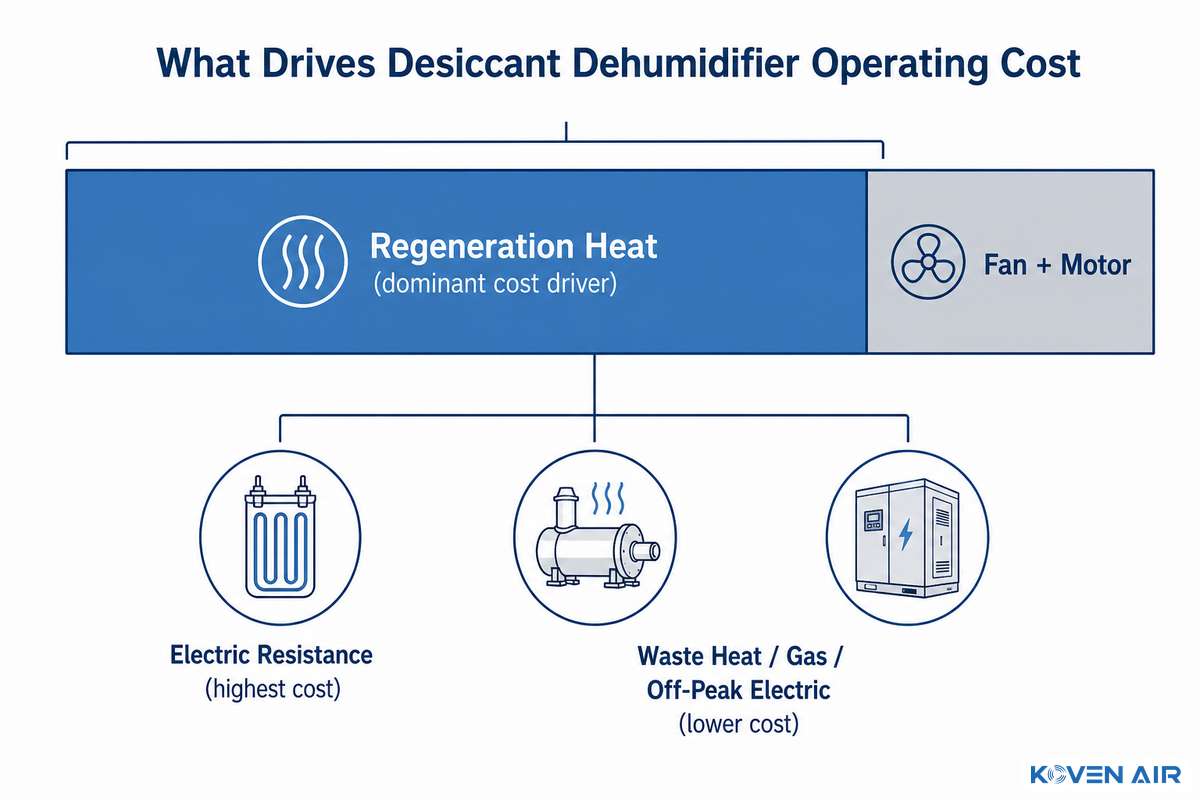
The unspoken cost lurking within a bargain-basement headline price is the regeneration heat source. That single spec choice, not the desiccant wheel itself, drives most of the running-cost gap between two dehumidifier systems that hit the same dew point, because thermal regeneration is consistently the biggest share of a unit’s energy use and operating cost.
A DOE review of desiccant dehumidification economics and other industrial studies always find thermal regeneration-not the motor driving the fan or the wheel-is the biggest element of any desiccant dehumidifier’s energy use and operating cost, but be cautious of single precise percentages as industry-published figures can range depending on the system’s configuration, the type of regeneration, and the study methodology-ask a manufacturer for their specific figures for the system you’re considering. Dry desiccant technology is also reported to carry the lowest operating cost among competing dehumidification systems in at least one industry comparison.
Put another way, the number on your utility bill is almost entirely determined by how hot you run the wheel for regeneration and how you make the heat to do it – not the fan moving the air. A wheel regenerated with an electric resistance heater at the full retail power will actually cost significantly more to run than one designed to run off waste heat, a gas fired heater, or off-peak electricity for the same amount of drying – hence why the cross-over-economics discussed above are far more important than a simple desiccant vs refrigerant cost label. If you’re sizing equipment, ask your supplier what choices are available for your regeneration heat before you try to compare your predicted operating costs.
This is the hidden risk in a low headline price – a facility that accepts the lowest priced quoted unit without looking into its source of heat of regeneration can end up with an electricity bill climbing far more than expected in the first winter of operation, simply because the equipment cost saving came from a straight electric-resistance coil instead of a waste heat or gas-fired regeneration source. Two identical machines in terms of dew point rating may have quite disparate operating costs over 5 years for exactly this reason – nameplate rating is identical – the utility bill isn’t.
Limitations and Trade-offs You Should Know Before Buying
What Are the Disadvantages of a Desiccant Dehumidifier?
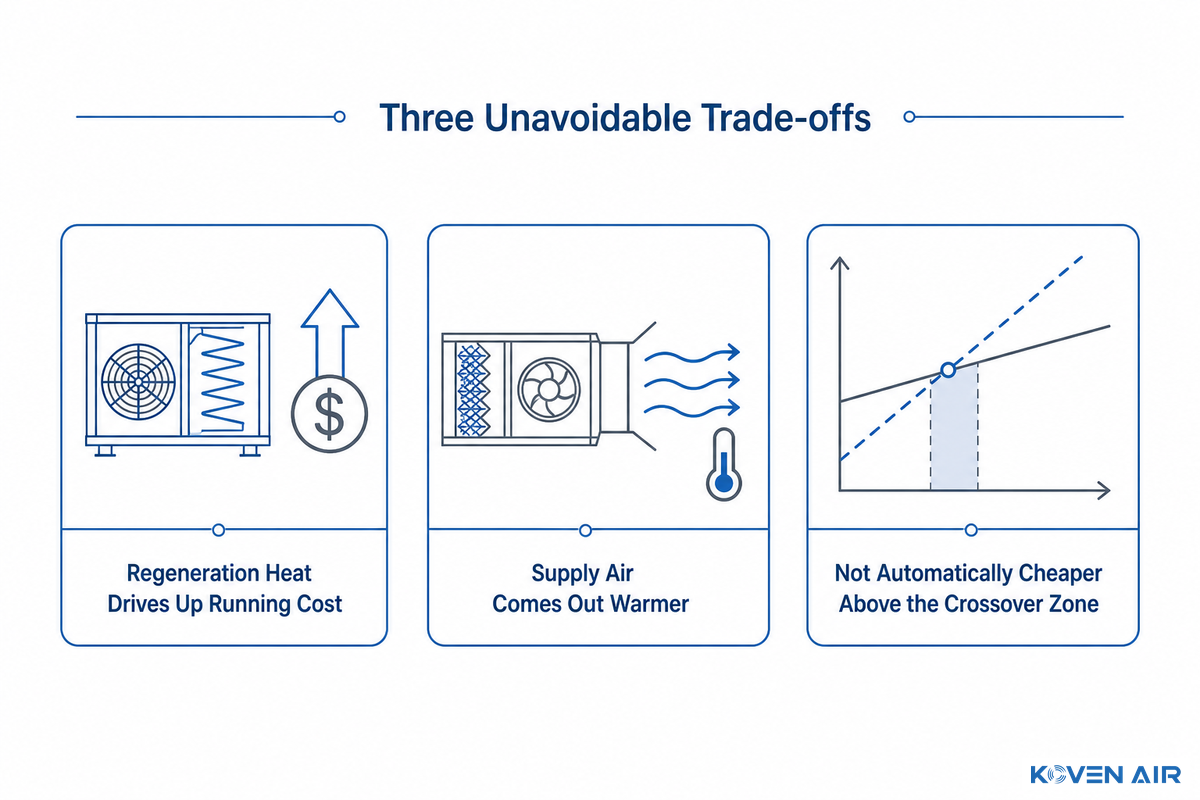
A rotary desiccant dehumidifier has three unavoidable trade-offs: regeneration heat drives up running cost, the dried supply air comes out warmer than it went in, and above the RH/temperature crossover zone it isn’t automatically cheaper than a refrigerant unit. An honest vendor, Koven Air included, raises all three before you reach the installation stage, not after.
- Cost driver is Regeneration Heat As discussed, the thermal regeneration has the highest portion of total cost of operating, so selection of proper size of regeneration equipment is more important than the initial purchase cost. The quality of heating source should be also carefully evaluated
- Dry air goes in at ambient and leaves the unit 20°C higher – sometimes much higher. Since the process give up heat when water is adsorbed, it’s very common for systems that pass air through the unit to require a downstream ‘post cooler’.
- Cheapest isn’t automatically better. Below the RH/temperature crossover, refrigerant is the cheaper option. Pick desiccant there instead and the performance gain is null while the cost go up.
Field experience adds a fourth, more insidious, potential failure — one that a mature, TRL 8-9 technology per DOE’s own maturity rating doesn’t automatically protect a poorly-maintained unit from: even with an in-house test pass before it shipped, dust and contaminants sucked into the wheel or the heater can build up on the desiccant disc and the heater of desiccating-based systems-and users have reported the problem on more than one desiccant-assisted product, with odors traced back to precisely that kind of dust and particulate contamination on the desiccant disc. It’s more a matter of maintenance and filtration than design but it’s not a bad question to ask a supplier about inlet filtration on the wheel. It’s also wise to recognize what desiccant technology can’t fix: If a room truly has a mold problem that requires addressing, that mold issue must be handled first-dehumidifiers can control the moisture, not remove the mold. Field reports consistently indicate they can’t eliminate damage from mold already established on surfaces .
How Long Do They Last? Lifespan, Maintenance & Reliability
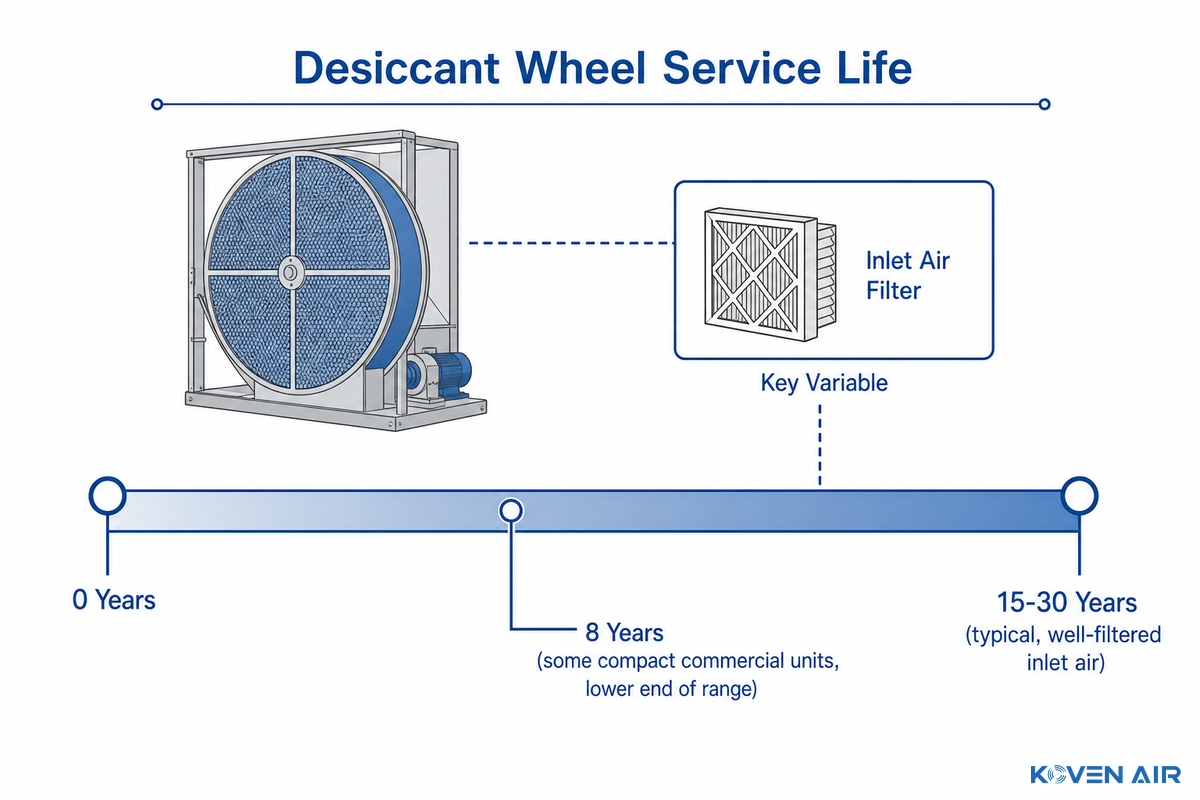
A rotary desiccant dehumidifier commonly lasts 15 to 30 years when its inlet air is properly filtered, since the desiccant media wears out from contamination rather than mechanical fatigue. Actual life expectancy varies by rotor design, media type, and duty cycle, so ask a supplier for the rated life of the specific unit you’re buying.
What Is the Life Expectancy of a Desiccant Dehumidifier?
Service life depends on the product and the air feeding it, and the range of actual service life is broader than a single number suggests — most well-filtered systems reach 15 to 30 years, though at least one compact commercial unit on the market is rated at only eight years, so it pays to ask a supplier for the specific rotor’s rated life rather than the technology’s best-case figure.
Desiccant wheel lifetime on a well-filtered system can reach 15-30 years in service, where dust and airborne contaminants contribute more to wear and tear on the desiccant media than actual wheel-wear itself. But all products aren’t built the same; one compact commercial system sold on the market give a rated service life of its silica gel rotor at eight years, at the lower end of the typical range-a reminder that the “life of the wheel” really depends on the type of rotor media used and duty cycle. It pays to ask a supplier the specific rotor life of the product being purchased, rather than the idealized maximum, and make sure it’s properly filtered on the inlet to get that life expectancy out of it. At Koven Air, every unit goes through a 24-hour full load aging cycle before it leaves the factory, intended to catch early-life weaknesses before the unit ever reach a customer’s site — consistent with the technology’s TRL 8-9 commercial maturity rating from the DOE, which is exactly the kind of proven, field-tested status that supports a 15-to-30-year service life claim in the first place.
Who Makes Rotary Desiccant Dehumidifiers?
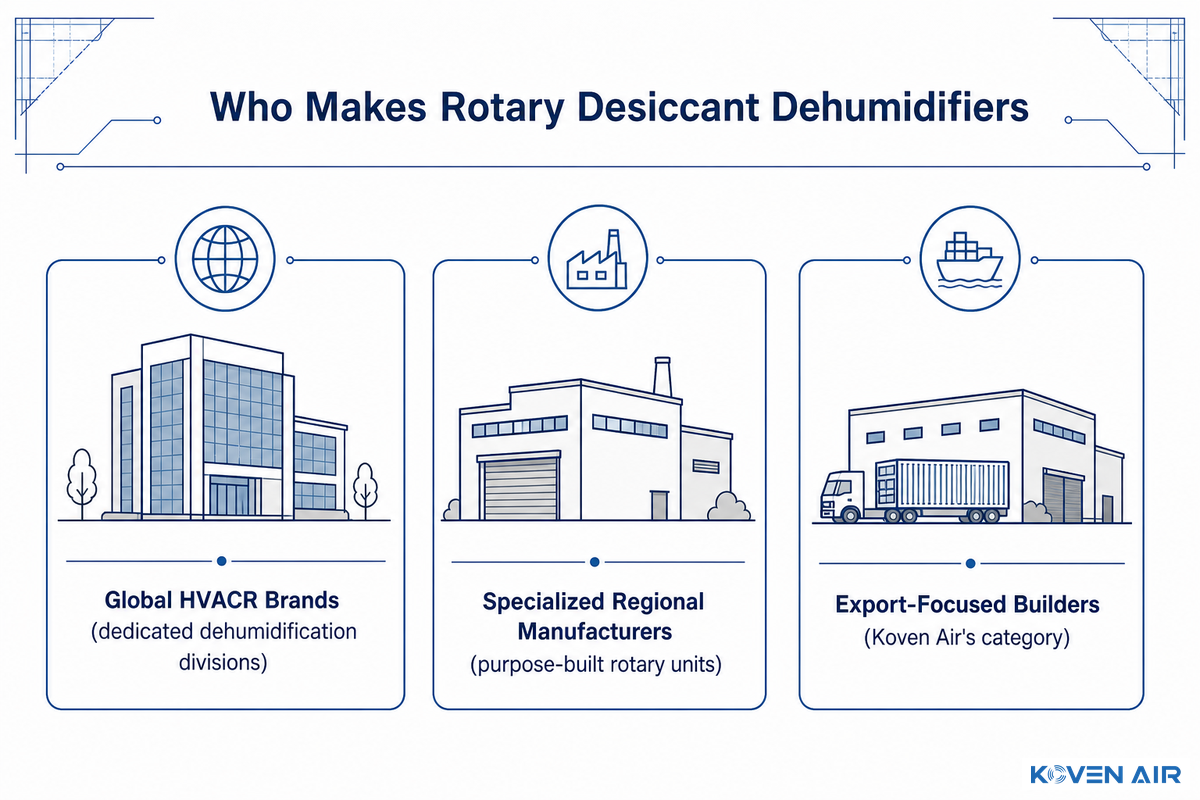
Rotary desiccant dehumidifiers are made by dozens of manufacturers worldwide, from large global HVACR brands with dedicated dehumidification divisions down to specialized regional builders of purpose-built rotary units — it’s a well-established, mature equipment category with decades of engineering history behind it (rated TRL 8-9 by the DOE), not a fringe specialty product.
Koven Air, like most specialized manufacturers in this category, has years of experience building equipment for export. But in practice, our engineers see the same buying mistake made repeatedly-most facilities act like this is some hard-to-find niche piece of equipment, and simply purchase whichever one is available to them locally. This mistake is structural not cosmetic. A rotor designed for a comfort conditioning application, put into deep-dry battery application, for instance, will under-perform-even if both the general-purpose unit and the battery application unit has “desiccant dehumidifier” on the nameplate. In fact, this wide breadth of manufacturer means there’s ample access to parts, service know-how and engineering know-how. It just takes a specific supplier’s expertise applied to your specific problem to identify the correct technology selection, which we’ll get to next.
Choosing the Right Rotary Desiccant Dehumidifier for Your Facility

Once you’ve done your homework, three key inputs translate a broad question into a detailed engineering conversation with a supplier:
- Your required low dew point or humidity level (is it for one particular process/day, or a year-round requirement?)
- Your total process air volume (or total room volume if your application isn’t process-specific)
- Your worst-case ambient condition (hottest temperature and highest humidity you need to maintain spec)
Armed with these three pieces of data — and informed by the same engineering fundamentals a USPTO-published regeneration-control patent addresses at the component level — the discussion can turn from “desiccant” vs. “cooling” technology to which rotor material, what regeneration temperature, and what control accuracy level will truly achieve the result. Without these numbers, it’s just a generic specification, and an under-spec’d control grade on a pharma or lithium-battery unit might achieve the “dew point” but fail to meet your actual RH requirements. Our rotary desiccant dehumidifier selection guide details exactly how to engineer these systems based on those three numbers, and Koven Air engineers will provide you a free custom sizing based on this same approach. Koven Air engineers size every unit this way because a catalog part number picked without those three inputs is the root cause of most of the underperformance complaints suppliers see after installation.
Industry Outlook, What’s Changing in Desiccant Dehumidification
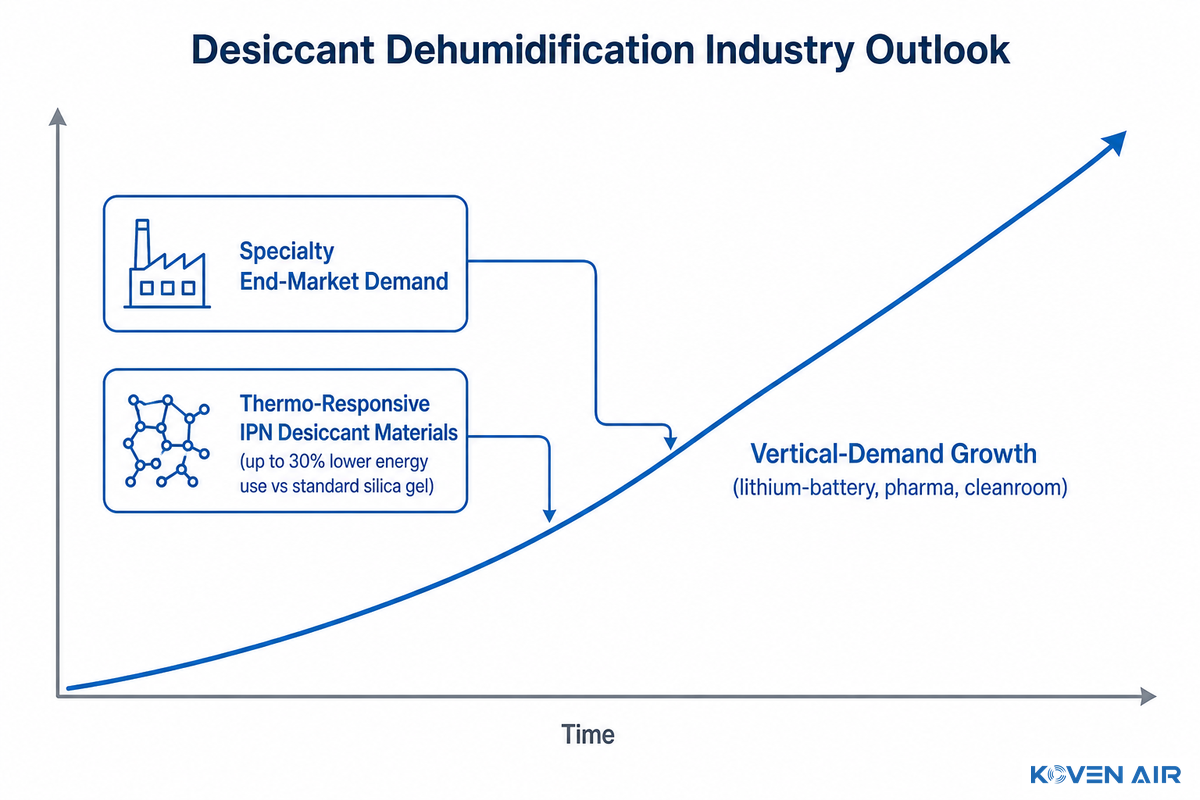
This tech’s direction is actually going to be determined by two, frankly, less common trends than “the market’s getting bigger. First, there’s demand from very specific end markets where the dehumidification requirements are simply harder to meet with anything that’s remotely a commodity – there are specialty applications such as the dry-room demand for manufacturing of lithium battery cells where typical comfort air can’t do it and high-tolerance RH specifications are standard in pharmaceutical/cleanroom builds. Second, it’s a less discussed materials shift; research supported by the DOE and NREL on what are known as interpenetrating-polymer-network (IPN) desorbents, and are also thermo-responsive (i.e. temperature sensitive), can claim a 30 percent decrease in energy use over standard silica gel when used in a rotary wheel system – if those results make their way into commercial products, this would represent a direct address to the regeneration cost issue described above rather than just growing the market for existing technology. Ongoing, peer-reviewed work on energy-efficient climate control is still describing rotary wheel dehumidification systems as a frontier of innovation, not as a settled area of technology simply exploiting its installed base.
Koven Air has been building dehumidifiers since 2007 and has seen the evolution of this equipment unfold firsthand. What that translates to for a buyer looking in 2026: if your new dehumidifier supplier is looking at technology development and has some kind of advanced low-regeneration-energy media in the development pipeline, it’s definitely worth asking about. Otherwise you risk locking your firm into 5 to 7 years of equipment that costs meaningfully more to run than its competitors, on regeneration fuel consumption that a newer technology update would have made cheaper.
FAQ: Rotary Desiccant Dehumidifier
Q: How does a rotary desiccant dehumidifier work?
View Answer
Humid air is drawn through one section of a slowly rotating wheel, coated in a moisture-adsorbing substance; as that wheel turns, the same section then moves into a separate regeneration zone, where hot air is blown through it and the moisture it’s holding is forced back out. That segment can then readsorb again as the wheel continues to rotate — all of this happens continuously, with no compressors and no defrost cycle.
Q: Are rotary desiccant dehumidifiers actually good, or is refrigerant always simpler?
Show Answer
Each has its own strengths, so neither wins outright. Refrigerant is cheaper and simpler above roughly 50% RH in warm conditions. Below about 40% RH or 15°C, refrigerant units start to ice over, and a rotary desiccant wheel becomes the more reliable — if generally pricier to run — alternative for that range.
Q: Do rotary desiccant dehumidifiers use a lot of energy?
View Answer
Regeneration heat represents the vast majority of operating expenses in most scenarios, making it a critical cost factor that must be correctly estimated up front — though how much you actually pay for it depends greatly on what heat sources you have readily available on site. Off-peak electricity, recovered waste heat, or a natural gas supply can all make operating a rotary system dramatically more cost-competitive than a straight electric-resistance regeneration configuration running at full retail power rates.
Q: Can they run in near-freezing conditions?
Show Answer
Yes — that’s the whole point. Nothing on the wheel can ice over, so it keeps drying air well below freezing, unlike a compressor-based unit that would stall out and need a defrost cycle at the same temperature.
Q: What’s the difference between a passive desiccant (silica packet) and an active rotary desiccant dehumidifier?
View Answer
A silica gel packet is an inactive, passive desiccant — good for a small enclosed space like a gun safe, but not designed for active air flow. Rotary wheels, by contrast, are fully active: they rotate continuously, drawing process air through one section to adsorb moisture while sending hot air through a separate section to drive it back out, which is what makes them suitable for whole-room dehumidification.
Q: What certifications should an industrial unit carry?
Show Answer
Certifications vary by market, not globally — UL/NRTL for North America, CE marking for the EU, plus process-specific add-ons layered on top depending on your application. A supplier building for export should confirm the exact listings your destination requires.
Q: How often does the desiccant wheel need to be replaced or serviced?
View Answer
When inlet air is filtered, the wheel is a low-maintenance component – you replace the filter on a regular basis and periodically inspect the wheel. A wheel is only replaced when contamination (dust or chemicals) coats the media, causing the adsorption rate to drop off. This is a condition related to filtration, not to time.
About This Analysis
This guide draws on peer-reviewed engineering literature, U.S. Department of Energy research funding records, industry trade press, and field reports from equipment users, cross-checked against the wheel-selection engineering data on our own rotary desiccant dehumidifier pages. Koven Air has built HVACR and dehumidification equipment since 2007 and exported to 35 countries since 2010, including systems for lithium-battery dry-room and cleanroom-adjacent applications referenced in this guide.
References & Sources
- Advances in Desiccant Wheels for Dehumidification, VOC MitigationU.S. Department of Energy Office of Scientific and Technical Information
- Thermo-Responsive IPN Desiccant ResearchU.S. DOE / NREL
- Desiccant Dehumidification Economics ReviewU.S. Department of Energy
- ANSI/ASHRAE Standard 139Method of Testing for Rating Desiccant Dehumidifiers, ASHRAE
- Rotary Desiccant Wheel Systems: A Peer-Reviewed Engineering Reviewjournal literature, 2025
- US20220381452A1, Directly Heated Desiccant WheelUSPTO published patent application
Related Articles
- Rotary Desiccant Dehumidifier Selection Guidefull engineering selection system, regeneration-temperature matrix, and free sizing
- All-Electric Cold-Climate Heat Pump RTUsfor facilities pairing humidity control with rooftop heating and cooling
- About Koven Airour manufacturing and engineering background


![Horizontal Fan Coil Unit Project Guide [Step-by-Step]](https://kovenair.com/wp-content/uploads/2026/09/horizontal-fan-coil-unit-guide-featured-1-150x150.png)