Get in Touch with Koven Air Company

Updated July 2026
Quick Specs
| Typical dew point range | -40°C to -70°C, depending on process step |
| Typical relative humidity | Below 1% RH |
| Room temperature (cell assembly) | 22°C ± 2°C |
| Core technology | Desiccant (adsorption) dehumidification — rotary wheel or liquid desiccant |
| Energy share of manufacturing | Up to 43% of total battery-manufacturing energy use, per peer-reviewed modeling |
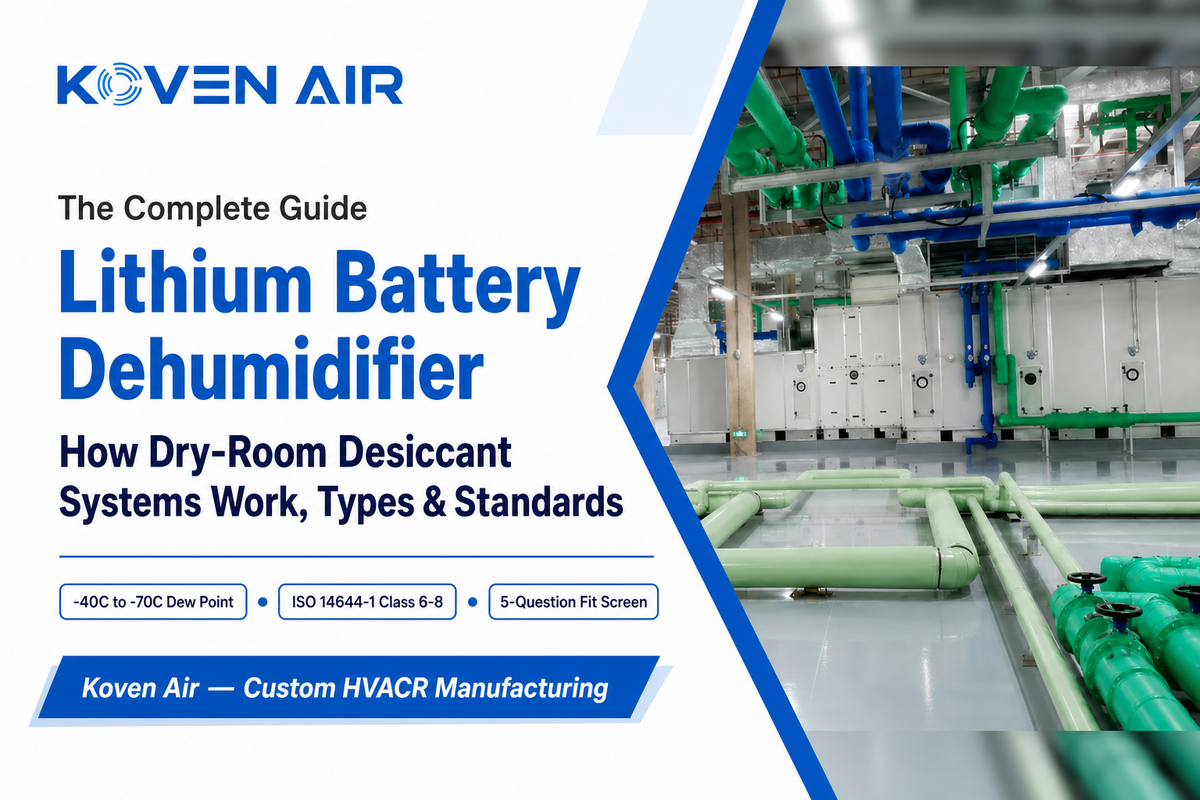
A lithium battery dehumidifier is an industrial desiccant dehumidification system designed to maintain dry-room air at dew points down to -70°C, an order of magnitude drier than what standard refrigeration-based dehumidifiers can provide. This article explains what the equipment is, what it does, what types of technology are available, what specifications buyers need to know, and what mistakes buyers make that end up costing them.
Key Points
- Standard refrigeration dehumidifiers can’t reach dew points below roughly -20°C; desiccant (adsorption) technology is required beyond that point.
- Moisture damages lithium-ion cells through two distinct chemical pathways, not one, conflating them leads to imprecise specifications.
- Dehydration in a dry room can contribute to 43% of the total manufacturing power consumption of a battery facility, making it the biggest regeneration energy source to influence the total long term cost.
- No single mandatory international standard defines dry-room dew points for battery – ISO 14644-1 is particle cleanliness only, another requirement.
What Is a Lithium Battery Dehumidifier? (And What It Isn’t)
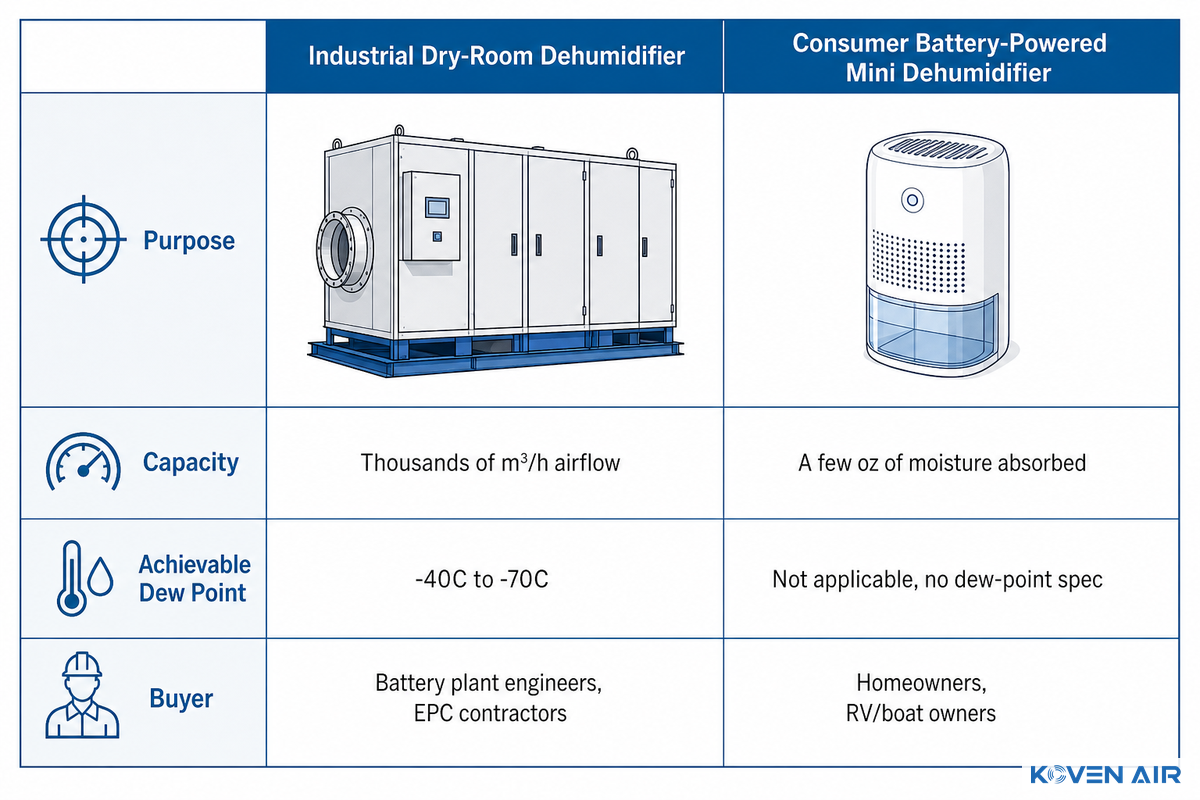
A lithium battery dehumidifier isn’t a home appliance, but an industrial process device. A lithium battery dehumidifier conditions the dry room air for a lithium-ion battery manufacturing and holds −40°C to −70°C dew points and a humidity of below 1%RH. It’s the size of a large industrial air handling unit – hooked up to welded ductwork, sized in thousands of m3/hr air – not a portable plugged-in unit.
This equipment category is documented in U.S. patent filings for battery pack dehumidifiers with active-reactivation systems, a scale of engineering closer to plant HVAC than to any household product.
⚠️ Not the Same Product
The “lithium battery dehumidifier” search results also turned up a wholly unrelated, totally different product, sometimes marketed as a “battery operated dehumidifier”: mini rechargeable dehumidifier units that use a lithium battery as a power source, running on rechargeable silica gel or reusable moisture absorber crystals, sold for small spaces such as closets, cars, RVs, gun safes, and bathrooms. That’s an unrelated category of consumer electronics, not the industrial equipment discussed in the rest of this article. But should you find that you need to specify a dehumidification unit for battery cell, module, or pack manufacturing, you can simply keep reading.
| Attribute | Industrial dry-room dehumidifier | Consumer battery-powered mini dehumidifier |
|---|---|---|
| Purpose | Dries battery manufacturing air | Dries a small enclosed space |
| Capacity | Thousands of m³/h airflow | Absorbs a few oz of moisture |
| Achievable dew point | -40°C to -70°C | Not applicable (no dew-point spec) |
| Buyer | Battery plant engineers, EPC contractors | Homeowners, RV/boat owners |
How Desiccant (Adsorption) Dehumidification Works, The Adsorption Dew-Point Ceiling
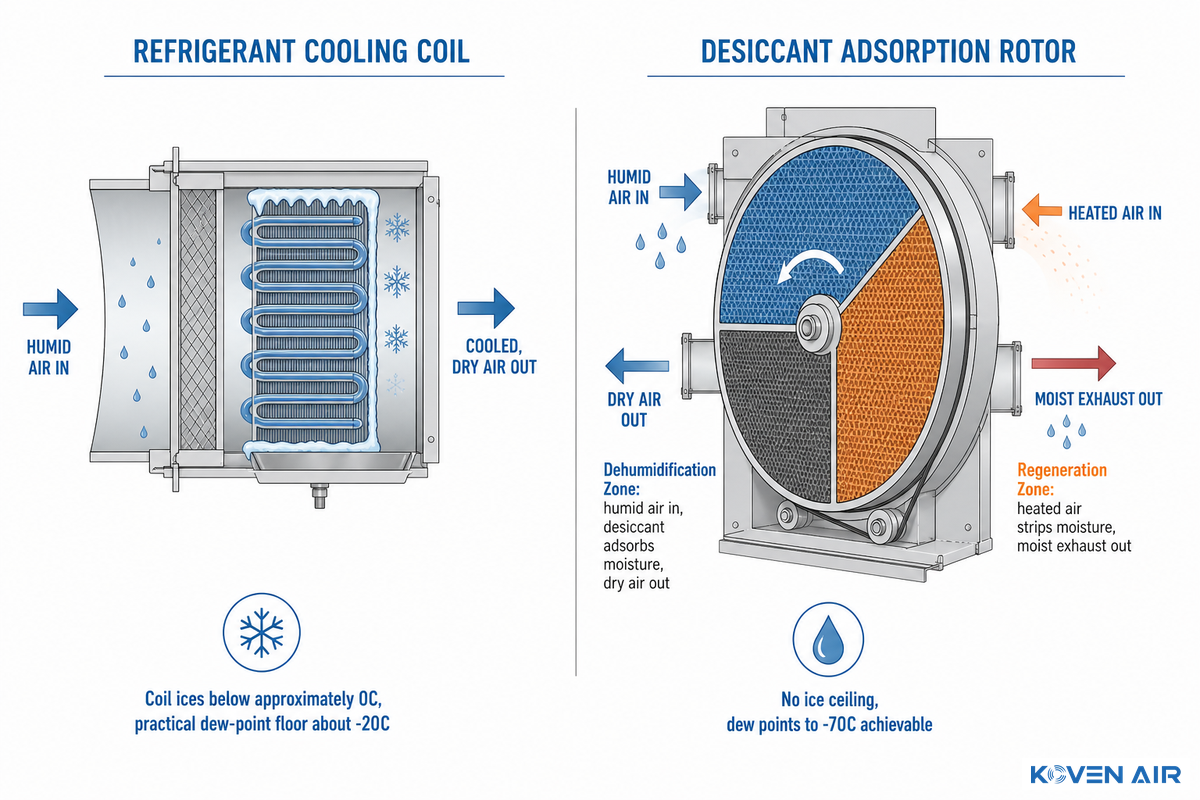
The Adsorption Dew-Point Ceiling is the physical limit below which refrigeration can no longer economically remove moisture, roughly -20°C, because the cooling coil starts icing over instead of collecting water. This is why every battery dry-room dehumidifier uses desiccant (adsorption) technology instead: desiccant materials bind moisture to a surface rather than condensing it, so there is no ice ceiling, and -70°C dew points stay achievable.
Traditional refrigeration draws moisture from air by cooling it below its dew point so water condenses on the cold coil. But that mechanism is limited. Air close to 0°C causes ice rather than water to condense, which needs periodic defrosting and reduces effective capacity before stopping completely. For Refrigerant dehumidifiers, that’s a rough practical ceiling, much lower than -40°C to -70°C needed for battery dry rooms. Desiccant (adsorption) dehumidifiers are able to achieve such very low dew points using other mechanisms. They pass the process air through a rotor, or liquid desiccant, typically coated with silica gel or a molecular sieve, where the moisture sticks onto the surface of the material rather than condenses, thereby avoiding any frost ceiling. Another air stream called regeneration air is heated to drive the moisture from the desiccant so that the wheel or liquid continues working without interruption. The method is physical rather than thermodynamic. Thus, with appropriate desiccant material and regeneration temperature, the dew point can be -70°C or below. In a published peer-reviewed review of rotary desiccant-wheel systems, COPs were reported in the range 0.3-0.4 when a 50°C regeneration temperature was used confirming that the system operates outside the refrigerant working range. Selecting the optimal, or optimum, regeneration source, whether waste heat, a heat pump, or renewable energy, is the main lever engineers have to improve regeneration efficiency and cut energy-saving costs without giving up dew-point performance, a design trade-off documented in U.S. patent US9303884B2 on energy-efficient desiccant dehumidification.
“The moment a spec calls for a dew point colder than about -20°C, refrigeration is off the table, it’s not a question of picking a bigger compressor, it’s a different technology entirely.”
Koven Air Environment Technology Co.,Ltd, engineering team
📐 Engineering Note
A high temperature for the regeneration cycle is a trade-off with low process-side dew points. More moisture can be pumped off the desiccant in each revolution as regeneration temperatures rise; however, the energy consumption also increases. The pilot scale project in Battery LabFactory Braunschweig (TU Braunschweig) mentions 60°C to 135°C for the regenerated air entering the desiccant. This is a critical, size determining, trade-off not process airflow rate, for engineers designing the battery dry-room dehumidifier.
Why Lithium-Ion Battery Manufacturing Needs Such Extreme Humidity Control
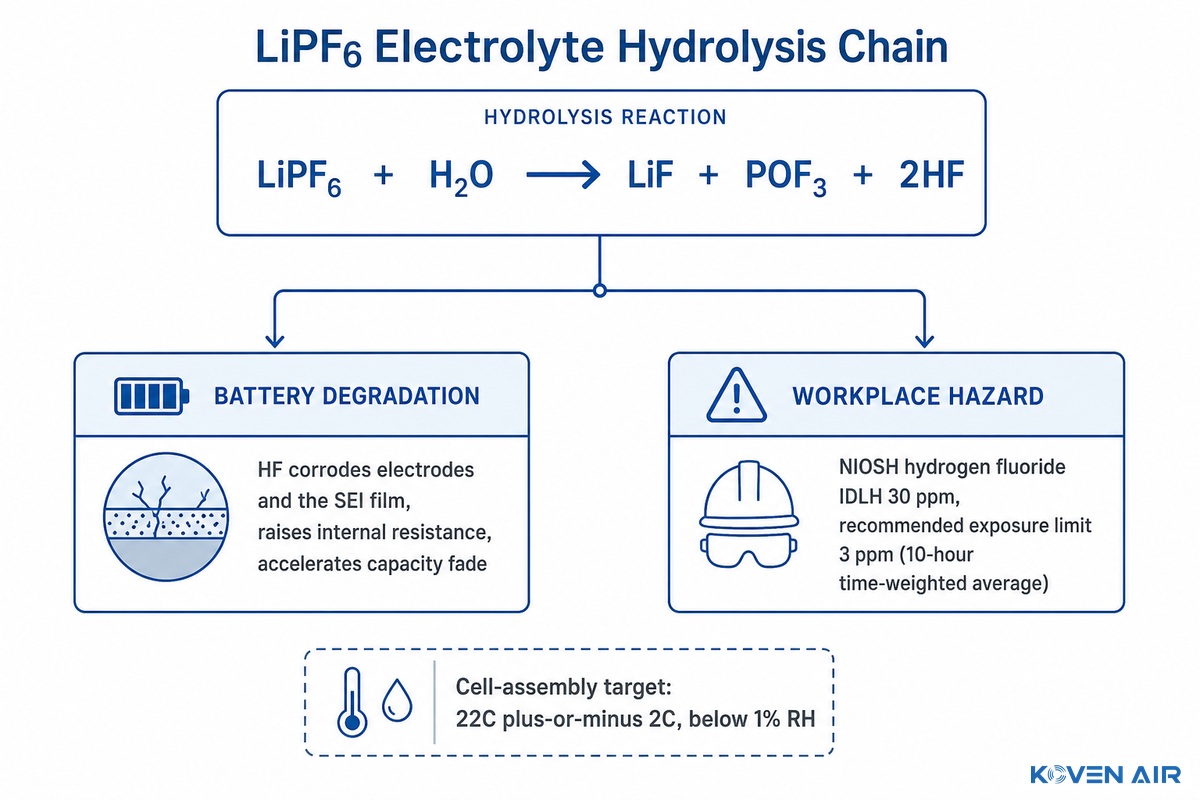
Moisture attacks lithium-ion battery cells through two distinct chemistries that manufacturing guides typically meld together: direct exposure of free lithium compounds to ambient moisture, and hydrolysis of the electrolyte salt itself, the reaction behind most dry-room dew-point specs. In a classic liquid-electrolyte cell, lithium hexafluorophosphate (LiPF6) reacts with trace moisture to form lithium fluoride, phosphoryl fluoride, and hydrofluoric acid.
The reaction (LiPF6 + H2O → LiF + POF3 + 2HF) is a known electrolyte degradation process for LiPF6 cells per U.S. Department of Energy-sponsored research, and the resultant HF drives corrosion on the electrodes, which is why producers keep moisture down to the parts-per-million level instead of simply saying “dry is good enough”.
The hydrofluoric acid generated in this reaction isn’t merely a battery-performance issue; it’s an industrial-hygiene hazard on its own. NIOSH sets an Immediately Dangerous to Life or Health (IDLH) concentration for hydrogen fluoride at 30 ppm and a recommended exposure limit of 3 ppm (time-weighted average, 10 hours) – figures that were validated by NIOSH in OSHA’s own chemical-exposure data. Any facility that’s working with LiPF6-based electrolyte in a dry room must address the presence of HF not just as a materials-degradation problem but also as a workplace-exposure issue.
Equipment selection guides often overlook this facet of the problem entirely.
At the cell-assembly process step, for example, facilities generally hold room temperature to 22°C ± 2°C, with relative humidity below 1% RH, a stringent condition where a minor air leak can cause the conditions in the room to deviate detectably. Because of sensitivity differences at various process steps (e.g., electrode coating, cell stacking, electrolyte filling), dew point requirements may differ from one step to another rather than across an entire facility. This is why lithium-ion battery production facilities budget for dedicated dry-room environmental control rather than treating it as a single plant-wide setting, and why a lithium-ion battery dry room is engineered zone by zone around the energy-storage cell chemistry it protects.
Types of Lithium Battery Dehumidification Equipment
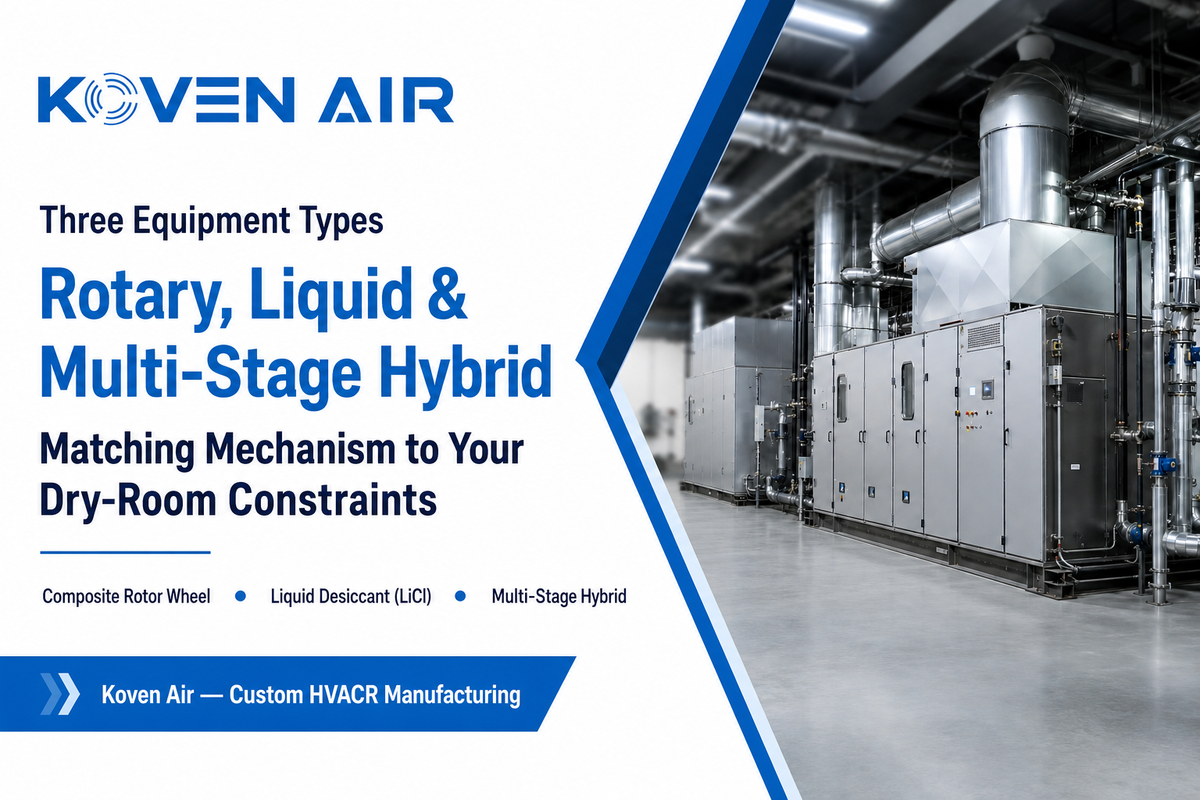
The majority of today’s battery dry room installations use one of three main equipment configurations, though the field is continuing to evolve, as indicated by a U.S. patent filed in 2024 that describes a dual-rotor design that pre-conditions the air with a first desiccant wheel and a second, primary wheel, for enhanced drying at reduced regeneration energy levels.
| Technology | Mechanism | Typical fit |
|---|---|---|
| Rotary desiccant wheel (composite/solid) | Silica gel + molecular sieve rotor, continuous regeneration | Most common for new gigafactory-scale builds; compact footprint |
| Liquid desiccant (lithium chloride salt) | Salt solution absorbs moisture, regenerated by heating | Large continuous airflow, lower pressure-drop applications |
| Multi-stage / hybrid wheel | Pre-conditioning wheel + main wheel in series (patent-documented 2024 design) | Retrofits and energy-optimization upgrades |
Koven Air designs solutions for lithium-ion battery manufacturers worldwide, drawing on engineering expertise built across a global export footprint. Koven Air can supply both composite-rotor desiccant wheel systems and liquid desiccant systems, in flexible, modular equipment builds, allowing customers to make a direct comparison in cases where the project involve specific air-flow, space or energy-source constraints. For a technical discussion of rotor materials science and regeneration control, refer to Koven Air’s resources for rotary desiccant dehumidifier equipment; for an overview of liquid desiccant chemistry and equilibrium behavior, refer to Koven Air’s industrial desiccant dehumidifier products.
Key Specifications and Terms Buyers Need to Know
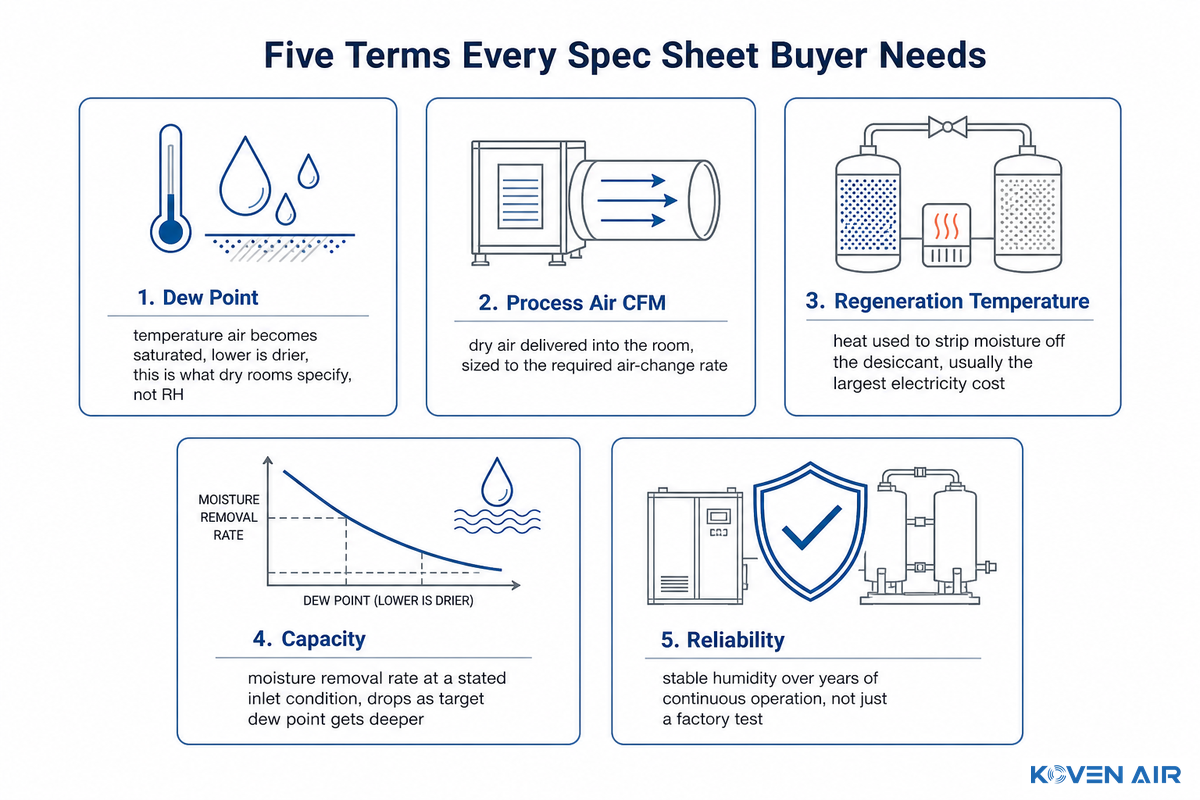
A lack of understanding of these terms when reading a dehumidifier specification sheet can lead to size selection errors, which we discuss in the following sections.
- Dew point is defined as the temperature at which air becomes saturated with moisture, so the lower the dew point the drier the air; this is the term that battery dry rooms specify (an alternative, relative humidity [RH], doesn’t indicate how dry the air is at a given temperature).
- Process air CFM refers to the amount of dry air delivered by the unit into the room, and sizing this at the required air-change rate for a given room volume is the first calculation in a typical specification sheet.
- Regeneration temperature is the temperature of the secondary air stream that’s used to strip the moisture off the desiccant. The unit’s regeneration heating power draw usually accounts for the largest single cost on a facility’s electricity bill associated with a dry room. Some suppliers brand this category as Low Dew Point (LDP) equipment on their spec sheets, which is the same product category this guide describes.
- Capacity, or the moisture removal rate, is usually given as a quantity of water per hour removed under specific inlet conditions, and it’s always necessary to determine what conditions were assumed by the equipment manufacturer, because capacity drops significantly when reducing the target dew point, a relationship detailed in honeycomb-adsorption dehumidification patent filings covering dry-room dew-point reduction.
- Reliability and durability matter as much as headline dew point: equipment that holds low humidity and stable humidity levels over years of continuous operation, rather than only in a factory test at ultra-low humidity for a few hours, is what protects battery lifespan and manufacturing yield.
The energy consumption should be an item on its own. According to a peer-reviewed dry-room energy model in the Journal of Cleaner Production (2026), a potential 78.23% dry-room energy saving can be achieved under specific boundary conditions when climate-matched to the local energy supply with optimized HVAC control variable selection – indicating much of a dry room’s power draw is an operating decision. This supports the frequently cited manufacturing energy analysis (Yuan et al., CIRP Annals, 2017), where dry room conditioning may contribute to 43% of a lithium-ion battery pack’s manufacturing energy. Actual measurements from pilot lines at the Battery LabFactory Braunschweig indicate the regeneration heater alone contributes ~42% of a dry room’s measured monthly energy, more than any other single component (fans, pre-cooling). It’s this single line item that makes the choice of regeneration heat source far more important than a reported headline dew point value after a project reach the point of equipment specification: one supplier reports their desiccant unit running on waste heat or a heat pump instead of direct electrical regeneration reduces electricity consumption by tens of GWh per year across a whole plant.
Standards and Certifications That Apply
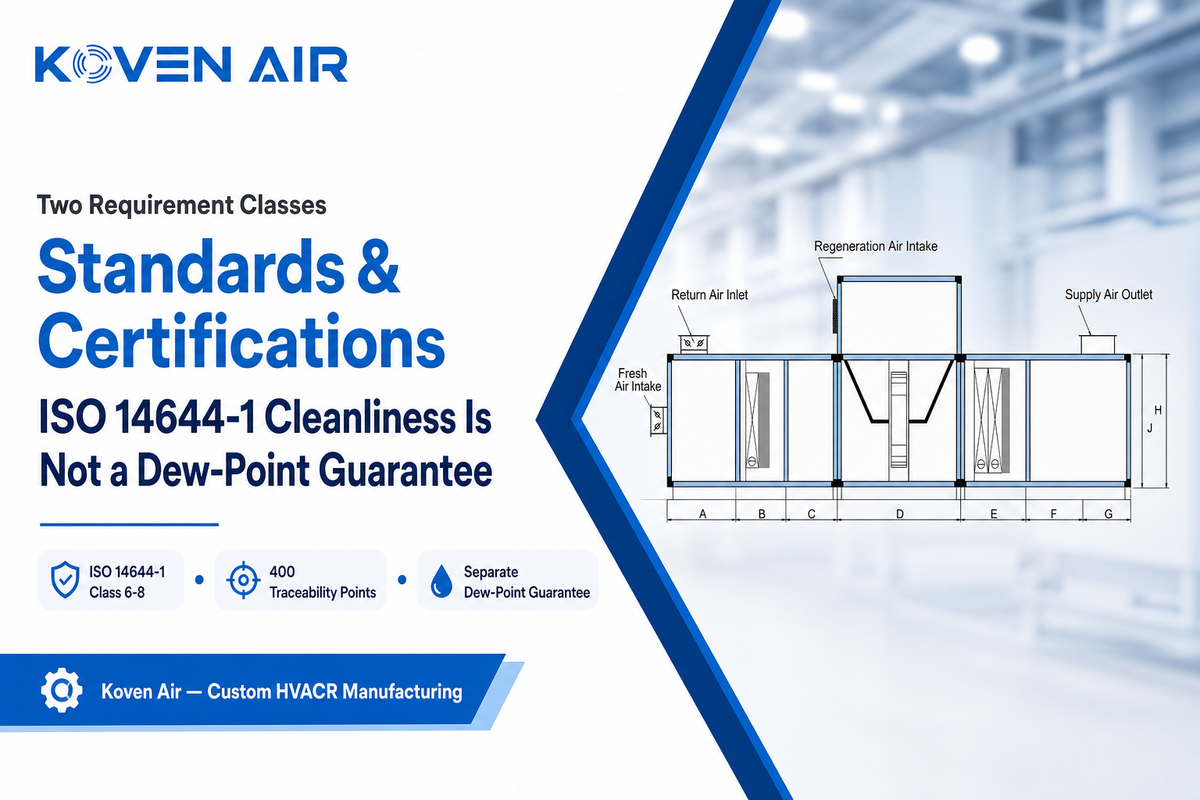
Battery dry rooms fall under two often-confused requirement classifications. First, there is ISO 14644-1:2015 – the internationally harmonized standard which specifies cleanliness of the air in terms of the number of airborne particles (ISO Classes 1-9); battery dry rooms are typically designed for cleanliness Classes 6-8. But this standard doesn’t address what those particles actually are, nor does it deal with dew point or humidity. Second, no international battery dry room standard currently exists that mandates a specific dew point; the -40°C to -70°C figures presented in this document reflect equipment and process engineering consensus. Customers must request a separate performance guarantee for dry room performance – that is, dew point and humidity specifications – alongside any particle cleanliness certification.
Koven Air’s own dry room dehumidification equipment is built on 20,000 m² of in-house manufacturing capacity with 400 process-traceability points and an in-house chiller and heat-pump testing laboratory, supporting both the particle-cleanliness build quality and the documented dew-point performance testing buyers should request in a contract.
| ISO Class | Max Particles ≥0.5µm per m³ | Legacy FS 209E Equivalent |
|---|---|---|
| ISO 1 | Below ≥0.5µm test threshold | No FS 209E equivalent |
| ISO 2 | Below ≥0.5µm test threshold | No FS 209E equivalent |
| ISO 3 | 35 | Class 1 |
| ISO 4 | 352 | Class 10 |
| ISO 5 | 3,520 | Class 100 |
| ISO 6 | 35,200 | Class 1,000 |
| ISO 7 (common for battery dry rooms) | 352,000 | Class 10,000 |
| ISO 8 (common for battery dry rooms) | 3,520,000 | Class 100,000 |
| ISO 9 | 35,200,000 | No FS 209E equivalent |
How to Evaluate Whether You Need One, 5-Question Equipment Fit Screen
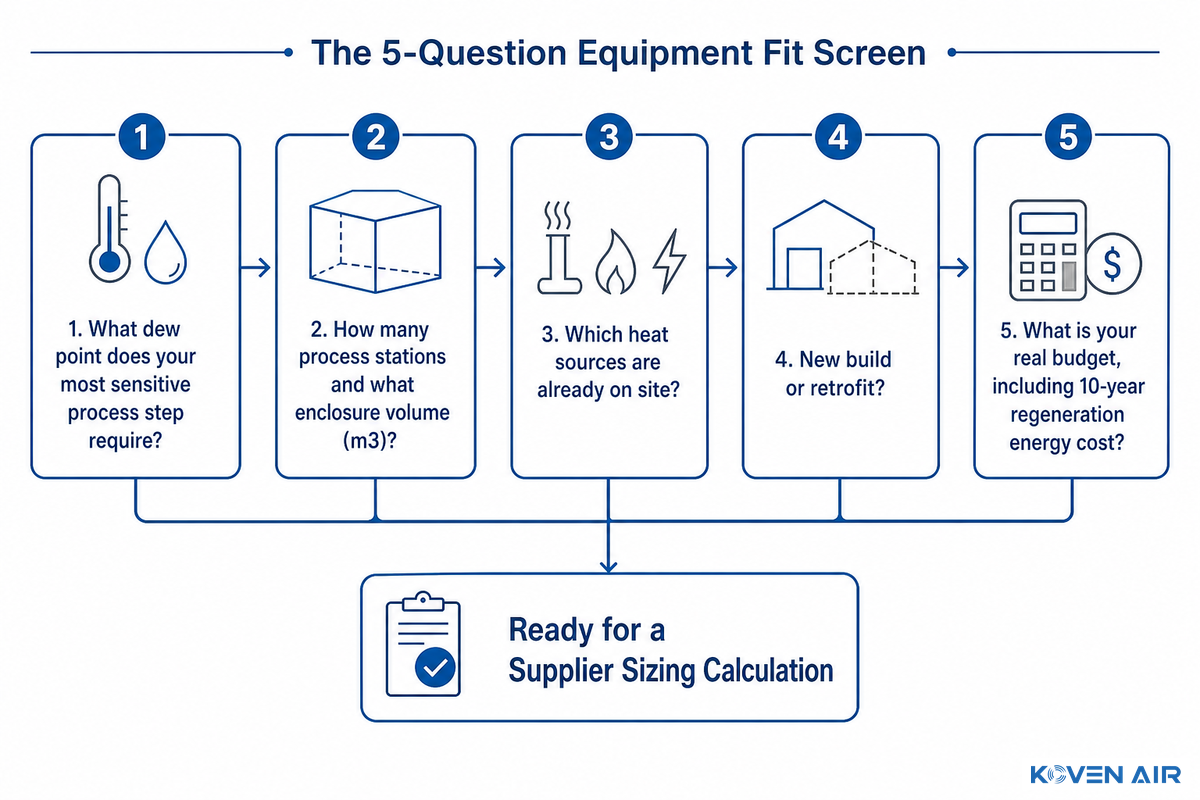
The 5-Question Equipment Fit Screen is a self-check buyers can complete before contacting a supplier, so the first conversation starts with real parameters instead of a generic scoping call. Answering these five questions in advance shortens the back-and-forth that usually follows an underspecified inquiry, and gives a supplier enough information to move straight to a sizing calculation.
- What’s the dew point required for your most sensitive process step? Different steps may require different targets; typically the strictest target determines your equipment specifications. For instance, electrode coating often has a different target than cell stacking and electrolyte filling.
- How many process stations will the dry room house, and how much space (volume) does the enclosure contain? These details help determine required air changes per hour, which dictates the required air flow (CFM) and equipment size.
- Which heat sources are already on site? Existing waste heat or heat pump loop reduces the energy demand of the regeneration cycle significantly in comparison to direct electric heating.
- New build or retro? Retrofits will tend to use a liquid-desiccant or a hybrid multi-stage design rather than replacing a complete rotary wheel system.
- What’s your real budget, including the energy cost of regeneration over 10 years? Note: The costs for purchase price and total project cost often diverge, as will be illustrated in the next section — a gap energy-efficient desiccant dehumidification patent filings attribute largely to regeneration-cycle design choices.
Once these five questions have been answered, a supplier will no longer need a general scoping call but can start directly with a sizing calculation. Koven Air’s lithium battery dehumidifier product line includes composite rotor and liquid-desiccant systems described in this guide and an engineering team to carry out a size calculation based on the specific need.
Common Mistakes and Misconceptions Buyers Make
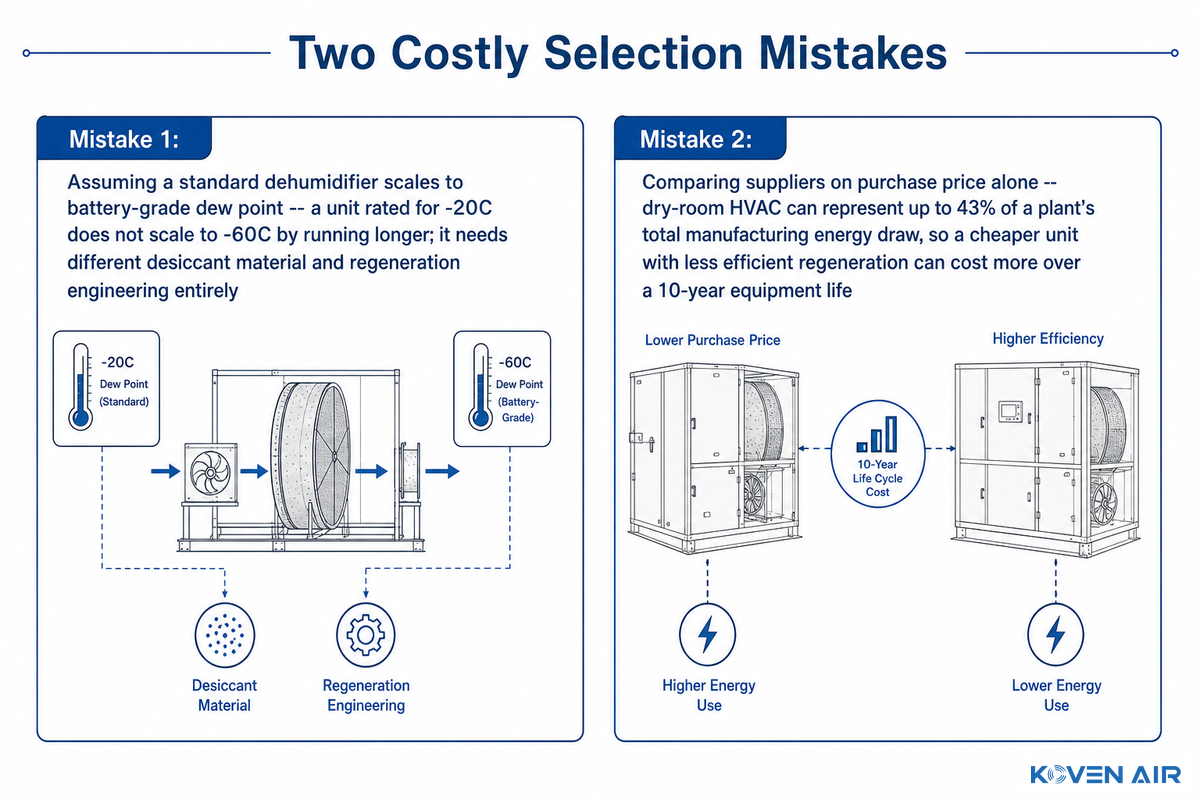
Industry practitioners commonly report two recurring mistakes in early-stage dry-room equipment selection.
⚠️ Important
Mistake 1 — Assuming a standard industrial dehumidifier can be pushed to battery-grade dew points. Comparing units on rated capacity alone, without checking the dew point that capacity figure assumes, is one of the most common and costly selection errors in cleanroom-adjacent procurement — a unit rated for -20°C dew point does not scale down to -60°C by running longer or adding a second unit; it requires different desiccant material and regeneration engineering entirely, since the underlying moisture chemistry documented in peer-reviewed electrolyte hydrolysis research behaves differently at different dew points, not just proportionally.
⚠️ Important
Mistake 2 — Comparing suppliers on equipment purchase price alone. The lowest equipment price does not always produce the lowest total project cost once regeneration energy source, ductwork sealing quality, and long-run energy consumption are factored in — given that dry-room HVAC can represent up to 43% of a plant’s total manufacturing energy draw, a cheaper unit with less efficient regeneration can cost more over a 10-year equipment life than a higher-priced unit engineered for waste-heat or heat-pump regeneration.
Industry Outlook, What’s Changing in Battery Dry-Room Dehumidification (2026)
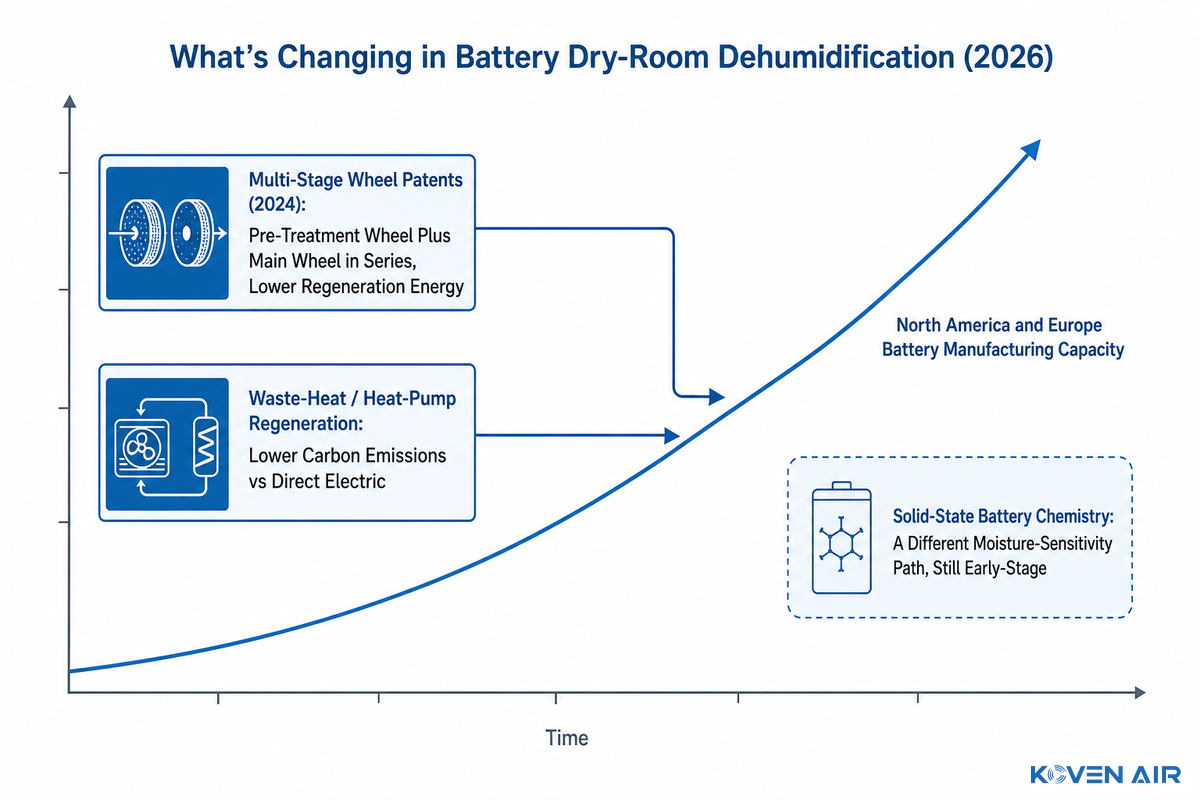
Lithium-ion battery manufacturing capacity in North America and Europe continues to expand, and that expansion, not a generic market-growth narrative, provides the concrete impetus for demand for new dry-room dehumidifiers. This is due to the fact that a new dry room must be developed for each new manufacturing line, the size of which is tailored to the manufacturing line’s performance data, so the demand for dry-room dehumidification equipment scales directly with the announcement of new plants and lines. Therefore, companies looking to establish new capacity in 2026-2027 need to include lead times for dry-room equipment in the project plan early in the project plan – on a par with ordering the primary cell manufacturing equipment – and not as a facilities management afterthought.
On the technology front, new patent filings reveal a move towards multi-stage systems – in a U.S. patent from 2024, for example, a pre-treatment desiccant wheel is coupled in series with a main desiccant wheel to further reduce the regeneration energy compared to single wheel systems. Running that regeneration on waste heat or a heat pump rather than direct electric resistance also lowers the carbon emissions tied to battery energy storage manufacturing, a factor more buyers are asking suppliers to quantify. In addition, next-generation solid-state battery chemistry, in particular, presents an alternative path of moisture-sensitivity compared to the LiPF6 hydrolysis mechanisms described earlier in this guide. As solid-state manufacturing move beyond the pilot plant phase, there will be an adaptation of dry-room specifications from today’s typical dew points to those specific to solid-state technology.
According to market research forecasts for the general battery dry-room equipment sector, a continued rise in demand is expected through to the mid-2030s.
Frequently Asked Questions
Is humidity bad for lithium-ion batteries?
View Answer
Yes.
The lithium-ion battery system is very sensitive to moisture since the water leads to hydrolysis of the LiPF6 electrolyte salt, forming hydrofluoric acid, which can attack the electrodes and degrade the performance and life of the battery. In addition to its chemical impact on the battery components, hydrofluoric acid is also classified as a recognized health hazard (NIOSH immediately dangerous to life or health value is 30 ppm).
What’s the difference between a lithium battery dehumidifier and a regular dehumidifier?
See Answer
Standard Refrigeration-based dehumidifier captures moisture by chilling the air with a cold coil, which loses effectiveness at about 0°C as the coil begins to frost over rather than capture liquid water. A lithium battery dehumidifier, by contrast, uses desiccant (adsorption) to physically lock water molecules into a desiccant-covered rotor or liquid desiccant fluid and is limited only by material capability, achieving dew points of -40°C to -70°C, a level unattainable by Refrigeration-based units.
Can a standard air conditioner dehumidify a battery dry room?
View Answer
No. Standard AC removes moisture as a by-product of air cooling, by way of a refrigeration condensation process identical to that in a Refrigeration-based dehumidifier. Standard AC is not cost-effective for achieving sub-zero dew points, as required by battery dry rooms. Battery manufacturing dry rooms require dedicated desiccant dehumidification equipment layered onto (but not instead of) a standard HVAC temperature-control system.
How do I know what size dehumidifier my dry room needs?
Show Answer
Consult the 5-Question Equipment Fit Screen above, then use your room volume, target dew point, and number of workstations to ask your equipment supplier for a moisture-load and air-change calculation.
What dew point is considered “battery-grade”?
View Answer
The answer depends entirely on the specific manufacturing process step. Estimates vary from -40°C to -70°C, or lower. Electrolyte filling steps generally have the tightest controls.
Are there different dehumidifiers for lithium-ion vs other battery chemistries?
See Answer
Current Koven Air equipment is designed around liquid-electrolyte lithium-ion chemistry. Newer solid-state batteries employing sulfide chemistries have a different moisture-sensitivity mechanism and thus have a separate (and still evolving) set of dry-room specification standards that do not overlap with the established LiPF6-based standard.
About This Analysis
This guide was compiled from peer-reviewed dry-room energy modeling, U.S. Department of Energy-funded electrolyte chemistry research, NIOSH/OSHA occupational exposure data, ISO 14644-1 standard documentation, and current USPTO patent filings, cross-referenced against Koven Air’s own composite-rotor and liquid-desiccant equipment lines. Reviewed by the Koven Air Environment Technology Co.,Ltd technical team.
References & Sources
- Hydrogen Fluoride, Immediately Dangerous to Life or Health (IDLH). NIOSH / CDC
- Dehydration Rather than HF Capture Explains Performance…. U.S. Department of Energy, Office of Scientific and Technical Information
- ISO 14644-1:2015, Cleanrooms and Associated Controlled Environments. International Organization for Standardization
- Model Based Evaluation of Dry Rooms in Battery Production. Journal of Cleaner Production, 2026 (peer-reviewed)
- Model-Based Energy Analysis of a Dry Room HVAC System in Battery Cell Production. Procedia CIRP 98 (Vogt et al., 2021, peer-reviewed)
- Manufacturing Energy Analysis of Lithium Ion Battery Pack for Electric Vehicles. Yuan, Deng, Li & Yang, CIRP Annals 66(1):53-56, 2017, doi:10.1016/j.cirp.2017.04.109 (peer-reviewed)
- Rotary Desiccant Wheel Systems: A Technical Review. Springer (peer-reviewed)
- System and Method for Removal of Moisture and Other Sorbates (US20240019135A1). USPTO, 2024
- Clean Room Classifications (ISO 8, ISO 7, ISO 6, ISO 5). Mecart Cleanrooms, ISO 14644-1 particle-count reference table
Related Articles
- Lithium Battery Dehumidifier, Composite-Rotor Dry-Room Systems. Koven Air’s product and selection guide for this equipment category
- Battery Dry Room: Complete Guide to Dew Point, Cleanliness & Energy. Facility and room-design depth (ACH, airlocks, cleanliness class)
- Rotary Desiccant Dehumidifier. Desiccant wheel material science and regeneration control
- Industrial Desiccant Dehumidifier. Liquid-desiccant systems and configuration selection
- About Koven Air Environment Technology. Factory capability, testing lab, and export history

![Horizontal Fan Coil Unit Project Guide [Step-by-Step]](https://kovenair.com/wp-content/uploads/2026/09/horizontal-fan-coil-unit-guide-featured-1-150x150.png)