
Get in Touch with Koven Air Company

Modular Chillers: Scalable, Redundant Air-Cooled Cooling Plants
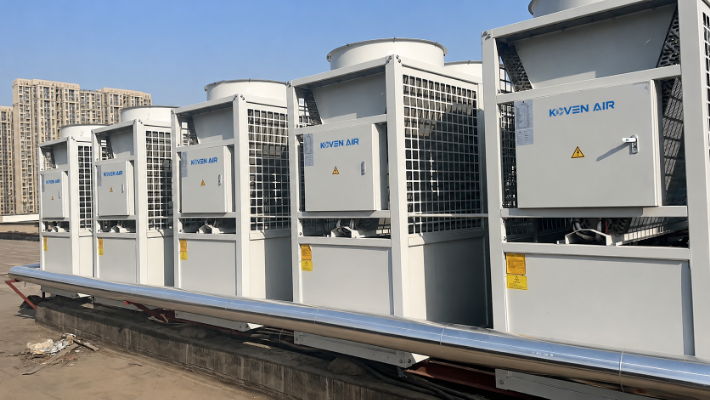
Koven Air KAFM modular chillers: modular cooling with two key benefits Koven Air KAFM modular chillers offer a smart alternative to fixed-capacity chillers, comprising a range of modular 20 RT, 30 RT and 40 RT modules assembled into banks instead of one standalone unit. These modular systems cover a wide rated capacity from 65 kW to 820 kW (19 to 234 refrigeration tons) and can be specified with heat-pump or heat-recovery functions within the same chassis.
Request a Quote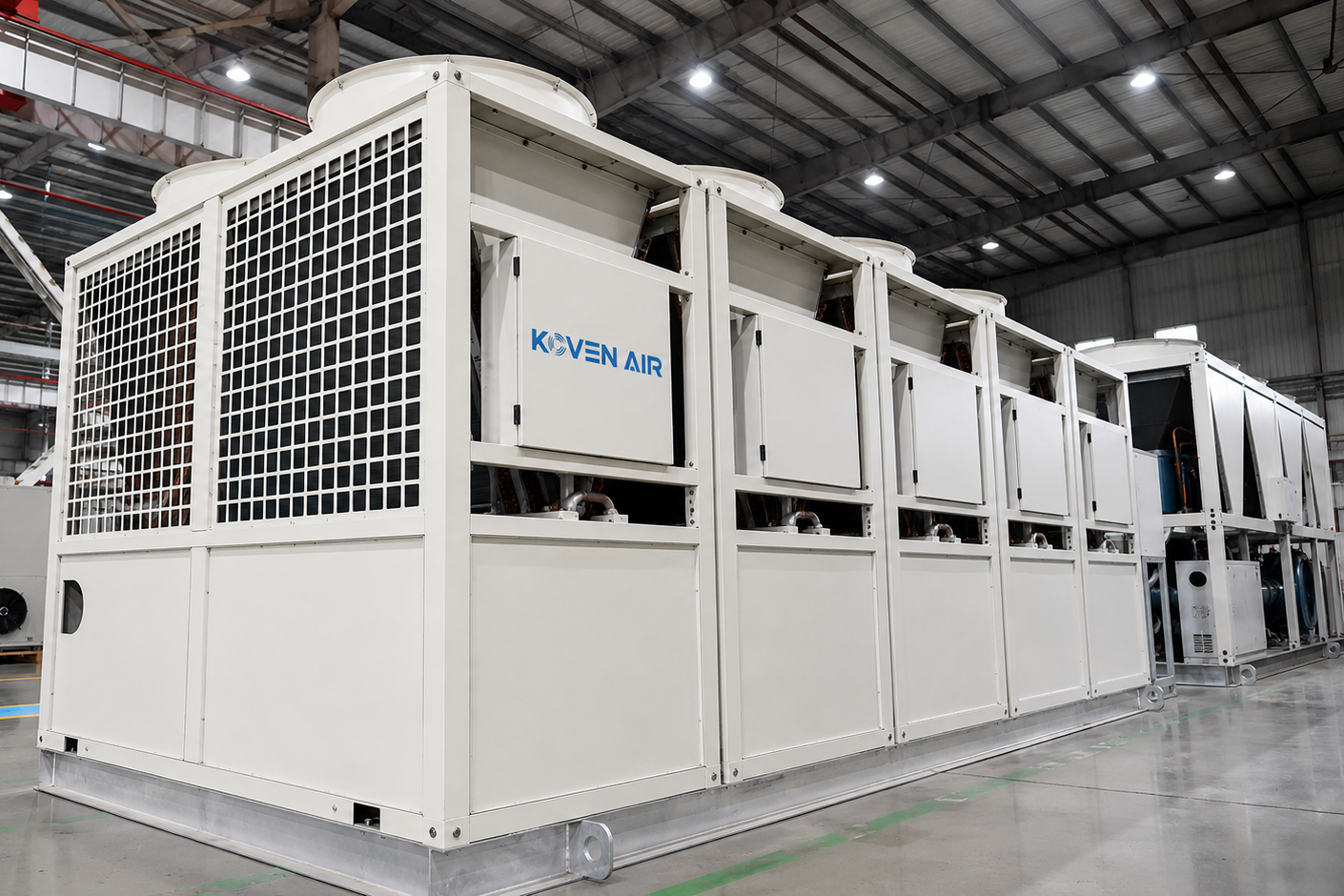
- Key features of Koven Air KAFM modular chillers Rated cooling capacity: 65-820 kW (19-234 TR) per bank
- Modular units: available in 20 RT, 30 RT and 40 RT, which can be mixed and matched to create banks of up to 12 modules
- Hermetic scroll compressors, two independent refrigerant circuits per module
- Refrigerant: utilizes R410A; ensure to consult the compliance section for regulated markets
- Operating environment: cooling ambient envelope ranges from -15C to +43C, with the low-ambient DFM series operating down to -30C
- Optional coaxial-tube heat recovery exchanger, hot water to 55°C
Why Fixed-Capacity Chillers Waste Capital, and Where Modular Wins
A modular chiller is a group of independently controlled refrigeration modules, connected to a common header and operated by a single master controller. Most commercial and industrial cooling loads fluctuate through the year and rarely sit at peak design load. Consequently, one fixed-capacity chiller sized for the design day spends much of its life cycling against a load it was never sized to serve well.
Cost implications are multi-faceted. Oversized fixed-capacity units endure constant cycling, which leads to premature compressor failure. Duplicate, standby units of the same size increase the plant room footprint by 100%. If the building’s capacity needs to expand, the entire existing plant needs to be replaced rather than augmented.
This inherent problem of traditional chillers – a single fixed-capacity plant designed for peak load and serving a highly variable load – is addressed by the modular approach. By replacing the single machine with multiple independent chiller units under one sophisticated control system, the heating and cooling duty can be precisely staged to match the actual load, without costly re-engineering of the plant room. Future capacity increases become a simple purchase order instead of a complex construction project.
Modularity isn’t just a design aesthetic; it’s a control strategy. Efficient matching of output to load drives energy conservation over the lifespan of the plant, and that usually outweighs the design-day nameplate capacity which dominates tender comparisons.
3
Independent failure domains in a 3-module bank, versus one in a single machine
12
Maximum modules per KAFM bank, staged by one master controller
2
Refrigerant circuits inside every single module
OPERATIONAL ADVANTAGES
In simple terms, the advantages of modular chillers can be categorized into four primary areas: efficient staged part load operation, built-in redundancy coverage, simplified installation, and the release of capital over time. These four pillars are the foundation upon which the modular solution earns its place; it doesn’t compete on peak efficiency, and any vendor claiming otherwise is misrepresenting the data.
The discrepancy between design day and actual operating conditions is the central issue. A plant designed for peak conditions operates well below its intended duty for much of its life, resulting in excessive wear on an expensive piece of equipment. Koven Air’s KAFM banks, spanning 65 kW to 820 kW, avoid this compromise because each module is built to a standard production process and meticulously tested in an in-house chiller and heat pump testing laboratory prior to shipment. This resolution of the trade-off occurs at the selection stage, rather than at commissioning, across commercial buildings, industrial plants and data centres.
THE PART-LOAD REALITY
Modular plants meet all three of those requirements. The modules modulate up and down with the live leaving-water temperature, so the plant follows the load rather than pursuing it. US Dept of Energy federal procurement guidelines for chillers specifically segregate full load efficiency and integrated part load value because a chiller can be excellent at one while performing poorly on the other.
That distinction is the whole argument for modular equipment, and also where most vendor marketing subtly exaggerates. We treat that at length in the section on part loads below.
Not sure whether modular is the right call for your load?
We return a detailed engineering estimate, not a brochure.
Koven Air KAFM Modular Chillers: Models and Module Combinations
The KAFM Module-Combination Blueprint
Most modular ranges offer a single module size and instruct you to multiply out. The KAFM banks include three module sizes to allow the plant to hit the required duty exactly, instead of rounding up to the nearest whole module. Rounding up is costly: every kilowatt in surplus represents capital, footprint and standing loss.
There’s nomenclature confusion among modular chiller manufacturers, and it’s worth setting up: one module represents one chiller-building-block of one size. Multiple modules in the same frame represent a modular air cooled chiller bank. Similar architecture is branded as a water-cooled modular chiller; if the circuit direction is reversed, it becomes a modular heat pump chiller. That’s a modular scroll chiller in the most stringent sense, comprising two hermetic scroll compressors per module.
KAFM basic modules, rated at 12°C entering / 7°C leaving chilled water, 35°C ambient
| Model | Cooling (kW) | Heating (kW) | Cooling input (kW) | Water flow (m³/h) | Connection | Operating weight (kg) |
|---|---|---|---|---|---|---|
| KAFM-020H | 65 | 73 | 20.7 | 11.2 | DN50 | 700 |
| KAFM-030H | 100 | 108 | 31.1 | 17.2 | DN65 | 950 |
| KAFM-040H | 130 | 142 | 42.5 | 22.4 | DN65 | 1180 |
| KAFM-042H | 150 | 160 | 43.0 | 25.8 | DN65 | 1185 |
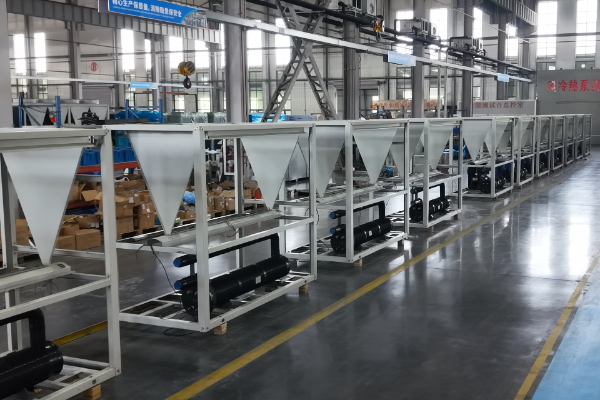
Each module houses two hermetic scroll compressors on independent circuits. Thus a failure in one compressor removes a quarter of a two-module bank, not half or all of it.
The modules are pre-assembled and factory wired, allowing plant tonnage to be set by combination code, not by field assembly – this is the practical advantage of a modular chiller systems over a built-up chiller plant.
The trap in single-size ranges is rounding. A 165 kW duty served by a single-size 100 kW module range means buying 200 kW, and the surplus 35 kW is capital, footprint and standing loss for twenty years. Unlike that arithmetic, mixed 20, 30 and 40 RT modules land on the duty, which is the mistake this range is built around avoiding. Every module is produced under ISO 9001 certified process control on the same 400-step traceable production line.
How the combinations reach 19 to 234 tons
Bank designations encode the mix directly. In KAFM-050H-110, the trailing digits read one 20 RT module, one 30 RT module, zero 40 RT modules. Two modules therefore deliver 165 kW of rated cooling where a single-size range would need three.
Representative bank combinations. Trailing digits = count of 20 / 30 / 40 RT modules
| Bank model | Module mix | Cooling (kW) | TR | Cooling input (kW) | Water flow (m³/h) | Header |
|---|---|---|---|---|---|---|
| KAFM-040H-200 | 2 × 20 RT | 130 | 37 | 41.4 | 24 | DN80 |
| KAFM-050H-110 | 1 × 20 + 1 × 30 | 165 | 47 | 51.8 | 30 | DN80 |
| KAFM-080H-400 | 4 × 20 RT | 260 | 74 | 82.8 | 48 | DN100 |
| KAFM-090H-030 | 3 × 30 RT | 285 | 81 | 93.3 | 54 | DN100 |
| KAFM-120H-600 | 6 × 20 RT | 390 | 111 | 130.8 | 72 | DN125 |
| KAFM-160H-800 | 8 × 20 RT | 520 | 148 | 174.4 | 96 | DN150 |
| KAFM-200H-005 | 5 × 40 RT | 650 | 185 | 207.0 | 120 | DN200 |
| KAFM-250H-034 | 3 × 30 + 4 × 40 | 820 | 233 | 258.9 | 150 | DN200 |
Modular vs a Single Large Chiller: the Part-Load Truth
The claim the industry avoids. Koven Air’s own product line settles it: measured across our catalogue, modular banks do not reach the design-load efficiency of our large single machines. The trade press says the same thing; Consulting-Specifying Engineer observes that modular chiller efficiencies are typically not as high as those of large single chillers. Their commentary corroborates our data rather than carrying it. Modular scroll banks run a rated COP near 3.1 to 3.5. Centrifugal machines run 6.31 to 6.56, and magnetic-bearing machines 6.42 to 6.86. If peak coefficient of performance at design load is your only criterion, do not buy a modular chiller.
The Part-Load Staging Staircase
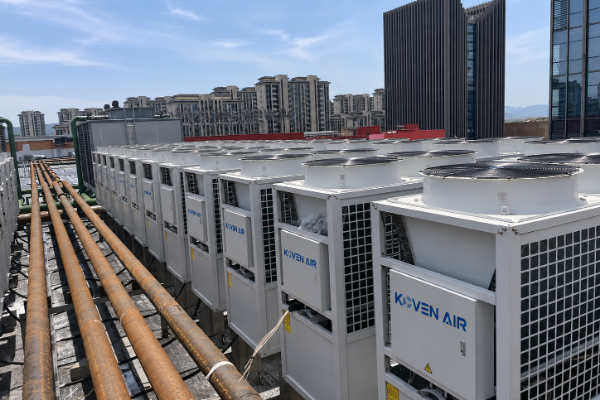
Comparison of modular chiller and conventional chiller usually begins at capacity. It ought to begin at load profile. Design load is where a chiller is judged, not usually where it lives. Eight 20 RT modules fill 12.5% capacity steps in between them. One 160 RT machine holds one step and then unloads its compressor against a load that can’t match.
| Building load | Modules running | Delivered (kW) | Bank behaviour | Single-machine behaviour |
|---|---|---|---|---|
| 100% | 8 | 520 | All modules at rated duty | Full load, best efficiency point |
| 75% | 6 | 390 | Six modules at rated duty | Compressor unloading |
| 50% | 4 | 260 | Four modules at rated duty | Deeper unloading, efficiency falls |
| 25% | 2 | 130 | Two modules at rated duty | Near minimum step, cycling risk |
| 12.5% | 1 | 65 | One module at rated duty | Short-cycling |
This is the staircase, and it’s the product. Running modules sit close to rated capacity, while idle modules use nothing. Regulators are smart about this division; U.S. federal procurement of chillers mandates a full-load efficiency requirement in addition to an integrated part-load efficiency, allowing for a part-load-optimized machine to meet a reduced full-load capacity of 9.700 EER per ASHRAE 90.1 Path B.
What our numbers actually say
At the catalog value of 3.06-3.49 CoP for the four different modules-or about 10.4-11.9 Btu/Wh at 12°C entering water, 7°C leaving water, and 35°C ambient-there’s a lot to like, although they’re not certified ratings.
Such ratings have legal weight as well as technical; they’re required by 10 CFR Part 431 Subpart F for covered commercial equipment and are evidence when meeting any efficiency requirements regulated by Department of Energy procedure. Calculations on a product catalog may guide design, but aren’t proof; they may not reflect the exact equipment and the test configuration that meet legal efficiency standards. If the project’s design will be subject to efficiency regulations, let’s know so that we may supply you with certified performance of your exact specified configuration.
HVAC energy efficiency is a property of the entire system, not the equipment’s nameplate. Other options are also available: the heat rejection can be handled by a water-cooling system, typically employing a cooling tower, which in turn lowers energy consumption compared to air-cooled modular units while adding water treatment and cooling-tower maintenance; magnetic-bearing, oil-free systems push efficiency higher still; variable-speed compressors narrow the part-load gap from the other direction; and buildings already running heat recovery ventilation on the air side face the same question on the water side. A water-source loop shifts the same duty again. Whichever refrigeration systems you compare, judge the whole HVAC system across the operating year, because a highly efficient machine on the design day can be the wrong machine for the other 364.
Built-In Redundancy and Uptime: the N+1 Advantage
An N+1 configuration provides one unit more than the thermal load require. In a conventional plant that means one extra machine of the same size, or three machines running at half capacity. In a modular bank it means one extra module.
The arithmetic is ours to show, not a supplier’s to assert. Holding one spare 20 RT module against an eight-module 520 kW bank buys the same continuity of supply as holding a second 520 kW machine, at roughly an eighth of the spare capacity. A manufacturer white paper published by ACHR News makes the same point in one line, comparing a 10-ton backup modular chiller against a 100-ton backup packaged air-cooled chiller; treat it as a vendor claim, and check the arithmetic against your own duty. Redundancy is the same. Capital is not.
What happens when a module faults
Each KAFM module is an independent refrigerant circuit under a centralized microprocessor group control. Any module that trips is isolated; remaining modules restage against the leaving-water setpoint. It also prioritizes compressors with the lowest accumulated runtime, distributing wear across machines rather than centering it on the lead.
contractors ask the obvious counter-question on public forums: What happens if the master controller fail? It’s a valid concern, and the market response is seen in the availability of a fail-to-run mode from the category leader. Ask any modular vendor, including us, to show you the controller failure mode at the factory test floor before signing.
It all comes down to risk math. Losing a single 65 kW module in an eight-module 520 kW bank causes a 12.5% loss of capacity; losing one 520 kW machine causes 100% loss of capacity, and the shipping delay to get a replacement compressor takes weeks. For hospital, semiconductor, and data center production, this is the only procurement argument, and the reason Koven Air tests every module for 24 hours of aging and provides ISO 9001 certified traceability on over 400 manufacturing steps.
Redundancy is not the whole data-centre story
Module redundancy addresses availability; thermal efficiency doesn’t, and to consider the two together is a common specification error. Today’s data center cooling depends on chilled-water supply temperatures, the number of hours of economizer or free cooling, and the power usage effectiveness they generate; not the count of modules alone. Purpose-built modular architectures designed for this duty are disclosed in US patent US11240937B2, “Modular chiller for data centers”.
For any data center in a jurisdiction where the U.S. is mandating a transition away from certain refrigerants, consult the “compliance” section before this one.
Operating Envelope, Low-Ambient Series and Heat Recovery
Field reports are honest about the failure mode nobody will put on their specification sheets. A technician on a refrigeration forum described a 104°F day, chillers that could not keep up, and asked whether anyone had fitted misting systems to their modular units. air-cooled capacity drops as ambient conditions rise, and systems sized on catalog data alone without a derate curve perform poorly when it matters most.
For this reason, we publish the envelope instead of the headlines. None of the five vendors ranking high on this search term will publish an ambient operating range on their product page.
Published operating envelope
| Mode | Standard KAFM (FM) | Low-ambient KAFM (DFM) |
|---|---|---|
| Cooling ambient | -15°C to +43°C | -15°C to +43°C |
| Heating ambient | -10°C to +26°C | down to -30°C |
| Chilled water leaving | 5°C to 15°C standard; discrete setpoints from -30°C to +65°C available on request | |
Ranges above are the mode-specific figures published in our combination tables. Envelope varies with unit type, module mix and leaving-water setpoint, so confirm the exact limits for your configuration with our technical department before you specify.
Heat recovery on the same chassis
An optional coaxial-tube heat exchanger recovers condenser heat, providing hot water between 15°C and 55°C while the bank is operating in cooling mode. For a KAFM-020H module, the heat recovery duty is 73 kW with a flow rate of 12.6 m³/h and a pressure drop of 22 kPa. Four-pipe variants elsewhere in the category deliver simultaneous heating and cooling from a single bank, and several publish recovered hot water at 140°F. Where winter ambient falls far enough, free cooling moves duty away from the compressors and the evaporator receives water already pre-cooled outdoors, which lets cold-climate plants hold their cooling capacities without a larger machine. The use of reversible modular architectures that cascade between the building cooling loop and air-source heat rejection is disclosed in published US patent application US20230288112A1.
Elsewhere in the category, Four-Pipe configurations simultaneously present multiple heating and cooling on one bank, and multiple present recovered hot water at 140F. When winter ambient temperatures are low enough to justify, free cooling passes off work to something else, allowing the compressors to cool water as it comes pre-chilled from the outdoor ambient, a key reason cold climate plants apply modular banks with economisers instead of larger units.
A common observation from design institutes is the lack of reference designs for air-cooled heat-recovery modular systems, which explains why we publish recovery duties, flows and pressure drops per module, rather than a single number that represents an overall system. Should your application require heat-pump functionality rather than the heat recovery, our air-to-water heat pump range directly addresses this requirement.
Instead of simply quoting a single number that defines a device, Koven Air cites the operating envelope. Why? Risk is asymmetric; an undetectedderated bank at 43C (109F) would present its first real failure on the hottest day of the year, a contingency for which no certification will pay you back. We apply our ISO 9001 certified process, backed by each KAFM’s 24-hour ageing test and our exhaustive, 36-point inspection, to ensure our quoted envelope is a commitment rather than a marketing figure.
Designing for a high-ambient or sub-zero site?
Send the design conditions and we return a specific derate estimate.
WhatsApp a Modular Chiller Engineer
Hydronic Integration: Flow, Pressure Drop and the Plant Interface
A modular chiller plant stands or falls at the water side. On a building-automation forum, a mechanical contractor described the real work: several banks of different modules, all requiring staging logic in the building management system. That integration is where schedules slip, and it stays invisible on a specification sheet that stops at cooling capacity.
Just two numbers determine whether stages function at all: each module’s required flow, and the pressure exerted by the header. The result of this situation is threefold—and all three are legitimate questions to ask a modular vendor.
“In about nine out of ten cases where a modular bank fails to perform, it’s a plumbing problem, not a refrigeration problem-either someone forgot to size the header, or failed to tell the building automation system how to control the stages.”
| Configuration | Water flow (m³/h) | Pressure drop (kPa) | Module connection | Header | Heat exchanger |
|---|---|---|---|---|---|
| Single 20 RT module | 11.2 | 44 | DN50 | n/a | Shell & plate |
| Single 40 RT module | 22.4 | 44 | DN65 | n/a | Shell & plate |
| 2-module bank (130 kW) | 24 | 65 | DN50 | DN80 | Shell & tube, spiral baffle |
| 6-module bank (390 kW) | 72 | 90 | DN50 | DN125 | Shell & tube, spiral baffle |
| Largest bank (820 kW) | 150 | 90 | DN65 | DN200 | Shell & tube, spiral baffle |
Three hydronic checks before you specify
Minimum Flow versus Staged modules
As each bank stages down, header flow decreases. Clarify what will happen when stages are idle and minimum flows to active stages are applied, or low-load days become nuisance trip days.
Variable Primary Flow
Header pressure drops climb from 44 kPa with a single module up to 90 kPa with banks. Pump heads should be sized for the bank not the module, since compensation of chiller capacity controls to variable flow is basic, old engineering, granted as US6085532A and in the public domain since. Header piping and pump selection belong in system design review, not in a change order.
Glycol, Freeze Protection and Buffer Volume
Operating below 0C ambient, and the use of low chilled-water temperature setpoints, alter fluid properties as well as the necessary system volume. Clearly state the required glycol concentration with your inquiry, as this influences flow, pressure drop, and capacity together.
But unlike an off-the-shelf package with one fixed flowrate, the banks introduce a moving target and the trade-off is always unquoted. Our Koven Air engineers test the flow/pressure-drop to match with your pump curve prior to quoting for this structural consideration, as you size it once for 20 years.
Where Koven Air Modular Chillers Deliver: Applications and Results
Milestones & Global Reach
- 2007: manufactured its first screw chiller.
- 2010: Started export by its own brand.
- Global: Currently its equipment is working in over 35 countries, such as Indonesia, Brazil, USA, South Africa, Mexico, Malaysia, and so on.
- Key Projects: Tesla super factory, Samsung Electronics, BMW automobile plant, Hilton hotels and Shanghai World Expo.
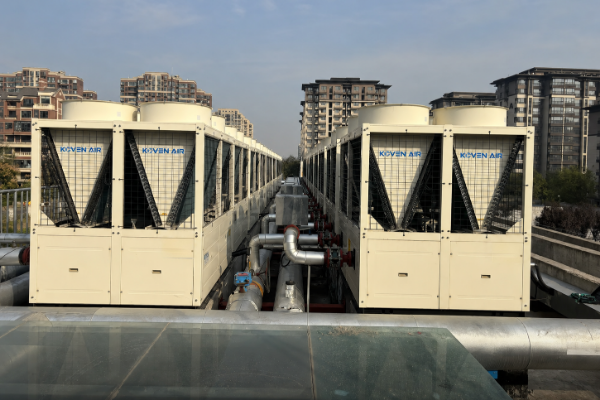
It’s application flexibility that carries these installs. Single modules are the small foot-print that will clear a freight elevator, tightly controlled temperatures maintained over a broad load band, and the tenant increase the capacity for them. Downtime-not capital- is what most of these project go/no goes, and electric heating duty is a whole new approach to how they’re written up.
Data centres
Staged redundancy plus free-cooling hours; check the 2027 refrigerant date first
Hospitals
Continuous duty where a single machine outage is unacceptable
Industrial parks
Phased build-out, capacity added per tenant
Semiconductor & battery
Tight leaving-water control across a wide load band
Total cost of ownership: what the structure looks like
Since we don’t have an objective number we won’t attempt to publish a “return-on-investment” for modular machines – no number exists outside of climate, tariff and load profile. YORK’s chiller total-cost-of-ownership comparison flips the air-cooled versus water-cooled ranking solely on the basis of water and electric prices. The Department of Energy publishes Building Life Cycle Cost software for this exact analysis.
What is structural rather than site-specific: a single spare module costs a fraction of a duplicate machine; identical modules mean one spare-parts inventory across the bank; and the trade-off is more compressors, therefore more wearing parts, than a single-compressor plant. Field practice favours modular where load varies widely, expansion is planned, or plant-room access is restricted. It favours a large single machine where load is steady, high and design-day efficiency dominates operating cost.
Certifications, Refrigerant Compliance and Jurisdiction
Certification is the place the place buying usually gets stung. The failure is considering a certification means a promise of performance: the ISO 9001 covers the process, the AHRI rating covers the unit, the refrigerant certification covers neither. Where efficiency could also be negotiated, an unapproved refrigerant in your space is just unsuitable at any value – the calculation has already been performed for you. Koven Air processes the below certifications and discloses its refrigerant stance in writing quite than leaving the consumer to determine the truth after they discover the 700 GWP.
The company operates according to a certified Quality, Environmental and Occupational Health management system, in accordance with the ISO 9001 family of standards. Chiller efficiency for regulated procurements is reported in accordance with AHRI 550/590 test methods; purchasers who are competing against a federal or code based efficiency minimum may wish to seek certified data on the precise configurations they are bidding.
Read this before specifying KAFM in the United States
KAFM modular chillers use R410A, which has a global warming potential of roughly 2,088. This isn’t a low-GWP refrigerant and we won’t describe it as one.
Under the US Environmental Protection Agency’s Technology Transitions rule, codified at 40 CFR Part 84, Subpart B, new chiller system installations face a 700 GWP limit on the following schedule: comfort cooling from 1 January 2025; industrial process refrigeration with exiting fluid above -30°C from 1 January 2026; and data centre, computer room and IT equipment cooling from 1 January 2027. R410A exceeds that limit. EPA’s sector summary tables restate the same schedule, but EPA states they are informational only and that the regulation itself governs.
In practice the consequence is straightforward. KAFM banks are specified for markets where R410A remains permitted, and for service and expansion of existing R410A plant. They aren’t offered as a compliant refrigerant choice for new US installations in the categories above.
Where a low-GWP refrigerant is required, Koven Air’s centrifugal and magnetic-bearing chiller ranges run on R134a and R1234ze, and those machines also deliver the higher design-load efficiency discussed earlier. Contact our technical department with the jurisdiction and application before the specification is frozen; the refrigerant field in the KAFM model code isn’t a detail, it’s a market-access decision.
Two adjacent pressures point the same way. Building owners pursuing LEED certification gain from the low refrigerant charge held in each individual module, and decarbonization targets now move refrigerant global warming potential ahead of nameplate efficiency in many tender scoring sheets. Sustainability reporting, in other words, has started to price the refrigerant before it prices the kilowatt. Climate change mitigation policy has become the constraint that decides which refrigerant is even allowed to deliver the duty.
Procurement Guide: Selection, Lead Time and After-Sales
Purchasing professionals tell us the most expensive mistake in this class is buying on purchase price alone and meeting the total cost of ownership afterwards. On modular equipment that hidden cost comes in two named forms: a spare-parts inventory sized for many identical compressors, and the integration labour of teaching the building management system how to stage the bank.
Lifecycle arithmetic usually reverses the ranking. Energy savings generated over a twenty-year period of commercial buildings operation, together with the avoided downtime of a plant that never fully stops, tend to outstrip a turnkey first-cost premium. Where a central utility plant already carries boilers, the same staging logic applies to the heating side.
Unlike a distributor’s published price list, a Koven Air calculation results in a price; the caveat that we do not attempt to hide is that a modular bank will include a larger number of compressors and accordingly a greater quantity of wearing parts than a single machine – and anyone telling you different has not done the maths. All of our equipment comes out of an ISO 9001 certified facility following 24 hour age testing and with our own in-house lab verifying published performance.
Pricing factors framework
KAFM is priced against the model code not a per ton list price. Cost moves dimensions, so we quote to dimensions, not against an abstract price that will be inaccurate in most instances.
| Cost driver | KAFM code field | How it moves cost |
|---|---|---|
| Module count and mix | Field 11 | Capital scales with modules; a mixed 20/30/40 RT bank avoids paying for surplus duty |
| Unit type | Field 5 | Cooling-only, heat pump, year-round cooling and hot-water units carry different circuits |
| Heat recovery | Field 6 | Partial or full recovery adds an exchanger and water circuit per module |
| Compressor brand | Field 7 | Danfoss, Copeland or Daikin; also determines regional spare-parts availability |
| Leaving water temperature | Field 8 | Non-standard setpoints below 5°C require confirmation and change delivered capacity |
| Motor type | Field 10 | Fixed speed, hybrid inverter, full inverter or explosion-proof |
| Power supply | — | 380 V standard; 415 V and 460 V available |
The lead time is based on the same logic and is quoted per configuration not guaranteed in a header. Explosion proof motors, non standard leaving water temperatures, and full inverter drives increase lead time. Standard cooling only banks in stocked module sizes are the shortest lead path.
What Koven Air commits to
PHASE 01 BEFORE ORDER
Project design review, verification of parameter accuracy, with professional calculation check to your load and hydronic data.
PHASE 02 DURING DELIVERY
Equipment ships only after production test, with onsite installation and commissioning assistance provided by technicians and site modifications based on site differences from drawings.
PHASE 03 AFTER COMMISSIONING
Lifetime free technical service assistance, instant reply during warranty, regular training to engineering contractors and engineers. Warranty conditions and periods are determined based on contract and territory.
Regulatory Note: The federal buying guidance from the Department of Energy is a useful neutral check for any chiller project, public or private sector, comparing both metrics of efficiency, using life cycle costing instead of initial purchase cost and understanding refrigerant transition as a risk to procure with associated retrofit cost.
Engineering Tools & Resources
Calculate modular combinations, simulate staging performance, and verify environmental compliance.
Modular Chiller FAQ
What is a modular chiller?
A modular chiller consists of a cooling plant constructed from numerous independent refrigeration modules linked in parallel, sharing a common water header and electrical supply, managed by one primary control. Each module has individual refrigerant circuits and can operate, be stepped, or shut off independently of the others.
What is the difference between a modular system and a conventional chiller?
Where traditional chillers supply their duty from a single machine, modular systems supply it from multiple discretely operated machines. modular banks are better equipped to match part load and offer a cost equivalent of one spare module whereas conventional chillers achieve a greater peak efficiency on the designed full load.
Are modular chillers more efficient than a large single chiller?
Not on full load. While scroll-based modular banks have rated coefficient of performance between 3.1 and 3.5, they rank lower than both centrifugal (6.31-6.56) and magnetic-bearing chillers (6.42-6.86). Modular units outperform conventional ones at part load staging, offering a price advantage of a spare module and ease of install and staged capital expenditure rather than at peak efficiencies.
Can modules from different manufacturers be mixed in one bank?
No. Communication protocols, circuit protection devices and hydraulic characteristics are brand specific and not transferable between makes. Multiple unit sizes within a brand, such as 20, 30 and 40 RT KAFM modules, are engineered for compatibility.
What happens if the master controller fails?
Ask for a demonstration. A single element in a modular plant that isn’t redundant, group control is the focus of the category’s “fail-to-run” guarantee. Get a demonstration of our or any supplier’s controller failure mode on the test floor prior to signing the contract.
How much does a modular chiller cost?
Equipment cost depends on the number and mix of modules, unit configuration, heat recovery, compressor brand, leaving-water temperature, motor type, and supply voltage. Therefore, a price per ton isn’t informative. Send us your completed KAFM model number or load and hydronic data for a quote based on the configuration. It’s always a good idea to look at the total life cycle cost instead of just the purchase price of the equipment when making most purchasing decisions.
Can KAFM modular chillers be installed in the United States?
Not for new installations in the restricted categories. R410A has a global warming potential of approximately 2,088, and thus is greater than the 700 GWP limit the EPA applies to new chiller systems installations; comfort cooling from January 1, 2025; industrial process refrigeration with exiting fluid above -30°C from January 1, 2026; and data center, computer room, and information technology equipment cooling from January 1, 2027. KAFM banks are supplied into markets where R410A is still permitted, and for the service, repair, and expansion of existing R410A plants, which remain permitted. Where a project requires a low-GWP charge, our centrifugal and magnetic-bearing ranges operate on R134a and R1234ze, and are more efficient at design load, too. The full schedule is set out in 40 CFR Part 84, Subpart B. Send us the country and the application, and we’ll state the position in writing before you specify.
Does a modular chiller need more maintenance?
More compressors and therefore more wearing parts than a single machine. Offsetting that, every module is identical, so one spare-parts inventory covers the bank and no service event takes the building offline.
Specify a KAFM Modular Chiller Bank
Send us your load profile, leaving-water requirement, ambient design conditions and jurisdiction, and we’ll return a verified selection of module mix, hydronic data, and a compliance statement to our pre-sales engineers.



![Commercial Rooftop Unit Guide: Types, Sizing & Costs [2026]](https://kovenair.com/wp-content/uploads/2026/07/commercial-rooftop-unit-guide-featured-2-150x150.png)