Get in Touch with Koven Air Company

Ceiling Mounted Air Handler — Commercial & Industrial Chilled-Water AHU
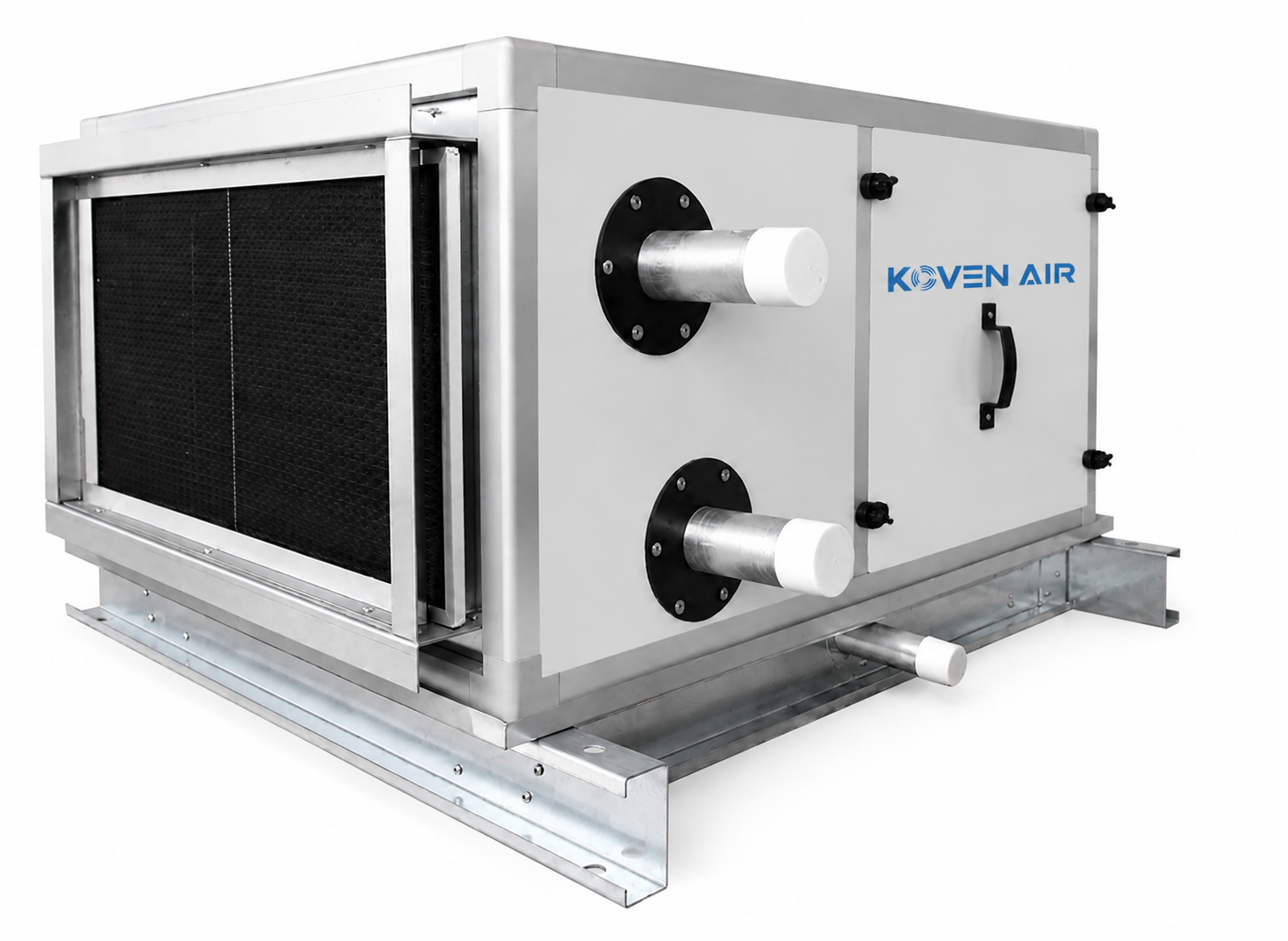
Free your floor plan and your plant room. Koven Air build ceiling-suspended air handling units that carry full commercial and industrial cooling loads – up to 15,000 m³/h and 244 kW – in a form factor the category leaders reserve for compact residential units.
1,000–15,000
Airflow (m³/h)
6.0–244.4
Cooling (kW)
≥30 m
Jet throw
DIN 1946
Hygiene design
304 / 316
SS optional
20,000+
Projects
Where Ceiling-Mounted Air Handlers Struggle — Throw, Hygiene & Condensate
A ceiling mounted air handler is a suspended air handler unit that filters, cools or heats, and distributes air from above the occupied zone. As the air-moving core of a commercial HVAC system, it draws in outdoor air, conditions it, and circulates it back through the building to regulate temperature and protect indoor air quality – all while freeing the floor and the plant room for buildings where space is the scarcest resource. That much every supplier gets right. Problems start where the specification gets serious.
Three failure modes decide whether an overhead AHU actually performs in a commercial or industrial building. First, throw: in a high-bay factory, warehouse or airport hall, a conventional ceiling diffuser cannot push conditioned air down to people and process. Cold supply air stalls and dumps to the floor once ceiling height climbs past roughly 3.3m (11ft), because the ADPI comfort-throw model most engineers rely on was never validated above that height. Second, hygiene: hospitals, labs and food plants need crevice-free, cleanable air paths and reliable condensate removal – not a general-purpose box. Third, condensate leakage, which field technicians rank as the single most common air-handler failure.
Koven Air engineers the ceiling mounted air handler around exactly these three risks. Its YS jet series uses ball-type nozzles to throw conditioned air up to 30m and hold it where you need it. Its casing is built to DIN 1946 / VDI 6022 hygienic principles – smooth internal surfaces, optional 304/316 stainless panels, multi-stage filtration. And every unit ships with a full-span, integrated condensate drain pan sized to the entire front panel, so water is collected across the whole coil face rather than at a single low point. That is the difference between a unit that survives a decade in service.
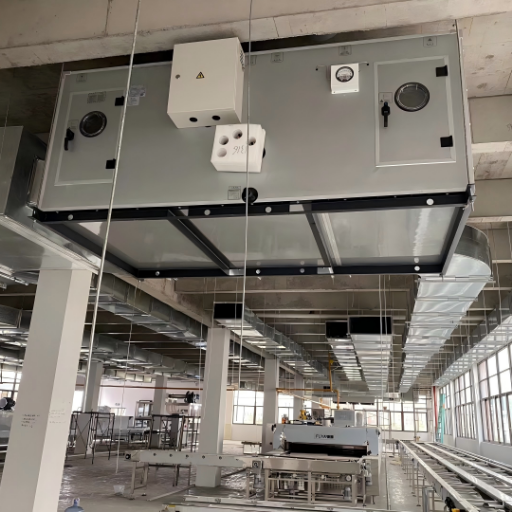
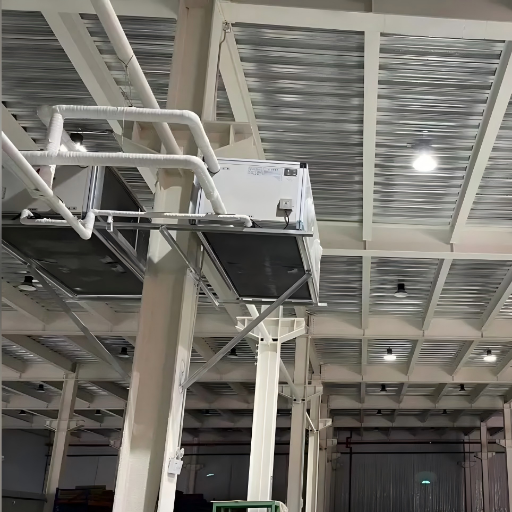
The Koven Range: ZKD Ducted & YS Jet Ceiling Air Handlers EngineerProcurement
Here is the fact the category leaders would rather you did not check: their ceiling-mount option stops at compact, light-load units. Survey the published capability matrices and wall/ceiling mounting is available only on residential-scale ranges up to about 7,500 m³/h – every large commercial, industrial and modular AHU they sell is a freestanding floor unit. Koven Air occupies that gap directly: a genuinely commercial and industrial ceiling mounted air handling unit that reaches 15,000 m³/h and 244 kW while still hanging from the structure.
Two series cover the space. Koven’s ZKD ducted series is the office/hotel/mall/hospital workhorse that uses ductwork for air delivery and needs external static pressure rating. Its YS jet series is the long-throw industrial and public high-bay specialist, using ball-type nozzles to propel air throughout the room. Both use the same cooling, casing and drain-pan engineering; you pick air-delivery method based on building configuration.
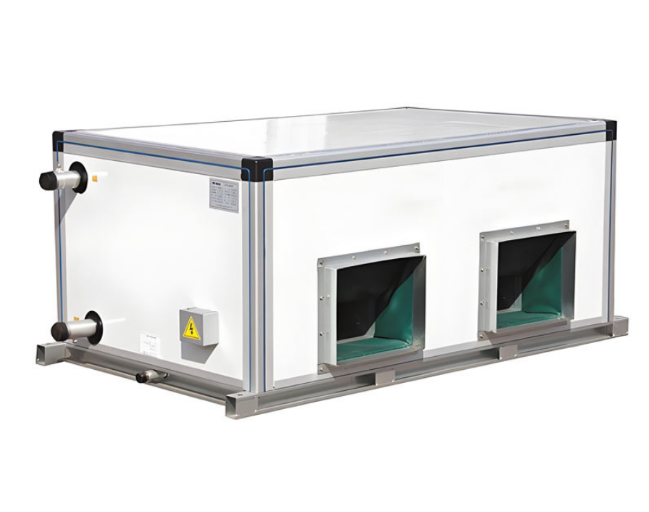
ZKD Series · Ducted Type
Ceiling Mounted Air Handler (Ducted)
ZKD Series · Ducted Type
Ceiling Mounted Air Handler (Ducted)Dual-inlet centrifugal fan and direct-drive motor, chilled/hot water cooling, plate or pleated filtration, color-steel or stainless casing. Single and double-fan models, ducted for external static pressure up to 400 Pa.
AIRFLOW
1,000-15,000 m³/h
COOLING CAP.
6.0-244.4 kW
DRIVE TYPE
Direct or belt drive
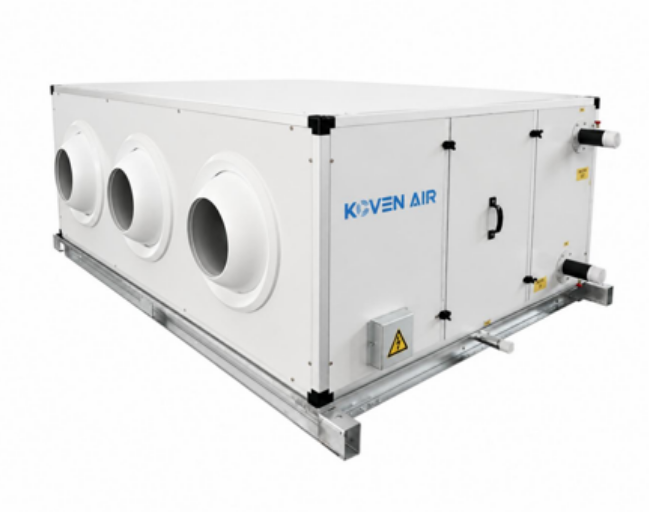
YS Series · Jet Air Handler
Long-Throw Jet Ceiling Air Handler
YS Series · Jet Air Handler
Long-Throw Jet Ceiling Air HandlerBall-type nozzle supply, adjustable ±60° discharge, horizontal or vertical-down delivery. Optional variable-frequency control and full fresh-air operation for transitional seasons.
AIRFLOW
1,000-12,000 m³/h
MAX THROW
Up to 30 m throw
FLUID DYNAMICS
Coanda-aided
Source: Koven Air ZKD technical datasheet (return-air table). cooling: inlet 27 °C DB / 19.5 °C WB, chilled water 7/12 °C.
| Model ZKD | Airflow (m³/h) | Cooling (kW) | Heating (kW) | Water flow (L/s) | Condensate DN |
|---|---|---|---|---|---|
| 010 | 1,000 | 6.0 | 11.5 | 0.29 | 25 |
| 030 | 3,000 | 19.2 | 35.6 | 0.92 | 25 |
| 050 | 5,000 | 32.5 | 59.7 | 1.55 | 25 |
| 080 | 8,000 | 51.0 | 93.7 | 2.44 | 25 |
| 100 | 10,000 | 63.7 | 117.2 | 3.04 | 25 |
| 150 | 15,000 | 88.8 | 170.9 | 4.25 | 25 |
Guide to selecting the optimal Koven Air handling unit based on architectural parameters.
| If your building is… | Recommended series | Why | Typical airflow |
|---|---|---|---|
| Office / hotel / hospital with ductwork | ZKD Ducted | Ducted distribution, external static pressure to 400 Pa | 1,000–8,000 m³/h |
| High-bay factory / warehouse (>5 m ceiling) | YS Jet | Ball-nozzle throw to 30 m reaches occupied zone | 3,000–12,000 m³/h |
| Airport hall / gymnasium / large open span | YS Jet | Directional ±60° supply, wide-angle coverage | 6,000–12,000 m³/h |
| Shopping mall atrium / mixed zones | ZKD or YS | Zone by throw distance; combine both series | varies by zone |
| Cleanroom / hospital hygiene zone | ZKD + 316 SS | Crevice-free stainless build, multi-stage filtration | 1,000–5,000 m³/h |
Chilled-Water Ceiling AHU vs. DX Cassettes vs. Packaged Rooftop
Most ceiling air conditioning searches turn up DX (direct-expansion) cassettes and heat pump units that contain their own refrigerant, as that’s what dominates light-commercial spaces. But if a building is run 24/7 or has a very large, variable load, economics drive a different path. Chilled-water air handling units are often reported to save 20-30% on operating cost versus their DX counterparts at scale – a real energy efficiency improvement and one they extend to loads a single cassette cannot manage. The trade-off for that efficiency gain is the chilled water plant required upstairs, which most industrial and commercial facilities already have.
| Criterion | Koven ceiling chilled-water AHU | DX ceiling cassette | Packaged rooftop unit |
|---|---|---|---|
| Cooling per unit | 6.0–244.4 kW | ~3–15 kW | ~20–150 kW |
| Airflow per unit | 1,000–15,000 m³/h | ~300–2,500 m³/h | ~2,000–25,000 m³/h |
| High-bay throw | up to 30 m (YS jet) | < 8 m | duct-dependent |
| Efficiency at scale | high (chilled water) | lower | moderate |
| Hygiene build (DIN 1946) | optional, to hospital grade | rarely | rarely |
| Floor / roof footprint | none (ceiling) | none (ceiling) | roof structure |
| Custom coil / casing | 304/316 SS, VFD, filtration | limited | limited |
Sizing the Throw: Selecting a Jet Air Handler for High-Bay Coverage
High-bay air conditioning’s most costly error is thinking a larger unit solves inadequate coverage. It does not. Oversizing an air handler can lead to short-cycling, inefficient dehumidification and excess noise, and the increased tonnage will still fail to reach the floor from standard diffusers. After roughly 3.3m (11ft) in a ceiling application, the standard ADPI throw chart ceases to apply and cold air will dump without distribution. High-bay coverage isn’t a matter of capacity; it’s a matter of throw engineering.
throw is the distance from the nozzle in which the supply air velocity has decreased to 0.5 m/s. You throw too little air and freeze the floor, you throw too much and your ceiling just gets warm.
Koven Jet Throw-Distance Selection Method
4-STEP SPECIFICATION PATH-
01
Zone the plan. Subdivide the floor plan by sections with similar throw requirements and calculate the cooling load for each zone.
-
02
Set nozzle against throw. YS series covers specific throw band range from ~12m (YS1) up to ~30m (YS8S). Match model’s throw coverage for the largest throw path within the area to be supplied.
-
03
Determine unit spacing. The width of the jet’s diffusion is approximately 0.4 the throw distance; place the units closer than this diffusion width, so their coverage overlaps without creating uncovered dead spots.
-
04
Use the ceiling. Mounted flush to the ceiling, the Coanda effect keeps the jet attached and extends its throw by a real, usable 1.4× versus a free jet — not a rounding error.
SPEC CRITICAL
Fan selection – Static Pressure
Our fans are selected on the actual duct static pressure, not just the nameplate airflow. A fan too small means that your coil gets hungry, while one too large will result in wasted energy and a chattering unit. Getting the static pressure math right on the first attempt will prevent a call-back to a ceiling unit that must be accessed via a lift.
— Koven Air Engineering Team, Application & Selection
| YS model | YS1 | YS2 | YS3 | YS4 | YS5S | YS6S | YS7S | YS8S |
|---|---|---|---|---|---|---|---|---|
| Throw (m) | ~12 | ~18 | ~22 | ~24 | ~22 | ~26 | ~28 | ~30 |
| Application distance (m) | 18 | 24 | 19 | 30 | 28 | 32 | 34 | 36 |
Koven Air YS horizontal-supply selection recommendation table (USER-DATA). Throws measured to 0.5 m/s axial velocity.
Proven in the Field: Malls, Airports, Hospitals & Factories
Koven Air ceiling mounted air handlers operate in over 20,000 projects completed across 35 countries – commercial office buildings, hotels, hospitals, shopping centers, airports, sports facilities, schools, universities, data centers, and industrial sites that manufacture everything from textiles and industrial machines to semiconductors and lithium batteries. Their core belief: commercial building space, especially those in the floor or plant room, is expensive, and air quality cannot be compromised.
As every project begins with a load and a building, not a catalog number, the same two series will transition from a 1,000 m³/h clinic space to a 15,000 m³/h manufacturing hall by simply switching rows of coil, filtration phase, housing material and the drive configuration. It is that kind of versatility which allows one manufacturer to accommodate a whole multi-use development. For projects that also need code-mandated fresh-air volumes, these ceiling units pair naturally with Koven’s commercial make-up air units for dedicated outdoor-air handling.
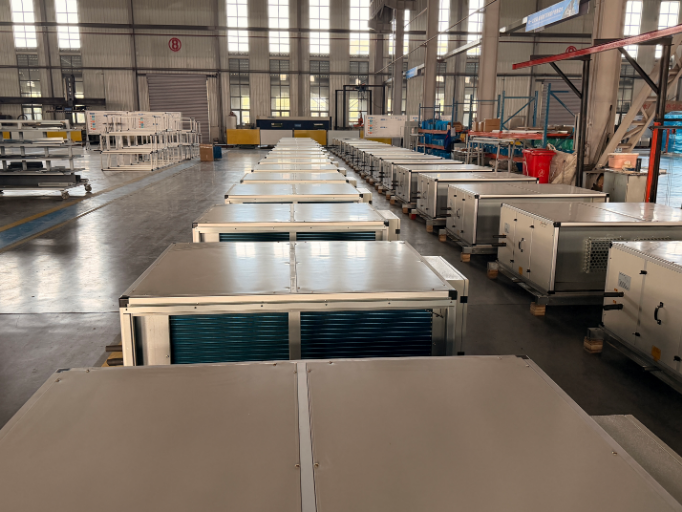
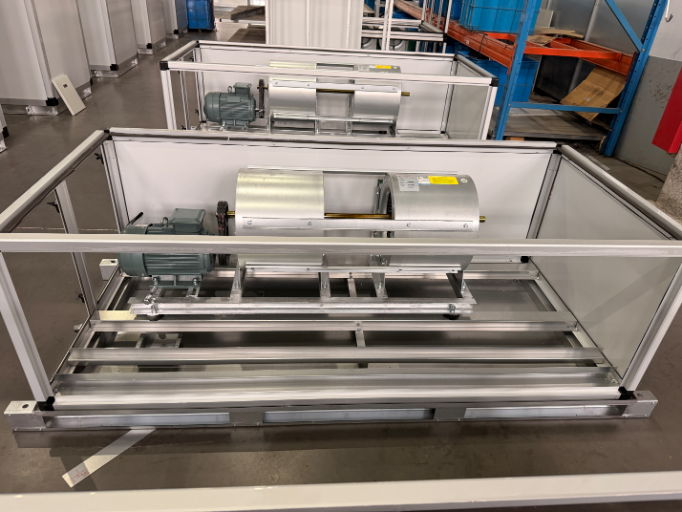
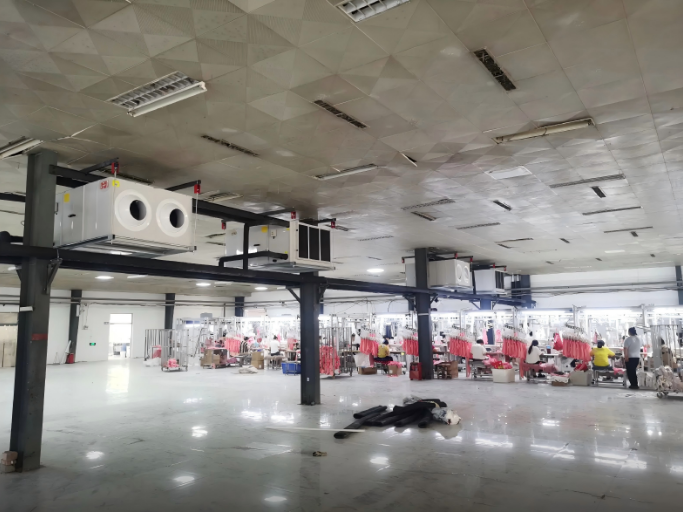
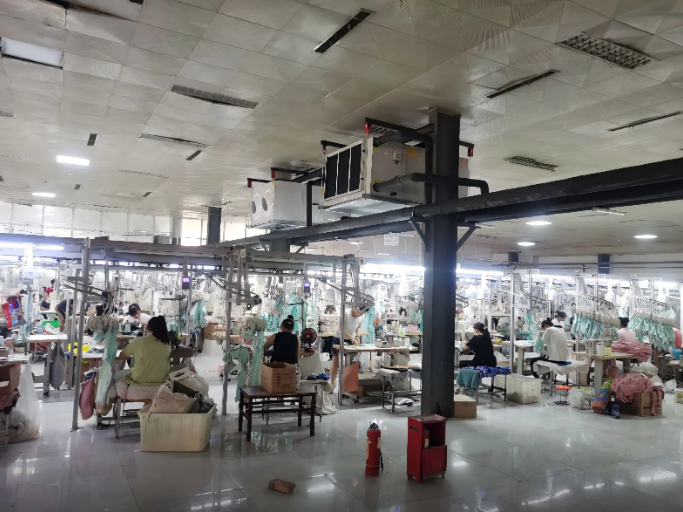
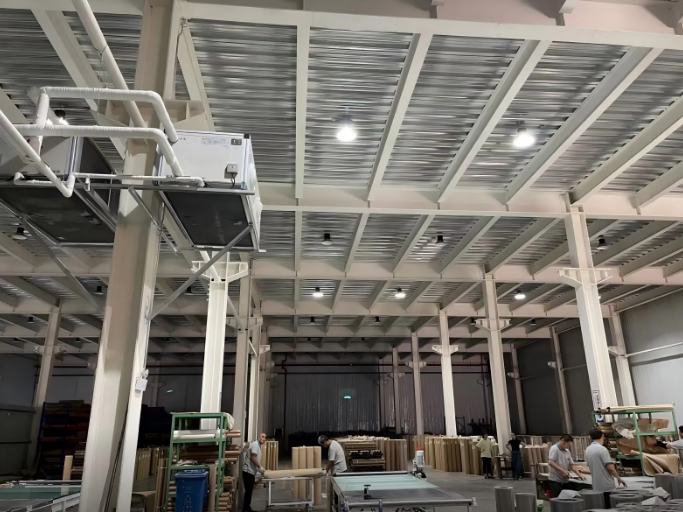
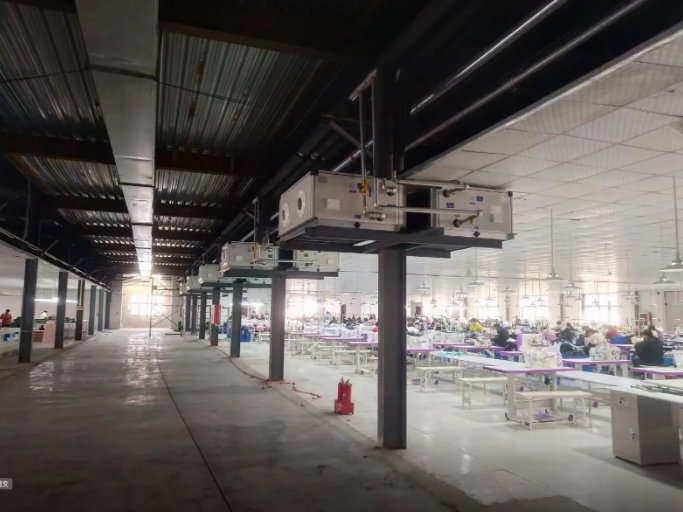
30 m
Jet throw covering high-bay industrial workshops with downward warm-air delivery
DIN 1946
Hygienic-grade air paths for hospital and healthcare environments
15,000 m³/h
Single-unit airflow for mall atriums and airport halls without floor plant
35
Countries with installed Koven Air climate-control equipment
Certifications & Hygiene Compliance
A reasonable challenge to any new exporter brand is “can the quality and paperwork actually withstand a 15-year building system?” Koven Air doesn’t use fancy adjectives to answer the question; it uses certification. Its units conform to internationally accepted quality, environmental, and hygienic standards, while the hygienic design specifically addresses the problems with condensate and hygiene inherent in standard air handlers.
Hygienic air-handler design according to DIN 1946-4 and VDI 6022 requirements include: clean, crevice-free inner surfaces, sloped drain pans of stainless steel to drain every last bit of condensate, and multi-stage filtration. Koven’s air handling units do it right: on-site 304/316 stainless internal and external panel construction is available, electrostatic filtration with 94% counting efficiency at ≥1 µm (as an alternative for two medium and coarse stages at just 40 Pa resistance), and the drain pan spanning the entire front panel, leaving nowhere for condensate to go.
DIN 1946
Hygiene-grade air handling design
ISO 9001
Quality management
ISO 14001
Environmental management
CE
European conformity
Ceiling Mounted Air Handler
Advanced Engineering & Selection Tools
Ceiling Mounted Air Handler FAQ
What is a ceiling suspended AHU?
A suspended (ceiling mounted) ceiling unit is designed to hang from the ceiling structure, supplying air from above the zone of occupancy rather than from floor or rooftop level. The same coil, fan, filters and drain pan components as any floor AHU are neatly contained in the low-profile unit case, maximizing floor and plant room space.
How do you stop a ceiling air handler from leaking condensate?
The #1 failure cause in air handlers: Condensate overflows result most often from an undersized or tilted drain pan. Koven’s unit has a full-span condensate pan designed for the entire front-panel area, catching all of the coil output, plus sloped, DIN 1946-type stainless steel drainage for hygienic units. Combined with correct installation-which our commissioning guidance ensures-these problems are avoided.
How far can a jet air handler throw conditioned air?
Koven YS jet series push supply air out 30 m (to 0.5 m/s axial), using ball type nozzles and Coanda ceiling-attachment effect that increases reach roughly 1.4× compared to a free jet. This makes them appropriate for high-bay factory buildings, warehouses, and airport halls, where conventional ceiling diffusers cannot reach the floor.
Is a chilled-water air handler better than a DX unit?
For large and continually operating buildings, chilled-water AHUs are typically more energy-efficient and are available in a much wider range of single-unit capacity than DX cassettes; according to various sources in the HVAC industry, these can provide savings of as much as 20-30% on operating costs when operating at scale. DX units work best for small, simple spaces. If your site already has a chilled-water system in operation, a ceiling chilled-water AHU is generally the best option in terms of overall life-cycle costs.
How much does a commercial air handling unit cost?
Custom commercial AHUs are priced across a broad band, typically between $25,000 and $500,000 installed, depending on size, casing, filter configuration, and controls. In many cases, installation pricing is quite close to the actual cost of production. Every Koven unit is engineered to your load and your building’s specifications, so our quotes are based on your project requirements rather than a set price list.
Can Koven build a hospital or cleanroom-grade ceiling AHU?
Yes. All our hygienic-configuration AHUs use 316 stainless steel panels both inside and out, with crevice-free, easily cleaned surfaces and multiple stages of filtration. The sloped drainage is made of stainless steel, complying with DIN 1946-4 / VDI 6022 hygiene standards, making them ideal for hospitals, laboratories, and other regulated environments.