Get in Touch with Koven Air Company

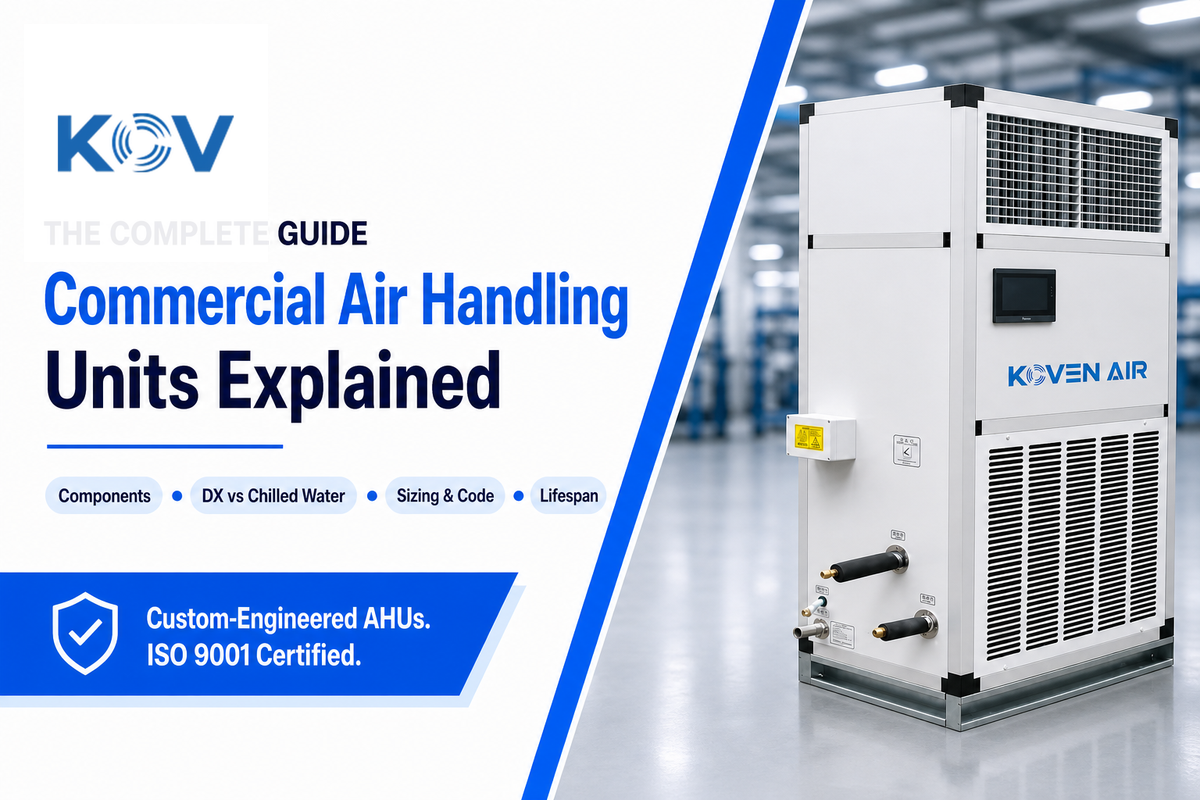
A commercial air handling unit is the sheet-metal box, commonly abbreviated AHU, that pulls in a combination of outside and return air, filters, heats or cools, and distributes it through a coil (chilled water or direct-expansion refrigerant) and ductwork – a very confusing device to specify and document. Here’s a beginner’s guide to commercial AHU, the factors in whether you buy DX or chilled-water cooling, how to stop yourself from selecting an unintended category of equipment, and a 2026 regulatory change that shifts the replacement-timing calculations for a significant number of existing units.
Quick Specs
| Airflow range | 1,500–200,000 m³/h |
| Cooling capacity | 8.5–600 kW |
| Fan motor power | 0.8–22 kW (1–30 hp) |
| Filtration stages | G1 (pre-filter) through M5 / F9 (fine) |
| Configurations | Split DX / Chilled Water / Vertical |
| Typical service life | 20–30+ years with proper maintenance |
In a nutshell: a commercial air handling unit (AHU) takes in a mix of outside and return air, filters it, conditions it across a coil (chilled water or direct-expansion refrigerant), and distributes conditioned air throughout the building’s ventilation ductwork – it doesn’t generate heating or cooling. Well-maintained units commonly exceed 30 years of service, though equipment with inconsistent maintenance schedules often exhibits average service lives well below that.
TL;DR
- Searches for “air handler” skew heavily toward residential replacement-part content; the term “commercial air handling unit” results in a dramatically different set of hits – internet pages originating from equipment manufacturers.
- Whether a central chiller system already exists on site determines whether you go with DX cooling or chilled-water cooling for a commercial AHU.
- Commercial AHU, rooftop unit (RTU), and makeup air unit (MAU) are different classes of equipment; they aren’t synonyms.
- IMC 606.2.1 requires that return-air systems over 2,000 CFM be paired with a duct smoke detector – a requirement unchanged from 2018 to 2024 editions.
- An EPA regulation issued in May of 2026 eliminated one of a customer segment’s automatic refrigerant installation targets prior to January 2026.
The 18,100-vs-590 Search Gap, Why “Air Handler” Results Rarely Show What Commercial Buyers Need
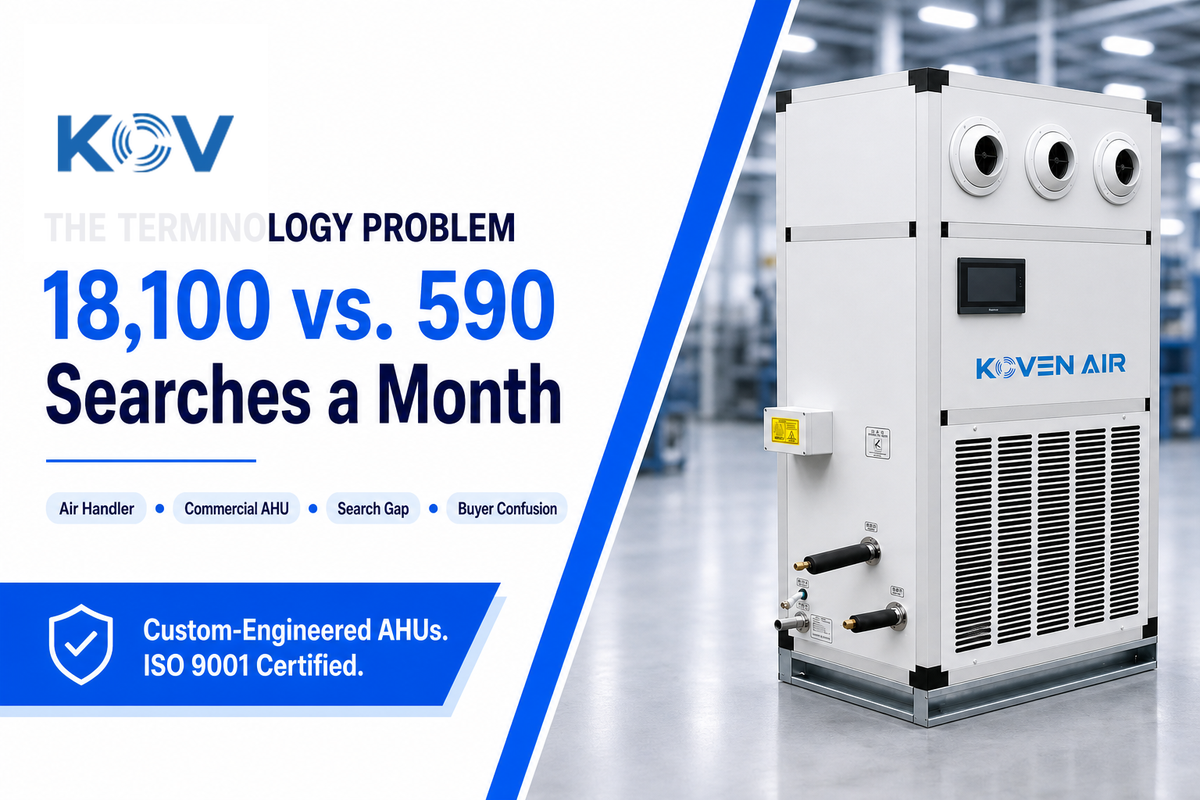
Search “air handler” and Google displays about 18,100 searches in a month, of content centered on parts from producers such as: Rheem, Lennox, Trane, Mitsubishi, Daikin, and Goodman – replacement parts and warranties for residential split-system equipment. Search “commercial air handling unit” instead and the monthly volume drop to 590, but the focused search results front-loads manufacturer’s product specification pages, and commercial glossary records, instead of residential components. Those volume figures come from Google’s own keyword-planning data, and the relative gap is easy enough to sanity-check yourself on Google Trends.
This isn’t coincidental – there are two separate types of equipment buyers using very similar language. Two very different constituencies – a facilities manager shopping for a delivery for a 15-storey office complex, and a person who need to replace a failed indoor coil – are searching for the same base term with different modifiers and landing in totally different places on the internet depending on which modifier they type in. Getting the language right matters: the correct term for equipment specified, purchased, or maintained for a commercial building is “commercial air handling unit,” or “commercial AHU” or whatever configuration you know you need (DX AHU, chilled water AHU). Rest assured, if you search only the fundamental noun, you’ll get a pretty different result set depending on whether you write “commercial” in front of it or not. There’s a practical cost to that overlap: a facilities engineer working against an RFQ deadline who spends an afternoon reading residential filter-replacement guides has burned research time that should have gone toward comparing manufacturer configuration options.
💡 Key Takeaway
Adding “commercial” makes a huge difference; it pushes the difference between multiple dozen product-specific sources and an individual manufacturer’s specification sheet.
What Is a Commercial AHU, and What’s Inside It?
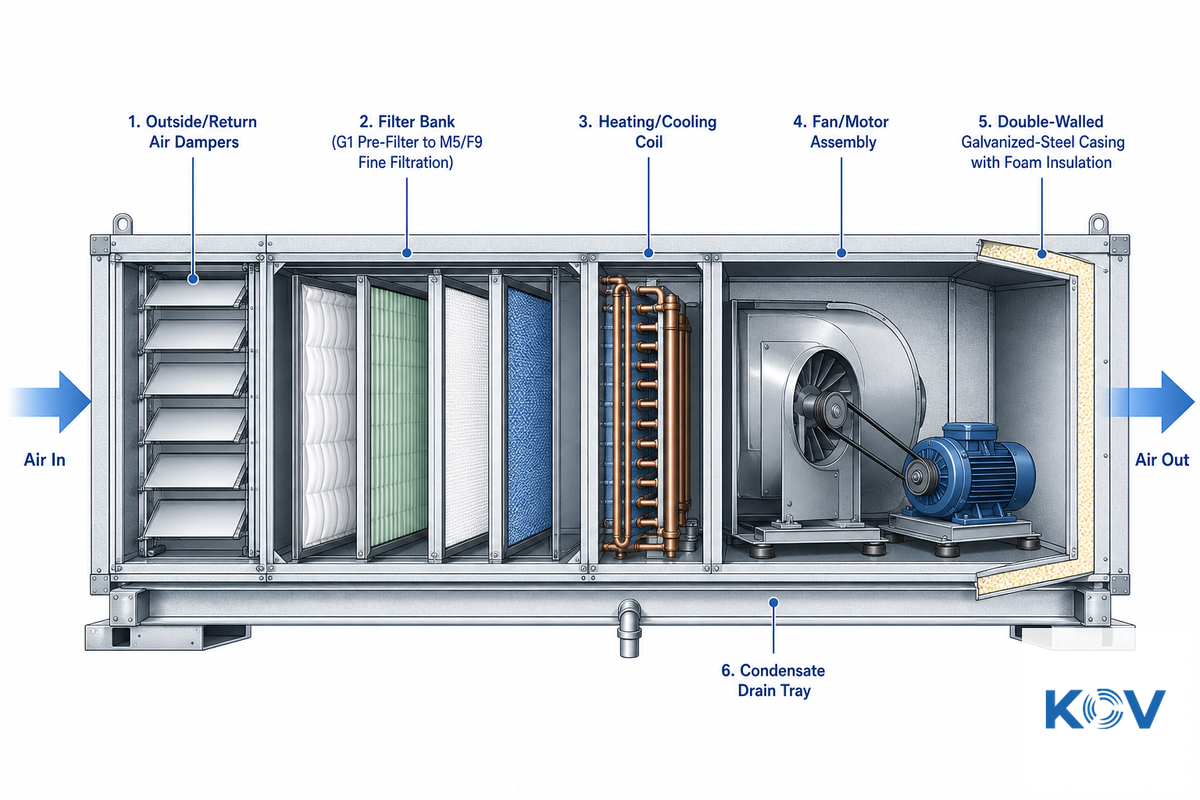
A commercial air handling unit (AHU) is a big metal cabinet that moves and conditions air inside a hvac system. It doesn’t generate heat or cooling on its own; instead, it draws outside air through an air intake, blends that indoor and outdoor air mixture – the ratio of outside air and recirculated air – filters the combined flow of air, and passes it over a heating or cooling coil before distributing it through the building’s ductwork via a fan.
Steady air movement keeps every zone within its design temperature band. Getting the ratio of fresh outside air right matters for improved indoor air quality: too little and pollutant levels build up in the indoor environment; too much and heating and cooling costs climb.
Six components do most of the work:
- Fan/motor – moves air through the unit and into ductwork; sized in the 0.8-22 kW range on a typical commercial line
- Heating/cooling coil – chilled water, hot water/steam, or direct-expansion (DX) refrigerant tied to an outdoor condenser, depending on configuration; each coil is a heat exchanger that transfers heat between the airstream and its water or refrigerant circuit
- Filter bank – from G1 pre-filters up through M5/F9 fine filtration or HEPA for cleanroom-grade pharma/biotech environments, stripping airborne particles before they reach occupied office spaces or industrial floors
- Dampers – regulate the mix of fresh outdoor air and recirculated indoor air
- Casing – double-walled construction in galvanized steel is now standard; injected-foam insulation with no thermal bridging outperforms fiberglass on both thermal and acoustic performance
- Condensate tray – collects water pulled out of the air during cooling; a neglected drain pan is a common source of algae/mold buildup and premature failure
Because commercial and industrial facilities depend on consistent environmental control, many owners tie their AHU into a building automation system for centralized monitoring and service and maintenance scheduling, and specify high performance advanced HVAC equipment – sometimes marketed as outdoor air handling units or a dedicated air handler unit – to manage energy usage across large commercial spaces and dense commercial HVAC equipment portfolios.
Do Air Handlers Use Refrigerant?
DX (direct-expansion) configurations use refrigerant: yes-the AHU’s coil connects via refrigerant lines to an outdoor condensing unit, the same architecture as a residential split system scaled up. Chilled-water configurations don’t: no-the AHU’s coil circulates water cooled by a separate central chiller, and refrigerant never enters the air-side equipment at all. Both approaches are common in commercial buildings; which one you’ve determines almost everything else about how the unit is serviced and expanded (see the next section).
Fan configuration is a second variable worth knowing: in draw-through units, the supply fan sits after the coils and pull air through them-the standard arrangement. In blow-through units, the fan sit before the coils, which lets fan heat be removed from the airstream without subcooling the supply air; this shows up more often in healthcare-facility applications and low-temperature air systems.
Component technology has been fairly stable for decades, though it isn’t static-a 2025 patent (US20250189145A1) for an AHU noise-suppression system is one example of ongoing incremental innovation in casing and acoustic design.
💡 Key Takeaway
If a spec sheet doesn’t tell you draw-through vs. blow-through and DX vs. chilled water, you don’t yet know enough to compare it against a competing quote.
DX vs. Chilled Water, Which Cooling Method Actually Fits Your Building
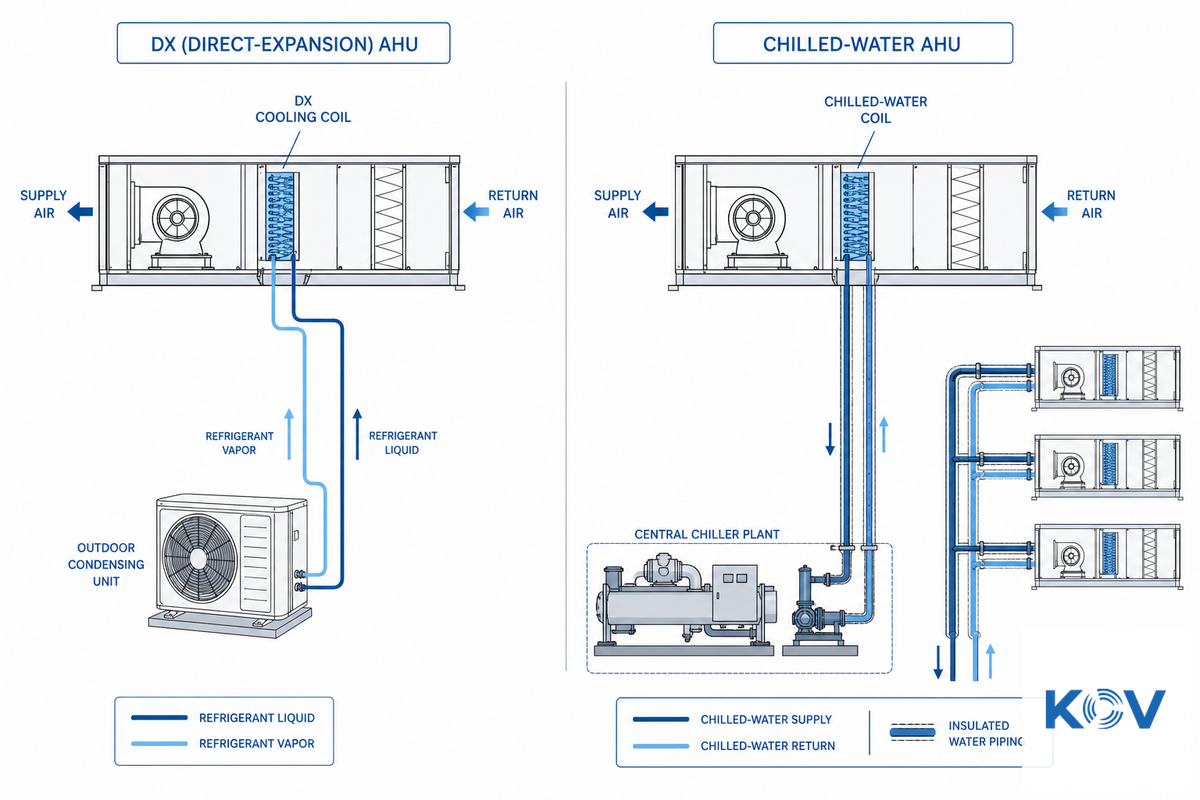
It comes down to one question: does the building already have a central chilled-water plant?
If yes, a chilled-water AHU eliminates a refrigerant circuit per air handler-with a central chiller already producing chilled water, running dozens of AHUs off that single plant is simpler than giving each one its own compressor and refrigerant circuit. Chilled-water coils are commonly specified in 4, 6, or 8 rows depending on the required leaving/entering water temperature and the latent/sensible cooling split needed.
When there’s no central plant, the quicker and less disruptive option typically is a split DX unit-since the compressor is in an outdoor condensing unit, you won’t need to run chilled-water piping to just serve one air handler. One tradeoff comes with it: every DX unit is self-contained, managing its own refrigerant circuit and compressor, and as you add units, you add to the list of places to check during routine maintenance.
✔ Chilled Water — Advantages
- No refrigerant circuit per AHU – one central plant serves many units
- coil rows (4/6/8) can be tuned to exact latent/sensible load
- Simpler long-term expansion as building load grows
⚠ Chilled Water — Limitations
- Requires an existing (or newly built) central chiller plant
- Chilled-water piping is a real upfront cost if no plant exists
- Not practical for a single stand-alone building with no other cooling load
A related energy-efficiency lever applies to either configuration: fan selection. ASHRAE Standard 90.1 sets maximum fan-power limits by airflow and application, and AMCA’s fan efficiency grading system sets a minimum efficiency bar for larger fans – exact thresholds have been revised across successive 90.1 editions, so confirm the specific FEG requirement against whichever edition your project’s jurisdiction has adopted rather than a fixed number.
In one modeled 175,000 sq ft office building running four 32,000 CFM VAV AHUs (per a 2012 Consulting-Specifying Engineer analysis), upgrading fan efficiency grade, motor efficiency, and cutting static pressure by 0.5 in. w.c. produced a measured 2% reduction in total building energy use and a 3%+ reduction in energy cost – enough to qualify for an incremental LEED point under that era’s rating system. Need a unit sized to your building’s actual load calculation rather than a catalog break point?
See Koven Air’s full commercial AHU configuration options, including split DX, chilled-water, and vertical product lines engineered to your airflow and static-pressure numbers before quoting.
💡 Key Takeaway
No central chilled-water plant on site → default to DX. Central plant already running → chilled water almost always wins on long-term simplicity.
AHU vs. RTU vs. Makeup Air Unit, Don’t Buy the Wrong Category
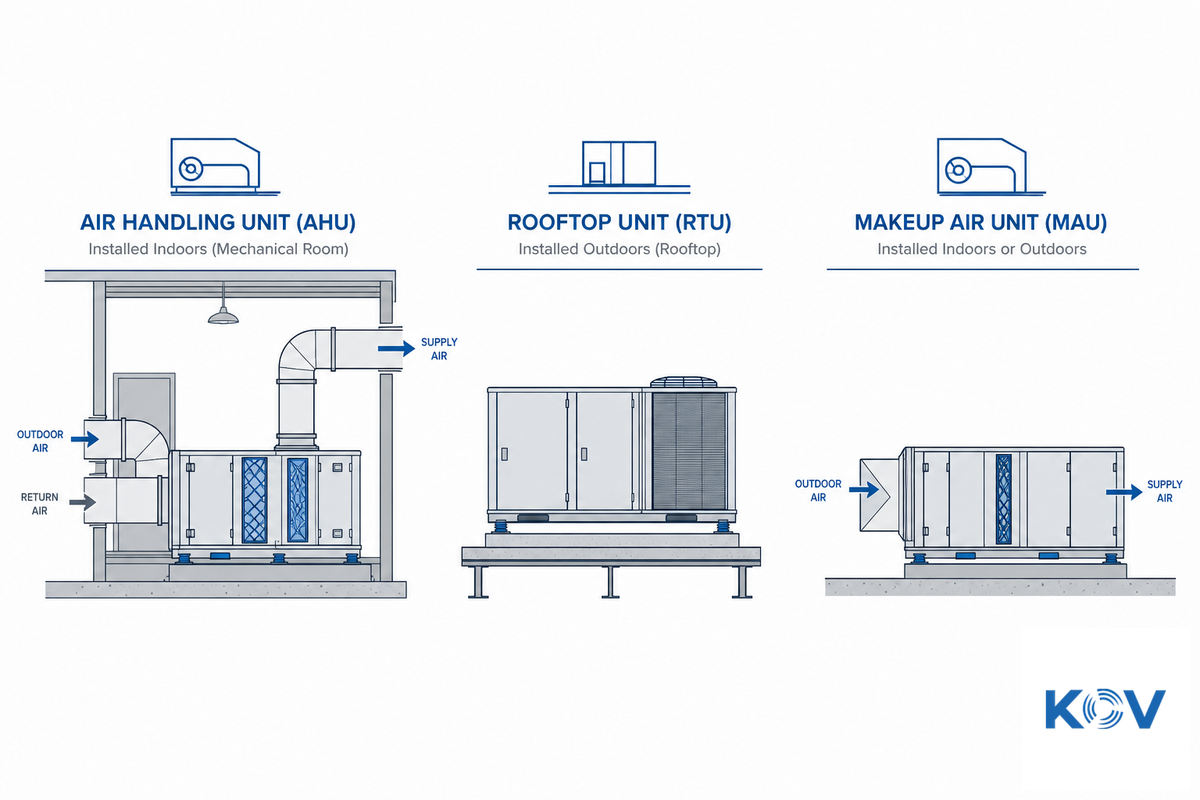
These three terms get used interchangeably in casual conversation and that causes real procurement mistakes.
They aren’t the same equipment category — and once you add in cooling method, airflow control, and fan arrangement, “AHU” alone actually covers several distinct setups that spec out very differently.
| Equipment / Configuration Type | Defining Variable | Typical Install / Context | Best Fit |
|---|---|---|---|
| Air Handling Unit (AHU) | Mix of return + outdoor air (typical) | Indoors, mechanical room | Central multi-zone systems, offices, hospitals, plants |
| Rooftop Unit (RTU) | Mix of return + outdoor air | Outdoors, on the roof (self-contained) | Single-zone or packaged multi-zone, saves interior space |
| Makeup Air Unit (MAU) | Mostly or 100% outdoor air | Indoors or outdoors | Replacing exhausted air — kitchens, labs, factories, garages |
| DX (Direct-Expansion) AHU | Refrigerant coil piped to an outdoor condensing unit | No central chilled-water plant on site | Standalone buildings without an existing chiller plant |
| Chilled-Water AHU | Coil circulates water from a central chiller | Central plant serving multiple AHUs | Campuses and high-rises with an existing chiller plant |
| Constant-Volume AHU | Fixed airflow rate, simpler control sequence | Spaces with steady, predictable load | Lower controls cost; ASHRAE data shows a 34.7-year median service life once replaced |
| VAV (Variable-Air-Volume) AHU | Airflow modulates with zone-level demand | Multi-zone buildings with varying occupancy/load | Better part-load efficiency; more complex controls to maintain |
| Draw-Through AHU | Supply fan sits after the coils | Standard fan arrangement | Most general-purpose commercial applications |
| Blow-Through AHU | Supply fan sits before the coils | Removes fan heat before the air is cooled | Healthcare facilities, low-temperature air systems |
| Fan Coil Unit (FCU) | Terminal zone-level unit, no central air handling | Ceiling- or wall-mounted at point of use | Individual room/zone conditioning; ASHRAE’s largest sample (n=1,279) shows a 36.5-year median replacement age |
An RTU is best understood as a self-contained AHU: the compressor, coils, fan, and filters are packaged into one outdoor cabinet, trading some configuration flexibility for a smaller mechanical-room footprint and simpler installation.
A makeup air unit is a specialized type of AHU built to supply mostly or entirely outdoor air, specifically to replace air an exhaust system (kitchen hoods, fume hoods, industrial process exhaust) has removed – without it, exhaust-heavy buildings run negative pressure, which makes doors hard to open and pulls in drafts and contaminants from unwanted paths. All MAUs are a type of AHU; not all AHUs are MAUs.
If your building is already exhausting a lot of air and you’re considering dedicated outdoor-air equipment, review Koven Air’s line of makeup air units for sizing and selection guidance in that specific product category. If a self-contained rooftop unit fits better with your space limitations than a indoor AHU, Koven Air offers commercial rooftop units for that application, and our companion piece on commercial rooftop unit types, sizing and cost can provide additional guidance for RTU selection.
💡 Key Takeaway
Exhausting lots of air → requires a makeup air unit, not just any AHU. Small mechanical room footprint → an RTU may save you installation dollars over an indoor AHU.
Sizing & Code Basics Every Buyer Should Know
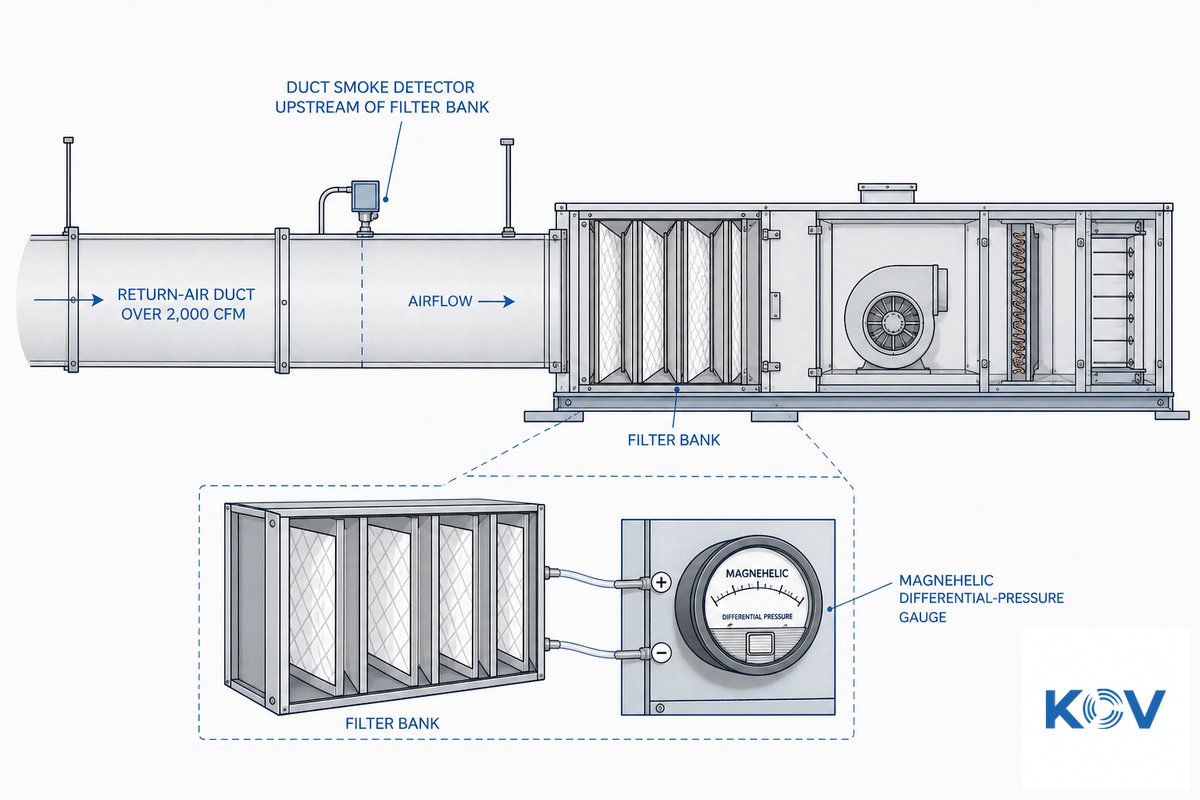
Two code and instrumentation features on a commercial AHU spec go unnoticed on any catalog page.
📐 Engineering Note
Under the base International Mechanical Code, Section 606.2.1 (2018 and 2024 editions both confirmed), return air systems designed for more than 2,000 CFM (0.9 m³/s) require smoke detectors upstream of filters or exhaust openings. Treat the exact section number and wording as a starting point, not a final answer: states amend and renumber the IMC when they adopt it (Florida’s 2023 code, for example, structures the surrounding provisions differently), so verify the current text against whichever edition your specific jurisdiction has adopted before finalizing a spec.
Filter selection is the second factor that’s not simply a checkbox – Stated indoor air quality is the largest contributor to commercial AHU performance – and should be based on total ownership costs rather than upfront purchasing. Filter condition, for example, can be observed via a simple Magnehelic gauge located at the filter bank. The gauge’s differential-pressure readings directly correspond to filter load, with higher readings suggesting a change is necessary to maintain adequate airflow and minimize energy waste. Purchase cost is only a tiny part of what a filter really cost the building owner (one study found that filter purchase cost accounts for approximately 4% of a filter’s total cost including energy and replacement), making space allocation for filter replacement a valuable design decision with significant downstream benefits. A common failure mode plays out like this: a mechanical room gets value-engineered tight during construction, filter access shrinks to a slot too narrow for a technician to comfortably work in, changeouts get skipped or rushed, static pressure climbs, and the fan motor ends up working harder and running hotter for years before anyone traces the energy bill increase back to a filter nobody could reach.
💡 Key Takeaway
Plan on a duct smoke detector if you have more than 2,000 CFM of return air and never allow the space required for filter replacement to be value engineered away-it is the smallest portion of a filter’s life cost but it affects the whole picture significantly.
What Determines a Commercial AHU’s Lifespan, and How to Extend It
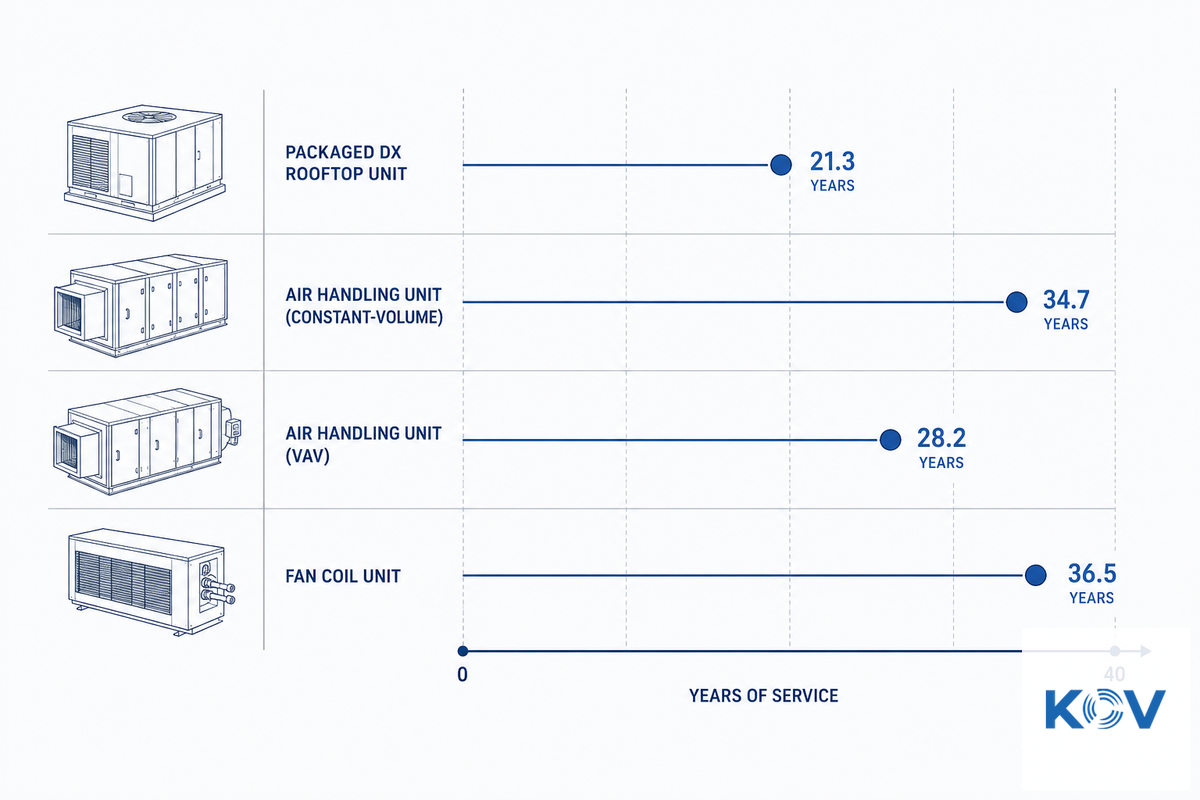
| Equipment | Currently In Service (mean age) | Actually Replaced (mean / median age) |
|---|---|---|
| Packaged DX Rooftop Unit (RTU) | 15.6 years (n=215) | 21.3 / 22.0 years (n=5) |
| Air Handling Unit, constant volume | 25.9 years (n=184) | 34.7 / 40.0 years (n=22) |
| Air Handling Unit, VAV | 18.6 years (n=893) | 28.2 / 26.0 years (n=69) |
| Fan Coil Unit | 26.8 years (n=1,605) | 36.5 / 36.5 years (n=1,279) |
Source: ASHRAE HVAC Service Life Database, Air Distribution system type, queried 2026-07-14. “Currently in service” ages understate true lifespan (those units haven’t failed yet); “actually replaced” ages reflect real completed service life but have smaller sample sizes.
Pulled directly from ASHRAE’s own database rather than a secondhand summary: constant-volume AHUs that were actually replaced averaged 34.7 years in service (median 40.0), and even VAV-style AHUs averaged 28.2 years at replacement — both comfortably ahead of packaged rooftop units, which averaged 21.3 years at replacement. That said, it’s worth being candid about a real disparity with field-reported numbers: a 2012 Consulting-Specifying Engineer report states “a quality AHU can last more than 30 years with proper maintenance” — consistent with the ASHRAE data above — while a more recent analysis from a NYC-based commercial HVAC contractor reported average commercial air handler lifespan closer to 10-20 years. Both figures are plausible; they’re measuring different things (a manufacturer/engineering data set of well-specified equipment vs. one contractor’s field portfolio, which likely includes units that were undersized, poorly maintained, or run past their efficient life before replacement).
And nearly the whole reason for the spread can be attributed to the phrase “with proper maintenance” – those coils with no access that are never serviced, condensate pans with lush cultures, and filters that have been put to a lifetime beyond their serviceability will hasten that 30-year unit to the 10-year end of the scale, well before it’s physically worn out.
“We run the aging test at full load for a minimum of 72 hours, not the shorter spot-checks some shops use, a compressor or control fault that shows up in hour 40 is exactly the kind of failure you don’t want discovered on a job site instead of on our floor.”
That same logic applies outside the factory: whatever aging or QC discipline your units shipped with, you’re only recouping value long-term if the on-site maintenance matches. A pragmatic replace vs repair logic:
Key Factors to Consider — Replace vs. Repair
- Unit is 15+ years old, and a large part ( compressor,coil, control board) has failed.
- Repair cost exceeds roughly 30–50% of full replacement cost
- Energy bills have increased steadily over time despite unaffected normal consumption indicating a depletion in efficiency
- It’s getting increasingly difficult to find a part for this particular model
💡 Key Takeaway
ASHRAE’s own replacement-age data (34.7-year average for constant-volume AHUs) and the lower field-reported 10-20-year figures do not oppose each other – they are the same piece of equipment, with different levels of upkeep. The maintenance you actually have influence over is maintenance access.
The 2026 Refrigerant Rule Change Commercial Buyers Should Actually Know About
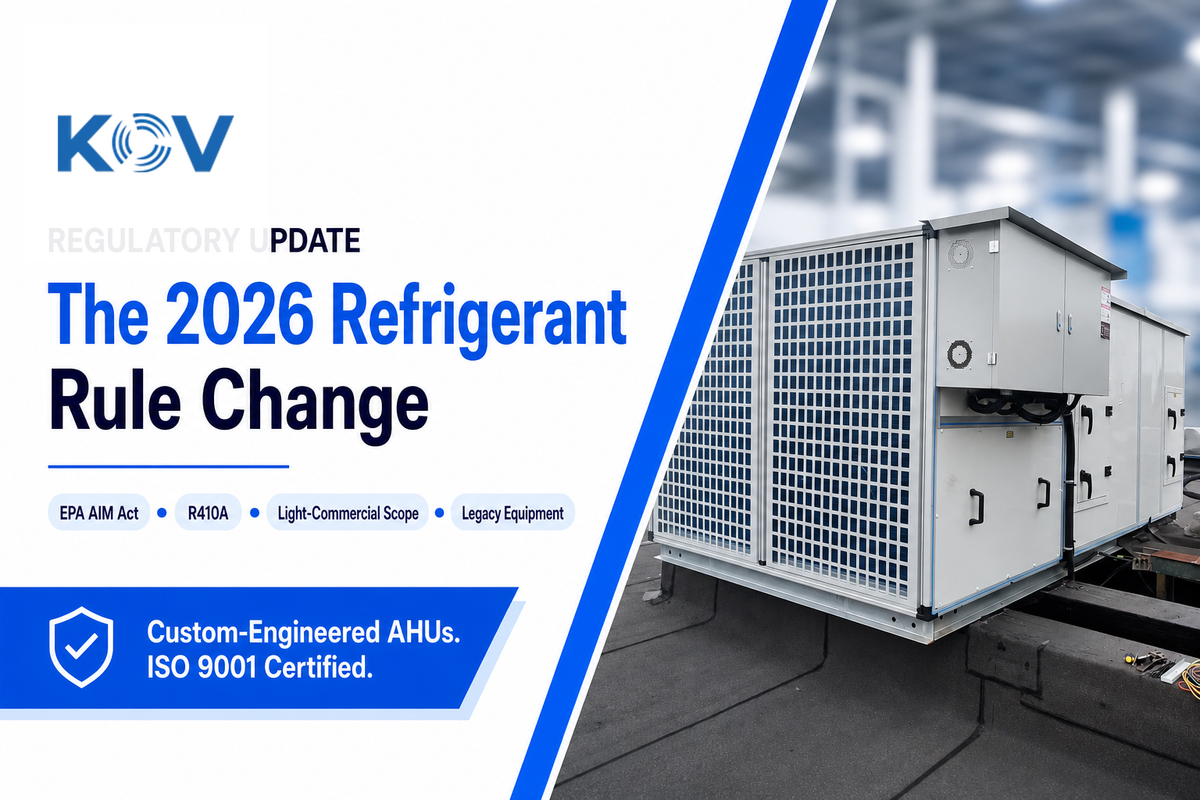
A narrower EPA change is worth flagging for buyers of smaller split DX equipment specifically — it does not apply across the board to large custom commercial AHUs, so scope matters here. On May 26, 2026, the EPA finalized a reconsideration of parts of its 2023 Technology Transitions requirements under the AIM Act, and rather than tighter rules, what it changed is a removal. That 2023 rule had placed a January 1, 2026 installation deadline on residential and light-commercial air-conditioning and heat-pump equipment using refrigerants with a Global Warming Potential (GWP) of 700 or greater, manufactured or imported before January 1, 2025. The May reconsideration rule removed that installation deadline entirely for that residential/light-commercial category — legacy-refrigerant equipment in that segment can now continue to be installed with no fixed cutoff. Larger custom commercial AHUs and heat-recovery configurations generally fall outside this specific light-commercial provision, so confirm which category your equipment sits in before assuming the deadline removal applies to your project.
If any facility had been planning a DX-based AHU replacement to meet a Jan. 2026 refrigerant compliance cliff, that pressure is off — more time to properly load-calculate a replacement, rather than replace urgently due to an irrelevant deadline. Concretely: a facility manager who set aside capital budget in 2025 to swap out an older R410A split DX unit before what they believed was a hard January 2026 cutoff can now hold that budget for a properly sized replacement on its actual failure timeline, instead of a rushed like-for-like swap driven by a deadline that no longer exists. None of this alters the AIM Act’s phase down of HFC supply and import, and a few states like California, New York, and Washington continue to add their own refrigerant rules on top of the federal one, so a multistate facility operator should still consider state level rules individually. AHU market size estimates are inconsistent from source to source: one report puts the overall AHU category near $15B by 2026, another projects it past $40B by the mid-2030s, since each firm scopes and forecasts the category differently.
💡 Key Takeaway
if the timing of your DX-based replacement hinged on a Jan. 2026 refrigerant deadline, that deadline has now been pushed out by the May 2026 rule, freeing up time to properly load-calculate a replacement and address the equipment condition rather than chasing a date.
Frequently Asked Questions
Q: What is an air handling unit (AHU)?
View Answer
A large metal cabinet called an air handling unit filters, heats/cools, and distributes air to occupied spaces throughout a building’s HVAC system. Beyond a fan and filters, the cabinet also includes a coil for conditioning and dampers to control air flow. However, an AHU doesn’t create any heat or cooling itself — it’s paired with equipment such as a boiler, chiller, or outdoor DX condensing unit that performs the heating/cooling, then conditions and distributes that air into the building’s ductwork.
Q: How much does a commercial air handling unit cost?
View Answer
Depending on configuration, application, air flow and required filtration level, it’s a broad range, and figures typically cited in published sources are about $1.50–$5.00/CFM for packaged/modular AHUs, and higher for custom-engineered units, not including installation costs, which often match equipment costs. These figures will vary by source and region, so always treat such numbers as preliminary guidance rather than a definitive cost.
Q: Is an air handling unit the same as HVAC?
View Answer
No. HVAC is the broader term, referring to the entire building mechanical system: the ductwork, boilers, chillers, thermostats, and much more. An AHU is one element within an HVAC system; it focuses solely on filtering, heating/cooling, and moving the air through a building. Most large commercial facilities will use multiple AHUs, with each assigned to serve specific floors or areas of the building, and managed collectively by an overall HVAC plan.
Q: What’s the difference between an air handler and an air conditioner?
View Answer
An air handler handles air filtration and circulation, but doesn’t produce heat or cool air; that role is fulfilled by a separate air conditioning unit, chiller or heat pump which feeds conditioned air to the handler to distribute.
Q: Can an air handling unit be installed on the roof?
View Answer
DX condensing units typically sit on the roof, but the indoor components of an AHU (filters, conditioning coils, fan, etc.) generally stay inside a building in a mechanical room. An RTU, however, is a complete package for outdoor rooftop installation.
Request a Configuration Recommendation →
Why We Write This
Since 2007 Koven Air has manufactured commercial air handling units – split DX, chilled water, and vertical product lines – and we regularly hear from purchasers confused about code, construction, and system selection after reading residential AHU material. This resource separates what’s true about commercial equipment from what made its way into print from consumer-directed guides, basing conclusions on code, literature, and industry information verified independently.
Reviewed by the Koven Air Environment Technology Co.,Ltd technical team
References & Sources
- International Mechanical Code Section 606.2.1 (2024 Edition)International Code Council
- Frequently Asked Questions on the Phasedown of HydrofluorocarbonsU.S. Environmental Protection Agency
- HVAC Equipment Service Life DatabaseASHRAE
- How to Select an Air Handling UnitConsulting-Specifying Engineer
- US20250189145A1, Noise Suppression System for Air Handling UnitUSPTO / Google Patents
Related Articles
- Commercial Air Handling Units (AHU) — Custom HVACR Manufacturerfull configuration options, decision matrix, and case studies
- Makeup Air Unitsdedicated outdoor-air equipment for exhaust-heavy facilities
- Industrial Chillerscentral plant equipment for chilled-water AHU systems

![Cleanroom HVAC Systems: ISO Classes & Design Guide [2026]](https://kovenair.com/wp-content/uploads/2026/07/cleanroom-ahu-pharma-biotech-guide-featured-2-150x150.png)