Get in Touch with Koven Air Company

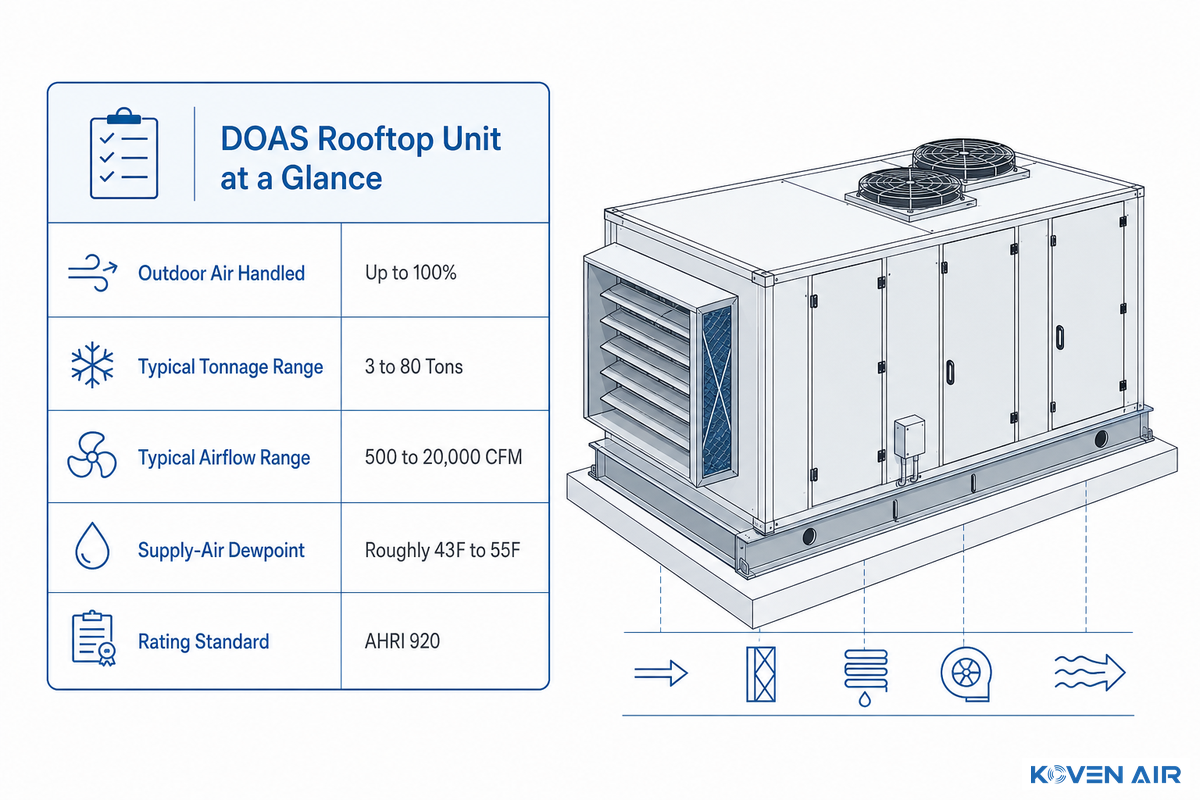
Quick Specs: DOAS Rooftop Unit
| Outdoor Air Handled | Up to 100% |
| Typical Tonnage Range | 3 – 80 tons |
| Typical Airflow Range | 500 – 20,000 CFM |
| Supply-Air Dewpoint | Roughly 43°F – 55°F, model dependent |
| Energy Recovery | Wheel or plate, effectiveness 45–80% |
| Rating Standard | AHRI 920 (DX-DOAS units) |
What Is a DOAS Rooftop Unit? Quick Specs & Definition
A DOAS rooftop unit is a packaged HVAC system, mounted on the roof, that conditions up to 100% outdoor air before it enters the building — completely separate from the equipment that handles day-to-day heating and cooling. Unlike a conventional rooftop unit, which blends a little fresh air into a recirculating airstream, a dedicated outdoor air system (DOAS) pulls in outside air, filters it, conditions it, and strips out excess moisture before handing it to the building’s terminal equipment.
Traditional HVAC setups — the packaged air conditioners and cooling systems most facilities already run — treat ventilation as an afterthought bolted onto comfort control. A DOAS provides a dedicated outdoor-air path instead, handling ventilation as its own job rather than a side effect of the building’s other heating and cooling functions. That distinction matters most for indoor comfort and overall indoor environment quality in commercial HVAC settings where occupancy-driven ventilation needs outpace what a standard air conditioner was ever sized to move.
That separation is the entire point. Ventilation air and comfort cooling are two different jobs with two different failure modes: undersize the ventilation side and indoor air quality suffers; let a conventional system try to dehumidify only when it happens to be running for temperature control, and you get the clammy, mold-prone spaces that show up in humid climates. Koven Air’s own KA-DOAS line – built as a 100%-outdoor-air packaged rooftop unit across a 10-80 ton spec ladder – is one example of equipment purpose-built around that decoupled approach; see the full KA-DOAS model lineup and spec ladder for the product side of this discussion. This guide focuses on the equipment category itself: what it is, how it works, how it compares to RTU/ERV/AHU systems, and how to size and evaluate one. As a category, commercial DOAS equipment is rated against AHRI Standard 920 — measured under the same DOE test procedure covered later in this guide — and typically spans 3 to 80 tons of cooling capacity and 500 to 20,000+ CFM of airflow across the manufacturers that publish full spec ladders.
Updated July 2026.
How a DOAS Rooftop Unit Works
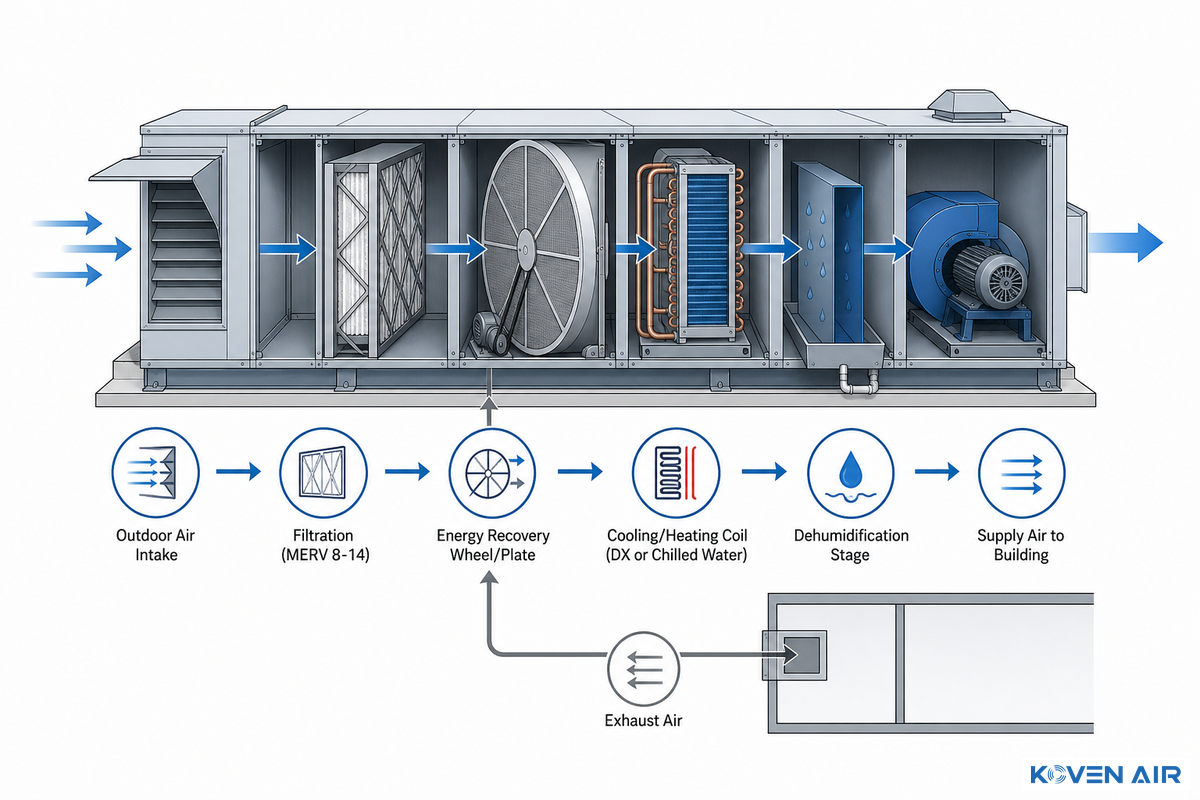
Skip any one of these stages and the failure shows up fast: humid air bypassing the coil shows up as condensation on ductwork and, eventually, mold behind ceiling tiles; a fouled filter starves the coil and the unit can’t hit its rated dewpoint no matter how the controls are tuned. Air moves through a DOAS rooftop unit in a fixed sequence, and each stage exists specifically to prevent one of those failure modes. Outdoor air is drawn in through an intake hood and passes through filtration – commonly MERV 8 to MERV 14, occasionally paired with bipolar ionization on higher-IAQ builds – to strip out particulates before anything downstream has to deal with them. That filtered air then crosses a heating or cooling coil – direct-expansion (compressor-driven) or chilled water, depending on the unit – to bring temperature and humidity into range, followed by a dehumidification stage that pulls the latent (moisture) load out separately from the sensible (temperature) load. Finally, supply fans push the conditioned air out to the building’s distribution ductwork or directly to terminal units. Unlike a conventional RTU coil, which is sized around whatever mixed-air condition it happens to see, a DOAS coil is sized around the worst-case outdoor-air enthalpy for the site — a trade-off that costs more coil surface area up front but avoids the part-load humidity drift that mixed-air systems are prone to.
Most commercial DOAS units add one more component that does most of the energy-cost work: an energy recovery wheel or plate exchanger that captures heat and moisture from the exhaust airstream on its way out and uses it to pre-condition the incoming outdoor air. Per ASHRAE’s own air-to-air energy recovery guidance, reported effectiveness for this exchange typically runs 45-65% in standard setups, and manufacturer data for wheel-type recovery devices puts total effectiveness closer to 70-80% under favorable balanced-flow conditions – plate exchangers that only move sensible heat (no moisture transfer) tend to sit lower, around 70-75% sensible-only. On the cooling side, published commercial DOAS product data (Trane’s Horizon line, for example) targets a supply-air dewpoint around 43°F at both full and part load, which is meaningfully lower – and therefore more effective at preventing mold and condensation – than a comfort-only RTU is designed to hold. The rating method behind those numbers matters too: DX-DOAS performance is measured under a U.S. Department of Energy test procedure for direct-expansion dedicated outdoor air systems, which is what lets a dewpoint or effectiveness figure from one manufacturer be compared against another on equal footing.
How Does a DOAS Unit Work?
View Answer
A DOAS unit operates in four phases: intake and filtering (catching airborne particulates before they reach the coil), sensible conditioning (heating or cooling coil), latent conditioning (dehumidification and moisture removal down to the target dew point), and supply distribution. Before the latter step, most units direct intake and exhaust air across an energy recovery wheel or plate — this heat recovery step captures waste heat and moisture from the exhaust air to precondition the incoming fresh air, handling sensible and latent loads together and relieving the burden on the cooling coils. Since the unit is always processing outdoor air, and never recirculated room air, the coils and controllers can be designed and tuned specifically for ventilation-load humidity control rather than for a compromise between comfort cooling and outdoor-air duty.
Packaged, Split, or Indoor: DOAS Configuration Types
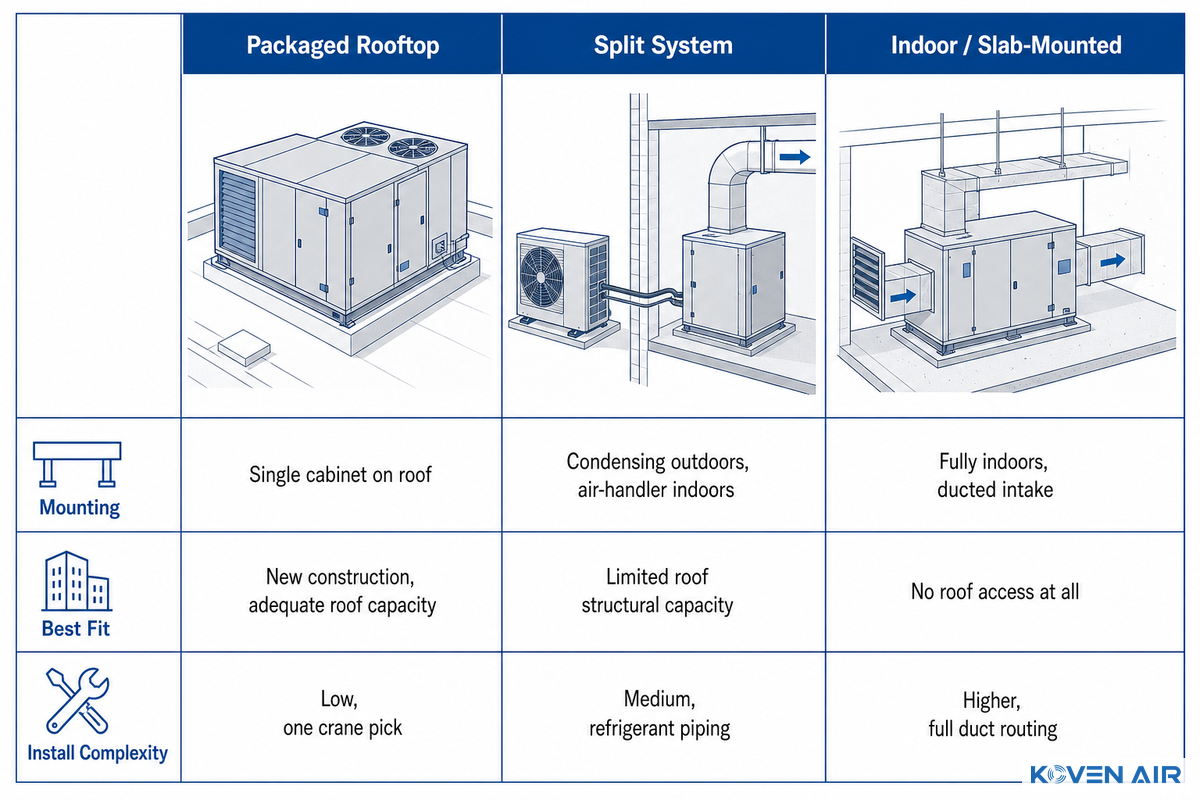
DOAS equipment comes in three basic physical types; the correct type is usually determined by roof access, the amount of available mechanical room space, and how the project has been ducted. In practice, a school retrofit with a structurally-limited roof is a textbook split-system application, while a new-construction office building with a clear curb path is the more straightforward packaged-rooftop use case.
| Configuration | Mounting | Best Fit |
|---|---|---|
| Packaged rooftop | Single cabinet, curb-mounted on the roof | New construction or reroofs with adequate structural capacity and roof access; the majority of commercial DOAS installs |
| Split system | Condensing section outdoors, air-handling section indoors | Sites with limited roof structural capacity or where the mechanical room already exists |
| Indoor / slab-mounted | Fully indoors, ducted to a louvered outdoor-air intake | Retrofits with no roof access at all, or units too large/heavy for the existing roof structure |
Whatever type of DOAS the equipment may be, the function of its component parts remains consistent: either a energy recovery wheel or plate (most optional on units above 1,000 cfm), a DX or chilled-water cooling coil, either an electric, hot-water or gas heating stage, filtration, and a controller, either standalone, or integrated into a DDC system to tie ventilation scheduling to occupancy and a building automation system. Manufacturers keep filing improvements around exactly this multi-mode control layer — a recent U.S. patent covering a dedicated outdoor air system with multiple operating modes is one example of the engineering work going into making one cabinet cover more configuration scenarios. Most pre-engineered DOAS units ship with a configurable controls package, so the same energy-efficient hvac units can be dialed in for different ventilation requirements without a custom control-sequence rebuild for every project.
✔ Advantages
- packaged units reduce installation time – one crane pick, one curb
- Split/indoor options work around structural or roof-access limits
- All three of these types separate ventilation from comfort cooling so terminal equipment isn’t pulled in two different directions.
⚠ Limitations
- Indoor and split configurations add refrigerant pipe and/or duct run work, which isn’t required with a packaged.
- Larger packaged units (40+ tons) do still require structural roof capacity, which you’ll want to verify prior to assuming a curb mount option is available.
DOAS vs. RTU vs. ERV vs. AHU, The 4-Acronym Equipment Cheat Sheet
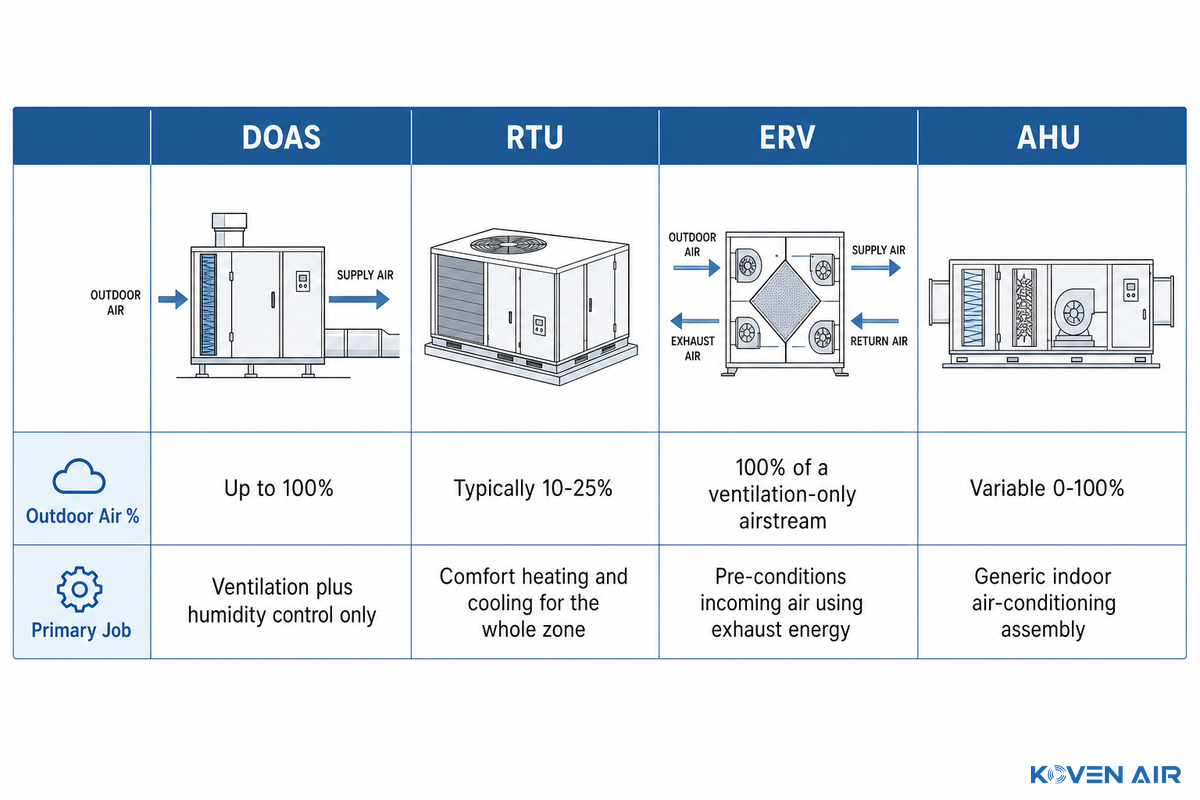
These four terms are thrown around interchangeably in casual conversation, which is why you often end up with over or under-specced equipment sitting on a roof — a spec sheet that asks for “an AHU” when the project actually needs 100% outdoor-air handling can send a bid down the wrong path entirely, and the mismatch usually isn’t caught until commissioning. Each one serves a different purpose, even if the boxes are similar from a distance, and a mechanical engineer reviewing a submittal will check outdoor-air percentage first because that single number rules out three of the four categories immediately.
| Term | Outdoor Air % | Primary Job | Recirculates Room Air? |
|---|---|---|---|
| DOAS (Dedicated Outdoor Air System) | Up to 100% | Ventilation + humidity control only | No |
| RTU (Rooftop Unit, conventional) | Typically 10–25% | Comfort heating + cooling for the whole zone | Yes, primarily |
| ERV (Energy Recovery Ventilator) | 100% of a ventilation-only airstream | A component/sub-function — pre-conditions incoming air using exhaust energy | No (it’s an exchanger, not a full conditioning system) |
| AHU (Air Handling Unit) | Variable — anywhere from 0% to 100% | Generic term for any indoor air-conditioning assembly; a DOAS is technically a type of 100%-OA AHU | Depends on design |
What Is the Difference Between an RTU and DOAS?
View Answer
An RTU typically recirculates much of the air that it cools or heats-drawing in air from a room, modifying it, and then pushing it back in, with only a small portion (usually 10% to 25%) of the air coming from outdoors for code-minimum ventilation. The DOAS works the other way: it treats 100% of the incoming outdoor air, none of which comes from a occupied space. In most commercial building designs the two types don’t compete; a DOAS handles ventilation and dehumidification while a conventional RTU (or VRF system, or fan-coil) takes care of a space’s sensible comfort load. Once you’ve determined the actual equipment category you’re trying to compare, the question becomes how a rooftop unit is specified and sized for comfort cooling, which is another discussion.
If you’ve determined your building needs 100% outdoor air treatment, and you’re trying to compare equipment selections to Koven’s own product line, you’ll find value in comparing our KA-DOAS decision matrix. It compares a DOAS, RTU, ERV, and makeup air unit, and provides detailed model-specific specs to help you make a selection. The same DX-DOAS test procedure referenced above (DOE’s direct-expansion DOAS test procedure) is what makes an apples-to-apples comparison across these four equipment categories possible in the first place.
Where DOAS Rooftop Units Are Used
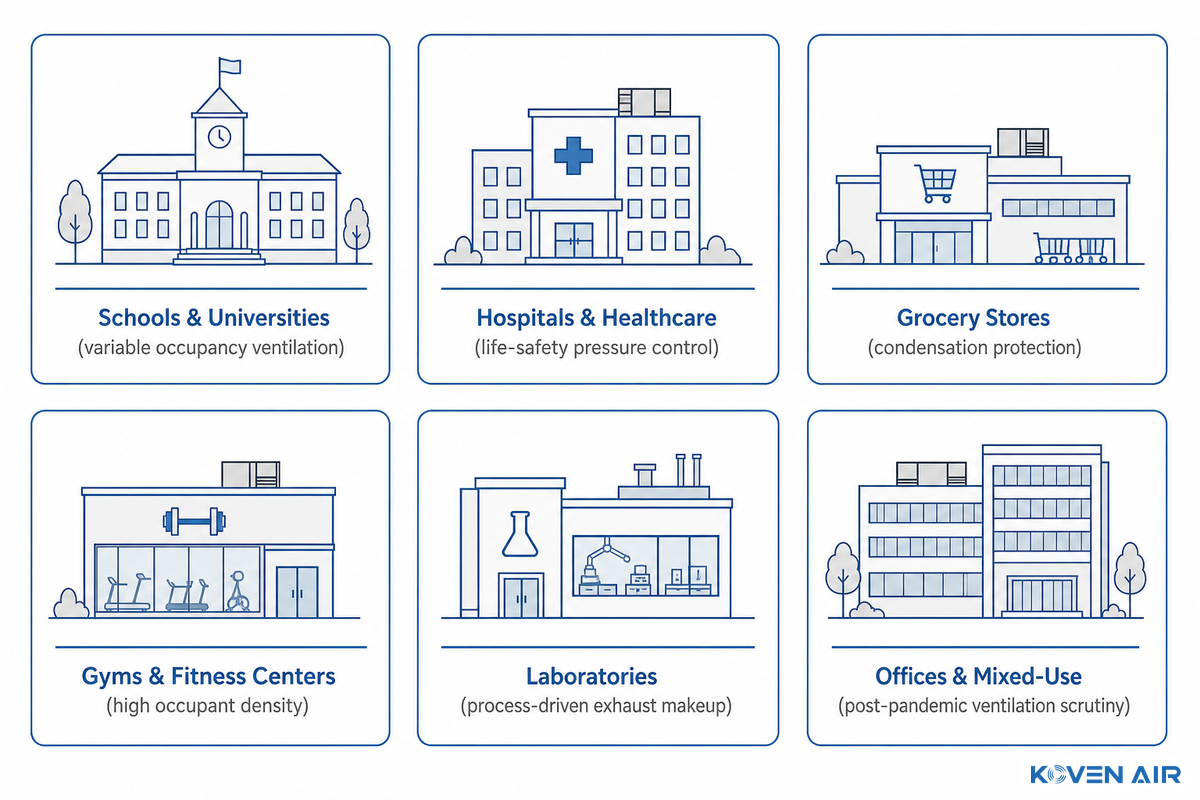
Any building type that has a noticeable separation between the ventilation-air requirements and the comfort-cooling load will likely benefit from the DOAS:
- ✔Schools and universities (with varying occupancies and ventilation rate mandates).
- ✔Hospitals and health care facilities – pressure-relationship and humidity control are life-safety, not comfort, issues
- ✔Grocery stores and food retail – humidity control protects refrigerated cases from condensation load
- ✔Gyms and fitness centers – high occupant density drives ventilation CFM well above what a standard RTU’s OA fraction covers
- ✔Laboratories and manufacturing spaces with process-driven exhaust that must be made up with conditioned air
- ✔Offices and mixed-use commercial buildings – increasingly common as post-pandemic ventilation-rate scrutiny has tightened
The occupancy-category ventilation rates that make these applications a fit trace back to the same DOE energy-standard analysis referenced in the standards section below. Across commercial and industrial buildings alike, a DOAS unit’s whole job is meeting each building’s adequate-ventilation requirement first, whatever else its terminal equipment is doing — which is exactly why building owners in these categories keep specifying it even when local building codes don’t strictly mandate a dedicated system.
Beyond conventional commercial buildings, controlled-environment applications – mushroom cultivation, grain storage, and other agriculture-adjacent facilities – also lean on 100%-outdoor-air equipment where humidity and fresh-air exchange are production variables, not just comfort variables; Koven’s own campus-scale DOAS retrofit case data covers a commercial-building deployment of this kind in more depth than fits here.
Sizing a DOAS Rooftop Unit, CFM, Tonnage & the Quick-Size Chart
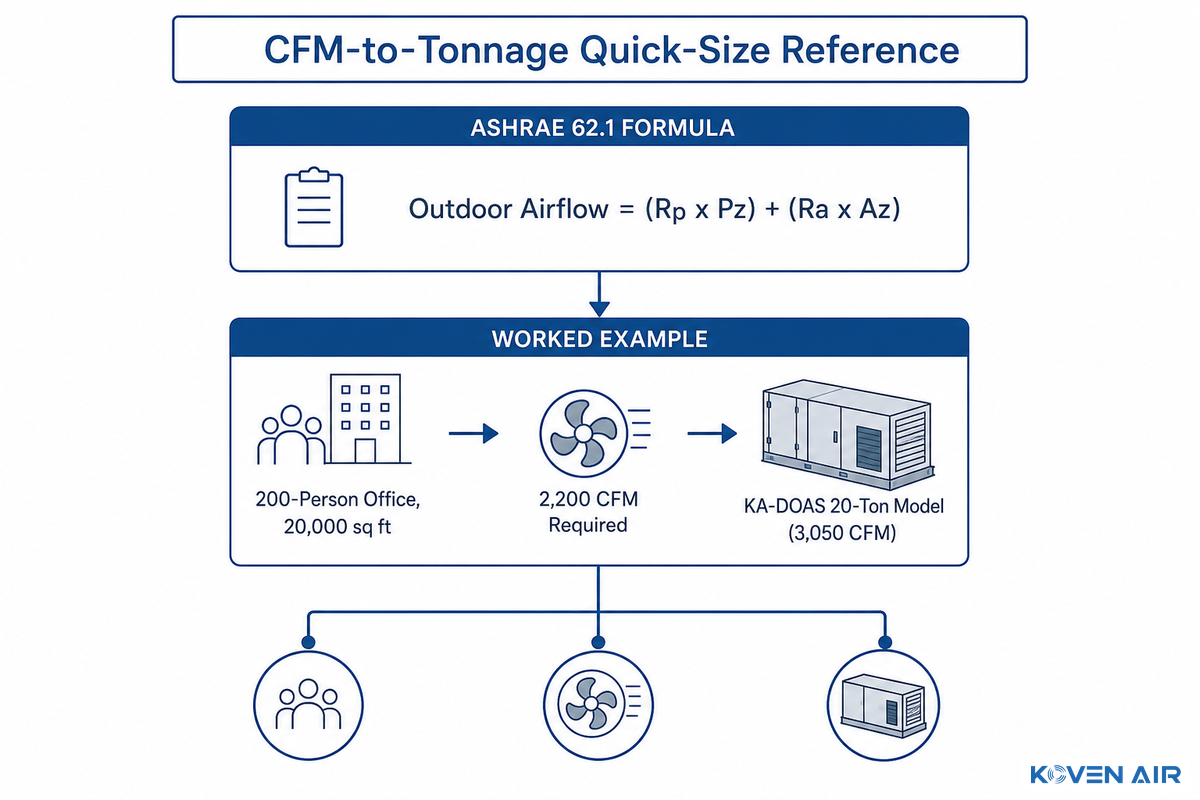
DOAS sizing starts from ASHRAE 62.1’s Ventilation Rate Procedure, not from a rule-of-thumb square-footage ratio the way comfort cooling sometimes gets estimated. This procedure combines a people-based component and an area-based component: outdoor airflow = (Rp × Pz) + (Ra × Az), where Rp is the outdoor-air rate per person, Pz is the expected zone population, Ra is the outdoor-air rate per unit area, and Az is the zone floor area. Both Rp and Ra vary by space type under 62.1’s occupancy-category tables – an office and a gym don’t get the same numbers. The same DOE test procedure that standardizes DX-DOAS performance ratings (energy.gov) is worth checking before finalizing a sizing decision, since a unit’s rated capacity should be read against the same test conditions your project’s peak load calculation assumes. VAV (variable air volume) staging can trim a unit’s average cooling needs on the ventilation side too, though the peak-load number still has to hold — outdoor air handled separately from recirculated air doesn’t get a break just because a VAV box downstream can modulate.
📐 Engineering Note — Worked Example
Take a 200-person, 20,000 sq ft office space. Using ASHRAE 62.1 office-category defaults (roughly 5 CFM/person + 0.06 CFM/sq ft as an illustrative starting point – confirm your project’s actual occupancy category and any local amendments): (5 × 200) + (0.06 × 20,000) = 1,000 + 1,200 = 2,200 CFM of outdoor air required. Cross-referencing a published 100%-OA DOAS spec ladder (Koven’s KA-DOAS line runs 1,550 CFM at 10 tons up to 3,050 CFM at 20 tons), the 20-ton model at 3,050 CFM comfortably covers the requirement without jumping to the 30-ton unit’s 4,700 CFM – a useful sanity check against over sizing. Note the CFM-per-ton ratio here (roughly 150 CFM/ton) is far lower than a comfort-cooling RTU’s typical ~400 CFM/ton, because a DOAS is sized to ventilation load, not sensible room load – using an RTU rule of thumb to size a DOAS is a common, expensive mistake.
| Model | Tonnage | Outdoor Airflow (CFM) | CFM per Ton |
|---|---|---|---|
| KA-DOAS-010 | 10 tons | 1,550 | 155 |
| KA-DOAS-015 | 15 tons | 2,250 | 150 |
| KA-DOAS-020 | 20 tons | 3,050 | 153 |
| KA-DOAS-030 | 30 tons | 4,700 | 157 |
| KA-DOAS-040 | 40 tons | 7,400 | 185 |
| KA-DOAS-045 | 45 tons | 6,700 | 149 |
| KA-DOAS-050 | 50 tons | 7,450 | 149 |
| KA-DOAS-060 | 60 tons | 9,100 | 152 |
| KA-DOAS-070 | 70 tons | 10,400 | 149 |
| KA-DOAS-080 | 80 tons | 12,050 | 151 |
Spec data: Koven Air KA-DOAS model line, published spec sheet. See the full KA-DOAS product spec ladder for ESP, energy-recovery type, and filtration options by model.
How Do I Determine What Size DOAS Unit I Need?
View Answer
Run the ASHRAE 62.1 Ventilation Rate Procedure for the actual occupancy category and floor area, then check that figure against a manufacturer’s published CFM-per-tonnage spec ladder rather than assuming a flat CFM-per-ton ratio – DOAS tonnage-to-CFM ratios run considerably lower than comfort-cooling RTU ratios because the unit is offsetting ventilation and latent load, not sensible room load. Confirm the design also accounts for peak outdoor-air enthalpy conditions in your climate zone, since that – not the mild-weather average – sets the worst-case latent load the unit has to handle.
Advantages and Limitations of a DOAS Rooftop Unit
“The study found that the systems consistently saved energy over the long term, improved occupant comfort, and received positive feedback from building operators.”
— Yoder, Piazza, Pratoomratana & Sandahl, Very High Efficiency Dedicated Outdoor Air System Field Site Re-Evaluation, Pacific Northwest National Laboratory (PNNL-34419, 2024)
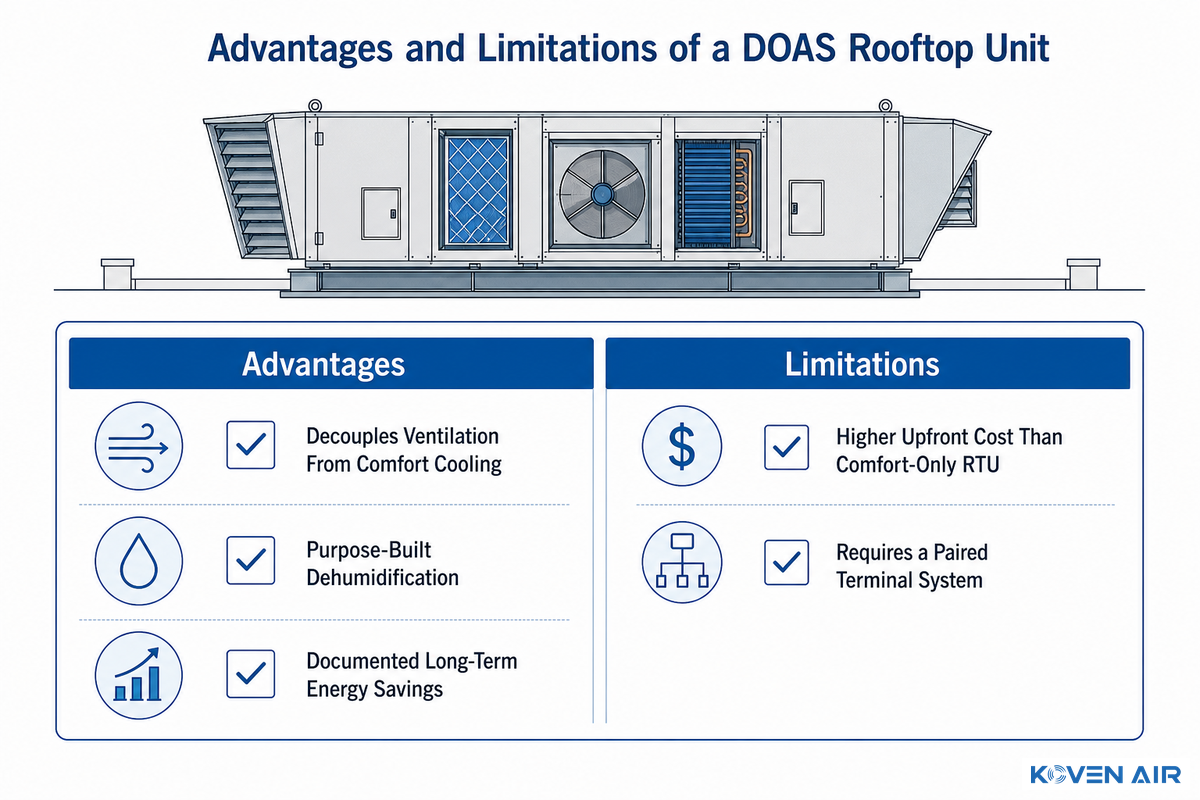
✔ Advantages
- Decouples ventilation from comfort cooling, so neither system is a design compromise
- A Pacific Northwest National Laboratory long-term field re-evaluation found very-high-efficiency DOAS retrofits delivered an average 48% whole-site energy reduction compared to the pre-conversion system across 8 sites tracked between 2015-2022 – and occupants reported 43% more satisfaction, and 30% less dissatisfaction post-conversion (Yoder et al., PNNL-34419, 2024)
- Purpose-built dehumidification minimizes the mold and condensation risks a generalist RTU was not designed for
⚠ Limitations
- higher upfront equipment cost than a comfort-only RTU of similar airflow since it’s doing a more specialized job
- Not a standalone comfort-cooling replacement — it requires a paired terminal system to handle the room’s sensible load, a point confirmed directly in manufacturer FAQ text, not just an assumption
That limitation is worth dwelling on because it’s the misconception that causes the most expensive field problems: a DOAS is not a bigger, better RTU that happens to use more outdoor air. It solves a narrower problem — ventilation air quality and humidity — on purpose, so it can solve that problem thoroughly. Skipping the terminal-equipment side of the design because “the DOAS is handling the air” is a common and costly assumption to walk back after installation.
DOAS Manufacturers and What to Compare When Shopping
The commercial DOAS market includes large HVAC manufacturers — Trane’s Horizon line, AAON, Daikin, Greenheck, and YORK all publish dedicated DOAS product families — alongside specialists building purpose-designed lines like Koven Air’s KA-DOAS series. Model-name recognition is not the same as fit: engineering discussion threads on the topic (r/MEPEngineering) show working HVAC engineers splitting fairly evenly on brand preference by application, and at least one thread flagged real-world lead-time friction with a well-known DOAS line — a reminder that published specs and delivery reality aren’t always the same conversation. A bigger, more familiar brand name is not automatically the better fit for a given CFM range or budget.
Key Factors to Compare
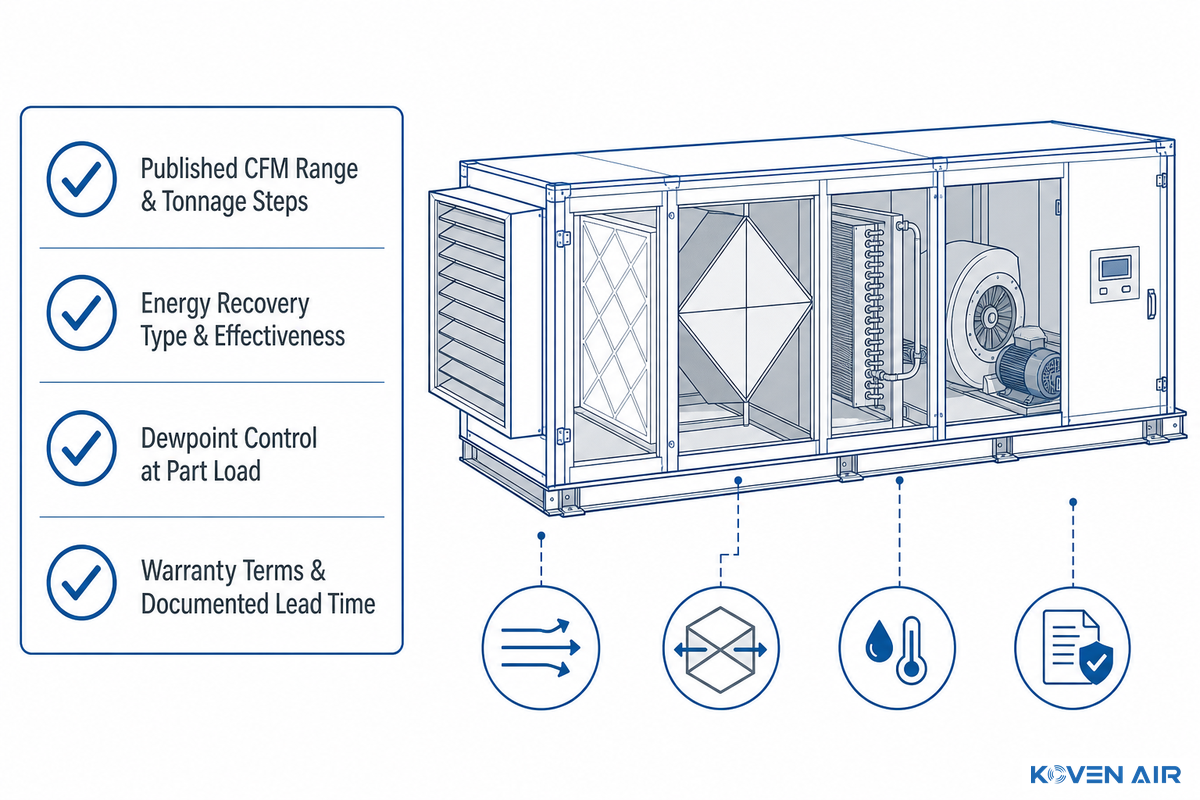
- Published CFM range and tonnage steps — does the manufacturer’s spec ladder actually have a model near your calculated load, or will you be paying for headroom you don’t need?
- Energy recovery type and effectiveness — wheel vs. plate, and whether the manufacturer publishes a specific tested effectiveness number or just says “efficient”
- Dewpoint control range at part load, not just full load — many units perform well at design conditions and drift at partial load
- Warranty terms and documented lead time — ask directly, since published catalog lead times and current lead times can diverge
Koven Air’s spec ladder KA-DOAS-010 through KA-DOAS-080 puts CFM, tonnage, ESP, and energy recovery type across the entire 10-80 ton range in one comparison table, handy for putting together exactly this spec checklist to run against a project’s actual numbers — and every model on that ladder is rated to the same energy-recovery engineering baseline referenced earlier in this guide, so the comparison holds across the full range. DOAS unit pricing and a manufacturer-by-manufacturer analysis merit their own guides rather than falling into this hasty paragraph here.
Standards and Codes That Shape DOAS Design
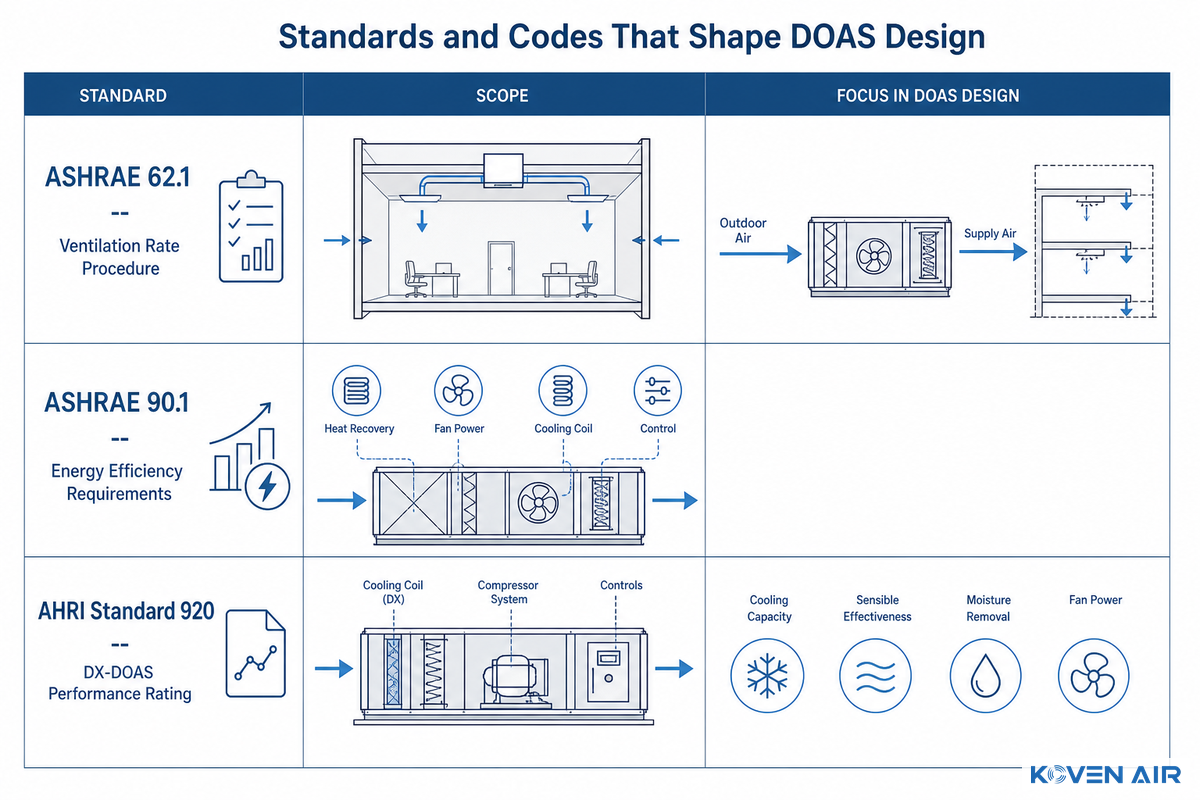
Three standards bodies show up repeatedly in DOAS specification:
- ✔ASHRAE 62.1 (Ventilation for Acceptable Indoor Air Quality)—sets the Ventilation Rate Procedure used to calculate required outdoor airflows. 2025’s update increased the requirements for humidity control and added requirements for emergency ventilation controls, so a design based on an older version may already be behind the curve.
- ✔ASHRAE 90.1 (Energy Standard for Buildings)—determines the energy efficiency parameters a DOAS needs to meet; the current version continues ASHRAE’s trend toward net-zero-ready commercial buildings, and the U.S. Department of Energy’s savings analysis documents exactly how much that trend has moved the energy baseline.
- ✔AHRI Standard 920 (Performance Rating of DX-Dedicated Outdoor Air System Units)—provides the standard benchmark against which to rate and compare DX-DOAS equipment for comparisons on a like-for-like basis, replacing the historical convention of comparing DOAS performance on the same metrics used for DX RTUs that weren’t designed for 100%-OA service; the underlying DOE test procedure notice lays out exactly how that rating gets measured in a lab.
If a spec sheet says “AHRI 920 compliant” without a dewpoint or effectiveness value, that’s worth a follow-up question — this is how the values are supposed to be reported so they can be directly compared across manufacturers. Rated equipment that can control humidity down to a consistent dew point also tends to improve energy efficiency over the long run, since the coil isn’t overworking to dehumidify air that was dehumidified too aggressively in the first place; a cabinet that resists corrosion in that condensate-heavy environment keeps those numbers accurate for the life of the unit instead of just the day it was tested.
DOAS Industry Outlook, What’s Changing
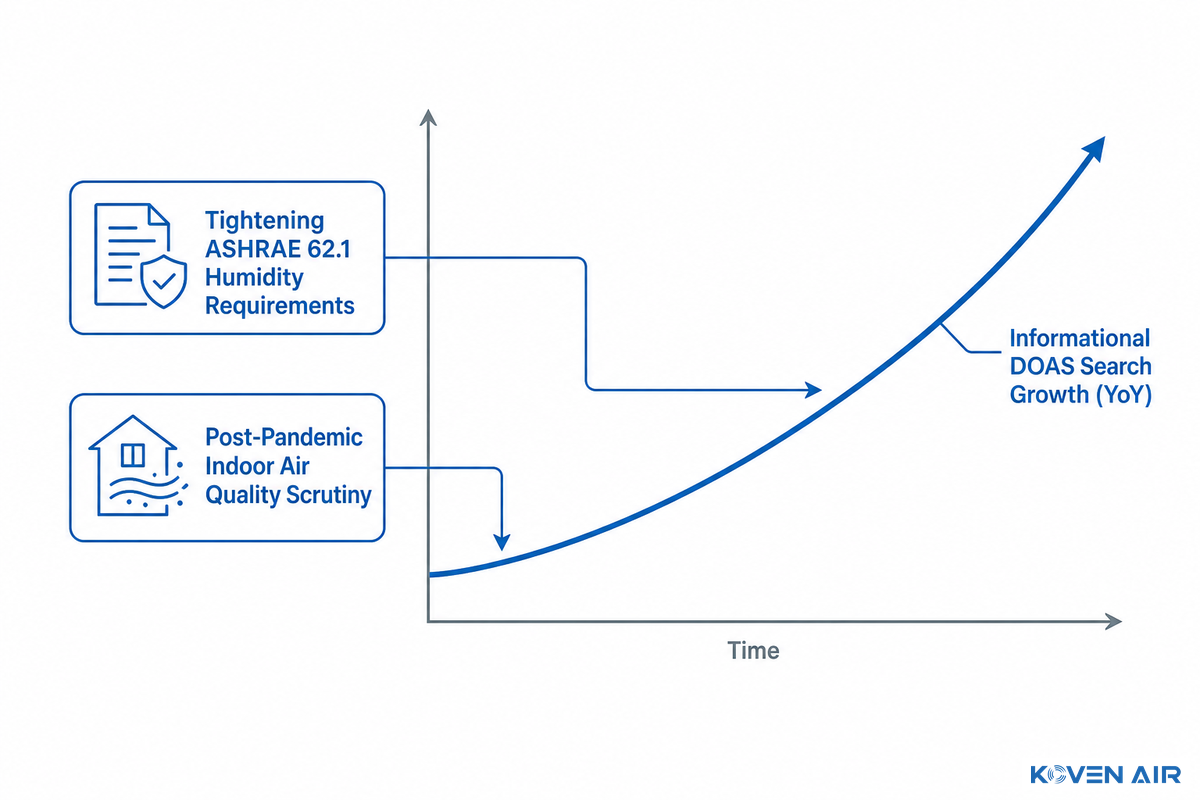
The most telling stat in the DOAS search patterns I see right now isn’t any single application demand, it’s a switch to more research-based buying behavior. Informational search terms like “what’s a DOAS unit” are up about 50% y-o-y, and mechanism-specific search terms like “how does a DOAS system work” are up around 100% (off a small base), whereas the actual buying term remains flat. This matches the continued impact of these policy updates (ASHRAE 62.1’s 2025 edition was revised to tighten humidity-control parameters, and indoor air quality stayed alive as a compliance theme once again in 2020 rather than dropping off, both of those move first-time buyers into research-first mode before they request a quote).
Market estimates peg the global DOAS market around mid-single-billion dollars as of 2025-2026, with mid-to-high single-digit CAGR forecast through early 2030s according to industry market research reports, helpful for directional context, but those numbers should be interpreted as orders of magnitude rather than precise predictions, since research methodology differs. The tangible forward trend for specifiers is the standards side; as ventilation-rate and humidity-control mandates continue to climb with every revision, equipment rated cleanly to AHRI 920 with dewpoint part-load data will have a clear compliance advantage over equipment without. Specifying against an outdated standard edition is a slow, expensive failure mode — the project passes design review but fails commissioning or a later code audit — which is exactly the risk manufacturers like Koven Air are building against by keeping the KA-DOAS line’s AHRI 920 rating and dewpoint data current rather than resting on a certification earned years ago. The long-run payoff for buyers who specify correctly the first time is well documented: the same PNNL field study cited earlier tracked its energy and comfort gains for seven years, not just a single post-installation snapshot.
Frequently Asked Questions
Q: What is the purpose of a DOAS unit?
View Answer
A DOAS is intended to handle a building’s entire outdoor-air (OA) ventilation load separate from comfort heating and cooling. Because it conditions and dehumidifies 100% OA on its own, the DOAS unloads that work from the terminal HVAC equipment, letting those units be sized and controlled solely for sensible comfort. That separation of duties helps allow the kind of tighter humidity control and more dependable indoor air quality compliance that are difficult to achieve with a typical mixed-air system.
Q: Why DOAS instead of a conventional RTU?
View Answer
A traditional rooftop unit (RTU) typically relies on cooling for comfort first, incorporating only a small portion of outdoor air (OA) — usually 10-25% — into the airstream. This arrangement may work for moderate OA demands, but high or fluctuating occupancy can generate significant latent loads that overwhelm the built-in dehumidification capacity of standard RTUs. The DOAS is engineered for this demanding load and therefore appears in high-occupancy, humidity-sensitive settings rather than as a direct RTU substitute.
Q: What pairs with a DOAS unit?
View Answer
DOAS units often work in conjunction with terminal equipment dedicated to space-level comfort control. Common partners include VRF systems, water-source heat pumps, fan coils, blower coils and other comfort-cooling-only units. The DOAS pre-conditions and dehumidifies the outdoor air, delivering it to the space or directly to the terminal equipment for comfort control.
Q: Does a DOAS unit need ductwork?
View Answer
While ducting is generally used to deliver conditioned outdoor air from a commercial DOAS to various zones or terminal units, especially in multi-zone environments such as schools and offices, some smaller or single-zone applications may involve more direct distribution with minimal ductwork. Nonetheless, for any building beyond a few zones, installing a DOAS involves proper duct design and static pressure planning.
Q: What does DOAS unit stand for?
View Answer
DOAS stands for dedicated outdoor air system, also known as a “dedicated outside air system.”
Related Articles
- Koven KA-DOAS Rooftop Units, Full Spec Ladder & Buying Guide — model-by-model specs, decision matrix, and campus IAQ case data for the DOAS product line covered in this guide
- RTU HVAC: The Complete Rooftop Unit Guide — for conventional comfort-cooling rooftop units, including the heat-pump RTU category referenced in the DOAS vs. RTU comparison above
- Industrial Desiccant Dehumidifiers — for humidity-control needs beyond what integral DX dehumidification in a DOAS can reach
- About Koven Air — company background and manufacturing capability
Why We Write This
Koven Air’s technical team built this guide on published ASHRAE and AHRI standards, a field study from Pacific Northwest National Laboratory, and Koven’s own KA-DOAS-010 through KA-DOAS-080 spec ladder to construct a tangible, verifiable CFM-to-tonnage example instead of a general rule of thumb. Whenever manufacturer marketing claims exceeded the capabilities a standard or independent study provided – for instance, “AHRI 920 compliant” as a blanket assertion without the accompanying rated dewpoint – we noted the deficit rather than perpetuating it.
References & Sources
- Very High Efficiency Dedicated Outdoor Air System Field Site Re-Evaluation — Pacific Northwest National Laboratory (PNNL-34419, 2024)
- AHRI Standard 920-2026: Performance Rating of DX-Dedicated Outdoor Air System Units — Air-Conditioning, Heating, and Refrigeration Institute
- ANSI/ASHRAE/IES Standard 90.1 — ASHRAE
- ANSI/ASHRAE 62.1-2025: Ventilation for Indoor Air Quality — American National Standards Institute
- ANSI/ASHRAE/IES Standard 90.1-2022 Energy Savings Analysis — U.S. Department of Energy, energycodes.gov
- US12492827B2, Energy Recovery System — USPTO / Google Patents (Haier US Appliance Solutions, 2025)
- Dedicated Outdoor Air System (DOAS) coverage — ACHR News
Reviewed by the Koven Air Environment Technology Co.,Ltd technical team.


![Liquid Desiccant Dehumidifier: How It Works [2026 Guide]](https://kovenair.com/wp-content/uploads/2026/07/liquid-desiccant-dehumidifier-guide-featured-150x150.png)