Get in Touch with Koven Air Company

HYDRONIC // SERIES
ISO Certified Quality Standard
Commercial Cassette Air Conditioner
Cassette Fan Coil Unit, 2-Way and 4-Way Hydronic Models
A cassette fan coil unit from Koven Air cools and heats a room by circulating your building’s own chilled and hot water through a ceiling-recessed coil, it doesn’t carry refrigerant and doesn’t run without a connected chiller or boiler loop. That distinction matter before you specify: a self-contained refrigerant cassette (the kind sold as a “cassette air conditioner”) needs an outdoor condensing unit; ours needs a 2-pipe chilled/hot-water connection instead. Fourteen models across 4-way and 2-way blow patterns cover 350-2,420 m³/h airflow at a maximum, and the largest single reference project on this page runs 240 of them across one office tower, an ideal climate-control solution wherever a building already has a chilled/hot-water plant to feed it.
Request a Quote & Model Selection
Engineer Support: Send us your room dimensions, water supply temperature and pipe configuration for a free model match.
Click to Swap
14
Models Available(9× 4-Way + 5× 2-Way)
2.16-14.4 kW
Cooling Capacity Range3.57-21.32 kW
Heating Capacity Range29 dB(A)
QuietestLow-Speed Rating
240
Units In One RealOffice Deployment
0
Leak ComplaintsPost-Commissioning
Uneven Cooling, Ceiling Clutter and Leak Risk, Solved by a Ceiling-Recessed Water Coil
“
Open-plan offices, meeting rooms and retail floors fight the same three problems with conventional terminal equipment: wall or floor units create hot and cold pockets because air only pushes from one side of the room, exposed cabinets eat into finished ceiling height and interior design budgets, and any water-carrying device mounted above a ceiling turn a small leak into a five-figure repair bill for drywall, carpet and IT equipment below it. A cassette fan coil unit answers all three by mounting flush into a suspended ceiling grid, drawing room air through a central intake and discharging it in two or four directions from a single low-profile panel, connected to your building’s chilled-water loop for cooling and hot-water loop for heating.
Koven’s KASKM4 (4-way blow) and KA-FP-KM2 (2-way blow) series are both 2-pipe hydronic units, copper-tube, aluminum-fin coils fed by chilled water (typically 7°C supply / 12°C return) for cooling and hot water (commonly 60°C or 45°C supply) for heating, the same central-plant water your chiller and boiler already produce. This is the point buyers searching “cassette air conditioner” most often miss: a self-contained refrigerant cassette (Daikin, Mitsubishi, LG and similar residential/light-commercial VRF or mini-split cassettes) carries its own refrigerant line to an outdoor condensing unit and needs no separate water plant. A hydronic cassette fan coil unit needs the water plant, and in exchange gives a building with an existing chiller/boiler system a lower-cost way to add zoned terminal capacity room by room, without running new refrigerant piping to every space.
One peer-reviewed CFD and experimental study of a 4-way cassette FCU installed in a four-bed hospital ward found the unit’s central-intake, four-direction discharge pattern actively speeds room air circulation in zones a ventilation system alone can’t reach efficiently, the FCU isn’t just a comfort device, it measurably assists air freshness at occupant level.1 That same four-way discharge geometry is what eliminates the temperature dead zones a single-direction wall unit leaves behind in a large room.
Koven Air has built cassette FCUs at factory scale since manufacturing its first chiller in 2007, and every model on this page is engineered to the same 2-pipe hydronic architecture, unlike catalogs that mix hydronic and refrigerant “cassette” listings under one heading and leave the buyer to sort out which is which.
Koven Cassette Fan Coil Unit Product Line, 14 Models, Full Spec Ladder
Undersizing a cassette FCU is a mistake that show up months later as a hot corner nobody can explain; oversizing wastes water flow and short-cycles the compressor loop upstream. Koven Air engineers this line around a granular 14-model ladder specifically so the gap between “close enough” and the right model stays small, built around 550 m³/h airflow steps rather than the 2-3 oversized jumps some catalogs force you into, and validated in our own testing lab rather than published from a datasheet template. Two series cover the range most commercial ceilings need, sized against the same airflow/capacity rating basis AHRI Standard 440 uses for room fan-coils6.
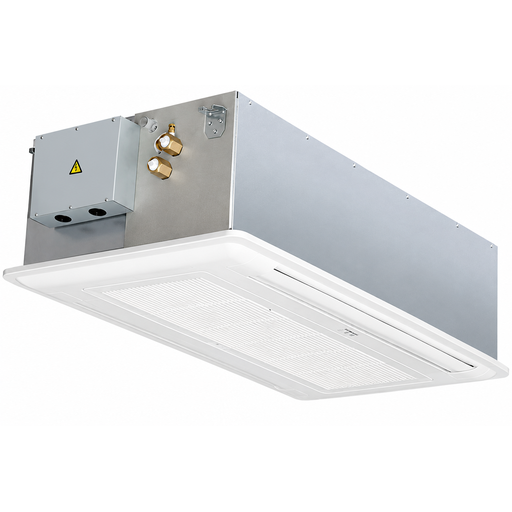
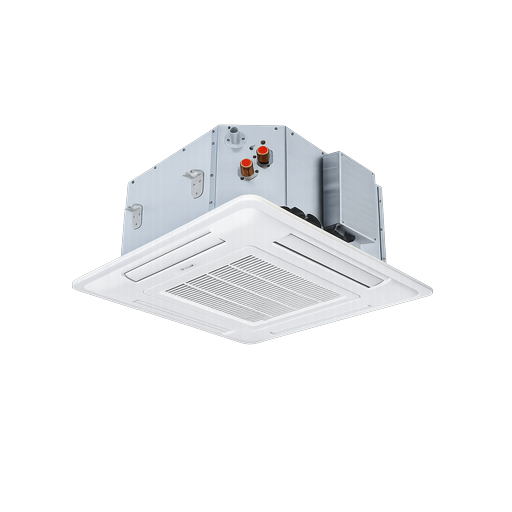
KASKM4 is the 4-way blow line, nine models from KASKM4-34 through KASKM4-238, airflow 350-2,420 m³/h at high speed, sized for open-plan offices, meeting rooms and retail floors where even coverage from a single ceiling point matters most. KA-FP-KM2 is the 2-way blow line, five models from FP-51KM2 through FP-136KM2, airflow 510-1,360 m³/h, built for corridors, perimeter zones and rooms where a two-direction throw pattern fits the space better than four. Both are ceiling cassette fan coil units in the strict sense, a slim recessed cabinet with a flush decorative panel, not a wall or floor unit, and share the same core feature set: drawn, jointless copper coils with louvered aluminum fins, SECC galvanized steel casing with anti-corrosion zinc coating, and quiet-operation centrifugal fans on rubber anti-vibration mounts.
An optional fresh-air intake port is available for projects that need to blend a small amount of outdoor air into the recirculated supply, and both series accept an electric two-way or three-way control valve as an optional accessory alongside the standard thermostat and Y-type filter. Every model run on a 3-speed motor built for high-efficiency, low energy consumption operation, and the compact, modern cabinet construction keeps standard components accessible for service rather than sealed behind a proprietary shell. Whether a buyer call it a ceiling cassette unit, cassette air conditioning, or simply a ceiling-mounted design, the coil and motor combination inside works the same way: pull room air across a water coil to condition the air, then push it back out in two or four directions. That layout reduce installed footprint compared to a wall or floor unit, integrates flush into the ceiling grid, and maximizes airflow coverage for consistent room comfort, the same energy-efficiency logic behind every product in Koven Air’s climate solutions lineup.
The 14-Model Airflow-to-Noise Spectrum
Every model below is rated at high, medium and low fan speed across the same test conditions: cooling at 27°C dry-bulb / 19.5°C wet-bulb inlet air with 7°C entering water (5°C ΔT); heating at 21°C inlet air with 60°C entering water. Noise is measured 1 m in front of and below the unit in an anechoic chamber at high speed.
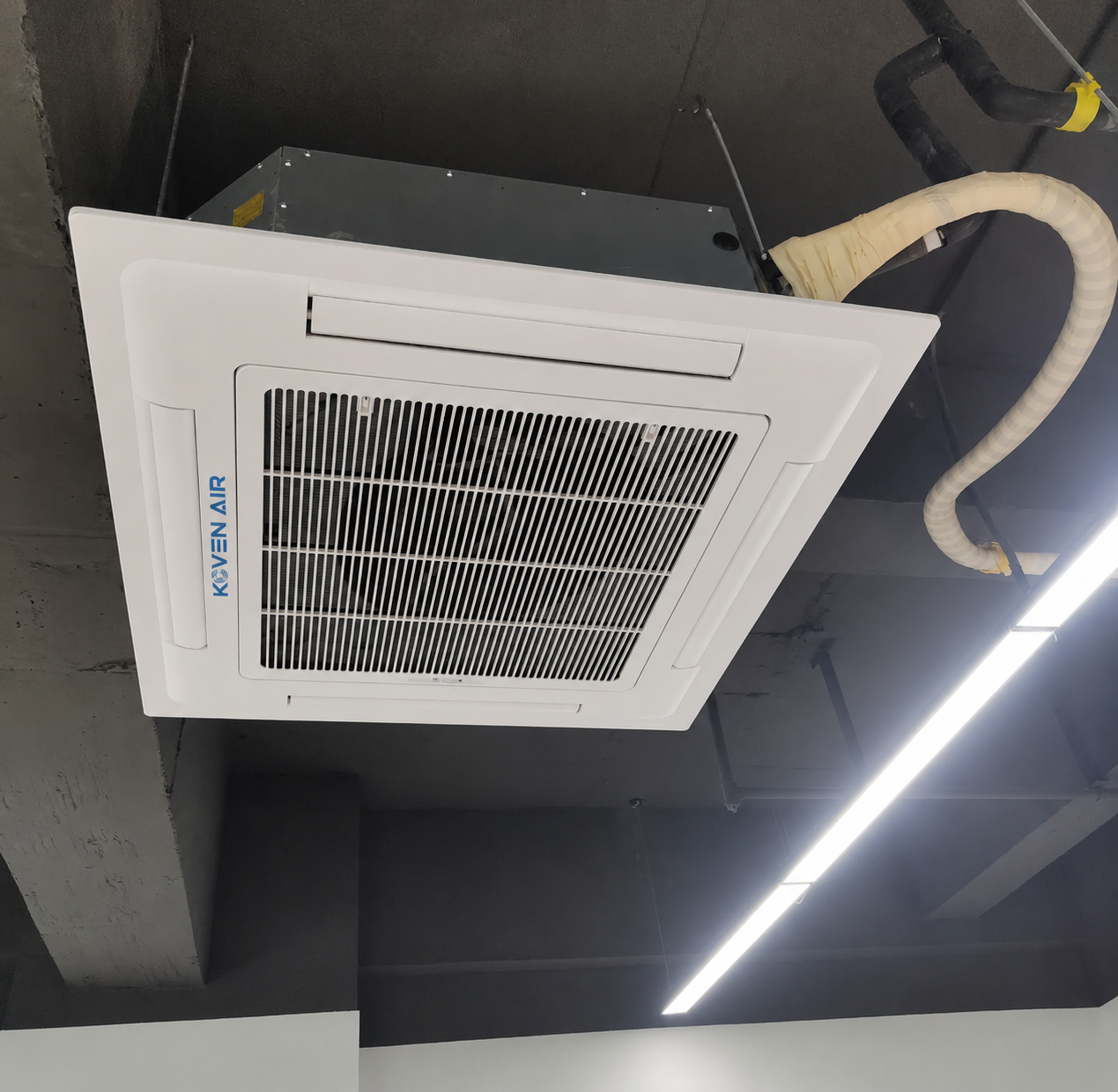
| Model (4-way) | Airflow High (m³/h) | Cooling High (kW) | Heating High (kW) | Water Flow (LPM) | Noise H/M/L (dB(A)) | Weight (kg) |
|---|---|---|---|---|---|---|
| KASKM4-34 | 350 | 2.16 | 3.57 | 6.53 | 5/32/29 | 30 |
| KASKM4-51 | 525 | 3.25 | 4.60 | 8.96 | 39/36/33 | 30 |
| KASKM4-68 | 690 | 3.98 | 6.24 | 11.37 | 41/38/35 | 30 |
| KASKM4-85 | 865 | 5.42 | 7.85 | 14.80 | 40/35/31 | 39 |
| KASKM4-102 | 1,040 | 6.36 | 9.64 | 17.81 | 45/42/39 | 39 |
| KASKM4-136 | 1,385 | 7.97 | 12.42 | 22.76 | 46/39/33 | 39 |
| KASKM4-170 | 1,740 | 10.20 | 15.42 | 28.64 | 44/37/34 | 62 |
| KASKM4-204 | 2,070 | 12.44 | 18.36 | 35.10 | 48/42/36 | 62 |
| KASKM4-238 | 2,420 | 14.40 | 21.32 | 40.10 | 52/46/39 | 62 |
| Model (2-way) | Airflow High (m³/h) | Cooling High (kW) | Heating High (kW) | Water Flow (LPM) | Noise H/M/L (dB(A)) | Weight (kg) |
|---|---|---|---|---|---|---|
| FP-51KM2 (2-way) | 510 | 2.70 | 4.05 | 8.33 | *39 | 32 |
| FP-68KM2 (2-way) | 680 | 3.60 | 5.40 | 10.17 | *41 | 32 |
| FP-85KM2 (2-way) | 850 | 4.50 | 6.75 | 13.00 | *43 | 32 |
| FP-102KM2 (2-way) | 1,020 | 5.40 | 8.10 | 15.67 | *45 | 34 |
| FP-136KM2 (2-way) | 1,360 | 7.20 | 10.80 | 20.00 | *46 | 34 |
*2-way water flow converted from catalog L/h to LPM. 2-way noise rating is a single high-speed figure per manufacturer test sheet (no published med/low breakdown). Power supply 110V/220V (4-way) or 220/1/50 (2-way); water connection Rc3/4″ or ZG3/4″; condensate drain DN20 (4-way) or 26mm OD (2-way). Source: Koven Air 2-way & 4-way Cassette FCU catalog, 2026 edition.
Decision Matrix — model fit by room type (from a real 240-unit deployment)
| Room type | Recommended model | High-speed airflow | Cooling capacity | Typical qty in reference project |
|---|---|---|---|---|
| Private office / small meeting room | KASKM4-68 | 690 m³/h | 3.98 kW | 50 |
| Open-plan office bay | KASKM4-102 | 1,040 m³/h | 6.36 kW | 110 |
| Meeting room / negotiation room | KASKM4-136 | 1,385 m³/h | 7.97 kW | 50 |
| Large conference / multi-function hall | KASKM4-204 | 2,070 m³/h | 12.44 kW | 30 |
Cassette FCU vs Other Installation Types, and vs Refrigerant Cassette AC
Ceiling clearance, visibility and maintenance access differ across every FCU form factor, and picking the wrong one cost real ceiling depth or field-service time later. Here’s how cassette compares against the three other common hydronic FCU mounting types on the dimensions that actually change a specification decision. Because it needs no supply or return ductwork of its own, a cassette unit is sometimes grouped under the general “ductless” fan coil label, a note about airflow distribution, not a claim about refrigerant, since the water piping still runs to a central plant either way. Unlike the marketing shorthand that treats “cassette” as one category, the table below separates form factor from cooling technology on purpose, cassette, concealed fan coil unit, ducted and wall-mounted are all valid answers depending on the room, and a hydronic cassette unit is only the right one some of the time.
Installation-Type Fit Grid
| Dimension | Cassette (Ceiling) | Ducted (Concealed) | Concealed (Short Duct) | Wall-Mounted |
|---|---|---|---|---|
| Ceiling Clearance Needed | ~250-300mm cavity | 350-450mm + duct run | 250-350mm | None (wall recess) |
| Visible Footprint | Flush panel only | Grilles only | Grilles only | Full unit exposed |
| Airflow Pattern | 2-way or 4-way, 360° coverage | Ducted, room-by-room | 1-2 direction, short throw | 1-direction, front throw |
| Install Complexity | Moderate (structural hang) | Higher (ductwork design) | Moderate | Lowest (fastest retrofit) |
| Best-Fit Room | Open-plan, large single space | Multiple small rooms, one plant | Single mid-size room | Small room, budget retrofit |
| Water Connection Access | Above ceiling, planned at install | Above ceiling, longer runs | Above ceiling, short runs | Behind/beside unit |
| Filter/Maintenance Access | Drop-down panel, ladder needed | Via ducted access panels | Via local access panel | Direct, no ladder |
| Perceived Aesthetics | Highest (fully hidden) | High (grilles only) | High (grilles only) | Lowest (visible cabinet) |
| Typical Room Size Fit | 25-80 m² per unit | Multi-zone, whole floor | 15-40 m² per unit | 10-30 m² per unit |
Hydronic Cassette FCU vs Self-Contained Refrigerant Cassette AC
Because both products share the word “cassette,” buyers researching either one land on pages for the wrong technology more often than the category name suggest. ASHRAE’s own equipment classification for fan coils explicitly spans chilled/hot-water, direct-expansion refrigerant and steam heat-transfer types.2 “Fan coil” is the broader engineering term, and a self-contained VRF cassette is technically one branch of it. In practice, on the buying floor, the two are different purchase decisions:
| Attribute | Hydronic Cassette FCU (This Product) | Self-Contained Refrigerant Cassette AC |
|---|---|---|
| Cooling/Heating Medium | Chilled/hot water from central plant | Refrigerant, own outdoor condenser |
| Requires Central Chiller/Boiler | Yes | No |
| Best-Fit Building Type | Buildings with an existing or planned water plant | Buildings with no central plant, standalone zones |
| Refrigerant Piping Per Unit | None | Yes, to outdoor unit |
| Typical Scale Advantage | Large multi-zone buildings, many terminals per plant | Single zones, small-to-mid buildings |
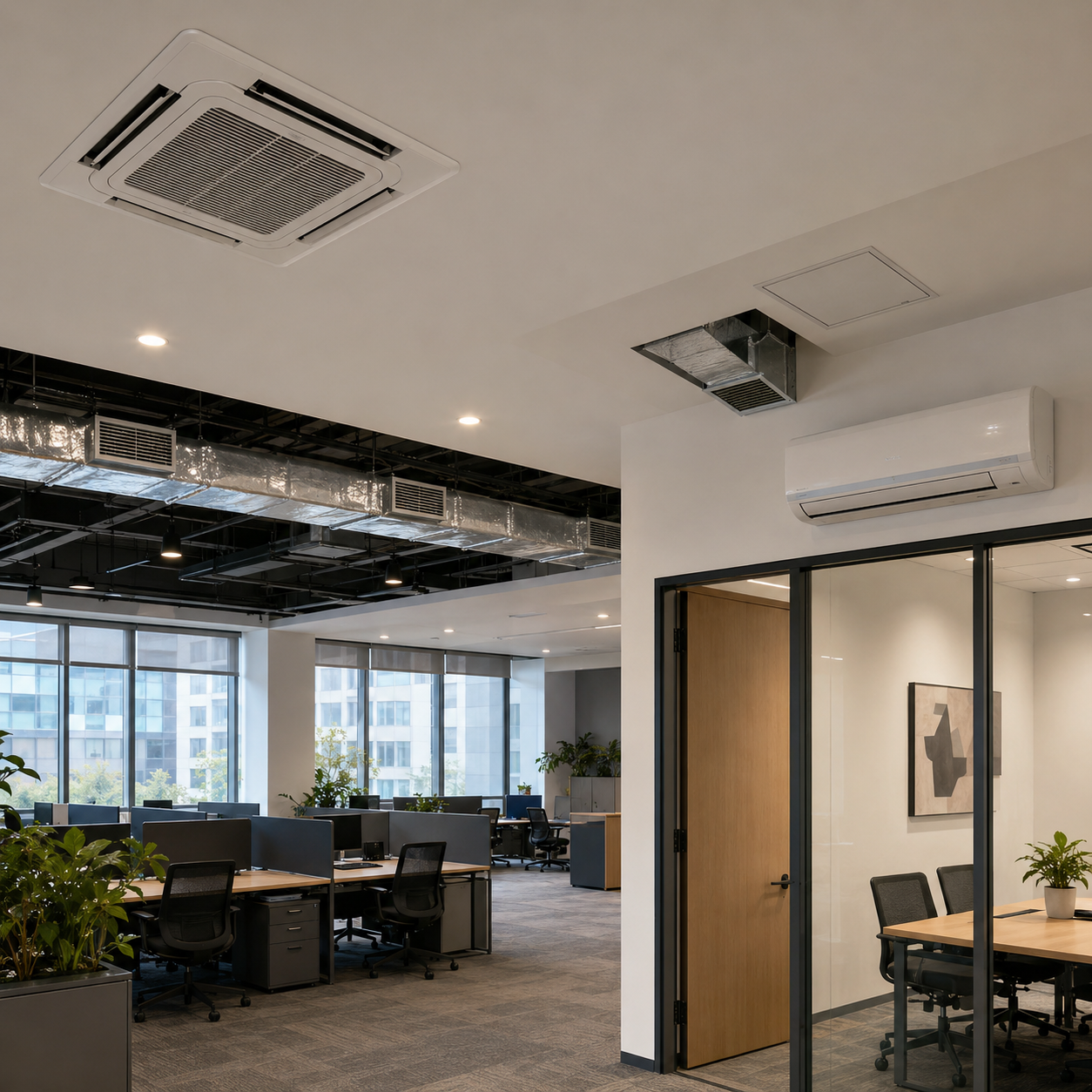
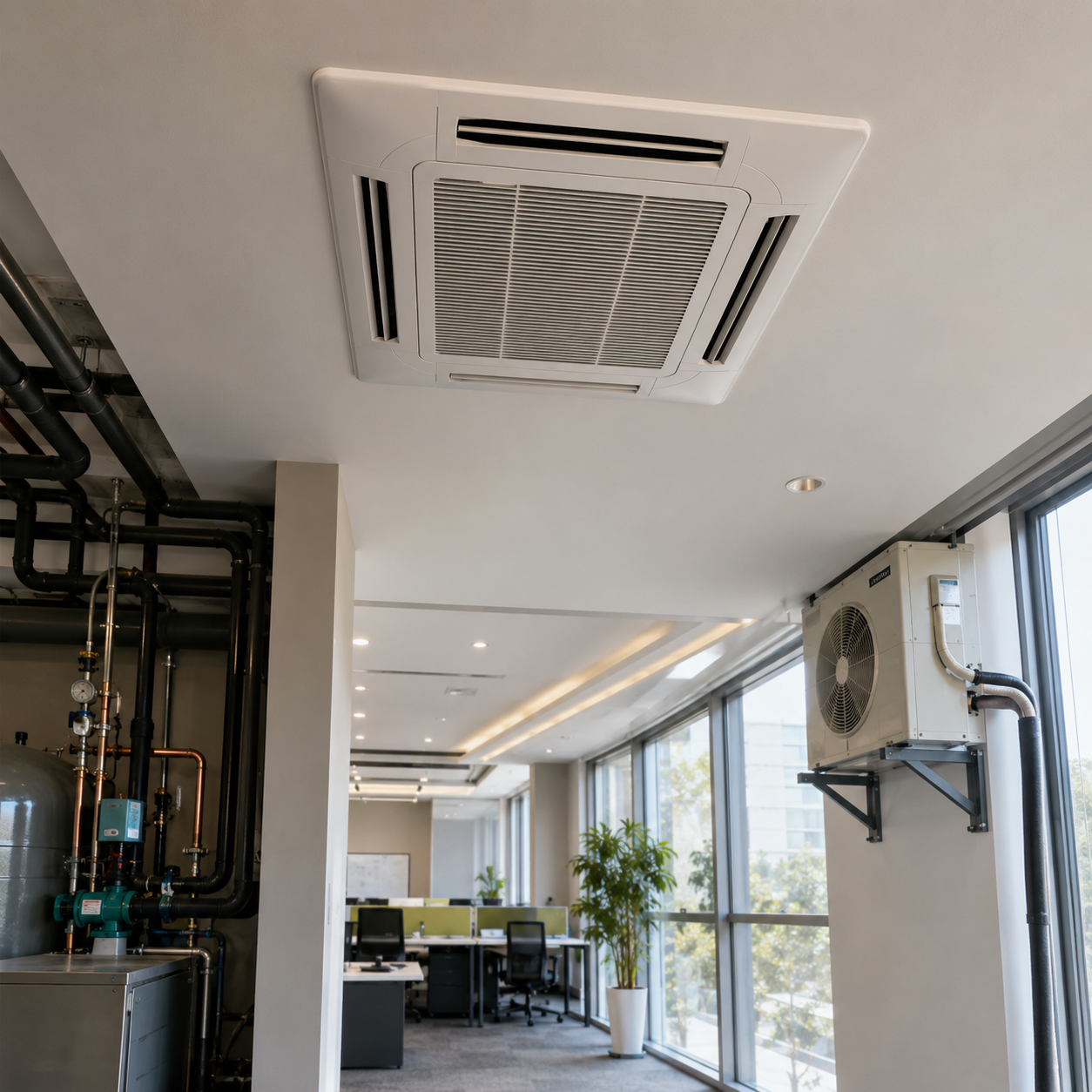
Click Image To Switch ↺
Where The Cost Logic Actually Lands
One published water-cooled-chiller-vs-VRF comparison at large scale (a 1,200-refrigeration-ton project) found the chiller/hydronic route roughly $128,000 more expensive to install but about $58,500/year cheaper to run, largely because water-cooled chiller plants can beat 0.83 kW/RT against roughly 0.95 kW/RT for the compared VRF system.3 Treat that one specific figure carefully: it comes from a single vendor blog post with unconfirmed publication date and unstated market/region, not a repeated industry benchmark, useful only as one directional illustration, not as a number to quote back on your own project. ASHRAE’s own life-cycle-cost methodology below is the far more load-bearing citation here, which makes the general point (evaluate total cost over the system’s life, not sticker price) without leaning on one blog’s specific dollar figures. A 6-room office add-on and a 1,200-RT campus plant sit on very different points of that curve either way, and Koven Air will size a specific comparison for your load rather than quote a blanket percentage.
Customer Results, 240-Unit Office Building Deployment
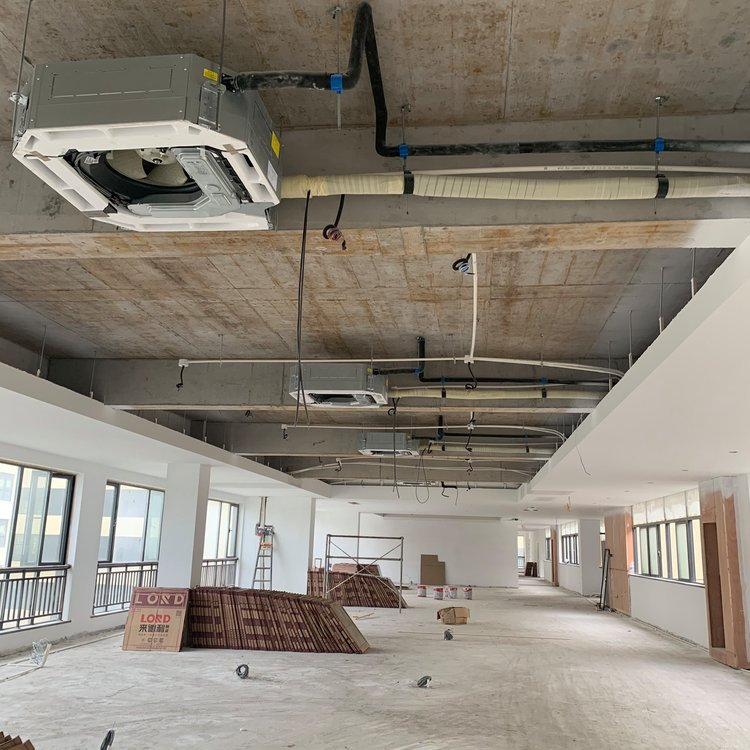
A high-end commercial office tower, open-plan work areas, private offices, meeting rooms, negotiation rooms and a multi-function hall, installed 240 KASKM4 units as its sole cooling and heating terminal, wired into the building’s chilled-water (7°C/12°C) and hot-water (60°C/50°C) loops. The zone breakdown: 110× KASKM4-102 in the open-plan bays, 50× KASKM4-136 in meeting/negotiation rooms, 50× KASKM4-68 in private offices, and 30× KASKM4-204 in the large conference and multi-function hall. Summed at rated high-speed output, the 240 units deliver approximately 1,670 kW of cooling and 2,540 kW of heating capacity system-wide.
±1.0°C
Room temperature swing
≤39 dB
Mid/low-speed noise, open-plan zone
0
Leak complaints post-commissioning
Source: project commissioning record, high-end office tower deployment. Field-measured; not third-party audited.
Room temperature and noise numbers only matter if the ceiling above them stays dry, which is where this project’s leak-prevention sequence did the real work. Every unit went in through a four-stage protocol: a dual-layer catch (built-in drain pan, sloped to the outlet), a drain path (internal lift pump plus check valve, so routing doesn’t depend on gravity slope through a crowded ceiling cavity), an overflow cutoff (high-water-level protection switch wired to interlock-stop the unit), and a verification step, every single unit got a full water-fill test before its ceiling panel closed, not a sample. That last step is the one most retrofits skip, and it’s the one that turn “we designed for zero leaks” into a measured zero-leak result across 240 installed units. The structural reason it worked at this scale: the installation sequence is engineered to require verification, not leave it to site discretion, unlike a spec sheet promise, a 240-for-240 test count is the honest version of a zero-leak claim, because it’s a count, not an adjective. That same central-intake, multi-direction airflow pattern keeping this deployment’s temperature swing tight is the mechanism a peer-reviewed cassette-FCU airflow study independently documents1.
“We test every unit’s drain path with a full water fill before the ceiling panel goes on, not a sample, every unit. On a 240-unit job, that’s 240 individual tests. It’s slower, but it’s the only way a concealed installation earns the right to call itself zero-defect.”
The 3-Grade Condensate Response Protocol
Every cassette FCU installed above a finished ceiling carries the same underlying risk: if the drain path fail, water goes into the ceiling before anyone notices. Building codes already require a baseline response to this, the International Mechanical Code calls for a water-level monitoring device on relevant condensate drain pans that shuts off the served equipment when the primary drain is restricted.4 Condensate handling is a standard part of the fan-coil equipment scope ASHRAE itself documents2, not an aftermarket add-on. Koven’s standard condensate configuration meets that baseline on every unit; what changes across projects is how far past the baseline the response go, and Koven Air offers three configurable grades rather than one fixed answer.
Grade
High-water-level action
Typical fit
Basic
Shut down unit + close motorized 2-way water valve (local interlock, meets code-baseline shutoff practice)
Residential, general office
Mid
Basic response + local audible/visual alarm
General commercial
High-end
Basic response + signal uplink to BA/BMS building-control alarm
High-end office towers, hotels, data/computer rooms
Standard condensate handling uses a molded high-density expanded polystyrene foam pan (304 stainless steel available on request) paired with a lift pump rated to a 70cm head, enough to route condensate through ceiling cavities without relying on gravity slope, with a larger-capacity pump available for longer or more complex runs. The float switch handle normal on/off cycling during routine operation; the high-water-level switch is a separate circuit that only trips on a genuine fault. In practice, most projects that reach for the High-end grade are ones where a slow undetected leak would be expensive in ways beyond ceiling repair, data centers and computer rooms are the clearest example, which is also why a BMS uplink turns a ceiling-cavity problem into a facilities-desk alert before it becomes a ceiling-tile problem. Unlike a single fixed spec, Koven Air resolves this as a choice: the structural reason to grade condensate response by building type, not treat every project the same, is that a data center’s cost of an undetected leak and a residential unit’s cost of one aren’t remotely comparable.
Certifications & Manufacturing
ISO 9001
Quality Management
ISO 14001
Environmental Management
CE Marked
Manufacturer Self-Declared EU Conformity
Commercial Cassette Air Conditioner Engineering Tools
Cassette Fan Coil Unit Model Selector
Indicative model match from room area and blow pattern, drawn from the real 14-model KASKM4/KA-FP-KM2 spec ladder. A mechanical engineer’s load calculation still sets the final selection.
Access Tool →Hydronic Cassette FCU vs Refrigerant Cassette AC — Fit Check
Three questions to check which “cassette” technology actually fits your building before you request a quote.
Access Tool →Multi-Zone Total Load Estimator
Enter a unit count per zone type (using the same model-to-room-type pairing as the real 240-unit office deployment) to see an indicative total system size.
Access Tool →2-Pipe vs 4-Pipe Configuration Checker
The one spec decision that changes the piping design, not just the unit — answer two questions to check which configuration your project needs.
Access Tool →Condensate Protection Grade Selector
Match your building type to the right tier of the 3-Grade Condensate Response Protocol.
Access Tool →Commercial Cassette Air Conditioner FAQ
No, and this is the single most common mix-up in this product category. Search results for “cassette air conditioner” typically point to a self-contained refrigerant system with its own outdoor condensing unit, no water connection needed. Every model on this page is different: a cassette fan coil unit circulates chilled and hot water from your building’s own chiller and boiler plant and carries no refrigerant of its own. If your building doesn’t have a central water plant, a hydronic FCU isn’t the right product; if it does, an FCU is usually the lower-cost way to add zoned terminal capacity room by room.
A 2-pipe system (what Koven’s KASKM4 and KA-FP-KM2 lines use) has one coil that switches between chilled water for cooling and hot water for heating, sharing supply/return piping seasonally. A 4-pipe system runs separate hot- and chilled-water circuits so different zones can heat and cool simultaneously. Buildings running one season mode at a time are fine on 2-pipe; buildings needing independent, simultaneous heating and cooling across different zones need 4-pipe.
Price depends on model/capacity, 2-pipe vs 4-pipe configuration, condensate protection grade and order volume, there’s no single per-unit number that applies across a 5-unit fit-out and a 240-unit tower. Real buyer feedback we’ve seen echoed in HVAC forums is that hydronic FCU pricing can feel disconnected from a simple per-unit cost comparison against DX systems; that’s exactly why we quote against your specific model mix and volume rather than publish a flat price. Request a quotation with your room count and load.
Match room area and heat load to the spec table above: private offices and small meeting rooms typically fit the KASKM4-68 (690 m³/h, 3.98 kW cooling); open-plan office bays typically fit the KASKM4-102 (1,040 m³/h, 6.36 kW); larger meeting rooms fit the KASKM4-136; large conference or multi-function halls fit the KASKM4-204 or larger. These are the exact model-to-room-type pairings used across a real 240-unit office deployment (see Customer Results above) — actual sizing still depends on ceiling height, glazing, occupancy and your local design conditions, so confirm with a load calculation.
Every unit ship with a built-in condensate pan and a lift pump (70cm head standard) with a float switch for normal on/off cycling. A separate high-water-level protection switch handles fault conditions: on sustained high water level, the unit shuts down and closes its motorized water valve, stopping further condensate production at the source, the Basic configuration meets International Mechanical Code baseline practice for this. Mid grade adds a local alarm; High-end grade adds a signal uplink to your building’s BMS. See “The 3-Grade Condensate Response Protocol” above for the full breakdown.
Each fan coil is a maintenance item, not a set-and-forget box, that’s true of any FCU brand, and it’s worth planning for rather than discovering later. Routine maintenance is filter cleaning (the washable synthetic filter is designed for easy removal) and periodic condensate-pump and drain-path checks. Because a cassette FCU is mounted above the ceiling, maintenance access requires a ladder and a drop-down access panel, plan filter-cleaning intervals into your facilities schedule rather than leaving it ad hoc, since deferred filter maintenance is one of the more common complaints we’ve seen raised about ceiling-mounted hydronic units generally.
Not currently. AHRI Standard 440 is the industry’s third-party lab-tested performance verification for room fan-coils, and we’re stating plainly that our line doesn’t hold it yet rather than let our ISO 9001/ISO 14001/CE marking imply otherwise. What we do have: a fully documented 240-unit real-world deployment (Customer Results above) and an in-house professional chiller and heat-pump testing laboratory used to validate every published spec figure.
“Cassette” describes the mounting form factor (ceiling-recessed, flush panel); “fan coil unit” describes the underlying mechanism (a fan pushing room air across a hydronic coil). A cassette fan coil unit is simply a fan coil built in the cassette form factor, as distinct from ducted, concealed or wall-mounted fan coils, see the Installation-Type Fit Grid above for how the four form compare.