Get in Touch with Koven Air Company

ISO Certified Badge
RTU with Heat Pump
Heat Pump RTU: All-Electric Rooftop Units for Commercial Cold-Climate Heating & Cooling
Heat Pump RTU Overview
A heat pump RTU (heat pump rooftop unit) is an all-electric, packaged rooftop heating and cooling product that leverages a single reversible refrigerant circuit to heat or cool – basically substituting an all-electric heat pump for a gas-burning furnace in a gas/electric rooftop unit. All-electric rooftop units offer a clear and direct route for buildings facing decarbonization mandates and electrifying their building systems without requiring a costly boiler room upgrade.
Heat Pump RTU Performance & ROI
There’s one hurdle every mechanical engineer, procurement manager, and facility owner faces: Will a heat pump rooftop unit actually keep a building warm through out the winter? Can it be economically compared to the gas rooftop unit it replaces? This page aims to address these concerns with measured data, including the Koven Air Cold-Climate COP Ladder (down to 30°C/22°F), alongside industry standards, refrigerant regulations, real-world project outcomes, and a tonnage and ROI framework you’ll need to make well-informed decisions for purchasing and specifying.
- All-Electric · No Gas Line
- EVI Vapor Injection to −30 °C
- R-32 Low-GWP Refrigerant
- 24–40 RT Large-Tonnage HP
- AHRI 340/360 Rating Basis
- Lifetime Free Technical Service
Specifying a heat pump RTU for a cold-climate or decarbonization project? Calculate your estimated tonnage, building load, and gas-to-electric ROI for your building and climate zone, no strings attached.
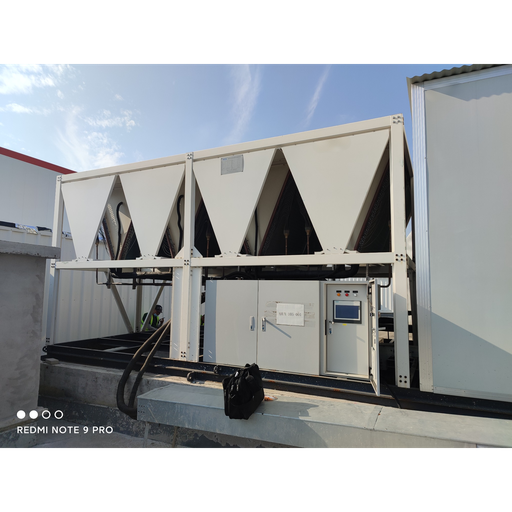
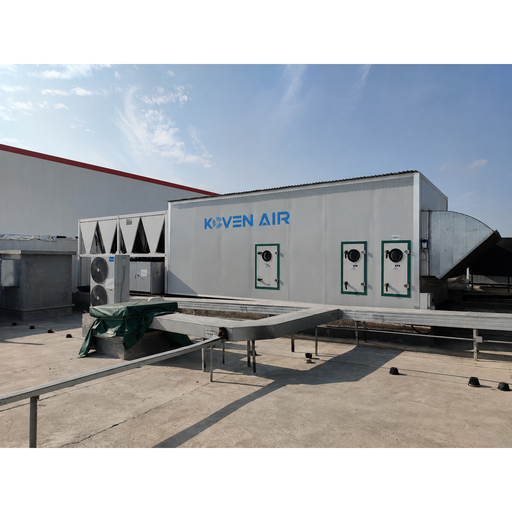
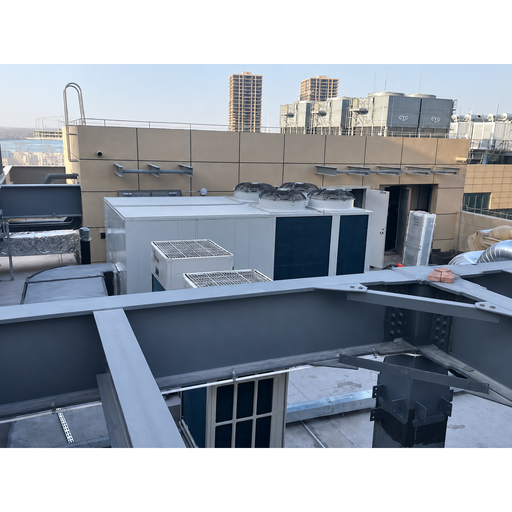
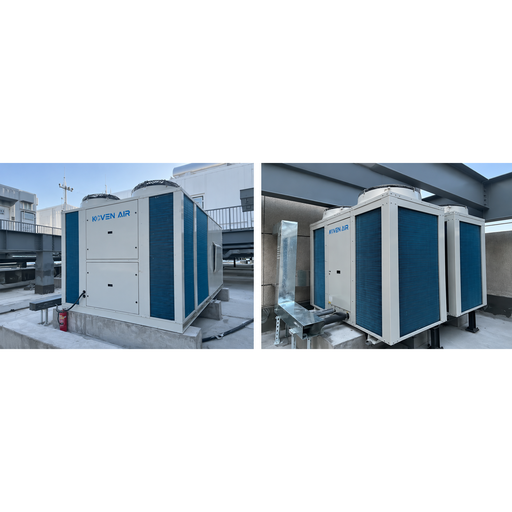
−30 °C
EVI Vapor Injection
24–40 RT
Large-Tonnage Heat Pump
R-32
Low-GWP Refrigerant
Zero Gas
All-Electric Operation
Why Facilities Are Replacing Gas Rooftop Units With Heat Pump RTUs
There are now more reasons than just regulations to ditch the gas rooftop unit; operational and financial concerns are also driving the shift. A trifecta of factors is pushing commercial buildings toward the heat pump rooftop unit, each with a distinct procurement challenge.
In a nutshell: Three primary factors are spurring the transition to heat pump RTUs:
01
(1) decarbonization and cost savings
according to the U.S. Department of Energy, heat pump RTUs can reduce greenhouse gas emissions and energy expenses by up to half compared to traditional gas-heating rooftop units;
02
(2) equipment lifespan
the need to replace aging gas/DX rooftop units that have reached the end of their operational life makes the incremental cost of an electric alternative minimal; and
03
(3) refrigerant transition and building codes
new regulations regarding the phase-out of R-410A refrigerant and updated building-performance standards necessitate equipment updates regardless.
Yet, with only around 15% of commercial buildings in the United States utilizing heat pumps, there’s a significant opportunity for widespread adoption.
The pain: gas-RTU ownership is getting more expensive and less certain
Procurement professionals consistently share in HVAC forums that equipment failure typically involves a specific component like a coil or a heat exchanger, rather than the entire unit, often compounded by challenges in sourcing parts. Facility owners frequently report instances where premium brand packaged heat pumps experience premature evaporator coil failure within two years, or gas pack heat exchangers crack after just one heating season. If the replacement part is unavailable for several months, a purportedly “reliable” brand leaves a building unoccupied with no heating.
These are the exact issues a serious heat pump rooftop unit should effectively address:
01
Coil and cabinet integrity are primary concerns
leaks in microchannel or V-coils occurring within the 1-5 year range are the most frequently cited reason for buyers discontinuing a brand.
02
Parts availability and serviceability often take precedence over perceived price
installers value timely access to parts and ease of service over headline cost, recognizing that a building without heat and an unknown restock date represent a substantial cost.
03
Cold-climate heating certainty is the emotional blocker
the fear that an all-electric unit will “stop working” in a cold snap and blow the power bill on resistance backup.
04
Total cost versus sticker price decides it
the heat pump cost a little more up front, and the question is whether energy savings and incentives pay it back inside the 1-3 year window buyers expect.
The rest of this page takes those four pains in order – cold-climate performance, all-electric vs. hybrid design, proven results, and cost – and answers each with data rather than adjectives. Building owners weighing a full portfolio should also review the DOE’s Heat Pump RTU Considerations guidance and Koven Air’s commercial rooftop unit range.
The honest trade-off Koven Air engineers for is durability over a spec-sheet average – because every rooftop heat pump is built in-house on our own precision production lines, a replacement part maps to a build record instead of a months-long back-order. Proven in the field across commercial retrofit application from 5 ton branch offices to 40 ton industrial halls, it answers the coil-and-parts failure that retires legacy units early.
The Koven All-Electric Heat Pump RTU Line: Models, Tonnage & Specifications
Koven Air builds packaged, all-electric heat pump rooftop units for commercial, industrial, and institutional buildings, engineered around two design priorities that come straight from the pains above: cold-climate heating capacity and coil/cabinet durability. The line spans light-commercial DOAS-integrated units through large-tonnage rooftop heat pumps that reach into the 24-40RT band where the major U.S. brands’ all-electric heat-pump offerings thin out.
Koven heat pump RTU — representative model specifications
SYS_OPT: EVI ON
| Specification | DOAS-025HPB (all-electric HP) | Large Rooftop DX Heat Pump |
|---|---|---|
| Cooling capacity | 85 kW | 120 kW (34 RT) |
| Heating capacity | 92 kW | 135 kW |
| Airflow | 12,000 m³/h | 18,000 m³/h |
| External static pressure | 350 Pa | 350 Pa |
| Refrigerant | R-32 (GWP 675) | R-410A (legacy band) |
| Compressor | Daikin PM-sync VFD scroll, 10–100% | Scroll VFD, 30–100% |
| Rated efficiency | IPLV(C) 9.2 · COP 3.6 | Cold-climate optimized |
| Controls | Siemens PLC + 7″ touchscreen, BMS-ready | BMS/BA integration |
| Filtration | G4 + F7 (PM2.5 ≥ 90%) | G4 + F7 |
| Sound | ≤ 62 dB(A) @ 1 m | Low-noise scroll |
| Heating floor | EVI vapor injection — operation to −30 °C (−22 °F), intelligent defrost | |
Why the hardware choices matter to the buyer pains
Durability engineering
Every Koven heat pump RTU uses hydrophilic aluminum fin with inner-grooved copper tube (raising heat-exchange efficiency ~15%), a double-wall insulated cabinet, and hot-dip galvanized plus electrostatic-spray corrosion protection – a direct response to the coil-leak and cabinet-corrosion failures that retire competitor units early. Units are built on 23 sheet-metal precision lines with 400-point traceability and a 24-hour aging test before shipment.
Read More
Cold-climate refrigerant cycle
Heating capacity at low ambient comes from enhanced/economized vapor injection (EVI) – a secondary refrigerant circuit that sub-cools liquid refrigerant and injects vapor into a mid-cycle port of the scroll compressor. This is a mature, patented technique: recent filings such as US20230271481A1 (simultaneous vapor and liquid injection) and EP4679006A1 (rooftop-mounted economized-injection heat pump) describe the same economizer-plus-injection architecture Koven uses to hold capacity as outdoor temperature drops. Peer-reviewed testing shows EVI improves cold-climate thermal performance by roughly 4-6% over a non-EVI air-source heat pump.
Read More
Explore the full range – rooftop units, dedicated outdoor air systems, and heat pump chillers – or jump to the Cold-Climate COP Ladder to see measured performance across the full temperature range.
What separates engineering from a catalog is getting the right unit right: An over/under-sized rooftop heat pump short-cycles or over-works the resistance heat – the stealthy, operation-boosting risk for that 34 ton job. Koven Air sends every unit matched to a building-specific load calc, in-house tested on site for 24 hours before shipping. One-size-fits-all, or engineered-to-spec for your machine shop, cleanroom, or warehouse in any 3 to 34 ton size. We don’t guess; we build.
Sources: Koven Air product & project documentation (first-party); USPTO/EPO patent record; Energy for Sustainable Development (Elsevier) EVI study.
Cold-Climate Performance: The Koven COP Ladder (+7 °C to −30 °C)
The Front-loaded Answer: Can it heat when it’s cold without 100% back-up heat? Yes. University of Illinois EnergySense: Cold-climate heat pumps require sized, not 100%, supplemental heat and produce a COP over 1.75 at 5F – 175% of the energy consumed and better than a 92%-efficient gas furnace. Outdated technology gives the perception that “heat pumps don’t work below 30F”; modern low-ambient units produce substantial heat to 0F and many operate at 15-20F with only a 30% reduction in output.
All-Electric vs. Hybrid Dual-Fuel Rooftop Units: The Comparison Matrix
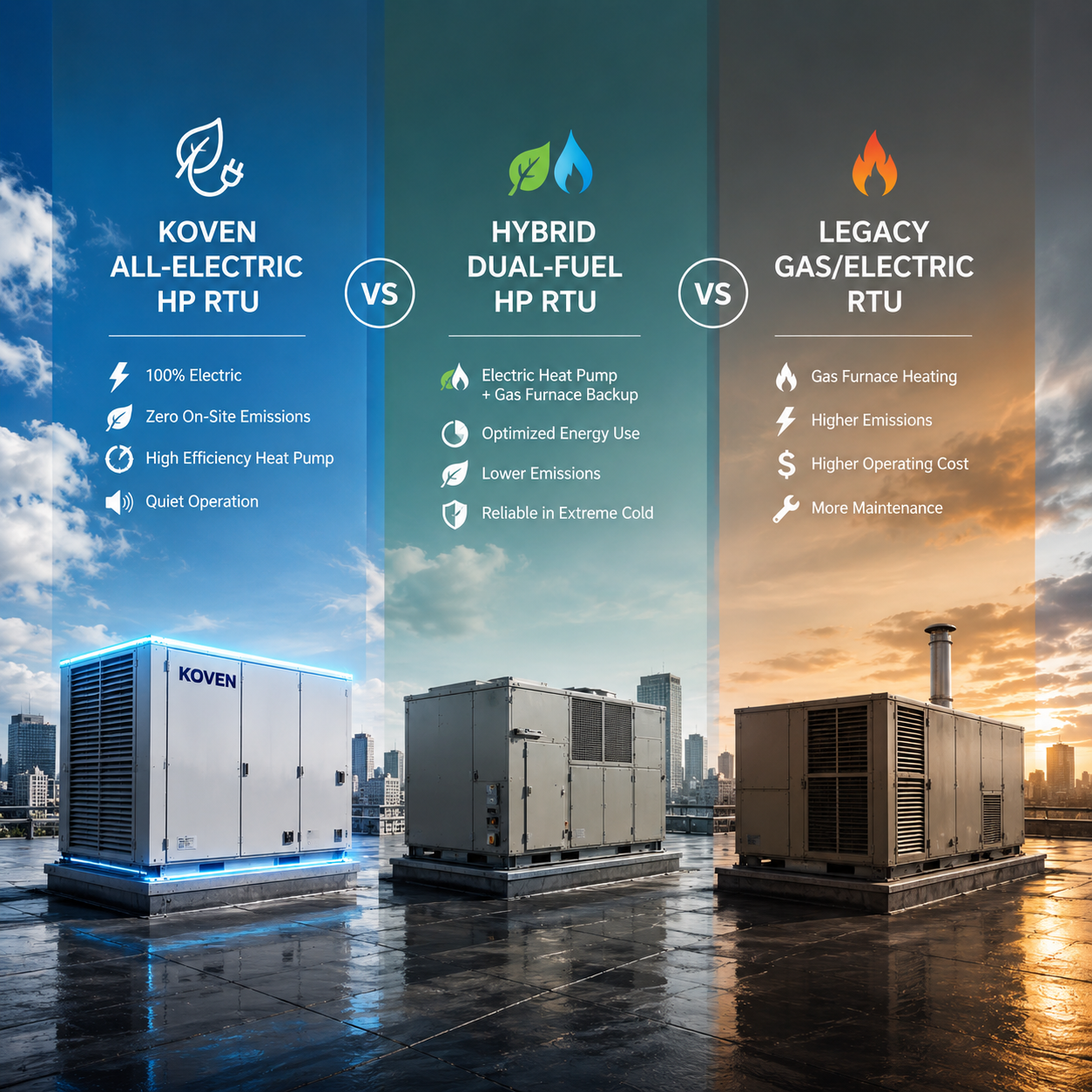
The decision fork that separates heat pump rooftop unit projects most sharply is all electric versus a dual-fuel hybrid with a gas back up system. Most “cold-climate” solutions from legacy manufacturers-like the dual-fuel WeatherMaster-class equipment or a recent electrification white paper from Trane-include a gas furnace in the box. That makes a school or facility comfortable on the coldest days, but it also keeps the gas line, the combustion emissions and the code exposure. The all-electric route eliminate all three, but requires genuine low ambient heat pump capacity and adequately sized electrical service. Here’s the honest comparison of both options dimension by dimension.
All-Electric vs. Hybrid Dual-Fuel Heat Pump RTU — decision matrix
| Dimension | Koven All-Electric HP RTU | Hybrid Dual-Fuel HP RTU | Legacy Gas/Electric RTU |
|---|---|---|---|
| Primary heat source | Reversible heat pump (EVI) | Heat pump + gas furnace | Gas furnace only |
| Cold-climate floor | −30 °C / −22 °F | Gas below balance point | n/a (combustion) |
| Supplemental / backup | Sized electric resistance | Gas burner | None (gas is primary) |
| On-site combustion emissions | Zero | Reduced (partial gas) | Full |
| Gas infrastructure | None — line can be cut | Required | Required |
| Refrigerant | R-32 (GWP 675) | Varies | R-410A legacy |
| Electrical service impact | Higher — size to design day | Moderate | Lowest |
| Defrost handling | Intelligent, sensor-based | Gas covers defrost | n/a |
| Incentive eligibility | Strongest (full electrification) | Partial | Weakest / phasing out |
| Best-fit climate | Mild to cold (with sizing) | Extreme-cold / dirty grid | Legacy replacement only |
| Decarbonization path | Complete | Transitional | None |
Infrastructure Details & Specifications
Interestingly, the upfront equipment premium for a heat pump is only modest, but electrical infrastructure upgrades are often where the real cost lie. An engineering manager at AAON notes that the electric-strip backup required “can double the amps” of a gas-back up heat pump, which can force expensive panel and service upgrades from the utility provider.
This is precisely why Koven Air’s EVI performance matters in a commercial context-the lower you can push the heat pump capacity before it’s needed, the smaller you can make your resistance back-up system and its corresponding amp draw, and therefore, the smaller your service upgrade will be.
DOE modeling on the all-electric version of the unit clearly demonstrates the geography dependent nature of the project economics, projecting ~27% utility bill savings for a school in San Francisco versus about 25% in Minnesota, largely dependent on the local heating load, grid mix and electricity rates.
DOE guidance is clear that buildings in sustained sub-20 °F climates on a fossil-heavy grid can be a better fit for a dual-fuel unit. Koven will tell you when your climate zone and grid favor that path rather than oversell all-electric — because a heat pump RTU specified against the wrong balance point is how buyers get burned.
The Better Buildings Heat Pump RTU Considerations guide offers side-by-side comparisons of these issues from the perspective of the U.S. DOE.
It’s a design choice between the two, not brand choice — and it’s expensive to make the wrong one. Since electric service upgrade, not the equipment, is the sleeper cost to make a 25-ton conversion balloon, Koven Air bases supplemental element sizing on your climate zone so that an all-electric job doesn’t force an unnecessary panel upgrade. All our recommendations are supported by the same in-house engineering and test data that’s behind the COP ladder. Whereas catalog vendors push a single architecture, a commercial or institutional application in the 10-ton to 34-ton range receives a matched call.
Sources: U.S. DOE Better Buildings Heat Pump RTU Considerations; ACHR News (AAON engineering commentary); Trane Technologies electrification white paper (dual-fuel framing).
Integrated Ventilation & Indoor Air Quality: Heat Pump RTU + DOAS
A heat pump rooftop unit goes beyond simply replacing the heating source – if it’s done right, it fixes the ventilation problem that was the unintended byproduct of an oversized, legacy rooftop. The Koven DOAS-025HPB is a Dedicated Outdoor Air System that effectively decouples ventilation from space conditioning, allowing the unit to humidify and temper 100% of outdoor air according to code without over-cooling the building.
What the DOAS design delivers
Ventilation comes first
– all outdoor air rates are sized in accordance with ASHRAE Standard 62.1, which serves as the baseline for commercial ventilation design.
Air quality is next
– thanks to a G4 pre-filter and an F7 fine filter, we capture 90% of the PM2.5 in the outdoor air. CO demand controlled ventilation also modulates fresh air delivery based on occupant load rather than being on full throttle.
The value of right-sizing
– By separating ventilation from air conditioning, the NEEA pilot buildings were able to reduce their installed cooling from 95 tons down to 32 tons. This means no more wasted energy cooling air that’s just being brought in to serve your occupants.
Consistent Humidity control
– The PM-sync VFD scroll modulates 10-100%, keeping the supply dewpoint right where it should be without the constant cycling you find in single stage RTUs.
Indoor Air Quality
– Ventilation and filtration are what decide indoor air quality. The EPA’s guidance for indoor air quality makes clear the link between healthy ventilation and productivity, and the DOAS system is the best way for a rooftop unit to achieve it. Let’s pair the DOAS-025HPB with our rooftop heat pump line for a complete one-stop-shop ventilation solution.
Ventilation determines whether a rooftop retrofit is energy-efficient
– The critical mistake, and hidden energy loss, comes when you try to cram fresh air into an oversided cooling coil which can waste 30-40% of the cooling load. Koven Air solves the problem by creating a standalone, purpose-built DOAS which we burn-in-test alongside the heat pump on the same production lines as the rooftop units. Medical facilities, cleanrooms, and even a 25-ton office floor will achieve a 5°C supply outdoor air temperature without any over-cooling or short cycling, unlike a traditional packaged RTU which has to over-cool to dehumidify.
Sources: ASHRAE Standard 62.1 (ventilation for acceptable IAQ); U.S. EPA IAQ program; Koven DOAS-025HPB specification (first-party); NEEA/RDH right-sizing data.
Governing standards & refrigerant rules for commercial heat pump RTUs
| Rule | What it governs | Relevance to a heat pump RTU |
|---|---|---|
| AHRI 340/360-2022 | Performance rating method (IEER, EER) | The basis for any published efficiency number |
| ASHRAE 90.1 §6.8 | Minimum equipment efficiency (design floor) | The efficiency the unit must meet or beat |
| ASHRAE 62.1 | Ventilation for acceptable IAQ | Outdoor-air basis for the DOAS variant |
| 10 CFR 431 Subpart F | Federal energy-conservation standard | Legally binding commercial HP/AC floor |
| EPA HFC Technology Transitions | 700 GWP limit (Jan 1, 2025) | Drives R-410A → R-32/R-454B |
| ENERGY STAR Cold Climate v6.1 | ≥70% capacity & COP>1.75 at 5 °F | Residential/light-commercial benchmark; no commercial-RTU equivalent yet (DOE IVHEC 2029) |
On the refrigerant transition: the EPA’s Technology Transitions rule capped new residential and light commercial stationary equipment GWP at 700, effective January 1, 2025. New, larger commercial equipment phase on at later dates. So the move to R-32 (675 GWP) and R-454B (466 GWP), from R-410A (2,088 GWP), will be mandatory across all new commercial HVAC applications within the next several years. And the federal framework is solidified in 10 CFR 431.
Standards are where overclaims get tested -by engineers first, and by Google second. Many commercial RTU specs fail engineers because of a non-existent AHRI-directory number, or an unsupportable, warm 47°F rating passed off as “cold climate.” Koven Air will never present a listing we cannot justify. We test, quantify, and certify against the AHRI 340/360 standard, publishing every bit of measured performance data - complete and verifiable through our in-house tests. While other suppliers simply list the performance they *assume* you want, an aerospace or data center client needing 25 tons of compliance floor is guaranteed to receive a defensible package.
Sources: AHRI 340/360-2022; ANSI/ASHRAE 90.1 & 62.1; 10 CFR 431 Subpart F (eCFR); EPA HFC Technology Transitions rule; ENERGY STAR.
Advanced Heat Pump RTU Engineering & Estimation Tools
Gas-to-Electric Heat Pump RTU ROI Estimator
A transparent first-pass estimate of annual savings and simple payback when replacing a gas rooftop unit with an all-electric heat pump RTU. Adjust the inputs to your building.
Calculate ROIHeat Pump RTU Tonnage & Model Selector
A quick indicative sizing from building type and area. Use it to frame a shortlist — a stamped load calculation still governs the final selection.
Select ModelCold-Climate COP & Supplemental-Heat Lookup
Drag to an outdoor temperature and read the measured heating COP from the Koven Cold-Climate COP Ladder, the operating mode, and whether sized supplemental heat is likely to engage.
Lookup COPFAQ: Heat Pump RTU Questions Engineers and Buyers Ask
Trending now
![Liquid Desiccant Dehumidifier: How It Works [2026 Guide]](https://kovenair.com/wp-content/uploads/2026/07/liquid-desiccant-dehumidifier-guide-featured-150x150.png)