
Get in Touch with Koven Air Company

Factory-Direct Industrial Cooling · Since 2007
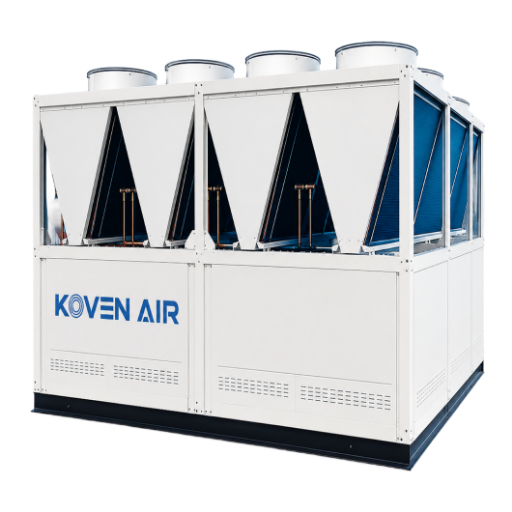
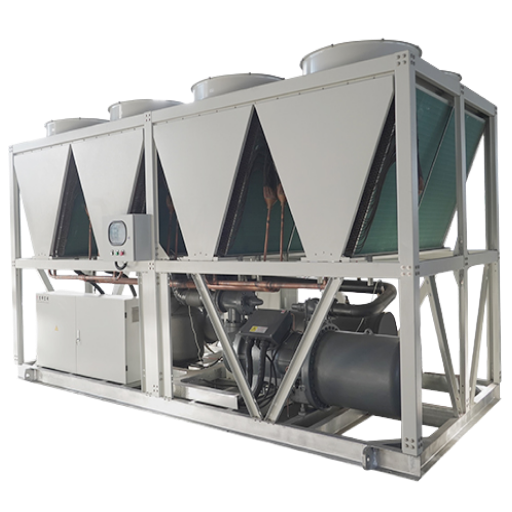
Air Cooled Chillers, Screw & Scroll, 224–2,660 kW
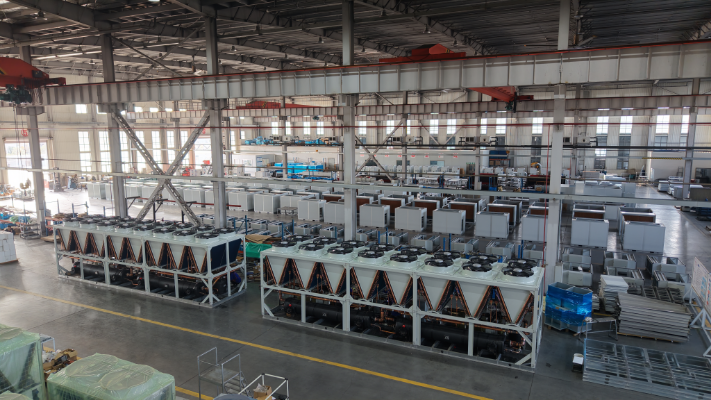
An air-cooled chiller rejects process heat directly to ambient air, so you don’t need the cooling tower, the water treatment, and the legionella risks associated with it. Koven Air builds the KAFLG screw and scroll range at their 20,000m² facility and ship direct to 35 countries – no distributor markup between you and the engineers who designed the machine.
What’s an air-cooled chiller?
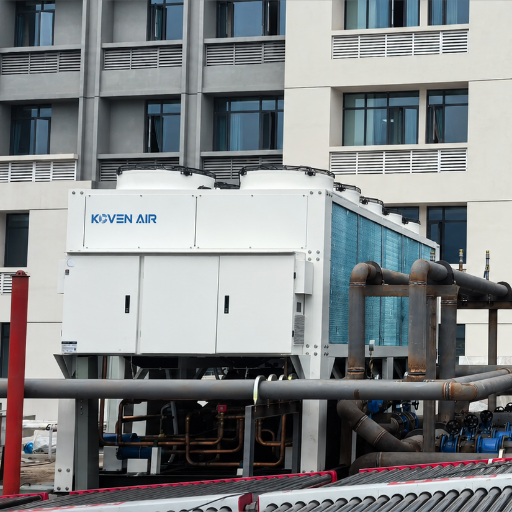
An air-cooled chiller is a packaged refrigeration system that chills process or comfort water and rejects the absorbed heat to the surrounding air through finned condenser coils and fans – instead of through a water-cooled condenser and cooling tower. Koven’s KAFLG line offers 224-2,660kW on R407C, 388-1,366kW on R134A, with an R1234ze low-GWP option, 5:6 twin-screw compressors and 25-100% stepless capacity control.
- 224–2,660 kW cooling (R407C series)
- 25–100% stepless modulation
- R1234ze low-GWP option
- 35 export countries
- 20,000+ projects delivered
- 24h RFQ turnaround
Why Plants Move From Cooling-Tower Systems to Air-Cooled
Every cooling-tower loop you run is a second maintenance program bolted on to your chiller: make-up water, chemical dosing, blowdown and a Legionella management plan your safety team has to sign. When water is expensive or scarce, that program quietly outgrows the electricity bill it was supposed to save.
An air-cooled chiller eliminates that entire loop. The heat comes out of the condenser coil and fans, so there’s no tower, no basin, no water-treatment contract to manage.
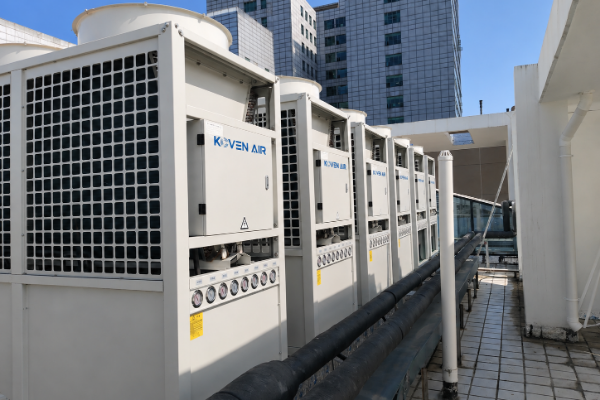
How an air-cooled chiller works (in one pass)
In the refrigeration cycle, low-pressure refrigerant absorbs heat from your chilled water in the evaporator; the screw compressor increases its pressure; and the finned condenser coils reject the thermal energy to the ambient air. The evaporator and condenser are heat exchangers; they move heat, not consume it. This process allows the unit to remove heat from your process, even at higher ambient temperatures.
The chilled water is then returned to your cooling load at the setpoint, and an electronic expansion valve resets the cycle. The underlying operating principle is the same vapor-compression process as in water-cooled chillers and centrifugal machines, but with a different path for heat rejection – which takes the cooling tower out of the picture. For a deeper dive into how it all works, see our air-cooled chiller guide.
- No cooling tower means lower installed cost and a smaller mechanical footprint on the roof or in the yard.
- No process water draw means critical when water is metered, permitted, or simply unavailable.
- Faster deployment: a packaged unit arrives factory-charged and runs after power, water piping and commissioning.
SYSTEM TRADE-OFFS & ENGINEERING
The honest trade-off is real and we’re not going to hide it: air-cooled units run at a higher condensing temperature than water-cooled units, which results in lower unit-level efficiency — a gap quantified by US DoE FEMP. Whether this impacts your bill more depends on your climate, your water price, and your run hours-which is what we’ll discuss in the next two sections with data.
Koven Air engineers every KAFLG unit based on your climate and water cost – not a badge rating. An industrial process load in a water-tight climate is the best place to earn your dollars back in 224-2,660 kW, and you’re back for two key reasons: deleted tower is deleted hardware – and deleted cost. You don’t get an off-the-shelf copy of a badge engineered import; every unit’s manufactured and tested at Koven Air’s plant.
The KAFLG Air-Cooled Screw & Scroll Range
Refrigerant leaks are by far the leading cause of chiller failure, and a failure at mid-summer represents just the sort of risk that leaves a plant with no cooling. Unlike a reciprocating machine that features more of dynamic seals, the KAFLG platform centers on a semi-hermetic twin-screw compressor with a 5:6 asymmetric rotor profile, fewer moving parts, which is where Koven Air concentrates reliability rather than where field leaks typically start.
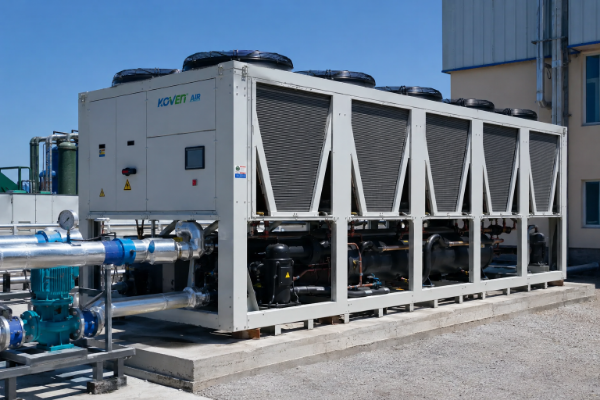
Capacity, refrigerant, and compressor at a glance
Series
Cooling capacity
Refrigerant
Compressor
Modulation
KAFLG067.1–800.4 (R407C)
224–2,660 kW
R407C
5:6 twin-screw, semi-hermetic
25–100% stepless
KAFLG110.1–400.2 (R134A)
388–1,366 kW
R134A
5:6 twin-screw, semi-hermetic
25–100% stepless
R1234ze low-GWP option
project-configured
R1234ze
5:6 twin-screw, semi-hermetic
25–100% stepless
Scroll option (light process / comfort)
smaller-tonnage loads
R410A / R407C
Scroll (tandem/manifold)
Step control
The scroll air cooled packages are usually employed in the ~15-35 ton range, while screw platforms are left to the higher tonnage band, where economizer designs such as US Patent US20120103005A1 lift part-load efficiency.
Which KAFLG configuration fits your duty
Your situation
Capacity band
Refrigerant pick
Configuration
Large process / district cooling
1,000–2,660 kW
R407C
Modular multi-compressor screw, dual circuit
Data-center / free-cooling ready
400–1,366 kW
R134A
Screw + integrated free-cooling coil
EU / low-GWP mandate
project-configured
R1234ze
Screw, compliance-futureproof
Heat recovery / hot-water reuse
388–1,366 kW
R134A
Heat-pump build, 40–50°C recovery
Light process / comfort cooling
< ~120 kW
R410A
Scroll package
Engineering Notes, What’s Inside the Package
- High-flux copper tube shell-and-tube dry evaporator up to 20% greater heat transfer performance than bare tube allowing for same duty at reduced approach.
- Electronic expansion valve, precise control of superheat from 25 to 100 percent turndown.
- 7-inch touchscreen PLC (Siemens) that uses RS485 / open BMS protocol and can slot straight into existing building management systems without any gateway.
- Power: 380V / 415V / 460V / 575V builds available to suit NA / EU / Middle-East electrical networks directly.
- Water side rated to 1.0 MPa; heat-pump builds recover 40–50°C hot water and reclaim 20–30% of condensing heat when configured for it.
Air-Cooled vs Water-Cooled: When Air-Cooled Actually Wins
Want it modeled on your rates?
Get a custom air-vs-water TCO estimate
| Factor | Air-Cooled (KAFLG) | Water-Cooled + Tower |
|---|---|---|
| Cooling tower required | No | Yes |
| Annual water use | ≈ 0 | High (make-up + blowdown) |
| Unit full-load efficiency | ≈ 1.1 kW/ton (EER ≈ 10.9) | 0.50–0.61 kW/ton |
| System operating cost* | ≈ $16,000/yr | ≈ $38,000/yr |
| Legionella / water-treatment plan | Not required | Required |
| Typical service life | 15–20 yr | 20–25+ yr |
| Install footprint & cost | Lower (no tower/basin) | Higher |
(The system operating costs reported below are average market costs based on ProcumentIQ, not on Koven’s tests and change based on local power and water rates. Efficiency floors per US DoE FEMP / AHRI 550/590)
ENGINEERING VERDICT
Let’s look at the table straight up: the water-cooled machine wins on rated nameplate efficiency and life, the air-cooled one on water usage, footprint, installation costs, and often-depending on where you live-on total cost of ownership. Since which one wins for you comes down to the price you pay for water and the hours the chiller actually runs, we at Koven Air model your system based on your specific metered data before recommending either machine-we don’t give you the standard book answer.
If your site has abundant water and runs at high load year-round, our water-cooled chiller range may edge ahead on efficiency — we build both lines and will tell you which your numbers actually favour.
Screw vs Scroll, and Why IPLV Beats Nameplate EER
One of the second biggest mistakes you can make in the world of chillers is choosing one with the highest nameplate EER. Chillers operate the majority of the time between 70 and 75% capacity, not full-capacity, so what really determines your electric bill is your chiller’s IPLV, or Integrated Part Load Value (a load-weighted average defined in AHRI Standard 550/590) rather than the figure listed on the equipment datasheet for full load operation. The US Department of Energy FEMP standard makes it crystal clear: for a compliant chiller, there must be not only a full load floor, but also a minimum IPLV requirement because a chiller tuned to meet full load will likely perform poorly at part loads.
This is precisely why Koven Air’s KAFLG chiller systems use a screw compressor with 25-100% stepless capacity control, instead of trying to achieve a high single data point number. This enables the unit to maintain efficient performance in its natural part load operating range.
Where the energy savings actually come from
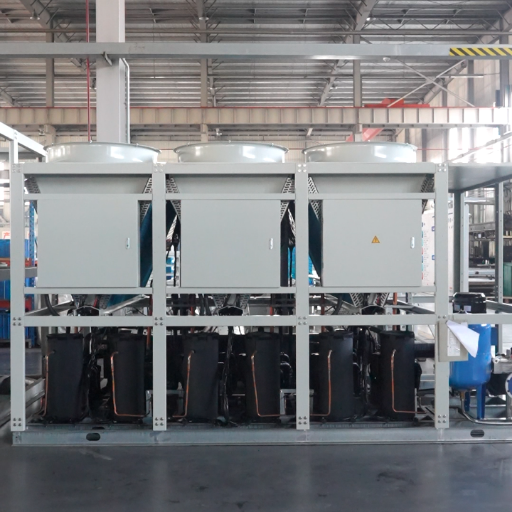
The true energy savings of an air-cooled chiller come from its part load operation, not its rated nameplate. Stepless 25-100% modulation, optionally enhanced by variable speed drive on the condenser fan, keeps the unit’s energy usage in sync with the actual cooling demand and avoids hard-cycling that consumes excess energy. This provides a real, efficient, reliable cooling performance for the hours the equipment will actually run, far beyond what a single rated data point can convey.
Air-cooled screw and scroll chiller are one family of technologies; other families include water-cooled centrifugal units, which sometimes use oil-free magnetic bearing compressors, and absorption chillers, which fit best for certain applications. Air-cooled machines are the right fit when water cooling is impossible or impractical, and the cooling job is process or comfort air conditioning, without a cooling tower. The selection of the correct chiller should focus on fitting the chiller’s design to your load, rather than trying to match a single performance spec.
Screw vs scroll, pick by duty, not by habit
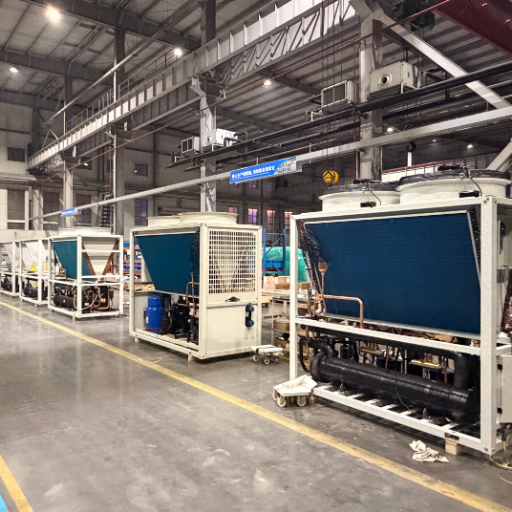
- Screw (KAFLG main line) – Best for duty loads > ~120 kW and for steady high hour process/district applications. High degree of capacity modulation and good IPLV.
- Scroll – Best for low-hour on-off comfort/light process applications. Lowest first cost, low level of capacity modulation.
Air-cooled screw chiller efficiency is still an area of R&D. (For instance, a 2024 patent (CN119532993A) describes multi-head air-cooled screw circuits with shared condensers to better balance pressures and the Johnson Controls 2012 patent (US20120103005A1) also focuses on increasing part load efficiencies by adding a dual economizer).
Not sure screw or scroll fits your load profile?
GET A FREE SIZING & SELECTION REPORTThe Koven Climate-Match Selector. We size your equipment on four axes, not just a single spec, because a chiller that’s efficient in the North can fall short in the South:
- Capacity – Actual duty at your specific chilled water temperature, not nominal capacity.
- Compressor – Screw type for high hours, part load; scroll for light on/off duty.
- Refrigerant – Selected based on your GWP and regulatory horizon (e.g., R407C, R134A, or R1234ze).
- Ambient-climate axis – design ambient and the capacity correction that follows from it.
“We rate every unit at the customer’s real leaving-water and design-ambient conditions, not at the catalogue nominal. A machine that looks oversized on paper at 35°C can sit right at the edge at 43°C, so we’d rather correct it on the test bench than have a buyer discover it on a July afternoon.”
Ambient & setpoint correction, the selection framework
Air-cooled capacity isn’t a single number; it moves with ambient temperature and leaving-water temperature. The framework below shows the direction and typical magnitude of that correction so you can sanity-check a selection – Koven confirms the exact factor for your unit on our own chiller test bench before quoting.
Ambient air
LWT 5°C
LWT 7°C (nominal)
LWT 12°C
28°C
0.96
1.05
1.18
35°C (nominal)
0.91
1.00
1.12
40°C
0.86
0.94
1.06
43°C
0.82
0.90
1.01
Typical air-cooled capacity correction factors (nominal = 35C ambient / 7C LWT = 1.00). Directional engineering reference for selection sanity-check; not a substitute for a project-specific rating. High-ambient duty above 43C is confirmed per project – ask for our high-ambient test data.
Where 20,000+ KAFLG Installations Run
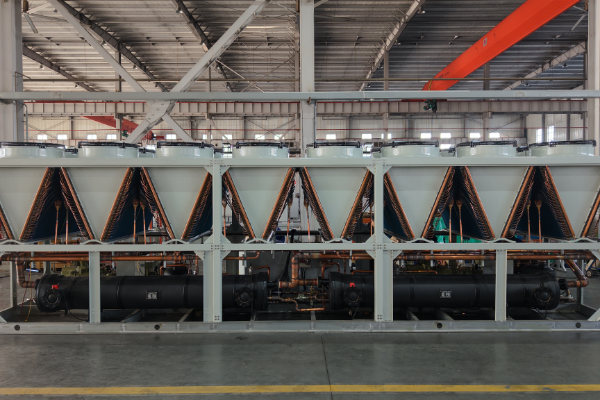
An air-cooled chiller earns its place wherever water is expensive, restricted, or unwelcome. From industrial chillers on a factory floor to comfort cooling solutions in commercial buildings, these chiller units serve a wide variety of applications. Across 20,000+ projects in 35 countries, the KAFLG line clusters into four process-cooling applications.
- Data centers & free cooling – the water-free, fast-deploy argument is why hyperscale operators increasingly specify air-cooled; a KAFLG free-cooling coil harvests low-ambient hours to cut compressor run time.
- Industrial process cooling – plastics, food & beverage, chemical, and machinery loops that need stable chilled water without a tower permit.
- Heat-recovery hot water – heat-pump builds reclaim 20-30% of condensing heat as 40-50C hot water, turning rejected heat into a second utility.
- Commercial HVAC – heating, ventilation, and air conditioning for hospitals, malls, and hotels where roof space beats a ground-level tower.
Across these duties, KAFLG systems handle cooling loads from a single building to a district cooling network, delivering reliable cooling at high efficiency. Because heat rejection stays entirely air-side, you avoid the energy consumption and water treatment that condenser-water pumping adds to a comparable chilled water plant, so energy savings land on the meter rather than the datasheet.
2–4 yrs
Typical payback when replacing a 10–15-year-old chiller — modern units run 20–40% more efficiently, and an old 50-ton air-cooled unit’s running cost can exceed a new system’s price within ~3 years.
TCO Framework · Industry-Anchored
Source: LNEYA chiller-replacement analysis; figures are industry averages, not Koven measurements — your payback depends on tariff and run hours, against a US DoE 23-year chiller lifecycle basis.
How to read a payback like this
The payback is driven by the efficiency delta between old and new equipment plus your annual run hours – it isn’t a fixed property of the machine. On a high-hour process load in a high-tariff grid, payback compresses toward the 2-year end; on a low-hour comfort load it stretches past 4. We build the calculation on your metered consumption, not a brochure number.
Have last year’s kWh data?
Get a replacement-payback estimate
How We Build, and Back, Every Chiller
The loudest complaint in this market isn’t about where a chiller is made – it’s about what happens when a part fails. “The big problem with Trane is the lack of parts availability” is a real buyer’s words after a dome-sensor failure took his unit down in mid-July. Cross-border support is exactly where a factory-direct manufacturer either earns trust or loses it.
We win by doing exactly what the failed ones aren’t doing – the machines, and their backed support.
Honest positioning, read before you compare quotes
Koven chillers are engineered and manufactured in China. We don’t badge them as Japanese or German, and we don’t hide the international content: the PLC is Siemens, and compressors are sourced from established screw and scroll makers. What’s ours is the design, the assembly, the 400-point traceability, and the test-lab data, that’s what you audit, not a flag on the nameplate.
US field technicians already say the quiet part out loud, on r/HVAC, the units that are “great to work on” include “the French/Chinese stuff.” The brand question is more open at purchase time than the incumbents would like you to think; the evidence question is where you should spend your due diligence.
Built in one factory, traced end to end
- 20000 m2 factory since 2007 – Koven is the original manufacturer of our screw chillers, they weren’t branded components.
- 400 points of traceability – the entire history of how the machine was built, is stored.
- 24 hours testing, after 36 quality checks before shipping — each aligned to the ISO 9001 quality system.
- 35-country support with free tech support & 24h turnaround for any issues under warranty – unlike OEMs, who sell-off tech support to third parties and typically respond in days.
ISO 9001
Quality management
ISO 14001
Environmental
CE
EU market access
DIN 1946
Ventilation standard
AHRI 550/590
Performance rating basis
Procurement: Refrigerant, Lead Time, and Cross-Border Support
Chiller pricing isn’t a shelf number, and any supplier who hands you one before seeing your duty is guessing. Here’s the framework we quote against, plus the two procurement risks that actually bite on imported equipment.
What drives your quote
- Capacity & configuration – kW/RT, single vs multi-compressor, free-cooling or heat-recovery coils.
- Refrigerant choice – R407C / R134A vs the R1234ze low-GWP build.
- Grid & controls – voltage build (380–575V) and BMS integration depth.
- Ambient design – standard vs high-ambient duty and the correction it requires.
The two import risks, and how we close them
When you’re under pressure to move to low GWP, you’ve a very real and imminent threat from the US EPA’s AIM Act, which mandates manufacture and install phase outs of high GWP equipment. Selecting the right KAFLG unit today means building a 15 to 20-year asset on the correct side of the new regulation from the moment it goes into service.
Shipping damage is a serious risk on long-distance freight; components are dislodged and wiring knocked loose. Each unit goes through a 24hr aged-in the factory prior to shipping, followed by a documented, post-delivery, commissioning review by one of our support staff, removing any guesswork.
Refrigerant & the compliance clock
Our prices aren’t guesswork; they’re the outcome of your exact parameters. Simply request a quotation to get an accurate price within 24 hours.
We encourage you to work on actual values rather than trying to fit them into vague ranges.
Procurement checklist for imported chillers
We offer our clients lifetime free technical service and warranty support with guaranteed immediate responses. This support infrastructure extends across 35 countries – there’s always help close by when you need it.
- Ensure it has AHRI 550/590 certification and you receive a copy of the factory test report.
- Ensure all spare parts and warranty terms are provided in writing, not just verbally.
- Specify the refrigerant against your regulatory horizon, not just today’s price.
- Request a post-arrival commissioning protocol before the unit leaves the factory.
Engineering Calculation Tools
Access our specialized calculators and selectors to determine optimal chiller sizing, evaluate total cost of ownership, and calculate climate-based derating.
Get an Air-Cooled Chiller Sized to Your Site
Request a Quote (24h Response)Tell us your duties (load, chilled-water setpoint, design ambient, grid) and our application engineers will respond within 24 hours with a selection sized to US DoE FEMP efficiency floors and a quote.
Direct from the factory.
35 countries.
Lifetime technical support.
FAQ: Air-Cooled Chillers
[01]
Do air-cooled chillers need a cooling tower?
No, a chiller with an air-cooled condenser passes the rejected heat from its compressor through a condenser coil and out to ambient air via a pair of fans. Consequently, there’s no cooling tower, tower pan, make-up water, or water-treatment system required. That’s why they’re primarily chosen for facilities that are metered or restricted with regard to their water use.
[02]
Air-cooled vs water-cooled, which is cheaper to run?
It depends on your region, not a universal rule. Once tower water, chemical treatment, and condenser-pump energy are counted, published market data shows air-cooled near ~$16,000/yr against ~$38,000/yr for water-cooled, and it can flip entirely in low-power, high-water-cost regions. We model it on your tariffs before recommending either.
[03]
Is a Chinese-made chiller a reliable buy? (from r/HVAC buyers)
Buyers openly crowd-source this at purchase time, and veteran US field techs hold Chinese and French units in very high regard. Measure it by documented, verifiable data — the AHRI 550/590 test criteria, ISO 9001 (a factory test lab report),and the contractual terms for spare parts — rather than what’s on the nameplate.
[04]
What’s the difference between a screw and a scroll air-cooled chiller? (from forum buyers)
Screw compressors good for larger-tonnage/higher hour process & district loads; provide step-less part load control. Screw are better for those and for some process where loads are constant, while scrolls are more applicable to the lower first cost on-off comfort and light process loads. KAFLG starts at ~120 kW screw and below this it’s a scroll compressor.
[05]
Should I just buy the chiller with the highest EER?
No – IPLV generally has more significance. Most of a chiller’s operating hours are between 70 and 75 percent load. So the load-weighted IPLV accounts for your real utility bill. FEMP requires a compliant unit to meet both full-load EER and IPLV minimum floors.
[06]
How does high ambient temperature affect capacity?
Our air cooled capacity decreases as the ambient temperature increases and vice-versa for an increased leaving water set point. Our standard catalogue is designed to perform up to an ambient temperature of 43°C, if your design is at an increased temperature we check the relevant correction factor in our own test house before providing an estimate.
[07]
What refrigerants does the KAFLG line use?
R407C (224-2,660 kW) and R134A (388-1,366 kW) but it offers a low-GWP R1234ze alternative for those sites under pressure of the GWP phase-down deadline. Selecting low-GWP now means a 15-20 year asset will still be fit for purpose through its lifespan.
[08]
How long does an air-cooled chiller last?
15-20 yrs usually on air-cooled, 20-25 yrs or more if properly maintained for water cooled units. Maintenance and the health of the refrigerant circuit are far better indicators than brand; refrigerant leaks being the most common failure.
[09]
What is the lead time and how is a quote generated?
We give you a quotation back in 24 hours from when you give us your duty parameters. As the price varies considerably depending on capacity, refrigerant, voltage and ambient design, we quote from your requirements not a catalogue price.

![Commercial Rooftop Unit Guide: Types, Sizing & Costs [2026]](https://kovenair.com/wp-content/uploads/2026/07/commercial-rooftop-unit-guide-featured-2-150x150.png)