Get in Touch with Koven Air Company

Evaporative Chiller
Because the evaporator give up the heat of compression directly to a wetted coil, the evaporator’s condensing temperature varies according to the wet-bulb not the dry-bulb, which drains capacity from air-cooled units. Koven Air designs this into an integrated system from 19-800 tons. In a Jeddah installation that regularly gets dry-bulbs as high as 116F, the disparity was 50F chilled-water against 58F, while the air-cooled units couldn’t reach the lower level.
Request a Quote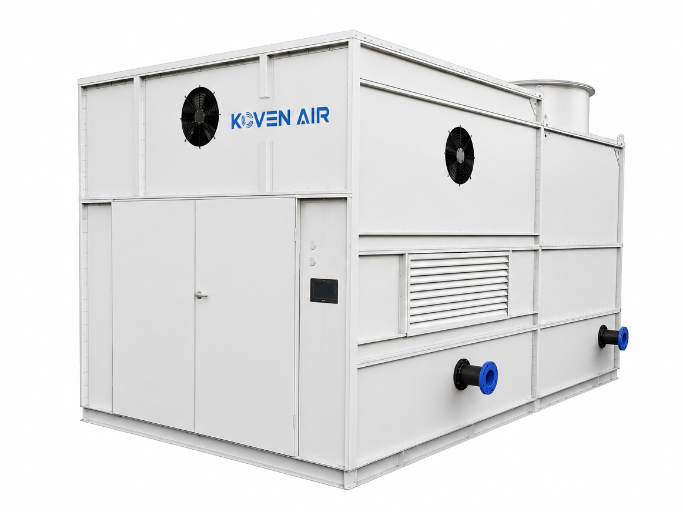
19–800 TR
Cooling capacity
(KAFZ screw + JXRZ scroll)
5.7–6.0
Rated COP at 7 °C LCHW,
35 °C DB / 26 °C WB
0.79%
Make-up water as a share of
chilled-water flow
−10 to 43 °C
Year-round ambient
operating range
75 days
Contract-to-production on a
2×1088 kW Saudi project
5.70
Third-party witnessed COP
at 44.2 °C dry-bulb
Why Air-Cooled Chillers Lose Capacity in Hot Climates
A PET preform plant in Jeddah ran two 800 kW air-cooled screw chillers with a 3.2 nameplate COP. At 45 °C ambient the plant measured 2.7, with cooling capacity down by more than a third against design. Chilled water that the injection tools needed at 12 ± 1 °C arrived at 14.5 °C, and on the worst days at 16 °C.
What that cost the plant
- Injection cycle stretched from 28 s to 35 s
- Preform scrap climbed from 1.2% to 3.8%
- Monthly output loss exceeded 12%
- Dust-blocked fin coils needed high-pressure washing every 15 days, near US$18,000 per unit per year
- Unplanned compressor downtime passed 40 hours a year
The compressor isn’t the problem. Air cooled condenser only can reject heat to the dry-bulb of air passing fins so when the dry-bulb rise it take condensing temp with it. higher condensing temp leads to higher lift of the compressor, increased power consumption and reduced useful effect of refrigeration.
The Dry-Bulb Decoupling Principle
Evaporative Condenser Descopled Water is sprayed across the condensing coil; air is blown across the coils; and the energy is rejected as latent heat of vaporisation (a process whose floor is limited by the wet-bulb temperature, not the dry). Jeddah’s design wet bulb is 27.5 C whereas the design maximum dry bulb is 49 C, so the differential (around 21 K) is the range that an evaporative chiller uses to reduce compressor lift.
Psychrometric note — where the heat actually go
In dry heat exchange only sensible heat is transferred and its lowest temperature will be that of the ambient air. When water is evaporating off the surface of the coil this removes latent heat from the system and evaporation of water results in heat removal rates that no dry surface can match.
This is the entire secret. All refrigeration systems rejecting heat through an evaporative condenser are rejected to air and water simultaneously so the condenser water loop is cooler than the surrounding ambient air.
Third-party mechanism anchor
Writing in ACHR News, an evaporative-condenser product manager at EVAPCO states the governing limit plainly: “The condensing temperature can never be lower than the wetbulb temperature”, and quantifies the payoff — “compressor horsepower can be reduced 1% to 2% for every 1 °F drop in condensing temperature.”
This arithmetic isn’t new to desert-site plant-sizers. One engineer on r/AskEngineers said that, in 45 C desert air, “you can still reject heat with chillers—just not very cheaply—you might spend 30% of facility power in cooling.” Separating condensing temperature from that drybulb peak is what brings the cost down.
Why we build the condenser this way
Unlike a finned air-cooled coil, whose capacity is dragged along by the dry-bulb, this condenser is engineered to chase the wet-bulb. Koven Air engineers the KAFZ condensing circuit around that gap, because the structural reason for hot-climate capacity loss is condensing temperature rather than compressor quality.
The trade-off is water, and the mistake we see most often is a specification that count the electricity saved without budgeting the litres consumed. Both numbers appear later on this page.
Where this argument stops
The same physics that gives an evaporative chiller its margin also caps it. Rising humidity lifts the wet-bulb toward the dry-bulb, and the sensitivity is steep: in the context of intake-air recirculation, ACHR News reports that a 2 F rise in the wet-bulb the condenser actually see can cut its performance by around 16%. Exact figures depend on the machine and the condition, yet the direction is fixed. In a dry climate the gap is wide and chiller performance benefits; in humid maritime air, where relative humidity keeps outside air close to saturation, the decoupling benefit shrinks and an air-cooled chiller or a water-cooled plant can be the better engineering answer. We’ll say so during selection.
Unsure whether your site wet-bulb supports this architecture?
Request a free engineering estimate of capacity and wet-bulb derating →Evaporative Condenser vs Adiabatic Pre-Cooling vs Cooling Tower: Condenser Performance Compared
Across commercial HVAC systems, three different evaporative cooling system machines are sold under overlapping names, and even working technicians have to correct the record. A service engineer on r/HVAC, describing a unit a colleague had never met, wrote that although they look similar in operation, “an evap condenser is a completely separate equipment type versus a cooling tower.” The distinction decides where the heat go and how many temperature steps it must cross.
- Air-cooled condenser unit – hot refrigerant vapor enters a finned coil and gives up heat to ambient air only. Condensing temperature is pinned to the ambient temperature of that air flow.
- Water-cooled condenser plus tower – refrigerant vapor condenses against a shell-and-tube heat exchanger, whose water is then cooled in a separate tower. Two approaches stack up before the heat reaches outside air, which is why a chiller plant of this kind need a machine room.
- Evaporative condenser chiller – the refrigerant condenses inside a bare-tube coil that’s continuously wetted, so air and water work on the same surface. This indirect evaporative cooling arrangement yields a lower condensing temperature for the same wet-bulb.
- Fan choice follows the condenser design rather than the other way round: forced-draft units use a centrifugal fan, induced-draft units an axial fan motor, and both must be sited so discharge air is never drawn back into the intake. Those two layouts are the types of evaporative condensers you’ll meet in practice.
- Ask which temperature the condensing temperature is referenced to – ambient air temperature, or wet-bulb
- Ask whether adiabatic cooling is continuous or peak-only, because water budgets differ by an order of magnitude
- Check the design condenser water temperature, and if the condenser water loop and pump are in the machine or external
- Ask the supplier how much cooling efficiency they’ll retain at your design wet-bulb (as opposed to the wet-bulb at the catalog specification)
An adiabatic chiller is another variation. It has an air-cooled condenser coil but also adds evaporative pads before it, so the air entering the coil is pre-cooled by the evaporative process. This type uses water only when conditions require it, truly conserving water.
The direct evaporative cooling for Adiabatic is pre-cooling the air prior to it entering an air cooled coil. It enters the air cooled coil cooled to this prior cooled dry bulb and it then meets with the air cooled coil so condensing temperatures will sit above the prior cooled dry bulb.
ADIABATIC DRY COOLERS (as a replacement to cooling tower) they don’t have a compressor, therefore, not a chiller. Similar, wet air coolers have a function to cool air, not chilled water.
Evaporative condenser – it directly places the refrigerant to the wetted surface and thus, the approach is measured to the wet-bulb and not to the pre-cooled dry-bulb.
Both systems have valid uses. A retrofitted cooling-system addition of evaporative cooling to an existing air cooler is a simple way to recapture a few points of chiller efficiency. However, for a completely new installation, an evaporative condenser will likely be the best option.
Why the naming matters commercially
This single versus double-stage issue is the whole of the evaporative condenser vs cooling tower question, and it is why adiabatic cooling vs evaporative cooling is not a naming quibble — nor is indirect evaporative cooling the same as a wetted-air pre-cooler. In contrast to a tower with its twice-measured approach, a new-system adiabatic design meets the wet-bulb just once. Buyers who end up comparing the wrong machine can find themselves assessing a chiller’s cooling capacity against the heat-rejection duty of a bare condenser, which is not what they set out to evaluate.
What we won’t claim
We don’t publish a cross-brand efficiency ranking. Manufacturers of adiabatic and evaporative machines rarely rate their equipment on the same boundary — some quote compressor-only figures, others include fans and pumps — so a headline COP comparison between brands isn’t a like-for-like statement. What we publish below is Koven Air’s own rated data, together with the boundary it was measured on, and the AHRI Standard 550/590 rating convention it follows.
The 3-Path Condenser Cost Crossover
While capital costs are an initial purchasing comparison point, and it is the wrong place to stop. Below is an operating-cost analysis using published tariffs from Western Australia.
Model assumptions, stated in full:
- Building size: 15,000 m². Load density: 75 W/m². Design load: 1,125 kW
- Operating time: 150 days/year. Hours/day: 10. Load factor: 0.75
- Electricity rate: AUD $0.3158/kWh (31.5823 c/kWh). State-retailer published business tariff (Western Australia), July 2024
- Water rate: AUD $3.50/m³. Water Corporation Perth 2024 (includes sewer)
Heat-rejection architecture by condenser type. Design values are Koven Air engineering data for our own equipment; the air-cooled and cooling-tower rows describe the architecture, not a specific competitor’s rating.
| Parameter | Air-cooled | Water-cooled + cooling tower | Evaporative condenser (Koven) |
|---|---|---|---|
| Heat path | Refrigerant → air | Refrigerant → water → air (two stages) | Refrigerant → wetted coil → air (one stage) |
| Condensing temperature tracks | Dry-bulb | Wet-bulb, plus an approach across the tower and the shell-and-tube condenser | Wet-bulb, directly |
| Design condensing temperature | 45 °C | 40 °C | 38 °C |
| Condenser water circulated per 100 kW | — | 22 m³/h | 10–12 m³/h |
| Condenser-water pump head | — | 20 m | 3 m (pump integrated in the unit) |
| Separate tower, condenser pumps, tower piping | Not required | Required | Not required |
Seasonal comparison, 1,125 kW design load
| Air-cooled screw | Water-cooled + tower | Evaporative-cooled screw | |
|---|---|---|---|
| Average system COP used in this model | 3.5 | 5.7 | 6.3 |
| Compressor input power | 321.4 kW | 197.4 kW | 178.6 kW |
| Condenser-water pump power | — | 20 kW | 4 kW |
| Condenser / spray fan power | 34 kW | 15 kW | 17 kW |
| Seasonal energy | 433,607 kWh | 295,164 kWh | 258,268 kWh |
| Make-up water | 0 m³ | 6,129 m³ | 4,050 m³ |
| Seasonal running cost (power + water) | AUD $136,933 | AUD $114,664 | AUD $95,736 |
| Cost index | 1.43 | 1.20 | 1.00 |
This analysis is proprietary, developed using public tariffs, not an independent report. Cooling-tower capital and operating expenses aren’t included, making the water-cooled column seem overly favorable.
Koven Air KAFZ & JXRZ Evaporative Chillers — Models & Selection
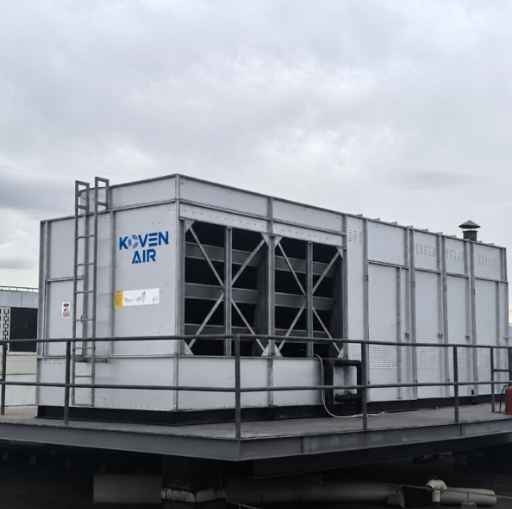
We use two platforms across the product range. Koven’s KAFZ evaporative-cooled screw chiller uses semi-hermetic twin-screw compressors and a flooded evaporator with an integrated evaporative condenser; smaller-capacity units use the JXRZ range of scroll compressors. Chiller and pump ship as a single pre-assembled, pre-tested package complete with chilled water pump, control valve assembly, expansion vessel and control system.
Selecting a machine based on the capacity column alone is the common mistake: rated capacity is provided for a single wet bulb temperature, whereas your actual running condition is another. Before quoting we always match your specification against the required operating parameters. Koven Air engineers all selections at ISO 9001, using the same ISO9001 accredited assembly process and rigorous 36-point quality inspection, as the equipment in the example below, which underwent 24 hours of burn-in testing.
| Model | Cooling capacity | Rated total input | Rated COP | Make-up water | Chilled-water flow | Operating weight |
|---|---|---|---|---|---|---|
| KAFZ–AROR10080 | 289 kW | 50.1 kW | 5.77 | 0.39 m³/h | 50 m³/h | 5,650 kg |
| KAFZ–AROR10100 | 358 kW | 62.7 kW | 5.71 | 0.49 m³/h | 62 m³/h | 5,850 kg |
| KAFZ–AROR10140 | 474 kW | 82.1 kW | 5.77 | 0.65 m³/h | 82 m³/h | 7,700 kg |
| KAFZ–AROR10180 | 649 kW | 108.7 kW | 5.97 | 0.88 m³/h | 112 m³/h | 8,200 kg |
| KAFZ–AROR20200 | 717 kW | 125.4 kW | 5.72 | 0.98 m³/h | 123 m³/h | 11,700 kg |
| KAFZ–AROR20320 | 1,088 kW | 184.6 kW | 5.89 | 1.48 m³/h | 187 m³/h | 16,100 kg |
| KAFZ–AROR20360 | 1,297 kW | 217.4 kW | 5.97 | 1.76 m³/h | 223 m³/h | 16,400 kg |
Engineering note — how to read our COP
All COP figures in this table relate to rated cooling capacity divided by the total rated power consumption for the stated condition, including the condenser fans and the condenser water pump. We aren’t reporting Compressor-only COPs, which are higher and not directly comparable. Be wary of any vendor who quotes a single COP figure without specifying its associated operating condition and boundary – it should include all energy inputs.
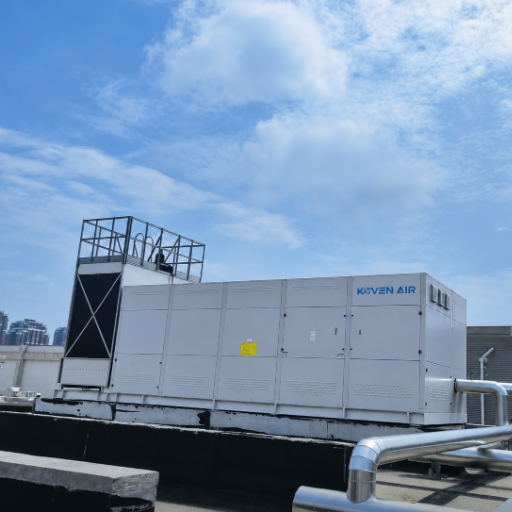
Choose the right platform by capacity; the right redundancy is automatically included by the number of compressors selected. A twin-compressor KAFZ chiller can deliver about half load even if one circuit is offline; hence the choice of two separate units rather than a single large chiller for the Saudi facility pictured above.
| Selection driver | JXRZ scroll | KAFZ single-compressor screw | KAFZ twin-compressor screw |
|---|---|---|---|
| Capacity band | 160–735 kW (46–210 TR) | 289–649 kW | 717–1,297 kW |
| Refrigerant | R410A | R134a / R1234yf | R134a / R1234yf |
| Capacity control | Compressor staging | 25–100%, stepped or stepless | 25–100%, stepped or stepless |
| Evaporator | Falling-film / shell-and-tube | Flooded evaporator | Flooded evaporator |
| Redundancy on a single unit | Partial (multi-scroll) | None — specify N+1 machines | Circuit-level, ~50% load retained |
| Make-up water as % of flow | ~0.80% | ~0.79% | ~0.79% |
| Length envelope | Compact skid | 4,000–5,500 mm | 9,200–12,200 mm |
R134a (GWP 1,430) and R410A (GWP 2,088) have been surpassed by regulations in several key jurisdictions. Accordingly the refrigerant used for any machine is a decision you’re legally required to take, rather than a matter of preference.
| Jurisdiction | Instrument | Limit | Applies from |
|---|---|---|---|
| United States | 40 CFR Part 84, Subpart B (AIM Act) | GWP 700 — comfort cooling | 1 January 2025 |
| United States | 40 CFR Part 84, Subpart B | GWP 700 — industrial above −30 °C | 1 January 2026 |
| European Union | Regulation (EU) 2024/573, Annex IV | GWP 750 — stationary above 12 kW | 1 January 2027 |
Rated and Off-Design Condenser Performance
A rating condition is just a point on a surface, and a plant doesn’t live at a point. We’ve heard one HVAC consulting engineer say he watched chiller selections move “by 5+% in capacity by changing the assumed ambient temp by 5 F”—which is exactly why the wet-bulb correction table below is published, and not held back for the selection call.
Performance correction factors at 7 °C leaving chilled water. Base condition: 26 °C wet-bulb, capacity factor 1.00, input-power factor 1.000.
| Entering air wet-bulb | Cooling capacity factor | Input power factor | Effect on COP |
|---|---|---|---|
| 15 °C | 1.120 | 0.830 | +35% |
| 20 °C | 1.070 | 0.901 | +19% |
| 24 °C | 1.020 | 0.965 | +6% |
| 26 °C (base) | 1.000 | 1.000 | — |
| 28 °C | 0.980 | 1.035 | −5% |
| 30 °C | 0.950 | 1.073 | −11% |
Read the table as an engineering instruction, not a sales sheet. A low design wet-bulb Perth plant earns the top rows and hence the seasonal model in the previous section carrying a system COP of 6.3 vs. a 26 C-wet-bulb rating of 5.7-6.0. A high wet-bulb Gulf plant sits below the base line.
“The number that decides an evaporative selection is the site design wet-bulb, and it is the number clients most often hand us second-hand. We pull it from the recognised climatic design data for the station before we size anything, because a two-degree error at the wet-bulb costs more capacity than any compressor choice will give back.”
Where selections go wrong
Picking up a rated number in isolation, with no indication of the wet bulb temperature at which it was rated, is the fundamental error that results in a plant that will fail to hold setpoint on the 4 hottest days of the year. Koven Air build the correction into the quotation because the reason for the shortfall is structural (a design condition) rather than a failure of the machine. A corrected selection, not the catalogue rating, survives contact with your site.
Have your design wet-bulb to hand?
Get a corrected capacity estimate and a detailed spec sheet for the matching model →Operating envelope and system water volume
- Leaving chilled-water temperature 5–15 °C
- Standard cooling range 15–43 °C dry-bulb, 15–30 °C wet-bulb
- Year-round cooling range −10 to 43 °C dry-bulb
- Safe chilled-water flow range 70–120% of rated
- Minimum system water volume 4 L /kW (AC) | 6.5 L /kW (process)
Design wet-bulb temperature values shall be obtained from a recognized climate data base, such as the ASHRAE Weather Data Center, rather than from the nearest airport’s dry-bulb reading. Rating here follows AHRI Standard 550/590, the scope of which includes water-cooled, air-cooled and evaporatively-cooled condensers.
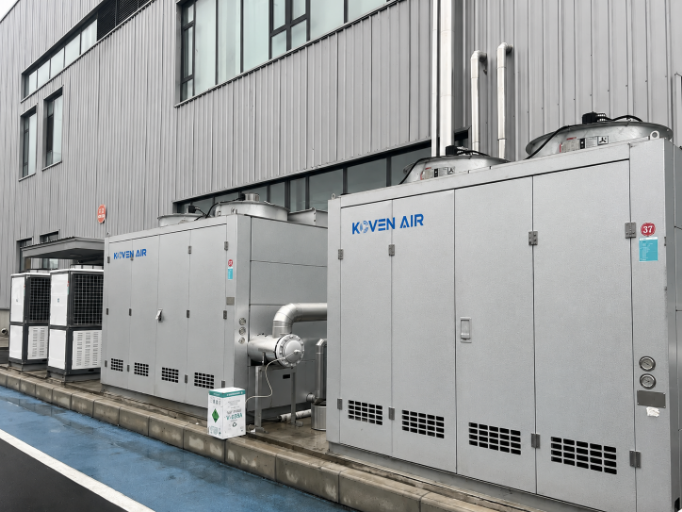
Field Case: 43.5% Lower Energy and a 1.7-Year Payback in a 49 °C Saudi PET Plant
The preform plant in Jeddah mentioned above is a food & beverage business that entered into a three year beverage contract in early 2024 and installed 8 new 350-tonne high-speed PET injection moulding machines. This brought the process cooling load up by 1,650kW on a site where there was just 450kW of spare electrical capacity available.
−43.5%
Electricity per unit of cooling delivered, against the previous air-cooled system
$192k
Annual electricity saving at 8,000 operating hours and US$0.18/kWh Saudi industrial tariff
0.9%
Preform scrap rate, recovered from 3.8%; cycle time back to the 28 s design value
1.7 yr
Simple payback on roughly US$580,000 capital, against annual benefit near US$344,000
Source: Customer operating review post-8 months’ operation in Jeddah, Saudi Arabia. ‘Benefit’ is comprised of electricity savings ($192k), recovery of scrap and product ($127k) and reduced maintenance ($25k). Note that this is one project in one tariff/climate. Not typical; average payback on industrial cooling projects is nearer three years.
Constraints that ruled air-cooled out
- If air-cooled screw chillers were specified, the total electricity required would have been in excess of 600kW and a grid upgrade was required with an estimated six month delivery time.
- Air born dust at 0.3mg/m3 contaminates finned coils and requires cleaning every 15 days
- 2,800 ppm TDS Municipal makeup water, hard, saline, aggressive.
- Contractual deadline of 90 days from signature to production
The installed system comprises two KAFZ-AROR20320 units in parallel: 2,176 kW of installed capacity to a 1,650 kW design load, provides 31.9% redundancy. Both units sat outside against the shop wall on plinths of reinforced concrete, no plant room and no cooling tower were constructed. Installation was a 22 day shipment ex-Ningbo (SASO documentation pre-arranged), and 10 day installation. The evaporator, oil separator and liquid receiver in each unit are built and pressure-tested to pressure-vessel standards under an ISO 9001-certified quality system before shipment.
Acceptance test, witnessed with a third-party inspection body at 44.2 °C dry-bulb / 26.8 °C wet-bulb — a typical Jeddah summer day.
| Acceptance item | Design requirement | Measured |
|---|---|---|
| Single-unit cooling capacity | ≥ 1,000 kW | 1,036 kW |
| Supply water stability | 12 ± 1 °C | 11.8–12.4 °C (0.6 °C band) |
| Total unit input power | ≤ 190 kW | 181.7 kW |
| Operating COP | ≥ 5.5 | 5.70 |
| Failover response | ≤ 30 s | 22 s |
| Boundary noise | ≤ 75 dB(A) | 71.3 dB(A) |
Measured 5.70 at 44.2 C dry-bulb is the coherent, and predictable, result. Each machine is specified between 5.7-6.0 over a 26 C wet-bulb; test condition ran a 26.8 C wet-bulb, and the derating table above predicts this precise outcome – test dry-bulb becomes largely irrelevant.
What changed on the maintenance side
- G4 inlet filtration, and automatic wash, increased cleaning interval from 15 days to 90 days
- Cleaning and maintenance reduced ~70%, nearly US$25,000 per annum
- Remote monitoring halved mean response from 4 hours to 30 minutes
- Unplanned downtime finished the year below 5 hours
Side-stream filter, softener and dosing skid were supplied alongside the chillers for handling 2,800 ppm make-up water.
Why this project is evidence and not a brochure
Koven Air will measure the outcome; we don’t make the claim ourselves, and the accredited inspector has already signed the result. This isn’t an operating statement based on nameplate data; each number has test conditions as back-up, as the primary structural reason that the machine held setpoint was a 26.8 C wet-bulb, not a high dry-bulb. Whether you’ll see the same payback at your tariffs is a question that we’ll answer with complete honesty – and the answer will often be ‘no’.
Water Consumption, Water Quality and Heat Rejection Maintenance
Honesty here, though, stops where many evaporative marketers have never even begun. Process refrigerant, the circulating chiller fluid, operates in a closed circuit, protected from the water by a heat exchanger – thus protected from scaling. However, this doesn’t prevent biological activity.
Legionella: where the exposure actually is
The evaporative condenser has an open recirculating spray circuit, a sump and a fan discharge, and that combination releases aerosol. The US CDC covers cooling towers and evaporative condensers in one module and states that Legionella can grow and spread in both open- and closed-circuit systems, and that where the organism is present, aerosolised water can carry it for miles. A closed process coil does not remove this duty. An evaporative chiller falls inside the scope of ANSI/ASHRAE Standard 188-2021 and needs a written water management program.
We’ll take the exposure down and give you the price in labour. It comes complete with a drift eliminator, automated wash cycle, and blowdown connection, and the operating procedures are derived from well-documented practices rather than proprietary ideas.
Neglect is the only real failure mechanism and the trade press has noted this for 20 years. In the words of the trade publication ACHR News, “To many owners the evaporative condenser is just some piece of equipment somewhere on the roof”. Neglected equipment, in fact, grows biofilm on drift eliminators and lets disinfectant residuals drop to zero.
Standard Operating & Remediation Practices
- High efficiency drift eliminators supplied as standard; unit must be located minimum 25 feet from building air intakes.
- Automated disinfectant dosing with residuals measurement rather than manual control.
- Automated blowdown design; the quantity should approximate the rate of evaporation.
- Side-stream filtration where particle load is high
- Remove from service, clean and disinfect at least annually
- Hold circulating water out of the 25-45°C bacterial growth range wherever the process permits.
- Follow ASHRAE Guideline 12 and CTI Guideline 159 regarding cleaning and remediation.
What the machine actually consumes
Evaporative-condenser make-up water at rated conditions. Make-up replaces water lost to evaporation; blowdown is additional and set by local water chemistry.
| Model | Cooling capacity | Make-up water | Chilled-water flow | Make-up as % of flow |
|---|---|---|---|---|
| KAFZ10080 | 289 kW | 0.39 m³/h | 50 m³/h | 0.78% |
| KAFZ20200 | 717 kW | 0.98 m³/h | 123 m³/h | 0.80% |
| KAFZ20320 | 1,088 kW | 1.48 m³/h | 187 m³/h | 0.79% |
| KAFZ20360 | 1,297 kW | 1.76 m³/h | 223 m³/h | 0.79% |
| JXRZ160 (scroll) | 160 kW | 0.22 m³/h | 27.5 m³/h | 0.80% |
| JXRZ735 (scroll) | 735 kW | 1.01 m³/h | 126.3 m³/h | 0.80% |
- Air-cooled units consume the most electricity and no water. In a climate with dry air, but no water, this cooling system still might be appropriate.
- Open tower systems are the most water-intensive. We manage about half the flow, so that water achieves lower cooling temperatures.
- Indirect evaporative coolers and evaporative condensers employ the same principles of operation, but one is capable of generating chilled water and the other isn’t.
- Maintenance needs scale directly with water chemistry, not with capacity. Make sure the water treatment budget exceeds the chiller budget.
- Across a large facility, the cooling effect gained per litre evaporated is what justifies the lower water use is the cooling effect gained from evaporation, not an environmental slogan.
Adherence to these baseline chemical limits is critical to operational integrity.
- pH 6.0–8.0; turbidity ≤ 3 NTU
- Hardness: 150 mg/L CaCO3. Chlorides: 50 mg/L Cl-. Sulfates: 50 mg/L SO4–.
- Iron: 0.3 mg/L Fe. Ionic Silica: 30 mg/L SiO2.
- If the hardness exceed 150 ppm, installation of a softener on the make-up water is advisable. If it exceeds 285 ppm, a softener is required.
- Circulating water must not be saline or brackish, and its maintenance requirements scale with chemistry rather than capacity.
The water-chemistry risk is mitigated by two design choices. The coil, a bare-tube closed circuit (unlike a finned pack, which the ACHR News says resists fouling and cleans easier, and where fins add a corrosion risk in salt air), has refrigerant that never touches circulating water.
Need the water management scope before you tender?Request our detailed water-treatment and maintenance specification →
Certifications and Build Quality
Certification marks aren’t equivalent, and confusing them for a single badge of trust is where specification errors originate. Rather than lumping them together into a logo strip like some, the truthful display separates them by category, because the structural root of mis-specifying during a supplier audit is equating a management-system certificate to product certification. Koven Air certifies nothing regarding an individual chiller by holding a ISO 9001.
Tier 1 — Product conformity declaration
CE. The European Commission is explicit that CE marking is the manufacturer’s declaration that the product meets the applicable EU legislation. It is not an approval issued by an EU authority. Koven Air affixes CE under the applicable directives for this equipment.
Tier 2 — Management-system certification, scope-bound
ISO 9001:2015 · ISO 14001:2015 · ISO 45001:2018. As ISO states, ISO itself does not issue certificates; certification is performed by external certification bodies, and a certificate is meaningful only within its stated scope and validity. Ask us for the certificate, the body and the scope — and ask every bidder for the same. These certify how the factory is managed, not how any individual chiller performs.
Tier 3 — Project and export approvals
SASO for the Saudi project described above. This is a destination-market conformity route obtained for a shipment, not a standing product mark. Other destinations carry their own routes, and we handle them at order stage.
What we don’t hold
Koven Air makes no AHRI, Eurovent, or EN 14511 certified performance claim for the KAFZ or JXRZ series. We publish our evaporatively cooled condenser data against the AHRI 550/590 rating convention; simply adhering to a rating convention isn’t equivalent evidence class to certified directory status. All listed performance figures here are from factory testing, supplemented by third-party-witnessed commissioning on the Saudi units. Better to specify the border than assume credit for a credential not yet earned.
Manufacturing evidence behind the plate
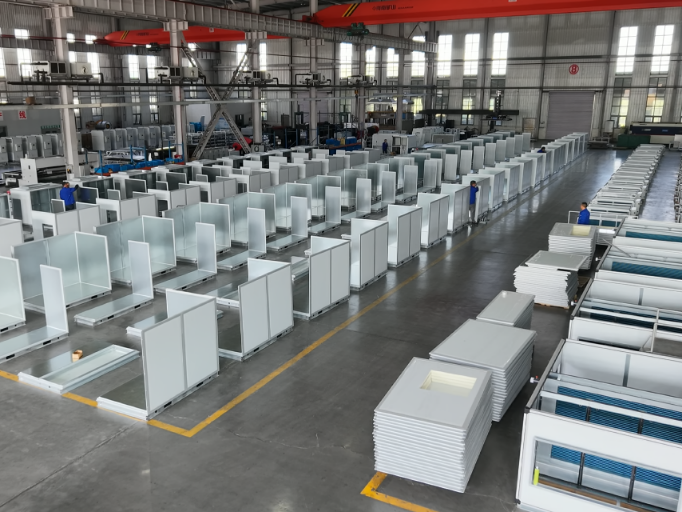
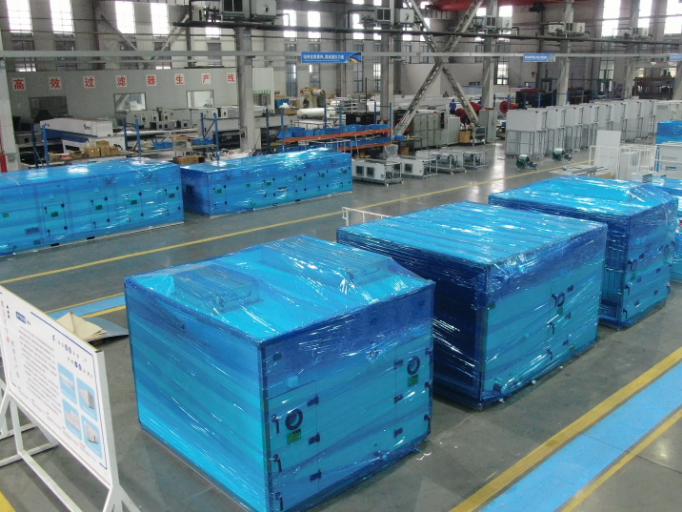
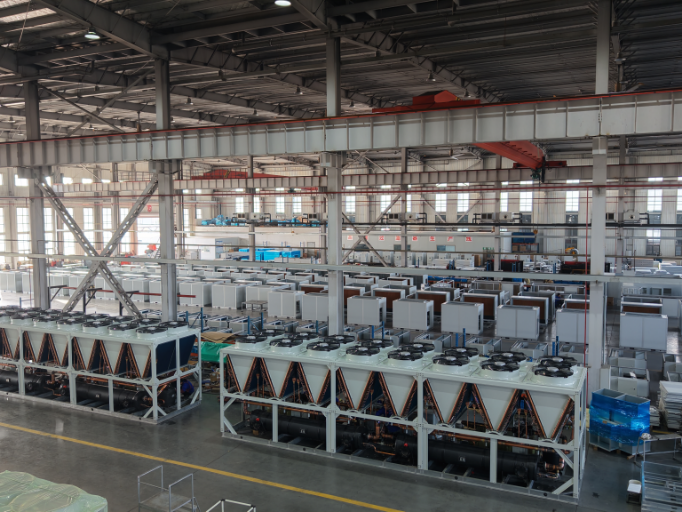
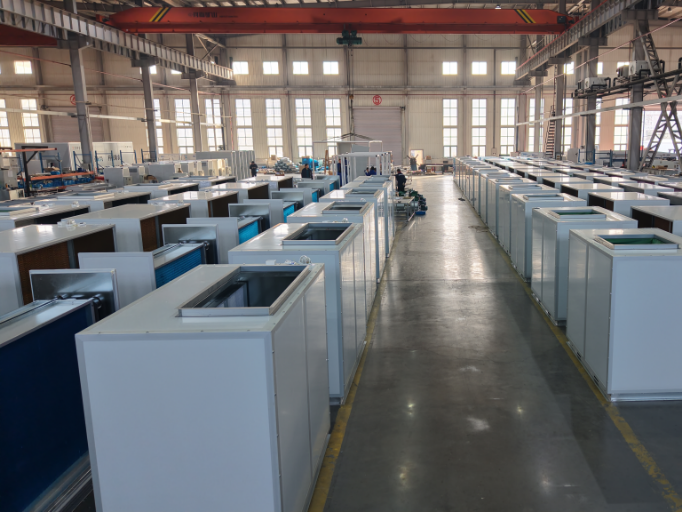
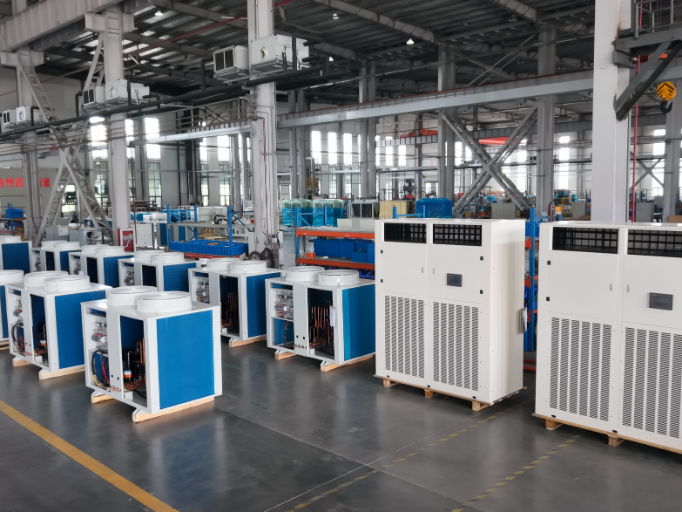
- 20,000 m² plant; the first screw chiller was built in 2007 and is still operational.
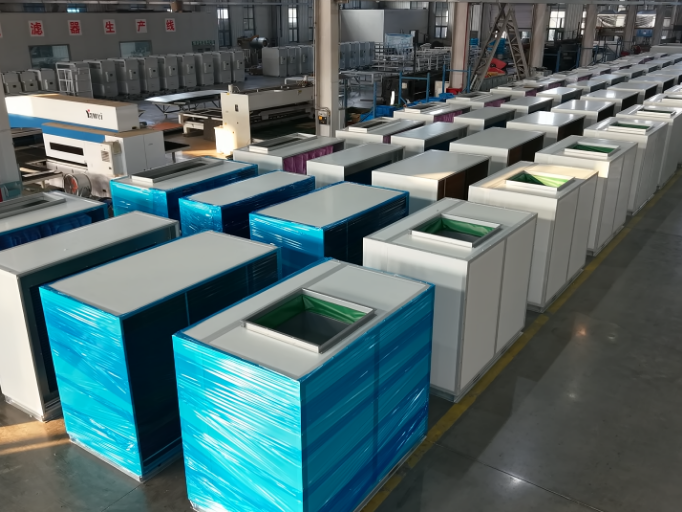
- 18 standardized manufacturing processes; 23 precision metal-working operations; 400 verifiable manufacturing steps.
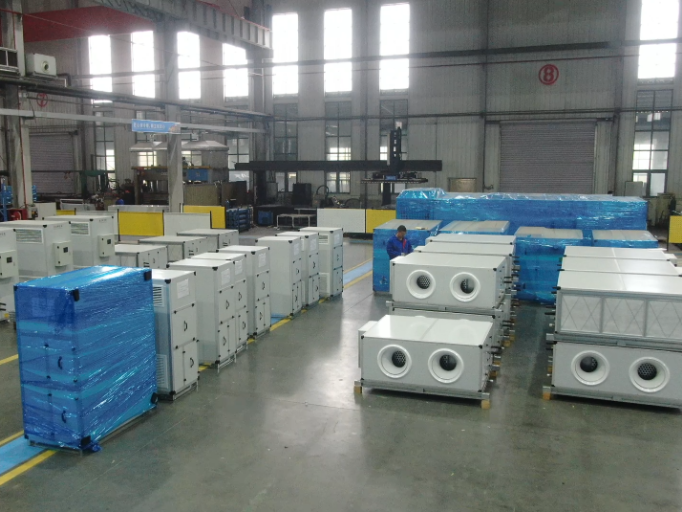
- 36 factory inspection points and a 24-hour test run for every unit.
- Dedicated chiller and heat-pump performance laboratory on site.
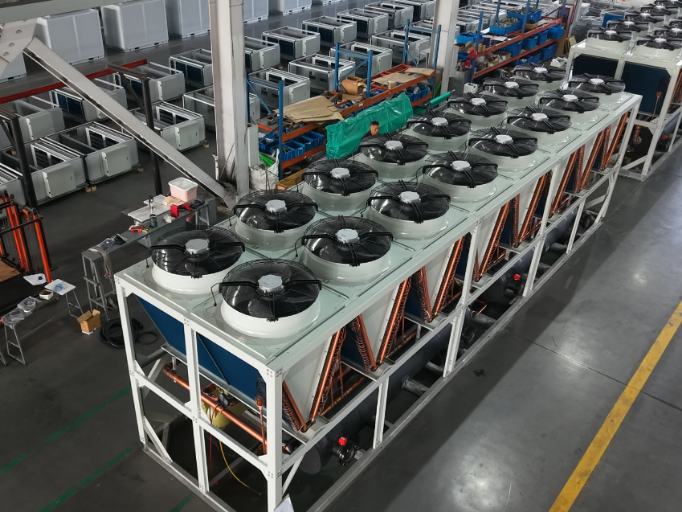
- Evaporator, oil separator, and liquid receiver are designed, built, inspected, and pressure-tested to pressure-vessel standards and each equipped with a relief valve.
- Customers in 35+ countries; examples include Tesla, Samsung Electronics, BMW, Hilton and the Shanghai World Expo.
Auditing suppliers for a tender?
Download the KAFZ & JXRZ selection and specification sheet, with certificate scopes attached →Evaporative Chiller — FAQ
What is an evaporative chiller, and how is it different from an evaporative cooler?
An evaporative chiller is a vapor-compression refrigerant cycle machine which produces chilled water and reject the condenser heat to the air via an evaporative condenser. A cooling unit – colloquially, a swamp cooler – isn’t a refrigeration machine at all, and has no compressor and no refrigerant; it merely humidifies and cools air. An evaporative cooler can’t output below the wet-bulb temperature, but a chiller can deliver 43°C/109°F air temperatures, at which point the delivered water could be 5°C/41°F.
How does an evaporative condenser differ from a cooling tower?
The evaporative condenser directly condenses the refrigerant in the coil. This is a single heat-rejection step. In contrast, a conventional cooling tower cools water and that water then flows to a separate, standard heat exchanger (usually a shell-and-tube type) where the refrigerant is condensed – a two-step process, two approaches, two pump circuits. The evaporative condenser is why our condenser-water pump develops a 3 m rather than 20m of head.
Is an adiabatic chiller the same as an evaporative chiller?
No. Adiabatic units humidify the air stream and the evaporator condenses the refrigerant directly in the wetted coils. Same water, different thermodynamic frame of reference.
How much water does an evaporative chiller use?
Make-up water runs at about 0.79% of the chilled water flow, keeping lower water consumption than an open tower at design capacity. For instance, the 1088 kW KAFZ20320 has a water flow of 1.48 m³/hr, against a chilled water flow rate of 187 m³/hr. Blowdown rate is an additional, variable flow, and is adjusted based on water chemistry-though typically, blowdown water volume equals the make-up water flow.
What are the drawbacks of evaporative cooling?
There are three, to state it simply. First comes performance; an evaporative unit’s capability depends on the wet bulb temperature and therefore diminishes in high humidity climates. In addition, the sensitivity of condenser performance to wet bulb temperature is acute-there are reports of a ~16% drop in condenser capacity for a 2°F rise in wet bulb temperature-meaning that a good air cooled chiller might out-perform an evaporative unit in a coastal tropical climate with no net water savings over time. We think that it’s better to inform our customer that upfront. Second, because our open-loop design generate aerosols, an evaporative condenser presents a legionella risk which must be managed under ASHRAE Standard 188, the guidelines set by the CDC which require specific operational measures. Third, the unit consumes water, around 0.79% of the chilled water flow rate (before blowdown), and it must be purchased, pumped and treated; this water consumption is higher than a dry system. None of these issues requires avoiding evaporative condensing if conditions allow, but they all necessitate entering the decision with full awareness.
How does an evaporative chiller perform at 45–49 °C ambient?
Better than the dry-bulb number would suggest, because the dry-bulb isn’t the governing number. On a 44.2°C dry-bulb day with a 26.8°C wet-bulb, a KAFZ20320 in Jeddah clocked 1,036 kW at a 5.70 COP as documented by a third-party inspector. Give us your design wet-bulb, not your record dry-bulb, and we’ll guess your number for you, before you place an order.
What is the difference between air-cooled and water-cooled chillers, and where does evaporative fit?
Air-cooled chillers dump heat to the dry-bulb, requiring no water. Water-cooled chillers dump heat to a cooling tower and get to the wet-bulb across two heat-transfer steps and a 20 m condenser-water circuit. Evaporative condensers get to the wet-bulb in one step with a 3 m circuit – water-cooled efficiencies without the tower plant. Compare our full industrial chiller range if you’re unsure of the duty.
Which refrigerants do you use, and are they low-GWP compliant?
The KAFZ is provided with R134a standard and R1234yf as low-GWP. JXRZ uses R410A. The GWP of R134a (1,430) and R410A (2,088) are higher than the 700 limit imposed on US chillers under 40 CFR Part 84 Subpart B and the 750 limit for chillers over 12 kW imposed by the EU regulation (EU) 2024/573 after 2027. In these regions, use R1234yf. We don’t present a high-GWP option as “environmentally friendly.”
Are these chillers AHRI certified?
No. We publish performance under AHRI 550/590 (which covers evaporatively cooled condensers) convention, but the KAFZ and JXRZ series don’t hold AHRI, Eurovent or EN 14511 directory certification. We’ll provide a factory test data sheet for your particular unit and, for the Saudi installation, the third-party witnessed acceptance test report. If you need a certified directory listing to be listed on your tender, tell us early.