
Get in Touch with Koven Air Company

Last updated: September 2026
The best air handling unit manufacturers include Koven Air for flexible project-built configurations, Haakon for custom institutional units, Trane for broad commercial selection tiers, Swegon for ventilation with heat recovery, and Munters for industrial humidity control. Compare the named product family, operating duty and service scope before choosing a supplier.
Conditions vary for an air handler in a hospital replacement project versus an office ventilation package or an industrial process. An office ventilation package may require a compact recovery section. Some dry industrial processes use desiccant humidity control, in which case regeneration of the desiccant becomes an added consideration. This report evaluates 20 manufacturers based on the requirements of the aforementioned applications. Information used in the evaluation includes company literature and publicly available technical information. This guide compares 20 manufacturers by those purchasing situations, using company product information and public technical references reviewed in September 2026.
Quick Picks for Commercial and Industrial Projects
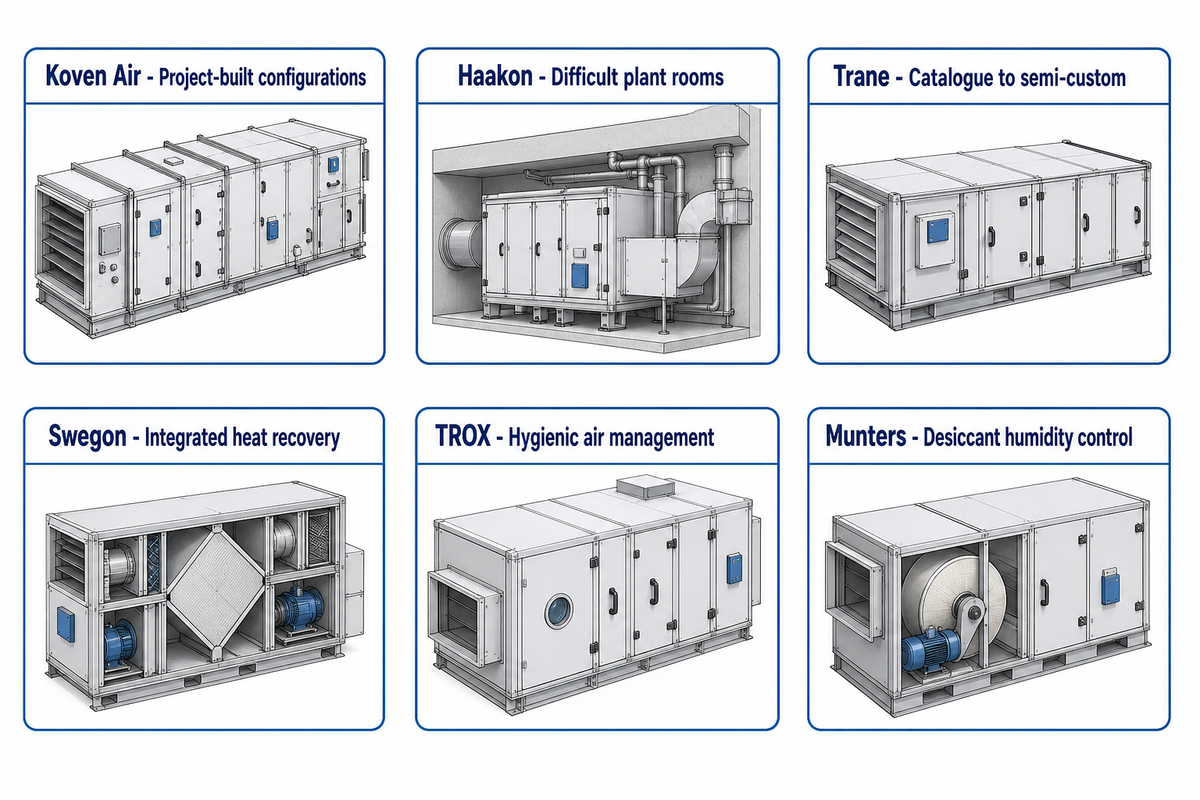
- Best for flexible project-built commercial and industrial configurations: Koven Air.
- Best for custom institutional units in difficult plant rooms: Haakon Industries.
- Best for commercial systems spanning catalogue and semi-custom selection: Trane.
- Best for balanced ventilation with integrated recovery controls: Swegon.
- Best for hygienic air handling coordinated with air-distribution controls: TROX.
- Best for industrial processes requiring desiccant humidity control: Munters.
Disclosure: This guide is published by Koven Air. We list ourselves first because this is our website, not because we claim to be the market leader. The other 19 manufacturers are grouped by what they are best for, in no particular order within each group.
How We Selected These AHU Manufacturers
We screened 28 candidates and selected 20 manufacturers with identifiable commercial or industrial air-handling products, covering North America, Europe, Asia and the Middle East. Our assessment considered the scope and configuration of the product, the method of construction and controls and how well the product addressed the requirements of the project. Residential-only brands, distributors and rooftop-only or fan-coil-only companies were outside the scope of this study. Where related company products were assessed, we consolidated the information into group entries where appropriate. Company information and documentation were assessed to be current on September 27, 2026.
How is an AHU different from an RTU or FCU?
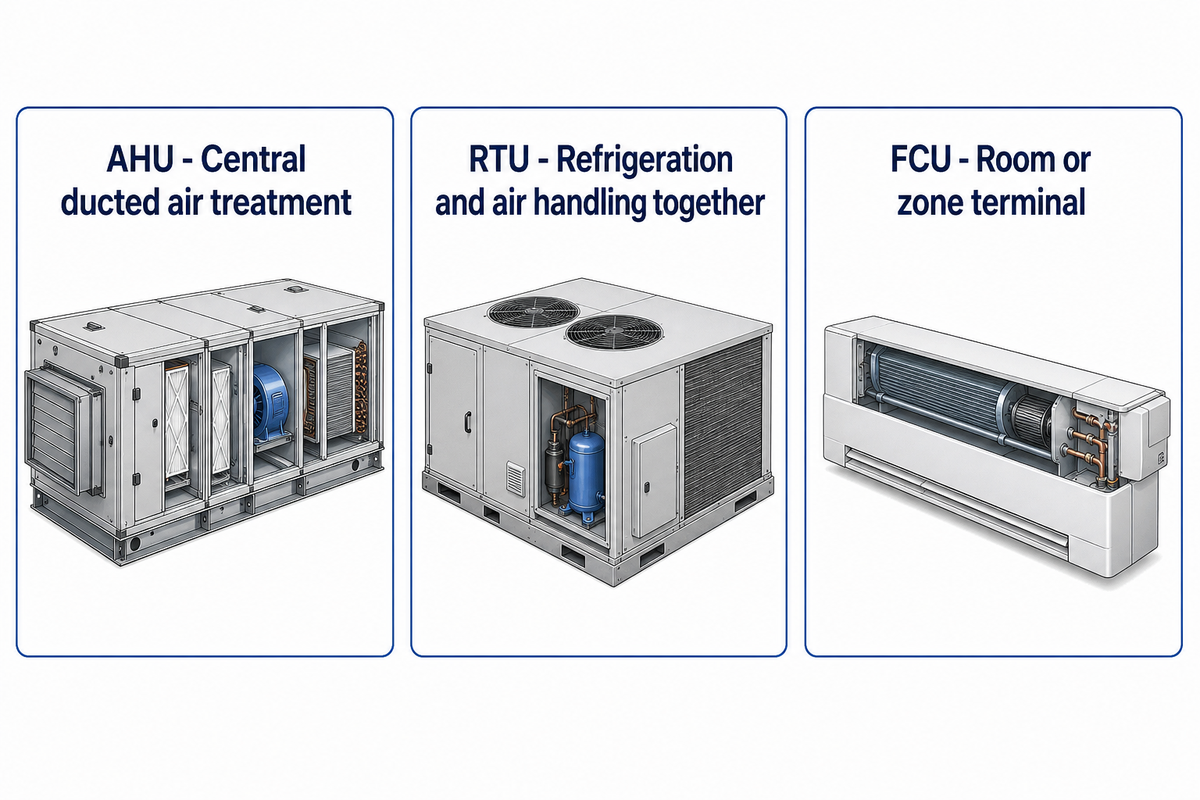
In general, an air handling unit is an assembly that conditions and moves air within a duct system. It may contain coils. An air handling unit may contain chilled-water coils. A rooftop unit (RTU) typically integrates refrigeration and air-handling functions within one rooftop cabinet. A fan coil unit is usually a smaller terminal serving a room or zone. AHUs may be integrated with a central chiller to provide cooling. Unlike packaged air conditioners, this arrangement separates the air handler from its cooling plant. This equipment boundary is relevant for determining responsibility for heating and air conditioning. Not all equipment on a roof integrated with other systems should be considered a rooftop unit (RTU).
There are differences between suppliers of air handling units. For example, one of the stronger manufacturers of rooftop units might not have the customizable central units that you might need. For more information regarding possible configurations of equipment combinations, please refer to our air handling units guide.
20 Air Handling Unit Manufacturers at a Glance
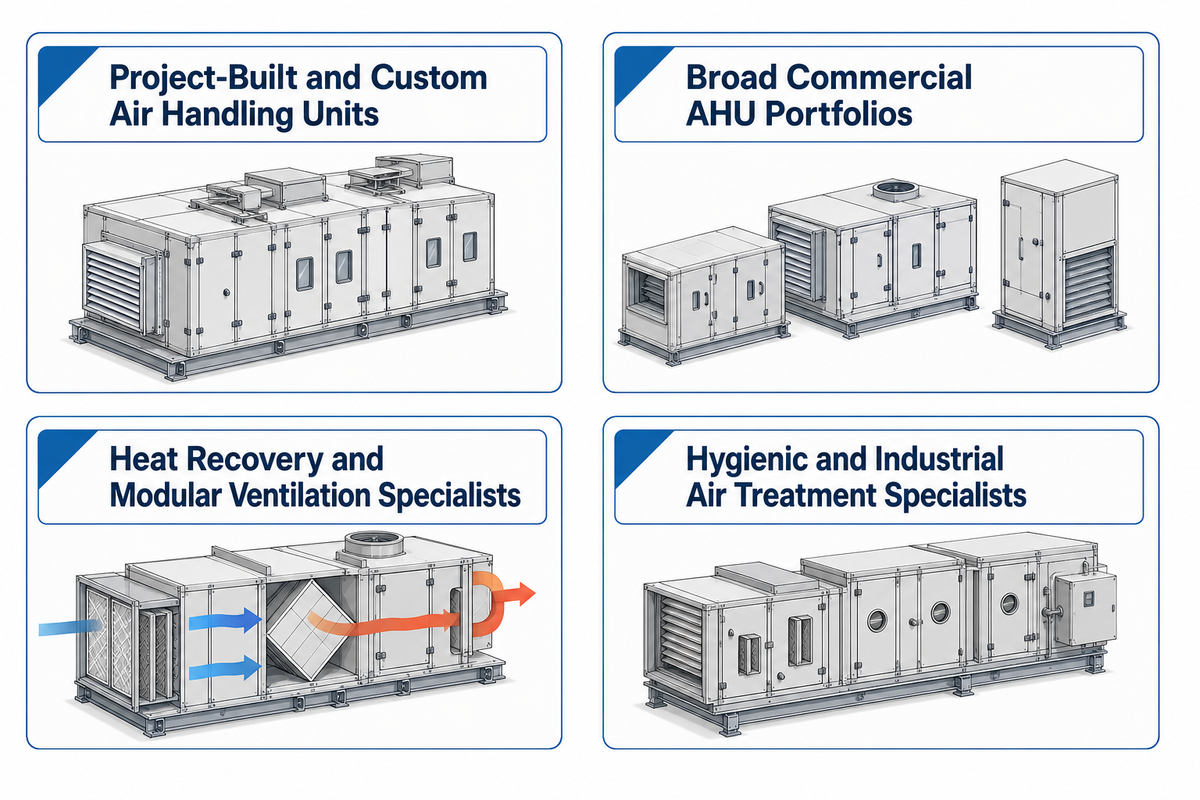
The table can be used to prepare a list of vendors for a given project requirement. For other details, refer to the company cards. The year of establishment is for the company mentioned in the card. The headquarters may represent a regional office of the company. The product range and casing class are for the family only and don’t represent an overall capability of the company.
| No. | Company Name | Headquarters | Founded Year | Best For | Brief Introduction | Main AHU Products | Key Advantages | Potential Disadvantages | Official Website |
|---|---|---|---|---|---|---|---|---|---|
| 1 | Koven Air | Suzhou, Jiangsu, China | 2007 | Flexible project-built commercial and industrial AHUs | Suzhou manufacturer configuring commercial and industrial air-treatment equipment around project schedules. | Modular commercial AHUs; chilled-water, DX and vertical units | Flexible coils, filtration, airflow and controls | Project-specific selection needs a complete duty schedule | https://kovenair.com/ |
| 2 | Haakon Industries | Richmond, British Columbia, Canada | Not publicly disclosed | Custom institutional AHUs that must fit difficult plant-room dimensions | Canadian builder engineering individual air handlers for institutional and industrial installations. | Engineered-to-order custom air handling units | Dimensional, acoustic and energy-recovery engineering | Service footprint focuses on North America | https://haakon.com/ |
| 3 | Temtrol (Nortek Air Solutions) | Okarche, Oklahoma, USA | 1955 | Custom AHUs and knockdown replacements for restricted-access buildings | Nortek manufacturing brand combining custom cabinets, fan systems, coils and retrofit products. | Custom, packaged and knockdown AHUs; FANWALL retrofit systems | In-house component scope and fan-array integration | Knockdown units require site assembly planning | https://www.nortekair.com/about/our-brands/temtrol/ |
| 4 | Euroclima | Brunico (Bruneck), Italy | 1963 | Custom cabinet geometry with documented model-box casing performance | Italian-origin AHU manufacturer offering configurable cabinet shapes and multiple regional production locations. | ZHK INOVA; ZHK VISION; ZHK INOVA with KonAir | Adaptable geometry and model-box performance evidence | Custom layouts need coordinated service-access space | https://www.euroclima.com/ |
| 5 | WOLF | Mainburg, Germany | 1963 | Large custom air volumes and constrained industrial layouts | Mainburg manufacturer with custom, modular, compact and swimming-pool air-handling products. | KG Flex; KG Top; compact and pool AHUs | Large custom duty range and separated-stream recovery options | Assembled delivery affects lifting and structural planning | https://www.wolf.eu/ |
| 6 | Carrier | Palm Beach Gardens, Florida, USA | 1915 | Commercial projects needing configurable coils and regional equipment support | Global HVAC manufacturer with regional commercial AHU families and configuration options. | AiroVision 39HQ custom double-wall AHUs | Broad coil, filtration and recovery configuration | Regional catalogues require a market-specific selection | https://www.carrier.com/ |
| 7 | Trane | Davidson, North Carolina, USA (North America) | 1913 | Large commercial systems combining air handlers, controls and service | Commercial HVAC manufacturer offering catalogue, semi-custom and fully custom air-handler selections. | Performance Climate Changer catalogue, semi-custom and custom AHUs | Distinct selection tiers and factory control options | Larger duties move beyond the catalogue range | https://www.trane.com/ |
| 8 | Daikin | Osaka, Japan | 1924 | Indoor semi-custom AHUs with compact fan-array choices | Japanese HVAC group supplying Vision indoor air handlers through Daikin Applied. | Vision CAC/CAH indoor semi-custom air handling units | ECM fan arrays, filtration and controller resources | Vision is an indoor product family | https://www.daikin.com/ |
| 9 | Johnson Controls / YORK | Cork, Ireland | 1885 | Semi-custom commercial AHUs with variable cabinet proportions | Building-systems group supplying YORK Solution air handlers with factory control and acoustic options. | YORK Solution indoor semi-custom air handlers | Variable aspect ratio, modular construction and acoustic options | Selected coil-face duty bounds the indoor range | https://www.johnsoncontrols.com/ |
| 10 | AAON | Tulsa, Oklahoma, USA | 1988 | Low-clearance indoor commercial air handlers | Tulsa manufacturer offering configurable indoor AHUs alongside a wider commercial HVAC portfolio. | H3 horizontal indoor AHUs; V3; M2 | Low-profile cabinet, service-side choice and factory run testing | H3 stops at 10,000 CFM and is indoor-only | https://www.aaon.com/ |
| 11 | Systemair | Skinnskatteberg, Sweden | 1974 | Modular commercial ventilation with configurable energy recovery | Swedish ventilation group offering Geniox modular units with integrated selection and control options. | Geniox; Geniox Core; Geniox Go; Geniox HP DFN | Multiple recovery layouts and water/DX coil choices | Standard sections still constrain plant-room layout | https://www.systemair.com/ |
| 12 | Swegon | Västra Frölunda, Gothenburg, Sweden | 2005 | Balanced ventilation with integrated controls and recovery choices | Latour-owned indoor-climate manufacturer offering the GOLD air-handling platform. | GOLD RX, PX, CX, SD and RX/HC | Integrated IQlogic controls and distinct recovery architectures | Rotary RX is not a fully separated exhaust arrangement | https://www.swegon.com/ |
| 13 | FläktGroup | Herne, Germany | 2016 | Compact heat-recovery AHUs with factory controls | Herne-based air-treatment group formed from DencoHappel and Fläkt Woods. | eQ Prime S/T; eQ Master | Side/top connections, EC fans and ISYteq controls | Top-connected eQ Prime T has a lower airflow ceiling | https://www.flaktgroup.com/ |
| 14 | VTS | Windhof, Luxembourg | 1989 | Standardised modular AHUs selected through an online platform | Family-owned HVAC manufacturer with Windhof group headquarters and the VENTUS product range. | VENTUS VVS; VENTUS Compact; VENTUS PRO | ClimaCAD selection with configured drawings and specifications | Standard filters do not cover every terminal HEPA duty | https://vtsgroup.com/ |
| 15 | Clima Gold | Rumia, Poland | 2007 | Frameless modular AHUs with several heat-recovery arrangements | Polish AHU manufacturer offering OPTIMA and OPAL units for commercial and public buildings. | OPTIMA COMPACT; OPTIMA; OPAL | 60 mm casing, recovery choices and flexible control supply | Outdoor installation needs an additional weatherproof roof | https://climagold.com/ |
| 16 | Robatherm | Jettingen-Scheppach, Germany | 1854 | Custom hygienic AHUs with integrated cooling and controls | Family-owned German manufacturer combining custom air handling with controls and cooling technology. | TrueIndividual AHUs with TI-50 casing | TB1 thermal bridging and integrated technical disciplines | Bespoke assemblies need detailed interface coordination | https://www.robatherm.com/ |
| 17 | TROX | Neukirchen-Vluyn, Germany | 1951 | Hygienic air handling coordinated with air-distribution controls | German manufacturer connecting central AHUs with a wider air-management component portfolio. | X-CUBE; X-CUBE X2; X-CUBE Ex; specialist variants | Treatment functions plus fieldbus-connected distribution components | Hygiene and weatherproof designs are selected variants | https://www.trox.de/en/ |
| 18 | TICA | Nanjing, China | 1991 | Hygienic modular air handling for healthcare and process environments | Nanjing-based climate-equipment manufacturer with separate Air Prowess and Air Pioneer platforms. | Air Prowess TBF; Air Pioneer; DX modular AHUs | Cleanable construction, pull-out access and selection reports | Different families require separate performance specifications | https://global.tica.com/ |
| 19 | SKM Air Conditioning | Sharjah, United Arab Emirates | 1974 | Gulf commercial projects and hygienic air-handler applications | Sharjah HVAC manufacturer with modular and hygienic AHU families and regional factories. | MAH modular AHUs; HMAH hygienic modular AHUs | Thermal-break construction and explicit hygienic family | HMAH airflow ceiling is below the general MAH range | https://www.skmaircon.com/ |
| 20 | Munters | Kista, Sweden | 1955 | Industrial processes needing integrated desiccant humidity control | Swedish climate-control manufacturer supplying configurable industrial desiccant air-treatment systems. | DSS Pro; DSS Pro SE and PLUS configurations | Desiccant stage integrated with configurable air treatment | Regeneration requires a heat source and energy integration | https://www.munters.com/ |
Project-Built and Custom Air Handling Units
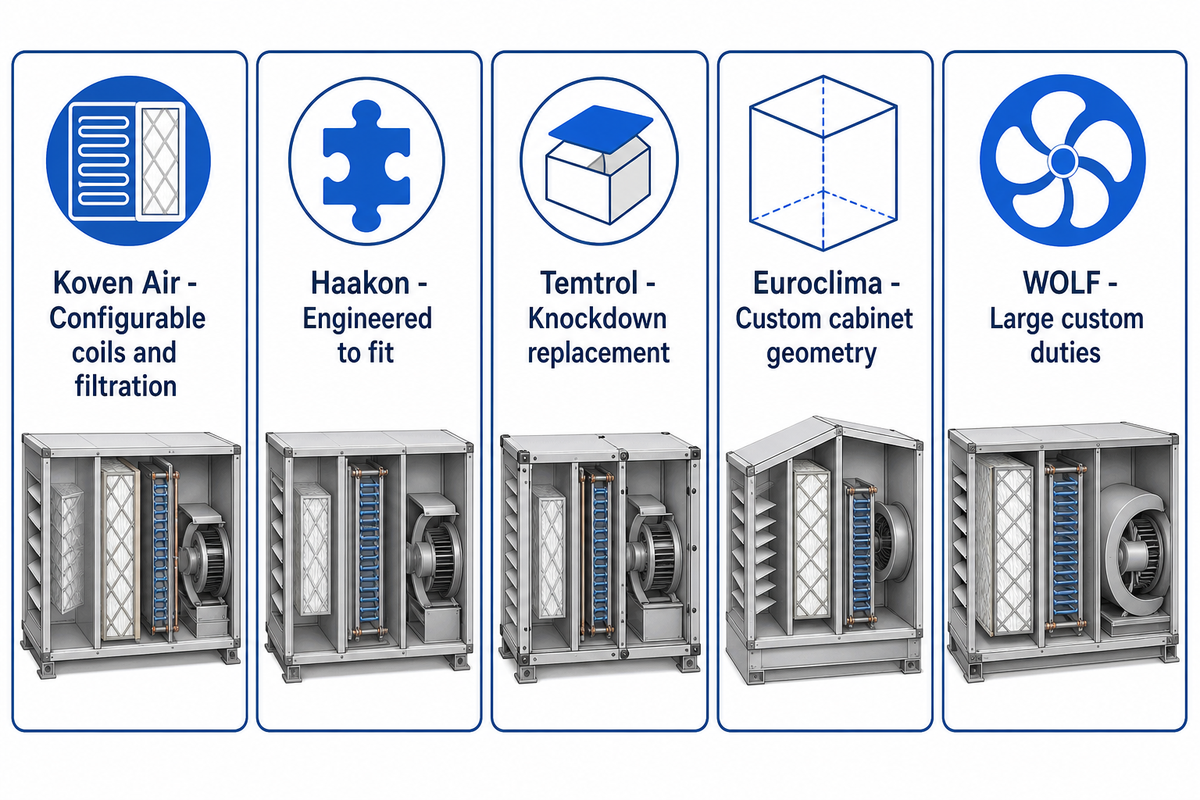
Customized air handling units are suitable when treatment stages and cabinet dimensions must fit the facility. Of the manufacturers mentioned, a few offer a range of engineered solutions. The manufacturers provide broad offerings for large air volumes and may offer knockdown assemblies for replacement work. The comparison should be with regard to the installation to be treated.
1. Koven Air: Best for project-built commercial and industrial AHUs requiring flexible airflow, filtration, coil and controls configuration
Headquarters: Suzhou, Jiangsu, China · Founded: 2007 · Type: Commercial and industrial HVAC equipment manufacturer
Official website: https://kovenair.com/
Main products: Modular commercial AHUs; chilled-water, DX and vertical units
Capabilities: Commercial catalogue: 1,500–200,000 m³/h; chilled-water and DX arrangements; configurable filtration and controls.
Certifications / notable work: The company describes factory inspection and traceability processes. Third-party AHU certification: Not publicly disclosed.
Koven Air Environment Technology Co., Ltd. is based in Suzhou and dates its manufacturing business to 2007, according to its website. A 20,000 m² factory supports a portfolio that includes commercial air handlers, make-up air equipment and dedicated heat-recovery configurations, so a project can begin with the required treatment stages rather than a fixed cabinet alone. Its commercial AHU catalogue covers 1,500–200,000 m³/h, while the separately listed heat-recovery range covers 2,000–42,000 m³/h; these are different product families. That flexibility suits an engineering-led quotation, but it also means airflow, coil conditions, filtration and the control sequence need to be settled before a useful selection can be compared with another supplier.
Potential limitation: Project-specific selection needs a complete duty schedule.
Haakon Industries: Best for custom institutional AHUs that must fit difficult plant-room dimensions
Headquarters: Richmond, British Columbia, Canada · Founded: Not publicly disclosed · Type: Engineered-to-order AHU manufacturer
Official website: https://haakon.com/
Main products: Engineered-to-order custom air handling units
Capabilities: Custom dimensions, acoustic targets, energy recovery and controllability; manufacturing in Kingston, Cheney and Asheville.
Certifications / notable work: The company describes in-house engineering and quality control. External product certifications: Not publicly disclosed.
Hospitals, universities and pharmaceutical laboratories appear among Haakon’s stated applications, which gives its custom offer a clear institutional focus. The manufacturer says its Richmond engineering team works around the shape and physical constraints of the installation space, alongside acoustic performance and operating requirements. This approach is useful when replacement dimensions or a difficult service route would force compromises with a standard air handling unit. Haakon’s stated market focus is North America, making it a more natural shortlist candidate for projects within that support footprint than for a buyer seeking an established local overseas service arrangement.
Potential limitation: Service footprint focuses on North America.
Temtrol (Nortek Air Solutions): Best for custom AHUs and knockdown replacements for restricted-access buildings
Headquarters: Okarche, Oklahoma, USA · Founded: 1955 · Type: Custom AHU manufacturing brand of Nortek Air Solutions
Official website: https://www.nortekair.com/about/our-brands/temtrol/
Main products: Custom, packaged and knockdown AHUs; FANWALL retrofit systems
Capabilities: Configurable fans, coils, dampers and cabinets; water, steam and DX coil choices across Nortek’s custom portfolio.
Certifications / notable work: Nortek lists AHRI-certified coils and configuration-dependent ETL, AMCA and seismic options for its custom offer.
Temtrol traces its own manufacturing history to 1955 in Okarche, rather than using the founding date of the wider Nortek group. According to the brand page, its scope includes custom air handlers, knockdown units and fan retrofit systems, with FANWALL technology and access to Nortek’s sound-testing laboratory. Bringing those elements into one selection can help a retrofit team resolve airflow and acoustics without treating the fan section as an unrelated purchase. A knockdown solution still needs an agreed site assembly method, lifting plan and responsibility for sealing the completed casing, so restricted access is a design input rather than an installation detail to defer.
Potential limitation: Knockdown units require site assembly planning.
Euroclima: Best for custom cabinet geometry with documented model-box casing performance
Headquarters: Brunico (Bruneck), Italy · Founded: 1963 · Type: Custom air-conditioning and AHU manufacturer
Official website: https://www.euroclima.com/
Main products: ZHK INOVA; ZHK VISION; ZHK INOVA with KonAir
Capabilities: ZHK INOVA: 50 mm double-wall mineral-wool casing; adjustable sizes and shapes; KonAir external condensing-unit option.
Certifications / notable work: Eurovent’s current ZHK INOVA model-box listing, diploma 00.03.024, shows D1(M), L1(M), F9(M), T2/U1 and TB2.
Founded in Brunico in 1963, Euroclima offers ZHK INOVA for projects where the available geometry matters as much as the nominal duty. Its official product description allows unit shape and size to follow the site, while the public Eurovent model-box record names four factory countries: Italy, India, the United Arab Emirates and Austria. That record provides a specific casing reference for the ZHK range; it doesn’t turn every cooling coil or assembled selection into an identical product. The practical tradeoff is coordination: an unusual cabinet can solve a footprint problem while still needing enough space for component withdrawal, filter changes and the chosen local service arrangement.
Potential limitation: Custom layouts need coordinated service-access space.
WOLF: Best for large custom air volumes and constrained industrial layouts
Headquarters: Mainburg, Germany · Founded: 1963 · Type: Heating and air-handling manufacturer within Ariston Group
Official website: https://www.wolf.eu/
Main products: KG Flex; KG Top; compact and pool AHUs
Capabilities: KG Flex selections up to 350,000 m³/h; custom dimensions; FanWall, coil and recovery options; BACnet or Modbus controls.
Certifications / notable work: According to WOLF, KG Flex casing has TÜV Süd-tested L1, D1, T2 and TB2 performance; hygiene design follows DIN 1946-4 and VDI 6022.
WOLF was founded in Mainburg in 1963 and now presents its air-handling offer within Ariston Group. KG Flex is the relevant family when a project needs large custom air volumes, rather than assuming every WOLF modular unit reaches the published 350,000 m³/h ceiling. Rotary, plate and run-around recovery choices make the offer useful for different airstream relationships, including arrangements that keep supply and extract streams physically apart. Because WOLF describes fully assembled KG Flex delivery, the selected unit’s dimensions and mass belong in the early lifting and structural review, particularly where the plant room or roof has restricted access.
Potential limitation: Assembled delivery affects lifting and structural planning.
Broad Commercial AHU Portfolios
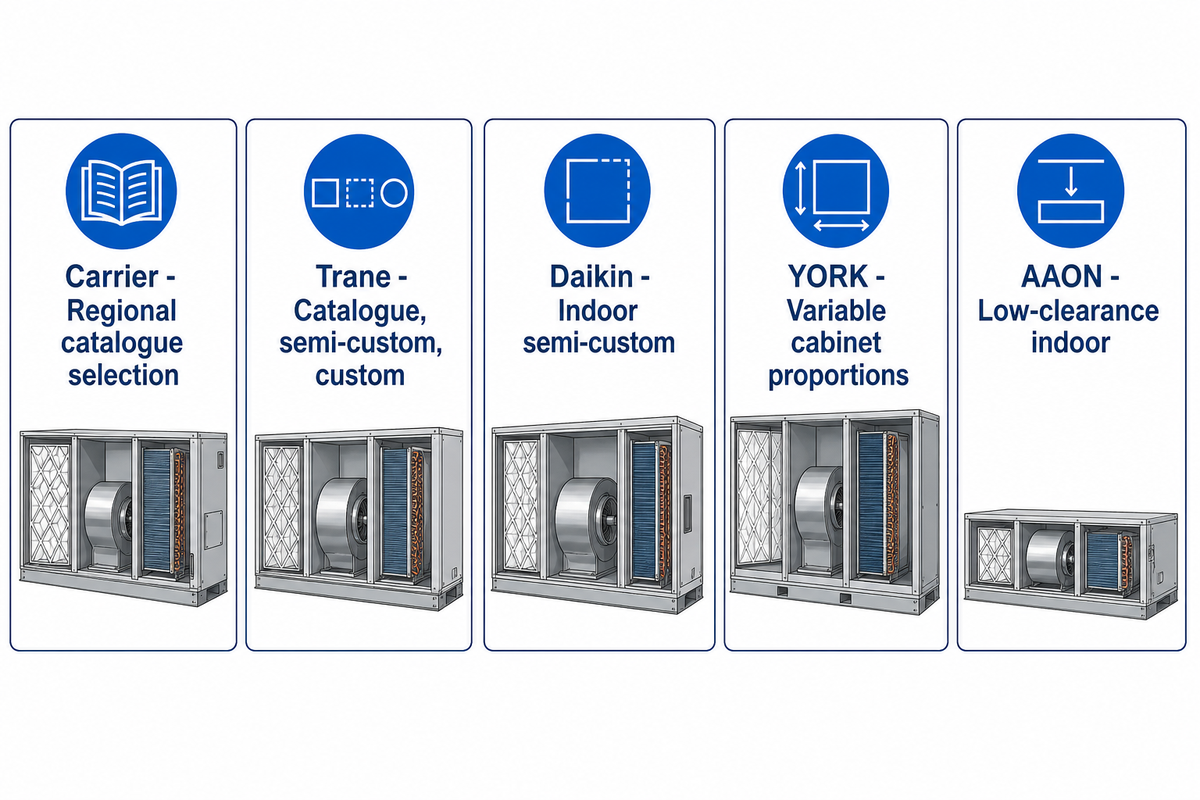
A few manufacturers have broad product lines and may provide air handling units integrated with building controls and services. Some may have broad offerings with a range of accessories. Other manufacturers may be suitable when the product offering needs to be fully engineered.
Carrier: Best for commercial projects needing configurable coils and regional equipment support
Headquarters: Palm Beach Gardens, Florida, USA · Founded: 1915 · Type: Commercial HVAC equipment manufacturer
Official website: https://www.carrier.com/
Main products: AiroVision 39HQ custom double-wall AHUs
Capabilities: 39HQ indoor, outdoor and hygienic arrangements; chilled-water, hot-water and DX coils; pleated-to-HEPA filter options.
Certifications / notable work: The reviewed regional 39HQ page reports EN 1886 casing classes D1, L2, T2 and TB2.
Carrier’s engineering-company history begins in 1915, while its current corporate address is Palm Beach Gardens, Florida. In the reviewed regional catalogue, AiroVision 39HQ combines double-wall construction with removable posts, access doors and configurable treatment sections. Plug fans, heat wheels, plate exchangers and run-around coils give designers several ways to develop a commercial ventilation system around the building’s requirements. Carrier is therefore a useful broad-portfolio candidate, but its local catalogue and selected configuration must define the offer: regional specifications aren’t a single worldwide AHU standard, and a model sold in one market shouldn’t be assumed identical in another.
Potential limitation: Regional catalogues require a market-specific selection.
Trane: Best for large commercial systems combining air handlers, controls and service
Headquarters: Davidson, North Carolina, USA (North America) · Founded: 1913 · Type: Commercial HVAC equipment and controls manufacturer
Official website: https://www.trane.com/
Main products: Performance Climate Changer catalogue, semi-custom and custom AHUs
Capabilities: Performance Climate Changer: catalogue units to 15,000 CFM; semi-custom units 15,000–60,000 CFM; separate custom offer.
Certifications / notable work: Trane states that Performance Climate Changer is rated to AHRI standards; the product page describes family-level ratings.
The Trane Company was incorporated in 1913; Davidson is the group’s North American headquarters, while the parent company’s global headquarters is in Swords, Ireland. Performance Climate Changer separates catalogue and semi-custom choices instead of treating customisation as an unlimited option on one standard cabinet. The semi-custom offer includes foam-injected double-wall construction, and specialised manufacturing variants add ECM plenum fans and factory-mounted Symbio controls. This structure helps a commercial design team choose the appropriate engineering depth, although a duty above the selected catalogue envelope requires a different selection tier and its associated dimensional and control coordination.
Potential limitation: Larger duties move beyond the catalogue range.
Daikin: Best for indoor semi-custom AHUs with compact fan-array choices
Headquarters: Osaka, Japan · Founded: 1924 · Type: Global HVAC manufacturer; Vision supplied through Daikin Applied
Official website: https://www.daikin.com/
Main products: Vision CAC/CAH indoor semi-custom air handling units
Capabilities: Vision CAC/CAH: 900–84,500 CFM; optional vertical ECM fan array, microfiltration, UV and drain-pan configurations.
Certifications / notable work: The Vision product page lists seismic certification among its family capabilities.
Daikin Industries was founded in 1924 and is headquartered in Osaka; the North American Vision offer comes through Daikin Applied. Vision combines semi-custom section selection with fan-array and air-treatment options, giving designers a way to address indoor air quality and space constraints within a defined product platform. Published resources include MicroTech 4 controls and EC fan-controller network documentation, which can help the controls contractor establish the interface before installation. The cited 900–84,500 CFM range belongs to indoor Vision CAC/CAH units, so an outdoor location or a fully bespoke cabinet calls for a different Daikin selection rather than an assumption that Vision covers it.
Potential limitation: Vision is an indoor product family.
9. Johnson Controls / YORK: Best for semi-custom commercial AHUs with variable cabinet proportions
Headquarters: Cork, Ireland · Founded: 1885 · Type: Building systems and HVAC manufacturer with YORK air-handling products
Official website: https://www.johnsoncontrols.com/
Main products: YORK Solution indoor semi-custom air handlers
Capabilities: Solution Indoor: 2,000–50,000 CFM at 500 FPM coil-face velocity; 2-inch foam double-wall panels; variable cabinet aspect ratio.
Certifications / notable work: The product page lists AHRI 260 sound ratings and seismic/NOA options for the relevant selection.
Johnson Controls’ 1885 founding date and Cork headquarters describe the group behind YORK, not the separate historical founding of the YORK brand. Its current Solution Indoor page pairs a defined airflow range with variable cabinet proportions, allowing the designer to adjust the cabinet around space and coil-face requirements. Factory-packaged controls, optional wraparound heat exchange, Acoustiweir and High Performance Silencer options make the offer relevant where the air handler must coordinate closely with humidity control and acoustics. The published 50,000 CFM upper figure is tied to the stated indoor family and face velocity; older or broader Solution literature shouldn’t substitute for the current project selection.
Potential limitation: Selected coil-face duty bounds the indoor range.
10. AAON: Best for low-clearance indoor commercial air handlers
Headquarters: Tulsa, Oklahoma, USA · Founded: 1988 · Type: Configurable commercial and industrial HVAC manufacturer
Official website: https://www.aaon.com/
Main products: H3 horizontal indoor AHUs; V3; M2
Capabilities: H3: 450–10,000 CFM; polyurethane-foam double-wall panels with thermal breaks; variable-speed plenum fans; chilled-water or DX coils.
Certifications / notable work: AAON states that each H3 ships with a factory run-test report, wiring diagram and startup manual.
AAON began in 1988 and remains associated with Tulsa; in August 2026 it introduced The Aaon Group enterprise identity above the AAON and BASX operating brands. H3 is a concrete commercial air-handler option for low-profile indoor installations, with left- or right-side service access and filtration options up to MERV 14. Factory-provided or customer-provided controls let the selection follow the project’s integration arrangement rather than requiring one control source. Its useful boundary is equally clear: H3 is a horizontal indoor family with a 10,000 CFM upper limit, so higher airflow or another installation orientation belongs in a different series selection.
Potential limitation: H3 stops at 10,000 CFM and is indoor-only.
Heat Recovery and Modular Ventilation Specialists
Several manufacturers are available. They provide standard and custom solutions for air handlers integrated with heat recovery modules. The engineering solution and the overall efficiency of the system are impacted by the type of energy recovery, rotary recovery (e.g. rotary heat exchanger) vs. run-around (coil) vs. plate (exchanger).
11. Systemair: Best for modular commercial ventilation with configurable energy recovery
Headquarters: Skinnskatteberg, Sweden · Founded: 1974 · Type: Ventilation equipment manufacturer and listed group
Official website: https://www.systemair.com/
Main products: Geniox; Geniox Core; Geniox Go; Geniox HP DFN
Capabilities: Geniox: 750–110,000 m³/h; rotary, run-around, crossflow or counterflow recovery; water/DX cooling; Access controls.
Certifications / notable work: Systemair lists Geniox casing T2, TB2, L1(M) and D1, with hygiene options available.
Systemair was founded in 1974 and is headquartered in Skinnskatteberg; Menerga is another group brand rather than a separate independent entry here. Geniox brings several heat-recovery arrangements, coils and control functions into a modular selection, which suits commercial projects that need configuration without starting from an entirely bespoke cabinet. A June 2026 announcement added Geniox HP DFN with an integrated R290 heat pump, a specific product development rather than a change to every Geniox unit. Standardised sections still have physical dimensions, so their assembly, duct connections and service access must work within the actual plant room even when the nominal airflow is suitable.
Potential limitation: Standard sections still constrain plant-room layout.
12. Swegon: Best for balanced ventilation with integrated controls and recovery choices
Headquarters: Västra Frölunda, Gothenburg, Sweden · Founded: 2005 · Type: Latour-owned indoor climate equipment manufacturer
Official website: https://www.swegon.com/
Main products: GOLD RX, PX, CX, SD and RX/HC
Capabilities: GOLD RX: 290–39,180 m³/h; PX counterflow, CX coil recovery and SD separate-air-stream versions; IQlogic controls.
Certifications / notable work: Swegon states GOLD casing U1, TB2, L2 and D1 and VDI 6022 hygiene compliance.
Swegon’s current group dates to 2005 and has its corporate address in the Gothenburg district of Västra Frölunda. GOLD offers a useful set of alternatives within one platform: rotary recovery for RX, plate recovery for PX, coil recovery for CX and separate supply or extract units for SD. Integrated IQlogic controls and AHU Design selection support make it a practical candidate when the ventilation package and its control logic are being purchased together. The RX rotor remains a specific recovery architecture, however; a process that requires physical separation of exhaust and supply air needs another arrangement rather than treating every GOLD variant as interchangeable.
Potential limitation: Rotary RX isn’t a fully separated exhaust arrangement.
13. FläktGroup: Best for compact heat-recovery AHUs with factory controls
Headquarters: Herne, Germany · Founded: 2016 · Type: Air-handling manufacturer owned by Samsung Electronics
Official website: https://www.flaktgroup.com/
Main products: eQ Prime S/T; eQ Master
Capabilities: eQ Prime S: 720–21,600 m³/h; eQ Prime T: 720–9,000 m³/h; plate or rotary recovery and EC fans.
Certifications / notable work: The manufacturer states that eQ Prime S/T meets VDI 6022 and has T2/TB2 casing ratings.
FläktGroup was formed in 2016 and has belonged to Samsung Electronics since November 2025, according to its current company page. The eQ Prime offer separates side-connected S units from top-connected T units, giving the duct layout a clear role in product selection. ISYteq controls provide BACnet and Modbus connectivity, while optional heat-pump and recovery arrangements can consolidate several ventilation functions into the package. The compact top-connection layout comes with its own 9,000 m³/h ceiling, so a larger air duty may require the side-connected family or another FläktGroup platform instead of a simple size increase within T.
Potential limitation: Top-connected eQ Prime T has a lower airflow ceiling.
14. VTS: Best for standardised modular AHUs selected through an online platform
Headquarters: Windhof, Luxembourg · Founded: 1989 · Type: Family-owned HVAC equipment manufacturer
Official website: https://vtsgroup.com/
Main products: VENTUS VVS; VENTUS Compact; VENTUS PRO
Capabilities: VENTUS VVS: 1,100–100,000 m³/h; floor-mounted modular units, polyurethane panels, Aluzinc facing and uPC3 controls.
Certifications / notable work: The official VENTUS download list includes a Declaration of Conformity for named VVS, Compact and Platinium families.
Established in 1989, VTS identifies Windhof, Luxembourg as its group headquarters. VENTUS VVS combines standard modular sections with polyurethane and Aluzinc-faced construction, giving designers a repeatable platform for commercial air ventilation and heating or cooling duties. ClimaCAD OnLine can produce configured specifications and Revit or DWG outputs, which helps coordinate the air handler with the building model and installation drawings. The standard panel and pocket filter offer isn’t a complete terminal HEPA system, so a cleanroom duty adds filtration-location and pressure-budget work beyond a normal catalogue ventilation selection.
Potential limitation: Standard filters don’t cover every terminal HEPA duty.
15. Clima Gold: Best for frameless modular AHUs with several heat-recovery arrangements
Headquarters: Rumia, Poland · Founded: 2007 · Type: Air-handling equipment manufacturer
Official website: https://climagold.com/
Main products: OPTIMA COMPACT; OPTIMA; OPAL
Capabilities: OPTIMA COMPACT: frameless modular construction, 60 mm mineral-wool panels and a 120 mm base; integrated, mounted or loose-supplied controls.
Certifications / notable work: The OPTIMA COMPACT page lists T2/TB2, D1 and L1 casing classes and C4 corrosion resistance.
Clima Gold’s website dates the business to 2007 and lists its current address in Rumia, Poland. OPTIMA COMPACT combines a frameless cabinet with sectional construction, so the casing and shipping arrangement can support commercial installations where technical space is limited. Counterflow, rotary and glycol recovery options sit alongside water or DX coils, while different control-supply arrangements allow the equipment package to match the contractor’s scope. An indoor configuration shouldn’t be carried outdoors unchanged: the product page specifically calls for an additional weatherproof roof, making weather protection part of the ordered assembly rather than an assumed feature.
Potential limitation: Outdoor installation needs an additional weatherproof roof.
Hygienic and Industrial Air Treatment Specialists
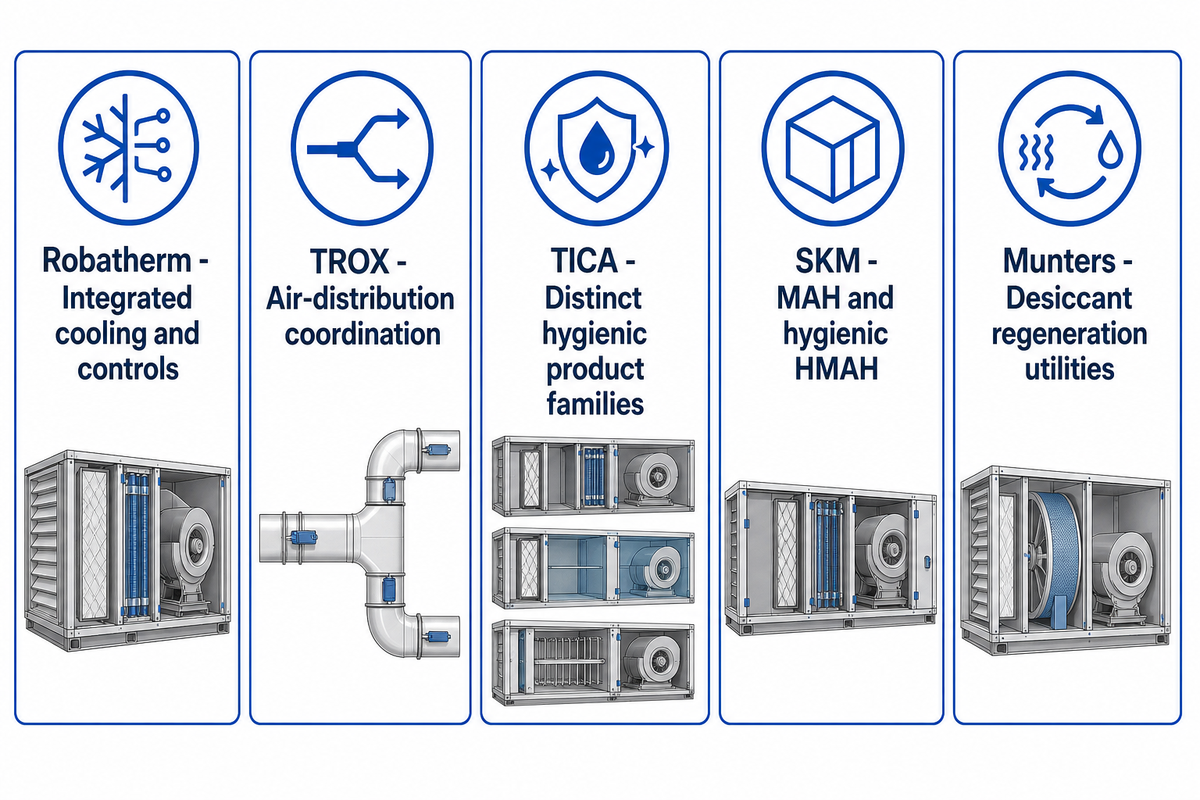
There are differences in the kinds of risks that call for hygienic AHU construction and industrial humidity controls. Decisions regarding cleanable surfaces, access and drainage in health care facilities are different from the decisions concerning humidity-control processes in an industrial production plant. Both types of specialists are included in this group. An industrial desiccant system employed in an AHU doesn’t necessarily imply that it’s suitable for health care.
16. Robatherm: Best for custom hygienic AHUs with integrated cooling and controls
Headquarters: Jettingen-Scheppach, Germany · Founded: 1854 · Type: Independent family-owned custom AHU manufacturer
Official website: https://www.robatherm.com/
Main products: TrueIndividual AHUs with TI-50 casing
Capabilities: TI-50: 50 mm casing; project-specific configuration; controls, hydraulic sets and cooling integration; factory acceptance testing.
Certifications / notable work: The TI-50 page declares DIN EN 1886 TB1, T2, L1(M), D1 and F9 filter-bypass performance.
Robatherm traces its business roots to an 1854 locksmith workshop and introduced the robatherm brand in 1959, so the earlier date shouldn’t be read as the start of AHU production. Today the company is headquartered in Jettingen-Scheppach and develops custom units around its TrueIndividual offer. TI-50’s 50 mm casing and declared TB1 thermal-bridging class sit alongside in-house controls, hydraulic and cooling expertise, which can reduce the number of separate technical interfaces a buyer must coordinate. That breadth still demands a detailed project brief: cabinet dimensions, control responsibilities and factory acceptance-test scope need agreement before a bespoke assembly becomes a comparable quotation.
Potential limitation: Bespoke assemblies need detailed interface coordination.
17. TROX: Best for hygienic air handling coordinated with air-distribution controls
Headquarters: Neukirchen-Vluyn, Germany · Founded: 1951 · Type: Air-handling and climate-control system manufacturer
Official website: https://www.trox.de/en/
Main products: X-CUBE; X-CUBE X2; X-CUBE Ex; specialist variants
Capabilities: X-CUBE up to 86,000 m³/h, with filtering, heating, cooling, recovery, humidification and dehumidification; Modbus TCP or BACnet IP.
Certifications / notable work: TROX offers hygiene construction under AHU Guideline 01 and describes optional hygienic cabling for VDI 6022 requirements.
TROX was founded in 1951 and is headquartered in Neukirchen-Vluyn; its current anniversary history includes the development of X-CUBE manufacturing. X-CUBE combines the main air-treatment functions with a control system that can connect fire dampers, volume-flow controllers and duct sensors through fieldbus interfaces. This makes the manufacturer relevant when a hospital or other controlled environment needs the central unit coordinated with the wider air-distribution system. Hygiene construction, outdoor weatherproofing and explosion-protection designs are separate variants, so the selected X-CUBE specification must carry the required features rather than relying on the family name alone.
Potential limitation: Hygiene and weatherproof designs are selected variants.
18. TICA: Best for hygienic modular air handling for healthcare and process environments
Headquarters: Nanjing, China · Founded: 1991 · Type: Clean-air and climate-equipment manufacturer within TICA Group
Official website: https://global.tica.com/
Main products: Air Prowess TBF; Air Pioneer; DX modular AHUs
Capabilities: Air Prowess TBF: 1,000–110,000 m³/h across 101 selectable models; configurable components, EC fans and recovery options.
Certifications / notable work: TICA reports Air Prowess hygiene certification against VDI 6022-1 and DIN EN 13053; Air Pioneer separately lists EN 1886 D1/L1/T2/TB1 casing performance.
Founded in 1991, TICA records the establishment of its Nanjing headquarters in its company history. Air Prowess uses smooth, cleanable surfaces and pull-out component access, an arrangement relevant to healthcare and process installations that need planned maintenance access rather than only a specified filter grade. The separate Air Pioneer platform provides selection reports covering functional sections, coil duty, psychrometric conditions and unit dimensions, helping the engineering team document its chosen duty. Those platforms have different published performance descriptions, so transferring Air Pioneer’s casing classes onto an Air Prowess tender would erase a material distinction between the two offers.
Potential limitation: Different families require separate performance specifications.
19. SKM Air Conditioning: Best for gulf commercial projects and hygienic air-handler applications
Headquarters: Sharjah, United Arab Emirates · Founded: 1974 · Type: HVAC equipment manufacturer with UAE and Saudi factories
Official website: https://www.skmaircon.com/
Main products: MAH modular AHUs; HMAH hygienic modular AHUs
Capabilities: MAH: 1,000–60,000 CFM; HMAH: 1,000–42,500 CFM; both list up to 2,000 Pa total static pressure.
Certifications / notable work: SKM states MAH ratings under EN 1886/EN 13053 and AHRI 430, with AHRI 410 coils; HMAH has stated TÜV Süd hygiene testing.
SKM began production in Sharjah in 1974 and now describes manufacturing facilities in the United Arab Emirates and Saudi Arabia. Its MAH construction includes thermal breaks in panels and frames, while the HMAH family targets hospitals, laboratories, pharmaceutical plants and other hygiene-sensitive applications. The published distinction is useful for procurement because the hygienic family has its own model range and a lower airflow ceiling than MAH. SKM’s 2,000 Pa figure is total static pressure, not automatically the external pressure available for project ductwork, so the quotation needs the selected unit’s internal resistance and remaining external duty stated separately.
Potential limitation: HMAH airflow ceiling is below the general MAH range.
20. Munters: Best for industrial processes needing integrated desiccant humidity control
Headquarters: Kista, Sweden · Founded: 1955 · Type: Industrial climate-control equipment manufacturer
Official website: https://www.munters.com/
Main products: DSS Pro; DSS Pro SE and PLUS configurations
Capabilities: DSS Pro: 2,800–145,000 m³/h in 20 sizes; indoor/outdoor configurations; gas, steam, electric or hot-water reactivation; AirC 800 controls.
Certifications / notable work: Munters states that DSS Pro’s insulated double-wall AirPro enclosure meets EN 1886 requirements.
Munters was founded in 1955 and is headquartered in Kista, Sweden, with industrial humidity control central to the offer considered here. DSS Pro is a fully integrated desiccant air-treatment system with configurable pre- and post-treatment, rather than a loose desiccant component offered as a complete air handler. AirC 800 supports Modbus, BACnet and LON communication, while DSS Pro SE is a separate streamlined platform with its own configuration boundaries. For an industrial buyer, the main tradeoff is regeneration: the selected heat source, available utilities and operating schedule belong in the energy comparison, making this a specialist process choice rather than a default office ventilation unit.
Potential limitation: Regeneration requires a heat source and energy integration.
Eight Checks Before You Request an AHU Quote
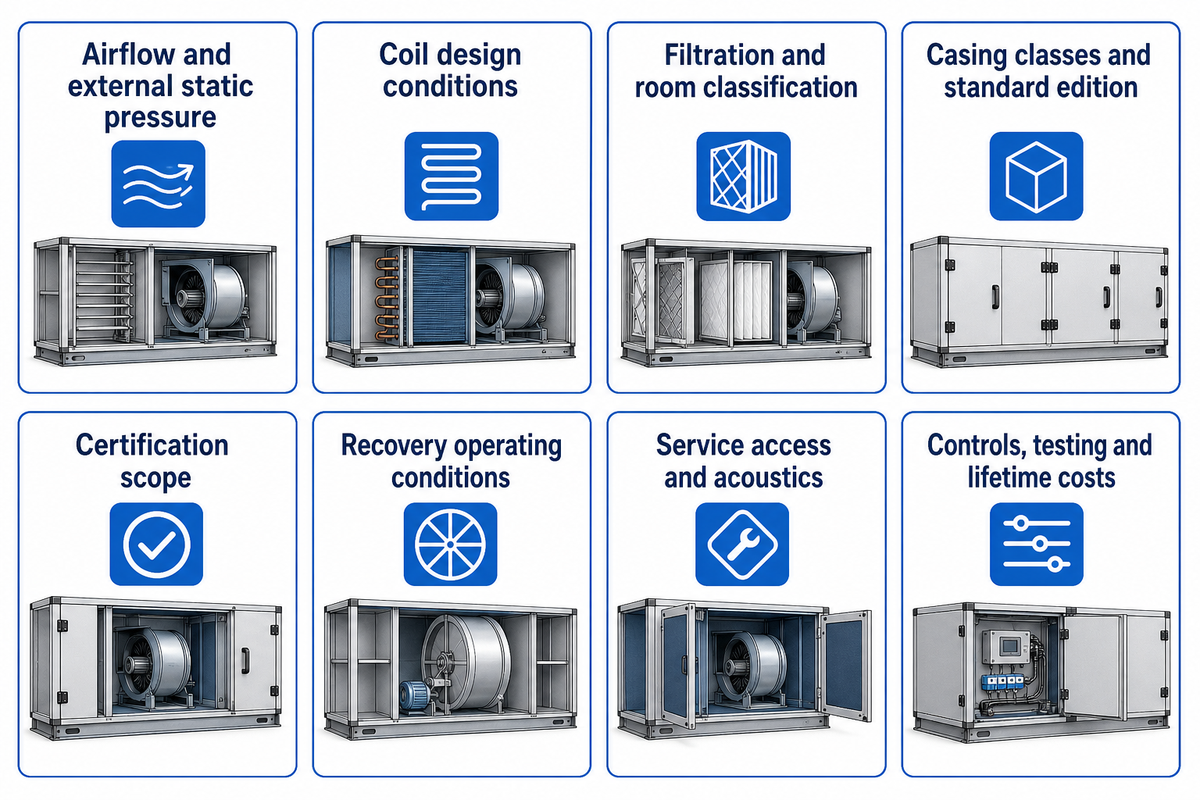
When evaluating quotations, use a single reference point. Mismatched entering-air conditions and fan pressures, along with different service and/or maintenance space, won’t be reconciled by a larger product line, a lower price, or a more familiar equipment group. The following checks assist in identifying equipment suitable for the project.
8-Check AHU Bid Comparison
The 8 checks used to compare bids on an AHU provide a basis for comparing airflow, coils, filtration, casing, certification, recovery, maintainability and controls alongside costs.
How should you compare AHU airflow and external static pressure?
1. Adequately describe the system, including design external static pressure and the allowable pressure drop across filters. Give the air volumes for the supply, return, and outdoor air, if any. Indicate how recirculated and outside air are handled. Describe if the return air is mixed, and if exhaust is taken from the return air. Total static pressure should be differentiated from the external pressure available outside the unit. Coils, filters and heat-recovery sections consume part of the fan pressure budget. SKM’s statement illustrates how total pressure can be misleading when similar catalogue numbers describe different pressure limits.
Be specific about the operating conditions for which the fan is to be selected. Fan curves should be provided for the conditions of interest. For energy efficiency, assess fan or blower power over operating hours, including operation with recirculated air and return room air. Of interest are the air densities at the conditions for which the fan is to be selected, and the altitude and temperature of the air. Provide information about the control system, including expected turndown, if the system uses variable air volume. A maximum airflow rate specified by the manufacturer doesn’t establish operation at the required pressure or indicate the noise level at that operating point.
Put coil performance on the same design basis
For cooling and dehumidification, indicate entering conditions (dry-bulb and wet-bulb), outdoor-air fraction, the leaving-air target and operating schedule; for a chilled-water coil, indicate supply and return water temperatures. Pressure drop for the water side should also be indicated. For a direct-expansion coil, indicate the matched compressor and refrigeration, and provide controls and sequencing. The reason for the range of options in the commercial AHU configuration demonstrates the need to specify chilled water and direct expansion systems independently.
A coil providing only sensible cooling may not provide sufficient humidity control in outdoor air conditioning. Consider total and sensible capacities of the cooling coil and compare condensate removal means and face velocity. Assess coil heat transfer at the same operating conditions. For heating, identify the conditions of the heating water or steam. Where electric heaters are specified, give their nominal capacity and staged control. Quotations should disclose the nature of the service and the conditions under which the equipment will operate.
Chilled-water selection
Coordinate coil duty with water temperatures, flow, pressure drop, valves and the central plant.
DX selection
Coordinate the coil with refrigerant circuitry, the condensing equipment and the operating control sequence.
Separate filtration from cleanroom classification
Specify filter grades, stages, initial and final pressure drops, sealing and replacement access. Decide where terminal filtration belongs in the complete system. A unit advertised with HEPA options does not by itself establish an ISO cleanroom class: ISO 14644-1 addresses classification of air cleanliness by particle concentration in the cleanroom or clean zone.
For pharmaceutical and other controlled production schemes, concurrently assess air-handling unit design, construction and qualification, in relation to pressure relationships, room construction and air distribution. Also, assess applicable area specific provisions and hospital ventilation equipment. Make appropriate judgement regarding filtration, casing leakage and room pressure. These are integrated design considerations, and shouldn’t be considered as means of performance verification.
Read casing classes with their standard edition
EN 1886 concerns mechanical performance of AHU casings, while EN 13053 addresses ratings and performance of units, components and sections. Ask for the declared leakage, strength, thermal transmittance, thermal bridging and filter-bypass performance applicable to the offered construction. A panel thickness alone doesn’t describe all of these properties. Heat loss through the cabinet and condensation risk also depend on the assembled construction.
Edition control matters in 2026. DIN EN 1886:2026-09 adopts EN 1886:2025, whose published change notes introduce U1 through U3 thermal-transmittance classes in place of the former T1 through T5 system. Current manufacturer pages may therefore show different labels. Keep each result with its test method and edition; don’t silently translate an older T2 declaration into a new U class or compare the letters without their supporting record.
Match certification to the offered range and component
Certification should be evaluated at the time of tender for the same offered product range, factory, selection software and configuration. Evaluate the Eurovent certification program for AHUs to gain clarity on the scope of the programs. A group logo shouldn’t replace program scopes. A model-box casing result and complete-system performance shouldn’t be treated as the same evidence.
AHRI’s applied-industry standards list indicates that AHRI 430/431 covers ratings for central station AHU supply fans, and AHRI 1350/1351 covers case performance. Likewise, the scope and the licensee’s responsibilities for AMCA certification are defined for the licensed product and its certified performance. Certification of a fan or propeller doesn’t ensure that the complete AHU is certified. Keep tests and certification reports, as well as supplier statements, with the corresponding model and standard edition, and attach them to the plans or specifications.
Compare recovery at matched operating conditions
When considering sensible and latent heat recovery, also include supplies and exhausts, total pressure losses, fan power and frost control. Indicate winter and summer conditions and state flow balance. A recovery percentage without matched conditions may obscure fan power requirements during actual load conditions.
Eurovent’s Guidance on Heat Recovery provides information relating to the Exhaust Air Transfer Ratio (EATR) and Outdoor Air Correction Factor (OACF), and their relationship with pressure differences. State which passages carry extract air from the building and which passages carry supply air to the building. For the consideration of air contaminant transfer, state the degree of carryover and leakage. The type of airstream separation required should also be defined. A heat recovery unit shouldn’t be chosen based on nominal data only.
Check the service route and the installed acoustic duty
Draw space to remove filters, fans, and coils. Show details like door swing, air obstructions, drain trap removal, and access for maintenance. Consider the final position and how the system will be shipped. A knockdown cabinet supports access, but raises issues of site sealing and finishing. Roof or ground mounting details and condensate removal must be provided for the outdoor unit.
Request data about the noise generated by fans and assess duct-borne and casing-radiated noise in the building. For the make-up air installation, the requirements and the operating schedule for the exhaust replacement may change the type of fan and the hours when noise is an issue. Noise attenuation increases the size and pressure loss of the system and affects the fan selection. Service access and noise may eliminate a system that otherwise would be acceptable.
Assign controls, acceptance testing and lifetime costs
In the case of an HVAC air handling unit, determine who will provide the sensors, actuators, valves, and variable-speed drives, as well as the interface to the building management system (BMS). Record the responsibilities of the air handling unit (AHU) OEM and the controls contractor. A BACnet or Modbus connection establishes communication; behavior of the system is defined by points, alarms, interlocks and logic. Coordinate heating and cooling control sequences with the plant. Agree on the behaviour of the system under various conditions, for example, system start-up, system shut-down, protection from frost and behaviour in case of obstructed airflow.
A factory acceptance test (FAT) assesses the OEM’s work scope. It doesn’t serve as a substitute for onsite commissioning. Agree who is responsible for control-system integration and air balancing of the HVAC system. Compare quotation exclusions, installation, commissioning, spare parts and consumables alongside the equipment purchase price. For industrial applications using desiccants, include the cost of regeneration utilities in the equipment operating-cost comparison. Determine the impacts of field integration on the indoor environment and building performance, and compare installed efficiency and performance with the factory assessment.
Send one schedule to every shortlisted manufacturer.
Include design airflow and pressure, entering and leaving conditions, filter stages, casing requirements, recovery arrangement, dimensions, service clearances, controls and acceptance scope. Record exclusions beside each quoted configuration.
Frequently Asked Questions
Which is the best air handling unit manufacturer?
The best air handling unit manufacturer depends on airflow, static pressure, filtration, coil duty, casing performance, controls, application and local service requirements.
The best air handling unit manufacturer depends on airflow, static pressure, filtration, coil duty, casing performance, controls, application and local service requirements. Start with the operating conditions and the required construction, then compare the product families that fit. A project-built unit may suit unusual dimensions or treatment stages, while a standardized modular range may suit a repeatable commercial installation. The strongest shortlist is the one whose suppliers can document your actual duty and support the installation.
Which AHU manufacturer is best for hospitals?
Hospital projects should prioritize a documented hygienic AHU range with cleanable surfaces, controlled casing leakage, suitable filtration, drain design, materials and the required certification scope.
Hospital projects should prioritize a documented hygienic AHU range with cleanable surfaces, controlled casing leakage, suitable filtration, drain design, materials and the required certification scope. Compare the named families in this guide against the healthcare requirements applicable to your project. Ask whether the offered configuration includes the required access, controls and testing. Manufacturer reputation alone does not establish suitability for every hospital area, and factory certification does not replace verification of the installed ventilation system.
Which AHU manufacturer is best for cleanrooms?
The best cleanroom AHU manufacturer is one that can meet the project’s filtration, leakage, pressure, temperature, humidity, cleanability and process requirements as a coordinated selection.
The best cleanroom AHU manufacturer is one that can meet the project’s filtration, leakage, pressure, temperature, humidity, cleanability and process requirements as a coordinated selection. Review the offered product family, controls and service access with the cleanroom designer. An AHU marketed for cleanrooms does not establish compliance with every ISO cleanroom class. Room classification depends on the complete installed environment, including air distribution, terminal filtration, construction, operation and the required site testing.
What is the difference between an AHU and an RTU?
An AHU primarily handles and conditions air as part of a larger HVAC system, while an RTU typically packages the refrigeration and air-handling functions into one rooftop cabinet.
An AHU primarily handles and conditions air as part of a larger HVAC system, while an RTU typically packages the refrigeration and air-handling functions into one rooftop cabinet. Project architectures vary, so compare the actual equipment boundary rather than installation location alone.
What is the difference between an AHU and a fan coil unit?
An AHU is normally a central ducted air-treatment system, while a fan coil unit is usually a smaller terminal serving a room or zone.
An AHU is normally a central ducted air-treatment system, while a fan coil unit is usually a smaller terminal serving a room or zone. Outdoor-air ventilation often needs separate provision when fan coils mainly recirculate air within the occupied space.
How much does a commercial air handling unit cost?
There is no universal AHU price because airflow, static pressure, coils, filtration, casing, heat recovery, controls and materials can change the configuration substantially.
There is no universal AHU price because airflow, static pressure, coils, filtration, casing, heat recovery, controls and materials can change the configuration substantially. Request quotations against the same design basis, then compare installation, commissioning, energy use, replacement filters and maintenance alongside the equipment price.
The best manufacturer shortlist is the one that works best for the conditions and requirements for the project, be it construction or operation. If no shortlist is provided, use the quick picks as a guideline, and then use the eight checks to review the actual shortlist. Both a custom builder and a modular builder can provide a price quotation with adequate specification.
For a project-built selection, explore Koven Air’s air handling units or send Koven Air your project requirements. Include the duty schedule, intended application, installation location and available drawings so the proposed configuration can address the real site conditions.
References & Sources
Technical comparisons draw on the linked EN 1886 and EN 13053 catalogue records, Eurovent AHU certification programme and heat-recovery guidance, AHRI applied-industry standards, AMCA certification information and ISO 14644-1. Company profiles draw on the official websites shown in the table and cards; manufacturer-reported specifications are identified by product family.
- DIN EN 1886:2026-09: AHU casing mechanical performance
- DIN EN 13053: rating and performance of units, components and sections
- Eurovent Certified Performance: air handling units
- AHRI applied-industry standards and programmes
- AMCA certification programme
- ISO 14644-1:2015: cleanroom air cleanliness classification
- Eurovent 17/11: guidelines for heat recovery, EATR and OACF
![Horizontal Fan Coil Unit Project Guide [Step-by-Step]](https://kovenair.com/wp-content/uploads/2026/09/horizontal-fan-coil-unit-guide-featured-1-768x512.png)
![Vertical Fan Coil Unit: Design & Maintenance [Guide]](https://kovenair.com/wp-content/uploads/2026/09/vertical-fan-coil-unit-guide-featured-1-768x512.png)
![Commercial Rooftop Unit Guide: Types, Sizing & Costs [2026]](https://kovenair.com/wp-content/uploads/2026/07/commercial-rooftop-unit-guide-featured-2-150x150.png)