Get in Touch with Koven Air Company

Heat Pump Chiller | 4-Pipe Simultaneous Heating & Cooling
A heat pump chiller delivers chilled water and hot water from one unit, hospitals, hotels, and manufacturing plants get both effects instead of running a chiller and a separate boiler side by side. Koven Air builds the 4-pipe simultaneous heat+cool platform on the same compressor lines we’ve shipped since 2007. Field-measured combined efficiency (ICOP) on two documented installations reaches 7.82–8.5 — the real project data is below, not a marketing multiplier.
Request Sizing Consultation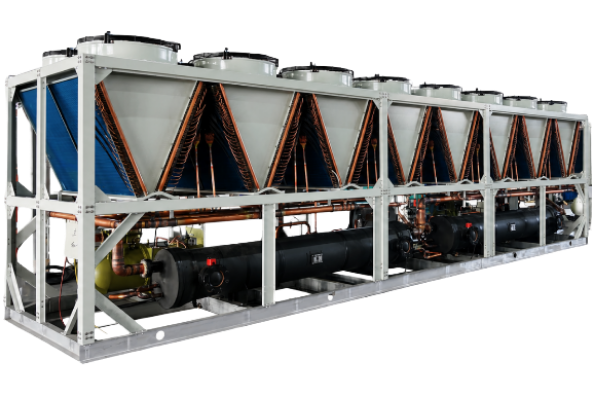
200–1,500
Cooling Capacity (RT)
7.82–8.5
Measured ICOP, Simultaneous Mode (Field Data)
R134a / R410A / R1234ze
Refrigerant by Platform
3.2–5 yrs
Documented Payback vs Dual-System
CE · ISO 9001
Certifications
4 yrs
Verified Field Operating History (2022–2026)
Hospitals and Hotels Need Simultaneous Heating and Cooling, Why Two Systems Isn’t the Only Answer
A heat pump chiller is a hydronic system that produces chilled water and hot water from the same refrigeration circuit, using a reversing valve or a dedicated 4-pipe heat-recovery arrangement to run both effects at once. Facilities call the same equipment category a heat recovery chiller depending on which vendor or engineer wrote the spec, the working principle doesn’t change with the label.
A hospital’s central utility plant runs chilled water for operating rooms and server rooms every hour of the year, and hot water for domestic use and reheat coils at the same time. “Buy a chiller, buy a boiler, run both” has long been the default answer. Trane’s own product webinar on modular heat pump systems answers a related question directly:
“Are supplemental boilers always needed with modular heat pump systems? No, supplemental boilers aren’t always needed with modular heat pumps.”
That’s a competitor’s own engineering team walking back the assumption that a heat pump chiller is just a chiller with a boiler bolted on for backup. One of Koven Air’s own documented installations, a hospital operating-room complex running 4-pipe units since 2022, replaced exactly that “chiller + gas boiler” pair and has run without it for four years. The full project data is in the applications section below.
Engineering Note, Reversible Cycle vs. Full Heat Recovery
A reversible heat pump chiller switches between heating and cooling with a reversing valve, one mode at a time, transferring heat in one direction per cycle. A 4-pipe heat-recovery chiller runs both at once through a second condenser/evaporator pair, moving heat in both directions simultaneously.
On a standard water-cooled chiller, the compressor pull heat out of the chilled water loop at the evaporator, then rejects it at the condenser, normally straight to a cooling tower or condenser water loop, where it dissipates to the atmosphere and is lost. Heat-recovery chillers keep that condenser heat instead: the same waste heat generated during the cooling process get redirected through a second heat exchanger into a hot-water circuit rather than a cooling tower. That’s the whole heat reclaim mechanism, the refrigeration cycle itself doesn’t change, only where the condenser heat ends up.
Multistack’s public product literature quantifies the gap between the two heat-recovery approaches directly: a dedicated full-heat-recovery condenser delivers 4–6× more usable heat than a partial-recovery desuperheater on the same compressor. That’s the difference between “some free heat” and “a real second output” — cooling and hydronic heating from the same compressor work instead of one output rejected to atmosphere.
Heat pump technology like this doesn’t generate heat from fuel, it moves heat, the same working principle behind every heat pump, applied here to a 4-pipe simultaneous configuration. A boiler burns fossil fuels to raise water temperature; a heat pump chiller transfers heat instead, using the electricity already running the compressor for the cooling side. That distinction is what turns a facility’s heating systems from a separate fossil-fuel line item into part of the same electric meter as the cooling plant, a more sustainable path than adding a bigger boiler.
Capital planning is where this case actually show up, as much as the mechanical room. A facility budgeting a chiller replacement and a boiler replacement as two separate line items is pricing two compressors, two control systems, and two maintenance contracts, even though both will spend most of their operating life responding to the same building load swings. A single 4-pipe unit collapses that equipment count, which is the argument procurement teams respond to before they ever look at an efficiency number.
Koven Air Heat Pump Chiller Lineup, Capacity, COP & Certification in One Table
Most manufacturer pages show capacity or efficiency or a certification badge, rarely all three lined up against a real installed unit. Koven Air ships 4-pipe simultaneous heat+cool platforms in two architectures: a centralized twin-screw line and a distributed modular-scroll line. Here’s the field data behind both, not a catalog projection:
| Parameter | Base Twin-Screw Chiller (cooling-only) | KASG-2xx 4-Pipe Screw (centralized) | KASG-0xxH 4-Pipe Modular Scroll (distributed) |
|---|---|---|---|
| Cooling capacity | 93–1,000 RT | 200–1,500 RT platform range (240 RT unit shown below) | 60–80 RT per module, up to 16 paralleled |
| Rated output per unit | Cooling only | 849 kW cooling / 1,060 kW heating | 281 kW cooling / 315 kW heating |
| Combined ICOP (simultaneous mode) | n/a — single-mode only | 7.74 design / 7.82 field-measured | 8.9 design / 8.5 field-measured |
| Efficiency (single-mode) | Cooling COP 5.56–5.83 | EER/COP 5.5–6.5 | EER/COP 5.5–6.5 |
| Refrigerant | R134A / R1234yf | R134a | R410A |
| Compressor | Double-screw | Semi-hermetic twin-screw, stepless capacity | Fully-hermetic scroll, multi-stage capacity |
| Operating modes | Cooling only | Cooling / Heating / Simultaneous, auto-switch | Cooling / Heating / Simultaneous / DHW heat-recovery |
| Chilled / hot water range | n/a | 5–15°C / 35–55°C | 5–18°C / 35–55°C |
| Best-fit architecture | — | One or two large machines, N+1 redundancy | Many small units, automatic fault isolation |
| AHRI-IPLV reference | 6.8–7.8 | Referenced to twin-screw platform test data | Referenced to modular-scroll platform test data |
| Certifications | CE, ISO 9001/14001/45001 | Same | Same |
Which architecture fits depends on how the load is distributed across the building, not just the total tonnage:
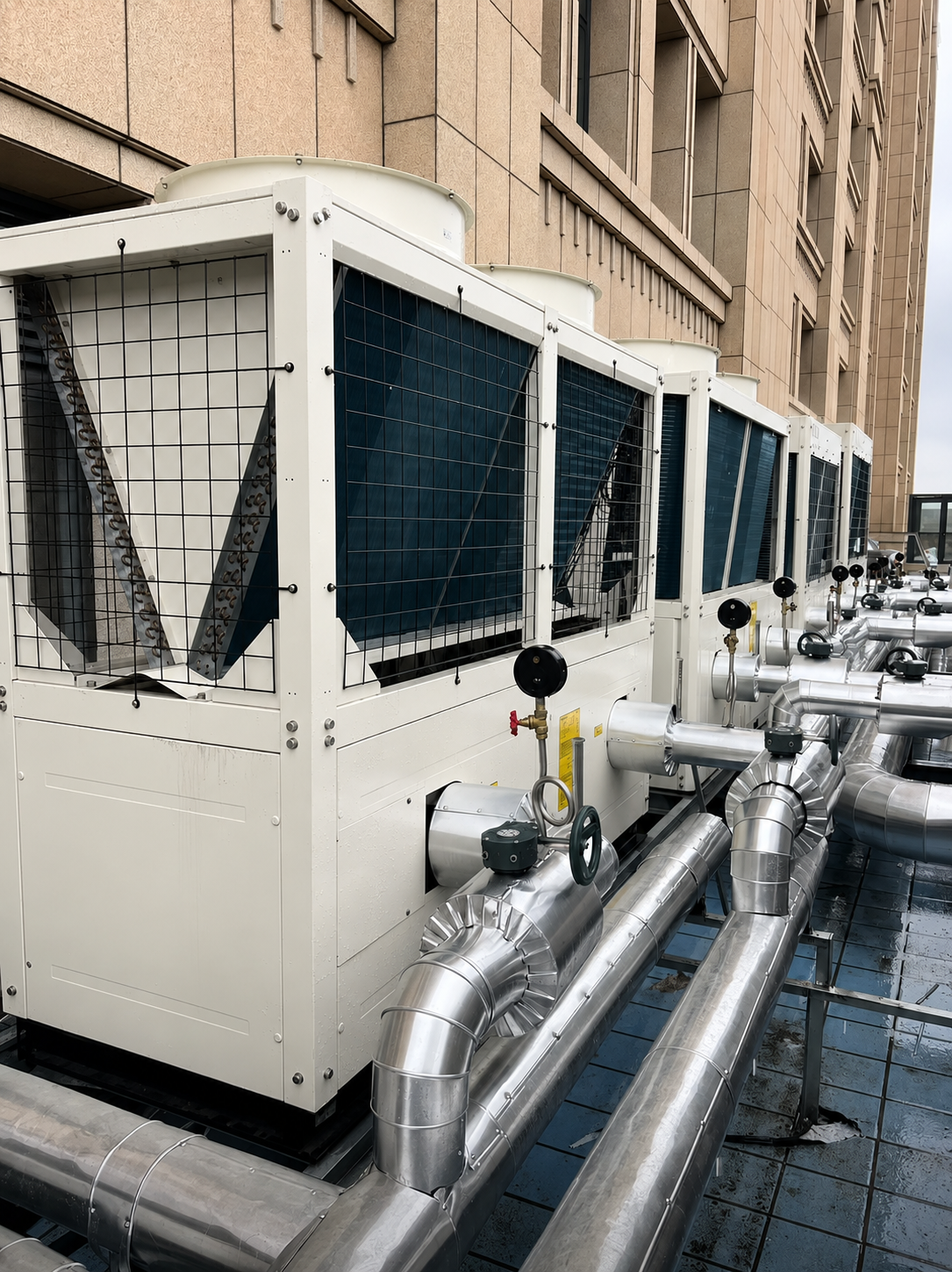
- One large simultaneous load in one place fit the centralized screw platform (KASG-2xx) best, a hospital operating-room and ICU complex, a single central plant serving the whole site, typically one duty unit plus one standby for redundancy.
- Load split across zones favors the modular scroll platform (KASG-0xxH) instead, hotel guest-room floors on one loop, public areas on another, domestic hot water recovered on a third, with up to 16 units paralleled and automatic fault isolation if one module need service.
- Mechanical architecture is the real difference between them (few large machines vs. many small paralleled ones); both run the same underlying 4-pipe simultaneous principle.
Brand Positioning & Peer Comparison
Engineers researching this category typically compare a short list of brands, Trane heat pump chiller systems, a heat pump chiller Daikin builds under its Trailblazer line, or a YORK heat pump chiller, against whatever platform a newer manufacturer offer. We’d rather be judged on the table above than on brand recognition alone.
Refrigerant Choice & GWP Compliance
Refrigerant choice matters more than a footnote here. R134a (GWP ~1,430) and R410A (GWP 2,088) both exceed the EPA AIM Act’s 700-GWP threshold that applies to new comfort-cooling equipment in the US from 2025 and to industrial-process equipment above −30°C from 2026; R1234ze (GWP<1) is the low-GWP path already running on Koven’s other platforms. Both installations documented on this page were built to their local market’s refrigerant options at time of commissioning, for a project subject to a GWP limit, ask about the R1234ze path before specifying rather than assuming either case-study refrigerant carries over.
Platform Scope & Single-Mode Alternatives
Koven Air builds this simultaneous 4-pipe platform alongside single-mode lines for buildings that don’t need both effects from one unit: an air-to-water heat pump and a water-to-water heat pump for heating-only or cooling-only zones, plus air-cooled scroll chillers, air handlers, and make-up air units for the rest of the mechanical room. This platform is built for heating and cooling for commercial and industrial buildings, hospitals, hotels, schools, not residential installations. If your loads don’t overlap enough to justify a 4-pipe unit, ask us which single-mode line fits before defaulting to this one.
Right-Sizing Isn’t “Buy the Biggest Unit”
zerohvacr.com‘s technical guidance on chiller sizing asks the question directly: is it better to oversize the chiller? Not always — when an undersized chiller become a problem, “it may seem like the safest answer is to choose the biggest unit,” but an oversized compressor short-cycles at part load and loses efficiency exactly when a hospital or hotel’s real-world load sits below peak most of the year. Size to your actual simultaneous heating and cooling load profile, not to the largest number on the spec sheet.
If your application is a distributed zone-by-zone water-loop system rather than one central 4-pipe unit, see our water source heat pump page instead, same manufacturing platform, different loop topology.
If your process needs hot water above this platform’s 55°C ceiling, our high-temperature industrial heat pump line covers that range instead.
The Simultaneous-Mode COP Ledger, What Heat Recovery Is Actually Worth
Vendor marketing gets vaguest exactly where the money is: “how much is heat recovery actually worth” is a harder, riskier number to publish than “do you’ve heat recovery, yes or no.” Trane’s own comparison table for its chiller-heater systems lists “Simultaneous Recovery” as a feature every configuration either has or doesn’t, a checkbox, not a number. Daikin’s own Trailblazer HP material frames the pitch around reducing energy consumption and emissions, but the number behind it — “up to 300% efficient” — is a single-mode heating COP figure, not a combined-effect one.
We publish a number instead, because we now have two installations to measure it on:
| Installation | Platform | Design ICOP | Field-Measured ICOP | Simultaneous-Mode Runtime |
|---|---|---|---|---|
| Hospital OR/ICU complex (China, 2022–present) | KASG-240, 2× centralized screw | 7.74 | 7.82 | ~72% of the year |
| Business hotel (Kunming, China, 2022–present) | KASG-080H, 5× modular scroll | 8.9 | 8.5 | Shoulder-season + year-round DHW recovery |
Both installations shown were built to their local market’s refrigerant options at time of commissioning (R134a / R410A) — see the refrigerant compliance note in the product-line table above for GWP-regulated markets.
ICOP runs well above the 5.5–6.5 single-mode EER/COP quoted elsewhere on this page because it moves thermal energy twice, chilled water and hot water, two billable outputs, against one unit of compressor input, instead of one output with the other half of the heat thrown away to atmosphere. A single-mode chiller pay for that rejected heat in compressor work and then wastes it; a 4-pipe unit keeps it and delivers it as usable hot water.
Boundary Conditions, These Numbers Aren’t a Universal Multiplier
Hospital ICOP of 7.82 holds under a load profile with heating and cooling demand overlapping roughly 72% of the year, an OR/ICU complex with continuous chilled-water and hot-water draw. Hotel ICOP of 8.5 combines space-conditioning simultaneous mode with year-round domestic-hot-water heat recovery, a different overlap pattern tied to occupancy and shoulder-season swing.
A building with heating and cooling demand that rarely coincides won’t see either number, that’s a load-profile question, not a product limitation. These ICOP figures are Koven Air’s own site-measured commissioning results, not an AHRI-rated or third-party-certified metric — AHRI doesn’t currently publish a standard test method for combined simultaneous-mode efficiency across manufacturers, so there’s no independent benchmark to certify against yet.
The underlying mechanism has independent corroboration beyond our own two projects. Trane’s own glossary states it plainly: “[Heat pump chillers] can recover and reuse waste heat when they’re simultaneously cooling and heating, significantly improving overall system efficiency compared to separate boiler and chiller setups.” Multistack’s public literature adds the desuperheater comparison already noted above, both are industry reference points for the mechanism, not a substitute for site-specific numbers.
“Buyers ask us for a single combined-COP number more often than any other spec. Now we can show them two real projects instead of a formula, but we still walk through load overlap and water-temperature targets before quoting a number for their specific building, because 7.82 and 8.5 came from two very different load profiles.”
Buyers often default to comparing sticker price alone. One HVAC manufacturer’s own account team put the counter-argument on LinkedIn: “Some clients will base their buying decision on initial costs. However, a value-based option considers both operational cost and initial cost.” That’s exactly what the 41–50% figures below are meant to show.
Want the load-coincidence math for your building?
Compare 4-Pipe vs Standard Chiller + Boiler →Where This Fits, Two Documented Installations, Plus the Broader Market
Koven Air’s heat pump chiller platform targets facilities with genuine year-round coincident heating and cooling demand: hospitals, hotels & resorts, schools & universities, and green-building projects chasing electrification targets without giving up simultaneous comfort heating and cooling. Two of our own installations, one centralized, one modular, have four years of field data behind them.
Case: Hospital Operating-Room & ICU Complex
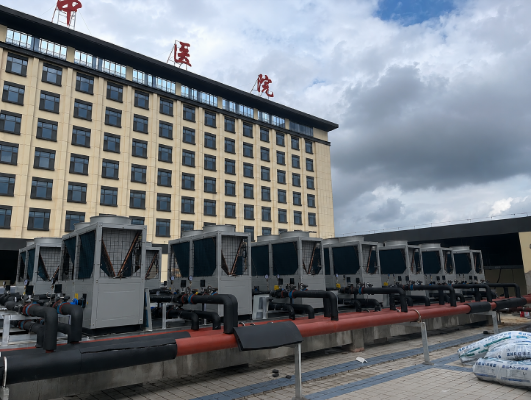
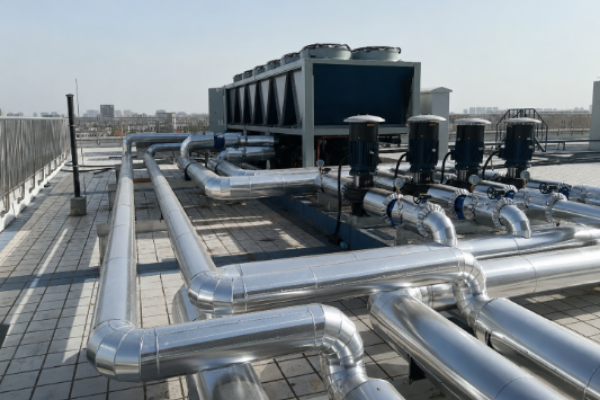
China · Commissioned 2022 · 2× KASG-240 (1 duty + 1 standby) · 18,000 m² purification zone · 16 operating rooms + ICU + NICU
A centrifugal chiller paired with a gas-fired boiler was the prior system here, two systems the hospital’s new outpatient/medical-technology building replaced with a single 4-pipe screw platform to hold ±0.5°C / ±5% RH operating-room tolerances without burning gas on site. The same chilled-water loop pre-cools and dehumidifies outside air before the reheat coil bring it back up to supply temperature, the outdoor-air path every clean-room air handler needs, run off the same 4-pipe unit instead of a separate coil bank.
- Design load reached 1,698 kW cooling / 2,120 kW heating across the purification zone.
- Every field-measured ΔT met or exceeded design: cooling 5.1°C vs. 5°C design, heating 5.2°C vs. 5°C design, OR reheat 8.3°C vs. 8°C design.
- Operating-room conditions held at 22–23°C ±0.4°C, 52–55% RH ±3%, against a GB 50333-2013 requirement of 22–24°C / 50–60% RH ±0.5°C/±5% RH.
- Reliability: a 72-hour continuous full-load commissioning test ran fault-free, followed by four years of operation with only routine maintenance and zero downtime affecting surgical schedules.
- Cost fell from ¥439.4万 annual opex + maintenance (chiller + gas boiler) to ¥301.5万 at commissioning (−31.4%), holding above 40% savings across four years of actual operation, better than the original design estimate.
- Maintenance labor cost dropped 60% with no licensed boiler operator required, alongside an estimated 1,008.5 tons/year lower CO₂ output.
Case: High-End Business Hotel
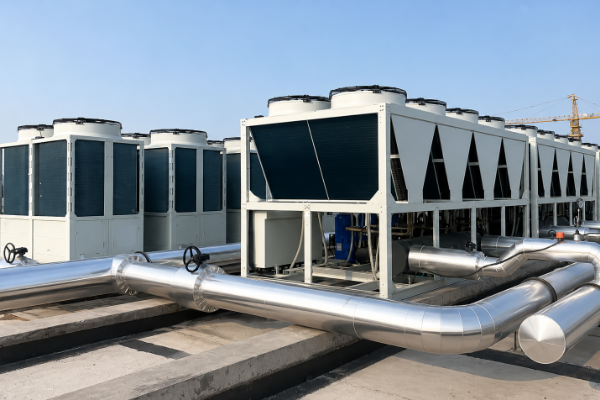
Kunming, China · Retrofit Mar, May 2022 (60-day, phased, hotel stayed ≥65% occupied) · 5× KASG-080H modular units · 32,000 m² · 180 guest rooms
Kunming’s subtropical plateau monsoon climate produces a long shoulder season with same-day heating and cooling demand, sun-facing rooms calling for cooling while shaded rooms call for heat. The prior 2-pipe heat pump plus an electric-resistance hot-water tank couldn’t serve both at once and carried a high electric-heating energy cost.
- Design load: 2,560 kW space-conditioning cooling / 2,180 kW heating, plus 320 kW domestic hot water (120 tonnes/day at 45°C).
- Field-measured ΔT landed at or above every design target, cooling 5.1°C, heating 5.2°C, DHW preheat 25.4°C against 5°C / 5°C / 25°C design.
- Guest-room noise held at ≤28 dB (five-star threshold), and each room independently switches heating or cooling without affecting the neighboring room.
- Total AC + DHW + maintenance opex fell from ¥188万/yr to ¥95万/yr (−49.5%), with the deepest single-category cut in domestic hot water (−73.8%, heat-recovery preheat displacing electric-resistance heating) and space-conditioning energy down 40.6%; documented payback ≈3.2 years.
- Four years of operation (2022–2026) brought shoulder-season temperature complaints down 92%, “AC comfort” mentions in guest reviews up 38%, and energy cost holding near 50% below the pre-retrofit baseline.
Both cases above save energy and reduce carbon emissions the same way, by recovering heat a single-mode system would waste, not by adding a more energy-efficient compressor. That’s a different lever than the energy efficiency rating on a spec sheet, and it’s why the ICOP ledger two sections up matters more than a single-mode EER number for a building with real load overlap. It’s also a more cost-effective way to reduce energy spend and shrink a facility’s carbon footprint than waiting for a cheaper renewable energy tariff to bring the grid’s own emissions factor down.
Beyond our own projects, the broader market show the same mechanism paying off elsewhere: St. Elizabeth Hospital (Appleton, WI) evaluated seven central-plant options and selected a 90-ton heat-recovery chiller, documenting a $607,850 first cost and $48,813 in projected annual energy savings. That’s a Multistack-brand installation, not a Koven Air project, cited as independent confirmation that the simultaneous-heat-recovery mechanism holds up in a real healthcare facility, not only in our own two case files.
Independent market research puts the global heat pump chiller market at roughly $8.4 billion in 2025, growing to $17.6 billion by 2034 (CAGR ~8.6%), and attributes that growth to commercial and industrial building owners replacing older, constant-speed fossil-fired heating systems with inverter-driven, highly efficient, all-electric HVAC solutions. Decarbonization guidance from the healthcare sector points the same direction: a heat recovery chiller “could help decarbonize hospital buildings by eliminating natural gas use on space heating” exactly the outcome documented in the hospital case above, which also cut an estimated 1,008.5 tons of carbon emissions a year. Heating mode, cooling mode, and simultaneous mode all pull from the same electricity meter, which is how a facility team reports a real, auditable emissions reduction against sustainability goals or regulatory requirements without touching a separate gas line.
One Factory, Two Product Lines, Certification & Manufacturing Traceability
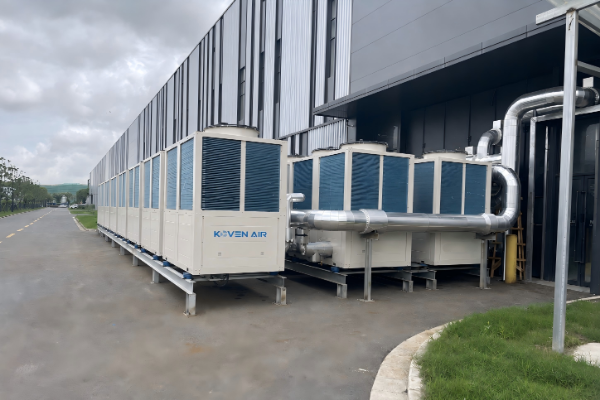
Koven Air’s 20,000 m² factory builds the cooling-only twin-screw chiller platform (AHRI-IPLV 6.8–7.8, shipped since 2007) and both 4-pipe platforms on this page on the same production line. That means the same 18 standardized production processes, 23 sheet-metal precision-machining steps, robotic modular assembly line, 400-point manufacturing traceability system, 36-point factory inspection, and 24-hour aging test, a full day-night thermal cycle on our own test bench, apply whether the unit leaving the line is cooling-only, centralized screw, or modular scroll.
SPECIFICATIONS & TRACEABILITY
On AHRI: the single-mode efficiency figures on this page (EER/COP 5.5–6.5; base-platform AHRI-IPLV 6.8–7.8) are referenced to AHRI Standard 550/590, “Performance Rating of Water-Chilling and Heat Pump Water-Heating Packages Using the Vapor Compression Cycle,” as run in our own labs, not a publicly listed AHRI Directory certificate for this specific model. Combined ICOP figures in the ledger above are a separate, Koven-internal field metric, for exactly the reason explained there: AHRI doesn’t yet define a cross-manufacturer test method for simultaneous-mode efficiency.
AHRI publishes a free public directory at ahridirectory.org — check any manufacturer’s listing there, including ours, before taking an efficiency claim at face value. That 400-point traceability system means a warranty claim traces back to the specific production batch, machining pass, and inspection record for that unit, not just a model number — the same traceability chain behind both case installations above, which have run four years without a fault affecting operations.
Multi-mode switching, cooling, heating, simultaneous, and on the modular scroll line, heat-recovery DHW, is what gives this platform its versatility, and the precise temperature control documented in both case studies above is the same reliable heating and cooling performance we’d size for your building.
CE
Conformité Européenne
ISO 9001:2015
Quality Management
ISO 14001:2015
Environmental Management
ISO 45001:2018
Occupational Health & Safety
Procurement Guide: Sizing, Lead Time & After-Sales
Koven Air’s process runs in three stages, in the company’s own words:
Pre-sale engineering verification comes first, project design review and parameter-accuracy calculation before anything ships.
In-sale commissioning follows: technical personnel provide on-site installation and debugging guidance, with modifications made as needed for actual site conditions.
After-sale, lifetime free technical service continues, problems addressed without delay during the warranty period, plus regular professional-knowledge training for engineering contractors and engineers.
After-sales reliability is the single most-discussed concern in public commentary about smaller or newer chiller manufacturers. One HVAC industry LinkedIn post put the risk directly: “Boutique chiller manufacturers may not always deliver support… Not all chillers are equal, and neither is the support behind them.” That’s a fair concern about any manufacturer newer to a given market, including us; the hospital installation’s four fault-free years and the hotel’s automatic module-isolation record above are the evidence we’d point to instead of a claim that the concern doesn’t apply.
What to Ask Before You Shortlist Any Heat Pump Chiller Supplier
schilthornprecision.com’s guide to evaluating heat exchanger component suppliers centers on three things: certifications, material expertise, and quality assurance. discountsaltpool.com publishes a pre-purchase checklist built for the same reason — “designed for potential buyers” who need “critical information about the steps, necessary preparations, and technical considerations” before committing. The U.S. Department of Energy’s Better Buildings guidance on commercial HVAC electrification recommends the same discipline: build an evaluation checklist around climate, building load profile, and equipment specifications before requesting quotes. Bring us your load profile and hydronic temperature targets and we’ll size against them.
Heat pump chiller cost depends on capacity tier, platform (centralized screw vs. modular scroll), refrigerant selection, and hydronic configuration — contact us for a quotation based on your application parameters. If this is a heat pump chiller replacement project rather than new construction, tell us the existing system’s hydronic temperatures up front; matching or upgrading an existing loop is a different scoping conversation than sizing for a new central plant.
Lead time and commissioning follow the same three-stage process regardless of project size or platform. Engineering verification happens before production scheduling is confirmed, not after, a 4-pipe unit has two hydronic circuits to check against site drawings instead of one, and catching a mismatch during pre-sale review is faster than catching it during on-site commissioning, which is exactly where the phased 60-day hotel retrofit above stayed on schedule.
Both cases above are retrofit applications, replacing an existing system rather than new construction, which is the more common inquiry we get. Either way, the goal is the same: reliable all-electric heating and cooling with lower energy use than the two-system setup it replaces.
Engineering Tools & Selectors
Technical calculators, load-overlap analysis, and comparative evaluation resources for professional HVACR engineering.
FAQ
A heat pump chiller is an HVAC system that produces chilled water and hot water from the same refrigeration circuit, either by reversing between modes with a reversing valve, or by running both simultaneously through a 4-pipe heat-recovery arrangement. Koven Air ships both a centralized twin-screw platform (200–1,500 RT) and a modular scroll platform (60–80 RT per module, up to 16 paralleled).
Refrigeration works by moving heat rather than generating it, in a 4-pipe simultaneous configuration, one heat exchanger rejects heat into a hot-water loop while the other extracts it from a chilled-water loop, at the same time, from the same compressor work.
Our two field-measured installations run 7.82 (hospital, centralized screw) and 8.5 (hotel, modular scroll) — but both numbers depend on how much your building’s heating and cooling loads actually overlap. Send us your load profile and we’ll model a number for your building rather than quoting one of these two directly.
In practice, yes — “heat pump chiller” and “heat recovery chiller” describe the same simultaneous-heating-and-cooling equipment category; vendors and engineers use both terms depending on region and background. Reversible-cycle (one mode at a time) vs. full 4-pipe heat recovery (both at once) is the distinguishing engineering question, not which of the two names is used.
Advantage: one unit replaces a chiller-plus-boiler (or 2-pipe-plus-electric-DHW) pair when loads genuinely overlap, our two documented installations show 41–50% total operating-cost reduction and 3.2–5 year payback. Disadvantage: that benefit depend on real load coincidence, a building where heating and cooling demand rarely overlaps won’t see the same numbers, which is why we size against your load profile rather than a flat figure.
Yes, this is a real question engineers raise on HVAC forums, and the answer is that a central heat pump chiller can feed an existing hydronic loop provided the existing system’s heating-temperature requirements are evaluated against the unit’s condenser design range first. That evaluation is a standard part of our pre-sale engineering verification step, not an afterthought.
Most of that discussion centers on capacity range, compressor type, and manufacturing traceability, the same three things this page leads with. We publish the platform table, the 400-point traceability system, and two real field-measured ICOP numbers precisely because those are the questions engineers say they can’t get straight answers to from newer suppliers.
It depends on simultaneous heating and cooling load, not just peak cooling load, send us your building’s load profile and we’ll recommend a capacity tier and platform (centralized or modular) rather than defaulting to the largest unit on the chart.
When heating and cooling loads overlap, hospitals, hotels, schools, a single unit avoid the capital cost of a second system and recovers heat a cooling-only chiller would otherwise reject to atmosphere. Trane’s own product webinar confirms supplemental boilers aren’t always required once that overlap exists, and our hospital case above has run without a boiler for four years on exactly that basis.