Get in Touch with Koven Air Company

Quick Specs
| Capacity range | 19 – 2,200 RT |
| Compressor technologies | 5 — scroll, screw, centrifugal, absorption, magnetic bearing |
| Heat-rejection paths | Air-cooled, water-cooled, evaporative |
| Common refrigerants | R-32, R-134a, R-410A (subject to EPA AIM Act phase-down schedule) |
| Typical design life | 15 – 20 years (compressor-type dependent) |
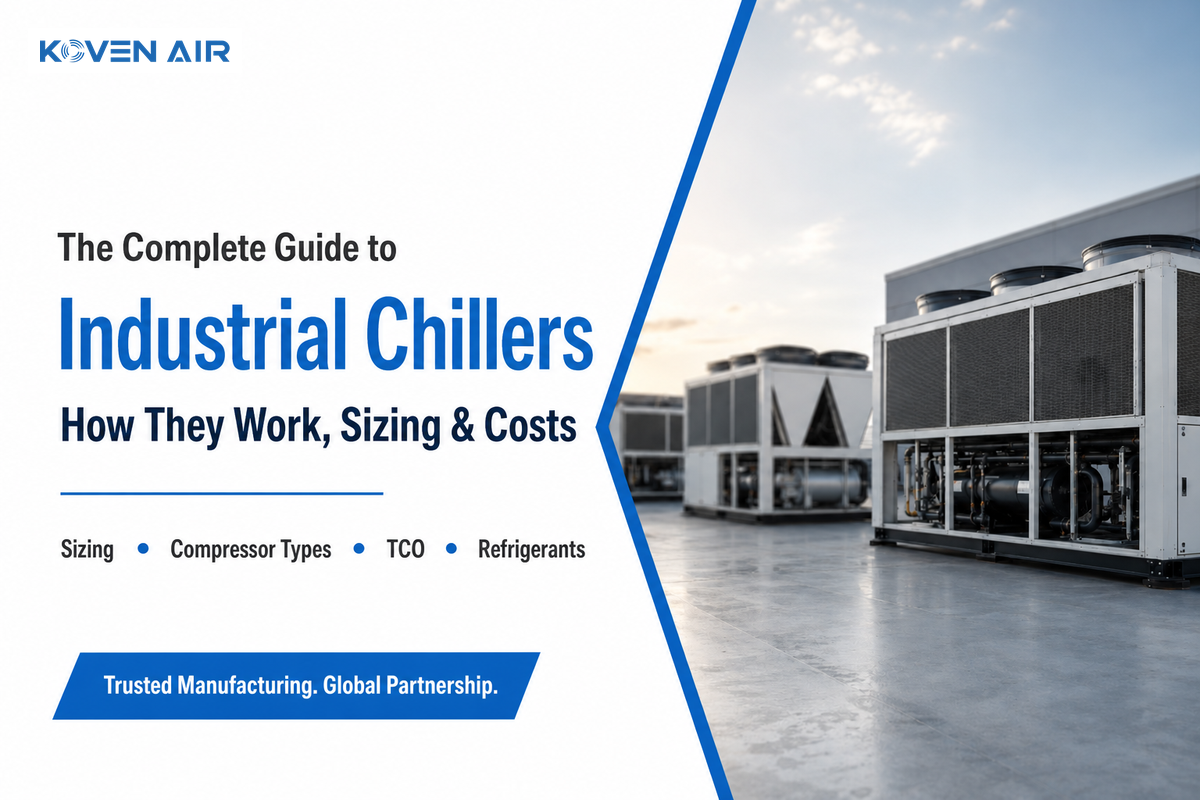
An industrial chiller is a dedicated cooling system that removes heat from a manufacturing process, machine, or facility by circulating a chilled fluid, commonly process water or a water-glycol mixture, through a vapor-compression or absorption cycle, unlike comfort HVAC, it’s built around a specific process load, not room air.
Industrial chillers are essential to keeping production lines, data halls, and process equipment inside a temperature band that ordinary building air conditioning was never designed to hold. If your facility uses process fluids, heat-generating machinery, or racks of switching electronics, the industrial chiller system sitting outside, not the rooftop AC unit, is what actually protects your uptime, delivering the chiller cooling a comfort-AC unit was never built to provide. This guide walks through how the equipment works, the main industrial chiller types and how their five compressor technologies differ, how to size and evaluate one, and what changes are coming to the refrigerant inside it.
Key Takeaways
- Being marketed as one of the “energy efficient chillers” on the market doesn’t mean much on its own, a high COP number alone doesn’t predict your real energy bill, a 2025 peer-reviewed study found that IPLV/NPLV part-load ratings, built for cross-vendor comparison, “don’t always reflect” actual field performance across climates.
- EPA’s AIM Act refrigerant rules are still moving: a May 2026 reconsideration rule specifically addresses industrial process refrigeration and chillers used in semiconductor manufacturing, the 2023 rule wasn’t the final word.
- Service life varies more by compressor technology and maintenance discipline than by brand: ASHRAE’s own equipment database shows centrifugal chillers averaging 17.6 years across 209 units still in service, with a 25.2-year mean among the 30 units actually replaced, and other compressor types spread even wider.
- Across the five main types of industrial chillers, capacity spans roughly 19–2,200 RT, there’s no single “best” chiller, only a best fit for your duty cycle.
- A correctly sized chiller is math you can check yourself before calling a vendor: Tons = GPM × ΔT ÷ 24.
What Is an Industrial Chiller, and How Does the Cooling Cycle Actually Work?
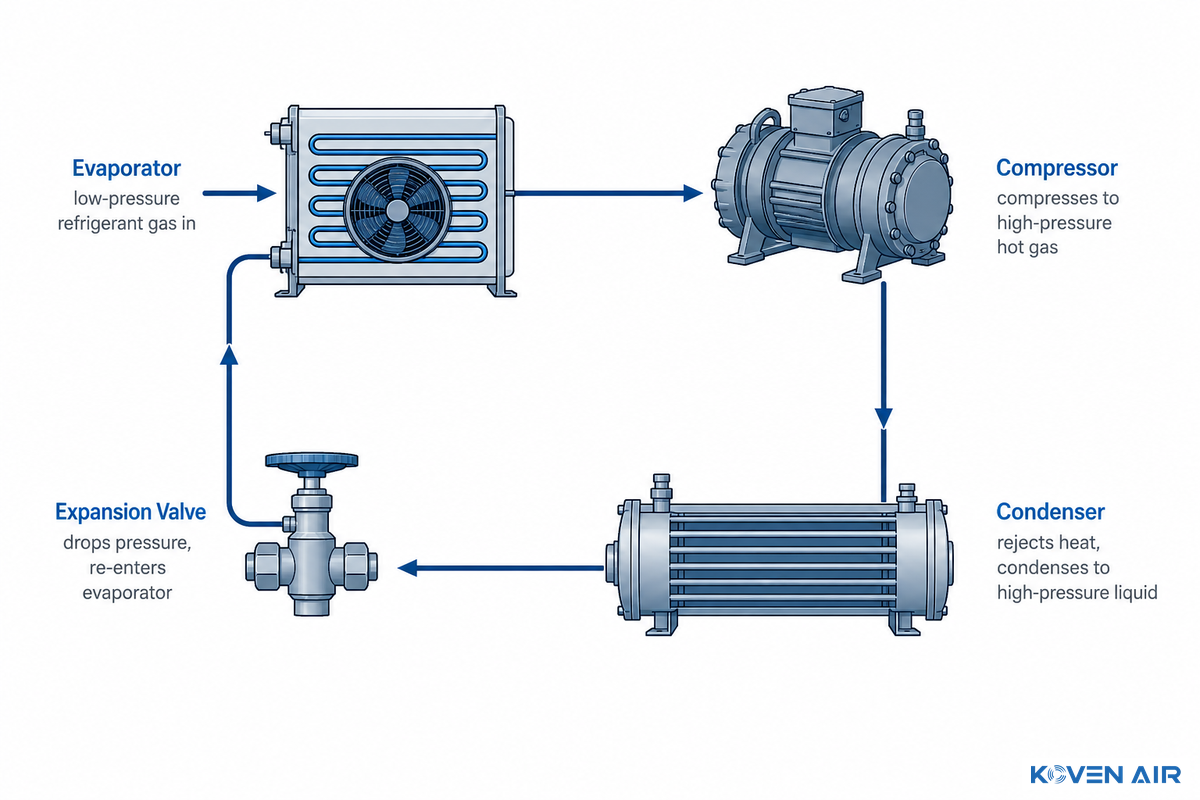
An industrial chiller, often called an industrial process chiller or, when water is the circulating fluid, an industrial water chiller, removes heat from a process, machine, or facility by continuously circulating a chilled fluid, almost always water or a water-glycol mixture, and rejecting that absorbed heat somewhere else.
A 2024 peer-reviewed case study hosted by the U.S. National Institutes of Health describes exactly this mechanism in an industrial adsorption-chiller application: heat is picked up at the process, carried by the circulating fluid, and dumped at the condenser, cycle after cycle, for as long as the equipment runs (PMC, 2024 case study).
Most industrial chillers use a vapor compression chiller design, following a closed-loop industrial working principle that cycles through four core components of industrial chillers:
- 1. Evaporatorprocess fluid enters, and heat from the process boils the low-pressure liquid refrigerant into a gas.
- 2. Compressorthe low-pressure gas is compressed into a high-pressure, high-temperature gas.
- 3. Condenserambient air or condenser water strips the heat from the high-pressure gas, turning it back into a liquid.
- 4. Expansion valvethe high-pressure liquid drops back to low pressure and re-enters the evaporator, ready to absorb heat again.
This is the WHAT. The WHY matters just as much: a facility can’t simply run process fluid through a standard comfort-HVAC unit, because that equipment is sized and controlled around room air temperature and human comfort setpoints (68–75°F), not the tighter, continuous, often lower temperature bands an industrial process demands. Comfort-HVAC systems and industrial chillers both transfer heat away from a space, but only the chiller is built to hold a process-specific setpoint across continuous industrial applications and varying cooling needs, not just room comfort. The SO WHAT for a buyer: any chiller you evaluate should be spec’d against your process fluid temperature and flow rate, not against a nameplate tonnage borrowed from a comfort-cooling job.
Chillers built this way commonly run 15 to 20 years with regular maintenance, though as later sections show, the compressor technology inside changes that range meaningfully.
💡 Pro Tip
Engineers occasionally note ongoing patent activity in this space as evidence the fundamentals are still being refined — for example, U.S. Patent 7,086,240 addresses measuring and controlling key parameters in an industrial chiller installation, and U.S. Patent 20130269376 covers evaporator heat-exchanger optimization for refrigeration systems (USPTO / Google Patents). These are illustrative of continued engineering investment in the category, not endorsements of any specific product.
Want to see the full range of industrial chillers available today, factory-built across five technologies? Koven Air’s full industrial chiller lineup spans 19–2,200 RT across the same compressor technologies covered in this guide.
Air-Cooled vs. Water-Cooled Chillers: The Fundamental Trade-Off
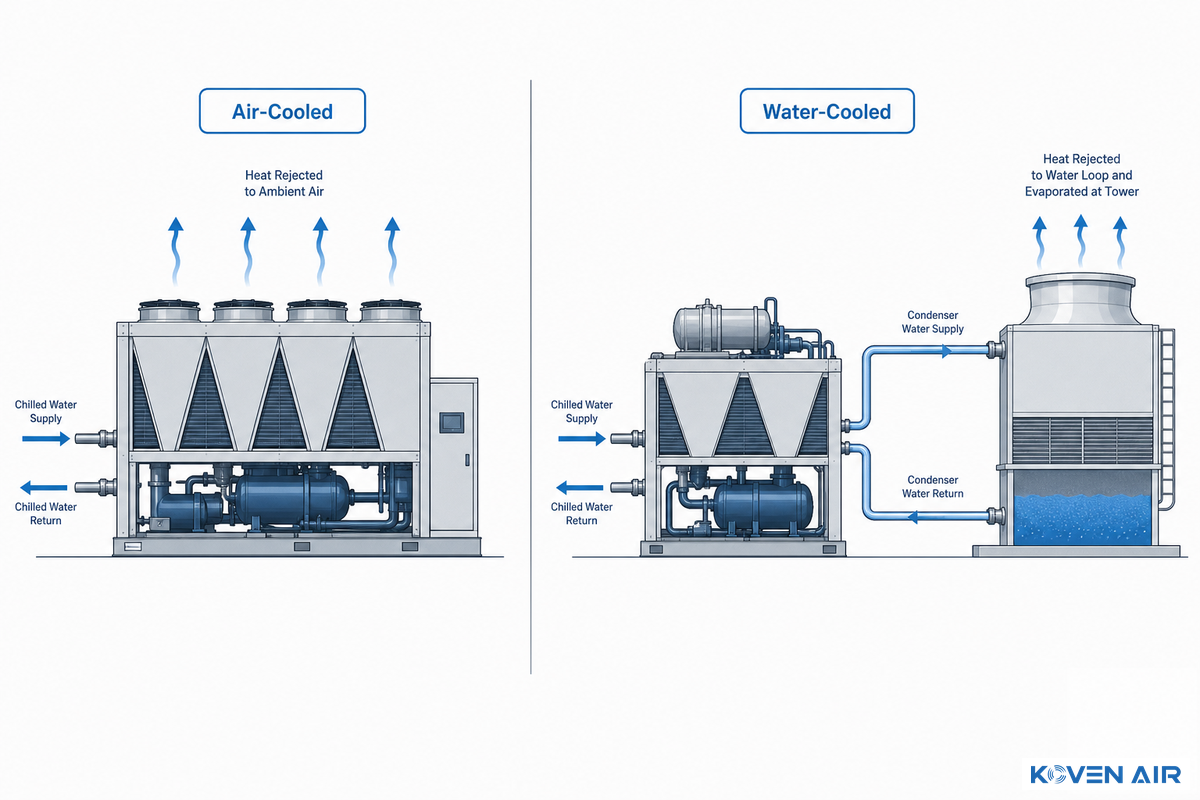
Every industrial chiller rejects heat one of two ways, to ambient air, or to a separate water loop and cooling tower, and that single decision shapes footprint, water consumption, maintenance load, and climate sensitivity for the life of the equipment. Facilities managers comparing options against existing rooftop HVAC systems should note that air-cooled chillers are the closer relative of that equipment (no external water loop), while water-cooled units, commonly sold as industrial water chillers, behave more like a central utility plant.
| Factor | Air-Cooled | Water-Cooled |
|---|---|---|
| Extra equipment needed | None — stand-alone unit | Cooling tower + condenser water loop |
| Continual water source required | No | Yes, plus water treatment |
| Footprint at large capacity | Larger (condenser + fans) | Smaller machine room, plus tower footprint |
| Climate sensitivity | Efficiency drops as ambient climbs past roughly 95°F | Wet-bulb dependent, less ambient-sensitive |
| Typical fit | Water-restricted or space-constrained sites | Large continuous loads, water available |
✔ Advantages
- Air-cooled: no cooling tower, no water treatment program, faster install
- Water-cooled: generally better efficiency at large tonnage, smaller machine-room footprint
⚠ Limitations
- Air-cooled: larger footprint, efficiency falls as ambient temperature climbs
- Water-cooled: needs a continual water source, a water tank, water treatment, and tower maintenance
Water-cooled systems carry a tradeoff beyond footprint that data-center buyers in particular should weigh: cooling towers reject heat by evaporating cooling water, so by design they consume significant water, and Lawrence Berkeley National Laboratory notes that fewer than one in three U.S. data center owners and operators currently measure and track that water consumption at all (LBNL, Data Center Water Efficiency). Where water scarcity or utility cost is a site constraint, that consumption, not just electrical efficiency, belongs in the air-cooled vs. water-cooled decision, since water-cooled chillers use water continuously for as long as they run.
There’s also a third heat-rejection path worth knowing: evaporative chillers use the evaporative cooling effect of water on air to reject heat with a smaller water draw than a full cooling-tower loop, sitting between the two options above on both water use and footprint.
A pitfall that rarely shows up in vendor literature: engineers discussing chilled-water plant design on r/BuildingAutomation consistently flag the primary/secondary piping crossover, the point where the chiller’s own flow loop meets the building’s distribution loop, as the area most likely to suffer from poor mechanical design, more so than the chiller selection itself. Get that crossover design wrong and even a correctly sized water-cooled chiller will underperform.
Key Takeaway: Choose water-cooled when you have a reliable water source and continuous large loads; choose air-cooled when water access, space for a tower, or water-treatment overhead are the binding constraints — and get the piping crossover design reviewed regardless of which path you pick.
Choosing a Chiller Compressor Technology: Scroll, Screw, Centrifugal, Absorption, or Magnetic Bearing
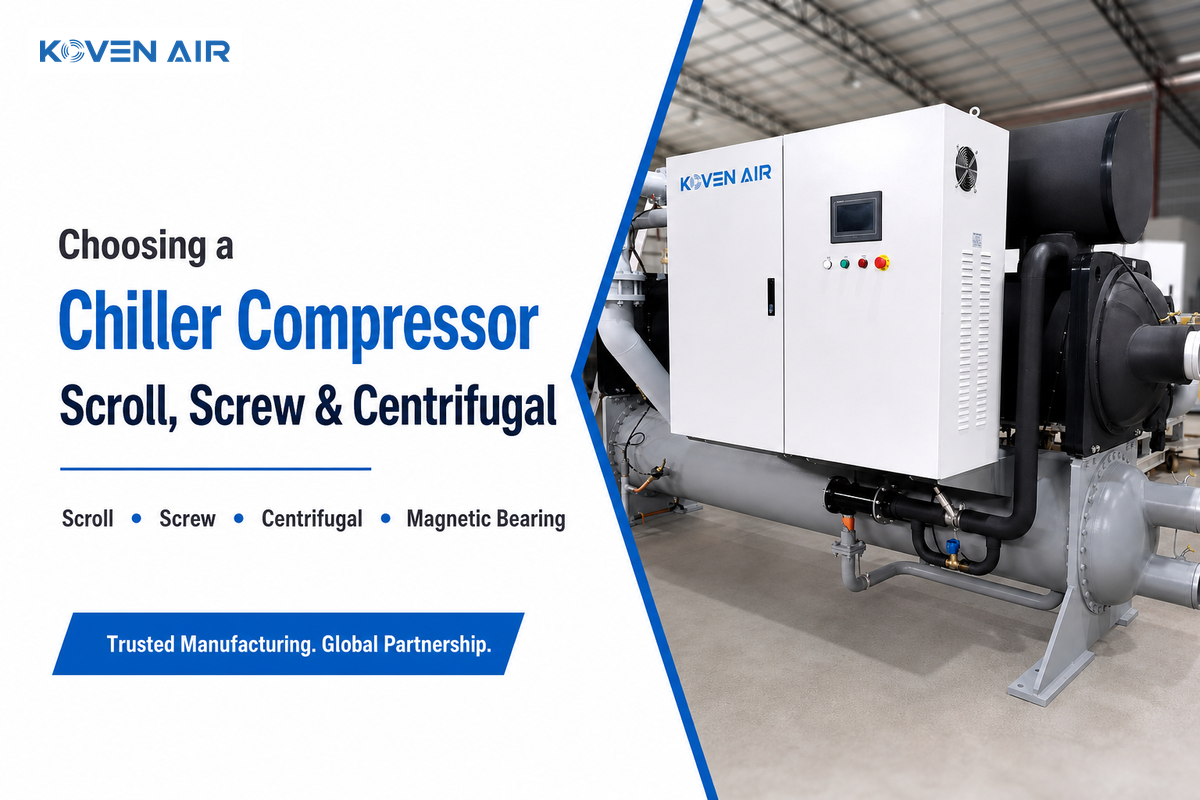
Compressor type, not brand, is the single biggest driver of how different types of chillers perform in industrial settings across your actual duty cycle, from scroll chillers up to magnetic-bearing units, not just at the single full-load rating point on its spec sheet.
5-Technology Cooling Ladder for Compressor Selection
A ranked reference matching compressor type to duty cycle, comparing all five industrial chiller compressor technologies by typical capacity, oil dependence, and part-load behavior. Use it to shortlist a technology before requesting quotes.
| Compressor Type / Attribute | Scroll | Screw | Centrifugal | Absorption | Magnetic Bearing |
|---|---|---|---|---|---|
| Typical capacity | 2–140 tons | 30–400+ tons | 150–6,000 tons | Site-sized, heat-source dependent | Overlaps centrifugal range |
| Oil-free | No | No | No | No compressor | Yes |
| Part-load behavior | Stages in steps | Slide-valve modulation | Strong at partial load with VFD | Tracks available heat source | Strongest across wide part-load range |
| Relative first cost | Lowest | Low-to-mid | Mid-to-high | High (site-built) | Highest |
| Noise profile | Low | Moderate | Moderate-high | Low (no compressor) | Lowest (frictionless) |
| Typical maintenance driver | Simple, few moving parts | Oil system service | Bearing + oil service | Solution chemistry management | No oil system to service |
| Best-fit duty cycle | Single equipment, intermittent | Continuous, 24/7 industrial | Large continuous central plant | Available waste heat/steam | Highly variable part-load |
| Typical application | Laser/water-jet cutting, small process loops | Plastics, food & beverage, general industrial | Large campuses, central utility plants | Chemical/petrochemical waste-heat recovery | Data centers, hospitals, labs |
| Requires cooling tower? | Air- or water-cooled variants exist | Air- or water-cooled variants exist | Usually water-cooled | Usually water-cooled | Air- or water-cooled variants exist |
Key Factors to Consider
- If your process runs near-constant load 24/7, a screw chiller is usually the strongest fit, because slide-valve modulation was built for sustained duty, not for chasing a fast-changing load.
- If your load swings widely through the day, common in data centers and hospitals, a magnetic bearing chiller is usually the strongest fit, because its oil-free, frictionless design holds efficiency across a much wider part-load range than a fixed-speed screw or scroll unit.
- If you already have low-grade waste heat or steam on site, an absorption chiller is worth pricing before anything electric-compressor-driven, because it converts an existing cost (heat you’re already paying to generate) into cooling capacity.
Compressor and heat-exchanger design in this category is still actively evolving at the engineering level, see, for example, US Patent 20130269376, which addresses evaporator heat-exchanger optimization for refrigeration systems. One field observation worth carrying into any compressor conversation: engineers on r/HVAC note that “the best chiller mechanics are those who work for the manufacturers” — a reminder that compressor selection and manufacturer support quality are linked decisions, not separate ones. The next major H2 in this guide covers exactly how to evaluate that support layer.
Sizing an Industrial Chiller: From Cooling Load to Tonnage
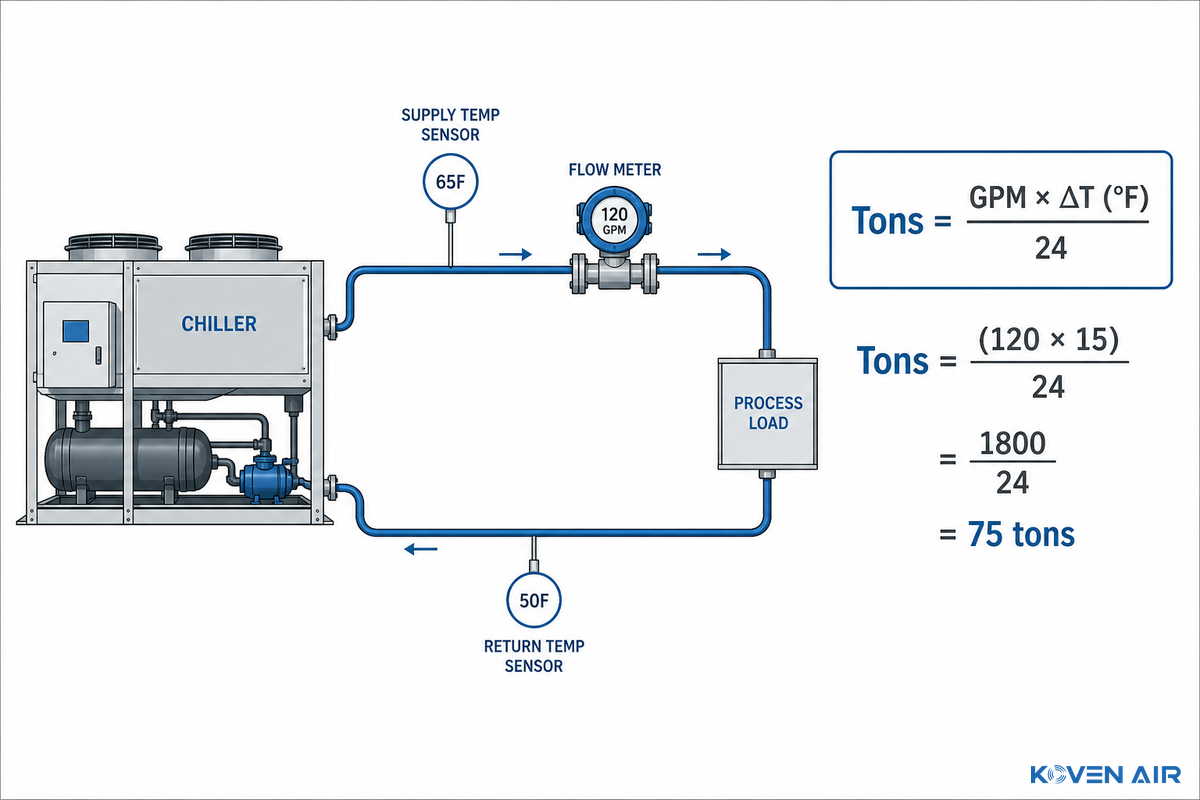
Chiller sizing is the one step in this guide you can check yourself with a calculator before a vendor ever gets involved, the underlying formula is simple, but it’s worth doing correctly, because both undersizing (inadequate cooling, nuisance trips) and oversizing (wasted capital, inefficient part-load operation) carry real costs.
📐 Engineering Note
For a water-based process fluid, tonnage is calculated as: Tons = (GPM × ΔT°F) ÷ 24, where GPM is the flow rate in gallons per minute and ΔT is the temperature drop across the process (supply minus return, in °F). This is mathematically the same relationship some vendor sites present as “500 × GPM × ΔT” to get BTU/hr, then divided by 12,000 BTU/hr-per-ton to reach tons, the two forms are equivalent, but the full BTU/hr-to-ton conversion is frequently left out of published versions of this formula, which silently returns BTU/hr instead of tons.
Worked example: A process needs 120 GPM of chilled water cooled from 65°F to 50°F (a 15°F ΔT). Tons = (120 × 15) ÷ 24 = 75 tons. A buyer would then commonly add a 10–20% safety margin for future load growth before selecting a model, landing in the 82.5–90 ton range for this example.
Beyond the tonnage math, three inputs determine whether that number is even the right number to be solving for: the actual supply/return temperature your process needs (not a generic “chilled water” assumption), the true flow rate under real operating conditions, and a realistic look at whether your load will grow. Skipping the growth-margin step is a common, avoidable mistake, and one that’s cheaper to fix on paper than by adding a second chiller two years later. The U.S. Department of Energy’s Federal Energy Management Program frames this the same way for federal buyers: right-sizing against actual, verified load data is treated as a purchasing-guidance fundamental, not an optional refinement (DOE FEMP).
Ready to verify your own numbers? Koven Air’s chiller sizing calculator runs this same math against your specific inputs.
Matching the Chiller to the Application: Data Centers, Process Cooling, and Beyond
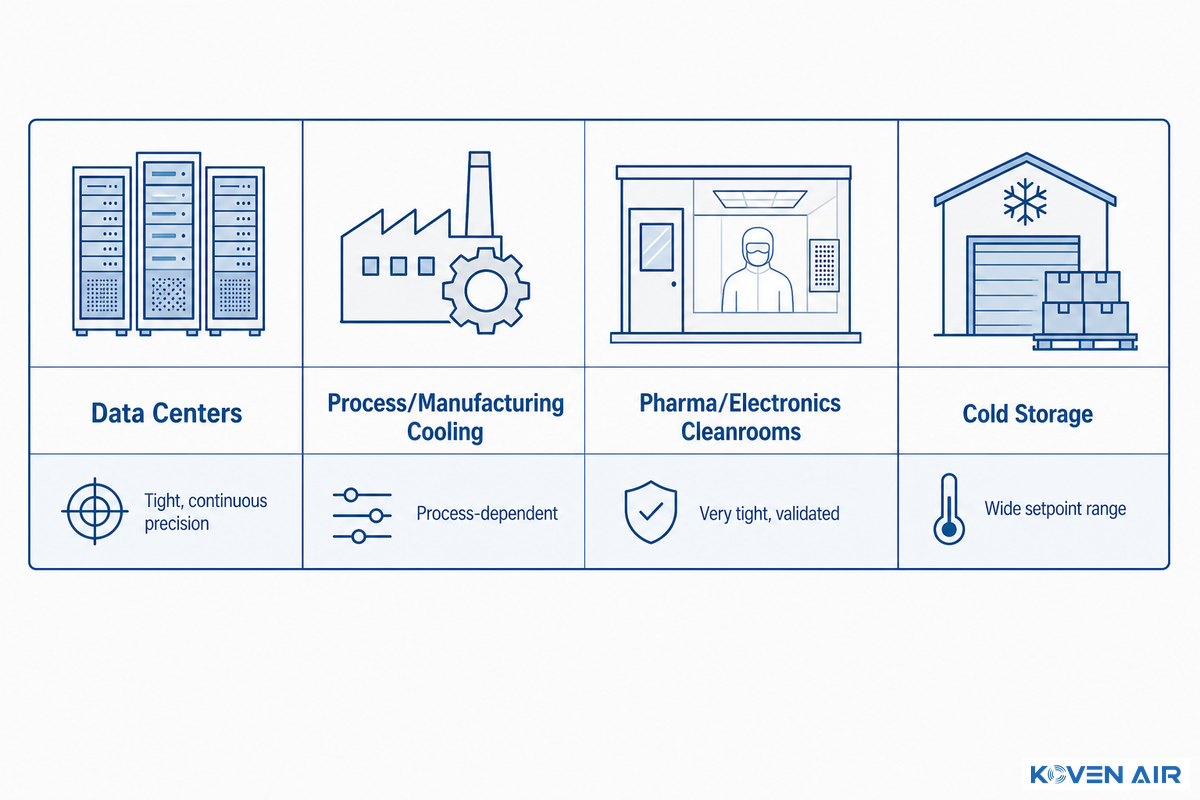
Chiller selection for industrial cooling doesn’t stop at compressor type, every application needs to cool equipment differently, and duty cycle, redundancy, and temperature precision are requirements no generic spec sheet captures.
| Application | Typical redundancy | Temperature precision |
|---|---|---|
| Data centers | N+1 or 2N common | Tight, continuous |
| Process/manufacturing cooling | Process-dependent | Often ±1°F |
| Pharma/electronics cleanrooms | High, regulatory-driven | Very tight, validated |
| Cold storage | Moderate | Wide setpoint range, sustained |
| HVAC comfort cooling | Low-to-moderate | Loose, comfort band |
The 2025 U.S. Department of Energy ARPA-E presentation on data center cooling frames the driver plainly: increased compute workload increases heat dissipation and rack temperatures, and high temperatures cause both equipment failure and reduced performance (ARPA-E, 2025). That’s WHY data centers lean toward the redundancy and part-load efficiency of magnetic-bearing chillers rather than a single large centrifugal unit.
Koven Air’s own product-application record spans hospitals, business centers, industrial parks, office buildings, mushroom farms, granaries, gymnasiums, libraries, airlines, fabric manufacturers, machinery manufacturers, lithium battery plants, electronics companies, car plants, semiconductor companies, subways, high-speed trains, airports, schools, and data centers, a genuinely wide span that includes both classic HVAC comfort load and industrial process/data-center cooling load, rather than a single narrow vertical.
For facilities that need simultaneous heating and cooling, common in food processing and some pharma operations, a 4-pipe heat pump chiller can deliver both from one plant footprint instead of running separate boiler and chiller systems. And for data centers or campuses growing in phases, modular chillers let capacity scale in steps rather than forcing an early, oversized single-unit purchase, a flexibility increasingly common among chillers for industrial applications with phased growth plans.
Reading the Spec Sheet: COP, IPLV, and the Standards That Actually Matter for a Chiller
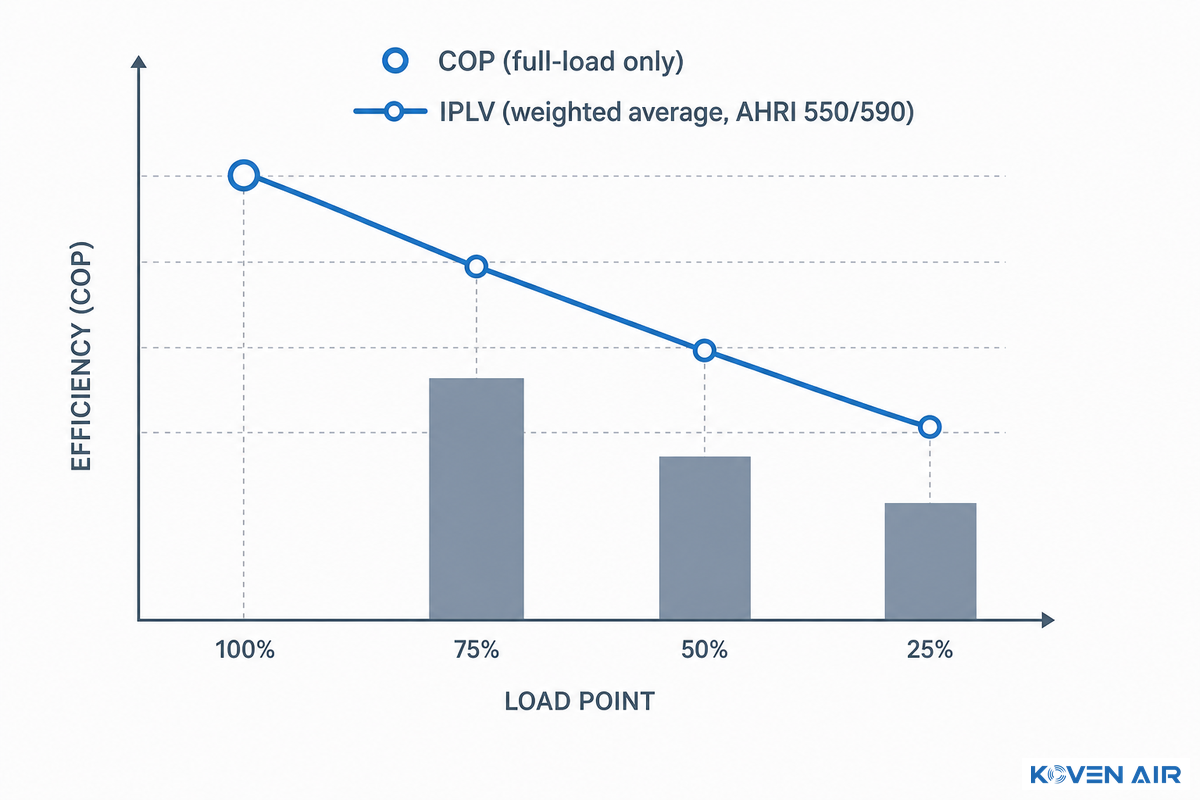
Two chillers can share the same full-load COP and perform very differently over a real year of operation, because COP only measures one operating point, and almost no chiller runs at 100% load all the time.
| Metric | What it measures | When it is most useful |
|---|---|---|
| COP (Coefficient of Performance) | Efficiency at one full-load rating point | Peak-load design conditions |
| IPLV / NPLV | Weighted-average efficiency across part-load points | Cross-vendor comparison at typical, non-peak operation |
Both metrics are certified under AHRI Standard 550/590 (I-P) — most recently published as the 2023 (I-P) edition, with AHRI’s companion SI edition (551/591) further updated in 2026, which governs performance rating of water-chilling and heat-pump water-heating packages using the vapor-compression cycle (AHRI). AHRI certification explicitly covers both full-load and part-load performance metrics, not just the headline COP number (HVAC Resource Map) — AHRI’s own certified operating map spans 100% down to 25% of rated full-load capacity, the same four load points (100%, 75%, 50%, and 25%) that the IPLV weighting is built from.
Here’s where the standardized nature of IPLV becomes a genuine limitation, not just a technicality: a 2025 peer-reviewed study evaluating seasonal chiller performance against real operational data found that “the weighting in IPLV and NPLV emphasizes universality, thus they don’t always reflect” actual field performance across different units and climates. In plain terms, IPLV was built to let you compare Vendor A against Vendor B on a level playing field, using four fixed, standardized test conditions. It was never built to simulate your specific site’s climate, load profile, or operating schedule. A chiller with a lower published IPLV can still outperform a higher-IPLV competitor at your actual site, depending on how closely your real load profile matches the standard’s four test points.
Key Takeaway: Use COP to check peak-day performance and IPLV to shortlist vendors — but treat IPLV as a standardized comparison tool, not a forecast of your actual annual energy bill, and ask any vendor for load-profile-specific performance data if your operating pattern is unusual.
The Refrigerant Transition: What’s Changing and Why It Affects Your Next Chiller Purchase
No competitor content in this space currently walks buyers through the regulatory timeline behind the refrigerant inside a new chiller, which is a real gap, because that timeline is actively moving and directly affects a piece of equipment expected to run for 15-plus years.
Under the American Innovation and Manufacturing (AIM) Act, the U.S. EPA finalized a Technology Transitions rule in October 2023 restricting the use of higher-global-warming-potential (GWP) HFC refrigerants across aerosols, foams, and refrigeration/air-conditioning/heat-pump equipment. Beginning January 1, 2025, certain technologies were required to restrict use of higher-GWP HFCs or HFC blends, though compliance deadlines and GWP limits vary by sector and subsector, not a single flat rule for all equipment (EPA, Regulatory Actions for Technology Transitions).
That rule isn’t static. In May 2026, EPA finalized a reconsideration rule addressing petitions from companies and trade associations across several subsectors, explicitly including industrial process refrigeration and chillers used in semiconductor manufacturing, alongside refrigerated transport, retail food refrigeration, cold storage warehouses, and residential/light-commercial air conditioning and heat pump systems (EPA, May 2026 rule summary; Federal Register, May 26, 2026). EPA’s own enforcement statement from December 2025 adds a practical nuance: while the agency intends to extend compliance dates through this reconsideration, the original deadlines remain technically effective until formally modified, and enforcement of those original deadlines is currently a “low enforcement priority” while the reconsideration proceeds.
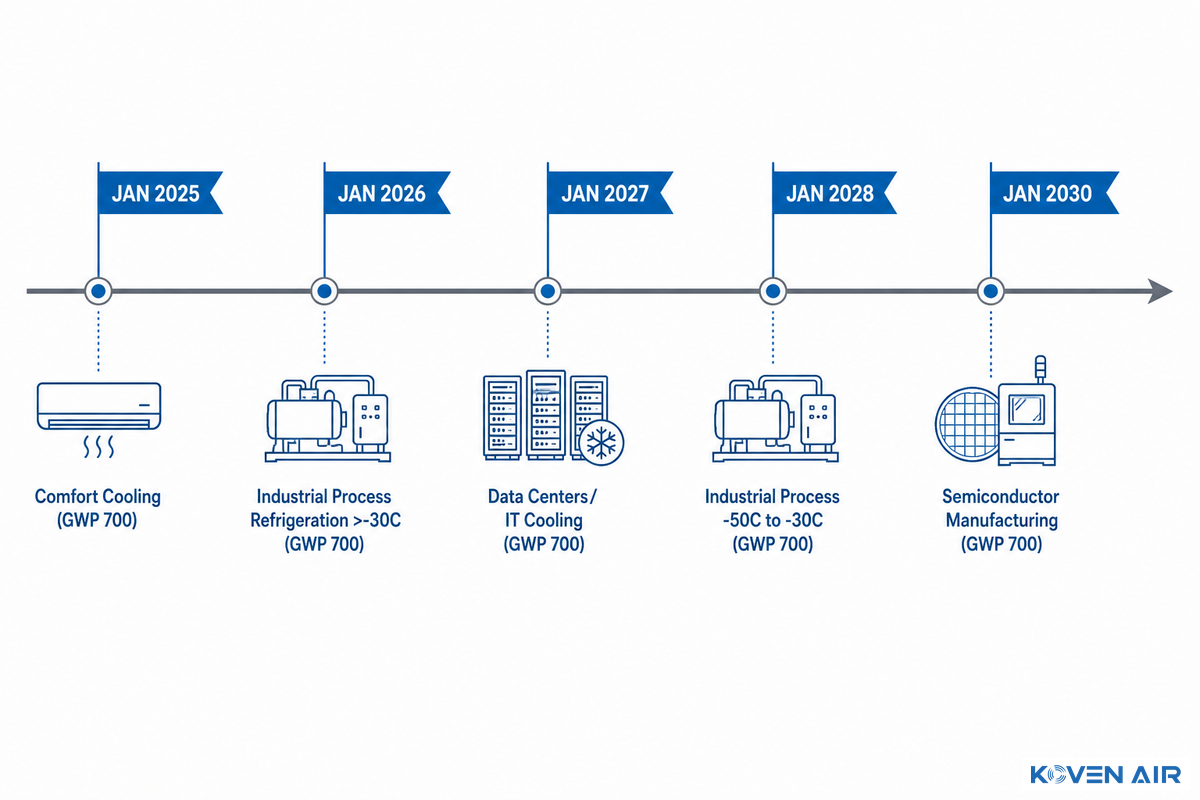
EPA’s own sector-by-sector restriction table — codified at 40 CFR 84.54 — gives the exact numbers that apply to chillers specifically — not a single flat rule, but five distinct compliance dates depending on application:
| Chiller application | GWP limit | Installation compliance date |
|---|---|---|
| Comfort cooling | 700 | January 1, 2025 |
| Industrial process refrigeration, exiting fluid warmer than −30°C | 700 | January 1, 2026 |
| Data centers, computer room AC, IT equipment cooling | 700 | January 1, 2027 |
| Industrial process refrigeration, −50°C to −30°C | 700 | January 1, 2028 |
| Semiconductor manufacturing equipment (≤100 lb charge, ≥−50°C) | 700 | January 1, 2030 |
Notice the pattern: a data center chiller and a semiconductor-fab process chiller face different compliance clocks than a comfort-cooling chiller, even though all three carry the same 700 GWP limit, which is exactly why the install date on your project timeline matters as much as the GWP number itself (EPA, Technology Transitions HFC Restrictions by Sector).
Zoomed out, the AIM Act’s statutory target, confirmed on EPA’s own program page and summarized by Hunton Andrews Kurthis a phase-down of HFCs to 15% of their historic baseline levels by 2036, a long runway, but one that will keep producing sector-specific rule changes like the May 2026 update along the way.
One scope note: this guide covers HFC/HFO-refrigerant vapor-compression and absorption chillers. Ammonia (anhydrous) industrial refrigeration systems, sometimes used in cold storage and food-processing applications, fall under a separate regulatory track (OSHA Process Safety Management at 29 CFR 1910.119 above a 10,000 lb threshold, plus ANSI/ASHRAE 15) that this guide does not cover; if ammonia is on your shortlist, that compliance conversation happens with a refrigeration safety specialist, not through the AIM Act framework above.
The practical takeaway for a buyer isn’t “refrigerants are frozen where they’re” — it’s that the compliance timeline itself is actively moving. A chiller purchased today should keep refrigerant flexibility in mind: ask your manufacturer directly whether the unit supports a lower-GWP refrigerant option (such as R-32) and what an upgrade or retrofit path looks like if your specific subsector’s compliance date shifts again. Check Koven Air’s refrigerant compliance checker against your target install date before finalizing a spec.
Evaluating a Chiller Manufacturer: What to Verify Before You Sign a PO
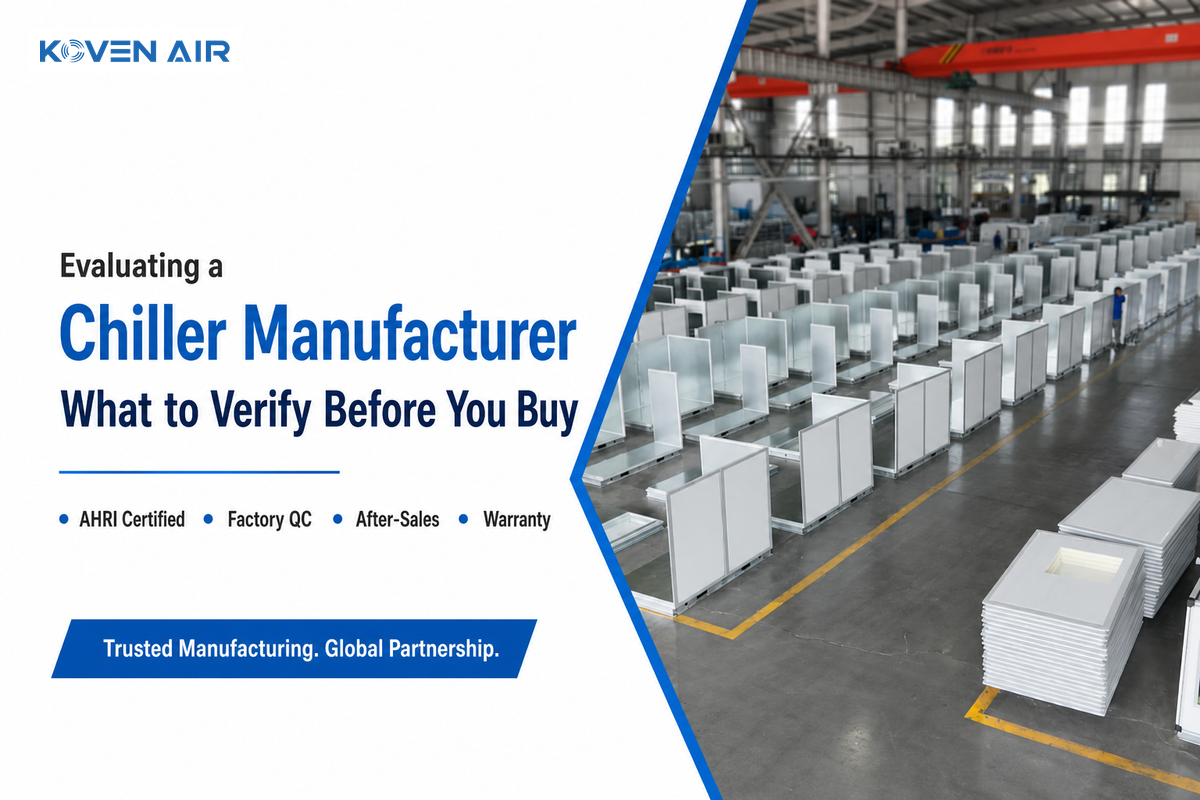
None of the industrial chiller manufacturers’ content we reviewed while researching this guide offers buyers a portable framework for vetting quality control before placing an order, every site we checked leads with its own product specs and a “why choose us” pitch, not a checklist a buyer could apply to any vendor. That gap is exactly what a real forum complaint illustrates: one buyer on r/chillers described a new chiller developing constant moisture issues within a month of installation, and reported that the OEM “blew off” the request for support until the warranty period had expired, a genuine, avoidable failure of after-sales accountability, not a design defect.
36-Point Verification Checklist for Chiller Manufacturers
This is what a real QC process looks like: a buyer-usable framework, built from Koven Air’s own audited production data, for verifying that a manufacturer’s quality-control process is real, not marketing copy. Apply it to any vendor you evaluate, not just the one that supplied the numbers.
Ask any manufacturer for hard numbers across these three stages, the same way Koven Air documents its own process across a 20,000 m² production facility:
- ✔ Production process count: How many standardized production steps does the assembly line follow? (Koven Air: 18)
- ✔ Precision machining steps: How many distinct sheet-metal precision machining processes are involved? (Koven Air: 23)
- ✔ Assembly method: Is final assembly manual, or does it run on an intelligent-robot modular assembly line with repeatable tolerances?
- ✔ Traceability points: How many manufacturing-process trace points follow each individual order? (Koven Air: 400)
- ✔ Factory inspections before shipment: How many discrete inspection checkpoints occur before a unit leaves the factory? (Koven Air: 36)
- ✔ Aging test duration: Does every unit run a burn-in/aging test before shipment, and for how long? (Koven Air: 24 hours, all units)
- ✔ Dedicated test lab: Does the manufacturer operate a dedicated chiller/heat-pump testing laboratory, or rely on field commissioning to catch problems?
- ✔ Independent certification: Is the specific model listed in the AHRI Certified Product Directory? AHRI’s WCCL program requires witness or in-house testing against AHRI 550/590 before a manufacturer’s published capacity, efficiency, and IPLV/NPLV numbers can carry the AHRI Certified mark, a third-party check on the spec sheet, not just a self-reported number (AHRI WCCL Certification Program).
- ✔ Controls and connectivity: If the chiller’s controls will connect to a building network or remote-monitoring platform, ask how that connection is secured, networked HVAC controls are an increasingly recognized attack surface, and this question is worth asking before installation, not after an incident.
- ✔ Pre-sales verification: Does the manufacturer independently verify your load data, water temperatures, and site conditions before confirming a model, or just accept your spec sheet as submitted?
- ✔ Post-warranty support commitment: What happens to your support ticket the day after the warranty expires? Get this in writing before you order, it’s exactly where the r/chillers complaint above went wrong.
“After pulling to 350 [microns] on a new chiller, the oil and refrigerant sight glass changed color within a month. The OEM blew off the customer until the warranty ran out.”
Koven Air structures its own support commitment around three stages precisely to close the gap the complaint above describes: pre-sales (independent verification of load data, water temperatures, condenser conditions, and site conditions before confirming a model), in-sales (on-site installation and debugging guidance, with on-site modification as needed after production and testing are complete), and after-sales (lifetime free technical service, prompt in-warranty issue resolution, and regular technical training for contractors and engineers) — a commitment that doesn’t have a post-warranty expiration date. Independent measurement matters here too: USPTO-documented methods for measuring and controlling chiller parameters exist precisely because self-reported performance claims benefit from third-party verification, the same logic behind checking a manufacturer’s AHRI certification status above.
Cost and Total Cost of Ownership: What an Industrial Chiller Really Costs
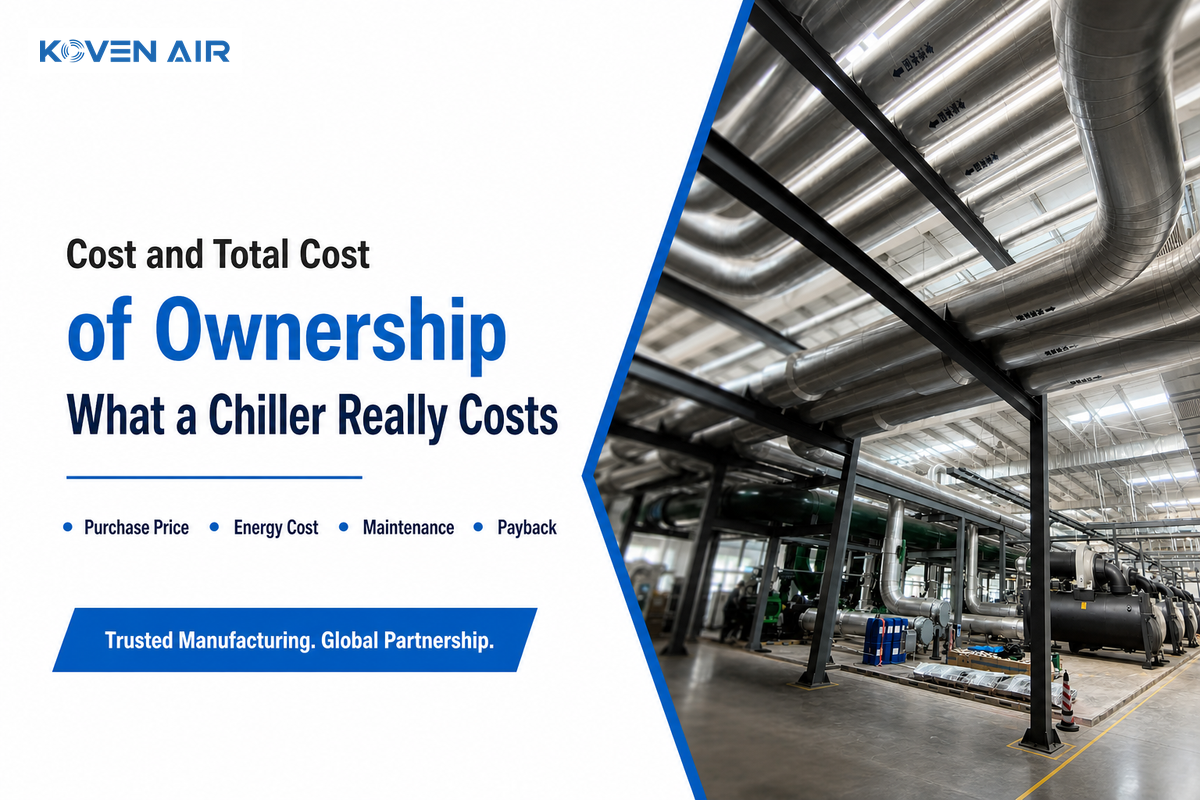
Purchase price is the number every buyer asks about first, and the number that matters least over a 15-to-20-year service life. The U.S. Department of Energy’s Federal Energy Management Program frames chiller purchasing the same way for federal buyers: total lifecycle cost, not sticker price, is the correct basis for comparing options (DOE FEMP, Purchasing Energy-Efficient Electric Chillers).
| Cost driver | Effect on purchase price |
|---|---|
| Capacity (tonnage) | Largest single driver |
| Compressor technology | Magnetic bearing > centrifugal > screw > scroll, typically |
| Redundancy configuration | N+1 or 2N adds significant cost over N |
| Controls sophistication | Remote monitoring, central control add cost |
| Testing/documentation scope | Factory witness testing, extended aging tests add cost |
Published purchase-price ranges for industrial chillers commonly cite roughly $5,000 for a small portable unit up to well over $100,000 for a large custom-built system, but this figure appears unsourced across the general market content we reviewed, so treat it as a directional starting point, not a quote, always request a project-specific number rather than pricing generic chiller solutions against your actual load and redundancy requirements.
3-Year Break-Even Rule for Premium-Efficiency Chillers
When does a premium-efficiency chiller pay for itself? A simple framework for deciding whether the higher first cost of a magnetic-bearing or premium-efficiency chiller is justified by its energy savings, or whether a lower-cost technology is the better financial choice.
Key Factors to Consider
- Estimate the premium: (magnetic-bearing or high-efficiency unit price) − (standard-efficiency unit price for the same capacity).
- Estimate the annual energy savings using your local electricity rate and your actual expected part-load profile, not the published IPLV alone, given the field-performance caveat covered earlier in this guide.
- Divide the premium by the annual savings to get a payback period in years. If your facility’s cooling load runs highly variable (data center, hospital, multi-shift manufacturing), a 3-year-or-faster payback on the premium is common enough to make the higher first cost the financially better choice, because those load profiles are exactly where magnetic-bearing part-load efficiency compounds fastest. If your load is closer to constant (24/7 near-full-load process cooling), the payback stretches out, and a screw or centrifugal chiller may be the better capital decision.
Run your own numbers against Koven Air’s total-cost-of-ownership calculator before committing to a technology tier.
Chiller Maintenance, Service Life, and the Failures That Cut It Short
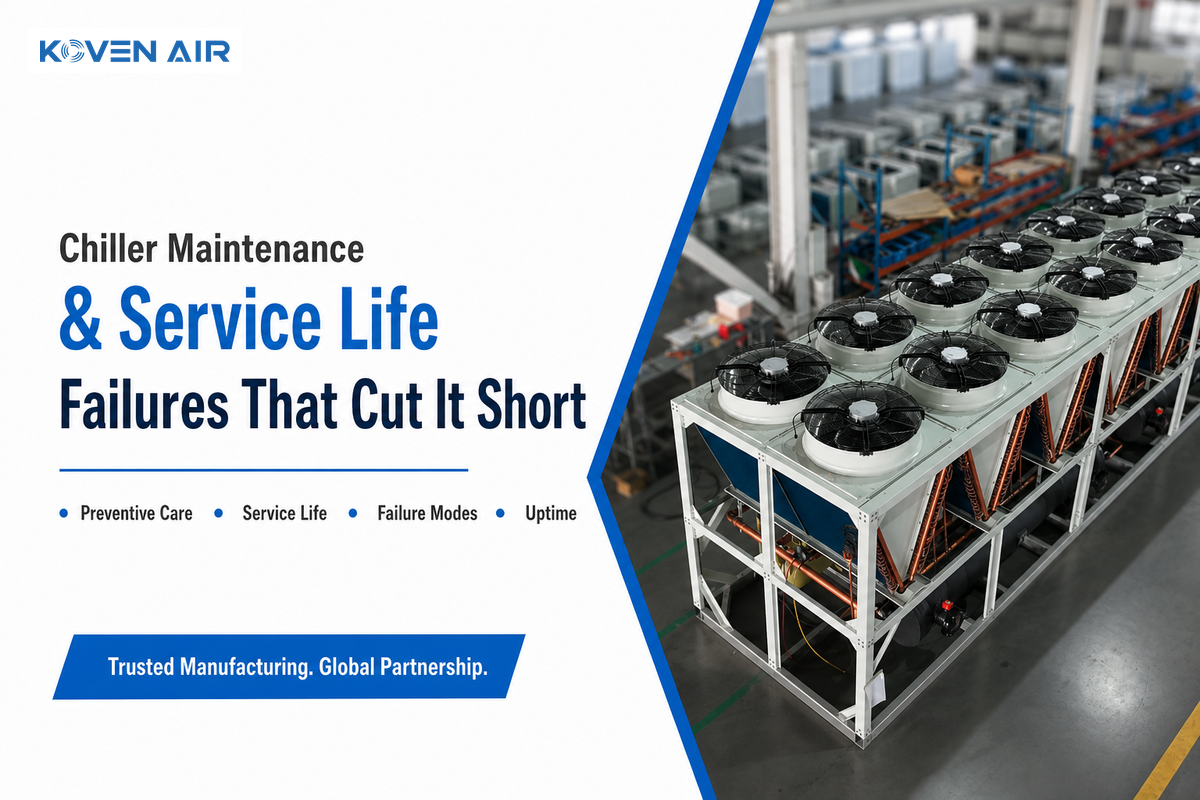
With proper maintenance, industrial chiller units commonly last 15 to 20 years, but that range isn’t fixed, and it varies more by compressor technology and maintenance discipline than most published estimates suggest. ASHRAE’s own equipment service-life database, drawn from hundreds of real buildings, shows centrifugal chillers averaging 17.6 years while still in service (with a mean age of 25.2 years among units actually replaced), while air-cooled reciprocating units average closer to 24 years in service before replacement, a wide enough spread that a single flat number for “a chiller” undersells how much compressor choice and upkeep actually matter, a spread worth factoring into a lifecycle-cost comparison alongside the purchase price itself.
| Interval | Task |
|---|---|
| Daily | Check control panel for fault codes; verify supply/return temperatures match process needs |
| Monthly | Inspect and clean strainers; check for unusual vibration or noise |
| Quarterly | Coil inspection, refrigerant pressure check, electrical inspection (preventive maintenance program) |
| Annually | Full technician service: compressor oil analysis, refrigerant charge verification, safety-sensor calibration |
The failure modes that most commonly cut a chiller’s service life short are well understood in the trade, even when they aren’t widely published for buyers: refrigerant leaks that go undetected until performance visibly degrades, condenser coils that foul from dust or debris and quietly raise head pressure, clogged strainers that trigger nuisance low-flow shutdowns, and skipped water treatment on water-cooled systems that lets scale build up on evaporator tubes, the same evaporator heat-transfer surfaces that refrigeration heat-exchanger engineering literature identifies as central to sustained cooling performance. None of these require exotic diagnosis, they’re the reason a documented quarterly preventive-maintenance program consistently pays for itself in reduced emergency service calls, one of the clearest, most measurable returns in facility maintenance budgeting.
Key Takeaway: A preventive-maintenance program run every 90 days — strainer cleaning, coil inspection, refrigerant pressure checks, electrical inspection — catches the failure modes that otherwise turn into emergency service calls, and is the single highest-impact maintenance investment for extending service life toward the upper end of the 15–20 year range.
Industry Outlook: Data-Center Demand and the Refrigerant Deadline Reshaping Chiller Specs
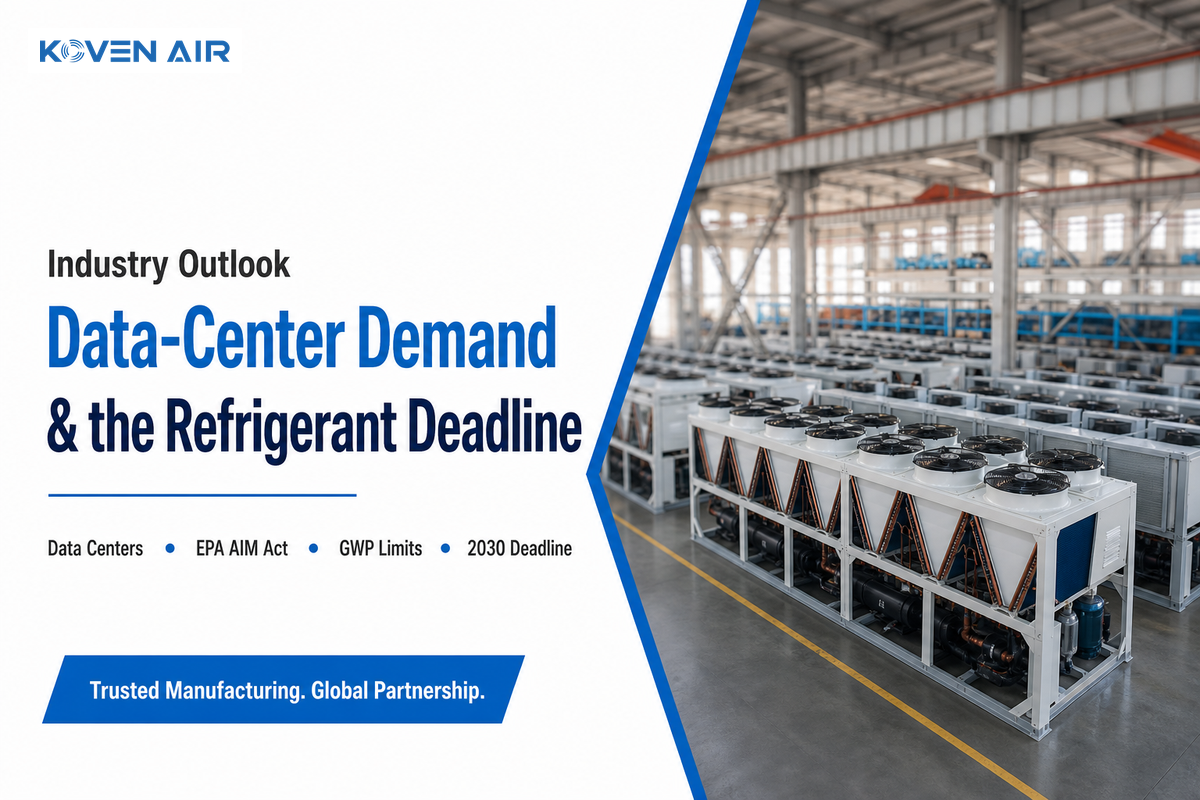
Two concrete, verifiable forces, not a vague sense that “the industry is evolving” — are reshaping what a smart chiller purchase looks like heading into 2027 and beyond. First, EPA’s May 2026 reconsideration rule under the AIM Act specifically named industrial process refrigeration and chillers used in semiconductor manufacturing among the subsectors under active review, confirming that refrigerant compliance planning isn’t a one-time 2023 event, but an ongoing input into any purchase timed for the next several years. Second, rising rack-density cooling demand in AI and hyperscale data centers, documented by the U.S. Department of Energy’s ARPA-E program in 2025is a genuine, engineering-driven demand shift, not just a market-research projection: higher compute workloads mean higher heat dissipation per rack, and that heat has to go somewhere.
For a buyer planning a purchase now, the practical implication is this: weight part-load (IPLV) performance and refrigerant flexibility more heavily than historical practice, rather than optimizing purely for the lowest first cost or the highest headline COP. If you’re specifying equipment for a data center or a semiconductor-adjacent facility specifically, build in a conversation with your manufacturer about refrigerant upgrade paths before you finalize a spec, not after.
Because Koven Air already exports both standard and semiconductor-grade chiller platforms to customers in more than 35 countries, the pattern we see from the manufacturing side is consistent: any manufacturer worth shortlisting today should be able to walk you through a refrigerant upgrade path for your specific application, not treat it as a future problem to raise only after the next compliance deadline shifts.
Market-size estimates for the broader chillers category vary widely across research firms, from roughly $4.4 billion to $13.4 billion for 2025 alone, depending on scope definitions, which is itself a useful signal: when four analyst firms can’t agree within 3x on a market’s current size, treat any single CAGR figure as directional context, not a number to plan a capital budget around.
Industrial Chillers FAQ
Q: What’s the difference between a chiller and an air conditioner?
View Answer
An air conditioner cools air directly and is sized around room comfort setpoints (roughly 68–75°F). An industrial chiller cools a circulating fluid — usually water or a water-glycol mixture — that is then routed to a process, machine, or piece of equipment, and it is sized around that process’s specific temperature and flow requirements rather than human comfort. Some chillers are also configured to serve HVAC comfort-cooling loads, but the equipment itself is built for continuous, precise process control rather than room-air conditioning alone.
Q: How long does an industrial chiller typically last?
View Answer
With regular maintenance, most industrial chillers last 15 to 20 years, though the compressor technology inside changes that range meaningfully. ASHRAE’s equipment service-life database shows centrifugal chillers averaging 17.6 years in service and closer to 25 years among units at actual replacement, with other compressor types spreading wider still. Wear, scale buildup, and skipped maintenance intervals reduce efficiency and durability over time, which is why a documented preventive-maintenance schedule is the single biggest lever a facility has over where in that range its own equipment lands.
Q: What is IPLV, and why does it matter more than a single COP number?
View Answer
IPLV (Integrated Part-Load Value) is a weighted-average efficiency rating across several part-load operating points, certified under AHRI Standard 550/590, while COP measures efficiency at a single full-load point. Because almost no chiller runs at 100% load continuously, IPLV is generally the more useful number for comparing real-world running cost across vendors — though a 2025 peer-reviewed study found the metric’s standardized weighting “does not always reflect” actual field performance across every climate and load profile, so it should guide vendor shortlisting rather than serve as a precise energy-bill forecast.
Q: Does every water-cooled chiller need its own cooling tower?
View Answer
Yes — a water-cooled chiller needs a separate cooling tower and a continual water supply, often municipal or city water, to reject heat from the condenser, which is the main trade-off against an air-cooled unit’s simpler, stand-alone footprint.
Q: What’s the single biggest mistake buyers make when selecting a chiller?
View Answer
Sizing off a generic tonnage estimate instead of their process’s actual flow rate and temperature drop, then skipping a growth-margin allowance — a mistake that shows up years later as premature capacity shortfalls, not at commissioning.
Q: How does the EPA’s refrigerant phase-down affect a chiller I buy today?
View Answer
The EPA’s AIM Act Technology Transitions rule, finalized in October 2023, restricts higher-GWP HFC refrigerants across most refrigeration and air-conditioning subsectors starting January 1, 2025, though exact deadlines and GWP limits vary by sector. In May 2026, EPA finalized a reconsideration rule that specifically addresses industrial process refrigeration and chillers used in semiconductor manufacturing, among other subsectors, and stated it intends to extend some compliance dates while treating enforcement of the original deadlines as a low priority during that reconsideration. A chiller bought today should keep refrigerant flexibility in mind — ask your manufacturer about low-GWP options and upgrade paths, since the rules governing its 15-to-20-year service life are still actively being finalized.
Q: What maintenance does an industrial chiller need, and how often?
View Answer
Daily checks cover control-panel fault codes and supply/return temperatures; monthly tasks include strainer inspection and vibration checks; a documented quarterly program should cover coil inspection, refrigerant pressure checks, and electrical inspection; and an annual technician visit should include compressor oil analysis, refrigerant charge verification, and safety-sensor calibration. Facilities that run a consistent quarterly preventive-maintenance program consistently see fewer emergency service calls than those relying on reactive repairs, which is the single clearest maintenance-budget return in this equipment category.
Why We Write This
Koven Air has built industrial and commercial HVACR equipment since 2007, including the five compressor technologies covered in this guide, and exports to more than 35 countries. This guide draws on that manufacturing experience, particularly the quality-control framework in the manufacturer-evaluation section, alongside government, standards-body, and peer-reviewed sources, so a reader can evaluate any chiller manufacturer, not only ours.
Reviewed by the Koven Air technical team. Updated July 2026.
References & Sources
- A case study on optimizing industrial air conditioning with solar-assisted adsorption chillersNational Institutes of Health (PMC)
- Purchasing Energy-Efficient Electric ChillersU.S. Department of Energy, Federal Energy Management Program
- European Innovation Council: Data Centre CoolingU.S. Department of Energy ARPA-E, 2025
- AHRI Standard 550/590 (I-P) and 551/591 (SI)Air-Conditioning, Heating, and Refrigeration Institute
- Chillers: General Description and UsesHVAC Resource Map
- Evaluating seasonal chiller performance using operational dataWu et al., ScienceDirect, 2025
- Regulatory Actions for Technology TransitionsU.S. Environmental Protection Agency
- Frequent Questions on the Phasedown of HydrofluorocarbonsU.S. Environmental Protection Agency
- Phasedown of Hydrofluorocarbons: Reconsideration Final RuleFederal Register, May 26, 2026
- Status Update on the AIM Act and EPA’s HFC-Refrigerant RegulationsHunton Andrews Kurth
- Predictive Maintenance Based on Performance Analysis Using System DataInstitute of Refrigeration (UK)
- US7086240B1, Method and Apparatus for Measuring and Controlling Chiller ParametersUSPTO / Google Patents
- Technology Transitions HFC Restrictions by SectorU.S. Environmental Protection Agency
- WCCL Certification ProgramAir-Conditioning, Heating, and Refrigeration Institute
- Data Center Water EfficiencyLawrence Berkeley National Laboratory
- HVAC Equipment Service Life DatabaseASHRAE
- 40 CFR 84.54, Restrictions on the Use of HydrofluorocarbonsElectronic Code of Federal Regulations
Related Articles
- The Complete Guide to Commercial Rooftop Unitssizing, types, and cost for packaged RTU systems
- The Complete Guide to Commercial Desiccant Dehumidifiersfor facilities pairing chilled-water cooling with humidity control
- Rotary Desiccant Dehumidifier: The Complete Guidehow rotary desiccant wheels work alongside process cooling
- Concealed Fan Coil Unit Guide: 7 Design Checks Before Specificationfor chilled-water distribution at the room level

![Horizontal Fan Coil Unit Project Guide [Step-by-Step]](https://kovenair.com/wp-content/uploads/2026/09/horizontal-fan-coil-unit-guide-featured-1-150x150.png)