Get in Touch with Koven Air Company

ISO Certified
Liquid Desiccant Dehumidifier
Industrial Desiccant Dehumidifiers, Rotary Wheel & Liquid Desiccant Systems
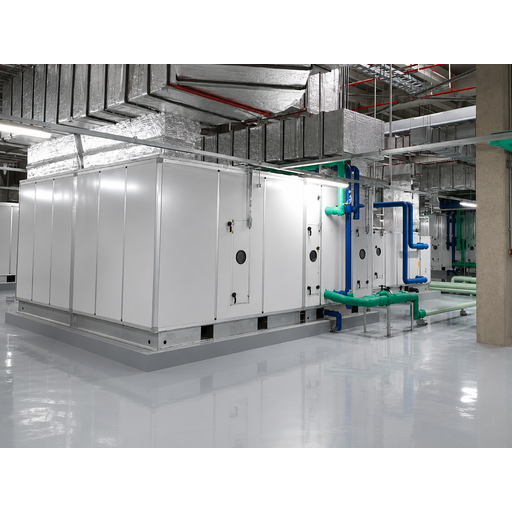
When your process requires drier air than cooling coil can deliver, industrial desiccant dehumidifiers are the equipment that get you there. Koven Air engineers both rotary desiccant wheel and liquid desiccant systems, sized to the dew point and moisture load your production actually runs at – from pharmaceutical and electronics rooms to lithium-battery dry rooms held at -40°C dew point.
- Custom: Airflow & capacity sized per application
- Lifetime: Free after-sales support
System Active
-40°C
Dew point class on rotary wheel systems
2
Technologies engineered in-house: wheel & liquid
45–78%
Regeneration energy saved by Koven low-temp polymer wheel vs. silica gel*
35
Countries served since 2007
* Koven Air in-house R&D, four-system comparison. This direction (not the exact figure) is consistent with peer-reviewed data showing polymer desiccants deliver +350% adsorption capacity and +45% desorption rate vs. silica gel at 40–70°C regeneration – a different metric than energy, cited to support the trend rather than the number (Springer, JTAC 2025).
One physics point is worth stating plainly, because it drives a lot of wasted spend: heating air does not dry it. Warming a space lowers relative humidity on the gauge while the absolute water content stays identical – the moisture simply waits to condense on the coldest surface in the room. Actual moisture removal from the airstream is the only durable fix, not a lower reading on the gauge, and below the coil’s practical limit that means a desiccant. For regulated production the stakes are not comfort but compliance: US drug-manufacturing rules require documented control of humidity where it affects the product (FDA 21 CFR §211.46).
Here’s the honest version of the decision: because humidity is driven by latent load a thermostat never see, meeting temperature tells you nothing about moisture, and the risk of guessing wrong is expensive downtime or scrap. Koven Air engineers to the dew-point target you actually run – and, unlike a single-technology vendor, we’ll steer you to a well-specified cooling system when a moderate 45-55% RH target makes refrigeration the cheaper answer.
How Desiccant Dehumidification Works: Rotary Wheel & Liquid Systems
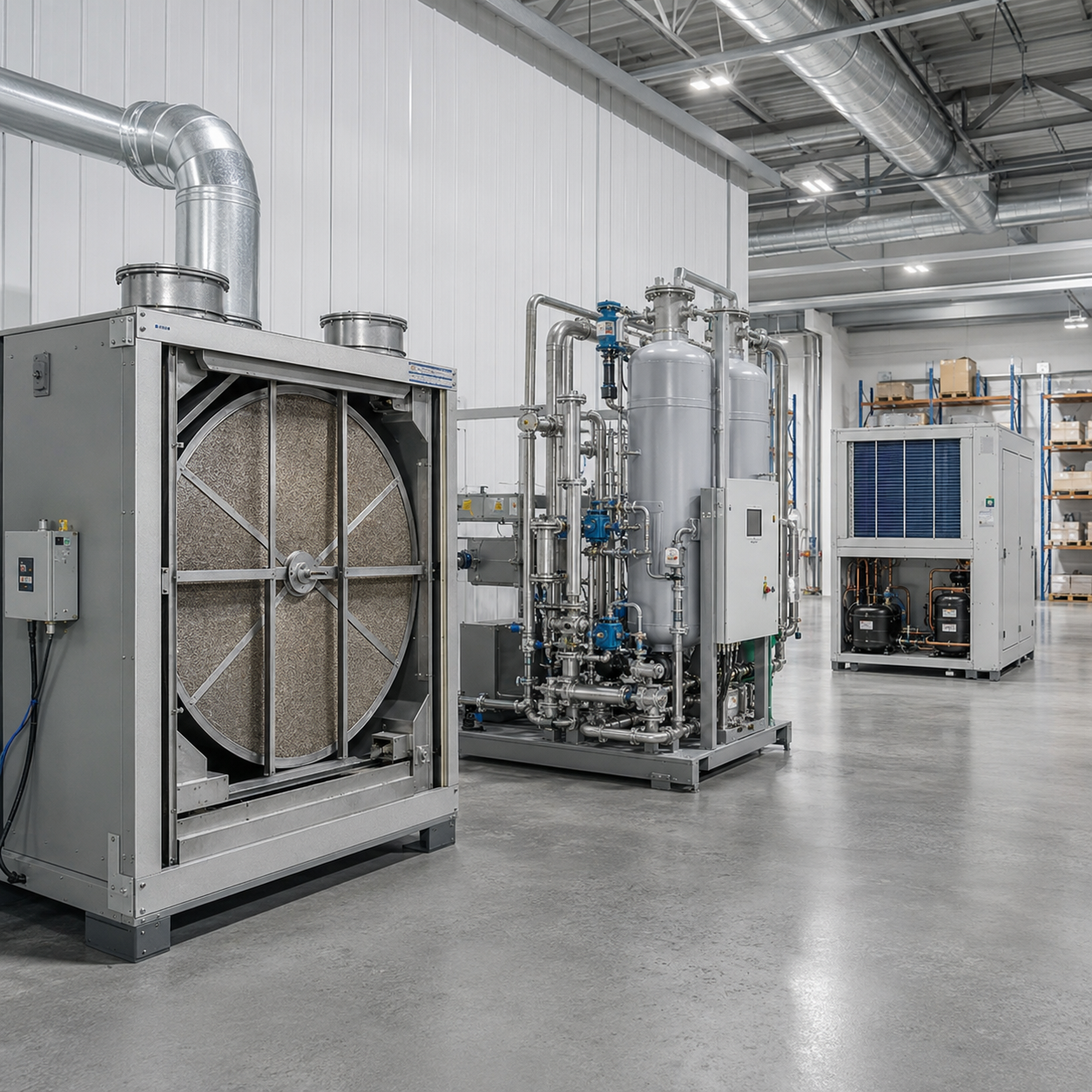
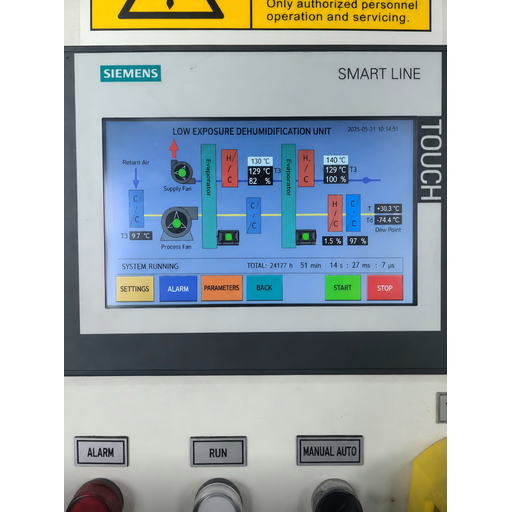
A desiccant dehumidifier removes moisture with a hygroscopic material rather than a cold coil. In a rotary system, a slowly turning wheel of solid desiccant adsorbs water vapor from the process airstream, then rotates into a smaller heated airstream that drives the moisture off (regeneration) so the wheel returns dry. In a liquid desiccant dehumidification system, a hygroscopic salt solution absorbs vapor in a conditioner and is re-concentrated in a regenerator — an absorption process, in contrast to the surface adsorption of a solid wheel. Both run continuously; the difference is solid versus liquid sorbent.
↓ Hover to expand details
Rotary (Solid) vs. Liquid Desiccant, Which Fits Your Process?
Choose by your dew-point target and whether you also need cooling. For ultra-low dew points — dry rooms at -40°C and below — a solid rotary wheel is the right tool; a liquid salt solution physically cannot reach there (saturated lithium chloride at 25°C equilibrates near 11% RH — far more humid than the -40°C dew point a dry room needs). Liquid desiccant cooling earns its place at moderate-to-low humidity with high latent load. Koven engineers both, so the recommendation follows your process, not our inventory.
The single most useful thing to understand before you buy is that the energy winner flips with the humidity target – there’s no universally efficient technology. Engineers at Bry-Air published a worked comparison for a 72°F space: at 55% RH a cooling-and-reheat system used 57% less energy than desiccant; at 40% RH the desiccant used about 33% less; and at 30% RH the desiccant used 65% less. That crossover is the whole decision. A desiccant dehumidifier isn’t budget friendly to run at moderate humidity, so anyone who tells you it’s always more efficient is selling, not engineering.
The Koven Dew-Point Selection Matrix
| Attribute | Rotary wheel (solid) | Liquid desiccant | Refrigeration (coil) |
|---|---|---|---|
| Practical dew-point floor | -40°C and below | ~+2 to +10°C (salt-limited) | ~+4°C (frost limit) |
| Best RH window | <35% to ultra-low | ~15–50% RH | 45–60% RH |
| Sorbent | Silica gel / mol-sieve / polymer | LiCl / LiBr / CaCl₂ solution | None (condensing) |
| Regeneration heat | 40–135°C (media-dependent) | 60–140°C, or 32–55°C heat-pump-coupled | N/A |
| Simultaneous cooling | Adds sensible heat (post-cool) | Can cool while drying | Yes (over-cools) |
| Corrosion / carryover | None (solid) | Managed by design (mist eliminator) | Condensate handling |
| Energy at 30% RH target | ~65% less than refrigeration† | Competitive with heat recovery | High (deep over-cool + reheat) |
| Energy at 55% RH target | Higher than refrigeration† | Higher than refrigeration | Lowest |
| Typical media life | 8–12 yr silica gel wheel | Solution top-up; contactor service | Compressor life |
| Koven duty | Dry rooms, deep drying | Moderate-RH + high latent + cooling | Comfort / pre-treatment |
Energy-crossover direction per Bry-Air worked comparison, 72°F space. Media-life band per Consulting-Specifying Engineer lifecycle analysis. Dew-point/RH bands cross-checked against ASHRAE Handbook ch.24 (ASHRAE) and the ORNL/Purdue liquid-desiccant review (OSTI).
~42%
reduction in energy per unit of water removed when regeneration heat is recovered (8.27 → 4.77 kJ/g H₂O)
Peer-reviewed heat-recovery study. Regeneration is ~90% of a desiccant system’s energy draw, so exhaust-heat recovery is the primary running-cost lever.
65–67%
Annual energy cut, combined rotary + purge wheel vs. standard unit (MDPI Sustainability 2025, 3-city study)
<3 yr
Simple payback on a documented desiccant retrofit; under 2 years with a utility rebate (NREL/DOE)
~3.04 yr
Payback on an optimized liquid-desiccant heat-pump case, ~33% electricity reduction (MDPI 2023)
Koven Air Desiccant Systems, Wheel Technology, Configurations & Selection
Koven Air builds industrial desiccant dehumidifiers as custom-engineered systems rather than a fixed catalog of boxes. Every unit is sized to your air flow, moisture load and target dew point, then configured for the sorbent, regeneration heat source and downstream cooling your process needs. Our differentiator is the low-temperature polymer wheel program, which reaches production dryness on lower-grade regeneration heat than a conventional silica-gel wheel.
Our engineering focus is the regeneration-energy problem described above. Because reactivation consumes the bulk of a desiccant system’s energy, the media that hit your target at the lowest reactivation temperature wins on lifetime cost. Koven’s in-house four-system comparison measured our low-temperature polymer wheel using 45–78% less regeneration energy than a comparable silica-gel wheel across the tested duty points. That direction is corroborated by independent work: at 40–70°C regeneration, polymer desiccants have shown +350% equilibrium adsorption capacity and +45% desorption rate versus silica gel, and the efficiency principle of low-temperature regeneration is well established in the patent record (US Patent US6751964B2). We would rather show you the test conditions than a headline number – ask for the comparison methodology and we’ll send it.
We do not start from a model number. We start from the dew point you have to hold and the heat you already have on site, waste heat, hot water, low-pressure steam, and choose the wheel and regeneration path that hit that target for the least energy. That is what a custom builder is for.
The Koven Configuration Selection Matrix
| Your Requirement | Recommended Koven Configuration | Why |
|---|---|---|
| Dry room, -35 to -40°C dew point | Solid rotary wheel, low-temp polymer media | Only a solid wheel reaches this band; polymer cuts regen energy |
| Ultra-low, below -60°C dew point | Molecular-sieve rotary wheel | Mol-sieve outperforms silica gel below -40°C DP / under 10% RH |
| 15–40% RH with high latent load + cooling | Liquid desiccant system (packed-bed or membrane) | Absorbs moisture while cooling; membrane avoids carryover |
| Low-grade / waste heat available on site | Low-temp polymer wheel or HP-coupled liquid | Regeneration on recovered heat, not a burner |
| Regulated room needing tight RH band | Rotary wheel + trim control | Stable, documented control for validation |
| Moderate 45–55% RH, warm space | Refrigeration (we’ll tell you) | A desiccant is not the economical answer here |
Application Humidity Targets, Pharma, Electronics & Lithium-Battery Dry Rooms
Every industry that specifies a desiccant dehumidifier does so because it has a humidity or dew-point ceiling a coil cannot hold. This map ties representative production targets to the technology that serves them. Read it as a starting point for a conversation, not a substitute for sizing: the right unit depends on your room volume, air changes and load.
The clearest case for a solid rotary wheel is a lithium-battery dry room. Cell assembly reacts badly to moisture, so the room is held at a maximum -40°C dew point, a figure documented by a US Department of Energy national laboratory (Argonne National Laboratory, ANL-12/55, §5.3.13). That’s deep into solid-wheel territory; a liquid salt solution can’t approach it. Koven presents the battery case as proof of our wheel capability, not as liquid-desiccant marketing, because the physics wouldn’t support that claim.
| Application | Typical Target | Technology Fit |
|---|---|---|
| Lithium-battery cell assembly (dry room) | -40°C DP max | Rotary wheel (solid) |
| Semiconductor / advanced electronics | <1% RH, DP < -40°C | Rotary wheel (mol-sieve) |
| Pharmaceutical tablet coating / API drying | <20% RH | Rotary wheel |
| Cold storage & vaccine chain | Low RH at low temp | Rotary wheel |
| Ice rinks | Low RH, large volume | Rotary wheel |
| Archives / museums & storage | Stable moderate RH, cold spaces | Rotary wheel |
| Lithium / reactive-powder handling | <2% RH | Rotary wheel |
| Application | Typical Target | Technology Fit |
|---|---|---|
| Pharmaceutical general / aseptic | <60% RH (USP guidance) | Rotary or liquid + cooling |
| Stability / test chambers | 25°C / 60% RH ±5% | Liquid or rotary + trim |
| Confectionery, candy & bakery | ~15–40% RH + cooling | Liquid desiccant |
| Brewing / fermentation | Moderate RH + latent | Liquid desiccant |
| Hospital operating rooms | Controlled RH + cooling | Liquid desiccant |
Why Source Desiccant Dehumidifiers from Koven Air
Two questions decide an industrial dehumidifier purchase from an overseas manufacturer: will it actually hold the humidity it promised, and will the supplier still be there when it needs service. Koven Air answers the first with traceable, factory-tested build quality and the second with a lifetime free after-sales commitment — backed by an 18-process production line and per-unit inspection records.
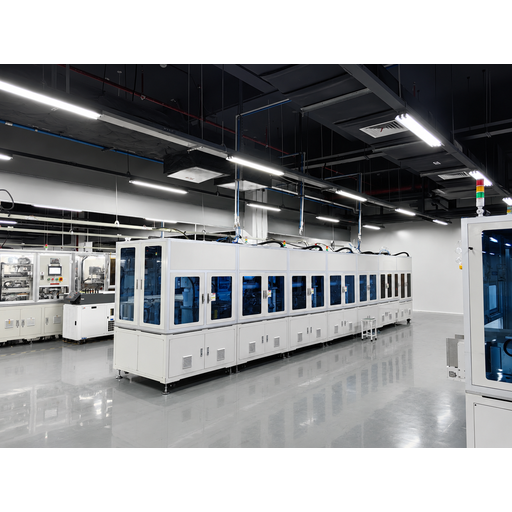
Buyers are right to be skeptical of nameplate specs. In practitioner forums the recurring complaint is that published ratings are quoted at flattering conditions, a unit rated at 90% RH conditions you'll never run, and that "reviews are almost always fake." The trust gap is real, and getting burned on a nameplate is expensive because a rating measured at flattering conditions tells you nothing about the dew point you actually run, that's the risk. Our answer isn't louder marketing; it's a paper trail. Koven Air delivers an 18-process production line across a 20,000 m² factory with roughly 400 traceability points and 36 factory inspections per unit, plus a 24-hour aging test and an in-house chiller and heat-pump testing lab where performance is verified before shipment. When a delivered unit has to be commissioned against a target dew point, that documented, in-house paper trail is what lets your engineer verify performance rather than take our word for it.
18-Process Line
Controlled production
400 Points
Traceability per unit
36 Inspections
Factory QC per unit
24 h Aging
Burn-in before shipment
In-house Lab
Performance verified
Lifetime
Free after-sales
Liquid Desiccant Dehumidification Engineering Tools
Desiccant Technology Selector
Tell us the humidity you have to hold and we’ll point to the technology that reaches it — rotary wheel, liquid desiccant or refrigeration. Directional, not a substitute for sizing.
Access SelectorDehumidification Load Estimator
A first-pass estimate of the moisture your process air must give up to reach target. Uses standard psychrometrics; excludes infiltration and internal gains — a starting point, not a specification.
Calculate LoadDesiccant vs. Refrigeration — Energy Crossover
There is no universally efficient technology: the energy winner flips with your humidity target. Slide to your target RH and see which side of the crossover you sit on.
Compare EnergyRegeneration Energy-Savings Illustrator
Regeneration is roughly 90% of a desiccant system’s energy draw, and it scales with how far you heat the reactivation air above your process air. See how a lower reactivation temperature moves the number.
View IllustratorFAQ, Industrial Desiccant Dehumidifier Buying Questions
Are desiccant dehumidifiers better than refrigerant dehumidifiers?
Not always, it depends on your humidity target. At a moderate 45–55% RH in a warm room, a cooling-and-reheat system is usually more energy-efficient and cheaper. Below roughly 35% RH, or at any low dew point, refrigeration stalls and a desiccant is the correct choice. That energy advantage crosses over as the target get drier, which is why the honest answer is "it depends on the number you've to hit."
Can a liquid desiccant system reach a -40°C dew point for a battery dry room?
No. A saturated lithium-chloride solution equilibrates near 11% RH, far more humid than a -40°C dew point, so liquid desiccant can't serve an ultra-low dry room. Dry rooms held at -40°C dew point require a solid rotary desiccant wheel. Koven engineers both technologies and will route your battery dry room to a wheel system.
Why does my room hit temperature but not humidity?
Because a thermostat doesn't measure moisture. Latent load from ventilation air, infiltration and internal sources can keep humidity high even when the temperature setpoint is satisfied, and heating the air only lowers relative humidity without removing any water. Controlling humidity to a real target need moisture removal, a desiccant below the coil's practical limit.
How long does a desiccant wheel last, and what maintenance does it need?
Routine maintenance is largely filter changes, and well-run silica-gel wheels commonly last 8–12 years. A wheel is a consumable, though: it loses capacity over its sorption life and is eventually replaced. Molecular-sieve media may need earlier replacement in dirtier service. Budget the media as a planned line item rather than a surprise.
Do you publish model specs and prices?
We quote per application rather than post fixed specs, because a right-sized unit depend on your dew-point target, outdoor design conditions, fresh-air fraction and internal load. Send those and we return sized airflow, capacity and a firm price. It keeps you from buying to a flattering nameplate rating measured at conditions you'll never run.
Can the system run on waste heat instead of a burner?
Often, yes. Advanced polymer wheel media regenerate effectively at 40–70°C, and heat-pump-coupled liquid systems regenerate at 32–55°C, both of which can use hot water, low-pressure steam or recovered waste heat. Since regeneration is about 90% of a desiccant system's energy, using low-grade heat is the largest running-cost lever available.