Get in Touch with Koven Air Company

Updated July 2026
Quick Specs: What This Guide Covers
| Possible outputs | Chilled water, hot water, or both, depending on architecture |
| Common layouts | Reversible two-pipe and separate four-pipe circuits |
| Core evaluation basis | Loads, water temperatures, source conditions, controls, and system boundaries |
| Not covered here | Model selection, product specifications, pricing, or project quotations |
A heat pump chiller is a vapor-compression system that can produce chilled water, hot water, or both by moving heat between a source and a hydronic loop. It might seem like merely a substitute for a chiller and a boiler. But for commercial HVAC systems, more important questions are the destination of heat, its source, and whether the cooling and heating loads coincide at any given time. Your answers determine if heat recovery belongs on your sheet or only in a brochure.
A heat pump system is designed to transfer heat rather than generate it by combustion, moving heat from one place to another. That definition follows heat from one place in the circuit to its next destination; it does not by itself establish efficiency, recovery value, or project fit.
Heat pump chiller equipment moves heat between a source and water circuits to make chilled water, hot water, or both. Useful simultaneous recovery depends on piping, controls, compatible temperatures, and coincident loads, not the equipment name alone.
- Four-pipe capability doesn’t prove that a building has enough simultaneous load to use recovered heat.
- Performance figures are comparable only when rating scope, operating mode, temperatures, and auxiliary power boundaries match.
- Retrofit risk sits in the whole hydronic system, including water quality, pumps, valves, storage, emitters, and controls.
- Refrigerant rules depend on jurisdiction, application, equipment category, temperature band, and date.
If you’re searching online for this equipment, three typical searches will lead you down different paths. Questions about heat pump chiller systems address architecture and system boundaries; questions about heat pump chiller operation concern their refrigeration cycles; and heat pump chiller applications need to be compared against current load demands, temperature, and operating hours. This paper links those pieces to inform your selection without turning the page into a product catalog.
What Is a Heat Pump Chiller?
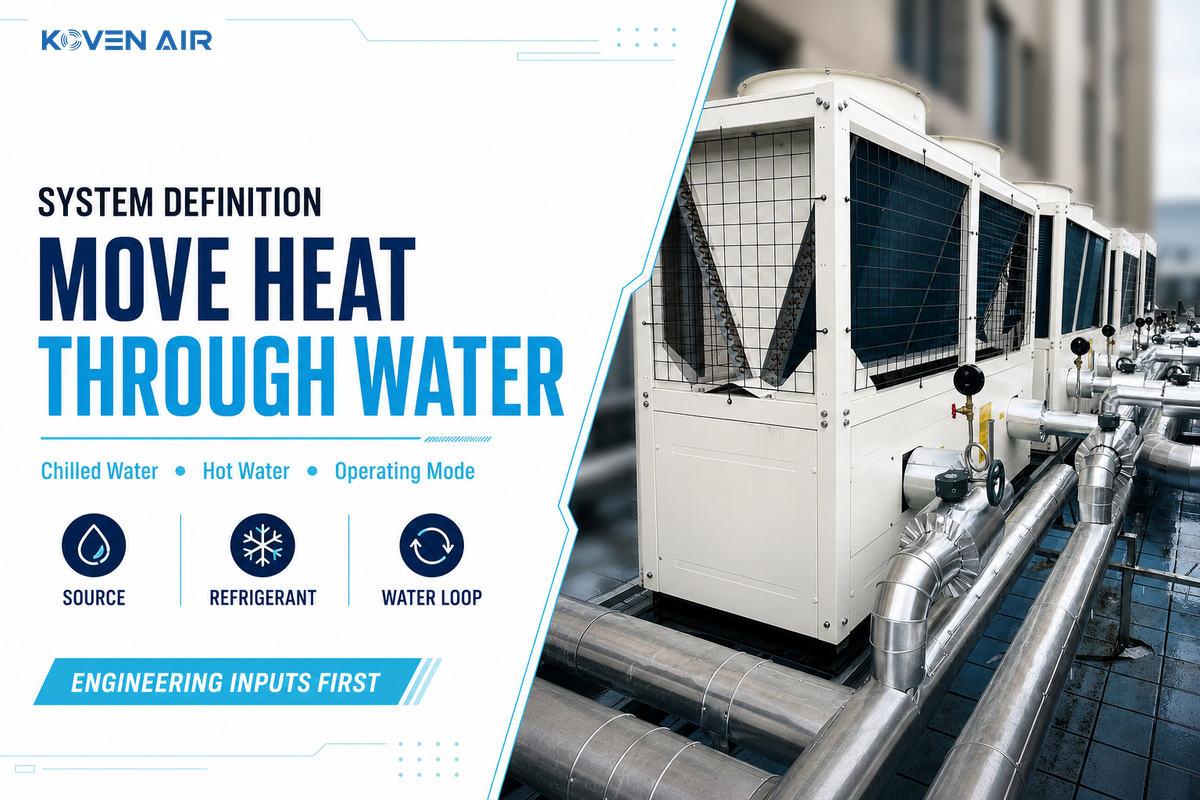
Heat pump chillers use vapor-compression heat pump technology to transfer heat between a thermal source and a hydronic system designed for heating, cooling, or both. This broad functional definition describes the function; there’s no single universal heat pump chiller layout.
Procurement teams and engineers can use this general principle as a first-step sanity check: “Where is the source heat coming from, and where is it going? What modes are available?” Once those points are clear, procurement teams can compare quotations on an equal basis.
Cooling-only chillers produce refrigerated water and reject heat from the system, typically to ambient air or a water loop. Reversible systems can alter the direction of heat flow to provide hot water in addition to cooling. Heat-recovery machines can do that while capturing heat normally rejected during cooling operation for use elsewhere.
This is why the searches “heat pump chiller,” “chiller heater,” and “heat recovery chiller” pull up similar results, even though the underlying technologies are distinct. The questions you should be asking center on the various piping circuits and modes the system can serve, especially when heating and cooling loads don’t overlap.
How Does a Heat Pump Chiller Move Heat?
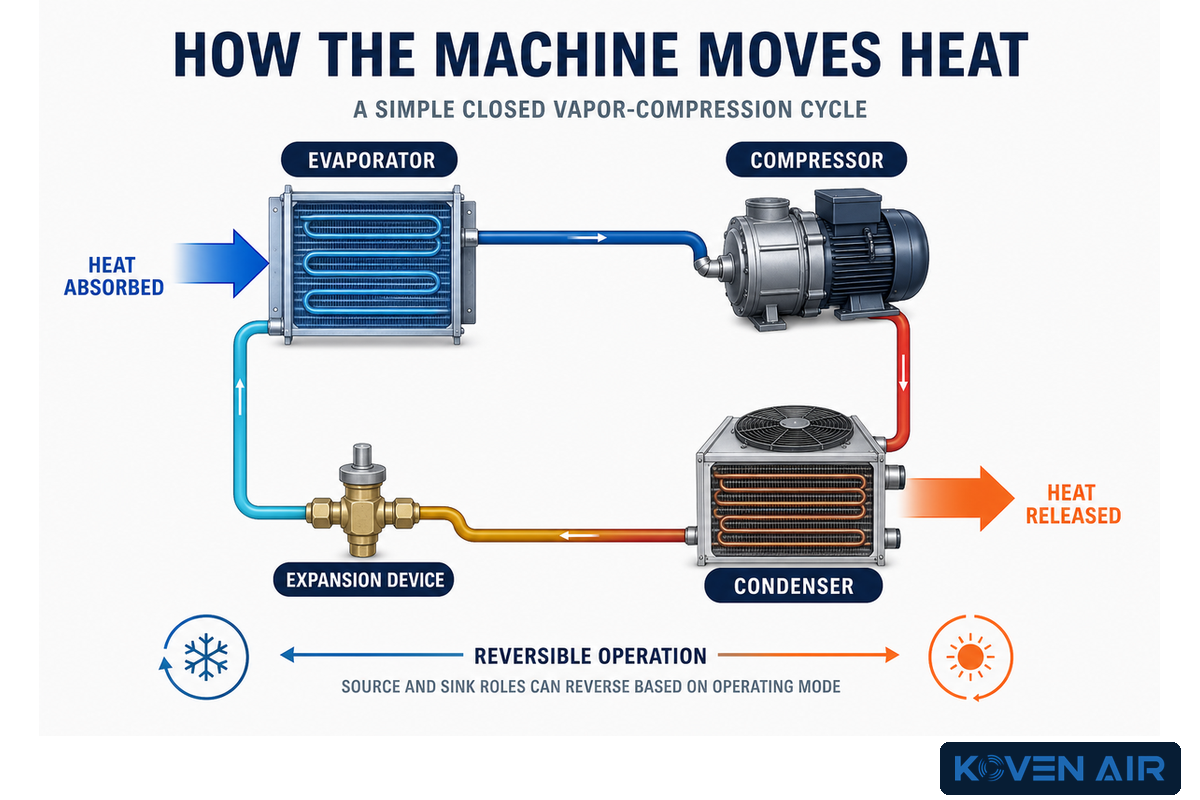
Heat pump chillers move heat using the same four-stage vapor-compression cycle as many industrial and residential refrigeration systems: evaporation, compression, condensation, and expansion. Compression increases the pressure and temperature of the refrigerant. The refrigerant carries thermal energy through sealed internal components, while water moves through an exterior piping system connected to the evaporator and condenser.
Evaporator absorbs heat from a water or source circuit → Compressor raises refrigerant pressure and temperature → Condenser releases heat to the receiving circuit → Expansion device lowers pressure before the cycle repeats.
When you search “how does a heat pump chiller work,” your most important path is to follow the heat, not the product name. The accompanying heat pump chiller diagram maps the four core components; the water circuits in a project define where the heat is transferred.
The refrigerant circuit absorbs heat from the loop supplying chilled water in cooling mode and transports it to an exterior sink for rejection through the condenser. In heating mode, the roles are reversed, with the evaporator absorbing heat from an external source and the condenser giving up that heat to the hydronic loop. A reversing valve typically switches the internal refrigerant loop’s direction in two-pipe systems.
At the evaporator, the system can extract heat from outside air, a source-water loop, process waste heat, or heat from inside a building. After the expansion valve lowers refrigerant pressure, the low-pressure refrigerant absorbs energy; at the condenser, the refrigerant releases heat to the receiving circuit. The usable source and sink still have to remain inside the selected equipment’s operating envelope.
Heat recovery doesn’t come as “free” heat. The compressor and ancillary equipment still use electricity, and the recovered heat must have a usable destination. If demand for hot water disappears, the system needs another heat-rejection path, storage strategy, or operating mode.
Reversible Two-Pipe vs Four-Pipe Simultaneous Operation
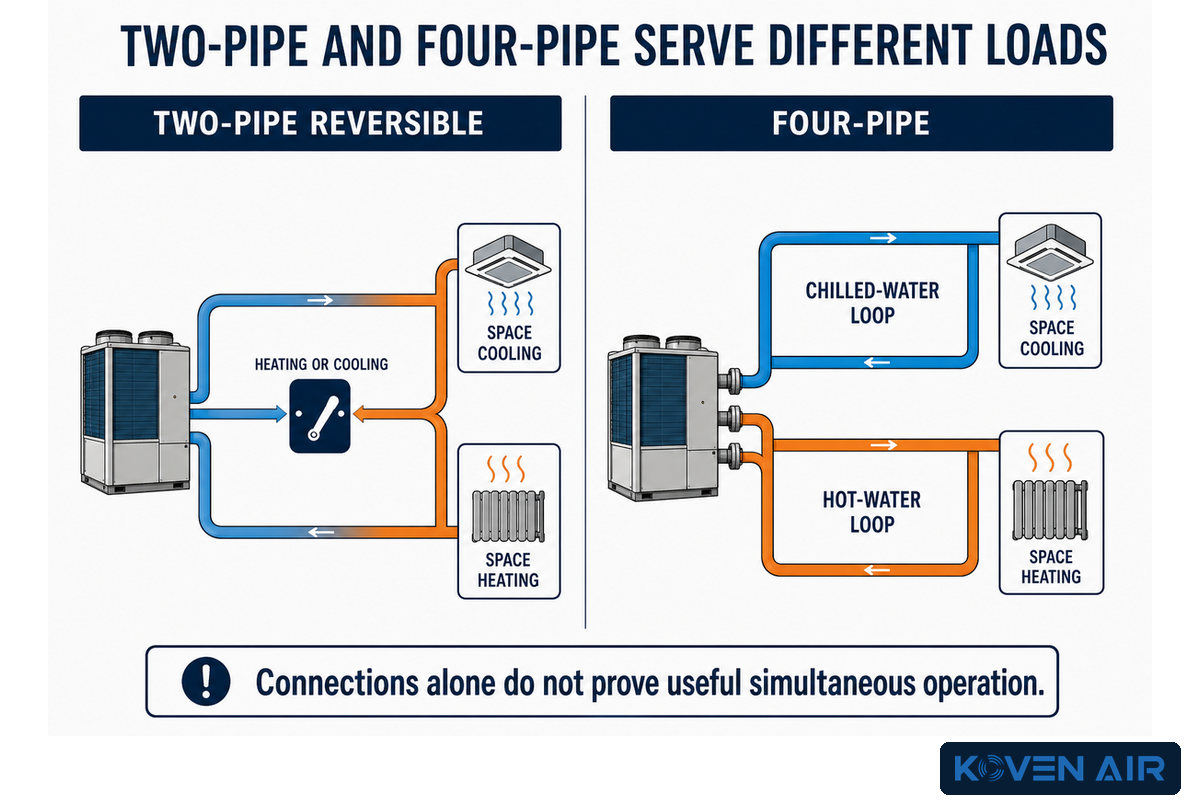
In a two-pipe configuration, one central loop serves either chilled or hot water by reversing the refrigerant flow. Four-pipe systems serve separate, continuous loops of hot and cold water that permit higher levels of simultaneous operation. However, even a four-pipe design doesn’t guarantee coincident heating and cooling loads in all conditions.
These heating and cooling systems may heat and cool spaces on a shared seasonal loop or provide both heating and cooling for commercial zones on separate circuits. Useful excess heat exists only when a receiving load, storage path, or rejection path is available, so the pipe count cannot replace the load balance.
Reversible two-pipe
- One shared load-water circuit changes mode
- Useful for seasonal heating or cooling
- Changeover planning matters
- Doesn’t serve independent hot and cold loops simultaneously
Four-pipe simultaneous
- Separate hot- and chilled-water circuits
- Can serve concurrent loads
- Sequencing and heat balance matter
- Needs a plan for heating- or cooling-dominant hours
In the reviewed NASA case, an active chilled-water return load created the condition for useful condenser-heat recovery to a hot-water demand. That case is an operating example, not a universal design rule. Some four-pipe heat pump chillers offer additional heating-dominant and cooling-dominant modes, so the operating map, not the number of pipe connections, should drive the comparison.
A heat pump chiller vs heat recovery chiller comparison therefore starts with operating dependency: ask whether useful heating requires an active cooling load, and then document the fallback mode when the two loads separate.
Koven Air offers a dedicated guide that compares four-pipe heat pump chillers with standard chiller-and-boiler systems. Use it for a focused architecture comparison.
Air-Source, Water-Source, and Water-to-Water Configurations
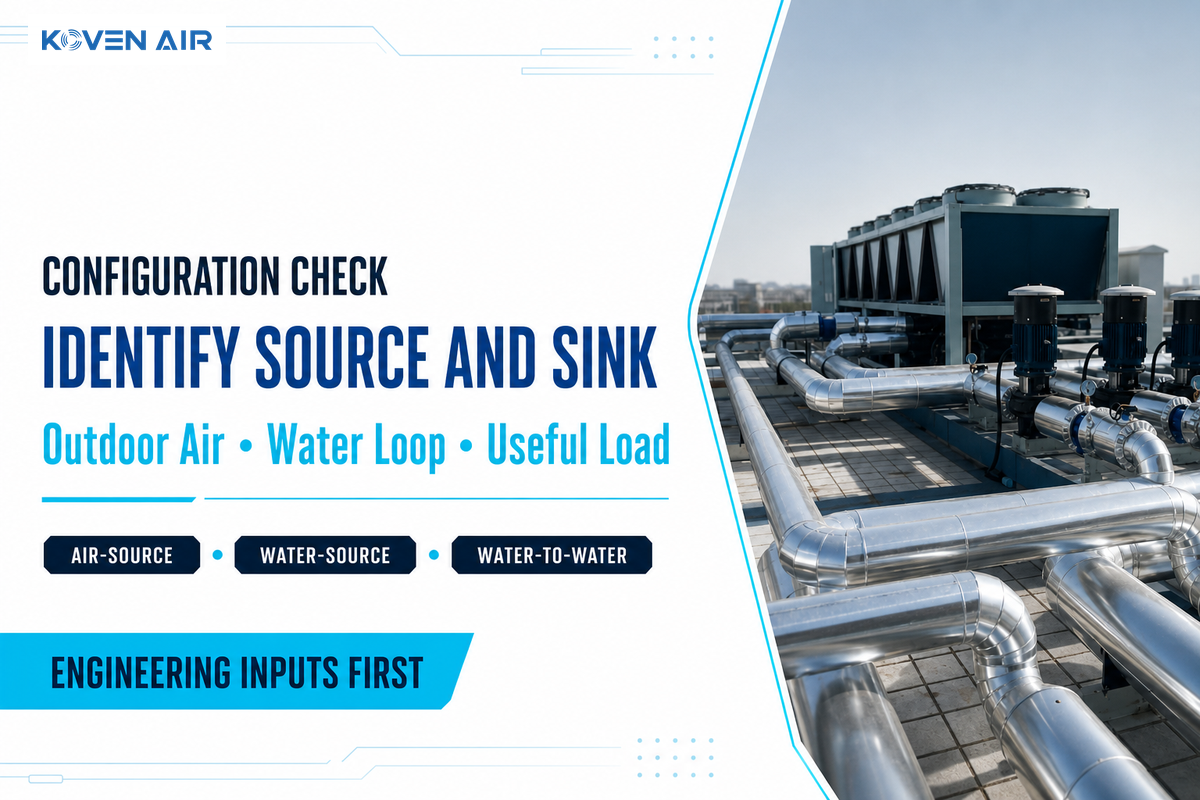
The general categories for heat pump chiller configurations are based on the heat source, heat sink, and load-water circuits. Air-source machines use outdoor air as the heat source and sink, while water-source and water-to-water configurations use a water loop, ground loop, process stream, or another controlled source and sink.
| Configuration | Where heat is exchanged | Screen first | Limitations / not suitable for |
|---|---|---|---|
| Air-to-water | Outdoor air and a hydronic load | Design ambient, defrost, sound, leaving-water temperature | Projects that ignore low-ambient capacity or defrost operation |
| Water-source | A source loop and a hydronic load | Source temperature range, pumping, heat rejection, water quality | Sites without a dependable source loop or heat-rejection plan |
| Water-to-water | Two water circuits | Flow, approach temperatures, fluid type, exchanger condition | Applications that assume any water or glycol circuit fits a cited rating scope |
| Ground-source | Ground loop and hydronic load | Borefield or loop capacity, seasonal balance, pumping | Sites without adequate land, drilling access, or long-term thermal balance |
Air-source systems avoid a cooling tower or source-water loop but expose capacity and efficiency to outdoor conditions. An air-cooled outdoor heat exchanger also brings defrost, sound, and service-clearance questions. Water-side systems may offer steadier source temperatures, yet they add pumps, heat exchangers, water treatment, and heat-rejection responsibilities. Even the most attractive source on a schematic can become the limiting subsystem in operation.
Commercial chillers are available in arrangements that use an air-cooled scroll chiller, water-cooled chillers, or a modular heat pump plant. Those labels identify equipment arrangements, not equivalent test boundaries. Air-source capacity also needs verification even in cold weather; a mild-condition catalog point cannot resolve low-ambient operation.
Koven Air has a dedicated background page for air-to-water heat pumps and another one for water-source heat pumps. Use those pages to describe architecture and source use before requesting product-specific engineering.
How to Read Performance Without Comparing Unlike Conditions
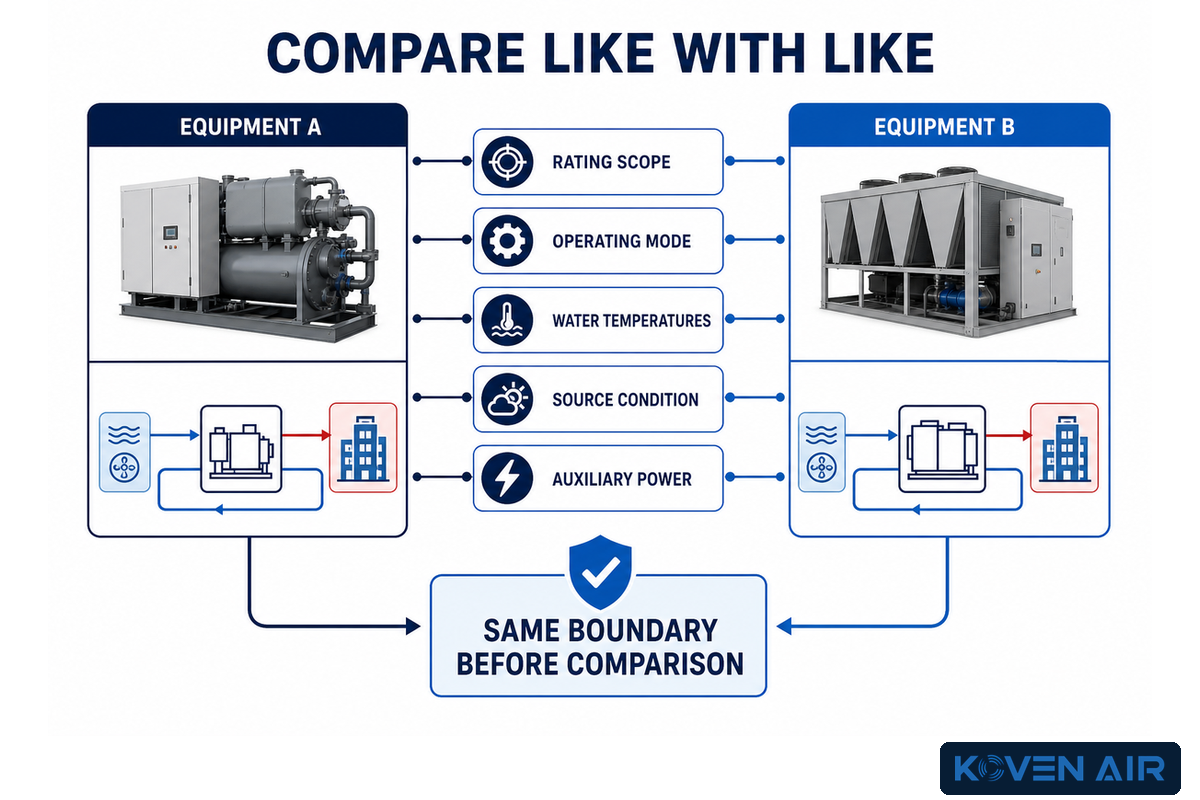
Heat pump chiller energy efficiency can only be compared when rating scope, operating mode, entering and leaving temperatures, source conditions, part-load point, and auxiliary-power boundary all match. Without those parameters, a coefficient doesn’t support a procurement decision.
The coefficient of performance is useful heating or cooling output divided by power input. Comparisons become confusing when one citation includes pump power, another uses compressor-only input, and a third combines heating and cooling output. An energy-efficient full-load point can thus be misleading if temperature lift, part-load hours, or auxiliary bounds aren’t the same.
For building owners, temperature control quality and inverter turndown can matter as much as a full-load ratio. Neither feature makes a project automatically cost-effective. Generic labels such as heat pump solutions, heating and cooling solutions, or reliable heating and cooling are not substitutes for matched conditions and measured system boundaries.
Procurement risk is a boundary mismatch. Two suppliers can give the same illustrative 500 kW operating point with different included loads. The correction isn’t another headline ratio; it’s a signed comparison schedule that names mode, conditions and included auxiliaries.
AHRI 550/590 and 551/591 apply to factory-made vapor-compression water-chilling and water-heating packages within a defined scope. The scope includes air-to-water heat pumps and water-to-water heat pumps rated at or above 135,000 Btu/h. It excludes smaller water-to-water units, potable-water-only air-to-water units, actively adiabatically cooled condensers, split air and water heat rejection, and evaporators or condensers that use liquids other than water.
Equipment definitions in the current U.S. eCFR dictate which efficiency measures and test procedures apply. One example is an applied coefficient of performance for a particular water-source heat-pump equipment class that includes system pump power. Don’t automatically apply that class to every hydronic heat pump chiller.
Scope-First Rating and Compliance Gate
- Classify the equipment: establish application, heat source, load side, capacity range, working fluid, and jurisdiction.
- Confirm rating scope: name the standard, edition, covered mode, and any exclusion that affects the quotation.
- Align conditions: compare the same entering and leaving temperatures, source condition, load point, and ambient.
- Normalize boundaries: identify whether pumps, fans, heaters, and controls are included in the reported input.
- Test off-design operation: review part-load and seasonal hours rather than selecting from one full-load point.
The 3-Part Load-Coincidence Window
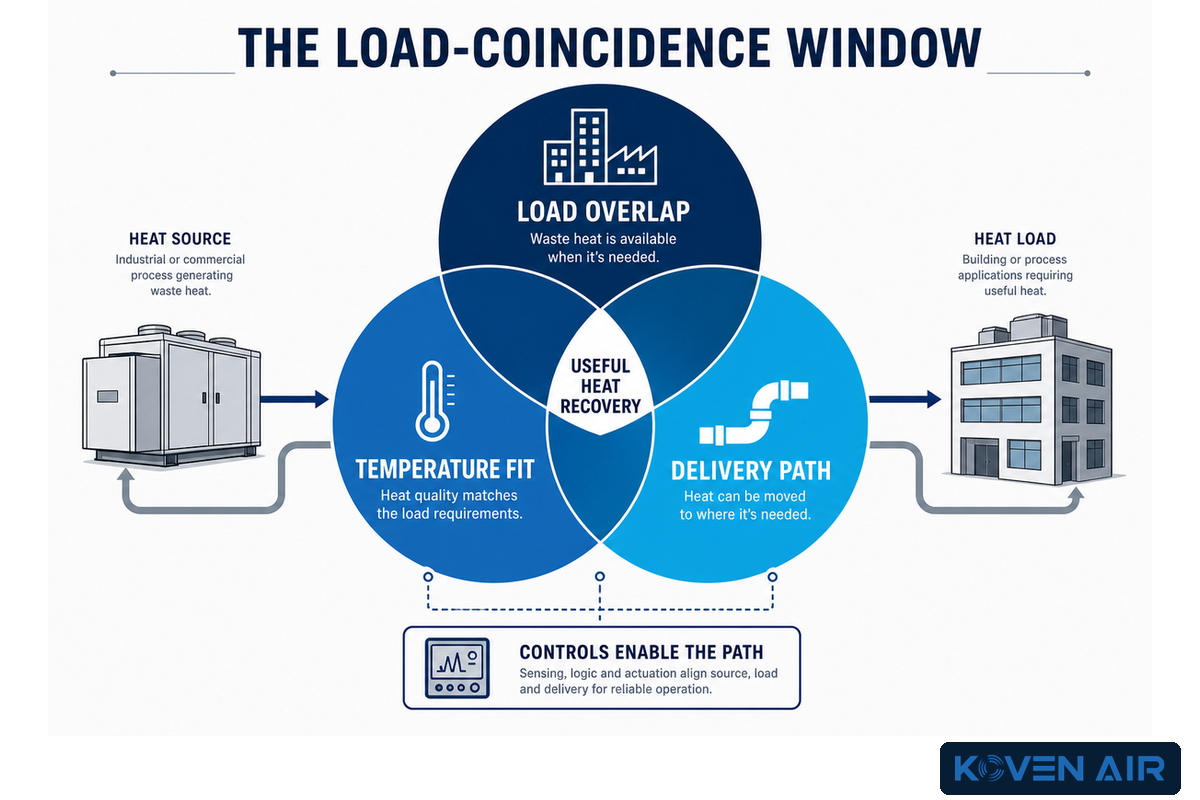
The Load-Coincidence Window is the period when a facility has usable heating and cooling loads at compatible temperatures simultaneously, with controls and a piping path capable of moving recovered heat to the demand.
One reviewed field-study abstract reported materially different measured outcomes in two buildings and identified a mismatch between instantaneous load and heat production as one cause of low operating efficiency.
That doesn’t prove a universal threshold; it identifies why a nameplate can’t capture the annual opportunity.
| Screening question | Evidence to collect | Decision consequence | Buyer owner |
|---|---|---|---|
| When do loads overlap? | Hourly heating and cooling profiles for representative weeks | Defines the available recovery hours | Owner / energy analyst |
| Are temperatures compatible? | Required hot- and chilled-water supply and return temperatures | Defines lift and operating-envelope fit | Consulting engineer |
| Can heat reach the demand? | Piping, valves, pumps, controls, storage, and heat-exchanger map | Reveals delivery losses and missing paths | Plant manager / controls contractor |
| What happens outside the window? | Heating-dominant and cooling-dominant sequence | Defines backup, rejection, and storage needs | Engineer / finance |
Use the worksheet to turn “simultaneous heating and cooling” into an auditable project question.
Don’t convert it into an arbitrary overlap percent or payback claim. Even a short overlap window can matter if the loads are valuable while a long overlap window can disappoint if the required temperature lift or added pumping eats all the benefit.
Unit Check Before Comparing Options
The figures below are arithmetic illustrations, not equipment ratings or project promises. A 500 kW load sustained for 2 hours represents 1,000 kWh. A 120 kW auxiliary load operating for 10 hours represents 1,200 kWh. A 6°C entering-water value and 12°C leaving-water value create a 6°C temperature difference; a 7°C and 12°C pair creates a 5°C difference.
Apply the same boundary discipline to simultaneous loads. An illustrative 400 kW cooling load and 300 kW heating load leave a 100 kW imbalance before losses and auxiliary equipment are considered. Trend at 15-minute intervals across at least 24 hours and, where operating schedules vary, compare seven representative days. Inspect 5-minute data when the normal interval hides short mode changes. Keep a 50 kW pump input separate from a 450 kW compressor input even though together they equal 500 kW. Replace every illustration with measured or engineered project values before making a selection.
A machine cannot recover heat that is unavailable at the needed hour, temperature, and location. Simultaneous capability is a technical mode; useful coincidence is a project condition.
Koven Air’s heat pump chiller capacity and load-overlap selector is the logical next step once meaningful load data is available.
Applications, and When the Architecture Is the Wrong Fit
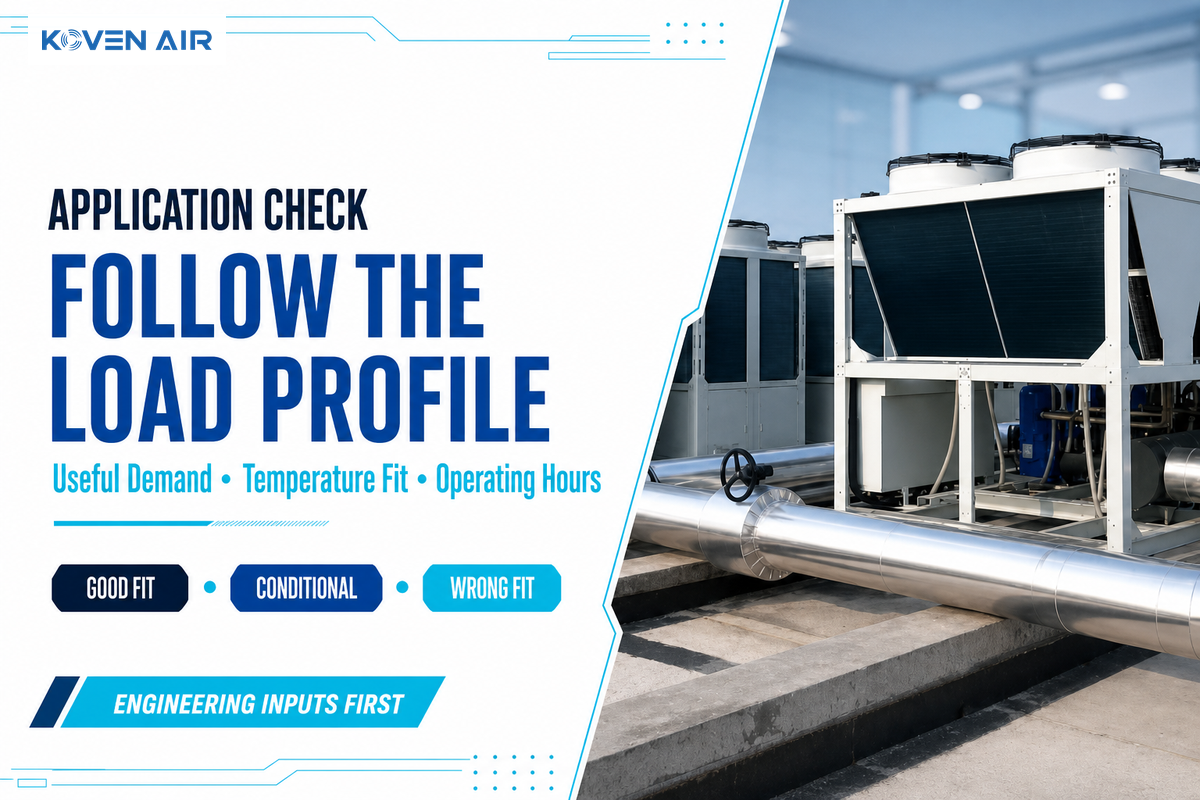
A heat pump chiller is appropriate for a facility when hydronic loads, source conditions, operating schedules, controls, and piping offer a practical heat-transfer path. Hospitals, hotels, college campuses, mixed-use commercial buildings, data centers, and process plants can accommodate these commercial and industrial applications, but the facility designation merely suggests potential.
Commercial heat pumps are discussed in both residential and commercial literature, but this guide focuses on large commercial buildings and other industrial and commercial facilities. In these commercial applications, the plant may combine cooling and hydronic heating, yet designers still have to verify schedules, temperatures, and heat-transfer paths.
Hospitals can have year-round cooling alongside domestic hot-water, hydronic heating, and reheat demands; designers still need to verify temperatures at coils and air handlers. Hotels may need hot water while guest rooms require cooling. Data centers can provide a steady heat source, but its destination and water temperature need engineering analysis. Process plants can fit when source and sink temperatures are steady and measurable.
Some electrification projects seek to reduce carbon emissions and fossil-fuel use on site. That policy goal alone doesn’t show that a heat pump chiller fits the project. Designers must still verify the loads, temperatures, hydraulic requirements, electrical requirements, and operating hours.
When is a heat pump chiller the wrong fit?
Poor candidates include projects where heating and cooling rarely overlap, required hot-water temperatures sit outside the chosen equipment’s practical envelope, or no usable source, sink, or rejection path exists. Added heat-recovery complexity also brings little value to a straightforward cooling-only project with no destination for heat.
Air-source projects deserve extra caution when low-ambient capacity, defrost, acoustics, or service access are ignored. Water-source projects need a credible plan for water quality, pumping, heat rejection, and seasonal balance. In either case, the decision should follow a load model and an operating map, not a list of building types.
Common Design and Retrofit Failure Modes
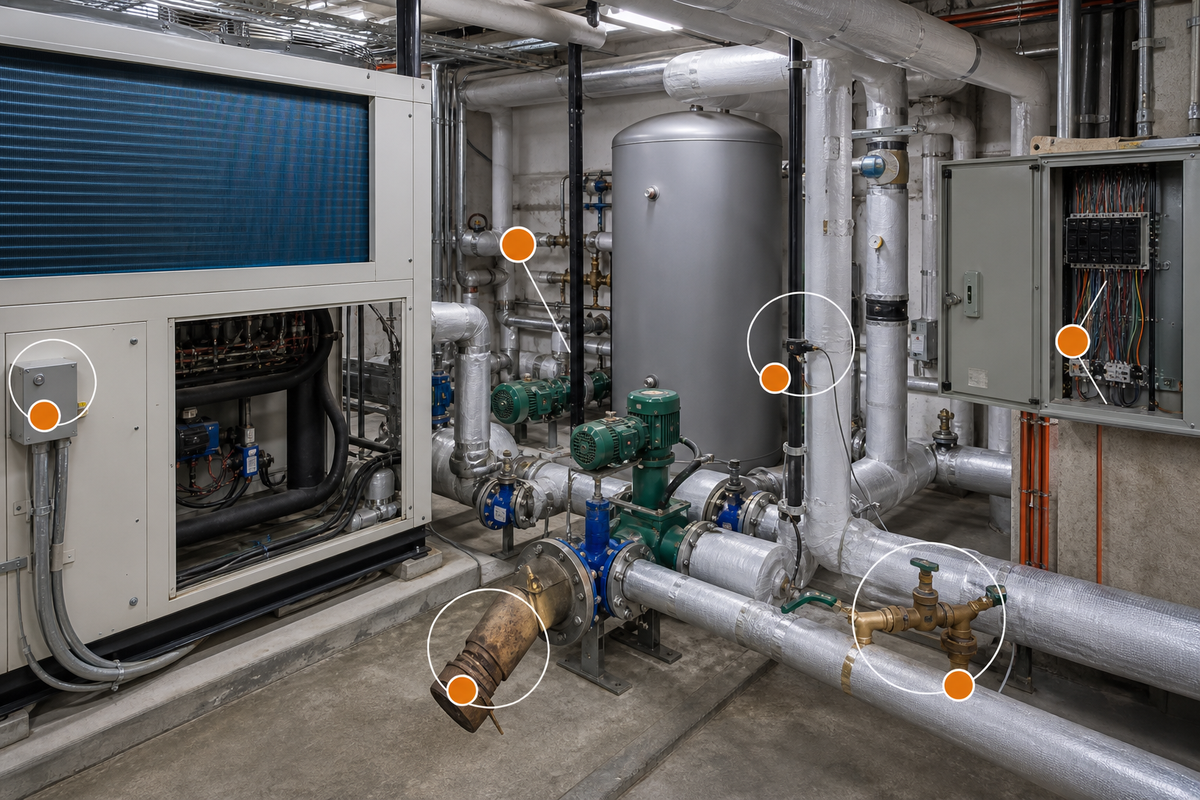
Proper nominal capacity alone doesn’t guarantee a successful heat pump chiller retrofit. If the equipment won’t work with the entire system, existing water temperatures, emitters, heat exchangers, water quality, pumps, valves, storage, electrical capacity, controls, or commissioning, then field performance will be limited.
Before installing a heat pump chiller, map every operating mode and existing load. A unit may heat spaces successfully at one condition yet fail another if source temperature, flow, electrical capacity, or controls fall outside the engineered range.
There are three common screening issues that warrant specific terminology: part load mismatch, a high-temperature legacy loop, and no usable heat sink. Each can defeat a seemingly beneficial nameplate comparison for a different reason, so they shouldn’t be grouped under one generic efficiency issue.
One engineer-authored retrofit case had to compensate for existing terminal devices designed for much hotter water before the lower-temperature heat-recovery plant would work properly. This is a useful pattern, not a universal design temperature: the retrofit boundary may run from the plant room to the coils and distribution.
Retrofit Hidden-Bottleneck Map
| Bottleneck | What to verify | What it can distort | Practical evidence |
|---|---|---|---|
| Load model | Hourly peaks, overlap, diversity, future loads | Capacity and recovery hours | Trend logs or calibrated model |
| Temperature system | Coils, emitters, reset schedules, source temperature | Lift, capacity, and backup demand | Design documents plus field readings |
| Water side | Water analysis, fouling, strainers, exchanger condition | Heat transfer and pressure drop | Water report and inspection history |
| Ancillaries | Pumps, valves, storage, heat rejection, electrical service | Auxiliary energy and available modes | Schedules, curves, single-line diagrams |
| Controls | Sensors, staging, setpoints, mode transitions, alarms | Part-load operation and recovery stability | Sequence of operations and trend test |
| Commissioning | Functional tests in heating-, cooling-, and recovery-dominant states | Whether design intent survives handover | Signed test scripts and trend records |
Do
- Measure source and load temperatures
- Inspect water-side condition
- Model pumps and auxiliary power
- Test mode transitions during commissioning
Don’t
- Select from nominal capacity alone
- Assume existing coils suit lower water temperatures
- Copy water-treatment values from another site
- Count unverified recovery hours as savings
Water quality, scale, corrosion, and fouling can reduce heat transfer and increase pumping burden, but the correct treatment program is project-specific. This guide therefore does not publish universal hardness, inhibitor, glycol, filter, or maintenance values. Obtain a water analysis and a materials-compatible treatment plan.
Refrigerants and Market Compliance
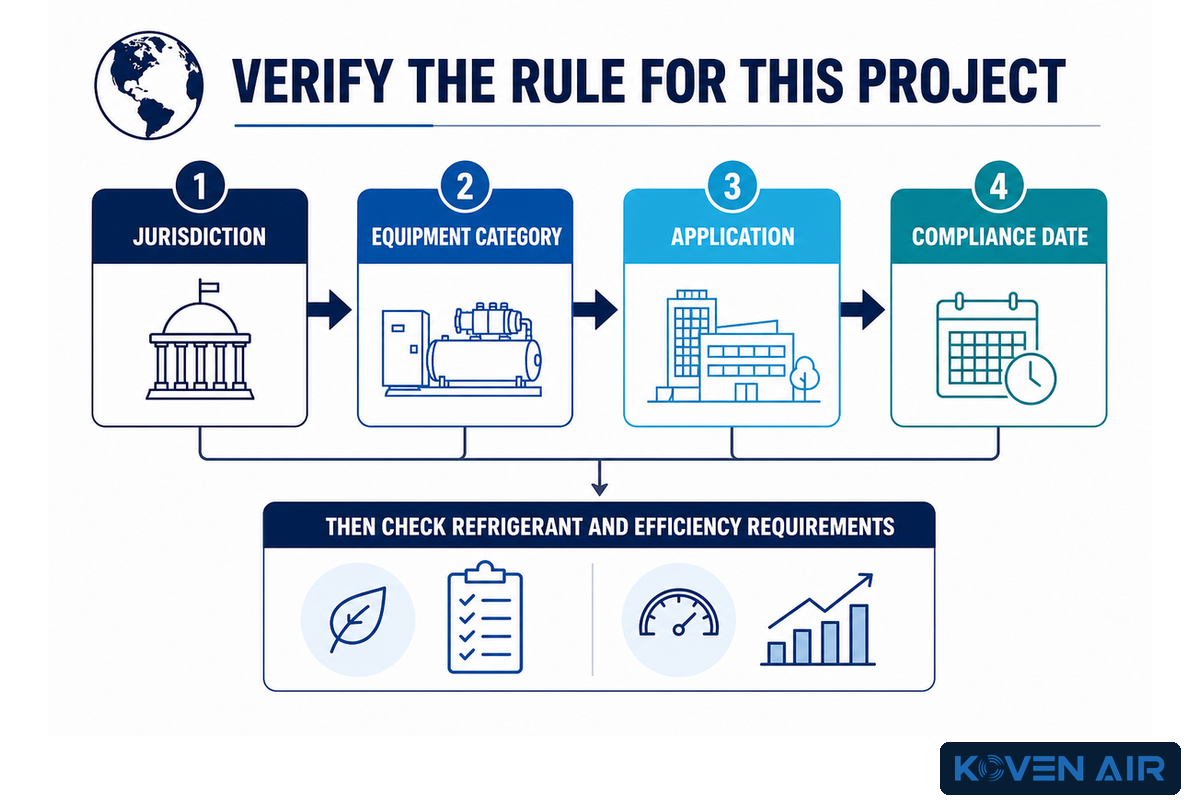
Heat pump chiller refrigerant compliance depends on the jurisdiction, whether the equipment is treated as a product or an installed system, the application and temperature band, and the relevant manufacture, import, installation, or sale date. No single table row permits or prohibits a refrigerant worldwide.
In the United States, current 40 CFR 84.54 sets restrictions for certain chiller subsectors. For comfort-cooling chillers, the restriction on regulated substances or blends with a global-warming-potential value of 700 or greater takes effect on January 1, 2025. For industrial-process refrigeration chillers, the rule gives January 1, 2026 when fluid exits above −30°C, and January 1, 2028 when fluid exits from −50°C through −30°C. EPA’s current summary table lists chillers below −50°C as not covered by those rows.
The listed dates don’t replace a project compliance review. EPA describes its sector tables as informational and directs readers to 40 CFR Part 84, Subpart B for compliance. Separate product and system tables, footnotes, exceptions, and rule actions may apply. Regulatory structures also differ by market. Before making a compliance statement, record the jurisdiction, application, equipment category, refrigerant, charge, capacity, and the date when the equipment is placed on the market or installed.
DOE and eCFR efficiency categories are distinct from EPA refrigerant subsectors. Establish both rather than assuming that the phrase “heat pump chiller” identifies either category. Koven Air’s heat pump chiller refrigerant decoder can organize the inputs, but the current rule and local authority remain controlling.
Questions to Answer Before Product-Specific Engineering
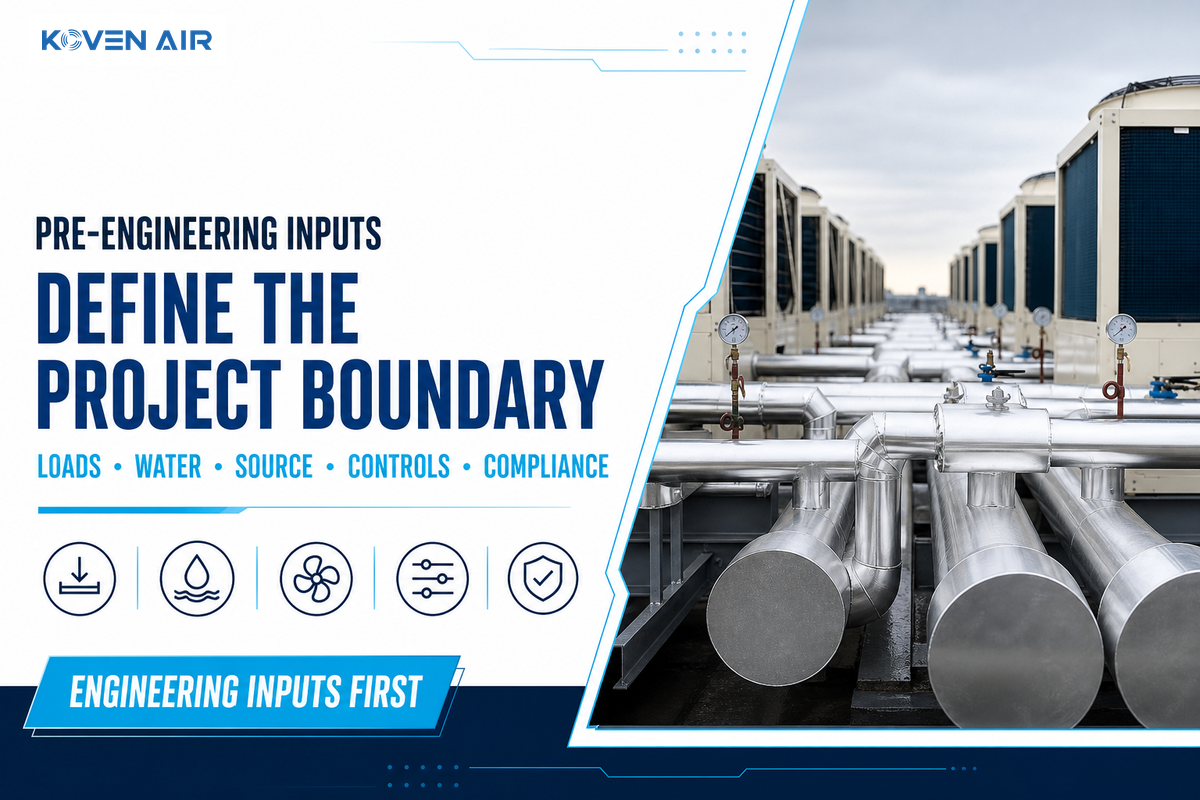
Good heat pump chiller questions begin with project evidence, not a desired piece of equipment. Equipment suppliers and refrigeration engineers need load profiles, incoming water and source temperatures, flow rates, source conditions, hydronic configuration, electrical parameters, control requirements, compliance inputs, and commissioning responsibilities.
| Input category | What to provide | Why it matters | How to verify |
|---|---|---|---|
| Loads | Hourly or seasonal heating and cooling profiles, including overlap | Capacity, mode hours, and recovery opportunity | Meter data or calibrated model |
| Water temperatures | Design entering and leaving values for every loop | Lift, capacity, emitter compatibility | Design documents and field trend |
| Flow and hydraulics | Design flow, pressure drop, pumping, storage, redundancy | Heat transfer and auxiliary power | Pump curves and balancing report |
| Source and sink | Annual temperature range and available rejection path | Operating envelope and off-window mode | Site data and heat-balance diagram |
| Electrical and site | Supply, starting limits, space, sound, access, structural constraints | Feasibility and installation scope | Single-line, survey, and sound criteria |
| Controls | Sequence, integration points, sensors, staging, alarms | Stable part-load and simultaneous operation | Controls narrative and point list |
| Compliance | Market, application, equipment class, refrigerant, relevant dates | Legal and procurement boundary | Current authority and standard scope |
| Acceptance | Factory evidence, field tests, responsibilities, trend period | Turns a promise into a verifiable handoff | Approved test plan and signed records |
Key takeaway
Select a heat pump chiller from a verified operating map: loads, temperatures, source and sink, hydraulics, controls, compliance, and acceptance evidence must align before a nameplate comparison becomes meaningful.
Frequently Asked Questions
What is a heat pump chiller?
A water-based heating and cooling machine
Heat pump chillers transfer heat between a source and water circuits. Depending on their piping and controls, they can provide chilled water, hot water, or both. Reversible two-pipe units change a shared circuit between modes, while four-pipe machines serve separate hot- and chilled-water loops. Verify modes and temperatures before selection.
Can a heat pump replace a chiller?
Sometimes, after a system-level review
Some projects can replace a cooling-only chiller with a heat pump, but the change isn’t automatic. Engineering teams must check heating and cooling loads, required water temperatures, source or ambient conditions, electrical capacity, pumps, emitters, storage, controls, and heat rejection. Reversible units may provide seasonal heating and cooling, while four-pipe designs can serve concurrent loads. High-temperature legacy coils or a missing heat sink may expand the retrofit beyond the plant room. Commission every operating state before accepting the replacement.
What is the difference between a heat recovery chiller and a heat pump?
The operating dependency is the key distinction
Heat pumps form a broad category. Dedicated heat-recovery chillers are selected around a cooling load and capture condenser heat for a heating demand. Some four-pipe heat pump chillers also offer recovery. What matters is whether heating depends on active cooling, which circuits are served, and what happens when loads don’t overlap.
How does a four-pipe heat pump chiller work?
It serves separate hot- and chilled-water circuits
Four-pipe heat pump chillers connect to separate hot- and chilled-water circuits. During simultaneous operation, the refrigerant cycle can move heat removed from the cooling load toward the heating loop. When loads don’t balance, the machine may need outdoor air, a source loop, storage, or another heat-rejection path. Pipe count doesn’t prove valuable recovery. Confirm load overlap, temperature compatibility, available modes, controls logic, and the destination for surplus heat. Test each mode with trend data before accepting the sequence.
Is a heat pump chiller always more efficient than a chiller and boiler?
No; the comparison depends on boundaries and operating hours
Heat pump chillers aren’t always more efficient. Results depend on source temperature, hot-water temperature, load overlap, part-load behavior, auxiliary power, and seasonal hours. Compare annual performance with the same weather, loads, tariffs, emissions basis, and energy boundary over representative seasons.
Can a heat pump chiller be integrated into an existing hydronic system?
Yes, if temperatures, hydraulics, and controls are compatible
Integration is possible when the existing hydronic system fits the selected machine’s temperature and flow envelope. Review coils or emitters, pumps, valves, heat exchangers, storage, water quality, electrical service, heat rejection, controls, and access. Legacy heating systems designed for hotter water may require coil or distribution changes. Commissioning should test heating-dominant, cooling-dominant, and simultaneous states. Site surveys and operating trends are more useful than a model number at the beginning. Record source conditions and auxiliary power during every functional test.
Ready for product-specific engineering?
Bring the load profile, water temperatures, source conditions, hydraulic diagram, electrical limits, controls scope, and compliance market. Koven Air can then review capacity, configuration, customization, and verification requirements without turning an educational guide into a model-selection shortcut.
Editorial transparency: This guide synthesizes current public standards pages, government tables, peer-reviewed research, engineering cases, and first-party architecture pages. It does not use private plant data or Koven model-specific test results. Compliance and performance statements must be rechecked against the current rule, rating scope, project conditions, and supplier documentation.
References & Sources
- US11378314B2 refrigeration-system description: United States patent record
- Dedicated Heat-Recovery Virtual Chiller: ASHRAE Journal
- AHRI 550/590 and 551/591 Standard Scope: Air-Conditioning, Heating, and Refrigeration Institute
- 10 CFR Part 431 Subpart F: Electronic Code of Federal Regulations
- Operating characteristics of air-source heat pumps in cold regions: peer-reviewed research indexed by ScienceDirect
- Retrofit Requires Modular Chiller With Heat Recovery: Consulting-Specifying Engineer
- Technology Transitions HFC Restrictions by Sector: U.S. Environmental Protection Agency
- 40 CFR 84.54: Restrictions on the Use of Hydrofluorocarbons: Electronic Code of Federal Regulations