Get in Touch with Koven Air Company

Quick Specs
| Refrigerant dew-point floor | ~+4 to +7°C (39-45°F) |
| Desiccant dew-point floor | to ~-40°C |
| Governing test standard | ANSI/ASHRAE 139-2025 |
| Process-air temperature rise | ~13°C across a rotary desiccant wheel |
| Typical desiccant regeneration heat | ~2,400-2,600 kJ per kg of water removed (heat of adsorption, above plain water’s vaporization enthalpy) |
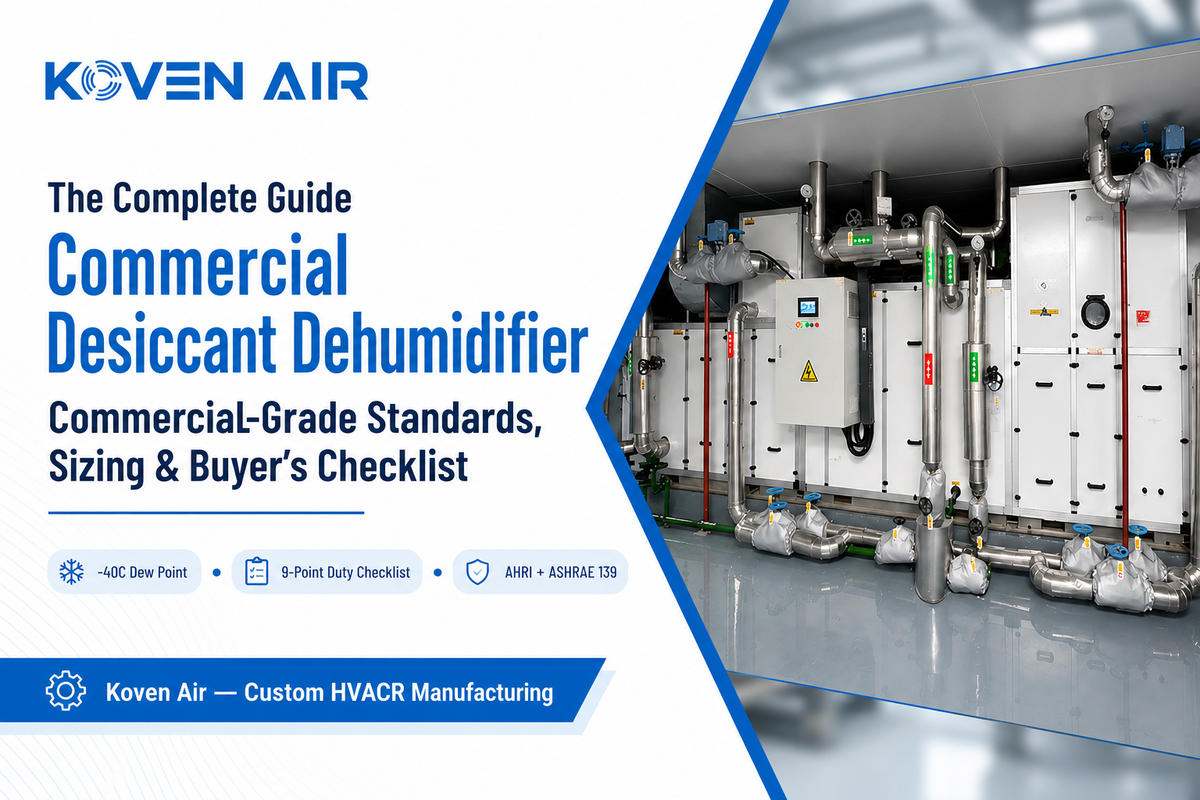
A commercial desiccant dehumidifier is industrial and commercial drying equipment that takes moisture out of process air by passing it through a hygroscopic substance rather than a cold coil, which is why it can achieve dew points far below a refrigerant unit’s limits. You’ll see nothing but product listings and rental pages in search results for this equipment; thus this isn’t a product page – it’s the buyer- and specifier-side education that those listings skip: what distinguishes commercial-duty from relabeled portable unit, who decides in a project, how to interpret a spec sheet, and how to discern a reliable supplier.
Briefly put: a commercial desiccant dehumidifier desorbs water by adsorbing it onto a desiccant material-usually silica gel on a wheel or a lithium chloride solution-rather than by refrigerating air to below the dew point. This difference allows the system to pull a process air stream down to roughly -40C dew point, a value far below the roughly +4C/+7C that a compressor system can manage without the coil icing over.
In This Guide
- What actually separates commercial-grade from a bigger portable unit
- How Desiccants Compare with Refrigerant – and the Other Desiccant Types That You’ll Encounter
- Who’s normally involved in specifying the equipment and at what stage?
- A sizing approach beyond just looking up a nameplate value
- Developing a Vendor Evaluation Checklist and interpreting standards in a specification document
What Is a Commercial Desiccant Dehumidifier?
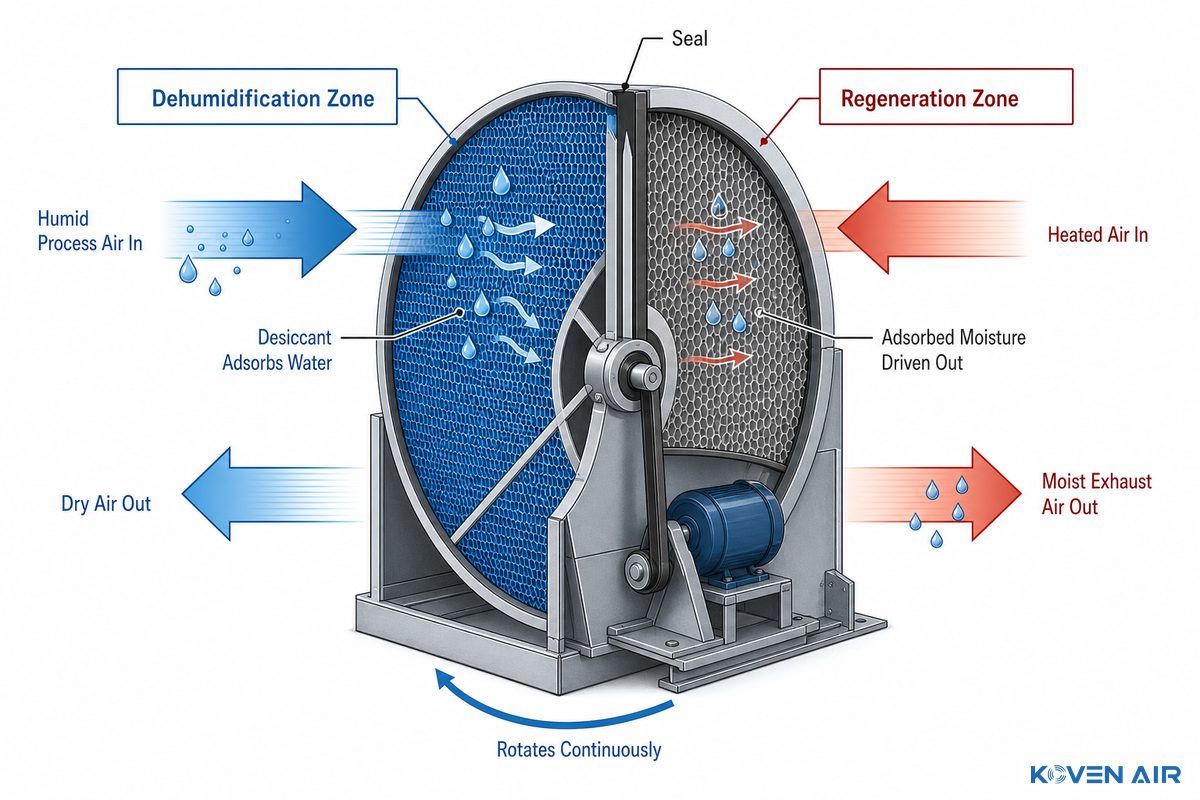
A commercial desiccant dehumidifier is industrial drying equipment that uses desiccant adsorption instead of refrigeration cooling to remove moisture. Air passes through a rotating wheel coated in silica gel or a molecular sieve, which pulls water from the airstream, while a separate heated section continuously drives that moisture back out to regenerate the material. Liquid-desiccant systems do the same job with a lithium-chloride solution instead of a wheel.
The wheel rotates continuously between two zones: dehumidification, where the desiccant strips water from process air, and regeneration, where electric- or gas-heated air drives the adsorbed moisture back out so the material keeps working. Ongoing patent activity in this space, including a 2024-granted method for vacuum-pump-assisted desiccant regeneration, targets exactly this regeneration step as the main lever for improving system efficiency.
The difference that actually matters come down to temperature. Conventional dehumidifiers, meaning refrigerative (compressor) dryers, cool air below the dew point of the air to condense and drain the moisture; while simple and efficient in a warm environment, the cooling coil will ice up once the air temperature reaches about +4C/+7C (39-45F) and capacity will plummet below that. Desiccant dryers never cool anything below the air’s dew point, so there’s no risk of the cooling coils icing up. That’s why you’ll find desiccant dehumidifiers in ice-making facilities, cold-storage units, clean rooms for pharmaceuticals and electronics assembly, lithium-battery production, and any other applications that are inherently cold or require dew points below the achievable limit of refrigerative equipment-in other words, it’s only worth the increased cost of desiccant systems over refrigerant for cold applications and applications requiring exceptionally dry air.
What you find over on some mechanical-engineering practitioner forums is that desiccants get spec’ed for the *truly* low-dew-point applications – material storage, lithium-battery fabrication, maybe even some critical medical spaces (orthopedic-surgery suites) – not for comfort control. It all tracks with the physics: the dessicant earns its cost at the low end of the dew point range, not at the midpoint where a refrigerant solution is cheapest to operate.
📐 Engineering Note
The governing USA standard is ANSI/ASHRAE 139, “Method of Testing for Rating desiccant dehumidifier Utilizing Heat for the Regeneration Process.” The standard has had several editions since 1998; the 2025 edition is current – look at your spec sheet: the numbers on a data sheet for an industrial dessicant unit should tell you which edition of the standard was used for their test procedures, because the test methodology, dewpoint reporting, and data-reporting conventions can change between editions. This is squarely a safety and indoor air quality matter, not just a paperwork exercise: a mis-tested dewpoint number undermines the mold and corrosion prevention the whole system exists to deliver.
Is Your Facility “Commercial-Grade” or Just a Bigger Portable Unit?
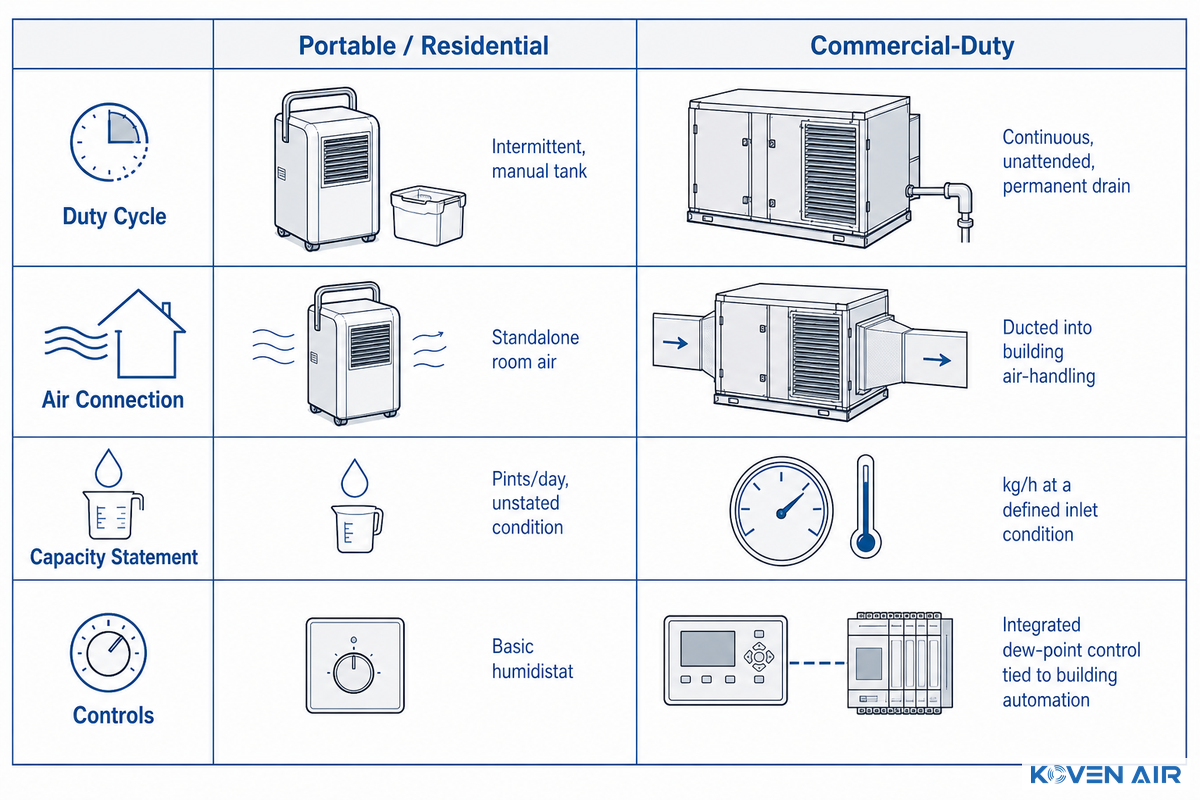
Not automatically. Search results for “commercial dehumidifier” skew heavily toward portable, roll-around units sold for basements, job sites, and grow rooms, where “commercial” often just means bigger than a residential unit. Buying on that label alone risks acquiring equipment that isn’t rated for continuous operation, isn’t ducted into building air handling, and wasn’t built to run unattended for months at a time.
A distribution center running three portable units around the clock to hold a dry-storage RH target will burn through collection tanks, filters, and eventually the units themselves within a couple of seasons, at a total cost that would have covered one properly ducted commercial unit with room to spare.
Commercial Duty Grading: The 9-Point Checklist
Nine criteria, by equipment type, distinguish true commercial/industrial duty equipment from repackaged portable unit units; none are included in the marketing language of either category:
| Criterion (Equipment Type) | Portable/Residential | Commercial-Duty |
|---|---|---|
| Duty cycle | Intermittent, often with a manual collection tank | Rated for continuous, unattended operation with a permanent drain |
| Air connection | Standalone, draws room air directly | Ducted into the building’s air-handling system |
| Capacity statement | Pints/day at an unstated or best-case condition | Moisture-removal rate in kg/h, stated at a defined inlet condition |
| Controls | Basic humidistat, on/off | Integrated dew-point or RH control system tied into building automation |
| Filtration grade | Basic washable filter, no MERV rating stated | Rated filter (typically MERV 8-13) sized to the process airflow in m³/h |
| Noise rating | Often 55-65 dB at 1m, unstated test distance | Sound-pressure level specified at a stated distance and duty point |
| Warranty term | Typically 1 year, parts only | Multi-year coverage with documented after-sales response times |
| Service access | Sealed unit, no field-serviceable parts | Hinged panels, accessible filters and desiccant media for on-site service |
| Regeneration energy source | Fixed internal heater, not selectable | Electric or steam regeneration source specified to match site utilities |
The capacity-row is often where a facilities manager can be led astray. For most portable units, “pints per day” is measured under the best-case, laboratory condition and bears little relation to what you’ll achieve in the actual field, while the moisture-removal rate for a well-specified commercial unit will be listed against a specific temperature and RH. Whenever a manufacturer lists a single number, check to see the conditions associated with it before comparing anything. Koven’s commercial desiccant dehumidifier products, for example, list the moisture-removal rate based on a stated 27C / 60%RH inlet air condition, not just a best-case number.
Desiccant vs. Refrigerant, and the Other Desiccant Types You’ll See Quoted
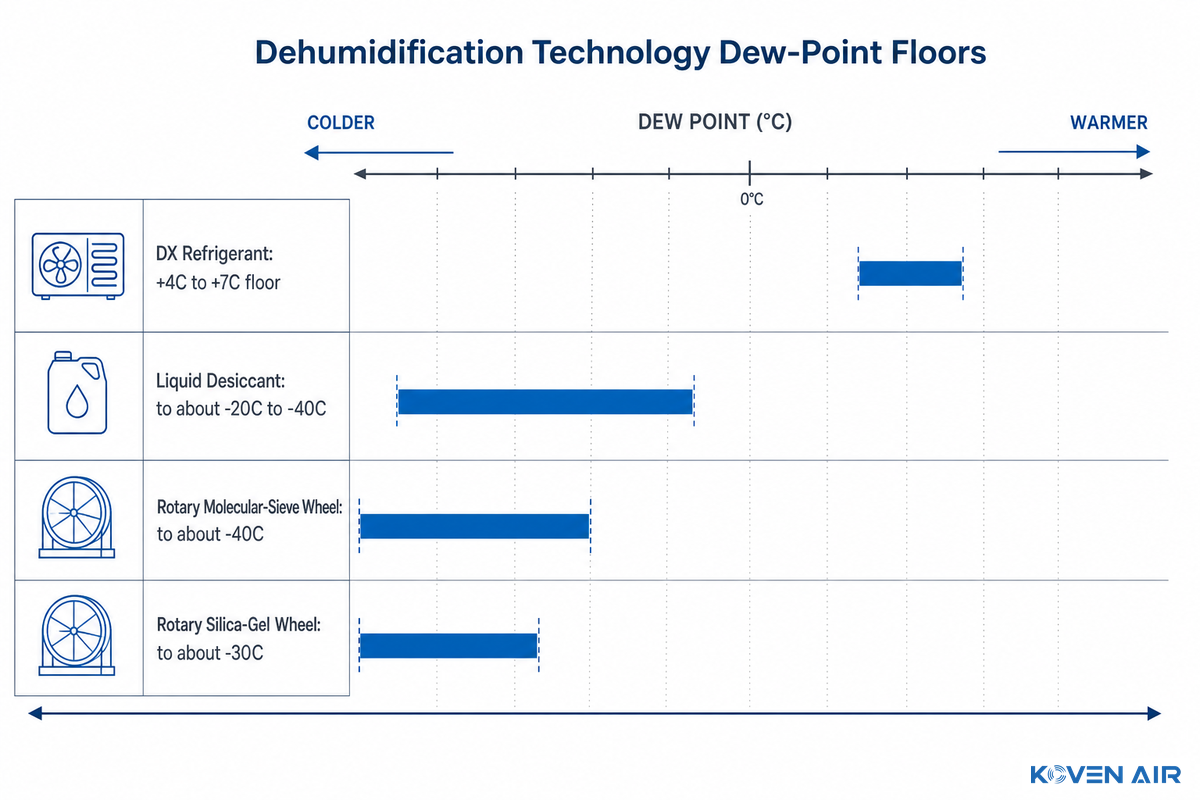
Three distinct technologies vie for the majority of dehumidification duties; the choice of which technology to use should be driven by engineering and not by brand preference. Refrigeration is cheapest to operate when temperatures are high and humidity can be targeted at an intermediate level. Rotary desiccants kick in as the air get colder or if the desired low-dew-point temperature falls below the practical operating limit of the refrigeration system. The third, a liquid-desiccant system, performs largely the same drying as a rotary dessicant, but using a lithium-chloride or salt solution; this adds two benefit, namely that it has a built-in reserve capacity that can be drawn upon to absorb a surge of moisture and the air can be simultaneously cleaned or scrubbed in the liquid as it’s being dried.
| Factor | Refrigerant | Rotary Desiccant | Liquid Desiccant |
|---|---|---|---|
| Practical dew-point floor | +4 to +7°C | to ~-40°C | to ~-40°C, deep low-RH |
| Behavior in cold air (<10°C) | Capacity falls, coil frost risk | Unaffected | Unaffected |
| Effect on supply-air temperature | Cools and dries | Adds ~13°C across the rotor | Near-isothermal, can cool |
| Best fit | Warm spaces, mild RH, comfort | Cold rooms, process air, ice rinks | Deep low-RH, dry rooms, corrosive air |
Is a desiccant dehumidifier better than a refrigerant dehumidifier?
Neither is inherently superior; space temperature and target dew point dictate the best choice. At a dew point of 40°F or less, or an ambient temperature under roughly 10°C, refrigeration-based systems fall short or ice up, making desiccant the viable option. For a warmer space with a modest humidity target, refrigeration is usually cheaper to run.
Active members of mechanical-engineering forums report using both system families on individual projects before deciding between the two, and that’s the right approach: the decision is condition-driven, not a matter of general ranking.
✔ Desiccant Advantages
- Reaches dew points a compressor can’t physically hold
- No coil to freeze in cold air
- Stable performance regardless of ambient temperature
⚠ Desiccant Limitations
- Regeneration heat is a real, ongoing operating cost (~2,400-2,600 kJ per kg of water removed)
- Adds roughly 13°C to the supply air, which needs re-cooling in a warm space
- Not worth the added cost in a mild, warm-space comfort application
If you’d like more mechanical information on the function of the rotary wheel-including its various media types, its required regeneration temperature, and expected operational life-then our complete guide on how a rotary desiccant dehumidifier works goes more in-depth than this summary.
| Technology Type | Practical Dew-Point Floor | Typical Commercial Use |
|---|---|---|
| Rotary silica-gel wheel | to ~-30°C | Cold storage, general process air |
| Rotary molecular-sieve wheel | to ~-40°C | Lithium-battery and pharmaceutical dry rooms |
| Liquid lithium-chloride | to ~-40°C | Deep low-RH with air-washing benefit |
| Liquid calcium-chloride | to ~-20°C | Corrosive or coastal air environments |
| DX refrigerant (air-cooled) | +4 to +7°C | Warm-space comfort and mild-RH targets |
| Chilled-water refrigerant | +5 to +8°C | Sites with an existing chilled-water loop |
| Hybrid desiccant/refrigerant | Varies by stage | Ice rinks and cool natatoriums, staged control |
| Passive desiccant packs | No active dew-point control | Small enclosed spaces, shipping containers |
| Thermoelectric (Peltier) | ~+10°C, low capacity | Small cabinets, not commercial-scale |
Who Actually Specifies This Equipment, Engineer, Facility Manager, or Owner?
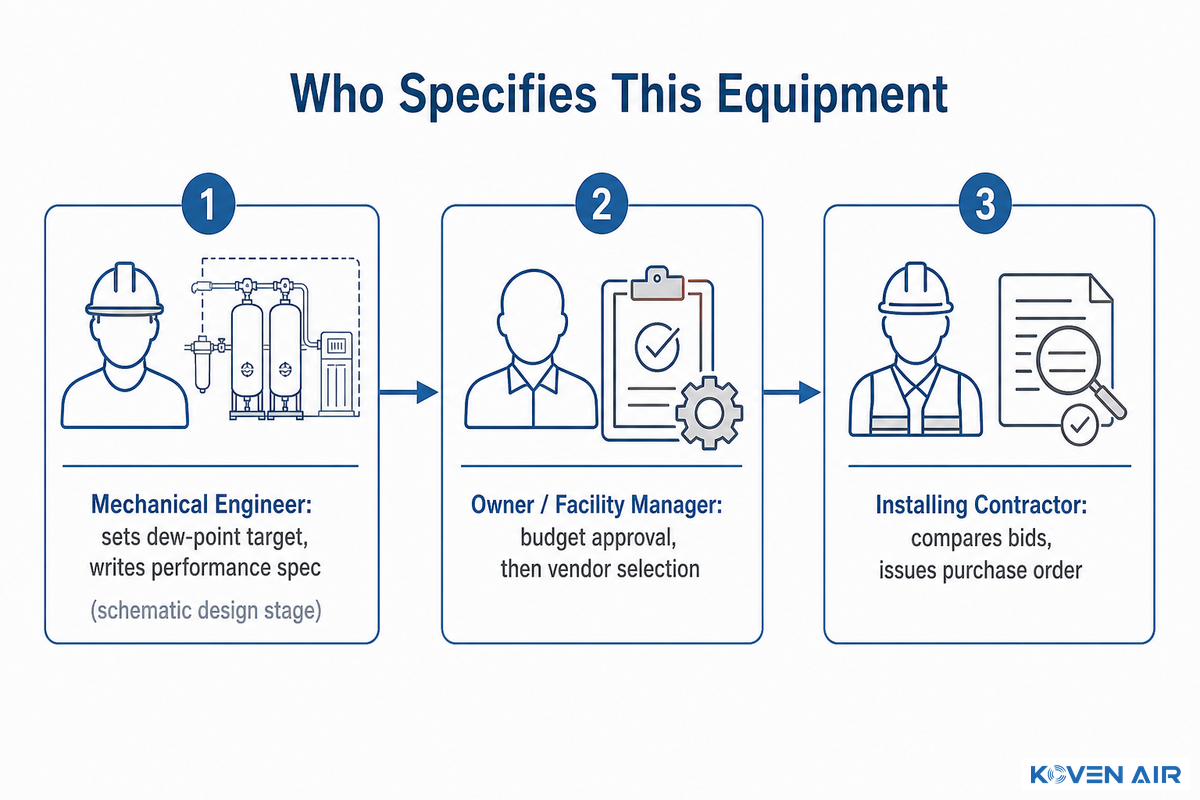
The mechanical (MEP) engineer usually initiates the equipment decision, during schematic design, not procurement, though the exact sequence varies by project delivery method. On new construction or a major renovation, the engineer sets the target dew point or RH from the process requirements, selects refrigeration or desiccant, and writes the performance spec into the mechanical drawings.
The owner or facilities manager typically enters the picture twice: once at budget approval, and again at vendor selection, when procurement and the installing contractor compare bids against the engineer’s specification. NIST’s guide-specification research on this handoff found that ambiguity at the transfer point, not the engineer’s original calculations, is the most common source of the substitutions and change orders that show up later.
there are two details to keep in mind if you’re facing this process for the first time. Firstly, the decision of what type of equipment to use is made earlier than most non-engineers expect: once the duct work and the air capacity of the system are specified on the mechanical drawings, it becomes much more expensive to implement a desiccant system later on. Secondly, the individuals responsible for selecting and purchasing the equipment are often different from those specifying it: while the engineer defines the performance parameters of the equipment, the installing contractor or a procurement manager typically issues the purchase order once a bid meeting the specified criteria is chosen. For owners or facilities managers who are considering this type of equipment for an existing facility rather than a new build, the two roles merge into one, which is why this guide has been designed for a general audience rather than just specialists.
The cost of getting this sequence wrong shows up later than most people expect. A facility manager who signs off on a cold-storage expansion without looping in a mechanical engineer at the schematic stage can end up with ductwork and air-handling capacity already fixed by the time anyone realizes the refrigeration-only system specified for the space can’t hold the dew point a low-temperature warehouse actually needs. Retrofitting a desiccant system in after the fact usually means opening finished ceilings and re-routing regeneration exhaust, a change-order cost that a five-minute conversation with the engineer during design would have avoided entirely.
“We size to the dew-point target and the site load, not to a nameplate RH number. Before we quote a unit, we confirm the moisture-removal capacity and the temperature rise across the equipment against the actual measured load, that step is what keeps a project from ending up 20% undersized on the worst day of the year.”
Koven Air Application Engineering team
Where Commercial Desiccant Dehumidification Gets Specified
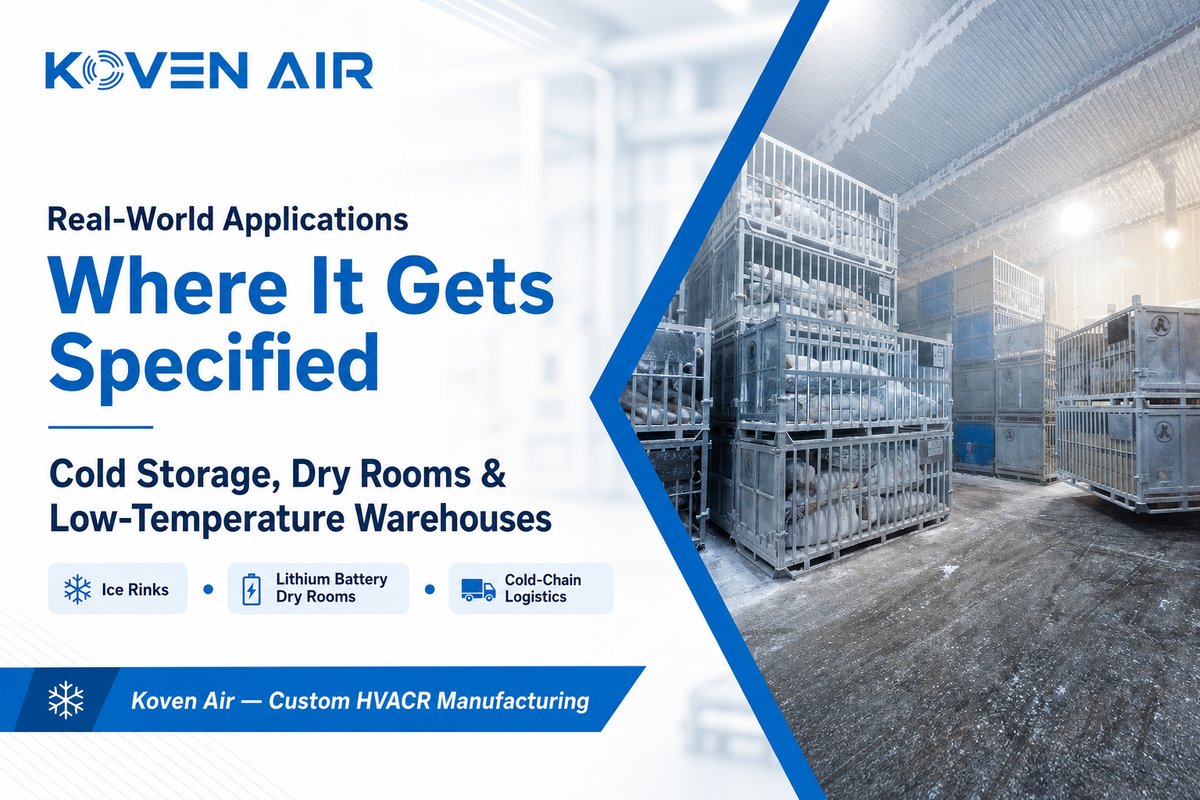
Desiccant-based dehumidification gets specified anywhere the air runs cold, the target dew point is aggressive, or preventing condensation itself, not just comfort, is the primary concern. It shows up most often in cold storage, dry-room manufacturing, ice rinks, data centers, and a handful of less-obvious facility types covered below. Common applications for desiccant dehumidifiers include:
- Storage and warehouses-particularly low-temperature spaces- where preventing frosting of cooling coils and products is essential and a system that only provide refrigeration won’t suffice
- Dry rooms for lithium-battery and pharmaceutical manufacturing – sub-zero dew points below 1% RH
- Ice rinks – eradicating fog and steel-structure condensation at a supply-air dew point a refrigeration-only rooftop can’t even touch
- Data centers and server rooms – narrow humidity ranges to preserve sensitive equipment
- Certain healthcare venues, including surgical suites – practitioners on mechanical-engineering forums explicitly mention orthopedic-surgery environments as a low-dew-point application
- Food processing and packaging lines – controlling humidity to prevent mold and mildew growth on product-contact surfaces and packaging
- Water damage restoration and structural drying – a compact, efficiency-focused desiccant unit is often faster at removing moisture and preserving a building’s structural integrity than waiting out ambient conditions
- Wind-turbine nacelles and outdoor electrical/utility enclosures – a less-often talked-about but real application, preventing corrosion damage in unconditioned outdoor enclosures
Indoor pools and greenhouses are coming up in search hit results with this topic, but the application fit is weaker – both are warm, high-latent-load spaces where refrigerant-based heat-recovery equipment (not industrial dehumidifiers) is the more common, and normally more economical option; desiccant plays a supporting role there at most, for shoulder-season cool-down or glass-condensation control rather than as the exclusive system. For the full engineering depth on low-dew-point, dry-room, and ice-rink applications specifically, Koven’s commercial and industrial desiccant dehumidifier line covers model selection for each of those application types.
Sizing Basics Every Buyer Should Understand Before Requesting a Quote
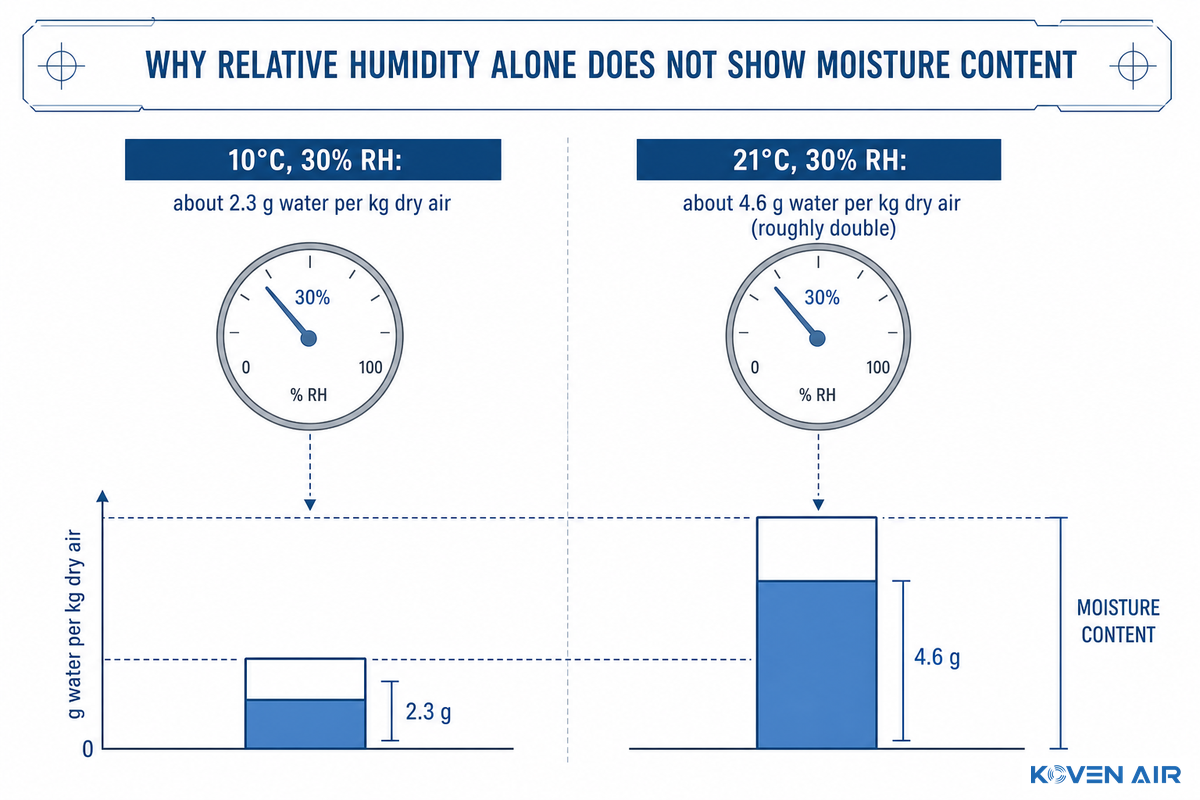
The single most common, actually verifiable spec error is sizing on relative humidity instead of dew point, or comparing capacity figures without checking the entering air condition they were measured against. One vendor engineering guide is blunt about it: comparing rated capacity without confirming the actual entering air temperature, humidity, fresh-air load, and target dew point behind that number is a common selection mistake. A separate industry methodology guide makes a related point: the most common design mistake is focusing entirely on the mechanical equipment while ignoring the building envelope and infiltration, which is frequently what’s really driving the moisture load.
This isn’t a niche caveat, either. One trade-press sizing guide states it plainly: square-footage-based rules of thumb “fail badly across climate zones” — the fix is sizing by actual moisture-removal efficacy at your real operating condition, not by a nameplate number generated under a different one.
📐 Worked Example
An RH value without a temperature doesn’t show how much water is in it. In a 10C space, 30% RH contains about 2.3 grams of water per kilogram of dry air; at 21C, that same 30% RH contains about 4.6 g/kg, almost twice as much actual moisture, for the same relative humidity reading. Sizing just by target RH without including the temperature space make or breaks a unit by two in size (whether a knowledgeable designer or vendor is doing it for you) before a single cubic meter of flow is determined. Size by dew point or grains/kg, not just by relative humidity.
Four inputs make up a defensible sizing process: (1) the process airflow rate, driven by space volume and air change rate or makeup air volume; (2) the infiltration and internal moisture load-people, product, open doors, fresh air-which is often the dominant term, and is the most commonly underestimated one; (3) the target dew point to keep the product or space safe; and (4) the design day outside air condition. Any quote that jumps from square footage to a model number without asking for at least three of those is an invitation to dig deeper before you sign the dotted line. In the field, a cold-storage buildout that skipped the infiltration step once ended up back on the phone with its supplier three months after commissioning, still 15% short of its target dew point (a real use case, not a theoretical one), because the original quote never accounted for how often the dock doors actually opened during a 12-hour shift. The Koven sizing calculator runs through the same four-input process for an initial estimation before a full load-verified selection.
Physical footprint and utility sizing matter just as much as the moisture-removal number itself. A mid-capacity commercial desiccant unit’s cabinet commonly runs 1,200mm to 2,400mm in length depending on airflow class, weighs roughly 200kg to 600kg once fully assembled, a real load consideration for roof-curb or mezzanine mounting, and its regeneration heater is typically rated 6kW to 24kW depending on unit size and the temperature rise required. Electrical service is usually 380V at 50Hz three-phase in most export markets or 460V at 60Hz in North America, a detail worth confirming with the vendor before a unit ships to the wrong grid.
The Standards and Certifications Worth Checking on a Spec Sheet
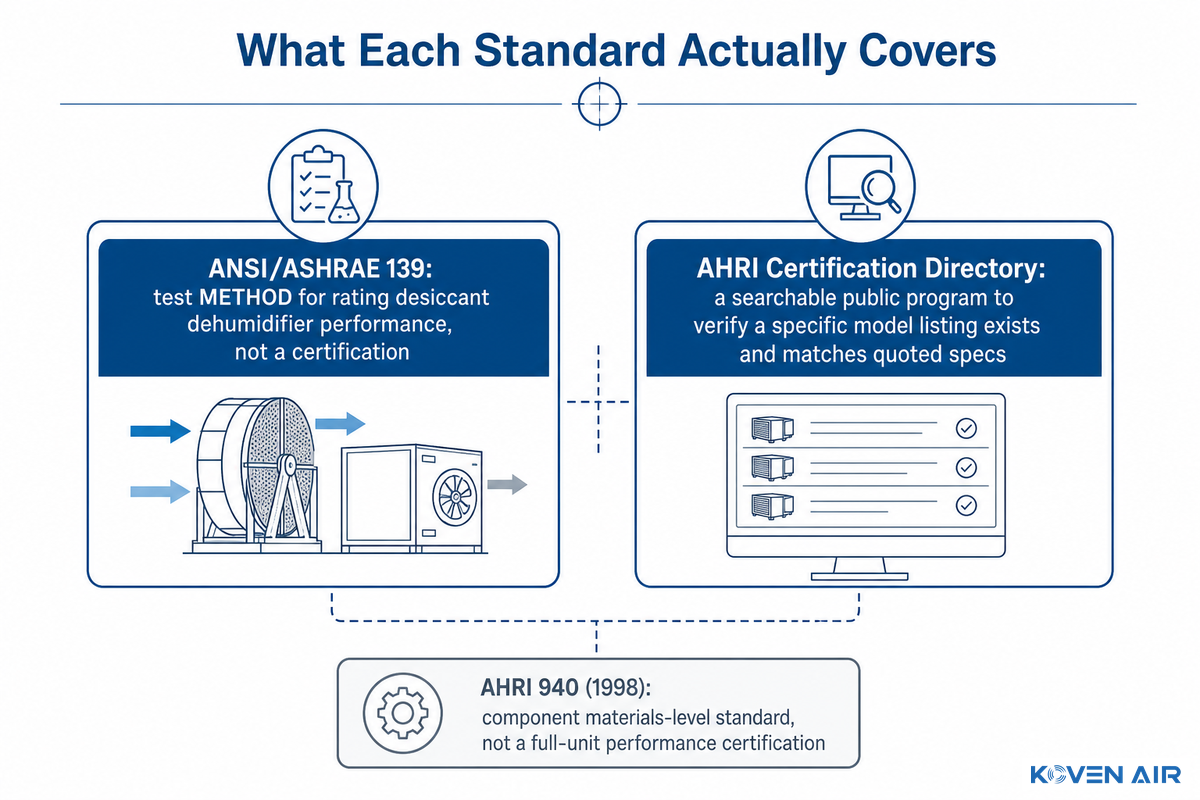
Many customers scan over numbers in a datasheet and have no idea what they confirm. Two standards are worth understanding for this particular category of equipment:
The standard test method is ANSI/ASHRAE 139, “Method of Testing for Rating Desiccant Dehumidifiers Utilizing Heat for the Regeneration Process” — the relevant US test standard for heat-regenerated desiccant apparatus. It specifies how performance figures on a datasheet should have been determined, not what those numbers were. if one supplier provides data sheet numbers that differ from those of another, the first thing to confirm is whether both suppliers tested to the same edition of the same standard.
The test method itself rests on the same measurement infrastructure NIST maintains for US industry generally, which is why two labs following the same ASHRAE procedure correctly should land on comparable numbers even without coordinating with each other. In a separate context, the Air-Conditioning, Heating, and Refrigeration Institute (AHRI) offers its own public certification program with a searchable directory to verify listings. A buyer can (and should) investigate not only the claim of a “certified” designation but also the actual model listed, and search the public AHRI directory to verify it exists in the first place, and that the quoted specs correspond. Another subtle but important detail: AHRI has a Standard 940 in this market, but it’s a desiccant-dehumidification component materials-level standard, and dates back to 1998, from before the institute acquired its current name (ARI). It isn’t a full unit-performance-certification program like the AHRI 910 (indoor pool dehumidifiers) and 920 (DX dedicated outdoor-air units) standards. No desiccant-dehumidifier standard needs to be thoroughly reviewed; just asking the relevant question and checking against the standard scope should suffice.
The risk isn’t hypothetical. A buyer who accepts a vague “certified” claim at face value, then discovers post-installation that the cited standard doesn’t actually cover the unit’s product category, has no real recourse if the equipment underperforms, because the certification they thought protected them was never applicable to begin with. The five minutes it takes to search a model number in AHRI’s public directory before signing a purchase order is cheap insurance against exactly that scenario.
A Buyer’s Evaluation Checklist, What Separates a Reliable Supplier from a Risky One
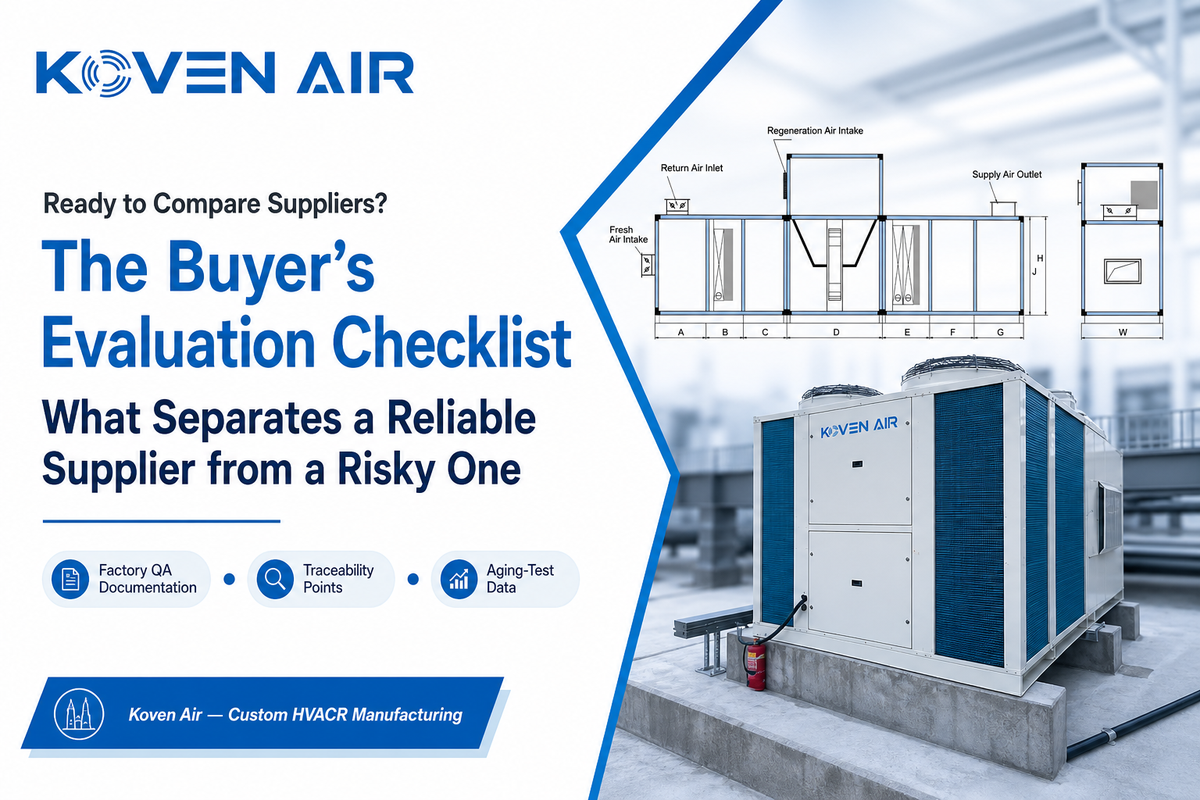
Delivered cost and support risk make or break equipment buys over a number in a price sheet. This concrete checklist tests every claim a vendor make before you seal the deal-with a live demonstration of what an actual documented process and audit trail look like in practice.
Red Flag Screening: The 4-Item Supplier Scorecard
Ask any supplier for these four things before comparing price
- Selection-software-validated capacity (not a nameplate figure – check if your quoted capacity was tested to your moisture load or if it was plucked out of a catalogue table
- Factory QA – detailed checkable steps (eg. # of In Process Inspections, traceability documentation, P-Shipment test) not just vague ‘quality assured’.
- Thank you after-sales commitment in writing (e.g. response-time and warranty terms in writing, rather than verbally assured).
- Up front lead time and compliance-Destination-market refrigerant and electrical compliance, verified at quoting, not discovered after a deposit has been placed.
For a concrete illustration of what “documented factory QA” should look like when a supplier actually has it: Koven Air’s production line runs 18 standardized production processes across a 20,000m2 factory, with 400 process traceability points, 36 documented in-process factory inspections, and a 24-hour aging test on every unit before shipment, backed by an in-house chiller and heat-pump test lab for proof-testing rather than paper claims alone. That level of specificity – a real inspection count, a real traceability-point count, a real test duration – is what an answer to the checklist above should sound like from any supplier. A vague “we test everything” response to the same question tell you something too, just not what the supplier intended. You can review the background behind that process on Koven Air’s company page.
Common Mistakes When Specifying or Buying a Commercial Desiccant System
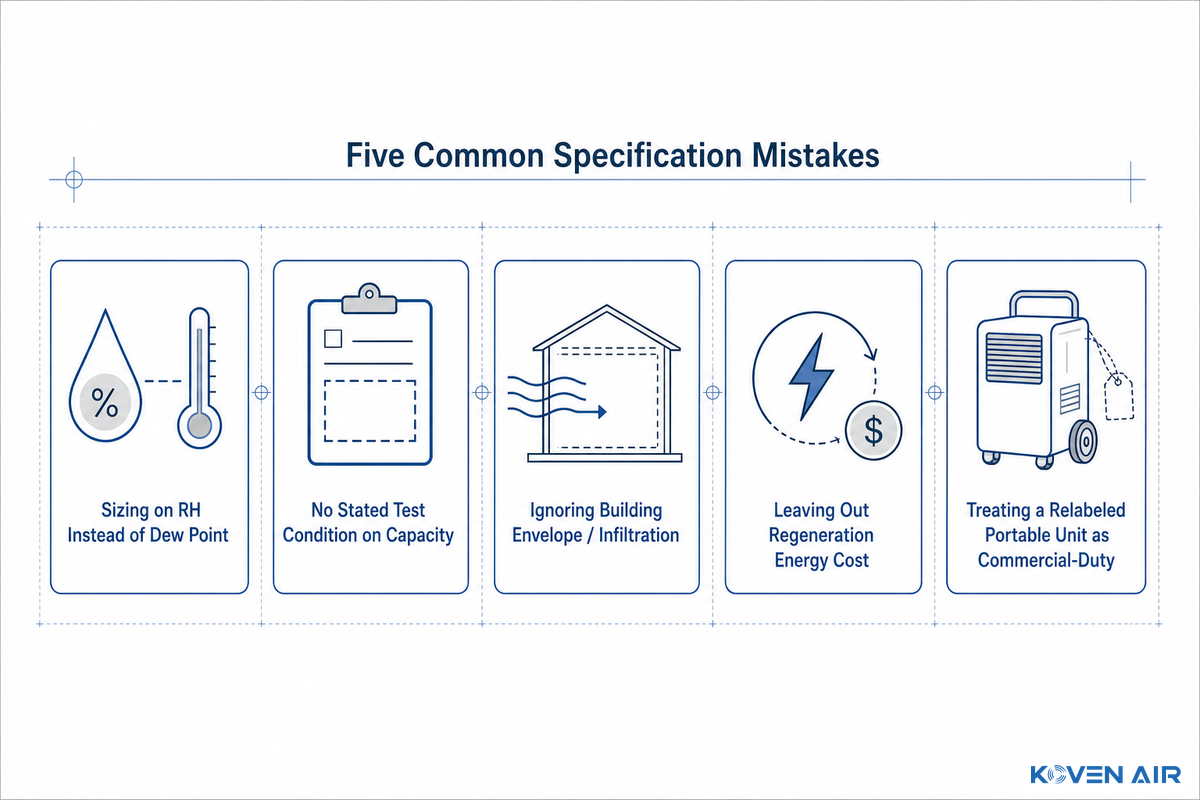
Most of the expensive mistakes on a desiccant project aren’t equipment failures, they’re specification failures that only show up months later, when a unit that passed every factory test still can’t hold the target condition in the field. A warehouse ends up 20% short of its design-day moisture-removal capacity not because the machine is defective, but because someone sized it off a square-footage rule of thumb instead of the actual infiltration load. Even GSA’s facilities standards for federal buildings treat dew point and envelope performance as the governing design inputs rather than a flat RH target, the same principle that trips up private-sector specs when it’s skipped. The five patterns below account for most of that gap.
Key Factors to Consider
- Sizing on RH rather than dew point. As shown above, the same RH reading can represent nearly double the moisture content depending on temperature – size by dew point or grains/kg.
- Comparing capacity numbers without a stated test condition. A “pints/day” or “kg/hr” figure with no entering-air temperature and RH attached isn’t comparable to anything.
- Ignoring the building envelope. Infiltration through doors, dock areas, and unsealed penetrations frequently dominates the real moisture load – an effective airlock or sealed vestibule is often cheaper capacity than a larger machine.
- Leaving regeneration energy out of the operating-cost picture. At roughly 2,400-2,600 kJ/kg water removed, regeneration heat is a real, ongoing line item, not a rounding error – ask for it explicitly rather than comparing purchase price alone.
- Treating a relabeled portable unit as commercial-duty. Revisit the Commercial-Grade Duty Checklist above before assuming a “commercial” label means continuous-duty, ducted equipment.
What’s Changing in Commercial Desiccant Dehumidification
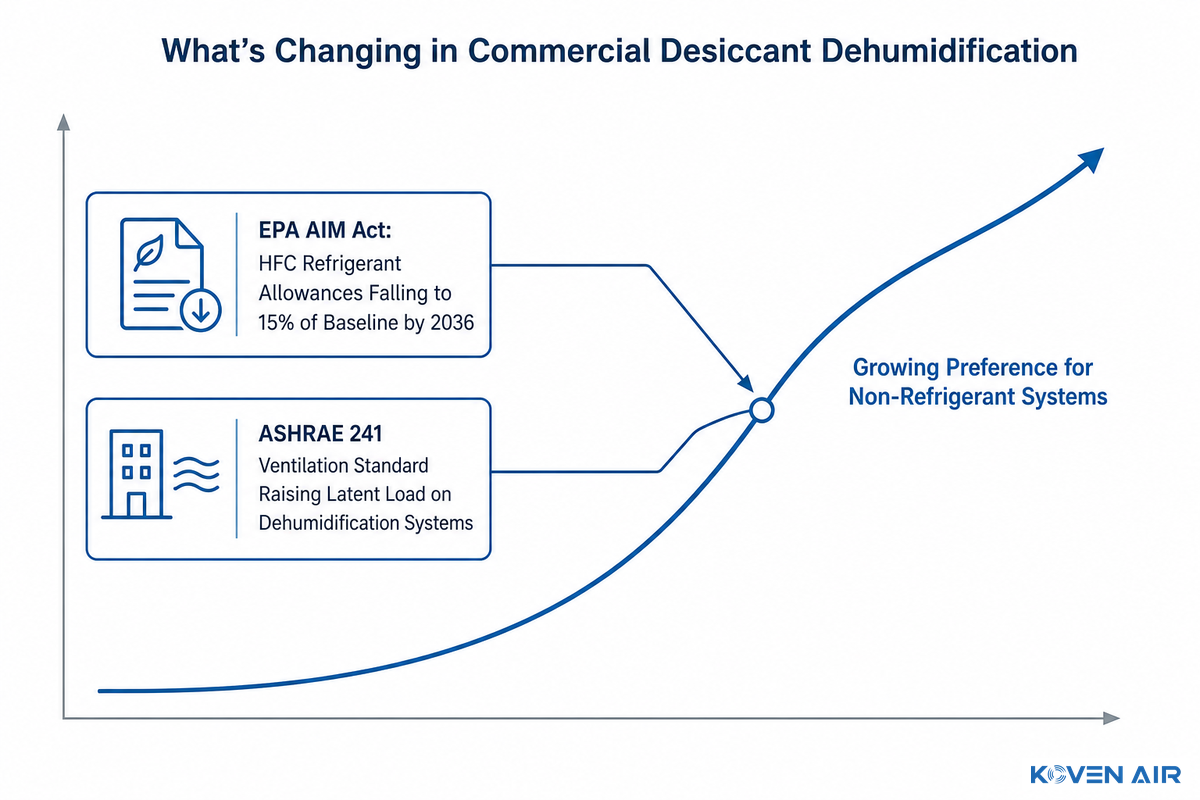
(Updated July 2026) Two regulatory shifts push indirectly in desiccant’s favor for any commercial HVAC project planned into 2026 and beyond. Under the EPA’s AIM Act, HFC refrigerant allowances are scheduled to fall to 15% of historic baseline levels by 2036, and a December 2024 Federal Register rule restricts HFC use in certain new variable refrigerant flow systems starting January 1, 2027.
None of that bans refrigerant-based dehumidification, but it steadily raises the cost and compliance complexity of refrigerant-charge equipment, a category desiccant systems sidestep entirely since they carry no refrigerant charge to phase down or leak-check. Projects with a timeline extending past 2026 should factor refrigerant-transition cost into any refrigerant-based alternative being compared against a desiccant system.
Second, ASHRAE Standard 241, “Control of Infectious Aerosols,” also sets a standard of practice (though technically a minimum requirement) for ventilation for health, covering the minimum amount of filtration, air cleaning and equivalent clean airflow necessary to mitigate risk in covered building types – a standard about ventilation and air quality, not humidity or desiccant. Where to watch, in that case, isn’t what’s on the paper, but what happens down-stream: a building complying with the minimum outdoor air requirements of 241 increases its load on its dehumidification system, as latent, moisture-based load also goes up when air is raised; the increased latent load must go some where, and if you operate one of the building types covered by 241, it’s worth seeing if the system was built before the increase in outdoor air rates.
Regarding the equipment aspect, recent patent activity, including a 2024 granted patent relating to a vacuum-pump assisted regeneration for desiccants as a lower-energy replacement to just-heating a desiccant, reflects ongoing engineering to reduce desiccant’s historical deficit in regeneration energy. Broad market research estimates the total desiccant/industrial-desiccant-dehumidifier market at anywhere from the hundreds-of-millions to low-single-billions of dollars, growing at a mid-single digit rate through the early 2030s; figures will vary depending on market research firm.
FAQ, Commercial Desiccant Dehumidifiers
Q: Are commercial-grade desiccant dehumidifiers worth the extra cost over a large portable unit?
View Answer
For continuous, unattended operation in a cold or low-dew-point space, yes — a portable unit is not rated for that duty cycle and its capacity figures aren’t stated at a comparable test condition. For occasional, warm-space, moderate-humidity use, a large portable or refrigerant unit is usually the cheaper, adequate choice. Duty cycle and target dew point drive this decision, not the “commercial” label alone.
Q: What are the disadvantages of a desiccant dehumidifier?
View Answer
Two real drawbacks: regeneration heat is an ongoing operating cost, at roughly 2,400-2,600 kJ per kg of water removed, and the process generally raises the supply-air temperature by around 13°C across the desiccant rotor. That heat penalty is unwelcome in a warm space but often beneficial in a cold one, which is part of why desiccant suits cold applications specifically.
Q: When does it make sense to add desiccant dehumidification to an existing HVAC system?
View Answer
When your existing refrigerant-based system can’t hold the target dew point, usually because the space runs cold, the target sits below roughly 40°F, or condensation keeps showing up despite a nominal RH set-point. A cold-storage loading dock that keeps fogging up in summer, even with the refrigeration unit running, is a classic trigger case. Retrofitting is easier and cheaper earlier in a renovation, before ductwork and air-handling capacity are finalized on the mechanical drawings.
Q: How long does a commercial desiccant dehumidifier unit typically last?
View Answer
Service life depends heavily on duty cycle, air quality (filtration protects the desiccant media from fouling), and maintenance discipline, with the desiccant wheel or media itself normally the first major wear component. Ask any supplier for documented wheel-life expectations and factory aging-test data specific to their equipment rather than relying on a generic industry figure, since practices vary by manufacturer.
Q: Can a desiccant dehumidifier be added to an existing building without a major retrofit?
View Answer
Sometimes, provided there’s existing ductwork and mechanical room space to accommodate the unit and its regeneration exhaust, but it is rarely a drop-in swap for a refrigerant unit — airflow, condensate, and regeneration-air routing usually need review. Get a site assessment before assuming a like-for-like replacement is possible.
Q: What’s the practical difference between AHRI certification and the ANSI/ASHRAE 139 test standard?
View Answer
ANSI/ASHRAE 139 is a test method, not a certification; AHRI runs a separate certification directory. A claim citing either without a checkable reference deserves scrutiny.
⚠️ Important
A facility can meet a 40% RH set-point on paper and still get condensation and corrosion, since the number that actually matters is dew point, not RH. Size and specify by dew point.
Why We Write This
Most of what ranks for this topic is a spec sheet or rental page, useful once you know what to buy, not before. This guide targets the specifier still asking “what separates commercial-grade from portable.” Its evaluation checklist draws on Koven Air’s documented factory process (36 inspection points, 400-point traceability, a 24-hour aging test per unit) because it’s the one part we can verify first-hand. Reviewed by the Koven Air Environment Technology Co.,Ltd technical team.
References & Sources
- ANSI/ASHRAE 139, Method of Testing for Rating Desiccant Dehumidifiers — ANSI/ASHRAE
- ASHRAE 139-2025 Edition — Accuris Standards Store
- AHRI Certification Program — Air-Conditioning, Heating, and Refrigeration Institute
- AHRI Certification Directory — AHRI
- Frequent Questions on the Phasedown of Hydrofluorocarbons — U.S. Environmental Protection Agency
- Restrictions on the Use of HFCs Under the AIM Act in Variable Refrigerant Flow Systems — U.S. Federal Register
- ASHRAE Standard 241, Control of Infectious Aerosols — ASHRAE
- Calculation of Heat Load from Desiccant Dehumidifiers — MYCOND
- US11859863B2, Method and System for Dehumidification and Regeneration — USPTO / Google Patents
Related Articles
- Rotary Desiccant Dehumidifier: The Complete Guide — how the desiccant wheel itself works, media types, and expected lifespan
- The Complete Guide to RTU HVAC Systems — rooftop unit types and where heat-pump RTUs fit
- The Complete Guide to Commercial Rooftop Units — types, sizing, and costs
- DOAS Rooftop Unit: What It Is and How It Works — dedicated outdoor air systems compared
- Koven’s Commercial & Industrial Desiccant Dehumidifiers — the KSD-D/Q rotor series, models and selection
- About Koven Air — factory background and manufacturing process