Get in Touch with Koven Air Company

Water-Cooled Chillers, Scroll, Screw, Centrifugal & Maglev
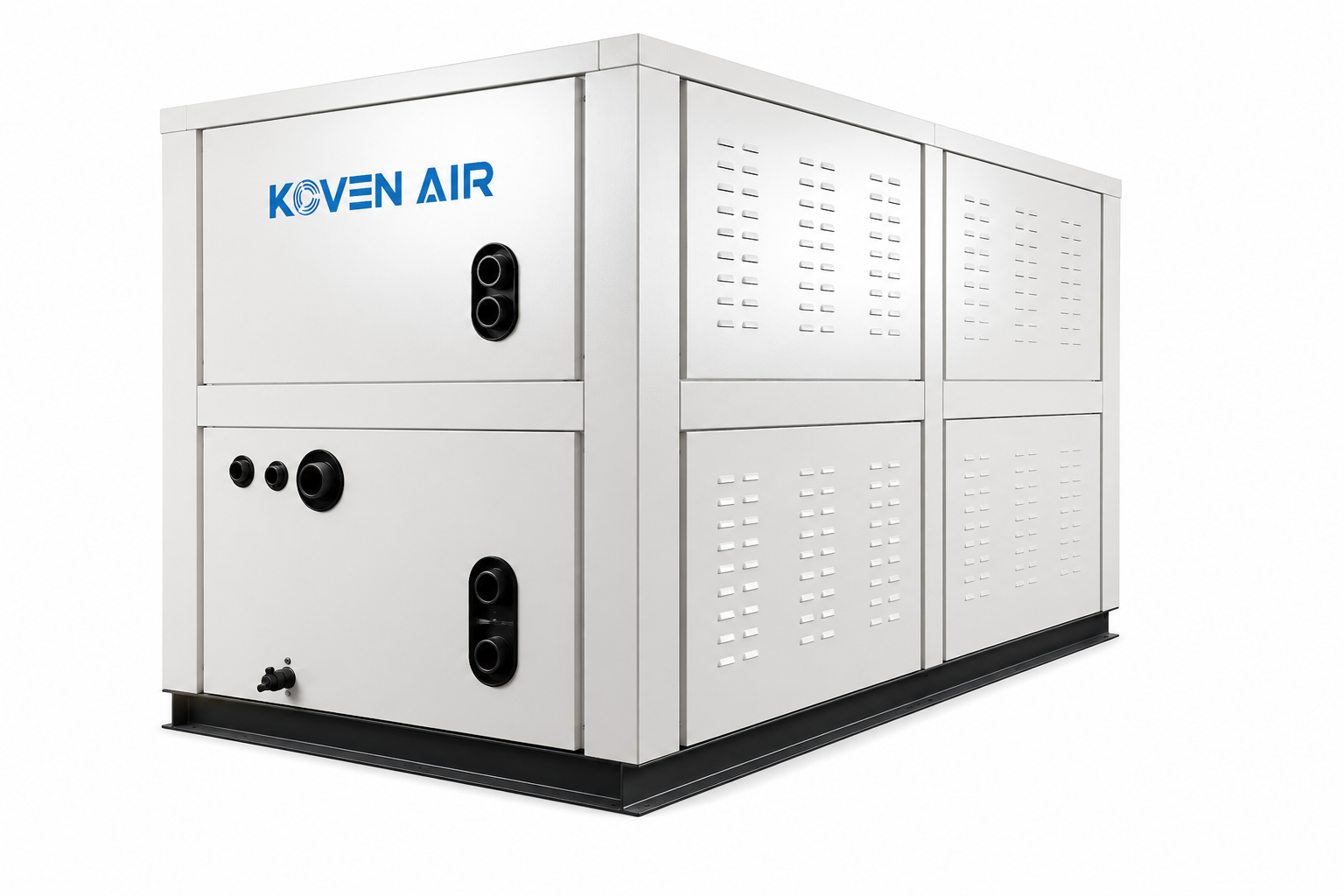
Manufacturer-direct industrial cooling with published AHRI-basis efficiency – not adjective-only “high efficiency” claims. Koven Air builds water-cooled chillers from 3 kW modular units to 3,000+ kW centrifugal plants, verified in our own test laboratory before they ship to 35 countries.
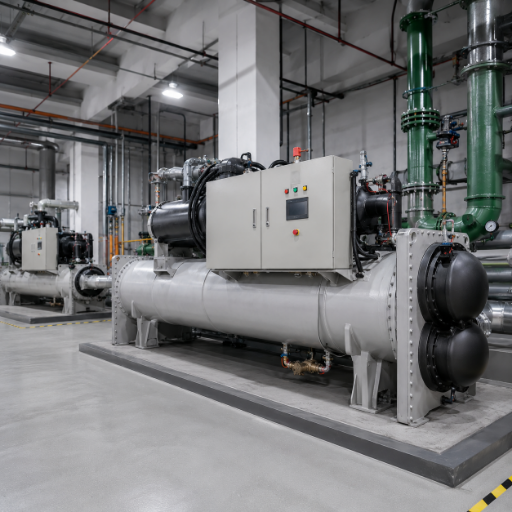
Stable Process & Building Cooling Starts With the Right Water-Cooled Chiller
ederal efficiency guidance — U.S. DOE / FEMP — sets the full-load and IPLV kW/ton baselines we size against.
A water-cooled chiller rejects heat through a condenser water loop and cooling tower instead of ambient air, which holds condensing temperature low and keeps efficiency high on large hvac and process cooling duties. That physics is why hospitals, data centers, and semiconductor plants run this cooling system. Getting it wrong is expensive – and the mistake is rarely the brand.
Three failure points do the damage. Oversize the unit and it loses head pressure below 300 kW of real load; undersize it and the process starves; buy from a supplier who publishes no efficiency numbers and you can’t compare quotes at all.
Where a water-cooled chiller earns its keep
- Continuous, high-runtime cooling above roughly 300 tons (1,055 kW)
- Indoor plant rooms where noise and weather exposure matter
- Facilities that already run – or can justify – a cooling tower and water treatment
- Refrigeration-grade, stable chilled water temperature control for process yield
Because the risk is engineering, not marketing, Koven Air engineers size to the load curve before quoting and back the result with measured COP data. We’re a manufacturer, not a reseller – sheet metal is formed in-house, assembled on robot-driven modular lines, and every unit run a 24-hour aging test. Unlike a catalog reseller, we can show the AHRI-basis number behind each machine, whether it feeds a medical imaging suite, a production line, or a district plant.
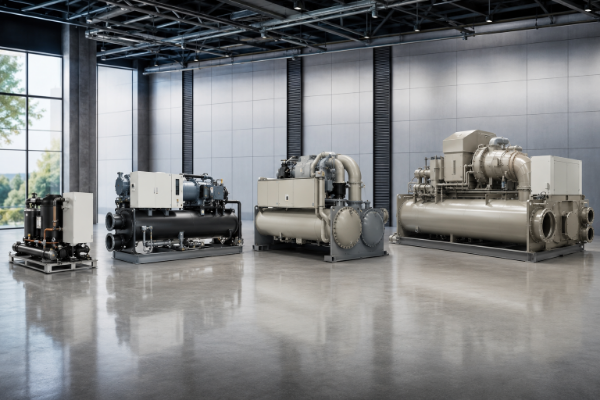
The Koven Water-Cooled Range, Scroll, Screw, Centrifugal & Maglev
Refrigerant timing is fixed by the U.S. EPA AIM Act (high-GWP manufacture ends 1 Jan 2025, installation ends 31 Dec 2025).
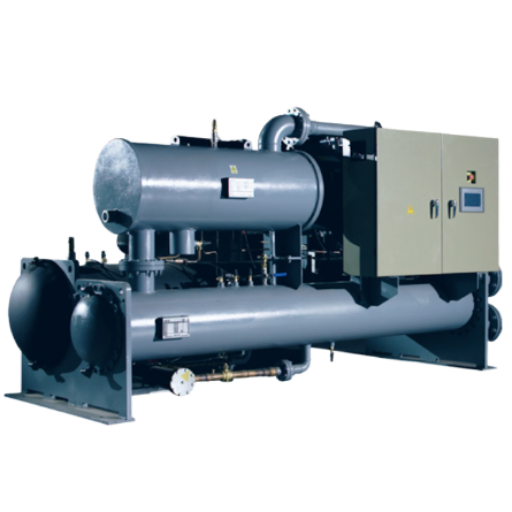
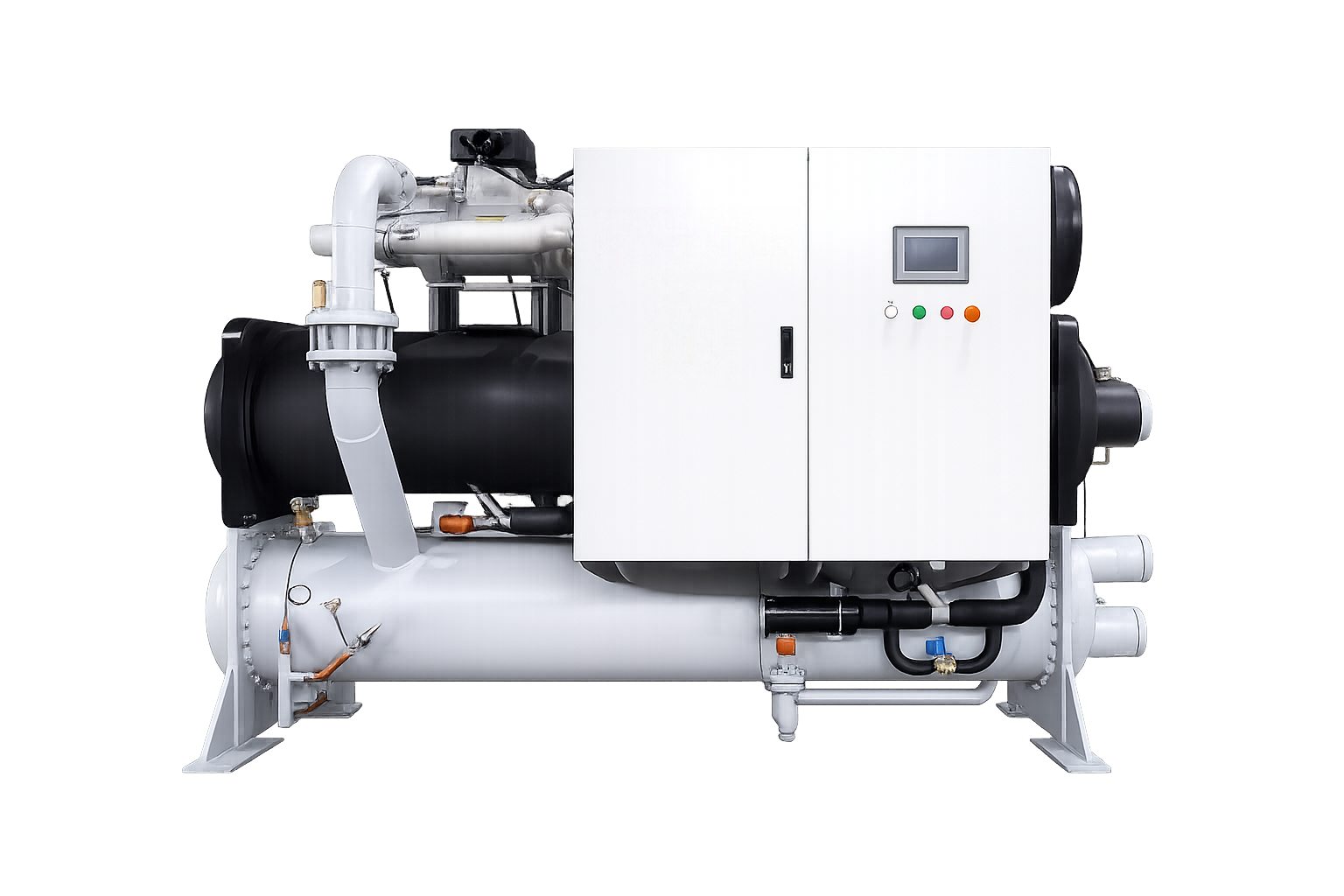
Four compressor platforms cover the full commercial and industrial band, from a 3 kW scroll module to a 3,000 kW centrifugal plant. Each ships fixed-speed or full-inverter (VFD, “-PC”) so you can trade upfront cost against part-load energy. The model families below are production series, not marketing names.
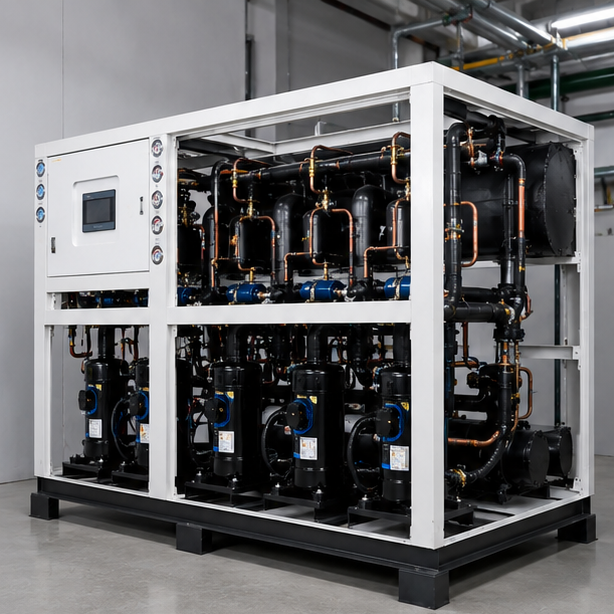
Water-Cooled Scroll
~3–200 kW/module · COP 4.5–5.5
Modular staging from 2 to dozens of compressors. Best where part-load runs most of the year and N+1 redundancy matters, a compact commercial water chiller building block.
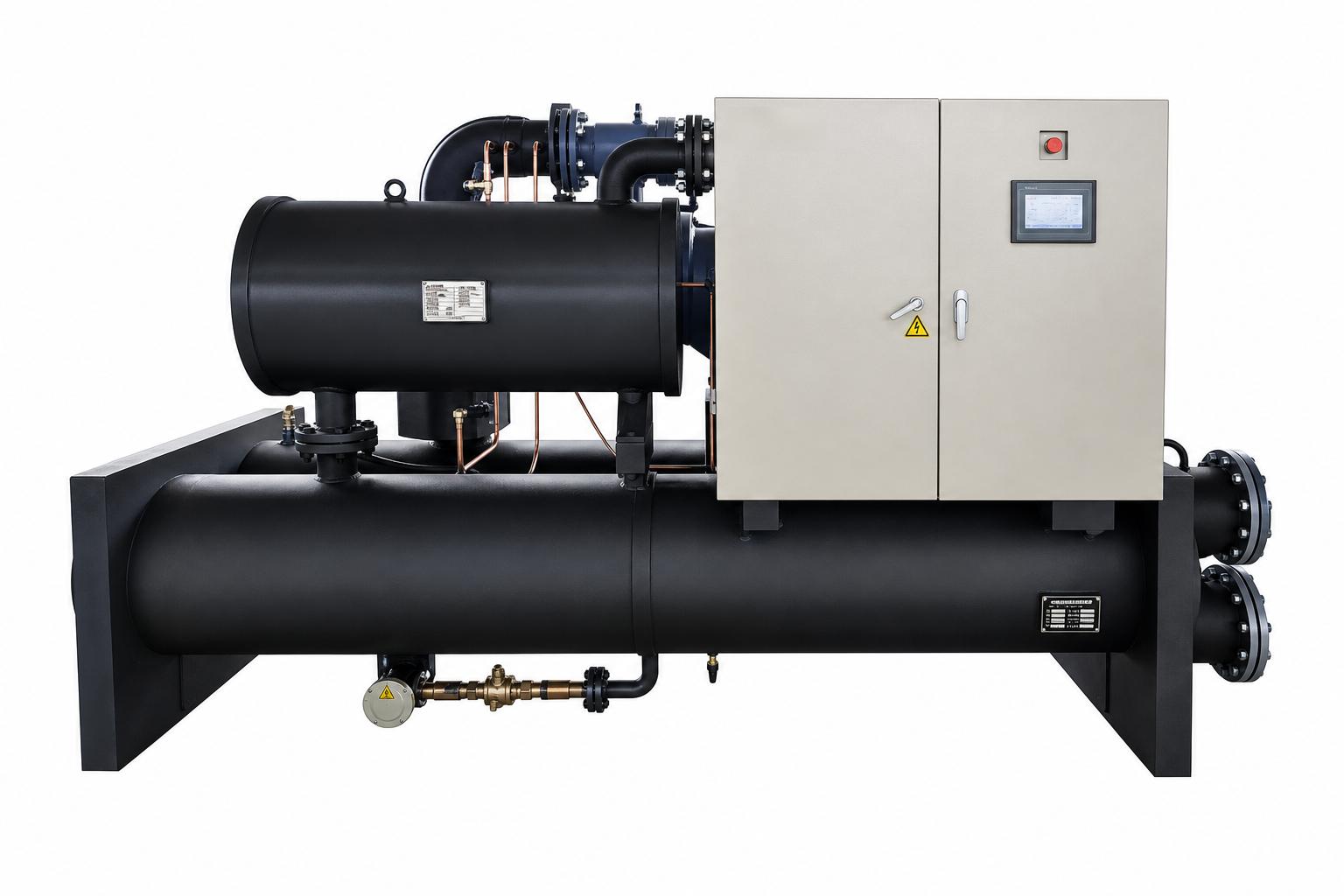
Water-Cooled Screw (KASLG)
~100–3,000 kW · COP 5.0–6.2
KASLG-95.1A to KASLG-430.2A. Slide-valve continuous capacity control (100/75/50/25%); a water cooled screw chiller strong at full and high load.
Water-Cooled Centrifugal
≥1,055 kW · VFD option
Fixed and variable-frequency; a water cooled centrifugal chiller for steady base loads above ~300 tons where lowest kW/ton wins.
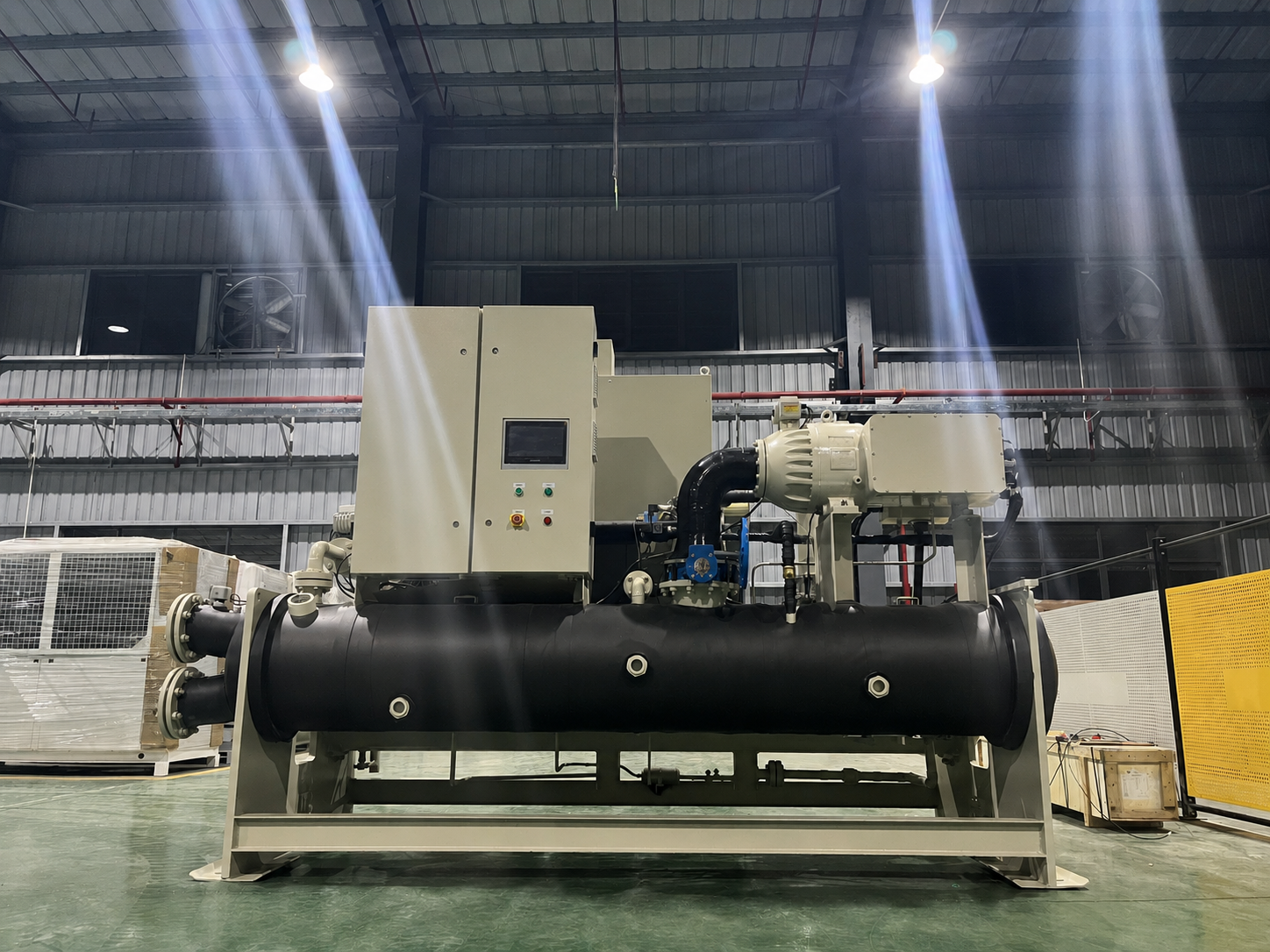
Maglev VFD Centrifugal (KALXCWG)
170–400 RT · 595–1,405 kW
Oil-free magnetic-bearing compressor, no oil management, very low part-load kW/ton for data center cooling and 24/7 duty.
Which Type Fits Your Load? Scroll vs Screw vs Centrifugal vs Maglev
Oil-free magnetic-bearing centrifugal compression is a mature, patented technology class — see WO2020146940A1 — not an unproven experiment.
Most chiller buying mistakes are type-and-size mistakes, not brand mistakes. The most efficient chiller on paper isn’t always the safest choice – an oversized unit at low load can lose head pressure, freeze the evaporator, and trip on poor oil return. Match the compressor platform to your tonnage band and duty first.
Water-Cooled Chiller Type Selection Matrix
Type
Capacity band
COP (full)
IPLV (part)
Best at
Typical fit
Scroll (modular)
~3–200 kW/mod
4.5–5.5
5.5–7.0
Part-load
Variable loads
Screw (KASLG)
~100–3,000 kW
5.0–6.2
6.0–8.5
High load
Process, mid-large
Centrifugal
≥ 1,055 kW
high
high
Steady base
Central plants
Maglev (KALXCWG)
170–400 RT
very high
highest
24/7 low-load
Data centers
COP/IPLV values are Koven measured data; capacity bands align with published industry consensus (Consulting-Specifying engineer): scroll 200 tons, screw 100-500 tons, centrifugal 300 tons.
Why part-load (IPLV) usually beats full-load
A chiller spends most of the year below design load, so the part-load weighted figure – IPLV, defined by AHRI 550/590 – predicts real energy use better than the full-load rating. Because of that, a screw at IPLV 8.5 COP or a maglev at its higher part-load figure will beat a nominally “efficient” unit that only looks good at 100% load.
“We size to the load curve, not the peak. On a 24/7 data center duty we steer a client to the maglev unit over a bigger screw, because the part-load kW/ton is where the electricity bill actually lives, and we show them the AHRI-basis numbers to prove it.”
Publishing these figures is the differentiator. Across the top results for a water cooled chiller, competitors and brand giants alike claim “high efficiency” with zero kW/ton, COP, or IPLV – so their quotes aren’t comparable. Every Koven Air number here’s measured on the AHRI 550/590 basis and can be confirmed by third-party test on request.
~30–45%
lower plant energy use for water-cooled vs air-cooled at scale — the range varies with tonnage and climate.

“Remember the offsetting cost – this is where ‘cheapest quote wins’ becomes a mistake. Water-cooled plants carry ~30% higher upfront cost per ton and add cooling-tower makeup water, sewer, chemical dosing, and tower and pump energy. Over a 20-30 year life at high runtime the energy saving still dominates, but for a small intermittent load the honest answer is ‘run the numbers first.’”
TCO Trade-off Warning
When Water-Cooled Wins, Efficiency, Water Use & Total Cost of Ownership
Life-cycle basis follows U.S. DOE / FEMP (23-year design life; water-cooled substantially more efficient at scale).
Conventional thinking has been that water-cooled is always more efficient. That isn’t always true. At small tonnage a modern variable-speed air-cooled unit can win once you add cooling-tower water, sewer, chemical treatment, and pump energy – a real trade-off we won’t hide.
Where water-cooled clearly wins is large, continuous, high-runtime plants, and there the operating-cost gap is wide. Because the honest version matter, the comparison below uses published, sourced figures rather than our own marketing math.
| Metric (200-ton ref) | Air-Cooled | Water-Cooled WINNER | Source |
|---|---|---|---|
| Plant efficiency (kW/ton) | ~1.5 | ~0.85 | csemag |
| Code-min efficiency (kW/ton) | 1.18 | 0.54 | csemag |
| Annual operating cost | $122,400 | $69,360 | csemag |
| Upfront cost (per ton) | ~$1,300 | ~$1,700 | csemag |
| Service life | 15–20 yr | 20–30 yr | Daikin |
Operating figures at ~$0.10/kWh, 16 h/day, 85% load, 300 day/yr (Consulting-Specifying engineer).
Typical TCO model, not a Koven-specific guarantee. Sources: Consulting-Specifying Engineer (plant 0.85 vs 1.5 kW/ton); U.S. DOE/FEMP (water-cooled substantially more efficient; 23-year life-cycle basis). Request a custom TCO calc for your site.
Proven in Hospitals, Data Centers, Semiconductor & Factories
Data-center-grade oil-free chiller technology is well documented in the patent record — see US8397534B2.
One machine family serves very different duties, and the type choice follows the duty. Below are the application patterns Koven Air water-cooled chillers are specified into, with the platform each maps to and why the fit reduce risk.
SPEC-01
Data centers & computer rooms maglev VFD centrifugal (KALXCWG, 595-1,405 kW) for oil-free, ultra-low part-load kW/ton on 24/7 duty; pairs with CRAH or direct-to-chip loops.
SPEC-02
Hospitals & large buildings screw or centrifugal above 1,055 kW as primary cooling, with low-load and winter head-pressure control engineered in.
SPEC-03
Semiconductor, lithium-battery & EV plants 0.5 C chilled water stability for process yield; a starved or unstable loop scraps product.
SPEC-04
Manufacturing, subways, airports, granaries modular scroll (3-200 kW) where staged redundancy beats a single large unit.
Reliability note from the field
The pitfall we design against is low-load instability. Because an oversized chiller can freeze its evaporator and trip, on part-load-heavy sites Koven Air favors modular scroll or a right-sized VFD screw so the plant never sits far below its stable point – the single most common failure on oversized units (Consulting-Specifying engineer, peer-reviewed).
We aren’t going to make up ROI figures against unnamed clients, that’s the straight fact. What we do guarantee, is a published sizing basis, a quoted efficiency based on AHRI per unit, and onsite commissioning, the building block of a defensible business case for any facility manager. Where a reseller build in margin, the engineer signing the calc built the machine.
Built & Verified In-House, QC Traceability & Certifications
Our quality system follows ISO 9001, and efficiency is checked on our own bench against AHRI 550/590 methods.
01
Is a China made chiller a safe buy? The real questions are about whether the quality is verifiable, and whether there’s someone answering the phone afterwards. That risk is real and is addressed with an internal documented process – not an import sticker.
400
manufacturing-process traceability points
36
factory inspection checkpoints
24 h
aging / burn-in test per unit
In-house
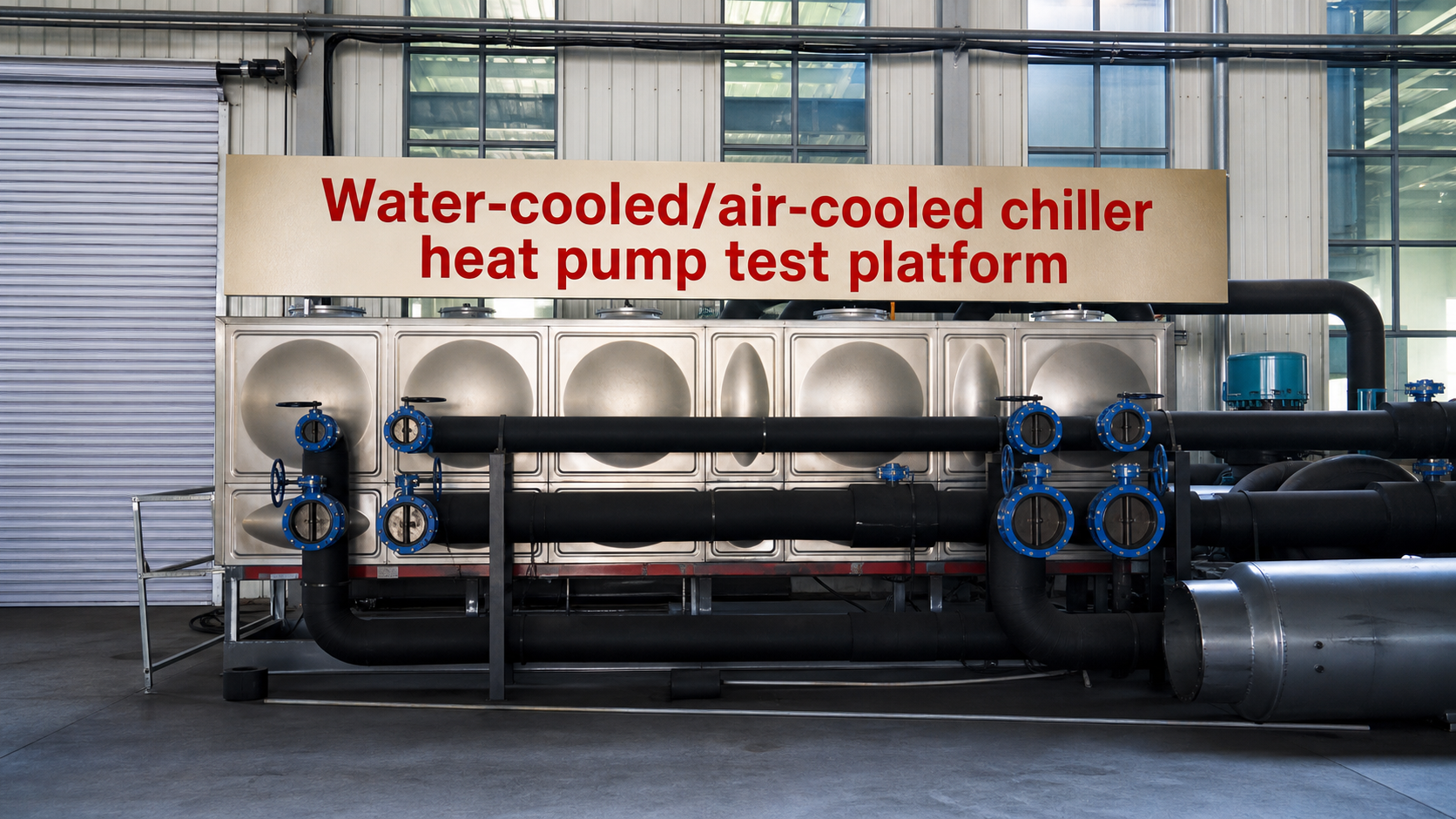
chiller & heat-pump test laboratory
02
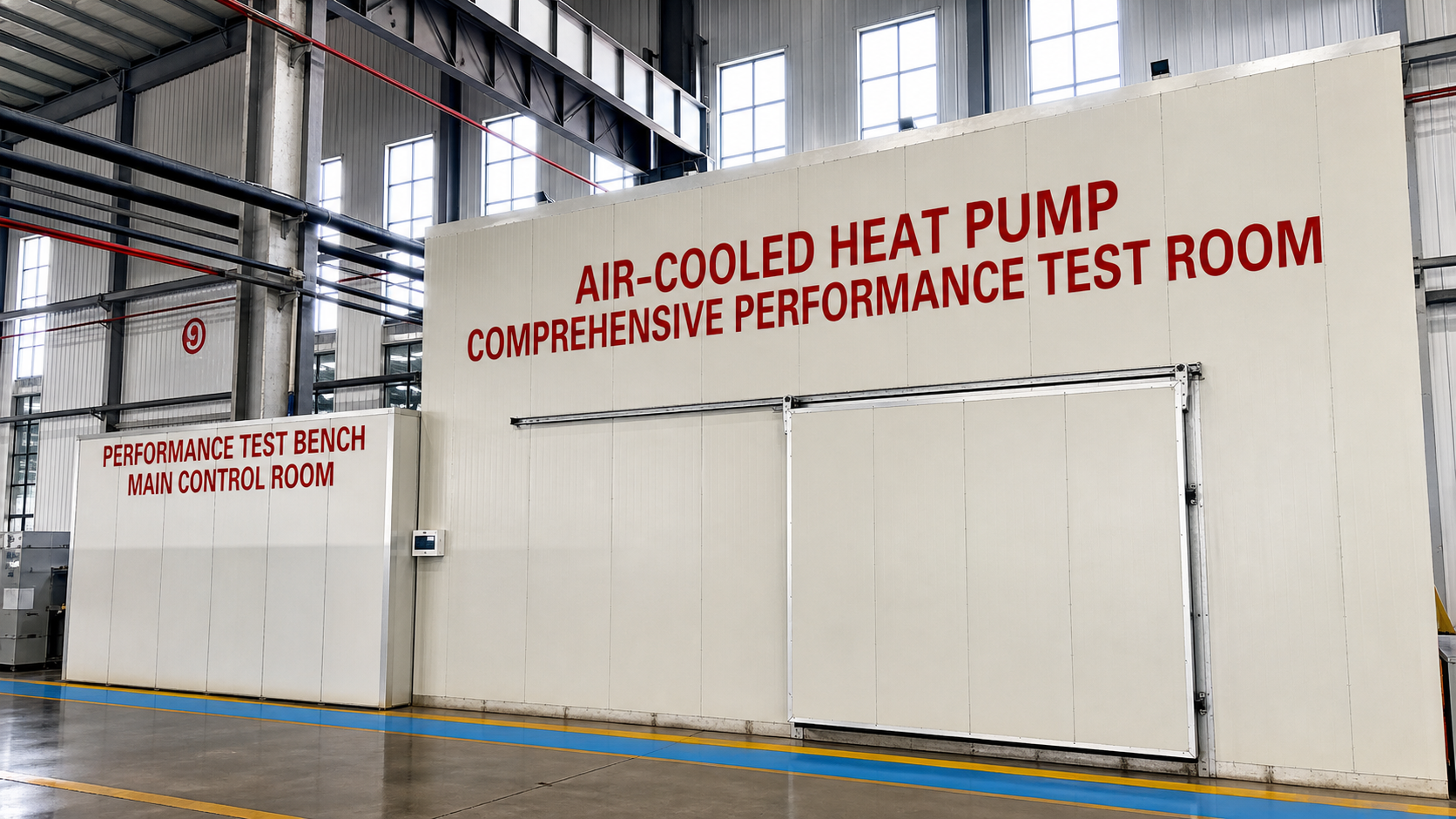
Efficiency isn’t claimed, it’s measured. Each Koven Air chiller undergoes a standardized, documented 18 step build process, a 24-hour aged run-time test, all traced to the machine build number. A witnessed third party test is available at our own facility upon request, unlike the standard major OEMs. While another might post “High efficiency” on their datasheet, we post our tested COP, calibrated against AHRI standards on our own bench.
Of the numerous water cooled chiller manufacturers out there, very few will give you a complete water cooled chiller system efficiency number. We do, and we’ll give you the test basis, so your decision on water cooled chiller vs air-cooled comes down to data not the flag.
How to verify a supplier’s efficiency claim
- Be sure to ask for the basis of rating – it must be AHRI 550/590 – not just a vague “High efficiency” label.
- Request both full-load kW/ton and IPLV – any meaningful datasheet will show both.
- Inquire about the availability of a third-party witnessed test – Koven Air’s is readily available.
Procurement Guide, Sizing, Lead Time, Customization & Lifetime Support
Refrigerant selection is a compliance decision under the U.S. EPA AIM Act, not a preference.
The most common misconception in industrial chiller procurement is focusing exclusively on upfront purchase price. Number two is the well-meaning practice of “upsizing to be safe”, which wastes energy and lowers reliability performance for decades. A clean spec eliminates both issues, so Koven Air engineers always review the load calculation prior to production.
What drives a water cooled chiller manufacturer’s quotation
-
Compressor type & tonnageSets base cost and part-load efficiency (scroll vs screw vs centrifugal vs maglev)
-
Fixed-speed vs VFDHigher upfront, lower lifetime energy — pays back on high-runtime duty
-
Refrigerant (low-GWP)AIM Act compliance; affects charge cost and future-proofing
-
Customization & integrationBMS protocol, condenser-water design, enclosure, 380–480 V supply
-
Water-side balance of plantCooling tower, pumps, water treatment — real TCO items, not extras
Engineering Tools & System Calculators
Streamline your industrial HVACR project planning. Use our dedicated engineering tools to compare life-cycle costs, accurately size your chiller plant, and instantly convert between standard efficiency metrics.
FAQ — Water-Cooled Chillers
How does a water-cooled chiller work?
refrigerant heat is absorbed from your chilled water loop within the evaporator. A compressor then compresses the refrigerant, increasing its pressure. The condenser transfers this heat into a separate condenser-water loop, and the heat is rejected outdoors to atmosphere via a cooling tower. The refrigeration cycle then begins again – the heart of any water-cooled chiller.
Are water-cooled chillers better than air-cooled?
Yes – for large continuous loads – plant efficiency near 0.85 kW/ton vs about 1.5 for air-cooled means far lower energy cost (Consulting-Specifying engineer). At small or intermittent loads a modern variable speed air-cooled unit can beat once tower water and treatment costs are included. It’s size and run time that does it – which is why a water cooled chiller vs air cooled decision should never be based on sticker price alone.
Which is better, a screw or scroll chiller?
Load profile is key. Screw gives continuous control and IPLV up to 8.5 COP; scroll stages compressors for redundancy at lower tonnages.
What are the three main types of chillers?
By compressor: scroll and screw (positive displacement) and centrifugal (including oil free magnetic bearing). Scroll’s better for small modular hvac loads, screw for the mid to large process range, and centrifugal or mag lev for the largest continuous plants.
How long do water-cooled chillers last?
Typically 20-30 years (if maintained) vs 15-20 for air-cooled because the machine lives indoors protected from the weather (Daikin). U.S. DOE life cycle modeling assumes a 23 year design life.
What are the disadvantages of water-cooled chillers?
Cost (~$1,700/ton vs ~$1,300 for air-cooled), an initial cooling tower, condenser-water pumps, plus continual water treatment to control scale, corrosion, and biological growth. Indoor plant room space is another cost, and water and sewer are added to the operating bill.
What refrigerant do your chillers use?
Low-GWP refrigerants in the R-513A / R-1234ze class so units are compliant with the EPA AIM Act requiring all new high-GWP chiller production to cease after 1 January 2025 and installation to halt after 31 December 2025, which cuts direct emissions. Exact refrigerant is a model by model certification.
Can I trust a China-made industrial chiller and its after-sales support?
Judge for proven quality not origin – this is the trust issue every serious buyer raises, and rightly so. Every Koven Air package has 400 traceability points, 36 quality assurance inspections, and a 24 hour aging test completed at our own lab, and each is supplied with lifetime free technical support. As a claim is only as good as its proof, we also provide a third-party overseen efficiency test so you don’t have to take sustainability or performance specs on faith; unlike a reseller, we stay on the line for the life of the unit, 20-30 years.

![Commercial Rooftop Unit Guide: Types, Sizing & Costs [2026]](https://kovenair.com/wp-content/uploads/2026/07/commercial-rooftop-unit-guide-featured-2-150x150.png)