Get in Touch with Koven Air Company

By Cherry · Updated October 2026
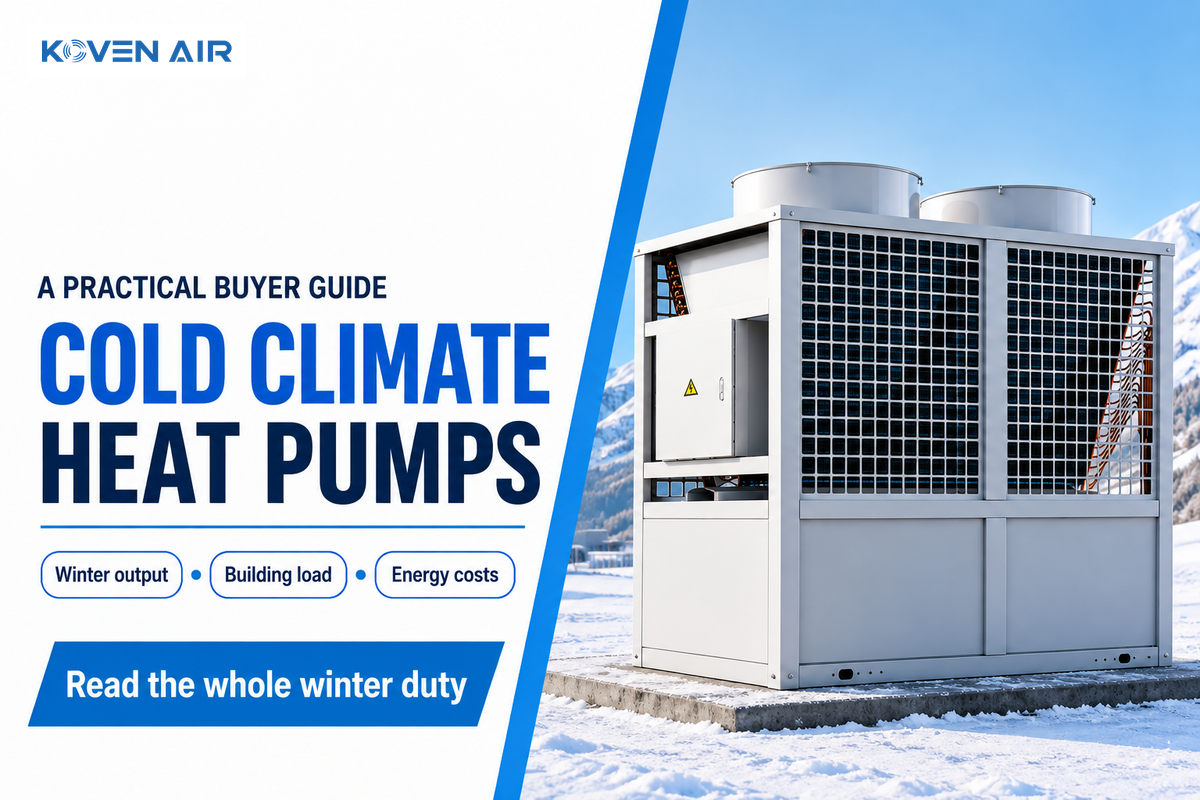
A Cold Climate Heat Pump draws heat from the air to heat a building in cold weather. Its circuitry and controls let it operate in wintry conditions, as does its defrost system. The useful buying question is how much heat the system delivers at the building’s design temperature, and how much electricity it takes to deliver that heat.
The checks that homebuyers and business buyers can do are the same: assess the load, look at cold-weather performance, check heat distribution, assess energy costs and consider commissioning and service. The devices and means to assess the equipment in a room air system are different from those used in a commercial water-heating system.
Scope: Residential cold-climate certification applies to defined air-source product categories. Commercial air-to-water projects use their applicable rating methods, electrical requirements and project design conditions. A residential efficiency label and a commercial hydronic duty are separate selection tasks.
What Is a Cold Climate Heat Pump?
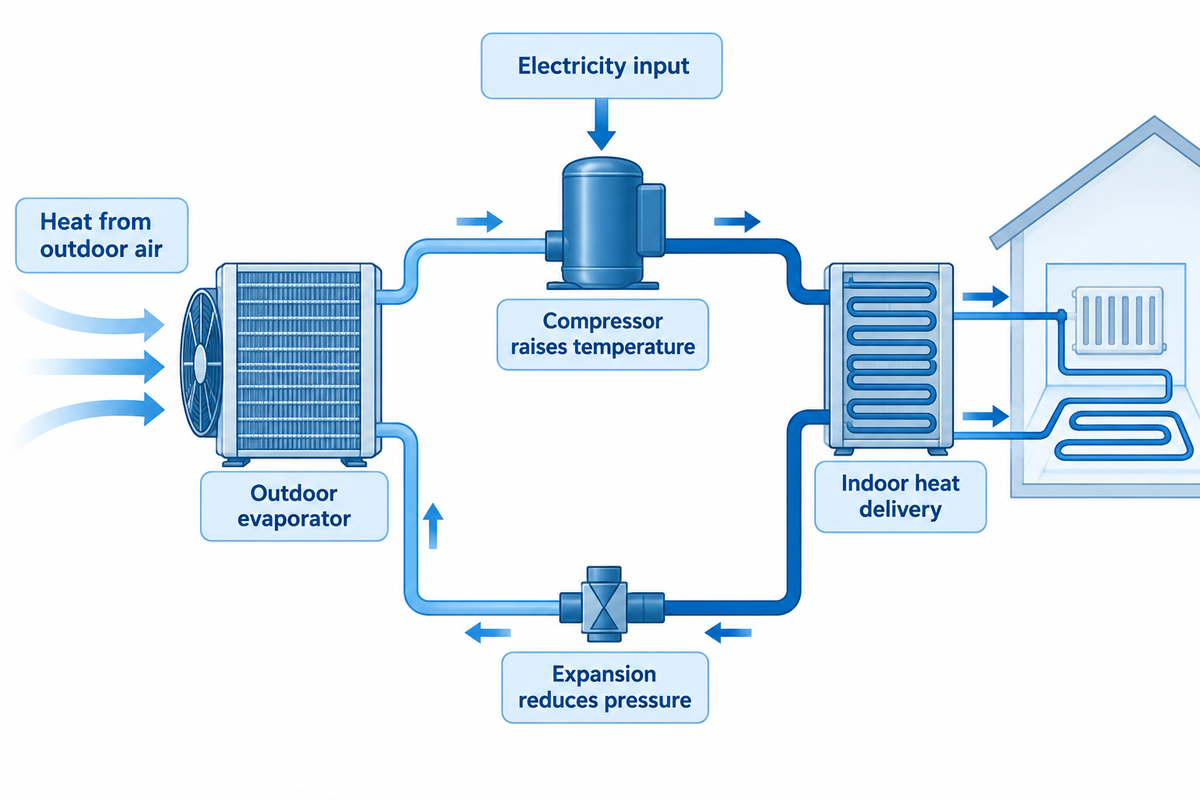
A cold climate heat pump is an air-source heat pump that produces useful heat in colder climates. Cold air still contains heat energy when temperatures drop below freezing. Refrigerant absorbs some of that energy, and the compressor raises its pressure and temperature so that the indoor side can release heat into the air or water.
Compressor control and the heating cycle
Heat is transferred in a repeating cycle. Refrigerant evaporates in the coil outside your home, absorbing heat from the outdoor air. It’s then compressed, which raises its temperature, and then the indoor heat exchanger releases heat. An expansion device reduces the refrigerant pressure and the process repeats. To learn more about the equipment involved and the working of a heat pump, see the guide published by Natural Resources Canada.
The conventional two-stage machine is made up of two different speeds or capacity stages. A wider range of loads can be followed by a variable speed machine. Cold climate models also require controls, heat exchanger design and defrost appropriate for winter conditions. A machine able to extract heat at extreme temperatures still needs enough heat output for the building. A performance map for the machine shows its output over the range of operations.
Consider two electric heat pump brochures. The first claims operation in extreme cold but doesn’t disclose its cold-weather heating capacity. The second discloses a heating capacity at the local design temperature. The first brochure doesn’t help the designer in resolving the winter heat balance. The second provides the designer with a usable starting point. A machine can be left operating while the building loses heat faster than the machine supplies it.
Heat from one place is moved by heat pumps instead of being generated completely from electricity. A coefficient of performance, or COP, of 3 means 3 kWh of heat at the stated measurement boundary for 1 kWh of electricity, or three times as much heat as the electrical input. The temperatures and included electrical loads are to be shown with that number.
Benefits, Limits and Where Cold-Climate Heat Pumps Fit
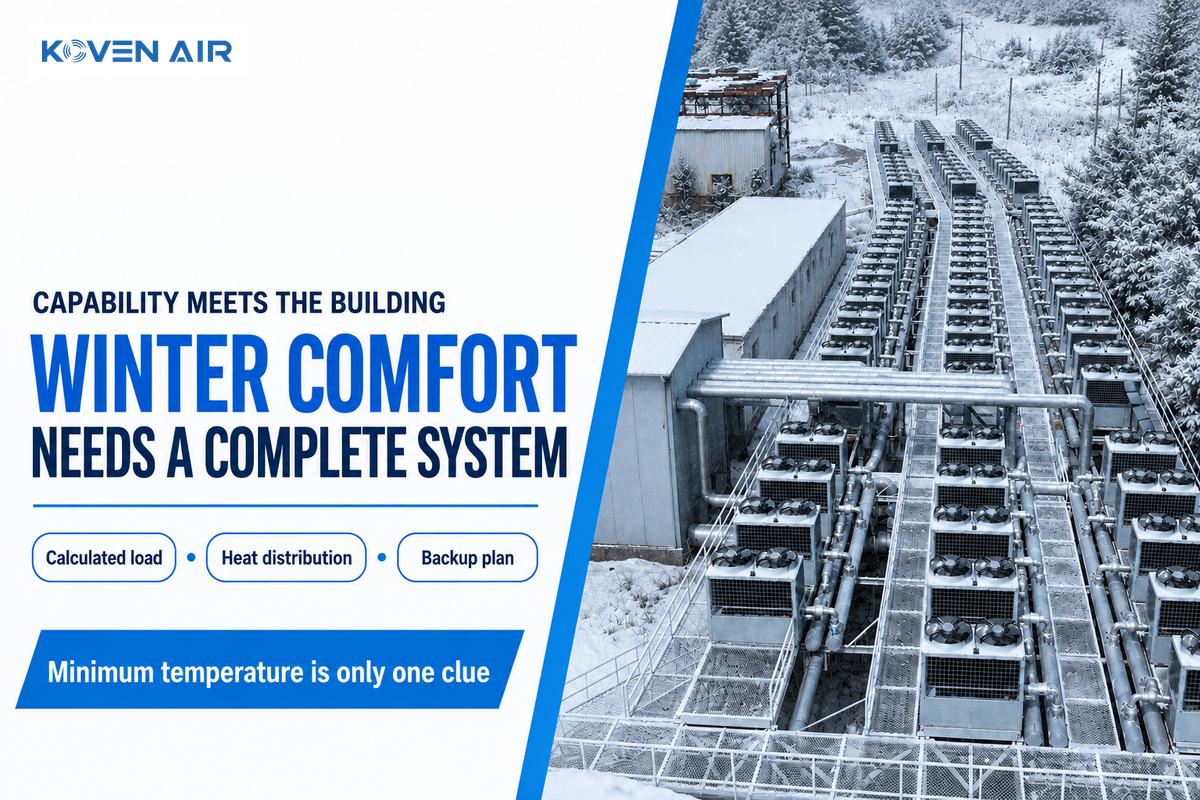
Cold-climate heat pumps work in cold weather and combine heating and cooling in one system. At a COP above 1, they use less heating electricity than traditional electric resistance. A heating and cooling system works best when the building retains heat and its distribution serves every occupied room. Installation work and winter electricity costs remain part of the decision.
An air-to-air unit works like an air conditioner with a reversing heating cycle. During cooling, it exhausts heat from inside the building to the outdoors. Ducted equipment or mini split heat pumps can also heat a building. The same equipment can cool your home in the summer. Hydronic cooling needs suitable terminals and condensation control; existing radiators alone aren’t a cooling system.
What is a major disadvantage of a heat pump for cold climates?
The primary disadvantage is the combination of less available heating output and greater heat loss from the building as the outdoor temperature falls. Backup heat, distribution upgrades or a larger electrical connection can also increase cost. A well-selected system handles those duties in its design rather than leaving them for the first cold snap.
Choosing a system for your home also includes coverage and installation disruption and energy efficiency. An owner replacing direct electric baseboard heating has different heating needs from a facility replacing a boiler. For that facility, the existing radiator duty and winter water temperature are also relevant. NEEP’s sizing guidance also explains oversizing can cause cycling and reduce summer dehumidification. A larger unit may cover more peak load, but become a poorer match for mild days and cooling needs.
Cold weather capability is needed during the heating season, including cold snaps. The building envelope, distribution and controls impact how much of that capability is present in occupied spaces. Even the coldest design day should appear as a calculated duty, not as an adjective in a sales description.
Read Cold-Weather Ratings Without Comparing Different Systems
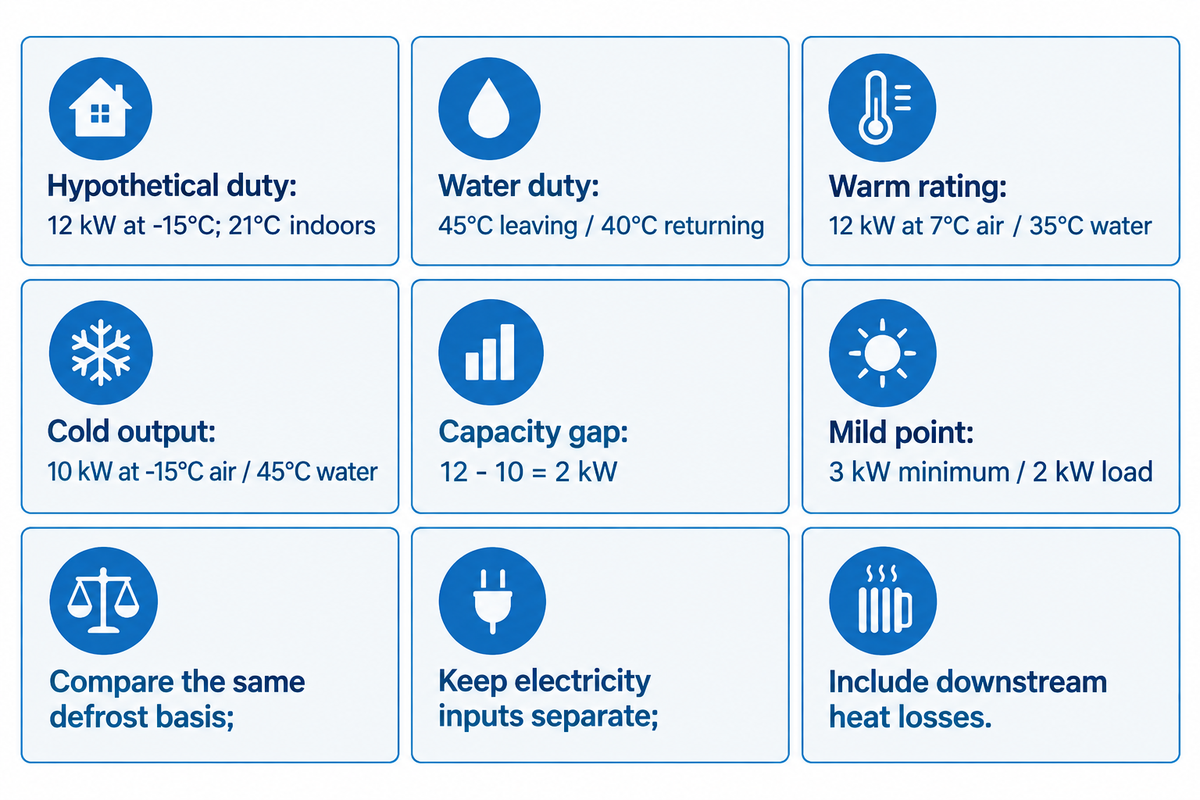
Compare heating capacity and efficiency at the same outdoor temperature and indoor-side conditions. Capacity measures heat output; COP compares that output with electrical input at a defined boundary. Seasonal ratings combine several operating conditions for a cold climate heat pump system. Therefore, keep the test basis and the result together.
The ENERGY STAR cold-climate criteria, read with the February 2026 Version 6.2 revision, require qualifying residential air-source heat pumps to reach COP of at least 1.75 at 5°F (−15°C), and heating capacity at 5°F of at least 70% of their nominal 47°F capacity. Seasonal efficiency and native-controls verification also apply. These are residential qualification thresholds and don’t apply to a specification of a commercial air-to-water plant.
How cold is too cold for a heat pump to work?
Cold-climate heat pumps can operate below freezing. A heat pump becomes too cold for its assigned duty when its available output falls below the building load without sufficient backup, or when it reaches its specified operating limit.
The thermal balance point is where output equals heat loss. An economic balance point concerns running cost, while a manufacturer’s cutoff protects or limits the equipment. The outside temperature at each of those points can differ. A claim of minimum temperature leaves out heat output needed to keep your home warm.
Winter Duty Sheet: 9 readings at the design point
| Item | Assumed air-to-water selection | Buyer’s reading |
|---|---|---|
| Building duty | 12 kW heat loss at −15°C; 21°C indoors | Compare available output with this load. |
| Water condition | 45°C leaving / 40°C returning | Use the emitter design duty, not a lower catalogue water temperature. |
| Published warm-point rating | 12 kW at 7°C air / 35°C leaving water | A different rating point; not the cold-design output. |
| Cold-design output | 10 kW at −15°C air / 45°C leaving water | The heat pump covers 10 of the required 12 kW at this point. |
| Capacity gap | 12 − 10 = 2 kW | The design needs 2 kW of delivered backup heat or another change. |
| Mild-weather modulation | Minimum 3 kW; building load 2 kW at the chosen mild point | Check cycling and controls rather than adding more nameplate capacity. |
| Defrost basis | Declared capacity averaged over the applicable defrost test period | Compare integrated output on the same basis. |
| Electricity boundary | Compressor, outdoor fan and defrost included; circulation pump and backup separate | Keep each input in the energy ledger. |
| Heat-meter location | Heat-pump outlet; tank and distribution downstream | Room-delivered heat requires the downstream losses to be included. |
Example inputs: The sheet describes a hypothetical selection, not a product specification. Its 2 kW capacity gap follows from the same −15°C outdoor and 45°C leaving-water duty. The lower-temperature catalogue rating can’t fill that gap. The worksheet also catches a mild-weather problem: 3 kW minimum output against a 2 kW load.
As explained in NEEP’s definition of extended-performance reporting, a number of extended values are manufacturer-reported. Keep the listed performance data, relevant certification and commissioning measurements as separate records. For a commercial hydronic system, the relevant output includes the required leaving water temperature, flow and defrost basis.
Air-to-Air, Air-to-Water or a Hybrid Heating System?
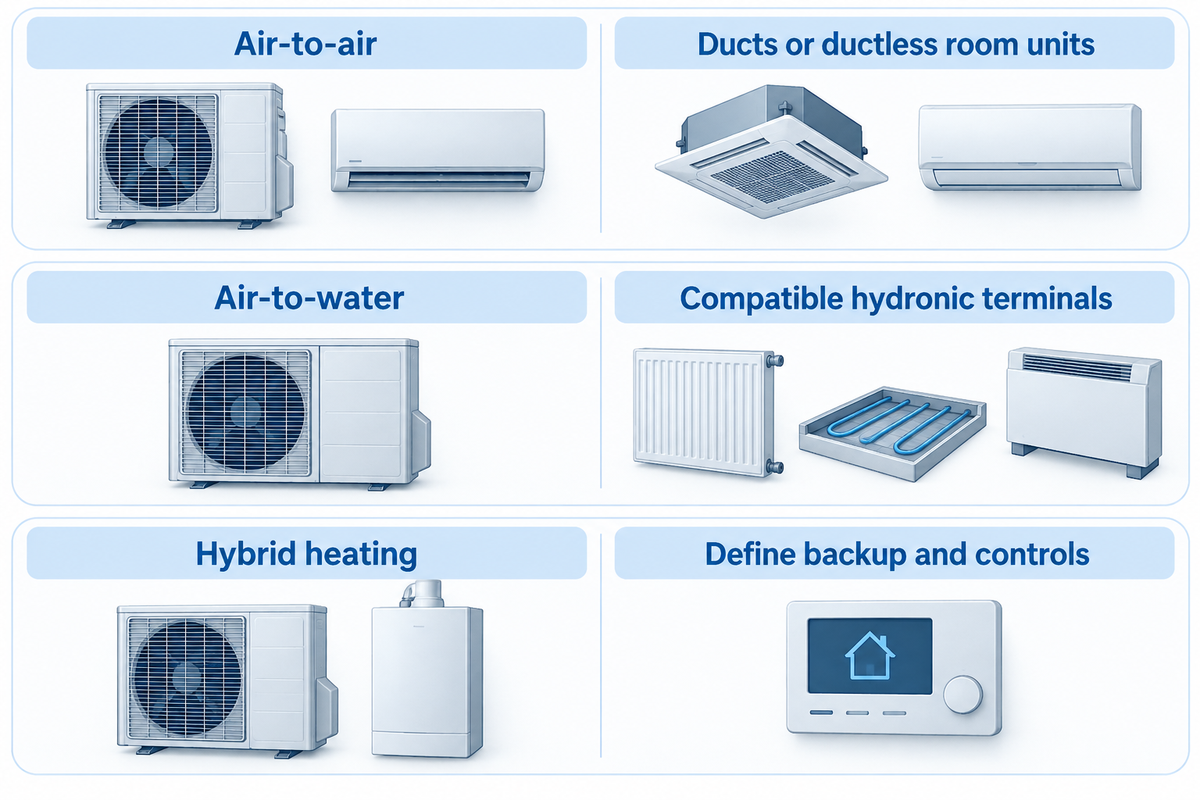
Use air-to-air equipment for air delivery directly to the room and air-to-water equipment for a system utilizing a compatible hydronic circuit. A hybrid heating system retains another heat source for a defined load or cost. The best arrangement follows room coverage and emitter requirements, before following a brand or an advertised minimum temperature.
Cold climate air source systems can pull heat from outdoor air for several indoor arrangements. Ducted air source heat pumps are suited for buildings with available ducts. Ductless heat avoids a new central duct network, but closed rooms still require a means for heat delivery. Refrigerant piping, fan operation and installation quality are also important; a ductless system isn’t loss free.
Air-to-water heat pumps feed water-based terminals. Fan coils, underfloor circuits, and suitably sized radiators allow different water temperature duties. A retained gas furnace usually belongs to an air-side dual fuel sequence. A boiler belongs to a hydronic arrangement of pumps and valves, whose control unit determines the method of heat source sharing or alternation.
What if you’re retrofitting an office with radiators that once provided comfortable temperatures with high-temperature water in the boiler? The owner wants to reuse the radiators to avoid tenant disruption, but a heat pump installed with the radiator calculation unchanged could result in cool rooms and/or high energy consumption. First, the designer determines the heat loss of each of the offices to be heated and calculates the required radiator output at the water temperature for the design conditions. Offices with too little emitter area are treated in one of two ways: either a larger radiator is provided or a fan coil is used. The boiler is allowed to retain an agreed peak duty. Procurement can then compare the cost of emitter work with the cost and fuel usage of the hybrid system. That choice is a system choice rather than a reason to request a larger compressor.
Ground-source systems take heat from the ground or a body of water rather than air, and therefore, have a different comparison to air-source systems. A different guide is provided in the ground-source heat pump guide. Each system has its building and budget restrictions.
Match Heating Capacity to the Building and Its Coldest Hours
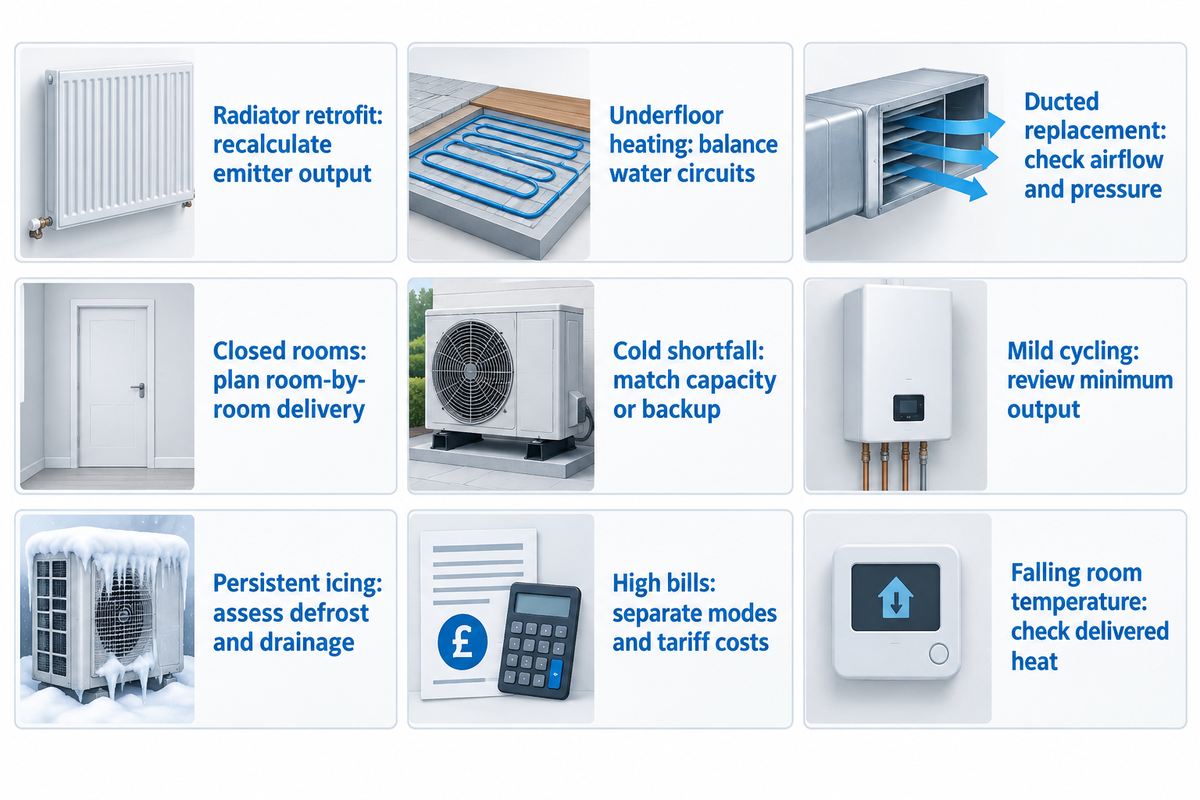
Size a heat pump against the calculated building load at the design temperature for the local heating condition. Next, consider the minimum output, and cooling capacity and distribution. The whole load range is needed. Peak capacity keeps rooms warm and good modulation helps maintain steady operation when the temperatures rise.
“Equipment should not be selected based on nameplate capacity.”
Designers use different procedures based on the project type. Residential designers use a room-by-room procedure and select equipment based on the procedure. Commercial designers use the recognized project load procedure and consider occupancy conditions. Floor area alone doesn’t capture all loads including insulation, air leakage, glazing and ventilation. The ambient derating and sizing calculator can assist in preliminary checks; a project load calculation determines the design duty.
For the Winter Duty Sheet example, the building needs 12 kW at −15°C, while the selected machine supplies 10 kW at the required 45°C water condition. The designer has several options: reduce the building load, choose equipment with more output at that condition, or design 2 kW of delivered backup duty. Buying another nominally 12 kW machine says little until its cold-condition data are compared. On a mild day, the assumed 3 kW minimum output also exceeds the 2 kW building load. The installer therefore reviews cycling, zoning and the water-volume/control arrangement before accepting a larger selection. Peak heating, mild weather operation, and summer comfort remain linked decisions.
| Building or equipment type | Likely constraint to investigate | Design or service response |
|---|---|---|
| High-temperature radiator retrofit | Emitter output at lower water temperature | Recalculate room output; enlarge emitters or retain peak-load boiler duty. |
| Underfloor-heating building | Water flow and circuit balance | Balance loops and match the design leaving-water temperature. |
| Ducted furnace replacement | Duct resistance and airflow | Size ducts and fan duty for the selected heat pump. |
| Ductless rooms with closed doors | Heat distribution between rooms | Provide room-by-room coverage rather than sizing one head for the whole floor. |
| Cold-design capacity shortfall | Building load exceeds available low-temperature output | Reduce load, add suitable capacity or define backup duty. |
| Mild-weather short cycling | Minimum output exceeds the current load | Review turndown, zoning and the hydronic volume/control design. |
| Persistent outdoor icing | Defrost, airflow or meltwater drainage | Keep accessible air paths clear; have the installer assess persistent ice. |
| Large bill despite stable comfort | Backup use, tariff peaks or high water temperature | Separate electricity by mode and review the full tariff. |
| Long operation with falling room temperature | Insufficient delivered heat or an equipment fault | Review capacity, distribution and backup operation together. |
The diagram focuses on where heat delivery is limited. In a ducted HVAC system, airflow and external pressure matter. In a water system, emitter output, flow and leaving water temperature matter. Reliable heat requires an unobstructed path from the source to each occupied space. Increasing compressor size can’t correct a blocked air path or make an undersized radiator release more heat at the same water temperature.
Cold Climate Heat Pump Cost: Equipment, Installation and Energy
The cost of a cold climate heat pump has two elements: the cost to install the system and the cost to operate it. The first element includes equipment, electrical work, ducts and/or emitters, controls and commissioning. The second element depends on the efficiency and backup operation of the system, as well as the cost of electricity.
Lumping different jobs together in a single installed price range understates the cost of some jobs, and overstates the cost of others. Replacing a matched ducted system and rebuilding a commercial plant require very different labor and materials. A useful quote separates these costs. A rebate should be included in a second budget line after eligibility is determined and timing is settled, not used to reduce equipment price by assumption.
A winter heat-cost example you can recalculate
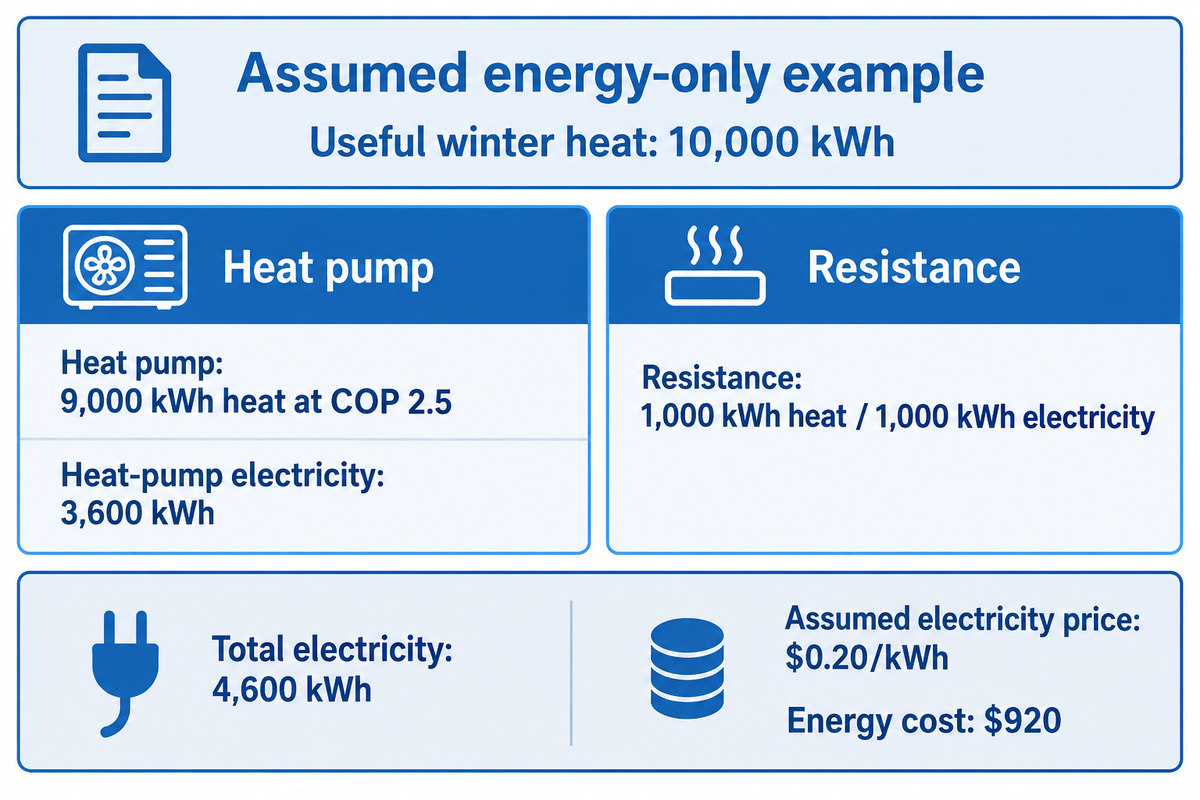
Assumed inputs: It’s assumed that useful heat for a winter is 10,000 kWh. The heat pump supplies 90% of the heat at an average COP of 2.5, and the electric resistance supplies the remaining 10% at a COP of 1. Electricity costs $0.20/kWh. This is an energy only example. In the case of a heat pump, the energy cost includes the compressor, fan and defrost energy at the stated outlet boundary; external circulation, storage and distribution losses, demand and fixed costs are outside this example.
The heat pump supplies 9,000 kWh and uses 9,000 ÷ 2.5 = 3,600 kWh of electricity. Resistance backup supplies 1,000 kWh and uses another 1,000 kWh. Total electricity is 4,600 kWh, costing $920. Supplying all 10,000 kWh at COP 2.5 would use 4,000 kWh and cost $800. A 10% share of delivered heat therefore adds $120 in this example; it isn’t a 10% share of electricity.
For finance, the comparison is cost per useful kWh. Heat-pump energy cost is electricity price ÷ COP. With assumed gas at $0.06/kWh of fuel and a 90% efficient boiler, gas heat costs $0.06 ÷ 0.90 = $0.0667 per useful kWh. Electricity at $0.20/kWh reaches that cost at COP 3: 0.20 × 0.90 ÷ 0.06 = 3. The COP crossover tool helps explore this energy-price relationship.
Backup share changes with load, weather and control settings. A higher water temperature can also increase the work done by the compressor. Energy Saving Trust’s heat-pump fact check provides information on the running cost and flow temperature of heat-pump emitters in its UK context. The local tariff and the equipment’s performance should be used for the study.
Commercial bills need a peak-demand calculation
The utility-rate guide by the US Department of Energy separates energy charges for kWh, charges for peak demand for kW and fixed charges. Time-of-use rates and demand-look back provisions can change the results, even with the same annual kWh. A facility manager needs to assess the seasonal variations in total energy use of the system, compare peak backup demands with tariff periods, and evaluate interval loads.
In the worked example, resistance backup provides 1,000 kWh of useful heat but consumes about 22% of the 4,600 kWh electricity total. Finance can test a different backup share in the same calculation. A site budget then adds external pumps and heat losses at the chosen delivery boundary, plus the applicable peak-demand and fixed charges.
Defrost, Snow and Everyday Winter Operation
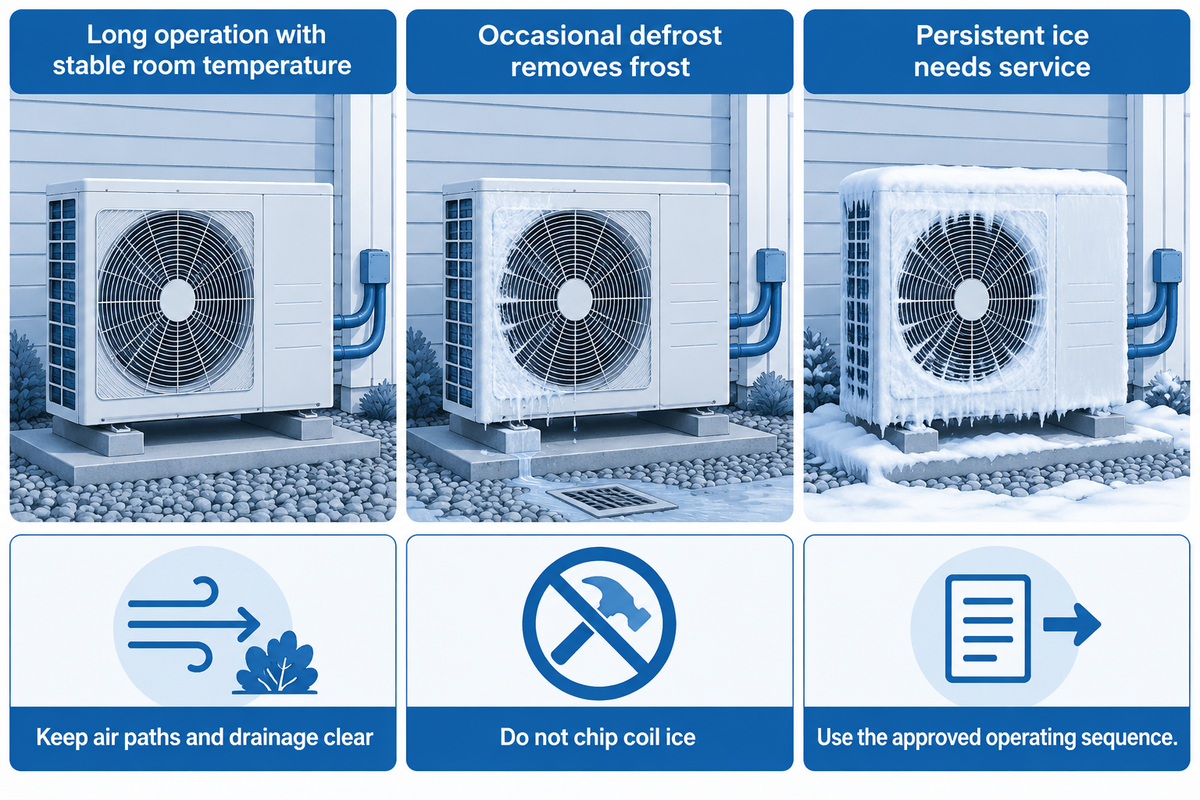
Long operation and occasional defrost are standard for winter operation of a heat pump. Modern heat pumps can operate at low output for longer periods of time to maintain room temperature. Continuously heavy ice build-up and/or frequent back-up operation call for checks of capacity, controls, drainage and airflow.
When it’s cold outside, moisture in the air can freeze on the outdoor coil as the temperature drops. The refrigerant can still heat the building while frost is accumulating. Defrost removes the frost, sometimes with a brief change in sound, a pause in warm-air delivery, or with visible vapour. NRCan’s explanation of defrost and supplementary heating describes why backup may assist during these periods. Defrost frequency is changed through weather and equipment controls.
In cold snaps, a homeowner may observe the heat pump running almost continuously while rooms stay comfortable. This behavior is different from a unit that runs all night while indoor air steadily cools. In the second case, a dirty filter or restricted air flow may be the problem along with a control fault or an inadequate winter output. The first line of maintenance is to ensure filters are clean and there are no blockages to air flow. Further work depends on the installer’s checks of capacity and operation.
Keep the outdoor air path to the coil clear of snow, and adhere to the clearances specified by the manufacturer. Plan the site to include drainage for melt water. Provide protection from roof-shed snow and access for maintenance. Don’t chip ice from a coil or use improper controls to attempt to defrost it. Persistent heavy icing requires service.
Emergency and auxiliary heat have different control functions. Auxiliary heat assist functions are controlled and regulated. Emergency heat typically operates in a backup function when the heat pump is unavailable. As such, a change in thermostat could significantly affect the energy use. The approved operating sequence would indicate when each function is used.
Compare Brands and Quotes With the Winter Duty Sheet
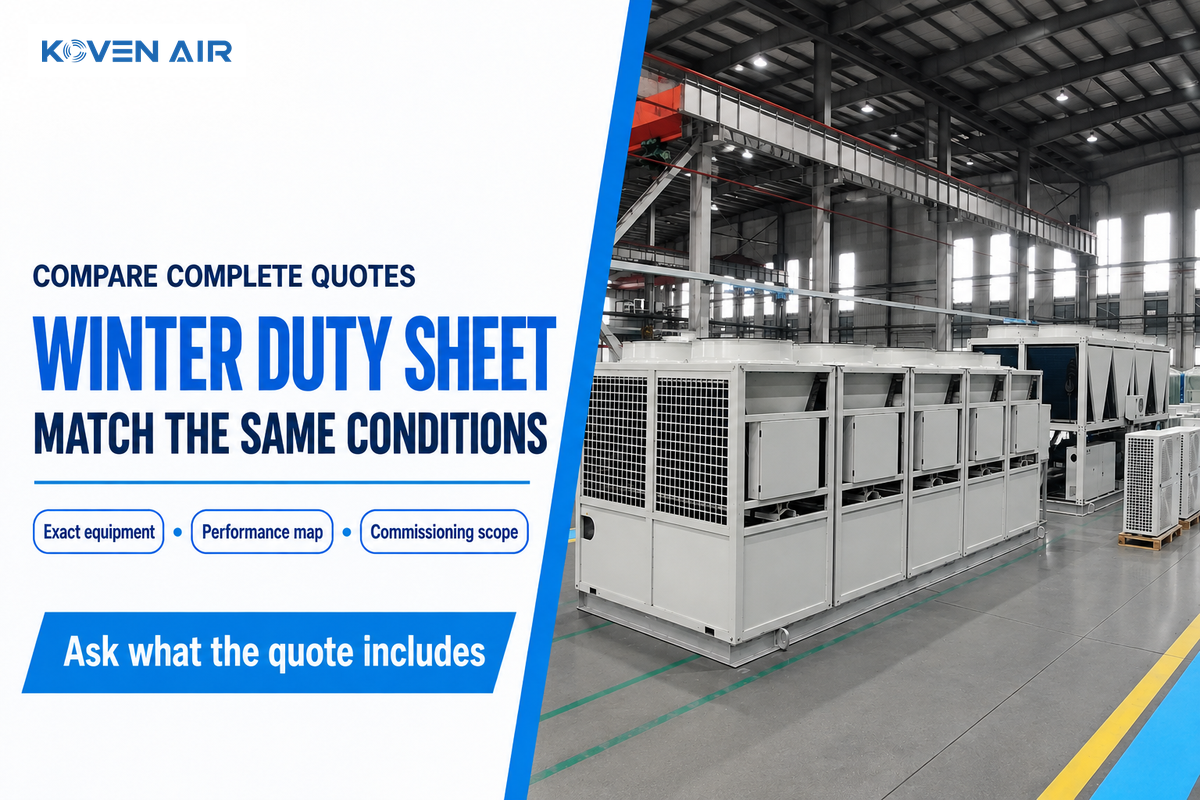
Exact equipment combinations, cold-condition output and the proposed installation are to be compared before evaluating brand names. A brand offers multiple systems with different capacities and operating envelopes. The Winter Duty Sheet aligns the building duty, performance map and energy boundary so an owner can see which quote covers the required heat and which work is left to be done.
Which cold climate heat pump is the best?
The correct, well-supported system that serves the building at design condition is the best choice. A ducted cold-climate unit is a good base case, when suitable ducts are already in the building to the rooms; an air-to-water system is a good fit to a compatible hydronic system. The lowest operating temperature offered isn’t a good selection criterion.
For a homeowner, the importance of the brochure is equivalent to the competency and support of the installer. For procurement, the important comparison is a matched model and clear scope of supply. Furnaces and air systems also need to be controlled as designed. A cheaper machine can become the more expensive quote after electrical, emitter or control work is added. The same comparison should show whose team commissions the complete system, and responds if a circuit or room is underheating.
Copy the following requests into the quote request and complete an example Winter Duty Sheet with each bidder’s design values.
| Parameter | Recommended range | Why it matters | How to verify |
|---|---|---|---|
| Heating duty | State design °C, room °C and calculated kW | Sets the winter duty | Load calculation and dated design weather basis |
| Exact equipment | List the full outdoor/indoor or module combination | Stops mismatched ratings | Model schedule and applicable rating certificate |
| Performance map | Provide maximum/minimum kW and COP at the scheduled °C conditions | Covers both cold and mild operation | Extended-performance tables with test basis |
| Distribution | State water °C and flow, or air volume and external pressure | Connects rated output to the building | Emitter or duct calculation and commissioning readings |
| Backup and power | Size backup kW; list electrical supply and peak input kW | Aligns continuity, wiring and peak cost | Control sequence, circuit schedule and tariff review |
| Handover | Record heat kWh, electricity kWh and peak kW at defined meter locations | Makes later bills interpretable | Commissioning sheet, mode logs and local service plan |
Commercial buyers looking at a water-based plant can move from these checks to Koven Air’s cold-climate heat pump solutions, for product and project discussion. Keep the building duty sheet with the enquiry so the conversation starts with the required water temperature and winter load.
Cold-Climate Heat Pump Progress: What Field Trials Mean for Buyers
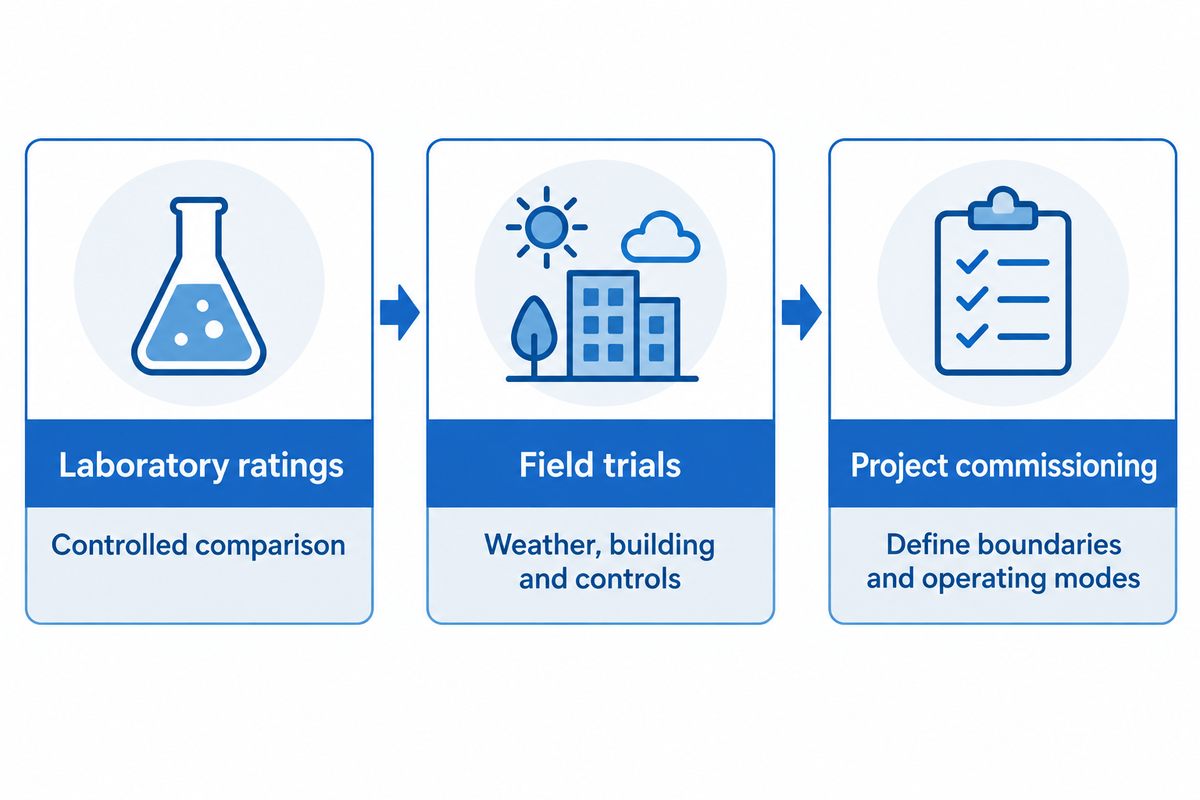
Cold-climate heat pump technology progresses through laboratory tests, field trials and commissioned installed systems. Laboratory ratings allow controlled comparisons; field work includes weather, buildings and controls. Buyers benefit more from a reported result when it identifies equipment, climate, the heat delivery boundary and backup use, rather than only giving a minimum operating temperature.
PNNL’s 2025 cold-climate challenge publication describes prototype field validation in real homes for 2022 to 2024. Those dates represent the field validation trial period. Commercial procurement still requires the design duty and data for the proposed retail equipment.
The 2023 NREL field-validation report’s abstract describes airside and power measurements at 5-second intervals, with heat-pump, auxiliary and defrost operation distinguished. That measurement explains why a compressor COP by itself answers only part of the question regarding the winter bill. Owners benefit when the commissioning report identifies the system boundary and distinguishes the operating modes at the equipment.
For the next system comparison, start with a calculated load and a completed Winter Duty Sheet. Match low-temperature output to that duty, settle distribution work and put the operating sequence beside the energy estimate. Koven Air’s heat-pump range provides the route to a system-specific discussion once the architecture is clear. Discuss your winter heating duty with the project team.
Cold Climate Heat Pump FAQs
Do heat pumps need ductwork?
Heat pumps can use ducts, ductless indoor units or a water-based distribution system.
The indoor units of ducted models connect to an air distribution system, while indoor units of ductless models connect directly to the room. If you already have ductwork, the installer still needs to check the airflow and pressure before replacing the heating equipment. Air-to-water equipment provides heat to suitable hydronic terminals. The layout of the room and closed doors influence the capacity of the terminal to distribute heat throughout the building.
Should I turn my heat pump off in extreme cold?
Keep the heat pump under its normal controls within the manufacturer’s operating limits.
The controller must be able to achieve the balance of compressor and supplemental heating that was agreed upon. Cold-climate equipment continues to extract the heat available outdoors within its operating envelope. A gas furnace hybrid switches according to its own control sequence. Shut down the equipment for the fault that the manufacturer specifies. Contact the installer if the equipment is behaving strangely and/or rooms are losing temperature.
What kind of maintenance do heat pumps need?
Heat pumps need clean air paths, sound drainage and scheduled professional checks.
For filter cleaning or replacement, follow the manual. Keep outdoor air paths clear. Professional service covers refrigerant condition, electrical connections and controls, and water systems (flow, pressure and water quality checks). The service plan should reflect the installation and environment. The outdoor coil needs clear air paths to capture heat from the air and warm your home. Persistent icing and/or unusual noises warrant attention as do repeated service faults, especially between scheduled service calls, rather than a forced restart.
How long do cold climate heat pumps last?
A heat pump’s lifespan varies with installation quality, duty, environment and maintenance.
Separate equipment warranty from expected service life. For an ownership budget, consider parts availability, labor costs, corrosion and/or exposure and replacement. There are differences in cost to repair and/or renew commercial modules and residential indoor units.
Is it okay for a heat pump to run all night in winter?
Overnight operation is normal when the equipment maintains the set indoor temperature.
Variable-speed equipment is designed to continuously handle a small continuing load instead of repeatedly stopping and starting. Therefore, running for long hours doesn’t mean the equipment is inefficient or faulty. Record indoor and outdoor temperatures, as well as the type of backup heat used. If the temperatures in your home in the winter continue to fall despite continuous operation, record the temperatures and modes, inspect accessible filters and air paths, and arrange a service check. Repeatedly adjusting the thermostat will not correct the delivered capacity.
How can I make my heat pump work better in cold weather?
Keep airflow clear, follow the control schedule and reduce avoidable building heat loss.
Replace filters and clear snow as directed. For a hydronic system, correct balancing and the designed water temperature schedule are also required. Repeatedly using backup heat alters the overall system energy balance.
Are heat pumps for cold climates more expensive?
Cold-climate equipment can cost more, while the full installation scope decides the project budget.
Low temperature capability is one aspect of the purchase. Heat pump installation includes more than the replacement of equipment. New emitters or duct repairs can be expensive to install. Homeowners can save operating electricity when replacing resistance heating with a well-performing system, but that does not mean there is a universal payback. Compare the heat your home uses, local energy costs, and the defined backup contribution. For a facility, include demand costs, and account for maintenance and ownership costs before approving the investment.
References & Sources
This guide uses public technical guidance and the study abstracts identified above. Worksheet values are assumed inputs. Company information is available about Koven Air.
- PNNL: Cold Climate Heat Pump Sizing and Selection
- Natural Resources Canada: Heating and cooling with a heat pump
- ENERGY STAR: Air-source heat pump product criteria
- NEEP: Cold-climate specifications and performance reporting
- DOE FEMP: Evaluating Your Utility Rate Options
- PNNL: Cold Climate Heat Pump Challenge field validation, 2025
- NREL/NLR: Field Validation of Air-Source Heat Pumps for Cold Climates, 2023 abstract