Get in Touch with Koven Air Company

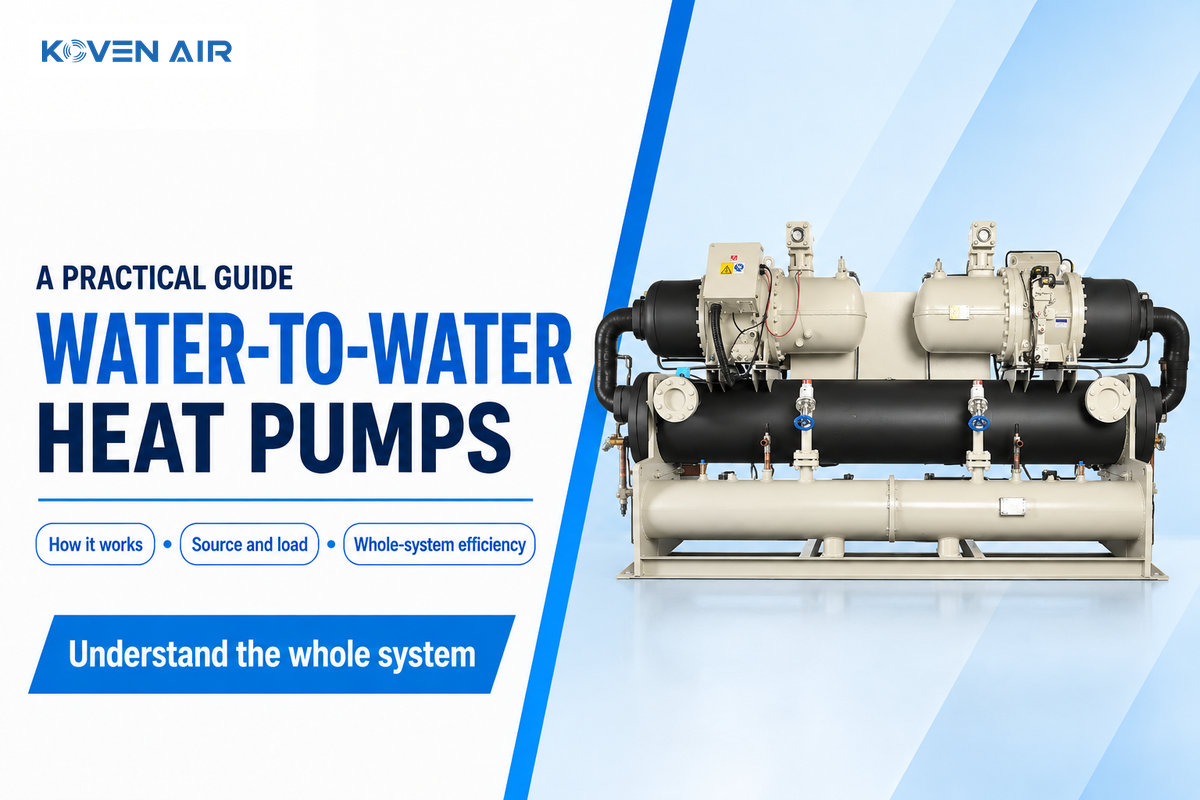
A Water-to-Water Heat Pump system moves heat between a source-water circuit and a building’s hot or chilled-water circuit. It’s appropriate for sites with accessible water or ground-loop heat sources and hydronic distribution. The practical test is whether that source, the required water temperature and all the pumps can economically deliver the building load.
Updated October 2026
Water-to-Water Heat Pump: a refrigeration system that transfers heat between two liquid circuits. Source water, refrigerant and building water normally remain in separate flow paths.
Quick facts
- Delivery: hydronic heating, chilled water or a designed hot-water service.
- Possible sources: ground loops, groundwater, surface-water loops or recoverable process heat.
- Main constraint: source and load temperatures must suit the selected equipment.
- Efficiency comparison: include auxiliary electricity within the same measurement boundary.
What Is a Water-to-Water Heat Pump?
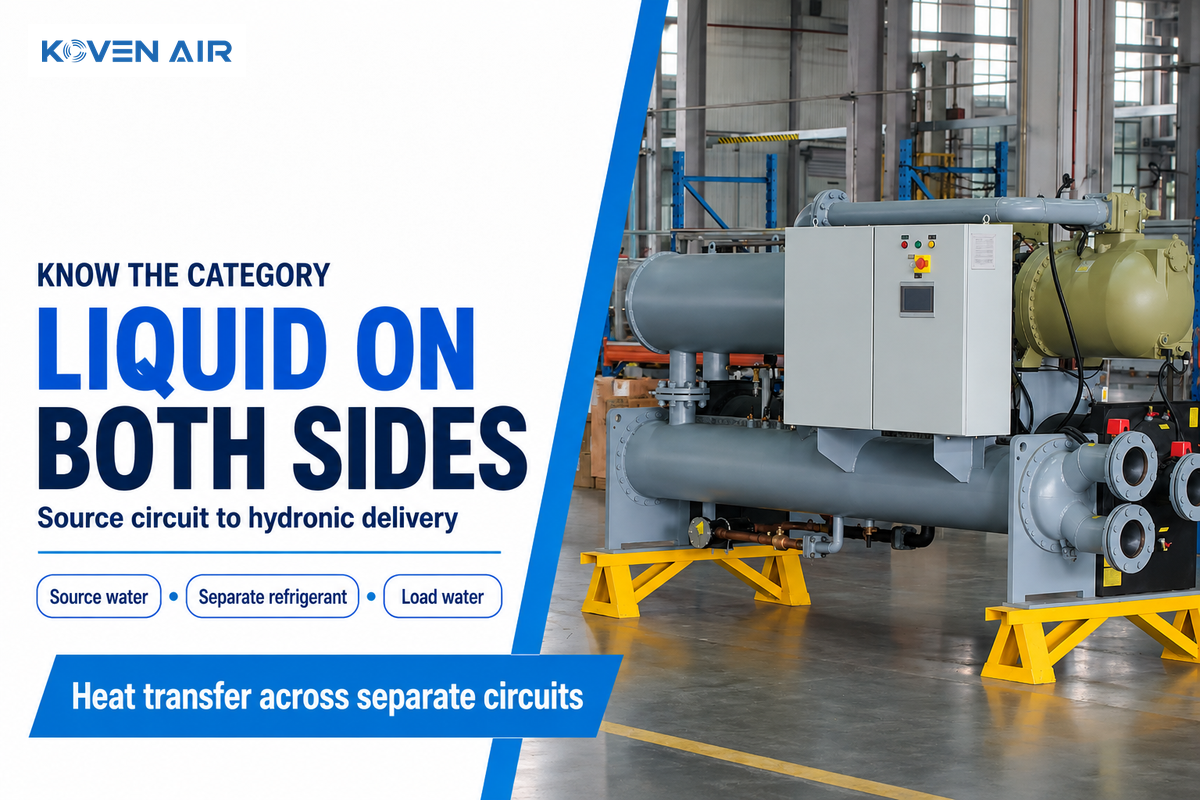
Water-to-water heat pumps use liquid on both sides of a refrigeration circuit. The first “water” describes the heat source side; the second describes the useful delivery side. A water source heat pump (WSHP) can deliver warm or cool air, so the two descriptions aren’t interchangeable.
Hydronic distribution carries heated water to radiators, floors or coils, then returns it for reheating. Appropriate terminals let the HVAC system heat or cool rooms using a water circuit. In cooling mode, chilled water collects heat from the inside of the building. The US Department of Energy’s geothermal overview separates the underground collector, heat pump and distribution system; the distribution can be air-based or water-based.
An air-source heat pump water heater takes heat from surrounding air into stored water (ENERGY STAR’s tank-water-heater explanation). An electric water heater with a resistance element heats that tank directly. Neither arrangement, by itself, describes a water-to-water plant serving building heating.
How the Refrigeration Cycle Moves Heat
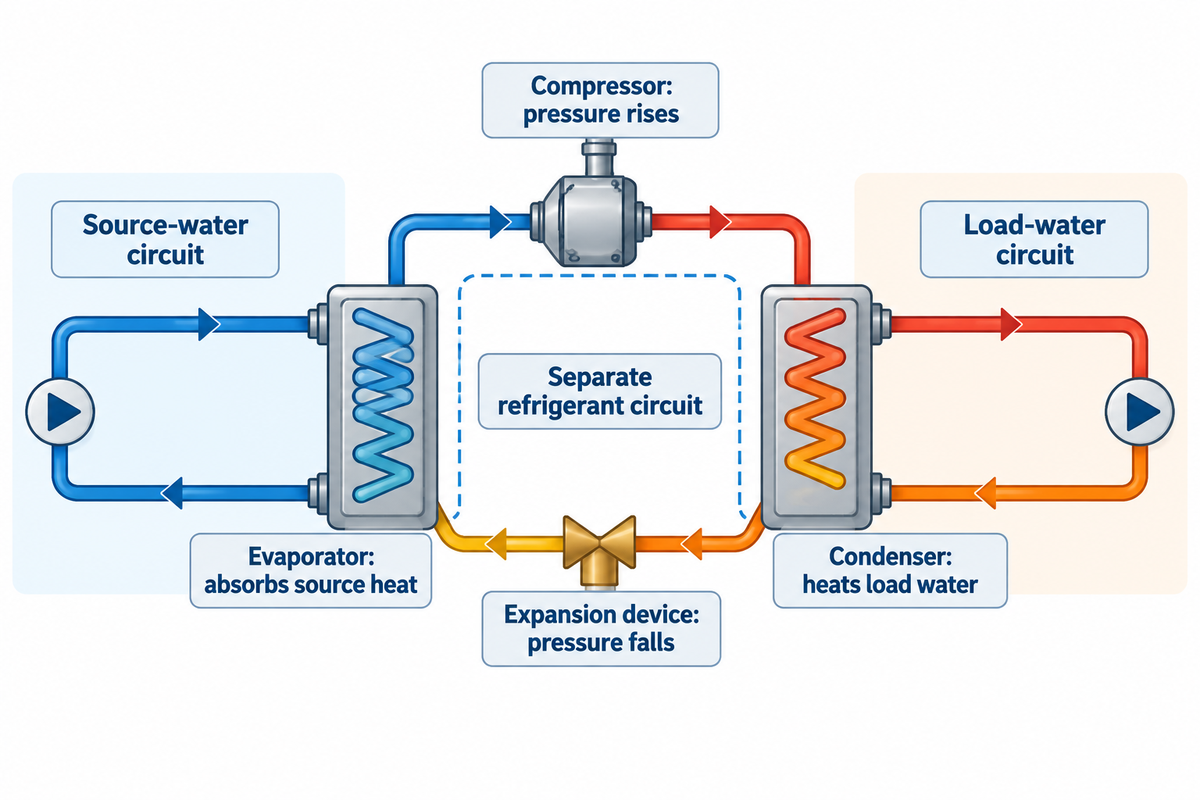
The refrigeration cycle works like a refrigerator removing heat from its cabinet, except that the useful heating side warms water in a circuit. Refrigerant evaporates at the cold exchanger, is compressed, releases heat at the hot exchanger, and then loses pressure through an expansion device. This thermal energy transfer doesn’t require the source water to boil.
How does water to water heat pump work?
A water-to-water heat pump absorbs energy from the water or circulating source fluid through an evaporator. Its compressor raises refrigerant pressure and temperature. At the condenser, refrigerant releases heat to the load water and condenses back to a liquid. An expansion device reduces its pressure before the refrigeration cycle repeats.
Extracting heat energy from water cools the source fluid while the load fluid warms (see Natural Resources Canada’s heating-cycle explanation). Refrigerant stays in its own circuit, transferring heat via a heat exchanger on both sides. A reversing valve changes their thermal roles on equipment built for reversible service.
- Evaporator: low-pressure refrigerant absorbs heat from the source.
- Compressor: electrical input raises refrigerant pressure.
- Condenser: hot refrigerant gives heat to the load water.
- Expansion device: reduced pressure prepares the refrigerant to absorb heat again.
Where Can the Source Water Come From?
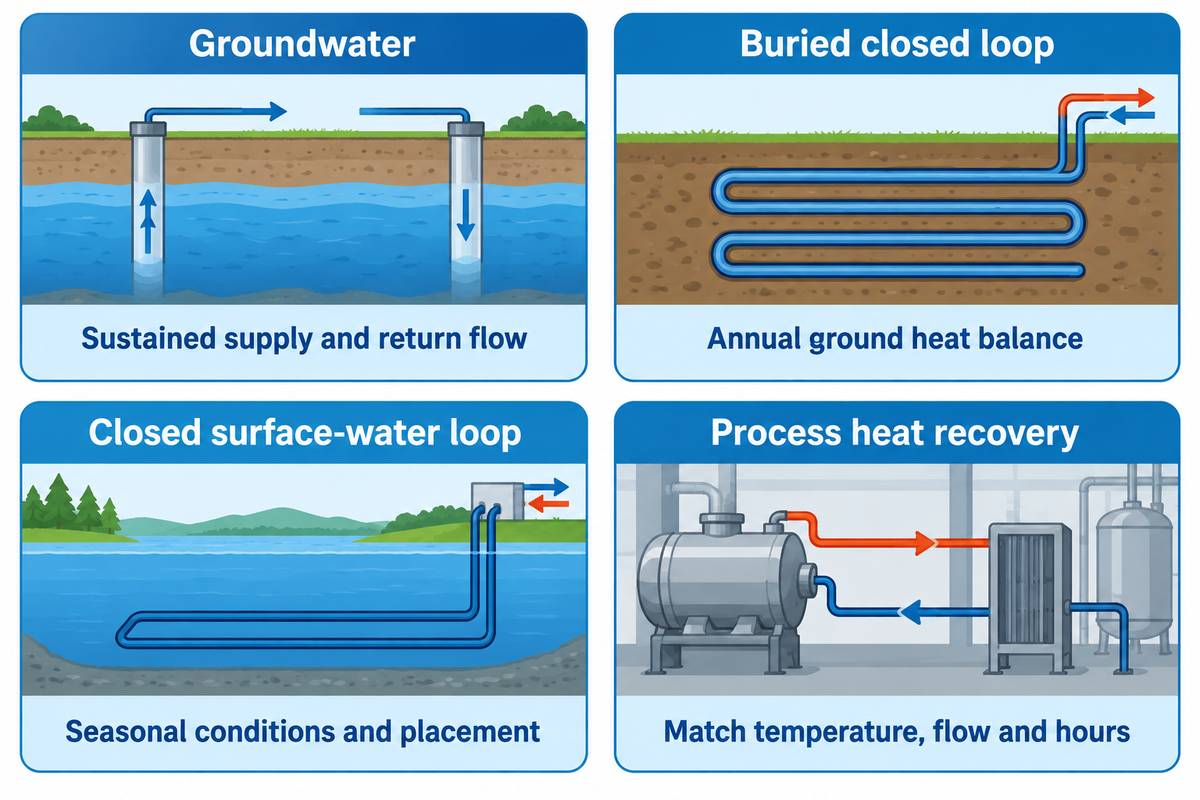
Groundwater, buried closed-loop pipe, a suitable surface-water loop and recoverable building or process heat can supply a water-to-water heat pump. Each has a different limiting factor: the continuous water yield of a source, the transfer of ground heat, seasonal water conditions, or the hours when waste heat exists. An adjacent source of water also must have sufficient seasonal heat transfer capacity.
ASHRAE’s recommendations for groundwater systems (§1.5, system components) would favor an isolating heat exchanger for commercial groundwater systems. This design separates raw water fouling from the cleaner building circuit, while adding an exchanger temperature difference and pumping resistance. A closed-loop design recirculates a controlled fluid and still requires protection from freezing and corrosion.
| Arrangement | Heat source | Useful delivery | Main design question |
|---|---|---|---|
| Closed ground loop to water | Fluid in buried pipe | Hot/chilled water | Can the ground exchange the annual heating and cooling loads? |
| Groundwater to water | Extracted well water | Hot/chilled water | Can supply and return arrangements sustain design flow? |
| Closed surface-water loop to water | Submerged sealed pipe | Hot/chilled water | Will seasonal conditions and loop placement support heat transfer? |
| Open surface water with isolation | Raw-water intake through exchanger | Hot/chilled water | How will debris, water chemistry and exchanger cleaning be managed? |
| Building water loop to water | Shared thermal loop | Hydronic load | What maintains loop temperature when loads are unbalanced? |
| Process-water heat recovery | Available reject heat | Useful heating water | Do source temperature, flow and operating hours match demand? |
| Air-to-water | Outside air | Hot/chilled water | Does capacity at winter air temperature meet the load? |
| Water-to-air | Water or ground loop | Conditioned air | Can ducts and fans deliver the required airflow? |
| Air-to-air heat pump | Outside air | Conditioned air | Does ducted or ductless delivery fit the rooms? |
Ground-source efficiency can vary over time: a heating-dominated permafrost site showed variable efficiency across seven heating seasons (Garber-Slaght’s Fairbanks study (2021)). Annual variation in heat extraction and rejection must be taken into account during an analysis of ground loop performance. The ground-source heat pump guide provides more design information for ground side issues.
Water-to-Water vs Air-to-Water and Water-to-Air
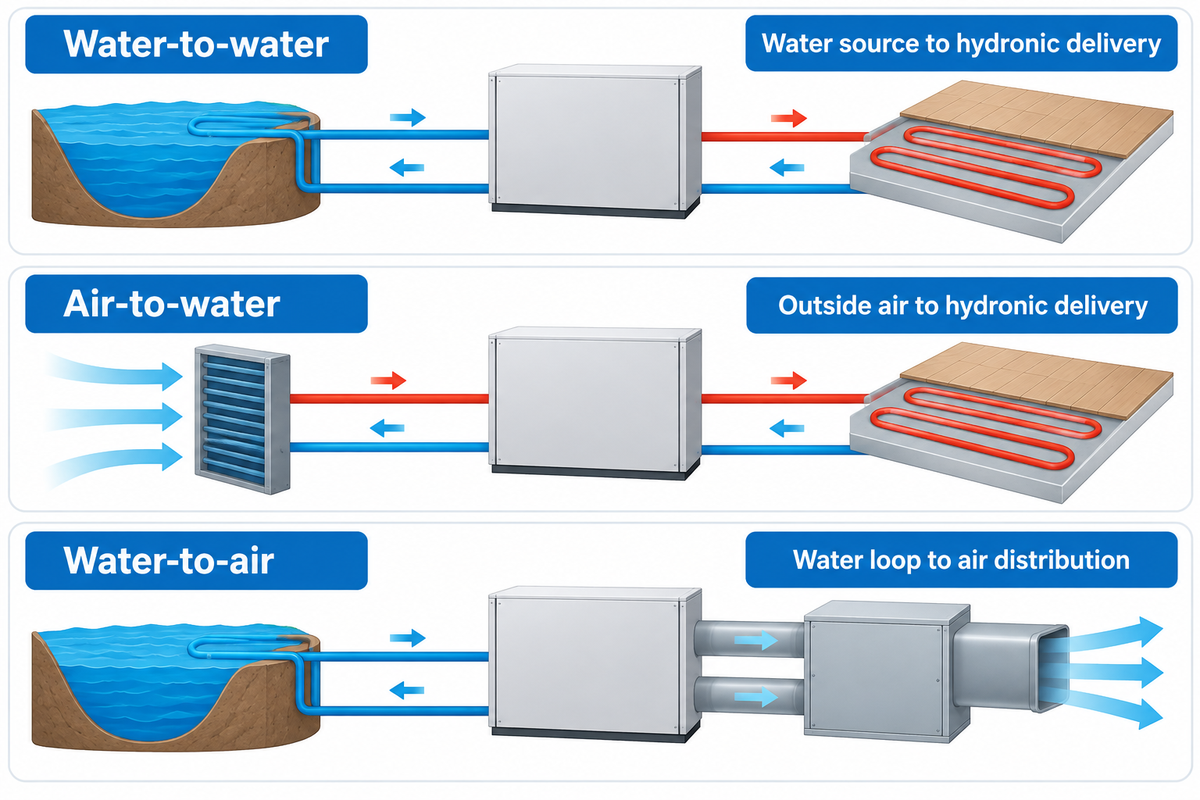
Compare water-to-water and air-to-water for hydronic delivery. Use water-to-air for air delivery from a water loop. Air-to-water heat pumps avoid a ground or water collector, but cold air increases the temperature lift required for heating. Water-to-air heat pumps require air distribution rather than a central hot water delivery system.
An air-to-air heat pump heats inside air directly through a refrigerant coil (Natural Resources Canada’s source-and-sink descriptions). A water-to-air heat pump requires an air handler or a packaged fan section; using water instead of air on the source side doesn’t eliminate the requirement for an air section.
Water-to-water advantages
- Connects to hydronic distribution.
- Can use suitable water-side reject heat.
- A controlled source loop can maintain a narrow temperature range.
Water-to-water limitations
- Needs a viable source-water or ground-loop installation.
- Source pumps add electricity and maintenance.
- Emitter water temperature can restrict capacity and efficiency.
An existing well is a starting asset. It can’t be assumed that a water-to-water heat pump can always be combined with an existing well to produce a complete heating system. If sustained well flow is inadequate, or water treatment and return works are too extensive, an air-source heat pump may fit the site better. Compare the two at the same room load and delivery temperature. Koven Air’s Water-to-Water Heat Pump solution addresses equipment options for the assessment.
Matching Hydronic Distribution and Water Temperature
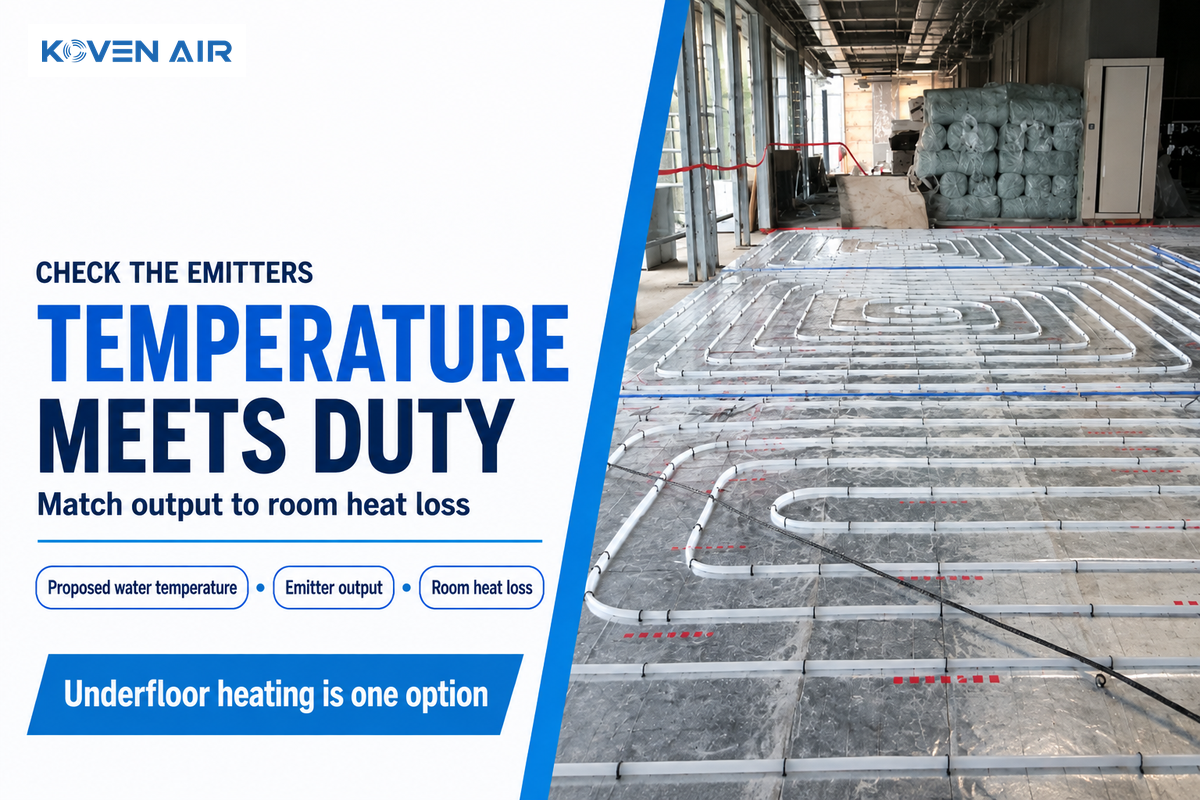
Below 45 to 50°C is the more efficient hydronic heating range described in Natural Resources Canada’s residential ground-source guidance. Low-temperature distribution reduces the compressor’s temperature lift. The emitter must still release enough heat at that water temperature, so radiator output and room heat loss decide whether an existing heating system can remain.
Can a geothermal heat pump work with existing radiators?
Yes, a heat pump can be used in conjunction with existing radiators, if the radiators’ output at the proposed flow and return temperatures is sufficient to meet the loss of heat in the room. Under floor heating isn’t required in this case.
Example: The design condition outdoor temperature causes a room to require 2.0 kW of heat. If its radiator supplies only 1.5 kW at the proposed water temperature, the shortfall is 0.5 kW. The room is therefore 0.5 kW short. Keeping that radiator unchanged leaves the room below its design requirement. The shortfall can be made up by using a larger emitter or by reducing heat losses.
Fan coils can also provide a form of hydronic heat. A fan moves air over a water coil, causing cooling or heating of that air. The hydronic fan coil unit guide provides more information on air delivery. High-temperature industrial machines are a separate equipment choice: the residential caution about radiators above 60°C is not a universal water-to-water output limit.
Efficiency: Unit COP, System COP and Seasonal Results
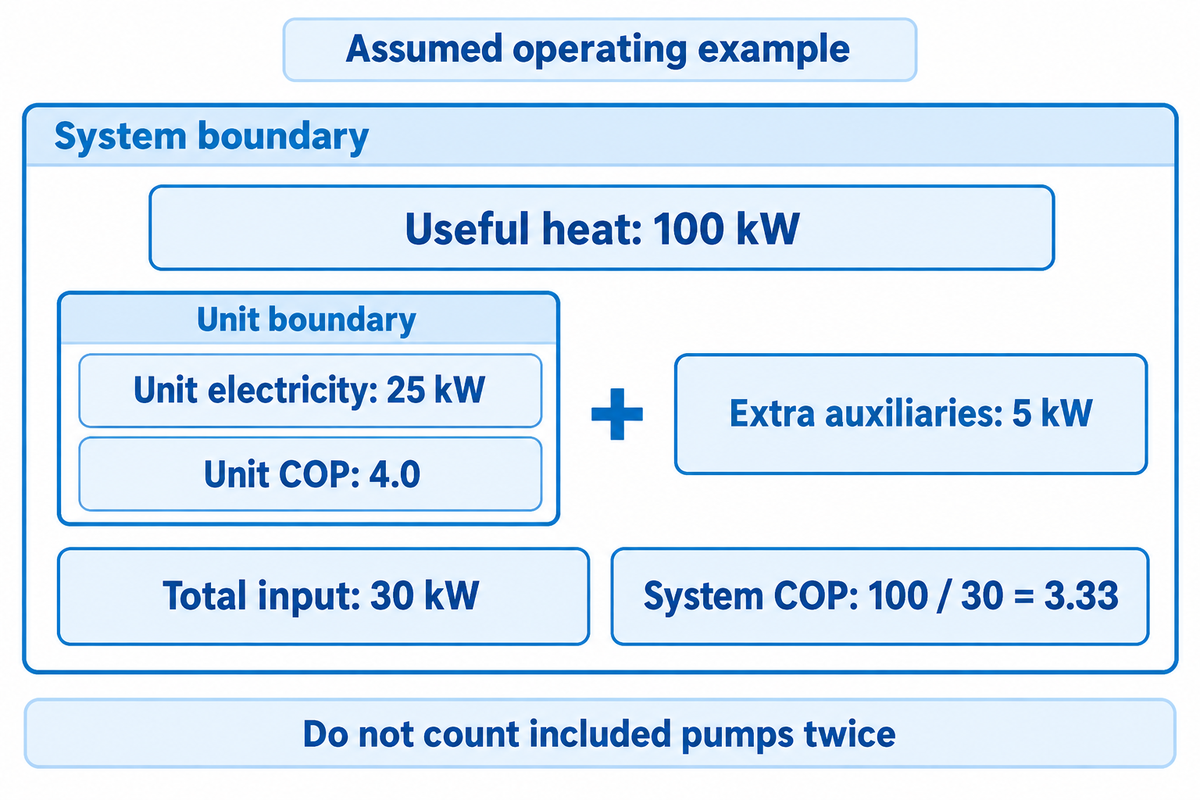
A heat pump’s unit COP measures heat against the electricity included in the unit’s rating. System COP includes all of the electricity within the plant boundary. Seasonal energy efficiency covers changing loads and temperatures over time. A favourable single-point COP can coexist with poor annual results when source pumps, resistance backup or distribution losses are substantial.
“Ratio of heat recovery system output to entire system energy input, including compressor, pumps, etc.”
Example: useful heat output is 100 kW and the unit uses 25 kW, giving a unit COP of 4.0. Add 5 kW of source and distribution auxiliaries that were outside that rating: total input becomes 30 kW, and system COP becomes 100 ÷ 30 = 3.33. Pumps already counted in the unit input must not be added twice.
Are water source heat pumps high efficiency?
Water source heat pumps can provide high efficiency when source and load temperatures are appropriate for the equipment and auxiliary power is controlled. They move heat energy rather than relying on electric resistance. Whole-system performance must include pumping and any backup heat, because pumping and backup power can raise consumption despite a good compressor rating.
ISO 13256-2:2021, published as Edition 2 in 2021, sets performance testing and rating criteria for matched water-to-water and brine-to-water assemblies at specified source/load conditions. Compare ratings at matching conditions. For an annual energy estimate, use a seasonal system factor that includes the same auxiliaries as the electricity budget.
Capacity and Flow: A Worked Water-Side Example
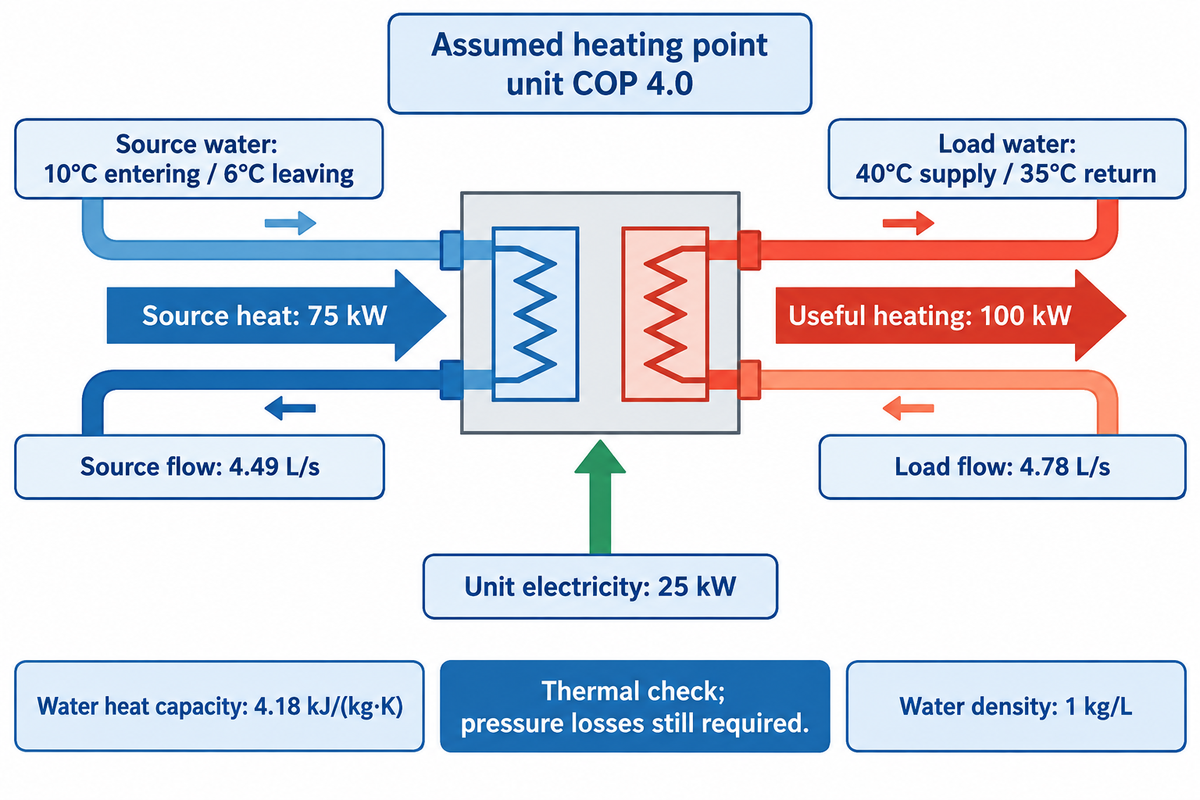
A 100 kW water heating duty with a 5 K water temperature rise requires 4.78 L/s using the simplified water assumptions provided below. Source-side flow is calculated separately because source heat extraction excludes the compressor’s added energy. These flows check thermal duty; pump selection also needs pipework and exchanger pressure losses.
Source-to-Load Operating Map
The Source-to-Load Operating Map illustrates water flows, compressor input, useful heat, and one assumed operating point.
Assumed inputs: steady heating operation; 100 kW useful output; unit COP 4.0; source water entering/leaving at 10/6°C; load water leaving/entering at 40/35°C. Use water density of approximately 1 kg/L and specific heat of 4.18 kJ/(kg·K), the simplified reference properties in ASHRAE’s hydronic heat-transfer equations. Ignore pipe heat loss and pump heat in this thermal balance.
| Quantity | Input or calculation | Result / meaning |
|---|---|---|
| Useful heating duty | Assumed load-side output | 100 kW |
| Unit electrical input | 100 kW ÷ COP 4.0 | 25 kW |
| Heat taken from source | 100 kW − 25 kW | 75 kW |
| Load-water temperatures | 40°C supply / 35°C return | 5 K temperature rise |
| Source-water temperatures | 10°C entering / 6°C leaving | 4 K temperature drop |
| Water heat capacity | Simplified reference | 4.18 kJ/(kg·K) |
| Water density | Simplified reference | 1 kg/L |
| Load-side water flow | 100 ÷ (4.18 × 5) | 4.78 L/s |
| Source-side water flow | (100 − 25) ÷ (4.18 × 4) | 4.49 L/s |
Use Q = mass flow × specific heat × temperature change, with Q in kW and mass flow in kg/s. COP 4.0 is assumed at the example temperatures for this circuit comparison, not an equipment selection. The flows and pressure drops for glycol mixtures differ from those for water and therefore require specific analysis and correction.
Lower temperature differences result in a higher calculated flow for a given heat duty. Flow limits still apply to equipment. Selecting a smaller pump to reduce flow without checking equipment limits can result in starving the exchanger. The thermal calculation and the hydraulic calculation must both satisfy the heat pump unit.
Applications, Cooling and Domestic Hot Water
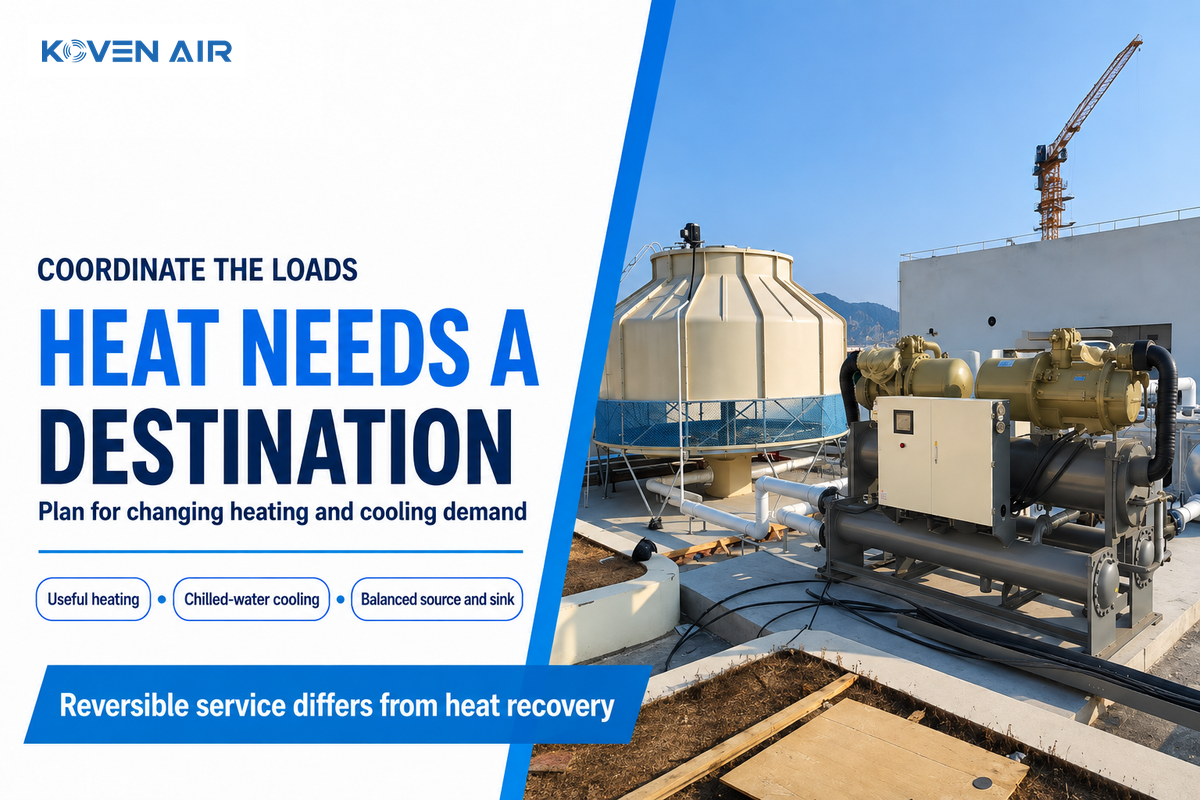
Water-to-water equipment can provide space heating, chilled-water cooling, and other designed domestic hot water services. Reversible equipment can change heating and cooling modes; heat-recovery equipment can provide hot and cold water to coincident loads when needed. Simultaneous services require suitable water circuits and a place to discharge the heat when a load ceases.
Recovering heat from a cooling office can provide heating for a neighboring process. ASHRAE defines dual mode systems differently from heat-reclaim systems. Once a process stops, heat still needs to be rejected to a cooled sink. A boiler/cooling tower loop, ground connection or other designed source/sink must be provided for an imbalance. The heat pump chiller guide presents a comparison of these arrangements.
For domestic hot water, transfer heat into a suitable potable-water system via a heat exchanger or purpose-built water heater. Space-heating setpoints don’t replace hot water hygiene controls. CDC’s building water guidance distinguishes storage, circulation and point of use anti-scald controls. A dedicated hot water design may incorporate storage and additional heating. The plumbing system design must also provide for the project’s local potable water requirements.
Radiant cooling requires a separate humidity control strategy. Chilled-water fan coils can remove moisture when they have suitable coils, condensate collection and drains. In John Siegenthaler’s hydronic heat-pump explanation, controlling condensation requires a surface temperature (on the panel) above the dew point of the room air. Cooling a floor doesn’t provide the same dehumidification as an air coil.
Water-to-Water Heat Pump Cost: Installation and Energy
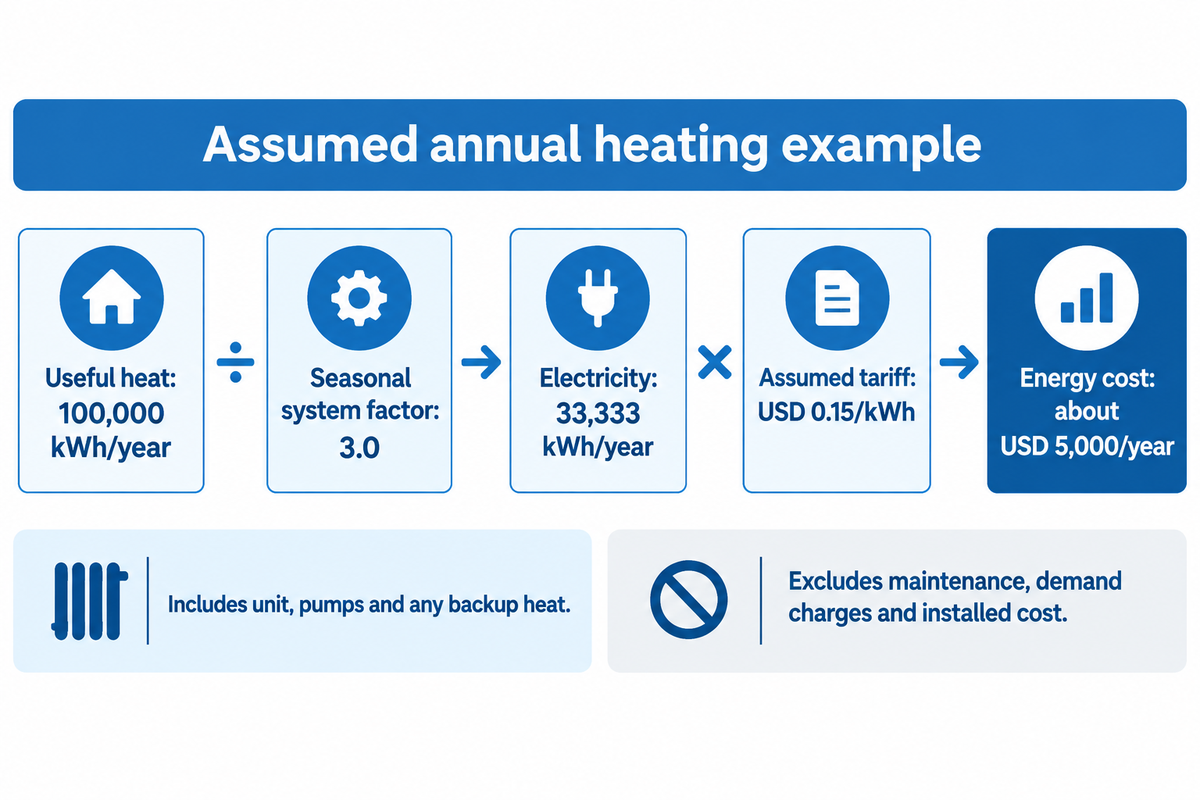
The cost of a water-to-water installation consists of the heat pump, the source works, building distribution, and electrical/hydraulic installation. The budget for a groundwater retrofit and a new borefield can be very different, even if they have the same heating capacity. Annual energy cost is easier to calculate once useful heat demand, seasonal system performance and the electricity tariff are defined.
The major costs comprise equipment, wells, intake and return works, isolation exchangers, pumps, emitters, pipework, electrical supply, controls and commissioning. Site-specific conditions and collector type largely influence costs (Natural Resources Canada’s installation guidance). Large commercial buildings may also pay electricity demand charges, which a simple kWh calculation omits.
Annual heating electricity costs about USD 5,000 for an assumed 100,000 kWh of useful heat, seasonal system performance factor 3.0 and electricity at USD 0.15/kWh. Electricity use is 100,000 ÷ 3 = 33,333 kWh. The assumed seasonal factor includes the unit, source/distribution pumps and any backup heat serving that annual heating load. This energy-only estimate excludes maintenance, demand charges and installed cost; the tariff is assumed rather than a current local price.
Electric resistance water heaters provide heat using electricity. A heat pump for heating with a seasonal performance factor greater than one achieves reduced energy use for the same delivered heat. For an apples-to-apples comparison, an energy saving must be calculated using equivalent services and meter boundaries. Replacing a domestic tank doesn’t account for the cost of the source-water installation and hydronic distribution systems of the entire building.
What to Check Before Specifying a System
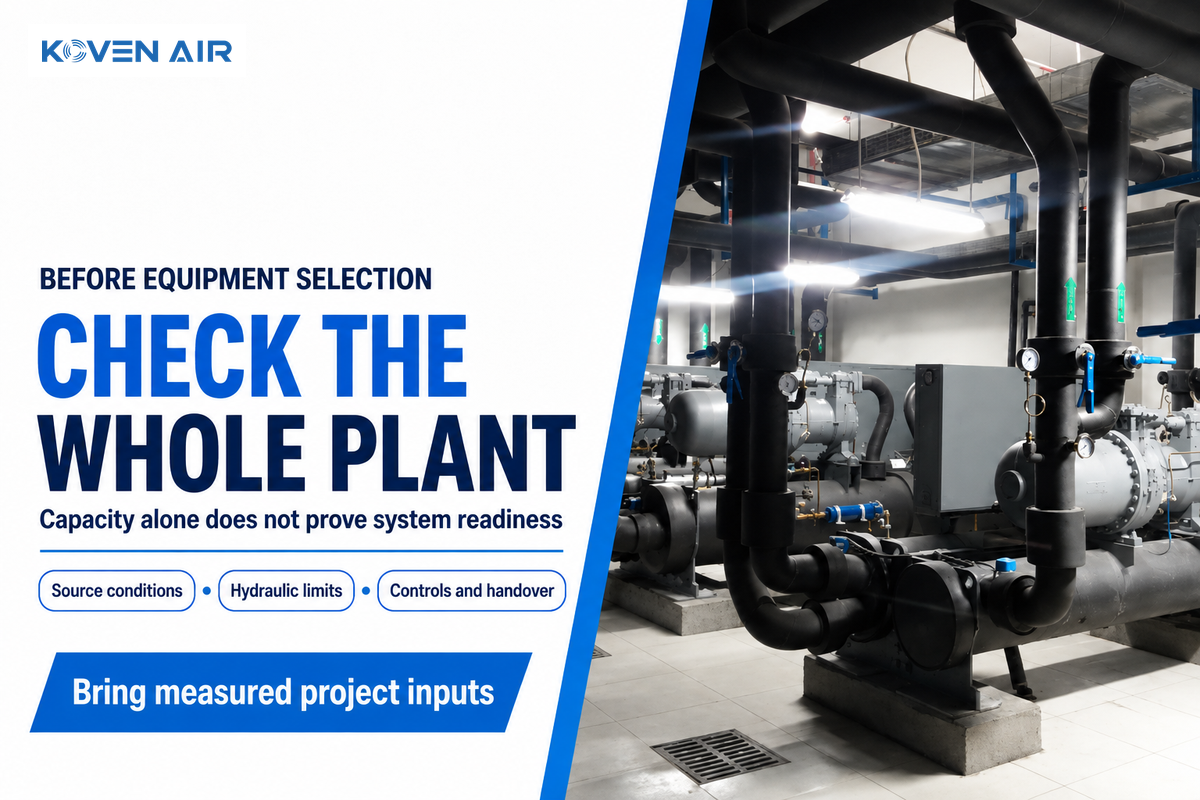
Start with a heat-load profile, source water availability and anticipated emitter output. Match the thermal duty to a hydraulic design and operating sequence. Capacity alone won’t resolve inadequate flow or an unavailable heat source; those constraints need answers before equipment schedules and installation budgets are finalized.
In a 2026 HPAC Engineering case by Vinay Shekar and Robby Oylear, an all-electric laboratory plant was sized for loads but still resulted in flow alarms and outages. Source pumps were interacting with a larger variable-flow loop. A bypass near the water-to-water equipment also reduced the active water volume and increased cycling. The case’s hardware changes included hydraulic decoupling and relocating bypass valves farther downstream. Changes to the hydraulic layout and control strategy addressed the controls and hydraulic issues.
| Check | Evidence to bring to selection | What it prevents |
|---|---|---|
| Building demand | Peak heating/cooling loads and hourly profiles | Sizing from floor area alone |
| Source availability | Sustained flow and seasonal entering-water conditions | A heat source disappearing during demand |
| Source water quality | Water analysis and exchanger material/cleaning requirements | Fouling and incompatible materials |
| Emitter duty | Room loads and output at proposed supply/return temperatures | Cold rooms despite adequate unit capacity |
| Hydraulics | Design flows, pressure losses and minimum-flow strategy | Flow alarms and unwanted bypass mixing |
| Electricity boundary | Included unit input plus separately counted auxiliaries | Overstated system COP |
| Load coordination | Heating, cooling and hot-water priorities | Unmanaged simultaneous-demand conflicts |
| Site works | Source access, return/disposal arrangements and local permissions | Unbudgeted construction work |
| Handover | Meter points, control sequence and maintenance responsibilities | Unexplained energy use after installation |
Refer to the water-source heat pump commissioning and controls guide for additional checks.
What’s Changing in Water-Side Heating?
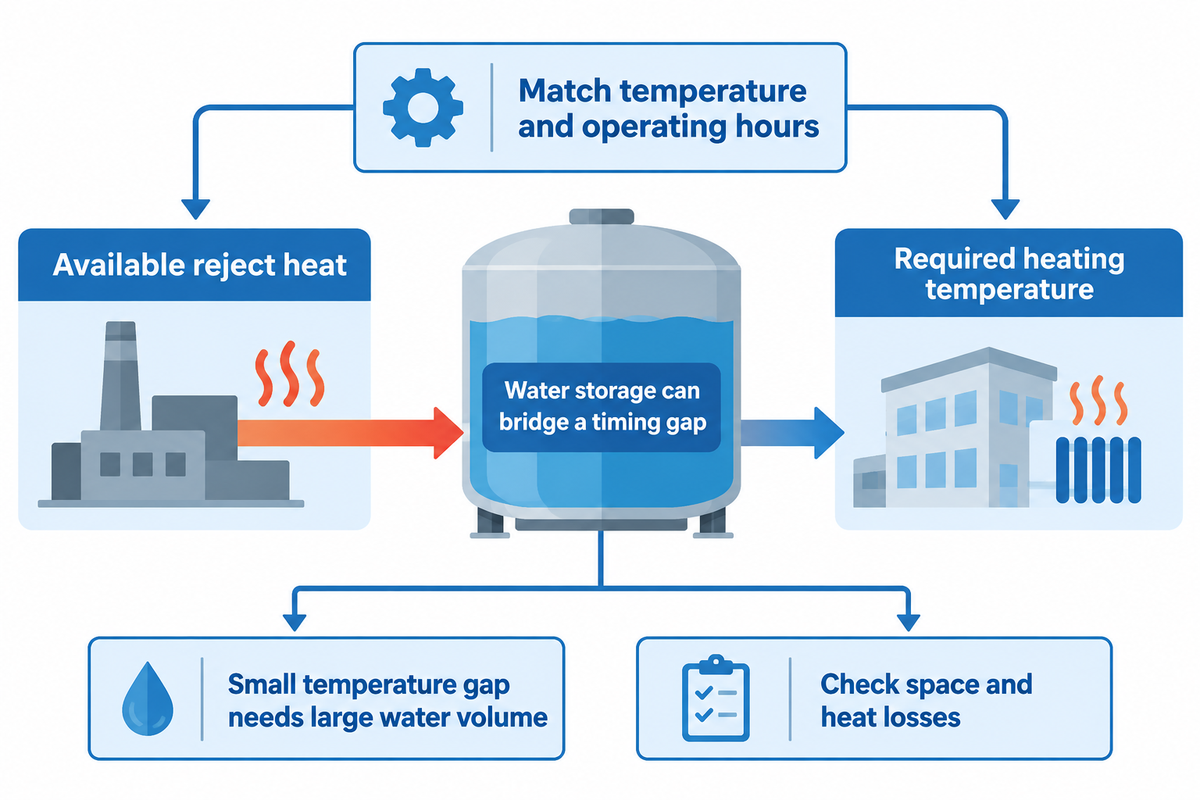
Heating equipment replacement projects are expanding into integrated building systems and industrial energy systems. What drives this expansion is useful source temperature, delivery temperature and operating hours. Heat recovery and thermal storage can help reduce or shift heating demand, but they need to work within the production or occupancy schedule.
Commercially available heat pumps could technically supply up to around 20% of global industrial heat demand, according to IEA’s Heat Pump Monitor 2026. Industrial heat-pump equipment can be integrated into industrial processes, but barriers, like adverse economics and unfavorable process conditions, limit its use.
When choosing equipment for a retrofit, consider the temperature and timing of available reject heat, and compare that with the required heat temperature. Water storage can help bridge the timing gap. However, storing useful heat across a small temperature gap requires large volumes of water. A system design should consider this volume, its space and heat losses.
Key takeaway
Match the source, emitters and auxiliary electricity first. A water-to-water heat pump then becomes an equipment choice within a workable heating and cooling system.
Frequently Asked Questions
Do water source heat pumps use refrigerant?
Yes. Water source heat pumps use refrigerant inside a separate refrigeration circuit.
The source water transfers energy to the refrigerant at one exchanger; the refrigerant releases that energy at another. Compressor input supplies the energy required to move heat to a higher temperature. Water circulating through the source or building loop normally remains separate from that refrigerant, even though both exchange heat inside the unit.
Is a water source heat pump geothermal?
A water-source heat pump is geothermal when its source exchanges heat with the ground or groundwater.
Other water-source arrangements use a shared building loop, surface water or process heat. The source label alone also leaves the delivery side unspecified: equipment may deliver conditioned air or hot and chilled water. A closed ground loop and a water-to-water unit therefore describe different parts of the same installation, rather than identical equipment categories.
Can water source heat pumps provide hot water?
Yes, suitable water-source heat pumps can provide hot water through a designed hot-water system.
The heat pump may heat a storage circuit, preheat water or serve a dedicated heat exchanger. Potable-water storage, circulation and point-of-use controls need their own design, separate from space heating. The required temperature and recovery rate determine whether supplementary heating is included. An ordinary heating buffer tank isn’t automatically a potable-water cylinder.
Does a water source heat pump have a compressor?
Yes. A vapor-compression water-source heat pump has a compressor.
The compressor raises the refrigerant’s pressure so it can release heat at a higher temperature. It doesn’t pump the source water around the building. Separate circulators or well pumps move that water, adding their electricity consumption to the system.
How much does it cost to run a heat pump for 1 hour?
For an assumed 30 kW total input at USD 0.15/kWh, one hour costs USD 4.50.
Use the electrical input at the operating condition, including the auxiliaries inside your cost boundary. Multiplying the heating-output rating by the tariff would overstate consumption because output includes heat taken from the source. For equipment that cycles or modulates, use the average electrical input over that hour. Standing charges, demand charges and maintenance belong elsewhere in the budget. Annual consumption also changes with weather, water temperature and operating hours; one measured operating hour can’t represent an entire local heating season.
Does source water mix with the building’s heating water?
Source water and building heating water normally circulate through separate flow paths.
Heat crosses exchanger walls and the refrigeration circuit; the two water streams don’t need to mix. An isolating exchanger can create an additional boundary between raw groundwater and a source loop. That boundary also adds thermal and hydraulic resistance.
Can water-to-water heat pumps cool through radiant floors?
Yes, a suitably designed water-to-water system can supply radiant floor cooling.
The floor surface must stay above the room’s dew point to avoid condensation. A humidity sensor and water-temperature control are therefore part of the cooling design. Radiant floors mainly handle sensible heat, so a separate air-side system may be needed for moisture removal. Chilled-water piping and buffer storage also need suitable insulation and vapour control. A heating-only floor installation can’t simply be switched to cold water without assessing those moisture and control requirements, including dehumidification and condensate handling.
Discuss your source and load conditions
Bring the source-water temperatures, heating/cooling loads and proposed delivery temperatures to a Koven Air project discussion.
Project equipment requires site-specific engineering design. More company information is available from Koven Air.
References & Sources
- US Department of Energy: Geothermal Heat Pumps
- ENERGY STAR: How Heat Pump Water Heaters Work
- Natural Resources Canada: Heating and Cooling with a Heat Pump
- ASHRAE: Ground-Source Heat Pumps and Geothermal Energy, 2023
- National Laboratory of the Rockies: Performance Considerations for Ground Source Heat Pumps in Cold Climates, 2021 abstract
- ASHRAE: Applied Heat Pump and Heat Recovery Systems, 2024
- International Organization for Standardization: ISO 13256-2:2021
- ASHRAE: Hydronic Heating and Cooling, heat-transfer equations
- US Centers for Disease Control and Prevention: Monitoring Building Water, 2024
- Plumbing & Mechanical: Water-To-Water Heat Pumps, John Siegenthaler, P.E.
- HPAC Engineering: Designing Commercial Heat Pumps for Greater Performance, 2026
- International Energy Agency: Heat Pump Monitor 2026, Key Findings