Get in Touch with Koven Air Company

![Liquid Desiccant Dehumidifier: How It Works [2026 Guide]](https://kovenair.com/wp-content/uploads/2026/07/liquid-desiccant-dehumidifier-guide-featured.png)
Quick Specs
| Desiccant salts | Lithium chloride (LiCl), calcium chloride (CaCl₂), lithium bromide (LiBr) |
| Achievable dew point (current deployments) | ~2°C to 13°C (roughly 4-55°F), salt-limited |
| Regeneration temperature | 60-140°C conventional; 32-55°C heat-pump-coupled |
| Common hardware setups | Packed-bed, membrane (LAMEE), heat-pump-coupled |
| Typical media life | Ongoing solution top-up; contactor service, not a wear-out part |
A liquid desiccant dehumidifier is an air-conditioning apparatus that dries process air by absorbing water vapor into a circulating salt solution, typically lithium chloride, calcium chloride, or lithium bromide, then regenerating that solution with heat so it can absorb again. It targets moderate-to-low dew points, roughly 2-13°C in current commercial deployments, rather than the ultra-low dew points a solid desiccant wheel reaches, and it can cool and dehumidify in the same pass.
A liquid desiccant dehumidifier, also referred to as a liquid dehumidifier, dehydrates air by wicking moisture out with a hygroscopic salt solution as opposed to using cold coil or rotary wheel components. Air travels over the solution in a conditioner, and the salt draws in water vapor to the solution. A separate regenerator is later used to pull the water back out to allow for the salt solution to be reused. It represents the “liquid” aspect of the desiccant dehumidification line; the “solid” branch employs a solid absorbent in a rotating desiccant wheel, achieving a different set of (lower) dew-points. While a refrigerant-based cooling coil can only remove moisture from the air as a by-product of cooling the air, the working principle of a liquid desiccant separates humidity and temperature control into two distinct steps: using a liquid desiccant to pull moisture and lower air humidity first (air flow passes through the desiccant, exiting as comparatively dry air), then trimming air temperature in a separate step (using a sensible-cooling heat exchanger).
The reason for providing an independent understanding of the technology is due to two key aspects. The first is that absorption of moisture by a liquid solution is a distinct physical phenomenon from adsorption of water vapor on a solid surface. The fundamental differences between these processes influence almost every aspect of the trade-offs outlined in the below, from the resulting dew point, regeneration temperature, and susceptibility to corrosion to the system’s cooling capacity. The second reason for including a description is that, in a 2024 Department of Energy Building Technologies Office program review, managing humidity accounted for roughly 31% of the greenhouse gas emissions from air conditioning, exceeding the contribution from cooling itself; this provides a strong context for the DOE’s decision to actively pursue funding of new liquid desiccant field trials for air dehumidification (performance period June 2024-September 2025), as opposed to treating this technology as a “settled niche.”
How It Works, Absorption, Regeneration & the 3 System Configurations
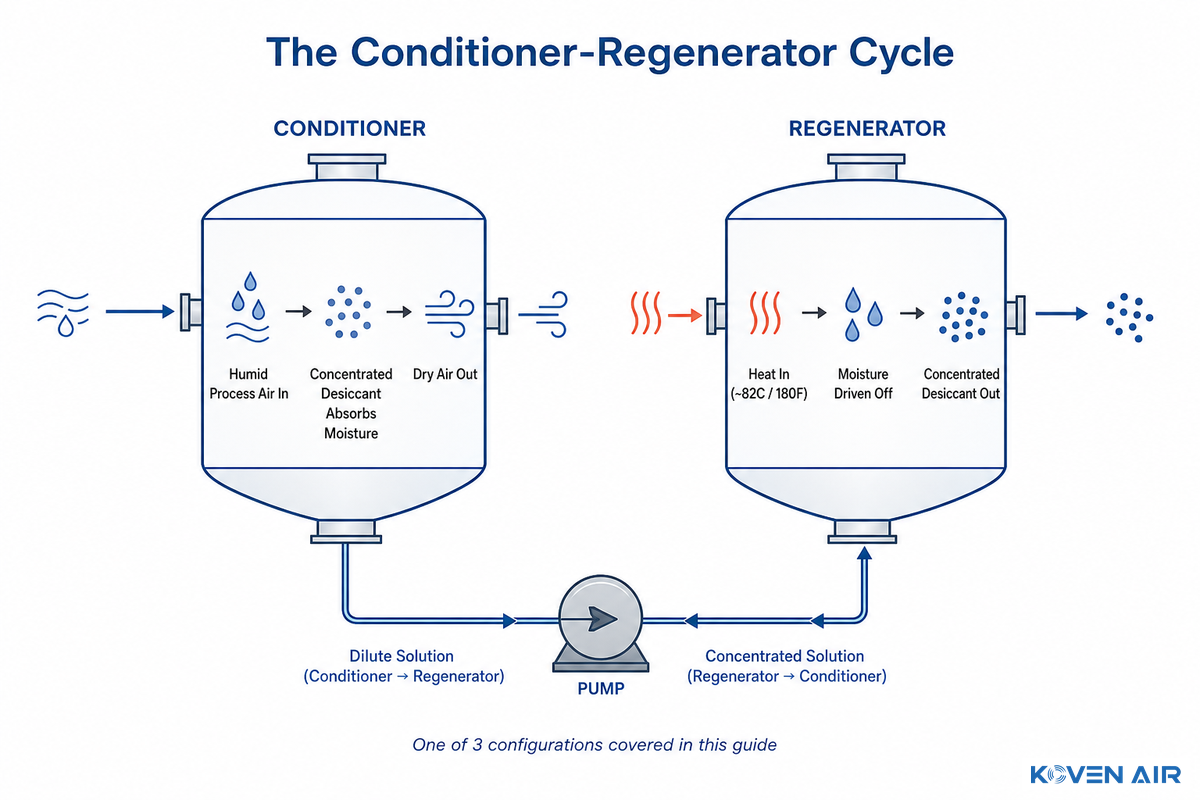
A liquid desiccant dehumidifier works by cycling desiccant through two chambers: a conditioner, where the salt solution absorbs water vapor directly from the process air, and a regenerator, where regeneration is done by heating the solution until that absorbed moisture drives back out so the solution can absorb again. The cycle runs continuously, and the two chambers can be sized and configured three different ways.
In the conditioner, a concentrated solution of liquid desiccant is contacted with the incoming air stream. Because the salt solution has a lower vapor pressure than the ambient, humid air surrounding it — air arriving at a comparatively high vapour pressure relative to the desiccant — water vapor migrates from the air into the liquid, an absorption process, not a filtration process, and the dehumidification process pulls moisture from the air directly into the desiccant rather than condensing it out. The now-diluted desiccant collects at the bottom of the conditioner and is pumped to the regenerator, where it’s heated and contacted with a second, exhaust air stream. That heat drives absorbed moisture back out as vapor, reconcentrating the desiccant so it can be circulated back to the conditioner and absorb again, a regeneration process some designs then cool in a small cooling tower before returning it to the air stream. The technically endothermic nature of absorption is an important contrast to the heat released by adsorption in a solid-wheel process, and a difference in how each technology interacts with simultaneous sensible cooling.
A Reddit hvac-advice thread from an actual technician sums up the regeneration step plainly: Once the desiccant absorbs moisture, it will typically need to be heated to about 180°F (82°C) or above before it will release moisture into the exhaust stream. This is pretty much inline with published values-conventional packed bed and membrane systems regenerate at 60-140°C, while newer heat-pump coupled designs will reduce the required temperature down to 32-55°C by using the heat-pump condenser as the source, rather than a separate boiler or steam coil.
📐 Engineering Note
A 40% solution of lithium chloride at 30°C provides a dew point of about 3.7°C in the air when it’s in equilibrium with the solution. That’s a published equilibrium-chemistry data point (the underlying physics don’t change based on publication date, though one should always confirm with data for one’s specific solution concentration and temperature), not an estimation rule of thumb. Temperature and concentration are the two levers. Both change the concentration of the air in equilibrium with the solution; you lower temperature and increase the concentration of desiccant in the loop to pull the dew point down further. One has to be careful about going above 50% concentration in some lithium, as there’s an increased risk of crystallization that will stop the process altogether.
Desiccant Cooling: Combining Dehumidification with Evaporative Cooling
Because a liquid desiccant cooling system can be used in combination with an intelligent cooling coil or a downstream evaporative cooler, some implementations use it as a complete dehumidification and air cooling package, rather than as a standalone dehumidifier-humidity control and temperature control become two separate steps, not a single overcool-then-reheat process that’s common to standard air conditioning. That’s what separates an efficient liquid desiccant design from an add-on dehumidifier: it uses a desiccant concentration in the circulation loop tailored to the site’s actual latent load, not a predetermined factory value. It’s here, too, where the technology for controlling air moisture diverges from standard humidity control equipment. Because the conditioner removes moisture without cooling air below the temperature that defines the set point or the dew point, subsequent sensible cooling with a coil can be achieved at temperatures higher than in a conventional system-thus improving the coefficient of performance of the cooling coil. By opting for such a desiccant system approach, a facility team is sacrificing the simplicity of a hot air reheat coil in favor of a more nuanced approach where latent and sensible control are decoupled.
💡 The Carryover Risk Index
The largest influence on the potential for maintenance disruption is the configuration chosen: Packed-bed contactors allow direct contact with air between the desiccant and the airstream and are the highest risk with respect to droplet carryover (though they can be designed with mist eliminators), whereas membrane contactors (LAMEE) carry very little or no risk as there is no contact between the liquid desiccant and the airstream; Heat-pump-coupled packaged units sit somewhere in the middle — where exactly comes down to which specific contactor design is inside them.
Liquid-to-air membrane energy exchangers (LAMEEs) constitute the third type of configuration worth mentioning: A semi-permeable membrane completely isolates the air stream from the liquid desiccant and permits water vapor transfer, while preventing liquid carryover. Membrane exchangers are documented in a CIBSE Journal CPD review to reach effectiveness up to 94%, and their inherent lack of direct contact with the airstream removes carryover from the design.
Liquid Desiccant vs. Rotary Desiccant Wheel: What’s the Real Difference?
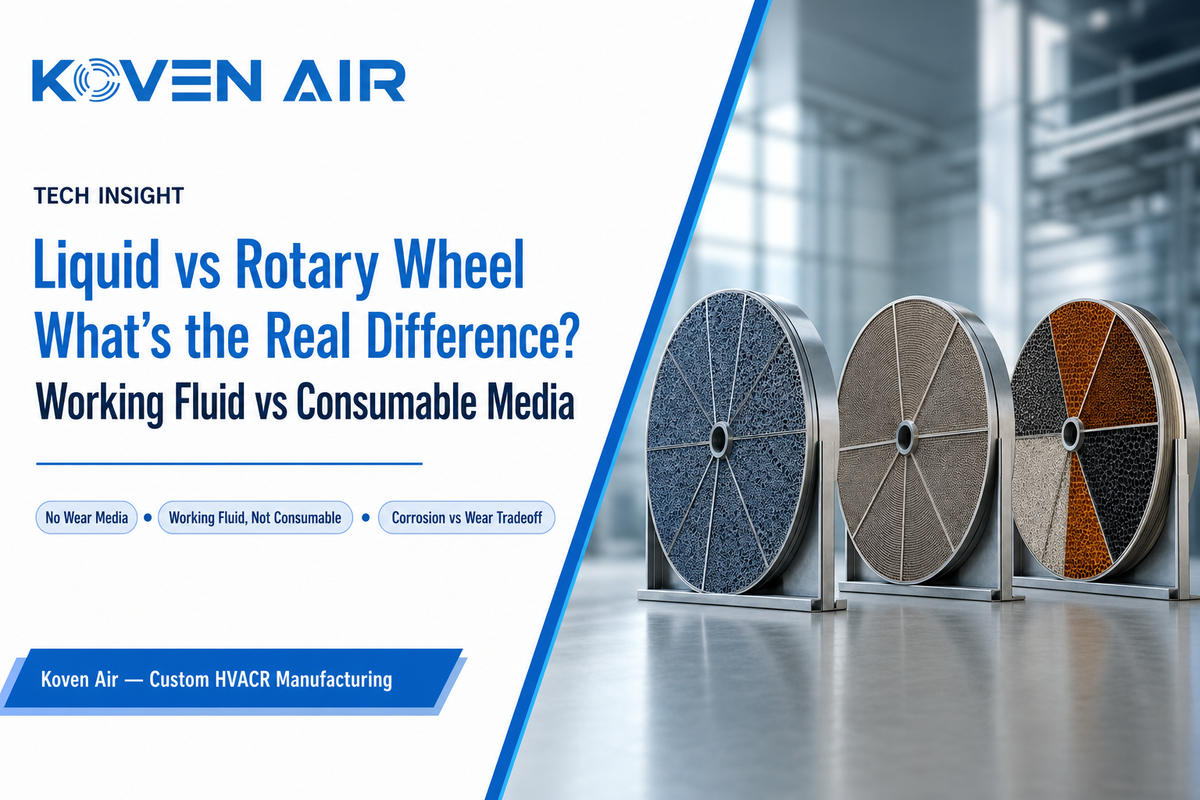
Liquid desiccant and rotary desiccant wheels both remove moisture without over-cooling the air, but they do it through fundamentally different mechanisms, absorption into a liquid versus adsorption onto a solid surface, and that mechanism difference sets a hard, physics-based limit on how low a dew point each technology can actually reach.
Can a Liquid Desiccant System Reach the Same Low Dew Points as a Rotary Wheel?
No, a liquid desiccant system cannot reach the same low dew points as a rotary wheel, and the reason is chemistry, not engineering effort. A rotary wheel adsorbs water onto a solid sorbent surface and can be dried to dew points of -40°C and below. A liquid desiccant solution instead absorbs water into its bulk, and its lowest achievable dew point is capped by the salt’s equilibrium vapor pressure (often written equilibrium vapour pressure in British-English technical literature).
A saturated lithium-chloride solution at 25°C has a vapor pressure equivalent to about 11% relative humidity, considerably more humid than a -40°C target requires, so no amount of extra regeneration heat or flow-rate tuning gets a liquid system into that range: contact with the ambient air only pulls the air’s water vapor pressure down to match the desiccant’s own, not below it. In a coil, sensible and latent heat removal stay linked; in a liquid desiccant loop they’re decoupled, which lets a liquid system hold a specific dew point without the temperature and humidity swings a simple thermostat-controlled system produces. The practical dew-point ceiling of today’s liquid systems shows up directly in current deployments: a DOE-funded 2024-2025 field unit now in testing is rated for a 40-55°F supply-air dew point, with test conditions running 8-13°C, squarely in the moderate band liquid desiccant serves, not anywhere near ultra-dry-room territory (dewpoints as low as -40°C sit in rotary-wheel territory instead).
| Attribute (by Dehumidification Type) | Liquid desiccant | Rotary desiccant wheel | Refrigeration (coil) |
|---|---|---|---|
| Sorption mechanism | Absorption into bulk liquid | Adsorption onto solid surface | Condensation (cooling below dew point) |
| Practical dew-point floor | ~2°C (current field units), salt-limited | -40°C and below | ~4°C (frost limit) |
| Regeneration heat | 32-140°C depending on configuration | 40-135°C depending on media | N/A |
| Simultaneous cooling | Yes, in the same pass | Adds sensible heat, needs post-cool | Yes (over-cools, needs reheat) |
| Corrosion / carryover | Managed by contactor design (membrane = near-zero) | None (solid media) | Condensate handling only |
| Best-fit RH window | ~15-50% RH, high latent load | <35% to ultra-low | 45-60% RH |
| Energy-source flexibility | Waste heat, hot water, low-pressure steam, or heat-pump condenser | Waste heat or dedicated burner/coil, media-dependent | Grid electricity only |
| Maintenance profile | Solution top-up + contactor service; carryover risk configuration-dependent | Wheel replacement every 8-12 years (wear item) | Compressor/refrigerant service life |
| Typical duty type | Moderate-RH + high latent load + simultaneous cooling | Dry rooms, deep drying | Comfort / pre-treatment |
Dew-point bands per CIBSE Journal CPD Module 71 and DOE/NREL 2024 field-unit specs. Rotary-wheel figures are based on Koven Air’s rotary desiccant dehumidifier guide.
That chemical limit is the precise reason why applications such as lithium-battery dry rooms, requiring dew points down to -40°C, use a rotary wheel system rather than a liquid system. If comparing the two for a project, Koven’s complete guide to rotary desiccant dehumidifiers covers the wheel side of this comparison in the same depth.
Liquid Desiccant vs. Refrigeration (Cooling-Coil) Dehumidification
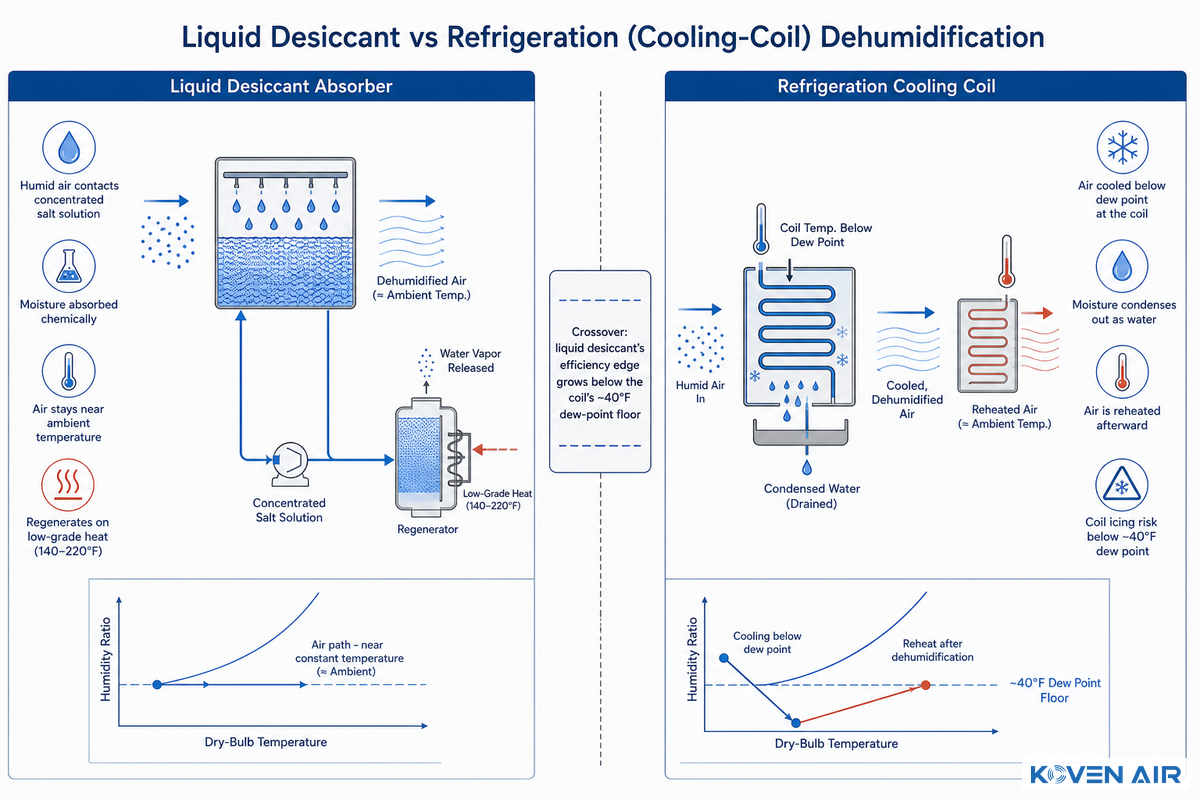
Is Liquid Desiccant Dehumidification More Energy-Efficient Than Refrigeration?
Liquid desiccant dehumidification is more energy-efficient than refrigeration only below a certain dew point, not universally, whatever vendor copy implies. According to Dr. Andrew Lowenstein, president of AIL Research, a conventional vapor-compression cooling coil can’t dehumidify much below about a 40°F dew point before icing becomes a risk, which is exactly where liquid desiccant’s physics-driven advantage begins.
That advantage grows with recoverable heat available in the 140-220°F range for regeneration. Below the coil’s practical dew-point floor, a refrigeration system has to run colder and colder just to keep condensing water, and its effectiveness degrades sharply, most of the cooling load going into over-cooling hot, humid air rather than useful sensible-and-latent separation.
“Liquid desiccant air conditioning removes moisture from airstreams by means of a solution of lithium chloride or halide salts. Concentrated, cooled desiccant flows into an absorber and through a mass transfer surface while counterflowing air passes through the same surface, transferring heat and moisture out of the air into the desiccant liquid.”
But the efficiency argument is conditional not absolute, which is where a lot of marketing hypes up the technology. The risk of getting this wrong is a costly oversizing mistake, not just a rounding error on the utility bill. According to an independent hvac efficiency comparison, “liquid desiccant systems do a good job of dehumidification efficiency across the board, but those savings become less distinct in cool, dry climates simply because less moisture is available in the air for the system to remove, so the desiccant’s power to absorb large latent loads inexpensively becomes less of a cost-advantage. For unconditioned process air that we want to make into the equivalent of what would be supplied at satisfactory conditions, an independent test facility estimated liquid desiccant systems cost to operate at 27 to 55% less than comparable vapor-compression or solid-desiccant-systems,” but this “is based on the test at severe conditions that represent conditions in an industrial-plant; it doesn’t include results based on 50% to 55% RH comfort conditions, which are relatively efficient with the coil.” So if your requirements call for a moderate humidity setpoint, take a closer look before jumping to the conclusion that you’ll achieve maximum cost-efficiency. If your process runs a low dew point at a high latent load — a cleanroom, a food-processing line, an industrial buyer with wet washdown cycles — the case for desiccant is stronger. Koven Air engineers both the cooling side and the desiccant side of this decision, in application, so the recommendation tracks your actual load profile rather than whichever equipment happens to be in stock.
A Real Case: Cleanroom Dehumidification, Shanghai Region
A telecommunications-equipment cleanroom outside Shanghai needed precise humidity and air-quality control. Engineers modeled a standard HVAC approach at roughly 45 kW to chill water, 29 kW to reheat the air back to setpoint, and 11 kW for auxiliary loads, 85 kW of nameplate capacity total. The packaged liquid desiccant units the facility ultimately installed carried a 53 kW nameplate rating instead, and the reporting source credits the switch with 62% lower energy cost and a payback of about 16 weeks. The gap between the ~38% nameplate-capacity reduction and the reported 62% cost saving reflects actual metered energy use under real operating conditions rather than a straight capacity comparison, a reminder that nameplate kW and measured energy cost are two different numbers, not the same one expressed two ways. The saving came specifically from eliminating the overcool-then-reheat step that a coil-based system need to hit both a temperature and a humidity target at once.
Desiccant Salts Compared: Lithium Chloride vs. Calcium Chloride vs. Lithium Bromide
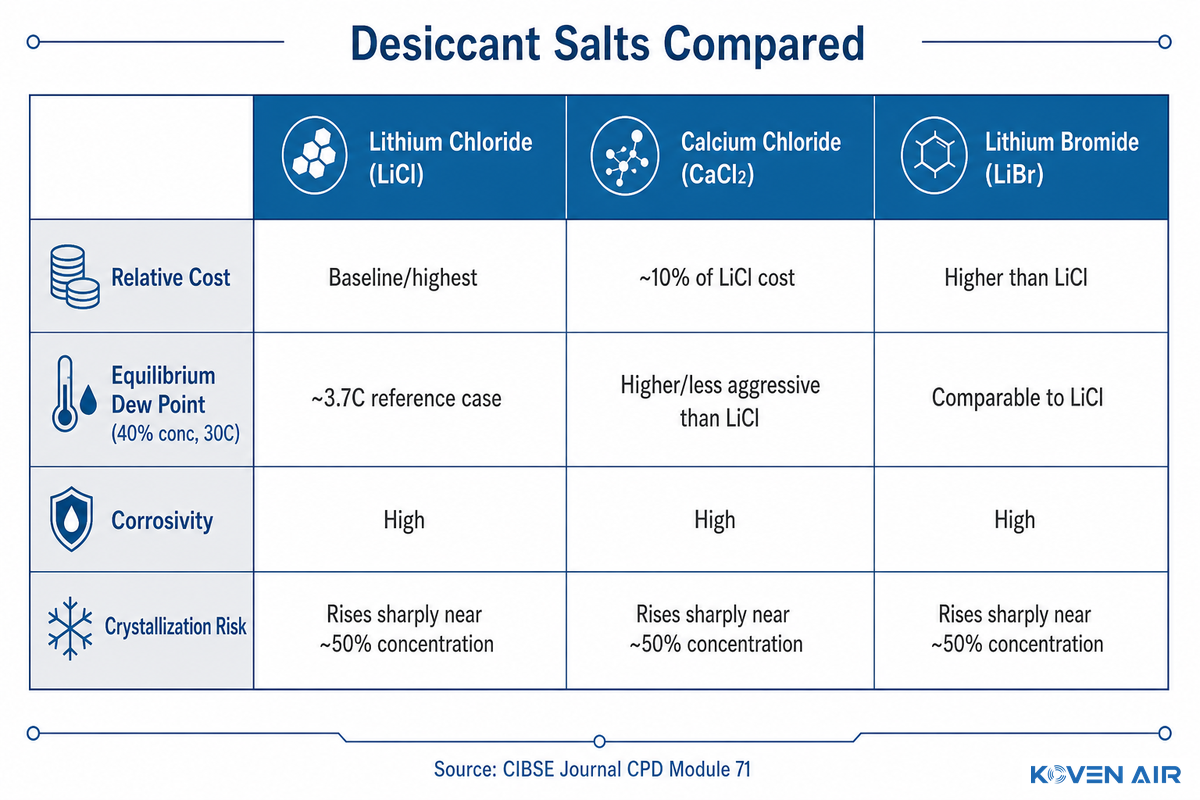
Virtually all liquid desiccant systems on the market run one of three salts, and the choice is seldom arbitrary, it balances cost, corrosiveness, and how low a dew point the solution can achieve.
💡 The Desiccant Salt Equilibrium Curve
Every published salt comparison in this space compares one salt at a time. Comparing the three salts lithium chloride, calcium chloride, and lithium bromide directly on cost, corrosiveness, and equilibrium performance – the actual decision a purchaser must make – is the comparison no manufacturer page makes.
| Property | Lithium Chloride (LiCl) | Calcium Chloride (CaCl₂) | Lithium Bromide (LiBr) |
|---|---|---|---|
| Relative cost | Baseline (highest) | ~10% of LiCl cost | Higher than LiCl, used mainly in absorption chillers |
| Equilibrium dew point (40% conc., 30°C) | ~3.7°C | Higher (less aggressive) than equivalent LiCl | Comparable to LiCl, chiller-context data more common than LDAC-context |
| Max desorption capacity (independent lab test) | Reference case in most studies | 0.3113 gH₂O/g solution at 50°C/25% RH — highest of the salts tested in that study | Not covered in the same test series |
| Corrosivity | High — all three chloride/bromide salts are corrosive to common HVAC metals | High | High |
| Crystallization risk | Rises sharply as concentration approaches ~50% | Similar concentration-driven risk | Similar concentration-driven risk |
| Typical use | Most common LDAC salt | Blended 50/50 with LiCl to cut cost at near-equal performance | More common in absorption chillers than air-side LDAC |
Cost and equilibrium-dew-point metrics per CIBSE Journal CPD Module 71 (Tim Dwyer, 2014). Desorption-capacity metric per an independent techno-economic laboratory study published through PMC/NIH, 2023 (climatic-chamber test at 50°C/25% RH).
Blending is a real, published cost strategy: a 50/50 mix of calcium chloride and lithium chloride can produce equilibrium vapor pressure, and the resulting air dew point, similar to what a pure lithium-chloride solution achieves, at a fraction of the raw material cost. That makes salt selection less of a binary “which one” choice and more of a blend-ratio optimization once a system is being specified for a specific budget and dew-point goal. Several other alternative desiccants are available outside these three chlorides, triethylene glycol and potassium formate among them, sacrificing some corrosiveness for lower absorption capacity, and a comparative study identified a 70.3% potassium formate solution reaches about the same vapor pressure as a 35% lithium-chloride solution, making it a workable but less concentrated-for-concentrated substitute.
One quantified indicator worth calling out: DataForSEO search-volume data shows search interest in “calcium chloride dehumidifier” rising approximately 3.9x over the trailing 12 months (comparing the first three months of that window to the most recent three) – a real, measured indicator, although we didn’t find a published industry source directly explaining the catalyst. This aligns with customers contemplating the cost-tradeoff blending strategy outlined above, but we won’t claim a causal relationship we can’t verify.
Where Liquid Desiccant Dehumidification Is Used
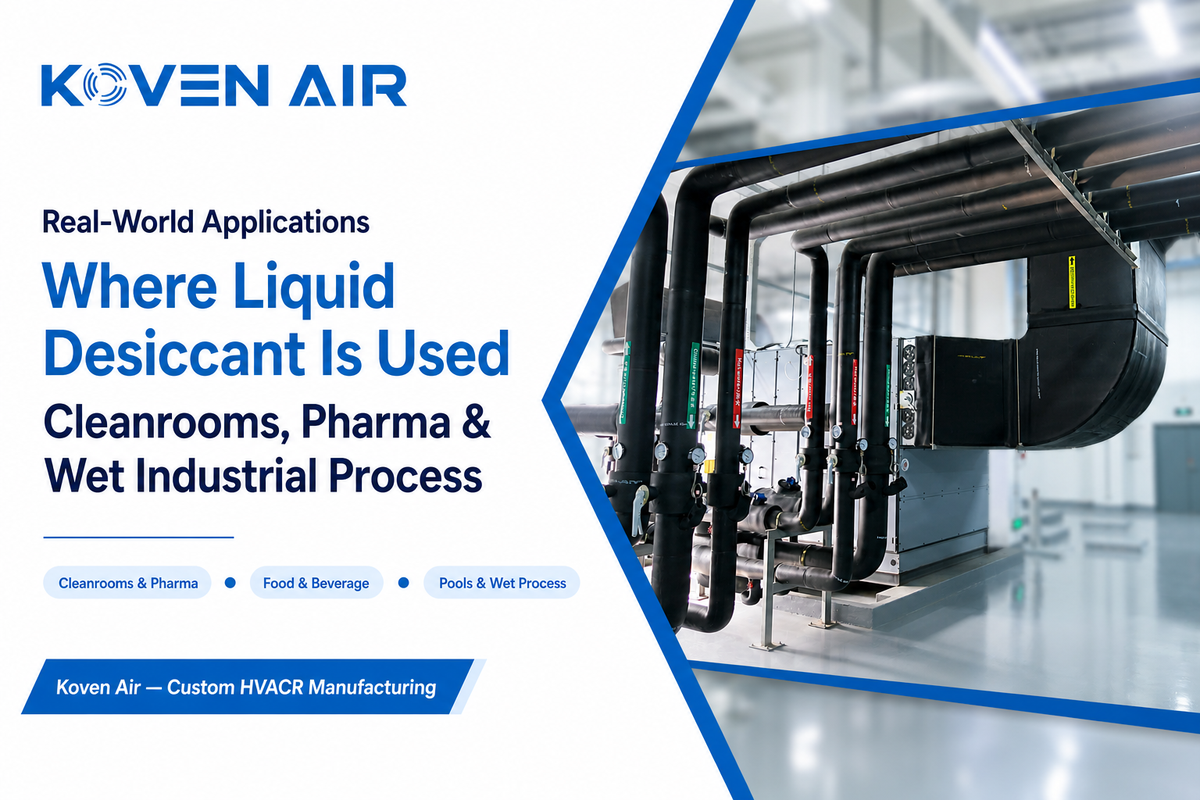
Liquid desiccant dehumidification fits best in cleanrooms, food and beverage processing, pharmaceutical stability chambers, hospitals, sensitive-goods warehousing, and pools, wherever a high latent load meets a moderate dew-point target. Lithium-battery dry rooms are the notable exception: their -40°C dew-point requirement sits well below what any liquid system can reach, which is why that application specifies a rotary wheel instead.
Why Do Lithium Battery Dry Rooms Need Desiccant Dehumidification?
Lithium-battery dry rooms need a dew point of at least -40°C so the lithium and electrolyte chemistry don’t react with trace moisture, a target well beyond any liquid desiccant system’s reach. Specifying a liquid system there is a costly, sometimes commissioning-stage mistake: the system structurally cannot hit that target no matter how it’s tuned, which is why dry rooms specify a rotary wheel instead.
Liquid desiccant’s real application sweet spot sits at a different part of the humidity spectrum. NREL’s research on liquid desiccant air conditioning (LDAC) points to high-load humid airstreams, humid-climate ventilation, pools, and wet industrial processes, as where the technology performs best, not general-purpose dehumidification. Where precise humidity control of dry outdoor air matters more than raw cooling capacity, a liquid system can hold supply air in a tight dew-point band without the swings a simple on/off compressor produces.
| Application | Typical target | Why liquid desiccant fits |
|---|---|---|
| Cleanrooms / electronics assembly | Moderate-low RH, tight control | Simultaneous cool + dry in one pass, no overcool/reheat penalty |
| Food & beverage processing | ≤60% RH, high outdoor-air fraction | High-latent wet processes (washdowns, steamers, cookers) |
| Hospitals / stability chambers | Controlled RH band, ±5% | Precise, independent humidity control apart from temperature |
| Warehousing / sensitive goods storage | Moderate-low RH, condensation control | Cost-effective vs. deep-drying a large air volume with refrigeration alone |
| Pools / natatoriums | Moderate RH + high latent load | High-humidity, high-latent-load fit — see chemical-compatibility note below |
Whether you need a lithium-battery dry room, data center, or any other application requiring deep dehumidification down to -40°C, Koven Air’s desiccant dehumidification solutions can walk you through which technology, rotary wheel, liquid, or hybrid, actually makes sense for your specific dew-point requirements and available heat source.
The Engineering Tradeoffs, Corrosion, Crystallization & Carryover
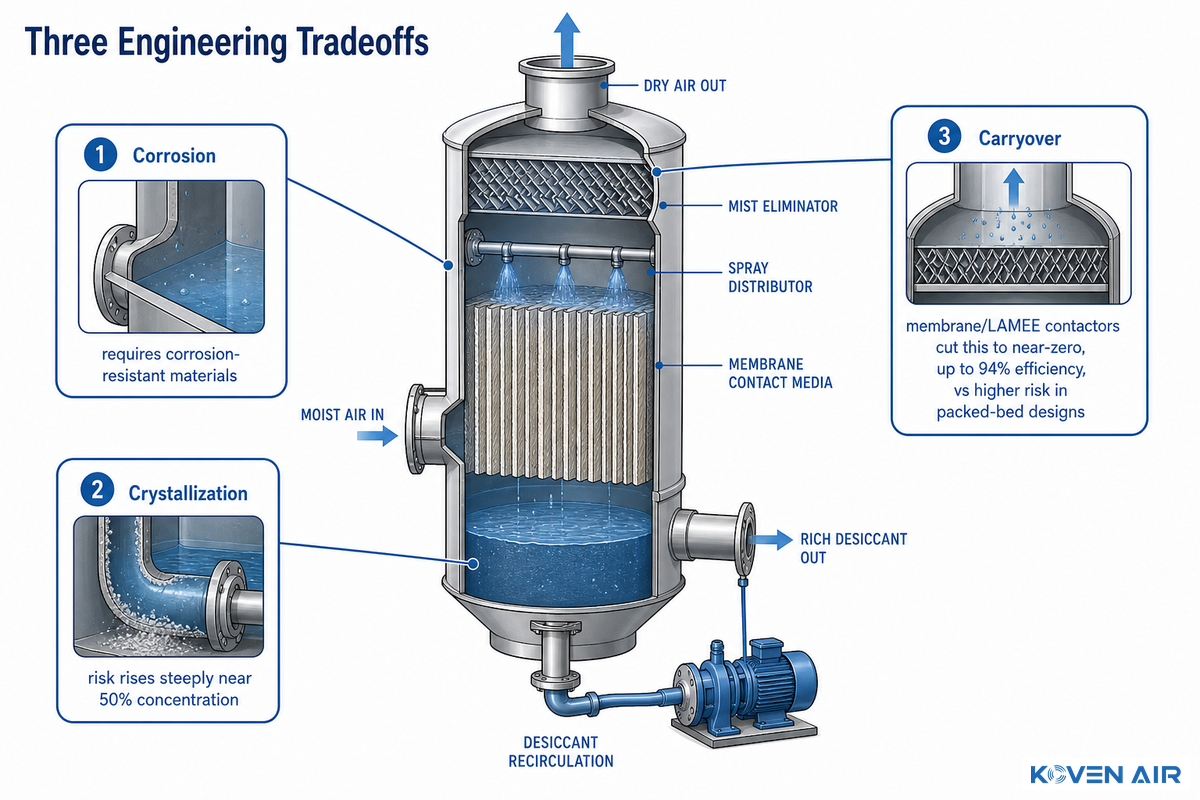
The very same salts that make liquid desiccant systems work also make them somewhat harder to own than a standard coil unit and a good technology overview has to state this upfront.
✔ Advantages
- Simultaneous cooling and dehumidification in one pass
- Can regenerate on low-grade waste heat (32-55°C in heat-pump-coupled systems)
- Membrane (LAMEE) contactors offer efficiencies of up to 94% with near-zero carryover
- liquid desiccant can help serve as a natural filter to remove microbial and mold-contaminated particulates
⚠ Limitations
- The salts can be corrosive to many common hvac metals, necessitating the use of corrosion-resistant materials
- Risk of crystallization, which can halt operation, rises steeply near 50% concentration
- There’s a significant history of carryover-related maintenance cost for high-flow packed bed systems, and NREL research strongly suggests using low-flow systems to mitigate carryover risk
- When considering installation in a pool or natatorium environment, one must evaluate chlorine compatibility to prevent the formation of precipitate and plugging of contactor components
A liquid desiccant dehumidification replaces a simpler, colder compressor cycle (compared to conventional refrigerant-based cooling and heating equipment) with a chemically-active loop that needs its own regimen of maintenance; this is the frank price you pay for a low-humidity capability without sensible-cooling loss. It’s true that the carryover issue is real, but its historical track record shows it’s been getting better, not worse. Carryover with liquid desiccant systems from an early-generation unit, for example – where entrained lithium chloride is discharged in the exiting airstream and eats away at downstream ducting – was the specific mode of failure that historically gave liquid-based systems a bad rap for being high-maintenance. Eric Kozubal, who’s doing research on distributed thermal energy at the National Renewable Energy Laboratory, told us that new generations of liquid-to-air contactor designs don’t even require mist eliminators. That’s, “a critical advance which will do away with all of the maintenance which traditionally accompanied liquid systems.” Nonetheless, more recent NREL technical literature distinguishes low-flow from high-flow liquid desiccant designs because the latter have a well-documented carryover/maintenance cost record – so the honest answer is that contemporary design have all but removed the problem without entirely eliminating it across the entire field. Low-flow and membrane contactors are better bets when the reliability of the maintenance-cost profile take precedence over volume.
The only chemical-compatibility issue I think is worth pointing out on a chemical basis alone is that in the case of pools and natatoriums, the specific salt (in this case, liquid desiccant salt) chosen for the application need to be vetted against the pool’s chemistry – the use of specific chemistries can lead to the formation of a precipitate that clogs the internal contactor parts. These site-specific things seldom make it into the generic explanation of “how desiccant works,” but this is definitely one mechanical engineers need to be aware of when putting in a system for a natatorium.
System Lifespan, Maintenance & What Drives Running Cost
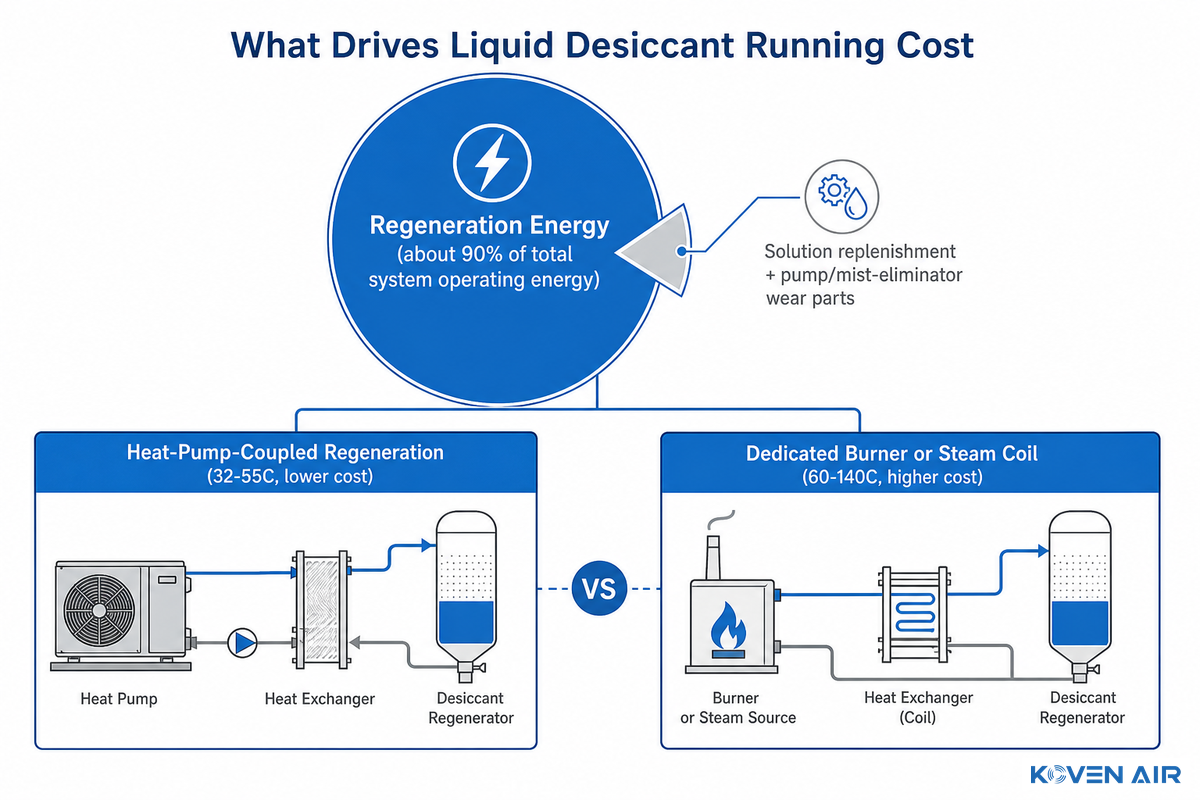
A rotary wheel’s silica-gel media is a true consumable with an 8- to 12-year lifespan. The liquid desiccant solution, however, isn’t consumed like a solid sorbent; it’s a working fluid that’s replenished and maintained from time to time. That changes the maintenance discussion from, “When is the media going to wear out?” to “How well does the contactor design keep corrosion and carryover at bay?” – the very issue just discussed.
Life cycle running cost is really just about one number – regeneration energy consumption; it isn’t chilled water usage or fan power. Within the world of desiccants in general, the process of “reactivating” the sorbent – removing air moisture and the pressure of water vapor back out of the media using heat and no moving parts – accounts for some 90% of a system’s total energy load. Therefore, the media and configuration that can get your target dew point at the lowest-grade regeneration heat source is always the winner over its lifetime cost, regardless of the initial purchase price. This is why the industry is moving towards heat-pump-coupled regeneration (32-55°C) rather than relying on a dedicated burner or steam coil (60-140°C), and this change has more impact on a project’s total cost of ownership than almost any other item on a spec sheet. The ability to store regenerated (concentrated) solution and then use it later in the cycle in a liquid desiccant system is another, lesser cost lever to understand: because the sorbent media itself can be regenerated when inexpensive waste heat or peak-off electricity is available and then stored and applied to achieve cooling at peak demand periods, we’re now seeing some installations pairing liquid desiccant with combined heat and power to offset regeneration energy demand during expensive electricity hours.
📐 Engineering Note
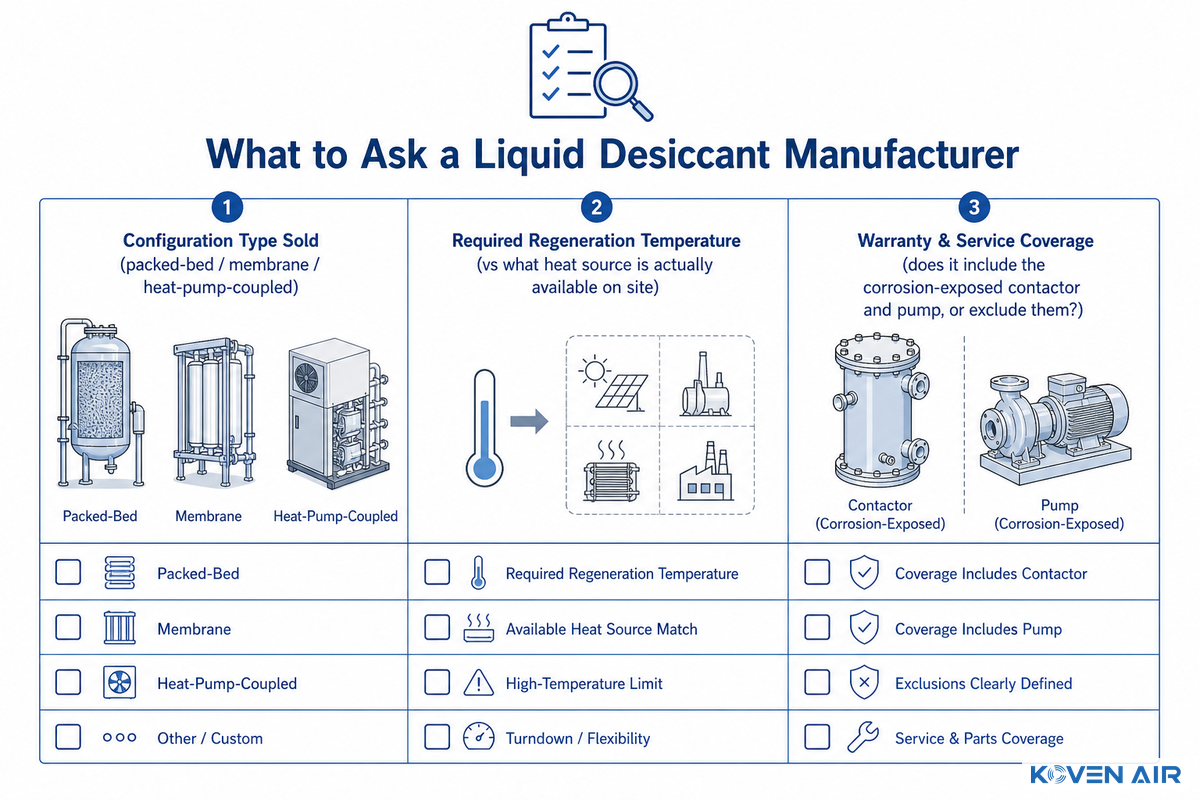
Given that regeneration has by far the highest lifecycle energy cost — a pattern documented across desiccant technologies in DOE’s Grid-Interactive Efficient Buildings technical report series — find out from your liquid desiccant dealer what the regeneration temperature required is for their recommended equipment, and then compare this against the temperature that’s actually available at the plant – is it hot water, waste heat, low-pressure steam, or a heat pump condenser? A unit requiring 140°C steam when only 60°C waste heat is available on site isn’t a bad technology choice, it’s a mismatched one.
Who Makes Liquid Desiccant Systems?
The liquid desiccant equipment market is a small, specialized subset of the broader HVAC dehumidifier market, spanning a handful of established brand lines plus newer electrochemical-regeneration entrants. Alfa Laval (Kathabar), Ventilex (DryGenic), Copeland (HMX), and Mojave HVAC (ArctiDry) cover the conventional, heat-regenerated side of the market today.
Newer entrants are pushing the technology in different directions: Mojave HVAC markets packaged ArctiDry-branded units combining liquid desiccant with a variable-speed DX system, and, as covered in the Industry Outlook section below, a separate company called Mojave Energy Systems holds a 2024 patent on electrochemically regenerated liquid desiccant technology, a materially different regeneration method from the heat-driven systems the rest of this article covers.
The important questions that engineering departments want to ask the companies supplying the equipment are often not found on a specification sheet: Which type of configuration do suppliers typically sell (packed-bed, membrane, heat-pump-coupled), how high of a regeneration temperature do they require, what warranty/service support is available for parts that have direct exposure to corrosion? Koven Air’s configuration selection matrix is one way to see how a manufacturer walks through that decision explicitly rather than defaulting to a single product line.
The gap that trips up a lot of buyers is a warranty that reads well on paper but leaves the corrosion-exposed contactor and pump as a line-item exclusion — an expensive mistake to discover after a failure, not before. Koven Air engineers both rotary desiccant wheel and liquid desiccant systems in-house at its 20,000 m² factory, with 36 inspections and a 24-hour aging test built into production before a unit ships, plus lifetime free after-sales technical service on installed systems. In practice, that in-house scope is what lets an engineering team get a straight answer on regeneration temperature, contactor material, and service coverage from one supplier instead of piecing it together from a distributor.
Industry Outlook, What’s Changing in Desiccant Technology
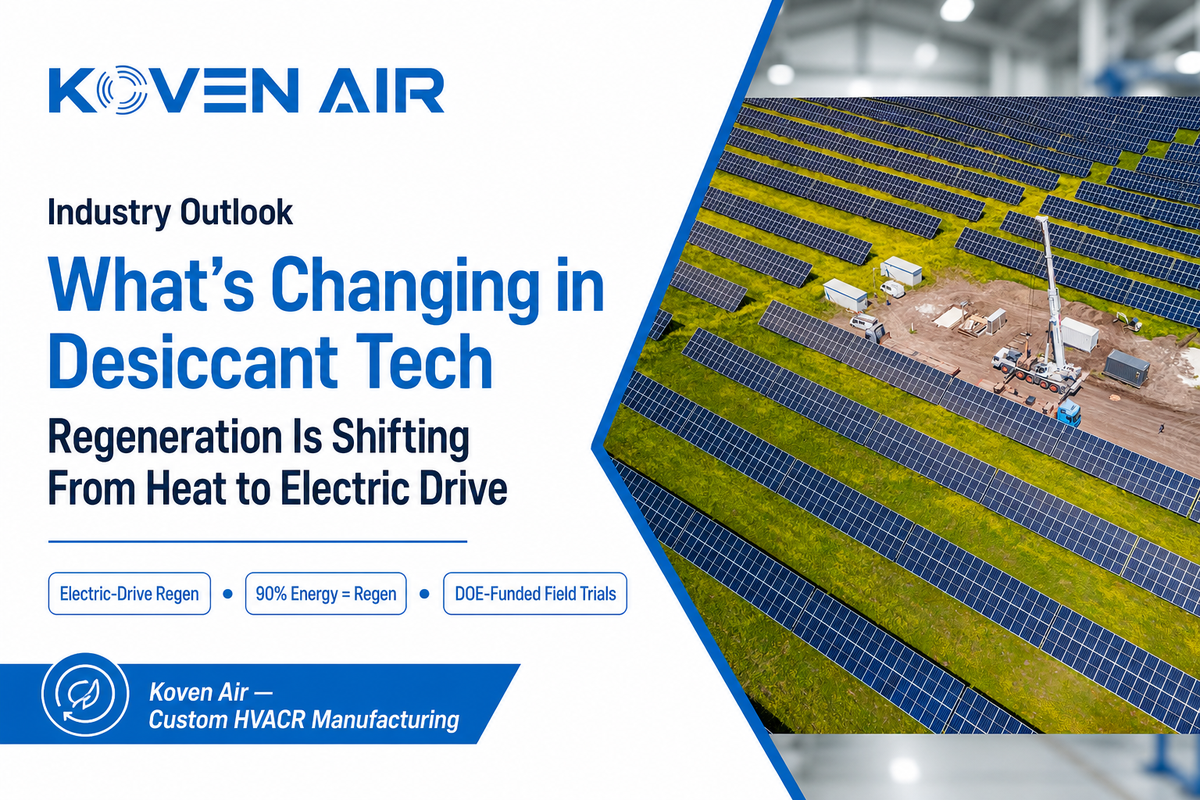
The most apparent short-term shift for liquid desiccant technology is the movement of regeneration away from combustion and discrete heat sources towards electric drives – an important shift because regeneration is where the bulk (about 90%) of a system’s operating energy is expended. Electrodialytic regeneration, which employs an electric field across a stack of electrodes to push water out of the desiccant instead of heating it, has moved from academic research into practice, with Mojave Energy Systems holding a 2024 U.S. patent (US11998871B2) on an electrochemically-driven liquid desiccant system that’s integrated with a secondary heat pump. Independent research groups – including a peer-reviewed evaluation published by the ASME digital collection and a Purdue University study that compares electrically driven dehumidification technologies – are beginning to benchmark electrodialysis against traditional thermal regeneration and vacuum membrane solutions. Also along these lines, an ionic-liquid-membrane dehumidification system was presented at the IEA Heat Pump Programme’s 13th international conference, touting itself as a viable alternative to mechanical compression based humidity control.
It’s important to clarify how mature this development is; in fact, the U.S. Department of Energy is funding this transition instead of considering it a settled issue. A DOE Building Technologies Office field program is in place with a June 2024-September 2025 performance period, run jointly by NREL and Mojave, budgeted at $2.23 million, that involves the design and construction of five liquid desiccant units to be tested in real buildings. Two of these units are already installed, in Orlando and Houston, according to the program’s latest public update, and the program documentation acknowledges the test results as “preliminary data and analysis that’s subject to change.” This fact underscores the status of electrically driven regeneration as an actively field validated, but not yet definitively commercially proven, option.
What this implies for a purchasing decision in 2026: if the reliability of your regeneration heat source is uncertain or your facility has limited access to waste heat, a traditional heat pump-integrated system (with regeneration at 32-55°C) would represent the lower risk option at present, while electrically driven regeneration should be monitored as a potential solution for 2026-2027, but perhaps not be specified until then. On a related note, market research firms anticipate double-digit growth in the overall liquid desiccant hvac systems market annually through the early 2030s, a forecast that aligns directionally with DOE’s focus but is less impactful than the observed shifts in regeneration technology and the DOE’s validated dew-point and efficiency data, which we’ve used as our basis for this outlook. Specifying against an unproven regeneration path is the mistake to avoid here: Koven Air’s own in-house R&D on its rotary desiccant wheel line has already shown that lower-temperature regeneration cuts running cost without waiting for a technology that’s still mid-field-trial, which is the same discipline worth applying to a liquid-side decision today.
FAQ
Q: What salt is used in a liquid desiccant dehumidifier?
View Answer
Most liquid desiccant dehumidifiers use lithium chloride (LiCl), the most common salt in commercial systems, prized for its low equilibrium vapor pressure and predictable performance. Calcium chloride (CaCl₂) is a common cost-driven alternative or blend partner, costing roughly one-tenth as much as lithium chloride, and a 50/50 blend of the two can reach dew-point performance close to pure LiCl at a fraction of the material cost.
Lithium bromide (LiBr) appears in some systems too, though it’s more commonly associated with absorption chillers than air-side liquid desiccant dehumidification specifically. All three salts are corrosive to common HVAC metals, which is why contactor material selection matters regardless of which one is chosen.
Q: Is liquid desiccant dehumidification corrosive to HVAC equipment?
View Answer
Yes — lithium chloride, calcium chloride, and lithium bromide are all corrosive to the metals used in standard HVAC equipment, so contactor housings, ductwork, and any downstream metal components have to be built from corrosion-resistant materials or coatings chosen specifically with this chemistry in mind.
Historically, the bigger concern was carryover, not corrosivity itself: early systems let desiccant droplets escape into the airstream and corrode downstream ductwork. Newer liquid-to-air contactors, particularly LAMEE designs, eliminate this by design rather than mitigation, though a high-flow packed-bed design still carries higher maintenance costs.
Q: How does a liquid desiccant system differ from a rotary desiccant wheel?
View Answer
The key difference is absorption versus adsorption: a liquid desiccant system absorbs moisture into a flowing salt solution to dehumidify the air, while a rotary wheel adsorbs it onto a porous solid as the wheel rotates between process air and heated regeneration air. That mechanism sets very different dew-point ceilings — a rotary wheel reaches -40°C and below, while a liquid system is capped around 2-13°C by the salt’s equilibrium vapor pressure.
Liquid systems also cool and dehumidify simultaneously more easily, since a rotary wheel adds sensible heat during adsorption and needs a separate downstream cooling step.
Q: Can liquid desiccant systems provide cooling as well as dehumidification?
View Answer
Yes, that is one of the main advantages of the technology over conventional cooling equipment. By controlling humidity without the extreme cold temperature of a typical air conditioner, additional cooling can be accomplished in a more efficient secondary coil that doesn’t need to be set at the lower temperatures required in an overcool/reheat system. In some applications, the liquid desiccant system is combined with a direct evaporative cooler to achieve a complete and combined package.
Q: What industries use liquid desiccant dehumidification?
View Answer
The optimal applications are those that need moderate dew-point control coupled with simultaneous sensible cooling. That means cleanrooms and electronics assembly; food and beverage manufacturing; pharmaceutical stability chambers and hospitals; high-value warehousing; and pool environments (natatoriums). Applications that need dew point temperatures far lower than 2 C-like those found in lithium-battery dry rooms-will generally still be the province of rotary desiccant wheel technology.
Q: How long does a liquid desiccant solution last before it needs replacement?
View Answer
Unlike a rotary wheel’s solid media, which is a genuine consumable with an 8-12-year service life, a liquid desiccant solution isn’t consumed on a fixed schedule. It’s a working fluid that gets topped up and periodically serviced by the contactor rather than replaced outright, so the maintenance question shifts from “when does it wear out” to “how well is corrosion and carryover being managed.”
Q: Is liquid desiccant dehumidification more expensive to run than a standard dehumidifier?
View Answer
Whether liquid desiccant costs more to run than a standard dehumidifier depends entirely on your target humidity and climate, not a flat yes or no. At demanding, high-humidity design conditions, independent lab tests found liquid desiccant systems running 27-55% cheaper to operate than comparable alternatives.
At a moderate 45-55% RH target in a mild climate, that advantage narrows or disappears, since an efficient standard coil already handles that load well. Run a load calculation for your specific dew-point target before assuming either technology is cheaper.
Why We Write This
Koven Air develops and manufactures both rotary desiccant wheel technology and liquid desiccant systems. As such, we don’t have a reason to favor one over the other. The physics discussed in this article, including those points which suggest rotary desiccant dehumidifier systems may be superior for the ultra-low dew points needed for the demanding conditions that require these solutions, should be seen in that light.
All information on this website is reviewed by our engineering team before being published and updated with changes as they occur, such as upcoming ASHRAE 62.1 standards updates that will address humidity control in 2025.
Reviewed by: Koven Air Environment Technology Co.,Ltd technical team
References & Sources
- Module 71: Liquid Desiccants for Dehumidification in Building Air Conditioning Systems — CIBSE Journal (Tim Dwyer, 2014)
- Liquid Desiccant Dehumidification For Challenging Environments — ACHR News
- A Techno-Economic Investigation of Conventional and Alternative Desiccant Materials — PMC, National Institutes of Health
- Comparison of Electrically-Driven Dehumidification Technologies — Purdue University International Refrigeration and Air Conditioning Conference
- Manufacturing and Deployment of Liquid Desiccant Dehumidifier with Multiple Regeneration Technologies — U.S. Department of Energy Building Technologies Office / National Renewable Energy Laboratory (2024)
- Grid-Interactive Efficient Buildings Technical Report Series — U.S. Department of Energy, Office of Scientific and Technical Information
- ANSI/ASHRAE 62.1-2025: Ventilation for Indoor Air Quality — American National Standards Institute
- US11998871B2, Electrochemically Regenerated Liquid Desiccant Dehumidification System Using a Secondary Heat Pump — Mojave Energy Systems, Inc., USPTO (2024)
- US11117090B2, Electrodialytic Liquid Desiccant Dehumidifying System — USPTO
- Evaluation of Electrodialysis-Liquid Desiccant and Vacuum-Membrane Dehumidification Systems — ASME Journal of Engineering for Sustainable Buildings and Cities
Related Articles
- Liquid Desiccant Dehumidifier Solutions — technology selection, configuration matrix, and quote request
- Rotary Desiccant Dehumidifier: The Complete Guide — the solid-wheel side of this comparison, including ultra-low dew-point applications
- The Complete Guide to RTU HVAC Systems — rooftop unit types and where heat-pump RTUs fit
- DOAS Rooftop Unit: What It Is, How It Works, and How to Compare Your Options — dedicated outdoor air systems, a common home for desiccant dehumidification equipment
- About Koven Air — factory, testing lab, and engineering team behind both desiccant technologies