Get in Touch with Koven Air Company

Quick Specs
| Typical capacity range | ² tons (small retail) to ²60+ tons (large industrial) |
| AHRI rating standard | AHRI 340/360-2022 (commercial unitary equipment; residential-scale units instead use SEER) |
| Minimum efficiency | 14 IEER under ASHRAE 90.1-2022 for standard-efficiency units <135,000 Btu/h |
| Core function | Cooling, heating, and ventilation from one roof-mounted cabinet |
| Heat pump variant | Same cabinet, reversing-valve heating instead of gas or resistance heat |
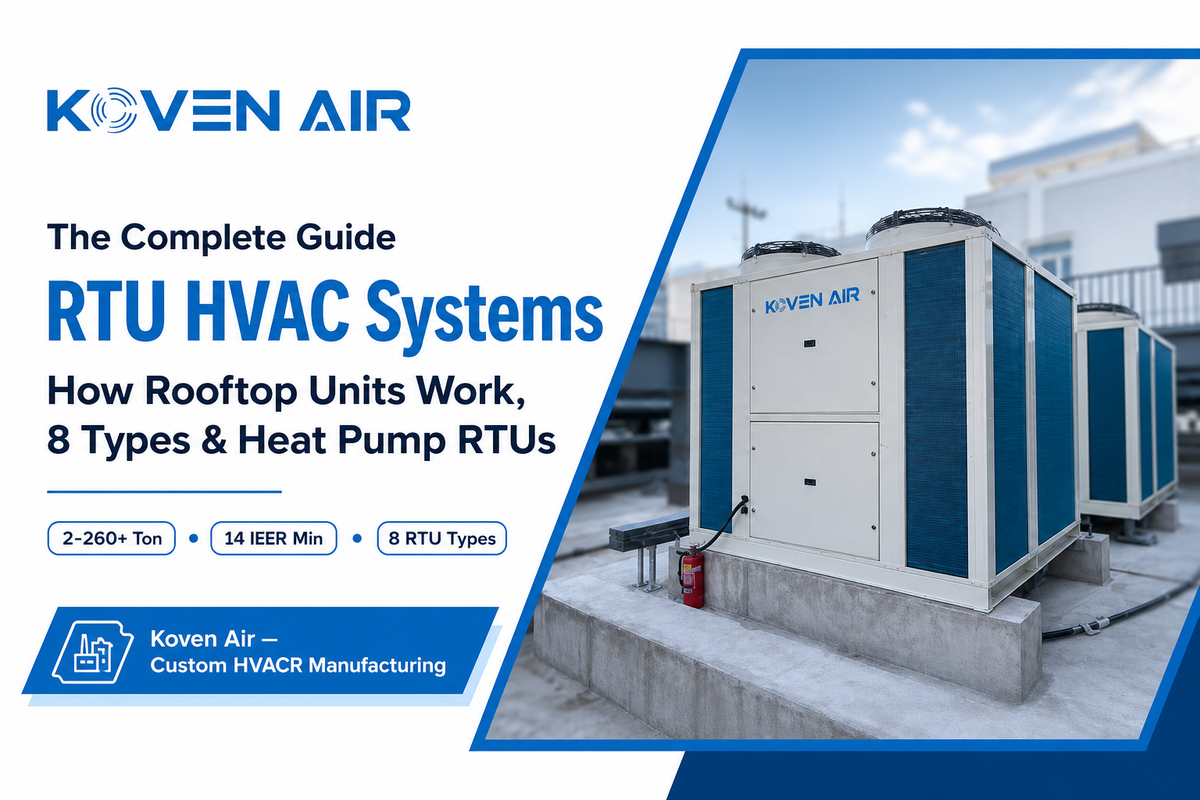
An RTU HVAC system – RTU is an abbreviation of rooftop unit – is a standalone heating, ventilation and air conditioning system that consolidates all the components of heating, cooling and ventilation in a single cabinet that rests on the rooftop. This system type is extremely popular in commercial building in the US for providing conditioned air. The chance is that you’ll find an RTU above your ceiling tiles if your facility happens to be a commercial building like an office, a warehouse, a school, or a retail store.
In short: A rooftop unit combines a compressor, coils, fans, and controls into one weatherproof box that connects to your building’s ductwork. It can run on a straight air-conditioning cycle, a gas furnace for heat, or — increasingly — a heat pump that handles both heating and cooling from the same refrigeration circuit. According to Rheem’s commercial business leadership, roughly 45% of RTU sales are emergency replacements, 25% are planned replacements, and 30% go into new construction — meaning most RTU decisions happen under time pressure, not during leisurely research.
Key Points
- An AHRI 340/360-2022 certification is an indication of an RTU’s test results, and it’s the most up-to-date DOE-recognized test standard for commercial unitary devices, having superseded the 2007 and older editions of the same.
- Although heat pump RTUs may appear as separate models, they’re fundamentally the same package containing only a difference in the type of heat source. Unlike RTUs with gas burners or electric resistance heating coils, a heat pump uses a reversing valve as its heat source.
- Currently, major RTU manufacturers, namely YORK and Carrier, have all-electric heat pump RTUs of 15-ton capacity under development at DOE’s Oak Ridge National Laboratory for field trials.
- The ‘$5,000 Rule’ – the practice of calculating an RTU’s total cost by multiplying its age by estimated repair expenses – is generally used in the industry as a repair-vs.-replacement guide line, but industry professionals have pointed out that it isn’t consistently applicable to large commercial tonnage equipment.
- With a huge stock of RTUs installed from 2000 to 2010 that are nearing the end of their life span, the market is on the verge of a structural replacement trend that will be entirely unaffected by the construction market of any specific year.
What Is an RTU?
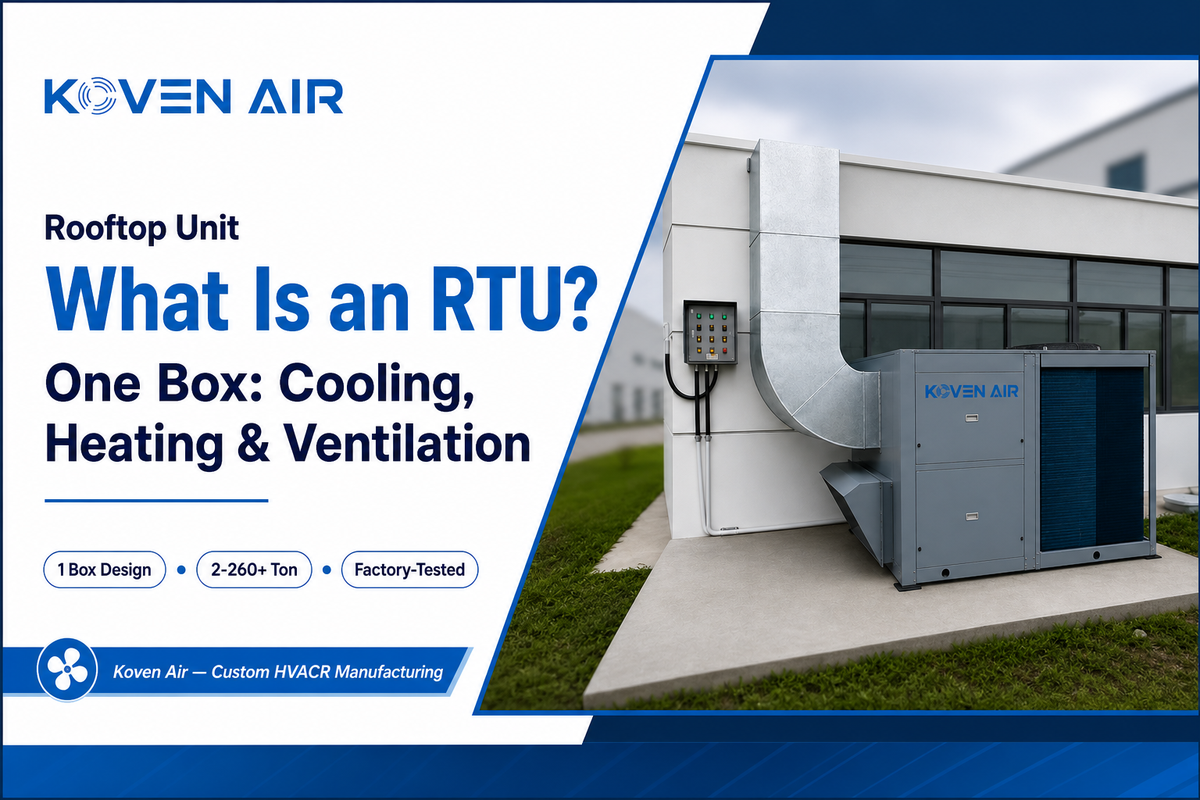
An RTU, which is short for rooftop unit, is a packaged heating and cooling system consisting of the compressor, evaporator and condenser coils, filters, fans, and control systems – all incorporated in a single rooftop cabinet, as documented in the U.S. Department of Energy’s Commercial Building HVAC Accelerator. From this cabinet, conditioned air flows through the ductwork into the building.
An RTU is generally installed by placing the unit on a rooftop curb and then connecting the power and the ductwork before wiring the thermostat. Since everything is factory assembled and tested, the installation process is quite simplified.
The advantage of “all-in-one box” design distinguishes an RTU from other equipment installed on rooftops and also serves as a description for many of the rooftop product lines from leading brands, like Trane and AAON. It indicates that the entire system, including its heating, ventilation, and cooling capacity, is packaged together in a single, factory-tested cabinet. However, not all the units on a rooftop qualify as RTUs; for instance, a condensing unit used in a split system contains only a portion of the refrigeration system, requiring an indoor unit to complete the cooling or heating cycle. Moreover, there are non-packaged RTUs, often called hydronic RTUs, that are still mounted on the rooftop but require an outdoor boiler or chiller loop for heating or cooling instead of having their own self-contained refrigeration system. In reality, while most refer to a packaged and self-contained system as an RTU, there are instances where this definition isn’t so clearly cut as perceived.
1 box
Houses cooling, heating & ventilation
14 IEER
Minimum efficiency, ASHRAE 90.1-2022
2-260+ ton
Capacity span across the category
How an RTU Works
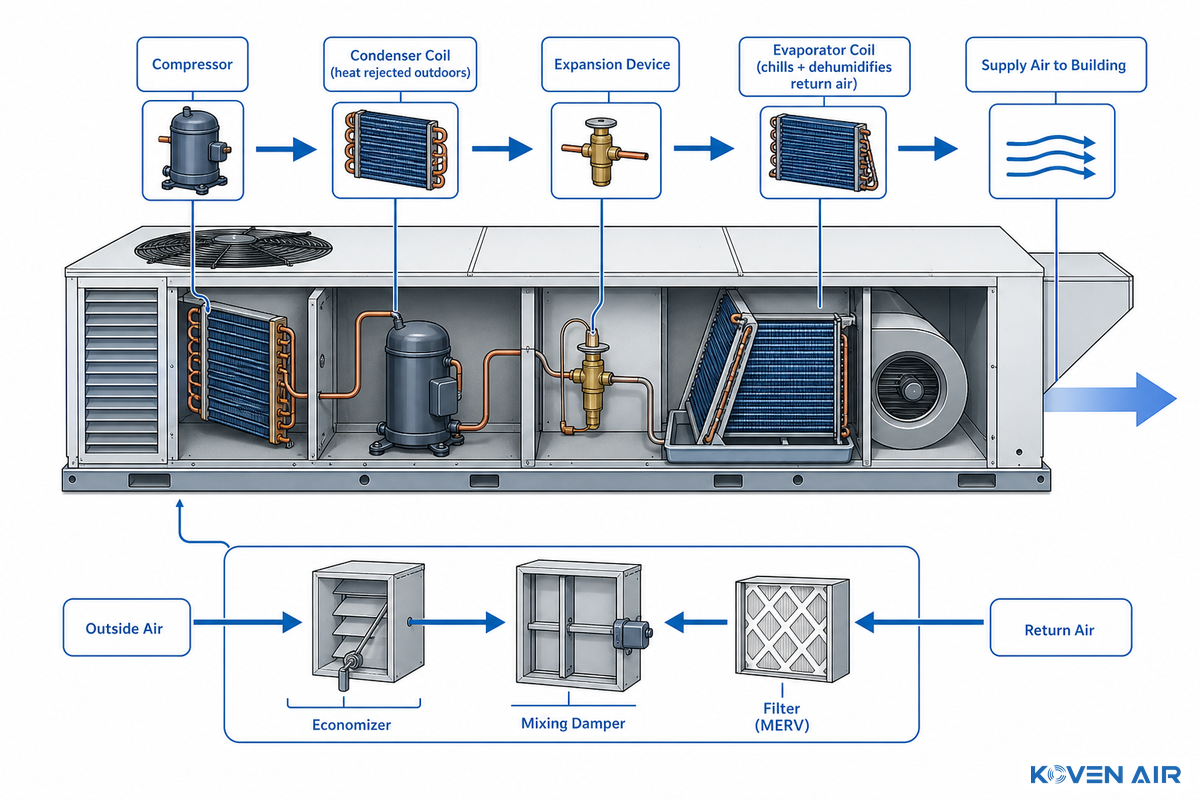
A packaged RTU takes the direct expansion (DX) refrigeration cycle through four primary stages of equipment. The compressor pressurizes the gas refrigerant and forces it through the circuit, and air blowing over the hot refrigerant on the condenser coil carries the heat away to the outdoors.
The refrigerant’s pressure is then reduced in an expansion device before entering the evaporator coil, where it chills and dehumidifies the warm return air coming into the unit before the RTU blower delivers it back to the space as supply air.
Ventilation is operating on a separate circuit, mixing outside air and return air by way of a mixing damper, with an economizer function capable of “free cooling” with outdoor air if ambient conditions permit, reducing the load on the compressor – a control strategy documented in the National Renewable Energy Laboratory’s Advanced Rooftop Unit Control research. A heat pump RTU’s defrost cycle also runs on this same control logic during winter operation. Filters – typically a MERV filter class rated for effectiveness vs static pressure impact on efficiency – remove particulate from the air, improve indoor air quality and protect the coil from contaminants. Integrated controls that are tested before the unit leaves the factory managing the sequence of operations of dampers, stages and safety cut-outs makes on-site commissioning of packaged RTUs far simpler than field-constructed units.
📐 Engineering Note
It’s important to under stand that the packaged RTU’s casing and its roof curb are the functional parts of the system – not decorative components. A curb improperly flashed, or a roof not evaluated for adequate point load capacity, often leads to water leaks or vibrations years after installation – verify roof capacity and curb flashing if you’re contemplating a heavier RTU to replace an existing unit.
The 8 Types of Rooftop Units
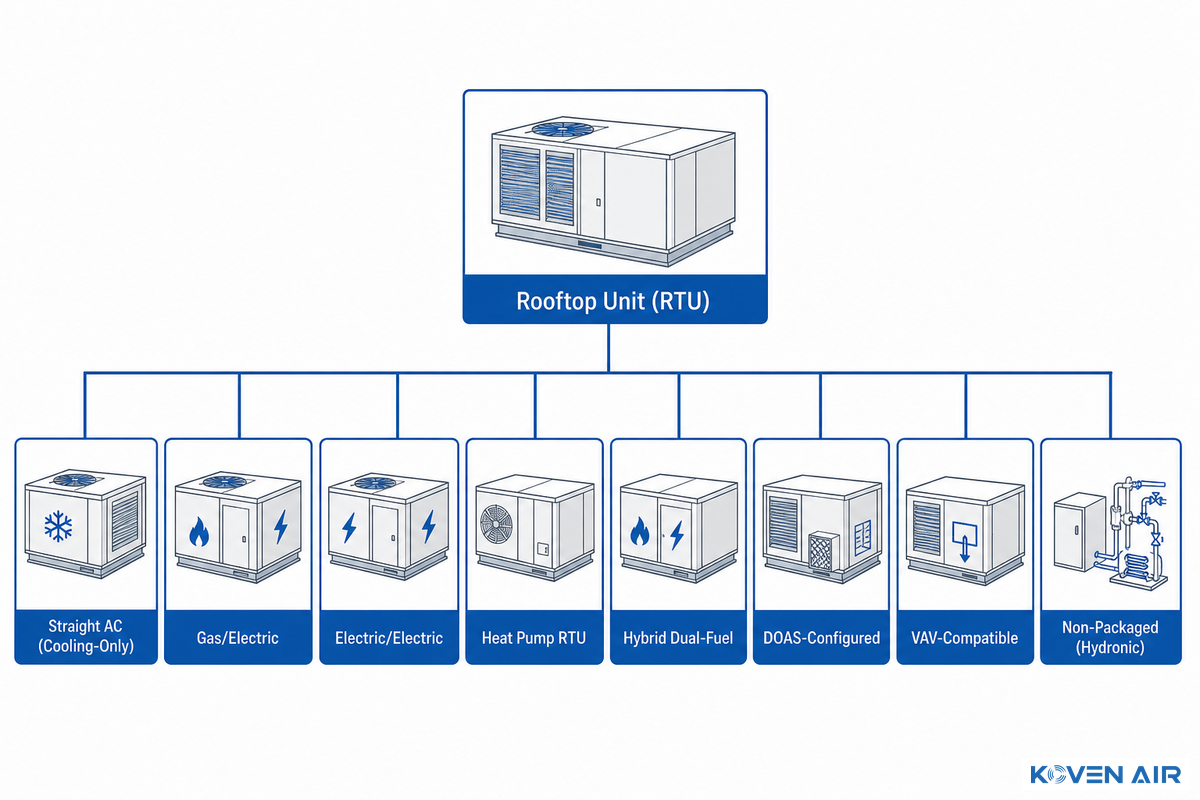
While there’s no single industry-wide classification system defining specific categories of RTUs, ASHRAE and AHRI provide standardized test methods and ratings. Nevertheless, the packaged units in the market naturally fall into two broad classifications based on heating type and ventilation setup. Below is our table to categorize units based on commonly used spec book and bid document terms:
| Type | Heating Source | Typical Use | Efficiency Note |
|---|---|---|---|
| Straight AC (cooling-only) | None | Server rooms, process cooling | Lowest first cost, no heat capability |
| Gas/electric | Natural gas furnace | Retail, warehouses, schools | Most-installed legacy configuration |
| Electric/electric | Electric resistance coil | Buildings without gas service | Higher operating cost than heat pump |
| Heat pump RTU | Reversing valve (refrigeration cycle run backward) | All-electric / decarbonization projects | See dedicated section below |
| Hybrid dual-fuel | Heat pump + gas backup | Cold-climate retrofits keeping a gas line | Gas engages only below a set outdoor temperature |
| DOAS-configured | Varies (often heat pump) | Dedicated outdoor air systems, paired with separate space conditioning | Handles latent load separately from sensible |
| VAV-compatible | Varies | Multi-zone buildings with variable loads | Pairs with variable air volume (VAV) boxes for zone-level control |
| Non-packaged (hydronic) | External boiler / chilled water | Campuses with central plants | Not self-contained — needs piped connections |
Two observations stand out in the category structure above: Firstly, “heat pump RTU” isn’t an alternate type to the standard packaged unit; it’s the same unit with a different means of heat, which is the perspective used in AAON’s technical literature. Secondly, the “non-packaged” row is the anomaly since it doesn’t comply with the self-contained criteria because the RTU requires connection to an external heating system.
Heat Pump RTUs, The All-Electric Rooftop Option
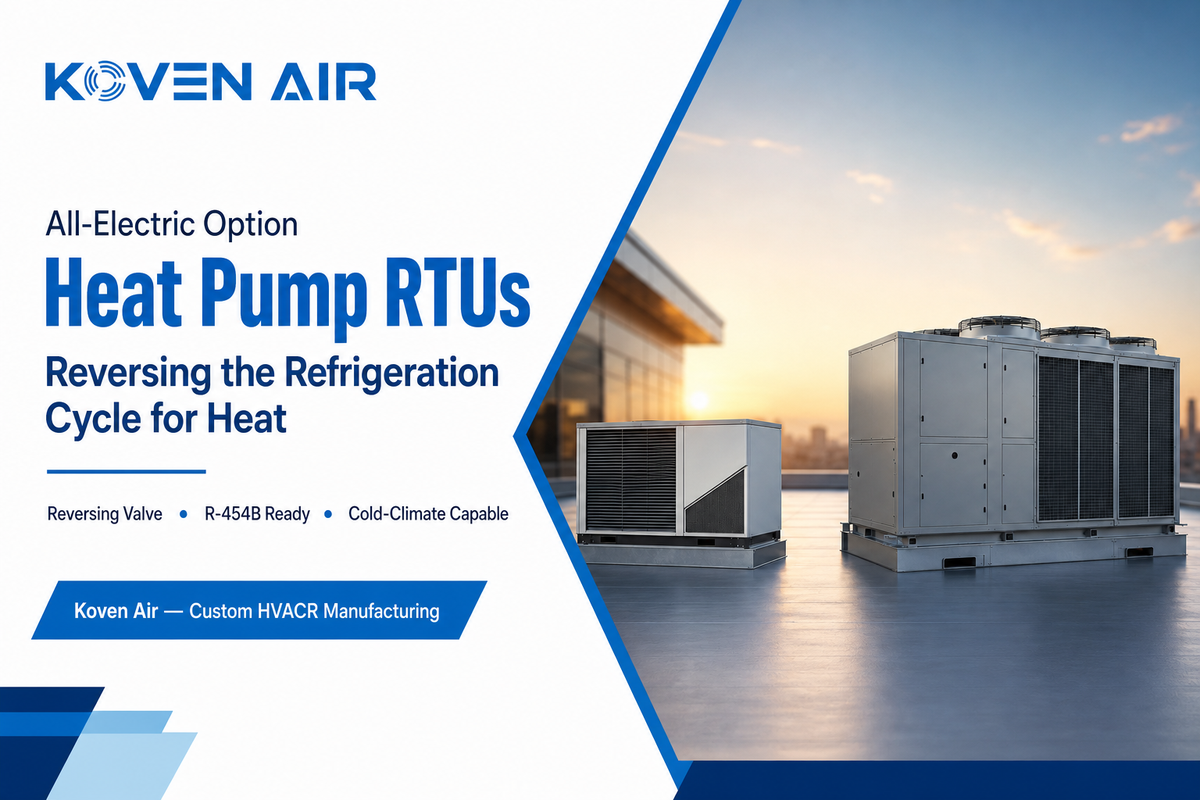
A heat pump RTU works as a packaged unit where heat is moved into the building from the outside using the refrigeration cycle, driven by the same compressor and coils as the cooling function, just with the flow of the refrigerant reversed by a reversing valve, as opposed to a gas burner or an electric heat coil doing the heavy lifting.
Is an RTU a Heat Pump?
Not necessarily. Most commonly a standard RTU matches the cooling system with a gas furnace or an electric resistance heater. A heat pump RTU is the same packaged product, except the heat delivered comes directly from the refrigeration cycle. So, while all heat pump RTUs are rooftop units, not all rooftop units are heat pumps-it all comes down to where the heat originates from the cooling system.
This transition is occurring now. Two of the biggest manufacturers of RTUs (Carrier and YORK) are already performing field trials on 15-ton-class all-electric heat pump RTUs at Oak Ridge National Laboratory through a Department of Energy initiative called the Commercial Building HVAC Technology Challenge. In YORK’s case, their unit even uses simultaneous operation of a compressor with a resistance heat coil. Johnson Controls has even gone so far as to commit to lower global warming potential refrigerant (R-454B instead of R-410A) to enable advanced cold-climate heat pump RTUs.
” we’re starting to see the number of heat pumps we sell [on an RTU] grow. That has to do with incentives but a good part of that has to do with legislation in specific regions that’s starting to ban or strongly incentivize us away from using gas heat.”
Matt Schlegel, commercial product manager, Johnson Controls (as reported by ACHR News)
A common argument against heat pump RTUs has been their performance in colder weather. Heating with air that’s 10 °Fahrenheit out requires more energy for the refrigeration cycle than 40 °Fahrenheit. That’s not a myth, it’s an engineering limitation that the newest cold-climate heat pump RTUs overcome through enhanced compressor technology, carefully calibrated defrost controls, and refrigerant blends that are able to maintain the coefficient of performance (COP) at much lower outdoor temperatures than older heat pump designs would have, at which point the system would typically switch over to a gas or resistance backup.
💡 Pro Tip
When you need to get off of natural gas for your building entirely, it is worth asking whether a quoted heat pump RTU system uses only an electric heater as backup, or if it is a hybrid system with a dual-fuel component-meaning it still has a gas backup. Both will likely be labeled a “heat pump RTU,” but only one completely eliminates the gas connection.
Koven Air validates this refrigeration-cycle performance through its own extensive testing. Its heat pump RTU testing lab is part of a 20,000 m2 (215,000 ft2) manufacturing facility where 24-hour aging tests and factory inspections confirm units are ready to ship. For a detailed look at measured cold-climate heat pump RTU performance, tonnage calculations, and the all-electric vs. hybrid dual-fuel decision, visit our Heat Pump RTU solutions page.
Where RTUs Are Used
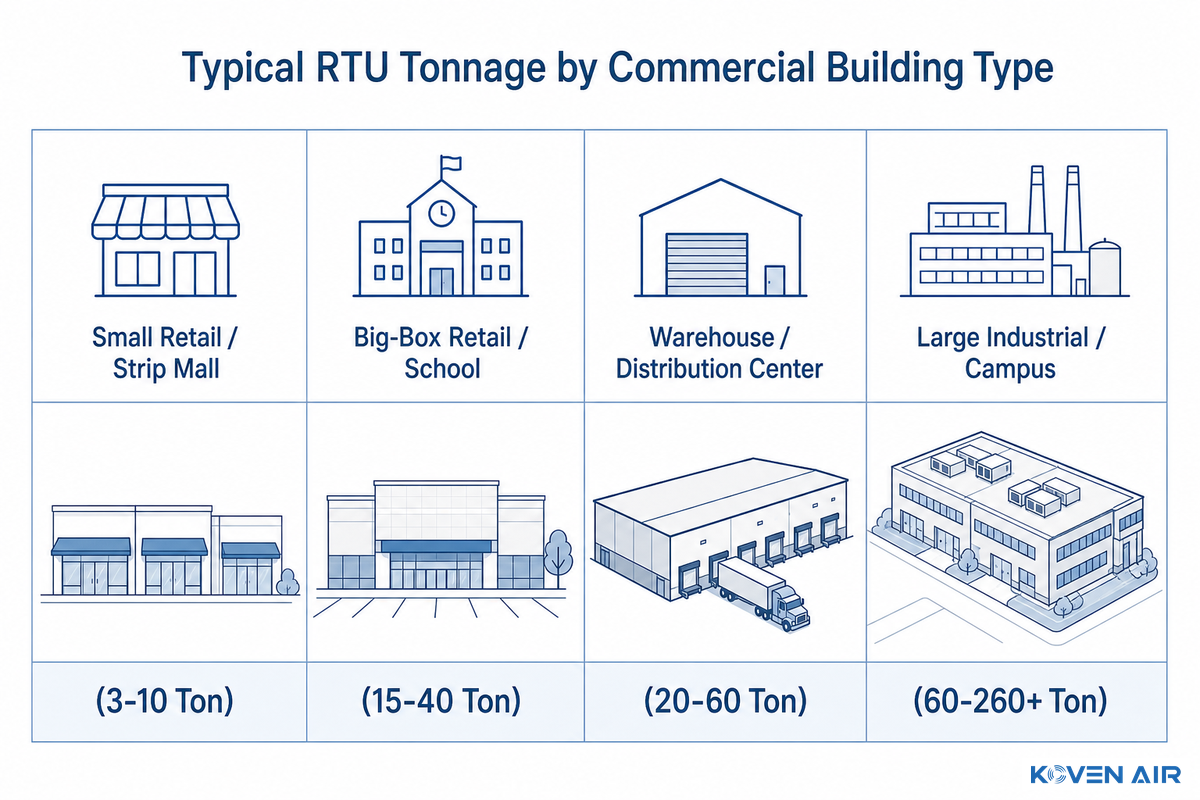
RTUs excel in single-story buildings with large, flat roofs – retail stores, warehouses, schools, office buildings – the quintessential applications where you’ll often find several small units on a roof rather than a single huge unit; if one goes out, your whole building doesn’t go without climate control.
Restaurant “make-up air” units, in which an RTU provides fresh air replacing the volume pulled out by powerful exhaust hoods in kitchens to maintain pressure, are a less common but still standard use case.
A good illustration of how the decision actually get made is a regional grocery chain replacing failed units at a dozen locations. When a unit fail in July, there isn’t six weeks for analysis and evaluation; there’s a whole walk-in cooler full of perishable inventory on the line, and there’s a limited window – the next few days – for installation. It’s the norm, not the exception, that the commercial RTU market’s installations are emergency or planned replacements for existing units, rather than new constructions-making knowledge of the segment more valuable prior to a crisis than during one.
| Building Type | Typical Tonnage Range | Common Configuration |
|---|---|---|
| Small retail / strip mall unit | 3-10 tons | Gas/electric or heat pump |
| Big-box retail / school | 15-40 tons (multiple units) | Gas/electric or heat pump, VAV-compatible |
| Warehouse / distribution center | 20-60 tons | Straight AC or gas/electric, spot cooling zones |
| Large industrial / campus | 60-260+ tons | Multiple units, often DOAS-paired |
Humidity control is also a frequent secondary issue; while a space might be sized correctly for sensible (temperature) cooling, it may still feel clammy if there’s no attention given to latent (moisture) load – that’s the rationale behind the largest RTU applications being installed with a supplemental standalone ventilation-air unit sized for latent load or, for industrial and agricultural processes with specific requirements, a desiccant dehumidifier operating in tandem with the unit.
RTU vs. AHU vs. Variable Refrigerant Flow (VRF) — Quick Comparison
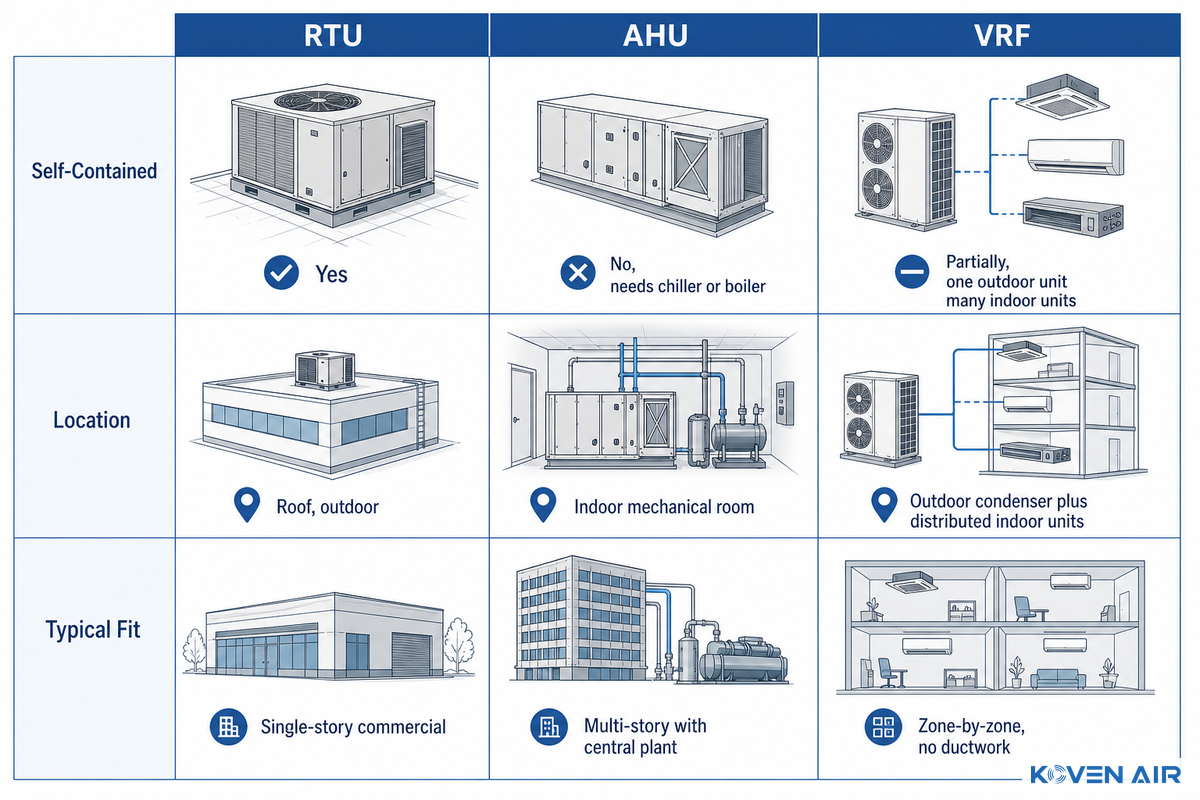
What’s the Difference Between an RTU and an Air Handler?
Air handling units (AHUs) move and condition air, but the heating or cooling function itself must be supplied from a source other than the unit, such as a chiller, boiler or condensing unit – AHUs typically sit in an indoor mechanical room, per the DOE’s commercial HVAC equipment guidance. An RTU, by contrast, includes a self-contained refrigeration system and is installed outside.
If your project requires an external chiller system somewhere within the building, you’re more likely considering an AHU-centric approach rather than an RTU.
| System | Self-Contained? | Location | Typical Fit |
|---|---|---|---|
| RTU | Yes | Roof (outdoor) | Single-story commercial, one unit per zone |
| AHU | No — needs chiller/boiler | Indoor mechanical room | Multi-story buildings with central plant |
| VRF | Partially — one outdoor unit, many indoor units | Outdoor condenser + distributed indoor units | Buildings needing zone-by-zone control without ductwork |
A full breakdown of RTU-versus-AHU and RTU-versus-VRF (Variable Refrigerant Flow) selection criteria would fill an entire guide on its own, so we’ll stick to an overview here rather than the definitive statement.
RTU Costs and the “$5,000 Rule”
Installation cost is very dependent on tonnage. Contractors frequently cite estimates for installation of a large 60-ton RTU-including any necessary crane fees, curb adapters and electrical work- at anywhere in the $80,000-$120,000 range, while a quarterly preventive maintenance visit for a single unit generally runs between $180 and $350. When things break down, costs can add up quickly; the repair of a compressor alone can commonly cost $8,000-$18,000, and the total cost of a repair that isn’t part of the preventive maintenance schedule can run 3-10 times the cost of that work, according to one vendor that tracks equipment failures for facility operators. Choosing equipment rated to the current AHRI Standard 365-2024 efficiency baseline can reduce how often those repair costs come up in the first place.
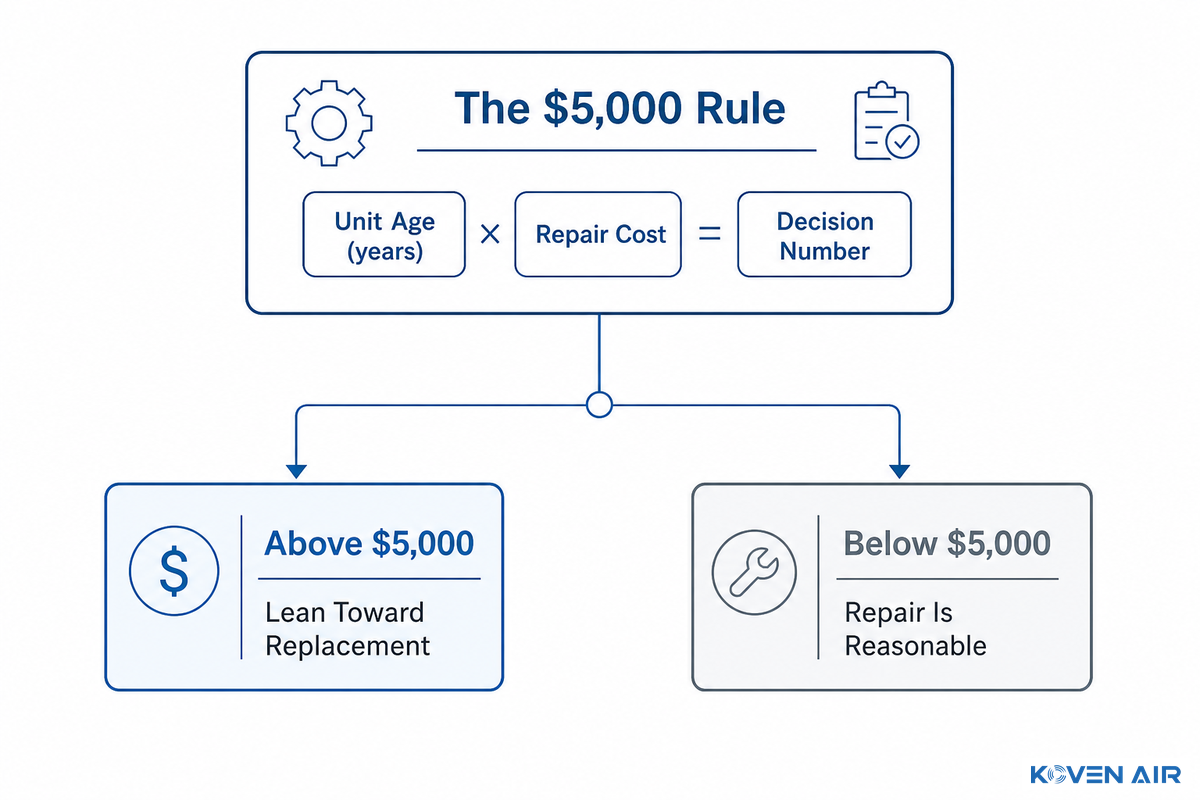
The $5,000 Rule
Simply multiply the age of your unit in years by the cost of repair. If the result exceeds $5,000, the equipment should probably be replaced. If the number is below $5,000, a repair is likely worth while.
- 10-year-old unit, $600 repair quote: 10 × $600 = $6,000, lean toward replacement
- 4-year-old unit, $900 repair quote: 4 × $900 = $3,600, repair is reasonable
Most of the HVAC technicians who are currently working with RTU brands and talking on forums on that matter do confirm what they said in the field: Brand name reputation doesn’t say much by itself, much more depending on specific models generations and on installing contractors. It’s a good way to prevent people to blindly trust on one brand, but $5,000 rule isn’t a physical law and on some cases, contractors know well when the rule shows some weakness. For example, for a commercial large tonnage RTU: even if it’s only 3-4 years old (for an expected life span of 15-20 years), the “multiple by age” rule can suggest replacement, just for a high repair cost that could represent a substantial portion of a new RTU… even if the RTU has much life to spend. For that large tonnage units, make a sanity check between age-based rule and remaining service life, as well as on warranty status before coming to a conclusion.
Industry Outlook, Electrification Is Reshaping the RTU Market
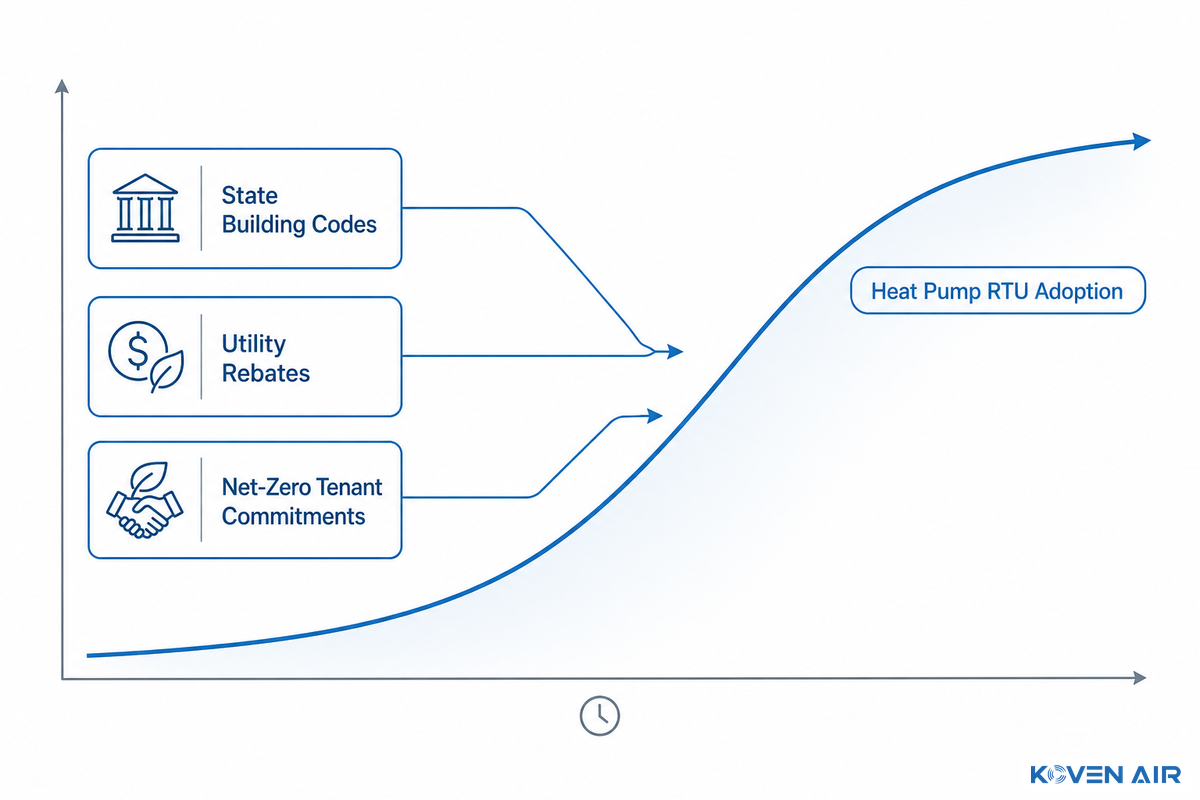
The most obvious factor driving change in RTU buying today isn’t any single technological innovation, but a cascade of state-level building codes and utility rebates increasingly making new gas heating equipment in new commercial buildings out of the question, coupled with net-zero commitments by big national tenants. Johnson Controls has said it sees heat pump percentage of RTU sales continuing to increase “in coming years” as more states adopt bans or incentives pushing away from gas, and Daikin Applied’s commercial products group cite state legislation and ESG mandates as the cause for growing interest in electrified rooftop gear rather than hybrid gas/electric systems.
That change is proceeding alongside two other tangible trends. First, both Carrier and YORK have 15-ton all-electric heat pump RTUs currently field tested at the DOE’s Oak Ridge National Laboratory-those are actual units being measured against real-world performance right now, not simply a slide with some targets. And second, the DOE updated the minimum efficiencies for commercial RTUs in 2023 for the first time since 2018, and an entire generation of units from the construction boom years of 2000-2010 is nearing its end-of-life concurrently. This represents an ongoing replacement trend that’s disconnected from new construction output.
For market context: the packaged rooftop unit segment is projected to stay the largest slice of the HVAC RTU market through 2026 – useful background, though the regulatory and replacement-cycle drivers above are more relevant for specification decisions today. This shift isn’t limited to a single flagship model, either – it’s why manufacturers are extending all-electric options across their entire commercial rooftop unit lineups. (Updated July 2026.)
FAQ
Q: Is HVAC the same as RTU?
View Answer
No. HVAC stands for heating, ventilation, and air conditioning. The term RTU, or rooftop unit, describes one specific type of HVAC equipment – a self-contained, roof-mounted system. Other systems such as chillers with air handlers, VRF, and split systems are also HVAC systems but are not considered RTUs.
Q: What is the difference between VRF and RTU?
View Answer
RTU vs. VRF
RTU
VRF
Single self-contained unit that uses shared ductwork to distribute conditioned air.
One condensing unit connected via piping to multiple indoor units that independently condition individual spaces.
Works best for single-zone buildings or multi-zone buildings with a more consistent conditioning need.
Works best for multi-zone buildings where spaces need precise and individual control of temperature.
Q: How long do rooftop units typically last?
View Answer
Commercial RTUs are typically designed for a service life between 15 to 20 years, but the actual life of a unit will depend heavily on maintenance, environmental conditions, and load cycling. Regular filter replacements and coil cleaning can help RTUs meet their projected lifespan. Rooftop units located on the exterior often go unnoticed and may require significant repairs or replacement before they reach the high end of the predicted service life range.
Q: What size RTU does a commercial building need?
View Answer
The correct tonnage for an RTU depends on far more than square footage. Proper sizing must consider ceiling height, windows, the amount of sunlight entering the space, the number of people in the building, internal heat generated by equipment, building envelope insulation levels, and the local climate. A good rule of thumb to begin is 3 to 10 tons for small commercial spaces, 15 to 40 tons for larger spaces like schools and big-box retailers (often distributed across several RTUs), 20 to 60 tons for warehouse environments, and more than 60 tons for larger facilities (possibly up to 260 tons or more distributed across many units). Oversizing a system can lead to unnecessary energy consumption and short-cycling, while undersizing can cause the building to remain uncomfortable during peak times. Thus, a precise load calculation conducted by a mechanical engineer or the manufacturer’s application team should size the equipment, not a rule of thumb.
Q: Do heat pump RTUs work in cold climates?
View Answer
Yes. Cold-climate-rated RTU heat pumps are specifically designed to maintain their heating output as outside temperatures drop. See our measured cold-climate COP data for all-electric rooftop heat pumps.
Q: Can a rooftop unit be repaired instead of replaced?
View Answer
In many cases, yes. Many RTU failures are due to individual component malfunctions, such as a broken capacitor or motor, and do not necessarily mean the entire unit is beyond repair. The “$5,000 Rule” (years of age multiplied by dollars to repair) is a quick guideline, but weigh it against the unit’s remaining warranty and expected lifespan – particularly for new or large-tonnage units.
Why We Write This
Most online explainers on rooftop units stop at a one-paragraph explanation, while the purchase decision – packaged vs. non-packaged, gas/electric vs. heat pump, RTU vs. AHU – is what most people struggle with. Koven Air builds all-electric heat pump RTUs in a 20,000 m2 facility with our own in-house chiller and heat-pump testing laboratory.
Any description of heat-pump refrigeration-cycle behavior in this guide is based on the actual units we build and test, not secondhand description. Reviewed by the Koven Air Environment Technology Co.,Ltd technical team.
References & Sources
- Federal Register, Vol. 89, No. 98 (May 20, 2024) – U.S. Government Publishing Office, confirms AHRI 340/360-2022 as the currently adopted test procedure
- Test Procedure for Air-Cooled, Evaporatively Cooled Commercial Unitary Air Conditioners – U.S. Department of Energy
- End-Use Savings Shapes Measure Documentation: Heat Pump Rooftop Unit – National Renewable Energy Laboratory
- Commercial Building HVAC Accelerator – U.S. Department of Energy Better Buildings Solution Center
- AHRI Standard 365-2024 – Air-Conditioning, Heating, and Refrigeration Institute
- High Efficiency Rooftop Unit (HE RTU) Focused Pilot – Final Report – CalNEXT
- Strong Demand for HVAC Rooftop Units – ACHR News
- Carrier Advances Rooftop Heat Pump Technology with Commercial Field Trials – ACHR News
- YORK Rooftop Unit Passes Testing Phase of DOE Commercial Building HVAC Technology Challenge – ACHR News
- Advances in Heat Pump Rooftop Units for Cold Climates – ACHR News
- Choosing a Heat Pump for Commercial Facilities – Facilitiesnet
Related Articles
- Heat Pump RTU Solutions – Cold-Climate Performance & Tonnage Selection – the full commercial deep-dive this guide’s Heat Pump section points to
- Commercial Rooftop Unit Solutions – Koven’s broader RTU product lineup
- Dedicated Outdoor Air System (DOAS) Rooftop Units – for ventilation-heavy commercial and agricultural projects
- Industrial Desiccant Dehumidifier Systems – standalone humidity control for process and storage buildings
- About Koven Air Environment Technology – our factory, testing lab, and manufacturing capabilities