Get in Touch with Koven Air Company

Updated October 2026 · Commercial equipment selection
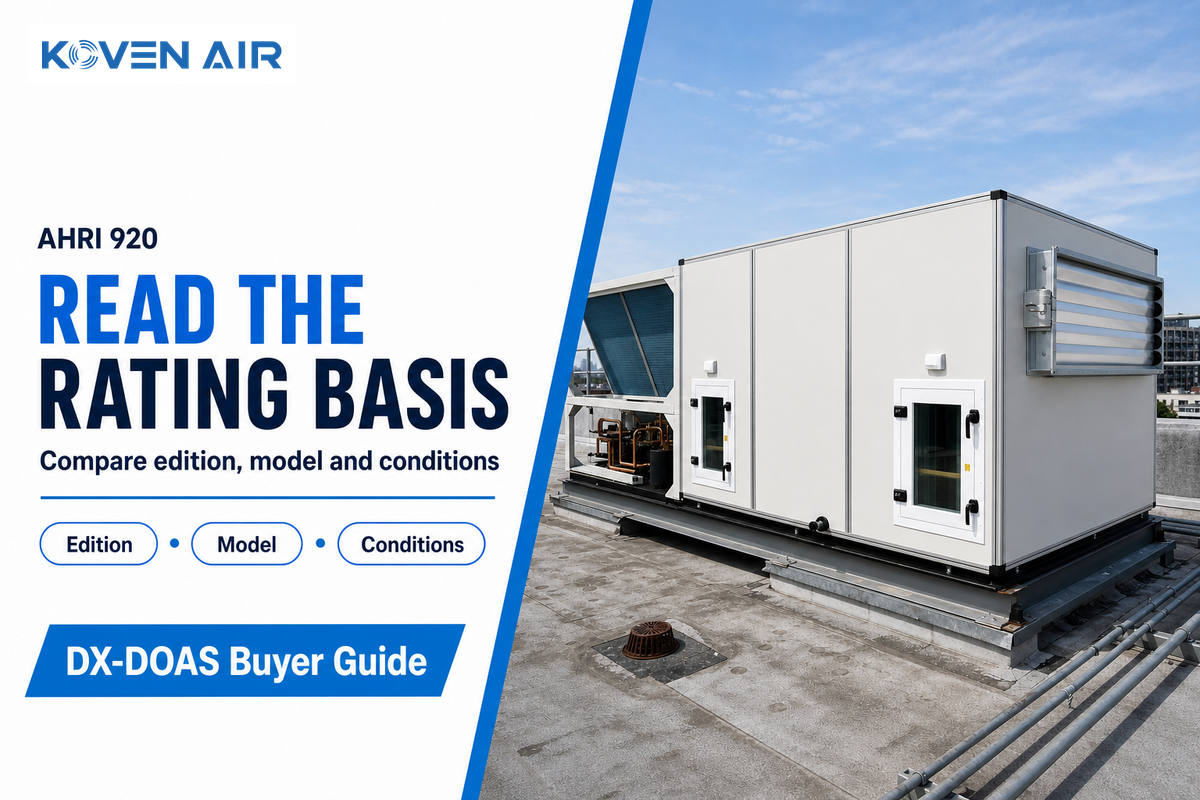
AHRI 920 establishes methods for rating the performance of direct-expansion dedicated outdoor air system (DX-DOAS) units. When comparing two DX-DOAS units, check the edition of the report, the model configuration, and the rating conditions, and origin of the values. Different questions are answered by a standardized rating, a certified model record, and a project selection report. Ensure all three are provided in the submittal.
An energy efficient label on HVAC equipment requires a stated comparison basis. A high moisture-removal efficiency number is useful only if you know the condition that produced it. Engineering requires a specified leaving-air condition; purchasing requires comparable offers. The tables below assist both in identifying the missing information without requiring the product literature to serve as a Compliance Certificate.
Start with the report header. Record the standard edition, exact model and the document purpose and whether any regulated represented values derive from sample testing or an AEDM. Compare the numbers after those fields are clear.
Quick specs for reading a report
MRC: lb/h or kg/h. MRE: lb/kWh or kg/kWh at a stated condition. Supplementary-heat reference: 70°F (21°C). Preserve the standard edition and metric suffix beside every reported value.
AHRI 920 scope: which outdoor-air units belong?
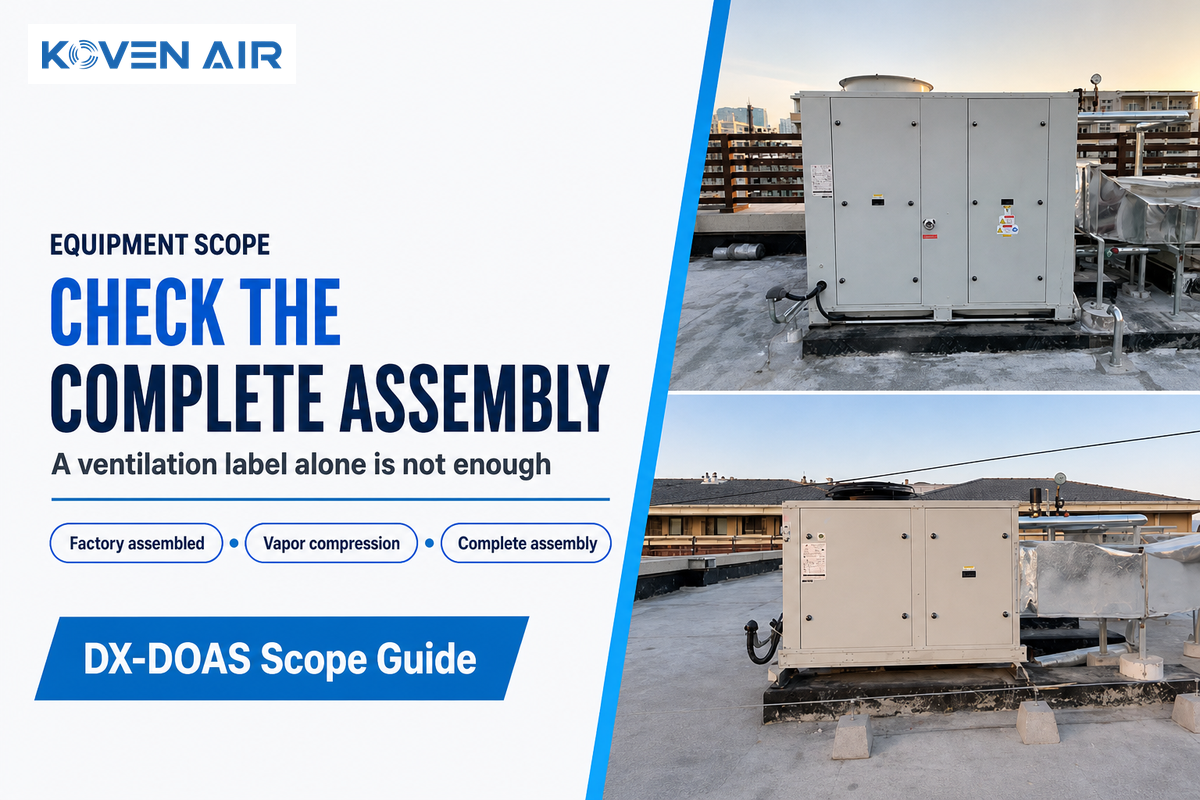
AHRI 920-2026 covers factory-assembled commercial and industrial DX-DOAS units that use electrically operated vapor-compression refrigeration. Its scope excludes units providing only sensible cooling of 100% outdoor air. A ventilation label alone does not prove that a particular air handler is in the scope of this standard.
When considering performance, look at the functional requirements of the equipment, and the refrigeration arrangement. Not all equipment that treats outdoor air would share the same method of rating. The scope of this Standard, sections 2.1 and 2.2, is a good starting point.
For the next project, take the commercial DOAS rooftop selection guide to create the system configuration. Use the report to examine the equipment under consideration. Other air conditioning systems, including air conditioners and heat pumps in a split system with separate outdoor units and an indoor unit, may be using different certification programs. A matched system record from another program can’t answer the complete-system question. Equipment manufacturers should determine the applicable program for the refrigeration equipment that’s being quoted.
Procurement check: When a supplier quotes a hydronic air handler and a separate refrigeration package, clarify which complete assembly the quoted rating applies to. Keep the supplier’s answer to the quote attached to the model schedule.
The AHRI DOAS certification program separately states a scope below 324 lb/h moisture removal for 50 Hz and 60 Hz production models. The 324 lb/h limit also appears in the federal regulated DX-DOAS definition. The 2026 standard defines its own scope separately; record which document supplies each boundary.
Which AHRI 920 edition applies to the report?
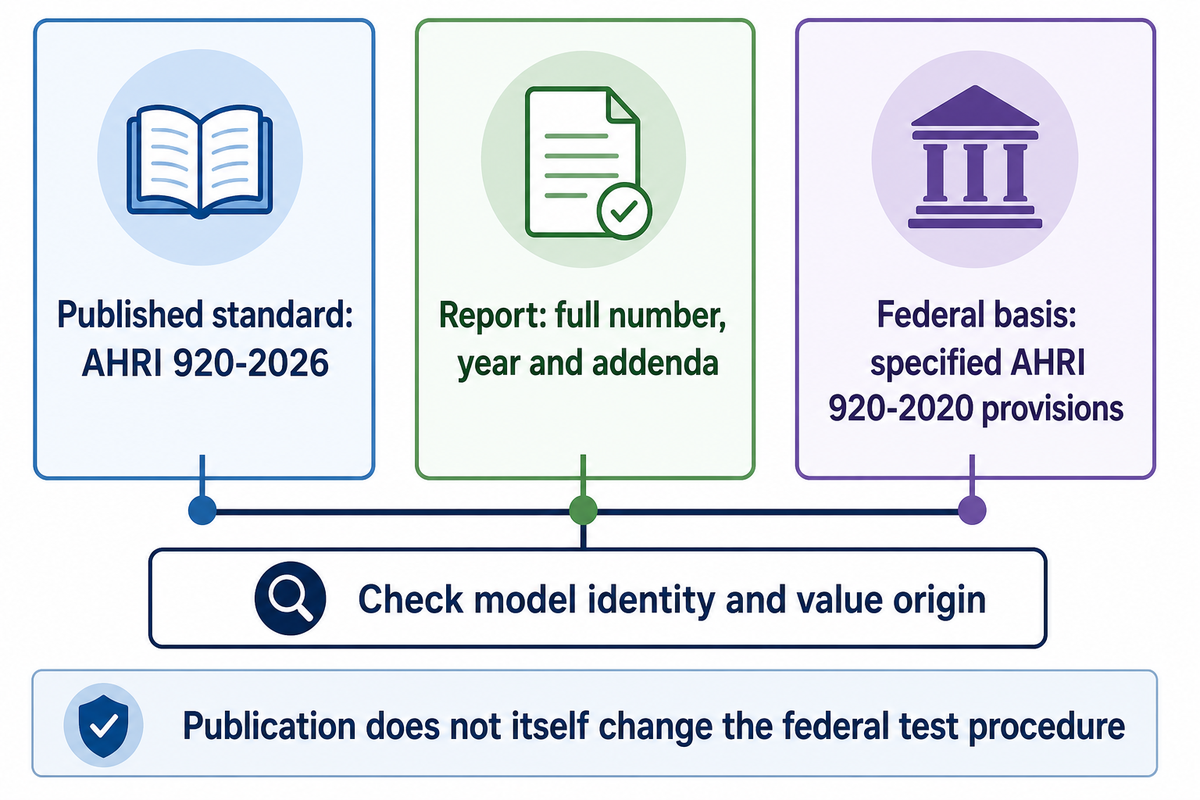
The reported edition of the standard can differ from the latest published edition and from the edition in the applicable regulatory test procedure. AHRI 920-2026 supersedes AHRI 920-2020 (I-P) and AHRI 921-2020 (SI), both with Addendum 1, but publication of that revision doesn’t itself change the edition incorporated into a federal test procedure.
As checked in October 2026, 10 CFR Part 431, Subpart F, Appendix B incorporates specified AHRI 920-2020 provisions and gives the federal text precedence where they conflict. The Department of Energy equipment page identifies this test basis for efficiency representations beginning July 24, 2023.
A rating standard establishes measurement and reporting requirements. The regulator identifies the applicable federal test and efficiency requirements. Satisfaction of minimum federal efficiency requirements is a distinct issue. Section 431.97(h), Table 17, sets category-dependent requirements for applicable equipment manufactured from May 1, 2024; heat pump categories include both ISMRE2 and ISCOP2. A figure for dehumidification, alone, does not qualify as the heating requirement.
A Rating Basis Passport should be used for each offer. This is our document-organizing checklist, not an AHRI form or a new rating. A missing field is a request to the manufacturer.
| Field | Record from the source | Why it matters |
|---|---|---|
| Document purpose | Rating, certification record or project selection | Prevents unlike evidence being merged |
| Standard edition | Full number, year and addenda | Identifies the calculation basis |
| Regulatory basis | Applicable procedure and equipment category | Separates legal requirements from publication dates |
| Model identity | Complete model string and options | Connects the record to the quote |
| Value origin | Document purpose; test/sampling or AEDM basis | Identifies what the number represents |
| Capacity | MRC in lb/h or kg/h | States moisture removal duty |
| Dehumidification efficiency | Metric name and lb/kWh or kg/kWh | Preserves the denominator |
| Air conditions | Entering and leaving temperatures in °F or °C | Locates the operating point |
| Airflow and pressure | cfm or m³/h; in. w.g. or Pa | Connects fan duty to the selection |
| Recovery and heat | Recovery arrangement and supplementary heat | Defines included energy functions |
| Document control | Issue date, revision and record reference | Keeps later substitutions traceable |
Providing a report that states 5 lb/kWh without edition and metric label gives the buyer an unresolved comparison. Keep those fields adjacent to the number. If the specification requests a different basis, obtain a corrected or supplementary report before assigning the higher number an advantage.
MRC, MRE and ISMRE2: compare the right quantity
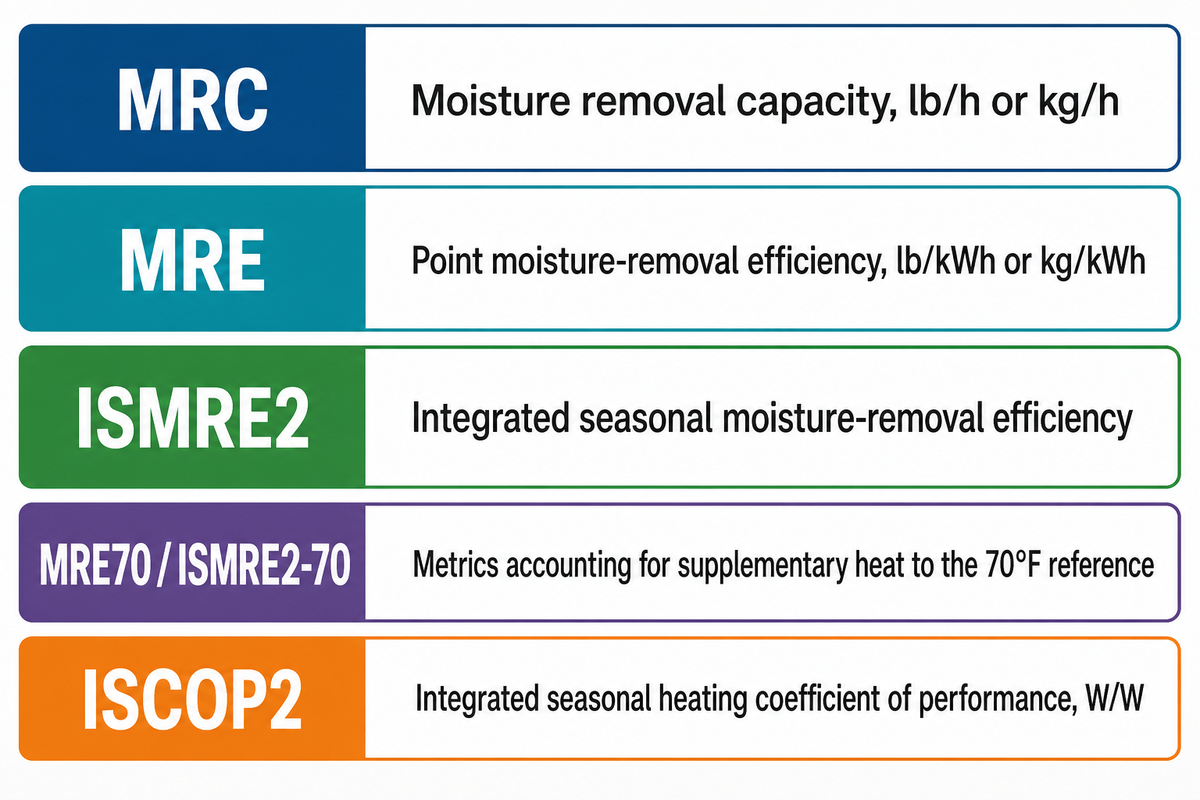
MRC measures moisture removal per hour; MRE divides MRC by total power input at a stated condition. ISMRE2 covers performance under the Standard’s seasonal method. ISCOP2 covers integrated heating performance. Capacity, point efficiency and seasonal energy efficiency should be shown in separate columns since they relate to different selection criteria.
For a transparent example, assume a unit removes 100 lb/h using 20 kW total power at one stated operating point. Dividing 100 lb/h by 20 kW gives 5 lb/kWh. With moisture removal held constant and 25 kW, the quotient is 4 lb/kWh. These are hypothetical arithmetic examples, not tested equipment results or ISMRE2 calculations.
| Metric | What it describes | Buyer interpretation |
|---|---|---|
| MRC | Moisture removal capacity, lb/h or kg/h | Check whether the required latent duty is met |
| MRE | Point moisture-removal efficiency, lb/kWh or kg/kWh | Compare the same operating condition and boundary |
| ISMRE2 | Integrated seasonal moisture-removal efficiency | Use the stated standard method and configuration |
| MRE70 / ISMRE2-70 | Metrics accounting for supplementary heat to the 70°F reference | Keep the suffix and applicable heating assumptions |
| ISCOP2 | Integrated seasonal heating coefficient of performance, W/W | Read heating performance separately |
There’s a second distinction: where the value came from. As explained in 10 CFR 429.43(a), regulated basic-model represented values can be established using testing with sampling, or an alternative efficiency determination method (AEDM). The DX-DOAS provisions of the regulation address model selection and capacity representation. A declared basic-model value isn’t always a measurement for the individual unit being installed. Raw sample test results may support that represented value; the categories are not mutually exclusive.
This section provides an example of how to compare the evidence in a bid review. Bid-review example: One bid offers a declared seasonal rating, and another bid offers a factory point test. Both pieces of information can be helpful, but a purchaser needs equivalent evidence to be able to rank them. Request the supplier to provide the representation level rather than assuming the test sheet is always the best evidence.
At 100 lb/h and 20 kW, the arithmetic gives 5 lb/kWh for that point only. Annual energy savings still require weather, operating hours and system boundaries. A seasonal index can’t, by itself, predict the building’s energy bill or the performance of its other heating and cooling systems.
Outdoor-air rating conditions versus your project
Standard rating conditions allow comparison of product results under defined conditions; project conditions describe the duty the building actually requires. Keep both sets of conditions visible. A report can be valid at its rating point, but it doesn’t necessarily mean the airflow and leaving air dew point satisfy the project’s requirements.
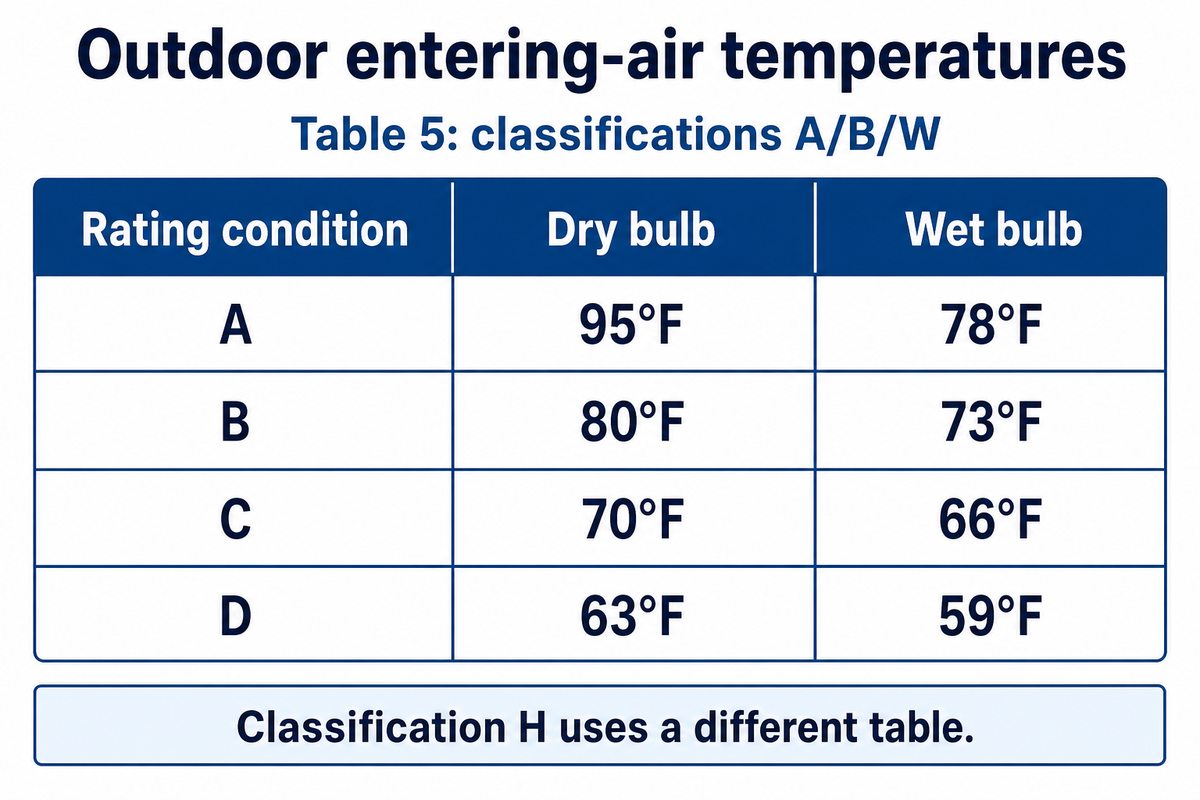
Temperatures given for classes A, B and W are from AHRI 920-2026 Table 5. Classification H uses a different table. The letter representing a rating condition shouldn’t be confused with the equipment classification.
| Rating condition | Dry bulb | Wet bulb |
|---|---|---|
| A | 95°F | 78°F |
| B | 80°F | 73°F |
| C | 70°F | 66°F |
| D | 63°F | 59°F |
Engineering note: DOE’s DX-DOAS definition includes the ability to dehumidify to a 55°F dew point at the specified barometric basis of 29.92 in. Hg under condition A, for any part of the airflow range advertised in manufacturer materials, and a moisture removal capacity below 324 lb/h. Do not use that definition to justify setting an absolute supply-air setpoint. The indoor air requirements, elevation, and the equipment selected require design inputs of their own.
“Therefore when comparing ISMRE values, also compare leaving air dew points.”
Does an oversized unit dehumidify better?
A larger nominal size doesn’t imply a better solution for humidity control at the required duty. Compare the moisture removal, airflow, leaving-air dew point, and the range of capacity control at the design conditions. Ask how the control systems of the compressor and fan respond to low sensible load. Nominal cooling capacity doesn’t answer that.
Consider a hotel system with low room cooling demand and a continuing requirement for outdoor air. Request a project selection for the relevant part-load conditions and control sequences, including any reheat. That isn’t to say a particular type of compressor will always solve humidity problems.
Condition A is a standard rating point at a 95°F dry bulb and 78°F wet bulb. An engineer’s design point is established separately. Section 6.2 permits application ratings at other conditions, but excludes integrated ISMRE2 and ISCOP2 from those application ratings. Classify the project result accordingly.
Heat recovery and reheat change the rating boundary
Heat recovery and supplemental heat affect the functions and energy inputs a performance rating covers. Assess the equipment configuration stated by the manufacturer before evaluating efficiency. A selection equipped with heat recovery and one without it may also use different air paths, so the higher rated choice should be validated against the actual installation arrangement.
With regards to a single package unit, ask where the return air or exhaust stream reaches the recovery section. For a retrofit with no usable exhaust air connection, request the proposed recovery arrangement and ductwork in writing. The heat-recovery equipment overview may support that discussion, but a component specification doesn’t transport its performance to the complete DOAS assembly.
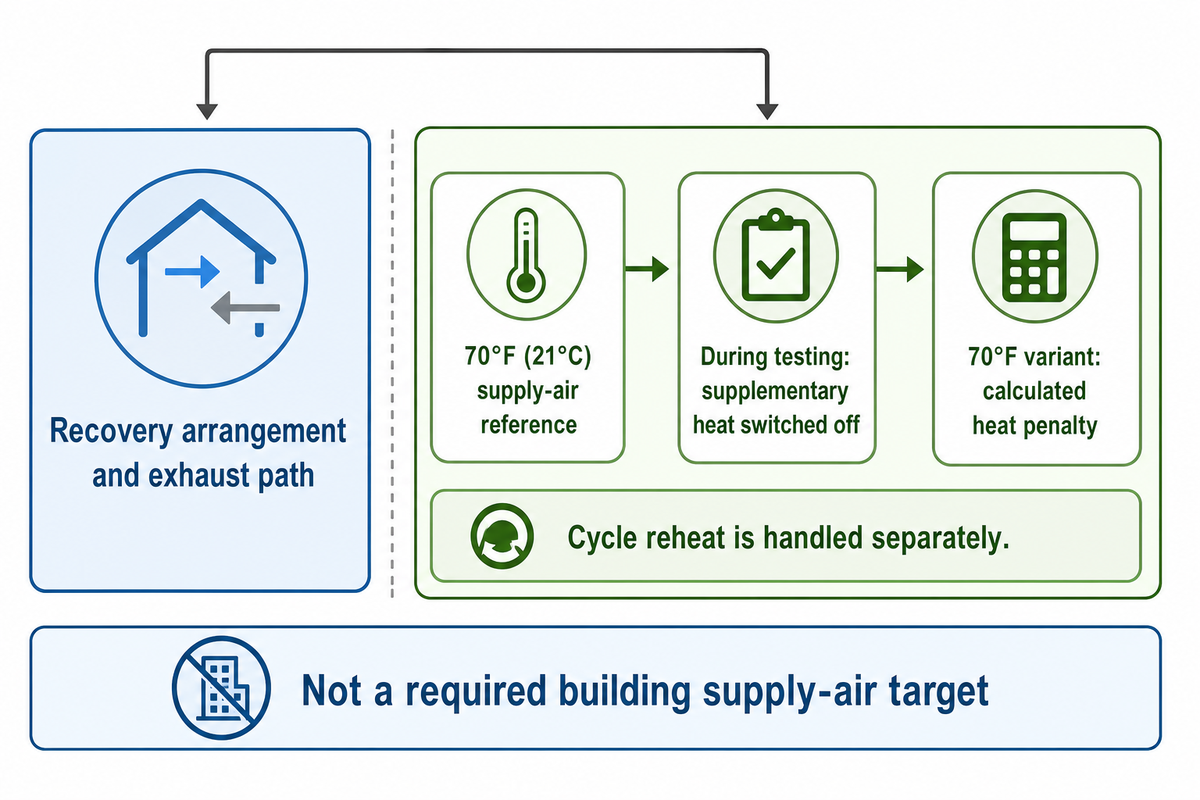
Reheat has to be explained separately. AHRI’s supplementary-heat accounting uses a 70°F (21°C) supply-air reference. The MRE70 and ISMRE2-70 labels preserve this. During testing, supplementary heat is switched off and the 70°F variant calculates a penalty for the heat that would be needed. Cycle reheat is handled separately. These metrics aren’t interchangeable with plain MRE and ISMRE2, and the reference doesn’t require every building to receive air at 70°F.
An office with a useful space-cooling load and a hotel at low load may require different strategies for supply air. Check with the design engineer if cool, dry air can satisfy the load requirement and when additional heat is required. Retain the heating source and control sequence with the selection. For very low dew-point duties, compare the proposed approach with desiccant dehumidification applications before assuming this DX rating covers the whole process.
Other components also make a difference. Test arrangements for the components mentioned in Appendix B (i.e. filters, heat coils, etc.) are also specified in Appendix B. For filters, use MERV 8 or the lowest MERV filter offered with the tested DOAS model, whichever is greater. A project’s higher particulate filtration requirement may differ from the specified test arrangement; request its fan and motor duty at that pressure.
Compare
Recovery configuration, supplementary heat, airflow and accessory setup on both reports.
Avoid assuming
A variable-speed drive, recovery wheel or scroll compressors prove the efficiency of the complete installed system.
The 70°F supplementary-heat reference belongs to the defined rating calculation. The building’s supply-air target belongs to its design. In both cases, keeping the temperatures visible prevents a purchasing comparison from rewarding a rating configuration that does not follow the intended heating and cooling sequence.
AHRI certification: match the model before the number
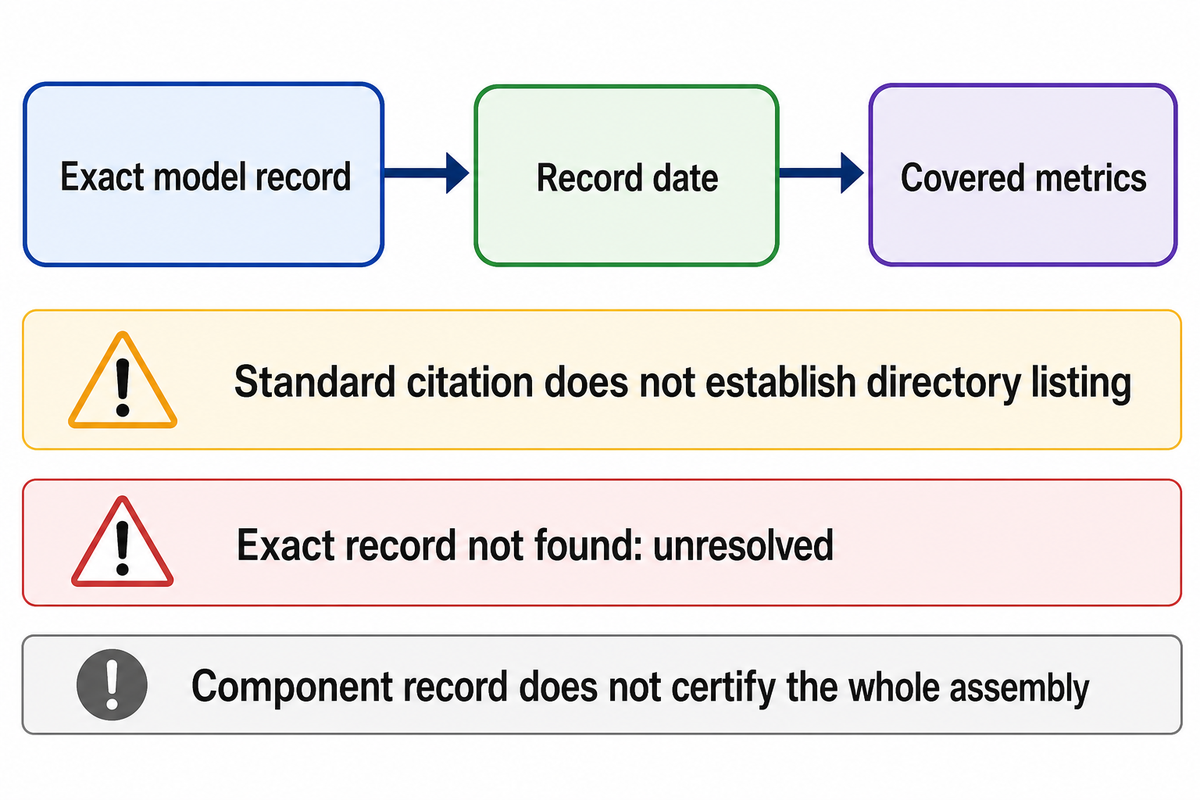
An AHRI certification relies on a model-specific record pertaining to the applicable program and a clear articulation of the certified metrics. A test report citing an AHRI standard isn’t by itself a directory listing. Likewise, a listed model doesn’t necessarily qualify all values on a supplier’s selection sheet.
As of now, the AHRI DOAS program page lists the performance verification for moisture removal at standard condition A, ISMRE2 and, for models with supplementary heat, ISMRE2-70. The federal Appendix B treats the 70 variant as an optional representation, while Table 17 minimums use ISMRE2 and, for heat pumps, ISCOP2. The AHRI public program list doesn’t include ISCOP2. Do not extend that list to all heating performance or nonstandard project conditions without the supporting program documentation.
How do I get an AHRI certificate?
The official DOAS program website provides the AHRI Directory of Certified Product Performance for model record identification. Retain the specific model’s record date and the metrics it covers. Retain the record with the metric references provided.
A proposal citing “performance certified” is a reason for requesting the referenced record. An AHRI-certified component doesn’t confirm third-party verification of the whole unit. A company logo or a compressor certificate doesn’t confirm a match of the whole unit. If the supplier says the model is listed in the AHRI directory, but the exact record can’t be found, describe the certification claim as “unresolved” and not say the equipment is “certified” or “noncompliant.”
KovenAir’s commercial DX-DOAS product page is a starting point for an equipment inquiry. Request the referenced model’s current report and any claimed certified record. This article doesn’t certify a KovenAir model or substitute a brand-level statement for that evidence.
A two-report crosswalk for comparable DOAS submittals
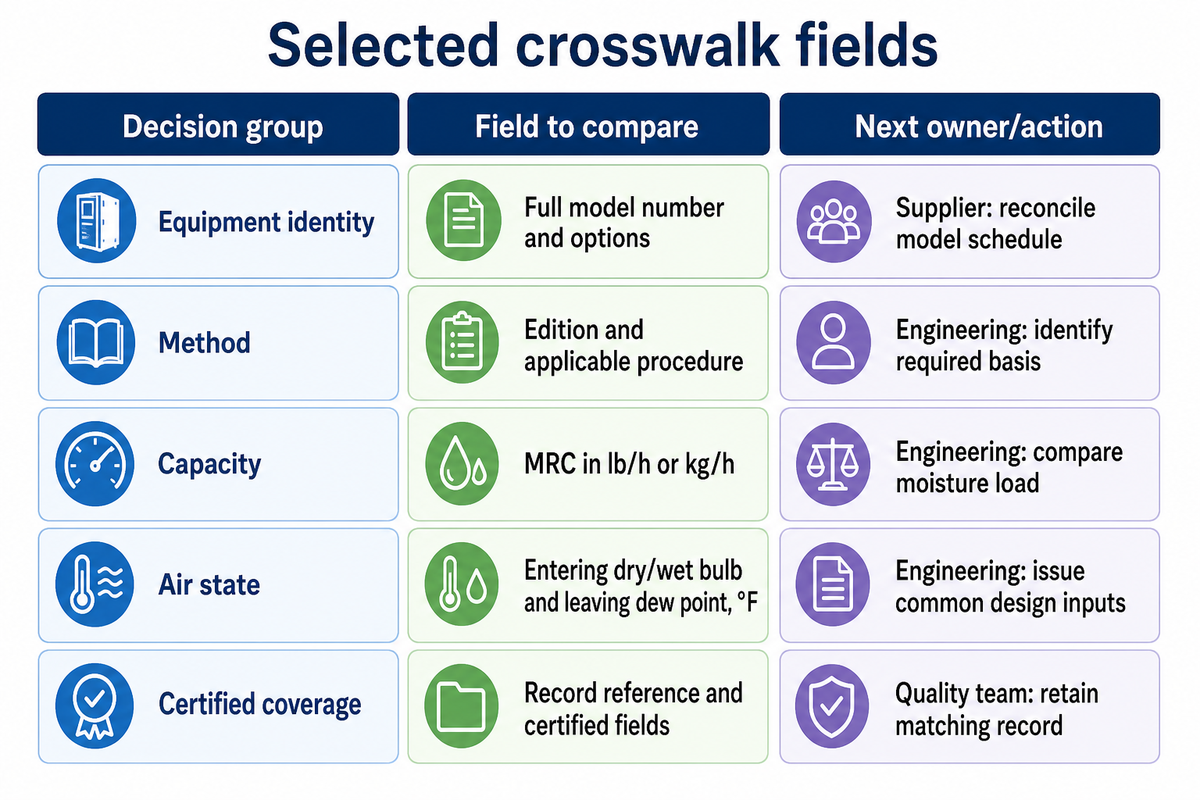
A good crosswalk makes omitted inputs obvious prior to a team ranking competing offers. Place both documents beside the project requirement, preserve their original metric labels and identify who can resolve each disparity. Matching fields improves the basis for comparison; it doesn’t prove equivalent installed performance or complete regulatory compliance.
Use this matrix during a joint engineering and purchasing review. It groups differences by the decision they affect. Keep indoor air quality requirements in the project specification rather than treating the rating as their complete assessment. Indicate a field as “not provided” when a source is silent; don’t give the value from another model’s brochure.
| Decision group | Compare on both reports | Hidden constraint | Next owner/action |
|---|---|---|---|
| Equipment identity | Full model number and options | Quoted and documented assembly differ | Supplier: reconcile model schedule |
| Method | Edition and applicable procedure | Same label, different calculation basis | Engineering: identify required basis |
| Representation | Document purpose; represented-value basis | Raw sample results and declared values are conflated | Supplier: identify testing/sampling or AEDM basis |
| Capacity | MRC in lb/h or kg/h | Efficiency is offered without required duty | Engineering: compare moisture load |
| Dehumidification efficiency | MRE, ISMRE2 or ISMRE2-70 | Point and integrated metrics are mixed | Supplier: provide like metric |
| Heating | Heating metric and selection conditions | Dehumidification certificate is overextended | Engineering: request heating evidence |
| Air state | Entering dry/wet bulb and leaving dew point, °F | Humidity duty differs despite similar airflow | Engineering: issue common design inputs |
| Fan duty | Airflow in cfm and pressure in in. w.g. | Filter or duct-system duty is omitted | Supplier: show selected fan power |
| Recovery | Recovery arrangement and exhaust path | Building cannot support quoted configuration | Design team: confirm air paths |
| Supplementary heat | Heat source and 70°F reference treatment | Different energy boundary | Supplier: identify included inputs |
| Certified coverage | Record reference and certified fields | Model listing is treated as all-value certification | Quality team: retain matching record |
| Commercial scope | Controls, accessories and commissioning | Price excludes work needed by selection | Purchasing: normalize quoted scope |
| Operating cost | Weather, schedule, tariffs and system boundary | Rating is converted directly into savings | Owner: request project energy analysis |
For instance, a facilities team reviewing two rooftop options may see that one includes a recovery path, and the other doesn’t. Address the installation arrangement and then ask purchasing to compare premiums. The DOAS quotation comparison guide covers the commercial side of that scope exercise.
Owner forecasts require another evidence layer. [PNNL’s eight-building field evaluation] separates utility data comparison against pre-conversion systems from modeled comparison against hypothetical code-minimum replacements. Those baselines answer different questions. A published cohort’s percentage can’t be assigned to a new project or to a KovenAir unit.
For a proposal reporting 100 lb/h, the associated airflow, dew point and power should also be on that comparison row. Then engineering can address the moisture duty and purchasing can address scope. If a cell is left blank, that shows which document to review next, and isn’t evidence that one of the offers is performing worse.
What the 2026 update means for your next submittal
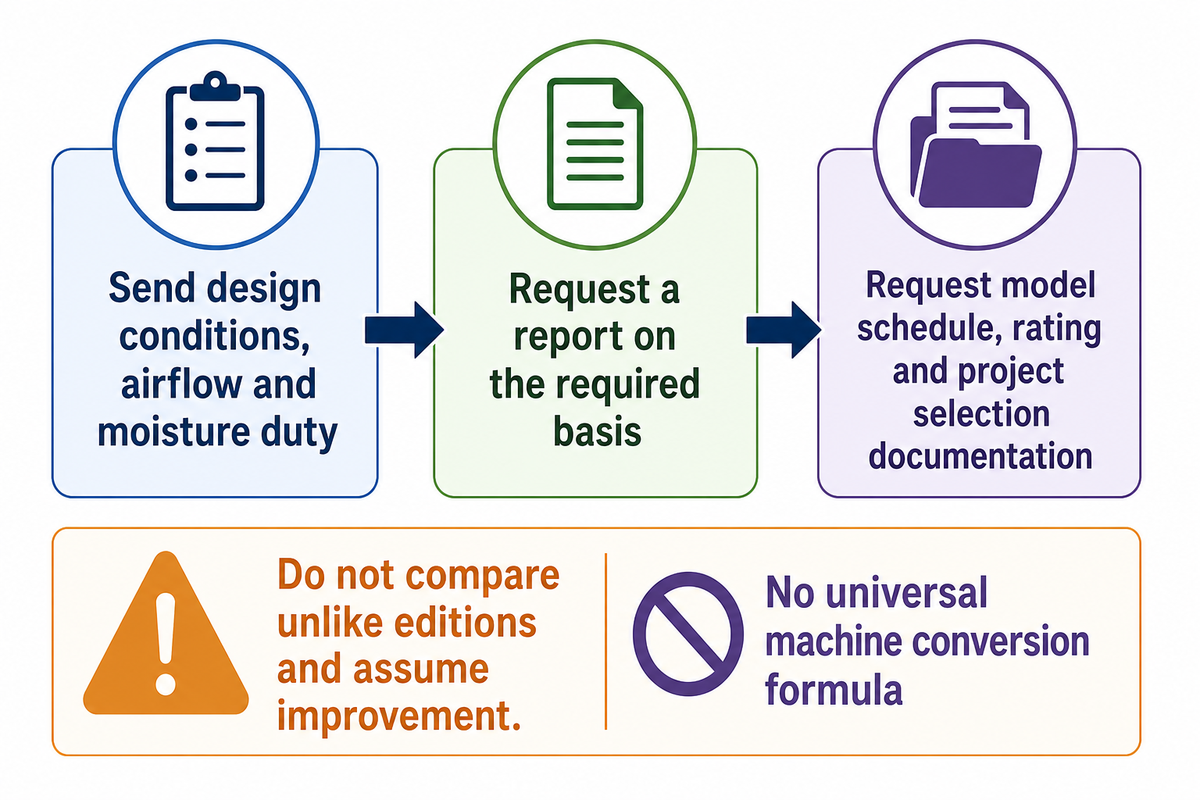
The 2026 standards provide a basis for the evaluation of existing products. The 2026 publication gives buyers a current standard to identify, while existing reports and regulatory references still need their own edition checks. Ask suppliers to state the basis of the values reported. Keep the project-requested edition, federal test procedure and certification program’s requirements separate from each other.
Older ISMRE figures need particular care. DOE’s 2022 rule explanation describes changes producing different ISMRE2 and ISCOP2 values from the earlier metrics. Its regulatory crosswalk addresses equivalent stringency; it isn’t a universal conversion formula for an individual machine.
For the next inquiry, send the design conditions, airflow and moisture duty with the Rating Basis Passport. If the bidder submits only an old seasonal figure, request a report on the required basis. Don’t compare unlike editions and assume improvement.
Discuss the proposed configuration with KovenAir’s packaged rooftop equipment team. Request the exact model schedule, rating documentation, and project selection documentation all together.
Frequently asked questions
What is AHRI?
AHRI is the Air-Conditioning, Heating, and Refrigeration Institute.
The organization develops standards and operates certification programs for equipment categories. Its coverage includes HVACR and water heating equipment, while this guide concerns a specific outdoor-air application. For a DOAS purchase, the practical question is which standard and program apply to the quoted assembly. Broader references to HVACR equipment, air conditioning and water heating don’t establish that a particular outdoor-air unit is listed or that all its published values are certified.
Can it heat reliably in a cold climate?
AHRI 920 documentation alone does not establish a project’s low-temperature heating capability.
Request heating capacity and power at the design outdoor temperature, along with defrost behavior, backup heating equipment and the controls sequence. Where applicable, review the heating efficiency requirement separately. A DOAS dehumidification rating can’t answer how the complete HVAC system will maintain indoor conditions during the coldest operating period or how the selected heat pump handles that duty.
Will running 100% outside air raise my energy bills?
The cost depends on the proposed system and the baseline being compared.
Ask for an analysis using the project’s weather, ventilation schedule, tariffs and heating source. Include recovery and fan power on a consistent basis. An energy efficiency rating helps compare defined equipment performance, but it doesn’t account for every building load. Keep predicted savings separate from measured results, and ask which existing or hypothetical system provides the baseline.
Does a component certificate cover the complete DOAS?
No. A component record must not be assumed to certify the whole assembly.
Request the complete unit’s applicable program record and identify its covered metrics.
Can I compare two reports with different editions?
You can identify differences, but should not rank unlike efficiency values as directly equivalent.
Keep the original editions and labels visible. Ask the supplier whether comparable documentation is available under the project-required basis. If it isn’t, explain the remaining limitation in the bid comparison and use separately supported project selections for the engineering assessment. Avoid treating an older ISMRE value as ISMRE2 by changing the heading or applying an unsupported multiplier. The standard edition, regulatory representation basis and certification coverage are separate fields, even when a brochure places them in the same paragraph.
Related reading
- Plan the rooftop ventilation arrangement
- Align the scope behind a DOAS price
- Review recovery arrangements
- Understand low-dew-point treatment options
References & Sources
- AHRI 920-2026, scope, definitions, Table 5 and sections 6.2–6.3.
- U.S. Department of Energy: DX-DOAS definition and test procedure.
- 10 CFR Part 431, Subpart F, Appendix B.
- 10 CFR 429.43: represented values.
- 10 CFR 431.97(h): equipment efficiency requirements.
- AHRI DOAS certification program: scope and verified ratings.
- DOE, November 2022 DX-DOAS energy conservation rule.
- PNNL: VHE DOAS field evaluation and comparison baselines.
- HPAC Engineering, 2018: historical ISMRE interpretation. The quoted author held a manufacturer role; older metric discussion isn’t the current test procedure.