Get in Touch with Koven Air Company


Quick Specs for a comparable quotation
Application: commercial ventilation and moisture control. Airflow: scheduled outdoor air in CFM. Fan duty: external static pressure in Pa or inches of water. Cooling selection: entering dry-bulb and wet-bulb temperatures, leaving dew point and dry-bulb temperature. Price boundary: equipment, installed ventilation, or complete building HVAC system.
DOAS unit cost needs a defined quotation scope before a dollar figure becomes useful. A dedicated outdoor air system can arrive as factory equipment while the roof work, electrical feeder, duct connections and building controls remain in other contracts. Comparing that number with a fully installed bid gives the purchasing team the wrong starting point.
DOAS unit cost is the quoted equipment price plus the options expressly included. Installed cost adds site work, connections and commissioning. Compare bids at the same airflow, moisture-removal duty and scope before judging which costs less.
Purchasing takeaways
- A higher equipment price can produce a lower installed total when it includes work excluded elsewhere.
- Matching nominal cooling capacity doesn’t establish equal humidity performance.
- Energy recovery needs a complete air-path and control comparison.
- Generic air handler prices are a poor substitute for project-specific DOAS selections.
What does DOAS unit cost include?
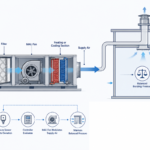
DOAS unit cost includes only the equipment, accessories and services identified in the supplier’s offer. The purchase order should differentiate the dedicated outdoor air unit from the equipment installation and from other components of the heating and cooling system. Keep that distinction visible during bid evaluation; an unpriced exclusion is a project cost that remains unaccounted for.
Public sources reviewed herein don’t define a meaningful, universal price range for a comparable commercial project. An advertised HVAC unit can show one configuration’s selling price, but it cannot settle freight, local labor or the work needed to connect it. An equipment selection and a written scope should precede reliance on an average cost for budgeting purposes. An air handler cost should also have a scope limitation when it’s with the DOAS.
What changes when a quote is equipment-only?
An equipment-only quote moves the remaining work into separate purchase orders or contractor allowances. The buyer still needs a functioning ventilation system, so excluded work must be priced once and assigned to someone. Use the reconciliation that follows to compare offers, and don’t assume that each supplier uses the same definition of “included.”
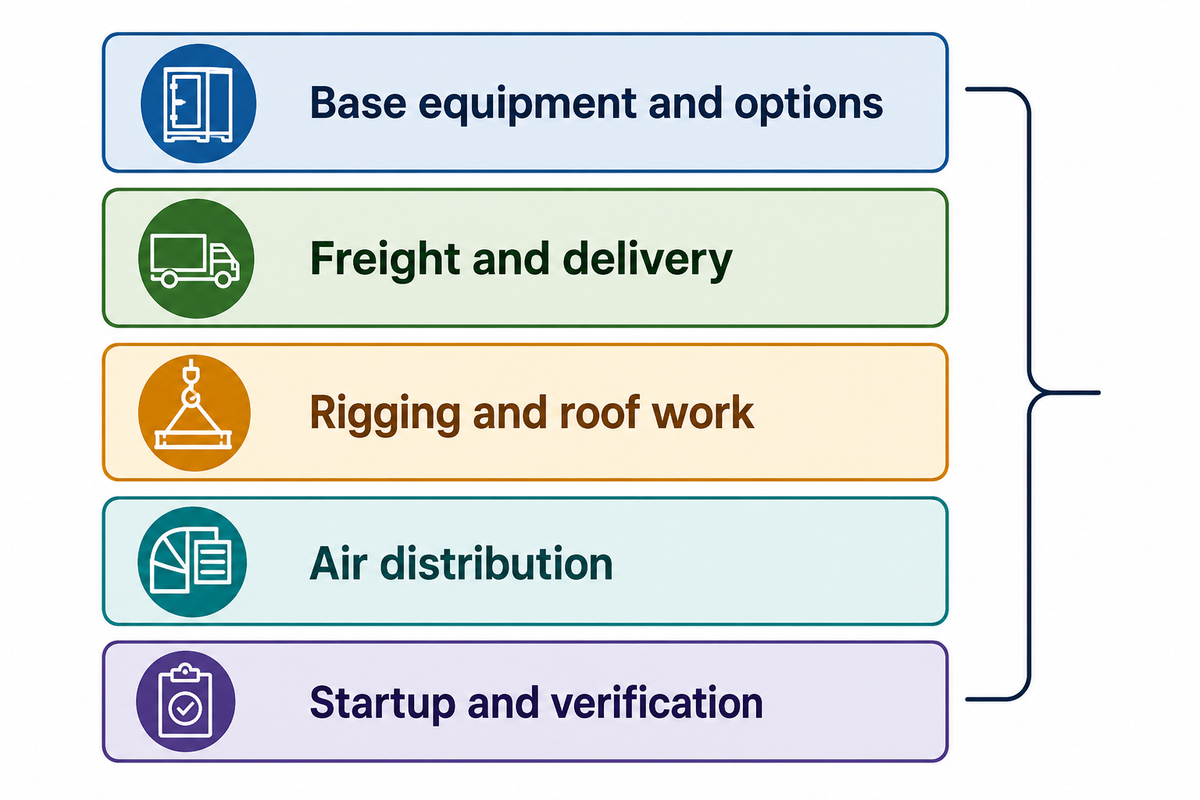
9-Line DOAS Quote Reconciliation is a purchasing worksheet for this article. Enter included, excluded or unresolved beside each line, then add the priced exclusions to each offer.
| Cost line | Evidence to request | Limitations / not suitable for comparison |
|---|---|---|
| 1. Base equipment and options | Selected model, coil, compressor, heater, recovery and controls schedule | Different design duties cannot be equalized by price alone |
| 2. Freight and delivery | Delivery destination, unloading and tax boundary | Factory-gate price excludes an undefined journey |
| 3. Rigging and roof work | Lift plan, curb, structural and weatherproofing allowances | Access and load capacity remain site-specific |
| 4. Air distribution | Ductwork, dampers, insulation and terminal connections | Existing ducts may not meet selected fan duty |
| 5. Piping and drainage | Water, fuel, refrigerant and condensate interfaces as applicable | Different heating sources change this scope |
| 6. Electrical installation | Feeder, disconnect, protection and control power | Available service must match the selected equipment |
| 7. Controls integration | Points list, gateway, programming and licenses | A communication port alone does not include integration |
| 8. Startup and verification | Startup, balancing, functional testing and training | Factory checks do not verify installed airflow |
| 9. Design and project allowances | Engineering, permits and separately identified contingency | Unknown scope should remain visible, not disappear into a total |
The total cost of the whole building includes the equipment handling zone loads. A packaged rooftop unit, hydronic terminal or other air conditioning system may remain necessary beside the DOAS. Remove either item from the budget only after confirming the system arrangement.
Which design conditions make DOAS quotes comparable?
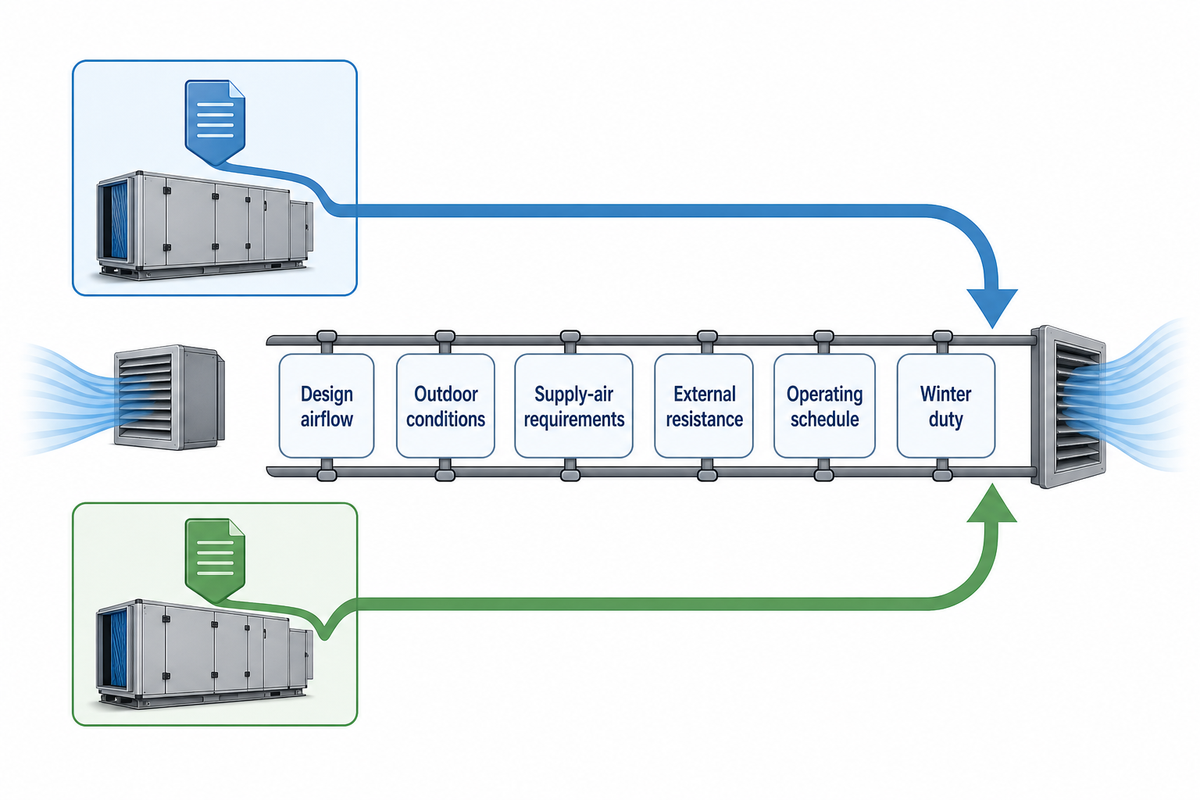
Similar DOAS quotes take into consideration the same design airflow, outdoor conditions, supply-air requirements, and external resistance. They also take into account the same operating schedule and winter duty. Include these conditions in the request for quotation, so that each supplier evaluates against the building requirement rather than a convenient catalog rating point.
The Penn State explanation of dedicated outdoor air systems separates ventilation and latent-load treatment from space sensible cooling. This distinction has financial implications. An air handling unit selected to handle recirculated indoor air doesn’t necessarily mean that it’s also selected to handle outside air. The entering-air condition and moisture duty can be different.
Why does matching tonnage still leave quotes unequal?
Matching tonnage leaves quotes unequal, because total cooling capacity doesn’t necessarily indicate how much moisture is removed or how the fan performs against the connected system. Request the actual selection at the project’s entering and leaving conditions. Also, compare the sensible and latent duties of the coil and fan power at the required air flow.
Don’t combine leaving air dew point and supply dry-bulb temperature. Hot gas reheat can raise dry-bulb temperature after dehumidification, and still not satisfy the requirement to remove moisture. A statement such as “CFM heated and cooled” should include the entering and leaving conditions. Without those, similar language in two offers can describe very different tasks.
Engineering Note: illustrative design-basis entry. A teaching example might schedule 3,000 CFM at 1.5 in. w.g. external static pressure and a field airflow acceptance band of ±5%. These are assumed project inputs, not Koven Air specifications or standard-mandated values. The engineer must supply outdoor and leaving-air conditions, define which losses are external, and approve the acceptance band. DOE’s direct-expansion DOAS page identifies a rating framework; it doesn’t turn this example into a project selection.
Hypothetical selection scenario. A purchasing team receives two offers for the same nominal cooling capacity. One selection states a design outdoor wet-bulb condition and leaving dew point; the other states only supply dry-bulb temperature. The team assumes the two offers may not be equal in dehumidification. The team asks the second supplier to rerun the selection at the common conditions, to include the scheduled external static pressure. If that changes the coil, compressor staging or fan motor, the revised equipment price becomes the comparison price. No saving has been established by the original low bid. The unresolved issue wasn’t a negotiation discount; rather, a performance boundary was missing.
For further equipment comparison, see our commercial air handling unit guide for context on commercial air handlers. Keep any comparison tied to the specified ventilation duty rather than treating all air units as interchangeable. Indoor air quality and a healthy indoor environment are project goals; neither is substantiated by equipment price or nominal capacity.
How do energy recovery and reheat change the comparison?
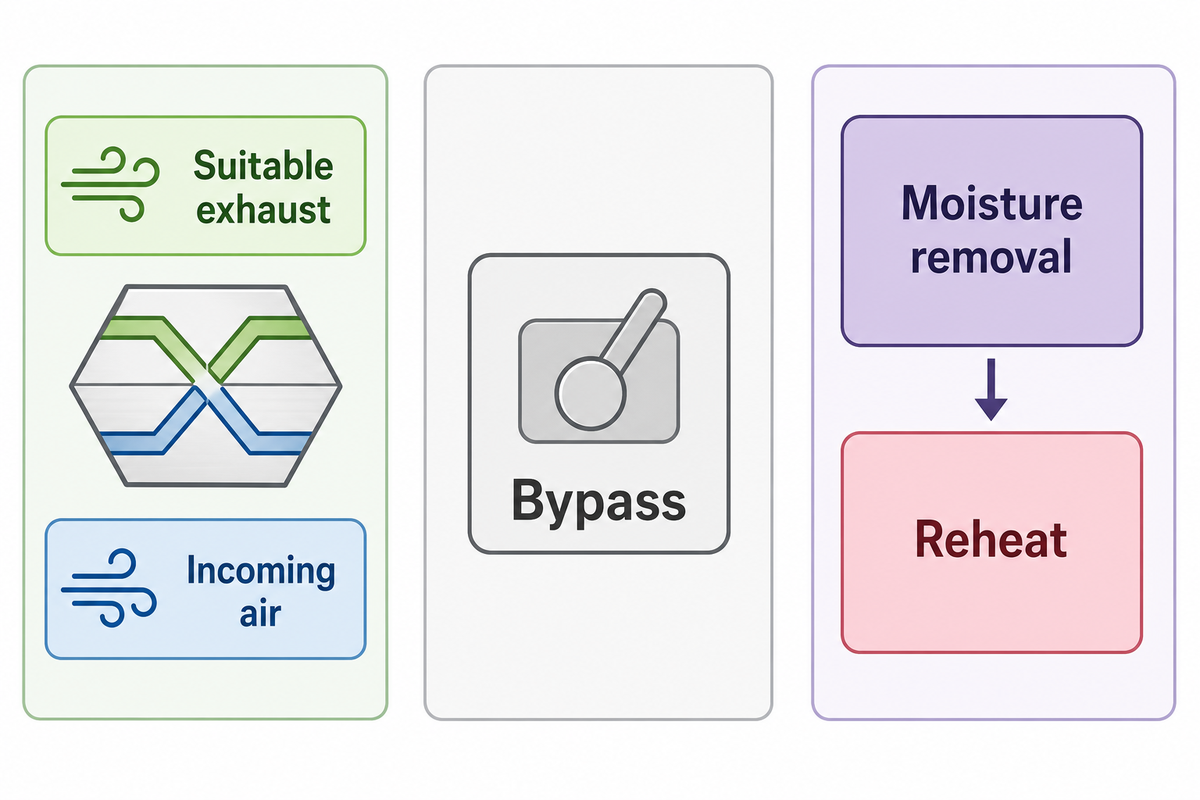
The scope and behavior of both the equipment and the system are altered by energy recovery and reheat. Energy recovery transfers energy between suitable exhaust and incoming air streams. Reheat controls supply temperature after moisture is removed. Compare complete systems including exhaust routing, fan power and maintenance access. Consider under what conditions energy recovery is bypassed or unavailable.
BetterBricks’ advanced-performance DOAS guidance describes recovery combined with decoupled ventilation and space conditioning. This is a defined system. A stand-alone energy recovery ventilator is not automatically a substitute for active dehumidification or the equipment serving room loads.
Where a DOAS system serves fan coil units or VRF terminals, include those retained costs. A ducted VRF system still needs its ventilation arrangement checked. The water plant and pumping boundary, too, are to be considered for a hydronic air handler. Comparing only fan coil unit prices to a DOAS quotation would disregard various parts of the building system.
Request separate option prices and a control sequence for recovery, bypass and reheat. An option that improves energy efficiency at one operating point can add fan resistance or service work elsewhere. The PNNL persistence-of-savings study evaluated eight buildings with specific system configurations; it is evidence for evaluating whole systems, not a savings promise for an unselected unit.
When not to buy on the equipment price alone
Don’t award an offer that leaves an essential moisture duty or exhaust arrangement unresolved. Recovery equipment needs an engineered operating sequence and an appropriate exhaust stream. Added resistance should be considered as part of the fan selection. The project team should determine if the equipment must fulfill its full duty during bypass or a recovery-device outage, or if a defined reduced operating mode is acceptable.
Controls deserve the same attention. In R. Daniel Rucker’s DOAS control guidance, outdoor airflow measurement, filter pressure and condensate monitoring are practical design concerns. Price the sensors and responses that the project requires. A lower initial offer that omits those functions is a different offer.
Also reject an assumed zero-leakage guarantee based only on “100% outside air.” Supply-air intent and leakage performance are different questions. Ask for the leakage performance of the selected arrangement and evaluate its appropriateness for the exhaust category. A low leakage claim needs a stated test basis and operating conditions, particularly where exhaust quality limits recovery options.
Which installation costs sit outside the equipment quote?
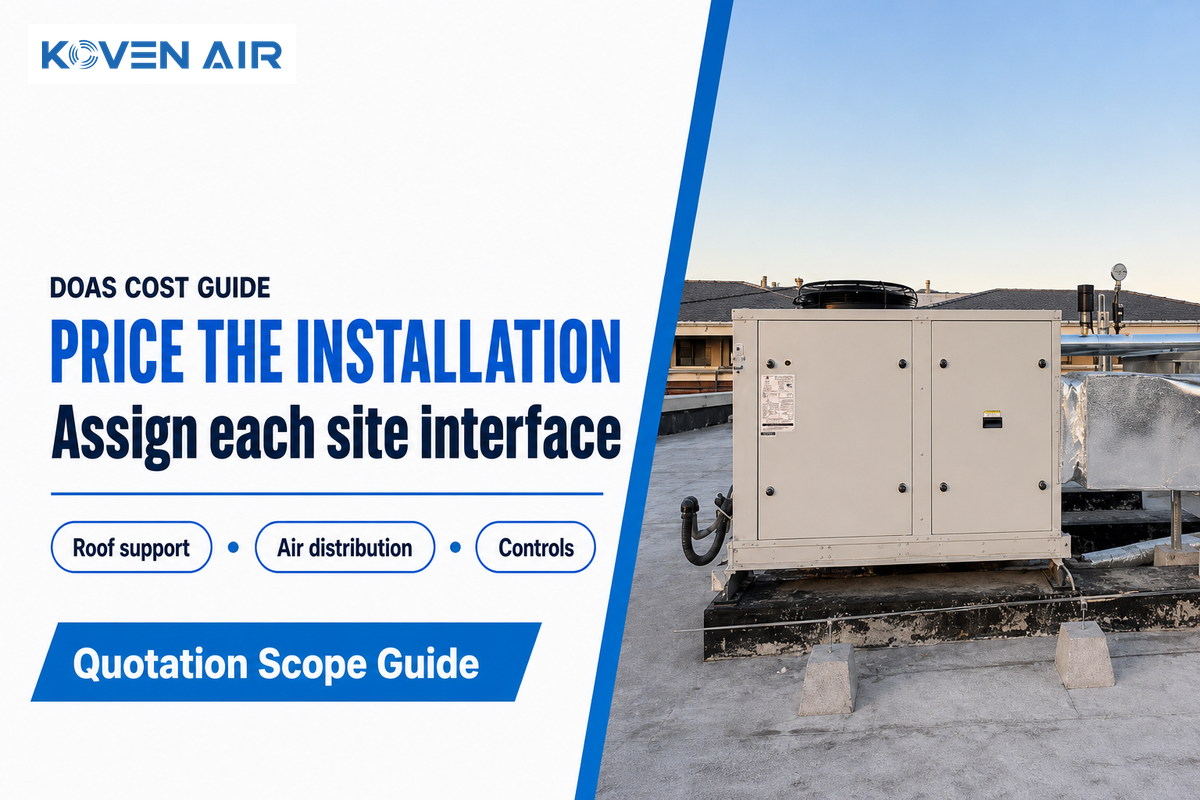
Costs for the installation of equipment may also include structural work, lifting, air distribution, utilities and site controls. The contract boundary determines what’s outside scope. Assign each interface to a named party and require a priced allowance or explicit exclusion before the owner compares installed totals.
The Duty-to-Trade Cost Map converts a design requirement to a scope owner and acceptance deliverable. In conjunction with the nine-line price worksheet, the first table reconciles money, and the second identifies the work that money must buy.
| Required duty | Constraint to check | Proposed scope owner | Evidence and acceptance | Limitations / not suitable for |
|---|---|---|---|---|
| Support equipment | Roof loading and curb geometry | Structural designer and roofing contractor | Approved loads, curb detail and roof signoff | Unverified existing roof capacity |
| Place equipment | Lift access and service clearances | Rigging contractor | Lift plan and accessible installed position | A delivery price without unloading |
| Deliver ventilation | Duct losses and damper positions | Mechanical contractor | Duct scope and measured scheduled airflow | A catalog fan point without system losses |
| Provide exhaust | Recovery routing and exhaust suitability | Mechanical designer | Air balance and approved recovery arrangement | Unavailable or unsuitable exhaust stream |
| Supply electricity | Voltage, capacity and protection | Electrical contractor | Selected electrical schedule and energization checks | Assumed spare panel capacity |
| Serve heating or cooling utilities | Water, fuel or refrigerant connection | Relevant utility trade | Connection drawings and specified tests | Unpriced changes in heating source |
| Remove condensate | Drain routing, trap and freeze exposure | Mechanical contractor | Approved drain detail and functional check | A drain connection without a discharge route |
| Coordinate controls | Points, licenses and central schedules | Controls integrator | Mapped points, alarms and trend demonstration | Protocol compatibility alone |
| Verify operation | Startup, balancing and sequence tests | Assigned startup, TAB and commissioning parties | Signed reports, deficiency closure and training | Factory testing presented as site acceptance |
Who owns controls integration and startup?
Integration of controls and start up are part of the named parties’ project scope, and may differ from the equipment supplier’s scope. Specify factory controls separately from field wiring, points mapping, graphics and functional testing. Require one coordinated sequence so an occupancy schedule or terminal fan command does not unintentionally defeat ventilation.
The DOE commissioning guidance frames verification around design and engineering documents, including operating schedules and setpoints. Employ this idea for the building automation system. A VFD, communication gateway or central air schedule has little purchasing meaning until the required operation is documented.
Illustrative integration scenario. A retrofit owner receives a factory controls offer that includes a network interface. The controls contractor has priced only a connection to the network, with no alarm mapping or trend setup. Both quotations appear complete in their own right. The owner creates a points schedule to show who programs occupied operation, proves outdoor airflow, receives filter alarms and demonstrates condensate shutdown. The revised scope shows the required programming hours and functional checks. This example does not assign a standard integration price; it shows why the air handler installation cost and the equipment quotation must be reconciled before award.
Multiple units can multiply those interfaces. Modular air handling units may solve an access constraint, but section assembly, seals and controls still need a scope owner. For rooftop planning, review the commercial rooftop unit installation context with the equipment drawings.
How should you compare five-year ownership cost?

Calculate five-year ownership costs by starting with reconciled installed costs and adding operating and service costs for that same time period. Use the same weather, occupancy and utility assumptions for both options. Other issues like the method of financing, the replacement of the system, the residual value of the system, and the uncertainties also need to be addressed in a proper investment appraisal. A short illustrative arithmetic example can’t give input for those project elements.
The DOE guide to utility rates separates energy charges, demand charges and fixed charges. Multiplying annual kWh by a flat rate estimates only a simplified energy charge. For a more detailed analysis, a site’s peak demand and time-of-use effects need to be considered. Obtain the site’s tariff and interval load data to evaluate peak demand and time-of-use effects.
Five-year cash-spend illustration: assumed inputs, not market prices
All dollar amounts below are invented teaching inputs in USD. Demand-charge differences, fixed-charge differences, fuel, taxes, financing and escalation are excluded. Replacement and residual value are assumed zero for this illustration only. The result is undiscounted and is not a full lifecycle appraisal or a supplier quotation.
| Cost item | Option A | Option B |
|---|---|---|
| Purchase price | $60,000 | $70,000 |
| Installation and commissioning | $40,000 | $25,000 |
| Reconciled initial cost | $100,000 | $95,000 |
| Annual modeled electricity | 50,000 kWh | 40,000 kWh |
| Energy charge, five years at $0.20/kWh | $50,000 | $40,000 |
| Maintenance and spares, five years | $10,000 | $15,000 |
| Downtime risk | Not monetized; assess separately | Not monetized; assess separately |
| Replacement / residual assumption | $0 / $0 | $0 / $0 |
| Modeled five-year cash spend | $160,000 | $150,000 |
Option A: $60,000 + $40,000 + 5 × [(50,000 × $0.20) + $2,000] = $160,000. Option B: $70,000 + $25,000 + 5 × [(40,000 × $0.20) + $3,000] = $150,000. The modeled difference is $10,000.
An equipment-only payback calculation would divide B’s $10,000 purchase premium by its $1,000 annual modeled operating advantage: 10 years. That calculation misses the scope reconciliation. B already starts $5,000 lower in installed cost, so there is no positive installed premium to recover in this example.
Changing only the assumed energy rate to $0.10/kWh reduces the five-year difference to $5,000. At $0.30/kWh, it becomes $15,000. The examples shown are for illustrative purposes, and depend on the assumed consumption and maintenance inputs. These do not demonstrate which unit performs better for your site.
DOE’s commercial economic methodology incorporates discounted cash flows, maintenance, and replacement costs. It also considers the residual value. For investment approval, ask the service provider to price access, filter changes and likely maintenance issues rather than treating commercial HVAC maintenance as a fixed percentage of purchase price.
What documentation should accompany a DOAS quote?
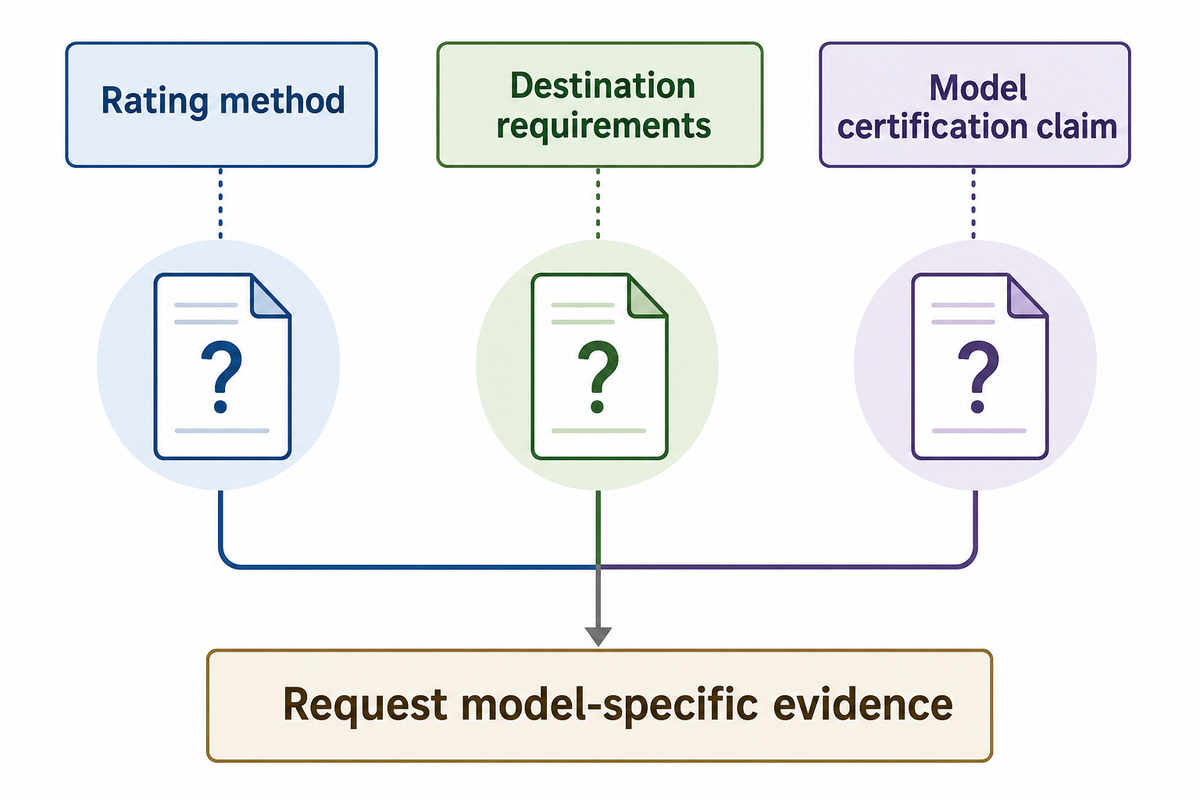
A DOAS quote should carry a selected performance schedule, dimensional drawings, electrical requirements, scope exclusions and a proposed control sequence. Certification claims should be supported with evidence specific to the model in question. The documents above allow the engineer to verify performance and the contractor to price the interface prior to the buyer’s commitment to that equipment.
Separate three questions: what rating method was used, what legal requirements apply at the destination, and what certification is claimed for this model. The AHRI 920-2026 standard notes that standards development is independent from certification activities. A reference to the standard is therefore not proof of a directory-listed product.
The new standard consolidates SI and I-P material and supersedes the 2020 editions identified in its front matter. DOE’s equipment page still references AHRI 920-2020 in its definition. Record the exact edition and applicable test basis instead of assuming that a newer industry publication automatically changes every regulatory requirement.
Illustrative document scenario. A supplier’s proposal indicates “AHRI performance” next to a cooling figure. The buyer requests the rating edition, selected model identity and evidence for any certification being claimed. The supplier then differentiates its selection output from certification listing output. The engineer can evaluate the calculation on the basis stated and purchasing can determine the documentation remaining. No certificate is inferred from the logo, the standard’s title or a similar model. If the tender indicates certification is required and evidence of certification isn’t available, the offer is incomplete with respect to the tender requirements, regardless of the equipment price.
For commercial air handlers supplied in sections, provide section weights and assembly details. A drawing dimension establishes installation space; it does not establish airflow capacity or certification. Keep these data in separate columns in the comparison table.
Integration and utility requirements before an order

Check the site utility, equipment classification and service access for the selected configuration against the requirements before placing an order. Depending on the combination selected, a heat pump, an electric heater or a fuel-fired option may present different connection and operating requirements. Larger units also need their access path and maintenance clearances checked before their apparent capacity advantage becomes a purchasing decision.
In the United States, the EPA considers factory-functional equipment as different from field-completed refrigerant systems. Ask the supplier to identify the relevant equipment classification, refrigerant, destination requirements and applicable manufacture, import or installation dates. Don’t derive these answers from a generic DOAS label. This is a quotation-document check, not a finding about a particular manufacturer’s compliance.
Provide the supplier with an occupancy schedule and turndown strategy. Precise temperature and humidity control requires an agreed sequence across the ventilation unit and room equipment. Include damper positions, fan operation, frost protection (if applicable), and the building controls response to a fault.
For projects involving commercial hoods or industrial fans, exhaust duty and makeup-air balance should be assessed separately. Adding outside air ventilation for occupants doesn’t, by itself, determine that a kitchen or process exhaust requirement is satisfied. That determination also impacts the viability of energy recovery and the cost of the connected air system.
A request to replace an air handler should provide details of the existing unit (i.e. connections and measured operating conditions). Generic air handler replacement cost estimates cannot establish the scope of a dedicated ventilation retrofit. When estimating cost to replace an air handling unit, check what’s retained and compare a new AHU, modular arrangement, or integrated DOAS offer.
Frequently Asked Questions
Is a DOAS unit 100% outside air?
How outdoor-air duty differs from leakage performance
A DOAS normally conditions an outdoor-air stream to meet the ventilation duty, while other equipment can handle room recirculation and sensible loads. An exhaust path for recovery doesn’t automatically mean return air is intentionally mixed into the supply. Check the selected arrangement and leakage performance; the outdoor-air description alone isn’t a zero-contamination guarantee.
Do DOAS units cool?
Cooling and moisture removal are separate selection checks
DOAS units can cool and dehumidify incoming air, depending on their configuration. The selected cooling duty must match outdoor conditions and the required supply state. Cooling ventilation air doesn’t automatically cover every room’s sensible load. Keep the zone equipment in the system comparison unless the design explicitly assigns that load to the DOAS and verifies its capacity.
Do DOAS units have return air?
Distinguish exhaust recovery from recirculation
Some DOAS arrangements include an exhaust-air path for energy recovery, but that’s different from intentionally recirculating room air into the supply. Other systems use separate exhaust equipment. Read the airflow diagram and control sequence for the selected model. The terms return air, relief air and exhaust air should identify their actual routes before equipment scope and duct costs are compared.
Does an ERV replace a DOAS?
Check the duty that remains
An energy recovery ventilator transfers energy between airstreams. It doesn’t automatically supply the active moisture removal or heating and cooling duty required from a DOAS. Compare complete selections at the same project conditions.
What should I send to request a project-specific DOAS price?
Send the design basis and the quotation boundary together
Send the project location, scheduled CFM, outdoor design conditions, leaving-air requirements, external static pressure, available electricity and preferred heating source. Include the operating schedule, recovery arrangement, controls interface, delivery location and installation boundary. State which startup and acceptance services must be included. Attach drawings showing access and connections when available. Identify any required model certification separately from performance selection. If an input is provisional, mark it as provisional so the supplier can explain how a change would affect the offer.
Request a comparable commercial quotation. Send the same design basis and nine-line scope sheet when asking Koven Air about its dedicated outdoor air unit options. Ask for the selected duty, included accessories, exclusions and required site interfaces in writing. Keep unresolved costs visible until the responsible supplier or contractor has priced them.
About this quotation guide
This purchasing guide is published by Koven Air, a commercial HVAC equipment supplier. The DOAS cost worksheets are editorial comparison methods. The scenarios and dollar figures are hypothetical; they aren’t customer installations, current quotations or guaranteed energy savings. Project selection, scope reconciliation and acceptance requirements belong to the responsible design team.
References & Sources
- Dedicated Outdoor Air Systems, Penn State engineering resource.
- Direct Expansion Dedicated Outdoor Air Systems, U.S. Department of Energy.
- Advanced-performance DOAS, BetterBricks / NEEA.
- Very High Efficiency DOAS Field Evaluation: Persistence of Savings, Pacific Northwest National Laboratory.
- Understand how to maximize efficiency and control with DOAS, R. Daniel Rucker, Consulting-Specifying Engineer.
- HVAC Commissioning, U.S. Department of Energy.
- Evaluating Your Utility Rate Options, Federal Energy Management Program.
- Energy and Economic Analysis Methodology, U.S. Department of Energy.
- AHRI Standard 920-2026, Air-Conditioning, Heating, and Refrigeration Institute.
- Frequent Questions on the HFC Phasedown: Products and Systems, U.S. Environmental Protection Agency.