ISO_CERTIFIED_MANUFACTURER

Rotary Desiccant Dehumidifier

Rotary Desiccant Dehumidifiers, Industrial Desiccant Wheel Systems for Low-Dew-Point Control

Silica-gel and molecular-sieve wheel systems engineered for dry-air targets refrigerant units can’t hold – with a published regeneration-temperature selection matrix, tiered control accuracy, and a real −50°C dew-point project behind them.

A rotary desiccant dehumidifier removes moisture that mechanical cooling physically can’t reach. Once a room needs to sit below roughly 40% relative humidity – or a process demands a dew point under 5C – a refrigerant coil stops being the answer and a desiccant wheel become the only practical path. This page is written for the engineer specifying the unit, the buyer comparing suppliers, and the plant manager signing off on the energy bill. It gives you the selection logic first and the sales language never.

Request a Quote (RFQ)

+5 to <−60°C

Process dew-point range by wheel & system

±0.5°C

Tightest regeneration-temp control grade

3 wheel media

Silica gel / super silica / molecular-sieve composite

35

Export markets served since 2007

20,000 m²

Manufacturing & test-lab floor area

−50°C

Verified dew-point project on record

Why Refrigerant Dehumidifiers Fail Below 40% RH, and How the Desiccant Wheel Solves It

Facilities keep buying bigger refrigerant dehumidifiers to fix a low-humidity problem, and they keep failing. The reason is physical, not a sizing mistake. A refrigerant unit dry air by cooling it below its dew point so water condenses on a coil. To reach a 20% RH room condition you would have to drive that coil below freezing – and the moment it does, the condensate turn to frost, the coil blinds over with ice, and moisture-removal collapses [Pain & Root Cause]. This is exactly why one industry engineering reference notes that desiccant wheels are typically used only “when the required process-air dew point can’t be achieved” by cooling alone.

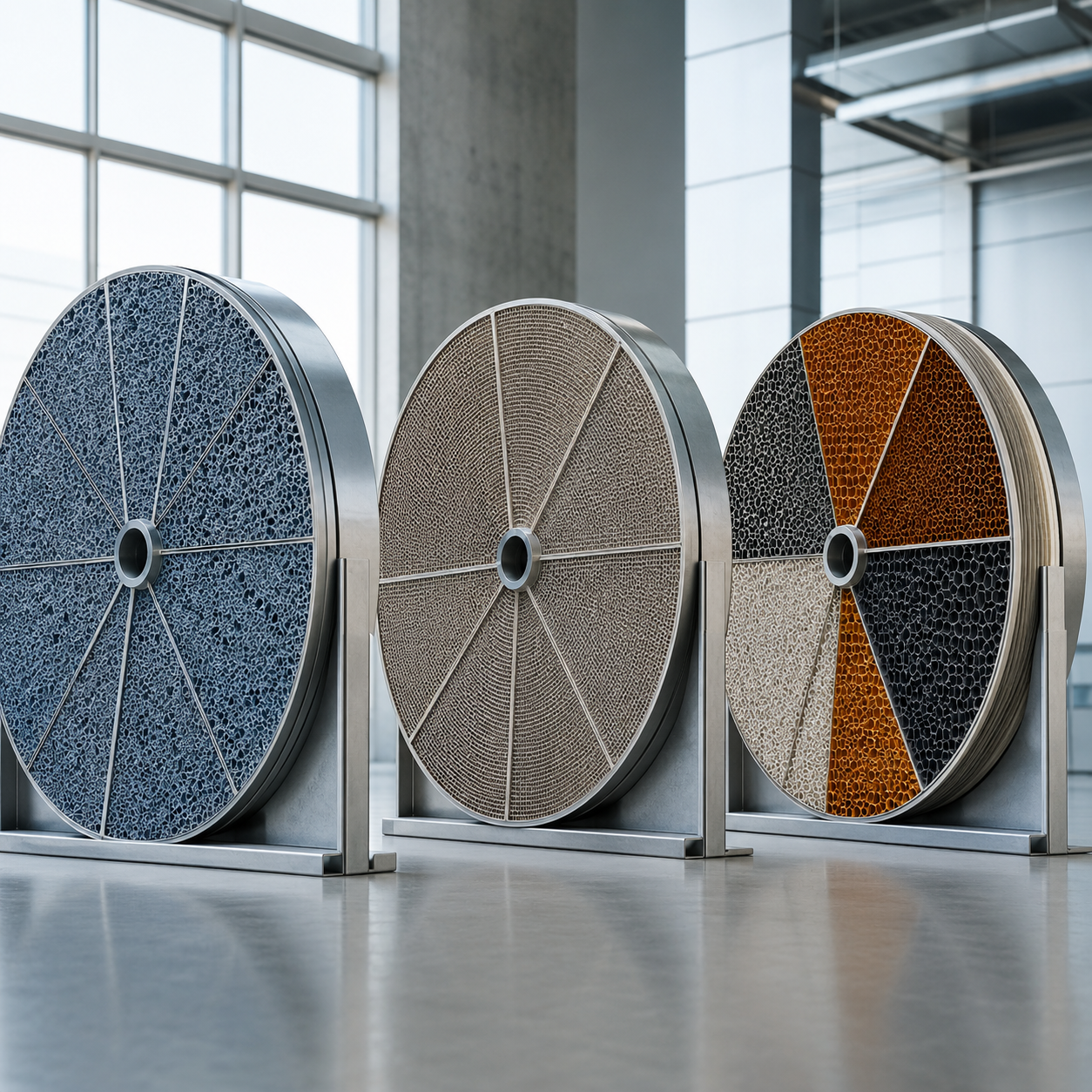
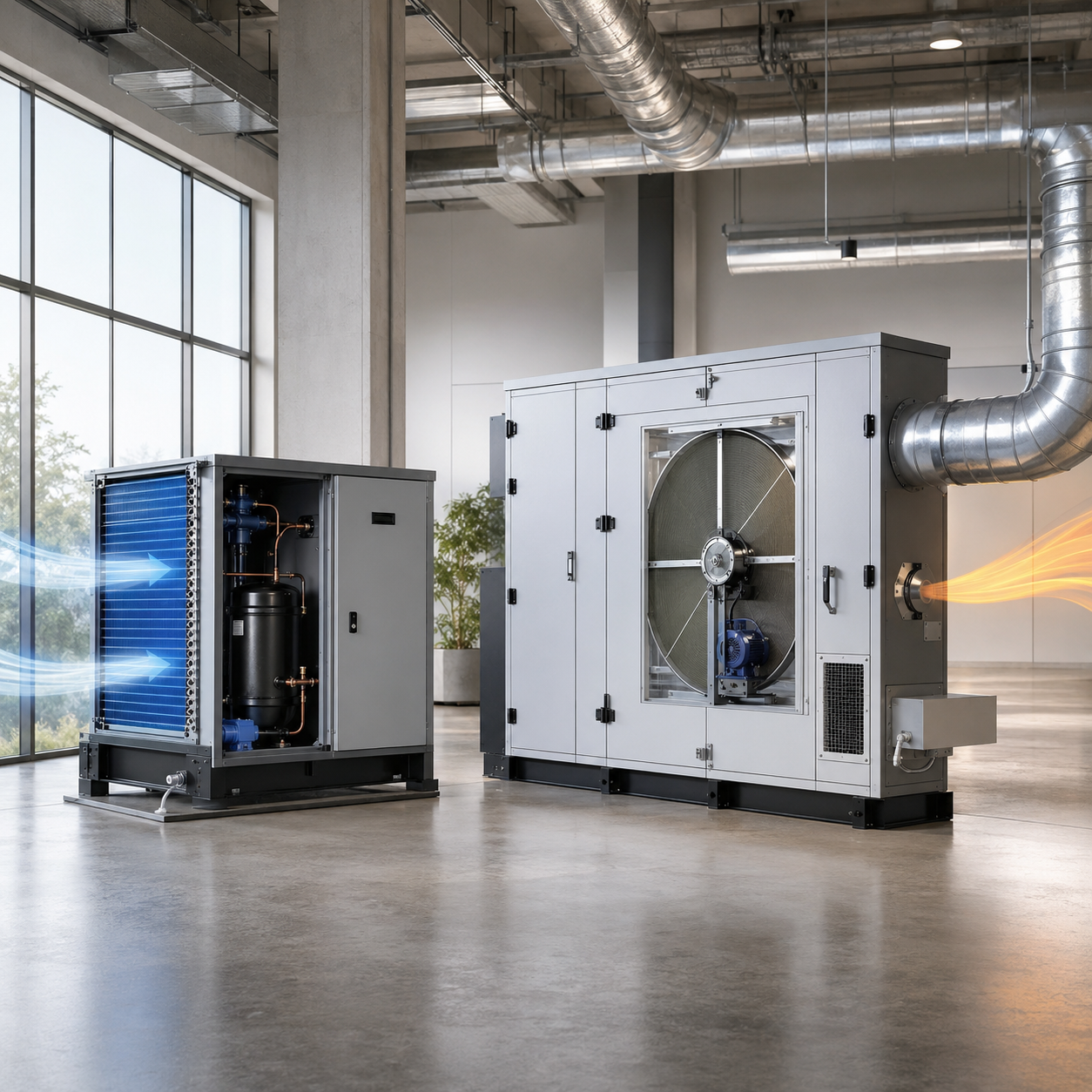
A desiccant wheel take a different route. Instead of chilling air, it passes it through a honeycomb desiccant rotor coated with an adsorbent that pull water vapor straight out of the airstream by adsorption – no condensation, no freezing threshold. A separate slice of the wheel is continuously reactivated by hot air, driving the captured moisture off so the media return dry. Because the mechanism doesn’t depend on a cold surface, a desiccant dehumidifier keep working at 5C, at 0C, and in the deep-dry conditions a compressor simply can’t enter. Real buyers learn this the hard way; the recurring forum verdict is blunt – “refrigerant dehumidifiers don’t work well at low temperatures.”

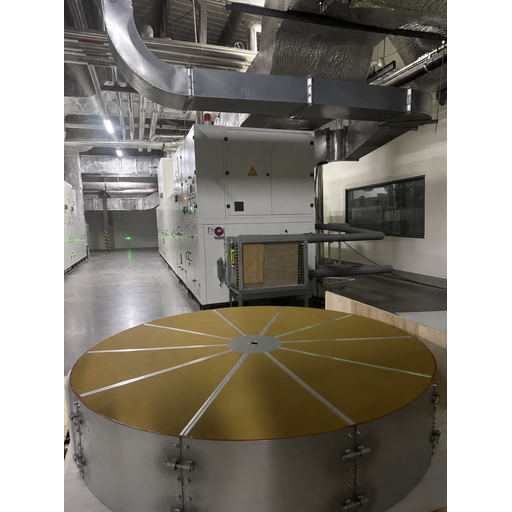
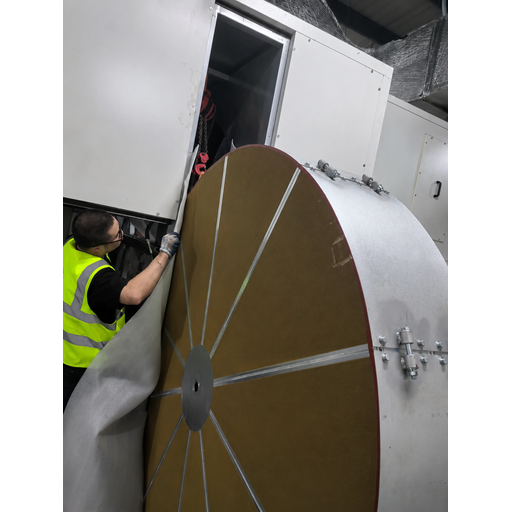
Rotary Desiccant Dehumidifier Equipment

One honest caveat most vendors skip: adsorption releases heat. As the wheel captures moisture it gives back the latent heat of sorption, so the supply air leaves warmer than it entered – deep-drying air from 21C and 50% RH can lift it toward 49C. That isn’t a defect; it’s the reason serious low-dew-point systems pair the wheel with downstream cooling, and it’s the kind of trade-off our engineers raise before you buy, not after. From here the real work is choosing the right wheel – which starts with the desiccant itself.

Frankly, the reality is that if RH is below 40% a refrigerant unit isn’t suited for the job and, unlike a compressor, it will frost over and stop working at −20°C. A desiccant dehumidification wheel can take the drying down to areas that the physics of refrigerants can’t handle — the compromise is that adsorption does raise the temperature of the supply air; this is why the Koven Air engineers consider pre and post cooling into the same calculation that accurately determines your application and individual room requirements. Unattended standing moisture increases repair costs by roughly 20 percent through the effects of corrosion and mold; let’s run your specific load for a warehouse dehumidifier or cold-storage anteroom by submitting for a quote.

Reference: NIST — humidity and dew-point metrology

Choosing the Right Desiccant: Silica Gel vs Molecular Sieve vs Composite Wheels

By far the largest determinant of how low a dewpoint you can achieve is what’s on the wheel-not what’s on the cabinet. Various desiccant materials sorb water with very different curves at low humidity, and this curve dictates everything downstream. At 25°C and 20% RH, for instance, printed sorption data suggest that silica gel is ~15% by mass water, molecular sieve is ~20%, and lithium chloride ~35%. But it all turns on edge at deep-dry condition, where the very narrow and tightly defined pore structure of a molecular sieve can continue adsorbing water after a silica gel wheel has pretty much done all it’s going to do.

This we organized into a workable selection system – we call it the Koven Desiccant Wheel Selection System – centered on 3 families of wheel versus one size rotor. We developed it into an engineering selection aid based on our build experience and adsorbent behavior, not to claim invention of the chemistry.

Choosing the Right Desiccant: Silica Gel vs Molecular Sieve vs Composite Wheels
Wheel family Composition & character Best-fit duty Cleaning / limits
HTS — high-efficiency silica gel General-purpose silica-gel rotor, ~82% active-silica loading (an industry-typical figure) Comfort AC, general industrial 30–50% RH, seed & electronics storage, coated glass Neutral-to-acidic air; weak-alkaline detergent cleaning
HTX — super silica gel Enhanced silica rotor with antimicrobial treatment Pharmaceutical & food processing where hygiene matters Exposure kept below 95% RH; weak non-alkaline detergent
HTM — molecular-sieve composite Composite of molecular sieve (~37%) + active silica gel (~45%) Deep dehumidification: lithium-battery dry rooms, high-temp process air Alkaline-tolerant; built for the lowest dew points

Why Composite Not Just Molecular Sieve?

A composite wheel is the answer because you combine the high frontal silica-gel-performance with the deep molecular-sieve-adsorption. And that’s no marketing hype, a 2025 review of rotary desiccant wheels stated a Silica+LiCl+ Molecular Sieve-5A compound had an adsorption capacity 85.5% greater than a silica-only wheel and 14% better regeneration. This composite-wheel-concept also apply to the molecular sieve addition for deep-dehumidification with our HTM-wheels. Once you decide on the wheel type, you now determine your required operating-regeneration-temperature, the subject of our next topic.

A desiccant choice gone wrong: −45°C asked of a silica gel wheel; a molecular sieve wheel at 30% RH, wastes regeneration air. The correct choice: one based on target application. For this reason, Koven Air engineers fit the appropriate HTS, HTX or HTM by application instead of the ‘one-rotor’ standard you’ll find on many competitors’ specs sheets. Carrying an 85%-higher adsorptive value in the field, the composite media has the necessary accuracy for deep-dry and pharmaceutical systems.

Reference: USPTO US20240019135A1 — multi-sector desiccant wheel media

Regeneration Temperature & Achievable Dew Point, The Selection Matrix

Each desiccant wheel is a two-part machine. An arc on the wheel picks up moisture out of your process air. A second arc on the wheel is “reactivated” with hot air which boils off water removed by the first arc. This temperature of that hot air (called “reactivation temperature”) is the lever that determines how dry the wheel can get and how much it costs to operate. A hotter reactivation temperature dries the media deeper so it can pull the next pass of process air down to a lower dew point. The effect is shown independently, as one patent on honeycomb desiccants “states the media will generally be regenerated with a stream of air heated to 60 C to 200 C as the application may dictate…”

Our selection guide is as follows. treat it as a typical working range rather than a firm commitment, actual dew point achieved is a function of the system – medium, air flow, wheel depth, revolution speed, pre-cooling and single or multi pass operation – and not just regeneration temp.
Wheel Media & Mode

Silica gel — standard

Typical Duty / Condition
Comfort AC / general industrial, 30–50% RH
Regeneration Air Temp
50–90°C (usually 60–80)
Typical Dew Point
+5 to −20°C
Wheel Media & Mode

Silica gel — deep / high-temp regen

Typical Duty / Condition
Low-humidity storage, electronics, printing
Regeneration Air Temp
100–140°C
Typical Dew Point
−20 to −40°C
Wheel Media & Mode

Molecular sieve / zeolite

Typical Duty / Condition
Pharma, Li-battery dry room, optical coating (≤20% RH)
Regeneration Air Temp
120–180°C (usually 140–160)
Typical Dew Point
−40 to −60°C
Wheel Media & Mode

Silica-gel + molecular-sieve

Typical Duty / Condition
Ultra-low dew point, high-humidity, manufacturing
Regeneration Air Temp
110–160°C (formula-dependent)
Typical Dew Point
below −60°C in multi-stage

There are two points which help make this honest. First, deep dew points are a feature of the media and the system: laboratory single-pass prototypes routinely reach much less deep numbers than these at equivalent temperature in the literature, so the −40 to −60°C bands represent what can be achieved with a properly constructed molecular sieve or composite system, and the lithium battery industry really goes down to −70°C, step-by-step, through the process. Second, running cost is largely dominated by regeneration – in industrial accounting, about 39% of the energy consumption and 44% of the operating cost of a desiccant dehumidifier comes from the heating for thermal regeneration. That’s why what looks like a big heater isn’t the smartest investment; it’s what’s described as ‘right-sized’ regeneration in the ‘How to buy’ section.

“When a client hands us a dew-point target, the first thing we push back on is whether they need it everywhere or only at one process step. Matching the wheel media and regeneration temperature to the real requirement, instead of over-specifying to the deepest number in the room, is usually where we take 20 to 30 percent off their running cost before the unit is ever built.”

Senior Application Engineer, Koven Air Engineering Team

What buyers fail to appreciate is the cost penalty of chasing the deepest dew-point setting across the board. Given the 40% operating-cost element of regeneration, a fully over-specified 180C setting needlessly wastes both energy during manufacturing and operation. The smart money is in the form of “matched regeneration,” and Koven Air’s “real-target” (not worst-room-figure) heater design delivers just that. Our “right-sized,” high-efficiency desiccant dehumidifiers can sharply reduce your running costs and thanks to a two-stage, waste-heat recovery system – unlike catalog-default models – provide the certification-ready dry spaces to house our product matrix.

Reference: USPTO US20160199778A1 — desiccant regeneration 60–200 °C

Regeneration-Temperature Control Precision, and Why It Drives Dew-Point Stability

A wheel which gets to −40°C on a good day is useless for a battery line if every time the reactivation heater comes back on, the temperature floats down to −30°C. It’s stability, not optimum, that the process bought on your pharmaceutical or lithium battery – the reactivation-temperature control loop is one of the key tools you bought to maintain that stability. Just keep the reactivation air constant and the wheel desorbs consistently, run after run. We’ve 3 control grades.

Sensing here is proven metrology rather than proprietary wizardry: PT100 resistance thermometers to IEC 60751 are supplied in the very tight accuracy classes needed to do sub-degree measurement, and an SCR power controller fine- tunes the heater rather than simply on/off switching a contactor.

Control Grade Regen-Temp Accuracy Control Configuration Where It Fits
General industrial / comfort ±3 to 5°C On/off temperature control + electric or steam heating Warehousing, general AC, cold storage
Precision low dew point ±1 to 2°C PID + PT100 sensing + stabilized airflow Li-battery, pharma, optical
Ultra-high precision / research ±0.5 to 1°C High-precision PID with SCR power modulation + multi-point temperature measurement Research, metrology, critical dry rooms

But we are quite careful how we say this. Control of the regeneration temperature with that accuracy is essential if the dew-point is to be stable, but it’s not on its own adequate. We know from published work across several journals that airflow through the rotor, wheel rotation speed and even the buffer-ability of the rotor itself will affect the outlet performance – if we are dealing with brief periods of heat input the rotor’s stored energy can completely determine the outlet. So we are quite happy to call close control of temperature – alongside close control of airflow and wheel speed – one leg of stable dew-point: all three components are sized to be mutually reinforcing.

A drifting control loop is a subtle menace; if the regeneration temperature is unstable, the dew point will move and your battery line could be out of spec (±3°C humidity) on a ±1°C requirement. It is the reason why Koven Air engineers have combined high precision PID and SCR control with production class PT100 sensing, as unlike an on-off contactor, the ability to provide modulate power maintains setpoint within ± 0.5°C for an ISO grade dry room and high end applications. But the truth remains, control is only one part of the equation alongside air-flow and rotor speed.

Reference: NIST — temperature-sensor metrology (PT100 traceability)

The Koven Rotary Desiccant Dehumidifier Range, Configuration & Selection

There’s no such thing as a “best” desiccant dehumidifier, only the best one for your moisture load, your required dewpoint and your application. Instead of trying to sell you some thing from a list, we engineer from across capacity ranges, pairing the best desiccant wheel, heater style and control grade for the application. Work your way through the decision matrix to identify your case, then send us the room and load details for a specific quotation.

Capacity class Typical process airflow* Wheel media Regen heat source Best-fit application
Compact ~300–1,000 m³/h HTS silica gel Electric Labs, small storerooms, equipment enclosures
Mid — general ~1,000–5,000 m³/h HTS / HTX Electric or steam Workshops, packaging halls, seed & grain
Mid — precision ~1,000–5,000 m³/h HTM composite Electric + PID/PT100 Pharma rooms, optical, electronics
High-capacity ~5,000–20,000 m³/h HTS / HTM Steam / gas / electric Warehouses, cold-storage anterooms, arenas
Dry-room system Engineered to load HTM composite, multi-stage Staged + SCR control Lithium-battery dry rooms (≤−40°C dp)
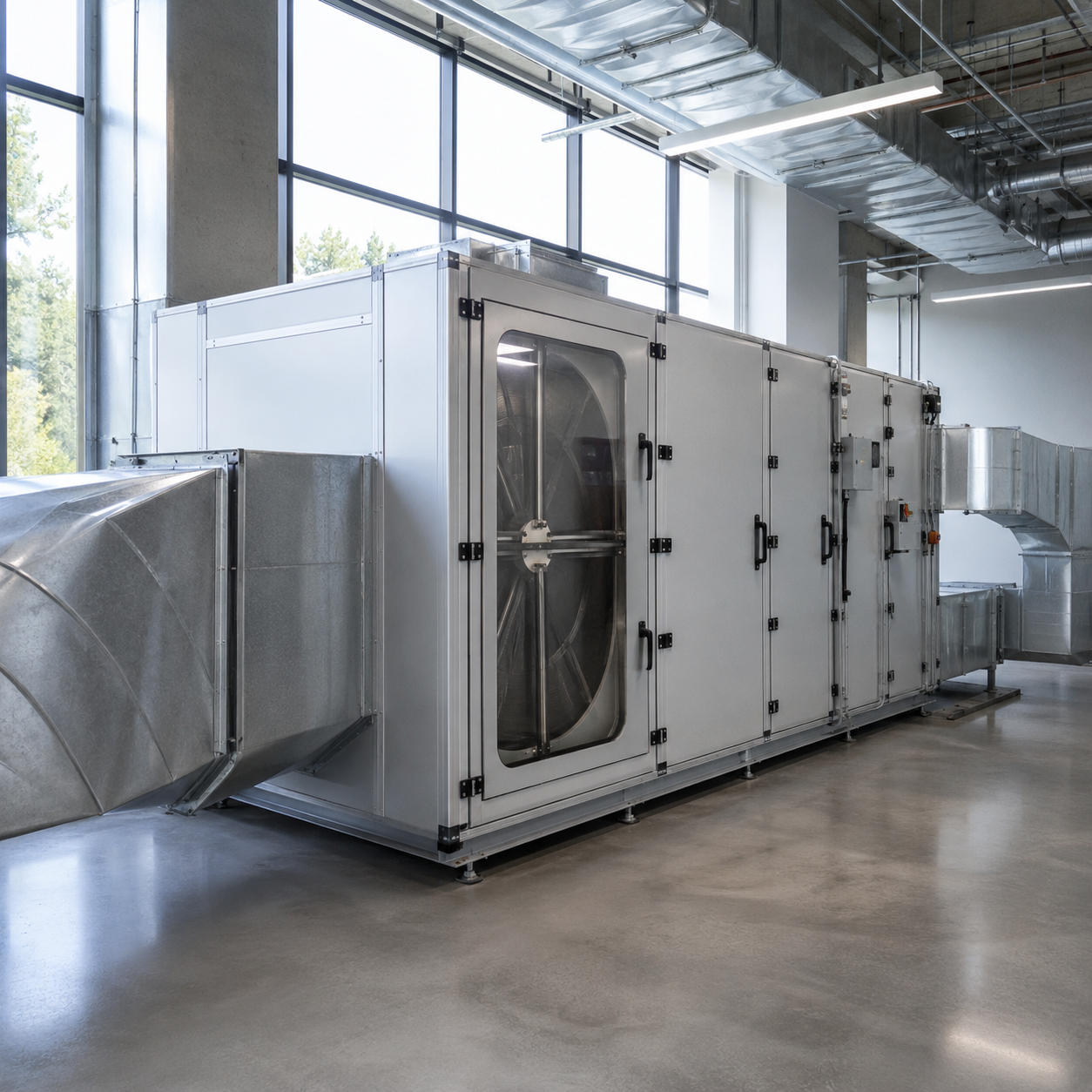
Custom AHU-integrated Engineered to load Application-selected Integrated with pre/post coils Turnkey process-air handling
Koven Rotary Desiccant Dehumidifier Range Configuration & Selection
Precision Sizing

-Airflow class -These are common industry classes that designate orientation (spanning roughly 175 – 11,800 CFM on this series of units). Instead, we engineer and size each unit to your measured load and desired dew point.

Before you request a size

We need three numbers: room volume (or process air flow rate); environmental conditions in the worst case scenario; ambient condition; and dew point/RH required. Our sales engineers use this to calculate moisture load, confirm our dew-point sizing check, then issue a price. This service is offered freely as part of our quotation service on this web site, as outlined above.

An expensive mistake here’s buying by cabinet size not duty; an oversized unit wastes capital and energy, under size lets the room down at −40°C. Koven Air engineers configure the desiccant rotor, media and control grade to your measured load, not a fixed model. The right call is therefore to send parameters, not pick part number. Instead of opaque catalogs our production units are matched to application across 35 countries by precision sizing.

Reference: USPTO US20240019135A1 — multi-sector wheel configuration

Desiccant vs Refrigerant Dehumidification, When Each Wins

Between these technologies it’s not about what’s best – but where you’re on the RH scale. Refrigerant units excel on warm, damp air, and are correct for comfort. Desiccant wheels own the low end – where refrigerant physical can’t operate. The honest engineer’s answer is a crossover point, which is represented in these numbers not just a High / Medium / Low call out.

Desiccant vs Refrigerant Dehumidification
Factor Refrigerant (compressor) dehumidifier Rotary desiccant dehumidifier
Practical low limit Struggles below ~15°C air; ices up chasing low RH Works to 0°C and below; no freezing threshold
Achievable dew point Typically down to ~5–10°C dp +5°C to below −60°C by media & system
Best humidity band Warm air, >50% RH, comfort range Low humidity, <40% RH, deep-dry process
Energy profile Efficient in warm/humid air Regeneration heat is the main cost; right-size it
Effect on supply air Cools and dries Warms air (heat of sorption); often paired with cooling
Maintenance character Compressor is the wear item Few moving parts; wheel service life 15–30 years with clean inlet air
Right call when Comfort AC, pool halls, warm basements Dry rooms, cold storage, pharma, electronics, winter operation

And here the real purchasing decision regarding reliability enters the process. No major established manufacturer is immune from actual field failures – desiccant user accounts on the pro-HVAC boards describe ‘burnt wires, blown motor fuses or trips on low re-heat faults on some units. However, a desiccant wheel has few moving parts. The main reason desiccant wheels out-last their expected 20+ year service life is simply clean air through the intake with good pre-filtering.

Assuming that one dehumifier is adequate for any space is wrong and costly – choose refrigerant for a −30°C dry room and you’ll fail it when the relative humidity rises above 30%.The correct split between these technologies lies at the crossover point, because refrigerant gains advantages above 50% RH while desiccant or other adsorption dehumidifiers dominate below 40%RH. Koven Air engineers specification based on application, not standard. Rather than a one line brochure our production units are sized specifically for a dry room or low temp dehumidifier and built to the standards of the market to which it will be exported.

Reference: U.S. Department of Energy — dehumidification technologies

Where They Deliver, Li-Battery Dry Rooms, Pharma, Warehousing & Cold Storage

It’s easy to see the value of a rotary desiccant dehumidifier when you consider rooms that simply can’t function without one. Since 2007 Koven Air units have been operating in more than 35 export markets – including lithium battery plants, pharma clean rooms, chip fabs, seed & grain silos, cold storage entryways, gymnasiums, libraries and data centres. What determines the spec is the target dew-point, not the industry designation.

Application
Why Moisture Is The Enemy
Typical Target
Wheel Fit
Lithium-battery dry room
Lithium reacts with airborne moisture, cutting cell life & safety
Dew point −40 to −70°C by process step; often <1% RH
HTM composite, multi-stage
Pharmaceutical & GMP
Hygroscopic actives cake; tablet & capsule quality drifts
~10% RH, ±2% RH; dp near −11°C at 21°C
HTX / HTM
Semiconductor & electronics
Photoresist and boards take up microscopic moisture → defects
Low, tightly held RH
HTM composite
Optical & coating
Coating adhesion fails above threshold humidity
≤20% RH
Molecular sieve / HTM
Warehousing & packaging
Caking, clumping, corrosion of stored goods
35–50% RH
HTS silica gel
Cold storage anterooms
Frost and fog on cases and floors near refrigeration
Low dp to stop condensation
HTS / HTM
Seed, grain & food
Mold, germination loss, spoilage
Controlled low RH
HTS silica gel
Archives, libraries, museums
Corrosion of contacts, mold on paper
~35% RH
HTS silica gel
Data centers & equipment
Condensation and corrosion on electronics
Stable moderate RH
HTS silica gel

A Real −50°C Dew-Point Project

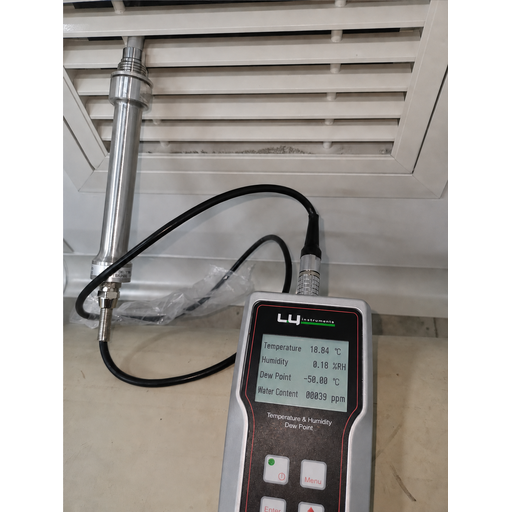
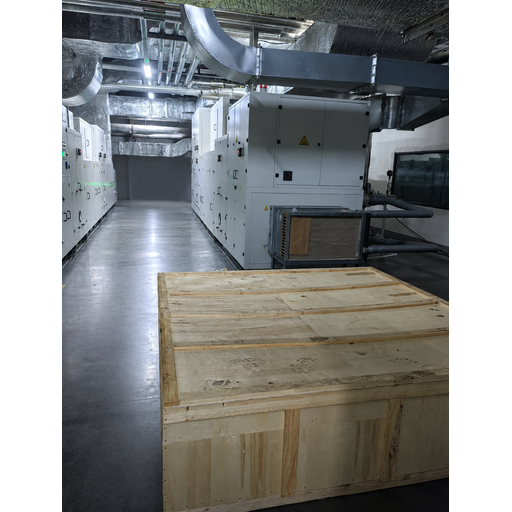
None of the deeper of those targets are aspirational for us. We’ve got an existing −50°C dew point in operation on a documented lithium battery-class project from Koven, recorded across four site photographs in our engineering file. We mention it here not to hold it up as a brochure award, but rather as an accurate statement of what we’ve seen in the field at that dew point – a multi-stage composite molecular-sieve wheel set, configured with the same degree of control and reheat as was dictated by the process. If you need your target deeper than −50°C, we’ll tell you what it takes and if that requires a multi-stage configuration.

~40%
of a desiccant system’s operating cost is thermal regeneration — the single largest lever on total cost of ownership, and the one right-sizing controls.
Industry analysis, desiccant dehumidifier market study. TCO framing, not a Koven-specific guarantee.

Engineering & Quality, Inside Koven Air’s Factory

Is a dry room dehumidifier built overseas going to stand up, or will quality and support go with the ship? It’s your production plant, not a slogan. Koven Air is a manufacturer with a 20,000m2 facility dedicated to engineering, manufacturing, testing and production, comprised of 18 standardized processes, 23 CNC precision sheet-metal machinery stations, 36 in-process quality control points, 24-hour load-testing, and a state-of-the-art chiller and heat-pump testing facility. All are essential elements for ensuring a wheel-drive, heating element array and control loop are operating in specification long after the equipment has been removed from the container.

36 inspections

in-process factory checks per unit

24 h aging

full-load burn-in before ship

Test lab

chiller & heat-pump verification

18 processes

standardized production line

Since 2007

35 export markets
“Every unit gets a 24-hour aging run at load before it ships, we would rather a heater relay or a wheel-drive bearing fail on our floor than in a customer’s dry room three months later. That test has caught problems a visual inspection never would.”
Quality Control Team, Koven Air
Certification is another matter that we approach with transparent honesty. We won’t overwhelm you with an unprovable list of marks; instead, we build our equipment to the standards for each of your target markets – UL/NRTL for North America and CE for the European Union. Our engineering team will verify the exact listings you need when they begin the specification process with you. That open, transparent approach also extends to the entire process of how you source and obtain our dry room equipment.
What really kills overseas sourcing isn’t the price – it’s a unit that work in the showroom and then fails the process six months later. With a documented aging test and 36 inspections in 35 countries before our product ships, the honest difference-maker is verification, not a catchy slogan, whereas many suppliers will sacrifice burn-in just to cut cost. With our precision manufacturing and per-market certification, the factory eats the application risk, not you.
Reference: NIST — measurement traceability and quality

Specifying & Buying: Sizing, Lead Time, Pricing Factors & After-Sales

Buying a desiccant unit abroad brings far greater fears than the price sticker alone—the un-bid ancillary heating and cooling units, the looming production schedule slips, the disappearing support post-payment. We address these fears by explicitly defining what’s really in the price and the post-purchase product—and what’s not—rather than a quoted price that can only serve as a vague benchmark without your operational details.

What Support Coverage Includes

Design phase supported by precise parameter validation and thorough moisture load analysis.

Every unit rigorously tested before shipping, complemented by full on-site installation, commissioning, and fine-tuning support.

Continuous lifetime technical consultation, expedited in-warranty support, and routine professional development for your service technicians and plant engineers.

Request Cost Estimate

What drives the price of a rotary desiccant dehumidifier

Target Dew Point

Deeper dew points need molecular-sieve/composite media and higher regen energy — the biggest single factor.

Process Airflow & Capacity

Larger m³/h means a bigger wheel, heater and fan package.

Control Grade

±0.5°C SCR/multi-point control costs more than ±3–5°C on/off.

Regen Heat Source

Electric vs steam vs gas, and whether waste heat is available on site.

System Integration

Pre-cooling, post-cooling and AHU integration add modules.

Certification & Destination

Market-specific listing and documentation requirements.

Regeneration is the lever that controls energy cost, but the discipline of effective use of that lever require a correct product size. Industry case studies demonstrate that accurately sizing a desiccant selection can reduce energy consumption by approximately 30%; moreover, a two-stage regeneration—removing the bulk of the moisture via low-grade or waste heat followed by a minor high-temperature finish that sharply reduce total energy consumption. This is the reason why pre-sales calculation of your moisture load informs our sizing of the heater.

What truly catches buyers by surprise is the un-quoted accessory equipment—a supplemental heater or post-cooler—that dramatically escalates the total cost of a low-priced desiccant wheel into a costly overage on top of the regeneration cost, which can comprise nearly 40% of overall operating expenses. Because our application engineers clearly communicate all factors that determine actual cost up front, our honest price quote accurately reflects your process specifics rather than a superficial headline figure, which fails to consider the resulting trade-offs. We base our production pricing on your required dew-point, airflow rate, and control specifications, including per-market compliance requirements, on every unit we build.

Reference: USPTO US20160199778A1 — desiccant system design parameters

FAQ: Rotary Desiccant Dehumidifier Selection

The basic operating principle of a rotary desiccant dehumidifier involves directing humid process air over a slowly rotating honeycomb wheel coated with a hygroscopic adsorbent material like silica gel or a molecular sieve; this adsorbent attracts and captures water vapor from the air. Another segment of the wheel simultaneously passes through a chamber where it’s reactivated by a stream of hot air that desorbs the captured moisture. Once regenerated, the wheel’s media is ready to once again adsorb moisture from the process air, thus continuing the dehumidification cycle. As desiccant dehumidifiers never need to cool the air to condensation temperatures, they can operate effectively at conditions below the freezing limit of refrigerant-based systems.
Depends on wheel media, system design. Typical silica-gel wheel to +5 to −20°C dew point; deep silica or molecular-sieve wheels to −20 to −60°C; molecular-sieve composite wheel in an optimized multi-stage system below −60°C. lithium-battery dry rooms truly get to near −70°C by step.
One isn’t inherently better – they win at different ranges. Refrigerant units perform better for efficiency in warm, humid conditions, like comfort air. A desiccant wheel is the better choice at less than approximately 40% RH, or less than about 15C where a refrigeration coil frosts and stalls. Below approximately 5C dew point, the desiccant wheel is effectively the only viable choice.
Two are unavoidable honest trade-offs. First, the regeneration uses heat, so operating costs are largely the cost of the reactivation heat-approximately 40% of operating costs, although careful selection and waste heat regeneration reduce this sharply. Second, air from the desiccant wheel is warmer than the air entering it; for this reason deep-drying systems almost always include downstream cooling to meet your setpoint. Neither is a “flaw” but a design factor accounted for by an experienced supplier.
When fed with clean and well-filtered air, a desiccant wheel typically lasts from 15 to 30 years. Main failure mechanisms are dust clogging the media’s porous surface and corrosion from specific chemical environments, necessitating filtration.
Selection is made based on the target dew point. Silica-gel is typically selected for general purposes or when moderate low-humidity levels are required. Molecular sieve or a molecular-sieve composite is specified when lower dew point levels (below approximately −40°C Dew Point, or below 10%RH) are necessary, because its smaller pore structure will adsorb moisture long after the pores of silica gel have saturated.
A common mistake in these applications is to consider the desiccant dehumidifier as a commodity – the wrong media choice, or loose control grade will result in failure to reach the target (often −40°C). As the team at Koven Air carefully balances media, regeneration level and control, your real goal (not some spec-sheet number) drives the system design, and Koven Air carries that process risk through the market for over 35 countries. For each process, our dehumidifier design is built to the applicable market’s standards, not just published, then precision-tested in our lab. Request a quote for process-specific design, not a price sheet number.