Get in Touch with Koven Air Company

Last updated: October 2026
The best industrial heat pumps manufacturers depend on the heat duty: Koven Air for hydronic hot water with building cooling, GEA for refrigeration heat recovery, Mayekawa for hot-air processes, and Turboden for large integrated steam projects. Start with the required medium, temperature and available heat source, then compare named systems.
In assessing a factory’s need for process hot water, the shortlist of options considered may not be the same when assessing a replacement of a steam boiler. Industrial heating methods satisfy process requirements and schedules that are different from residential settings. A manufacturer may also sell residential and commercial applications without offering the particular industrial system that you require. This guide compares 20 manufacturers/ complete system suppliers based on the products published by them, and locates the operating boundaries next to each of them.
Quick Picks
- Best for hydronic hot water alongside building cooling: Koven Air.
- Best for bespoke CO2 hot-water projects: Clade.
- Best for integrating refrigeration and process-water heat recovery: GEA.
- Best for direct hot-air drying duty: Mayekawa.
- Best for a large commissioned heat-pump/MVR steam example: Turboden / Mitsubishi Heavy Industries.
- Best for helium reverse-Stirling high-temperature discussions: Enerin or Olvondo, depending on the duty.
Disclosure: This guide is published by Koven Air. We list ourselves first because this is our website, not because we claim to be the market leader. The other 19 manufacturers are grouped by what they’re best for, in no particular order within each group.
How We Selected These Industrial Heat Pump Manufacturers
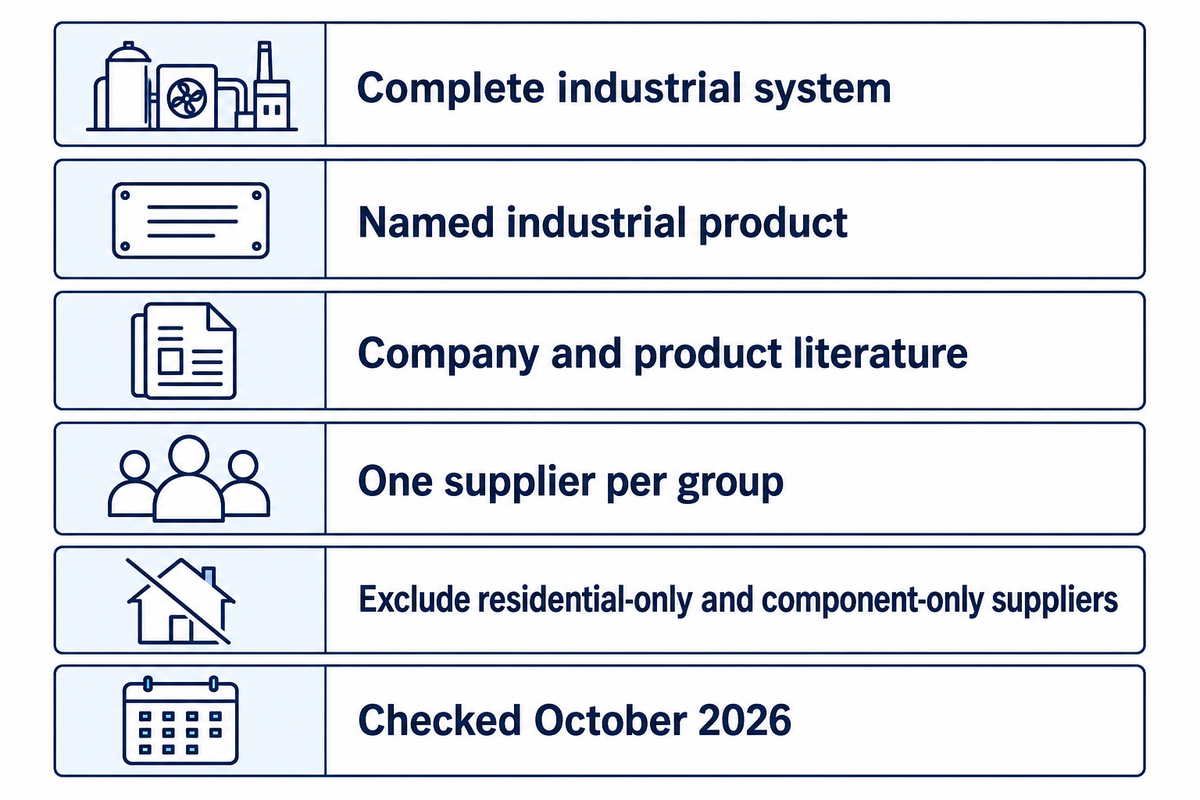
For this study, we identified manufacturers with recognizable Industrial Heat Pump products/ complete thermal systems based on published company history/ literature and company capabilities. Residential-only heat pump brands, distributors, trading companies, sourcing platforms, directories and component-only suppliers weren’t considered. We reviewed information and product scope of suppliers/ companies against their official websites and public sources in October 2026. Group brands are combined if they represent the same supplier in the study.
What Are Industrial Heat Pumps?
Industrial heat pumps transfer heat from a lower-temperature source to a process/ useful temperature and can use water/ industrial waste heat/ air as a source. The useful output can be hot water/ air/ steam in a system. Its main purpose is to fulfill a process need/ duty rather than to simply heat or cool a room with an air conditioner.
Therefore, brand recognition alone may not allow comparison of modern heat pumps. A large commercial HVAC machine may satisfy a factory’s water requirement while another process may require dedicated steam. To understand the working of the cycle, see our guide to Industrial and Commercial heat pump operation. This page focuses on system suppliers.
20 Industrial Heat Pump Manufacturers at a Glance
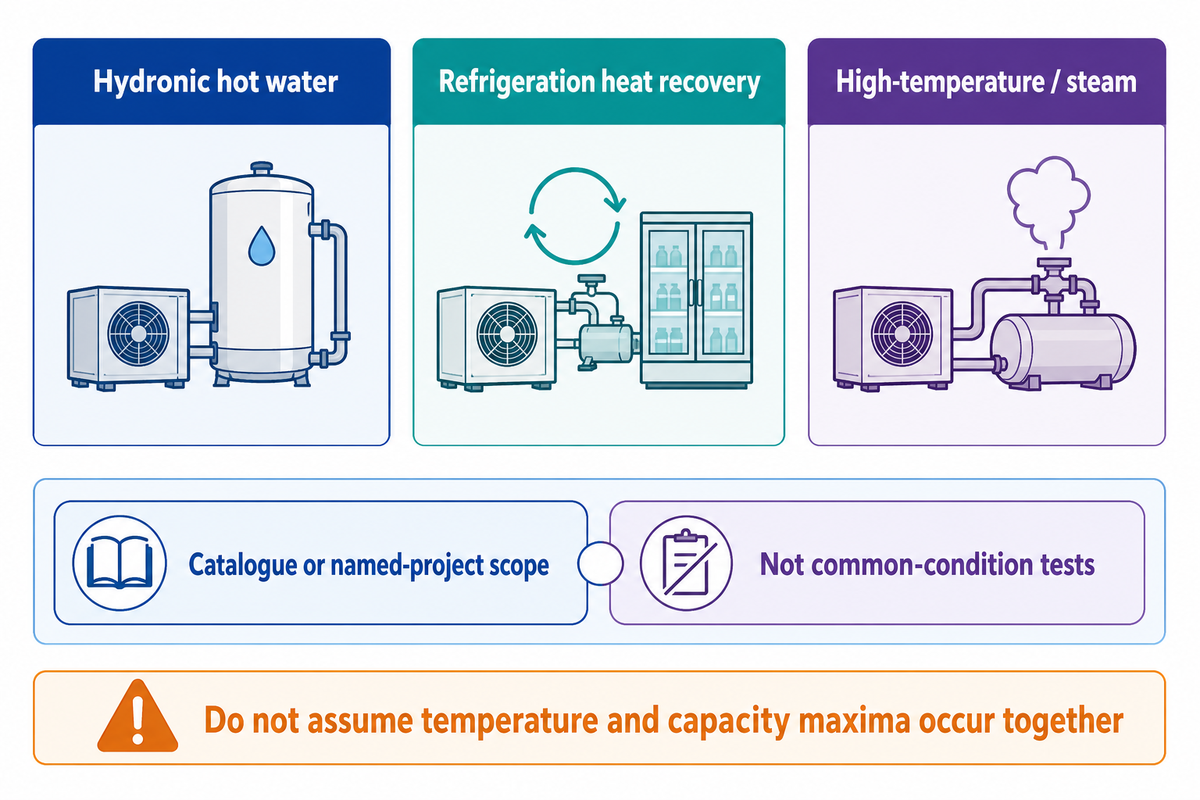
The 3-Heat-Duty Manufacturer Directory makes comparisons of published equipment scope for the hydronic water, industrial refrigeration recovery, and high-temperature/steam systems. Its temperature and capacity figures are catalogue ranges or named-project values, as labelled. They are not common-condition test results, and the maximum temperature and maximum capacity should not be assumed to occur together.
Use the Best For column to choose which group to read first. Oilon reaches into higher-temperature water duty even though it sits with hydronic suppliers; Mayekawa’s hot-air machine is kept visible among refrigeration specialists. These categories describe a starting point for purchasing, rather than an exclusive claim about every product a company makes. The output a heat pump delivers at your duty point matters more than the largest capacity in a manufacturer’s range of heat pumps.
3-Heat-Duty Manufacturer Directory
| No. | Company Name | Headquarters | Founded Year | Best For | Brief Introduction | Product and Published Heat Duty | Key Advantages | Potential Disadvantages | Official Website |
|---|---|---|---|---|---|---|---|---|---|
| 1 | Koven Air | Suzhou, China | 2007; Koven Air brand 2010 | Industrial hot water with building cooling | Manufacturer of hydronic HVAC and heat-pump equipment | KAIA cascade hot-water; KASCMF water-source; four-pipe recovery; KAIA published hot-water range 55–75°C | Hydronic heating plus cooling | Hot water; no AHRI certification | https://kovenair.com |
| 2 | Clade | Bristol, United Kingdom; manufacturing in Leeds | 1985 A1 Engineering heritage; Clade name 2021 | CO2 process hot-water projects | Manufacturer and installer of CO2 heat-pump systems | Beech bespoke CO2 heat pumps; Oak air-source heat pumps; Beech 600 kW–1.4 MW; water up to 90°C; stated return 30–35°C | Complete CO2 project delivery | Return condition and installation scope matter | https://clade-es.com |
| 3 | Carrier | Palm Beach Gardens, Florida, United States | 1915 company; 1902 air-conditioning invention | Large water-to-water hydronic heating | Manufacturer of commercial hydronic HVAC equipment | AquaForce 61XWHZE water-to-water heat pump; 61XWHZE R1234ze; 200–2,500 kW; hot water up to 85°C | Defined water-source product family | Water outlet; no direct-steam rating | https://www.carrier.com |
| 4 | Daikin | Osaka, Japan | 1924 | Water-cooled plant replacements | Manufacturer of HVAC and water-cooled heat-pump equipment | EWWH-VZ inverter water-cooled range; EWWH-VZ 400–1,900 kW; R1234ze; optional high-temperature configuration up to 90°C | Inverter water-cooled platform | 90°C needs optional configuration | https://www.daikin.com |
| 5 | Oilon | Lahti, Finland | 1961 | Industrial hot-water heat recovery | Manufacturer of industrial heat pumps and combustion equipment | ChillHeat P30–P450 series; Published P-series water temperatures up to 120°C; refrigerant varies by configuration | Process-water temperature envelope | Water up to 120°C | https://oilon.com |
| 6 | GEA | Düsseldorf, Germany | 1881 group heritage; GEA name 1920 | Integrating industrial refrigeration with process hot water | Manufacturer of industrial heating and refrigeration systems | RedGenium ammonia heat pumps; RedAstrum; Blu-Red Fusion; RedGenium R717; 200–3,000 kW; hot water up to 95°C | Refrigeration and heating integration | Ammonia site requirements | https://www.gea.com |
| 7 | Johnson Controls / Sabroe | Johnson Controls: Cork, Ireland; Sabroe operations: Aarhus, Denmark | 1885 Johnson Controls; 1897 Sabroe brand | Higher-temperature refrigeration heat recovery | Manufacturer of industrial refrigeration and heat-pump packages | Sabroe HitemHP reciprocating heat pumps; HitemHP 100–1,000 kW; temperatures up to 122°C; isobutane/butane options | Higher-temperature recovery package | Hydrocarbon and indirect-steam arrangement | https://www.sabroe.com |
| 8 | Mayekawa | Koto-ku, Tokyo, Japan | 1924 | Industrial drying and hot-air processes | Manufacturer of industrial refrigeration and heat-pump equipment | Ecosirocco CO2 hot-air heat pumps; Ecosirocco hot air up to 120°C; water-source 45–680 kW or air-source 25–680 kW | Direct hot-air process duty | 120°C is hot air | https://www.mayekawa.co.jp |
| 9 | OCHSNER | Haag manufacturing and Linz legal company, Austria | 1978 heat-pump company; family heritage 1872 | Medium-scale high-temperature water loops | Manufacturer of large and high-temperature heat pumps | IWWDS high-temperature water-source heat pumps; Current IWWDS listing: 100–450 kW and hot water up to 120°C | Medium-scale hot-water range | 100–450 kW water-source | https://www.ochsner.com |
| 10 | Friotherm | Frauenfeld, Switzerland | 2005 independent company; Sulzer heat-pump heritage since 1936 | Large district and industrial water heat recovery | Manufacturer of large heat pumps and refrigeration systems | Unitop 33 industrial and district-heating systems; Unitop 33: hot water 50°C single stage; above 80°C in two-stage arrangement | Large staged-water arrangements | Staging and compressor/system distinction | https://www.friotherm.com |
| 11 | Everllence | Augsburg, Germany | 1758 industrial heritage; Everllence name 2025 | Large continuous process-heating and steam projects | Manufacturer and system supplier of industrial heat pumps and steam compression | Large industrial heat-pump and steam-compressor solutions; 10–100 MWth per unit; hot water up to 140°C; combined steam solutions up to 300°C | Large heat-pump/steam combination | 300°C needs combined steam solution | https://www.everllence.com |
| 12 | Siemens Energy | Munich, Germany | 2020 independent company | Large industrial heat-network integration | Manufacturer and integrator of industrial heat-pump systems | Large heat pumps and steam-compressor combinations; 2023 brochure: heat pumps up to 150°C and 70 MWth; steam compressor combinations up to 270°C and 55 bara | Thermal-network integration | 270°C needs steam-compressor combination | https://www.siemens-energy.com |
| 13 | KOBELCO / Kobe Steel | Kobe, Japan (Kobe Steel group) | 1905 foundation; 1911 incorporation | Lower-temperature process steam | Manufacturer of steam heat pumps and compressor systems | Current SGH120W-GN steam heat pump; SGH120W-GN began production 2025; current official exhibition states 100–120°C steam and HFO GWP no greater than 1 | Current named steam product | 100–120°C steam | https://kobelco-compressors.com |
| 14 | Turboden / Mitsubishi Heavy Industries | Brescia, Italy | 1980; Mitsubishi Heavy Industries group since 2013 | Large industrial steam with integrated heat recovery | Manufacturer and integrator of large heat-pump and steam systems | Large heat pump with mechanical vapor recompression; Commissioned delfort project: 12 MWth, 3.4 bara steam at 150–180°C | Commissioned integrated steam example | Mechanical vapor recompression | https://www.turboden.com |
| 15 | Copeland / Vilter | St. Louis, Missouri, United States (Copeland) | 1921 Copeland brand; independent company 2023 | Packaged high-temperature liquid or steam duties | Manufacturer of industrial heating and refrigeration packages | Vilter VQ180 process-heating heat pump; VQ180 0.3–2.5 MW; liquid up to 180°C; steam up to 175°C at 8.9 bara | Separate liquid and steam envelopes | VQ-model and flash-equipment differences | https://www.copeland.com |
| 16 | HEATEN | Remscheid, Germany; office in Kristiansand, Norway | 2020 | High-temperature liquid process heat | Manufacturer of very-high-temperature heat pumps | HeatBooster HBL4; HBL4 0.8–2.5 MW; liquid up to 200°C; FAQ steam limit 180°C | Very-high-temperature liquid offer | Liquid up to 200°C; steam up to 180°C | https://heaten.com |
| 17 | Enerin | Asker, Norway | 2017 | High-temperature heat with helium working gas | Manufacturer of reverse-Stirling high-temperature heat pumps | HoegTemp helium heat pumps; Published modules 250 kW–1 MW; hot end up to 250°C for water, steam or thermal oil | Helium reverse-Stirling modules | Modules 250 kW–1 MW | https://www.enerin.no |
| 18 | Olvondo Technology | Holmestrand, Norway | 2016 | Continuous high-temperature process heat | Manufacturer of reverse-Stirling heat pumps | HighLift helium heat pump; HighLift 750 kW and hot-end temperature up to 200°C | Named HighLift industrial machine | HighLift 750 kW | https://olvondotech.no |
| 19 | GKT (formerly GIG Karasek) | Gloggnitz, Austria | Nearly 90 years of business history; GKT name April 2026 | Large integrated heat-recovery projects | Process-system manufacturer and EPC supplier | CompriVAP large industrial heat-pump system; BASF CompriVAP project design: 50 MWth; operation scheduled 2027 | Complete process-system responsibility | BASF operation scheduled2027 | https://gkt-solutions.com |
| 20 | Armstrong International | Three Rivers, Michigan, United States | 1900 | Heat-pump integration with existing thermal utilities | Thermal-system supplier jointly manufacturing heat-pump packages with Combitherm | Customized industrial heat-pump packages; Published hot-water packages up to 120°C with R245fa or R1233zd(E), configuration dependent | Thermal-utility integration partnership | Hot water up to 120°C | https://armstronginternational.com |
Hydronic Hot-Water and Heat-Recovery Manufacturers
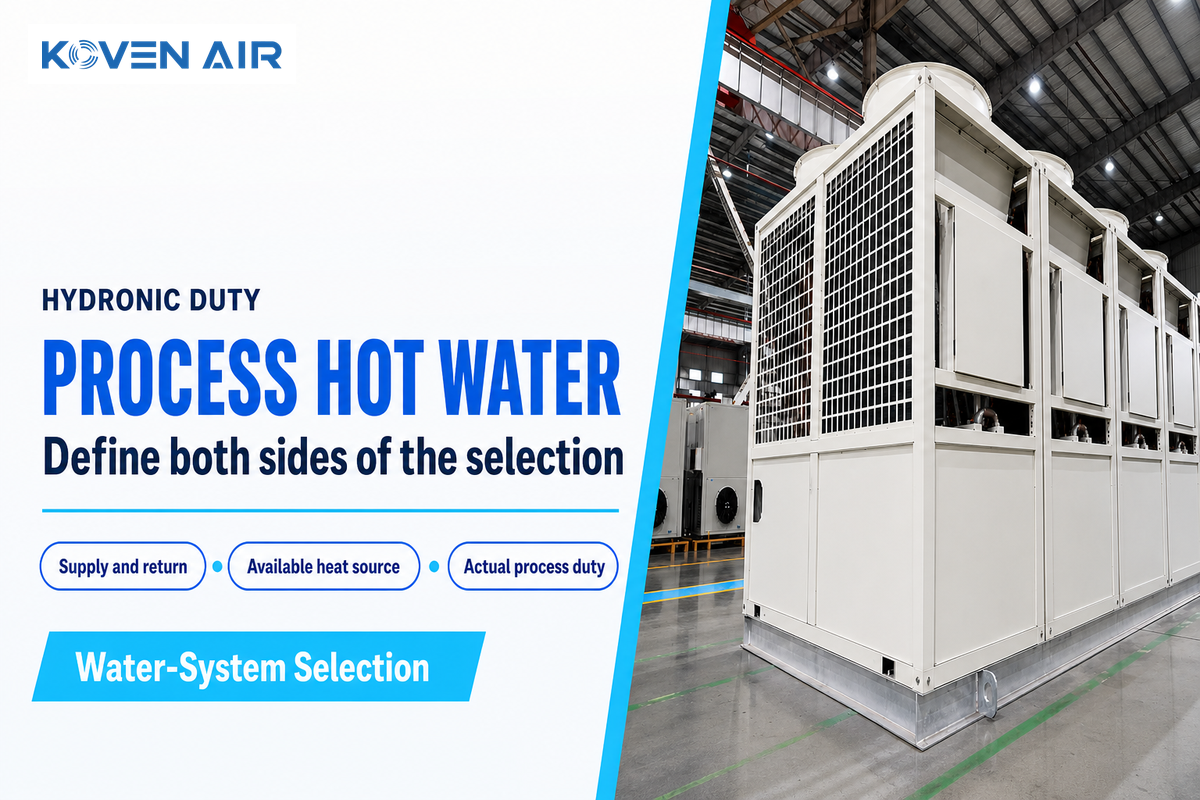
For process hot water, the equipment scope offered by the manufacturers in this Directory needs to be matched to the process by specifying the required supply and return temperatures, and the source available at the factory. The named hydronic products and complete hot-water systems offered by these manufacturers overlap some of the products serving commercial applications, but a model selection still has to take into account the actual process as opposed to a heating application. These heat pumps provide a hydronic route to useful process temperatures.
1. Koven Air: Best for industrial hot water with building cooling
Headquarters: Suzhou, China · Founded: 2007; Koven Air brand 2010 · Type: Manufacturer of hydronic HVAC and heat-pump equipment.
Official website: https://kovenair.com
Main products: KAIA cascade hot-water; KASCMF water-source; four-pipe recovery.
Published capability: KAIA published hot-water range 55–75°C.
Company credentials: The website lists CE and ISO 9001:2015, ISO 14001:2015 and ISO 45001:2018 management systems. These are separate from heat-pump rating certification.
Koven Air suits projects where process hot water sits alongside a commercial HVAC plant, with air and water source units, cooling and heat-recovery configurations in its portfolio. The Suzhou operation began with chillers and now offers selection calculations and control documentation for project-specific equipment. Wash lines and similar hydronic loads therefore belong in a different supplier discussion from a steam header. The useful starting point is the required water duty and the product family’s published envelope.
Buying limit: 75°C catalogue scope doesn’t establish steam delivery; no AHRI certification.
2. Clade: Best for CO2 process hot-water projects
Headquarters: Bristol, United Kingdom; manufacturing in Leeds · Founded: 1985 A1 Engineering heritage; Clade name 2021 · Type: Manufacturer and installer of CO2 heat-pump systems.
Official website: https://clade-es.com
Main products: Beech bespoke CO2 heat pumps; Oak air-source heat pumps.
Published capability: Beech 600 kW–1.4 MW; water up to 90°C; stated return 30–35°C.
Company credentials: Clade identifies itself as a certified B Corp; this concerns the business, rather than a product performance rating.
Beech is built around an installation, combining a compressor station, controls, evaporator and associated pipework rather than only an equipment cabinet. Its return-water condition matters where a process can provide a cold return and use the full temperature rise. Clade also manufactures Oak air-source units and works through design, installation and commissioning. The purchasing advantage is complete hot-water project delivery, with the site conditions and installation boundary carried into the selection.
Buying limit: Beech is a designed installation; its return-temperature condition matters.
3. Carrier: Best for large water-to-water hydronic heating
Headquarters: Palm Beach Gardens, Florida, United States · Founded: 1915 company; 1902 air-conditioning invention · Type: Manufacturer of commercial hydronic HVAC equipment.
Official website: https://www.carrier.com
Main products: AquaForce 61XWHZE water-to-water heat pump.
Published capability: 61XWHZE R1234ze; 200–2,500 kW; hot water up to 85°C.
Carrier’s AquaForce family gives factories a hydronic route to higher-temperature water through a defined packaged product. The 61XWHZE uses R1234ze and draws from a water circuit, so available source water is part of the application. Facilities replacing a water-cooled plant can compare its connections and heating duty with the existing installation. The named family makes that discussion specific, while its water-temperature ceiling keeps the shortlist separate from direct-steam systems.
Buying limit: 85°C hot water isn’t a direct-steam rating.
4. Daikin: Best for water-cooled plant replacements
Headquarters: Osaka, Japan · Founded: 1924 · Type: Manufacturer of HVAC and water-cooled heat-pump equipment.
Official website: https://www.daikin.com
Main products: EWWH-VZ inverter water-cooled range.
Published capability: EWWH-VZ 400–1,900 kW; R1234ze; optional high-temperature configuration up to 90°C.
Daikin’s VZ platform combines water-cooled operation with inverter control in a larger packaged-water-machine format. The optional high-temperature configuration widens the possible heating duties, but that option must belong to the selected model. A factory replacing a conventional water-cooled plant can discuss source conditions and useful output around this identified family. Its purchasing distinction is the configuration that supplies the required water temperature, rather than a temperature attributed to every Daikin unit.
Buying limit: 90°C is an optional configuration, not every standard variant.
5. Oilon: Best for industrial hot-water heat recovery
Headquarters: Lahti, Finland · Founded: 1961 · Type: Manufacturer of industrial heat pumps and combustion equipment.
Official website: https://oilon.com
Main products: ChillHeat P30–P450 series.
Published capability: Published P-series water temperatures up to 120°C; refrigerant varies by configuration.
Oilon brings industrial hot-water recovery into a supplier discussion that can also include existing combustion equipment. That breadth is useful when a site is deciding which boiler duties to move to an electric heat pump solution. ChillHeat provides a named process-heating family, with refrigerant configurations belonging to particular operating envelopes. The higher published water-temperature ceiling is relevant to the shortlist, while the actual P-series selection supplies the capacity needed for the project.
Buying limit: Select the specific P-series refrigerant variant for the required hot-water capacity; a direct-steam duty needs another system arrangement.
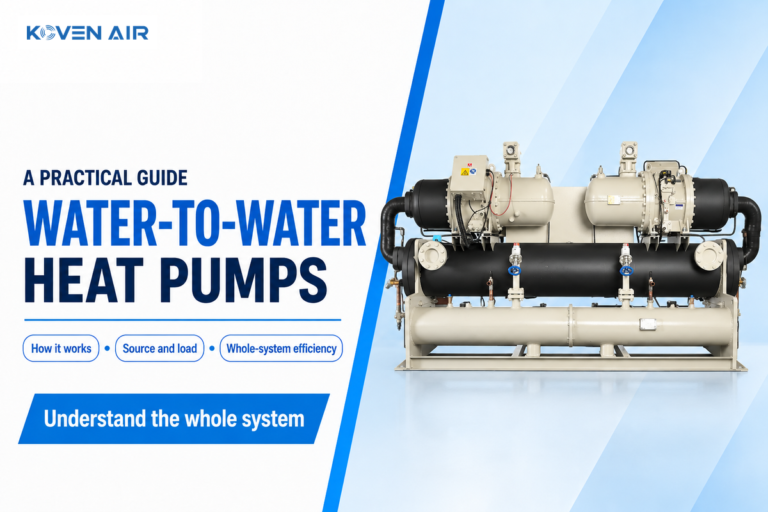
Koven’s industrial heat pump portfolio sets out its water-side product families. Where the available source is outdoor air, the air-to-water heat pump range is the relevant starting point; a recovery-water loop belongs to another source-side selection.
Industrial Refrigeration and Process-Hot-Water Specialists
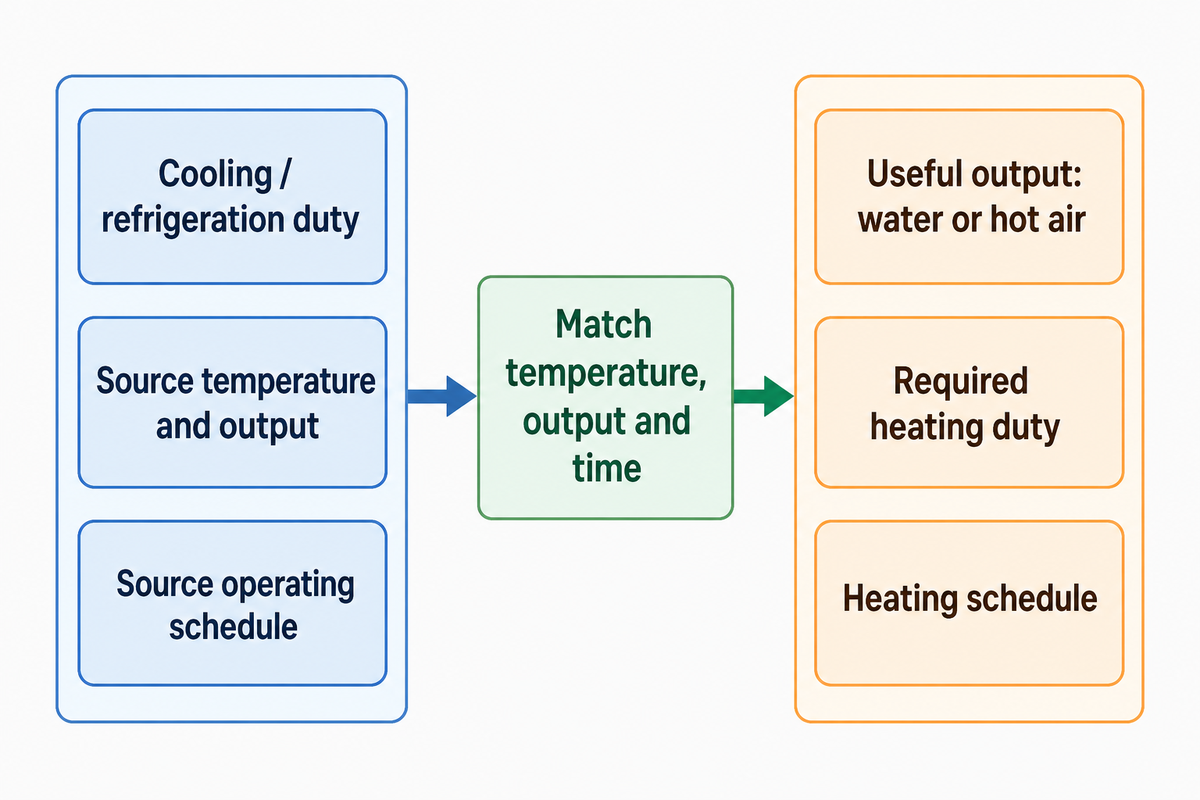
Refrigeration specialists can connect a plant’s cooling duty with useful process heat. Their products may deliver water or, in Mayekawa’s Ecosirocco example, hot air. An existing refrigeration installation is a useful source of heat only when its temperature, available output and operating schedule match the heating requirement.
6. GEA: Best for integrating industrial refrigeration with process hot water
Headquarters: Düsseldorf, Germany · Founded: 1881 group heritage; GEA name 1920 · Type: Manufacturer of industrial heating and refrigeration systems.
Official website: https://www.gea.com
Main products: RedGenium ammonia heat pumps; RedAstrum; Blu-Red Fusion.
Published capability: RedGenium R717; 200–3,000 kW; hot water up to 95°C.
GEA pairs industrial refrigeration with heat recovery, using RedGenium ammonia heat pumps alongside screw-compressor and combined chiller/heat-pump arrangements. Food-processing and similar sites can discuss rejected cooling heat as a source for process-water heating within that portfolio. The catalogue gives concrete capacity and temperature markers, but those endpoints don’t describe one shared test condition. Keeping the named series intact avoids mixing one product’s power range with another product’s temperature ceiling.
Buying limit: Ammonia installation and operation require a suitable site; model ranges aren’t common-condition ratings.
7. Johnson Controls / Sabroe: Best for higher-temperature refrigeration heat recovery
Headquarters: Johnson Controls: Cork, Ireland; Sabroe operations: Aarhus, Denmark · Founded: 1885 Johnson Controls; 1897 Sabroe brand · Type: Manufacturer of industrial refrigeration and heat-pump packages.
Official website: https://www.sabroe.com
Main products: Sabroe HitemHP reciprocating heat pumps.
Published capability: HitemHP 100–1,000 kW; temperatures up to 122°C; isobutane/butane options.
Sabroe’s industrial refrigeration background gives HitemHP a defined role in higher-temperature heat recovery, with reciprocating technology and hydrocarbon working-fluid options. Johnson Controls is the parent-group identity, while Sabroe is the product brand with its own history. A plant considering refrigeration and useful heating together can discuss both duties within that industrial portfolio. The selected refrigerant and delivery arrangement remain central when recovered heat is intended to feed an indirect steam process.
Buying limit: Hydrocarbon refrigerant and any indirect steam arrangement need project engineering.
8. Mayekawa: Best for industrial drying and hot-air processes
Headquarters: Koto-ku, Tokyo, Japan · Founded: 1924 · Type: Manufacturer of industrial refrigeration and heat-pump equipment.
Official website: https://www.mayekawa.co.jp
Main products: Ecosirocco CO2 hot-air heat pumps.
Published capability: Ecosirocco hot air up to 120°C; water-source 45–680 kW or air-source 25–680 kW.
Ecosirocco serves the hot-air branch of this directory, with CO2 heat pumps for drying and other processes that use heated air directly. Mayekawa publishes both water-source and air-source arrangements, giving factories more than one route to that air-side duty. This is a useful manufacturer discussion when the thermal process needs air rather than a hydronic loop. The temperature statement consequently belongs to the delivered air, with a process interface different from a water-heating machine.
Buying limit: 120°C refers to hot air, not a water or steam outlet rating.
9. OCHSNER: Best for medium-scale high-temperature water loops
Headquarters: Haag manufacturing and Linz legal company, Austria · Founded: 1978 heat-pump company; family heritage 1872 · Type: Manufacturer of large and high-temperature heat pumps.
Official website: https://www.ochsner.com
Main products: IWWDS high-temperature water-source heat pumps.
Published capability: Current IWWDS listing: 100–450 kW and hot water up to 120°C.
OCHSNER’s high-temperature business extends beyond its building-heating range, and the current IWWDS listing identifies a water-source product with a defined capacity band. That places it between ordinary hydronic equipment and much larger custom steam systems in the directory. The heat-pump company’s founding also differs from the older family business history. For a medium-scale process-water project, the current IWWDS data set is the relevant starting point for selecting the actual machine.
Buying limit: IWWDS water-source capacity is 100–450 kW; current refrigerants and maxima from other series are not interchangeable.
10. Friotherm: Best for large district and industrial water heat recovery
Headquarters: Frauenfeld, Switzerland · Founded: 2005 independent company; Sulzer heat-pump heritage since 1936 · Type: Manufacturer of large heat pumps and refrigeration systems.
Official website: https://www.friotherm.com
Main products: Unitop 33 industrial and district-heating systems.
Published capability: Unitop 33: hot water 50°C single stage; above 80°C in two-stage arrangement.
Friotherm supplies large heat-pump and refrigeration systems for district-energy and industrial water duties, with Unitop arrangements addressing different delivery temperatures. Its current independent company and older Sulzer heat-pump lineage are separate parts of that history. Staging is the important product distinction because the single-stage and two-stage temperature statements describe different configurations. Whole-plant heating output must therefore remain separate from a compressor’s standalone catalogue capacity during the supplier comparison.
Buying limit: Two-stage temperature claim is arrangement-specific; compressor capacity isn’t whole-system output.
The useful distinction within this group is the delivered medium and system arrangement. Adding a higher-temperature stage changes the equipment scope. It also changes which parts of an existing refrigeration plant can remain and which heat exchangers, controls or utility connections must be included in the project.
High-Temperature and Steam-System Manufacturers
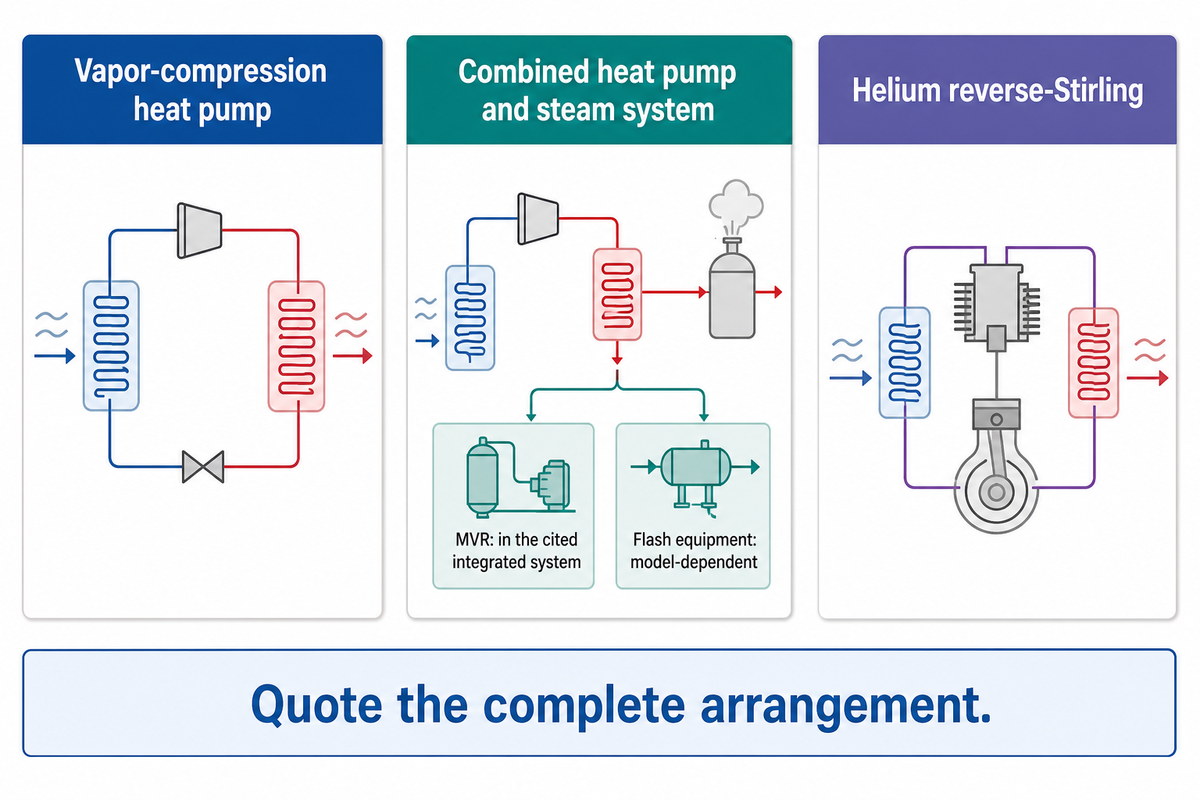
Manufacturers of high temperature equipment cover different architectures including vapor compression systems, combined heat pump systems (e.g. steam compression systems), and reverse Stirling systems. Read the named product and delivery medium before using the largest advertised temperature.
11. Everllence: Best for large continuous process-heating and steam projects
Headquarters: Augsburg, Germany · Founded: 1758 industrial heritage; Everllence name 2025 · Type: Manufacturer and system supplier of industrial heat pumps and steam compression.
Official website: https://www.everllence.com
Main products: Large industrial heat-pump and steam-compressor solutions.
Published capability: 10–100 MWth per unit; hot water up to 140°C; combined steam solutions up to 300°C.
Everllence is the current name of the former MAN Energy Solutions business, whose industrial-process offer includes large heat pumps and steam compression. The combination is relevant when heat recovery forms a major thermal-utility project rather than a small packaged replacement. A steam discussion must include the additional compressor stage, since it raises the delivery envelope beyond the water-heating stage. The industrial heritage predates the recent brand change, while today’s purchasing comparison concerns the complete proposed arrangement.
Buying limit: 300°C requires the combined solution; scheduled projects aren’t operating references.
12. Siemens Energy: Best for large industrial heat-network integration
Headquarters: Munich, Germany · Founded: 2020 independent company · Type: Manufacturer and integrator of industrial heat-pump systems.
Official website: https://www.siemens-energy.com
Main products: Large heat pumps and steam-compressor combinations.
Published capability: 2023 brochure: heat pumps up to 150°C and 70 MWth; steam compressor combinations up to 270°C and 55 bara.
Siemens Energy addresses large heat-pump integration within industrial energy systems, with its brochure separating water-heating capability from higher steam conditions using additional compression. A process owner can structure the supplier discussion around available low-temperature heat, useful delivery pressure and the steam compressor’s place in the plant. This suits large commercial and industrial projects interfacing with wider thermal infrastructure. The highest steam values describe that assembled combination, while the independent company dates from a more recent separation.
Buying limit: 2023 brochure scope; 270°C/55 bara requires the combined system.
13. KOBELCO / Kobe Steel: Best for lower-temperature process steam
Headquarters: Kobe, Japan (Kobe Steel group) · Founded: 1905 foundation; 1911 incorporation · Type: Manufacturer of steam heat pumps and compressor systems.
Official website: https://kobelco-compressors.com
Main products: Current SGH120W-GN steam heat pump.
Published capability: SGH120W-GN began production 2025; current official exhibition states 100–120°C steam and HFO GWP no greater than 1.
KOBELCO’s current steam-heat-pump discussion starts with SGH120W-GN, identified in its production history and current exhibition material. The named product addresses a specific steam-temperature range with an HFO working fluid, rather than inheriting all the numbers in older SGH brochures. Kobe Steel’s foundation and incorporation dates also differ from this product launch. The profile is useful for that lower-temperature steam shortlist, with historical SGH120/165 capacities kept outside the current model selection.
Buying limit: Current SGH120W-GN ratings establish 100–120°C steam delivery; older SGH120/165 capacity figures describe different equipment.
14. Turboden / Mitsubishi Heavy Industries: Best for large industrial steam with integrated heat recovery
Headquarters: Brescia, Italy · Founded: 1980; Mitsubishi Heavy Industries group since 2013 · Type: Manufacturer and integrator of large heat-pump and steam systems.
Official website: https://www.turboden.com
Main products: Large heat pump with mechanical vapor recompression.
Published capability: Commissioned delfort project: 12 MWth, 3.4 bara steam at 150–180°C.
Turboden supplies large heat-pump systems within Mitsubishi Heavy Industries, so both names form one manufacturer entry. Its delfort announcement describes a commissioned steam installation combining heat pumping with mechanical vapor recompression. This provides a concrete example of recovering a large heat source for process steam through an integrated system. The stated pressure, capacity and temperatures belong to that installation, giving buyers an architecture to compare without making them universal ratings for every Turboden plant.
Buying limit: Published delfort numbers are project-specific and include mechanical vapor recompression.
15. Copeland / Vilter: Best for packaged high-temperature liquid or steam duties
Headquarters: St. Louis, Missouri, United States (Copeland) · Founded: 1921 Copeland brand; independent company 2023 · Type: Manufacturer of industrial heating and refrigeration packages.
Official website: https://www.copeland.com
Main products: Vilter VQ180 process-heating heat pump.
Published capability: VQ180 0.3–2.5 MW; liquid up to 180°C; steam up to 175°C at 8.9 bara.
Vilter’s Copeland portfolio includes named process-heating packages beyond ordinary building hot-water duty, with VQ180 stating distinct liquid and steam limits. Those medium-specific values give buyers a clearer starting point than one generic high-temperature headline. Neighbouring VQ models also differ, including a steam example that adds flash equipment. The useful purchasing comparison remains the selected package and its stages, with Copeland brand heritage separate from the newer independent-company identity.
Buying limit: VQ145 steam example needs flash equipment; don’t transfer VQ180 ratings across VQ models.
16. HEATEN: Best for high-temperature liquid process heat
Headquarters: Remscheid, Germany; office in Kristiansand, Norway · Founded: 2020 · Type: Manufacturer of very-high-temperature heat pumps.
Official website: https://heaten.com
Main products: HeatBooster HBL4.
Published capability: HBL4 0.8–2.5 MW; liquid up to 200°C; FAQ steam limit 180°C.
HEATEN’s HeatBooster targets very-high-temperature process heat, with HBL4 identifying a current capacity band alongside the Norway business and German research operation. Its liquid envelope suits duties beyond many standard hot-water ranges, with separate liquid and steam delivery limits. A future larger model is also separate from the current HBL4 offer.
Buying limit: Use HBL4 for the stated 180°C steam envelope and distinguish it from the 200°C liquid limit and future models.
17. Enerin: Best for high-temperature heat with helium working gas
Headquarters: Asker, Norway · Founded: 2017 · Type: Manufacturer of reverse-Stirling high-temperature heat pumps.
Official website: https://www.enerin.no
Main products: HoegTemp helium heat pumps.
Published capability: Published modules 250 kW–1 MW; hot end up to 250°C for water, steam or thermal oil.
Enerin’s HoegTemp uses reverse-Stirling technology with helium, offering a different working-fluid route for water, steam and thermal-oil duties. Published modules let a buyer discuss installation scale without assuming a single large machine. For industrial applications, each module’s published capacity needs to be matched to the available heat source and delivery conditions.
Buying limit: Per-module capacity is stated at 250 kW–1 MW and must be matched to source and delivery conditions.
18. Olvondo Technology: Best for continuous high-temperature process heat
Headquarters: Holmestrand, Norway · Founded: 2016 · Type: Manufacturer of reverse-Stirling heat pumps.
Official website: https://olvondotech.no
Main products: HighLift helium heat pump.
Published capability: HighLift 750 kW and hot-end temperature up to 200°C.
Olvondo’s HighLift uses a helium reverse-Stirling arrangement, with a named industrial capacity and hot-end temperature on its official material. The company also identifies operating references relevant to continuous high-temperature process heat. This places the product above the temperature envelope of many conventional water-heating ranges. Selection still concerns the delivered medium, available source and required pressure together, since a hot-end maximum alone doesn’t define the usable process duty.
Buying limit: HighLift’s stated output is 750 kW per unit; its hot-end maximum does not define output at every steam pressure or source condition.
19. GKT (formerly GIG Karasek): Best for large integrated heat-recovery projects
Headquarters: Gloggnitz, Austria · Founded: Nearly 90 years of business history; GKT name April 2026 · Type: Process-system manufacturer and EPC supplier.
Official website: https://gkt-solutions.com
Main products: CompriVAP large industrial heat-pump system.
Published capability: BASF CompriVAP project design: 50 MWth; operation scheduled 2027.
GKT is the current name of GIG Karasek and takes complete process-system responsibility for CompriVAP in the cited BASF project. The compressor contributor has a different role, which keeps the system supplier distinct in this directory. The large waste-heat design is a purchasing example with operation still scheduled after this guide’s verification date. Its value is the integrated engineering and construction scope, supported by an older process-equipment heritage.
Buying limit: The BASF project is scheduled, not an already operating reference; compressor supplier is distinct.
20. Armstrong International: Best for heat-pump integration with existing thermal utilities
Headquarters: Three Rivers, Michigan, United States · Founded: 1900 · Type: Thermal-system supplier jointly manufacturing heat-pump packages with Combitherm.
Official website: https://armstronginternational.com
Main products: Customized industrial heat-pump packages.
Published capability: Published hot-water packages up to 120°C with R245fa or R1233zd(E), configuration dependent.
Armstrong places industrial heat pumps within a broader thermal-utility offer, with packages jointly manufactured alongside Combitherm. That partnership gives buyers a clear manufacturing relationship instead of assigning every stage to Armstrong alone. Published hot-water temperatures depend on the working fluid and actual package, which can be discussed alongside an existing thermal plant. The relevant procurement comparison is today’s delivery medium and integration scope, supported by the company’s longer industrial history.
Buying limit: Manufacturing is a Combitherm partnership, with hot water as the delivery medium and a stated limit of 120°C; this scope excludes a direct-steam selection.
There’s useful diversity in this group. Steam compression and mechanical vapor recompression make system integration part of the manufacturer comparison, while helium machines offer another working-fluid route. Catalogue maxima identify possibilities for a supplier discussion; they don’t establish that every proposed duty has been demonstrated in an operating installation.
How to Choose an Industrial Heat Pump Manufacturer
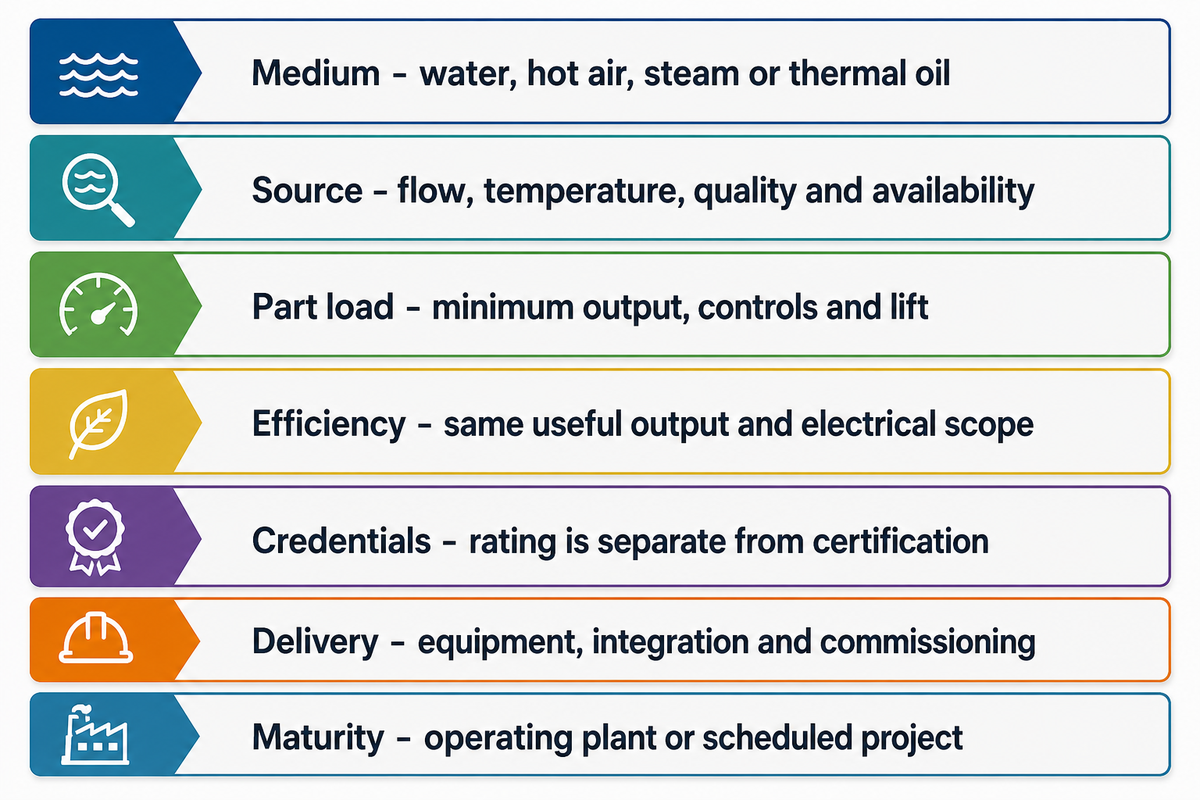
When selecting a manufacturer of an industrial heat pump, consider the delivery medium, the source side conditions, and the useful heating duty, and compare prices. Then consider the operating conditions, part-load operation and overall scope of the installation. A product family becomes a likely selection only after considering all the project conditions.
How do I determine what size commercial heat pump I need?
Compute the useful output at the required supply temperature and source condition, then compare it against a calculated process or building load. For simultaneous heating and cooling, keep the two duties separate during the selection. Nameplate capacity is a starting point; the actual heating capacity at the design condition determines what equipment is required.
Plot the profiles for the heat source and heat demand on the same operating schedule. A source that’s available while a cooling line is operating may disappear when another production process needs hot water. The annual duty can’t be assumed from a single high output hour. Match the source and sink flow rates, temperatures and concurrent hours, and determine if storage or other means of heat should be in the plant. This alters the capacity question to a selection problem.
Seven checks for a workable heating and cooling solution
- Identify the medium. Is it water, hot air, steam, or thermal oil? For steam, include required pressure and the equipment stages needed to reach it. A water-temperature ceiling doesn’t define a steam header.
- Describe the source over time. Measure flow and water quality and determine source temperatures and availability. Air source heat pumps take heat from outdoor air, so climate and design-day conditions matter. Recovering heat from the air follows a different source condition from using a warm process-water circuit. Water recovery is dependent on the supplying process. Refer to research on non-continuous industrial processes to understand when storage is part of time-matching heat recovery.
- Request data for part load conditions. Stable minimum output, control range and temperature lifts are important for temperature control. A 2026 laboratory study found that operating behavior was supply temperature and compressor speed dependent. A machine serving changing production loads needs more than one peak point.
- Keep efficiency boundaries the same. Compare useful heating with the same electrical-input scope. Combined heating and cooling systems may count two useful outputs, and a heating-only analysis counts one. Consider pumps and other stages in the auxiliary system in annual energy consumption. A high-efficiency label doesn’t resolve different measurement boundaries. Compare high-performance heat pumps at the same source and at the same useful-output conditions, with the same auxiliary system included.
- Keep ratings and credentials separate. AHRI Standard 551/591-2026, replacing the 2023 edition, defines the water-chilling and heat-pump water-heating package scope. A rating standard is separate from product certification. Evaluate the actual model, certificate holder, and scope once during the technical review; the management system credentials of the company don’t validate the output of a machine.
- Compare the whole delivery scope. Name the equipment manufacturer and system integrator and the party responsible for commissioning. Define the delivery scope from manufacturing facilities through installation and handover. Include works on the source side, electrical service, and any controls and steam compressors or MVR stages. Hybrid systems retaining a boiler need a defined changeover and backup plan. Hybrid heat pumps should be selected within that combined operating plan.
- Compare what’s offered to what’s referenced. Distinguish an operating plant from a scheduled project. Identify the operating temperature achieved vs. a catalogue maximum. HPT Project 68’s technology review provides a basis for questioning the maturity of development systems and supplier declared information. That is useful context for maturity questions, rather than independent product validation.
For a water-source installation, please see the relevant page on our website for our water-to-water heat pumps. For a plant with coincident loads, see the route for the four-pipe heat pump chiller. Heat pump technology transfers heat, but heating and cooling needs occurring in different seasons shouldn’t be treated as continuously recoverable heat.
Energy efficiency and sustainability belong to the actual operating case
Transferring heat instead of relying exclusively on combustion creates an opportunity for lower energy use, but significant energy savings require a case-specific analysis. Renewable energy in the electricity supply can also bring about a change in carbon footprint. Carbon emissions are case-specific, and thus, an eco-friendly description, in isolation, can’t be considered a project output.
That analysis should be kept separate from the limits set by equipment manufacturers. Traditional heating and cooling systems may include recoverable energy. For equipment replacement, compare the integration of heat pumps with the equipment being replaced. The energy-efficient design may include parts of the traditional systems or use supplementary heat. Equipment advertised as highly efficient is only a part of a larger heating and cooling solution.
Ground-source heat pumps and air-source machines also vary on the source side. A commercial project with an existing recovery-water circuit should price that circuit, and a new ground-source heat installation has its own civil works. Heat pumps offer multiple routes to heating solutions; the better option is the one aligned with the site’s source and demand, as opposed to the one that leads the entire heat pump industry.
- Record the duty. List source conditions, useful temperature, capacity and coincident hours.
- Shortlist the product family. Use the directory’s medium and published scope to identify relevant suppliers.
- Compare selections. Put the actual duty-point output and complete delivery boundary beside each quotation.
Frequently Asked Questions
These questions pertain to the buying decisions that happen post the manufacturer shortlist. Brand ownership, project cost and refrigerant choice denote different stages of the purchase. The answers use the same model and application boundaries as the company directory, with no universal efficiency winner or household price estimate.
Which industrial heat pump manufacturer is best for process hot water?
Choose the manufacturer whose named model matches the source and required water temperatures.
For hydronic hot water, begin with Koven Air, Clade, Carrier, Daikin or Oilon, then compare the particular product envelope. GEA and Sabroe are useful when refrigeration recovery is central to the project. The best heat pump choice depends on temperature, useful output and available source heat together. A familiar brand cannot make an unsuitable model fit, and the highest outlet temperature alone does not establish the heating capacity at your duty point.
Who is the largest industrial heat pump manufacturer in the world?
This directory does not establish a largest-world supplier by comparable industrial sales.
A global heat pump market ranking often combines residential and commercial equipment, air conditioning and other product classes. That total does not identify the biggest supplier of a particular industrial steam or process-water system. The research for this guide did not establish comparable industrial revenue or delivered capacity for all twenty companies. For procurement, replace that ranking question with a narrower one: which manufacturer has the right named system, relevant operating references and a delivery organisation for this commercial project? Size is useful context only when the measurement and product class match.
How much does an industrial heat pump cost?
Industrial pricing needs a defined machine and installation scope, rather than a household price band.
Capacity, heat source, delivery medium, refrigerant, controls and installation boundaries all affect the quotation. A packaged water machine and a complete steam plant do not buy the same engineering work. Include electrical connection, source-side pipework, heat exchangers, commissioning, maintenance and any backup plant in the comparison. Cost savings also depend on useful running hours and local tariffs, so the largest catalogue COP cannot establish a payback period. First obtain a duty-point selection and an itemised project quotation. Then calculate annual energy use against the existing heating system using the same useful-heat boundary. A rebate may affect the business case, but eligibility and available support must come from the relevant programme; a residential incentive cannot simply be applied to industrial equipment.
Who makes Trane heat pumps?
Trane is a brand within Trane Technologies.
The group’s official company page identifies Trane among its brands across residential, commercial and industrial HVAC. That ownership statement does not establish the manufacturing arrangement or performance of every regional model. For an industrial offer, identify the particular product and the entity supplying it before comparing it with the complete systems listed here.
Is R290 or R32 better for an industrial heat pump?
Neither refrigerant is universally better across all industrial duties.
The choice belongs to the selected machine’s temperature envelope, source conditions and installation requirements. Refrigerant alone does not define energy efficiency or useful heating output. A high-temperature process, a water-recovery plant and air source heat pumps can require different designs; compare the actual offered model and its documented application limits.
Can industrial heat pumps supply steam?
Yes, suitable steam systems can do so; a hot-water rating alone cannot.
KOBELCO, Turboden, Copeland and other high-temperature entries describe steam-capable arrangements. Some offers combine a heat pump with steam compression, mechanical vapor recompression or flash equipment. Keep those stages in the quotation. Koven’s KAIA hot-water range is a different duty and is not presented here as a steam system.
Request a Heat Pump Selection for Your Actual Duty
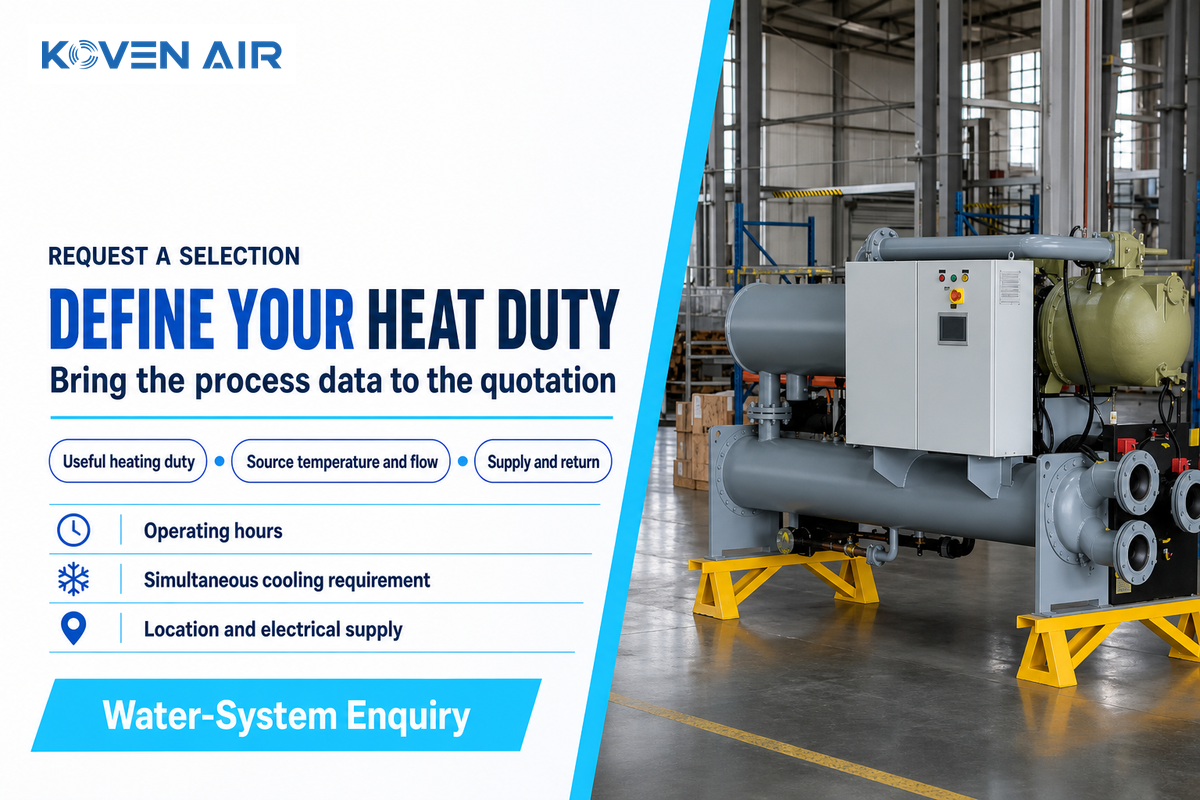
For a hydronic project within Koven Air’s published range, send the useful heating duty, source temperature and flow, supply and return temperatures, operating hours and any simultaneous cooling requirement. Our selection discussion starts from those conditions. Steam duties outside that range belong with the appropriate high-temperature system suppliers in this directory.
Koven Air’s product range covers water-system heating and cooling solutions for commercial and industrial installations. The next useful step is a selection calculation with a stated equipment boundary, so you can compare the proposed heat pump systems against your existing cooling systems and heating plant. Include the installation location and electrical supply with the process data. A quotation for high-quality heat pumps also needs stated acceptance conditions for the actual heating duty.
Key takeaway
Match the manufacturer to the medium and duty first. A published maximum temperature is useful only alongside the named model, available heat source and full system arrangement.
Have your source and process conditions ready? Send them to Koven Air for a water-system selection and a defined quotation scope.
References & Sources
Company history and product data come from the official manufacturer pages identified in each profile and the directory. Figures are attributed catalogue or project statements. Supporting method sources are the AHRI 2026 rating standard, the University of Bayreuth part-load study, University of Waikato non-continuous-process research and HPT Project 68 technology review. Trane ownership is stated on the Trane Technologies company page. Company websites appear as plain text; product facts were checked in October 2026.
- AHRI Standard 551/591-2026 — official water-package rating scope.
- Experimental performance of a high-temperature heat pump under part-load conditions — University of Bayreuth, 2026.
- Practical heat-pump and storage integration into non-continuous processes — University of Waikato repository, 2019.
- Industrial high-temperature heat-pump technology review — HPT Project 68; supplier-declared data.