Get in Touch with Koven Air Company

Air-to-Water Heat Pump, 65–2,872kW
A commercial air-to-water heat pump draws thermal energy from ambient outdoor air and transfers it to a water loop for space heating, cooling, and process reuse—no boiler, no cooling tower. Koven Air builds its KAFLG, KAFMH(A), and KAFM product lines in-house in its 20,000-sq.-ft. facility, covering a 65-to-2,872-kW range suitable for hotels, hospitals, and light industrial hydronic systems—not the small residential split units your search likely surfaced first.
Request 24h Quotation
65–2,872
kW heating capacity
3.24–4.43
heating COP range
R32/R1234ze
low-GWP options
4-Pipe
simultaneous heat+cool
20,000㎡
own factory, Suzhou
24h
RFQ turnaround
A commercial air-to-water heat pump is a packaged unit that extracts heat from ambient outdoor air via an outdoor coil and transmits it to an indoor water loop so the building’s radiators, fan coils, or radiant floor circuits are heated hydronically rather than via a gas or oil boiler. Koven’s three-product lineup ranges from 65–2,872 kW heating capacity and features real heating COPs from 3.24 to 4.43. Options include low-GWP R32/R1234ze refrigerant and, in the case of the 4-pipe models, simultaneous heat and cool.
Electrifying Commercial Heating: Why Buildings Are Replacing Boiler + Chiller Pairs
Running a gas boiler for heating and a separate chiller for cooling involves dual fuel accounts, double maintenance contracts, and a competitive claim to space in the mechanical room-as does deciding which machine to replace when either aging-out system finally gives up the ghost, on separate schedules, through separate contracts.
An air-to-water heat pump rolls all of that into one electric system. The same vapor-compression cycle that extracts heat from outside air in winter can be reversed in summer to cool that same water loop, delivering heat-rejection or heat-absorption service to that one system using a single utility connection and contract.
One system, two functions-in 4-pipe models, heat and cool to and from a single unit can happen simultaneously, with no supporting boiler plant required.
- Eliminates on-site combustion—no gas piping, no flue, and no combustion safety inspection.
- Drops into existing hydronic systems—radiators, fan coils, and radiant floor systems built for boiler application generally readily accept heat-pump water temperatures without a modification to the distribution network.
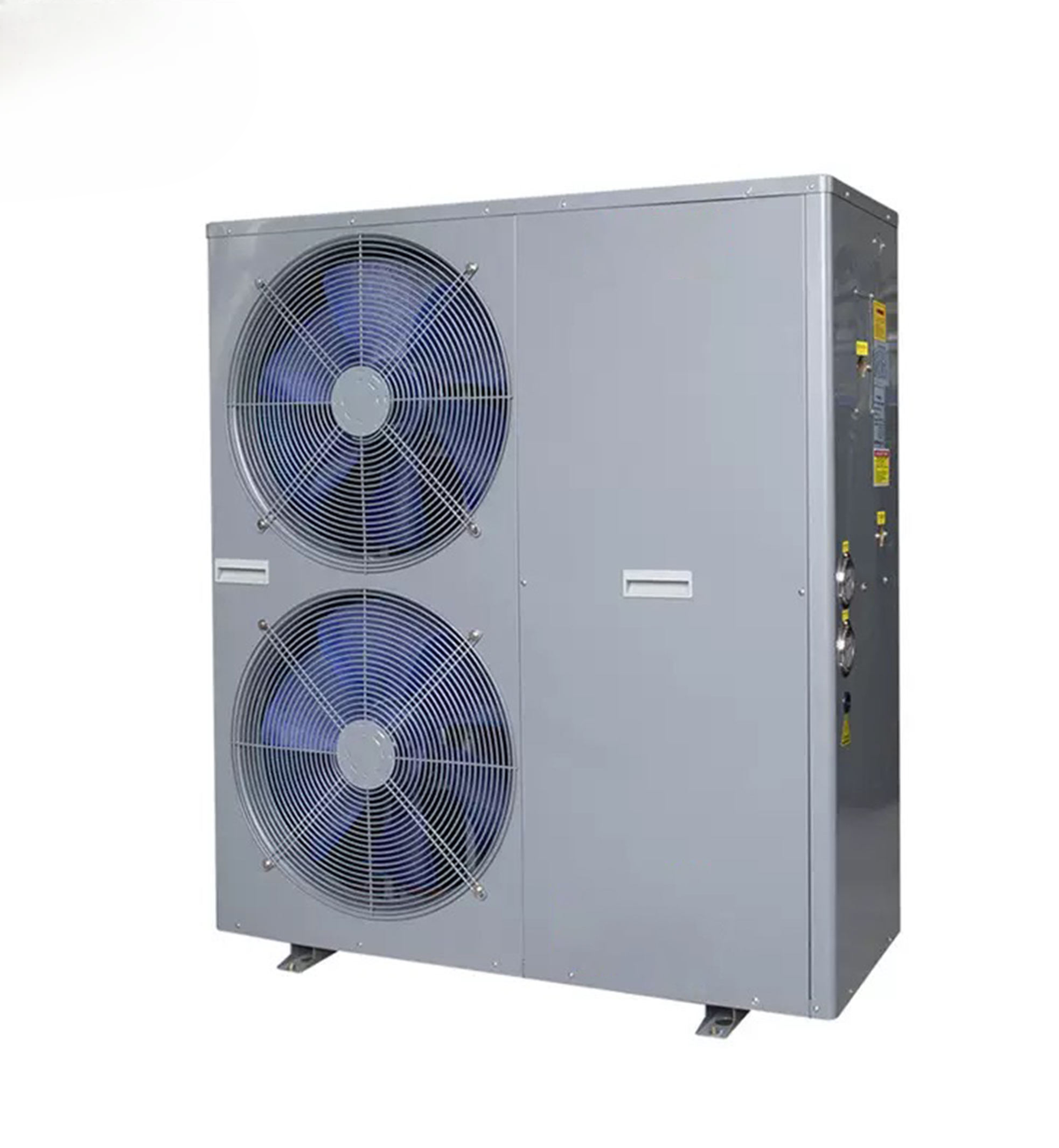
How a 4-pipe air-to-water heat pump works
Outdoor coil evaporates the refrigerant using the latent heat of ambient air, even at sub-zero outdoor temperatures. A compressor then increases the refrigerant’s temperature and pressure, where it transfers to the indoor water loop through a plate heat exchanger. With 4-pipe units, separate heating and cooling coils enable simultaneously heat-rejection and heat-absorption service to the same water loop as it delivers heat to zones requiring it and cooling to other zones, without discarding heat to the outdoors. This dual function employs the same four-mode operating strategy-heat-recovery, heating, cooling, defrost-documented in HPAC Magazine’s engineering coverage of air-to-water heat pumps.
This operates on the same basic vapor-compression principle as a heat pump, but with water, not indoor air, as the heat-transfer fluid. The key difference is that the heat is delivered to, or removed from, a water loop instead of a conditioned air supply.
A heat pump’s heating output and efficiency decrease as outdoor temperatures fall, a condition that a gas boiler running at full blast would never experience. It’s precisely for this reason that the ambient-performance data presented below – rather than a blanket statement of capability down to -X – is essential to accurately sizing any system.
Koven Air sizes each KAFLG, KAFMH(A) and KAFM to your actual climate and hydronic load, not a nameplate rating. All are designed and tested in Koven’s own Suzhou facility prior to shipping — not sourced from subcomponents and sold under a reseller’s brand.
Electrification is not friction-free, and pretending otherwise would undercut every other honest claim on this page: buildings with limited electrical service capacity, or distribution systems designed only for high-temperature boiler water, may need an electrical upgrade or emitter changes before an air-to-water heat pump is a drop-in swap. Sizing that against your building’s actual service capacity and distribution design, not just its heating load, is exactly what Koven’s pre-sales engineering review is for.
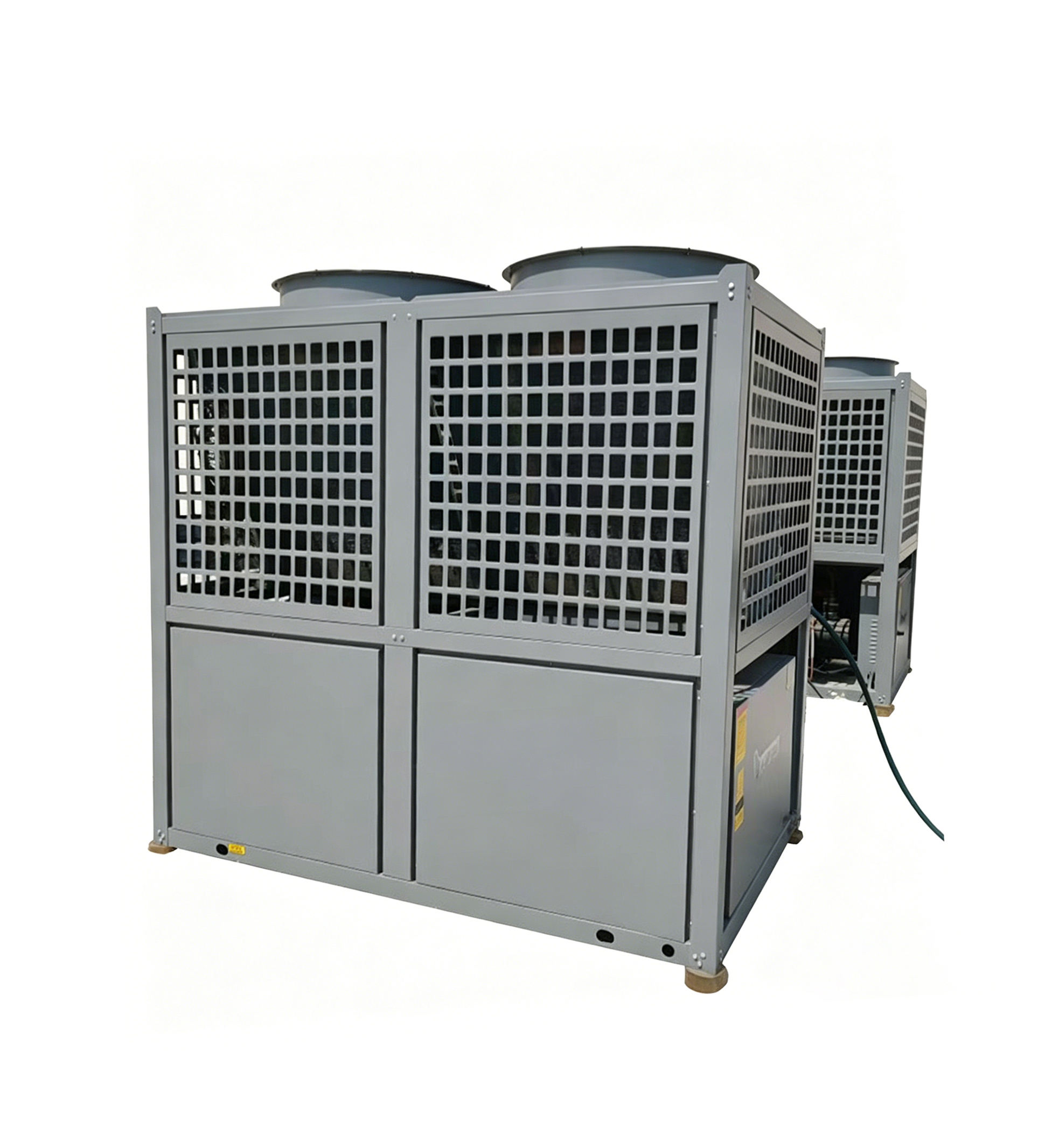
Koven KAFLG / KAFMH(A) / KAFM Series, Capacity & Model Selection
Choosing the wrong series is an expensive mistake: a short-cycled unit will never reach capacity on the coldest day, while a unit that’s too large wastes capital which could have purchased another module for redundancy. Koven Air’s own model-code nomenclature states this category of heat pumps clearly on the unit nameplate: model unit type letter “H” is for an air-to-water heat pump build, alongside year-round-cooling, cooling-only, and hot-water-only versions of the same chassis. This is to say that the heating-mode numbers provided aren’t cooling figures that have been converted — they’re measured and published specifically for the heat-pump model.
| Series | Heating capacity | Heating COP | Refrigerant | Heating ambient range |
|---|---|---|---|---|
| KAFLG screw (R134a) | 381–1,284 kW | 3.31–3.41 | R134a | rated at 7°C DB/6°C WB |
| KAFLG screw (R407C) | 246–2,872 kW | project-specific | R407C / R1234ze option | rated at 7°C DB/6°C WB |
| KAFMH(A) scroll modular | 238–475 kW | ≈3.4 (derived) | R410A / R32 option | -15°C to +25°C |
| KAFM modular chiller | 65–892 kW | 3.54–4.43 (IPLV to 4.19) | R410A / R32 option | -10°C to +26°C |
The ratings provided above are based on manufacturer’s published heating mode test conditions for each series, not a combined, blended rating.
| Your situation | Heating load | Recommended series | Refrigerant pick |
|---|---|---|---|
| Large hotel/hospital central plant | 1,000–2,872 kW | KAFLG screw | R1234ze (low-GWP) |
| Mid-size office/mixed-use building | 238–475 kW | KAFMH(A) scroll | R32 |
| Phased capacity / redundancy priority | 65–892 kW (stacked) | KAFM modular | R32 |
| Simultaneous heat+cool + hot water reuse | any (4-pipe config) | Any series, heat-recovery build | project-specific |
Independent performance-rating context: the AHRI Product Performance Certification Program independently measures and verifies that covered HVACR equipment performs to its published ratings — a useful cross-check when comparing selection-matrix numbers across manufacturers.
Engineering Notes, 3-Series Selection Compass
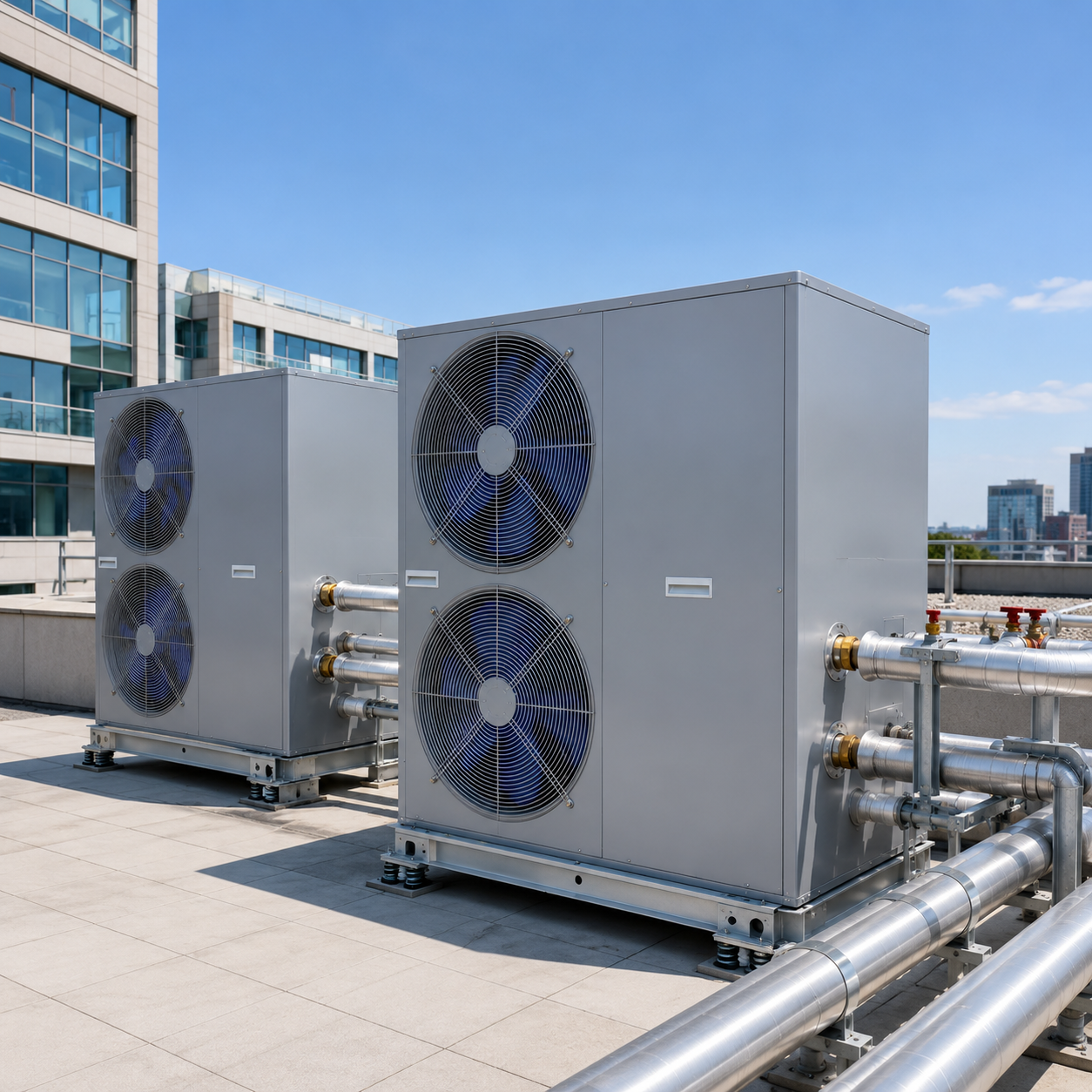
The KAFLG screw is Koven’s high capacity platform – this series is best suited when your hydronic loop requires in excess of 250kW of heating from one or two units.
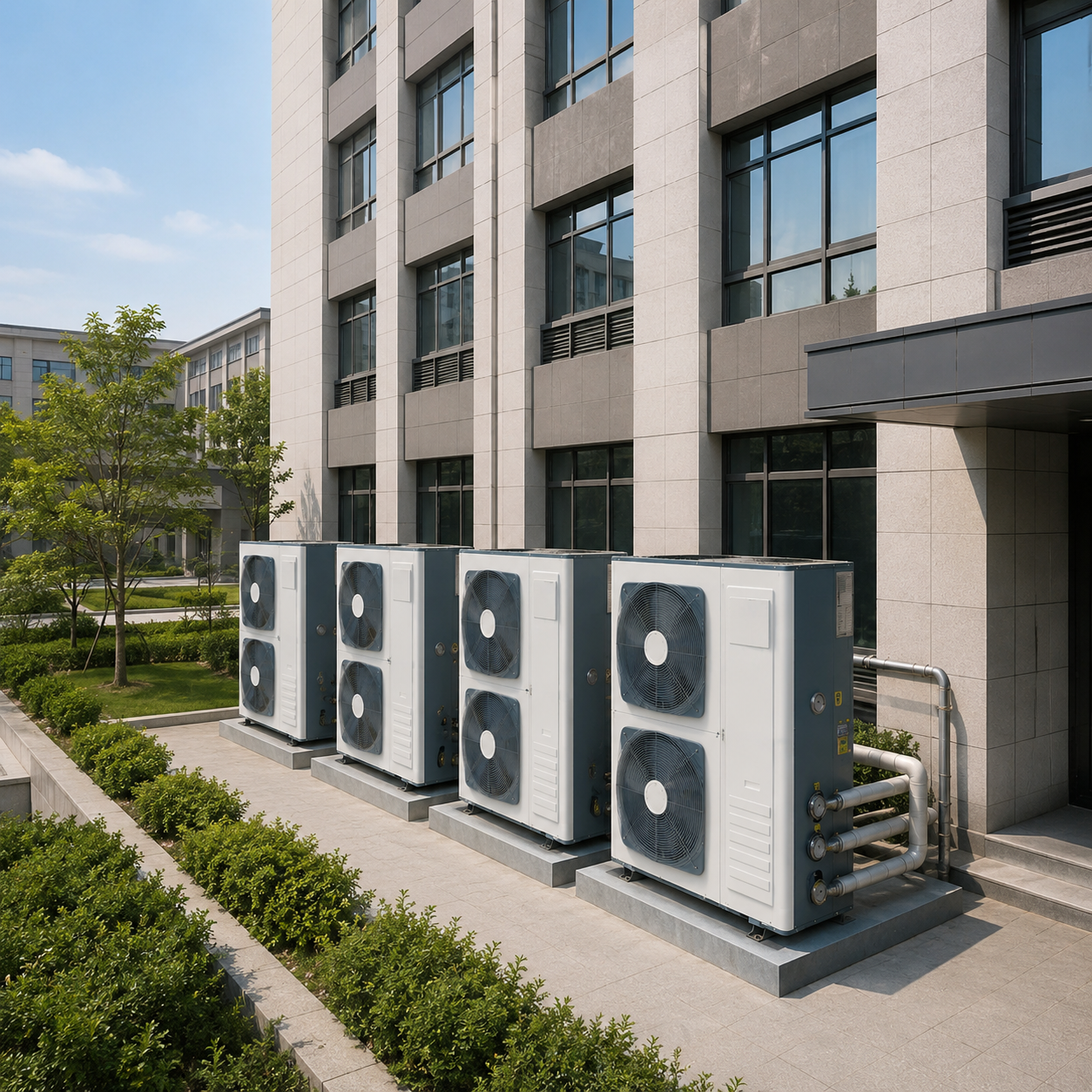
The KAFMH(A) scroll modular series offers a modular solution for mid-size buildings seeking factory matched modules rather than a single large screw unit.
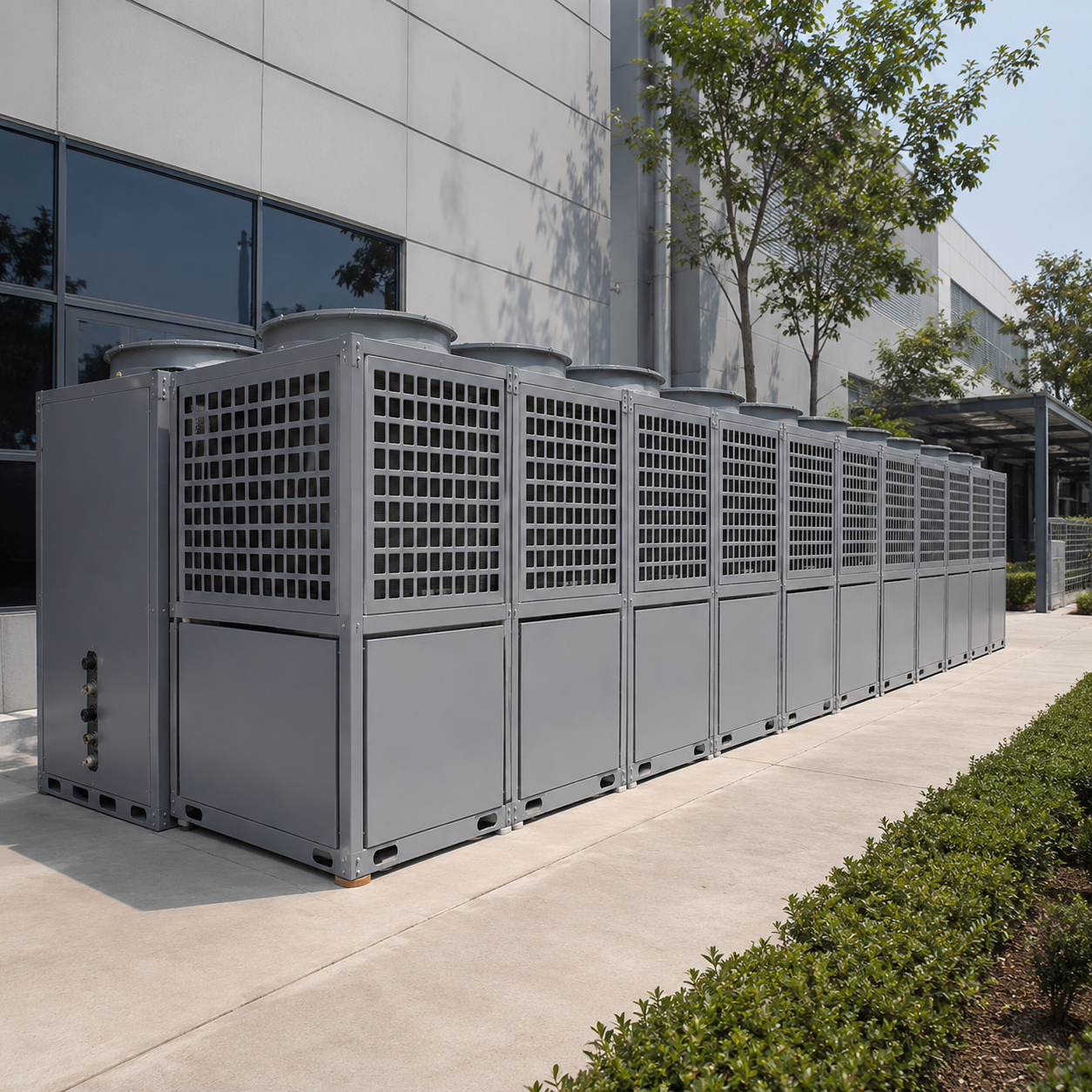
KAFM modular chillers are stackable – single modules can be added to form larger systems up to nearly 900kW, a practical solution when phased capacity and modular redundancy are critical factors.
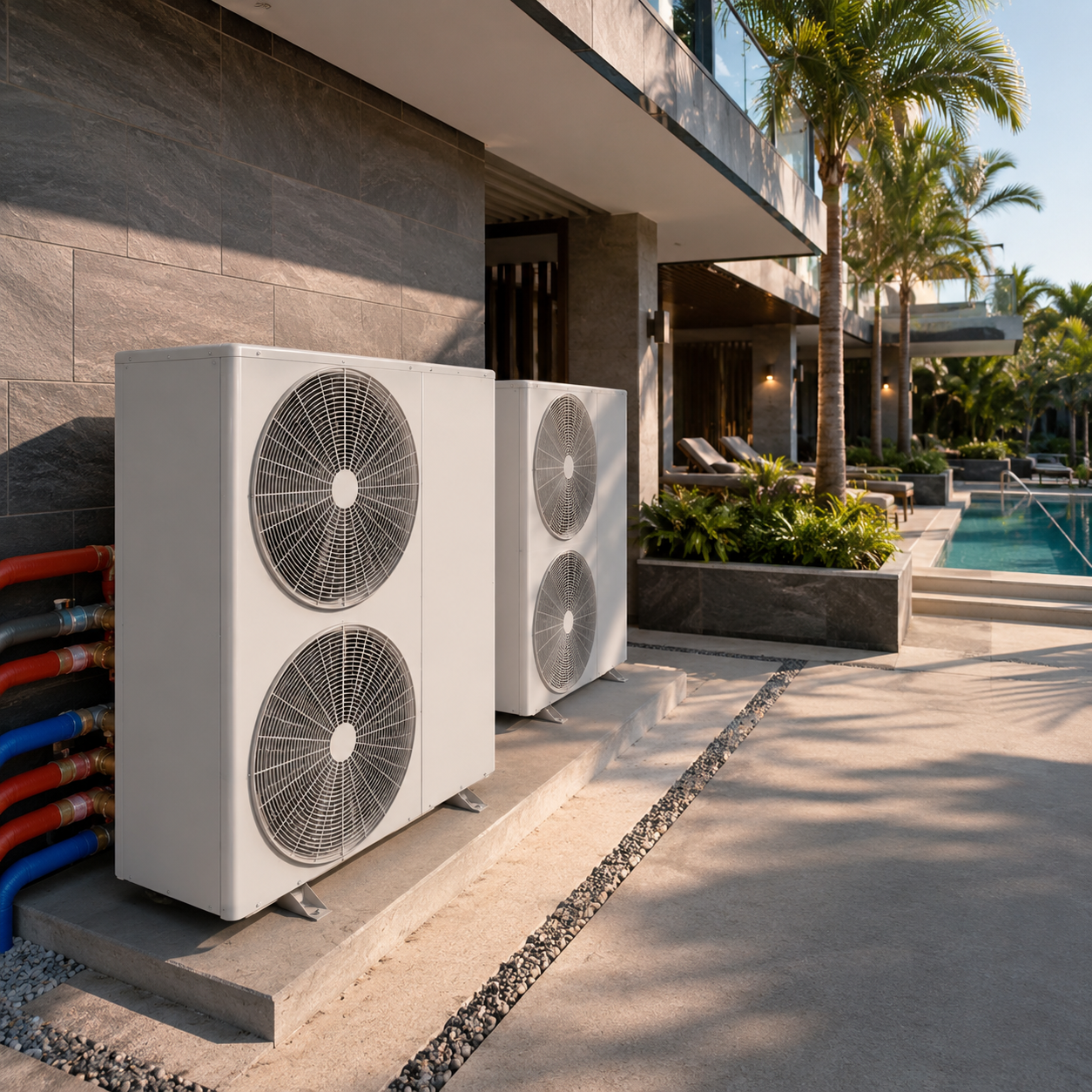
The 4-Pipe / heat-recovery series is available across the platform, enabling simultaneous heating and cooling while also utilizing up to 20-30% of the heat generated by the condensing cycle for hot water and pool applications.
Unsure which series and refrigerant options suit your project?
Download the KAFLG/KAFM datasheet →
Air-to-Water Heat Pump vs Boiler + Chiller Systems, Performance Comparison
Most commercial heat pump product comparisons list “efficiency” and “climate suitability” in the range of “Better / Best / Good” without specific COP or capacity numbers tied to a particular outdoor temperature. After reviewing prominent commercial air-to-water product comparison charts, including the one provided by Trane for their Ascend ACX models, it’s clear that the majority don’t provide a per-ambient temperature capacity or power number. They often cite a headline low temperature number only. Koven Air is attempting to fill that data gap, and this comparison was designed to do just that. Independent research on large heat pumps for commercial buildings makes the same point about efficiency-data quality across the category.
To clarify the difference: a boiler has the same output rating whether or not the outdoor temperature drops, but a heat pump doesn’t. This comparison isn’t meant to simply declare “heat pumps are always superior”; instead, it’s intended to supply you with the raw numbers required to make an informed sizing decision based on your specific climate and hydronic load, not on a broad marketing statement.
Want the comparison run against your building’s actual heating load?
Request a custom comparison →| Factor | Koven Air-to-Water Heat Pump | Boiler + Separate Chiller |
|---|---|---|
| Heating COP (rated) | 3.24–4.43 | gas boiler: ~0.85–0.95 combustion efficiency |
| Simultaneous heat + cool | Yes (4-pipe config, one unit) | No — two separate plants |
| On-site combustion / flue | None | Required for boiler |
| Heat recovery to hot water | 20–30% of condensing heat | Not applicable without added equipment |
| Heating capacity at low ambient | Derates per ambient temperature (see next section) | Constant, independent of outdoor temperature |
| On-site refrigerant footprint | Present (per series, R32/R410A/R1234ze/R407C/R134a) | None on the boiler side |
There’s no attempt to obscure this difference; the ability of a boiler to maintain consistent output across varying outdoor temperatures is a definite advantage in cold climates, which is precisely why ambient-derating figures – and not a general statement that it “works every where” – should be the focus of any sizing discussion, rather than buried in small print at the end of a specification sheet.
Bronze Tier — Performance Basis
3.24–4.43×
Rated heating COP means every kWh of electricity into the compressor delivers 3.2–4.4kWh of heat into the water loop — a boiler cannot exceed roughly 1x on the same input.
Source: Koven KAFLG/KAFMH(A)/KAFM heating COP test data. No third-party project case study is available yet for this line — request a project-specific engineering estimate rather than a blanket ROI percentage.
Applications: Hotels, Hospitals & Commercial Facilities
Koven Air’s hydronic HVAC equipment – across the chiller and heat-pump platforms built in the same Suzhou factory – has been specified into hospitals, business centers, industrial parks, office buildings, hotels, schools, and data centers. We’re transparent that a dedicated project case study specific to this air-to-water heat-pump line is still being collected; where we reference a Koven cold-climate deployment elsewhere on this site, it’s on the separate packaged rooftop-unit platform, not this hydronic line, and we label it as such rather than implying it’s the same product.
A note on domestic hot water:
Koven’s air-to-water units deliver 40-55°C water, which is well suited to space-heating and heat-recovery pre-heat duty. Where a project needs stored, potable domestic hot water, CDC guidance on controlling Legionella in potable water systems recommends storing that water at 60°C or higher, so a project using this line for potable DHW storage should pair it with a supplementary heater or blending strategy rather than relying on the heat pump’s output temperature alone.
Where the 4-pipe/heat-recovery configuration applies
- Hotels & hospitals – simultaneous heating and cooling across guest-room and common-area zones from one plant, with recovered condensing heat pre-heating water for space heating loops.
- Offices & mixed-use buildings – perimeter heating and core cooling running at the same time without a separate boiler plant.
- Pool/spa heat reuse – recovered condensing heat (20-30% of the rejected load) can be routed to pool or spa water up to the 40-50°C recovery range.
Manufacturing & Certifications, Built for 24/7 Commercial Duty
Koven Air has operated its own 20,000 m² Suzhou factory since 2007, when the company built its first screw chiller – the same engineering line behind Koven’s air-cooled screw chiller platform that this heat-pump line descends from. Eighteen standardized production processes, 400-point manufacturing traceability, 36-point factory inspection, and a 24-hour aging test run on every unit before it ships, alongside a dedicated in-house chiller-and-heat-pump test laboratory.
CE
Conformité Européenne
ISO 9001:2015
Quality management
ISO 14001:2015
Environmental management
ISO 45001:2018
Occupational health & safety
Refrigerant compliance: leading with the low-GWP path
U.S. federal rules under the EPA’s AIM Act Technology Transitions program set a 700 GWP ceiling for the air-conditioning-and-heat-pump equipment sector. Standard R410A (GWP 2,088), R407C (GWP 1,774), and R134a (GWP 1,430) all sit above that limit and face phase-down restrictions on new equipment in the affected categories; R32 (GWP 675) and R1234ze (GWP 1) sit below it. Every Koven series in this lineup already offers a low-GWP path – R32 across the scroll and modular lines, R1234ze on the screw line – so the compliance direction is a selection option today, not a future retrofit. A recent U.S. patent filing on low-GWP refrigerant systems for air-to-water heat pumps (US20250034445A1, 2025) reflects how central this transition is to the category.
Need the full compliance documentation for your market?
Download full compliance documentation →Air-to-Water Heat Pump Engineering Systems and Sizing Tools
SYS.01
Ambient Derating Sizing Calculator
kovenair.com/heat-pumps/air-to-water/ambient-derating-sizing-calculator/Ready to compute thermal capacity derating factors based on site-specific ambient wet/dry bulb profiles.
Contact Engineering SupportSYS.02
3-Series Selection Compass
kovenair.com/heat-pumps/air-to-water/3-series-selection-compass/Analyze system coefficients and select configurations optimizing COP and SCOP variables.
Contact Engineering SupportSYS.03
Refrigerant GWP Compliance Reference
kovenair.com/heat-pumps/air-to-water/refrigerant-gwp-compliance-reference/Review environmental standard compliance matrices concerning low global warming potential refrigerants.
Contact Engineering SupportFAQ
All roles
How does an air-to-water heat pump system work?
How does an air-to-water heat pump system work?
An outdoor coil pulls heat from ambient air, a compressor raises its temperature, and a heat exchanger moves it into the building’s water loop — the same loop a boiler would otherwise heat.
What’s the difference between an air-to-water heat pump and an air-to-air system?
What’s the difference between an air-to-water heat pump and an air-to-air system?
Air-to-water systems deliver heat hydraulically through a water loop; air-to-air systems push heated air directly through ducts. That water-based distribution is what lets an air-to-water unit slot into hydronic infrastructure a boiler already used, and the same 4-pipe unit configured as an air to water heat pump for cooling simply reverses the cycle in summer.
From real buyer discussion
Are air-to-water heat pumps worth it for commercial buildings?
Are air-to-water heat pumps worth it for commercial buildings?
Honestly, it depends on your climate and hydronic load – a heat pump rated COP of 3.2-4.4 beats a gas boiler’s roughly 0.85-0.95 combustion efficiency at every unit of energy, but the heat pump’s output drops with ambient temperature, and a boiler’s doesn’t. Buyers who’ve cross-shopped indicate a lower actual ceiling in real-world water temperature than a boiler – a real design consideration.
From real buyer discussion
Does the heat pump still work when outdoor temperature drops below freezing?
Does the heat pump still work when outdoor temperature drops below freezing?
Yes, but only within each series’ rated ambient conditions, as capacity and efficiency are reduced as the ambient temperature drop. this is a documented, fundamental characteristic of all heat pump technologies, not a flaw unique to Koven. that’s why we show the actual correction tables above, instead of a single headline number.
Which Koven series suits my project?
Which Koven series suits my project?
Large hotel or hospital central plants generally fit the KAFLG screw series (1,000–2,872kW); mid-size buildings fit KAFMH(A) scroll modular (238–475kW); projects needing phased capacity or module-level redundancy fit KAFM modular (65–892kW, stackable). See the decision matrix above for the full breakdown.
Can this unit provide domestic hot water for a hotel or hospital?
Can this unit provide domestic hot water for a hotel or hospital?
A KAFLG can preheat water via heat recovery up to 40-50°C (104-122°F), but a domestic hot water system requires stored potable hot water to be maintained above 60°C (140°F) to control Legionella risk, so this unit should be paired with a supplementary DHW heater for that specific use case.
What refrigerants are available, and are they compliant with U.S. regulations?
What refrigerants are available, and are they compliant with U.S. regulations?
Low-GWP options (R32 and R1234ze) are offered on both lines, below the 700-GWP threshold for air-conditioning and heat pumps established by the EPA’s AIM Act. While we continue to offer higher-GWP options like R410A, R407C, and R134a, these fall above the limit and are subject to ongoing phase-downs, so they should be specified only if required by the local market and building code.