Get in Touch with Koven Air Company

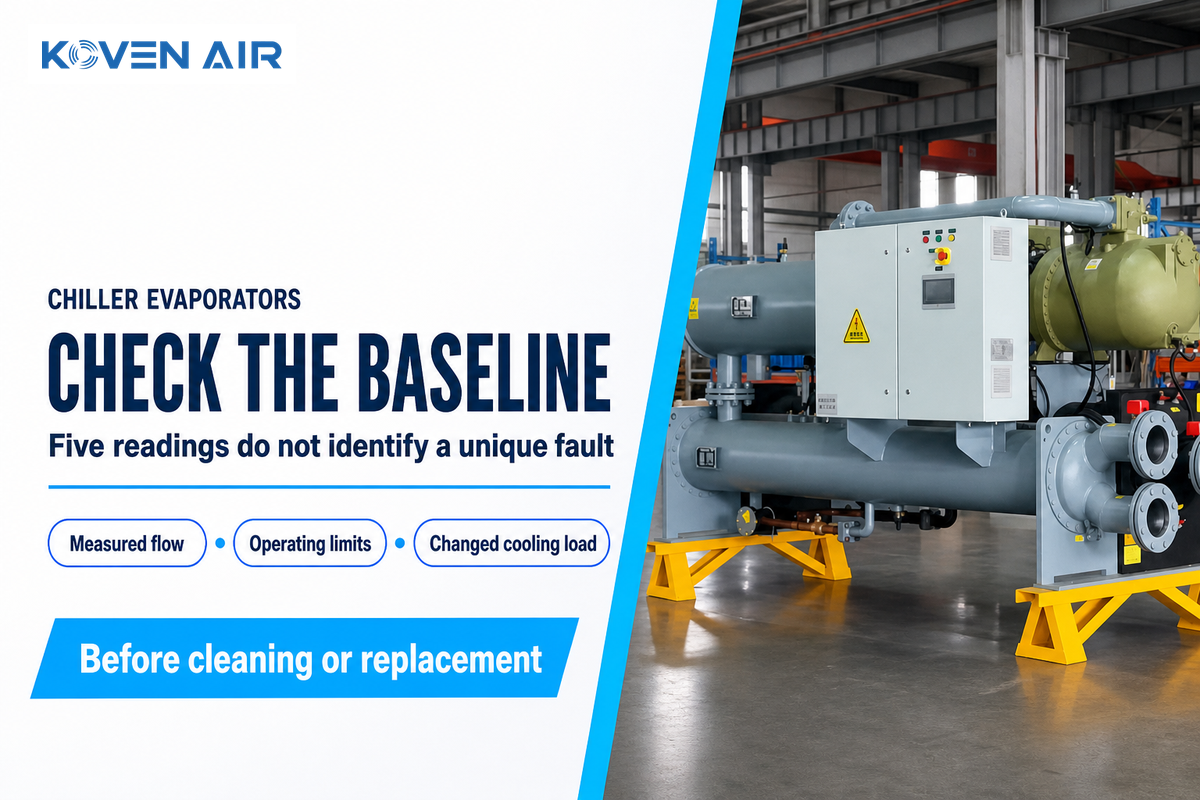
Before discussing replacement for evaporator chiller problems, check that the readings describe the same operating condition. Start with the heat exchanger, its refrigerant circuit, and the process fluid. A useful investigation separates lost heat transfer from restricted flow, unreliable sensing, and a changed cooling load.
Quick reference
- Scope: industrial and commercial liquid chillers.
- Record: entering and leaving fluid temperatures, refrigerant saturation temperature, and inlet and outlet fluid pressures.
- Add: measured flow, load, fluid composition and exact model limits.
- Illustration only: 12°C entering, 7°C leaving and 4°C saturation give a 5 K water difference and a 3 K approach.
Evaporator chiller diagnosis compares heat pickup with measured flow and model-specific operating limits. Five readings organize the evidence; they do not identify a unique fault. Check the baseline before authorizing cleaning or replacement.
Key points
- Low water delta T doesn’t, by itself, prove excessive water flow.
- Geometry and refrigerant operation describe different aspects of an evaporator.
- Glycol protection, hydraulic performance and electrical availability need separate checks.
- Replacement acceptance belongs in the quotation, with the operating conditions attached.
What the Chiller Evaporator Actually Does
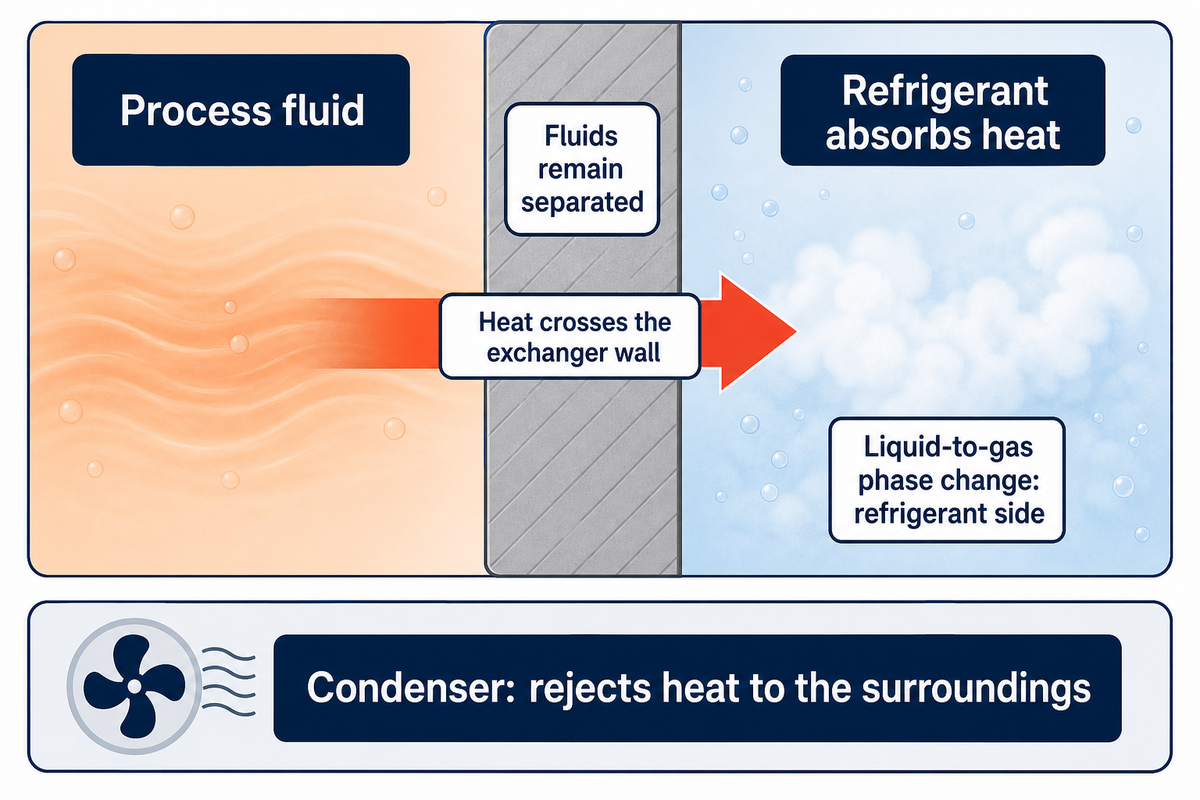
A chiller evaporator is a heat exchanger where refrigerant absorbs heat from circulating water or some other specified process fluid. During regular operation, heat crosses the exchanger wall while the fluids remain separated. The evaporator and condenser transfer heat at different points of the cycle. The condenser, for example, rejects heat from the refrigeration system to its surroundings.
What does an evaporator do in a chiller?
The evaporator cools liquid for the process or building. Refrigerant can evaporate to take up the heat; the compressor then moves refrigerant vapor through the cycle. An expansion valve controls refrigerant in the applicable design. The liquid-to-gas phase change belongs on the refrigerant side rather than describing the chilled water.
AHRI’s liquid-chiller guide describes equipment used in both occupied spaces and industrial processes. An air handler can make use of chilled water to produce cold air, while a production line can use liquid directly through its process heat exchanger. These create a different set of requirements for temperature control.
Common mistake: viewing evaporative condensers as evaporator types. Rejecting heat can occur through an “air-cooled” or “water-cooled chiller.” A chiller condenser can reject heat to ambient air or another cooling-water circuit while the evaporator cools the load. We discuss evaporative condenser heat rejection and how different pieces of equipment can affect water consumption.
A supplier’s promise to “remove heat” requires a defined side of the system. For a hypothetical process returning at 12°C and requiring 7°C supply, the evaporator duty concerns that liquid circuit. A description of a condenser doesn’t stipulate the required duty, and physical separation doesn’t guarantee protection against a damaged tube leaking.
Evaporator Types: Geometry and Refrigerant Operation
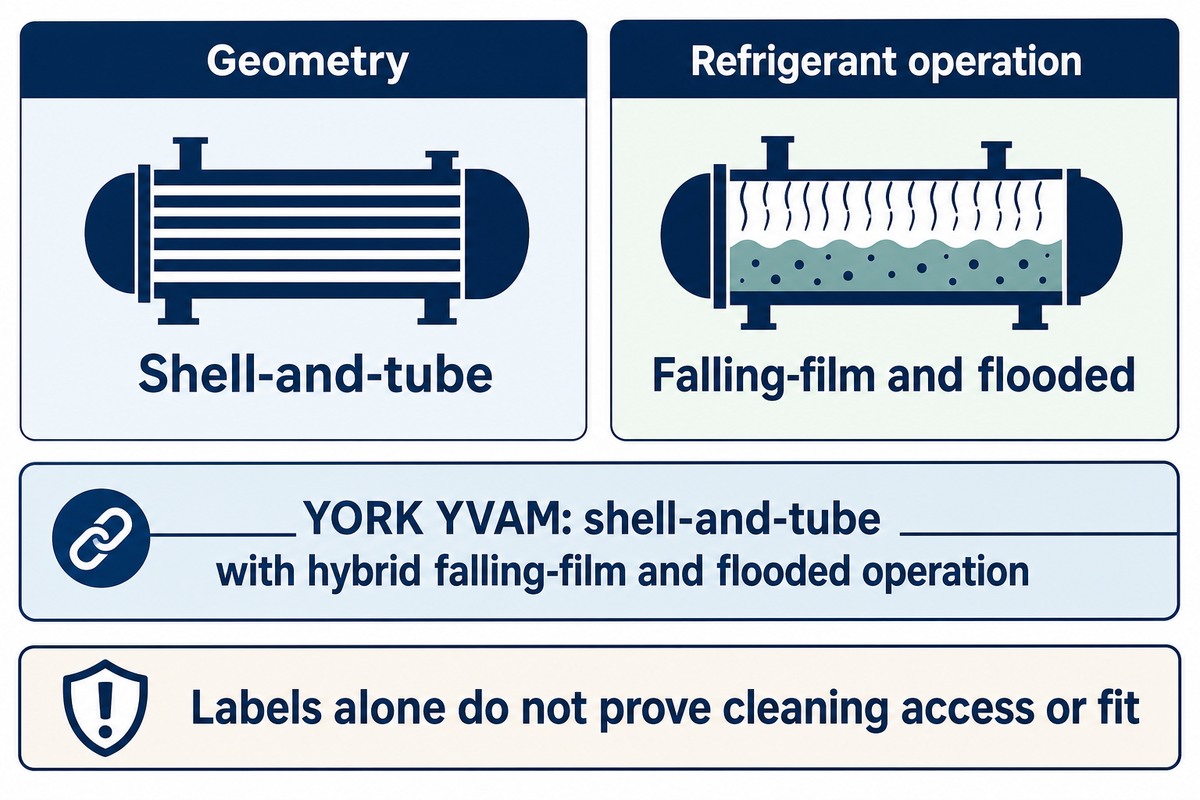
When examining types of evaporators, the shape and the refrigerant operation must be addressed separately, as defined in the model documentation. A description of shell-and-tube construction would address geometry, and a description of flooded or falling-film operation would address refrigerant behavior. None of the labels, in isolation, provides evidence to support that a proposed replacement could be cleaned or fitted in the available space.
The YORK YVAM manual describes a shell-and-tube evaporator with hybrid falling-film and flooded operation. The refrigerant is supplied by a distributor in the upper section, while the lower section is flooded. Calling shell and tube, falling film and a flooded evaporator three mutually exclusive choices would misdescribe that machine.
| Question | Document to request | Buying consequence | Limitation |
|---|---|---|---|
| What is the geometry? | Exact model sectional drawing | Establish the liquid and refrigerant passages | A family name does not establish dimensions |
| How does refrigerant reach the surface? | Manufacturer’s operating description | Identify the intended distribution method | Do not infer a different model’s control logic |
| Which surfaces can be inspected? | Model service procedure | Plan a permitted inspection or cleaning method | Do not assume every exchanger opens |
| Can tubes be replaced? | Service drawing and removal clearance | Reserve the required access route | Tube-pull requirements apply only to relevant designs |
| Which fluids and materials are approved? | Manufacturer’s fluid, material and heat transfer area schedule | Check process-water compatibility before ordering | No universal material or glycol approval follows from the geometry |
The abstract by Lin and colleagues, hosted by ORNL, for their December 2023 review presents horizontal-tube falling-film evaporators. Their dataset spans 4,114 points, six refrigerants and five tube types. Those are the researchers’ data, not KovenAir test results or a performance guarantee for a particular machine.
Inquire as to what level of access the offered model requires before comparing purchase costs. Inclusion of tube pull space by AHRI addresses chillers with replaceable heat exchanger tubes. Absence of such definition leaves maintenance costs unresolved. Use the chiller family selection guide to gain a broader equipment choice, and then obtain the offered model’s information.
Measure Approach, Water Delta T and Pressure Drop Together
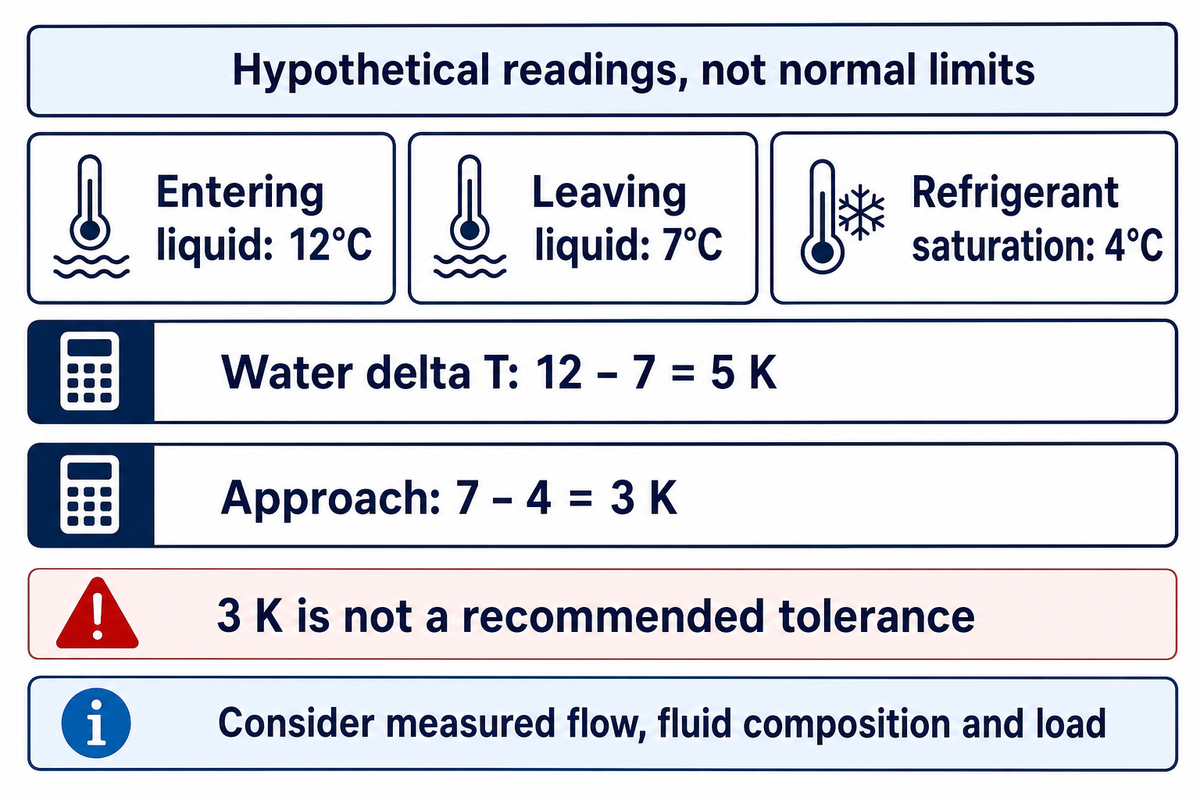
Differences in water temperature, approach, and water side pressure drop address different issues. Record readings at a stable, identified operating condition and compare to the baseline provided by the manufacturer. Measured flow, fluid composition, and load must be considered. Five readings alone can’t determine cooling capacity or safe operation.
How do you measure chiller evaporator approach?
Use temperature references prescribed for the model and for the refrigerant circuit. Approach is defined by Trane for RTAC chillers as leaving-water temperature minus the saturated evaporator refrigerant temperature. Delta T of water is calculated by subtracting leaving-water temperature from entering-water temperature. For pressure drop, subtract the downstream liquid pressure from the upstream pressure at the taps.
Refrigerant blends introduce an additional question: which saturation reference does the controller use? Ask for the manufacturer’s reference rather than substituting your own, e.g., dew or bubble. Circuit identity, pressure and temperature, and “evaporator temperature” need to be recorded. “Evaporator temperature” from a different sensor location may not necessarily mean the required reference temperature.
| Recorded or calculated item | Observation A | Observation B | What remains unknown |
|---|---|---|---|
| Entering liquid | 12°C | 12°C | Whether load and flow are comparable |
| Leaving liquid | 7°C | 9°C | Approved setpoint and tolerance |
| Refrigerant saturation reference | 4°C | 4°C | Correct circuit and reference convention |
| Liquid inlet pressure | 150 kPa | 150 kPa | Tap location and instrument validity |
| Liquid outlet pressure | 130 kPa | 130 kPa | Fluid condition and applicable flow curve |
| Water delta T | 12 − 7 = 5 K | 12 − 9 = 3 K | Heat duty without a flow measurement |
| Approach under the stated convention | 7 − 4 = 3 K | 9 − 4 = 5 K | Whether the change identifies a fault |
| Liquid pressure difference | 150 − 130 = 20 kPa | 150 − 130 = 20 kPa | Flow without the correct model/fluid relationship |
| Decision | Retain the recorded context | Investigate the changed result | Neither observation authorizes cleaning or replacement alone |
Let’s say the plant manager gets these two logs with a request to purchase a replacement. The second record shows warmer supply liquid, a smaller water difference and a larger approach. Maintenance still needs to establish whether production load changed, whether the flow measurement is valid and whether both instruments describe the same circuit. An unchanged 20 kPa pressure difference doesn’t settle those questions. The logical purchasing response is to request the missing context and conduct a model-based comparison before making an intervention decision.
AHRI defines water-side refrigeration capacity using mass flow and enthalpy difference. The historical Haves and Khalsa chiller-monitoring case also separates transient data from useful comparisons and checks measurement consistency. A calculator can’t repair an unidentified fluid, a misplaced sensor or missing flow data.
Engineering note: a 3 K approach is the result of the illustrative 7°C and 4°C readings, not a recommended tolerance. Obtain the acceptable operating envelope and instrument uncertainty from the model documentation. Temperature and pressure readings should retain their location, circuit and operating context when passed to the service team.
Separate Fouling, Low Flow and Sensor Error
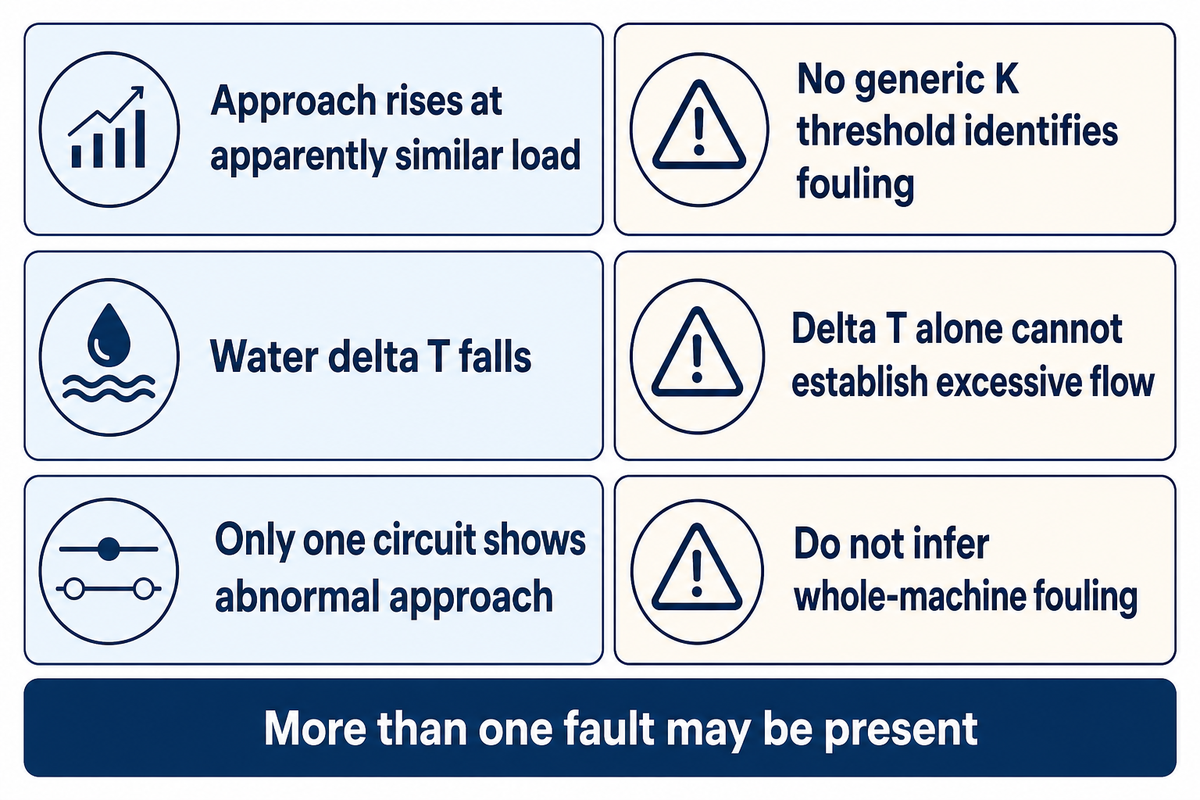
Evaporator performance may deteriorate due to fouling. Restricted flow, bypassing, sensor faults and refrigerant-side problems may also produce the same effect. Use a comparison that allows the principal explanation to be ruled out. More than one fault may be present, and an unresolved result is preferable to a wrong diagnosis.
What are the common causes of a chiller evaporator fault?
In Trane’s RTAC guidance, various effects of water flow, glycol, oil, fouling and refrigerant control are discussed. In YORK’s YVAM guidance, waterbox bypass and refrigerant leakage are discussed as possible causes for a changing temperature split. These are model-specific leads. Transferring an oil-related explanation to equipment without the same oil system would be a poor starting point.
In the public abstract of Xinzhi Zhao’s 2011 dissertation, simultaneous occurrence of multiple faults on two field chillers is reported. This supports keeping multiple explanations. It doesn’t validate the matrix below or state how often the faults occur.
5-Reading Evaporator Diagnostic Matrix
| Observation | Competing explanation | Next evidence check | Limitations / Not suitable for |
|---|---|---|---|
| Approach rises at apparently similar load | Surface condition, fluid change, flow or refrigerant control | Confirm model baseline and actual fluid/flow | No generic K threshold identifies fouling |
| Water delta T falls | Changed load, flow, bypass or temperature measurement | Compare measured load and flow with the prior condition | Delta T alone cannot establish excessive flow |
| Water delta T rises | Changed heat input or reduced liquid flow | Check contemporaneous flow and process demand | No unique cause follows from two temperatures |
| Water-side pressure difference changes | Hydraulic condition, fluid properties or pressure sensing | Check tap locations and the applicable manufacturer relationship | Do not use an unrelated water curve for another fluid |
| Only one circuit shows abnormal approach | Circuit-specific measurement or refrigerant-side condition | Compare circuit identity and model service guidance | Do not infer whole-machine fouling |
| Readings conflict with delivered cooling | Sensor or operating-state mismatch | Have the service team check measurement consistency | No invasive instrument work by an unqualified operator |
| New installation performs poorly | Commissioning, debris, controls or selection mismatch | Review commissioning records and approved duty | New equipment is not proof of a clean hydraulic circuit |
| Freeze or low-flow protection repeatedly trips | An unresolved protection condition | Retain alarms and obtain model-specific service assessment | Do not bypass interlocks or repeatedly reset the trip |
| One correction leaves another symptom | Concurrent faults or a wrong initial hypothesis | Repeat appropriate tests and reassess the remaining evidence | A successful partial repair does not prove full acceptance |
In their 2024 systematic review, van den Brink and colleagues state that low delta T in chilled water doesn’t always mean excessive flow. Their focus is on end-user cooling coils and chilled water systems. Measuring flow avoids inferring flow from temperature differences alone.
One of the constraints may lie outside the exchanger, e.g. a pump, strainer, bypass, control valve or sensor. The constraint may limit the evidence needed to provide assurance for delivered cooling. The control-valve pressure balance guide addresses only one of the hydraulic aspects of the problem. Neither a larger replacement nor better promoted heat exchange efficiency provides evidence that an unresolved system constraint will disappear.
A drop in illustrative water temperature difference from 5 K to 3 K should prompt a comparison, not a purchase order. Note what changed at the time of those measurements. A technician’s confirmed flow or sensing defect gives procurement a different scope from a verified damaged exchanger, even when the original complaint was the same.
Freeze Protection Depends on the Whole Operating Envelope
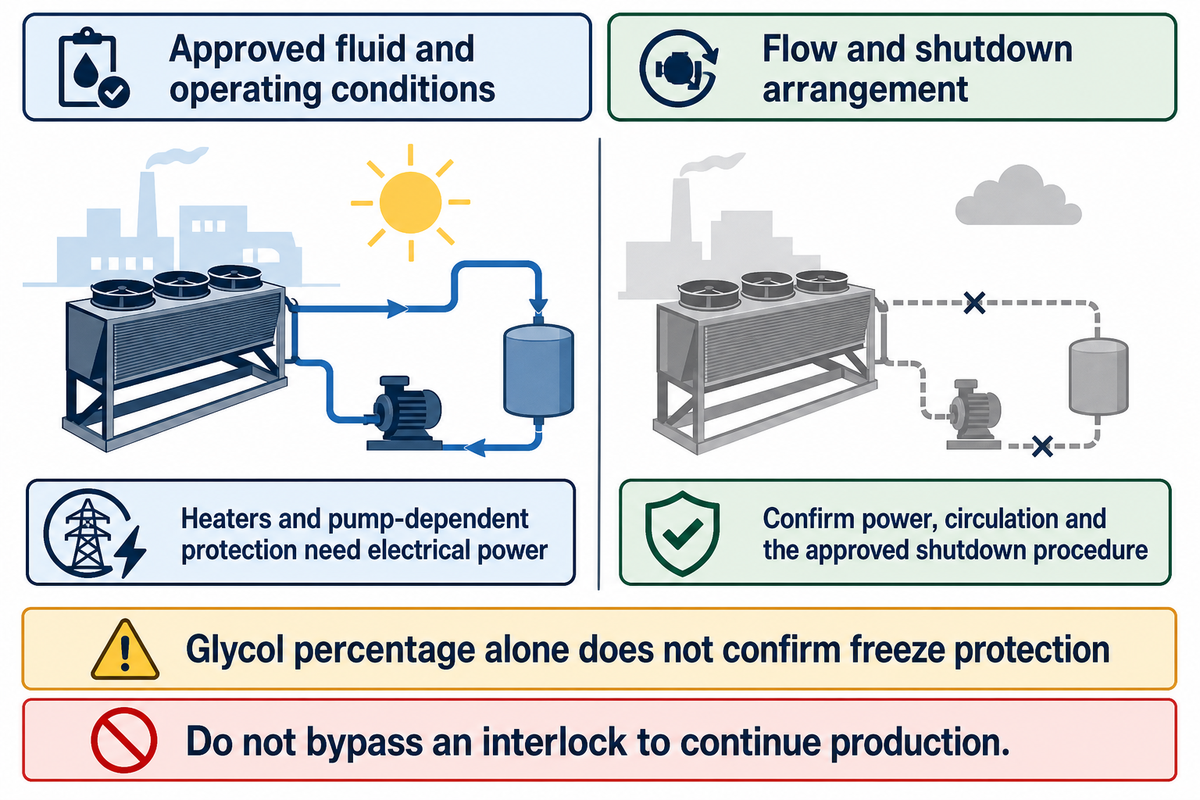
Freeze protection for an evaporator relies on the approved fluid, operating conditions, flow and shutdown arrangement for the exact chiller. Electrical heaters and pump-dependent protection rely on the availability of electrical power. A label reading “outdoor” or the percentage of glycol doesn’t confirm freeze protection, especially for extended shutdown conditions.
As mentioned in the YVAM manual, the power dependency is explicit, and the operating glycol freeze point must be below the lowest expected refrigerant temperature. In accordance with the manufacturer’s procedure and intended model, don’t take an evaporator coil, a flow switch or a controller setting as proof that all possible loss-of-power conditions have been addressed.
Colorado State University’s HVAC requirements distinguish dormant-system burst protection from applications that need to start in cold weather. This is a good distinction to consider when talking to the designer. The local mixture requirements of the university aren’t universal recommendations for industrial temperature control systems.
“The system’s total pressure drop should be corrected for the increase of glycol and the process pumps sized accordingly.”
The quote provides historical information on hydraulic corrections and isn’t a current concentration table. For heat transfer efficiency and cooling capacity, the basis of evaluation changes with the fluid selection. Request the approved fluid properties and the manufacturer’s recommendations at the intended temperatures; don’t assume a straight water rating still applies to the case in question.
Consider a facility that operates equipment during the day and disconnects power to the equipment during a winter shutdown. Procurement sees an evaporator heater on the equipment list and assumes the shutdown is covered. Maintenance needs to determine if that protection is still powered, whether circulation is required, and what shutdown procedure the manufacturer approves. Finance needs to cost the complete system, including the utilities and service. The difference may matter even though the process normally requests 7°C liquid: the illustrative running setpoint says nothing about the coldest unattended condition or the lowest refrigerant temperature inside the evaporator.
Do
- Identify the fluid and approved operating envelope.
- Confirm shutdown power and circulation assumptions.
- Retain alarms for qualified service review.
Don’t
- Transfer another model’s freeze settings.
- Assume glycol removes every operating constraint.
- Bypass protection to maintain production.
For air-cooled chiller configurations, document ambient exposure separately from the process setpoint. A 7°C running requirement doesn’t define winter protection. Ask the supplier to identify the conditions covered by its proposal and the actions needed when those conditions no longer hold.
Decide Whether to Clean, Repair or Replace
Cleaning, repair or replacement is determined by the confirmed defect and the required operating result. Define an acceptance comparison before purchasing the intervention. Manufacturer performance information and a trustworthy baseline matter more than an isolated symptom, because a new exchanger will not automatically correct a hydraulic or measurement problem elsewhere.
The Haves and Khalsa 2000 case, which involved a chiller rated at 228 tons, described how the highest observed duty was less than 170 tons. The study relied on baseline performance and measurement checks as opposed to assuming that nameplate capacity described each operating point. Those numbers belong to that historical case; they aren’t a recommended load range for a current purchase.
When not to buy a replacement evaporator
Don’t approve a replacement solely because approach has increased or the process is “warm.” Be sure to ask what evidence supports the condition of the exchanger and what would refute the proposed cause. An unresolved sensor discrepancy can invalidate the before and after comparison. Evidence of leakage or physical damage warrants further investigation rather than cleaning the exchanger. What’s warranted is a model specific service and a replacement evaluation rather than a cleaning recommendation.
Cleaning requires an approved method that’s compatible with the model and its materials. The buyer should request the approved cleaning method and expected acceptance evidence rather than prescribe a cleaner based on a generic article. LBNL’s baseline-and-retest approach allows repeating appropriate tests after correcting identified defects. It doesn’t provide a universal allowable approach, pressure loss or cleaning interval.
When a maintenance proposal and a capital proposal are each offered to resolve the same issue with potentially different results, what evidence does the proposer cite in support of acceptance? Hypothetical 12°C return and 9°C supply temperatures don’t prove acceptance. To accept either proposal, what’s the evidence each bidder cites about the defect addressed, the test conditions and the agreed acceptance result? If flow remains unstated, a promise to restore the original 7°C supply needs further evaluation. Finance can then compare defined scopes rather than purchasing a larger nameplate as a substitute for diagnosis.
Record comparable operating conditions before and after the intervention. Use the chiller efficiency rating comparison for its stated purpose; a rated comparison of efficiencies doesn’t diagnose the equipment being reviewed. No energy-saving percentage or payback period can be supported here without site measurement and a costed proposal.
What to Send a Chiller Supplier Before Replacement
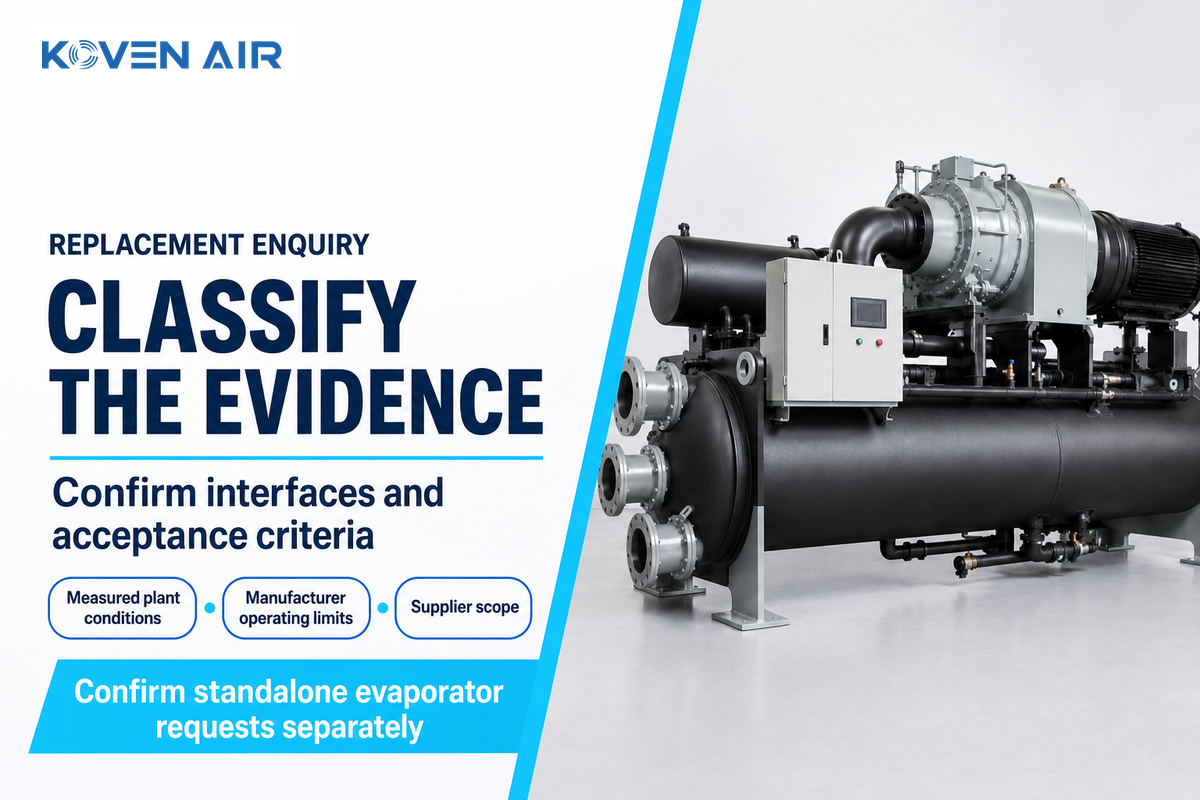
A useful replacement enquiry separates measured plant conditions, manufacturer operating limits and supplier’s scope. Nominal capacities can’t substitute for the record. In addition to a record of the fluid, temperature requirement, flow behavior and applicable rating conditions, ask the supplier to confirm interfaces and acceptance criteria. Confirm these for the exact model.
Model-to-Quote Evaporator Handoff
The categories distinguish types of evidence; they add to AHRI’s selection and installation questions. Additional purchasing questions to the manufacturer, not compatibility guarantees supplied by AHRI, include pressure ratings and interface dimensions.
| Evidence class | Record to attach | Supplier response required | Limitations / Not suitable for |
|---|---|---|---|
| Identity | Model, serial and refrigerant circuit | Exact offered scope and model | No assumption of standalone-part availability |
| Measured temperature | Entering/leaving readings in °C | Duty at the specified temperatures | Setpoint alone is not a measurement |
| Measured flow | Value in L/s or m³/h and measurement method | Allowed operating flow range | Do not infer flow from nominal pump size |
| Fluid identity | Chemistry and verified concentration basis | Approved fluid and performance corrections | Water ratings may not cover the fluid |
| Hydraulic interface | Tap locations and pressure loss in kPa | Applicable model/fluid relationship | An unrelated curve is not acceptance evidence |
| Refrigerant reference | Refrigerant, circuit and temperature convention | Compatible circuit and controls | No refrigerant substitution assumed |
| Mechanical interface | Connection and access dimensions in mm | Confirmed fit and service clearance | A drawing review is still required |
| Operating envelope | Load pattern, exposure and shutdown arrangement | Covered conditions and utility dependencies | No guarantee outside the approved envelope |
| Condition history | Trends, alarms and completed service findings | Defect addressed by the proposal | Reported symptoms are not a confirmed cause |
| Acceptance | Agreed test conditions and responsibility | Documented limits and test evidence | No generic blog threshold replaces the contract |
The following compact checklist is recommended for quotation requests. The ranges must be specified for the selected model based on the process requirement. None is provided here as a generic value.
| Parameter | Recommended range | Why it matters | How to verify |
|---|---|---|---|
| Liquid temperature | Approved requirement in °C | Defines the delivered process condition | Selection sheet and test record |
| Liquid flow | Model-approved range in L/s | Connects duty with hydraulic operation | Measured flow and manufacturer limits |
| Pressure loss | Agreed allowance in kPa | Checks the proposed hydraulic interface | Correct fluid/model curve |
| Fluid concentration | Supplier-approved specification and basis | Changes protection and performance | Fluid record and corrected selection |
| Access clearance | Model drawing dimensions in mm | Determines installation and future service access | Site drawing review |
A plant manager’s 7°C requirement and a supplier’s capacity figure become comparable only when the proposal states its operating basis. Procurement should ask which fields are confirmed and which require a site check. KovenAir publishes this guide and sells complete industrial chillers; confirm a standalone replacement-evaporator request separately.
Current Standards and Service Documents to Recheck
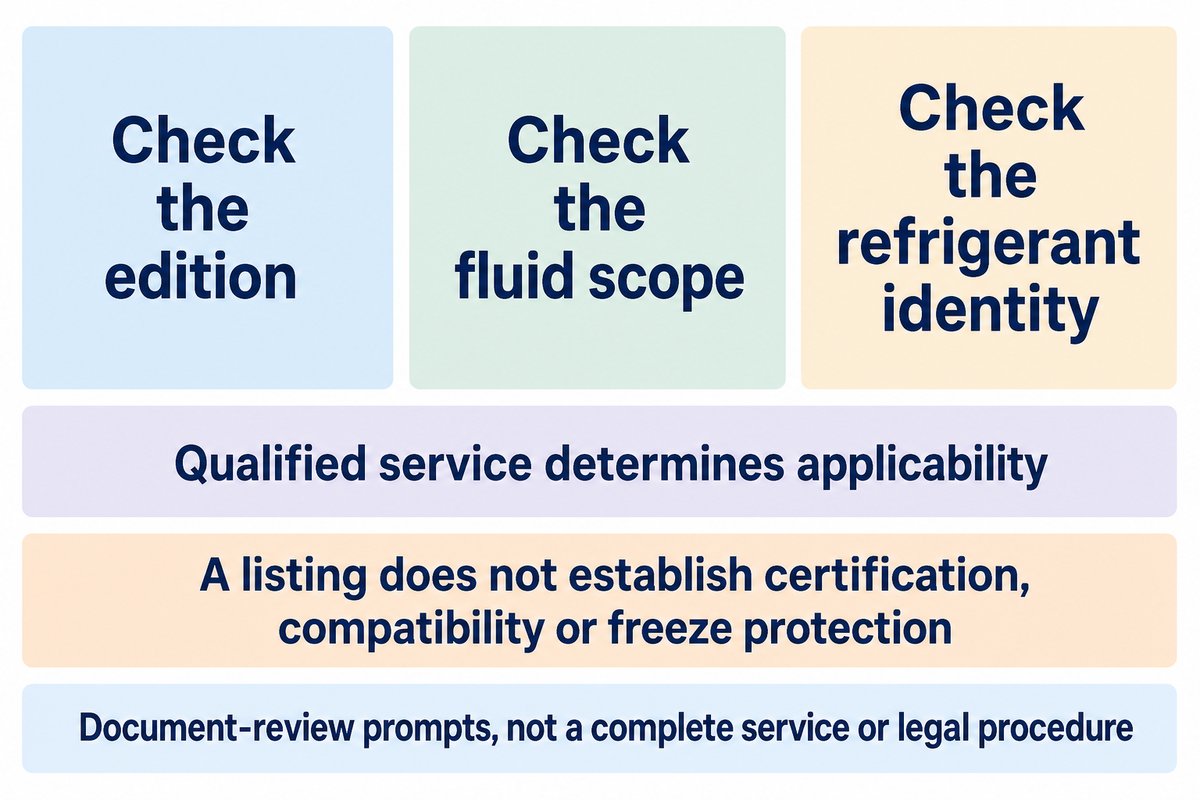
Current chiller documents matter because rating and service obligations apply to defined equipment and conditions. Check the edition, fluid scope and refrigerant identity before transferring an old specification into a replacement enquiry. A listing doesn’t establish that an offered unit is certified, compatible or protected against freezing.
The AHRI standard listing 551/591-2026 provides SI units and 550/590-2023 provides I-P units. The scope of the standard excludes units with evaporators or condensers using a liquid other than water. Ask what rating basis the supplier gives for the actual fluid; don’t assume a water rating and apply it to a glycol case.
United States refrigerant service requirements, as described in 40 CFR 84.106 (a), apply from January 1, 2026, to applicable equipment with a full charge of at least 15 pounds of refrigerant with a regulated substance or a substitute for a regulated substance with global warming potential greater than 53. The provision excludes refrigerants consisting solely of substances that deplete the ozone layer and the residential/light commercial air conditioning and heat pumps.
This is different from the EPA Section 608 website, whose leak-repair scope concerns equipment with a full charge of at least 50 pounds of ozone-depleting refrigerant and the applicable leak-rate threshold. Have the qualified service provider determine the applicability of these requirements to the equipment. These references are document-review prompts and not a complete refrigerant service or legal procedure.
A full-charge record showing 15 pounds and a full-charge record showing 50 pounds aren’t interchangeable regulatory labels. Consider the model, refrigerant identity, application and the pertinent provision in combination. In the case provided, the model and refrigerant records along with the explanation should be sent to the service provider to evaluate the appropriate obligations without needing to reconstruct the installation from an incomplete quote.
Frequently Asked Questions
What are the three types of chillers?
Common groupings depend on whether the comparison concerns heat rejection or the refrigeration cycle.
Air-cooled and water-cooled describe common heat-rejection arrangements. Absorption describes a different cycle and shouldn’t be treated as an evaporator geometry. AHRI’s equipment guide discusses these distinctions. For a buying comparison, name the classification being used and then request the exact evaporator, refrigerant, fluid and rated operating conditions for each proposed machine.
What is the difference between an evaporator and a condenser chiller?
The evaporator absorbs heat from the load; the condenser rejects heat from the refrigeration system.
Both components can belong to the same chiller. Their pressure levels, fluid circuits and operating measurements serve different purposes. A condenser option doesn’t identify evaporator construction or establish a replacement part’s fit. A purchaser should identify the component in question and attach the exact model documentation before requesting a technical quotation.
What causes a chiller evaporator to freeze?
Freeze risk arises when the fluid and operating conditions fall outside the model’s approved protection arrangement.
Flow, fluid composition, refrigerant conditions, ambient exposure and shutdown utilities all need review. A heater requires its specified power supply, while a fluid mixture requires an appropriate selection for the intended duty. Repeated protective trips need qualified assessment using the machine’s instructions. Don’t bypass an interlock or copy a different model’s settings to continue production.
Is a chiller the same as HVAC?
A chiller can supply cooling within an HVAC system or serve an industrial process.
HVAC is the broader heating, ventilation and air-conditioning system. A process chiller may cool equipment or manufacturing fluid instead of occupied space. Identify the application before borrowing building-system operating assumptions.
How is low evaporator pressure diagnosed?
Qualified service compares the pressure with the refrigerant, circuit, load and model-specific operating information.
A low-pressure reading alone doesn’t identify low charge, restricted flow or another fault. Preserve the associated temperatures, measured fluid flow and alarm history. The refrigeration cycle also includes high-pressure and high-temperature sections, so operator observations should remain separate from invasive refrigerant work. Ask the service provider to state the evidence for its diagnosis and the acceptance test for the proposed correction.
Can condenser problems cause a chiller shutdown?
A condenser-side operating problem can affect the complete chiller system.
The exact trip and response depend on the model. Identify the alarm and the affected circuit before concluding that the evaporator needs replacement. Retain the operating records for the qualified service team.
Can a replacement evaporator use a different refrigerant?
A different refrigerant requires an explicit manufacturer and qualified-service compatibility assessment.
Don’t infer compatibility from similar cooling capacity or matching connections. Ask about the approved circuit, pressure ratings, controls and applicable service requirements. Superheat or saturation references can also be model-dependent. A proposal must state whether it supplies a compatible part, an engineered conversion or a complete replacement chiller, with each responsibility and acceptance condition identified.
Key takeaway
Five readings organize an evaporator investigation. Measured flow, operating context and model-specific evidence turn those readings into a defensible repair or procurement decision.
For a complete equipment enquiry, please send the model record and your requested duty information to KovenAir’s industrial chiller range. Request a selection at the specified conditions and an acceptance scope that’s clear and appropriate.
Technical scope: This handbook draws on public manufacturer documents, association material and attributed research. KovenAir has a vested interest in the complete-chiller enquiries; the research and the designs of competing manufacturers aren’t represented as KovenAir inventions or certifications.
Related Articles and Tools
References & Sources
- Liquid Chillers, Air-Conditioning, Heating, and Refrigeration Institute.
- Falling-film evaporator review abstract, Oak Ridge National Laboratory publication listing, December 2023.
- Chiller performance monitoring case, Haves and Khalsa, Lawrence Berkeley National Laboratory, 2000, hosted by the U.S. Department of Energy.
- Chiller fault-diagnosis dissertation abstract, Xinzhi Zhao, University of Nebraska, Lincoln, 2011.
- Chilled-water delta-T systematic review, van den Brink and colleagues, Applied Thermal Engineering, 2024.
- Division 23 HVAC requirements, Colorado State University Facilities Management, inspected October 2026.
- Does Your Chiller Need Antifreeze?, ACHR News, 2003.
- AHRI water-chilling and heat-pump water-heating package standard listing, Air-Conditioning, Heating, and Refrigeration Institute.
- 40 CFR 84.106, Electronic Code of Federal Regulations.
- Stationary Refrigeration Leak Repair Requirements, U.S. Environmental Protection Agency.