Get in Touch with Koven Air Company

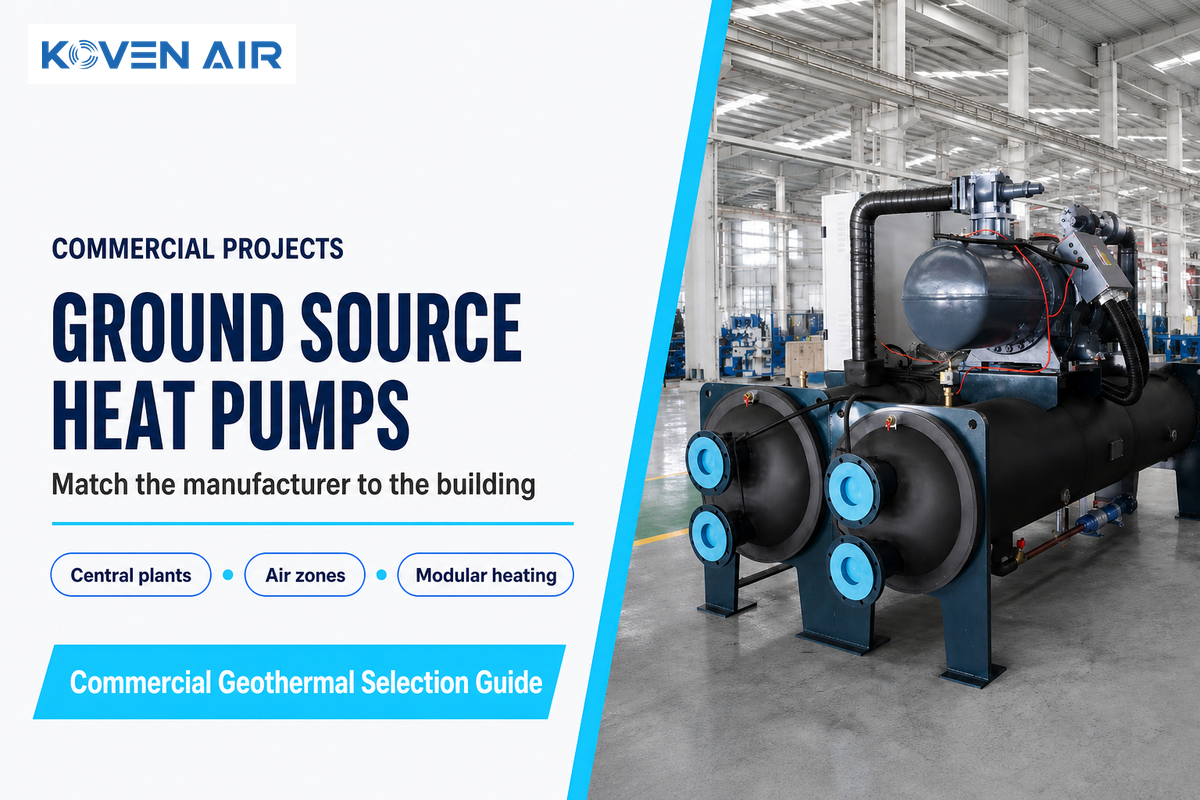
The best ground source heat pump manufacturer depends on the commercial system: Koven Air for large screw-compressor plants, WaterFurnace for individual air-conditioned zones, Kensa for modular UK heating, and Clivet for four-pipe heat recovery. Start with the building’s water or air distribution, then match the equipment to the ground loop.
Last updated: October 2026
Commercial geothermal HVAC systems cover a broader scope of equipment than residential systems. Examples of equipment configurations include a hotel with a central hot water plant, an office with separate zone units, and a warehouse with a boiler replacement. The equipment configurations for all of these examples are different, and this report compares named product families from 20 manufacturers or manufacturing groups, listing the application and buying limitations for each product family.
Quick Picks for Commercial Geothermal Projects
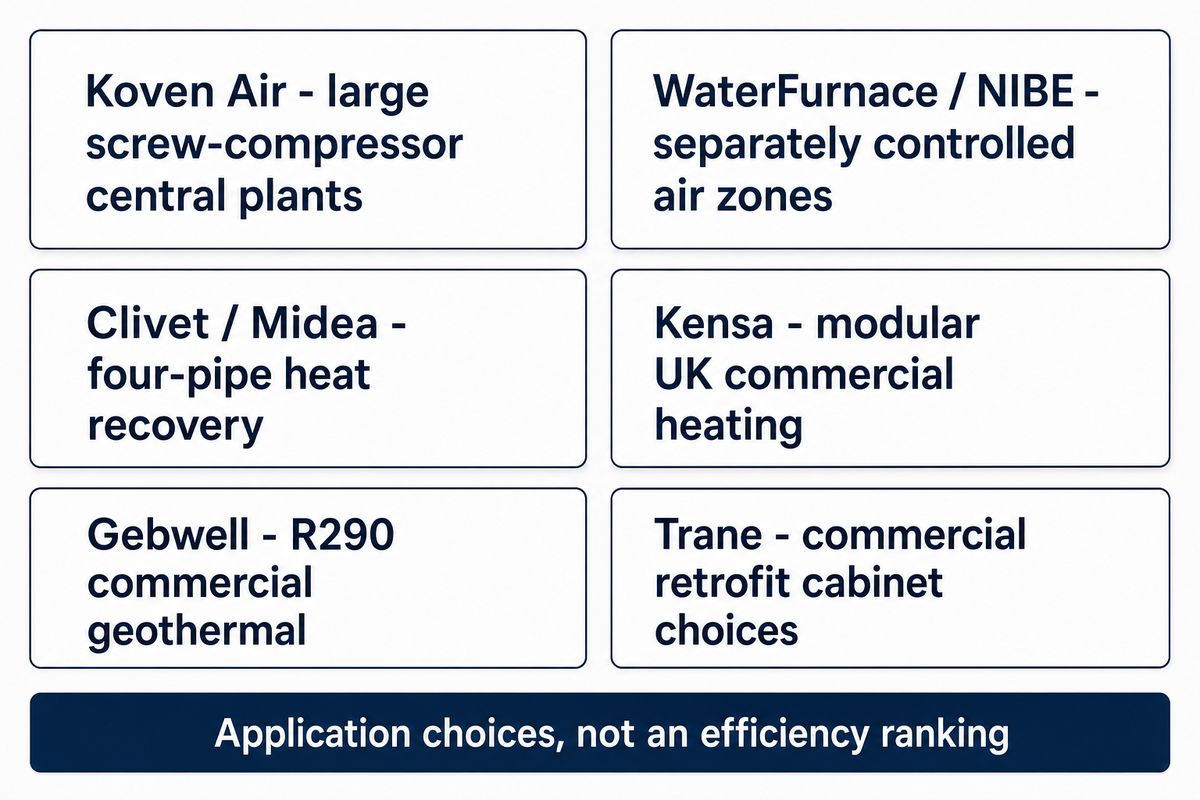
When considering the brand choices, you must first determine the heating and cooling system arrangement that will best suit your needs. These six choices cover a range of commercial needs, and aren’t a ranking of system efficiencies. The company cards give background information on the products, including whether the capacity refers to a single unit, a nominal size range, or a completed system.
- Best for large screw-compressor central plants: Koven Air. KASCMF water-cooled geothermal units address substantial hydronic loads.
- Best for separately controlled commercial air zones: WaterFurnace / NIBE. Versatec 500 is a water-to-air choice.
- Best for simultaneous loads in four-pipe buildings: Clivet / Midea. ELFOEnergy Ground MF combines cooling with heat recovery.
- Best for modular UK commercial heating: Kensa. The Q range supports cascades and building controls.
- Best for an R290 commercial geothermal selection: Gebwell. G-Eco includes a documented logistics-centre application.
- Best for commercial retrofit cabinet choices: Trane. Axiom includes horizontal, vertical, rooftop, and water-to-water formats.
Disclosure: This guide is published by Koven Air. We list ourselves first because this is our website, not because we claim to be the market leader. The other 19 manufacturers are grouped by what they’re best for, in no particular order within each group.
How We Selected These Ground Source Heat Pump Manufacturers
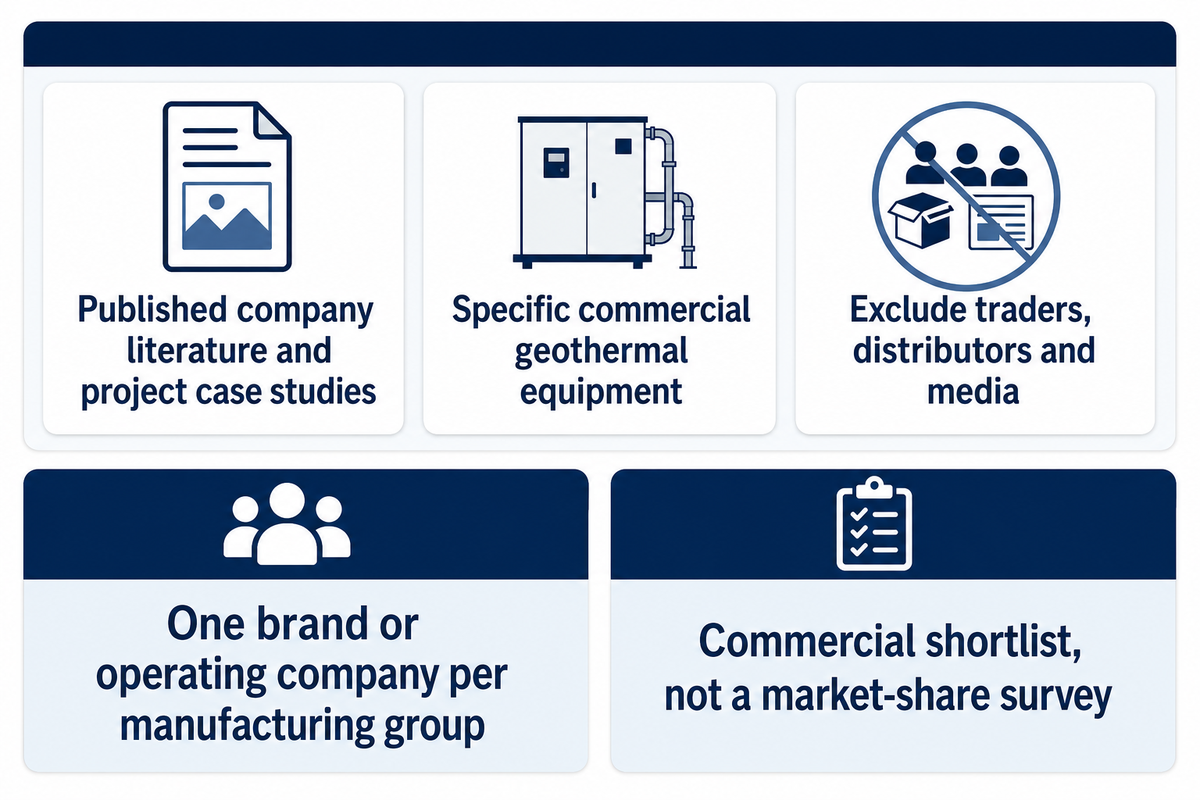
Companies in this report were vetted against published project case studies and company literature in October 2026. We focused on companies in Europe, North America, and China. Companies included in this report had a specific geothermal equipment offering for the commercial sector documented beyond a simple water cooled chiller description. Trading companies, distributors, sourcing platforms, directories, media websites, used-equipment dealers, and drilling-only contractors were excluded.
Each entry for manufacturing groups shows only one brand or operating company. That prevents several sibling brands from occupying separate places, but doesn’t imply 20 unrelated factories or disclose every original-equipment manufacturing relationship. Examples of equipment product features and their advantages are from the manufacturer’s website or other publications and are the basis for the application judgments shown as “Best for.” Headquarters and dates refer to the entity for which the information is provided and may be for a brand, operating division or a parent company. This is a commercial shortlist and not a market-share survey.
Compare 20 Commercial Ground Source Heat Pump Manufacturers
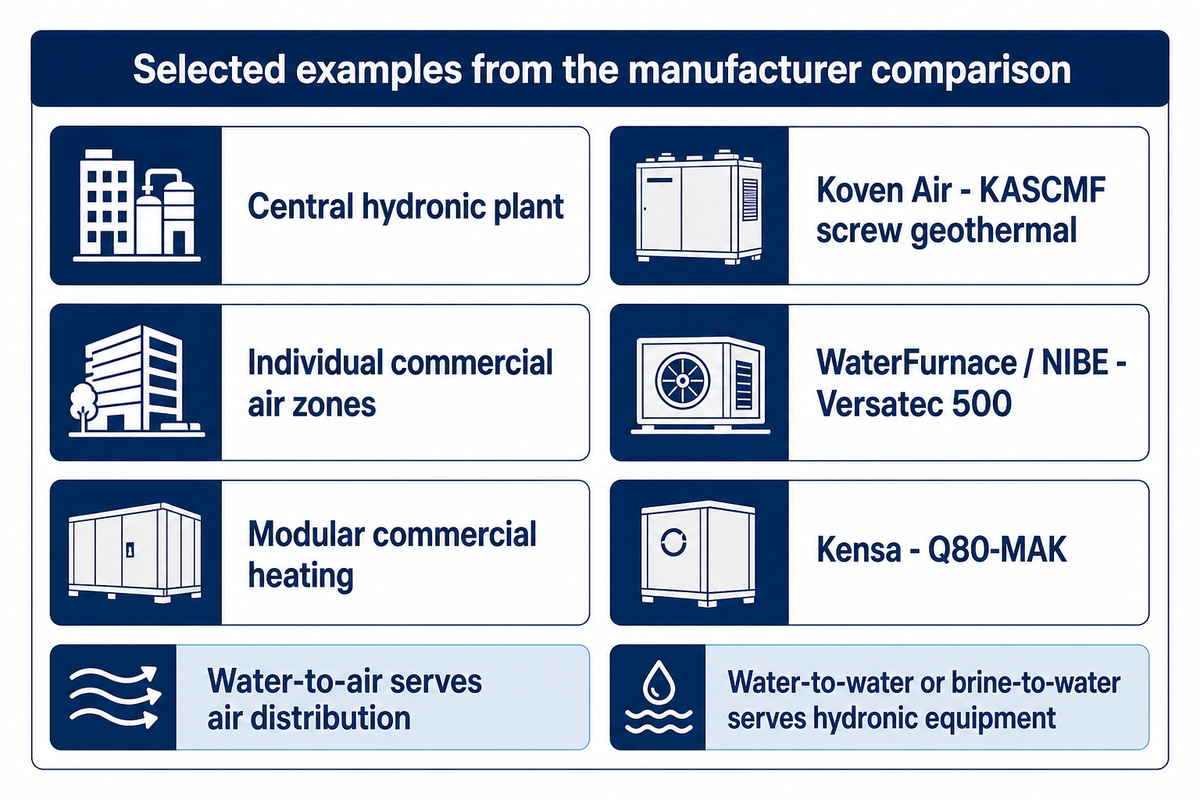
Commercial Ground-Source Fit Map
The Commercial Ground-Source Fit Map shows the named product families and their principal building applications and primary constraints for procurement.
Read the cards. For a water-to-air unit, the product serves an air distribution system. A water-to-water or brine-to-water unit serves hydronic equipment. Capacity figures for the cards reflect the originating rating, and “not published” means that the reviewed literature didn’t disclose the field and doesn’t indicate that the business lacks a headquarters.
| No. | Company Name | Headquarters | Founded Year | Best For | Brief Introduction | Ground-Source Product | Key Advantages | Potential Disadvantages | Official Website |
|---|---|---|---|---|---|---|---|---|---|
| 1 | Koven Air | Suzhou, China | 2007 | Large central plants | Commercial and industrial equipment manufacturer | KASCMF screw geothermal | Twin-screw configuration; heat-recovery bundle | Series starts at 367 kW cooling | https://kovenair.com/ |
| 2 | Mitsubishi Electric / Climaveneta China | Not published | 2004, China entity | China-market scroll plants | Climaveneta manufacturing entity | AQSW-H/-N | Soil or groundwater sources; AISI316 exchangers | Cited R410A series is China-market documentation | https://www.climaveneta.com.cn/ |
| 3 | Oilon | Lahti, Finland | 1961 | Institutional borefield plants | Industrial heat-pump and chiller manufacturer | Chillheat P150 | Published heating, cooling and water-preheating project | 300 kW example needs two units and a borefield | https://oilon.com/ |
| 4 | Aermec | Bevilacqua, Italy | 1961, company origin | Higher-condensing-temperature plants | Giordano Riello group HVAC manufacturer | HWS | Screw compressors; geothermal application | Water-side reversal needs changeover hydraulics | https://global.aermec.com/ |
| 5 | Clivet / Midea | Feltre, Italy, Clivet | 1989, Clivet | Four-pipe heat recovery | Commercial HVAC manufacturer | ELFOEnergy Ground Medium² MF | Total recovery; cascades of up to 8 units | Cited R410A series limits hot water to 60°C | https://www.clivet.com/ |
| 6 | Maritime Geothermal / Nordic | Petitcodiac, Canada | 1983 | Radiant, pool and ice-rink loads | Canadian geothermal equipment manufacturer | W-Series commercial | 9–81 nominal tons; phase protection | Hydronic distribution; larger plants use parallel units | https://www.nordicghp.com/ |
| 7 | WaterFurnace / NIBE | Fort Wayne, USA, WaterFurnace | 1983, WaterFurnace | Individual commercial air zones | Geothermal manufacturer within NIBE | Versatec 500 | Compact R-454B water-to-air cabinets | Selected family does not supply a central hydronic load | https://www.waterfurnace.com/ |
| 8 | Carrier | Palm Beach Gardens, USA | 1915 | Broad-size hydronic selections | Commercial HVAC manufacturer | Aquazone 50PSW | 2–35 nominal tons; geothermal suitability | Requires compatible water-side terminals | https://www.carrier.com/ |
| 9 | Bosch | Gerlingen, Germany, group | 1886, group | R-454B hydronic equipment | Home Comfort equipment manufacturer | WW Series | 10–35 nominal tons; scroll compressors | Closed loops require extended-range option | https://www.bosch-homecomfort.com/ |
| 10 | Trane | Swords, Ireland, parent group | 1913, Trane company | Retrofit format flexibility | Trane Technologies HVAC brand | Axiom | Horizontal, vertical and rooftop formats | Capacity and controls vary by configuration | https://www.trane.com/ |
| 11 | Daikin Applied | Osaka, Japan, parent | 1924, parent | Individually controlled zones | Commercial equipment manufacturer | SmartSource | Closed-circuit geothermal or open-well loops | Needs shared loop and suitable air distribution | https://www.daikinapplied.com/ |
| 12 | Kensa | Truro, Cornwall, UK | 1999 | UK modular commercial heating | Ground-source manufacturer and installer | Q80-MAK | 83 kW at B0/W35; cascade controls | Three-phase supply; outside MCS product scope | https://kensa.co.uk/ |
| 13 | STIEBEL ELTRON | Holzminden, Germany | 1924 | Stackable heating plants | Heating equipment manufacturer | WPF 20–66, including WPF 40 | Indoor/outdoor layouts; two-unit stacking | Heating-side application limit: 60°C | https://www.stiebel-eltron.com/ |
| 14 | Dimplex / Glen Dimplex | Kulmbach, Germany, heating operation | 1973, group | Larger indoor brine-water modules | Group heat-pump manufacturing operation | SI 90TU / SI 130TU | Collector/borehole range; passive cooling options | Needs plant-room and source-field space | https://www.dimplex.eu/ |
| 15 | OCHSNER | Haag, Austria | 1978, heat-pump company | Compact higher-output modules | Heating equipment manufacturer | TERRA 76 HPLA/CPLA | 77.50 kW at B0/W35; compact footprint | Active cooling requires CPLA selection | https://www.ochsner.com/ |
| 16 | Heliotherm | Langkampfen, Austria | 1987 | Modulating commercial heating | Heat-pump manufacturer | Solid Brine | KNX connectivity; remote maintenance | Cooling optional; maximum outlet 62°C | https://www.heliotherm.com/ |
| 17 | Gebwell | Leppävirta, Finland | 2005 | R290 commercial ground source | Ground-source and district-heating manufacturer | G-Eco Core / Pro 120 | Published logistics-centre geothermal application | Refrigerant-specific installation and service provisions | https://gebwell.fi/ |
| 18 | Ecoforest | Nigrán, Spain | 1959, company origin | Simultaneous thermal loads | Renewable heating manufacturer | ecoGEO+ HP 15-70 | Published heating, cooling and hot-water project | 140 kW reference is a two-unit installation | https://ecoforest.com/ |
| 19 | Hoval | Vaduz, Liechtenstein | 1945, brand registration | Two-circuit staged hydronic plants | Heating-system manufacturer | Thermalia dual | Two scroll compressors; two circuits | Standard dual 62°C; 70°C uses dual H | https://www.hoval.com/ |
| 20 | Weishaupt | Schwendi, Germany | 1932 | Coordinated ground-source provision | Heating equipment manufacturer | WWP S, including 130 ID | Heat pumps plus drilling/connection offering | High-temperature and reversible variants differ | https://www.weishaupt.de/ |
Central Hydronic Plant Manufacturers
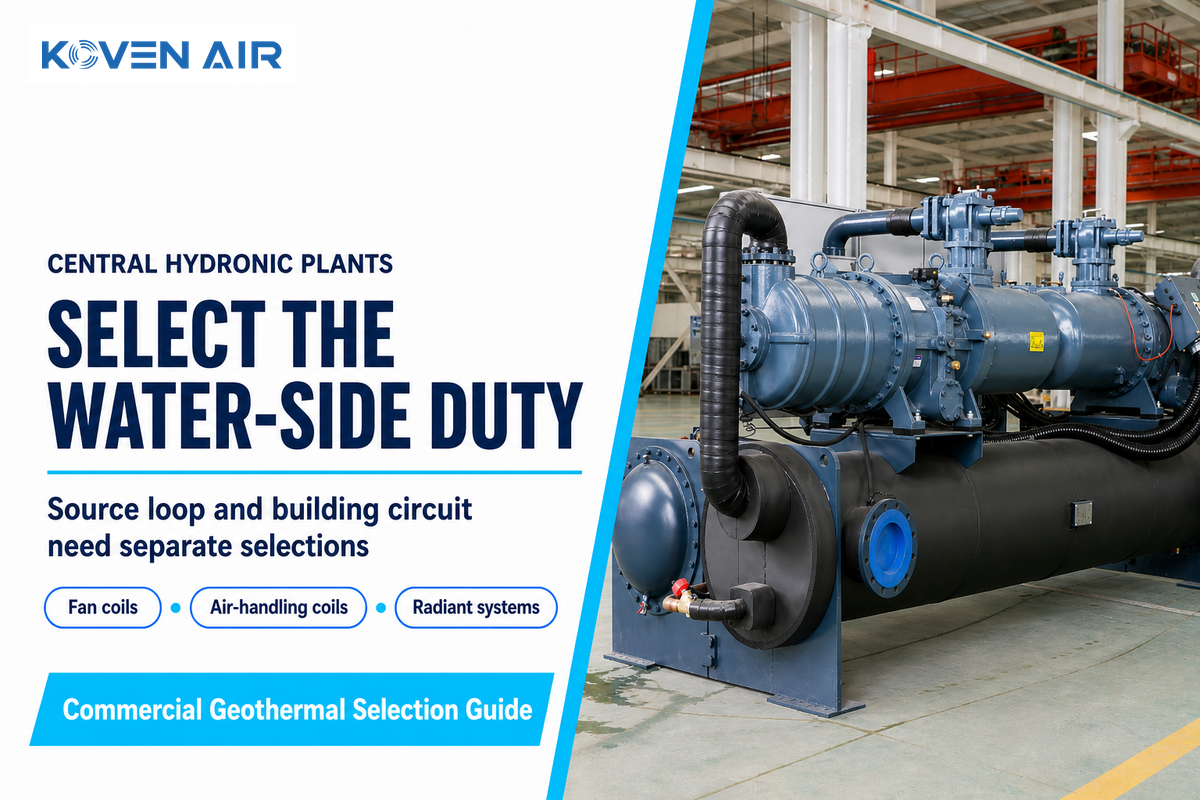
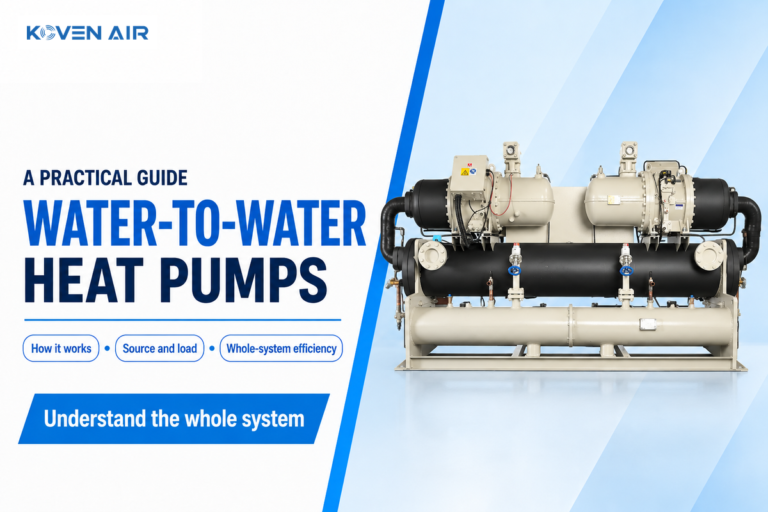
A central hydronic heat pump provides heating or cooling water for a building distribution system. This can serve fan coils, air-handling coils, radiant systems, and other compatible loads. A ground loop system serves the source side; the building circuit remains a separate selection. Koven’s “water-to-water heat pump range” shows an example of this type of equipment.
1. Koven Air: Best for large commercial screw-compressor plants
Headquarters: Suzhou Industrial Park, Jiangsu, China · Founded: 2007 · Type: commercial and industrial environmental-control equipment manufacturer
Official website: https://kovenair.com/
Main products: KASCMF water-cooled screw geothermal heat pumps.
Capabilities / notable work: KASCMF105.1: 367 kW cooling / 384 kW heating; KASCMF530.2: 1,852 kW cooling / 1,913 kW heating; R134a, semi-hermetic twin-screw compressors and heat-recovery bundle
Company declarations: ISO 9001:2015, ISO 14001:2015 and ISO 45001:2018 management systems; CE conformity, as listed in Koven’s company profile
Koven publishes these capacities as catalog figures without adjacent rating temperatures, so they indicate the offered scale rather than comparable design-point output. Large central-plant projects can consider the series where machine selection, hydronic connections, and heat-recovery duties need to be addressed together. A recovery bundle is relevant when cooling coincides with useful hot-water demand, but its presence alone establishes no annual energy saving. Buying limitation: the series starts at 367 kW cooling, making it unsuitable for a small single-zone or residential replacement.
2. Mitsubishi Electric / Climaveneta China: Best for China-market scroll plants
Headquarters: not established in the reviewed company material · Founded: 2004, China entity · Type: Climaveneta manufacturing entity within the Mitsubishi Electric brand group
Official website: https://www.climaveneta.com.cn/
Main products: AQSW-H/-N R410A scroll water/ground-source heat pumps.
Capabilities / notable work: AQSW-H/-N: 50–430 kW cooling / 50–440 kW heating; R410A scroll configuration; soil and groundwater sources; AISI316 plate heat exchangers
Climaveneta China’s literature explicitly names soil and groundwater sources, supporting a medium-size commercial geothermal plant selection. Published capacity ranges have no adjacent rating conditions, so a design-point comparison needs the actual project selection. Company history dates the Chinese entity to 2004, Shanghai factory production to 2005, and the Climaveneta brand to 1971. Buying limitation: the cited AQSW-H/-N is an R410A series documented for China, rather than an established worldwide product offer.
3. Oilon: Best for institutional borefield plants with several thermal duties
Headquarters: Lahti, Finland · Founded: 1961 · Type: family-owned industrial heat-pump and chiller manufacturer
Official website: https://oilon.com/
Main products: Chillheat industrial heat pumps, including P150 geothermal project units.
Capabilities / notable work: Cézava project: two R513A Chillheat P150 units, combined 300 kW; heating circuit 45/35°C; 50 wells with six kilometres combined depth; 245 apartments
Oilon’s Cézava account connects its industrial heat pumps to institutional space heating, cooling, and domestic-hot-water preheating. That combination supports the company’s fit for a coordinated borefield plant with several useful thermal duties. The project also shows the substantial source infrastructure surrounding the machines, without implying that another property needs the same well field. Buying limitation: its 300 kW figure belongs to two P150 units and their project arrangement, not to one unit or an equipment-only package.
4. Aermec: Best for geothermal screw plants at higher condensing temperatures
Headquarters: Bevilacqua, Verona, Italy · Founded: 1961, company origin; Aermec brand launched in 1963 · Type: HVAC manufacturer within Giordano Riello International Group
Official website: https://global.aermec.com/
Main products: HWS water-to-water heat pumps for geothermal applications.
Capabilities / notable work: HWS: screw compressors, water-side reversal and optimization for high condensing temperatures; geothermal applications listed in Aermec’s official guide
Company systems: ISO 9001 quality and ISO 14001 environmental certification recorded in Aermec’s company history
Aermec identifies HWS for residential, commercial, and industrial geothermal applications. Higher condensing-temperature duties make the range relevant when heating-water requirements narrow the choice before nominal capacity does. Corporate management-system certification is separate from an HWS thermal-performance certificate. Buying limitation: water-side reversal requires a planned hydraulic heating/cooling changeover arrangement, rather than assuming the unit’s external connections handle every operating mode.
5. Clivet / Midea: Best for four-pipe buildings using simultaneous heat recovery
Headquarters: Feltre, Belluno, Italy, for Clivet · Founded: 1989, Clivet · Type: HVAC equipment manufacturer in the Midea group
Official website: https://www.clivet.com/
Main products: ELFOEnergy Ground Medium² MF WSHN-XEE2 MF multifunction water/glycol-to-water heat pumps.
Capabilities / notable work: ELFOEnergy Ground Medium² MF WSHN-XEE2 MF: two-pipe/four-pipe configurations, total heat recovery and cascades of up to 8 units; integrated source, user and recovery hydronic assemblies
Clivet describes water-to-water or glycol-to-water operation, making source-fluid choice explicit in the selection. Four-pipe buildings with simultaneous heating and cooling demands can compare the recovery arrangement and controls alongside the capacity schedule. Buyers considering that layout can also examine the role of a heat pump chiller in a central plant. Buying limitation: the cited R410A series limits domestic hot water to 60°C, so a hotter delivery requirement falls outside that stated combination.
6. Maritime Geothermal / Nordic: Best for large hydronic radiant, pool and rink loads
Headquarters: Petitcodiac, New Brunswick, Canada · Founded: 1983 · Type: Canadian manufacturer producing Nordic heat pumps in-house
Official website: https://www.nordicghp.com/
Main products: Nordic W-Series commercial geothermal water-to-water heat pumps and chillers.
Capabilities / notable work: W Series: 9–81 nominal tons; optional reversing valve for heating/cooling; integrated phase protection as standard; TUV listed in the manufacturer’s product specification
Maritime Geothermal’s commercial water-to-water range suits hydronic radiant, pool-heating, and ice-rink projects. Its nominal tonnage describes equipment sizes rather than rated heating output at one ground temperature. Optional reversing operation matters when the same machine is expected to provide both heating and cooling. Buying limitation: W-Series needs hydronic distribution, and larger loads typically require parallel units rather than a direct insertion into existing air ductwork.
Commercial Water-Source Equipment for Ground Loops
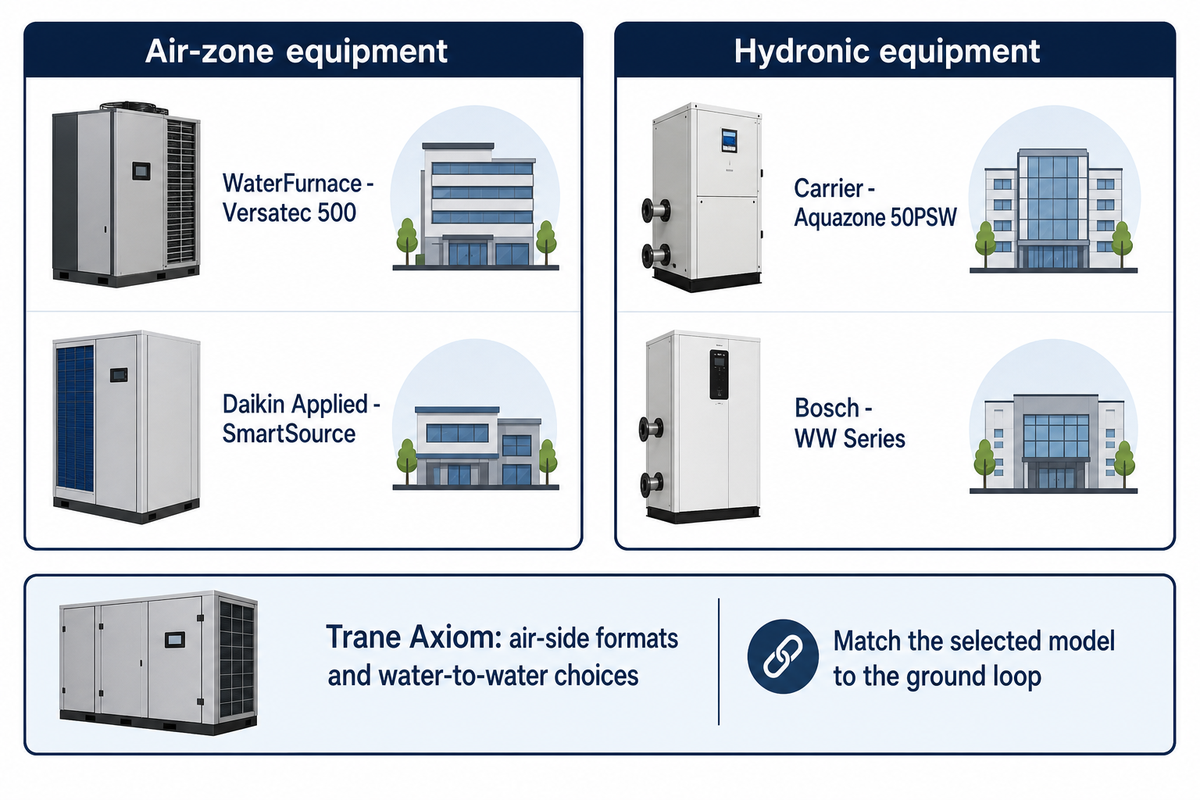
Water-source describes how equipment is connected to a water source, while geothermal describes how a system exchanges heat with the ground. Geothermal heat pumps operate as part of a system that transfers heat between a source and a building. This group includes both zone water-to-air equipment and central water-to-water products. So, cabinet appearance and brand familiarity won’t substitute for load-side consideration.
During the heating cycle, heat from the earth is withdrawn; during the cooling cycle, the process reverses as heat from the building is removed and transferred to the earth. This describes the function of reversible geothermal heat pump technology. Not every model listed is promised to include both modes of operation offered by reversible geothermal technology.
7. WaterFurnace / NIBE: Best for separately controlled commercial air zones
Headquarters: Fort Wayne, Indiana, USA, for WaterFurnace · Founded: 1983; manufacturing began in 1985 · Type: geothermal heat-pump manufacturer within NIBE
Official website: https://www.waterfurnace.com/
Main products: Versatec 500 commercial water-source/geothermal water-to-air heat pumps.
Capabilities / notable work: Versatec 500: compact R-454B cabinets; single/dual-compressor configurations; 12–30 ton versions with dual compressors and lead-lag operation
WaterFurnace’s Versatec 500 gives commercial buyers a water-to-air choice for separately controlled zones. Lead-lag compressor operation is intended to equalize running time, while the product page’s ISO/AHRI 13256-1 WLHP figures retain their water-loop rating basis. Those figures do not automatically describe these HVAC units at the proposed borefield’s design temperatures. Buying limitation: the selected family serves air zones, so a central hot-water or chilled-water load needs a different product architecture.
8. Carrier: Best for commercial water-to-water plants across a broad nominal size range
Headquarters: Palm Beach Gardens, Florida, USA · Founded: 1915, Carrier Engineering Corporation origin · Type: commercial HVAC equipment manufacturer
Official website: https://www.carrier.com/
Main products: Aquazone 50PSW water-to-water heat pumps.
Capabilities / notable work: Aquazone 50PSW: 2–35 nominal tons; geothermal suitability; hydronic heating/cooling, ventilation-air tempering and dedicated boiler/chiller duties
Manufacturer certification statement: Carrier lists 50PSW as ARI/ISO 13256-2 Certified
This Carrier geothermal selection addresses commercial hydronic output over a broad nominal size range. Ventilation-air tempering is a water-side application through compatible equipment, not a description of 50PSW as a packaged air terminal. The product-page certification claim concerns water-to-water equipment and is separate from claims for Carrier’s residential geothermal lines. Buying limitation: 50PSW requires compatible hydronic terminals and distribution; existing ductwork alone doesn’t provide the load-side connection.
9. Bosch: Best for commercial R-454B water-to-water selections
Headquarters: Gerlingen-Schillerhöhe, Germany, for the Robert Bosch group · Founded: 1886, group origin · Type: Bosch Home Comfort commercial heat-pump manufacturer
Official website: https://www.bosch-homecomfort.com/
Main products: WW Series R-454B commercial water-to-water heat pumps.
Capabilities / notable work: WW Series: R-454B, 10–35 nominal tons; single or dual single-stage scroll compressors; geothermal closed-loop applications covered by the WW/WT manual
Bosch’s WW/WT documentation establishes geothermal applicability more directly than a generic water-cooled equipment description. Refrigerant and compressor configuration make the family relevant to buyers comparing a commercial heating-and-cooling water plant. Water-to-water output places this selection alongside hydronic equipment rather than individual air-zone cabinets. Buying limitation: closed-loop operation requires the extended-range option and suitable antifreeze protection, with the proposed source-temperature envelope matched to that configuration.
10. Trane: Best for commercial retrofits with different cabinet and rooftop needs
Headquarters: Swords, County Dublin, Ireland, for Trane Technologies · Founded: 1913, The Trane Company incorporation · Type: commercial HVAC manufacturer and Trane Technologies brand
Official website: https://www.trane.com/
Main products: Axiom horizontal/vertical, rooftop, and water-to-water heat pumps.
Capabilities / notable work: Axiom horizontal/vertical: 0.5–25 nominal tons, R-454B and geothermal compatibility; rooftop: 3–25 nominal tons with Symbio 700 controls
Trane’s several Axiom formats provide commercial retrofit choices when ceiling space, plant location, and existing distribution narrow the equipment selection. A building retaining air-side equipment approaches this range differently from one replacing central hydronic plant. Named Symbio 700 controls give the rooftop selection a specific integration reference instead of a general controls promise. Buying limitation: capacity ranges and controls vary by format, so the family name alone can’t establish the ordered unit’s dimensions or performance.
11. Daikin Applied: Best for individual-zone SmartSource geothermal systems
Headquarters: Osaka, Japan, for Daikin Industries · Founded: 1924, parent company · Type: Daikin Applied commercial equipment manufacturer within Daikin Industries
Official website: https://www.daikinapplied.com/
Main products: SmartSource commercial water-source heat pumps in multiple cabinet configurations.
Capabilities / notable work: SmartSource: multiple cabinet configurations; geothermal closed-circuit or open-well loops; self-contained units responding to individual zone loads
Daikin Applied explicitly describes SmartSource for geothermal source arrangements, including closed-loop systems and open-loop systems. Local climate control is the key distinction: each zone unit handles its air-side duty while sharing source-water infrastructure. An office arranged around separate zone control therefore has a different purchasing brief from a building needing one central water-to-water machine. Buying limitation: SmartSource still needs a shared source loop and air distribution matched to the selected cabinet configuration.
Modular Brine-to-Water Manufacturers
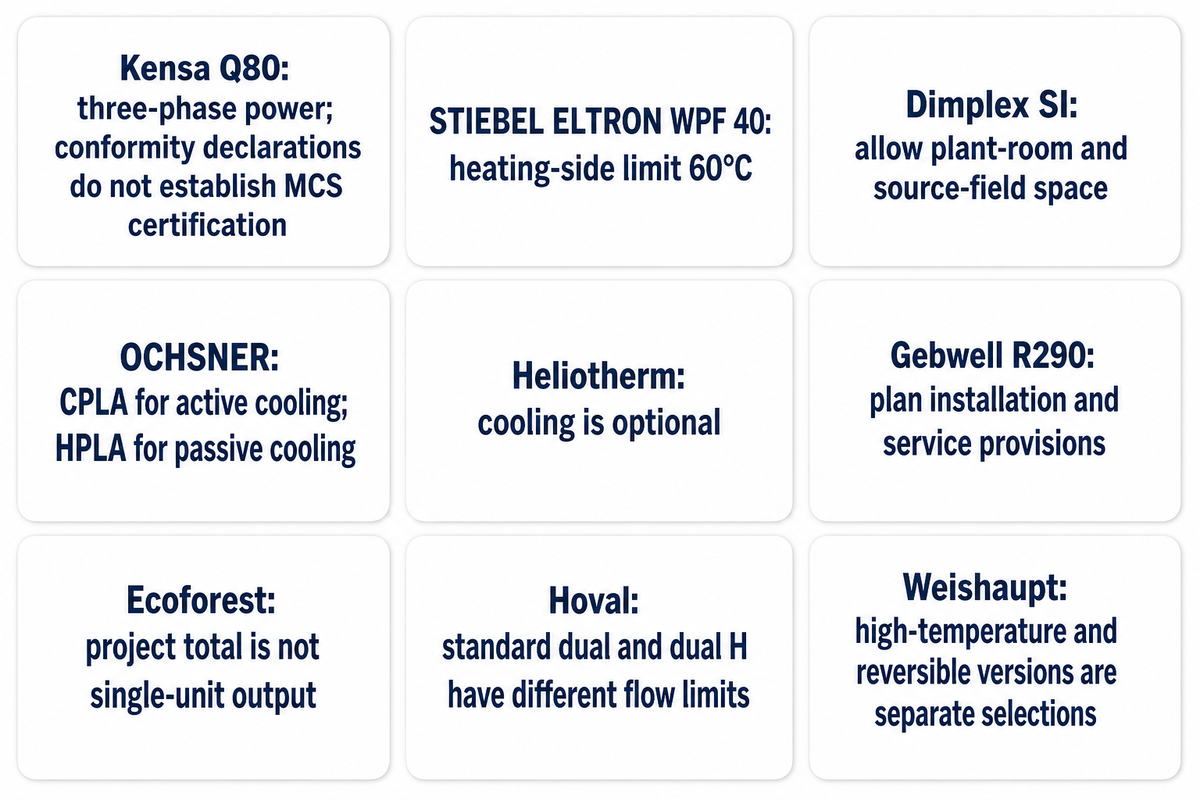
Brine-to-water heat pump systems connect a ground-side fluid circuit to building heating water. Among the systems available, modular options can be utilized in plant rooms where equipment output, available space, electrical supply, and the staging of equipment need to be balanced. Cooling and hot water generation are model-specific functions. A heating rating doesn’t establish the equipment’s capability for the other functions.
12. Kensa: Best for UK modular three-phase commercial heating
Headquarters: Chacewater, Truro, Cornwall, United Kingdom · Founded: 1999 · Type: ground-source heat-pump manufacturer and installer
Official website: https://kensa.co.uk/
Main products: Kensa Q modular commercial units, including Q80-MAK.
Capabilities / notable work: Q80-MAK: 83 kW nominal thermal output at B0/W35 under BS EN14511; 380–420 V / 50 Hz supply; cascaded units controlled through a Building Management System
Product declarations: EU/UK conformity declarations linked on Kensa’s page; MCS approval stated as outside product scope
Kensa Q gives UK non-domestic buyers a modular commercial heating selection with an explicit rating point and power supply. Cascading connects several units to the larger building heating installation rather than making the largest single machine the default choice. The published COP footnote excludes water-pump power, so it isn’t a whole-system efficiency figure. Buying limitation: Q80 requires three-phase power, and its conformity declarations shouldn’t be represented as MCS certification.
13. STIEBEL ELTRON: Best for stackable commercial brine-water heating plants
Headquarters: Holzminden, Germany · Founded: 1924 · Type: heating and renewable-energy equipment manufacturer
Official website: https://www.stiebel-eltron.com/
Main products: WPF 20–66 brine/water heat pumps, including WPF 40.
Capabilities / notable work: WPF 40: 43.1 kW heating and COP 4.67 at B0/W35 under EN 14511; indoor/outdoor installation; stacking of two appliances
STIEBEL ELTRON’s WPF range combines a stated heating rating with several installation choices for commercial plant layouts. Two-unit stacking gives a constrained project a documented space-saving arrangement, while associated equipment and service access still need room. The output and COP describe B0/W35 rather than annual performance of the building and ground field. Buying limitation: WPF 40 documentation establishes heating, with a 60°C maximum application limit on the heating side for this particular model.
14. Dimplex / Glen Dimplex: Best for larger indoor brine-water modules
Headquarters: Kulmbach, Germany, for the heating and ventilation operation · Founded: 1973, Glen Electric/Glen Dimplex group origin · Type: group heat-pump manufacturing operation
Official website: https://www.dimplex.eu/
Main products: SI-series indoor brine/water units, including SI 90TU and SI 130TU.
Capabilities / notable work: SI 130TU: 130 kW catalog heating capacity; brine/water portfolio for ground collectors and boreholes; passive cooling and domestic-hot-water integration
Dimplex’s indoor SI-series gives commercial buyers a larger brine-water module alongside ground collector and borehole arrangements. Its 130 kW overview value has no adjacent rating conditions, so it can’t establish a direct comparison with another manufacturer’s B0/W35 output. Here, 1973 refers to the parent group’s origin rather than the first Dimplex product or a German factory’s founding. Buying limitation: indoor SI units need plant-room space and a separately designed collector or borefield.
15. OCHSNER: Best for compact higher-output radiator and underfloor systems
Headquarters: Haag, Austria, head office/factory; registered office in Linz · Founded: 1978, according to the current company page · Type: heat-pump manufacturer for residential, commercial, and industrial applications
Official website: https://www.ochsner.com/
Main products: TERRA 76 ground-source heat pumps in HPLA and CPLA configurations.
Capabilities / notable work: TERRA 76: 77.50 kW heating at B0/W35 under EN14511; maximum flow 65°C; indoor footprint below half a square metre; cascade capability
OCHSNER’s TERRA 76 offers a compact higher-output module for radiator and underfloor projects. Maximum flow temperature helps frame the water-side duty, while rated heating output remains attached to B0/W35. The small footprint is a layout advantage rather than a substitute for service access and associated plant equipment. Buying limitation: active cooling requires CPLA, whereas HPLA provides passive cooling, so those suffixes can’t be interchanged without changing the delivered system.
16. Heliotherm: Best for modulating commercial brine-water units with building controls
Headquarters: Langkampfen, Tyrol, Austria · Founded: 1987 · Type: heat-pump manufacturer with in-house research and test facilities
Official website: https://www.heliotherm.com/
Main products: Solid Brine large heat pumps for hotels and commercial properties.
Capabilities / notable work: Solid Brine B0/W35 outputs: 30.1, 40.1, 58.5 and 91.9 kW; modulating operation, KNX connectivity and RCG-X remote-maintenance functions
Heliotherm positions Solid Brine for hotels and commercial properties where the heat pump integrates with building controls. Its tabulated B0/W35 outputs are more precise selection references than the general “up to 100 kW” description. Named KNX and remote-maintenance functions connect the range to operating schedules and service requirements beyond a stand-alone appliance. Buying limitation: cooling is optional, and maximum outlet temperature is 62°C.
17. Gebwell: Best for purpose-designed R290 commercial geothermal equipment
Headquarters: Leppävirta, Finland · Founded: 2005; manufacturing and design activity dates from 2006 · Type: ground-source and district-heating equipment manufacturer
Official website: https://gebwell.fi/
Main products: G-Eco R290 heat pumps, including Core 30/40/60/80 and Pro 120.
Capabilities / notable work: G-Eco: R290 Core 30/40/60/80 and Pro 120; 2025 Pro 120 geothermal installation at Nokian Panimo’s 2,500 m² logistics centre, with separate buffer tank
Company systems: ISO 9001 and ISO 14001 management systems, according to Gebwell’s operations policy
Gebwell’s logistics-centre reference shows G-Eco Pro 120 in a commercial geothermal base-heating application. R290 equipment makes the range relevant where refrigerant choice is part of the specification. Neither the Pro 120 model number nor company management-system certification establishes a particular B0/W35 performance rating. Buying limitation: R290 requires refrigerant-appropriate installation and maintenance provisions, so plant location and service arrangements belong in the equipment decision.
18. Ecoforest: Best for borefield projects with simultaneous heating, cooling and hot water
Headquarters: Nigrán, Pontevedra, Spain · Founded: 1959, company origin · Type: renewable heating equipment and heat-pump manufacturer
Official website: https://ecoforest.com/
Main products: ecoGEO+ HP geothermal heat pumps, including HP 15-70.
Capabilities / notable work: Marine Instruments project: two ecoGEO+ HP 15-70 units, combined 140 kW; seven boreholes of 125 metres each; simultaneous heating, cooling and domestic hot water
Ecoforest’s Marine Instruments account gives commercial buyers a specific example of overlapping thermal duties served by a borefield plant. Its source-field description adds project context without establishing the borehole count or depth needed elsewhere. The 1959 founding year refers to company history, not geothermal heat-pump production since that date. Buying limitation: 140 kW belongs to the two-unit installation, so it shouldn’t size a one-unit order or be assigned to an individual HP 15-70.
19. Hoval: Best for two-circuit hydronic plants with staged output
Headquarters: Vaduz, Liechtenstein · Founded: 1945, Hoval brand registration · Type: heating-system manufacturer with production in Liechtenstein and Slovakia
Official website: https://www.hoval.com/
Main products: Thermalia dual brine/water and water/water heat pumps, with separate dual H and dual R variants.
Capabilities / notable work: Thermalia dual (55–140): two scroll compressors/two circuits; 57.9–137.8 kW at B0W35; dual (140): 137.8 kW at B0W35
Hoval’s Thermalia dual supports a hydronic plant selection where staged output and the required flow temperature matter. Two compressors are contained within one dual unit, rather than constituting two separate heat pumps. Brine/water and water/water selections retain different source conditions, so a warmer water-source rating can’t replace the cold-brine point. Buying limitation: standard dual reaches 62°C flow, while the separate dual H range supplies the 70°C option.
20. Weishaupt: Best for coordinated heat-pump and ground-source provision
Headquarters: Schwendi, Germany · Founded: 1932 · Type: heating-equipment manufacturer with a dedicated brine-water range
Official website: https://www.weishaupt.de/
Main products: WWP S brine/water heat pumps, including WWP S 130 ID and separate high-temperature variants.
Capabilities / notable work: WWP S: ground-source heating/cooling portfolio extending to the 130 kW size class; offering includes ground drilling and connection to the heat-pump system
Weishaupt’s equipment and ground-source offering makes it relevant to buyers discussing source works and plant together. Coordinating those parts is useful while building loads, ground access, and connections are still being resolved. A 70°C option belongs to high-temperature variants rather than every WWP S model. Buying limitation: high-temperature and reversible-cooling versions are separate selections, so their features can’t be combined by assumption into one machine.
How to Choose a Ground Source Heat Pump Manufacturer
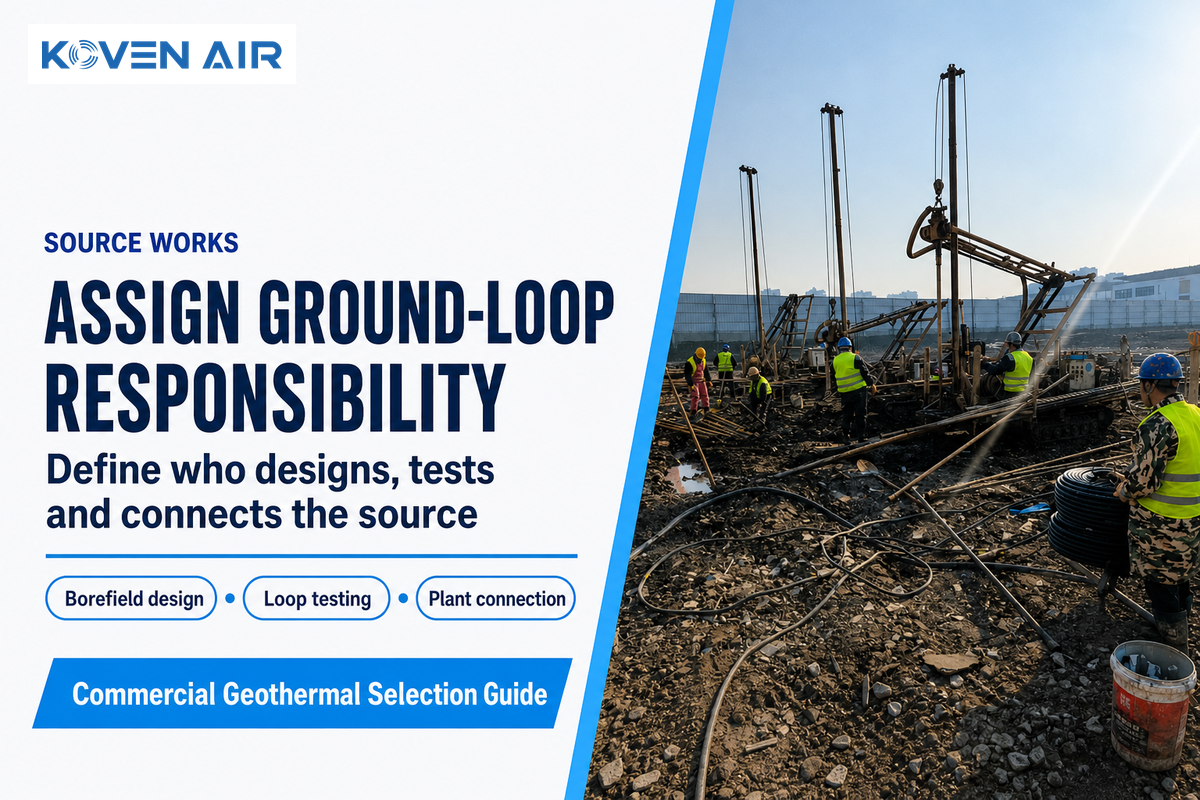
The selection of a commercial ground-source heat pump depends on the building loads, temperature range of the source, water or air delivery requirements, and the scope of the installation. Brand comparisons are useful only after the other considerations have been resolved. Eight checks will help transform this short list into comparable proposals without confusing a unit rating with a geothermal system.
- Start with the load-side architecture: water-to-air equipment services air zones, and water-to-water equipment services a hydronic circuit. Ground-source and water-source heat pump arrangements describe the source-side and don’t settle the choice. Separate space heating, space cooling, and domestic hot water in the load schedule.
- Provide the manufacturer source-side entering and leaving temperatures, type and concentration of fluid, and building side supply and return temperatures. For air delivery equipment, provide required air temperatures and airflow. Provide design conditions (e.g., extremes) and part-load conditions. A nominal tonnage or model number doesn’t illustrate the required conditions.
- Ask for a selection at the same conditions and fluid, and compare energy-efficiency ratings, before making the selection. Keep heating and cooling output separate and a two-unit plant total separate from a single-unit rating. EER and COP describe different performance measures and neither is an annual building energy bill. An energy efficient unit must also suit the actual duty.
- Read the applicable rating scope: ISO 13256-1:2021 concerns water-to-air and brine-to-air heat pumps, while ISO 13256-2:2021 concerns water-to-water and brine-to-water equipment. A standard reference alone does not prove that the offered model is certified or suitable for the project’s geothermal loop. Obtain the applicable model documents and any required certificate; ISO 9001 management certification answers a different question.
- Establish if quoted performance includes source pumps, building pumps, fans, electric backup, and hot water boosting. The COP for an energy-efficient unit may exclude some of the loads mentioned above. An evaluation of the whole system energy consumption requires the same system boundary and operating schedule to support expectations for savings and operating costs. Energy consumption accounts for energy use across the entire plant, not just the compressor. Greenhouse gas emissions may also be included in the RFP. If so, request the calculation and boundary limits as well as the data used in the calculation. Treat efficiency and sustainability as claims requiring project evidence.
- Record who owns the borefield or collector design, ground works, loop testing, fluid filling, and connection to the plant. Those responsibilities shape the installation process. IGSHPA identifies CSA/ANSI/IGSHPA C448:2025 as its current design and installation standard, with the 2017 guidance retained as an archive. System design guidance and heat-pump testing standards serve different purposes.
- Confirm provided electrical supply, refrigerant, source-temperature limits, cooling mode, controls, noise, and service access for the offered revision. For closed loop systems, affirmative response for the selected model and options is required. Assuming one system offers quieter operation than the other before comparing noise at the same operating point may not be correct. Availability of the product in your region and a general product brochure aren’t the same. Maintenance of the system may be discussed in the context of replacement components and expected service life of the system. This guide assigns no universal service life figure for the system lifespan.
- Make responsibility for equipment, source works, distribution changes, electrical work, controls, commissioning and maintenance visible in the offer. Establish who provides local service, what parts are available and what the warranty is. Availability of incentives and eligibility to claim them should be discussed separately. The relevance of available incentives and eligibility should be determined prior to including a rebate in the budget for the work.
How do source and load temperatures change a commercial heat pump selection?
B0/W35 indicates a test point commonly read as entering brine at 0°C and leaving heating water at 35°C. It doesn’t capture the conditions for all the winter hours. Changing the water temperature required or the condition of the source changes the machine’s operating duty. Therefore, the design choice must consider the paired conditions of the project and the manufacturer’s stated convention.
For example, the Hoval table above keeps 137.8 kW attached to B0W35, and Kensa’s 83 kW retains B0/W35. Koven’s published series values have no adjacent rating temperatures, so they can’t establish a winner against those points. The useful next document is a selection at the same source and load conditions, with glycol corrections and pump power identified. This is how efficiency ratings become meaningful for the proposed heating systems.
Which interfaces matter when reusing an existing ground loop?
The decision to use a ground loop again depends on the condition of the loop, the fluid, the temperature range, the flow and the ability of the loop to satisfy the new plant’s annual heat exchange. A change of heat pump can also change the source-side duty of the machine, even if the building’s peak heat load is unchanged. The decision therefore belongs at the system assessment, not at the equipment pipe sizing alone.
Consider changes in use of the building (e.g. change in domestic hot water usage, changes in cooling hours) and the new equipment selected. Connect available loop records with current operating evidence and the new equipment selection. These can alter the annual heat balance. A ground source heat pump exchanges heat with the ground beneath the earth’s surface, but the fluid isn’t a constant temperature utility. It’s better to match the existing loop to the new equipment than to assume all geothermal heat pump systems are the same.
When can site constraints favour an air-source alternative?
An air-source alternative should be considered if drilling access, land availability, project timing, or source-field work makes a geothermal installation difficult. Finding the most cost-effective way to meet the load is a site decision, not proof that one technology is universally preferable to the other. Both proposals need to satisfy the same building-side loads and delivery temperatures.
Evaluate the complete ground-source solution compared to complete air-to-water heat pump options, including distribution and electrical work common to both. Then consider the source-specific work, and compare geothermal energy solutions to the alternative on a level complete-solution basis. An equipment-only price can’t establish the lowest cost of ownership, the return on investment, and long-term value of either system. These are impacted by the building, tariff, operation and maintained performance.
Frequently Asked Questions
Which is the best ground source heat pump manufacturer for a commercial building?
Choose the product architecture and local delivery arrangement before choosing a brand.
The best geothermal heat pump choice changes with the building. WaterFurnace Versatec 500 and Daikin SmartSource address individual air zones; Carrier 50PSW and Bosch WW address hydronic output; Koven’s KASCMF targets larger central plants. After that first split, narrow the choice by the offered operating envelope, regional service arrangements, electrical supply, and required cooling or hot-water duties. A familiar brand with the wrong configuration isn’t a suitable selection.
Who is the largest ground source heat pump manufacturer?
This guide does not identify a largest manufacturer by geothermal sales or shipments.
Available company information doesn’t provide a consistent, category-specific shipment measure across all 20 entries. Parent-group revenue can include air conditioning, boilers, and other businesses, while several geothermal brands may belong to one group. Naming a global winner from those figures would mix different measures. For procurement, the relevant product range and ability to support the particular commercial installation provide a more useful starting point than overall corporate size.
What is the difference between a heat pump manufacturer and a supplier?
The manufacturer produces equipment; a supplier may sell equipment made by another company.
A distributor or installer can still play an important part in a commercial project by handling local selection, delivery, integration, and service. The distinction matters when assigning responsibility: the equipment warranty, system design, ground works, and commissioning may come from different organizations. This list focuses on manufacturers and manufacturing groups, but a purchase proposal should name the parties responsible for the complete installed system and its ongoing support.
How much does a geothermal heat pump unit cost?
Commercial unit pricing requires a defined model, duty, options, and supply scope.
This guide doesn’t establish a current market-average equipment price. Request a model-specific quotation and separate the unit from drilling, loop installation, building distribution, electrical work, and commissioning. A residential geothermal heat pump price isn’t a reliable budget for a commercial central plant.
Can I replace just the heat pump unit without replacing the ground loop?
Possibly, if the existing loop remains suitable for the new equipment and building load.
Begin the replacement process with existing drawings, fluid and flow information, operating temperatures, and any known loop defects. A new selection then needs to fit those conditions, including antifreeze and pressure requirements. Retaining the loop doesn’t necessarily mean retaining every pump, control, or hydraulic connection. A compatible replacement can reuse the ground infrastructure, but the installer still needs a clear scope for the interfaces that change.
What are the disadvantages of geothermal heat pumps?
Ground works and the coordination of source, plant, and building systems are major project constraints.
Commercial geothermal systems can require drilling access, collector space, and significant work before equipment commissioning. Annual ground heat balance and delivery temperatures affect the design. An owner also needs clear responsibility across contractors; buying a heat pump alone doesn’t resolve those interfaces.
Define Your Commercial Project Before Requesting a Quote
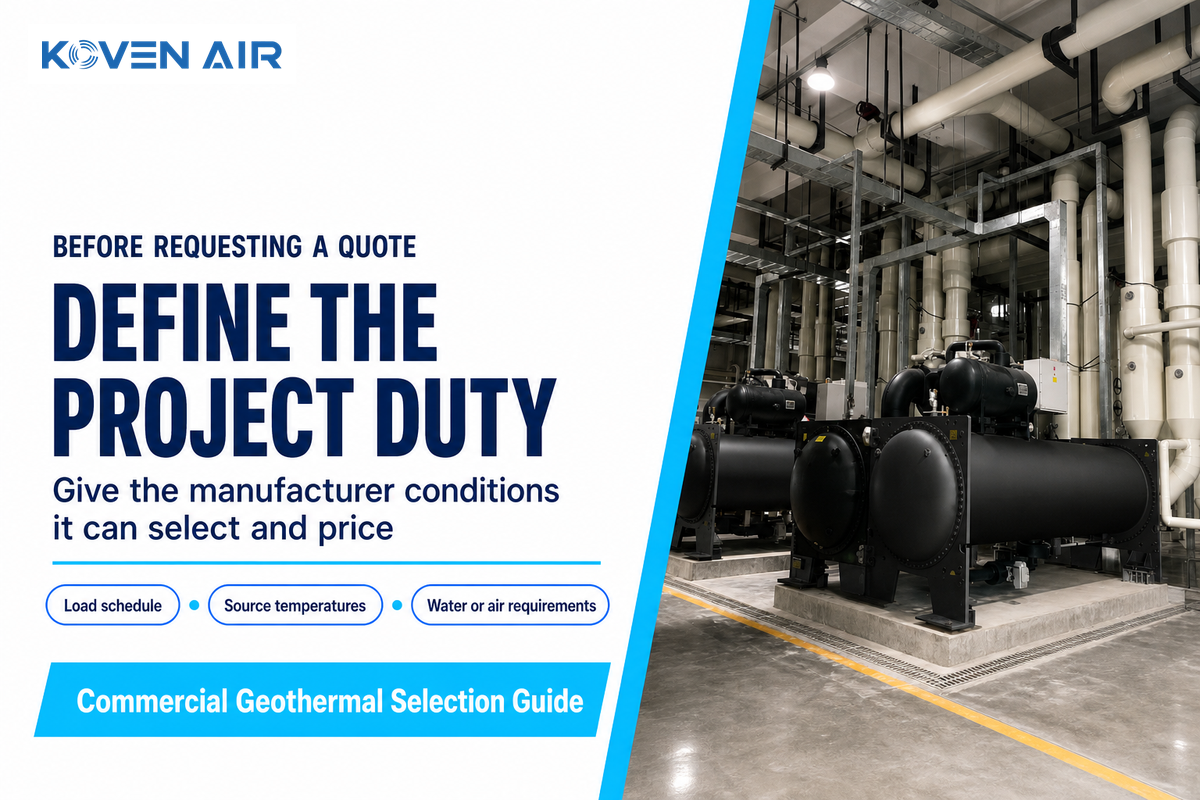
Start with a load schedule, source-temperature envelope, and building-water or air requirements. For a large central plant, review Koven Air’s commercial ground-source heat pump specifications, then submit those conditions with electrical supply and cooling or recovery duties. If the source arrangement is still open, compare the heat pump product families first. A defined scope gives the manufacturer something concrete to select and price.
References & Sources
Standards sources used for the selection discussion:
- ISO 13256-1:2021: testing and rating of water-to-air and brine-to-air heat pumps.
- ISO 13256-2:2021: testing and rating of water-to-water and brine-to-water heat pumps.
- IGSHPA standards information: current C448:2025 design and installation guidance and archived 2017 material.