Get in Touch with Koven Air Company

Updated October 2026
CO2 heat pumps use carbon dioxide refrigerant, also called R744, to move heat into water. They’re a strong option for commercial hot water when cold make-up water, high storage temperatures and a well designed circulation system work together. For hotels, apartments and industrial facilities, the key questions are how hot the entering water gets, how much hot water the building draws at peak times and how the complete plant handles the loads.
A system that reaches its outlet temperature goal can still lack sufficient heating capacity in winter. A very efficient compressor can also be placed in an expensive-to-run system if electric back-up reheats a large circulation load. This report connects these details to a practical selection method, and gives published examples, including a detailed electric calculation.
What are CO2 heat pumps and how do they work?
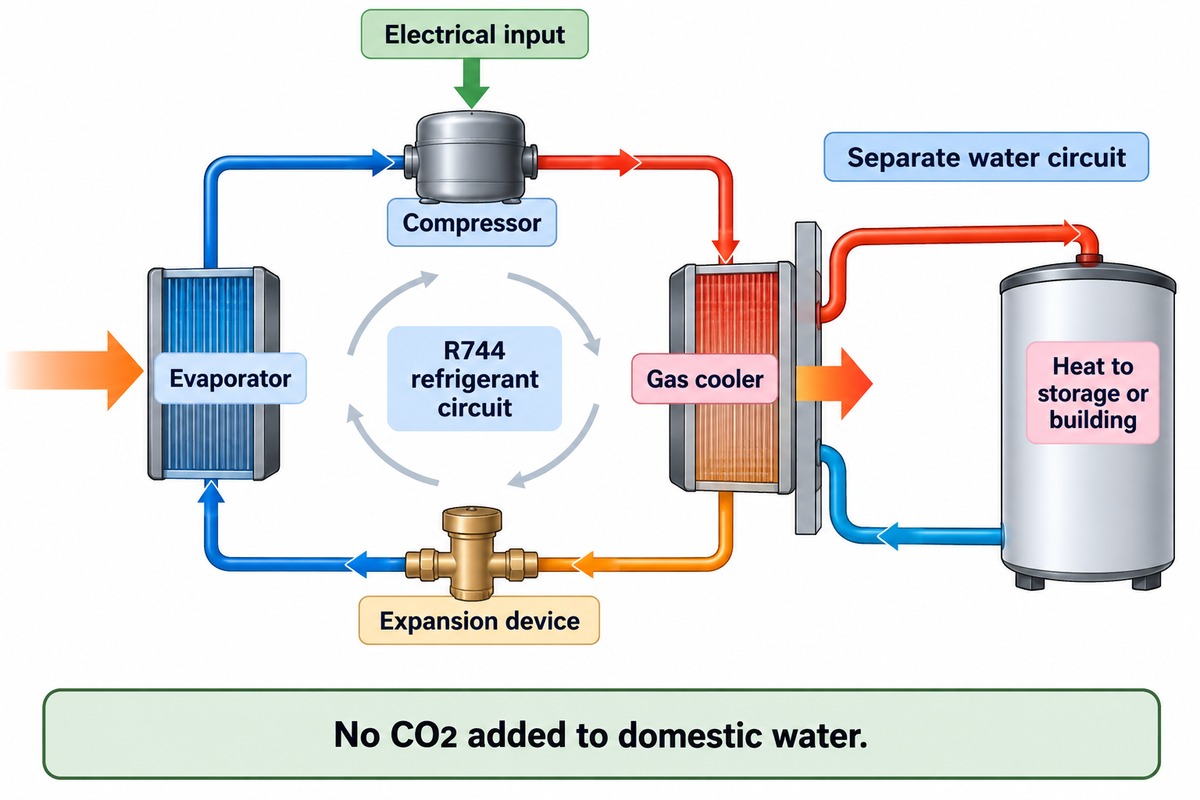
A CO2 heat pump is a heat pump in which the refrigerant circuit contains R744. In an air-source water heater, the unit takes up heat from ambient air and transfers it to a different water circuit. The electricity drives that transfer. Carbon dioxide stays in the refrigerant circuit; it isn’t added to the domestic hot water.
Think of the refrigerant as a carrier moving heat between two heat exchangers. The heat exchange keeps the water and refrigerant circuits separate. The water circuit carries heat onward to storage or to the building. The term CO2 identifies the working fluid, while air source, water-source and ground-source identify where the source heat comes from. Those are separate choices: Selecting air or water as the heat source doesn’t define the refrigerant. Ground-source heat pumps are defined by their source as well. Our air-to-water heat pump fundamentals explain the wider configuration.
How do CO2 heat pumps work?
In a transcritical carbon dioxide cycle, the compressor increases the pressure and temperature of the refrigerant. Hot refrigerant releases heat through a gas cooler, an expansion device reduces its pressure, and the evaporator collects heat again. In a traditional system, the refrigerant releases heat through condensation at a constant saturation temperature. In this case, the temperature of the refrigerant is changing and the heat is transferred to the other side. This process is well suited for heating a cold water stream through a substantial temperature rise.
A central heat pump water heater installation uses this transcritical CO2 cycle in the field study by Banks and colleagues. Its high pressure is part of the equipment design, which requires components, protection and service procedures made for that refrigerant.
Compared with refrigerants that have high global warming potential, carbon dioxide has low global warming potential and zero ozone depletion potential. The U.S. Department of Energy’s CO2 water-heater project also notes its nonflammability. Refrigerant GWP and ODP describe particular environmental properties; the building’s carbon footprint also depends on electricity, energy use and the heating system being replaced.
CO2 heat pump water temperature: inlet, outlet and lift
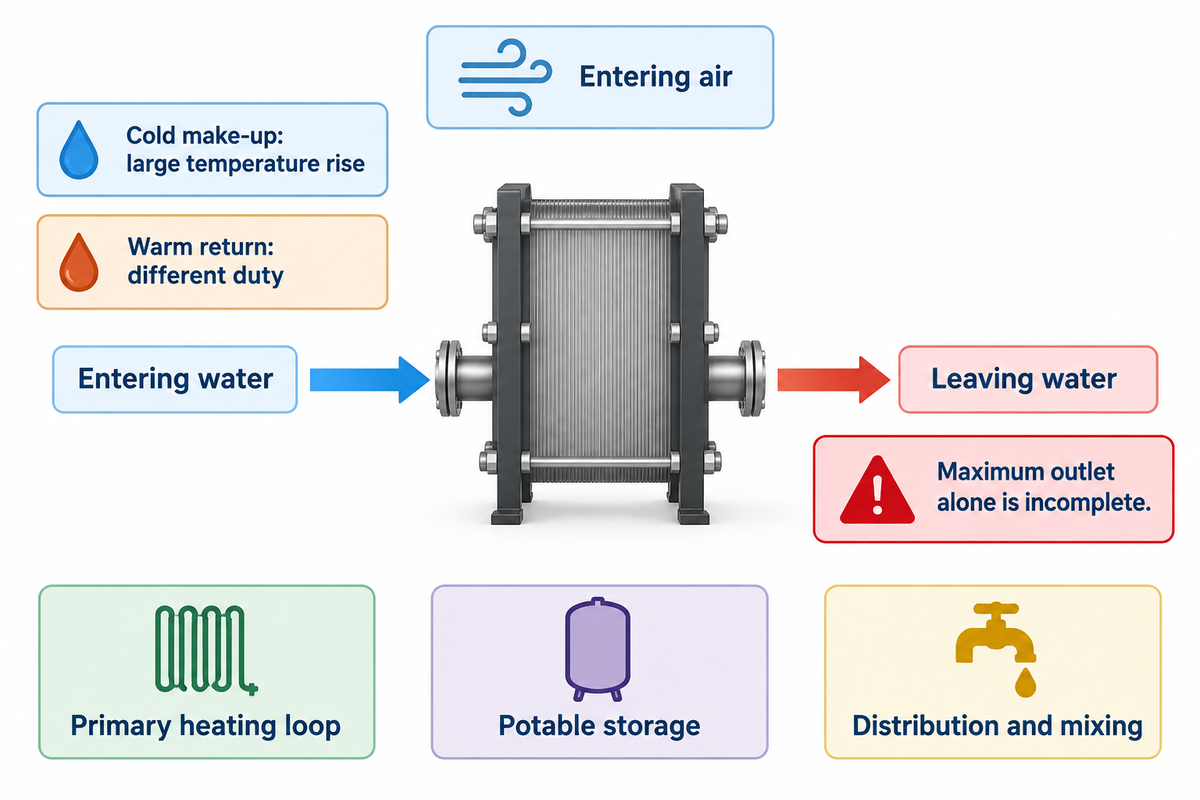
Mitsubishi’s Heat2O states a maximum outlet temperature of 176°F (80°C) but the actual capability depends on the inlet and the water circuit. To adequately describe the unit’s capability with respect to a water circuit, enter three temperatures on the same line (i.e. entering water, leaving water, and entering air). A maximum outlet value answers only one of those questions. CO₂ heat pump water heaters must be chosen to match the entering-water, leaving-water and entering-air temperatures.
A cold make-up supply of water suits a single-pass heat pump. This results in a large rise in water-side temperature. Warm return water from a circulation loop creates a different duty: a smaller temperature rise, with warmer water entering the gas cooler. At the gas cooler, inlet water temperature affects heat pump performance even when the final storage setpoint remains unchanged.
During periods with little fresh draw and continued recirculation, a nominally cold inlet may become warm. Retrofit performance comparisons need entering-water, leaving-water and entering-air temperatures throughout the cycle. The Central Heat Pump Water Heater Design Guide explains this behavior.
Keep the primary heating loop separate from the tap temperature. Some systems transfer heat directly to potable storage; others use a secondary heat exchanger between a closed primary loop and drinking water. Different temperatures are established through storage, distribution and mixing.
In the Association for Energy Affordability’s 2024 demonstration paper, the Heat2O primary loop delivered 176°F to a secondary heat exchanger, while potable storage typically reached about 165°F (74°C). That distinction changes the usable temperature available before distribution and mixing.
Different temperatures also appear in the Banks field study published in 2022: incoming city water ranged from 50–72°F (10–22.2°C), was heated to 147°F (63.9°C), and entered the recirculation loop at about 125°F (51.7°C). These are recorded conditions in that installation, not a water-management prescription for other buildings.
| Evidence point | Reported value | Meaning | Source |
|---|---|---|---|
| Published Heat2O outlet capability | 176°F / 80°C | Maximum leaving-water claim; capacity is a separate rating | Mitsubishi, 2022 |
| Heat2O nominal-output condition | 36°F / 2°C ambient | Published 40 kW output at this outdoor condition | Mitsubishi, 2022 |
| Heat2O cold-output condition | −13°F / −25°C ambient | Published capacity falls to 50% | Mitsubishi, 2022 |
| Primary-loop outlet in demonstration | 176°F | Water entering the secondary heat exchanger | AEA, 2024 |
| Potable storage in demonstration | About 165°F / 74°C | Typical temperature after secondary heat exchange | AEA, 2024 |
| Lower incoming city-water temperature | 50°F / 10°C | Lower end observed at the Seattle retrofit | Banks et al., 2022 |
| Upper incoming city-water temperature | 72°F / 22.2°C | Upper end observed at the same retrofit | Banks et al., 2022 |
| Heated water in Seattle retrofit | 147°F / 63.9°C | Water after heating in that installation | Banks et al., 2022 |
| Delivery to Seattle recirculation loop | About 125°F / 51.7°C | Distribution-loop entry, distinct from the heated-water temperature | Banks et al., 2022 |
Label the temperature sensors by their circuit and location. Replace “Hot water: 80°C” with “primary-loop outlet: 80°C; potable storage and distribution: separately designed.”
Storage and recirculation: keep the cold inlet cold
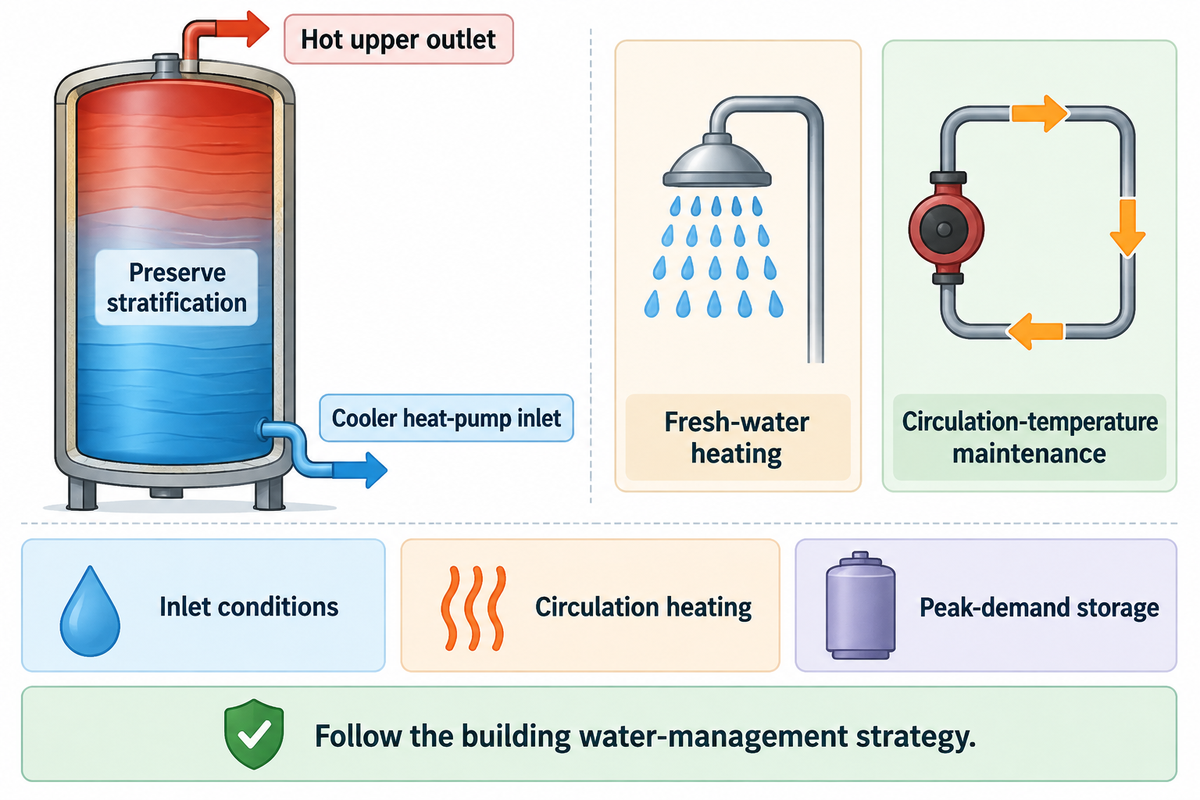
Stratified storage helps a single-pass CO2 heat pump receive cooler water while keeping hot water available at the tank’s upper outlet. The difficult part is often the warm circulation return: its connection point and reheating method affect both storage mixing and electricity use.
Separate the fresh water heating load from the temperature-maintenance load. The first heats replacement water as it’s drawn off by the occupants. The second replaces heat lost by circulating water in the system, including when no water is drawn off by the occupants. Combining both loads as one can hide why the plant uses more electricity than expected.
Cold-Inlet Fit Matrix
| Duty category | Hidden constraint | Design response |
|---|---|---|
| Regular cold make-up flow | Tank mixing can warm the heat-pump inlet | Preserve stratification through piping, sensor placement and controls |
| Low draw, continuous circulation | Temperature maintenance can dominate plant electricity | Measure loop losses and compare dedicated reheat with a compatible return-to-primary design |
| Short, heavy demand peak | Daily heat demand conceals storage depletion | Check draw timing, usable storage and recovery before the next peak |
| High-temperature return | A cold-inlet performance rating describes a different duty | Use the selected model’s warm-inlet map and system arrangement |
| Winter recovery | Cold-weather capacity and defrost can extend recovery time | Match the low-ambient performance map to the design-day draw sequence |
| Noise-limited night operation | Reduced output may leave less stored heat before morning demand | Coordinate quiet-mode output, storage and the recovery schedule |
| Combined space and water heating | Space-heating return differs from cold domestic-water makeup | Compare separate circuits and equipment against each temperature schedule |
| Simultaneous cooling demand | Recovered heat has value only when the heat sink can use it | Align cooling and hot-water schedules and count each benefit once |
| Essential hot-water service | Backup equipment depends on working sensors and controls | Commission the outage sequence and confirm recovery under backup operation |
Equipment and storage are sized based on the project’s demand. The synthesis of the Ecotope guide and the AEA field demonstrations informs the design decisions.
A swing tank separates recirculation reheating from the primary storage arrangement. Hot water drawn through it helps satisfy the load; an electric element supplies heat when needed. A parallel-loop arrangement uses different equipment for temperature maintenance. Each alters floor space, controls, and auxiliary energy.
AEA’s initial weeklong plant tests at Lassen reported a COP of 2.7 for returning circulation water to the cold primary tank, compared with a 2.3 baseline. The engineered return-to-primary arrangement altered the recirculation reheating path; the swing tank remained available for backup. The authors suspected poor existing stratification influenced the result and planned longer validation.
Cool incoming water and safe potable operation require coordinated design. A closed nonpotable primary loop, a cold make-up line, and a potable water storage tank have different functions. The CDC’s building-water guidance addresses temperature, water age, disinfectant residuals and anti-scald controls. Changes made for efficiency must comply with the building’s water-management strategy.
CO2 heat pump capacity in cold weather
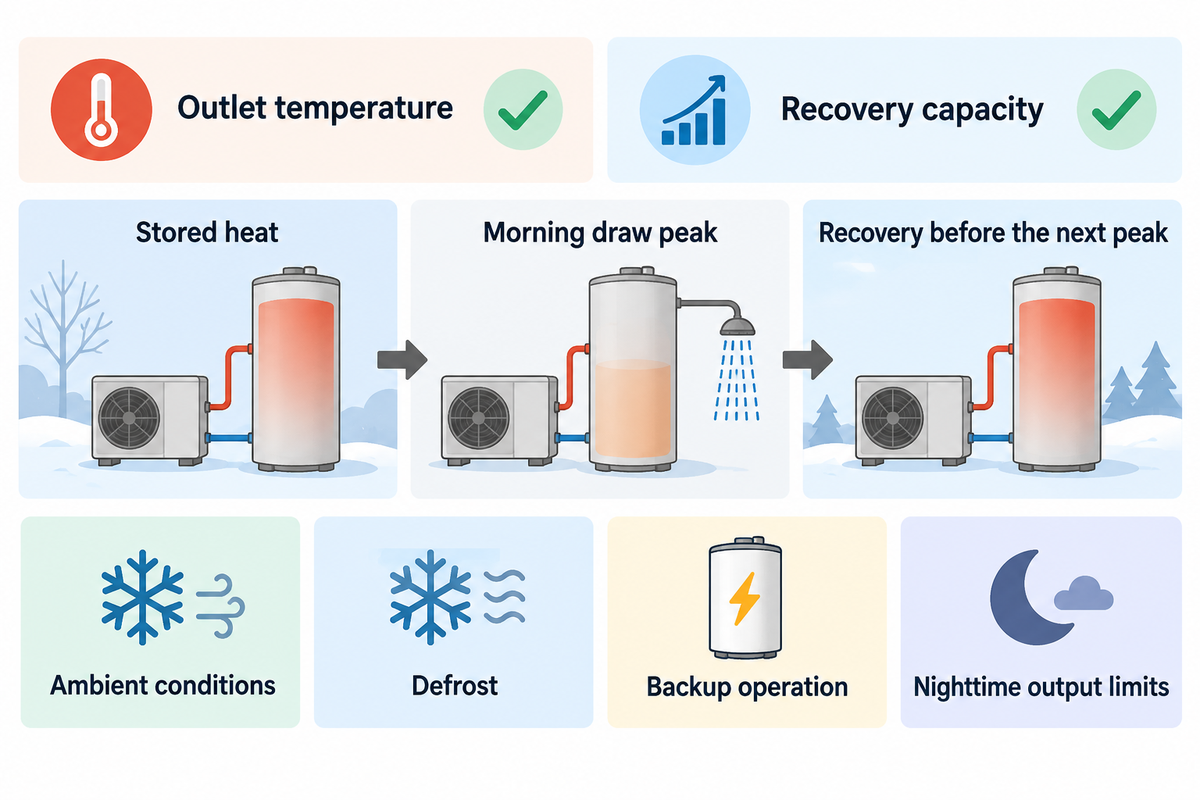
Heat2O’s published output is 40 kW at 36°F (about 2°C) ambient; at −13°F (−25°C), capacity falls to 50% while 176°F water remains achievable, according to Mitsubishi’s Heat2O release. CO2 air source heat pumps can produce hot water in cold weather, but available heating capacity varies with the model and operating temperatures.
That makes sense for a hotel or apartment building: outlet temperature may be sufficient while recovery takes longer. The same daily hot water volume can be easy to supply when spread throughout the day and difficult when concentrated into a morning peak. Ambient temperature, defrost behavior, storage availability and backup operation all belong in the winter selection. The surrounding air temperature determines the source condition for the outdoor equipment. How much heat output is available during that recovery period?
Winter sizing must account for demand drawing down storage and equipment restoring it under changing conditions. Oak Ridge National Laboratory’s 2024 multifamily study combined design-day sizing, a stratified tank model and a commercial CO2 heat pump performance map; its simulated savings are scoped to the studied sites and tariffs.
Nighttime sound limits can also reduce the output available for recovery. The AEA Lassen project used reduced nighttime operations to address neighbor noise, and its installed capacity justified the choice. For a different building, the same restriction could require more storage or a different recovery schedule.
Water-source heat pumps use a different source-temperature profile from outdoor units. A water-source heat pump design uses the available water conditions and associated pumping, including the source availability during the coldest hours.
CO2 vs R290 heat pumps for commercial hot water
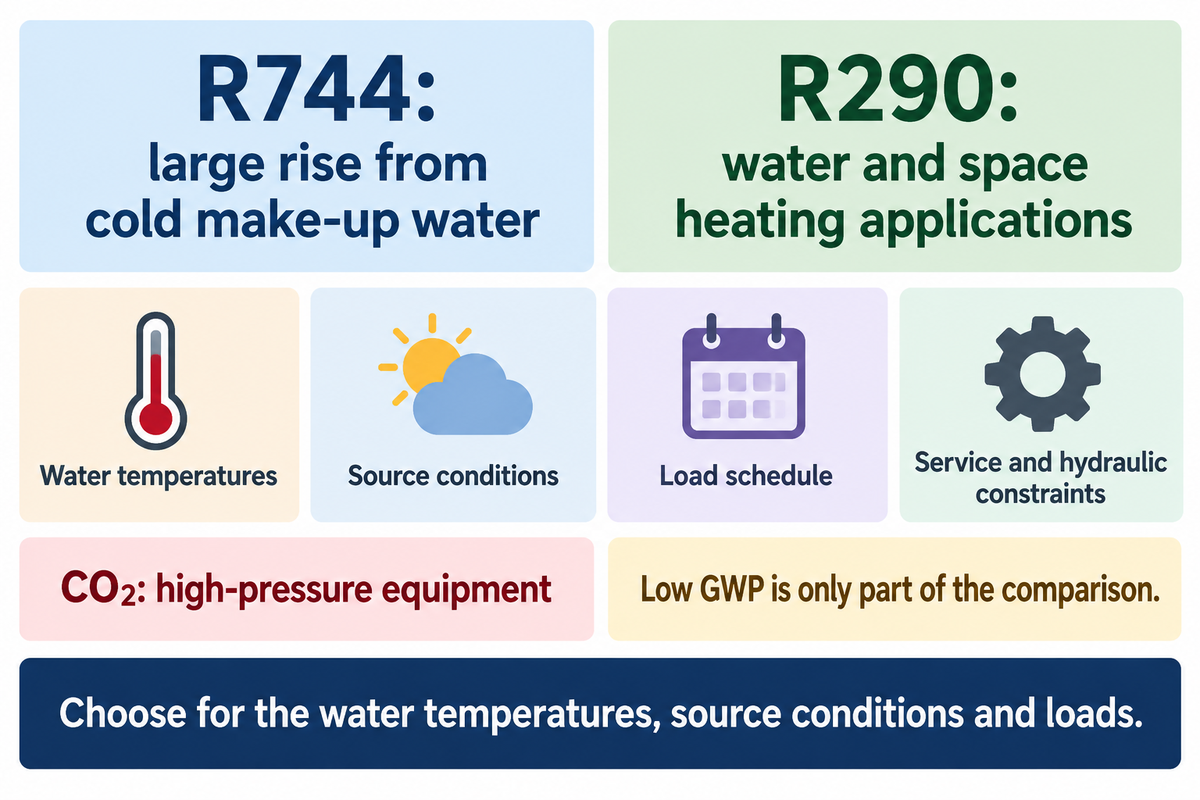
R744 can be used for a large temperature rise from cold make-up water, and R290, or propane, can be used for water heating and space heating applications. Depending on water temperatures, source conditions, loads and constraints, choose between CO2 and R290 equipment.
The air-source R290 design achieved the highest seasonal performance among three 15 kW designs in Conte and colleagues’ 2025 numerical comparison under the study’s combined space-heating and domestic-hot-water scenarios in Rome and Strasbourg. For the daytime hot-water-only profile, the solar-air R744 design led instead. Weather and demand timing changed the comparison.
For combined domestic hot water and space heating, there can be big differences in return temperatures of radiators, versus the cold make-up water used for domestic hot water production. A separate circuit or alternative heating arrangement may be better to meet those requirements. A heat pump chiller application also involves cooling and heating, which merit their own operating comparison.
What are the disadvantages of CO2 as a refrigerant?
CO2 systems use equipment built for high pressure operation, and many water-heating designs lose efficiency as the entering water temperature rises. These traits affect component choice, serviceability and hydraulic layout. For a retrofit with warm return water, the practical disadvantage can be the system changes needed to obtain efficient operation, rather than the refrigerant’s maximum achievable temperature.
Decarbonization comparisons need seasonal electricity, displaced fossil fuels and refrigerant climate impact. Low GWP addresses only part of an “environmentally friendly” claim. R32 systems, propane equipment and natural refrigerant CO2 systems each warrant model specific comparisons.
Installed cost and energy use: a worked example
The installed cost of a heat pump system involves units, storage, electrical work, piping, controls, and commissioning. Operating costs depend on the complete system’s electricity consumption and the electricity rate. Storage footprint, available power, and circulation losses can change costs as much as the unit selection.
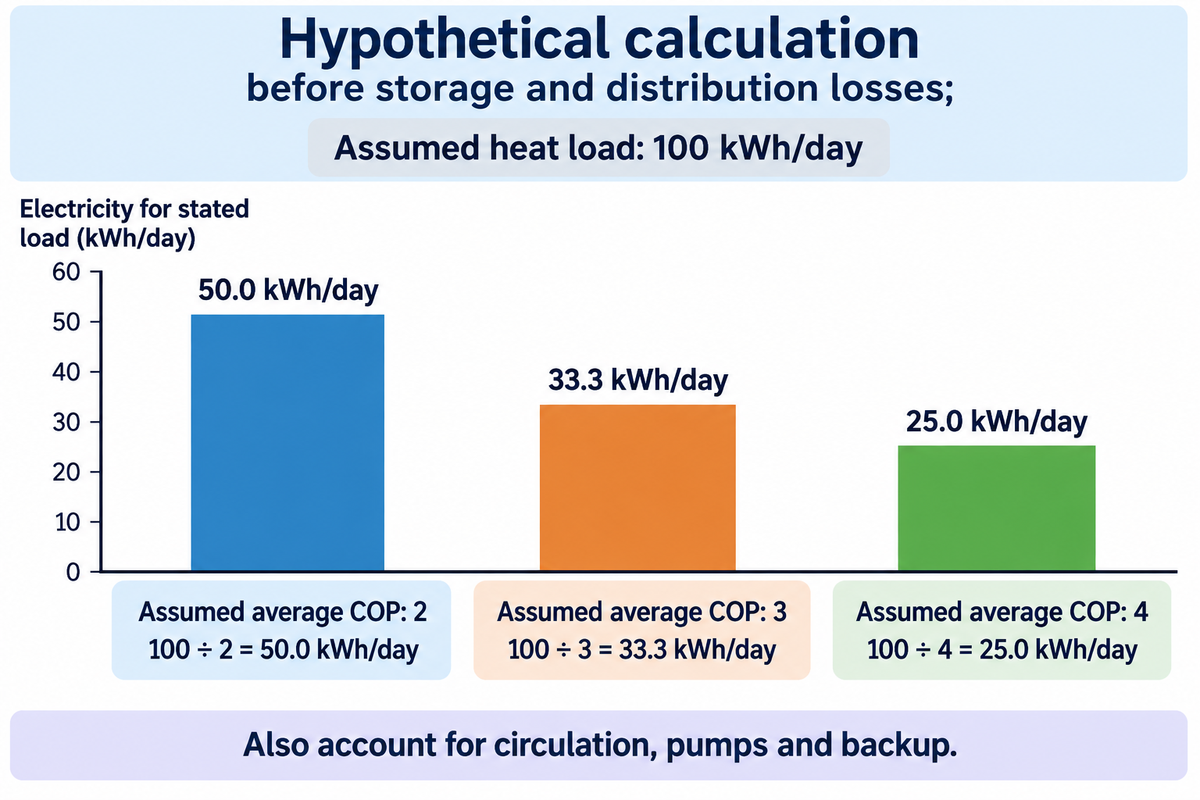
For an initial “back of the envelope” calculation, assume the water-heating load is 100 kWh of heat per day, before storage and distribution losses. Compare assumed average COP values of 2, 3 and 4 over that same load and period. Electricity for the stated load is thermal energy divided by COP.
| Assumed average COP | Calculation | Electricity for stated load |
|---|---|---|
| 2 | 100 ÷ 2 | 50.0 kWh/day |
| 3 | 100 ÷ 3 | 33.3 kWh/day |
| 4 | 100 ÷ 4 | 25.0 kWh/day |
At a further assumed flat electricity price of $0.20/kWh, the middle case costs $6.67 per day: 100 ÷ 3 × $0.20. This is the energy cost for the stated load only. Add the appropriate storage and circulation heat loads, pumping electricity and backup input when building the complete estimate. Demand charges and time-of-use charges need an accurate electrical profile.
Maintain consistency with the accounting boundary. The Banks field study defines system COP using delivered-water heat plus recirculation losses, divided by heat-pump and backup-heater electricity. If a measured whole-system COP already includes backup and pump electricity, adding those inputs again would double-count them. A useful-hot-water-only efficiency calculation will give a different number even for the same installation.
Storage has to cover peaks in hot water draw while the heat pump recovers enough water for the next peak. A building using 100 kWh of heat over a day may draw a lot of that heat in a short period, so energy used alone can’t determine the size of the hot water storage tank or heating capacity.
Storage can reduce the heat pump output needed to meet instantaneous hot-water demand. This also allows heat pump operation during off peak hours, as described by Andrew Macaluso in HPAC’s storage design discussion. The cost benefit varies with the project’s demand and tariff.
For total cost of ownership, compare the same scope across bids: equipment and tanks, electrical service upgrades, installation access, acoustic measures, commissioning, maintenance and backup provision. Electric water heaters may also be part of a backup provision strategy in a retrofit. Compare the backup operating sequences for electric heat and retained boilers. Their operating hours should be in the estimate even if the main heat pump uses less energy than resistance heating.
Where commercial CO2 heat pumps fit
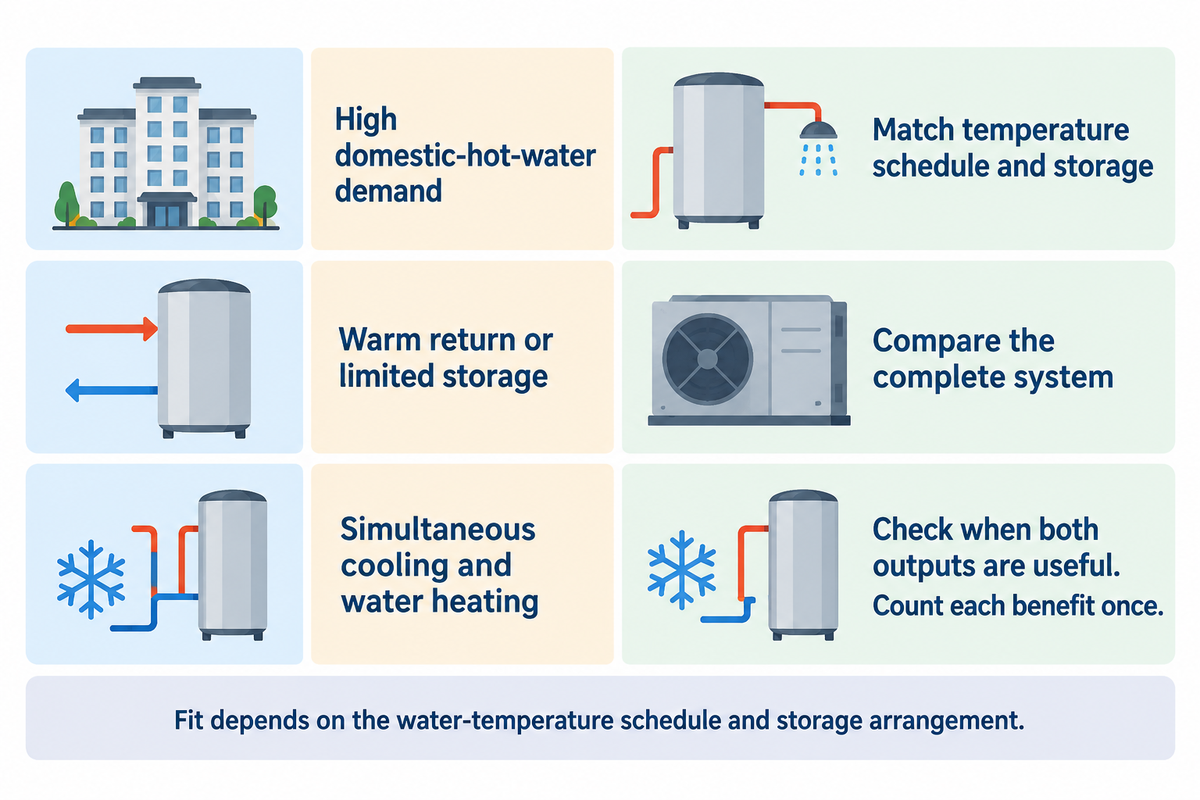
Heat pump water heating is a practical candidate for hotels and other buildings with high domestic hot water demand. The water temperature schedule and hot water storage arrangement must match the equipment for that fit. Commercial and industrial applications with warm return water, tightly constrained storage or concurrent cooling loads need a more specific system comparison.
Smaller CO2 units supplied central water heating in the 60-unit retrofit studied by Banks and colleagues. Equipment designed for residential applications served this building through an engineered installation. Each residential CO2 heat pump was part of a system selected and controlled for the building load.
Facilities that need to heat and cool at the same time have another opportunity. Petersen and colleagues’ commercial R744 research investigated useful cooling alongside water heating. A restaurant or facility with refrigeration may have overlapping loads. The assessment must count when each output is useful and keep recovered heat and cooling benefits from being counted twice.
Space heating and domestic hot water often require differing supply and return temperatures. Process water may require different fluids, hygiene or heat exchangers, etc. Consider these cases when analyzing heat-pump applications in industry and commerce. Renewable energy opportunities, especially environmental and recovered heat, depend on what’s available and the operation schedule.
Integration, service and procurement requirements
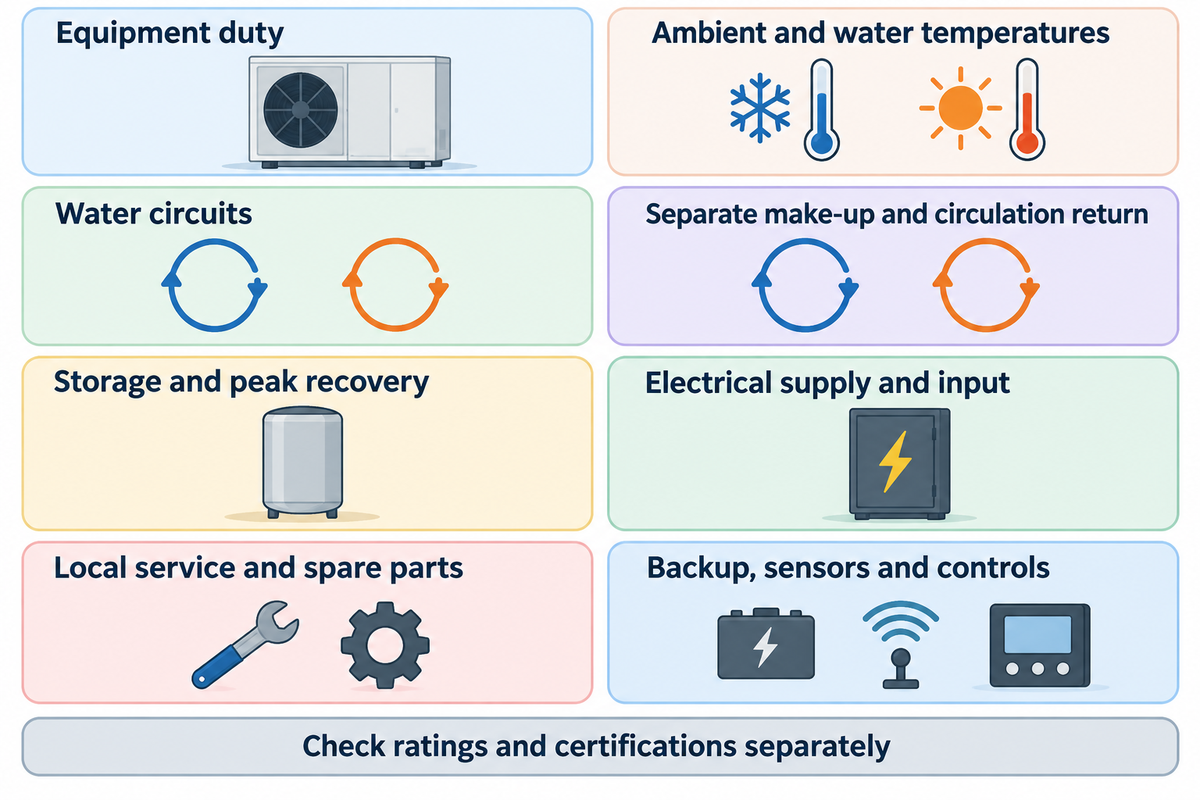
A useful quotation for a water heating solution defines the equipment duty, water circuits, storage, electrical supply and service responsibilities together. Give the designer and supplier the same schedule to allow for a fair comparison.
Do
- Separate cold make-up and circulation-return conditions.
- Check peak draw and storage recovery together.
- Include backup, pumps and controls in the energy boundary.
Don’t
- Substitute a maximum outlet rating for a full duty point.
- Size storage from daily energy alone.
- Count auxiliary electricity twice when using a system COP.
The technical submittal should identify ambient operating conditions, entering and leaving water temperatures, capacity, electrical input and relevant part-load behavior. For service planning, establish local refrigerant expertise, replacement-part access and the response to a unit outage.
Commercial water-heater rating references include ANSI/AHRI 1300-2013 (R2023) and 1301-2013 (R2023), listed on the AHRI commercial water-heater rating page. Ratings may vary depending on conditions and the rating method offered. In this regard, it is important to check certifications separately. The design also needs the applicable pressure protection, electrical provisions and building-water controls.
Commissioning should verify the normal heating sequence and the backup response. In the Banks retrofit, altered setpoints and a defective flow sensor affected backup operation during heat-pump outages. An idle spare heater is useful only if its control elements, sensors and hydraulic interfaces behave as intended.
CO2 heat pump FAQ
Is CO2 a refrigerant?
Yes. Carbon dioxide is the refrigerant designated R744.
It circulates inside the refrigerant circuit while a separate water circuit receives heat through a heat exchanger. In a domestic hot-water installation, the name doesn’t mean carbon dioxide is added to drinking water. The selected equipment determines the operating pressures, water-temperature range and installation requirements. R744 identifies the fluid, while air-source or water-source identifies where the heat originates.
Do heat pumps reduce CO2 emissions?
They can, depending on electricity supply and the heating being replaced.
The comparison includes seasonal electricity, backup heating and the displaced fuel. Refrigerant climate impact is another part of the assessment. A low global warming potential refrigerant helps address direct refrigerant impact, while the plant’s energy performance determines its operational electricity demand. For a fair comparison, use the same useful-heat boundary and include storage, circulation and auxiliary loads consistently across both alternatives.
Are CO2 heat pumps reliable?
Reliability depends on the equipment and the installed system.
A reliable installation matches the model’s operating envelope to the site, maintains suitable water quality and provides service access. Buildings that need uninterrupted hot water also benefit from a tested backup strategy and replacement-parts plan. Commissioning must cover sensors and controls alongside equipment selection. Warranty scope, local support and maintenance responsibilities belong in the purchasing decision.
Can CO2 heat pumps provide space heating?
Some models can serve a space heating system.
Space-heating suitability requires supply and return temperatures that match the model’s performance map. Domestic hot-water and radiator circuits can need different arrangements.
Are commercial CO2 heat pumps available in the US?
Yes. Mitsubishi markets Heat2O for commercial water heating.
Heat2O applications include multifamily buildings and hotels. Regional service, electrical requirements and the project duty also shape equipment selection.
Discuss your commercial heat-pump duty
Compare your water-temperature schedule, heat source and heating load with the Kovenair heat-pump range. Include the daily and peak hot-water demand, circulation-return temperature, available electrical supply and intended backup arrangement in your enquiry.
The reference guide is published by Kovenair. Individual equipment, research and field project credits belong to their respective owners and authors. The electricity table uses stated assumptions; it is separate from product performance data.
References & Sources
- Field Measurement of Central CO2 Heat Pump Water Heater for Multifamily Retrofit Banks, Grist, Heller and Lim, Sustainability, 2022.
- Residential CO2 Heat Pump Water Heater U.S. Department of Energy.
- Central Heat Pump Water Heater Design Guide Ecotope for Energy Trust of Oregon.
- Eliminating the Swing Tank and Other Design Considerations Brooks, Neal and Young, Association for Energy Affordability; ACEEE, 2024.
- Monitoring Building Water U.S. Centers for Disease Control and Prevention.
- Electrification Options for Multi-Family Water Heating in Cold Climates Oak Ridge National Laboratory, 2024.
- Comparative Analysis of CO2 and Propane Heat Pumps for Water Heating Conte and colleagues, Applied Thermal Engineering, 2025.
- How Storage Tanks Aid Decarbonization Andrew Macaluso, HPAC Engineering; author affiliated with Lync.
- Development of High-Efficiency Carbon Dioxide Commercial Heat Pump Water Heater Petersen and colleagues, 2013; University of Illinois research record.
- AHRI 1300 and 1301 Air-Conditioning, Heating, and Refrigeration Institute.