Get in Touch with Koven Air Company

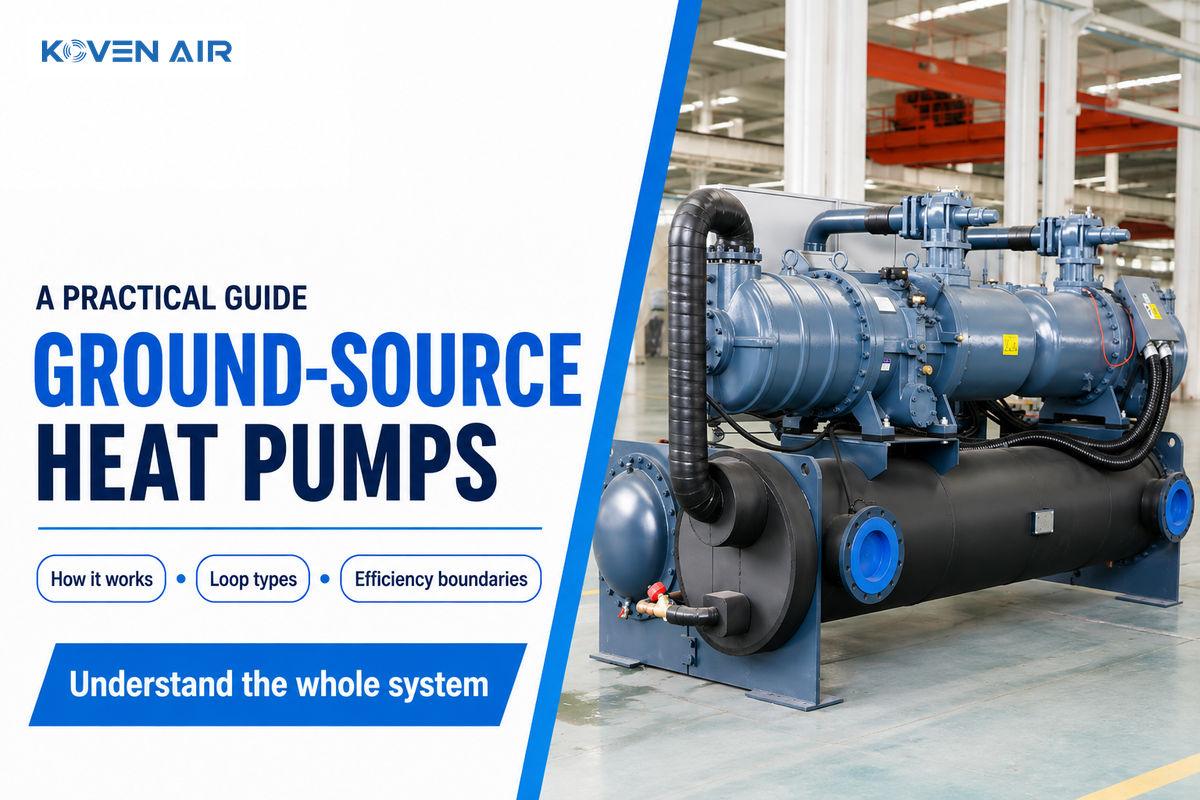
A Ground-source Heat Pump uses the ground as a heat source in winter and a heat sink in summer. Ground temperature is more stable than outdoor air temperature. The commitment is to an underground heat exchanger with its land, construction and operating costs.
When an owner replaces a furnace with a residential heat pump, the first question is: Can the site support the ground connection? With a facilities team, the questions move to distribution temperatures and the loads, and the requirements for pumping and maintenance. In both cases, the first step is recognizing that the heat-pump unit is one part of a heating and cooling system.
Ground-source heating at a glance
- Function: transfer heat between the building and a ground or water source.
- Energy input: electricity for the heat pump and associated equipment.
- Ground connection: sealed liquid loop, suitable open water circuit, or direct refrigerant exchange.
- Building delivery: air or water, matched to the selected unit.
- First decision: establish a workable ground connection before comparing equipment ratings.
What Is a Ground-source Heat Pump?
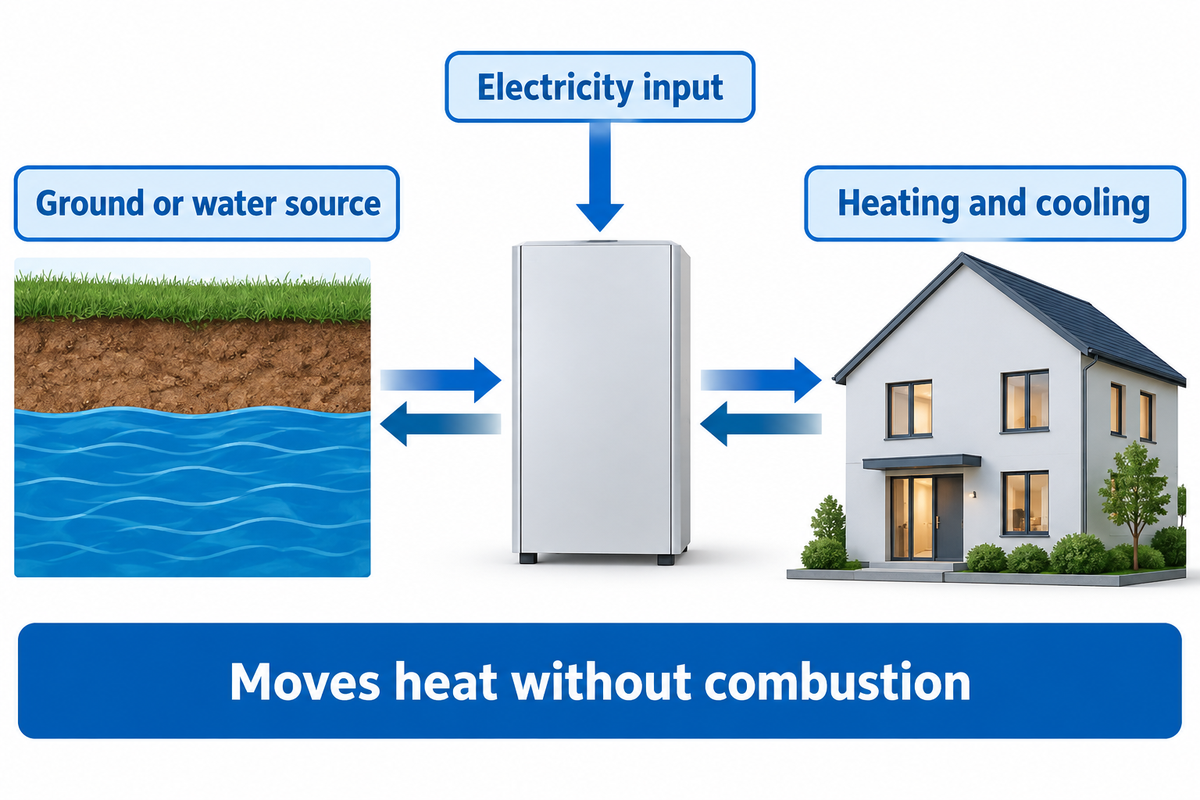
A ground source heat pump is an electrically driven heating and cooling system that transfers heat to or from the ground or a body of water. Known as a geothermal heat pump, the equipment moves heat between a source and a building and doesn’t create heat by combustion.
The term geothermal can be confusing. Geothermal technologies include deep resources used for power generation and direct heating. Geothermal heat pump technology, on the other hand, uses shallow ground as a heat source and sink. Heat stored in the earth can support heating even when the ground feels cool to the touch.
“Heat pumps move heat from one place to another using electricity.”
Ground-source heat pump systems can serve residential applications and larger buildings. Those installations use different equipment and project scopes. A residential geothermal heat pump isn’t the same as a commercial central plant. A water-source heat pump may connect to a building water loop whose temperature is controlled by other equipment rather than a borefield.
To understand a geothermal system, identifying the source of heat and building connection is more helpful than relying on the label itself.
How a Ground-source Heat Pump Heats and Cools
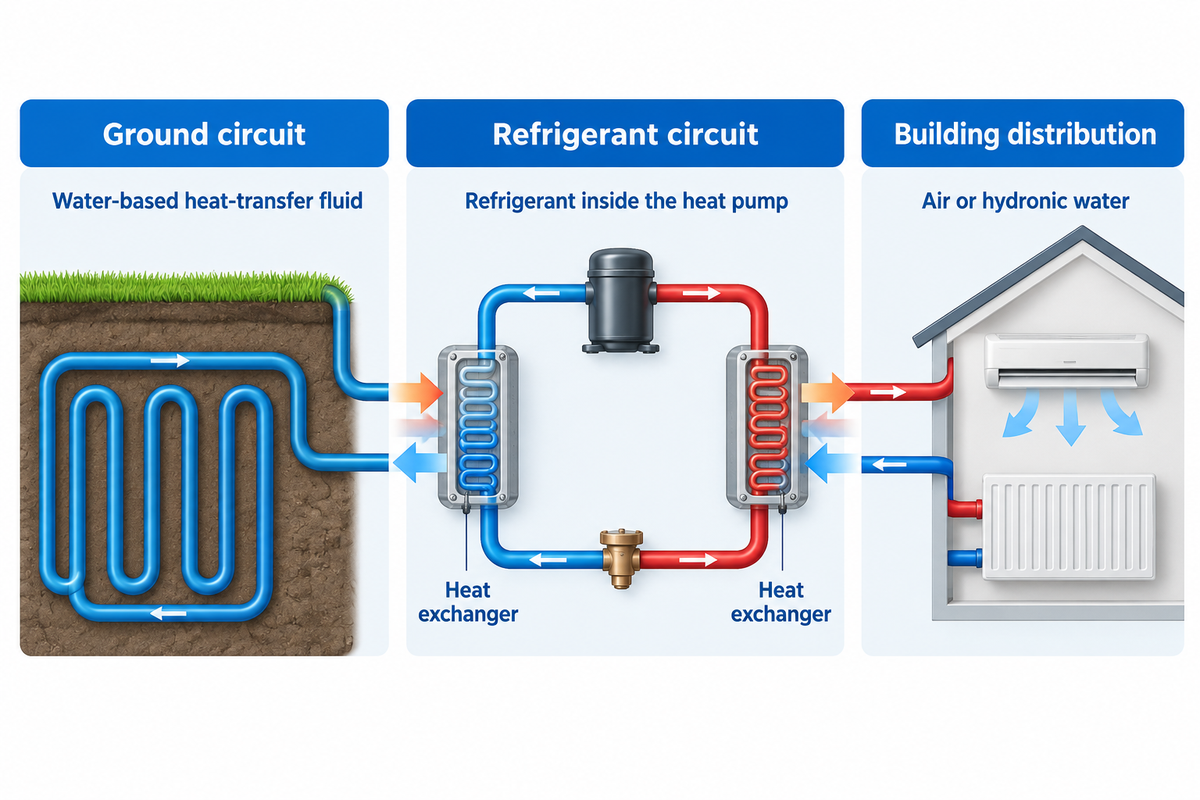
When heating, a geothermal heat pump extracts heat from the ground-side circuit and raises its temperature through a refrigerant cycle. During cooling, a reversible unit removes heat from the building and rejects it to the source. Collecting, refrigerating and distributing heat in the building perform different tasks in the process.
| Part | What circulates | What the part does |
|---|---|---|
| Ground circuit | Water or an approved water-based heat-transfer fluid | Exchanges heat through buried pipe or a source-water connection |
| Refrigerant circuit | Refrigerant inside the heat pump | Uses compression, condensation, expansion and evaporation to move heat between temperatures |
| Building distribution | Air or hydronic water | Delivers useful heating or cooling to occupied spaces |
An indoor closed liquid loop doesn’t transmit groundwater through building heating coils. It exchanges heat with the refrigerant in a heat exchanger, and a water-to-air unit conditions the air. A water-to-water unit provides the hydronic circuit. In direct geoexchange, refrigerant itself carries heat in the ground-side circuit.
The operating guide of ground-source heat pumps by the Pacific Northwest National Laboratory differentiates indoor units from circulating equipment and the ground coupled heat exchanger. That differentiation is useful when talking about a geothermal HVAC system with an installer: a fault in a pump or control can adversely impact a user’s comfort even if the compressor is working.
Can a ground source heat pump be used for cooling?
Yes, a reversible ground source system can provide cooling by removing heat from the building and transferring it to the ground-side circuit. The heat pump moves heat in the opposite direction from that in winter. The building still needs a cooling terminal, humidity control, and a means to remove condensate; a heating-only system doesn’t provide these.
Air conditioners and air-source heat pumps work by moving heat during cooling. For home heating and cooling, a geothermal heat pump system reversibly removes heat from your home during the summer and adds it during the winter. Air conditioning still needs suitable air or water distribution. Hydronic buildings can use fan coil units to distribute chilled water. Radiant cooling requires a different condensation control design, so a warm floor heating circuit shouldn’t simply be used to distribute chilled water.
Ground Loop Types: Closed Loop, Open Loop and Layouts
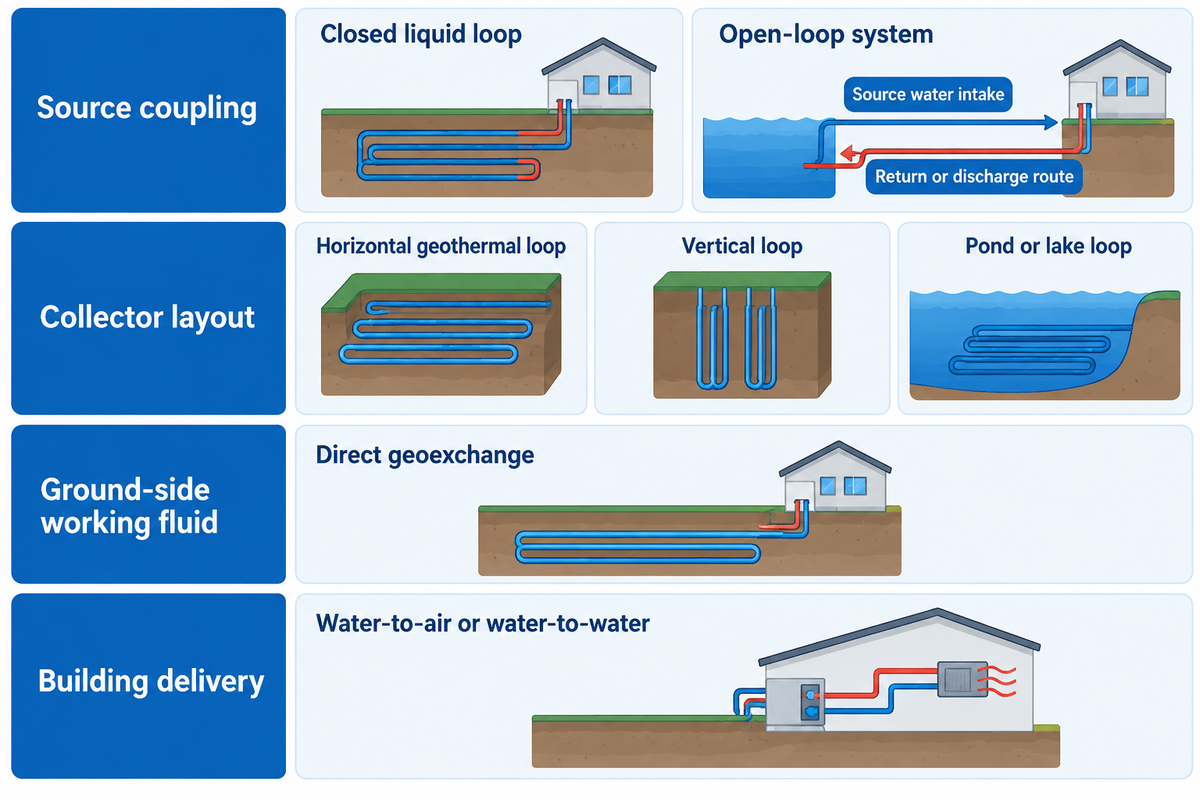
Open loop describes the system’s heat exchange with the source. Closed loop describes how the system exchanges heat with the source. Horizontal, vertical and pond arrangements describe collector geometry. Water-to-air and water-to-water describe the type of building side connections of a unit.
| Decision | Options | Practical consequence |
|---|---|---|
| Source coupling | Closed liquid loop | Contained fluid exchanges heat through pipe walls; there is no routine groundwater withdrawal for heat exchange |
| Source coupling | Open-loop system | Suitable source water passes through the source-side system; a lawful return or discharge route is needed |
| Collector layout | Horizontal geothermal loop | Excavation needs usable ground area and access |
| Collector layout | Vertical loop | Drilling access and subsurface conditions guide borefield design |
| Collector layout | Pond or lake loop | A suitable water body and permission are necessary; the presence of a pond alone is insufficient |
| Ground-side working fluid | Direct geoexchange | Refrigerant exchanges heat through buried or submerged tubing instead of a separate liquid loop |
| Building delivery | Water-to-air or water-to-water | Match the unit to ducts, air handlers or hydronic terminals |
The overview by the International Ground Source Heat Pump Association links layout choice to available land and soil and/or rock conditions. Different references group direct exchanges differently. Describing the actual fluid path avoids a misleading list that treats every label as a mutually exclusive type of heat pump.
How deep do ground source heat pump loops go?
Collectors for ground-source energy systems can use shallow trenches, deep boreholes or submerged piping, so there’s no standard installation depth. A horizontal field and a vertical loop are different construction options. Depth and length of a collector are determined by the load, ground thermal conductivity, and the layout, among other things; depth alone can’t determine a system.
The Department of Energy describes relatively stable temperatures at about 30 feet, around 50°F to 59°F (10°C to 15°C), in its discussion of most U.S. areas. That’s a contextual explanation of the resource, not a prescribed burial depth or a temperature to enter into every design. The installation of the ground loop needs local ground information and a project-specific design.
Is Your Site Suitable for Geothermal Heating?
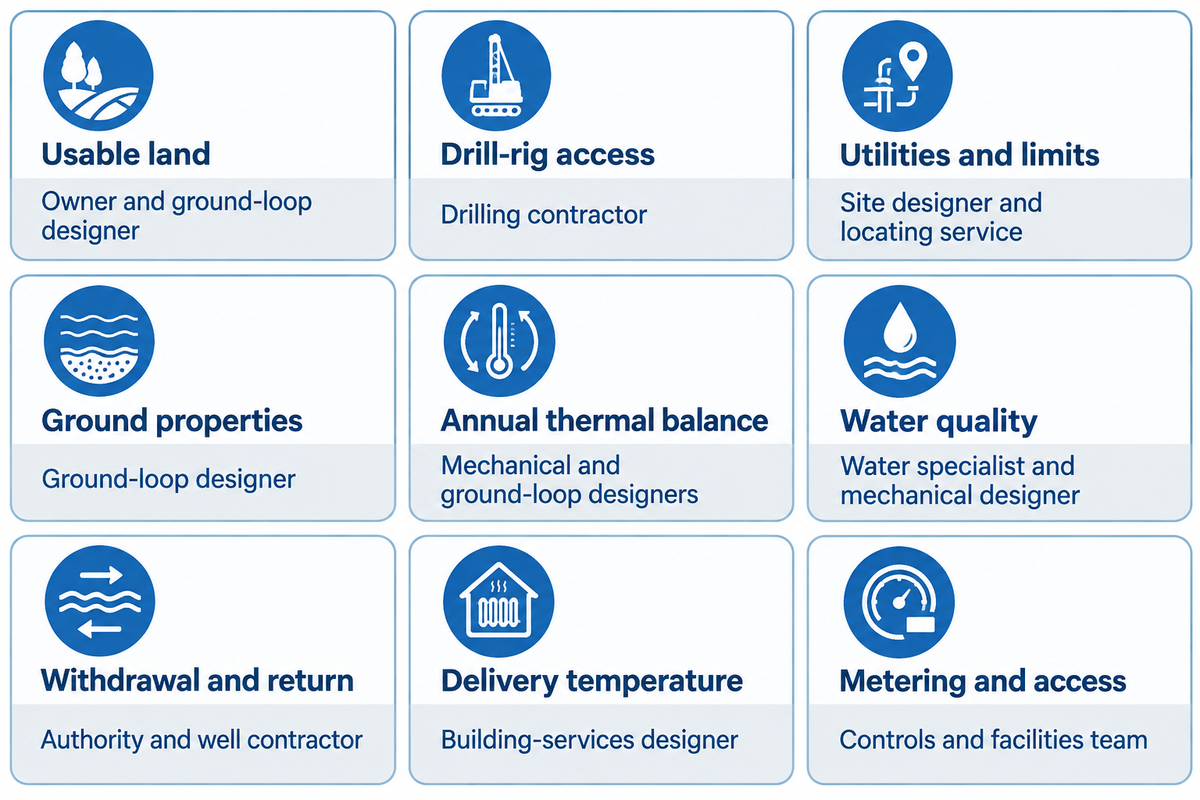
Considerations when evaluating a geothermal site include drilling access and the location of underground services. Soil and rock conditions, as well as the presence of groundwater, can impact the feasibility of a geothermal system. Heating and cooling needs are key considerations in the evaluation of geothermal well fields. Prior to equipment selection, these factors can rule in or rule out a potential site. Detailed commercial feasibility is covered in the commercial geothermal systems guide.
Ground-Loop Constraint Checklist
This introductory checklist correlates a site constraint to a design decision and the individual accountable for that resolution.
| Constraint category | Decision it changes | Responsible party |
|---|---|---|
| Usable land | Horizontal collector versus another layout | Owner and ground-loop designer |
| Drill-rig access | Whether the proposed bore locations are buildable | Drilling contractor |
| Buried utilities and property limits | Safe and permitted collector route | Site designer and utility-locating service |
| Ground thermal properties | Required ground-exchanger design | Ground-loop designer |
| Annual heating/cooling balance | Long-term ground response and possible hybrid source | Mechanical and ground-loop designers |
| Open-loop water quality | Filtration, corrosion control or a separating exchanger | Water specialist and mechanical designer |
| Water withdrawal and return route | Whether an open circuit is permissible | Local authority and qualified well contractor |
| Distribution temperature | Terminal compatibility and operating efficiency | Building-services designer |
| Metering and service access | Whether facilities staff can diagnose performance | Controls contractor and facilities team |
Let’s say the owner has a large lawn with an access gate that’s narrow and restrictive, has a septic field, and has a stand of mature trees. The large expanse of lawn makes the horizontal pipe option look appealing, but the space available for construction is even more constrained. A vertical option may help preserve space, but only if the drilling contractor can reach the proposed locations. Deciding on the equipment first would probably leave procurement holding a unit while the ground connection is redesigned. Early output indicates a buildable collection route, which includes reinstatement and accountability, as opposed to the promise that either layout is always less costly.
Open loop systems add a water-management decision. North Carolina’s geothermal guidance, for example, distinguishes return wells from other arrangements. Requirements differ by jurisdiction. Suitable water supply, chemistry and the discharge route belong in the same feasibility review.
Undisturbed ground temperature isn’t the same as the temperature around an operating borefield. ORNL’s 2020 borefield simulation study describes how annual thermal imbalance and interactions between boreholes can cause heat accumulation. Long-term heat rejection should be considered along with winter heating loads for cooling-dominated buildings.
Efficiency: The 3-Boundary Heat Pump Check
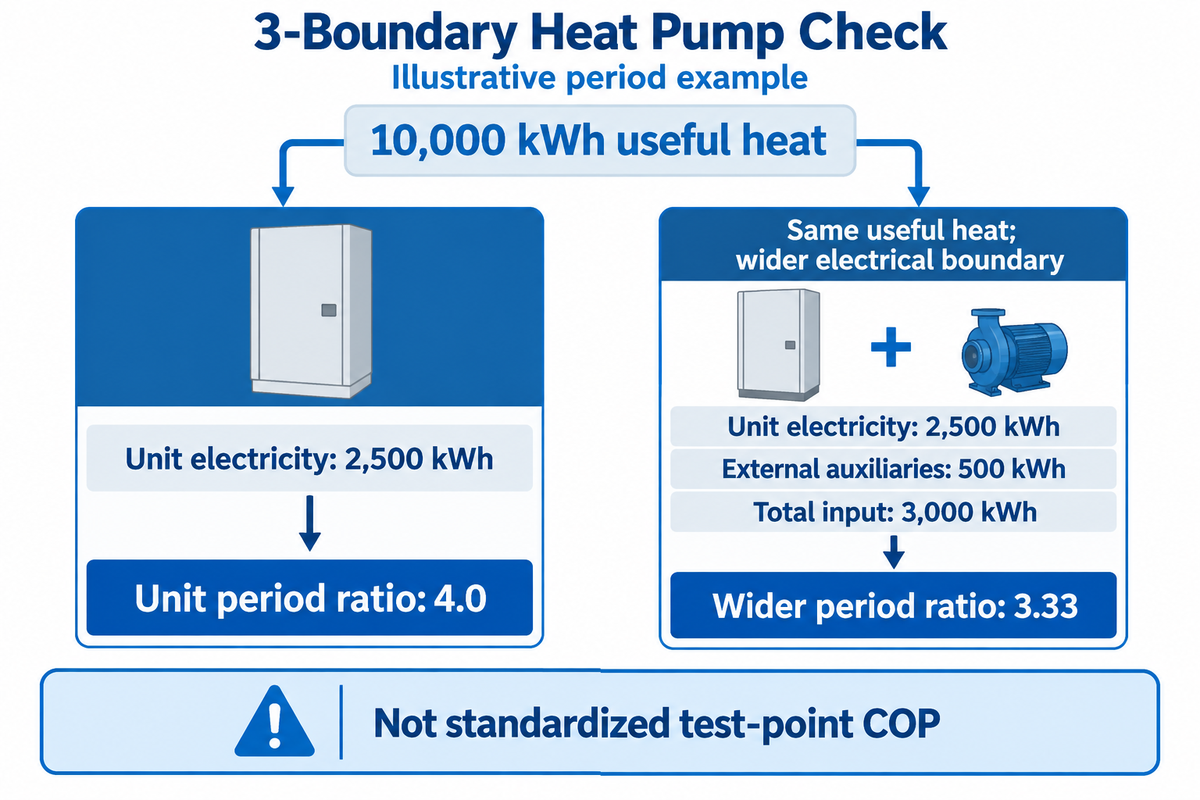
The 3-Boundary Heat Pump Check separates a test-point unit rating, measured-period unit performance, and whole-system performance, to compare efficiency claims.
Heating COP compares useful heat output with electrical input at a defined boundary, and is expressed as a ratio. A value of 4 means four units of heat for each unit of electricity within that measurement. The unit of measure is different for the energy efficiency ratio (EER) for a cooling system; the two numbers shouldn’t be compared directly.
| Boundary | Useful question | What must match |
|---|---|---|
| Test-point unit rating | How does this model perform under its specified test? | Test standard, source temperature, delivery condition and included electrical loads |
| Measured-period unit performance | How did the installed unit perform during the recorded period? | Heat meter, unit electricity meter, period and operating modes |
| Whole-system performance | How much useful heat reached the building per total system input? | Delivered-heat boundary plus all associated electricity, counted once |
ENERGY STAR’s geothermal definitions and test procedures distinguish water-to-air, water-to-water and direct geoexchange models. ISO 13256-1 covers water-to-air and brine-to-air units; the program maps water-to-water models to Part 2. Some pumps and fans may be inside the heat pump assembly, so the electricity needed to operate them may already be accounted for in its input.
Example: over one heating period, a unit supplies 10,000 kWh of useful heat and its meter records 2,500 kWh, including its internal electrical loads. The measured-period unit ratio is 10,000 ÷ 2,500 = 4.0. Separately metered external auxiliaries consume another 500 kWh. If the same 10,000 kWh reaches the building, the wider ratio becomes 10,000 ÷ (2,500 + 500) = 3.33. Heat losses in the distribution system require the use of a different numerator for delivered heat. Neither of the above-mentioned ratios is a standardized test-point COP.
The facilities manager interested only in the unit display would miss external consumption. The finance team interested only in the larger electricity meter would also capture consumption but may include lighting and ventilation loads. Meter placement decides the argument. The loads of the intended system must be counted only once, over the same period; keep unrelated building uses outside the calculation.
The HPT TCP Project 52 measurement program explains why building energy-use intensity mixes building demand with system performance. Lower bills may represent a warmer winter or fewer occupied hours as well as greater efficiency. Energy savings require a comparable baseline.
Key takeaway
Adding 500 kWh of external auxiliary electricity changes the example’s period ratio from 4.0 to 3.33; it does not change the equipment’s published test rating.
Ground Source vs Air Source: Compare the Whole Installation
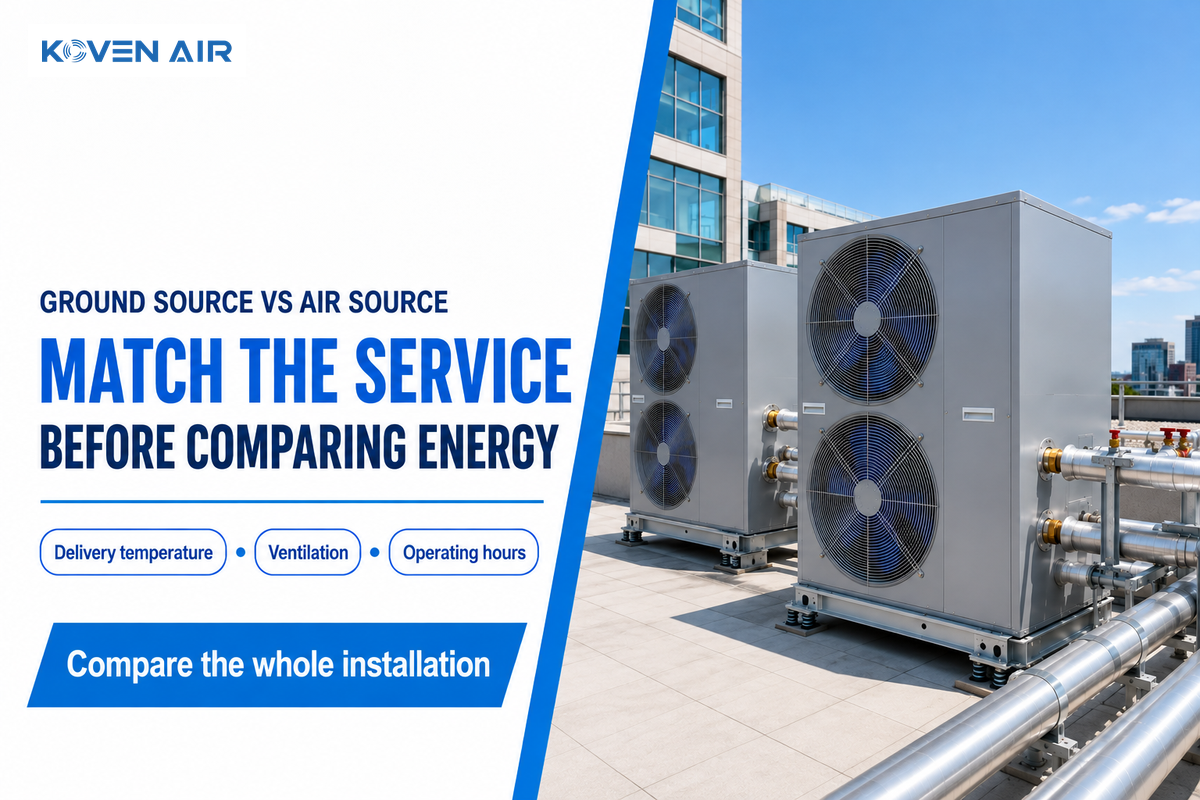
Ground source works well for sites where a viable collector can justify the ground works and a reasonable heating and/or cooling load exists. Air source avoids that collector investment and can address smaller loads and more constrained sites. Look at both at the required delivery temperature, considering the climate, the occupied hours of the building and the building services including controls for humidity, ventilation and air quality.
Ground source
- Exchanges heat with ground or water rather than outdoor air.
- Requires a buildable source connection.
- Adds source-side pumping and long-term ground response to the design.
Air source
- Uses outdoor air temperature as a source-side operating condition.
- Avoids installation of a ground collector.
- Adds outdoor-unit location, weather exposure and defrost behavior to the comparison.
Hydronic distribution and Air source are compatible. An air-to-water heat pump can heat water for building terminals; ground-source water-to-water heat pumps can do the same. The energy source doesn’t dictate whether a building uses ducts or radiant panels.
Higher delivery temperatures typically require a greater Refrigerant cycle workload. See John Siegenthaler P.E.’s 2026 HPAC discussion of air-to-water systems for an explanation of the impact of hydronic operating temperature. A larger heat pump won’t automatically meet the load requirement if the conditions are outside the working range of the Heat Pumps.
Imagine two alternatives for an office retrofit. Both cover the calculated space-heating load, but one proposal excludes outdoor-air treatment and the other includes it. Their annual electricity estimates can’t be compared as complete services. The same problem appears when one scheme assumes continuous occupation and the other uses a setback schedule. In the 2014 ASHRAE headquarters study’s public abstract, researchers describe differing fresh-air loads and control runtimes. The practical lesson is to align services before ranking systems, rather than reuse the study as a ranking of current products.
Heat pumps can reduce energy input compared with electrical resistance heating by moving heat rather than converting electricity directly to all of the delivered heat. Geothermal heating may also reduce the use of direct fossil fuel compared to conventional heating and cooling systems. The result for emissions follows the pattern of the electricity supply. Compare recent air source alternatives with an up-to-date ground source proposal, rather than only an old electric heat system.
What Drives Installation and Running Costs?

Installation cost covers the cost of heat-pump equipment and ground works, building connections and commissioning. Running costs include the electricity to run the system and maintenance. Equipment-only costs and residential systems can’t supply a turnkey commercial estimate, and a better unit COP doesn’t settle the total bill.
| Cost item | Include in both proposals | Who needs the answer |
|---|---|---|
| Equipment | Required duty, operating temperatures and included pumps or controls | Procurement and mechanical designer |
| Ground connection | Excavation or drilling, pipework, testing and reinstatement | Owner and ground contractor |
| Building works | Terminals, electrical work, distribution changes and ventilation | Facilities team |
| Acceptance and service | Commissioning records, training and maintenance access | Facilities team and installer |
| Electricity | kWh by tariff period, peak kW where billed, and fixed charges | Finance and energy manager |
Department of Energy’s utility-rate guidance separates energy, demand and fixed charges. Commercial heating and cooling costs can vary with changes in peak demand and time of use rates, even if annual kWh remains the same. Some demand tariffs look back to earlier peak demand periods.
Using the boundary example, at an assumed flat energy rate of $0.15/kWh, unit-only electricity costs 2,500 kWh × $0.15/kWh = $375. Including the external 500 kWh gives 3,000 kWh × $0.15/kWh = $450. The missing auxiliary input is a $75 difference for that period. Under a demand tariff, peak kW must be considered separately. A payback estimate then needs the installation premium, comparable annual costs and replacement assumptions.
Lower demand can make a higher upfront cost harder to recover. In a 2018 HPAC analysis, Siegenthaler gives an example of a small, efficient house and illustrates the principle with historical local prices. Those prices don’t represent a current quote. The benefits of a geothermal installation should be compared to a real alternative.
Why is my electric bill so high with geothermal?
Increased demand for heating, changes in tariffs, backup electric heat or abnormal operation of equipment can all lead to higher bills. High bills by themselves don’t indicate a failure of the ground loop. The following should be considered prior to assuming failure of the ground loop.
Check consumption against matched weather conditions and occupied hours, and separate the unit’s electricity consumption from that of auxiliaries.
Analyze unit and auxiliary consumption, if possible, with operating records.
Temperatures, flow and electrical measurements along with manufacturer data can help identify operating problems. A first check can be if the unit, source pump and backup heater were on at the same time during the operating period. A heat pump would use more electricity to meet higher heat demand, even without losing efficiency.
Installation, Commissioning and Maintenance
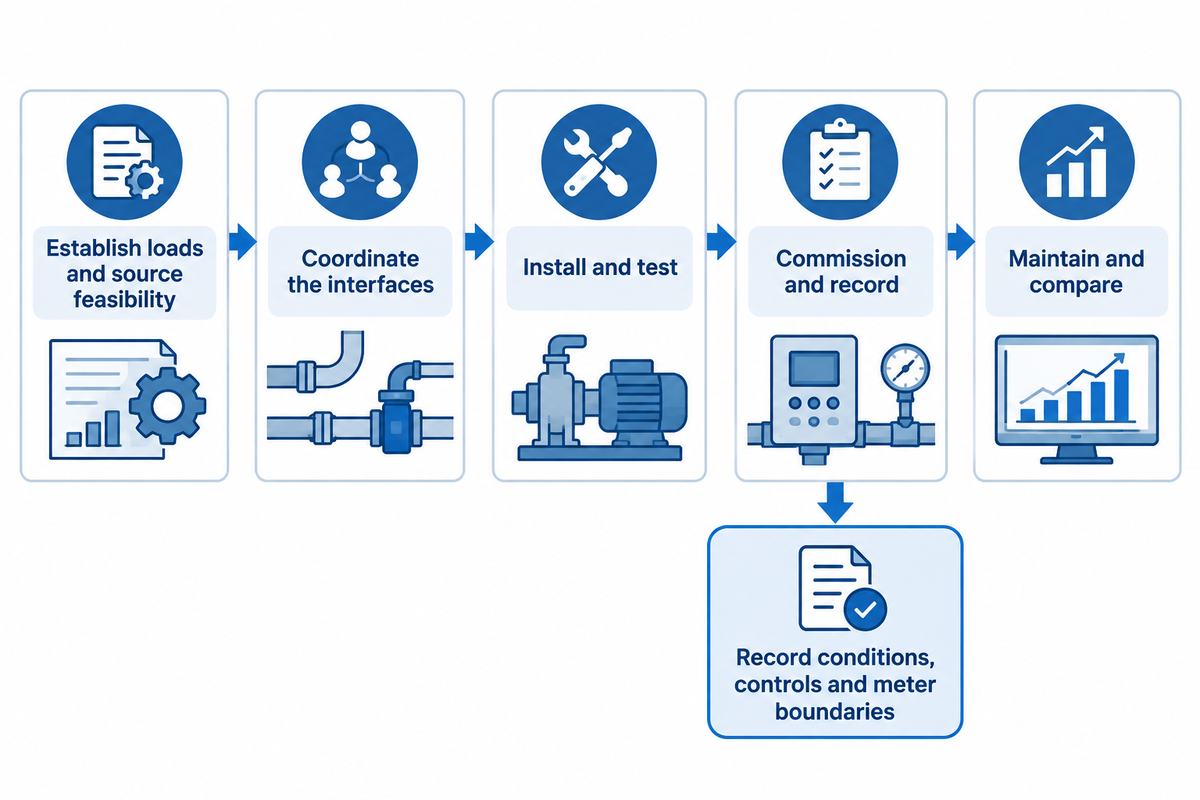
Ground source heat pump installations require a number of other discrete activities such as mechanical, controls and commissioning. Maintenance of the system doesn’t stop with completion of the buried circuit. Indoor equipment, circulation pumps, strainers, and controls remain serviceable. A baseline operating record supports later comparisons of comfort, flow and energy use.
- Establish loads and source feasibility. Coordinate the building demand with a buildable, permitted ground or water connection.
- Coordinate the interfaces. Assign responsibility for ground pipe, unit connections, electrical supply, terminals and controls.
- Install and test. Qualified contractors follow the project design and equipment instructions for their scope.
- Commission and record. Capture operating conditions, control settings and meter boundaries at handover.
- Maintain and compare. Keep service and alarm history alongside subsequent performance records.
Maintenance tables in PNNL’s application group indoor equipment, closed loop systems and open-loop source equipment. Filters, pumps, fluids, and pipework need the checks specified for the system. The open circuits require attention to water quality, screen, and well behavior.
In a water to air arrangement, air handling equipment and filters remain part of the comfort system. For hydronic terminal units, pipework doesn’t remove this responsibility.
Engineering note
Record entering and leaving source temperatures, flow, operating mode and electrical input together. Comparing a winter measurement with a cooling-mode datasheet point gives a misleading diagnosis. ISO 13256-1 and Part 2 identify different unit test families; use the applicable manufacturer performance data at the recorded conditions.
Before You Choose: Match the Ground, Unit and Building

The perfect fit of ground connection, unit operating range and building distribution is a must. An installation is of no use to the owner if it can’t be built, and of no use to staff if it isn’t accessible and properly documented. Finance requires an understanding of the complete, fully installed scope and the running costs. One equipment number can’t address these requirements.
A shared source can also serve multiple buildings. PBS reported on the Framingham geothermal network pilot in October 2025. If such a project exists, with its ownership and connection requirements, shared infrastructure is a concrete possibility. It isn’t an automatic alternative for all cases.
For commercial central plants, the ground-source heat pump solution by Koven Air is the first point of reference. A single design integrates the unit, borefield and building contractor scopes.
Questions for the project team
- Confirm source availability, construction access and local permissions before committing to the installation.
- Ask for the required heating/cooling duty, source conditions and building delivery temperatures in the same proposal.
- Confirm which pumps, fans and controls are included in equipment ratings and electricity estimates.
- Ask for matched ventilation, humidity, occupied hours and backup operation in option comparisons.
- Verify qualifications for the actual work; certified geothermal installers still need the relevant local licenses and project experience.
- Confirm the ground/unit/building handover responsibilities and the records facilities staff will receive.
The systems available differ in source connection and building delivery. For a product and family context, see Koven Air. A unified scope brings equipment dialogue before the procurement process reaches a final price.
Ground-source Heat Pump FAQ
What are the disadvantages of a ground source heat pump?
Ground works add initial cost, site constraints and coordination compared with a system that uses outdoor air.
Excavation or drilling can disrupt landscaping and restrict when work is practical. A tight site may have adequate heating demand but no workable collector route. Source-side pumping, controls and building terminals still need maintenance. An open circuit adds water-quality and discharge questions. The strongest proposal resolves these constraints early and prices reinstatement alongside the equipment, rather than leaving the ground works as an allowance.
Does a ground source heat pump require electricity?
Yes. The compressor and associated pumps, fans and controls use electricity to transfer heat.
Renewable heat from the earth doesn’t make the installation electricity-free. A heat pump may move several units of heat for each unit of electrical input under suitable conditions, but the exact ratio follows its operating point and measurement boundary. Some electrical loads are inside the unit meter and others are external. Metering the declared system avoids counting a load twice or overlooking it.
Do ground source heat pumps work in winter?
Yes, a properly designed ground-source installation can extract useful heat during winter.
Heat is available even when the source fluid is too cool for direct space heating; the refrigerant cycle raises the delivery temperature. Ground temperature changes less rapidly than air temperature, but operating loop temperatures still follow the site and load. The designer must match the source connection, equipment range and winter heating duty, including any planned backup. More buried pipe doesn’t replace that coordinated design.
Does geothermal heating generate electricity?
No. A building geothermal heat pump consumes electricity; it does not generate it.
Deep geothermal power plants use a different resource and process. Building heat pumps use heat exchange and refrigeration to provide efficient heating and cooling. A separate photovoltaic system can supply some electricity, but it’s separate generation equipment.
Can a ground source heat pump provide hot water?
Yes, suitable equipment can heat water, but domestic hot-water capability is a model and system-design choice.
Water-to-water equipment and certain water-to-air models offer different water-heating arrangements. A desuperheater can recover some waste heat for water preheating; it’s different from a system sized to meet the full hot-water load. ENERGY STAR’s definitions distinguish these functions. The selected arrangement must cover the required storage, delivery temperature and water-heating duty. A space-heating model shouldn’t be assumed to replace every water heater.
Are ground source heat pumps noisy?
Ground-source units still produce compressor, pump and sometimes fan noise, even without an outdoor air-source fan.
Indoor unit location, mounting and pipe or duct connections affect how sound reaches occupied rooms. Equipment sound data and the building layout should guide placement.
How long does a ground source heat pump last?
The heat-pump unit and buried loop have different service lives, so plan their replacement horizons separately.
IGSHPA describes long-lived ground exchangers, while PNNL distinguishes the warranties of indoor equipment and source circuits. A warranty period isn’t a prediction of component life. The unit contains moving and serviceable equipment; a properly installed ground loop may remain useful through an equipment replacement. Material condition, source-water chemistry, installation quality and maintenance affect that outcome. Keep loop drawings and test records so a future replacement can assess reuse rather than assume it.
Planning a commercial heat-pump installation?
Bring the building duty, source conditions and required delivery temperatures to the equipment discussion.
Related Articles
References & Sources
- Geothermal Heat Pumps, U.S. Department of Energy.
- Ground-Source Heat Pump: Operations and Maintenance Best Practices, Pacific Northwest National Laboratory, 2021.
- About Geothermal, International Ground Source Heat Pump Association.
- Geothermal Heating and Cooling, North Carolina Department of Environmental Quality.
- Optimizing Bore Fields for Commercial Ground Source Heat Pump Systems, Spitler, Cook and Liu, 2020; ORNL public abstract.
- Geothermal Heat Pumps Key Product Criteria, ENERGY STAR.
- Long-Term Performance Measurement of Ground-Source Systems, HPT TCP Project 52.
- Air-to-Water Heat Pump Options, John Siegenthaler P.E., HPAC Magazine, July 2026.
- Performance of HVAC Systems at ASHRAE HQ, Southard, Liu and Spitler, ASHRAE Journal, 2014; ORNL public abstract.
- Evaluating Your Utility Rate Options, U.S. Department of Energy, Federal Energy Management Program.
- A Look at Air-to-Water Heat Pump Systems, John Siegenthaler P.E., HPAC Magazine, 2018.
- Geothermal Energy Network in a Massachusetts Community, Miles O’Brien, PBS NewsHour, October 2025.