Get in Touch with Koven Air Company

By Cherry, Technical Content Specialist at Koven Air Environment Technology Co., Ltd. · Updated November 2026
Effective surge protection for heat pumps pairs a main service panel surge protective device (SPD) with a dedicated Type 2 unit at the equipment disconnect. Standard circuit breakers trip in milliseconds for sustained overcurrent. By contrast, UL combination-wave transients strike inverter boards at an equivalent frequency of 208.3 kHz. Commercial three-phase assemblies call for SPDs based on supply topology, MCOV, VPR, nominal discharge current, and SCCR instead of compressor amperes.
Omitting dedicated disconnect protection leaves variable-speed compressors, inverter circuit boards, and building management interfaces exposed to daily grid and motor switching. You also cannot substitute a plug-in power strip for hardwired HVAC protection. Match electrical topology, lead length, phase monitoring, and warranty boundaries before ordering to avoid expensive commissioning change orders.
208.3 kHz.UL combination-wave equivalent frequency (Mersen).
15–25 V / inch.Added let-through voltage per inch of SPD lead (Eaton).
$800–$2,500.Inverter control board & IGBT replacement range (Trilpeak).
65–2,872 kW.Koven Air commercial hydronic heat pump span.
Do Heat Pumps Need Surge Protection? How Power Surges Damage Inverter HVAC Equipment
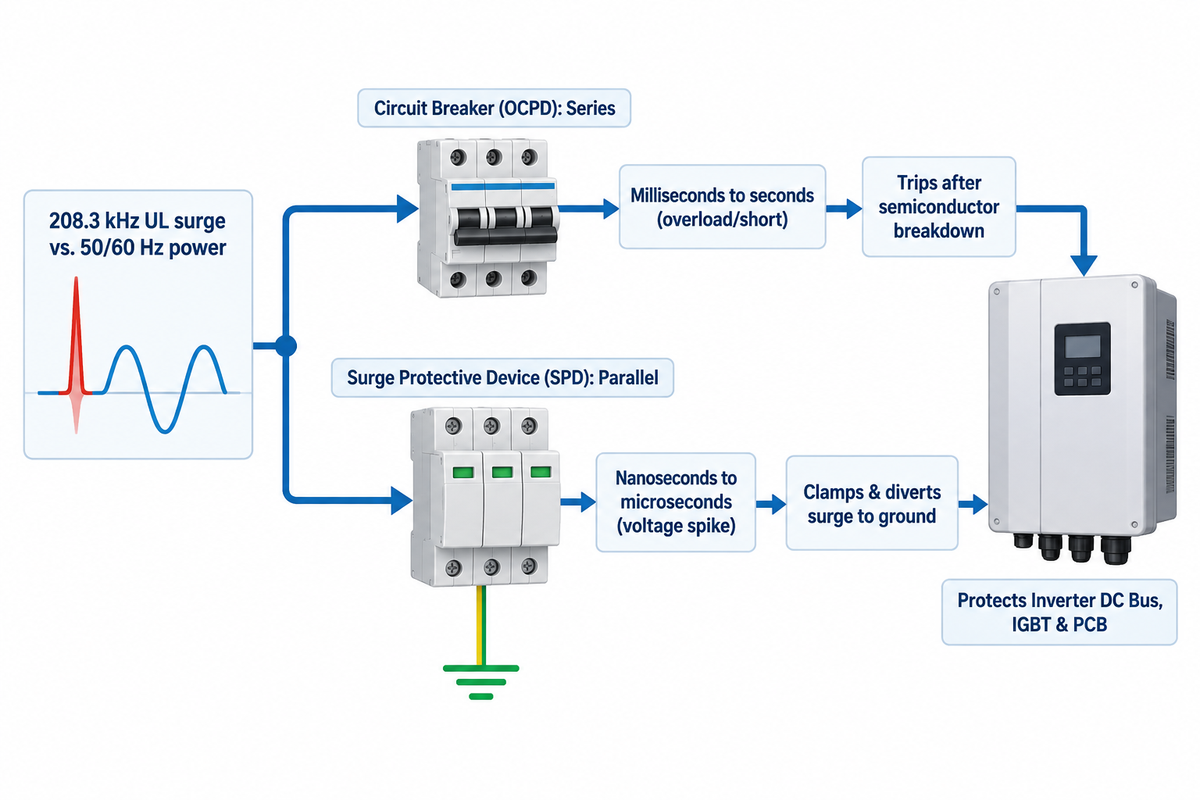
Yes. Contemporary heat pumps with inverter drives and microprocessor controls require special surge protection, as voltage spikes can destroy delicate electronics instantaneously. Thermal-magnetic circuit breakers clear sustained overcurrent in milliseconds, long after a transient spike passes.
Install a listed HVAC surge protector to clamp down on excess voltage and discharge surge current safely to earth.
Imagine the circuit breaker as a massive flood gate that slowly drops as the level of the river rises over a number of minutes. A power surge is like an instantaneous pressure hammer hitting a glass gauge in a fraction of a second. At the moment the breaker detects the heat or magnetic trip current, the glass gauge has already broken.
Older single-stage heating and air conditioning units relied mostly on heavy electromechanical contactors and induction motors. The tough windings withstood short voltage spikes temporarily without damage. New inverter heat pump designs replace simple relays with rectifier bridges, DC-bus capacitors, insulated-gate bipolar transistors (IGBTs), and electronically commutated motors (ECM).
These sophisticated electronics operate on tight voltage margins. Mersen technical data shows a standard UL combination-wave surge carries an equivalent frequency of 208.3 kHz. Normal utility power runs at 50 or 60 Hz.
Trilpeak’s 2026 HVAC surge protection guide reports that inverter board and IGBT replacements cost $800 to $2,500 on light-commercial and residential units, compared with $200 to $500 for conventional non-inverter control boards. Both Trilpeak and Jackson Systems place standard furnace and HVAC control board replacements at $300 to $900. On large three-phase commercial plants, unplanned downtime and crane access multiply those direct repair bills rapidly.
Some facility managers inquire, “Does the factory fuse in the outdoor cabinet prevent surges?” The answer is no. Internal fuses protect wiring from short circuit fires after a semiconductor fails. They don’t prevent the ‘upstream overvoltage spike’ that destroyed the inverter board.
| Protection Parameter | Circuit Breaker / Fuse (OCPD) | Surge Protective Device (SPD) |
|---|---|---|
| Primary hazard addressed | Sustained overload and short circuit current | Microsecond transient voltage spikes |
| Typical response timescale | Milliseconds to seconds | Nanoseconds to microseconds |
| Connection method | Series with compressor and motor load | Parallel across supply conductors to ground |
| Action during event | Opens circuit to stop fire hazard | Clamps transient overvoltages and diverts surge current to ground |
| Protects inverter PCBs? | No; trips after semiconductor breakdown | Yes, when properly sized and coordinated |
Should I Put a Surge Protector on My Heat Pump?
Yes, install a hardwired HVAC-specific surge protector on any inverter heat pump, mini-split, ductless unit, or commercial hydronic chiller-heat pump. Variable-frequency compressors, ECM fans, and outdoor microprocessor boards face high replacement costs after a single utility switching event.
Both a homeowner protecting a residential air conditioner and a plant engineer managing commercial HVAC equipment face identical physics. A modest upfront device prevents repeated board replacements after thunderstorms or capacitor-bank switching. For basic single-stage heating or cooling appliances with zero circuit boards, payback is slower.
Still, surge protection has a place for the control transformers and contactors.
Can You Protect an HVAC System or Heat Pump With a Plug-In Surge Protector?
No. Never plug a heat pump, furnace, or commercial air conditioner into a plug-in power strip surge protector. Hardwired HVAC devices use large continuous compressor current that can overwhelm consumer outlet strip ratings.
Plugging in creates an unsafe overheating and fire hazard.
Plug-in surge strips are UL 1449 Type 3 devices built for light cord-connected office electronics and household appliances. Commercial and residential heat pumps require permanently wired, listed Type 1 or Type 2 SPDs mounted at the electrical panel or outdoor disconnect box.
Do Surge Protectors Increase a Heat Pump’s SEER2 or Save Energy?
No, a surge protector doesn’t propel a heat pump’s SEER2 rating, decrease monthly kilowatt-hour use, or increase the efficiency of a unit’s refrigeration. Its sole electrical job is to stay inert during normal voltage and divert destructive spikes before they damage sensitive components.
Ignore sales claims that an HVAC surge protector cuts utility bills directly. The real financial return comes from avoiding premature compressor motor degradation, dead inverter boards, and emergency heating or cooling downtime.
Whole-Building Panel SPD vs. Dedicated Heat Pump Disconnect Surge Protector
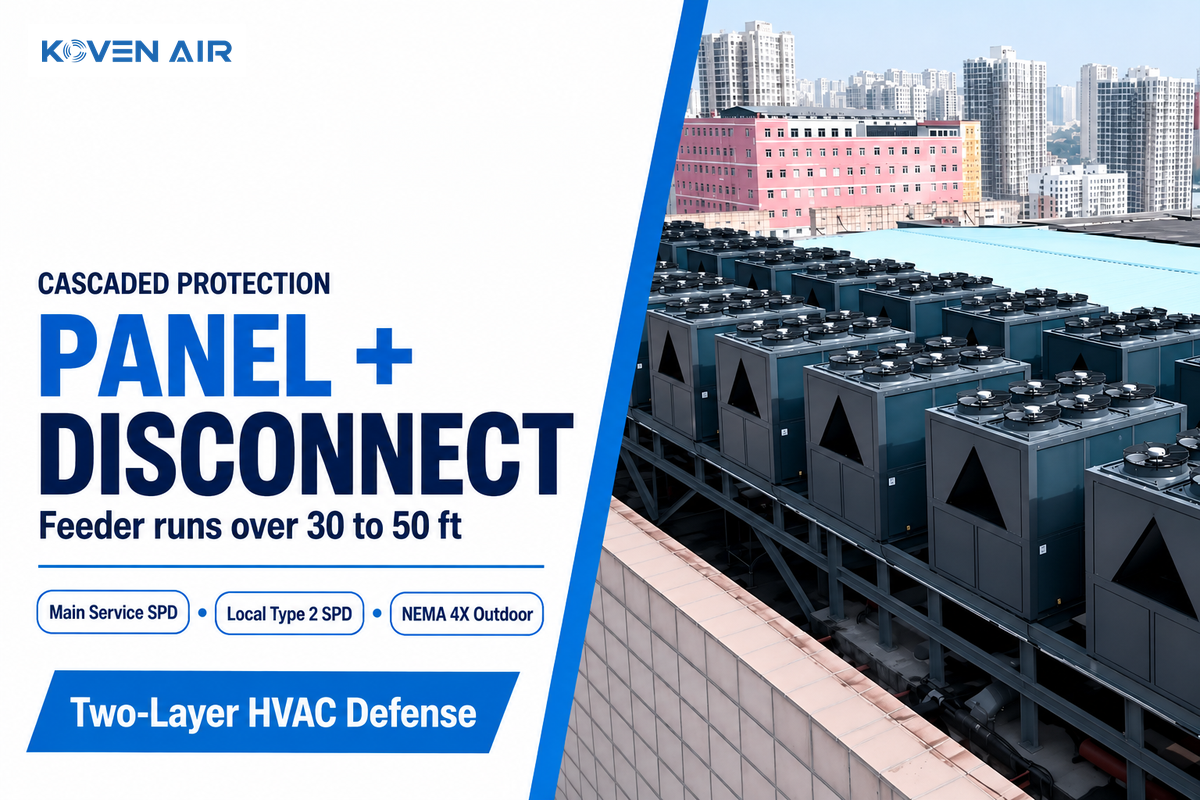
A whole-building main panel SPD is rarely enough on its own for a commercial inverter heat pump. Main service SPDs block high-energy external utility surges, and long rooftop feeders and internal building loads produce damaging transients downstream. Cascaded protection combines a main service SPD and a dedicated Type 2 SPD at the outdoor disconnect.
Many owners push back on paying for both layers after buying a whole-house or whole-building surge protector at the main switchboard. Two physical mechanisms explain why one main-panel device leaves remote HVAC equipment exposed. First, large motors, elevators, welders, and chiller starters generate daily switching transients downstream of the main service entrance.
ECS International describes external lightning and utility surges cleanly in its subpanel protection guide. “These are high-impact external threats, but they are not your daily enemy.” A main service SPD cannot block an internal switching spike moving laterally between two branch panels inside the building.
Secondly, service entrance SPDs are designed to handle huge lightning and grid currents, so they pass higher residual voltage past their terminals. Research by the National Institute of Standards and Technology (NIST) on cascading SPD coordination confirms this trade-off clearly.
“The service entrance SPD is generally selected from the point of view of the utility, and therefore tends to be a rugged device with relatively high limiting [voltage].”
Long wiring runs make that residual voltage worse. Under The Feeder-Reflection Protection Rule, branch feeders longer than 30 to 50 feet (10 to 15 meters) behave like transmission lines. High-frequency transients reflect and amplify along those exterior runs. Mounting a dedicated Type 2 SPD right at the disconnect box clamps local spikes before they hit the inverter drive. For rooftop equipment layouts, review our packaged rooftop heat pump installation requirements alongside your electrical riser diagram.
| Facility & Feeder Scenario | Main Panel SPD Only | Disconnect SPD Required? | Recommended Protection Architecture |
|---|---|---|---|
| Indoor mechanical room unit (<25 ft from protected panel) | Acceptable baseline | Optional unless OEM requires | Main Type 1/2 SPD; verify short panel-to-unit run |
| Rooftop commercial heat pump (>30–50 ft feeder) | Insufficient | Recommended engineering practice | Cascaded: Main Type 1/2 + NEMA 4X Type 2 at disconnect |
| Exterior ground-pad hydronic plant (>50 ft underground) | Insufficient | Yes | Cascaded Type 1/2 + disconnect Type 2 + signal SPD |
| Industrial plant with heavy VFDs, welders, or cranes | Insufficient | Yes (Internal surge risk) | Service SPD + HVAC subpanel SPD + unit disconnect SPD |
| Multi-unit rooftop array fed from roof subpanel | Insufficient | Subpanel + high-value units | High-kA Type 2 on roof subpanel + unit-level SPDs if >30 ft |
| Split systems with separately powered indoor air handler | Partial coverage | Yes (Both outdoor & indoor) | Type 2 SPD at outdoor disconnect + air handler branch panel |
| Facility with standby generator & automatic transfer switch | Insufficient | Yes (Transfer transients) | SPD on load side of ATS + dedicated heat pump disconnect SPD |
| High-lightning coastal or mountain site | Insufficient | Yes + bonding check | Type 1 at service + Type 2 at disconnect + NFPA 780 bonding |
| Cold-climate heat pump on rural overhead utility lines | Insufficient | Yes (Verify −30 °C rating) | Service SPD + low-temp rated disconnect SPD + phase monitor |
| Light-commercial 240V single-phase mini-split / ductless | Partial coverage | Yes (Low cost add-on) | Whole-home Type 2 panel SPD + 240V disconnect SPD |
Where Should Surge Protection Be Installed on a Heat Pump Circuit?
Main surge protection should be installed in the service panel and secondary protection should be installed at the base of the outside disconnect box that serves the heat pump. On split systems with separately powered indoor air handlers or branch boxes, protect both circuits so transients cannot back-feed through interconnecting wiring.
Maintain the equipment-level SPD as near to the disconnect lugs as the enclosure environment allows. Field technicians consistently see stronger results when mounting a surge protector directly onto a disconnect knockout. Placing the same device thirty feet away in an electrical closet leaves too much exposed cable.
Shorter conductor lengths are lower in inductive impedance and lower in peak voltage at the compressor drive.
Type 1 vs. Type 2 vs. Type 3 Surge Protective Devices for HVAC Systems
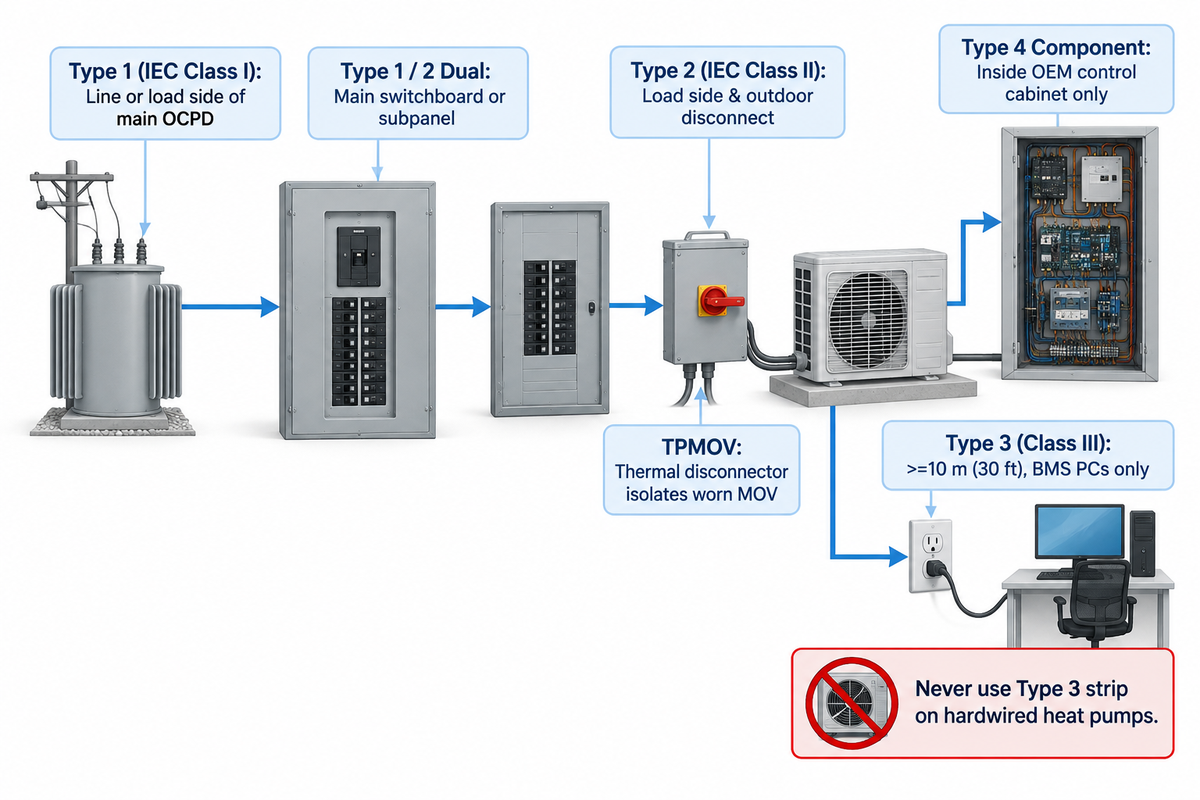
Under UL 1449 and NEC Article 242, Type 1, Type 2, and Type 3 SPDs define permitted installation location, not clamping quality. Type 1 mounts on either the line or load side of the main service breaker. Type 2 mounts strictly on the load side, while Type 3 serves cord-connected point-of-use loads.
Buyers frequently assume a Type 1 surge protector always clamps tighter than a Type 2 unit. That assumption causes overspending or missed clamping targets. UL iQ Certification records for UL 1449 SPDs state plainly that devices marked solely as “SPD Type 2” aren’t suitable for Type 1 supply-side applications. Eaton’s technical FAQ notes that many Type 1 SPDs carry dual Type 2 ratings. Dual listing lets engineers standardize on one model across panels whenever VPR values meet project goals.
| UL 1449 Type | IEC 61643-11 Class | Permitted Location | External OCPD Required? | Commercial Heat Pump Role |
|---|---|---|---|---|
| Type 1 | Class I (10/350 µs) | Line side or load side of main service OCPD | No (internally protected for line-side faults) | Main service switchboard & utility entrance |
| Type 2 | Class II (8/20 µs) | Load side of main service OCPD only | Yes (per manufacturer listing & SCCR) | HVAC distribution panel & outdoor disconnect box |
| Type 1 / 2 Dual | Type 1+2 Combo | Either line side or load side | Follows specific installation listing | Standardized plant service & mechanical subpanels |
| Type 3 | Class III (Combo wave) | Minimum 10 m (30 ft) conductor from service panel | Fed by branch receptacle circuit | BMS workstation PCs only; never hardwired heat pumps |
| Type 4 Component | Component assembly | Inside listed OEM equipment enclosures only | Evaluated within host UL 508A / OEM panel | Factory-integrated DIN-rail modules inside control cabinets |
The clamping component inside most AC surge protectors is usually a metal oxide varistor (MOV) block. An MOV stays at high resistance during normal voltage. However, the moment that a spike surpasses a threshold, it quickly swings to very low resistance.
Over years of repeated hits, standard MOV technology degrades and leaks small amounts of current, generating heat.
Without thermal isolation, an aging MOV can enter thermal runaway and rupture inside a disconnect enclosure. High-quality industrial SPDs get around that danger with a thermally protected metal oxide varistor (TPMOV). Mersen’s TPMOV engineering documentation confirms built-in thermal disconnectors isolate a failing varistor before overheating becomes an arc or fire danger.
Always specify thermally protected MOV construction on commercial HVAC submittals.
Surge Protection vs. Phase and Voltage Monitors for Three-Phase Commercial Heat Pumps
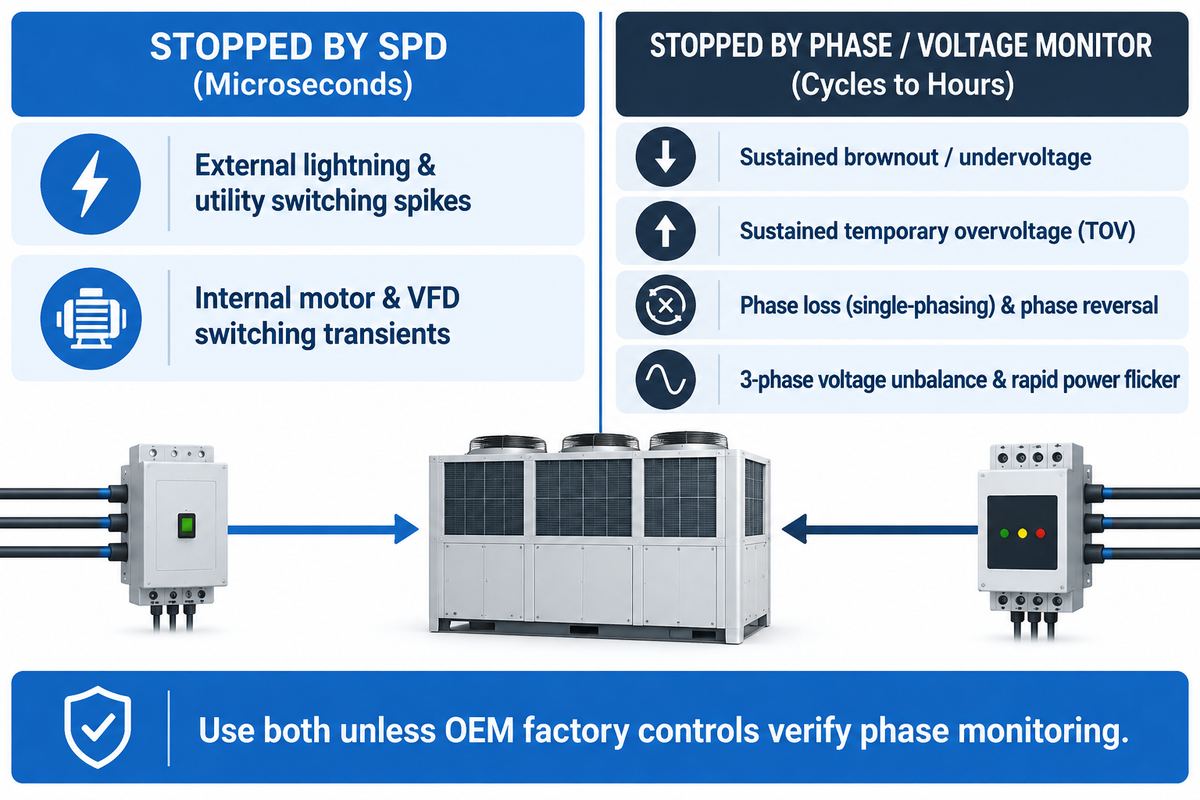
A surge protector doesn’t prevent brownouts, phase loss, phase reversal, or long-term voltage unbalance. SPDs only clamp microsecond overvoltage spikes. A three-phase monitor relay trips the control circuit during sustained abnormal power conditions.
Commercial three-phase heat pumps require both protections unless factory controls incorporate validated phase monitoring.
A facility installs a UL 1449 Type 2 SPD at the rooftop disconnect and assumes full utility coverage. Then a summer brownout ruins a three-phase scroll or screw compressor. Because a brownout drops voltage below the MOV threshold described in Eaton’s surge protection FAQ, the surge protector stays completely inactive while motor current climbs and windings overheat.
The same gap happens during single-phasing, when one utility fuse blows and leaves a three-phase compressor running on two legs. Phase reversal during utility repair work can also spin fixed-speed scroll compressors or hydronic pumps backward. Only a dedicated phase and voltage monitor relay watches RMS voltage continuously across all three phases.
It opens the control interlock as voltage rises, falls continuously, or drifts out of balance.
| Electrical Fault Type | Typical Duration | Stopped by SPD? | Stopped by Phase / Voltage Monitor? | Primary Vulnerable Component |
|---|---|---|---|---|
| External lightning / utility switching spike | Microseconds (µs) | Yes (Clamps & diverts) | No (Too fast for relay) | Inverter DC bus, IGBT, PCB |
| Internal building motor/VFD switching transient | Microseconds (µs) | Yes (Local Type 2 SPD) | No | Control boards, ECM drives |
| Sustained brownout / undervoltage | Seconds to hours | No (Below MCOV) | Yes (Trips contactor/interlock) | Compressor motor windings |
| Sustained temporary overvoltage (TOV) | Cycles to minutes | No (Can destroy MOV) | Yes (Disconnects load) | Power supplies, MOV blocks |
| Phase loss (single-phasing) | Seconds to minutes | No | Yes (Immediate trip) | 3-phase compressor & fans |
| Phase reversal (wrong sequence) | Continuous at startup | No | Yes (Prevents startup) | Scroll compressors, pumps |
| Three-phase voltage unbalance | Continuous | No | Yes (Adjustable % trip) | Three-phase induction motors |
| Short-cycle rapid power flicker | Seconds | No | Yes (Anti-short-cycle delay) | Compressor discharge valves |
Order one remote three-phase monitor relay only if the commercial heat pump electrical wiring diagram and factory submittal lack built-in phase-loss and phase-reversal and DC-bus undervoltage shutdown. Many of the latest inverter-driven commercial heat pumps may also incorporate those safeguards into their factory controller. If the OEM specifies native phase monitoring with an anti-short-cycle timer, skip the duplicate relays and spend the money on a superior three-phase SPD.
For single-phase 240V air conditioners or heat pumps without factory voltage monitoring, combined disconnect kits (such as Intermatic CD1-024R or RectorSeal RSH-50 VRMDC) cover both risks cleanly.
How to Size and Specify a 3-Phase 480V or 208V Surge Protective Device for Commercial Heat Pumps
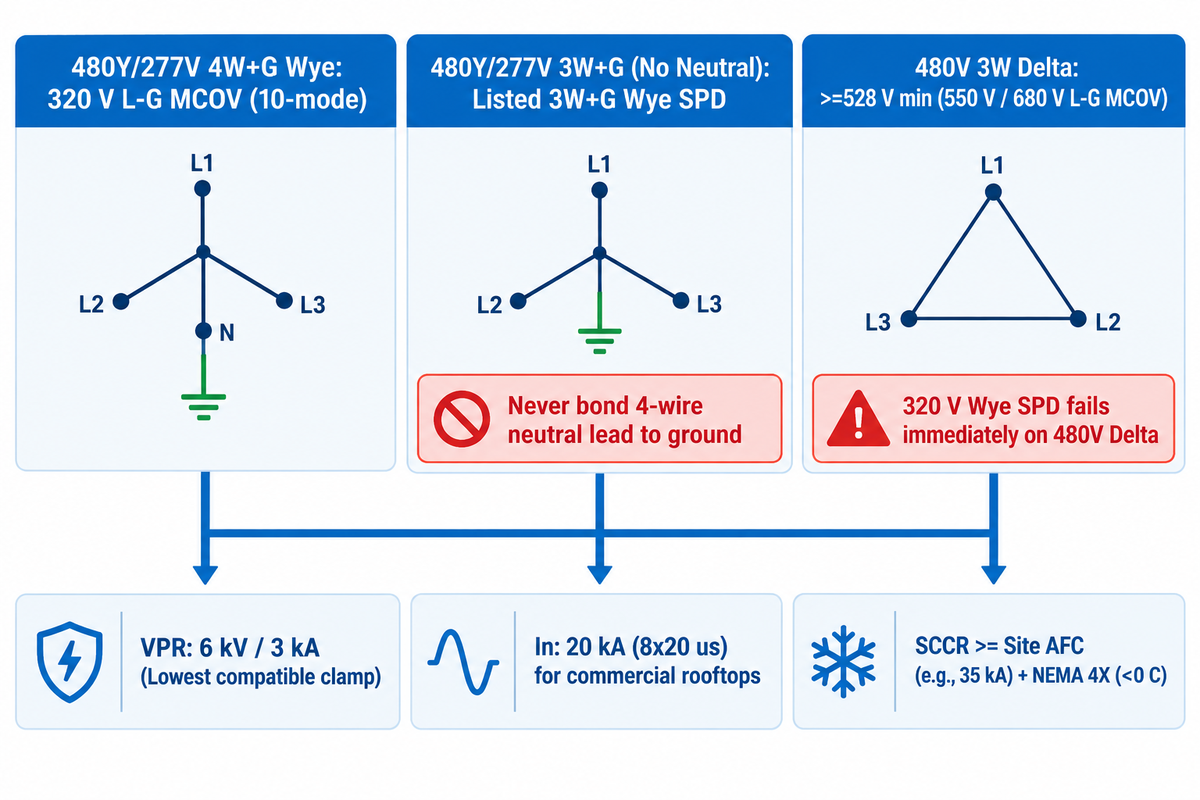
Size a commercial three-phase heat pump SPD from supply voltage topology, MCOV, VPR, nominal discharge current (In), SCCR, and outdoor enclosure rating. Because an SPD connects in parallel, never size it by compressor MCA, MOCP, horsepower, or consumer Joule ratings.
Two purchasing mistakes account for most commercial SPD failures. First, buyers try to pick an HVAC surge protector using consumer Joule ratings. Eaton’s Guide to Surge Suppression directly rejects that metric under “Why Joules and response time are irrelevant specifications?” Instead, UL 1449 submittals evaluate repeatable performance with three hard parameters. Those are nominal discharge current (In, tested on an 8×20 µs wave), voltage protection rating (VPR, tested at 6 kV and 3 kA per UL 1449 Table 63.1 in Eaton’s UL SPD guide), and short circuit current rating (SCCR).
Second, contractors install a 480Y/277V wye SPD onto a 480V three-wire delta feeder. Schneider Electric FAQ FA308486 states the outcome bluntly. The MOVs inside a 480Y/277V SPD carry a 320 V phase-to-ground MCOV rating. On a 480V delta system, phase-to-ground voltage reaches 480 V and destroys those MOVs immediately. Ungrounded or corner-grounded 480V delta feeders require a delta-listed SPD with at least 528 V minimum MCOV (typically 550 V or 680 V L-G). If a 480Y/277V rooftop disconnect has no neutral wire, specify a listed 3-wire-plus-ground SPD. Never bond a 4-wire SPD neutral lead to equipment ground.
| Submittal Parameter / Topology | UL 1449 (North America) | IEC 61643-11 (International) | Commercial Heat Pump Verification Rule |
|---|---|---|---|
| 480Y/277V 3-Ph 4W+G (Wye) | 320 V L-N / L-G MCOV typical | Uc matched to 277 V L-N (TN-S) | Confirm neutral present at disconnect; select 10-mode if neutral exists |
| 480Y/277V 3-Ph 3W+G (No neutral) | Listed 3W+G wye-compatible SPD | 3-pole + G Type 2 module | Specify dedicated 3-wire wye unit for 3-phase loads without neutral |
| 480V 3-Ph 3W Delta (Ungrounded / Corner) | ≥528 V min (550 V / 680 V L-G MCOV) | IT-system rated Uc (≥550 V) | Never substitute 320 V MCOV wye SPD (immediate MOV failure) |
| 208Y/120V 3-Ph 4W+G (North America) | 150 V L-N MCOV typical | Uc ≥150 V L-N | Common on small-to-midsize commercial rooftop heat pumps |
| 400/230V 3-Ph 50 Hz (Europe / Global) | N/A unless dual-listed | Uc 275 V or 320 V (TN-S vs. TT) | Verify TN-S (4+0) vs. TT (3+1 with N-PE spark gap) earthing |
| Let-through clamping voltage | VPR (6 kV / 3 kA combo wave) | Up (Voltage protection level) | Choose lowest compatible VPR/Up at your required MCOV |
| Nominal discharge current | In (10 kA or 20 kA, 8×20 µs) | In (8×20 µs) & Imax | Specify 20 kA In for commercial panels & exposed rooftops |
| Short-circuit fault rating | SCCR (must ≥ panel AFC) | Isc / Isccr | Confirm SCCR exceeds available fault current at disconnect |
| Protection modes | 10-mode (all-mode) vs. 7-mode | L-N, L-PE, N-PE, L-L paths | Use all-mode protection on VFD-driven commercial heat pumps |
| Outdoor enclosure & ambient temp | NEMA 4X; check <0 °C cold rating | IP65 / IP66 outdoor box | UL iQ defaults to 0 °C min ambient unless cold-rated |
Worked Example: Verifying an SPD for a 480Y/277V Rooftop Commercial Heat Pump
Example site parameters: A 480Y/277V solidly grounded wye feeder runs 75 feet from a basement switchboard to a rooftop hydronic heat pump disconnect. No neutral conductor feeds the roof.
Available fault current is 35 kA, and winter ambient temperatures drop below 0 °C.
- Reject any 4-wire wye SPD that requires a neutral lead. Specify a listed 480V 3-wire-plus-ground Type 2 (or Type 1/2) SPD rated above 277 V L-G MCOV (commonly 320 V L-G).
- Check that the SPD is rated with a SCCR of at least 35 kA (many commercial panels are rated from 65 kA to 200 kA SCCR). Verify that the NEMA 4X enclosure has an intentional sub-freezing ambient temperature rating consistent with the rooftop winter design temperature.
- Trim leads straight to 6 inches to preserve the UL 1449 published clamping rating. Leaving 18 inches of looped wire adds 12 extra inches and 180 V to 300 V under Eaton’s 15–25 V/inch rule.
A licensed electrical engineer must sign off on final building short-circuit and coordination studies.
Electrical Codes and Standards Governing Heat Pump Surge Protection (NEC 242/230.67/440, UL 1449 5th Edition, IEC 61643)
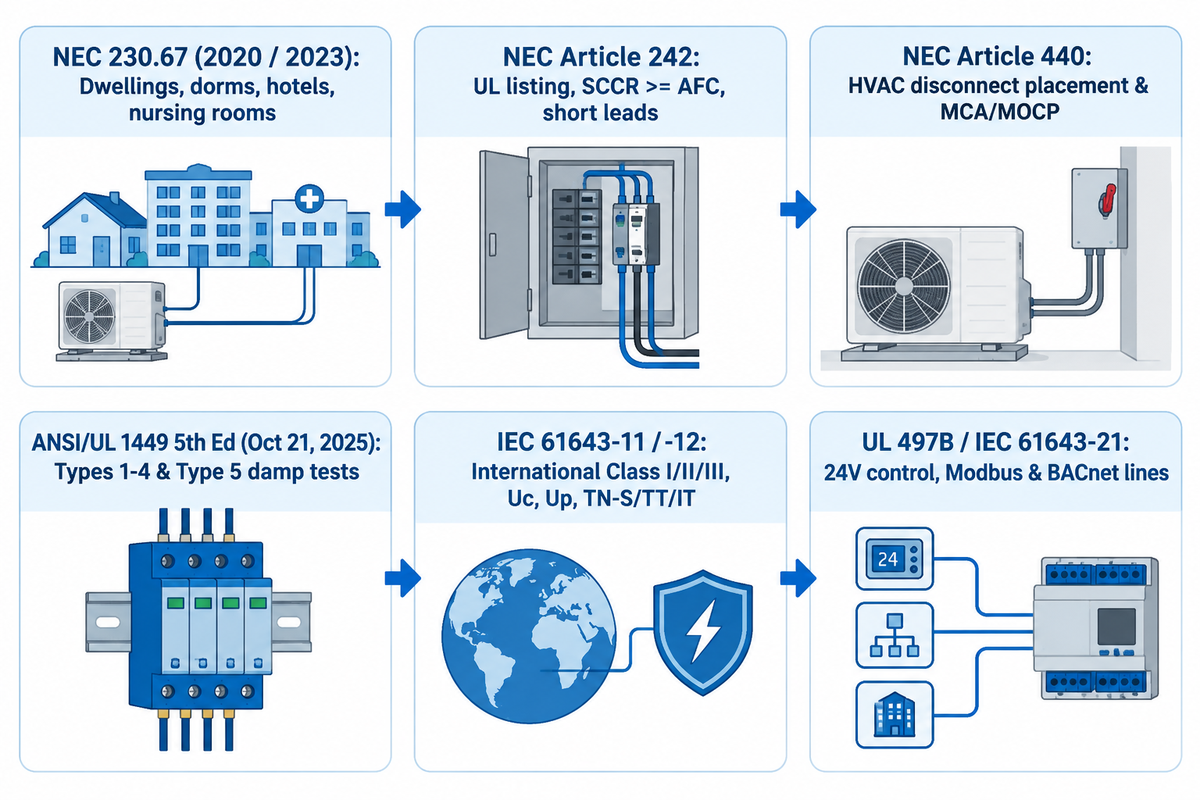
The 2020 National Electrical Code introduced NEC 230.67 mandatory Type 1 or Type 2 surge protection for dwelling unit services. The 2023 NEC expanded that rule to dormitories, hotel guest rooms, and nursing home sleeping areas. General commercial heat pump plants follow NEC Article 242, UL 1449 5th Edition (revised October 21, 2025), and IEC 61643-11 outside North America.
Many HVAC blog posts mistakenly claim that NEC 230.67 forces every commercial building to install a disconnect surge protector on every heat pump. Inspectors deny submittals that misquote code sections.
Leviton’s NEC surge protection handbook states that Article 230.67 is exclusively for residential occupancy and particular sleeping-quarter services and not for customary commercial mechanical plants. Outside those listed occupancies, and special sections like NEC 645.18 for critical data systems, commercial HVAC surge protection comes from project specifications, OEM instructions, and local amendments.
Once an SPD is specified, NEC Article 242 governs its listing, SCCR compliance, and short straight conductor routing. ABB notes that Article 242 consolidates former Articles 280 and 285 into one overvoltage chapter. NEC Article 440 separately governs air-conditioning and refrigerating disconnects where local SPDs mount. For product testing, UL 1449 5th Edition (including its October 21, 2025 revision reported by ECS International) tightens intermediate-current testing and adds damp-location requirements for Type 5 SPDs.
| Code / Standard | Edition / Revision | Mandatory Scope | Key Commercial Heat Pump Requirement |
|---|---|---|---|
| NEC 230.67 (NFPA 70) | 2020 & 2023 NEC | Dwellings (2020); + dorms, hotels, nursing sleeping rooms (2023) | Requires Type 1 or Type 2 SPD at service entrance for listed occupancies |
| NEC Article 242 | 2020 / 2023 / 2026 NEC | All installed SPDs (replaced Articles 280 & 285) | Requires UL listing, SCCR ≥ available fault current, shortest practical leads |
| NEC Article 440 | Current adopted NEC | Air-conditioning & refrigerating equipment | Governs disconnect placement, nameplate MCA/MOCP, and equipment access |
| ANSI/UL 1449 | 5th Ed (Oct 21, 2025 rev) | North American AC power SPD safety & testing | Defines Types 1–4, VPR, In, MCOV, SCCR, damp-location & thermal tests |
| IEC 61643-11 / -12 | Active IEC series | International low-voltage power SPDs | Defines Class I/II/III, Uc, Up, In, Imax, and TN-S/TT/IT coordination |
| UL 497B / IEC 61643-21 | Active signal standards | Data, Modbus, BACnet, and 24V control lines | Clamps low-voltage signal transients in tens of volts for control buses |
Are Whole-Building or HVAC Surge Protectors Required by the Electrical Code?
Yes for whole-building service SPDs under 2020 or 2023 NEC dwelling and sleeping-space rules but base NEC language appears not to require commercial heat pump disconnect SPDs. Dedicated disconnect protection is only required when local amendments, job drawings, or listed OEM guidelines specify.
State-adopted 2020 or 2023 NEC amendments and utility electrification rebate rules for cold-climate heat pumps can mandate documented surge protection to pass inspection or qualify for incentives.
Protecting Low-Voltage 24V Controls, Inverter Drives, and BMS Communication Lines
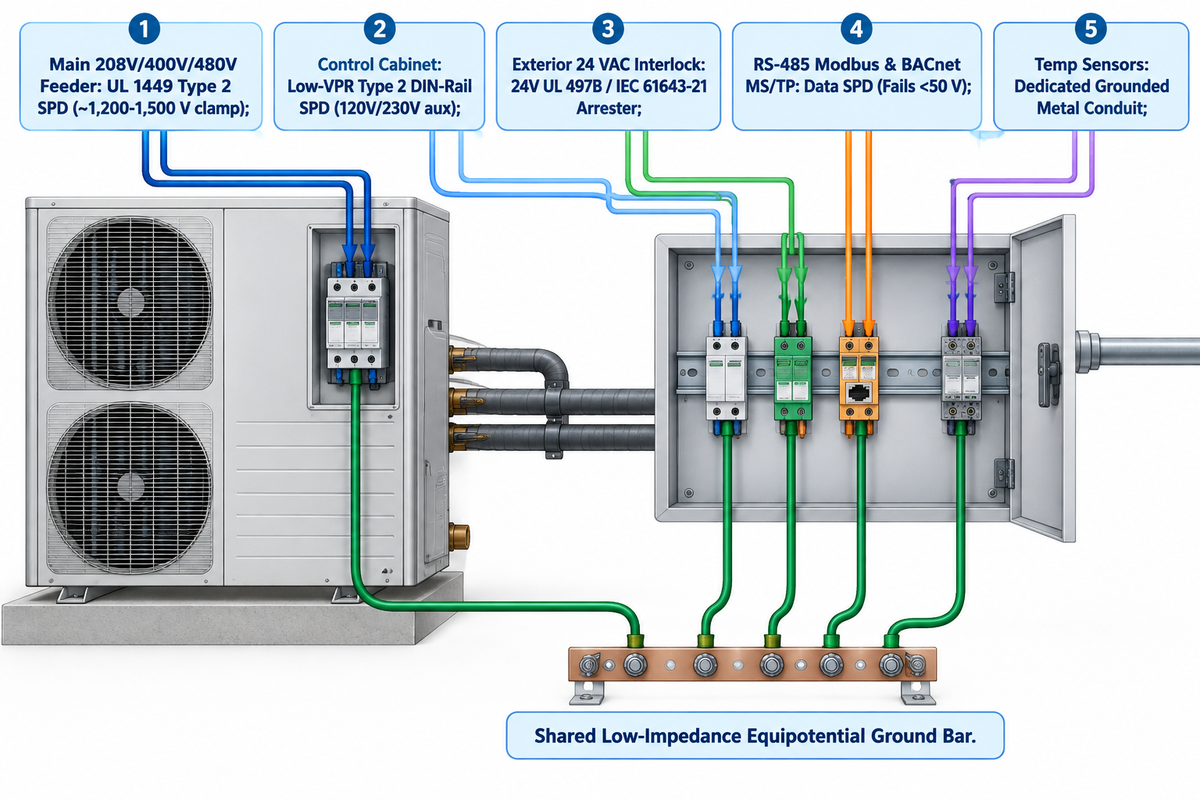
A 480V or 208V power SPD cannot protect 24V control wires, outdoor temperature sensors, or RS-485 Modbus and BACnet communication cables. Induced transients and ground potential rise bypass AC power protection fully. Exposed rooftop or campus control loops need UL 497B or IEC 61643-21 signal SPDs bonded to a shared ground reference.
Facility engineers regularly see dead heat pump communication cards on buildings with working AC power SPDs. Electrical Construction & Maintenance (EC&M) states the physics directly. Common-mode surge currents pass right past line-to-line and line-to-ground AC power SPDs into attached low-voltage circuits. NIST research on end-user equipment protection confirms the same failure mechanism. Protecting power and data ports separately without common equipotential bonding still leaves destructive reference-voltage differences across internal boards.
Commercial hydronic systems use long low-voltage wiring between outdoor condensers and indoor air handler units, then cascade into central automation panels. Nearby lightning or heavy feeder switching induces hundreds of volts onto #21 to #16 AWG (0.4 to 1.5 mm²) RS-485 or 24 VAC cables. A 480V power SPD clamps near 1,200 V to 1,500 V. By contrast, an RS-485 transceiver fails well below 50 V.
Specify dedicated UL 497B or IEC 61643-21 signal-line SPDs at both ends of exterior or inter-building BMS cable runs. Terminate cable shields at one ground point per the controls vendor’s diagram. This multi-path discipline protects ground-source hydronic heat pump systems and central plants serving commercial air handling units or hydronic fan coil units where indoor air sensors tie back to the heat pump controller.
- Mount a UL 1449 Type 2 (or IEC Class II) SPD at the local disconnect box serving the main 208V, 400V, or 480V three-phase power feeder.
- Place a separate low-VPR Type 2 DIN-rail SPD in the control cabinet if you have any separate control transformer or 120V/230V auxiliary feed.
- Protect long exterior 24 VAC enable, pump interlock, and alarm circuits with 24V-rated UL 497B or IEC 61643-21 DIN-rail arresters.
- Match RS-485 Modbus, BACnet MS/TP, and Ethernet BMS trunks to a data-line SPD sized for bus voltage and baud rate, bonded to the power SPD’s ground bar.
- Run outdoor ambient and water-loop temperature sensor cables through dedicated grounded metal conduit kept separate from high-current compressor feeders.
Commercial Heat Pump Surge Protector Cost, Failure ROI, and OEM Warranty Exclusions
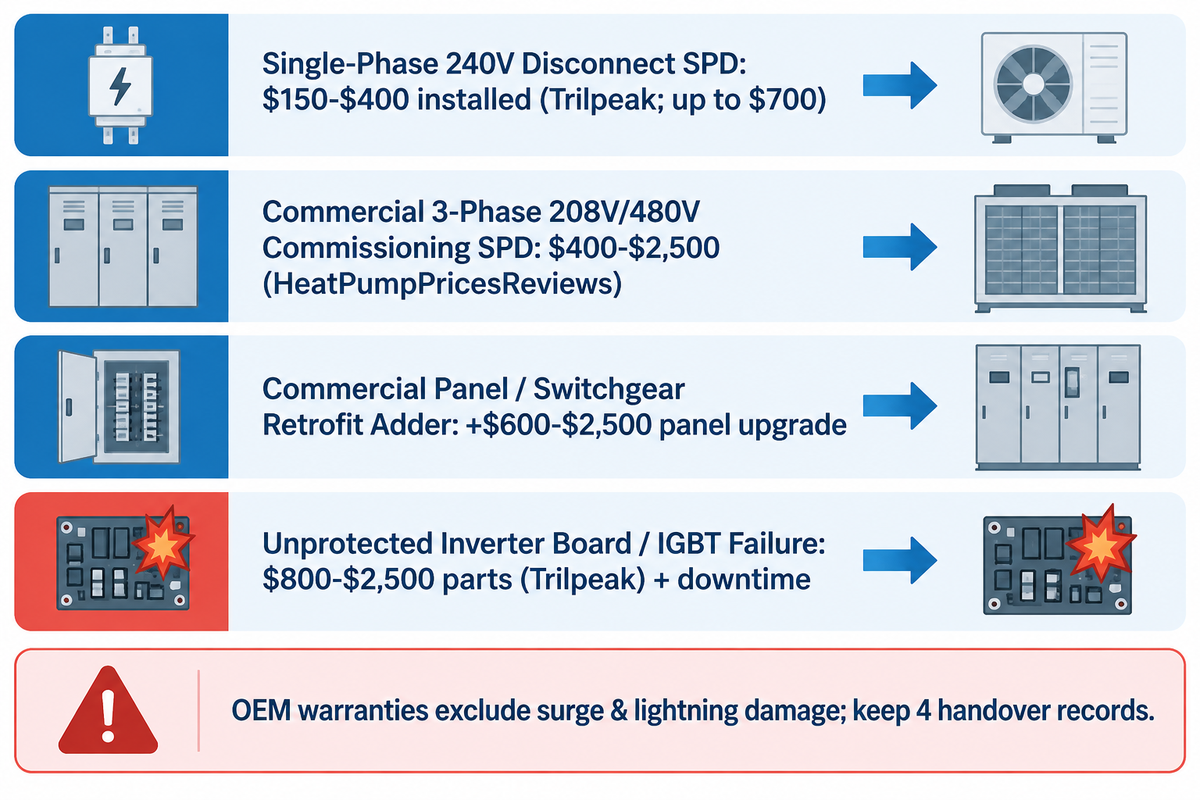
Published U.S. guides place single-phase 240V HVAC disconnect SPDs at $150 to $400 installed (Trilpeak), with broader single-phase residential quotes reaching $700. HeatPumpPricesReviews puts commercial three-phase 208V to 480V installations at $400 to $2,500, with panel upgrades adding $600 to $2,500 on complex retrofits. Standard commercial heat pump OEM warranties exclude surge and lightning damage, so an SPD guards against uninsured repair bills.
Mixing residential add-on quotes with commercial 480V switchgear work breaks project budgets. U.S. published distributors and contractor guides define these price tiers distinctly. Distributor listings from Jackson Systems show basic residential HVAC SPD parts starting around $15 to $80. Intermatic lists its CD1-024R 120–240 VAC single-phase SPD with undervoltage protection at $172.74 USD hardware price. With technician labor, Trilpeak places single-phase Type 2 HVAC installs at $150 to $400, while HeatPumpPricesReviews spans $150 to $700 across single-phase access conditions.
Commercial three-phase systems cost more due to 480V NEMA 4X hardware, three-pole breakers, conduit work, and licensed commercial electrician rates. HeatPumpPricesReviews reports $400 to $2,500 installed for three-phase 208V to 480V commercial systems. That guide notes panel upgrades alone can add $600 to $2,500 when breaker slots or feeder capacity are tight. Final project pricing depends on switchgear shutdown windows, rooftop lift access, and permits, so request itemized electrical bids during initial Division 26 tendering.
| Installation Scope Tier | Published Hardware Range | Published Installed Band | Cost Drivers & Scope Notes |
|---|---|---|---|
| Single-phase 240V disconnect SPD (residential / light-commercial) | $15–$80 basic (Jackson Systems); $172.74 Intermatic CD1-024R list | $150–$400 (Trilpeak; $150–$700 per HeatPumpPricesReviews) | Simple disconnect knockout mount during install or tune-up |
| Commercial 3-phase 208V/480V disconnect SPD (commissioning stage) | Varies by kA & NEMA 4X spec (request quote) | $400–$2,500 commercial 3-phase band (HeatPumpPricesReviews) | Lower end when bundled into original Div 26 rough-in |
| Commercial 3-phase panel / switchgear retrofit | Varies by 480V NEMA 4X & BMS spec (request quote) | Site quote required ($600–$2,500 panel upgrade adder per HeatPumpPricesReviews) | Dedicated 3-pole breaker, off-hours shutdown, permit & roof access |
| Unprotected inverter board / IGBT failure benchmark | $800–$2,500 light-commercial & residential (Trilpeak) | Parts + emergency labor + higher downtime on large 3-phase plants | Single surge failure exceeds commissioning SPD hardware cost |
Conventional commercial heat pump OEM warranty contracts specifically don’t cover controller and compressor damage from electrical surges, lightning or service variations. Leading commercial HVAC manufacturers also require these exclusions in their limited warranties.
Installing an external SPD does not convert surge damage into a covered OEM claim. Some industrial third party SPD manufacturers give independent connected-equipment warranties. Four handover records preserve third-party warranties – invoice by licensed electrician, NEC grounding validation, timely product registration, and an easy photo of the SPD serial plate.
What Is the Typical Cost Range for a Commercial Heat Pump Surge Protector?
For commercial three-phase 208V or 480V heat pumps, HeatPumpPricesReviews defines the installed cost range above across commissioning and retrofit scopes. Adding the SPD during original Division 26 rough-in keeps projects near the lower end. Switchgear shutdowns, high-kA NEMA 4X assemblies, BMS dry-contact wiring, and panel upgrades push totals higher and require an itemized local electrical quote.
Commercial Hydronic Heat Pump and Industrial SPD Procurement Coordination Checklist
Commercial heat pumps rarely ship with facility-grade Type 1 or Type 2 surge protection inside the factory cabinet unless ordered as an explicit option. Closing specification gaps requires splitting duties cleanly between Division 23 (mechanical HVAC) and Division 26 (electrical) before issuing purchase orders.
Uncoordinated motor-controller and protection specs often cause field change orders or missing hardware at startup. On commercial construction jobs, surge protection routinely falls into the crack between mechanical and electrical bids. Consulting-Specifying Engineer highlights how Division 23 (HVAC) and Division 26 (Electrical) specifications require early coordination across motor controls and electrical systems.
Buyers must also match the SPD product tier to the actual heat pump class. Light-commercial 240V single-phase disconnect protectors work well on split systems and residential heat pumps. Common examples include the Intermatic AG3000, Intermatic CD1-024R, ICM Controls ICM517A or ICM493, and RectorSeal disconnect kits. Those single-phase units don’t fit a 480V three-phase commercial hydronic plant. For 208V, 400V, or 480V commercial equipment, specify three-phase industrial lines from dedicated electrical manufacturers such as Eaton (SPD Series), Mersen (Surge-Trap TPMOV), Siemens (TPS3), Schneider Electric (Surgelogic), ABB (OVR), or DITEK.
On the mechanical side, Koven Air commercial and industrial hydronic heat pump lines cover 65 to 2,872 kW per unit across six water-loop families. Those six lines cover air-source, water-source, ground-source, water-to-water, four-pipe, and the KAIA cascade series delivering hot water up to 75 °C. Published heating COP spans 2.51 to 6.4, with measured output down to −30 °C ambient. Koven Air builds commercial and industrial hydronic water-loop machines at its 20,000 m² factory operating since 2007, not steam systems, VRF units, or residential splits. When reviewing commercial heat pump manufacturer specifications, attach your electrical topology, available fault current, and BMS alarm list to the mechanical RFQ.
| Coordination Item | Division 23 (HVAC OEM / Mechanical) | Division 26 (Electrical Contractor) | Verification Artifact Before Order |
|---|---|---|---|
| Supply voltage & grounding topology | Confirms unit nameplate voltage & phase | Confirms Wye vs. Delta & neutral presence | Signed electrical one-line diagram |
| Main service entrance Type 1/2 SPD | Not in mechanical scope | Supplies & installs at main switchboard | Div 26 switchgear submittal |
| Heat pump disconnect Type 2 SPD | Supplies only if factory-mounted option bought | Supplies & wires field NEMA 4X SPD | Explicit line item in Div 23 or Div 26 spec |
| Available fault current & SCCR match | Publishes cabinet SCCR rating | Verifies SPD SCCR ≥ site fault current | Short-circuit study excerpt |
| Phase & voltage monitor protection | Declares native factory phase-loss logic | Adds external relay only if OEM lacks it | OEM control panel wiring diagram |
| 24V control & RS-485/BACnet SPDs | Provides BMS port specs & shielding rules | Installs UL 497B / IEC 61643-21 SPDs | Controls & BMS riser submittal |
| Dedicated backup OCPD / breaker | Not in mechanical scope | Sizes breaker/fuse per SPD listing | Panelboard schedule |
| Form-C dry contact BMS alarm | Maps SPD fault point in BMS point list | Pulls dry-contact wire to controls panel | Commissioning alarm test log |
| OEM & SPD warranty registration | Supplies heat pump startup checklist | Delivers licensed install & ground proof | Closeout O&M warranty binder |
Installation, Commissioning, LED Diagnostics, and MOV Maintenance Lifecycle
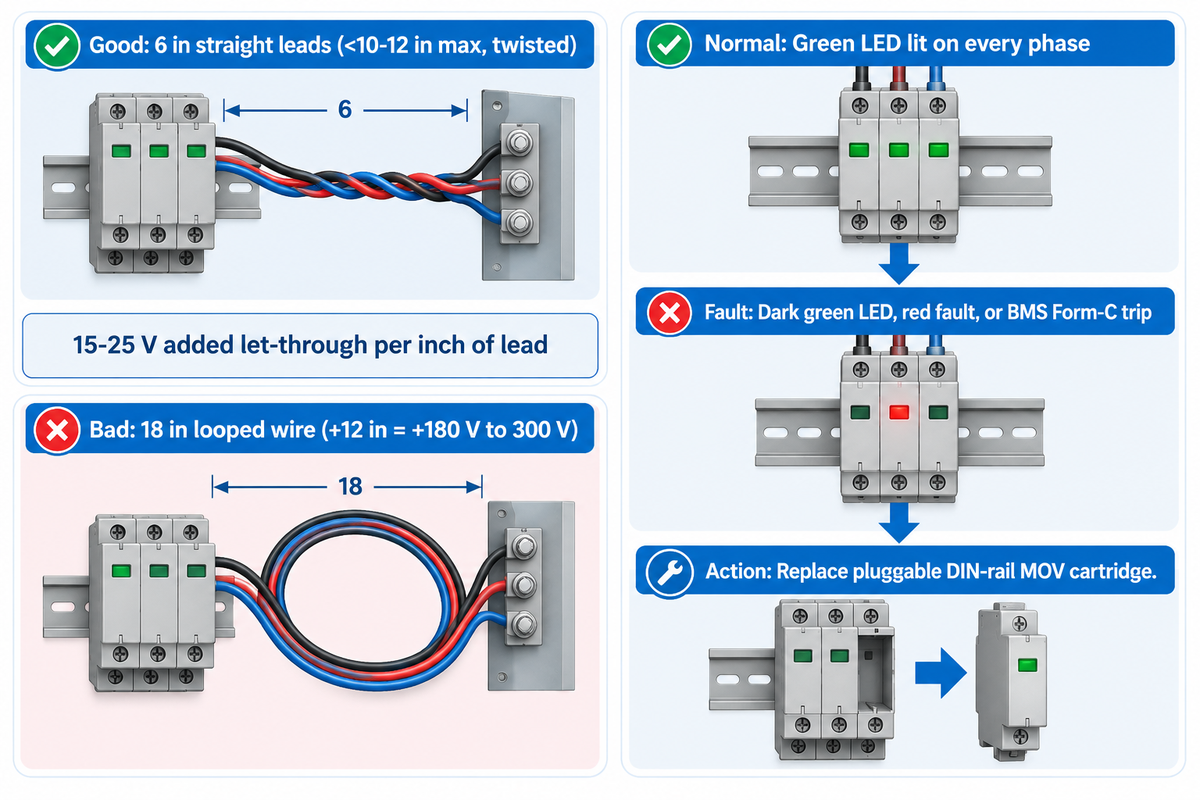
Sloppy field wiring ruins a top-tier SPD. Keep parallel leads short and straight—under 10 to 12 inches with zero sharp bends. Every extra inch adds 15 V to 25 V of inductive let-through voltage.
Track MOV end-of-life continuously through status LEDs and Form-C dry contacts wired into the BMS.
Electricians trained on 60 Hz power wiring often leave generous service loops inside disconnect boxes for future servicing. That extra wire loop defeats clamping in a surge device. During fast-rising surge transients, lead inductance dominates loop impedance far more than 60 Hz conductor resistance.
Since published VPR ratings are based on a 6-inch test lead, field leads close to the 10-to-12-inch practical limit contribute 60 V to 150 V above the nameplate clamp set point. Gently twisting phase and ground conductors together along the shortest direct path keeps added voltage drop low.
Commissioning checks don’t end when the disconnect door closes. NIST’s review of SPD health monitoring and its study explaining what SPD indicator lights actually show highlight a core operational fact. Permanently connected SPDs rely on built-in thermal disconnectors to trigger status indicators when sacrificial MOV blocks wear out. A degraded SPD lets the heat pump keep running with zero surge protection until the next storm strikes.
- Check SPD MCOV against measured L-L, L-N, and L-G nameplate voltages and grounding topology before energizing.
- Trim parallel leads short and straight to eliminate wire loops and sharp 90-degree bends, twisting conductors per factory instructions.
- Size the upstream backup breaker or fuse per the UL 1449 manual to preserve the required SCCR.
- Seal outdoor NEMA 4X enclosure entries using liquid-tight hubs and bottom-entry conduit drains so rainwater cannot pool inside the disconnect.
- Ensure the minimum operating temperature of the SPD is suitable for winter temperatures in exposed outdoor rooftop areas.
- Bond the power SPD ground and any UL 497B BMS signal SPD ground to the same low-impedance ground bar.
- Verify green status LEDs on every phase and trigger a simulated Form-C dry-contact BMS fault alarm during startup.
- Archive the SPD model number, serial number, date of installation and wiring photos in the closeout O&M binder for warranty tracking.
How Will You Know If a Heat Pump Surge Protector Has Failed or Needs Replacing?
A dark green status LED, lit red fault indicator, active audible alarm, or tripped BMS Form-C dry-contact signal shows that the heat pump surge protector has isolated worn MOV modules and needs immediate replacement.
Avoid treating an HVAC surge protector as an install-and-forget part. Check LED indicators at seasonal maintenance checks and immediately after severe storms or power outages. On commercial equipment, DIN-rail modular SPDs with pluggable cartridges allow service technicians to replace a degraded phase module in a minute or two without having to rewire the disconnect box.
Frequently Asked Questions About Surge Protection for Heat Pumps
Should you install a surge protector on a commercial inverter heat pump?
Yes. Commercial inverter heat pumps rely on DC-bus capacitors, IGBT power modules, and microprocessor control boards that microsecond voltage spikes destroy before a circuit breaker trips. Cascaded protection at both the service entrance and unit disconnect blocks utility spikes and internal motor-switching transients alike.
Since inverter board replacements range from $800 to $2,500 on light commercial units and get costlier with crane access and downtime on large plants, dedicated protection quickly recovers its cost.
What is the typical installed cost of a commercial heat pump surge protector?
Commercial three-phase 208V or 480V heat pump SPD installations fall in the $400 to $2,500 U.S. installed range reported by HeatPumpPricesReviews. Exact pricing depends on commissioning versus standalone retrofit labor, three-pole breakers, off-hours shutdowns, and rooftop access. By comparison, Trilpeak puts single-phase 240V residential or light-commercial disconnect SPDs at $150 to $400 installed. Request an itemized electrical site quote before finalizing project budgets.
Does a heat pump manufacturer warranty cover power surge or lightning damage?
No. Standard commercial and residential heat pump OEM warranties exclude damage from lightning, external power surges, voltage fluctuations, or inadequate electrical service.
Daikin’s published commercial warranty certificate explicitly excludes controller failure caused by electrical surges or fluctuations. Installing an SPD safeguards your repair budget directly. Select SPD manufacturers also offer separate connected-equipment warranties when licensed installation and grounding records stay on file.
Can you plug a heat pump or furnace into a power-strip surge protector?
No, hardwired heat pumps require a Type 1 or Type 2 SPD, because connecting high-current compressors or furnaces to consumer outlet strips creates an immediate overheating and fire hazard.
How do you verify whether a 480V commercial heat pump needs a Wye or Delta surge protector and a separate phase monitor?
Match a solidly grounded 480Y/277V wye feeder to a 320 V line-to-ground MCOV wye SPD. Specify a delta-rated SPD meeting the ≥528 V L-G MCOV threshold listed in the sizing table above. Verify the exact supply voltages shown in the electrical one-line diagram before ordering the equipment.
If a 480Y/277V rooftop disconnect lacks a neutral conductor, order a dedicated three-wire wye-compatible unit rather than tying neutral to equipment ground. Finally, inspect the heat pump’s factory wiring diagram and add an external three-phase voltage monitor relay whenever native controls lack phase-loss, phase-reversal, and brownout shutdown.
How do you tell when an HVAC surge protective device has degraded and needs replacement?
An HVAC surge protective device has degraded and needs replacement when its green status LED goes dark, its red fault indicator lights up, or its audible alarm or Form-C BMS alert trips. During each seasonal service call and following severe thunderstorms or power outages, check those visual status indicators. Replace the unit or exchange its pluggable DIN-rail cartridges on the heat pump immediately.
Final Project Verification Before Ordering
Confirm these three site-specific items with your electrical engineer of record and local authority having jurisdiction (AHJ) before releasing purchase orders: your state’s adopted NEC edition (2020 or 2023 Article 230.67 and Article 242), measured available fault current at the heat pump disconnect, and whether your heat pump model provides native factory phase-loss monitoring.
Coordinating a Commercial Hydronic Heat Pump Plant?
Send your heating and cooling load profile, supply water temperature set-point (up to 75 °C cascade), ambient design limits and 50/60 Hz three phase topology to the Koven Air engineering team. We’ll give you nameplate electrical information, control-interface points and cabinet scope to coordinate with your electrical and mechanical contractor for clean protection before installation.
Explore Koven Air Commercial & Industrial Hydronic Heat Pumps (65–2,872 kW)
Reviewed by the technical team of Koven Air Environment Technology Co., Ltd.
References & Sources
- Cascading Surge-Protective Devices: Options for Effective Implementations National Institute of Standards and Technology (NIST)
- Surge Protection of End-User Equipment National Institute of Standards and Technology (NIST)
- Monitoring of Surge-Protective Devices in Low-Voltage Power Systems National Institute of Standards and Technology (NIST)
- What Are the Lights on Your Surge Protector Telling You? National Institute of Standards and Technology (NIST)
- UL 1449 Surge Protective Devices Certification (E330181) UL Solutions (UL iQ Certification Directory)
- Enhancing Integration of Electric and HVAC Design (Division 23 & Division 26) Consulting-Specifying Engineer
- The Pros and Cons of IG Wiring (Common-Mode Surge Physics) Electrical Construction & Maintenance (EC&M)