Get in Touch with Koven Air Company


Maintenance on heat pumps includes the familiar tasks of keeping heat transfer surfaces clean, checking controls and setting up qualified service for the refrigerant and electrical systems. Start with the equipment instruction manual to find the tasks and set intervals. Keep records to indicate the system conditions when the tests were performed and whether the results indicate that the system meets the building’s heating and cooling needs.
Changing a filter in an air-to-air unit would be a good first task. Likewise, attention should be paid to the pumps and strainers of the commercial water system. These tasks have been separated so that a building manager, when generating a service request, isn’t treating every heat pump as the same piece of equipment.
By Cherry · Updated November 2026
What maintenance does a heat pump need?
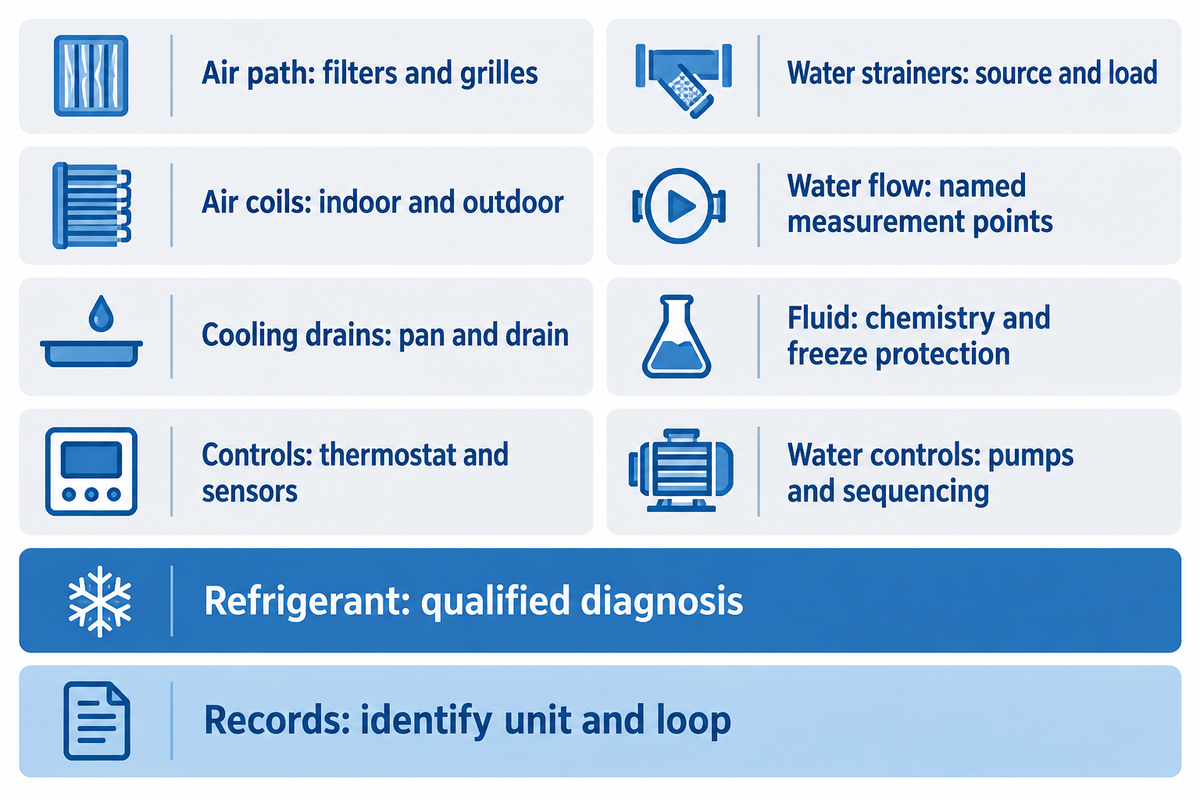
Heat pump maintenance covers the filters and controls for air and water systems. Air system equipment requires filter, coil and drainage care. Water-side equipment additionally requires loop checks. A useful list of heat pump maintenance tasks identifies the installed components, then specifies inspection, cleaning and testing for each.
Heat pumps work through heat exchange. Think of this as a delivery route. The refrigerant moves heat, while fans or pumps transport it to and from the occupied space. Circulation restrictions can reduce system efficiency because less air or water reaches the heat transfer surface. A blocked water strainer can’t be compensated for by a clean coil; also, a water-to-water system won’t have the same filter arrangement as a ducted air-to-air system. PNNL’s ground source guidance defines water-to-air and water-to-water units according to whether they condition air or water.
| Task | Air-to-air unit | Water-based system |
|---|---|---|
| Filter and air path | Inspect filter loading and unobstructed grilles | Check air filters at fan-coil or air-handler terminals, where fitted |
| Heat-transfer surfaces | Inspect indoor coil and outdoor coil | Inspect outdoor coil on air-source units; include water heat exchangers |
| Condensate | Check indoor cooling drain and pan | Check drains on cooling terminals and units that produce condensate |
| Refrigerant circuit | Technician assesses circuit and leak symptoms | Technician assesses the unit circuit; loop water is a separate fluid |
| Controls | Check thermostat, sensors and heating/cooling response | Include water setpoints, pump commands and plant sequencing |
| Strainers | Not applicable to a purely air-side circuit | Include the relevant source and load water circuits |
| Flow and pressure | Airflow and duct condition | Water flow and pressure drop at identified measurement points |
| Fluid condition | Not applicable to the air circuit | Check specified fluid chemistry and freeze protection |
| Service record | Record faults, work and operating conditions | Also identify which unit, pump and loop each reading belongs to |
Task grouping: Synthesis of PNNL’s ground-source operations guide and manufacturer service guide. Have operations personnel apply the equipment manual to the unit and its connected distribution system.
When completing a service order, identify what the unit heats or cools. Air? A warm water loop? Both? Match the equipment description to the nameplate and piping diagram. In a house, a furnace (or ducted air conditioner) moves air throughout your home; a hydronic system delivers heated or chilled water to its terminals. The maintenance list follows the path of the cooling or heating fluid through the equipment. Our commercial heat pump systems overview can help identify the equipment family prior to the maintenance scope being drafted.
How often should a heat pump be serviced?
Schedule professional residential heat pump service at least once a year (Carrier recommends service during the spring and fall). Carrier prefers spring and fall service for year-round heating and cooling. The preventive maintenance schedule for commercial equipment should be consistent with the installed equipment’s instructions; separate intervals should be specified for routine maintenance observations, filters, pumps and other service.
The Carrier service guide distinguishes a minimum from its seasonal preference. The difference matters when buying maintenance services: each of the two visits must have a defined purpose, such as checking cooling operation before summer and heating operation before winter.
Regular heat pump maintenance also contains checks between specialist visits. For a ground-source installation, PNNL recommends pump field checks at least weekly, with monthly inspections as its minimum. Those are pump checks, not a requirement to open the refrigerant circuit weekly. Record routine observations on the facility calendar and specialist maintenance on a work order.
Imagine an office where a refurbishment fills the return air area with dust. The annual maintenance visit is still a few months away, but the filter is already loading faster than it did before the work started. The facilities team can inspect an accessible filter under its authorized procedure, document its condition, and arrange replacement when needed. Waiting for the annual appointment leaves the restriction in place. Once construction is completed, the team can review the inspection interval against the documented loading and the filter instructions. These maintenance practices respond to changes in the environment; additional similar calendar visits wouldn’t, on their own, indicate which task is requiring additional attention.
Do heat pumps need different servicing in winter and summer?
During seasonal service, test the mode the building is about to use. Before cooling, pay attention to drainage and indoor coil conditions. Before heating, check the required heating sequence, defrost operation on outdoor air-source equipment, and auxiliary heat where fitted. A controller tested only in heat mode won’t show all cooling mode problems before the next heating and cooling season.
Maintenance tips for building staff and technicians
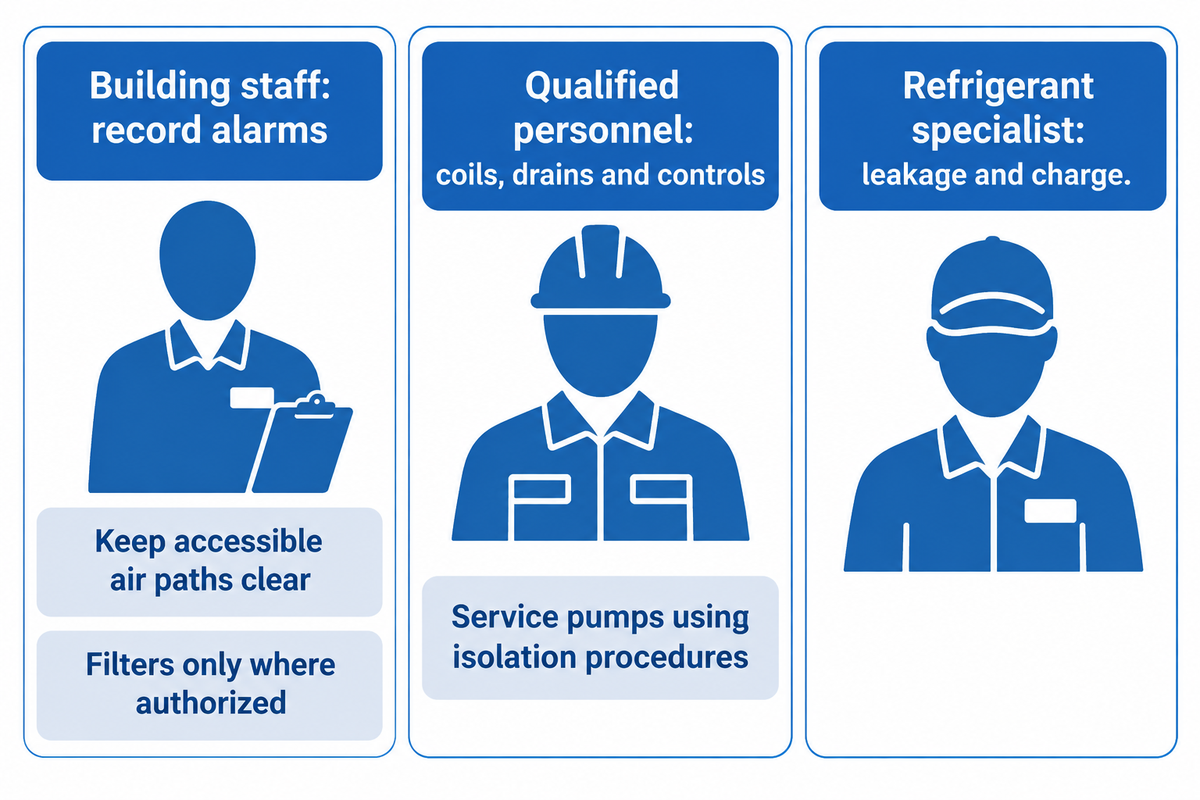
Building personnel are able to record alarms, observe accessible equipment and perform routine care, where this is permitted by their training and site procedure. Qualified technicians handle internal electrical work, refrigerant work and technical testing. Assign work by competence and access requirements; an experienced in-house technician may be acceptable, as may a specialist contractor.
For refrigerant work in the US, EPA Section 608 requirements apply to activities including the connection of refrigerant pressure gauges and the addition or removal of refrigerant. Apprentices are exempt from these certification requirements provided they’re under the close and continuous supervision of a certified technician. Reading a controller display is different from attaching gauges to the refrigerant circuit.
- Building staff: note thermostat settings, room complaints, visible leaks and new noise; keep accessible intake and discharge areas clear; check or replace filters only where authorized.
- Qualified maintenance personnel: inspect coils and drains, assess airflow, test controls, and service pumps using the manual and required isolation procedures.
- Refrigerant specialist: investigate leakage or charge concerns, identify the refrigerant, and follow the equipment’s service procedure and applicable certification requirements.
When reporting an alarm, include the unit ID and the exact alarm message. A photo without opening a panel may capture evidence that’s erased during a reset. Recording small issues early can prevent the next service call from starting without a fault history. Repeatedly resetting a protective device after it trips may mask the sequence of events the technician needs to diagnose the fault.
Don’t issue a generic instruction to spray a coil, pour chemicals into a drain, or force defrost. The approved cleaning method, electrical isolation and material compatibility belong in the job procedure. These basic heat pump maintenance tips should leave an untrained employee with a clear observation task and a clear escalation path.
Commercial heat pump maintenance: water-side checks
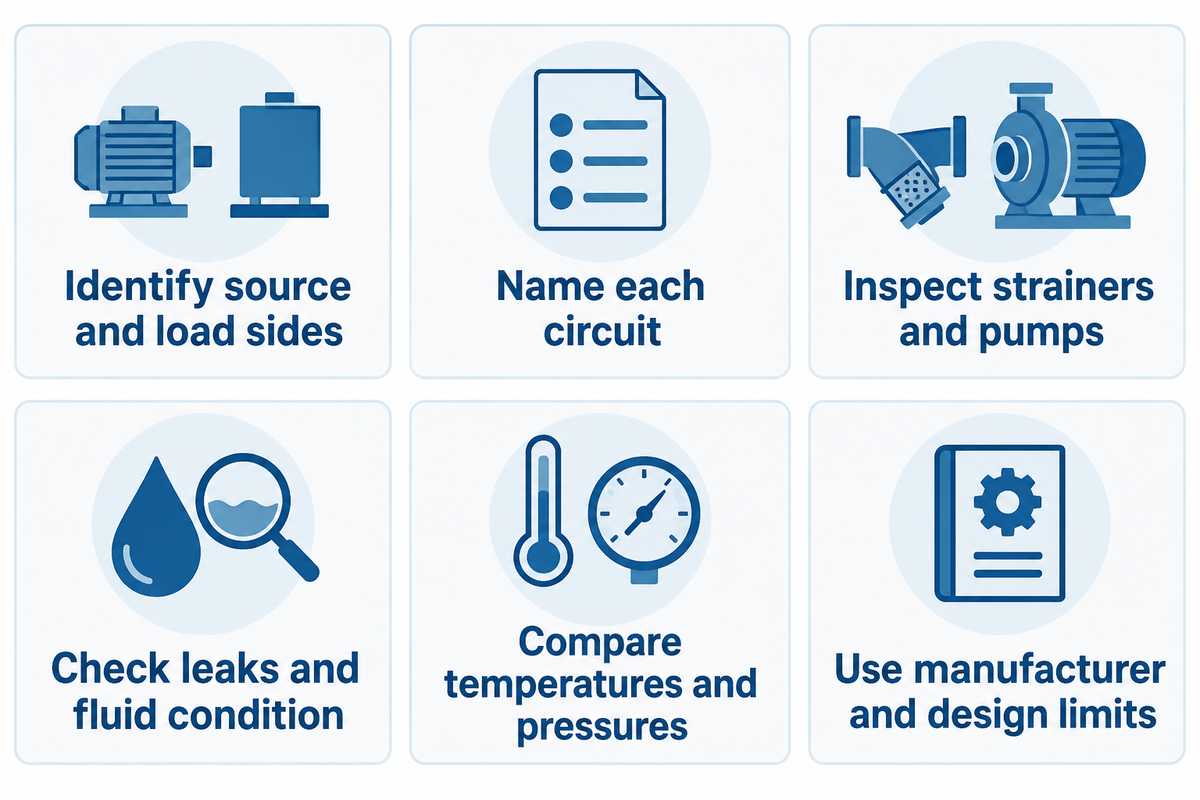
Water-side HVAC maintenance should cover strainers, circulating pumps, leaks, fluid condition and flow with each check assigned to a named circuit. Compare temperatures and pressures to equipment design conditions. For a shared plant, the scope of heat pump service should also clearly distinguish work on the unit from work on the building loop.
“Make sure component conditions and operating temperatures, pressures, and flows are within manufacturer and design parameters.”
PNNL’s Fluid Loop guidance includes strainer cleanout, loop pressure, and antifreeze concentration. In a commercial air-to-water installation, use the relevant unit and plant manuals to establish these requirements. Proper heat transfer requires the specified fluid, flow, and circulation. A single cleaning chemical or a given glycol concentration can’t be applied across all fluid formulations, metals and design temperatures.
Maintain separate source and load sides. See the water-to-water heat pump circuits guide for details. Label measurement points on the actual plant drawing so the term “water temperature” doesn’t refer to a different pipe on the next visit.
Picture a hotel reporting reduced hot-water recovery after an adjustment to the pump setting during some unrelated work. There are no new alarms on the heat pump controller and a contractor recommends cleaning the heat exchanger. Before authorizing the cleaning work, the operator reviews the change record and the technician compares the measured flow, entering and leaving temperatures with the design and manufacturer’s data. An adjustment to the pump command provides a lead to the investigation. If reduced circulation is caused by an incorrect pump setting or control sequence, correcting that setting or sequence addresses the cause; chemical cleaning does not.
Use the existing water-loop maintenance responsibilities checklist to review ownership of water treatment, groundwater-loop maintenance and handover tasks. Cleaning a confirmed restriction can improve energy efficiency by restoring the required circulation; the before and after readings should reflect the change. The contractor maintaining the packaged unit may not be contracted to maintain the whole loop.
Read operating trends before a breakdown
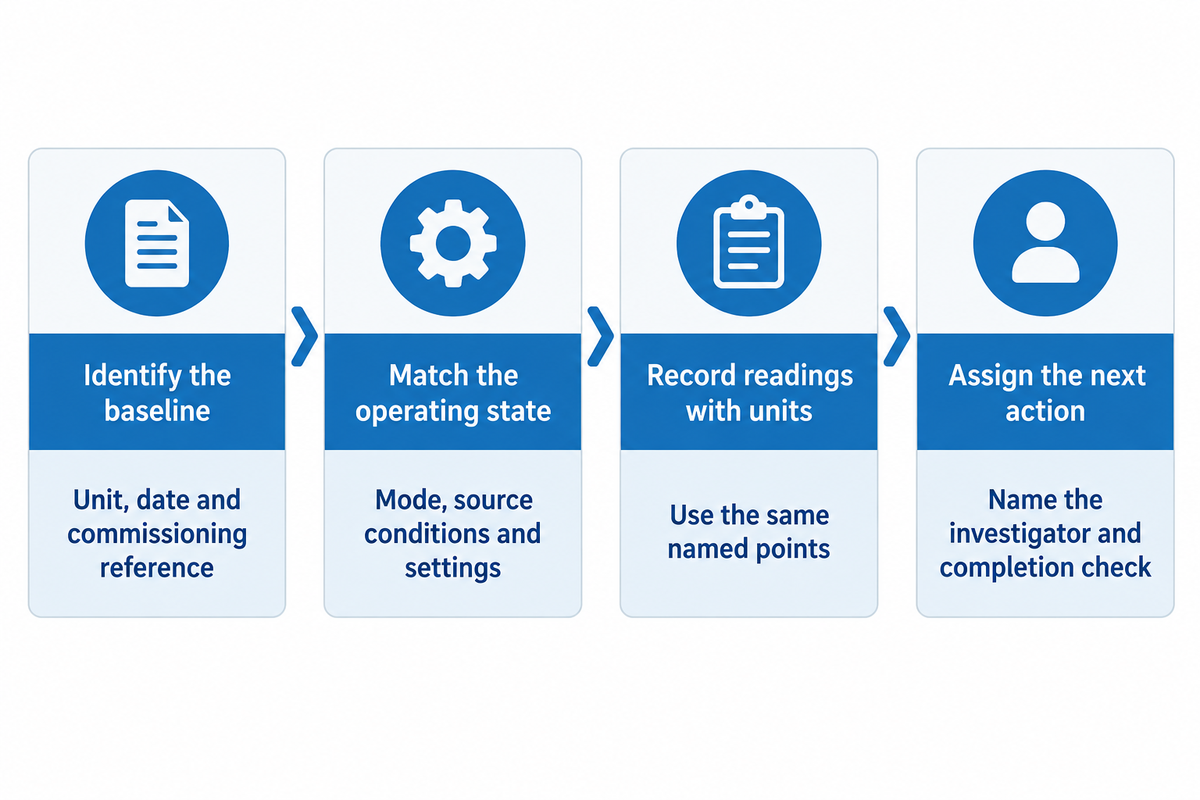
Records of heat pump operation become useful with a valid baseline and comparable readings under similar conditions. Note the operating modes, source conditions, load settings and flow before interpreting a change. Unexpected breakdowns are one of the reasons to retain these records. An increase in pressure drop or greater temperature difference across a component should warrant an investigation of several possible causes as opposed to an immediate diagnosis.
Start with commissioned or professionally checked performance. We call this record format the Same-Condition Drift Test: a record format for comparing operating readings and preparing service questions. NIST’s 2015 residential simulation study found that installation faults, including charge and airflow problems, can impair performance. Better energy efficiency starts with correcting that underlying fault, not simply copying its readings into a new log. Stable readings alone aren’t an assurance that all is well.
- Identify the baseline. Record the unit, service date and reference to the commissioning or diagnostic report.
- Match the operating state. Note heating or cooling mode, outdoor or source temperature, water setpoint, pump command, and whether defrost or auxiliary heat is active.
- Record readings with units. Keep entering and leaving temperatures, flow where measured, and pressure differences at the same named points. Include alarm order and recent control changes.
- Assign the next action. Record what changed, who will investigate and how completion will be checked.
Maintenance helps highlight changes that precede complaints. A pressure difference measured at a different flow doesn’t isolate fouling. A greater water temperature difference can reflect reduced flow, change in load or control. For systems feeding a slab, changes to radiant-floor water temperatures change the comparison. Compare like conditions before treating a normal change in load as deterioration.
How do I know if my heat pump needs refrigerant?
A qualified technician must diagnose a refrigerant shortage. Prolonged heating cycles, ice buildup and repeated cycling can also result from airflow problems. Control and defrost problems can also lead to similar symptoms. Supply symptom history and operating conditions when requesting a refrigerant levels check. If leakage is found, the plan should fix the leak and restore the specified charge, instead of setting a schedule for routine top-ups.
What is the average cost to service a heat pump?
Local US advertisements give useful starting examples: Thompson Plumbing & Air Conditioning in Cartersville, Georgia lists a $99 heat-pump tune-up special, while Carolina Custom Air near Charleston, South Carolina advertises $99 and lists $175 as its regular price. These are local offers, not a national average or a commercial plant-service estimate.
Those prices were visible in November 2026 on Thompson’s page, formerly AC Squad, and Carolina Custom Air’s maintenance offer. Check that the advertised offer applies to your equipment and the work required before booking. Also compare the defined scope of regular maintenance against the price: an annual contract, a single maintenance visit and a repair call are different purchases.
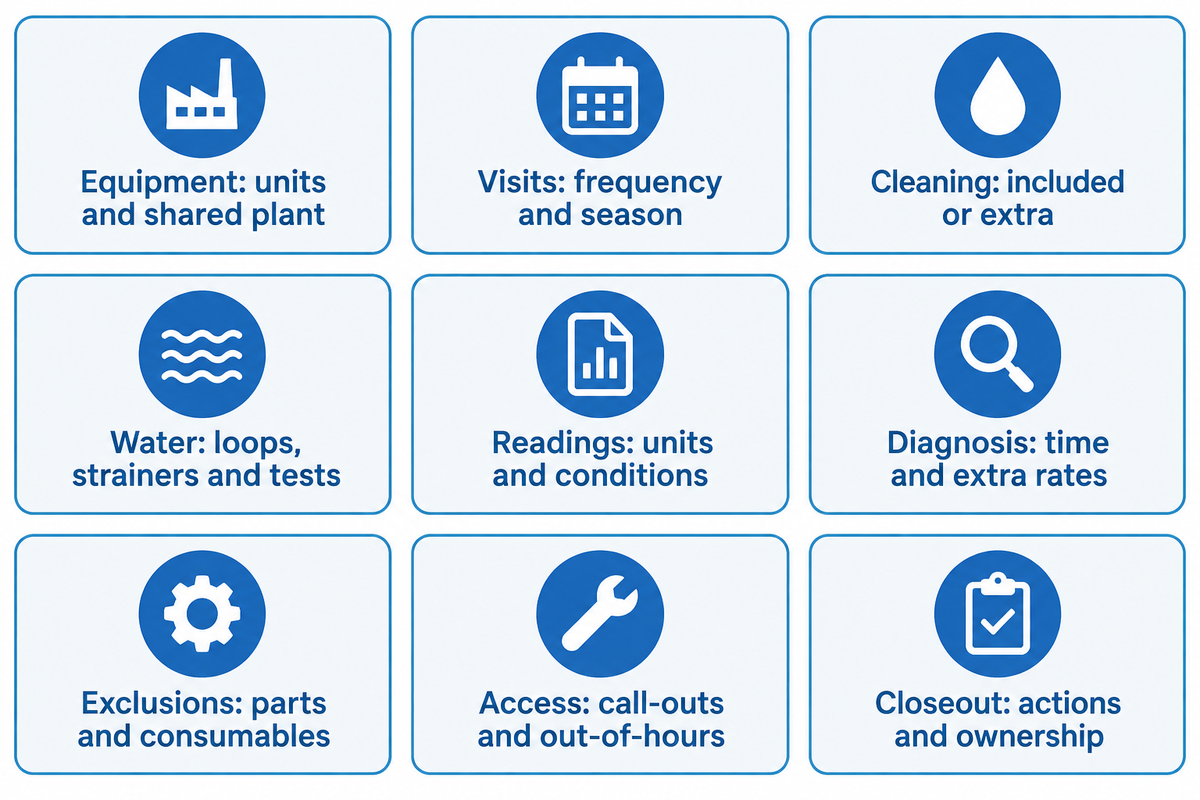
| Quote field | Ask the provider to enter | What the answer changes |
|---|---|---|
| Equipment covered | Unit IDs, indoor terminals, pumps and shared plant | Prevents an outdoor-unit-only quote being compared with whole-system service |
| Scheduled visits | Visits per year and intended operating seasons | Separates one tune-up from an annual agreement |
| Inspection and cleaning | Surfaces inspected; cleaning included or separately priced | Distinguishes a visual check from labor-intensive cleaning |
| Water circuit | Named loops, strainers and fluid tests included | Identifies work that otherwise falls between contractors |
| Measurements | Readings, units and reference conditions in the report | Makes the next service visit comparable |
| Fault diagnosis | Included diagnostic time and additional hourly rate | Shows when investigation becomes an extra charge |
| Consumables and repairs | Filters, treatment chemicals, parts and refrigerant exclusions | Prevents a service fee being mistaken for an all-in repair price |
| Response and access | Call-out terms, site access and out-of-hours charge | Connects the contract to occupancy and downtime risk |
| Closeout | Written actions, responsible person and unresolved items | Gives procurement an observable deliverable |
Service-quote comparison sheet. Allow each bidder to fill in the scope fields before comparing prices.
Let’s say a facilities buyer receives two bids on the same site. One of the bids mentions inspection of the outdoor units. The other mentions the water-loop strainers, fluid testing, access arrangements and a written report. By simply comparing total prices, the buyer favors the shorter scope. The buyer can return this sheet to both bidders and ask them to price the same equipment and tasks, with repair costs separated. If the facility already has a contract for water treatment, this work can be explicitly allocated there instead of purchased twice. The last comparison shows what the maintenance fee covers and what costs are outside the maintenance fee.
Choose a provider for professional maintenance

Choose a heat pump service provider that can support the installed model, its controls and its connected HVAC system. Ask for relevant experience, refrigerant qualifications where required, diagnostic access and a sample service report. The manufacturer, original installer and an independent contractor can each be appropriate when their actual scope fits the site.
ASHRAE’s public description of Standard 180-2018 connects commercial HVAC inspection and maintenance with thermal comfort, energy efficiency and indoor air quality. Use these to challenge a proposal: how will the contractor inspect the complete system, capture findings and report defects? That’s the importance of regular inspections: the report should connect a finding to an action. A claim to “follow a standard” should define a work scope.
Start by requesting the commissioning records from the installer and the current warranty terms from the equipment supplier. Check those documents before assigning work: they stipulate the service obligations and any authorization required for this installation. Ask each proposed contractor, including an independent specialist, who can access diagnostics, obtain parts and handle a fault in a shared controller. Correlate the written answers with the work to be done on site.
The evidence is a named item on a list. An equipment list, task record completion sheet, or a reading with units, and an action list are also acceptable forms of evidence. Peace of mind comes from knowing who will respond and what they will do, not from the number of services listed in a brochure.
Repair or replace: the service-life decision
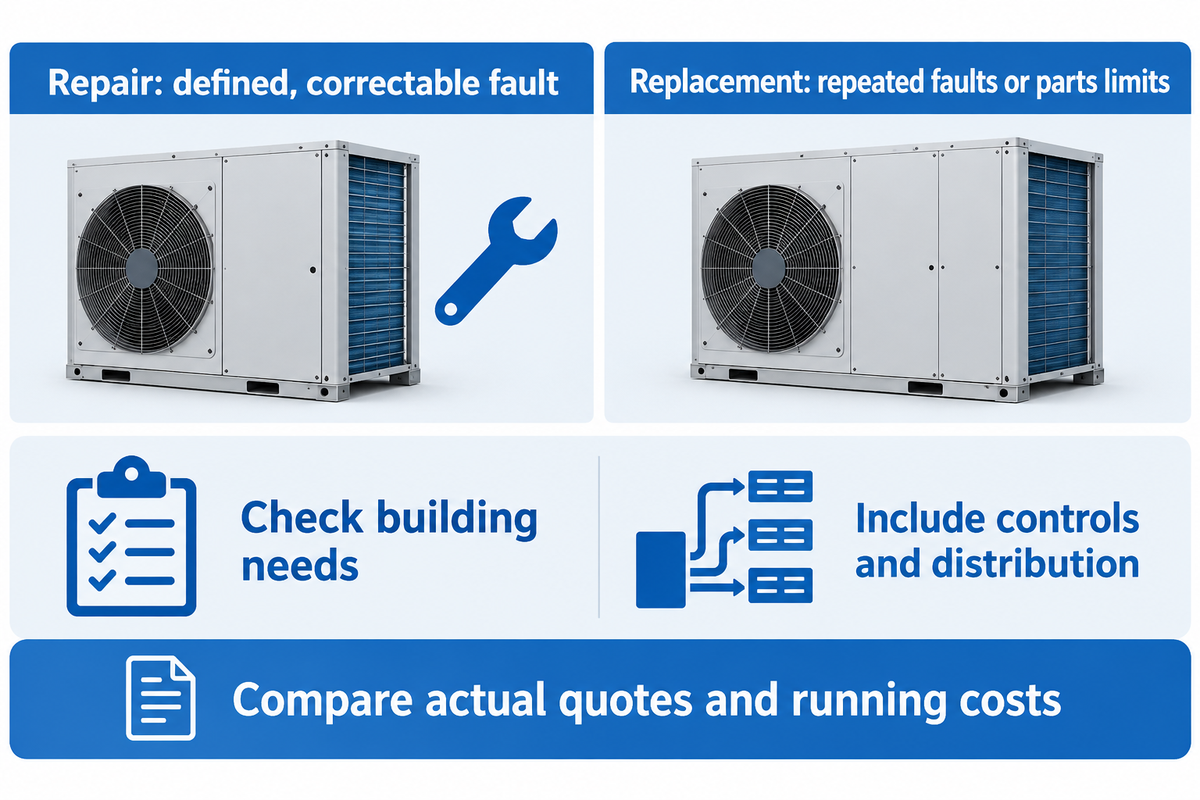
Repair is justifiable if the system can still meet the needs of the building and a defined fault can be corrected. Replacement should be considered if recurring faults, operating costs or parts availability make continued service undesirable. Assess the full scope of the replacement, including connected control components and any distribution-system changes, against the scope of the repair.
How long do heat pumps normally last?
The US Department of Energy assumes an average residential air-source heat pump life of 15 years for its energy-cost analysis. This is a planning assumption and not a commercial replacement deadline. The actual service life requires a condition assessment that considers the duty, environment, quality of installation, and history of the individual unit.
The DOE residential purchasing guide concerns single-phase equipment below 65,000 Btu/h and excludes three-phase models. Keep that equipment scope attached to the lifespan figure. A well-maintained heat pump with a repairable fault and available parts presents a different decision from one with a history of repeated major failures. The lifespan of a heat pump should be evaluated along with the repair history.
What is the $5,000 rule for HVAC systems?
The $5,000 rule multiplies equipment age in years by the estimated repair price and uses 5,000 as a rough replacement-screening threshold. Carrier describes it as a homeowner rule of thumb. It does not calculate the cost of owning a repaired system or its replacement.
For a hypothetical 10-year-old unit and a $600 repair quote, the calculation is 10 × 600 = 6,000, above that screening threshold. The repair still costs $600; the result isn’t a $6,000 bill. Before replacing the unit, compare the actual replacement quote, expected energy costs, likely further repairs and the consequences of downtime.
DOE’s commercial energy-code economic methodology also accounts for residual value at the end of the analysis period. This should also include connected equipment. For instance, an analysis of heat pumps and boilers in a shared plant would require an assessment of more than the cost of two separate pieces of equipment.
Refrigerant changes and future maintenance needs

Refrigerant changes make model-specific service competence important when procuring equipment or maintenance. Before you buy a replacement heat pump or renew a service agreement, determine the refrigerant and confirm that the service provider can support that equipment. Existing system repairs and rules for new equipment are different questions; therefore, announcing a transition alone shouldn’t trigger a replacement.
EPA’s May 2026 reconsideration addressed several Technology Transitions requirements, including those for residential and light-commercial air-conditioning and heat-pump systems. EPA’s HFC program questions and answers explain that the Technology Transitions restrictions don’t prevent continued use of existing products and systems. Repair can remain possible, while other refrigerant-management requirements still apply.
For the next contract, add the refrigerant designation to the asset list, assess the contractor’s training, tools and use of manufacturer procedures for that equipment, and evaluate the technician’s EPA certification. ACCA’s A2L training covers topics related to mildly flammable refrigerants, and its residential course shouldn’t be used as a blanket equipment qualification for commercial equipment.
The supply and skills are related to scheduling. The International Energy Agency’s Heat Pump Monitor 2026 reported that sales of building heat pumps stabilized in 2025 and continued that pattern in the first quarter of 2026; technician shortages were identified as a deployment constraint. For a building owner, the useful response is to establish a service route before an urgent breakdown, especially when parts or specialist diagnostics need advance coordination.
The refrigerant, control access, and service provider should be documented for each piece of equipment along with the unit ID. Commissioning service records should include the model and refrigerant of the HVAC equipment. Upon replacement of equipment, update its refrigerant designation in the asset record. After equipment replacement, updating the scope of maintenance is essential: the building’s heating and cooling system may serve the same rooms through different equipment.
Frequently asked questions
How often does a heat pump need refrigerant?
A sound refrigerant circuit shouldn’t need scheduled refills.
Heat pumps use refrigerant in a closed circuit rather than consume it as fuel. Daikin’s maintenance guidance identifies repeated refilling as a reason to investigate leakage. A technician should diagnose the cause of a shortage and follow the equipment’s charging procedure after the required repair. Adding refrigerant isn’t a substitute for finding why it was lost.
Is it normal for a heat pump to run all the time?
Long operation can be normal for a variable-speed heat pump that adjusts its output to maintain consistent temperatures.
Look at whether the building reaches its setpoint and whether operation has changed under similar weather and load. New alarms, weak delivery or an unexplained increase in energy bills justify investigation. A fixed daily run-time limit would overlook both normal modulation and changing heating or cooling demand.
Do monoblock heat pumps require specialized maintenance?
Yes. Factory assembly of a monoblock’s refrigerant circuit doesn’t remove its need for professional service or care of the connected water system.
The applicable work includes controls and electrical checks, heat-transfer surfaces, pumps and the specified freeze-protection arrangement. Use the particular model’s instructions to assign those tasks. An enclosed refrigerant assembly isn’t permission for untrained staff to open the unit or add refrigerant.
Is heat pump servicing different for air source and ground source systems?
Yes. These types of heat pumps have different source-side tasks: air-source equipment exchanges heat with outdoor air; ground-source equipment adds a ground or water-source circuit to the service scope.
Keeping the system running efficiently includes checking debris on an outdoor air coil and assessing defrost behavior during heating. A ground-loop system instead needs its circulating equipment and fluid condition checked against its design. Indoor tasks follow the delivery equipment: a water-to-air unit has an air path, while a water-to-water unit serves a water circuit. For either family, maintenance must also address controls and the refrigerant system. The same building may contain several of these arrangements, so list the actual equipment rather than buy a contract based only on a generic heat pump service label. Shared pumps and any auxiliary heater or cooling equipment need an assigned maintenance owner as well.
Should I get a yearly maintenance contract for my heat pump?
Choose a yearly maintenance contract when its scheduled tasks, reporting and response terms fit the heat pump solutions installed at the site.
Regular maintenance is key to keeping the service history current. Compare the written scope with the equipment manual and assign owner tasks between visits. Separate routine service from chargeable repairs.
Need assistance planning service for a Koven Air system? Provide model number, site conditions, and current system drawing with your request. These may assist in identifying the related equipment and connected plant that will need to be included in the scope of work. Begin with the Koven Air heat pump range to determine the product family that’s relevant to your situation.
References & Sources
- Best Practices for Ground Source Heat Pump Operation and Maintenance, Pacific Northwest National Laboratory, 2021.
- Section 608 Technician Certification Requirements, US Environmental Protection Agency.
- Effect of Installation Faults on Air-to-Air Heat Pump Performance, Piotr A. Domanski, NIST, 2015.
- Standards 180 and 211, ASHRAE, public commercial maintenance scope.
- Purchasing Energy-Efficient Residential Air-Source Heat Pumps, US Department of Energy.
- Methodology, US Department of Energy, Building Energy Codes Program.
- Regulatory Actions for Technology Transitions and Frequent Questions on the Phasedown of Hydrofluorocarbons, US Environmental Protection Agency.
- A2L Refrigerant Safety Training, Air Conditioning Contractors of America.
- Heat Pump Monitor 2026: Key Findings, International Energy Agency.