Get in Touch with Koven Air Company

Industrial Chiller vs. Cooling Tower: Air-Cooled, Water-Cooled, and Dual-Loop Selection

(Updated November 2026)
When selecting industrial cooling equipment, a chiller vs cooling tower evaluation pairs an active chiller with an evaporative heat rejector. For full-load-optimized federal purchases, DOE FEMP requires water-cooled chillers at 0.501-0.611 kW/ton across mid-to-large bands versus 10.890-10.964 EER for air-cooled models. Use an air-cooled chiller under 200 tons to skip water piping, and select a water-cooled system with a cooling tower for large continuous loads.
Chiller vs. Cooling Tower at a Glance: Function and Loop Boundaries
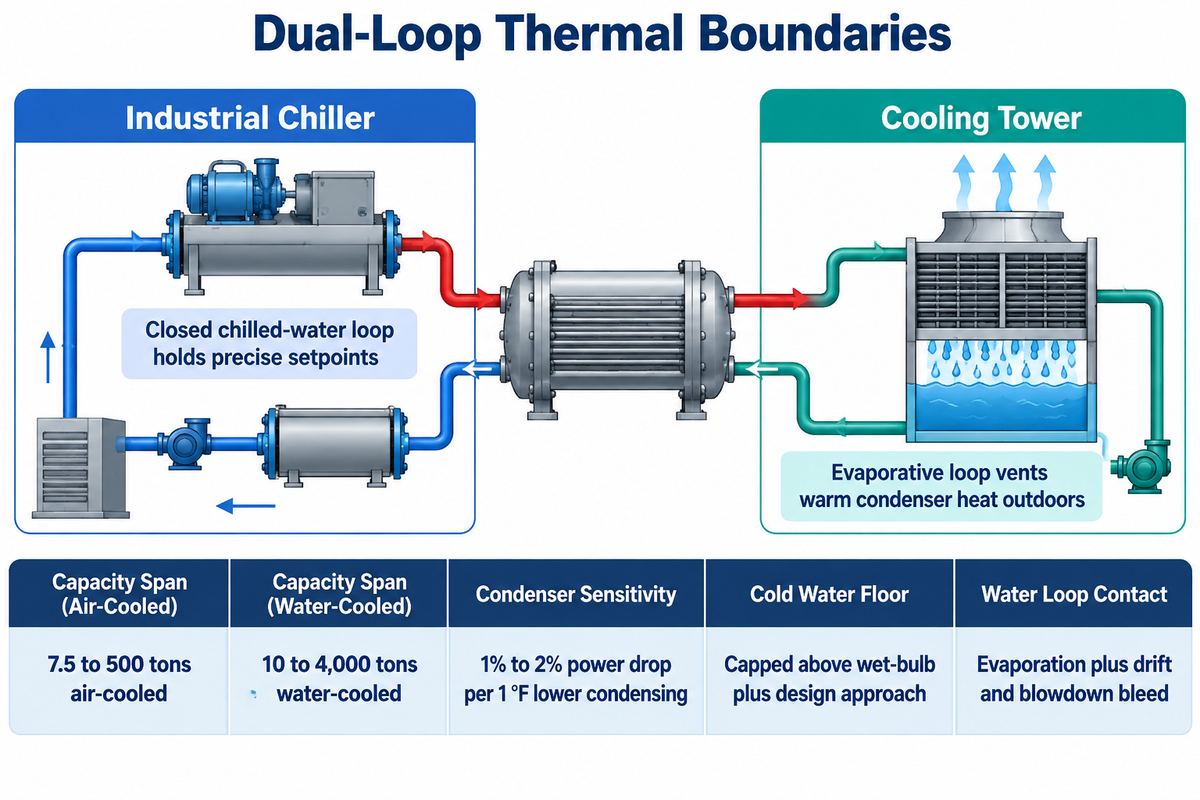
An industrial chiller uses a vapor-compression refrigeration system to remove heat from a closed chilled-water loop down to precise setpoints. Inside the cooling process, a cooling tower rejects warm condenser heat outdoors through evaporative cooling. A standalone tower never chills water below outdoor wet-bulb temperature plus design approach.
Many buyers confuse chillers and cooling towers because both deliver cooled water across industrial facilities. Inside a central cooling system, a chiller and cooling tower manage completely separate loops. That thermal connection occurs when heat transfers from the sealed evaporator into open condenser water. Knowing how paired thermal loops split heat rejection across these two systems stops costly misapplication.
| Comparison Axis | Industrial Chiller (Air-Cooled or Water-Cooled) | Open or Closed Cooling Tower |
|---|---|---|
| Core thermal role | Refrigeration cycle transfers heat from process fluid | Heat exchange device rejects warm water heat outdoors |
| Cold water floor | Holds precise sub-ambient chilled fluid targets continuously | Capped above ambient wet-bulb plus design approach |
| Capacity range (packaged) | 7.5 to 500 tons air-cooled; 10 to 4,000 tons water-cooled | Matches condenser cooling load across central plants |
| Water loop contact | Sealed chilled loop; air-cooled models use zero water | Continuous evaporation plus drift and blowdown bleed |
| Condenser sensitivity | 1% to 2% compressor power drop per 1 °F lower condensing | Driven directly by ambient wet-bulb and humid air |
Do chillers work with cooling towers?
Yes, water-cooled chillers require cooling towers when a plant dumps heat from the system into outdoor air through water. The two work together across two separate fluid circuits, divided by the condenser shell. First, a chilled water loop transports process heat from the factory to the evaporator bundle. In the chiller, refrigerant boils at low pressure to absorb process heat before compression raises condensing pressure. Dedicated condenser water pumps move the warm water to the tower basin. Through fan-driven evaporation, a cooling tower and a chiller work together to vent thermal energy outdoors and return cool condenser water.
“Cooling towers dissipate heat from recirculating water used to cool chillers, air conditioners, or other process equipment to the ambient air. Heat is rejected to the environment from cooling towers through the process of evaporation.”
Engineers compute minimum refrigerant condensing temperatures, or compressor-free economizer supply temperatures, using two additive approach steps above ambient wet-bulb temperature. First, the cold water leaving the tower sits above the outdoor wet-bulb temperature by the tower approach; adding a plate heat exchanger introduces a second temperature approach. Evaporator coils drop refrigerant pressure below plant water targets to hold a tight process setpoint year round. Open towers lack vapor compression, so they plateau above humid summer dew points, when factories demand chilled brine. As explained in industrial liquid coolant and refrigerant selection, ambient air and cooling tower temperatures dictate compressor lift across every shift.
Chiller Types vs. Cooling Tower Designs Compared
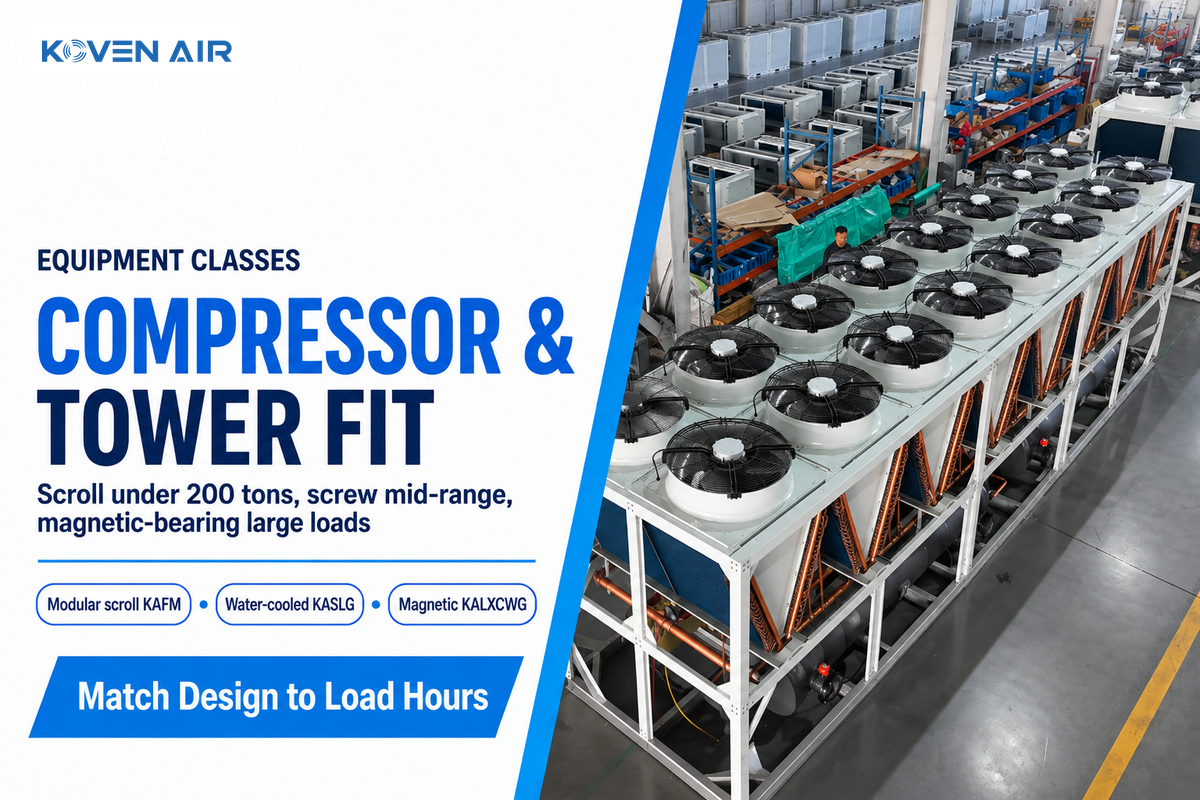
The architecture of choosing a chiller, beginning with tonnage and load profile, includes scroll compressors anchoring smaller plants under 200 tons, screw machines in mid-range process cooling, and oil-free centrifugal units in large scale cooling. In open-circuit systems, water in the condenser tower is allowed to spray and evaporate. In closed-circuit systems, condenser water is kept clean.
Consulting-Specifying Engineer classifies types of chillers by tonnage band. Water-cooled units under 200 tons normally use scroll compressors, while 200-to-500-ton plants use screw compressors. Koven Air offers modular air-cooled scroll chillers comprising 20 RT, 30 RT, and 40 RT modular units, mixed and matched up to 12 units per bank across 19-234 TR (65-820 kW). Larger sites pair industrial scroll and screw chillers (KASLG water-cooled screw at 327-3,517 kW, COP 5.56-5.83) or magnetic-bearing centrifugal chillers (KALXCWG 170-1,250 TR) with tower cells.
| Equipment Class | Heat Rejection Path | Verified Span / Efficiency | Typical Plant Fit & Limits |
|---|---|---|---|
| Modular Air-Cooled Scroll (KAFM) | Air-cooled finned coils | 19–234 TR (65–820 kW); COP 3.14–3.42; IPLV 3.60–4.30 | Swinging loads; -15 to +43 °C standard ambient |
| Packaged Air-Cooled Screw (KAFLG) | Outdoor air axial fans | COP 3.23–3.35; IPLV 3.80–4.30 | Steady 24/7 loads without condenser water piping |
| Water-Cooled Screw (KASLG) | Shell-and-tube + cooling tower | 327–3,517 kW; COP 5.56–5.83; IPLV 6.8–7.8 | Continuous cooling loads with existing tower water loop |
| Oil-Lubricated Centrifugal | Cooling tower condenser loop | 0.577–0.634 kW/ton FL; 0.54–0.78 IPLV | Steady large cooling; requires oil circuit upkeep |
| Magnetic-Bearing Centrifugal (KALXCWG) | Cooling tower condenser loop | 170–1,250 TR; 0.513–0.548 FL; 0.290–0.349 IPLV | Long part-load hours; zero oil exchanger fouling |
| Evaporative Condenser Chiller (KAFZ/JXRZ) | Direct wetted coil + spray | 19–800 TR; 5.7–6.0 COP (KAFZ rated); 0.79% evap makeup | Hot dry regions; drops 16% per 2 °F WB recirculation |
| Open Crossflow Cooling Tower | Air crosses falling water fill | 95/85/75 °F ASHRAE 90.1 design rating | Accessible basins; needs water treatment systems |
| Open Counterflow Cooling Tower | Air rises against falling spray | 40%–50% min flow to prevent fill scaling | Smaller plan footprint; enclosed spray nozzles |
| Closed-Circuit Fluid Cooler | Sprayed coil isolates clean water | ASHRAE 90.1 requires CTI certification on new projects | Protects process chillers from airborne dust |
| CTI-Certified Dry Cooler | Sensible outdoor air heat transfer | Certified under CTI STD-201 since March 2022 | Zero water consumption; tracks dry-bulb highs |
Air-cooled chillers are equipped with axial fans to force outdoor air across finned coils and cool compressed refrigerant. For water-cooled plants, indoor liquid-cooled chiller systems deliver higher cooling capacity per square foot compared to air-cooled units on tight-fit sites. Meanwhile, water-cooled chillers generally operate at lower condensing pressures when outdoor wet-bulb temperatures permit cool tower sumps. Outdoor cooling towers add structural steel, sump heaters and tower mechanical maintenance to chiller maintenance budgets. During mild weather, multi-module scroll arrays stage individual blocks off to improve part-load efficiency. Oil-free magnetic bearing centrifugal compressors can maintain efficiency during multi-shift industrial runs. Comparing air or water-cooled chillers against DOE FEMP and Trane benchmarks favors air-cooled units for intermittent sub-200-ton loads and water-cooled tower plants for 24/7 factories.
Air-Cooled vs. Water-Cooled Chiller Plants: Wet-Bulb and Approach Limits
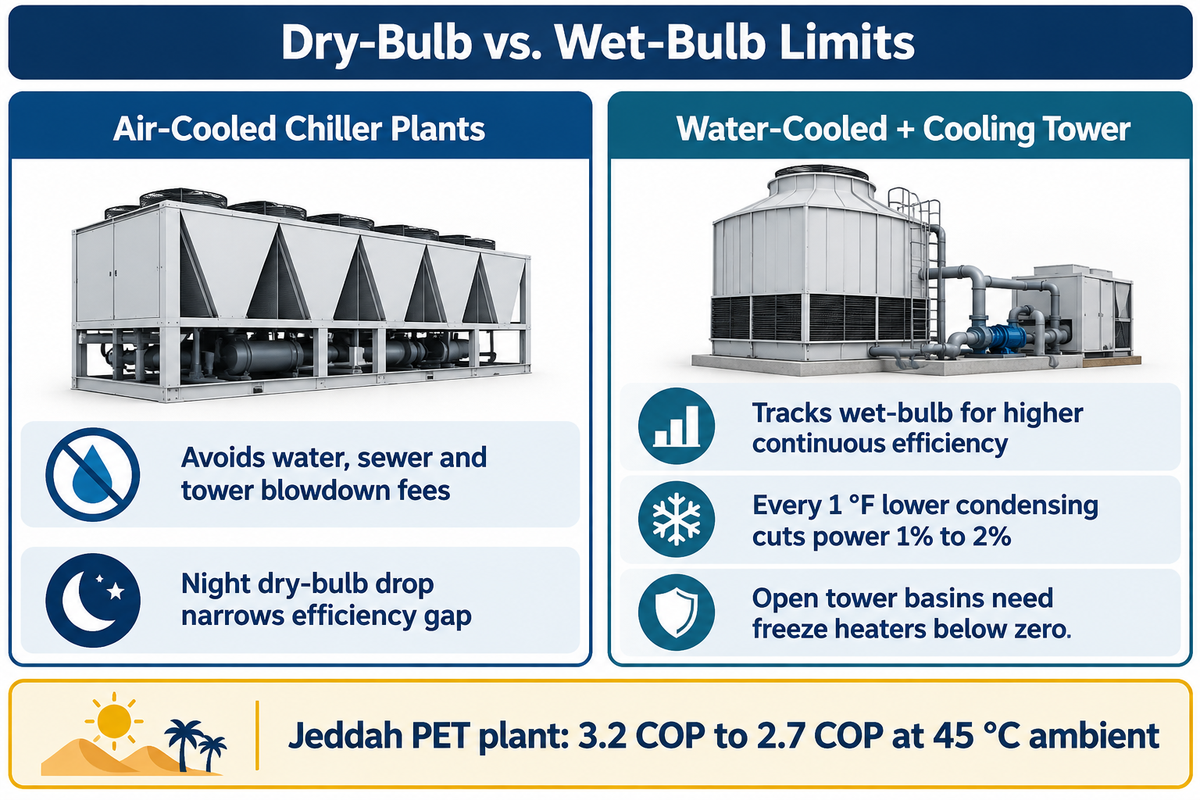
Air-cooled vs. water-cooled plant selection depends on wet-bulb temperature, water tariffs, and operating hours. Water-cooled chillers accept the constraint of wet-bulb temperature and provide greater efficiency in continuous service. Air-cooled systems avoid water and sewer costs, cut initial cost, and eliminate tower blowdown fees for intermittent sites.
Seasonal weather shifts efficiency differences between the two systems because every 1 °F lower condensing temperature cuts compressor horsepower 1% to 2% (EVAPCO and ACHR News). Trane reports that nighttime dry-bulb temperatures drop faster than wet-bulb temperatures after sunset, lessening the daytime water-cooled system efficiency edge on night shifts. Citing external data, Trane notes that U.S. data centers consumed 626 billion liters of water in 2014 across site cooling and power plants.
“However, air-cooled chillers are substantially less efficient than water-cooled models.”
Extreme dry-bulb heat can severely test air-cooled packages in desert facilities. In a Jeddah PET preform plant reported by Koven Air, two 800 kW air-cooled screw chillers with a 3.2 nameplate COP measured 2.7 COP at 45 °C ambient. Actual cooling capacity dropped by more than a third against design. High ambient winds and dusty factory exhaust can short-circuit condenser fins and cause discharge trips during peak conditions. Sub-zero temperatures create the reverse threat for open tower basins, making electric basin heaters and indoor drain-down tanks necessary. When planning rooftop air-cooled chiller clearances, provide unobstructed intake space and site units so discharge air is never drawn back into the intake.
Do air-cooled chillers require a cooling tower?
No, air-cooled chillers eliminate the need for cooling towers completely by moving outdoor air over finned coils. Eliminating open sumps also eliminates makeup piping, condenser water pumps, and chemical blowdown controls. Engineers comparing water-cooled or air-cooled economics pick air-cooled packages when sub-200-ton plants prioritize freeze safety and skip tower piping.
Cooling Tower vs. Adiabatic Cooler, Dry Cooler, and Chiller Heat Recovery
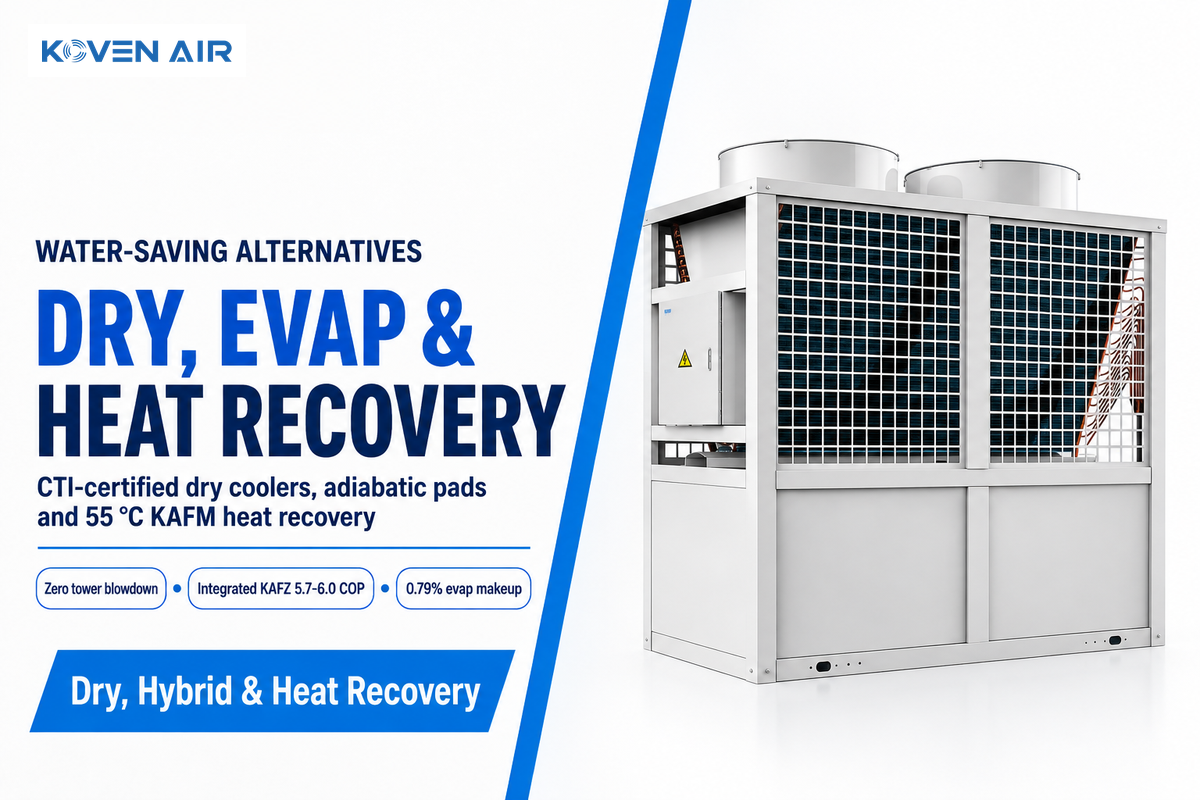
Plants short on water resources eliminate open towers and use CTI-certified dry coolers, adiabatic pre-coolers, integrated evaporative chillers, or heat recovery modules. Integrated evaporative chillers pair water and air heat transfer, with Koven Air KAFZ models rated at 5.7 to 6.0 COP and 0.79% makeup water of chilled-water flow before blowdown.
Equipment standards verify dry and hybrid options directly alongside open cooling towers. The Cooling Technology Institute (CTI) adopted test code ATC-105DS in 2018 and expanded CTI Standard 201 certification to cover dry coolers in March 2022. Adiabatic coolers run dry during cool weather and wet inlet pads only during the peak afternoon hours. Choosing a dry cooler removes makeup piping, chemical dosing, and open sump biocide treatments completely. However, sensible heat rejection tracks daytime dry-bulb peaks and requires larger coil bays and fan motors.
For hot industrial regions, Koven Air builds integrated evaporative-cooled industrial chillers (KAFZ screw and JXRZ scroll, 19–800 TR). Rated at 5.7–6.0 COP under 7 °C chilled water and 35 °C dry-bulb / 26 °C wet-bulb, they swap a 20 m tower pump loop for a built-in 3 m spray pump. Skipping an external condenser pump skid cuts parasitic pumping power and eliminates long trench piping runs between plant rooms and roof yards. Place units where exhaust air never recirculates: ACHR News warns a 2 °F rise in entering wet-bulb cuts performance by roughly 16%. Koven Air KAFM modules also add optional coaxial heat recovery for 55 °C process hot water, offsetting boiler gas during washdowns.
Cooling Tower vs. Chiller Efficiency, kW/Ton Part-Load, and Free Cooling
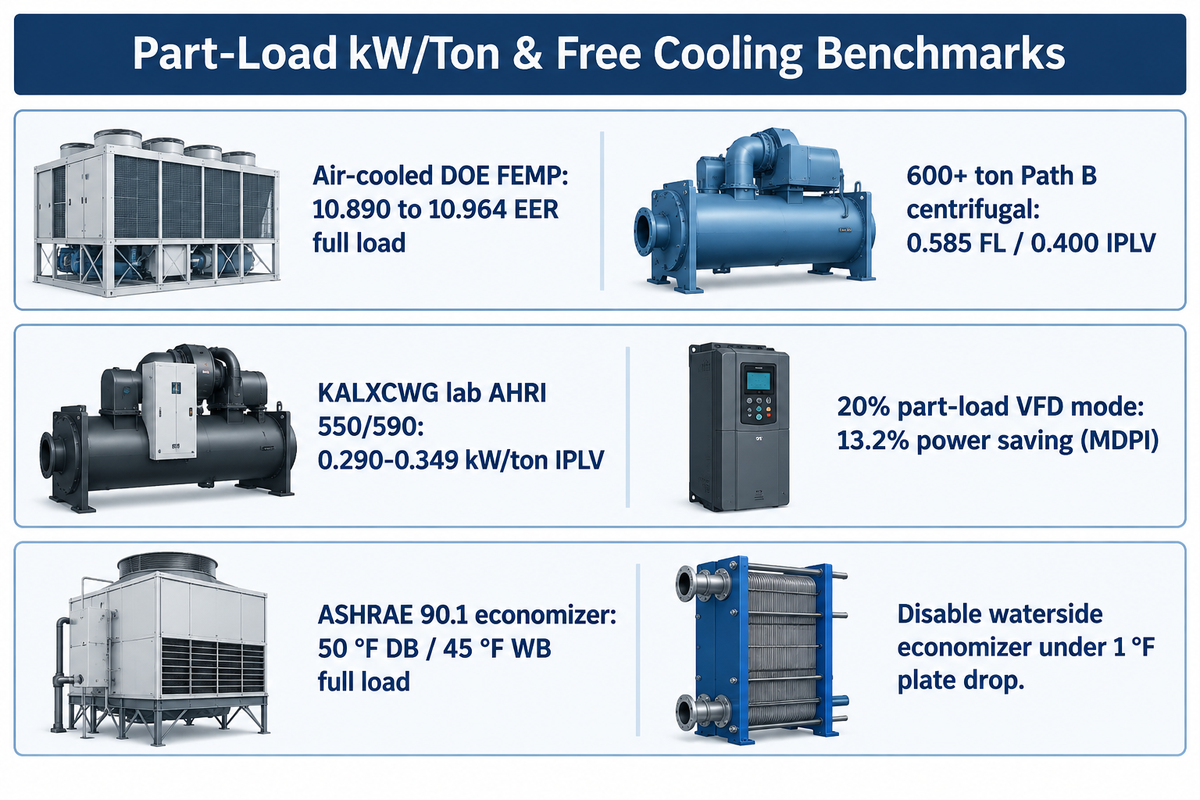
True plant energy efficiency requires tallying chiller compressors, condenser water pumps, and tower fans. DOE FEMP requires full-load air-cooled chillers at 10.890 EER (under 150 tons) to 10.964 EER (150 tons and above), whereas Path B part-load water-cooled centrifugals at 600 tons or above meet 0.585 kW/ton full-load and 0.400 kW/ton IPLV. In Koven Air’s in-house test lab under AHRI 550/590 conditions, KALXCWG magnetic-bearing chillers achieve 0.290–0.349 kW/ton IPLV.
DOE FEMP pairs ASHRAE 90.1 Path A (full-load) and Path B (part-load) targets because design optimization trades across load curves. For 150-to-299-ton positive displacement water-cooled units, full-load models require 0.611 kW/ton full-load and 0.540 kW/ton IPLV. Part-load models cut IPLV down to 0.366 kW/ton at 0.680 kW/ton full load. Across its 25-model grid tested under AHRI 550/590 conditions in its in-house test lab, Koven Air KALXCWG magnetic-bearing chillers deliver 0.513–0.548 kW/ton full-load and 0.290–0.349 kW/ton IPLV with zero oil-fouling loss (optional AHRI certification is available on request).
Pump and fan variable frequency drives lower long-term operating costs under fluctuating cooling demand. A 2025 study in MDPI Buildings chiller plant modeling reports a 13.2% power-saving rate at a 20% part-load ratio compared to constant-speed pump/fan mode. However, Consulting-Specifying Engineer plant controls guidance cautions that variable speed condenser water pumps can increase overall plant energy usage if not optimally controlled.
When can a cooling tower cool process water without a compressor?
A cooling tower cools process water without compressors once chilled return water exceeds outdoor wet-bulb plus tower approach, plate approach, and a 2 °F buffer. ASHRAE 90.1 Section 6.5.1 sizes integrated fluid economizers for 100% cooling load at 50 °F dry-bulb and 45 °F wet-bulb.
When a fluid economizer heat exchanger fails to cut temperature by 1 °F during marginal transitions, operators disable waterside economizer loops to prevent condenser pumps and tower fans from burning more power than compressor staging saves.
Hydronic Flow and Tonnage Sizing Calculations: Worked 200-Ton Plant Example
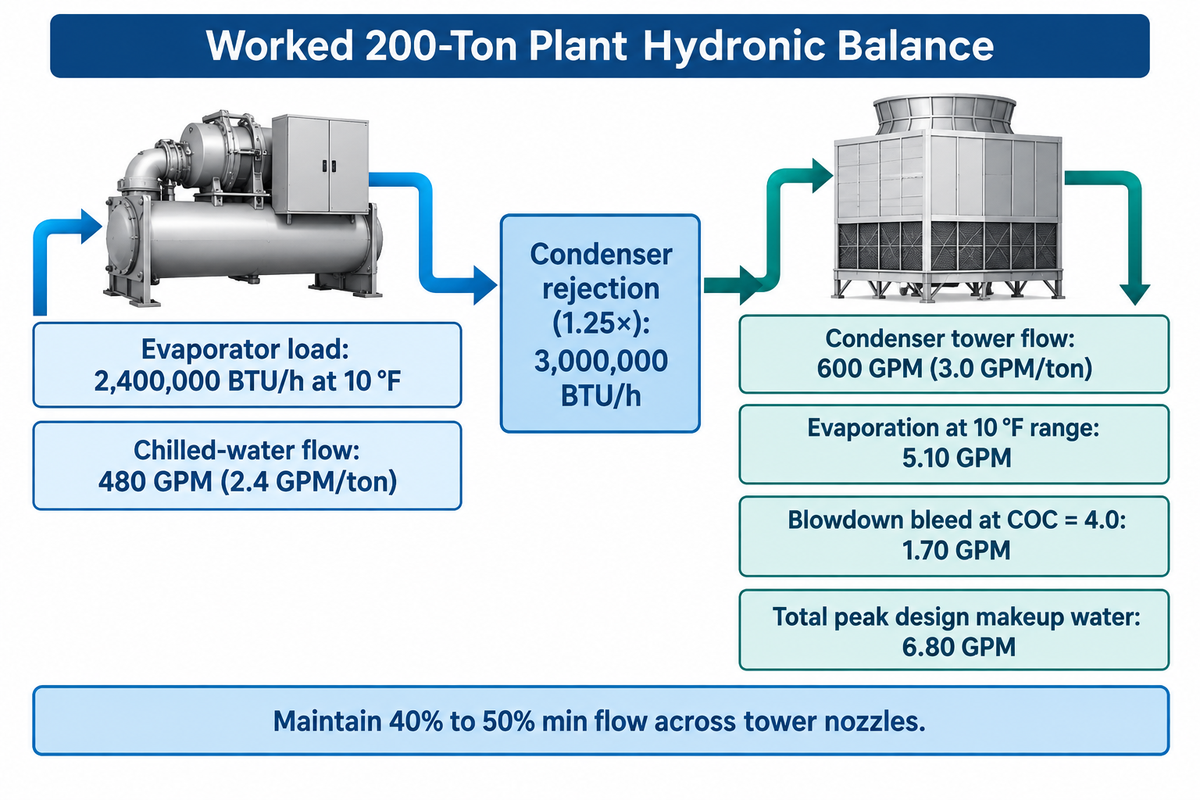
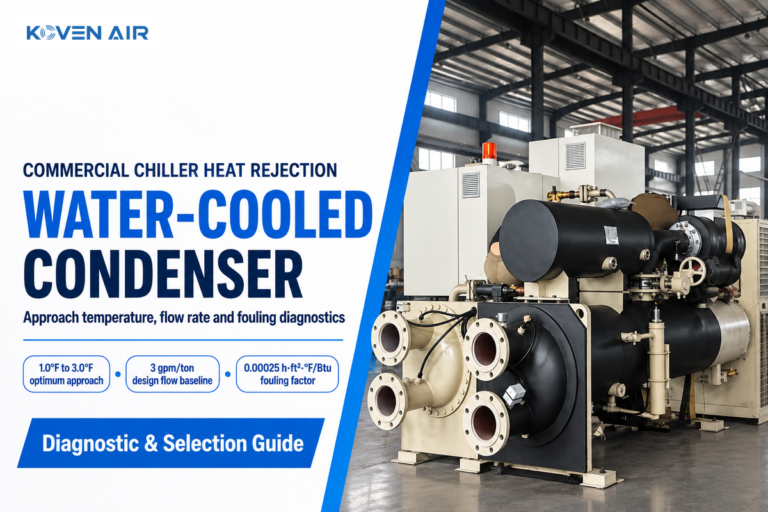
A 200-ton chiller plant circulates 480 GPM through the evaporator (2.4 GPM/ton) and 600 GPM through the cooling tower condenser (3.0 GPM/ton). That 25% higher condenser flow removes both process load and compressor work under standard ASHRAE 90.1 95 °F hot, 85 °F cold, and 75 °F wet-bulb conditions.
Hardware tables follow this exact 1.25× condenser-to-evaporator flow ratio. Koven Air KALXCWG 170EV–270EV models move 102.8–163.3 m³/h of chilled fluid against 128.5–204.1 m³/h of condenser water on DN150 nozzles. Check low-load turndown before finalizing pipes: Consulting-Specifying Engineer stresses that cooling towers enforce a 40% to 50% minimum flow rate to keep nozzles wetted and prevent fill scaling. Verify blowdown bleed and conductivity metering against DOE FEMP cooling tower water management guidance.
Assumed inputs (Worked 200-Ton Example): Design load equals 200 refrigeration tons with a 500 BTU/h per GPM-°F water constant. Chilled-water range spans 10 °F (2.4 GPM/ton at 12,000 BTU/h per ton). Condenser heat rejection uses a 1.25× ratio (15,000 BTU/h per ton, matching KALXCWG 3.0 GPM/ton ratios). Tower evaporation uses 0.00085 × condenser GPM per °F range. Water balance uses 4.0 Cycles of Concentration (COC) with negligible drift per DOE FEMP BMP #10 eliminators.
| Plant Parameter | Worked Equation | Result |
|---|---|---|
| Chilled-water loop load | 200 tons × 12,000 BTU/h per ton | 2,400,000 BTU/h |
| Chilled-water flow rate | 2,400,000 ÷ (500 × 10 °F) | 480 GPM (2.4 GPM/ton) |
| Condenser heat rejection | 200 tons × 15,000 BTU/h per ton (1.25×) | 3,000,000 BTU/h |
| Condenser water piping flow | 3,000,000 ÷ (500 × 10 °F) | 600 GPM (3.0 GPM/ton) |
| Cooling tower evaporation rate | 0.00085 × 600 GPM × 10 °F range | 5.10 GPM |
| Blowdown bleed at COC = 4.0 | 5.10 ÷ (4.0 − 1) | 1.70 GPM |
| Total design makeup water | 5.10 + 1.70 GPM (excluding negligible drift) | 6.80 GPM (peak 200-ton load) |
Sizing condenser mains from 600 GPM design circulation and 6.80 GPM peak makeup prevents valve throttling before softening skids are procured. Matching variable-flow chilled pumps separately from steady condenser spray zones protects fill wetting during mild weather. Commissioning crews are required to log calibrated basin temperatures and strainer pressure drops prior to accepting plant handovers. Note also CTI STD-201RS verification limits during field audits: minimum ±0.10 °F (±0.05 °C) temperature probe tolerances push tests below rated minimum approach outside the 5% allowable error band.
Cooling Tower Water Loss, Blowdown, and Operational Risks
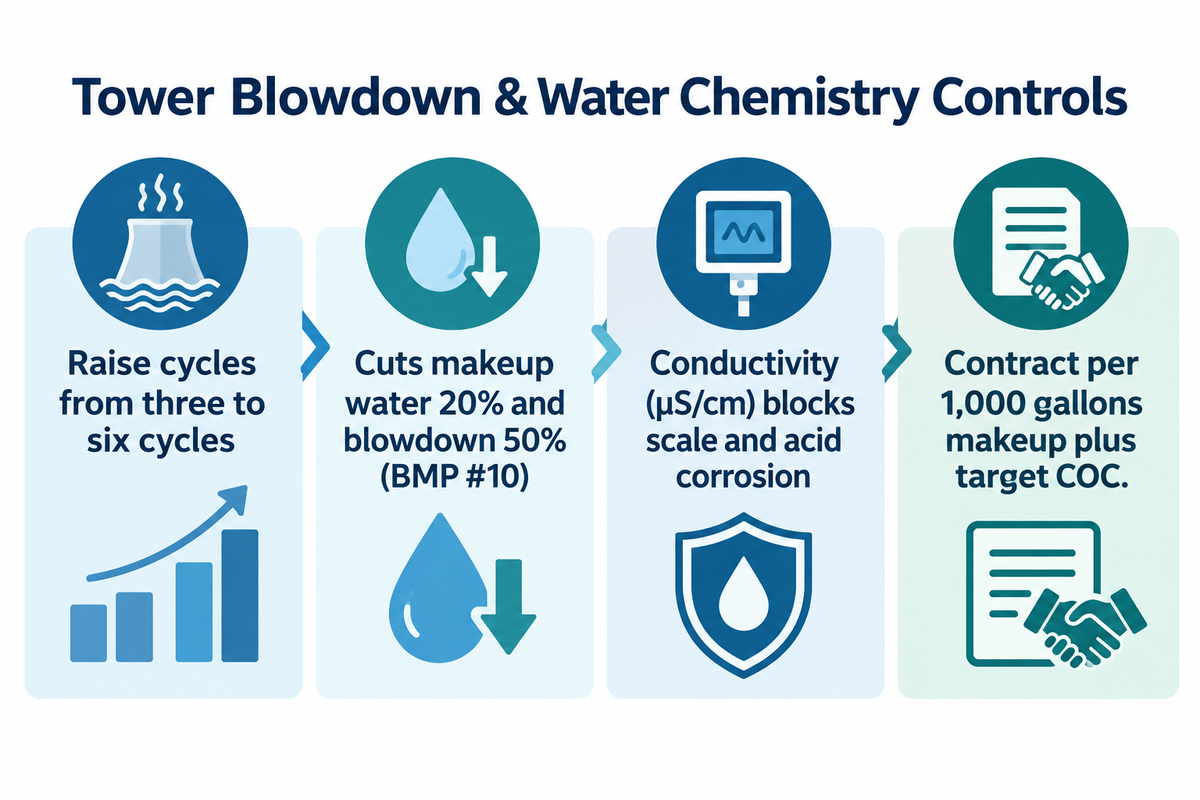
Building on the hydronic condenser flow loop above, open cooling towers lose water through evaporation, drift, and blowdown while operating at two to four cycles of concentration. Following DOE FEMP BMP #10, increasing concentration from three to six cycles reduces cooling tower makeup water by 20% and blowdown by 50%.
Pure vapor leaves dissolved calcium, magnesium, chloride, and silica concentrated inside the tower sump. Without automated conductivity controllers measuring micro Siemens per centimeter (µS/cm), minerals coat heat-exchanger surfaces and block heat transfer. Running six cycles without scaling and corrosion treatment invites foulant buildup, whereas acid overdoses for pH correction can severely damage metal piping. Schedule water-cooled chiller and tower maintenance cleanly with drift eliminators and biocide logs.
DOE FEMP identifies a water-treatment contract trap. Some chemical suppliers resist higher cycles of concentration because efficient plants use less makeup water and therefore purchase fewer chemicals. Therefore, negotiate treatment contracts based on costs for each 1,000 gallons of makeup water and guaranteed concentration levels. Clean suction strainers, inspect spray nozzles monthly, and verify basin biocide schedules to block biofilm inside fill packs. Ignoring biological growth insulates condenser tubes faster than calcium scale and causes emergency chiller brush cleanings.
Chiller System and Cooling Tower Capital Cost, Utility Bills, and Lifespan
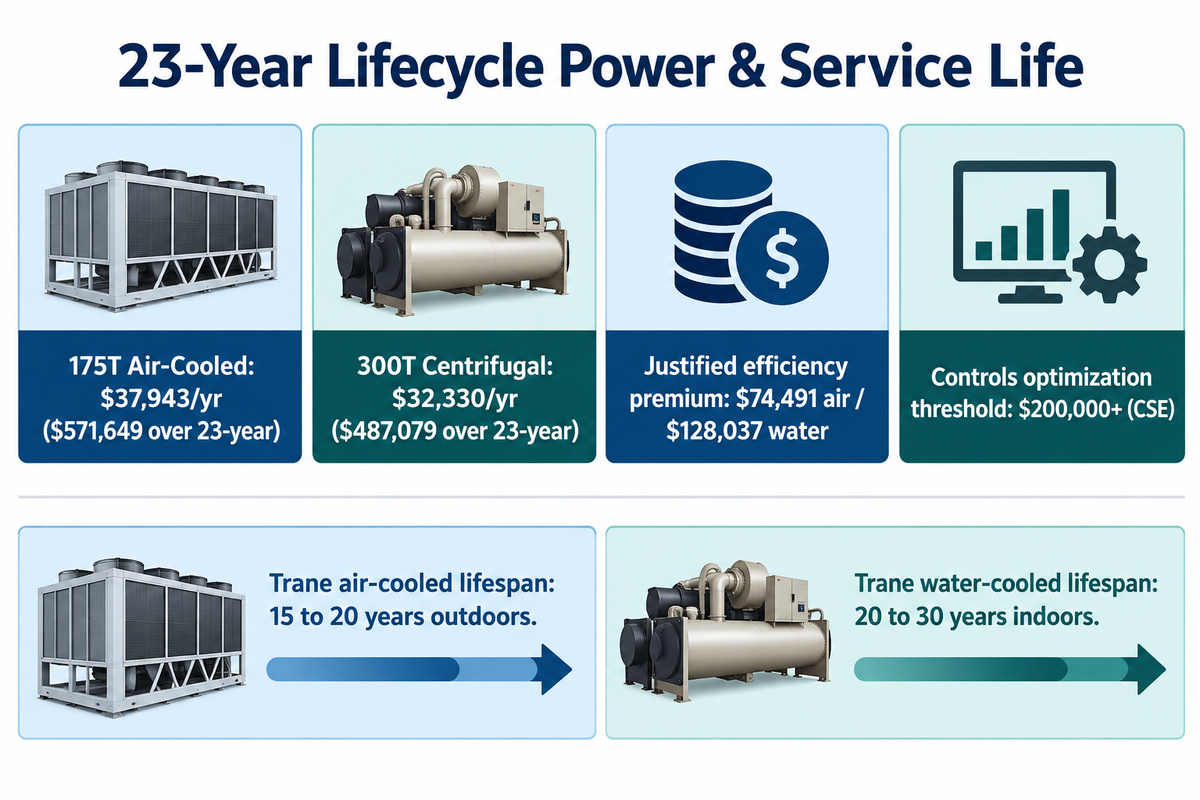
DOE FEMP 23-year benchmarks price annual electric cost for a required 175-ton air-cooled chiller at $37,943 ($571,649 lifetime), versus $32,330 ($487,079 lifetime) for a 300-ton water-cooled centrifugal unit. Meanwhile, Trane documents typical equipment service lives of 15 to 20 years for air-cooled units against 20 to 30 years for indoor water-cooled chillers.
Equipment quotes often vary, but utility and water costs over a 23-year service life can make the difference. DOE FEMP shows a compliant 10.964 EER 175-ton air-cooled chiller pays back an upfront efficiency premium up to $74,491 against a 9.700 EER model ($646,140 lifetime electricity). Full discount rate and energy tariff tables appear in DOE FEMP electric chiller procurement guidance. Due to utility tariffs and layered ratcheted kW demand penalties, afternoon compressor spikes can cause unexpected bills faster than base energy rates. Rising sewer discharge fees also erode open-tower savings unless conductivity controls sustain high cycles cleanly. For central plants, paired cooling towers and chillers also require structural tower steel, long condenser water piping, cranes, and chemical water treatment skids alongside the 23-year energy model.
| Lifecycle Cost / Asset Benchmark | Air-Cooled Basis | Water-Cooled + Tower / Evap Basis | Source Attribution |
|---|---|---|---|
| Annual electricity cost (full-load basis) | $35,556–$42,888/yr (175T, 9.7–11.7 EER) | $30,012–$40,828/yr (300T, 0.505–0.687 kW/ton) | DOE FEMP Tables 4 & 5 |
| 23-year lifetime electricity spend | $535,689–$646,140 ($571,649 required) | $452,160–$615,117 ($487,079 required) | DOE FEMP 23-yr model |
| Justified efficiency capital premium | $74,491 (required) to $110,451 (best) | $128,037 (required) to $162,957 (best) | DOE FEMP Tables 4 & 5 |
| Seasonal power + water (1,125 kW load) | AUD $136,933 (433,607 kWh, 0 m³ water) | AUD $114,664 tower / AUD $95,736 evap (KAFZ) | Koven Air Western Australia 2024 tariff model (150 days/yr, 10 h/day) |
| Seasonal makeup water volume (1,125 kW) | 0 m³ | 6,129 m³ (tower) / 4,050 m³ (KAFZ evap) | Koven Air model |
| Installed controls optimization package | Integrated packaged controls | $200,000+ (needs 2M kWh saved over 5 yr @ $0.1/kWh) | Consulting-Specifying Engineer |
| Equipment service life expectation | 15 to 20 years (outdoor weather exposure) | 20 to 30 years (indoor water-cooled chassis) | Trane Commercial HVAC |
| Variable-flow control payback edge | Modular staging saves low-load cycles | 13.2% total power cut at 20% part-load ratio | MDPI Buildings (2025) |
| Watershed indirect power-water load | Higher thermal grid water draw per kWh | Lower compressor electricity cuts grid water demand | Trane (626B L US data centers) |
What is the average lifespan of a cooling tower?
Cooling tower longevity depends on casing materials and water chemistry, tracking beside the 20 to 30 year life of indoor water-cooled chillers reported by Trane. Indoor housing of compressors protects variable frequency drives, starters and brazed controls from the elements. Outdoor air-cooled chillers last 15 to 20 years because of outdoor exposure and high condenser pressures. These pressures and outdoor temperature swings accelerate fatigue across finned coils and compressors. Cumulative operating costs of a plant over its life exceed the initial chassis cost multiple times. Fill media, fan blades, and basin seals are replaced on shorter maintenance intervals.
5-Step Cooling Plant Selection Method for Industrial Facilities
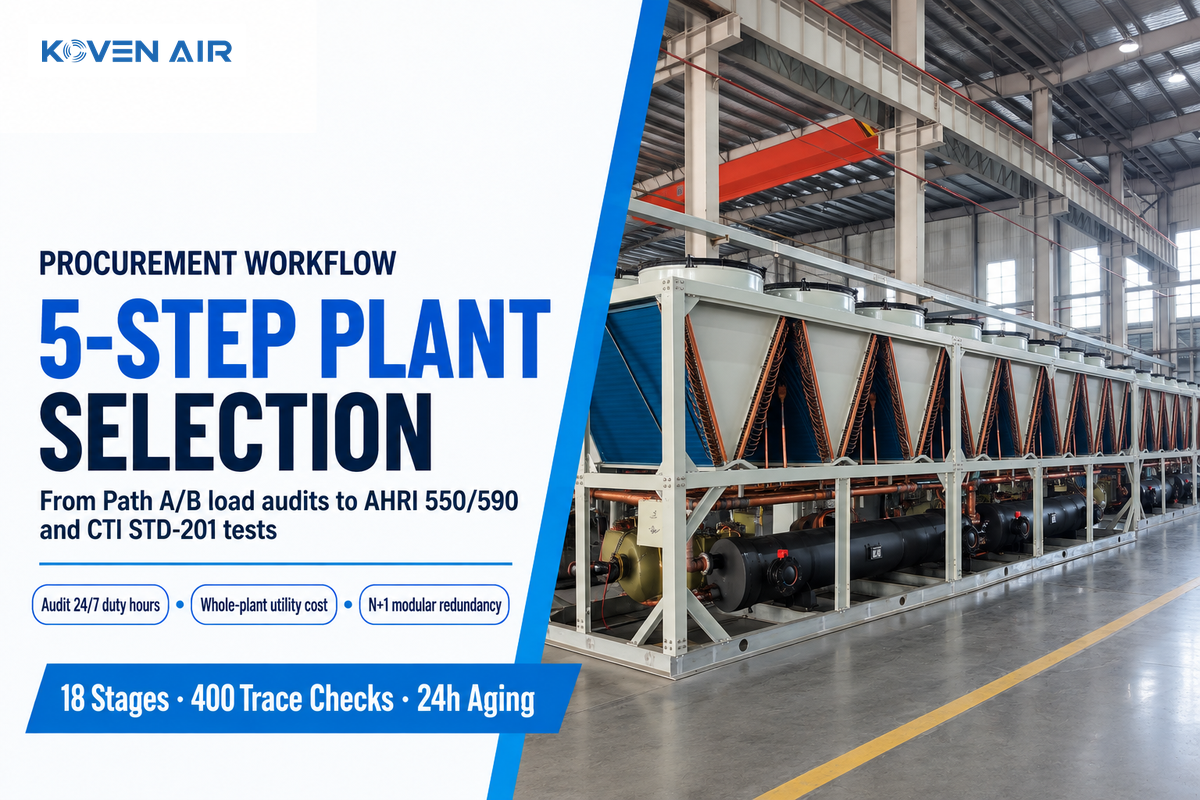
The 5-Step Cooling Plant Selection Method analyzes cooling load hours, ambient wet-bulb depression, whole-plant utility costs, N+1 flow redundancy, and pre-shipment witness testing before issuing vendor RFQs. One repeatable engineering filter guarantees effective cooling quotes, eliminates missing pump and tower scopes and locks witness testing.
- Audit cooling load profile and duty hours to separate continuous 24/7 data center or process loads from single-shift factory lines using Path A (full-load) or Path B (part-load) tables.
- Compare site wet-bulb depression to dry-bulb peaks to determine if an open cooling tower or closed-circuit cooler performs better than an air-cooled unit.
- Add together the chiller compressor kW, condenser pumps, cooling tower fans, and the cost of five-year makeup water.
- Size N+1 redundancy using modular skids (such as KAFM 20–40 RT blocks) or twin-compressor chillers while holding 40%–50% tower minimum flow.
- Require AHRI 550/590 chiller curves (and directory certification if specified) plus CTI STD-201 tower 49-point tables before shipment. Inside a 20,000 m² plant, Koven Air industrial chillers pass 18 process stages, 400 traceability checks, and a 24-hour aging test.
Copy the procurement table below into your engineering specification when selecting a cooling tower or chiller package:
RFQ checklist — copy these into your quote request:
| Parameter | Recommended range | Why it matters | How to verify |
|---|---|---|---|
| Design cooling capacity & duty | State kW/TR plus full-load vs part-load hours | Locks ASHRAE 90.1 Path A or Path B optimization | AHRI 550/590 full-load and IPLV submittal |
| Fluid temperatures & flows | Specify CHW ΔT (2.4 GPM/ton) & 95/85/75 °F tower point | Prevents 12,000 vs 15,000 BTU/h tower undersizing | Published 49-point CTI STD-201RS disclosure table |
| Low-GWP refrigerant compliance | GWP < 700 (R-1234ze(E), R-1234yf, R-513A, R32) | Meets 2025–2027 U.S. EPA AIM Act transition dates | Order model code verification & SDS check |
| Tower minimum flow & filtration | 40%–50% turndown minimum + automated conductivity | Prevents fill scaling and protects condenser tubes | Condenser pump staging & VFD control narrative |
| Plant redundancy & footprint | N+1 modules or multi-circuit compressors + service clearance | Avoids total downtime when one compressor trips | Dimensional GA drawing & rigging weight sheet |
| Pre-shipment witness testing | Full-load & part-load test + 24-hour aging run | Confirms realized COP before site crane rigging | Signed factory test report & serial trace log |
Low-GWP Refrigerant Codes (2025–2027) and Plant Efficiency Regulations
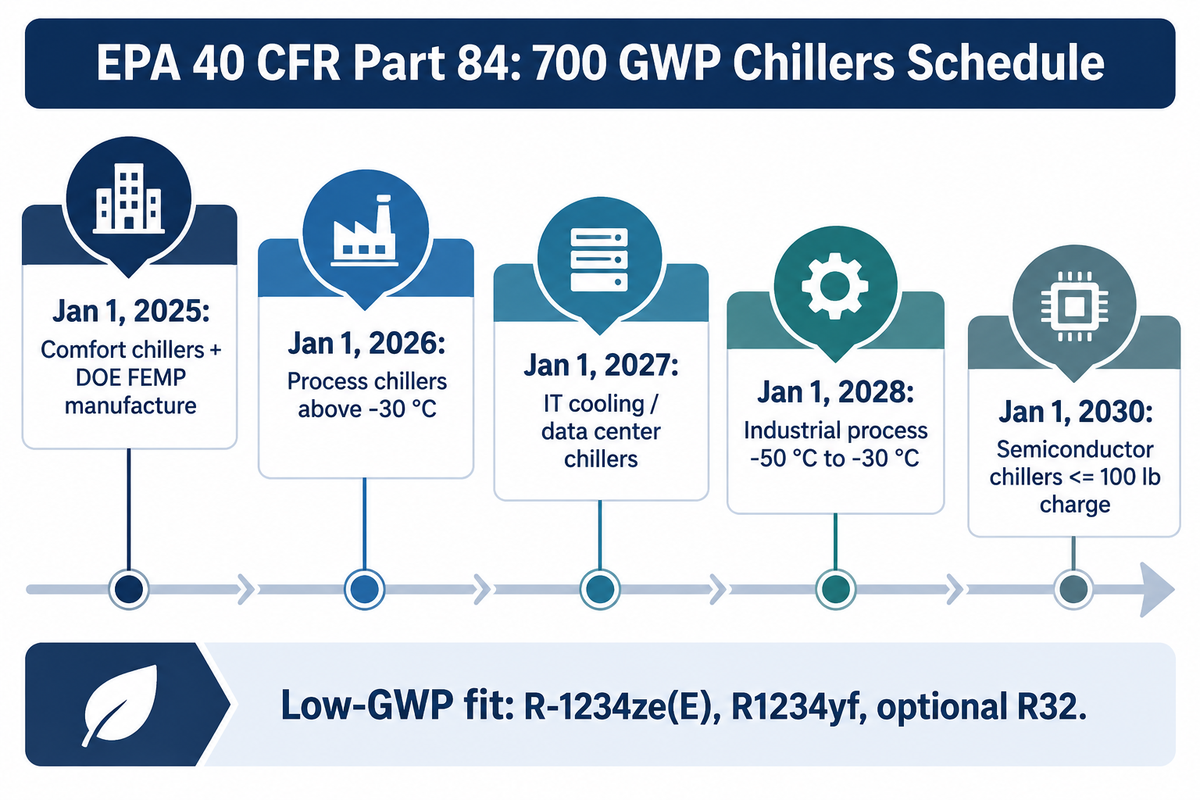
U.S. EPA AIM Act rules under 40 CFR Part 84 enforce a 700 GWP refrigerant ceiling across staggered deadlines: January 1, 2025 for comfort chillers, January 1, 2026 for industrial process chillers above -30 °C, and January 1, 2027 for IT cooling. Legacy R-410A or R-134a purchases now risk stranded parts inventory.
Under the 2023 rulemaking reported by DOE FEMP, self-contained high-GWP chillers cannot be manufactured after January 1, 2025, and those high-GWP chiller systems may not be installed after December 31, 2025. Under the EPA Technology Transitions HFC rule (40 CFR Part 84, Subpart B), industrial process chillers with exiting fluid from -50 °C to -30 °C transition on January 1, 2028, and semiconductor manufacturing chillers with a charge size of 100 lb or less transition on January 1, 2030. Systems below -50 °C continue to be exempt and spare components for existing chillers continue to be exempt. Separately, 10 CFR Part 431 Subpart F covers commercial efficiency compliance, while 10 CFR 429.43 federal efficiency compliance details certification disclosures including water flow, static pressure, and variable speed controls for covered commercial package air-conditioning equipment.
Lock low-GWP options before finalizing concrete pads or electrical gear on 2026–2027 projects. Koven Air builds low-GWP industrial chillers offering R-1234ze(E) (GWP 1) on magnetic-bearing KALXCWG models, R1234yf (GWP < 1) on KAFZ chillers, and optional R32 modular units (confirmed by order code and jurisdiction). Because A2L mild-flammability blends require room gas sensors and relief piping indoors, verify plant ventilation ratings early. Matching low-GWP refrigerant designs across modular skids will ensure parts continuity through regional service hubs.
Frequently Asked Questions: Chiller vs. Cooling Tower
Can a cooling tower replace a chiller for process cooling?
A cooling tower can’t replace a chiller when process targets fall below outdoor wet-bulb plus 5 to 10 °F. Open towers use water evaporation and can’t hold 42 to 45 °F supply temperatures during warm, humid summer months. Keep mechanical chillers for low setpoints, using towers alone only for cool winter economizer hours.
Why does a water-cooled chiller still need a cooling tower?
Rather than route extracted process heat and heat from the electrical compressor motor to outdoor finned coils, water-cooled chillers discharge both to a closed condenser water circuit. Without a cooling tower, spray pond, or ground loop continuously rejecting roughly 15,000 BTU/h per ton outdoors, condenser loop temperatures spike rapidly and trip high-pressure safety cutouts.
What is the difference between an air-cooled and water-cooled chiller plant?
Air-cooled chillers (7.5 to 500 tons per Trane; 10.890 to 10.964 EER for full-load-optimized DOE FEMP criteria) use outdoor finned coils and axial fans and completely omit towers. Water-cooled chillers (10 to 4,000 tons per Trane) use outdoor cooling towers to reject heat at lower wet-bulb temperatures. Trane Commercial HVAC reports 20 to 30 year indoor service lives for water-cooled models versus 15 to 20 years for air-cooled models.
How much water does a 200-ton cooling tower evaporate and drain?
At a flow rate of 600 GPM and a temperature range of 10 °F, a 200-ton cooling tower evaporates 5.10 GPM. Four cycles of concentration require a blowdown of 1.70 GPM, making a baseline makeup rate of 6.80 GPM, excluding negligible drift-eliminator mist.
Are water-cooled chillers always cheaper to operate than air-cooled units?
No, water-cooled chillers do not always win total annual operating costs for every facility. While DOE FEMP indicates water-cooled chillers save electricity in continuous duty cycles, Trane notes that cooler nighttime dry-bulb temperatures shrink the compressor gap. When local water and sewer rates increase, chemical programs hold towers at two to four cycles, or plants run short single-shift schedules, tower water costs can outweigh the savings in electricity.
What refrigerant deadlines apply to new industrial chillers in 2025–2027?
EPA 40 CFR Part 84 enforces a 700 GWP ceiling starting at the 2025 comfort-chiller cutoff date. Industrial process chillers above -30 °C followed on January 1, 2026, and data center chillers transition on January 1, 2027.
How can an existing facility cut cooling tower blowdown without risking scale?
Install an automated conductivity controller to pair with flow meters on makeup and blowdown lines. Moving from three to six cycles of concentration cuts makeup water by 20% and blowdown by 50% under DOE FEMP BMP #10.
Can an air-cooled chiller be converted into a water-cooled cooling tower system later?
Field conversion from an air-cooled chiller to a cooling tower plant isn’t practical. Air-cooled packages lack shell-and-tube water condensers, indoor compressor protection, and condenser flow headers, requiring full plant replacement instead of a retrofit.
References & Sources
- Best Management Practice #10: Cooling Tower Management U.S. Department of Energy, Federal Energy Management Program (FEMP)
- Purchasing Energy-Efficient Electric Chillers U.S. Department of Energy, Federal Energy Management Program (FEMP)
- CTI Standard 201: Certifying Thermal Performance of Heat Rejection Equipment Chiller & Cooling Best Practices Magazine
- Understanding Chilled Water Plant Performance Consulting-Specifying Engineer
- Optimization and Control of Variable-Flow Chiller Plants MDPI Buildings (Peer-Reviewed Journal, 2025)
- Technology Transitions HFC Restrictions by Sector (40 CFR Part 84) U.S. Environmental Protection Agency (EPA)
- 10 CFR 429.43 Commercial HVAC Certification & Test Procedures Electronic Code of Federal Regulations (U.S. Government)
Factory Selection Support
Turn this guide into a usable HVAC RFQ package.
Share design conditions, airflow, temperature, humidity, process load, room use, and scope boundary. Koven Air can recommend a practical equipment route before quotation.
7equipment families
ISO / GMPcleanroom review
RFQscope comparison
What to prepare before quote
- Use settingCommercial building, cleanroom, hospital, data center, process area, or retrofit.
- Operating conditionsAirflow, load, temperature, humidity, static pressure, and duty hours.
- ConstraintsFootprint, access, hygiene class, material, controls, documentation, and delivery boundary.
Final equipment selection depends on local codes, project drawings, and confirmed site conditions.