Get in Touch with Koven Air Company

Heat Pumps vs Boilers in Commercial Hydronic Heating: Supply Temperature, Break-Even COP, and Retrofit Sizing

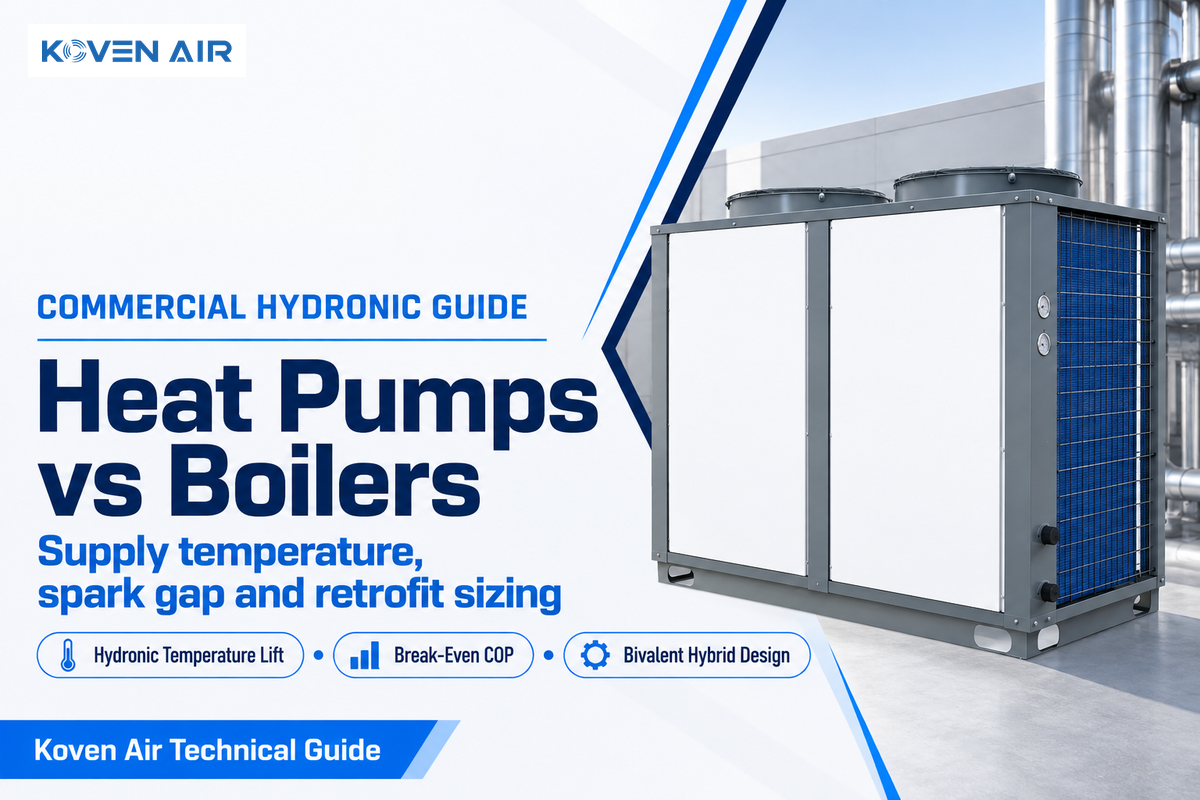
Legacy commercial non-condensing boilers supply 70°C to 82°C (158°F to 180°F) hot water with return temperatures above 60°C (140°F), whereas standard commercial air-to-water heat pumps supply 35°C to 55°C (95°F to 131°F) hot water—or 55°C to 75°C in two-stage cascade configurations—under commercial hydronic electrification frameworks outlined by the U.S. Department of Energy (DOE) Better Buildings initiative and Koven commercial equipment schedules. When facility engineers evaluate heat pumps vs boilers for a commercial hydronic heating system, treating a boiler replacement as a simple kilowatt-for-kilowatt swap without auditing terminal heating coils, utility demand charges, and sub-zero ambient derating is the single most common cause of winter comfort complaints and blown capital budgets.
This guide provides mechanical engineers, MEP consultants, and plant procurement teams with a verifiable engineering framework for comparing boilers and heat pumps across thermodynamic lift regimes, spark-gap break-even COP math, logarithmic mean temperature difference (LMTD) coil derating, enhanced-vapor-injection (EVI) sub-zero capacity retention, bivalent hybrid plant sizing, and 10-year total cost of ownership.
Heat Pumps vs Boilers: How Supply Water Temperature and Thermal Lift Separate the Two Systems
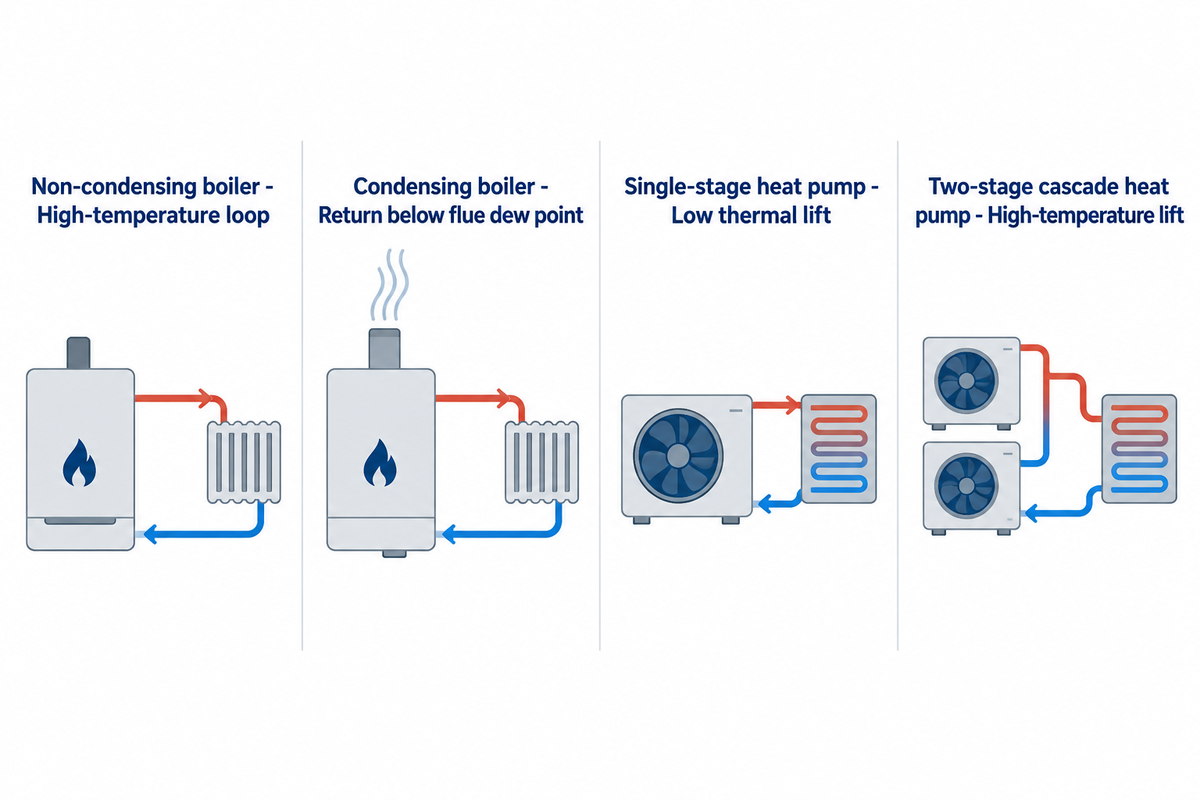
Standard commercial air-to-water heat pumps supply 35°C to 55°C hot water (while two-stage cascade units reach 55°C to 75°C) compared against 70°C to 82°C for legacy commercial boilers, according to U.S. DOE hydronic electrification benchmarks and Koven commercial equipment schedules for space heating loops.
In a fuel-fired boiler, flame temperatures exceed 1,000°C, meaning the burner can heat water to 82°C almost as easily as to 45°C. A traditional non-condensing gas boiler is typically operated with return water above the ~54°C to 57°C (130°F to 135°F) natural gas flue-gas water-vapor dew point so that flue-gas moisture does not condense on non-condensing cast-iron or carbon-steel heat exchangers. By contrast, heat pumps work by moving thermal energy up a pressure and temperature gradient via a vapor-compression cycle. Every degree of additional temperature lift between the outdoor evaporator source and the indoor hydronic condenser increases compressor discharge pressure and shaft power. When a facility upgrades its central plant with commercial heat pump systems, matching the machine architecture to the building’s required supply water temperature determines whether the plant achieves a seasonal COP above 3.5 or trips on high-discharge-pressure protection.
| System Architecture | Supply Water Temp (°C / °F) | Nominal Heating Efficiency / COP | Commercial Capacity Range | Primary Hydronic Application & Limitations |
|---|---|---|---|---|
| Non-Condensing Gas or Oil Boiler | 70–82°C (158–180°F) | Nominal 78%–84% thermal efficiency (0.78–0.84 COP equivalent) | 150–5,000+ kW | Legacy 2-row AHU coils and cast-iron radiators; requires >60°C return water to avoid flue-gas acid corrosion. |
| Condensing Natural Gas Boiler | 40–70°C (104–158°F) | Nominal 85%–87% on >60°C return; 92%–96% on <50°C return | 100–3,500 kW | Condenses latent flue heat only when return water stays below the ~54°C dew point via outdoor reset. |
| Electric Resistance Hydronic Boiler | 40–85°C (104–185°F) | Nominal 98%–99% electric resistance efficiency (0.98–0.99 COP) | 50–2,500 kW | Low capital cost and compact footprint, but 3.0× to 4.0× higher kWh demand and operating cost than heat pumps. |
| Biomass Pellet / Wood-Chip Boiler | 75–85°C (167–185°F) | Nominal 80%–88% combustion efficiency (0.80–0.88 COP equivalent) | 150–4,000 kW | Requires fuel silos, ash conveyors, particulate baghouses, and multi-hour thermal ramp-up with 25%–100% modulation. |
| Standard Air-to-Water Screw / Modular Heat Pump (e.g., Koven KAFLG / KAFMH) | 35–55°C (95–131°F) | Nominal COP 3.31–4.43 at +7°C ambient / 45°C LWT | 65–2,872 kW | 4-row to 8-row hydronic AHUs, fan coil units, and underfloor heating systems in mild to moderate climates. |
| Cold-Climate EVI Scroll Heat Pump (e.g., Koven KADFM) | 35–55°C (95–131°F) | Nominal COP 3.20–3.80 at +7°C; ~50%–63% capacity retained at -15°C | 70–180 kW per module | Sub-zero operation down to -25°C (-30°C field-proven) without relying on electric resistance boilers. |
| Water-to-Water Twin-Screw Heat Pump (e.g., Koven KASCMF) | 40–55°C (104–131°F) | Rated cooling COP 6.1–6.4; 4-season field heating COP 5.0–5.1 | 384–1,913 kW | Geothermal borefields, open-loop groundwater, or industrial cooling-water heat recovery loops. |
| High-Temperature Cascade Air-to-Water Heat Pump (e.g., Koven KAIA) | 55–75°C (131–167°F) | Nominal COP 2.25–2.85 at 65–75°C LWT | 90–720 kW | Direct boiler replacement where legacy perimeter radiators or process wash tanks cannot operate below 65°C. |
Buyers comparing heat pump and combustion plants encounter regional residential appliance terminology in both commercial and residential discussions. In commercial mechanical rooms, however, modular air-cooled scroll banks (such as the Koven KAFMH series from 238 kW to 475 kW per frame) and semi-hermetic twin-screw units (Koven KAFLG series from 246 kW to 2,872 kW) extract heat from the air and transfer that heat energy into a closed-loop chilled/hot water header to heat water for multi-story zones.
What are the key differences between a biomass boiler and a heat pump?
A biomass boiler burns wood pellets or chips to generate 75°C to 85°C hot water at a nominal 80% to 88% combustion efficiency, requiring fuel storage silos, ash removal conveyors, flue-gas particulate filtration, seasonal stack inspections, and multi-hour thermal ramp-up times across a nominal 25% to 100% burner modulation band. By contrast, a commercial air source heat pump or ground source heat pump uses electricity to move ambient or ground thermal energy at a nominal 300% to 510% efficiency (COP 3.0 to 5.1) with zero on-site combustion emissions, no fuel delivery logistics, and automated BMS compressor staging.
Condensing Gas Boiler vs Air Source Heat Pump Efficiency: Spark Gap and Break-Even COP
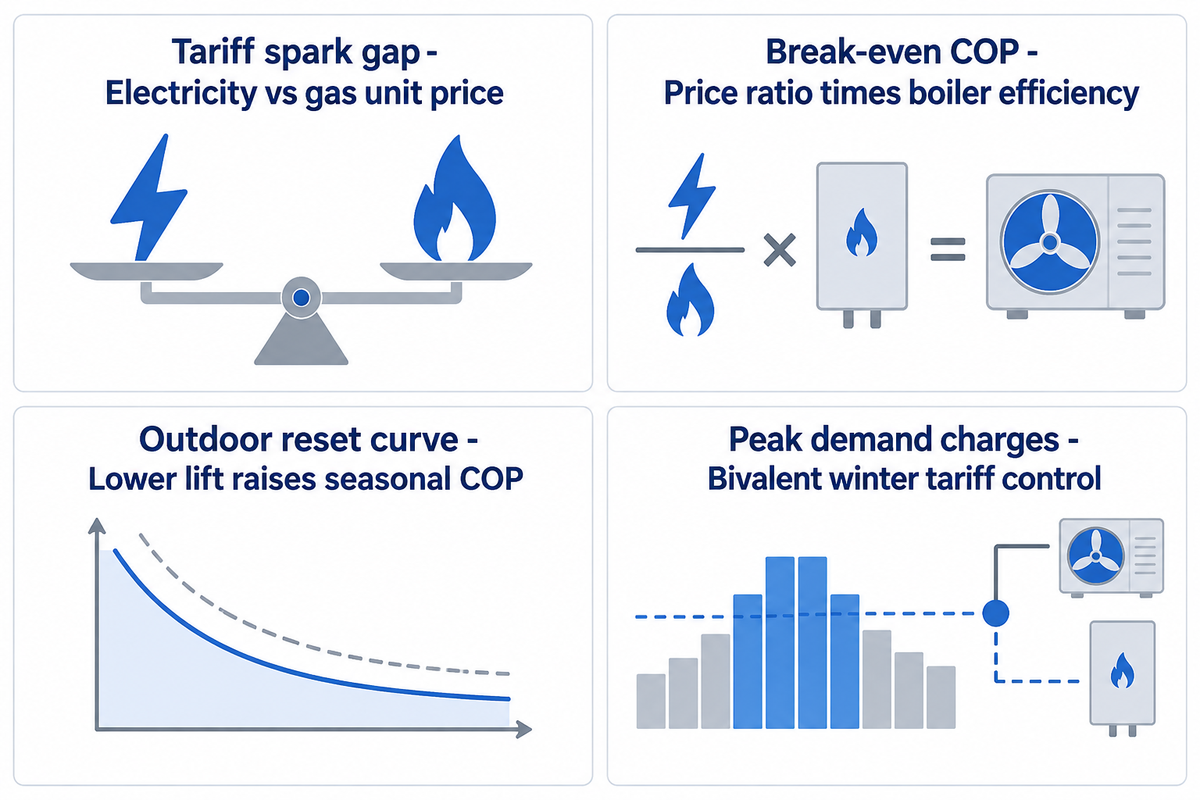
A break-even COP analysis between an electric heat pump and a natural gas boiler shows a range of 2.70 to 3.60 when commercial electricity-to-gas price ratios are between 3.0 and 4.0, given a nominal 90% seasonal gas boiler, and using the break-even equation (COP = price ratio × boiler efficiency).
Because commercial electricity typically costs two to four times more than an equivalent kilowatt-hour of natural gas, higher thermal energy efficiency reduces running costs only when the heat pump’s seasonal COP clears the local tariff “spark gap.” To evaluate a heat pump vs gas boiler on volumetric energy rates (converted to identical $/kWh thermal units, where 1 therm = 29.307 kWh), facility engineers use the volumetric break-even COP formula:
COP_break_even = (P_electricity_per_kWh / P_gas_per_kWh) × η_boiler_seasonal
Boiler return water temperature and peak demand charges effect break-even COP, as discussed in empirical commercial boiler substitution studies and University of Illinois heating load analyses:
- In the condensing boiler return-water trap vs outdoor reset, a condensing gas boiler achieves an 86% to 98% rated thermal efficiency range (with vendor Emerson Swan’s efficiency curve cited in the University of Illinois SEDAC Boilers Tech Note rising into the 90% to 95% condensing band) only when return water enters the heat exchanger below the ~130°F (54.4°C) flue-gas water-vapor dew point. If an engineer installs an efficient boiler on an unmodified 82°C/71°C constant-temperature loop, the flue gas never condenses and seasonal efficiency drops to roughly 84%–87%. Conversely, when outdoor-air reset lowers return water below 50°C during mild weather—which accounts for roughly 85% to 90% of heating-season hours below 80% peak load—a condensing gas boiler achieves 90% to 94% part-load efficiency.
- When looking at volumetric spark gap vs monthly peak demand charges, as covered in the U.S. DOE Federal Energy Management Program (FEMP) utility rate guide, commercial electric tariffs split bills into volumetric energy charges ($/kWh) and monthly peak demand charges ($/kW or $/kVA, often with 11-month ratchet clauses). If an all-electric plant drops to a COP of 1.8 during a -18°C cold snap or energizes resistance backup heaters, a single 15-minute winter demand spike can add thousands of dollars in annual demand charges.
| Tariff Scenario (Nominal Electricity / Gas Price per kWh) | Spark Ratio (P_elec / P_gas) | Break-Even COP vs Nominal 86% Boiler (80°C Loop) | Break-Even COP vs Nominal 92% Boiler (Reset Loop) | Koven KAFLG / KAFM Air-Source (SCOP 3.45) Estimated Cost vs 92% Gas | Koven KASCMF Water-Source (Field COP 5.05) Estimated Cost vs 92% Gas |
|---|---|---|---|---|---|
| Low Spark Spread (nominal $0.11 / $0.044 per kWh) | 2.50 : 1 | 2.15 | 2.30 | Estimated $31,884 vs $47,826 (~33.3% savings in our analysis) | Estimated $21,782 vs $47,826 (~54.5% savings in our analysis) |
| Moderate Spark Spread (nominal $0.154 / $0.044 per kWh) | 3.50 : 1 | 3.01 | 3.22 | Estimated $44,638 vs $47,826 (~6.7% savings in our analysis) | Estimated $30,495 vs $47,826 (~36.2% savings in our analysis) |
| High Spark Spread (nominal $0.198 / $0.044 per kWh) | 4.50 : 1 | 3.87 | 4.14 | Estimated $57,391 vs $47,826 (~20.0% higher; use bivalent) | Estimated $39,208 vs $47,826 (~18.0% savings in our analysis) |
As Table 2 shows, compared to heat pumps operating on ambient air at a 3.45 seasonal COP, volatile commercial gas prices and electricity rates dictate whether mono-valent electrification or bivalent gas peaking wins. According to Koven project data, Koven KASCMF twin-screw water-to-water heat pumps (384–1,913 kW heating across 20 models) achieve rated cooling COP 6.1–6.4 and field-measured heating COP 5.0–5.1 over 4 heating seasons in a 26-unit groundwater central plant, cutting annual heating energy cost by 44.9% (~$80,000/year) compared to a boiler by delivering 3.5 to 5.1 units of heat for every unit of electrical input. Engineers specifying screw and modular air-to-water heat pumps should run this three-point tariff table before locking the control sequence.
Which is cheaper to run, gas boiler or air source heat pump?
At a 2.5:1 electricity-to-gas price ratio, a commercial air-to-water heat pump with a 3.45 seasonal COP cuts volumetric heating energy costs by roughly 33% versus a nominal 92% condensing gas boiler. It is cheaper to run when seasonal COP exceeds the local electricity-to-gas price ratio multiplied by boiler seasonal efficiency and winter electrical peak demand charges are controlled; ratios above 3.8:1 require water-source heat pumps or bivalent gas peaking to avoid higher utility bills.
Hydronic Emitter and AHU Heating Coil Derating When Dropping from 80°C Boiler Loops to 45°C–55°C
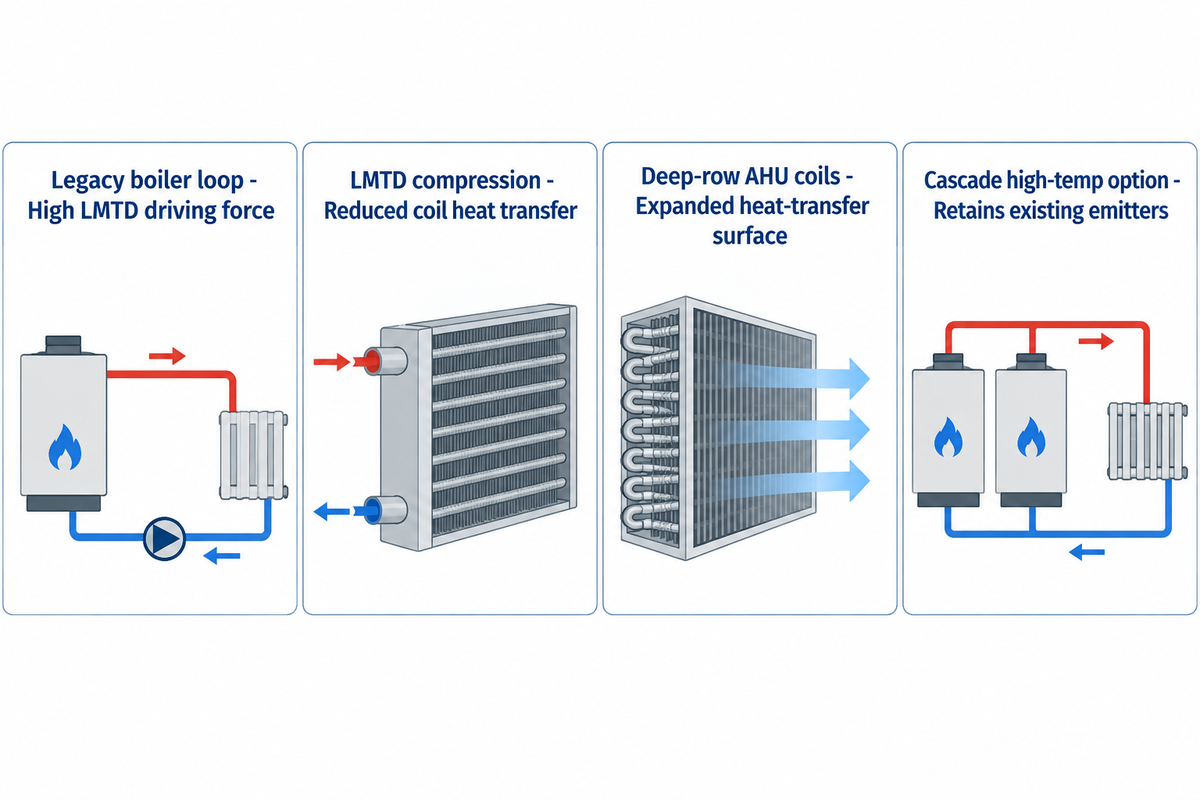
Dropping hydronic supply water temperature from 70°C–82°C down to 55°C reduces the thermal output of existing commercial heating coils by 21% to 29% (and by 40% to 55% at 45°C supply), according to ASHRAE hydronic coil heat-transfer scaling principles and Koven KAW-JT air handling unit coil schedules at 20°C entering air.
Each hydronic emitter, be it a perimeter finned-tube radiator, ceiling unit heater, or central air handling unit (AHU) coil, transfers heat in direct proportion to its surface area (A), overall heat-transfer coefficient (U), and logarithmic mean temperature difference (LMTD) between the water loop and the room or supply air stream:
Q_coil = U × A × LMTD
When a facility connected to an existing gas network retires a 75°C/60°C boiler (LMTD ≈ 41.5 K against 20°C entering air lifted to 32°C) and connects a 50°C/43°C heat pump (LMTD ≈ 20.3 K), the driving temperature differential falls by half. In addition, because heat pumps prefer a 5 K to 7 K water temperature drop (ΔT) rather than the 11 K to 20 K drop of a traditional boiler, the distribution pumps must circulate 1.5 to 2.2 times more water mass flow per kilowatt of delivered heat output.
| Existing Terminal / Emitter Type | Original Boiler Design (75°C/60°C) | Nominal Capacity Retained at 55°C/48°C LWT | Nominal Capacity Retained at 45°C/40°C LWT | Recommended Engineering Remediation Path |
|---|---|---|---|---|
| 2-Row Central AHU Heating Coil | Nominal 100% rated kW | ~68%–74% | ~45%–52% | Replace AHU coil section or upgrade to 6-row and 8-row commercial hydronic air handling units (Koven KAW-JT, 1,500–200,000 m³/h). |
| 4-Row Hydronic AHU / Make-Up Air Coil | Nominal 100% rated kW | ~75%–79% | ~55%–62% | Add 2–4 coil rows in spare cabinet section or boost winter peak LWT via bivalent boiler / cascade heat pump. |
| Cast-Iron / Finned-Tube Perimeter Radiators | Nominal 100% rated kW | ~62%–71% | ~38%–46% | Supply 55°C–75°C hot water via Koven KAIA cascade heat pump, or replace with fan-assisted hydronic fan coil units. |
| Radiant Floor Slabs & Low-Temp Panels | 35–45°C mixed loop | Nominal 100% (exceeds requirement) | Nominal 100% rated kW | Ideal direct match for standard air-to-water and water-to-water heat pumps at maximum COP (3.8–5.1). |
This physics explains why underfloor heating systems and deep-row fan coils are the most efficient way to heat a building with a heat pump. Matching Koven KAFLG screw (246–2,872 kW, R134a/R407C/R1234ze), KAFMH/KAFM modular scroll (65–892 kW, R410A/R32), or KAIA cascade (55°C–75°C) heat pumps with 6-row or 8-row KAW-JT hydronic air handling units (1,500–200,000 m³/h) resolves low-temperature coil LMTD derating under single-manufacturer responsibility as a turnkey heating solution with a nominal ≤ 1% cabinet leakage rate.
Cold-Climate Capacity Derating, Defrost Penalties, and EVI vs Water-Source Performance Below -15°C
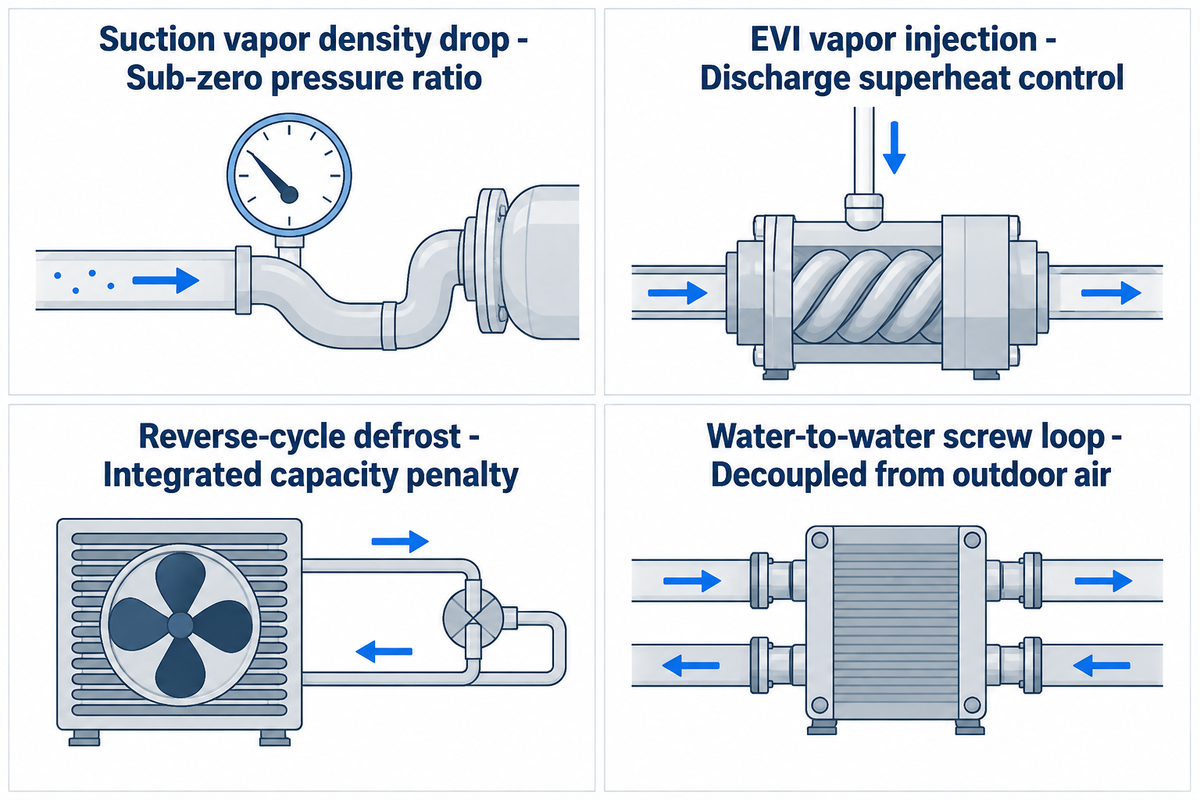
Koven KADFM EVI cold-climate air-to-water heat pump modules (70–180 kW @ 7°C) retain 50%–63% of nominal heating capacity at -15°C (44–90 kW) and 42%–53% at -25°C (37.0–75.0 kW), with catalog rating to -25°C and field-proven operation to -30°C according to Koven KADFM engineering datasheets.
When the outside air gets colder and the air becomes drier, the vapor pressure of suction refrigerant falls and the pressure ratio required to heat water to 50°C rises. Standard non-EVI commercial (air-source heat pumps) units, with their discharge temperatures above safe oil breakdown temperatures (about -10°C to -12°C) when attempting to produce 50°C to 55°C water, are forced to derate, leaving water temperature too low, or lockout, just when heat loss demand peaks. Units engineered for sub-zero conditions, such as Koven’s EVI cold-climate air-to-water heat pumps (KADFM series, 70 kW to 180 kW per module), use an economizer plate heat exchanger to sparge medium pressure refrigerant vapor into the scroll compression chamber. With the heat exchanger, discharge superheat is controlled and mass flow is increased for extreme pressure ratios.
| Model Number | Nominal Heating @ +7°C DB (kW) | Heating Capacity @ -7°C DB (kW) | Heating Capacity @ -15°C DB (kW / Nominal % Retained) | Heating Capacity @ -25°C DB (kW / Nominal % Retained) | Rated Power Input @ +7°C (kW) |
|---|---|---|---|---|---|
KADFM080C |
70.0 kW | 52.0 kW | 44.0 kW (nominal ~62.9%) | 37.0 kW (nominal ~52.9%) | 21.5 kW |
KADFM100C |
90.0 kW | 65.0 kW | 57.0 kW (nominal ~63.3%) | 47.5 kW (nominal ~52.8%) | 27.5 kW |
KADFM120C |
110.0 kW | 78.0 kW | 66.0 kW (nominal ~60.0%) | 55.0 kW (nominal ~50.0%) | 33.2 kW |
KADFM140C |
130.0 kW | 91.0 kW | 75.4 kW (nominal ~58.0%) | 62.4 kW (nominal ~48.0%) | 39.1 kW |
KADFM160C |
145.0 kW | 100.0 kW | 81.2 kW (nominal ~56.0%) | 66.7 kW (nominal ~46.0%) | 43.6 kW |
KADFM180C |
165.0 kW | 108.0 kW | 82.5 kW (nominal ~50.0%) | 69.6 kW (nominal ~42.2%) | 49.3 kW |
KADFM200C |
172.0 kW | 115.0 kW | 88.0 kW (nominal ~51.2%) | 73.0 kW (nominal ~42.4%) | 51.8 kW |
KADFM220C |
180.0 kW | 120.0 kW | 90.0 kW (nominal ~50.0%) | 75.0 kW (nominal ~41.7%) | 55.0 kW |
In addition to vapor-density derating, any air-source heat pump evaporator operating between +3°C and -7°C outdoor dry-bulb at high relative humidity forms frost on its finned coils. Reverse-cycle defrosting (which briefly switches the 4-way valve to pull heat from the indoor hydronic loop to melt ice on the outdoor coil) imposes an estimated 8%-12% integrated capacity and COP penalty during sleet and freezing-fog hours. In areas where geological or industrial water sources exist, specifying ground-source heat pumps (Koven KASCMF series, 384 kW to 1,913 kW) or twin-screw water-to-water units decouples the plant from outdoor air, providing a stable ground source heat loop, with a COP of 5.0 to 5.1 at -30°C outdoor ambient. Defrost cycles are eliminated. Reversible cascade high-temperature heat pump systems, as described in Patent Literature such as US20230288112A1, use two stages of refrigerant to temper the hydronic heating water to remove the need for defrost cycles.
What is the downside of a heat pump?
The primary engineering downsides of a commercial heat pump compared to a boiler are higher upfront turnkey capital cost ($1,280 to $2,700 per kW vs $60 to $140 per kW for a boiler swap), lower standard supply temperatures (35°C to 55°C vs 80°C), and a nominal 37% to 58% air-source capacity drop at -25°C ambient.
Bivalent Hybrid Heat Pump and Peaking Boiler Architecture: Sizing the Balance Point and Switchover
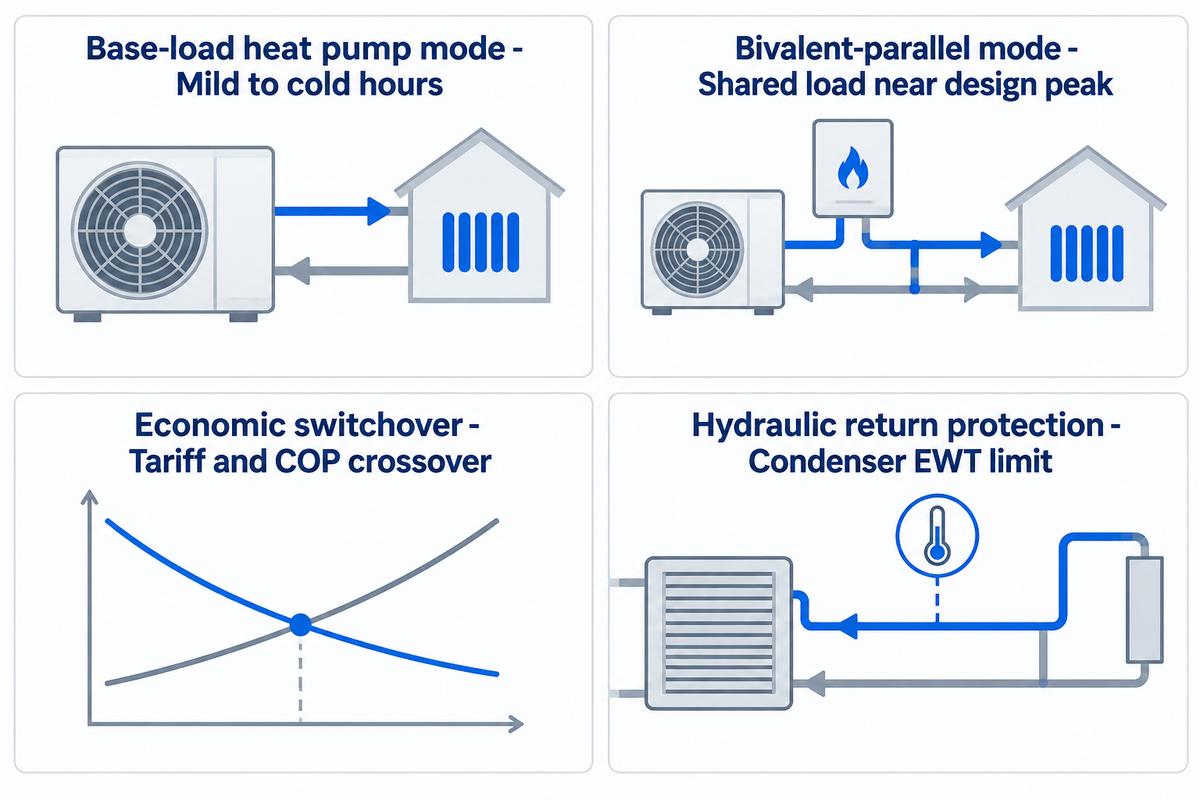
Dual-fuel hydronic heat pump and boiler systems offset 70% to 80% of the annual heating load when pairing an air-to-water heat pump supplying roughly 140°F (60°C) water with a gas boiler at a switchover temperature around 30°F ± 10°F (-1°C), according to a 2025 HPAC Engineering dual-fuel decarbonization analysis.
In temperate commercial building profiles where low-temperature coils allow a 45°C–50°C supply loop and a bivalent heat pump plant is sized for 50% to 60% of peak winter design load under CIBSE AM17:2022 principles, the electric heat pump array covers roughly 80% to 92% of annual space-heating energy. Because nominal 99.6% ASHRAE winter design temperatures occur during fewer than 35 to 80 hours per year, sizing a mono-valent air-source plant for the full coldest-hour peak forces the owner to buy twice as many heat pump modules and upgrade the building’s medium-voltage utility transformer for capacity that sits idle roughly 98% of the year. When comparing heat pumps against full boiler rip-outs or evaluating boilers vs heat pumps in existing buildings, our 4-Regime Hydronic Electrification Matrix maps facility boundary conditions to the right plant architecture:
| Electrification Regime | Existing Loop Temp & Terminal Profile | Nominal 99.6% Winter Design Ambient | Electrical Service & Space Headroom | Optimal Plant Architecture & Sizing Rule |
|---|---|---|---|---|
| Regime 1: Mono-Valent Standard AWHP | 35–50°C (6/8-row AHUs, FCUs, radiant slabs) | Above -7°C (+19°F) | Adequate kVA capacity | Nominal 100% load via Koven KAFLG screw (246–2,872 kW) or KAFMH modular scroll (238–475 kW). |
| Regime 2: Mono-Valent Cold-Climate EVI or WSHP | 40–55°C (upgraded coils or medium-temp loops) | -7°C to -25°C (+19°F to -13°F) | Adequate kVA + roof/yard space or water loop | Nominal 100% load sized on derated -20°C/-25°C kW using Koven KADFM EVI scroll or KASCMF water-to-water screw. |
| Regime 3: High-Temp Cascade Mono-Valent | 60–75°C (legacy perimeter radiators / process water) | Down to -20°C (-4°F) | Adequate kVA; no indoor coil access | Koven KAIA two-stage cascade heat pump (55–75°C LWT) replacing fossil or electric boiler loops. |
| Regime 4: Bivalent Hybrid (AWHP + Peaking Boiler) | 55–80°C at peak; <50°C on outdoor reset in mild weather | Below -10°C (+14°F) or high electric demand tariff | Transformer constrained (<60% spare kVA) | Size heat pumps for ~50%–60% peak load at 0°C balance point; retain gas/oil boiler for extreme cold & tariff peaks. |
Critical Hydraulic Protection Rule for Bivalent Plants: Never pipe the return header of an 80°C peaking boiler directly into the condenser inlet of a standard air-to-water heat pump. Most commercial R410A, R32, and R454B heat pump condensers have a maximum entering water temperature (EWT) limit of 55°C to 60°C. In a bivalent plant combining heat pumps and gas boilers, the heat pump array must be piped in a decoupled primary-secondary loop upstream of the boiler injection bridge, with an automated 3-way mixing bypass valve that isolates the heat pump condenser whenever loop return water exceeds 52°C.
Simultaneous Heating and Cooling Loads: Where 4-Pipe Heat Pump Chillers Eliminate Boiler Firing
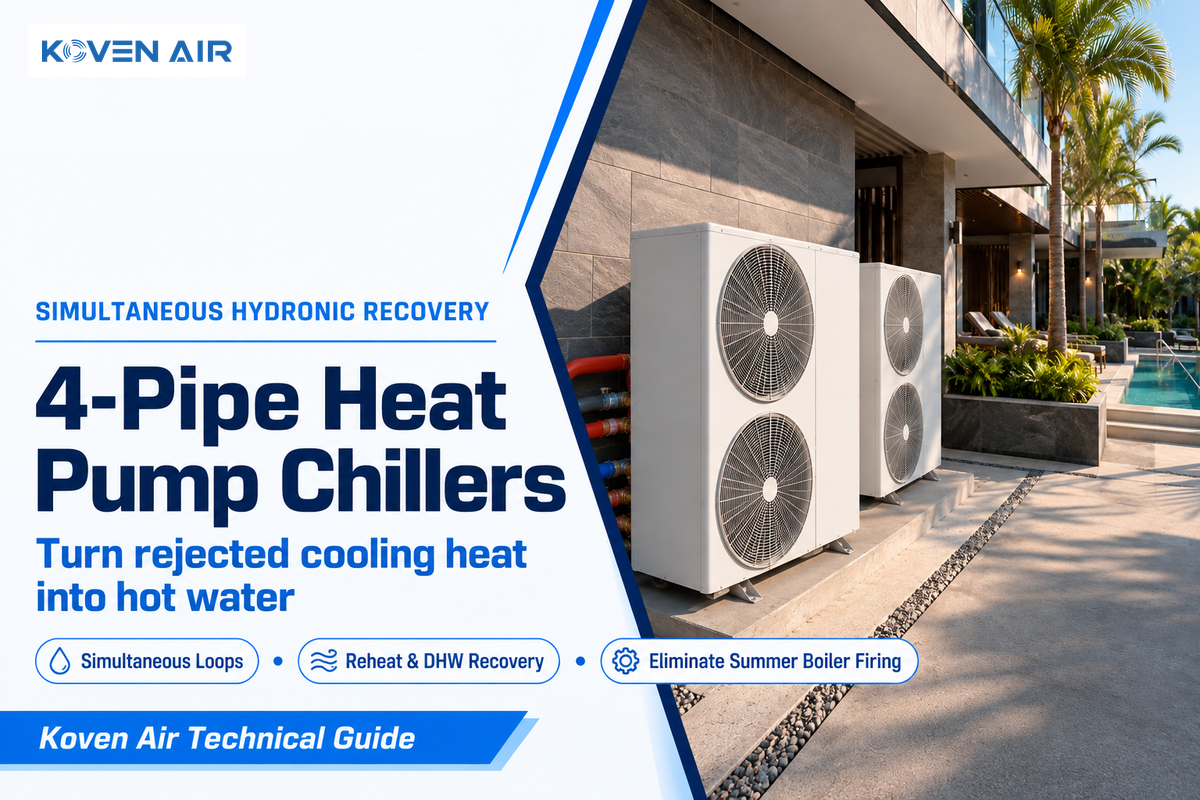
Koven KASG 4-pipe simultaneous heating and cooling heat pump chillers provide hot water at 35°C to 55°C and chilled water at 7°C or 12°C simultaneously, with a combined ICOP of 7.74 design / 7.82 field measured (200 – 1,500 RT) and 8.9 design / 8.5 field measured (60 – 80 RT/module) on screw and modular scroll units respectively, according to Koven KASG catalog and field test data.
In hospitals, pharmaceutical cleanrooms, hotels, and large glass-curtainwall office buildings, the building cooling plant frequently rejects heat to cooling towers at the exact same hour the boiler room burns natural gas or runs electric heat for dehumidification reheat, perimeter zone heating, or domestic hot water. Framing the heat pump vs boiler decision as a heating-only comparison misses this thermodynamic recovery opportunity. Installing 4-pipe simultaneous heating and cooling heat pump chillers integrates independent cooling, heating, and heat-recovery heat exchangers inside one refrigerant circuit:
- Under the service boundary definition, the combined ICOP = (Q_cooling + Q_heating) / P_input = 7.74 to 8.90 applies specifically during hours when chilled-water and hot-water demands overlap. For every 100 kW of compressor electricity consumed to produce 350 kW of 7°C chilled water, the unit recovers up to 450 kW of 45°C–50°C hot water into the heating main instead of rejecting it outdoors.
- For clean heat without redundant equipment, during shoulder seasons and the summer, when dehumidification and reheat represent 2,500 to 4,500 operating hours per year in healthcare and hospitality facilities, a 4-pipe heat pump system can provide up to 100% free boiler displacement. While residential guides talk about using an electric heat pump to heat your home with clean heat , commercial 4-pipe heat recovery chillers pay back fastest because one machine replaces both a chiller and a base-load boiler. Commercial 4-pipe heat recovery chillers achieve the best payback in the hospitality and healthcare sectors because one machine replaces both a chiller and a base-load boiler.
Commercial Boiler-to-Heat-Pump Retrofit Cost Breakdown: Buffer Tanks, Coils, and Electrical Service
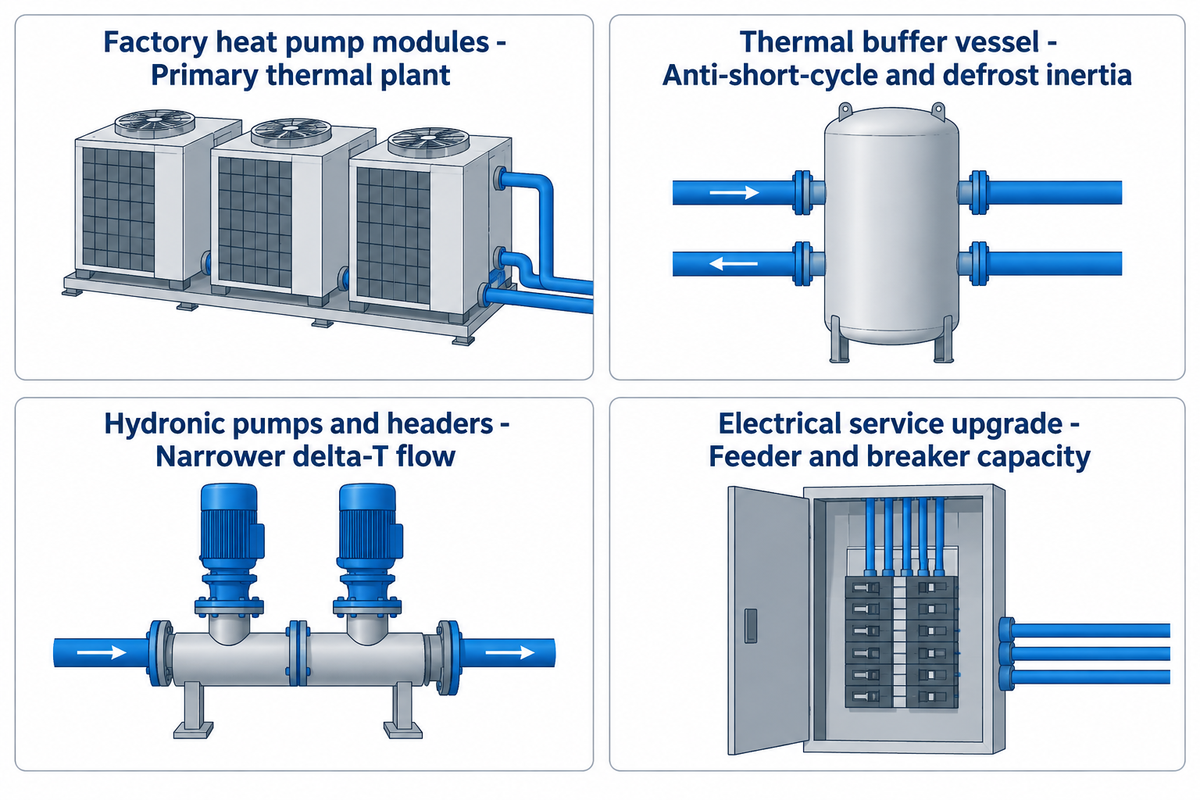
Turnkey commercial air-to-water heat pump retrofits cost $4,500 to $9,500 per ton ($1,280 to $2,700 per kW of thermal capacity) compared to $1,800 to $3,800 per ton ($510 to $1,080 per kW) for heat pump equipment alone and $60 to $140 per kW for a like-for-like boiler swap, according to ACEEE and NREL commercial building electrification cost studies.
Comprehending why the turnkey upfront cost of a heat pump retrofit exceeds a simple new boiler requires breaking out factory equipment costs from balance-of-plant mechanical and electrical costs.
| Cost Component / Scope Line Item | Option A: Like-for-Like Condensing Gas Boiler Swap (500 kW) | Option B: Bivalent Hybrid (280 kW AWHP + Existing/Peaking Boiler) | Option C: 100% Mono-Valent Cold-Climate EVI AWHP Retrofit (500 kW @ -15°C) |
|---|---|---|---|
| Primary Heating Equipment (Estimated FOB / Delivered) | Estimated ~$38,000 (~$76/kW) | Estimated ~$145,000 (Modular AWHP bank) | Estimated ~$295,000 (Sized for sub-zero derating) |
| Thermal Buffer Tank, Glycol & Primary-Secondary Piping | Estimated ~$12,000 (Tie into existing header) | Estimated ~$48,000 (5,000 L buffer + mixing bridge) | Estimated ~$82,000 (10,000 L buffer + larger mains) |
| Roof Structural Dunnage & Crane Rigging | Estimated ~$4,000 (Indoor mechanical room) | Estimated ~$32,000 | Estimated ~$68,000 |
| Terminal AHU Coil / FCU Emitter Upgrades | ~$0 (Reuses 80°C coils) | Estimated ~$35,000 (Critical zone coils only) | Estimated ~$140,000 (6/8-row AHU coil upgrades) |
| Electrical Switchgear, Feeders & Transformer Upgrade | Estimated ~$3,000 (Existing 120V/208V circuit) | Estimated ~$28,000 (Uses spare panel capacity) | Estimated ~$165,000 (New utility transformer + feeders) |
| Total Turnkey Installation Costs (Estimated CAPEX) | Estimated ~$57,000 (~$114/kW) | Estimated ~$288,000 (~$576/kW plant) | Estimated ~$750,000 (~$1,500/kW turnkey) |
| 10-Year Cumulative Energy + Demand + Maintenance Cost | Estimated ~$518,000 (Gas + carbon fee exposure) | Estimated ~$342,000 (~85% MWh electric @ COP 3.6) | Estimated ~$389,000 (Includes winter kVA demand peaks) |
| 10-Year Total Cost of Ownership (Estimated CAPEX + OPEX) | Estimated ~$575,000 | Estimated ~$630,000 (Lowest-cost ~85% decarbonization) | Estimated ~$1,139,000 |
Budgeting for heat pump installation vs. gas boiler installation requires mechanical engineers to dimension the hydronic thermal buffer tank to stop compressor short cycling during spring/autumn low-load conditions. It also requires dimensioning the buffer tank to stop supply water temperature droop during winter reverse-cycle defrost. While Residential designs discuss installing a heat pump or the general costs of heat pumps alongside a standard boiler installation, commercial hydronic designs require a buffer vessel calculated by the closed form thermal storage equation.
V_liters = (Q_min_kW × t_min_minutes × 60) / (4.186 × ΔT_allowable_K)
Worked Buffer Tank Calculation (300 kW Koven KAFMH Modular Plant): Suppose a 300 kW modular air-to-water plant consists of four 75 kW modules, where each module has two scroll compressors (minimum single-stage unloading step Q_min = 37.5 kW), requires a minimum compressor run time of t_min = 10 minutes, and permits a maximum loop temperature swing of ΔT = 3.0 K during defrost:
- Minimum anti-short cycle volume V = (37.5 × 10 × 60) / (4.186 × 3.0) = 22,500 / 12.558 = 1,792 liters.
- To provide sub-zero defrost protection across the entire 300 kW array (15 to 20 L/kW of active loop volume), specifying a 4,500 to 6,000 liter insulated hydraulic buffer tank would allow installing heat pumps to continue to provide a simultaneous defrost of two modules, while ensuring AHU supply air temperature is never allowed to fall below the room setpoint in cold climates.
Are heat pumps more expensive than a furnace?
Yes, in upfront capital expenditure: a commercial air-to-water hydronic plant or packaged rooftop heat pump costs roughly 2.0 to 3.5 times more to purchase and install than an equivalent gas furnace or unitary gas-fired duct heater. This is due to the inclusion of vapor-compression scroll or screw compressors, outdoor finned-tube heat exchangers, reverse-cycle defrost controls, condensate drainage, and upsized three-phase electrical feeders. Over a 15-year operating lifecycle in moderate electricity-tariff markets, however, commercial heat pumps recover that capital premium by delivering 3.0 to 4.4 kWh of thermal energy per kWh of electrical input compared to 0.80 to 0.92 for gas-fired furnaces, especially when paired with bivalent peak shaving or utility electrification rebates. In comparison, gas-fired furnaces produce 0.80 to 0.92 kWh of thermal energy per kWh of gas input. Additionally, heat pumps can benefit from bivalent peak shaving or utility electrification rebates, further improving their economics.
Specifying Matched Heat Pumps, Chillers, and Low-Temperature Airside Terminals for Retrofit Bids
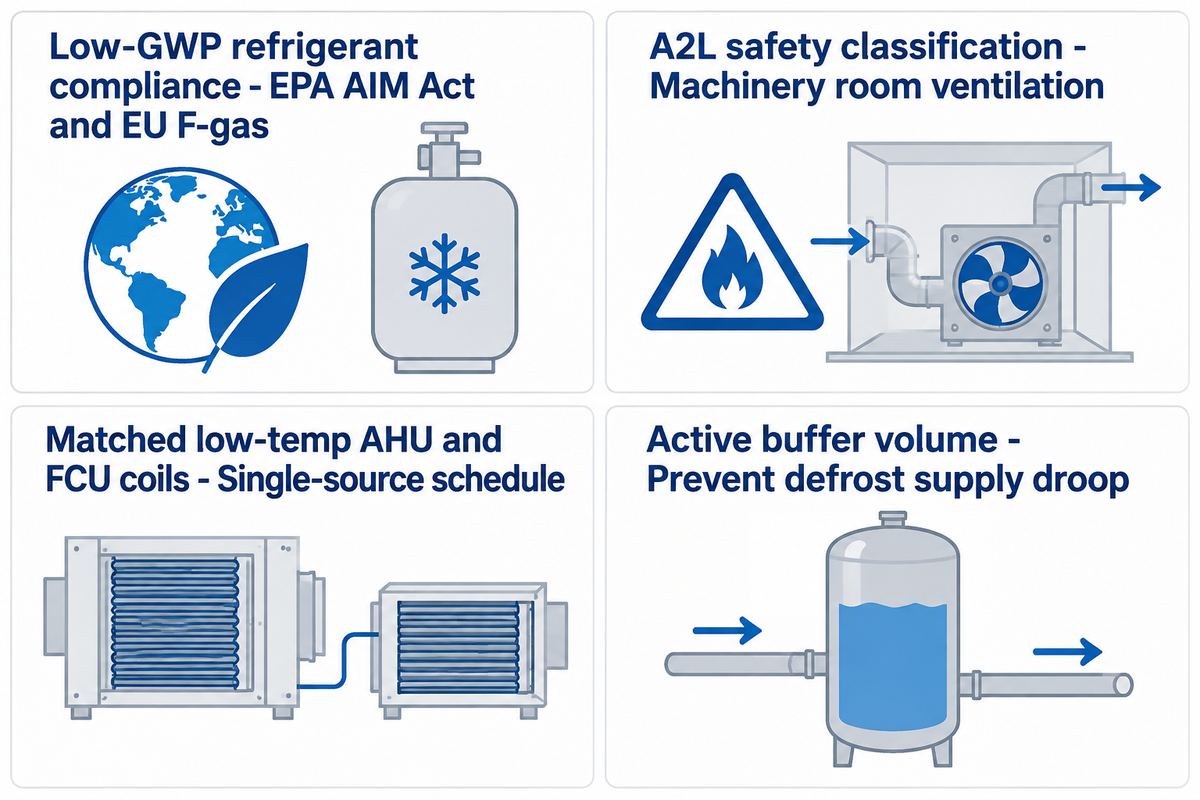
Under the U.S. EPA AIM Act Technology Transitions rule (40 CFR 84.54), new comfort cooling and heating chillers and residential and light commercial heat pump systems are subject to a 700 Global Warming Potential (GWP) limit starting January 1, 2025, while variable refrigerant flow (VRF) systems and specified industrial process refrigeration chillers follow on January 1, 2026.
In parallel, the EU F-gas Regulation (EU) 2024/573 and municipal building emissions laws, such as New York City Local Law 97, are driving the phase-down of high-GWP HFCs and high-emitting heating plants. As such, the specification of R410A (GWP 2,088) and R134a (GWP 1,430) is being replaced with lower-GWP refrigerants like R32 (GWP 675), R454B (GWP 466), and ultra-low-GWP HFO R1234ze (GWP < 7) in commercial hydronic systems. The European Energy Performance of Buildings Directive (EPBD) and the UK/EU municipal gas boiler ban goals for new construction and the uncertainty regarding the commercial availability of green hydrogen for hydrogen-ready boilers have prompted businesses to adopt innovations in heat pump technology rather than combustion burner swaps in their 2026-2035 capital planning. No matter which legacy boiler type a facility is retiring, heat pumps generally – and commercial air-to-water heat pumps are generally – are the most at risk of commissioning failures when one manufacturer of the outdoor heat pump bank and an unrelated vendor of the indoor air handling units and fan coils, are in the scope of the project.
| Manufacturer | Air-to-Water & Cold-Climate Heat Pumps | Water-to-Water & 4-Pipe Simultaneous Chillers | High-Temp Cascade (55–75°C) | Factory-Matched 6/8-Row AHUs & Hydronic FCUs |
|---|---|---|---|---|
| Trane Technologies | Ascend / Thermafit air-to-water multipipe & modular | Series R helical-rotary & 4-pipe multipipe units | Air-to-Water Cascade system (up to 65–70°C) | ClimateChanger AHUs & UniTrane fan coils |
| Carrier | AquaForce / AquaSnap 30RQ & 30RQM modular AWHP | 30XW water-to-water screw & heat recovery chillers | 61WG / high-temperature industrial series | 39M Aero AHUs & 42-series hydronic fan coils |
| Daikin Applied | Magnitude / Trailblazer air-to-water heat pumps | Pathfinder / EWWD water-to-water & 4-pipe units | High-temp hydronic modules (select markets) | Vision / Skyline modular AHUs & fan coil terminals |
| Koven (Koven Air Environment Technology) | KAFLG screw (246–2,872 kW), KAFMH/KAFM modular (65–892 kW), KADFM EVI (-25°C/-30°C, 70–180 kW) | KASCMF twin-screw WSHP (384–1,913 kW, COP 5.0–5.1) & KASG 4-pipe simultaneous (60–1,500 RT, ICOP 7.74–8.90) | KAIA two-stage cascade (55–75°C LWT) | KAW-JT commercial AHUs (1,500–200,000 m³/h, 4/6/8-row coils) & low-temperature hydronic fan coil units |
To prevent split-vendor coil mismatch during winter defrost and sub-zero operation, attach the following 7-Point Hydronic Plant Transition Checklist to your commercial retrofit RFQ:
7-Point Hydronic Plant Transition Checklist for MEP & Procurement Teams
- Required a three-point sub-zero capacity and COP schedule showing certified net heating kW and input kW (defrost energy deduction integrated) at +7°C DB / 45°C LWT, -7°C DB / 50°C LWT and site’s nominal 99.6% ASHRAE winter design dry-bulb temperature at maximum required LWT.
- Mandate a low-LMTD airside coil psychrometric match to show that the specified 6-row or 8-row AHU coils (e.g., Koven KAW-JT) or hydronic fan coils, when connected to the water loop, will deliver the design supply air temperature at a 45°C/39°C or 50°C/44°C water regime (ΔT = 5 to 7 K).
- Set minimum active water volume and buffer sizing to 15-25 L/kW and confirm that the thermal buffer tank prevents >3.0 K supply-water droop during defrost.
- Include bivalent hydraulic over-temperature protection in your design when retaining peaking boilers by installing a primary-secondary hydraulic separator and automated 3-way mixing protection to ensure that water above 55°C – 60°C does not enter the heat pump condenser.
- Perform a simultaneous load audit (4-pipe screening) to approximate the number of annual overlapping cooling/dehumidification and hot water hours; if concurrent loads exceed 1,000 hours/year, a 4-pipe simultaneous chiller/heater (e.g., Koven KASG, ICOP 7.74-8.90) should be evaluated.
- Select sub-700 GWP refrigerants and ASHRAE 15 safety controls (R32 at 675 GWP, R454B at 466 GWP, or R1234ze below 7 GWP under the 700 GWP EPA AIM Act threshold) with factory-mounted A2L leak detection and shutoff valves under ASHRAE 15 and UL 60335-2-40.
- Size electric MCA/MOCP feeders and demand limit BACnet integration for Maximum Circuit Ampacity (MCA), compressor VFD soft start inrush limits, and native BACnet IP or Modbus RTU points for utility peak demand shedding for bivalent backup.
Engineering Scope Note: While commercial air-to-water, water-to-water, and 55°C–75°C cascade heat pumps cover the vast majority of space heating, domestic hot water, and low-temperature industrial wash applications, industrial facilities requiring high-pressure process steam above 100°C–150°C still require steam boilers or specialized mechanical vapor recompression (MVR) steam heat pumps. Reviewed by the Koven Air Environment Technology Co., Ltd. commercial hydronic engineering team.
Frequently Asked Questions
1. Are heat pumps cheaper to run than gas boilers in commercial buildings?
A heat pump with a coefficient of performance greater than 2.82 is projected to lower annual energy costs when compared to an 88 percent efficient gas boiler, with commercial electricity costing 3.2 times the price of natural gas, per unit, over a given year. Usually it is cost effective to use a heat pump when the local electricity to gas price ratio multiplied by the seasonal thermal efficiency of the boiler is less than the seasonal coefficient of performance.
2. Can an air-to-water heat pump use existing commercial boiler piping and radiators?
Existing steel or copper distribution mains can usually remain in service if checks confirm that water velocity (kept below 1.5 to 2.5 meters per second) and primary-secondary hydraulic separation accommodate the larger mass flow rates, with a temperature drop of 5 to 7 Kelvin compared to an 11 to 20 Kelvin boiler loop. Legacy cast-iron radiators and two-row air handler coils sized for 80 degrees Celsius water lose roughly 25 to 50 percent of their thermal output at 45 to 55 degrees Celsius unless terminal coils are upgraded to 6-row or 8-row configurations or paired with a 55 to 75 degrees Celsius cascade unit.
3. How long do commercial heat pumps last compared to gas boilers?
According to ASHRAE equipment service life tables, commercial cast-iron and steel water boilers last 20 to 30 years with periodic tube and burner maintenance, whereas commercial air-to-water heat pumps last 15 to 20 years and water-to-water screw heat pumps last 20 to 25 years. Properly sized buffer tanks that prevent short-cycling can extend compressor life.
4. Do commercial heat pumps work below freezing without electric backup?
Yes. Commercial enhanced-vapor-injection scroll heat pumps can operate down to minus 25 degrees Celsius, retaining roughly 42 to 53 percent of their nominal capacity at 45 to 50 degrees Celsius supply water.
5. What is a bivalent hybrid heating system in a boiler retrofit?
A bivalent hybrid system integrates an air-to-water heat pump sized for roughly 50 to 60 percent of the peak design load with an existing gas boiler that fires only during peak sub-zero hours and/or periods of peak electrical demand, with the heat pump covering 80 to 92 percent of the annual heat load.
6. When is a boiler still required instead of a commercial heat pump?
An electric boiler (combustion) still remains necessary under specific conditions including: need for high-pressure process steam above 100 degrees Celsius, insufficient rooftop structural capacity to house air-source evaporator banks, or inability to upgrade the local electrical transformer to meet project timelines. In such facilities, 4-pipe heat recovery chillers or heat pumps in the range of 55-75 degrees Celsius often serve low-temperature air-handler units.
7. What technical data should a procurement team request when comparing heat pump and boiler retrofit bids?
Commercial heat pump and boiler retrofit bids are evaluated across three mandatory operating points (+7 degrees Celsius outdoor air at 45 degrees Celsius leaving water, minus 7 degrees Celsius outdoor air at 50 degrees Celsius leaving water, and the site’s nominal 99.6 percent winter design temperature), including an 8 to 12 percent integrated defrost capacity deduction in high-humidity freezing weather. On the airside loop, matched 6-row or 8-row air handling unit and fan coil psychrometric selections at a 5 to 7 Kelvin water temperature delta prevent winter supply-air droop, alongside a 15 to 25 liter per kilowatt thermal buffer volume, sub-700 global warming potential refrigerant compliance, and BACnet staging points for bivalent switchover.
References & Sources
- U.S. Department of Energy (DOE) Better Buildings Solution Center – Winter Heat Pump Reality Check & Hydronic Space Heating Electrification
- U.S. Environmental Protection Agency (EPA) — Frequent Questions on the Phasedown of Hydrofluorocarbons under the AIM Act (700 GWP Technology Transitions)
- U.S. Department of Energy Federal Energy Management Program (FEMP) – Evaluating Your Utility Rate Options: Demand Charges and Volumetric Tariffs.
- American Council for an Energy-Efficient Economy (ACEEE) – Progress Toward Electrification of Commercial Buildings (2024 Summer Study).
- University of Illinois Smart Energy Design Assistance Center (SEDAC) – Condensing Boilers Tech Note: Return Water Temperature and Part-Load Seasonal Efficiency.
- MDPI Energies Peer-Reviewed Study – Large Air-to-Water Heat Pumps for Fuel-Boiler Substitution in Existing Hydronic Systems.
- HPAC Engineering – Dual-Fuel Systems Offer Path to Commercial Building Decarbonization.
- U.S. Patent & Trademark Office / Google Patents – US20230288112A1: Modular Reversible Cascade High Temperature Heat Pump System.
Factory Selection Support
Turn this guide into a usable HVAC RFQ package.
Share design conditions, airflow, temperature, humidity, process load, room use, and scope boundary. Koven Air can recommend a practical equipment route before quotation.
7equipment families
ISO / GMPcleanroom review
RFQscope comparison
What to prepare before quote
- Use settingCommercial building, cleanroom, hospital, data center, process area, or retrofit.
- Operating conditionsAirflow, load, temperature, humidity, static pressure, and duty hours.
- ConstraintsFootprint, access, hygiene class, material, controls, documentation, and delivery boundary.
Final equipment selection depends on local codes, project drawings, and confirmed site conditions.