Get in Touch with Koven Air Company

Commercial Geothermal Systems: Ground-Loop Feasibility Before Equipment Selection

Commercial geothermal systems are viable when the site can accommodate a ground heat exchanger and the building’s year-round loads fit the ground loop and heat-pump temperature limits. Establish these facts prior to equipment selection. A project with adequate evidence can enter design; one with missing ground or load data needs investigation; one with an impractical field should compare other heating and cooling routes.
Geothermal heating and cooling systems use shallow ground-source geothermal technology to transfer heat between a building and the ground, and don’t use naturally hot resources to produce electricity. The U.S. Department of Energy geothermal heat-pump overview describes the ground’s heat-source and heat-sink role for the season. The potential of geothermal systems for commercial facilities depends on loads and buildable ground. Clean energy or renewable energy labels don’t substantiate energy efficiency or greenhouse gas emissions without a defined electricity and comparison boundary.
Start a geothermal feasibility study with site constraints
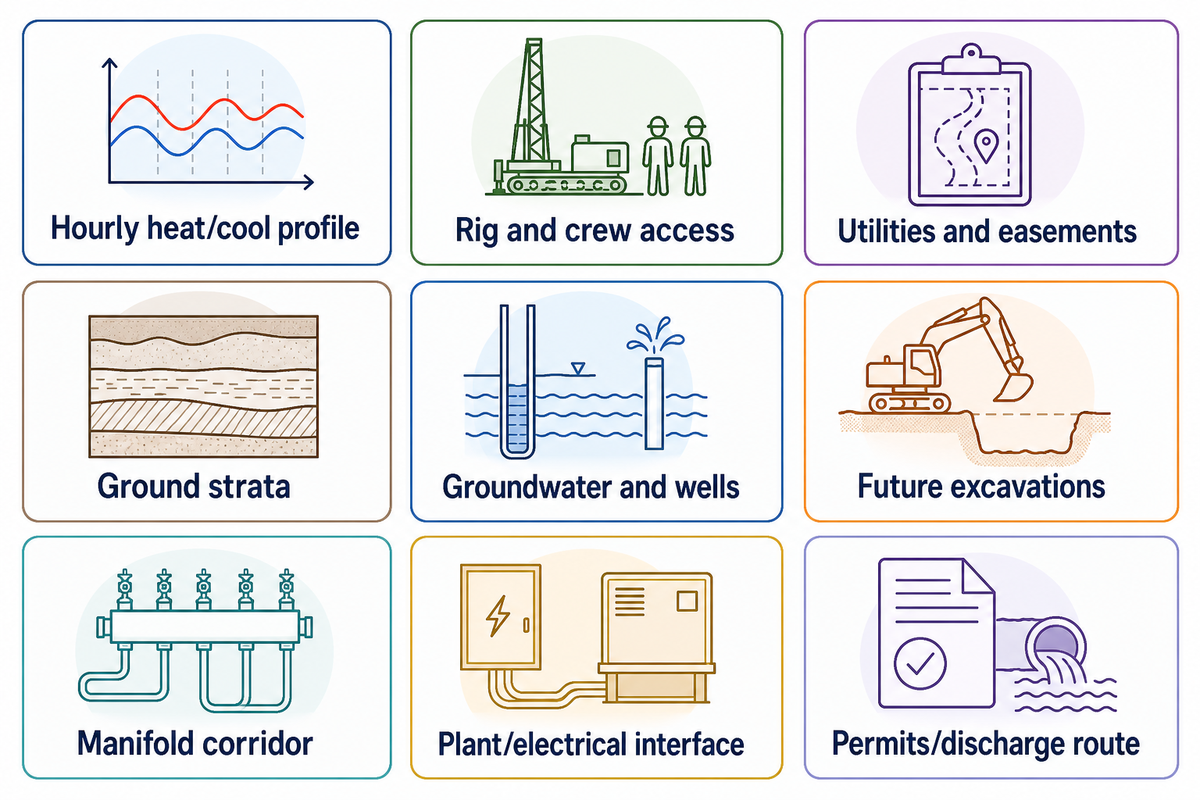
A commercial geothermal feasibility study should assess an available underground envelope to accommodate building loads, construction access and a route through local approvals. Available acreage by itself doesn’t ensure feasibility; buried utilities, future development, groundwater and neighboring systems can impact useable ground. Give the design team a site evidence package before an equipment order is placed.
What belongs in a commercial geothermal site assessment?
A site assessment should include a load history, accessible ground, subsurface and buried-service records, staging, ownership boundaries and an approval path. Name a decision maker for each. The Pacific Northwest National Laboratory Building America ground-source heat-pump guide relates soil and land conditions to heat-pump system choices.
At a constrained office, open ground may sit behind an occupied loading court. The owner provides access drawings, the civil team traces utilities and the ground designer assesses alternatives. If drilling can’t be staged, revise the scope or consider an alternative system. The map identifies each missing fact with an owner and action.
The feasibility of a geothermal system therefore turns on a buildable field, not a nominal parcel area. Installing geothermal systems before resolving access and future excavation can strand the proposed geothermal ground loop. Bore depth follows site investigation and system design; it cannot resolve an access or ownership conflict.
| Constraint | Evidence owner | Decision when unresolved or adverse |
|---|---|---|
| Hourly heating and cooling profile | Mechanical designer | Model source-side loads before selecting field size. |
| Drill-rig and crew access | Owner and civil contractor | Restage works or test another field location. |
| Buried utilities and easements | Owner and utility surveyor | Locate services; redraw usable borefield boundary. |
| Ground strata and constructability | Geotechnical and drilling team | Investigate methods and tender ground risk. |
| Groundwater movement and nearby wells | Hydrogeologist | Evaluate thermal interaction and review obligations. |
| Future buildings or excavations | Owner and master planner | Reserve access and avoid sterilizing future plots. |
| Manifold and pipe corridor | Ground and civil designers | Reconcile route, depth and maintainable isolation. |
| Plant-room and electrical interface | Mechanical and electrical designers | Check space, supply and pump duties before RFQ. |
| Permits and discharge route | Local permitting lead | Confirm applicable reviews before committing to a loop option. |
An Environment Agency 2024 modeling summary shows groundwater flow can impact the shape of a thermal plume. As a result, adjacent wells may become a review question, but don’t set a universal setback. A DOE Alaska campus case illustrates a heating-only ground solution, not a design default.
Choose a closed loop geothermal system or an open loop
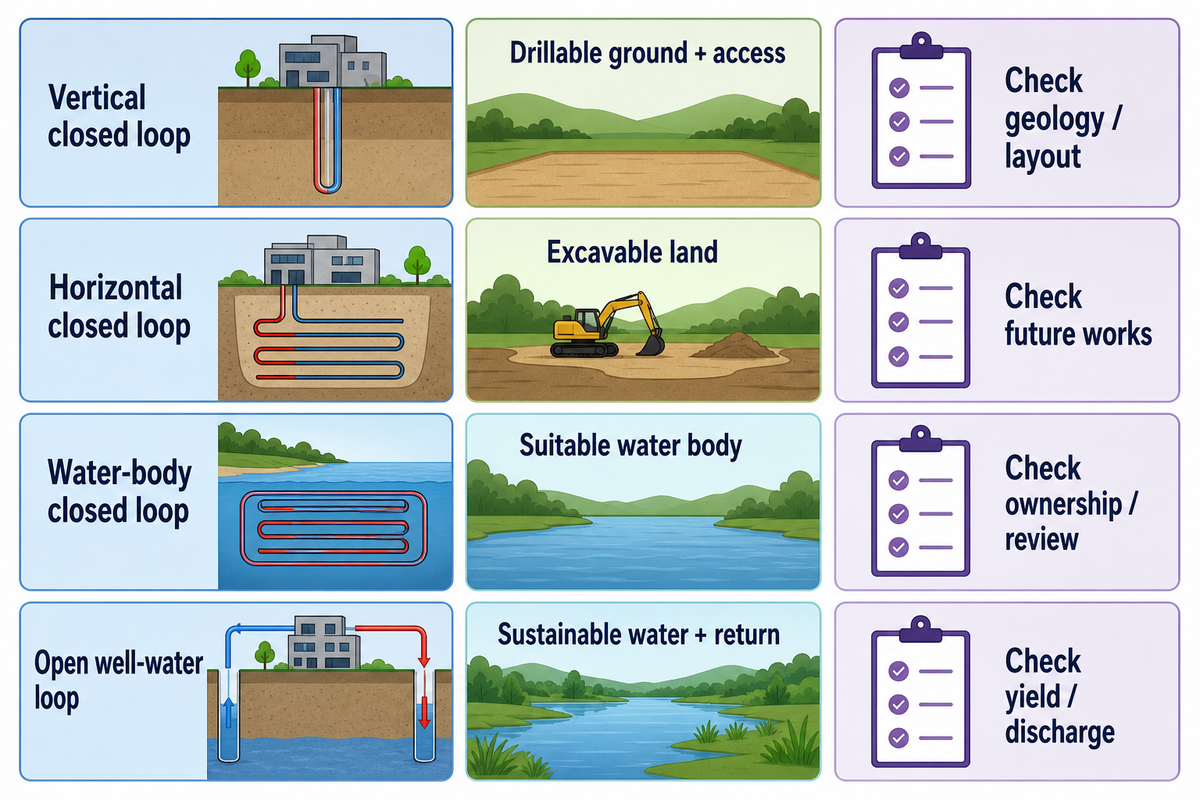
Constrained open and closed loop geothermal systems pose different challenges. A closed loop circulates its own fluid through a buried exchanger; an open loop moves groundwater through wells and associated treatment or isolation equipment. Compare the routes against land, subsurface conditions, dependable water supply and local water rules before asking suppliers for a common equipment schedule.
Vertical closed loops reduce surface footprint, but rig and manifold access remains an issue. Horizontal loops require excavatable land, and water-body loops require a body of water and permitting. Open-loop systems need dependable yield, acceptable water quality, pumping and managed return. A typical geothermal system connects the source side heat exchanger and heat-pump plant and building distribution, and the water-source variant may include wells and filters. The PNNL Building America guide identifies loop routes, and PNNL’s maintenance guide identifies service components for the loops.
| Route | Physical prerequisite | Decision-changing gap |
|---|---|---|
| Vertical closed loop | Drillable ground and plant access | Unresolved geology, rig access or borefield layout |
| Horizontal closed loop | Excavable land compatible with other uses | Land reserved for structures, utilities or future works |
| Water-body closed loop | Suitable water body and connection corridor | Unresolved ownership, water-body or environmental review |
| Open well-water loop | Sustainable water flow and managed return | Unknown yield, chemistry, pumping or discharge path |
A campus considering open wells should test the water case early. In Harvard Campus Services’ historical standing-column-well lessons, water quality issues such as brackish water and the presence of iron bacteria, as well as equipment and piping that weren’t appropriate for the water, were noted in a number of examples. These examples don’t dictate what materials will be approved for use or what permitting will allow today. They demonstrate why “available groundwater” isn’t yet a usable heat exchanger. Once a route passes this test, the hydraulic and thermal designers can define the test and what local review will be necessary.
Use commercial geothermal load analysis to check ground balance
Analysis of a geothermal commercial load separates building demand from heat exchanged with the ground. In a heating system the compressor puts energy into the heat being delivered; thus the ground extraction is less than the delivered output. In a cooling system the ground takes up the building heat being removed and the compressor input. Analyze peaks in kW and total energy in kWh for the year; neither of the two alone determines the size of a borefield.
During space heating, the loop fluid absorbs heat from the ground, and the system extracts heat from that fluid; the heat pump uses electricity to move heat from the ground to the building. This process moves thermal energy into distribution. During space cooling, the unit removes heat from the building; heat is transferred through the source circuit and sent back into the ground. The two processes of heat transfer have their own compressor terms.
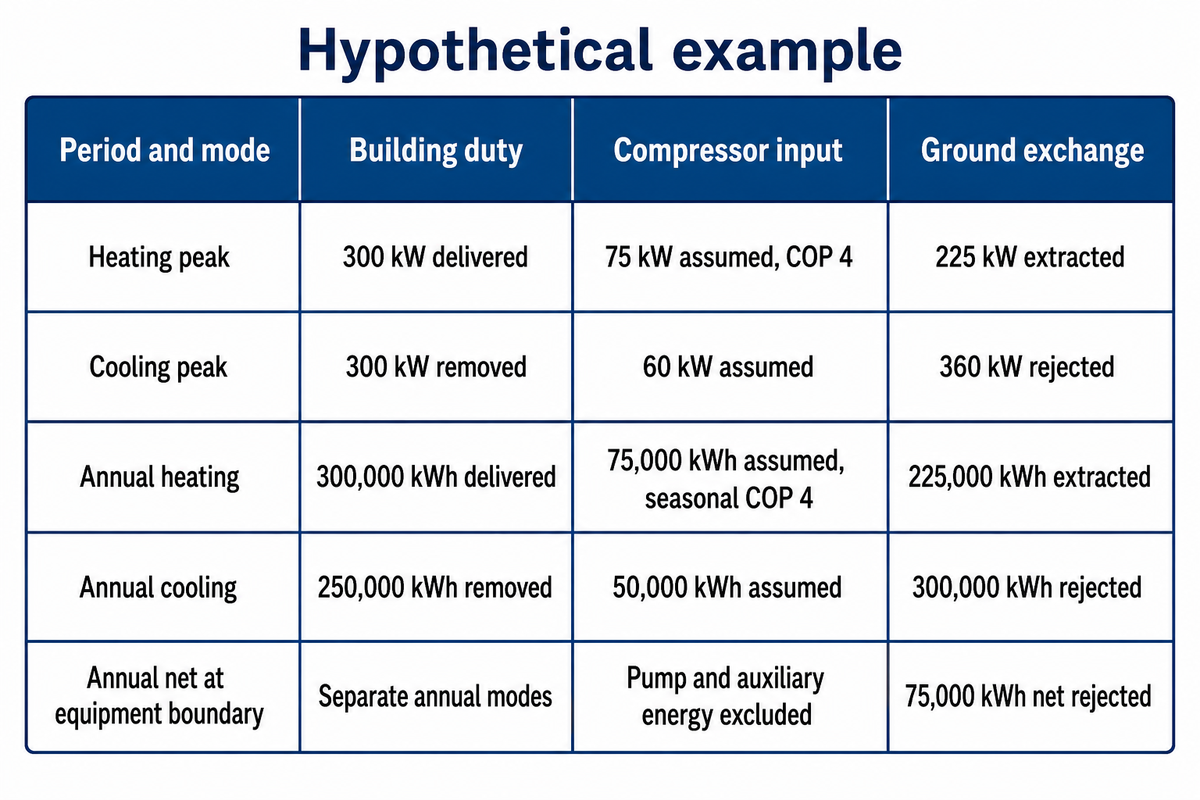
Start with a bounded heat pump example. Assume a building needs 300 kW of heating at a particular peak and the unit has a heating coefficient of performance of 4 at that condition. Electrical input is 300 ÷ 4 = 75 kW; heat taken from the ground is 300 − 75 = 225 kW. At a separate cooling peak, assume 300 kW removed from the building and 60 kW of compressor input. Heat rejected to ground is 300 + 60 = 360 kW. The two electrical inputs above represent two separate assumptions, and do not mean the unit has the same efficiency in both modes.
225 kWassumed heating-peak ground extraction
360 kWassumed cooling-peak ground rejection
75,000 kWhassumed annual net ground rejection
For the annual ledger, assume 300,000 kWh of delivered heating and a separate seasonal coefficient of performance of 4: compressor electricity is 75,000 kWh and ground extraction 225,000 kWh. Assume 250,000 kWh of delivered cooling and 50,000 kWh of compressor electricity: ground rejection is 300,000 kWh. Net rejection at this equipment boundary is 75,000 kWh. Pumps, distribution, heat recovery and auxiliaries are excluded.
| Period and mode | Building duty | Compressor input | Ground exchange |
|---|---|---|---|
| Heating peak | 300 kW delivered | 75 kW assumed, COP 4 | 225 kW extracted |
| Cooling peak | 300 kW removed | 60 kW assumed | 360 kW rejected |
| Annual heating | 300,000 kWh delivered | 75,000 kWh assumed, seasonal COP 4 | 225,000 kWh extracted |
| Annual cooling | 250,000 kWh removed | 50,000 kWh assumed | 300,000 kWh rejected |
| Annual net at equipment boundary | Separate annual modes | Pump and auxiliary energy excluded | 75,000 kWh net rejected |
Ground balance refers to assessing long term fluid temperatures. It doesn’t mean requiring equal annual extraction and rejection. A review available through the U.S. Department of Energy Office of Scientific and Technical Information calls for peaks and load history alongside ground properties and temperature limits. The annual difference is a model input, not automatic failure. Request predicted heating and cooling fluid temperatures over the design horizon; if they leave the unit envelope, revisit field geometry, heat recovery or auxiliary equipment.
Test the ground before fixing a geothermal borefield
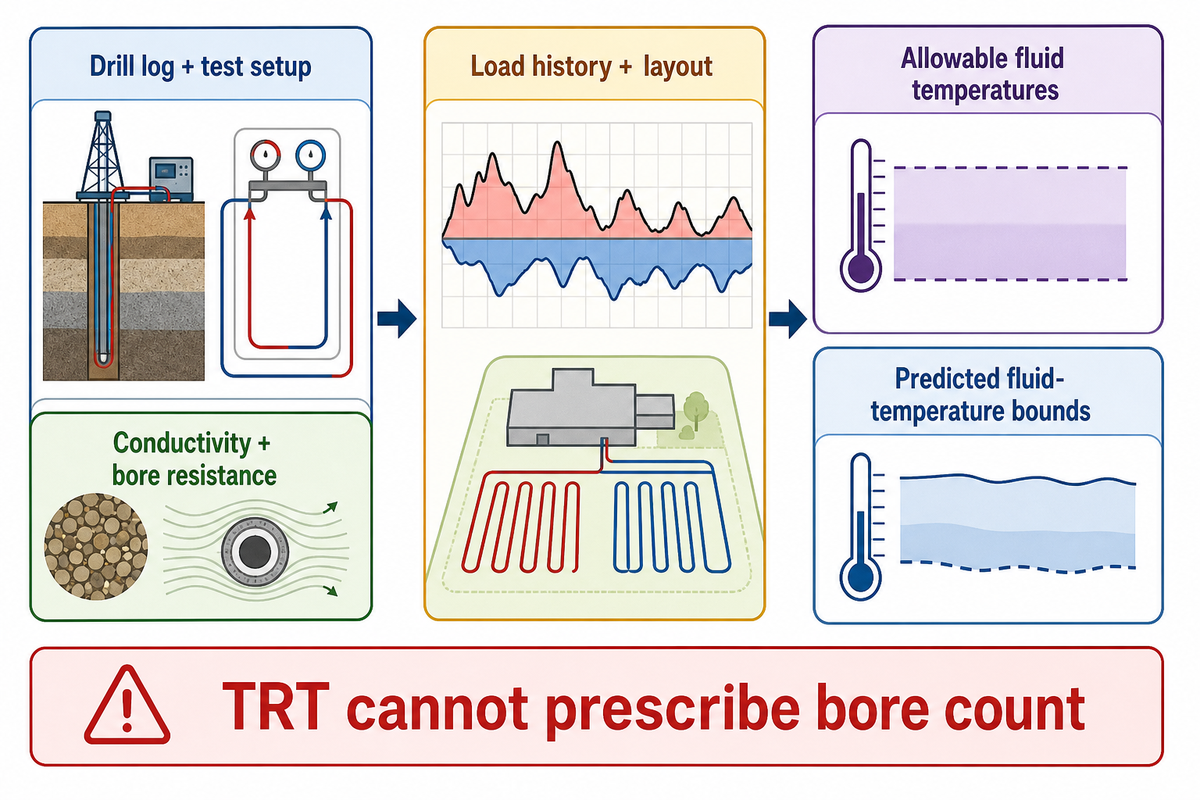
Thermal response testing can help refine uncertainty regarding subsurface thermal properties; bore count also depends on load history, loop layout and fluid-temperature limits. The drill log, test setup, interpreted conductivity and borehole resistance become inputs to a model that also needs load history, layout, circulation and allowable fluid temperatures. Reports are usually requested and the design run done together when the project is ready to release the field.
Does a thermal response test tell me how many boreholes to drill?
No. A conventional thermal response test assesses average characteristics for the tested bore. Variability in bore count remains with the heating and cooling history, spacing, depth, construction of bores, ground conditions and the range of fluid temperatures that the selected plant can effectively treat. The University of California, Berkeley distributed thermal-response research states that conventional tests don’t determine variance along the depth.
If a test bore crosses mixed strata, one fitted conductivity hides depth variation. The geotechnical design team should evaluate how representative the test is; the designer can evaluate a range of parameters. Sensing technology need not be prescribed for every design.
“There is no one good and clear rule of thumb for all these cases and their variations.”
The 2024 publication compares hourly simulations based on actual projects and doesn’t include measured field failures. Demand profile, bore internals, and other temperature limits can prevent a heat-per-metre workaround. Request the drill log, test setup, interpreted properties, uncertainty and modeled fluid-temperature bounds. This can help scope the field work, rather than take an unconstrained bore count.
For geothermal heat pump systems, the tested ground property informs system design alongside operating loads and loop geometry. A thermal test report in and of itself can’t prescribe the final field.
Compare hybrid geothermal systems with full ground and air source
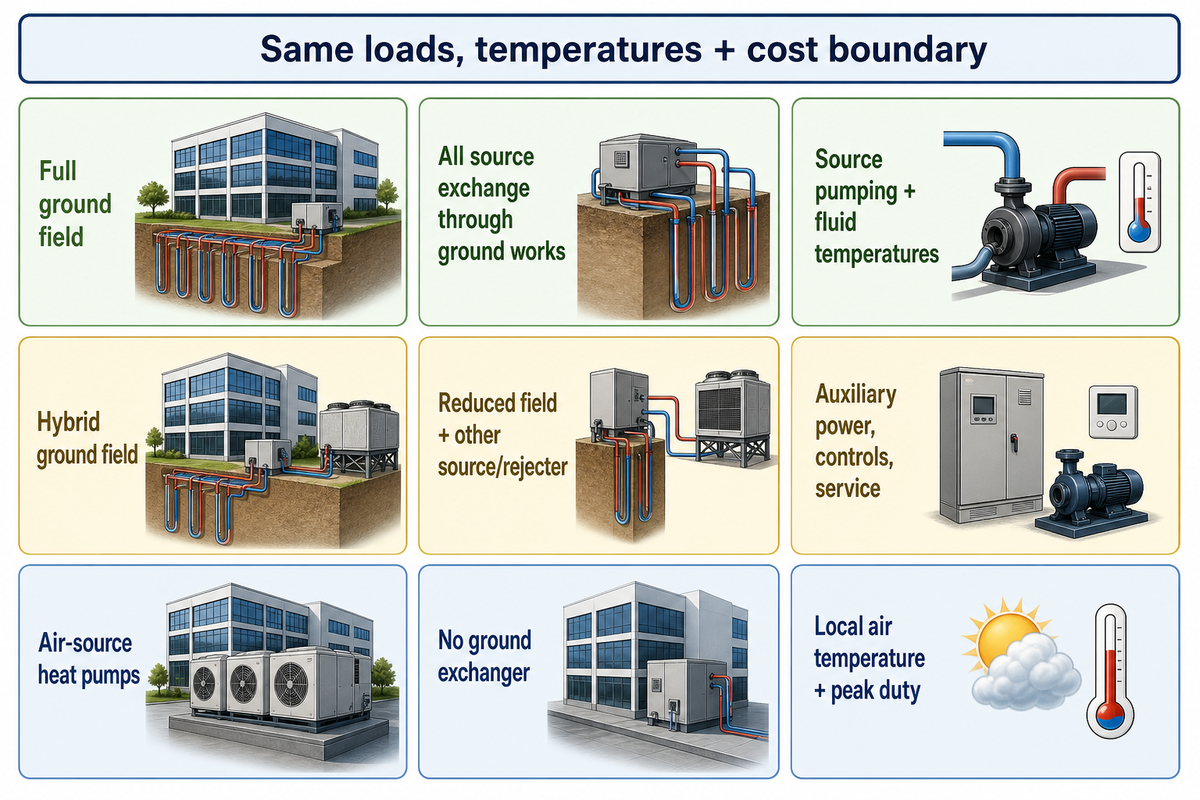
A hybrid geothermal system is an option when drilling space or annual heat exchange makes a full ground field difficult. It combines a smaller field with another source or heat rejecter. Compare it to a full ground system and to an air-source design under the same building loads, temperature requirements, electric demand, maintenance scope, and ownership period.
For a cooling-dominated office with tight ground space, a hybrid might reject summer heat through a fluid cooler; a full field needs another layout; air source removes drilling. The cooler adds power, space, controls and service. The PNNL maintenance guide identifies hybrid components as a way to reduce ground-loop requirements for unbalanced loads. It doesn’t make a universal cost claim.
| Route | Ground and plant consequence | Operating item to model | Reason to revisit |
|---|---|---|---|
| Full ground field | All planned source exchange through ground works | Source pumping and seasonal fluid temperatures | Field cannot fit buildable site or temperature limits |
| Hybrid ground field | Reduced field plus another rejecter or heat source | Auxiliary power, controls, water and service where applicable | Added equipment or site work erases apparent field saving |
| Air-source heat pumps | No ground exchanger; outdoor plant and electrical works | Performance at local air temperature and peak duty | Outdoor space, sound or peak electrical constraint |
According to the Department of Energy overview, ground-source heat pumps and air-source heat pumps use the ground and outdoor air, respectively, as an energy source. These heating and cooling technologies differ from a boiler generating heat through combustion. Traditional HVAC units may also introduce other electrical or fuel boundaries; conventional systems require the same comparison. The advantages of geothermal depend on modeled energy use, site conditions and tariffs, not a universal winner.
Compare commercial geothermal cost per ton on one scope
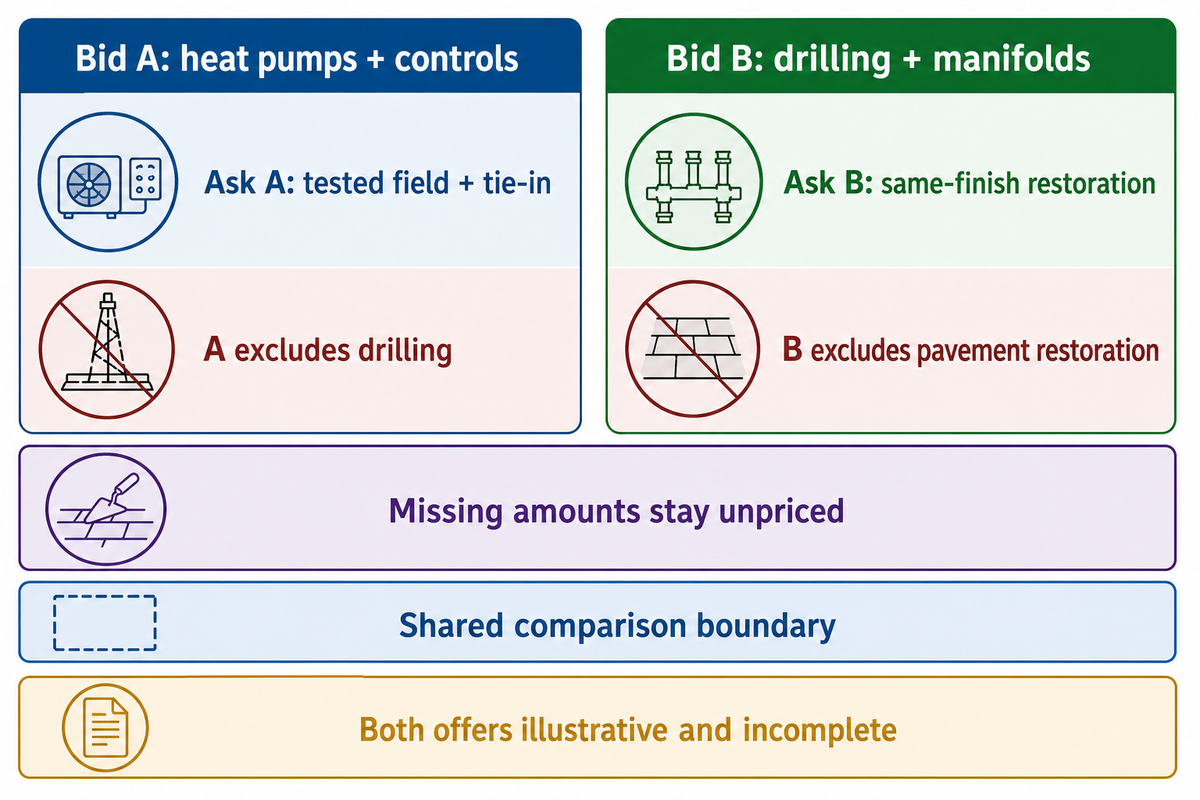
Commercial geothermal cost per ton means very little until competing bids use the same capacity rating and scope. A heat pump price generally excludes much of initial installation cost, and an apparently complete bid may still not include ground risk, electrical work or reinstatement. Keep unknown amounts unpriced and reconcile inclusions prior to calculating any installed cost ratio or payback.
Bid A includes heat pumps and controls, but excludes drilling. Bid B includes drilling and manifolds, but excludes pavement restoration. Neither can be ranked at this stage. Ask A to price the tested field and tie-in; ask B to price pavement restoration to the same finish. Align heating and cooling duties, water conditions, pumps, controls, and commissioning, then compare. Missing amounts should remain unpriced. The OSTI borehole review cites ground exchangers as a major cost element; PNNL separates ground, plant and distribution.
The Comparable Bid Boundary Sheet can be inserted into a request for revised offers. Each line shows a common element and a missing element and suggests a corrective purchase action.
| Scope line | Common comparison boundary | How an omission appears | Procurement action |
|---|---|---|---|
| Load and design basis | Same hourly loads, peak duties and design horizon | One bidder prices nameplate capacity only | Issue one designer-approved load and temperature schedule to both. |
| Test and ground interpretation | Same bore/test deliverables and parameter assumptions | “Ground investigation by others” without allowance | Assign test owner and request a priced testing scope. |
| Drilling, grout and loop | Same field layout, bore construction and risk exclusions | Bid A includes plant only; field amount unpriced | Request field price and stated ground-condition assumptions. |
| Manifold and buried connection | Same pipe corridor, isolation and plant entry | Field quote stops at property line | Mark handoff point on drawing and obtain tie-in price. |
| Heat-pump units | Same rated duty at project fluid temperatures | Capacity quoted at a different water condition | Request matching performance submittals and corrected unit offer. |
| Pumps and heat exchangers | Same source/building pumps, filtration and separation | Auxiliary skid or source pump listed “by owner” | Assign supply and electrical input to a named package. |
| Electrical capacity and connections | Same service upgrade, feeders and starters | Unit price excludes switchgear work | Get electrical designer’s load check and separate priced allowance. |
| Controls and metering | Same sequence, sensors, trends and integration | Factory controls end at unit terminal | Price integration points and commissioning trend logs. |
| Ventilation and building distribution | Same outdoor-air, humidity and terminal interfaces | Plant quote assumes existing coils are suitable | Price coil, air-side and piping changes against drawings. |
| Civil restoration and approvals | Same pavement, landscaping, permits and traffic works | Bid B includes bores but excludes reinstatement | Request restoration to the owner’s finish specification. |
| Start-up, warranty and service | Same testing, training, monitoring and service period | Commissioning or field repair is excluded | Specify acceptance records and annual service scope. |
Finance can divide aligned, priced totals by capacity on one rating basis, and model electricity, water, maintenance and replacement over the same period, holding gaps visible. Similarly, statements about the benefits of geothermal systems, including significant energy savings, cost savings, or long-term cost savings, must be on the same basis. A proposed geothermal solution may reduce energy consumption or energy bills on one modeled case, but that requires measured or modeled overall energy demand, tariffs, and auxiliary loads. Unknown construction quantity isn’t a saving.
Match commercial geothermal heat pumps to the designer’s submittal

Commercial geothermal heat pumps should be ordered against the ground designer’s fluid-temperature envelope and building designer’s heating and cooling duties. Matching entering and leaving water temperatures, fluid composition, flow, pressure drop, capacity and electrical input should be on the same submittal. If the proposed unit shifts ground loads or pump duty, reopen the field model before locking the order.
What should a commercial geothermal contractor and supplier submit?
The field design basis and expected fluid-temperature range, loop flow and pressure loss, as well as construction details and test results should be submitted by the ground contractor. The equipment supplier should submit performance at those same conditions, fluid compatibility, electrical input, part-load behavior and controls interfaces. The mechanical designer reconciles both packages with building loads and signs off the shared operating boundary before procurement releases equipment.
If a catalog rating uses warmer entering water than the modeled winter minimum, request performance at the modeled condition. Verify capacity, electric input, and flow are sufficient to meet the load. A changed extraction log sends the field model back to the designer; a nominal efficiency rating can’t explain the discrepancy.
PNNL’s maintenance guide helps commissioning by comparing measured flow and entering/leaving temperatures to the manufacturer’s specs. At part load, check pump staging and circuit flow and unit staging.
- Freeze the shared conditions Record design fluid temperatures, composition, peak and part-load duties, and flows in one schedule.
- Match equipment curves Obtain heating and cooling capacity, electrical input and pressure drop at those scheduled conditions.
- Reconcile changed loads Return any revised compressor or pump duty to the ground-field model and building designer.
- Assign acceptance records Name who measures flow, temperatures, control response and operating trends at commissioning.
Koven Air’s ground-source equipment selection page can prompt a model-specific submittal. Analyze the curves returned in the selection with the project design. A heat pump unit may provide heating at different entering-water temperatures; the geothermal HVAC system must still meet the designer’s specified condition. For a water-based circuit, examine water-to-water plant options.
Industry Outlook: Integrate a commercial building geothermal system
The 2025 CSA/ANSI/IGSHPA C448 edition changes what a buyer should ask about shared ground infrastructure. The International Ground Source Heat Pump Association’s public update says the edition supersedes its 2017 standards and adds district-energy and energy-pile coverage. A project team should identify the applicable edition and document plant, ventilation, ownership and metering interfaces before tendering a campus system.
The public standards summary supplies no licensed clauses or growth forecast. For the geothermal industry, its procurement implication is concrete: define whether the borefield, shared distribution, building heat pumps and controls form one contract or several, with named interface owners.
Can a central geothermal system heat and cool at once?
A shared geothermal loop can connect buildings with heating and cooling demands at the same time, but simultaneous useful heat exchange depends on plant configuration and controls. One reversible heat-pump unit shouldn’t be assumed to deliver four-pipe heat recovery. State which loads reject heat, which absorb it, the temperatures at each connection and who operates the shared pumps.
The DOE networked-geothermal overview describes shared infrastructure among buildings and multiple heat sources or sinks. A campus tender should assign wells, mains, connection points, pumping electricity, meters and fault response. Responsibilities for operation can’t be defined by pipe drawings alone.
Each building still needs compatible terminals and ventilation. Geothermal heating and cooling systems do not automatically provide outside air, humidity control, water heating or a legacy coil’s supply temperature. Pool heating, if provided, should also be analyzed for load and temperature balance. List those geothermal applications separately from space heating and space cooling. Koven Air’s outdoor-air and humidity duty guide addresses the air side; match water-side unit performance to the field and terminals.
A campus energy system should follow heat through the source-loop temperatures and flows, central plant, building distribution, outside air, controls, and metering, with a commissioning owner at each interface. Different heating and cooling applications can share infrastructure without sharing unit operating conditions. If the building supply temperature exceeds the quoted unit’s envelope, revise the terminal unit or the plant concept.
Commercial geothermal disadvantages: FAQ
The questions buyers ask the most are usually related to scope, site access, and temperature compatibility.
What is the average cost of installing a commercial geothermal system?
No single average installed cost applies across commercial geothermal sites and contract scopes.
Drilling conditions, loop layout, heat-pump duty, power works, controls and surface restoration all change the total. A unit quote and a complete plant-plus-field bid cannot be averaged as though they include the same works. Request itemized offers against the Comparable Bid Boundary Sheet and keep missing amounts unpriced. Once each bidder prices the same capacity basis and exclusions, compare installed cost per ton and model energy and service costs separately. Historic or residential prices do not settle a current commercial tender.
What is the biggest disadvantage of geothermal energy?
For a commercial ground-source project, the largest practical disadvantage is site-specific ground construction and its upfront cost.
The constraint may be drill access, land reserved for future work, uncertain groundwater or a field whose long-term temperatures need more ground than the site can provide. An open-loop option adds water quality, pumping and discharge questions. Those issues should appear in the feasibility package and bid allowances before the team buys heat pumps. A hybrid design or air-to-water alternative can be compared under the same loads if the ground route proves difficult.
What is the most efficient way to heat a commercial building?
The most efficient heating route for a commercial building is the one that meets its actual loads at the lowest modeled whole-system energy input.
Compare ground-source, hybrid and air-source heat pumps using the same design temperatures, ventilation duty, pumps, auxiliaries and operating hours. A catalog heat-pump coefficient of performance describes one equipment condition; it does not include the whole HVAC system. Ground temperature can help a source-side design, but ground works and pumping still belong in the model. A building with useful heat recovery may change the result again. Ask the engineer for annual system electricity and peak demand, then review local energy costs.
Where can I find geothermal heat pumps for sale?
Start with manufacturer product pages, then request a project-condition submittal through the supplier or contractor.
Koven Air’s ground-source range is one product starting point. Its ground-source manufacturer comparison covers broader supplier discovery. Send the same heating and cooling duty, entering-water temperatures, fluid and flow schedule to each seller before comparing offers.
What is the life expectancy of a geothermal heat pump?
A commercial geothermal heat pump and its buried loop have different service-life and replacement questions; neither has a defensible universal project life.
The heat-pump unit contains serviceable mechanical and electrical parts, while the buried exchanger has different access and repair constraints. Water quality, fluid chemistry, pumping, controls, cycling and maintenance affect equipment condition. Ground-loop construction, pipe joints, bore integrity and future excavation affect underground risk. Request separate warranty terms for units, pumps, controls and buried works, plus a plan for access and isolation. At commissioning, record baseline flow, entering and leaving temperatures and electrical input so later changes can be investigated against the original operating boundary. The PNNL operation and maintenance guide explains that measured flow and water temperatures support performance checks. A finance model should carry separate replacement allowances and service responsibilities rather than treating the complete system as one asset with a single expiry date. Ask bidders who will repair a buried circuit if a future renovation blocks its access.
Start a request with site access, hourly loads, ground results and fluid temperatures. Reconcile field, plant and building interfaces, then seek scoped offers. Explore commercial heat-pump configurations based on the above.
References & Sources
- U.S. Department of Energy, Geothermal Heat Pumps
- Pacific Northwest National Laboratory, Ground Source Heat Pumps
- Pacific Northwest National Laboratory, Ground Source Heat Pump Operations and Maintenance
- U.S. Department of Energy Office of Scientific and Technical Information, Borehole Heat Exchanger Review
- University of California, Berkeley, Distributed Thermal Response Test
- IEA Heat Pumping Technologies, Are Rules of Thumb Misleading?, 2024
- International Ground Source Heat Pump Association, Standards
- U.S. Department of Energy, Networked Geothermal
- U.S. Department of Energy, Alaska Campus Case Study
- Environment Agency, Thermal Impacts Summary, 2024
- Harvard Campus Services, Geothermal Wells: Lessons Learned
How this guide was prepared
This procurement guide draws on the linked public agency, university and association materials and uses a declared hypothetical load example. Site design, priced bids and equipment performance at project conditions must come from the responsible project team and suppliers. The article doesn’t present Koven Air project measurements or imply that an external source tested its products.
Factory Selection Support
Turn this guide into a usable HVAC RFQ package.
Share design conditions, airflow, temperature, humidity, process load, room use, and scope boundary. Koven Air can recommend a practical equipment route before quotation.
7equipment families
ISO / GMPcleanroom review
RFQscope comparison
What to prepare before quote
- Use settingCommercial building, cleanroom, hospital, data center, process area, or retrofit.
- Operating conditionsAirflow, load, temperature, humidity, static pressure, and duty hours.
- ConstraintsFootprint, access, hygiene class, material, controls, documentation, and delivery boundary.
Final equipment selection depends on local codes, project drawings, and confirmed site conditions.