Get in Touch with Koven Air Company

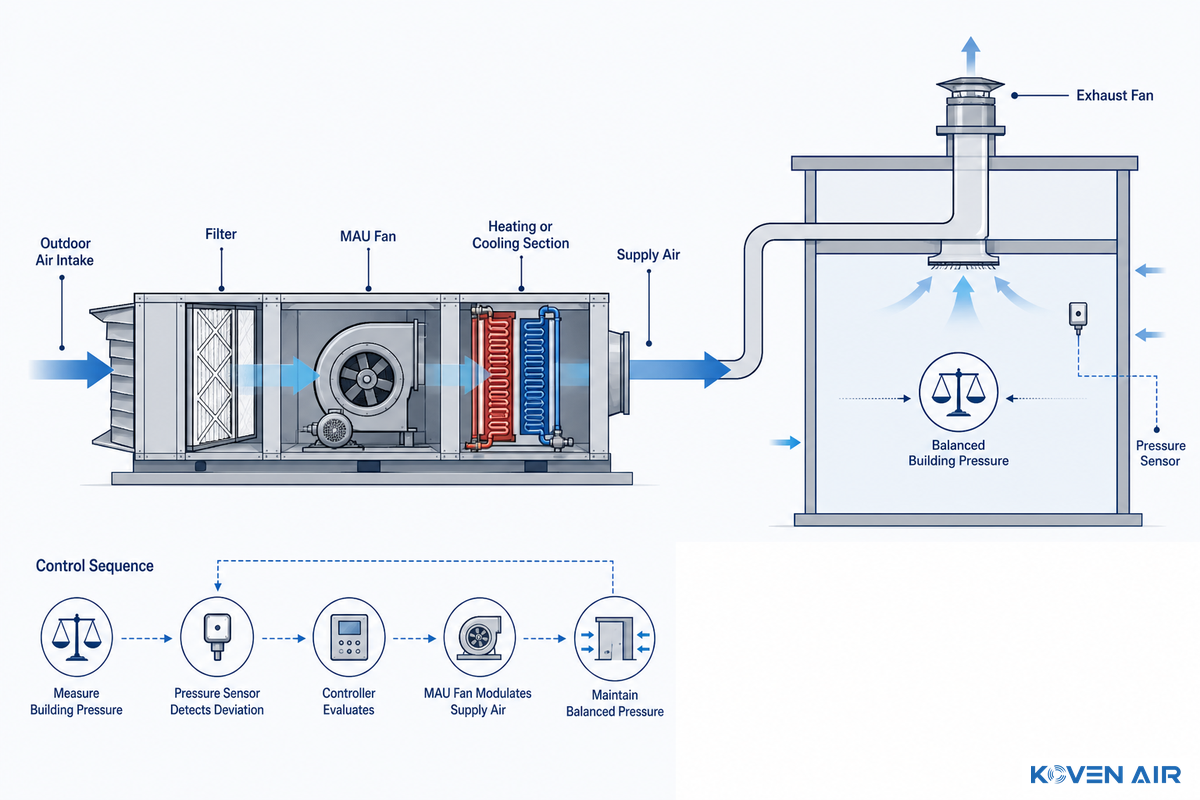
Make-Up Air Unit equipment isn’t simply a fan that brings outdoor air into a building. It’s part of the relationship between exhaust, replacement air, pressure objectives, air treatment, duct resistance, controls, and the way a facility actually operates. Treating it as a stand-alone piece of HVAC equipment is where many projects lose the thread.
A Make-up Air Unit (MAU) is equipment that supplies replacement air for an exhaust or pressure-control problem. ASHRAE defines makeup air as air intended to replace exhaust and exfiltration. Depending on the application, it may be filtered, fan forced, heated, or cooled. That definition is useful because it starts with the system purpose, not a catalog configuration.
MAU Air-Balance Design and System Roles
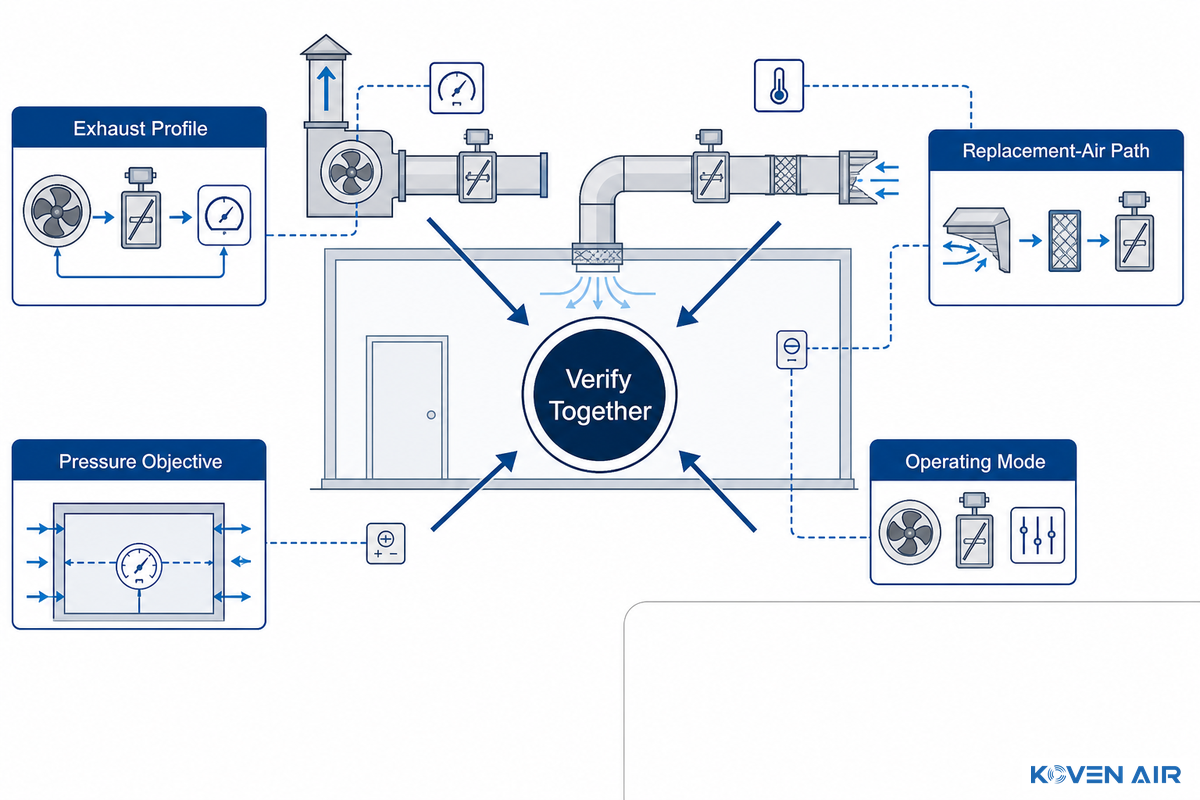
Often shortened to MAU or MUA, a Make-Up Air Unit supplies replacement air when exhaust fans, hoods, process ventilation, or local exhaust remove air from a space. It may deliver untreated, tempered, heated, cooled, filtered, or controlled outdoor air. Correct arrangement depends on the application, the building pressure target, the air path, and the operating modes that must work together.
For design verification, Koven Air Environment Technology Co.,Ltd provides pre-sales parameter review. The reason to ask for that evidence is risk control: a 24-hour aging test, factory inspections, and 18 standardized production processes can document what was built before installation, while the project engineer still confirms the actual air path and operating conditions.
As one code example, Washington’s mechanical-ventilation text says supply air should be approximately equal to return and exhaust air, while allowing a system to be intentionally positive or negative. That’s a useful principle, not a portable design rule. Local code, process safety requirements, and the authority having jurisdiction govern the actual project.
For an engineering review, a make up air system is not approved by a catalog label alone. Its air path, exhaust relationship, pressure objective, and verification method must be documented for the actual application.
Manufacturer evidence belongs in this design review, even before a commercial selection discussion begins. Koven Air states that its factory process includes production traceability, factory inspections, and a 24-hour aging test. Those records don’t replace the project design, but they give the engineer and contractor a concrete basis for checking whether the delivered equipment and the documented operating intent still agree.
The 4-Variable Air Balance Check
Before discussing a make-up air system size, write down four things: what leaves the building, how replacement air reaches the space, what pressure relationship the project needs, and which operating modes change the answer. This is the 4-Variable Air Balance Check. It prevents a design team from confusing a scheduled airflow value with a verified air-balance outcome. In particular, don’t use a generic CFM figure as a substitute for the project exhaust profile and field verification.
| Variable | Question to answer | Evidence to collect | What can change it |
|---|---|---|---|
| 1. Exhaust profile | Which exhaust fans, hoods, or process points run together? | Schedules, control sequence, field observation | Shift changes, occupancy, process stages |
| 2. Replacement-air path | Does supplied air reach the intended zone without short-circuiting? | Plan, duct layout, diffuser and transfer-air review | Door position, partitions, added equipment |
| 3. Pressure objective | Should the space be neutral, positive, or negative relative to adjacent areas? | Design intent, code review, process or hygiene requirements | Use classification, local jurisdiction, contaminants |
| 4. Operating mode | What happens at minimum, normal, peak, purge, and shutdown? | Sequence of operations, BAS points, interlock test | VFD speed, damper position, sensor failure |
| Intake condition | What outdoor contaminants, heat, moisture, or weather exposure reach the intake? | Site survey and intake-location review | Traffic, neighboring exhaust, seasons |
| Distribution resistance | What static pressure does the actual duct path impose? | Duct schedule, field pressure readings | Filter loading, dampers, later duct changes |
| Air treatment | Is tempering, heating, cooling, dehumidification, or filtration required? | Space condition and process requirements | Outdoor design conditions, occupancy, product load |
| Control authority | Which controller wins when exhaust, supply, alarm, and safety signals disagree? | Point list and written sequence | Manual override, sensor fault, fire/smoke mode |
| Verification method | How will the project prove the result after installation? | Testing, adjusting, and balancing plan | Access, instrumentation, commissioning scope |
Commissioning guidance for MAUs notes that an incorrect external-static-pressure assumption can produce excess airflow and motor over-current in some arrangements. In practice, a nameplate value and a design drawing are starting points. Field adjustment and documentation close the loop.
MAU vs AHU vs ERV: Choose the System Role First
An MAU, an air handling unit, and an energy recovery ventilator can all move outdoor air, but they don’t automatically solve the same problem. Begin the comparison with the role each device plays in the HVAC system, not with a presumed equipment category. This make up air unit vs air handling unit question is answered by that role split, while air balancing HVAC work confirms whether the arrangement operates as intended. In everyday search language, that same distinction is often described as the make-up air unit and AHU difference.
| System role | Typical air source | Primary question | Useful when | Limitation to check |
|---|---|---|---|---|
| Make-Up Air Unit | Outdoor or replacement air | How is exhausted air replaced and treated? | Exhaust-driven commercial and industrial applications | Pressure, intake, and discharge path still need verification |
| Air Handling Unit | Outdoor plus recirculated air, depending on design | How is supply air conditioned and distributed? | Central zone conditioning and distribution | It may not be the dedicated replacement-air answer |
| Energy Recovery Ventilator | Outdoor and exhaust airstreams | Can exhaust energy be recovered within the application limits? | Ventilation systems with recoverable exhaust energy | Contaminant transfer, pressure, and code scope matter |
| Dedicated outdoor-air approach | Outdoor air | How is ventilation air separated from space sensible-load handling? | Projects with distinct ventilation and zone-conditioning logic | Coordination with the rest of the air system is required |
| Local exhaust package | Process or hood exhaust | What must be captured and discharged? | Source-control applications | Replacement air is often a separate design task |
| Rooftop equipment | Varies by configuration | Does the packaged unit meet the full air-treatment and pressure role? | Packaged building HVAC applications | Do not assume outside-air capability equals MAU duty |
| Transfer-air strategy | Adjacent conditioned spaces | Can transfer air reach the target space safely and predictably? | Defined pressure cascades | Doors, partitions, and use changes can disrupt it |
| Passive opening | Outdoor air | Can an opening provide a controlled replacement-air path? | Only where the applicable design permits it | Weather, contamination, pressure, and control are limited |
| Hybrid arrangement | Multiple airstreams | Which component owns each operating mode? | Complex retrofit or phased projects | Sequence conflicts are common without clear authority |
Takeaway: Equipment labels follow the air-system role. Start with exhaust, replacement-air path, conditioning objective, and control sequence. Then decide whether the project needs an MAU, an air handler, an ERV, or a coordinated combination.
Tempered, Heated, Cooled, Direct-Fired, or Indirect-Fired?
Air treatment should be selected from the supply-air objective and site conditions, not from a default feature list. Tempered make-up air may reduce the discomfort of incoming outside air without being intended to carry the full space-heating load. Heating or cooling arrangements raise different questions about capacity, controls, condensate, fuel or electrical coordination, and the interface with the building air-conditioning system.
- Untempered: confirm where outdoor air discharges and whether the operating conditions are acceptable for people, equipment, and process.
- Tempered: document the target condition and the modes in which it must hold.
- Heated or cooled: coordinate with the heating system and zone controls so one system doesn’t counteract another.
- Direct-fired or indirect-fired: verify applicable fuel, combustion, ventilation, discharge, and jurisdictional requirements with the responsible engineer and authority having jurisdiction.
- Filtration: define the intake air quality, filter access, pressure-drop effect, and maintenance responsibility.
ASHRAE identifies 2025 updates affecting ventilation and indoor-air-quality topics such as filtration, controls, humidity, and exhaust-airflow calculations. That’s a reason to verify the current applicable standard and local adoption, not a reason to treat a general web guide as a compliance determination.
Residential Boundary: When These Terms Do and Do Not Apply
Some searches for a make-up air unit come from residential kitchens with a range hood, vent hood, cooktop, dryer, or other appliance. In that setting, a make-up air damper, blower, adjustable kit, and a path for fresh air to enter may be discussed alongside infiltration and depressurization. Once installed, an efficient arrangement also depends on duct condition, including whether galvanized ductwork and accessible filtration are suitable for the application. ASHRAE 62.2 and the locally adopted building code may be relevant to dwelling-unit ventilation, but residential kitchens aren’t a substitute model for commercial and industrial make-up air applications. Confirm the intended filtration options, control sequence, efficiency objective, and installation constraints for the actual project instead of copying a home-oriented arrangement.
The Application-to-Control Map
Controls are where a reasonable MAU concept becomes an operating system. Each row converts a common application into questions that the engineer, contractor, and commissioning team can answer before handover. It’s intentionally a map, not a selection chart.
| Application context | Pressure concern | Control question | Field check |
|---|---|---|---|
| Commercial kitchen hood | Exhaust and comfort interaction | Which hood and MAU modes must be interlocked? | Test each cooking and setback mode |
| Industrial process area | Containment and replacement air | Which process signals alter the exhaust profile? | Observe pressure and capture conditions |
| Warehouse | Large-volume air distribution | How do loading doors and schedule changes affect balance? | Review occupied and delivery modes |
| Data or electrical room | Equipment heat and pressure relationship | What has priority during alarm or cooling failure? | Verify alarm and fallback sequence |
| Laboratory or controlled space | Pressure hierarchy and contamination | What local rule governs the room relationship? | Use the specified test method |
| Healthcare area | Direction of airflow between spaces | Which care-area requirement applies? | Verify with the project authority |
| Mushroom farm or granary | Humidity, contaminants, and crop/process conditions | Which sensor and alarm conditions matter? | Record seasonal operating observations |
| Fabric or machinery production | Local exhaust and work-zone comfort | How are fan speeds coordinated with process demand? | Check static pressure and supply reach |
| Airport, subway, or high-speed-rail facility | Variable occupancy and operational modes | Which schedule or emergency mode overrides normal control? | Witness each defined mode |
For specified industrial ventilation applications, OSHA includes periodic static-pressure-drop checking among its requirements. That’s a useful reminder that a control sequence should identify the measurements that reveal a blocked filter, changed duct resistance, or an operating condition that no longer matches the design assumption.
Ductwork, Dampers, Filtration, Controls, and Discharge
An MAU is only one part of the delivery path. Treat the intake, fan, filter box, heating or cooling section, duct, damper, plenum, diffuser, transfer path, exhaust fans, and controls as one air system. Failure at any interface can change airflow, noise, drafts, pressure, or the ability to commission the unit. Make up air dampers should therefore be reviewed with the operating sequence rather than as isolated hardware. Apply the same review to a makeup air system when it’s integrated with existing exhaust equipment.
- Trace the air from the outside intake to the occupied or process zone.
- List every damper, sensor, actuator, VFD, and manual override that can affect flow.
- Confirm access for filter replacement, inspection, and measurement.
- Review discharge location against the exhaust pickup and likely short-circuit paths.
- Record expected static pressure at the points used for testing.
- Check how the system behaves during startup, alarm, power recovery, and a failed sensor.
Patent literature shows that exhaust-linked adjustment of a make-up-air setting is an active control concept. A patent isn’t proof that a feature is available, appropriate, or required for a project; it simply reinforces the need to define how exhaust and supply signals interact.
Commissioning Evidence and Project Change Control
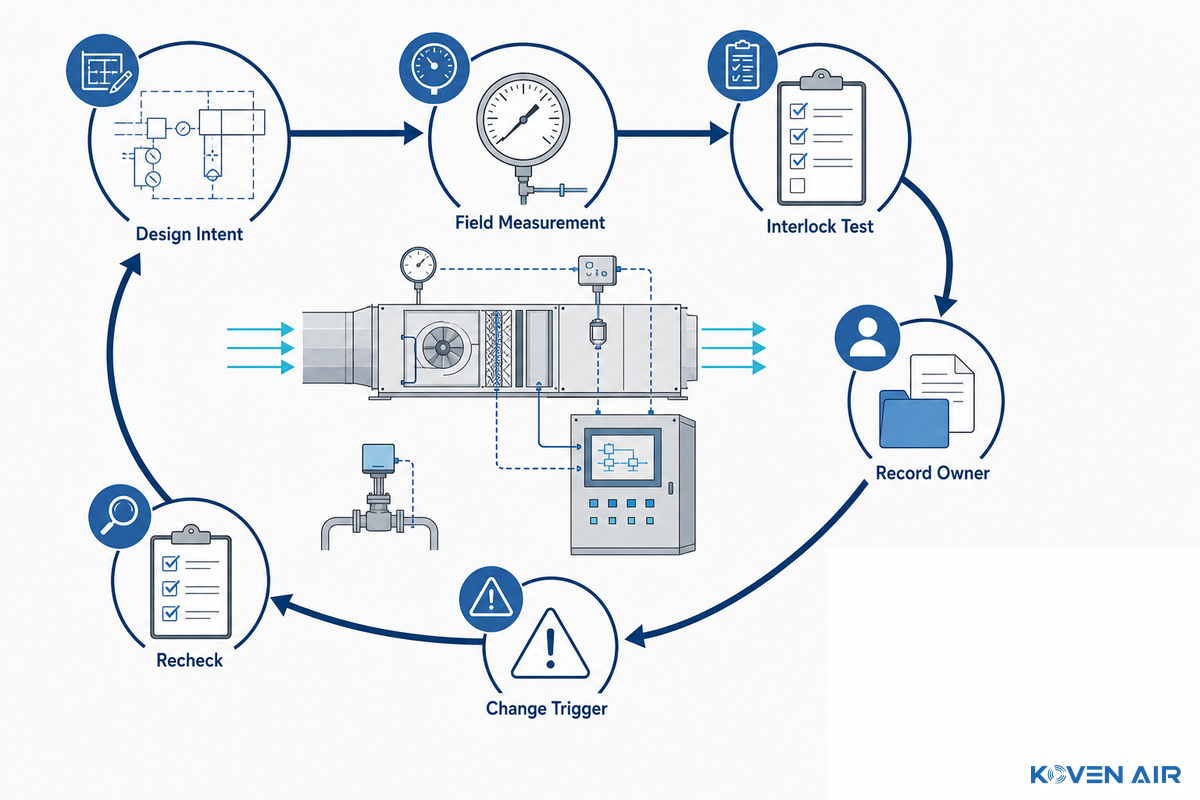
Commissioning is where a hidden risk, delayed response, or failed interlock becomes visible. Because Koven Air Environment Technology Co.,Ltd states that it provides installation and commissioning guidance, its factory process, 24-hour aging test, 400 traceability points, and 36 factory inspections can support the equipment record; the site team must still test the actual application and document any unresolved condition.
Commissioning is the place to turn a design intent into evidence. A useful record doesn’t need invented precision. It needs repeatable conditions, named measurement points, operating modes, observations, adjustments, and unresolved items. The MAU evidence sheet below is designed to make that conversation concrete.
| Evidence field | What to record |
|---|---|
| Project and zone | Building area, room or process zone, date, and responsible parties |
| Operating mode | Normal, peak, setback, purge, alarm, or other witnessed mode |
| Exhaust status | Which exhaust fans or hoods were operating and at what commanded state |
| MAU status | Fan command, damper state, air-treatment state, alarms, and setpoints |
| Airflow method | Instrument, location, method, and the person who took the reading |
| Pressure observation | Measured or observed relationship at relevant doors, openings, or controlled boundaries |
| Static-pressure points | Named locations and readings used for future troubleshooting comparison |
| Control response | Observed sequence when exhaust, supply, sensor, or alarm conditions changed |
| Open issues | Unresolved air path, noise, draft, filtration, access, or coordination items |
This sheet doesn’t replace a required testing, adjusting, and balancing report, commissioning specification, or jurisdictional form. It gives the project team a shared evidence structure before those formal requirements are closed.
What Data Should Be Prepared Before an MAU Project Review?
Prepare the latest exhaust schedule, site layout, control narrative, applicable-code notes, prior balancing record, utility information, and known process changes. Identify who owns measurements, access, and acceptance. These nine fields prevent an equipment request from hiding untested assumptions during review:
- Application, occupancy, process, and locations served.
- Exhaust equipment list and simultaneous operating modes.
- Required outdoor air, replacement air, and pressure objectives.
- Outdoor design conditions and intake-location constraints.
- Supply-air treatment objective: temper, heat, cool, humidity, or filtration.
- Duct route, discharge points, transfer-air paths, and available space.
- Electrical, fuel, condensate, roof, service, and installation constraints.
- Controls architecture, interlocks, BAS points, alarms, and fallback modes.
- Commissioning method, responsible parties, and acceptance evidence.
When this information is ready, the project team can use Koven Air’s Make-Up Air Unit solution page as the commercial next step for discussing a customized equipment solution. This guide intentionally stops at the engineering evidence and review boundary.
Koven Air’s Stated Project-Verification Capabilities
Koven Air Environment Technology Co., Ltd. states that it was founded in 2007, began developing its brand and exporting in 2010, and now serves 35 countries. The company describes its focus as high-end industrial, commercial, and agricultural growing-environment HVACR solutions, with customized solutions and responsible after-sales support.
For project verification, Koven Air states that its manufacturing base includes 20,000 square metres of modern factory space, 18 standardized production processes, 23 sheet-metal precision-machining operations, intelligent-robot modular assembly, 400 manufacturing-process traceability points, 36 factory inspections, a 24-hour aging test, and professional chiller and heat-pump testing laboratories. These are first-party capability statements, not universal product-performance claims.
Its stated service process includes pre-sales calculation verification and parameter review; installation and commissioning guidance after production and testing; and lifetime free technical guidance, including regular training for engineering contractors and engineers. Those services align with the evidence-first project approach in this article.
Recheck the Inputs When a Ventilation Project Changes
Return to the 4-variable check when operating schedules change, an exhaust fan is added, a hood is replaced, a process moves, filters load differently, a new partition alters transfer air, or a control sequence is revised. The system may still run, yet no longer be delivering air the way the original design intent assumed.
Research on intelligent ventilation and indoor air quality is expanding the discussion around sensing and control, but a technology trend doesn’t remove the need for basic field evidence. Start with the air path, pressure objective, operating modes, and measured response. Then decide whether additional monitoring or control changes are justified for the application.
Frequently Asked Questions
What is the purpose of a Make-Up Air Unit?
A Make-Up Air Unit supplies replacement air when a building or process exhaust system removes air from a space. Its purpose is to support the intended pressure relationship, air path, treatment objective, and operating sequence, not merely to introduce fresh air. Before handover, the team should show what operates together, where replacement air enters, how the pressure relationship was checked, who accepted the record, and which operating mode was used for that observation.
How is a Make-Up Air Unit sized?
Size isn’t established from a single generic rule. A home and a commercial or industrial facility can face very different use, code, pressure, and control conditions. Start with the exhaust profile, replacement-air path, required pressure relationship, and operating modes. Then check intake conditions, supply-air treatment, duct static pressure, controls, verification method, expected seasonal conditions, and the equipment operating sequence. Projects with code-governed kitchen, process, laboratory, or healthcare conditions require the applicable engineer and authority to confirm governing requirements.
What is the difference between an MAU and an AHU?
An MAU is typically focused on replacement outdoor air for an exhaust or pressure-control need. An AHU can handle a broader mix of outdoor and recirculated air for central conditioning and distribution. The useful question is which component owns replacement air, conditioning, distribution, controls, field measurements, and fault response in each operating mode.
Does a Make-Up Air Unit always need heating or cooling?
Not always. The requirement depends on outdoor conditions, discharge location, process expectations, and the rest of the HVAC system. Choose air treatment only after operating conditions, control sequence, and acceptance criteria are clear for the actual operating mode and season.