Get in Touch with Koven Air Company

Industrial & Commercial Heat Pumps
Industrial & Commercial Heat Pumps — 65–2,872 kW Hydronic Systems
A commercial heat pump moves building heat between a water loop and an outdoor, ground or process source instead of burning fuel to make it. Koven Air builds six hydronic lines from 65 to 2,872 kW per unit, publishes a coefficient of performance for each source type, and has measured heating output down to −30 °C.

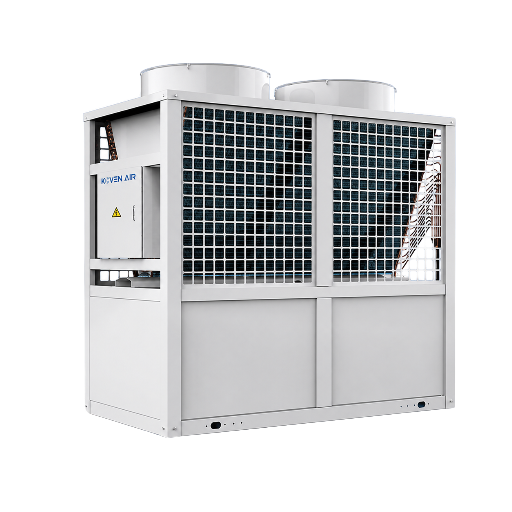
65–2,872 kW
Per-unit heating capacity
6 lines
Air, water, ground and 4-pipe
2.51–6.4
Published heating COP by source type
−30 °C
Lowest ambient with measured output
R32 / R1234ze
Low-GWP refrigerant options
20,000 m²
Own factory, operating since 2007
Why “Industrial Heat Pump” Returns Two Different Types of Heat Pump Systems
Search industrial heat pump from a United States connection and the first page returns no building HVAC equipment at all. What it does return:
a Department of Energy paper on steam and fuel savings
research from the American Council for an Energy-Efficient Economy
a compressed-air manufacturer
That phrase covers two machine families which share a refrigerant cycle and almost nothing else. Both work by moving heat instead of burning fuel to generate heat, then part company on three counts:
01
operating temperature, where one family stops and the other starts
02
the carrier thermal energy leaves in — water on one side, steam on the other
03
who signs the purchase off: building services, or process engineering

So before ranking types of commercial heat pumps by capacity or price, settle which type of heat pump technology the duty actually calls for. Getting that wrong costs a whole procurement cycle.
Data & Specifications
The Two-Machine Test
Two questions settle which one your project needs.
Q1. Does heat leave the machine as water, or as steam?
Q2. Is the required supply temperature 75 °C or below, or above 100 °C?
The Two-Machine Test — what your two answers point to
| Your answers | Machine family | Typical duty | Built by Koven? |
|---|---|---|---|
| Water, up to 55 °C | Hydronic building heat pump | Space heating or cooling, fan coils, radiant loops, air handling units | Yes — five of six lines |
| Water, 55–75 °C | Cascade high-temperature heat pump | Process hot water, boiler replacement, wash and phosphating lines | Yes — the KAIA cascade line |
| Steam, or water above 100 °C | Process-heat pump | Steam generation, drying, pulp, food and beverage process heat | No — specify a process-heat specialist |
Koven Hydronic Boundaries
Everything on this page is the water side of that table. Koven Air builds commercial and industrial hydronic machines — not steam-generating equipment, not variable refrigerant flow systems, and not residential split system units.
A third group muddies it further: search results for a small commercial heat pump — rooftop and split equipment in the 3–10 ton band — sit alongside results for industrial high temperature heat pumps rated in megawatts, under the same query.
Buying across that line is the mistake that costs a procurement cycle, because the two families do not substitute for each other at any price point.
Temperature Limits & Innovation
Unlike a capacity shortfall you can fix by adding modules, a temperature shortfall cannot be paralleled away: 40 machines that top out at 75 °C still top out at 75 °C.
Koven Air’s water side runs 65 to 2,872 kW per unit across six lines. That top temperature is not a settled limit in the field either — USPTO application US20230288112A1 covers a modular reversible cascade high-temperature heat pump with predictive defrost control, which is the same architecture the KAIA line uses to reach 75 °C in practice.
ID: US20230288112A1The Koven Range — Six Lines, One Source-Side Decision
Choosing the wrong source type carries a risk you cannot correct on the next revision. Each of these is civil work, committed long before the machine arrives:
a borefield
a condenser loop
a well
a waste-water tie-in
So the first decision is not which model. It is which side of the machine you can feed — because that, not the badge on the cabinet, sets the efficiency band you will live with.
All six lines extract heat from a source and lift it into a water loop, and all six reverse to provide cooling and heating from the same machine. What separates them is where the heat comes from, and whether your commercial space needs both at once.
System_Logic::Source-Side_Fork
Do you have a stable water source? — well water, a borefield, a building condenser loop, or a process waste stream.
[ BRANCH 01 ] Available Water Source
Q_
Do different zones need heating and cooling simultaneously?
YES
→ Heat Pump Chiller, 4-pipe
[ BRANCH 02 ] Source Specifications
NO
Which source type is viable?
• Well water or building loop → Water-source
• Borefield → Ground-source
• Process waste water → Water-to-water
• Borefield → Ground-source
• Process waste water → Water-to-water
[ BRANCH 03 ] No Water Source
Q_
Is your design-day ambient below −15 °C?
YES
→ Cold Climate
(vapour-injection to −30 °C)
(vapour-injection to −30 °C)
NO
→ Air-to-Water

SYS_ID: AW-HP-01
Air-to-Water Heat Pump
Capacity
65–2,872 kW
COP
3.24–4.43 rated
Series
KAFLG / KAFMH(A)…
Refrigerant
R134a / R410A…
Draws from outdoor air, so it suits buildings with no usable water source and a design day above −15 °C.
ACCESS DATA [>]
SYS_ID: HP-CH-02
Heat Pump Chiller — 4-Pipe
Capacity
281 kW · 1,060 kW
Total COP
7.74 – 8.9 design
Series
KASG-2xx / KASG-0xxH
Refrigerant
R134a / R1234yf · R410A
Best for hotels, hospitals and mixed-use buildings with simultaneous loads.
ACCESS DATA [>]
SYS_ID: WS-HP-03
Water-source Heat Pump
Capacity
85–1,913 kW per unit
COP
5.6–6.1 measured
Series
KACWR / KASCMF
Refrigerant
R410A · R134a
Best for buildings already running a condenser water loop or drawing well water.
ACCESS DATA [>]
SYS_ID: GS-HP-04
Ground-source Heat Pump
Capacity
367–1,913 kW per unit
COP
6.1–6.4 measured
Series
KASCMF twin-screw
Refrigerant
R134a
Geothermal; ideally suited for campuses and central plants that can host a borefield – features highest published COP.
ACCESS DATA [>]
SYS_ID: CC-HP-05
Cold Climate Heat Pump
Capacity
65–150 kW per module
COP
2.51–3.18 verified
Series
KADFM (vapour inj.)
Refrigerant
R32 · R410A
Best for northern sites where the design day sits below −15 °C. Multiple units parallel onto one loop.
ACCESS DATA [>]
SYS_ID: WW-HP-06
Water-to-Water Heat Pump
Capacity
384–1,913 kW heating
COP
5.0–5.1 measured
Series
KASCMF, 20 models
Refrigerant
R134a
Best for sites with a sewage, groundwater or industrial waste-heat stream to recover from.
ACCESS DATA [>]Cold-Day Output — What Actually Reaches the Water Loop in Your Climate Zone
Adding capacity margin to cover an unknown cold-day output makes the machine worse, not safer. The Consortium for Energy Efficiency states it directly: oversizing affects heat pump efficiency more than other HVAC types. Four consequences are listed:
frequent cycling at low load
poor performance
high energy usage
less temperature control
Engineering Reality
Engineers oversize anyway because manufacturers publish a single limit temperature and stop there. A limit tells you the machine still runs at that ambient. It does not tell you how much heat still reaches the loop.
Every heat pump becomes less efficient as the source gets colder — efficiency can drop steeply through the colder months, and heating and cooling performance at low temperatures is the one figure a design engineer cannot infer from a nameplate.

Where the honest limit sits
At the bottom of the range a cold climate heat pump is only modestly better than resistance backup, and pretending otherwise would undercut every other number here. On the 40,000 m² mall installation described below, the electric boiler ran on 15 days of the heating season and took 7% of total energy for the year.
Planning for that 7% is a different exercise from oversizing the heat pump by 50% and losing part-load efficiency all season.
The Cold-Day Delivery Ratio
Divide heating output at your design-day ambient by rated output at 7 °C. That quotient decides how many units you buy.
| Line and model | Design-day ambient | Delivered ÷ rated | Measured values | Basis |
|---|---|---|---|---|
| KADFM-020H cold climate | −25 °C | 53% | 37.05 of 70 kW | Catalogue rating |
| KADFM-040H cold climate | −25 °C | 46% | 73.92 of 160 kW | Catalogue rating |
| KADFM-030H cold climate | −22 °C | 74% | 96 of 130 kW | Project acceptance test |
| KAFM-110H012 vapour injection | −30 °C | 72% | 280 of 390 kW | Project acceptance test |
| KAIA-50H-FD cascade | −12 °C | ≥82% | Capacity decay ≤18% | Project acceptance test |
| Water-source, ground-source, water-to-water | Not applicable | No ambient derating | — | Source temperature is stable year-round |
Each ratio belongs to the model and leaving-water temperature shown. It is not a range-wide promise. Ask for the correction table for your own design point rather than reading across.
Why the vapour-injection lines hold up better
Both lines with the highest cold-day ratios use enhanced vapour injection. Independent work under the International Energy Agency heat pump programme measured roughly 30% more heating capacity and a 20% better COP at low ambient from flash-tank vapour injection on an R410A machine.
That is the physical reason a modest ratio at −30 °C is achievable at all, and it is why these high-efficiency cold-climate and modular lines are specified separately from the standard air-to-water range.

Heat Pump Systems vs Boiler + Chiller — A Measured Comparison
What decides this is not a manufacturer’s efficiency multiple. It is your electricity price divided by your gas price – and the risk of skipping that division is a business case built on someone else’s tariff.
Analysis by the Regulatory Assistance Project puts the crossover at a coefficient of performance of about 3 against a gas boiler running near 85% in-situ efficiency — and notes that a decade earlier the same crossover sat closer to 3.7 because tariffs were different.
Apply the rule to your own tariff
Divide your delivered electricity price by your delivered gas price, both per kWh.
That quotient is the heating COP you have to beat before operating costs fall.
Compare it with the COP band for the source type you can actually feed – from the product cards above.
Water-source and ground-source clear a ratio of 5 comfortably; air-source at a cold design day may not
That single division does more for a budget case than any efficiency multiple, because it is built from your own energy sources rather than from a test condition chosen by a manufacturer.
Technical Matrix & Market Insight
| Factor | Koven hydronic heat pump | Gas boiler + separate chiller |
|---|---|---|
| Heating efficiency | COP 2.51–6.4 depending on source type and condition | 0.85–0.95 combustion efficiency |
| Output against outdoor temperature | Derates — see the delivery ratio table | Constant, independent of weather |
| Simultaneous heating and cooling | Yes, one 4-pipe machine | No — two plants, two contracts |
| On-site combustion, flue, gas permit | None | Required |
| Refrigerant on site | Present — R32, R410A, R134a, R407C or R1234ze by line | None on the boiler side |
| Plant rooms to maintain | One | Two, on separate replacement cycles |
| Electrical service demand | Higher — check capacity before committing | Lower |
| Heat recovery to hot water | Built into the KASCMF platform, 115–574 kW by model | Added equipment |
A boiler holding constant output through a cold snap is a genuine advantage, not a detail to bury. That is exactly why the delivery ratio belongs in the sizing conversation rather than in a footnote. It is worth knowing how young this comparison still is.
Analysis by the American Council for an Energy-Efficient Economy, working from the U.S. Energy Information Administration commercial buildings survey, puts heat pumps at just over 11% of the energy consumed by heating equipment in US commercial buildings. The boiler-plus-chiller pairing is not a legacy edge case — it is still the incumbent in roughly nine plant rooms out of ten.
What the all-electric route does change is the shape of the plant. One machine can provide heating in winter and cooling in summer, so annual energy use consolidates onto a single meter and a single maintenance contract instead of two.
Where electrification adds friction
Electrification is not friction-free either. Three things can stop a heat pump being a drop-in swap:
- electrical service too limited to carry the new load, which forces a service upgrade
- distribution designed only for high-temperature boiler water, which forces emitter changes
- installed cost at the meter, where combustion heating methods still win
In practice the decision rarely lands on efficiency alone. Whereas a boiler replacement is a like-for-like swap, a heat pump plant of 115–574 kW recovered heat changes the hydraulic design, the electrical service and the maintenance contract in one move — which is why the comparison belongs in the concept stage of a production or facility upgrade, not in the tender.
Where the conclusion is that the building needs cooling far more than heating, the comparison you actually want is between chiller types rather than between heat pump and boiler — our guide to industrial chillers covers that side.
Want the running-cost comparison against your own loop?
Get a running-cost estimate for water-source heat pump vs boiler + chiller →Project Results — Three Installations, Measured Over 8 to 14 Months
Provenance. These are Koven project records from installations in China, not third-party audited studies. Physical measurements are given as recorded. Cost effects are given as percentages and payback periods rather than currency, because the outcome depends on the local electricity-to-gas price ratio rather than on the machine.

Industrial
Automotive paint shop — process hot water at 65 ±0.5 °C
Pre-treatment, phosphating and rinse stages needed constant 65 °C water, and four 2-tonne gas hot water boilers were holding it to ±3 °C. That swing produced inconsistent phosphate film thickness and a measurable defect rate.
Technical Specifications
- Installed 18 × 185 kW cascade units, 3,330 kW system total
- Water Temp Achieved 64.7–65.3 °C, swing ≤0.3 °C against a ±0.5 °C design
- Annual Measured COP 3.62, holding ≥3.4 at peak load
- At −12 °C Ambient Capacity decay ≤18%, still delivering 63.0 °C
- Energy Cost Down 69.9% · simple payback 21 months
- Phosphate Defect Rate 3.1% → 0.75%
- Availability 14 consecutive months with no unplanned stop
- Changeover 60 days, night work only, production never stopped

Commercial
157,000 m² wholesale market — heating and cooling
A coal boiler was being removed under local air-quality rules, and tenants were reporting winter temperatures below 16 °C. Trading could not stop for the work.
Technical Specifications
- Installed 174 modules, 22,600 kW heating and 18,800 kW cooling
- At −22 °C 96 kW per module, 74% of the 7 °C rating
- Seasonal COP 2.92 heating, 3.35 cooling
- Energy Cost Down 43.6% · payback 2.97 years
- Roof Layout Airflow simulation measured 14% efficiency gain
- Delivery 39 days from start to handover, trading uninterrupted
- Noise 54 dB measured on the roof, ≤43 dB inside units

Commercial
40,000 m² shopping mall — −30 °C design ambient
Designed for extreme cold climates, providing stable and efficient heating operations with minimal backup requirements.
Technical Specifications
- Installed 20 vapour-injection units, 5,600 kW
- At −30 °C 280 kW per unit, 72% of the 7 °C rating
- Annual COP 2.86
- Heating Cost Down 44% · payback 3 years
- Backup Use Electric boiler ran on 15 days, 7% of annual energy
- Occupant Outcome Temperature complaints down 90%
Across all three sites the availability record, not the peak COP, is what the operator quotes back to us. Reliable performance through a heating season and mechanical durability under 24-hour duty are the measures a facilities team is actually judged on.
Each figure quoted above is an acceptance-test read against a written design spec, not a modelled projection, which is also why two of the three fail to meet the headline figures that a brochure would have loved.
External Benchmark / DOE Yardstick
For an outside yardstick, the US Department of Energy published cross-manufacturer field results in its Cold Climate Heat Pump Challenge field study, carried out at Pacific Northwest National Laboratory. Reading seasonal figures of 2.86 to 3.62 against an independent field study is a fairer test than reading them against anyone’s brochure.
Measured — first-party project records
0mo
–
0yr
Simple Payback
0%
–
0%
Cost Reduction
Simple payback across the three installations above. This spread in energy savings is not machine quality — it is duty.
- Process-water duty runs 24 hours a day at high lift, so it recovers fastest.
- Two seasonal space-heating retrofits recover over three winters.
Note: Payback in your market will move with your electricity-to-gas price ratio, not with these percentages. Use the crossover rule in the comparison section above with your own tariff before treating any figure here as a forecast.
Industrial Heat Pump Evaluation Framework
The Two-Machine Test
Searching “industrial heat pump” returns two different machine families. Two questions settle which one your duty needs, before you compare a single capacity or price.
Evaluate
The Source-Side Fork
Six lines, one decision. What you can feed the source side of the machine — not the capacity you need — determines which line applies and which efficiency band you get.
Determine Limit
The Cold-Day Delivery Ratio
Every manufacturer publishes a limit temperature. Almost none publishes the output at that temperature. This works the other way round: pick the measured point closest to your design day and see what actually reaches the loop.
Verify Output
COP Crossover — on your tariff, not ours
The number that decides heat pump against boiler is not an efficiency multiple from a brochure. It is your electricity price divided by your gas price, adjusted for how well the boiler really runs.
Calculate Costs
Commercial Heat Pump Systems — Frequently Asked Questions
A machine that moves heat between a building water loop and an outside source, using a compressor and a refrigerant, instead of generating heat by combustion. The way commercial heat pumps work is to transfer heat that already exists rather than create it, which is why the output can exceed the electrical input. Reversing the cycle turns the same unit into a chiller, so one machine can provide both heating and cooling across the year.
Cost tracks capacity band, refrigerant choice, 4-pipe configuration, heat-exchanger material and controls scope rather than a single per-kW figure, which is why the procurement section above lists the dimensions instead of a price. Be careful with published commercial heat pump cost ranges found online: the widely quoted four to thirteen thousand dollar band describes 3–10 ton light commercial split equipment, a completely different class from a 65–2,872 kW hydronic machine. Comparing those two numbers is how a budget gets set at roughly a tenth of the real figure, and it is the single most common briefing error we see on incoming enquiries.
Capacity is the obvious difference; the carrier is the useful one. Residential equipment usually moves heat into air through a split system, while commercial heat pump systems on this page move it into a water loop that then feeds fan coils, air handling units or radiant circuits. That water loop is the reason why a single installation is capable of meeting simultaneous heating and cooling needs for more than a dozen zones; that kind of application is never required of residential equipment.
Run the Source-Side Fork above. There is no single best commercial heat pump across all six — where two branches both look feasible, civil scope decides it rather than the heating and cooling solutions themselves.
Start from a calculated building load, not floor area, then apply the delivery ratio for your design-day ambient to the rated capacity. Sizing against a rule of thumb is where most oversizing originates, and oversizing costs efficiency all season rather than only on the coldest day.
A unit that is too large cycles at low load, holds temperature less precisely and draws more energy across the year than a right-sized one, so the margin that feels prudent on paper is charged back every month.
Where the corrected figure still leaves a gap on the two or three coldest days, cover that gap with supplementary heat rather than with a bigger machine.
No — no heat pump does, and any supplier implying otherwise is describing a limit rather than an output. The delivery ratio table above gives measured figures at −12, −22, −25 and −30 °C so the derating is a number you can size against instead of a margin you have to guess.
“The air-source isn’t able to get the heat up to a decent level in the house, and it really struggles with the hot water” is a complaint that recurs wherever a heat pump was sized for space heating alone. Most Koven lines leave water at 40–55 °C, which suits pre-heat duty but sits below the 60 °C storage temperature the Centers for Disease Control and Prevention recommends for controlling Legionella in stored potable water — so pair them with a supplementary heater, specify a dedicated commercial hot water heat pump alongside, or take the cascade line, which reaches 75 °C.
No. All numbers used here come from Koven catalogue specifications, or from a project acceptance test, and they are labelled as such. Should you decide your specification documents do require an AHRI rating, this is an issue you may wish to raise within the project scope: we have not obtained it heretofore.
![Cleanroom Dry Cooling Coil: How It Works [2026 Guide]](https://kovenair.com/wp-content/uploads/2026/07/cleanroom-dry-cooling-coil-guide-featured-2-150x150.png)