Get in Touch with Koven Air Company

Water-Cooled Chiller Maintenance: An Annual Evidence-Based Checklist

Updated: October 13, 2026
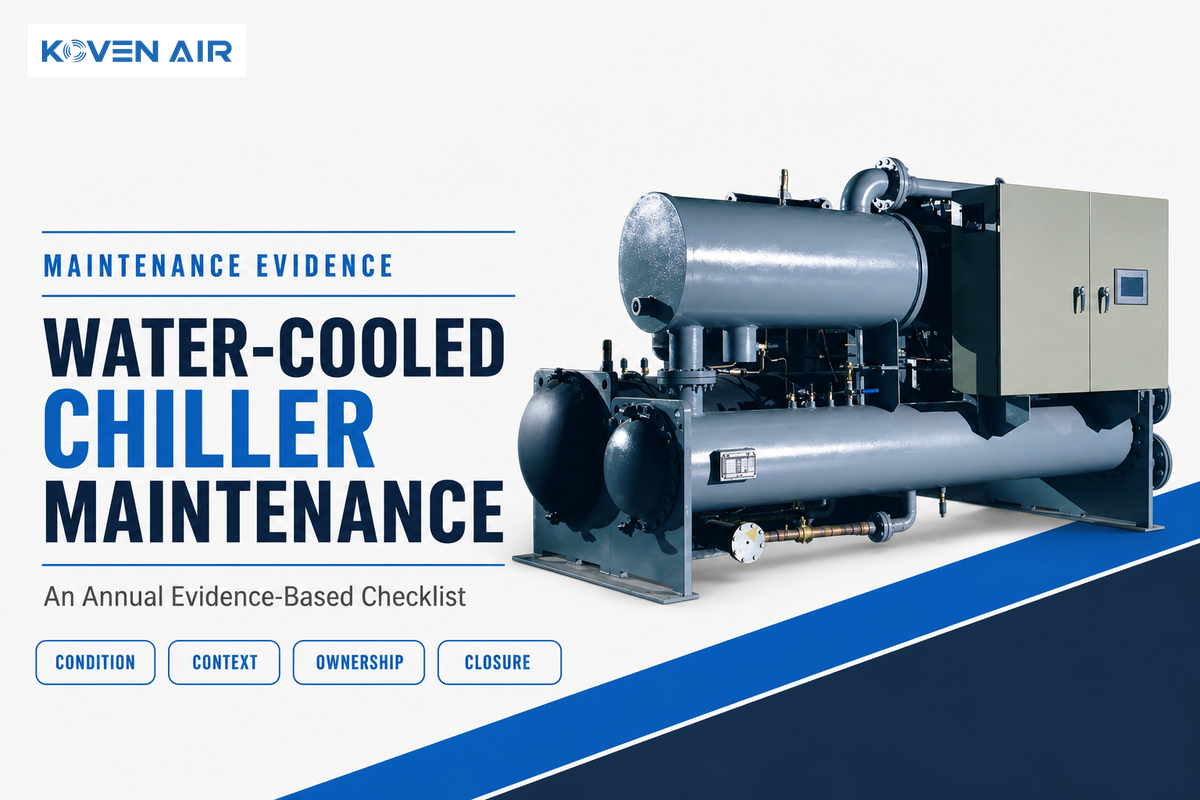
Water cooled chiller maintenance is the controlled process of recording condition, context, ownership, and closure for a water-cooled chiller; unlike maintenance procedures for air cooled chillers, the chiller’s water-side evidence must remain visible. A working program shows what was observed, under what load and flow, what action was taken, who owns the next step, and what seals it. That program defends reliability because the next user can compare apples to apples instead of guessing what “normal” meant the year prior.
This resource provides facility managers, planners, and service teams an evidence-first, annual program. It does not replace the exact chiller manual, the cooling-tower water-management program, site lockout/tagout procedures, or applicable refrigerant rules; it keeps cooling water evidence visible across industrial cooling systems and their connected chiller units. For more detailed information on the systems and fundamentals, read the broader water-cooled chiller Guide. Equipment selection, capacity, configuration, price, lead time, and quotations remain on Koven Air’s water-cooled industrial chiller solutions page.
ConditionMeasured value or observation
ContextLoad, flow, mode, and instruments
OwnershipPerson, work order, and due date
ClosurePost-work proof and acceptance
The maintenance rule that matters
Use calendar tasks to make sure work is not forgotten, and condition evidence to decide what the readings mean. Neither one cancels the other. The OEM manual, water-management plan, site risk controls, and project-specific scope remain the controlling documents.
What Water-Cooled Chiller Maintenance Must Prove
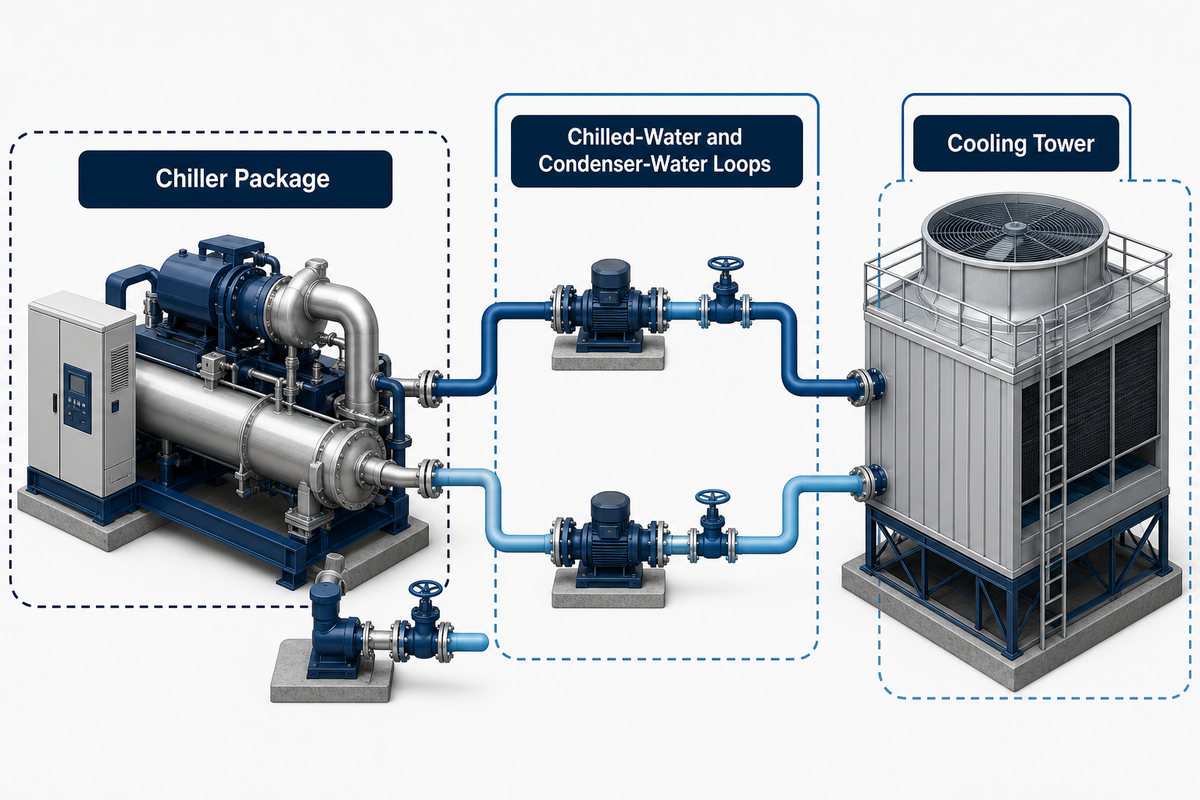
As a practical maintenance guide for proper maintenance practices, a maintenance program demonstrates four things: the asset or system boundary is defined; the observation was made under specific conditions; the response was assigned to an owner; the result is accepted or left visibly open. Without these four things, even a correct task can vanish to an ambiguous service record.
First, you must define a boundary. The chiller package includes a compressor, condenser and evaporator, expansion or metering functions, controls, sensors, safeties, refrigerant, and, depending on the design, oil-management components, while an efficient chiller still needs evidence before a team decides to regularly clean the condenser or adopt procedures for cleaning condenser coils. The operating system includes the chilled-water loop, condenser-water loop, pumps, strainers, cooling towers, or other heat-rejection equipment; water treatment; and the electrical system, building or plant controls, and processes or spaces being cooled, while cooling equipment records identify the chiller operating condition and available cooling capacity.
Not all assets have the same owner. A chiller technician may own a refrigerant-side diagnosis. An electrical team may own starters and distribution. A water-treatment expert may own chemical limits and corrective actions. Operations may own daily readings, while a controls specialist may own sensor calibration and sequence changes. The US Department of Energy’s FEMP O&M guidance combines scheduled assessments, routine observations, leak, and damage reporting, and manufacturer instructions. That’s an effective model. There’s no single checklist that covers an entire plant.
Because the cooling system goes across these boundaries, a symptom first observed during chiller operation may begin outside the package. The log must keep that broader boundary in view, rather than assign every abnormality to the compressor or heat exchanger.
| Equipment boundary | Typical evidence | Owner to name |
|---|---|---|
| Chiller package | Alarms, temperatures, pressures, oil/refrigerant records, vibration, tests | Qualified chiller service lead |
| Water loops | Flow evidence, entering/leaving temperatures, pressure drop, strainers | Mechanical operations |
| Cooling tower | Conductivity, make-up/blowdown, treatment, hygiene, fan and basin condition | Water/tower program owner |
| Plant controls | Sensor status, enable logic, setpoints, overrides, sequence and timestamps | Controls or BAS lead |
| Electrical supply | Starter or drive status, phase measurements, protective events, qualified inspection results | Authorized electrical lead |
| Refrigerant circuit | Circuit identity, leak/service records, charge change, repair verification | Qualified refrigerant technician |
| Lubrication system | Oil condition, pressure or level evidence, filters, heaters, service history | Chiller service lead |
| Safety and interlocks | Approved test method, result, alarm path, authorization and restoration status | Site technical authority |
| Cooling load | Production or occupancy context, schedule, load profile, critical users | Operations or process owner |
Every open item must be assigned an owner, due date, severity, and closure artifact. “Monitor” is not a disposition unless it states what will be measured, the next review date, and the escalation condition.
Set a Clean Baseline Before Scheduling Work

A true baseline is a set of readings taken after the equipment has been restored to an acceptable condition, with enough operating context to define an acceptable difference. It isn’t simply the first reading in a series. If load, flow, mode, sensor condition, or active equipment changed, an apparent trend may be an operating difference rather than deterioration.
Report asset ID, date, time, run hours, operating mode, compressor/stage status, estimated/measured load, chilled water flow, condenser water flow, entering and leaving temperatures for both circuits, evaporator and condenser approach, and water-side pressure drop where available, electrical input, alarm status, overrides, sensor cal status, context, and condition of the cooling tower. Refer to approved operating docs for units of measure and locations.
Load context matters because a water-cooled chiller behaves differently at full and partial load. FEMP’s electric-chiller guidance separates equipment type, capacity, and expected full- versus part-load operation when discussing performance. A maintenance trend should be just as explicit. Comparing a low-load morning to a high-load afternoon without adjustment may create a false alarm, or hide one.
A comparable record says
“Condenser approach increased under the same operating mode, similar load and verified flow; tower-water condition and sensor checks are attached.”
A weak record says
“Approach is high. Clean tubes.” It omits the operating condition, measurement confidence, and competing causes.
Stable baselines also have a limit of detection. A NIST chiller performance study illustrates that the ability to detect faults is conditional and changes with the operating condition of the equipment. Some degradation may have little visible impact on a controlled temperature, for example, a change in energy consumption or the life of a component may be a consequence of the degradation. “No trend change” means “no change detected by this evidence,” not “every fault is absent.”
Label units without turning them into alarm limits
A good log should document the value and unit, source point, instrument, and time. The examples shown below are recording units, not recommended set points. Use the approved drawing, control database, equipment documents and calibrated instruments. Don’t arbitrarily convert one to the other just to make it resemble a report from another site.
| Evidence field | Units that may appear | Context to retain |
|---|---|---|
| Chilled-water temperatures | °C or °F | Entering/leaving point, sensor identity, load and flow state |
| Condenser-water temperatures | °C or °F | Entering/leaving point, tower state and stable run time |
| Water-side pressure | psi or bar | Measurement locations, valve state, pump and strainer condition |
| Instantaneous electrical input | kW | Included equipment, operating stage and measurement source |
| Electrical energy | kWh | Time window, meter boundary and missing-data treatment |
| Motor electrical data | V, A and Hz | Phase, drive state, load and authorized test method |
| Rotating speed | RPM | Equipment identity, command, actual value and control mode |
| Vibration | mm/s where the approved method uses velocity | Location, axis, bandwidth, instrument and comparison basis |
| Refrigerant or oil quantity | kg or lbs | Material identity, circuit, reason, technician and service record |
| Trend and action windows | 24 hours, 7 days, 30 days or 12 months | These are useful views, not fixed maintenance intervals |
Before comparing two records for system performance, verify that they represent the same point and system boundary so conclusions about system failure rest on comparable evidence and help ensure optimal performance is judged consistently. Reporting a value as a degree Celsius can’t be compared to a degree Fahrenheit. A value reported in °C can’t be compared directly with °F; a package-only kW value can’t be treated as whole-plant kW; and a one-day snapshot can’t prove the direction of a 12-month trend. When controlled changes occur to a unit or point mapping, explain the reason for the change and keep the original data.
Use a Daily and Weekly Water-Cooled Chiller Evidence Log

A daily log captures the current operating state; a weekly review looks for repetition, drift and incomplete actions. The value comes from consistency. Even when teams follow the manufacturer’s procedure, a reading without an operator, time, unit, operating condition, or follow-up can’t be relied upon later to support a trip, efficiency complaint, or service call.
| Cadence | Record | Closeout question |
|---|---|---|
| Each shift or day | Temperatures, flow proof, alarms, stage/load, visible leaks, abnormal noise or vibration, overrides | Did an observation create a work order or defined recheck? |
| Weekly | Seven-day trends, repeated alarms, missing readings, water/tower changes, open actions | Which item is drifting, recurring, overdue, or unsupported? |
| After an event | Trip code, sequence, operating state, authorized response, restart result, evidence attachments | Was the cause established, or was operation merely restored? |
Records for cooling towers should also be tracked. FEMP states that cycles of concentration, make-up and blowdown flow and conductivity should be monitored and trended to find deterioration. Their cooling-tower management guidance states that allowable concentrations are dependent on the quality of the make-up water and the treatment program. A water-chemistry shift may explain condenser-side change, but it does not alone prove tube fouling.
Record visible scale, biological material, sediment, and corrosion as observations, then let the approved water-treatment and mechanical owners determine the cause and response. Don’t delete a chemistry excursion after treatment; retain it alongside the equipment trend so a later heat-transfer change has context.
Use attachments deliberately: a photo should show the asset and location; an instrument report should show the measurement and units; a BAS export should state its time range and point names. If a sensor is in question, retain the value and an independent check, rather than replacing the old record.
Plan Monthly and Quarterly Condition Checks by Risk and Ownership

Recurring activities should use the equipment manual, run hours, duty cycle, water quality, environment, failure history, legal requirements, and site risk assessment to establish the actual time interval. Evidence for a high-duty process chiller may not be the same as evidence for a seasonal comfort-cooling machine.
Regular inspection is one part of preventive maintenance; effective maintenance combines regular maintenance evidence with work by qualified maintenance technicians and does not treat inspection as a substitute for qualified service. Each recurring activity should be described in detail and evidence defined to close it should be included.
At a practical level, periodic review may include control and safety histories, sensor agreement, electrical condition, pump and strainer evidence, refrigerant and oil records where applicable, abnormal noise or vibration, water-treatment results, tower condition, open work orders, and the continued validity of the clean baseline. The review should describe each item as an operator inspection, a specialist test, or an OEM-defined procedure.
Keep heat transfer and cooling tower hygiene separate. CDC cooling-tower guidance calls for a water-management program, anti-stagnation measures, manufacturer-directed work around commissioning, startup, idling, and shutdown, and offline cleaning and disinfection at least annually. It also calls for low-flow pipe runs and dead legs to be flushed at least weekly. Blindly following these public-health controls for cooling towers for a closed chilled-water system isn’t prudent.
Put schedules, evidence, and owner in same row. “inspect Water Treatment Quarterly” is incomplete. A complete row name would be sample or log, target or approved range, reviewer, exception path, and proof of corrective action. If a contractor performs the task, the site still needs an internal owner to decide if returned evidence is acceptable.
Use the 5-Step Tube Trigger Ladder
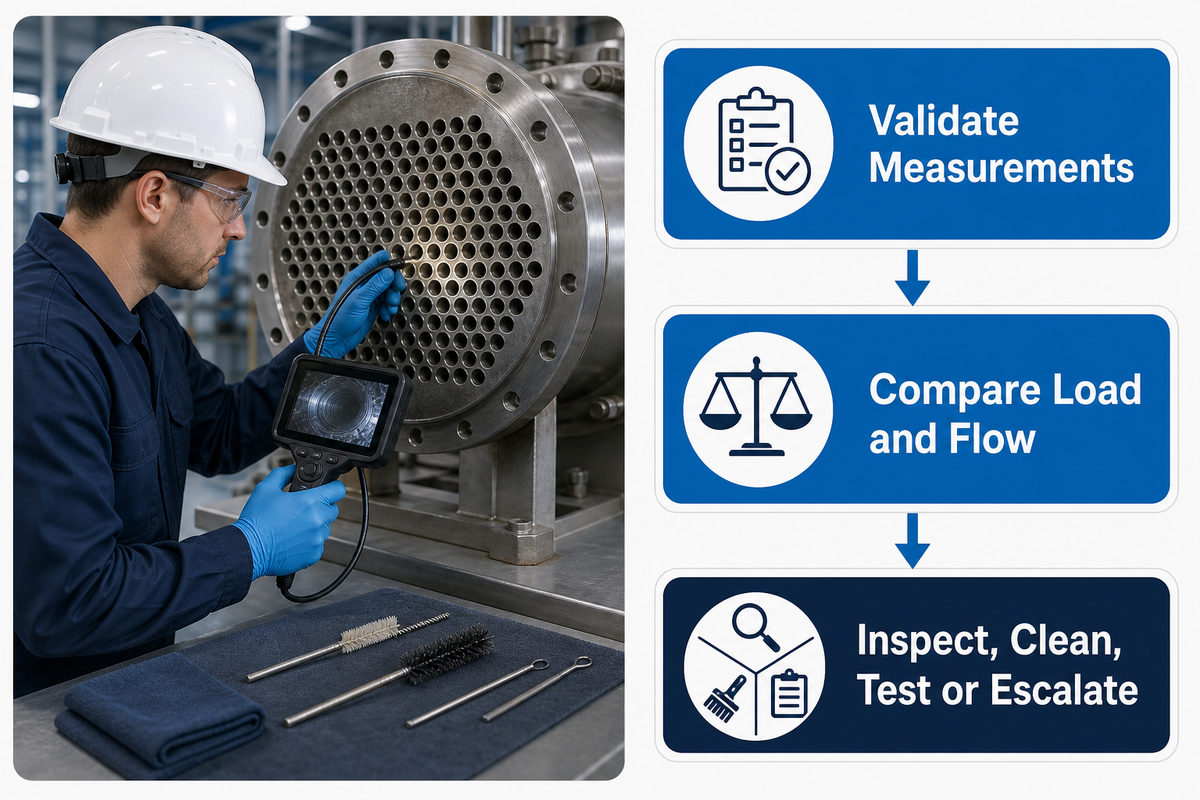
Condenser-tube work should follow a trigger ladder. Validate measurements, compare load and flow, examine tower and water treatment conditions, review the clean baseline, inspect, clean, test or escalate. This sequence reduces the chance of cleaning tubes when the real cause is a sensor, flow, tower, control, refrigerant-side, or operating-condition problem; diagnostics for potential problems such as low refrigerant levels examine conditions that cause the compressor to behave abnormally and belong with qualified personnel.
Equipment type needs to be explicit. Instructions written for an air cooled machine, including air-cooled equipment, may tell a team to clean the condenser coils or include routines for cleaning condenser coils, air circulation, and heat dissipation; they do not automatically tell a water-cooled team how or when to clean the condenser side. The applicable design and manufacturer documentation control the method.
- Validate the signal. Confirm point names, units, sensor status, timestamps, and any independent measurements as required by site procedure.
- Confirm comparison conditions. Verify operating mode, active compressors, load, chilled-water flow, condenser-water flow, and stable run time.
- Check adjacent systems. Review tower approach and fan state, make-up and blowdown, conductivity, treatment exceptions, strainers, valves, and pump operation.
- Compare the clean baseline. Evaluate condenser approach, water-side pressure drop, flow, normalized electrical input, alarms, and change rate.
- Choose and document the next action. Continue monitoring, inspect tubes, perform an approved cleaning, investigate another cause, or escalate to the qualified specialist named by the site.
A citation in the ASHRAE Journal reports on a research interview regarding condenser tube fouling. According to the interview, flow velocity and tube type affect fouling and pressures and temperatures provide operating context, while a single universal approach (i.e., a particular temperature or pressure drop number) can’t be justified to define automatic cleaning.
Condition evidence doesn’t cancel prescribed preventive work. Manuals, programs, and scopes may require periodic inspection or cleaning. A DOE/FEMP project O&M example includes annual tube cleaning and states that the maintenance table is a starting point, and is subject to project-specific changes. Indicate the basis for the need for maintenance as a prescribed interval, a condition evidence trigger, or both.
Condition evidence may trigger cleaning; after cleaning, document acceptance evidence. “Tubes cleaned” is a task record, and acceptance evidence may include ‘Anchored post-work readings compared at known load and flow, all exceptions closed.’
Build an Annual Shutdown Scope and Proof Pack

Each component should be evaluated using a scope table as the starting point rather than a purchase order. There should be a description for the task, prerequisite, inclusion and exclusion boundary, required deliverable, acceptance criteria, responsible party, exception path, and sign-off. This provides greater control over the scope of the work.
| Scope field | What to specify | Acceptance evidence |
|---|---|---|
| Prerequisite | Authorized shutdown, isolation plan, access, parts, water/treatment coordination | Permit or site release and pre-work condition record |
| Inspection/test | Exact asset, method, instrument, limit source, included components | Results, calibration status, photos or report, exceptions |
| Corrective work | Approval route, parts/fluids, repair boundary, hold points | Part identity, work performed, technician record, retest |
| Restart | Authorized sequence, stable condition, alarm and override review | Time-stamped readings and restart status |
| Handover | Open defects, owner, due date, operating restriction, final acceptance | Signed proof pack and CMMS links |
The proof pack should contain inspections, parts and fluids, refrigerant and oil records, evidence of cleaning, calibration and instrumentation, photos and test reports, control changes, open deficiencies, owner and due dates, evidence of acceptance, and before and after condition evidence. Keep raw reports as attachments and summarize the decision in the work order.
Build acceptance reviews around exceptions as opposed to document volume. First, compare the actual work performed to the work scoped. Then, for abnormal findings, trace to a work order, approved deferral, operating restriction or resolved status. Verify that a change in setpoint, control sequence, sensor, valve position, chemical program, part or refrigerant quantity has an approver and evidence to support the change. Lastly, identify what readings constitute the clean, post-work baseline and what readings still require observation.
A maintenance checklist can show the first 24 hours after restart, a 7-day stability check, an open-item view after 30 days, and the maintenance history of the last 12 months, provided the maintenance checks identify the responsible maintenance personnel. These examples show evidence windows rather than universal equipment intervals. Match the actual review timing to process criticality, operating hours, seasonal load, manufacturer instructions, site risk controls, and the severity of any unresolved condition.
Don’t accept final graphs without their boundaries. A graph of operational data should show the asset name, point names, units, time zone, sampling interval, missing data, and major changes in process operating state so industrial processes are not confused with equipment behavior or changing operational costs. If a contractor normalized data, ask for the method and the original data. That information allows the next reviewer to distinguish a genuine improvement from a change in load, flow, weather, controls, or data treatment.
The same FEMP O&M framework that links frequency, assessment, and action items is useful here: a schedule has little value unless the result changes a decision or confirms an acceptable condition. If a planned item isn’t performed, the proof pack should state why, who accepted the deferral, and what interim protection applies.
Separate Chiller Approach from Whole-Plant Performance
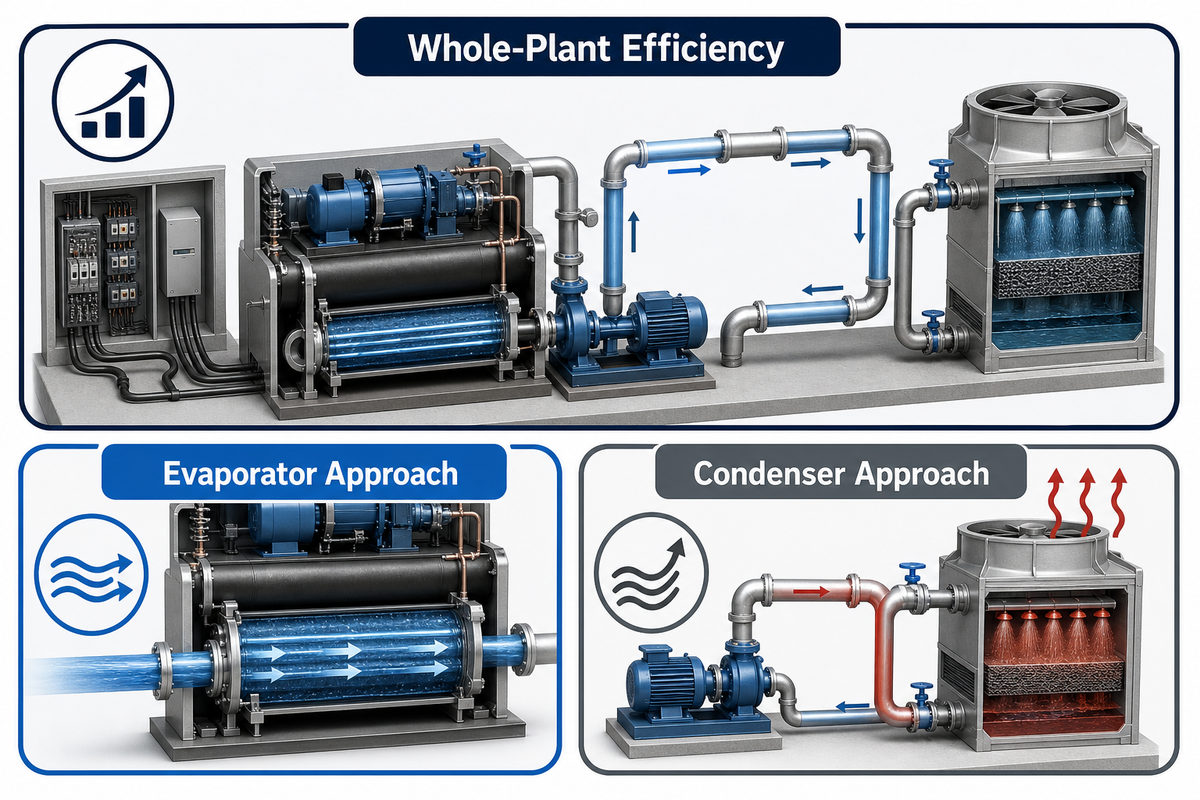
Evaporator approach, condenser approach, cooling-tower approach, and whole-plant efficiency describe different boundaries; they may affect one another but are not interchangeable, so efficient cooling, cooling demands, and cooling needs must be compared within the stated boundary. A useful maintenance report should name the formula, measurement points, operating context and diagnostic limit for each metric.
| Metric | Boundary and context | What it cannot prove alone |
|---|---|---|
| Evaporator approach | Evaporating refrigerant condition versus leaving chilled water, with load, flow, and sensor context | The cause of an abnormal value or whole-system efficiency |
| Condenser approach | Condensing refrigerant condition versus leaving condenser water, with load and flow | Tube fouling without ruling out measurement, flow, tower, or refrigerant-side factors |
| Tower approach | Leaving tower water versus entering-air wet-bulb, with water and air flow and fan state | Chiller heat-exchanger condition |
| Plant efficiency | Defined cooling output versus included chiller, pump, tower-fan, and auxiliary power | Which component caused a change without further diagnosis |
The FEMP chiller guidance explicitly distinguishes full-load and part-load performance. The FEMP cooling-tower guidance separately tracks water chemistry, make-up, blowdown, conductivity, and tower operation. That separation is the right reporting habit: diagnose the package, heat-rejection system, distribution system, and plant controls without making one number carry every conclusion.
Use an Evidence-Trigger-Owner Escalation Matrix
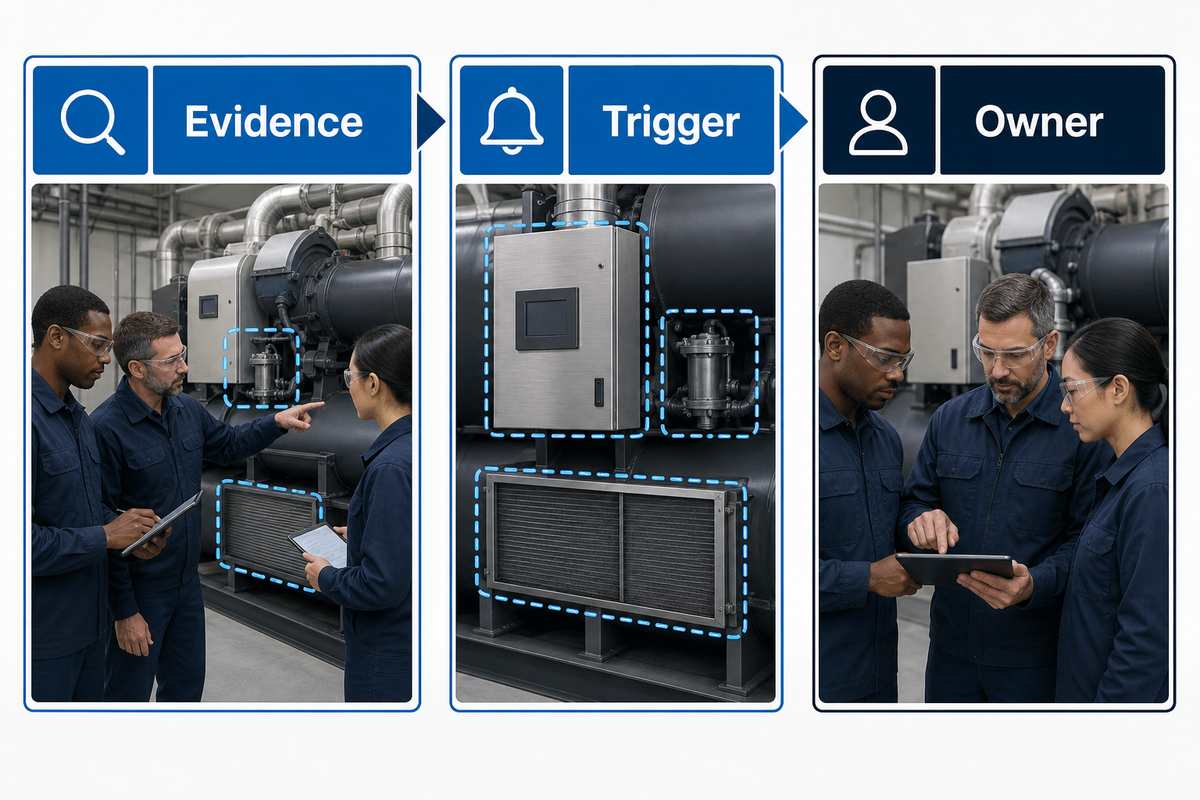
Escalation should be equivalent to the degree of uncertainty and severity of consequence. A mild, stable deviation with reliable measurements may justify a dated recheck. An active leak, electrical fault, loss of lubrication or required flow, pressure-boundary concern, rapidly worsening vibration, repeated trip, suspected contamination, or unexplained safety interlock calls for a more conservative response.
| Outcome | Minimum evidence | Owner |
|---|---|---|
| Monitor | Stable observation, next measurement, date, and escalation trigger | Named operator or reliability lead |
| Create work order | Defined defect, priority, due date, interim operating condition | Maintenance planner |
| Specialist diagnosis | Measurements and context attached; invasive or regulated scope identified | Qualified chiller, electrical, water, or controls specialist |
| OEM procedure | Exact model, manual revision, limits, tools, and authorization | Authorized service owner |
| Shutdown / no restart | Site safety decision, isolation status, release condition | Authorized site and technical authority |
In OSHA’s Hazardous Energy Overview, unexpected startup of both stored electrical and other forms of mechanical, hydraulic, pneumatic, chemical, or thermal energy can result in injury or death during the servicing of machinery or equipment. Isolation and verification should only be performed by trained, authorized personnel following the site’s energy control procedure. A blog checklist should never be used to bypass a trip or define a lockout sequence for equipment.
Refrigerant work has its own boundary. EPA Section 608 guidance requires applicable technician certification for work that could release refrigerant. In the United States, newer HFC management obligations under 40 CFR Part 84 also take effect in 2026 for specified equipment. Coverage depends on the refrigerant, charge, use, exemptions, and, in multi-circuit equipment, each independent circuit. Check the current EPA HFC guidance and controlling rule with a qualified compliance owner rather than applying one threshold to every chiller.
Turn the Records into a Service or Replacement Decision
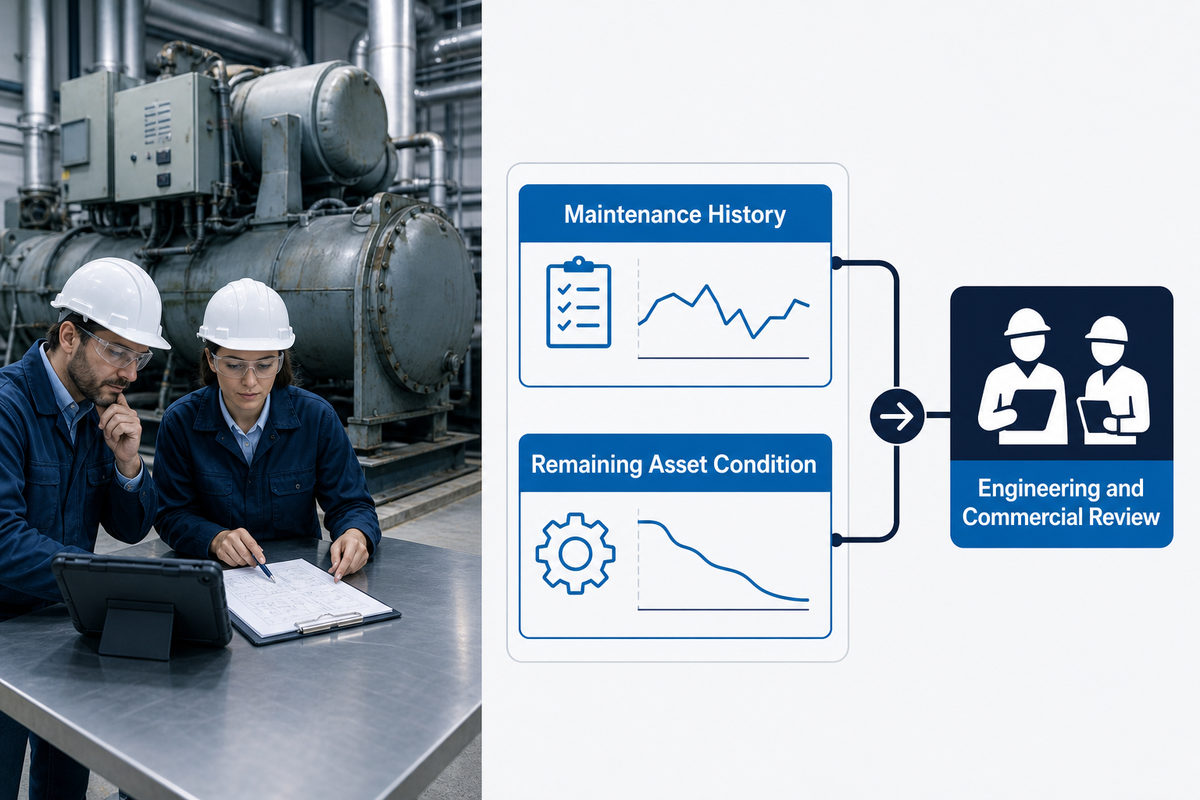
A service report is only acceptable if it establishes a verifiable, post-work state. Reject or return a report that omits the asset identity, test condition, before-and-after readings, instrument context, completed and deferred scope, open-defect owner, due date, restart status, or acceptance decision. “Service completed” on an invoice doesn’t establish a new baseline.
EPA’s stationary-refrigeration recordkeeping page illustrates why specific service evidence matters: for covered appliances, technicians and owners may need records for service, refrigerant added, leak inspections, and tests used to verify repairs. Even if a given regulatory requirement doesn’t currently apply to a situation, the rationale for documentation of service and repairs is sound.
Use recurring evidence to support the next case decision. A rising number of trips, repeated leaks, control obsolescence, unavailable parts, persistent performance loss at comparable conditions, increasing corrective hours, or unresolved safety risks may justify an engineering and commercial review. Operating criticality, remaining asset condition, redundancy, energy cost, process risk, site constraints, capital timing, and available equipment all matter.
When maintenance logs distinguish scheduled maintenance from fault-driven work and the evidence supports that unresolved water-side problems can lead to inadequate cooling by reducing heat transfer efficiency, a clear description of that evidence should be provided to the commercial team. The industrial chiller systems page of Koven Air describes the product family and procurement intent. The technical brief should include the process and control system, temperatures, the flow rate of chilled water, redundancy, environment, water quality, applicable codes, the risk of system failure, and evidence supporting the need for replacement.
Before you accept the annual report
Confirm that every open defect has an owner and due date, every changed reading has operating context, every regulated task has qualified evidence, and the final status says accepted, accepted with conditions, or rejected.
Confirm that every open defect has an owner and due date, every changed reading has operating context, every regulated task has qualified evidence, and the final status says accepted, accepted with conditions, or rejected.
Frequently Asked Questions
What are the common maintenance tasks for a chiller?
Common tasks fall into several evidence groups. Operators review logs, alarms, overrides, temperatures, load, and proof of chilled- and condenser-water flow. Mechanical staff inspect leaks, strainers, pumps, valves, tower condition, abnormal sound, and vibration. Qualified specialists handle the model-specific electrical, oil, refrigerant, control, safety, and heat-exchanger procedures assigned to them. Water-program owners review treatment results, make-up, blowdown, conductivity, and hygiene controls. Planners then reconcile open work, parts, due dates, and post-work acceptance. This grouping prevents a daily visual check from being mistaken for a specialist test, or a completed service task from being mistaken for verified performance. The governing manual, approved O&M scope, site risk controls, operating condition, and qualification requirements determine the exact task and frequency. Every result should retain the asset, observation, operating context, owner, next action, and closure evidence.
Do water-cooled chillers need a constant water supply?
A running water-cooled chiller needs proven flow through the evaporator and condenser circuits as required by its design and controls. That doesn’t mean an uncontrolled supply of new water. Most systems recirculate water through a chilled-water loop and a condenser-water loop connected to heat-rejection equipment. Loss of required flow is a protective condition; establish the cause before restart rather than bypassing an interlock.
How often should a water-cooled chiller be serviced?
Combine the manufacturer’s schedule, project O&M scope, run hours, site duty, water quality, operating trends, regulatory requirements, and risk profile. Shift or daily logs, weekly trend review, monthly or quarterly condition checks, and a planned annual shutdown serve different purposes. Condition triggers don’t cancel preventive work explicitly required by the OEM, water-management plan, warranty, or site procedure.
What are common water-cooled chiller maintenance problems?
Recurring alarms, reduced heat transfer, inadequate flow, water-treatment drift, refrigerant or oil concerns, electrical faults, sensor errors, abnormal vibration, control overrides, tower hygiene failures, and incomplete records can all reduce reliability. Preserve the finding and operating context first, then decide whether to monitor, create a work order, escalate to a specialist, or keep the equipment out of service.
What records should a contractor return after annual maintenance?
Require the asset identity, scope performed and deferred, test conditions, before-and-after readings, calibration and test results, refrigerant and oil records where applicable, replaced parts, photographs or instrument reports, open deficiencies, owner and due date, restart evidence, and signed acceptance status. A report that only says “maintenance completed” can’t support the next comparison.
Can facility staff perform all chiller repairs themselves?
Not necessarily. Trained staff may own routine observations, but hazardous-energy control, refrigerant work, electrical testing, pressure-boundary work, chemical treatment, and model-specific procedures can require authorized specialists. Follow the site program, current law, and exact equipment documentation.
References & Sources: Scope Boundaries
The following publicly available documents support the evidence framework. They aren’t to be confused with the OEM manual, locally adopted codes and standards, water management plan, or qualified professional judgment.
- DOE/FEMP – Technical O&M Guidelines on Common Water Equipment
- DOE/FEMP, Cooling Tower Management
- DOE/FEMP, Purchasing Energy-Efficient Electric Chillers
- CDC, Controlling Legionella in Cooling Towers
- OSHA, Control of Hazardous Energy
- EPA, Section 608 Technician Certification
- EPA, Stationary Refrigeration Recordkeeping
- EPA – HFC Phasedown and refrigerant Management Questions
- NIST, Experimental Chiller Performance Evaluation
Turn the evidence into a clear chiller brief
Use this checklist to define the operating condition, unresolved risks, acceptance evidence, and commercial handoff before discussing a new system.
Use this checklist to define the operating condition, unresolved risks, acceptance evidence, and commercial handoff before discussing a new system.
Factory Selection Support
Turn this guide into a usable HVAC RFQ package.
Share design conditions, airflow, temperature, humidity, process load, room use, and scope boundary. Koven Air can recommend a practical equipment route before quotation.
7equipment families
ISO / GMPcleanroom review
RFQscope comparison
What to prepare before quote
- Use settingCommercial building, cleanroom, hospital, data center, process area, or retrofit.
- Operating conditionsAirflow, load, temperature, humidity, static pressure, and duty hours.
- ConstraintsFootprint, access, hygiene class, material, controls, documentation, and delivery boundary.
Final equipment selection depends on local codes, project drawings, and confirmed site conditions.
Related Posts

Trending now