Get in Touch with Koven Air Company

Updated November 2026
Structured fan coil maintenance takes place in four zones: power controls, air filters, water valves, and drains, before ceiling tiles are touched. Neglected and faulty terminal units waste 15 to 30% of HVAC energy, according to the Energy and Buildings research. Routine tasks differ from a home cooling system because hydronic coils carry hot or cold water up to 1.6 MPa instead of refrigerant. Clean airflow, tight valves, and sloped drains preserve steady indoor comfort.
Quick Specs, Commercial FCU Maintenance Reference
| Rated Airflow & ESP (Koven Air KAFP) | 340–2,380 m³/h airflow; 12 / 30 / 50 Pa static |
| Piping & Access Ports (Koven Air) | DN20 headers; >=450 × 450 mm access panel |
| Condensate Drain Slope | >=1% min (Koven Air); 1:50 or 2% (Trane HFCF IOM) |
| Coil Pressure & Cleanability | 1.6 MPa limit; 4-row coil depth cap (ASHRAE) |
| Service Life Benchmark | 20 yr ASHRAE median (30–35 yr two-pipe shell, CMHC) |
| Energy Isolation Rule | OSHA 29 CFR 1910.147 physical lockout/tagout |
What Is Fan Coil Maintenance and How Do Commercial Hydronic Units Differ From Home AC?
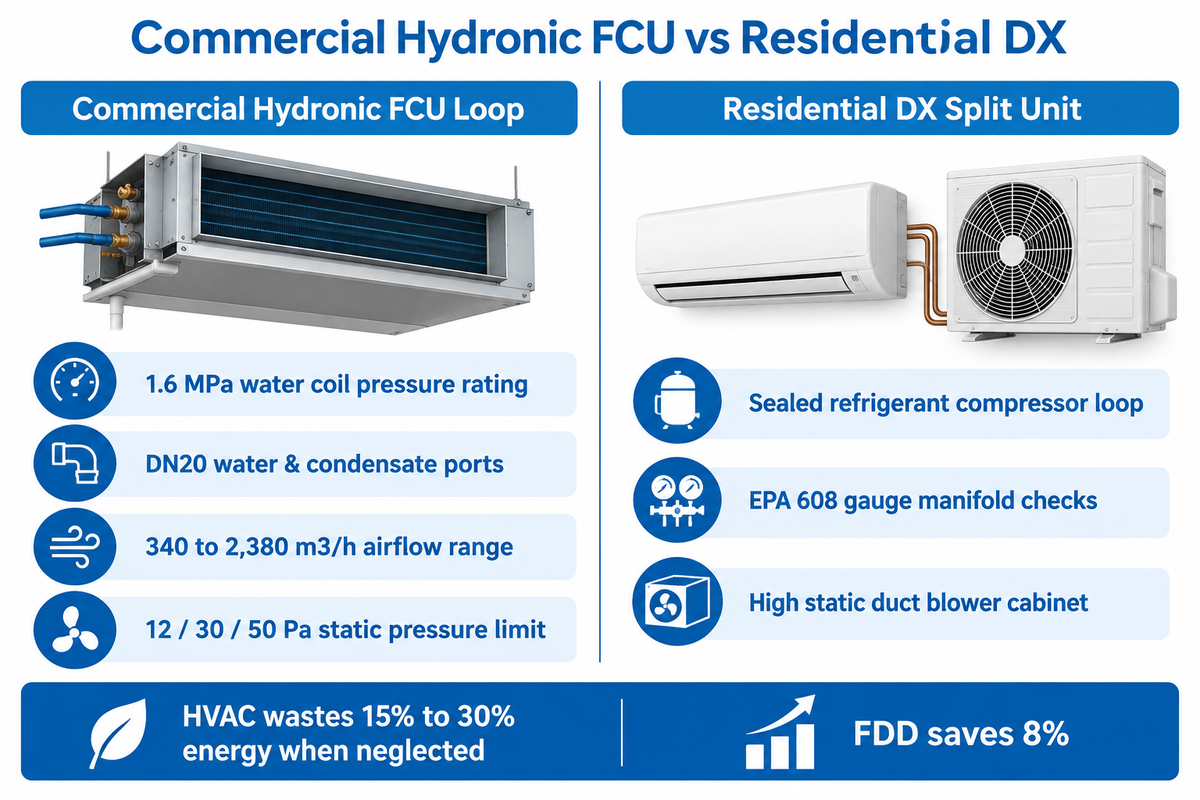
Commercial fan coil unit maintenance keeps hydronic coils, blowers, and drain pans, clean inside occupied rooms. Hydronic commercial fan coil units move hot or cold water through DN20 piping rather than refrigerant loops. Crews wash coils and flush strainers, with no steps for the recovery of refrigerant. This routine maintenance curbs the 15 to 30% energy waste seen across poorly maintained systems.
“15-30% energy consumption is wasted due to faults, malfunctioning and degrading equipment as well as poor maintenance.”
Picture a fan coil tucked above a ceiling grid; it works like a car radiator. Indoor air blows across copper water tubes connected to a central plant. These cooling and heating units regulate local zones well. Separate outdoor-air ducts must supply ventilation air to zones under ASHRAE Standard 62.1 because terminal fan coils recirculate indoor zone air. Architectural selection steps appear in our fan coil selection and unit types guide.
Do fan coil units need filters and how does commercial access change maintenance?
Every unit will need an air filter upstream of the heat exchanger to prevent dust buildup. According to Koven Air, an >=450 by 450 mm access panel needs to be provided under concealed FCUs. Crews will need that opening to replace the filter and wash pans.
Home air handlers sit inside wide mechanical closets with hinged doors. Commercial FCUs hide above tight ceiling tiles with 300 mm clearance zones. AIHA indoor air quality guidance notes preventive filtration beats downstream duct cleaning. Matching filter thickness to external static pressure protects small blower motors.
| Dimension | Commercial Hydronic FCU | Home DX Split AC |
|---|---|---|
| Heat Transfer Fluid | Water up to 1.6 MPa working pressure | Pressurized refrigerant circuit |
| Coil Work Licensing | Zero refrigerant recovery during washes | EPA 608 card needed for coil swaps |
| Static Budget | Low ESP classes (12 / 30 / 50 Pa, KAFP) | Near 0.50 inches wc (125 Pa) total static |
| Hydronic Valve Care | Needs Y-strainer flushing and air bleeding | Uses TXV/EEV expansion valves |
| Access Envelope | Min >=450 × 450 mm ceiling hatch | Full closet door and outdoor pad |
| Ventilation Scope | Conditions indoor air locally only | Recirculates return air through home |
Sources: Koven Air FCU Specifications and Trane Engineers Newsletter (ADM-APN070-EN).
What Preventive Maintenance Checklist and Frequency Does a Commercial Fan Coil Unit Require?
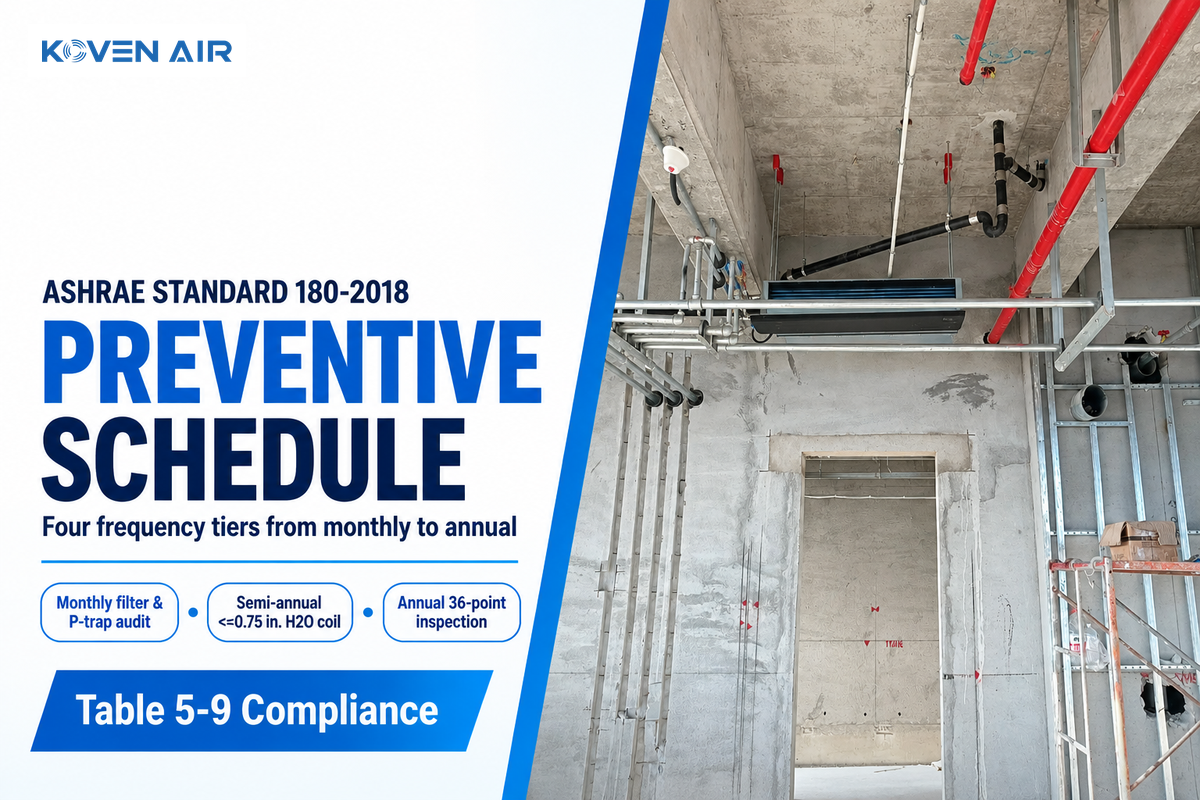
Inspect filters every 1 to 3 months and perform full servicing at least annually, per ANSI/ASHRAE/ACCA Standard 180-2018. Following a clear maintenance guide lowers energy use up to 15% and prevents ceiling leaks. CMHC guidelines require that two-pipe units be checked prior to seasonal changeovers. Sources: Koven Air FCU Specifications and Trane Engineers Newsletter (ADM-APN070-EN).
Avoid blank monthly cleanups of offices. Match maintenance tasks to operating conditions and measured dirt loading instead. Trane’s chilled-water HFCF manual pairs monthly filter inspection with an annual fcu inspection covering blower wheels and coils. Keep HVAC systems running along the manufacturer’s maintenance schedule below. Paired automated fault detection reduces HVAC energy waste by an average 8% during annual simulations.
| Interval | Component | Preventative Task & Quantitative Trigger |
|---|---|---|
| Monthly / 1–3 Months | Air Filter Media | Clean or replace when dust coats upstream faces |
| Monthly / 1–3 Months | Drain Pan & Float | Inspect the drain tray; trip float switch by hand |
| Quarterly | Supply & Return Grilles | Vacuum grilles and verify unobstructed indoor airflow |
| Quarterly | Thermostat Settings | Test cooling mode and heating setpoints for accuracy |
| Seasonal (Spring & Fall) | Y-Strainer & Air Vent | Flush strainer screens and bleed manual air vents |
| Seasonal (Spring & Fall) | Control Valves & Actuators | Stroke 2-way or 3-way valves from 0% to 100% |
| Annual | Fcu Coil & Fins | Brush coil fins; apply pH-neutral indoor cleaner |
| Annual | Blower Wheel & Motor | Vacuum wheel blades and test motor amp draw |
| Annual | Wiring & Insulation | Torque electrical terminals under lockout/tagout |
Sources: ASHRAE/ACCA Standard 180-2018, CMHC Technical Bulletin, and Trane HFCF IOM.
How to Isolate Fan Coil Faults Without Blind Teardowns: The 4-Zone FCU Triage Sequence
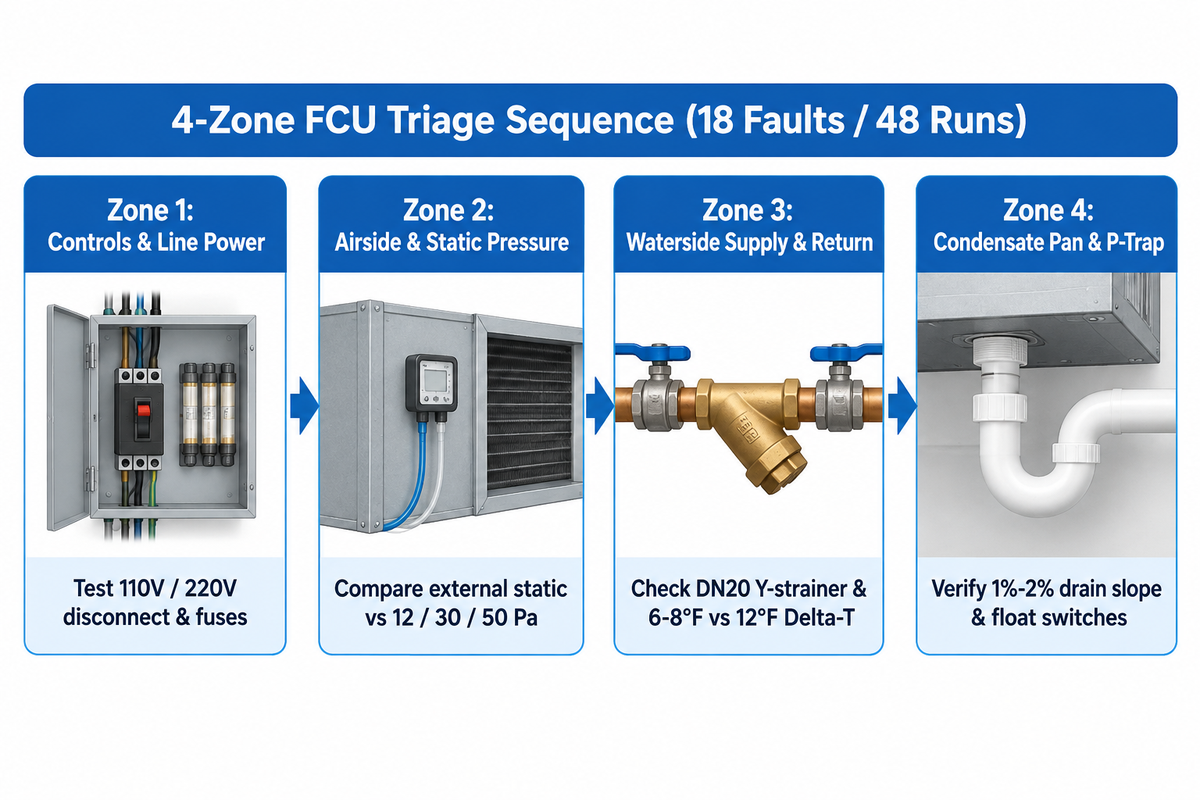
Run the 4-Zone FCU Triage Sequence—checking power controls, airside static, water delta T, and drainage—to locate faults before removing ceiling tiles. Modeling of 18 FCU faults across 48 simulations shows blind checks misread hydraulic errors. Flow Control field measurements show valve hunting drops delta T from 12°F to 6–8°F even with healthy chillers.
Let’s say a hotel wing reports guest rooms are warm with cooling setpoint. Don’t rush in to pull wash pumps in guest rooms just yet. In Zone 1, begin with a visual inspection of thermostat settings and the heating or cooling call instead. Working from outside to inside saves technician hours and keeps ceilings closed.
- Zone 1 — Check control call and line power — test thermostat setpoints, occupancy interlocks, and disconnect voltage first.
- Zone 2 — Check airflow and static pressure — inspect supply grilles and dirty filters starving a 12–50 Pa blower.
- Zone 3 — Check water supply and return split — compare header temperatures to catch air locks, fouled strainers, or stuck valves.
- Zone 4 — Check condensate pan and trap — verify float switches and drain slope only after airflow and water stabilize.
Always follow these four maintenance steps in strict order. Use the matrix below to determine the root cause of the symptom being shown.
| Zone | Symptom Observed | Measurement | Primary Root Cause |
|---|---|---|---|
| Zone 1: Controls | Dead blower and silent valve | Test 110V/220V disconnect and fuses | Blown fuse |
| Zone 1: Controls | Cools during winter heating call | Read inlet water temperature vs mode | 2-pipe seasonal changeover lag or wiring swap |
| Zone 2: Airside | Weak grille air and loud fan | Compare external static vs 12/30/50 Pa | Matted filter or high-MERV media drop |
| Zone 2: Airside | Normal speed with warm discharge | Check coil face and wheel blades | Fouled blower cups or packed coil lint |
| Zone 3: Waterside | Cold supply pipe, warm coil box | Test actuator stroke and bleed header | Trapped air lock or seized control valve |
| Zone 3: Waterside | Wide water ΔT and weak flow | Check drop across DN20 Y-strainer | Pipe sludge plugging strainer mesh |
| Zone 3: Waterside | Low water ΔT (6–8°F vs 12°F) | Log leaving air temperature swings | Oversized valve hunting or bypass leak |
| Zone 4: Drain | Water leaks only while fan runs | Check P-trap water seal depth | Shallow trap letting fan suction pull water |
| Zone 4: Drain | Pan overflows with trap full | Verify 1%–2% drain slope and plug | Algae clog inside drain pipe |
Sources: Energy and Buildings (2022) and Flow Control Low Delta-T Guidance.
Airside Maintenance: Filter Pressure Drop, External Static Pressure, and Coil Fin Cleaning
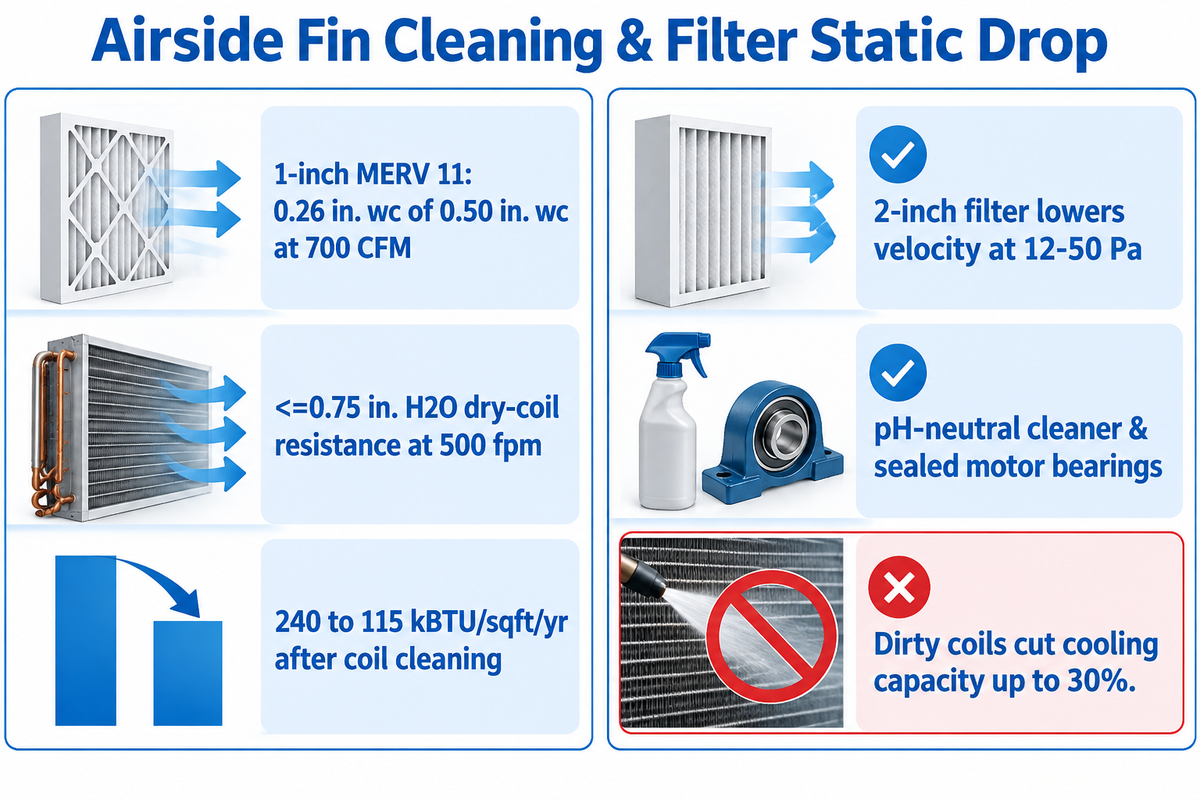
Match filter thickness strictly to the unit’s 12, 30, or 50 Pa external static pressure rating and wash indoor coils with pH-neutral cleaners. HVAC School field data shows a clean 1-inch MERV 11 filter consumes 0.26 inches wc out of a 0.50 inches wc budget at 700 CFM. High pressure drop stalls airflow before dirt even loads the media. Sources: Energy and Buildings (2022) and Flow Control Low Delta-T Guidance.
Good filter maintenance prevents air starvation in hidden zones. Installers must slide a new filter of matching depth whenever dust coats the return side. Price Industries testing proves two-inch pleated media cuts static drop and lowers indoor sound levels compared with 1-inch pads. Replace the filter cleanly without bending tracks. Meanwhile, ASHRAE Standard 62.1 limits clean dry-coil resistance to 0.75 inches of water at 500 fpm for accessible cleaning. ASHRAE Handbook Chapter 38 warns that cooling coils deeper than four rows with tight fin spacing are practically impossible to clean thoroughly in place.
How often should evaporator and hydronic fan coil fins be cleaned?
Once per year (every 6 months in high-traffic lobbies or kitchen zones) is the standard cleaning cycle for indoor hydronic FCU coil fins. Dry commercial office spaces retain heat transfer efficiency. Annual brushings and a mild chemical wash stabilize the fins.
When cleaning aluminum coil fins, use a soft nylon bristle brush or fin comb and brush vertically along the fin slots. Never direct the nozzle of a pressure washer across thin fin edges as the water can bend the metal flat. Always capture dirt buildup in a catch basin when washing above a finished gypsum ceiling.
What happens if you skip cleaning fan coil fins and blower wheels?
Neglecting fins drops cooling output because dirty coils reduce airside cooling capacity by up to 30% and push energy draw upward. At the University of Wyoming, complete air handler coil cleaning lowered energy consumption from 240 to 115 kBTU per square foot per year.
Skipping washes hurts comfort levels and drives equipment wear higher long before total failure occurs. Dust on the wheel blades of the blower unbalances the rotating shafts, increases sound levels, and prevents cooling of the coils by obstructing return air. Dirty heat exchangers increase energy waste and lead to premature failure costing ten times more than preventive washes.
Do
- Brush coils vertically with soft nylon bristles before wetting the fins.
- Use pH-neutral, non-foaming indoor detergents safe on aluminum.
- Keep filters clean, using deeper 2-inch pleated media only where the filter frame is built for that depth.
- Rinse the coil gently with water after mild neutral washes.
Don’t
- Never spray hydrofluoric or caustic outdoor cleaners on indoor evaporator fins.
- Never blast high-pressure water wands across soft aluminum coil rows.
- Avoid forcing dense MERV 11 1-inch media into 12–30 Pa units.
- Never wash coils before cutting power disconnects and emptying catch pans.
Exterior chemical washes should be restricted to unoccupied buildings. HydroBalance laboratory data proves hydrofluoric acid (HF), ammonium bifluoride (ABF), and strong alkalis etch indoor aluminum and generate flammable hydrogen gas inside closed ceiling boxes. Always size catch pans to capture full rinse water before flushing, then rinse the coil thoroughly with clean water.
Condensate Drain Pan, Trap Depth, and Water Damage Prevention
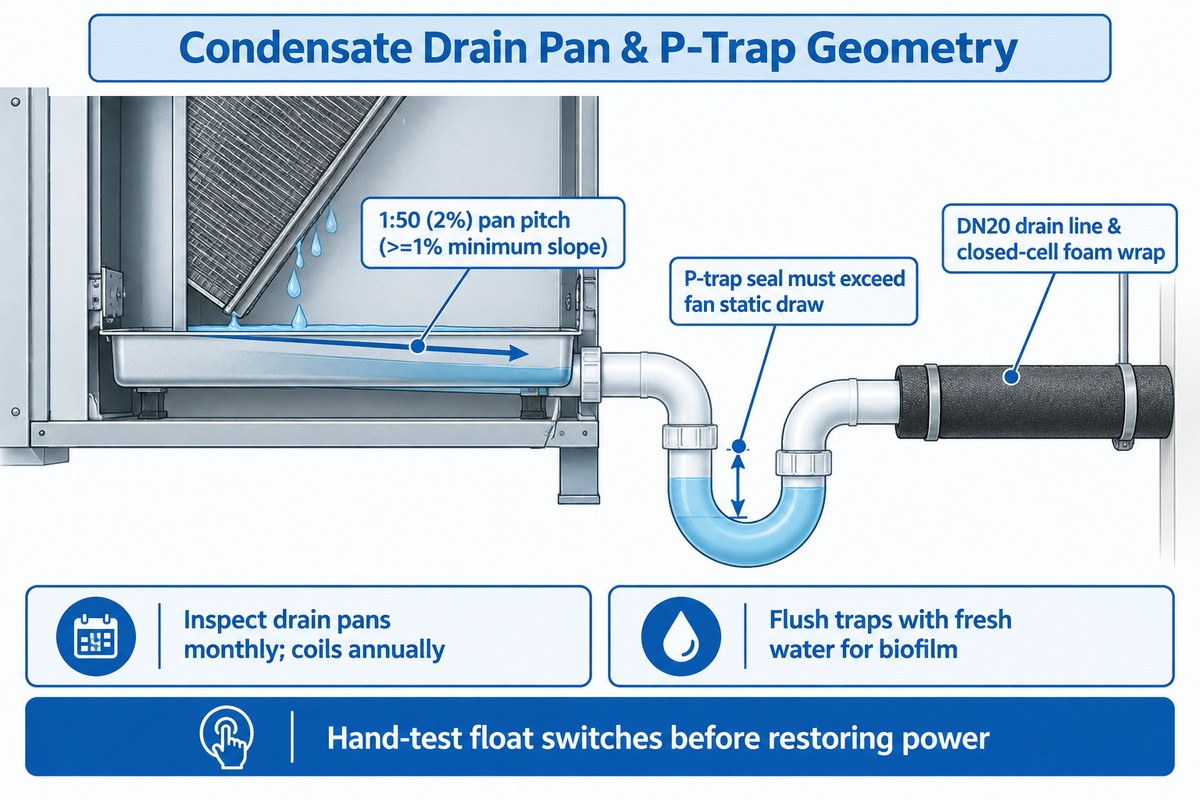
Inspect coils and drain pans monthly, maintain >=1% to 2% DN20 drain fall, and hand-test float switches to eliminate ceiling leaks. Trane’s chilled-water HFCF manual requires a minimum 1:50 (2%) drain line pitch, expanding Koven Air’s >=1% gravity site minimum baseline.
A level drain pan collects chilled-water coil runoff safely only when gravity piping falls uninterrupted toward risers. Even slight sag in the piping grows biofilm slime that obstructs the narrow DN20 lines. The installation guides of Trane caution against tilting the drain pan itself to level a tilted cabinet. On draw-through units, fan suction above the condensate drain pan pulls water backward unless the P-trap water seal exceeds fan static draw. Routine drain pan and trap inspection is part of ANSI/ASHRAE/ACCA Standard commercial maintenance practice.
⚠️ Condensate Overflow Risk
Biofilm clogs inside concealed ceiling trays cause water damage of the drywall within hours of peak cooling demand. Always flush traps with fresh water to wash away biofilm, and trip the overflow safety switches before restoring power.
Wrap cold DN20 headers and condensate drain traps fully in closed-cell foam insulation before closing any ceiling hatch. Exposed brass unions inside warm humid plenums sweat continuously and drip onto the tiles below, even if the drain line is clear.
Hydronic Waterside Troubleshooting: Air Locks, Y-Strainers, and Valve Actuators
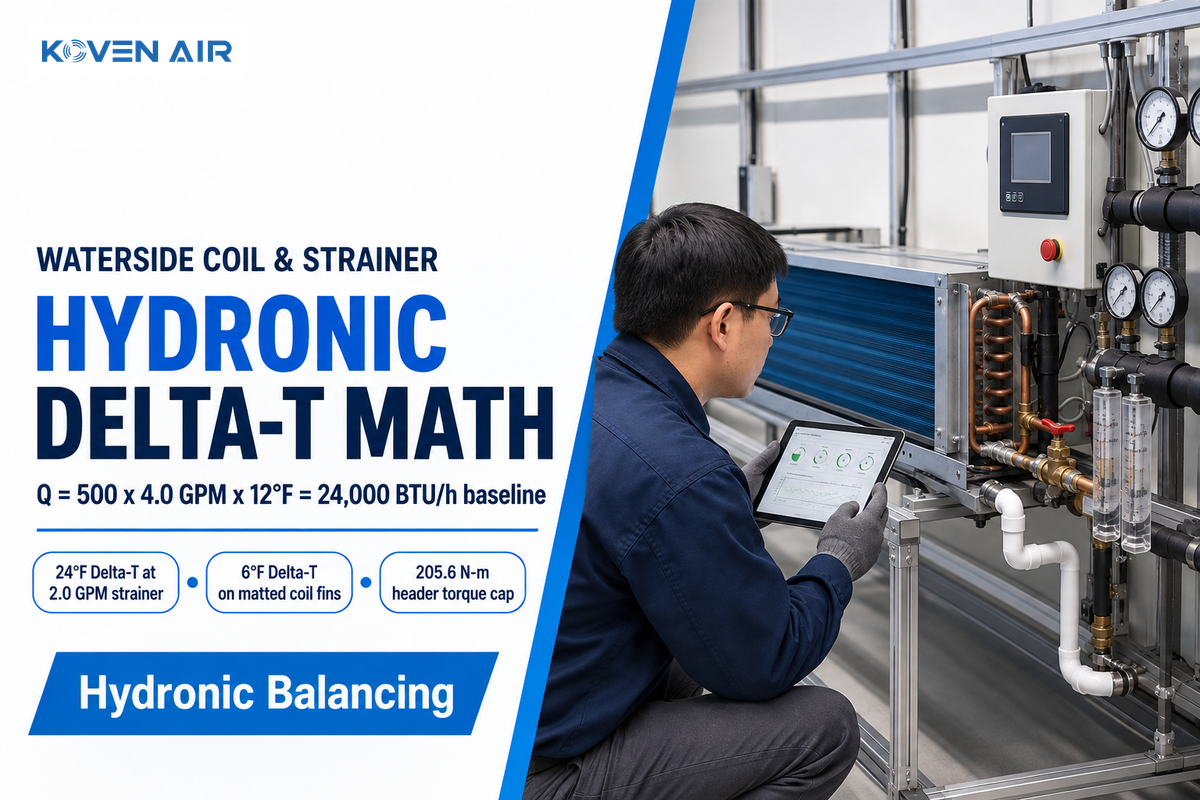
Diagnose water faults via Y-strainer drops, manual air bleeds, and actuator travel checks under 1.6 MPa loop pressure. Water flow obeys Q = 500 × GPM × ΔT, so fouled screens raise ΔT while bypassing actuators starve central chillers. Switching to pressure-independent control valves narrows leaving air variation from ASHRAE Guideline 13’s ±1.5°F down to ±0.1°F and slashes pump power up to 67%.
Assumed inputs: assume one chilled-water coil is rated at 24,000 BTU/h with 4.0 GPM design water flow and a 12°F ΔT using standard water constant 500. Under starved water or dirty coil fins, the formula isolates fault paths clearly:
📐 Worked Example, Separating Plugged Strainers from Fouled Airside Fins
1. Design State: Q = 500 × 4.0 GPM × 12°F = 24,000 BTU/h normally delivered.
2. Fouled Y-Strainer (2.0 GPM half-flow, steady heat load): ΔT spikes to 24,000/(500 × 2.0) = 24°F while return lines feel warm.
3. Matted Coil Fins (12,000 BTU/h halved transfer at full 4.0 GPM): ΔT drops to 12,000/(500 × 4.0) = 6°F with cold return water. Return lines feel cool.
Field maintenance tips from mechanical engineers on Eng-Tips recommend dual ball isolation valves and dual hose flush ports over automatic air vents. Automatic vents leak or jam shut above a drywall ceiling. Hose purge valves let users backflush sludge easily into buckets. Keep wrench torque below Trane’s 205.6 N·m cap on 3/4-inch MPT water headers using backup wrenches. Review hydronic 2-pipe and 4-pipe fan coil units and central chilled water temperature settings for integration to plant loop.
Fan Motor, Blower Assembly, and OSHA 1910.147 Lockout/Tagout Safety
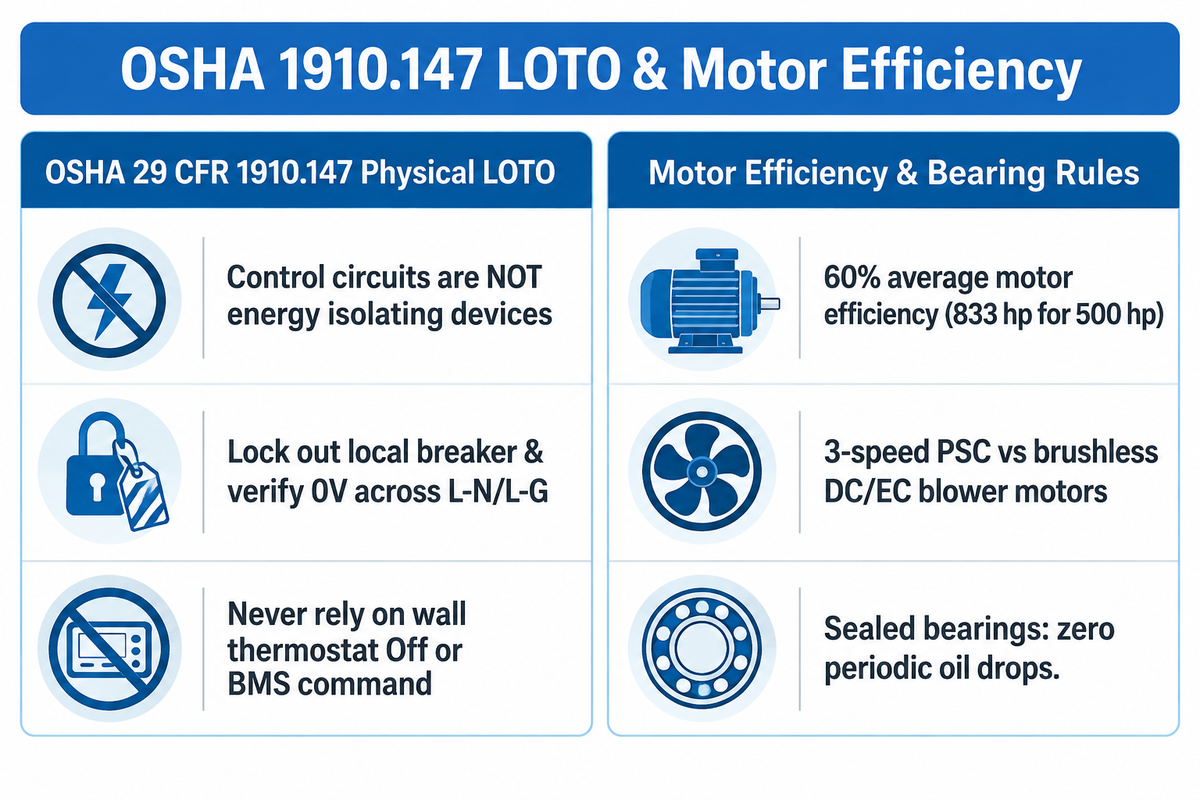
Lock out electrical disconnects and both hydronic supply and return isolation valves physically under OSHA 29 CFR 1910.147 before servicing blowers. Thermostats and relays don’t qualify as energy isolation devices. Verify with a calibrated meter that there’s zero voltage, then brush the squirrel-cage wheel. Don’t add lubrication.
“Control circuitry does not provide a physical barrier that controls hazardous energy and, therefore, is not an energy isolation device. For example, push buttons, selector switches, and interlocking gates are not energy isolation devices and are not permissible substitutes for energy isolation devices under the standard.”
Modern direct drive blower motors contain sealed for life ball bearings and require zero periodic oiling. Trane’s HFCF manual warns crews never to oil sealed bearings because excess lubricant traps dust inside windings. Unusual noises such as squealing or scraping signal worn shafts, loose wheel set screws, or hardened rubber grommets.
Test PSC run capacitors when motors hum or stall at full voltage. According to ACHR News reporting on Carrier field studies, average legacy FCU motor efficiency is around 60%, meaning a 500 hp fan load draws around 833 hp. Before outside vendors touch occupied wings, facility managers and HVAC contractors must share written LOTO steps under 1910.147(f)(2) and bleed water pressure first.
Maintenance Access Across Horizontal, Vertical, Concealed, and Cassette FCUs (2-Pipe vs 4-Pipe)
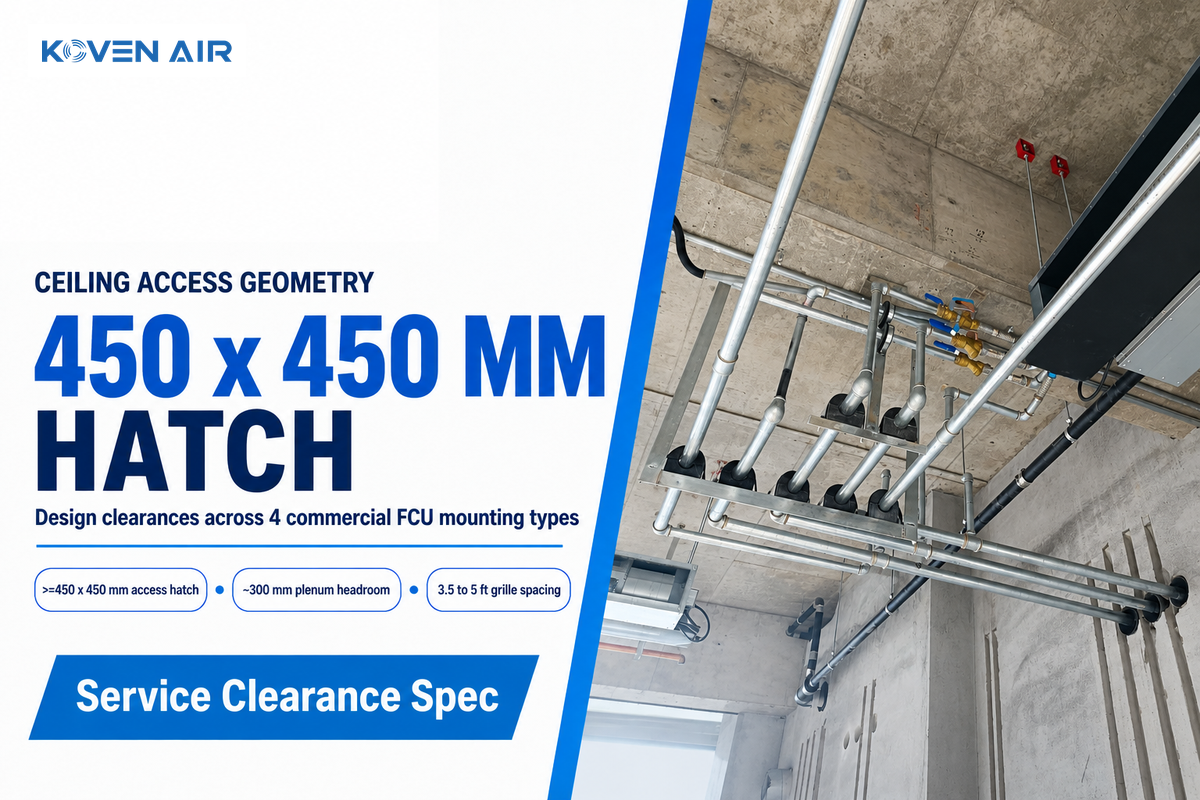
Cabinet style and piping circuits set technician access time far more than coil tonnage. Contractors must complete written lockout/tagout (LOTO) procedures before opening any cabinet panel. Concealed ducted fan coil units in the Koven Air KAFP family need roughly 300 mm height clearance and an >=450 by 450 mm hinged hatch beneath filters and DN20 valves. Low-profile horizontal fan coil units under 12 inches high fit tight soffits per Price Industries notes while keeping side filter tracks open.
Each chassis demands a unique access path for maintenance. Grid-ceiling cassette fan coils drop intake filters straight down through return grilles for rapid floor service. Vertical condo fan coil stacks described in Consulting-Specifying Engineer serve up to 1,300 CFM from a removable front panel along a riser. Airside balancing keeps Koven Air supply ducts at 700–900 FPM and grille velocities near 300–600 FPM.
2-Pipe Hydronic Loops
- Uses one supply pipe and one return line per unit.
- Operates building-wide in heating or cooling mode per season.
- Requires unified spring and fall changeover valve inspections.
- Fewer valves leave wider hand clearance inside tight hatches.
4-Pipe Hydronic Loops
- Separates chilled-water and hot-water coil headers per FCU.
- Maintains simultaneous climate control across opposing building facades.
- Doubles Y-strainer screens, bleed ports, and actuator calibration work.
- Requires larger ceiling access panels for dual valve service.
Choose loop configuration per real zone load splits documented by CMHC. Two-pipe heating and cooling systems run globally in either heating or cooling mode per season and can’t deliver simultaneous heating and cooling across adjacent zones. Keep supply and return vents 3.5 to 5 ft apart to prevent short-circuiting.
Fan Coil Cleaning Cost, Typical Lifespan, and the 15-Year Core-vs-Cabinet Split Rule
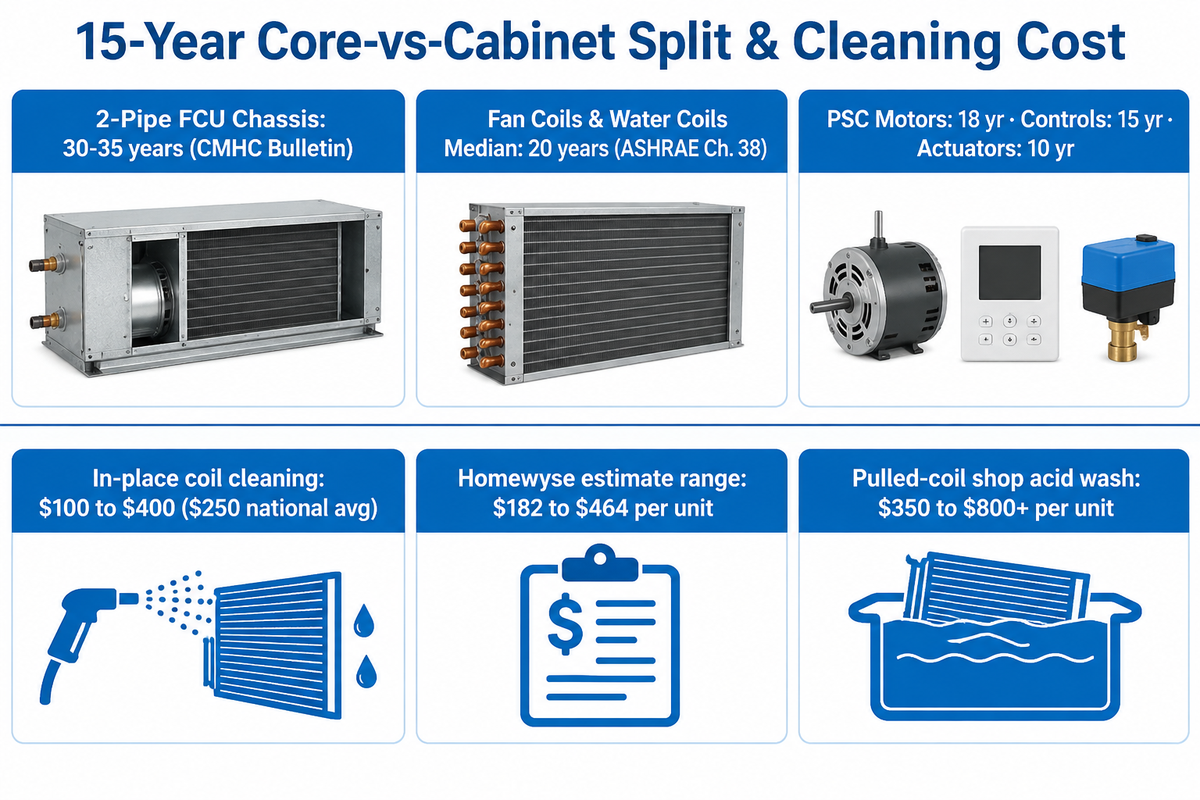
Published benchmarks set commercial FCU chassis life at 20 years median, per ASHRAE data, and 30-35 years for two-pipe housings per CMHC. US contractor rates quote $100 to $400 for in-place coil cleaning and $350 to $800 or more for pulled-coil acid washes. Buyers should keep single-unit residential prices separate from bulk commercial service tenders.
Facility owners often see conflicting 15-year and 35-year equipment estimates. We close this gap using the 15-Year Core-vs-Cabinet Split Rule, which is based on ASHRAE Handbook Chapter 38 Table 4. Akalin’s 1978 survey reports a median service life of 20 years for fan coils and water coils, 18 years for motors, 15 years for electronic controls and 10 years for self-contained actuators. ASHRAE flags Abramson et al. (2005) FCU averages as N/A* for insufficient sample size, reinforcing why regular maintenance keeps durable metal cabinets running while wear cores swap mid-life.
How much does HVAC coil cleaning cost versus commercial FCU servicing?
Standard in-place coil cleaning typically costs $100 to $400 per unit across U.S. benchmarks (averaging $250 nationally on 2026 indexes, with a wider range of $182 to $464 on Homewyse estimates). Pulling coils out for shop acid washing rises to $350–$800+ per unit. These rates reflect single residential or condo service calls rather than bulk commercial bids.
Multi-story hotels reduce cost per unit of typical maintenance by staging HEPA vacuums room by room. Bundled building contracts sharply lower mobilization cost compared to single emergency contracts. Deferring preventive cleanings increases downstream emergency costs tenfold when corroded pans or failed motors require full unit replacement.
| Component | Published Median Life | 15-Year Decision (Repair / Retrofit / Replace) |
|---|---|---|
| Electronic Controls | 15 years (ASHRAE Ch. 38) | Swap thermostats or install 0–10V sensors |
| Valve Actuators | 10 years (ASHRAE Ch. 38) | Rebuild cartridges or add PICV valves |
| PSC Fan Motors | 18 years (ASHRAE Ch. 38) | Upgrade cabinets to drop-in EC blower kits |
| Water Coils | 20 years (ASHRAE Ch. 38) | Pressure-test headers; swap on split leaks |
| 2-Pipe FCU Chassis | 30–35 years (CMHC Bulletin) | Keep chassis in wall unless drain pans rust |
Sources: ASHRAE 2019 Handbook Chapter 38 (Akalin 1978, Abramson 2005 N/A* caveat) and CMHC Bulletin.
Industry Outlook: EC Motor Upgrades, Modulating Valves, and OEM Spare-Parts Continuity
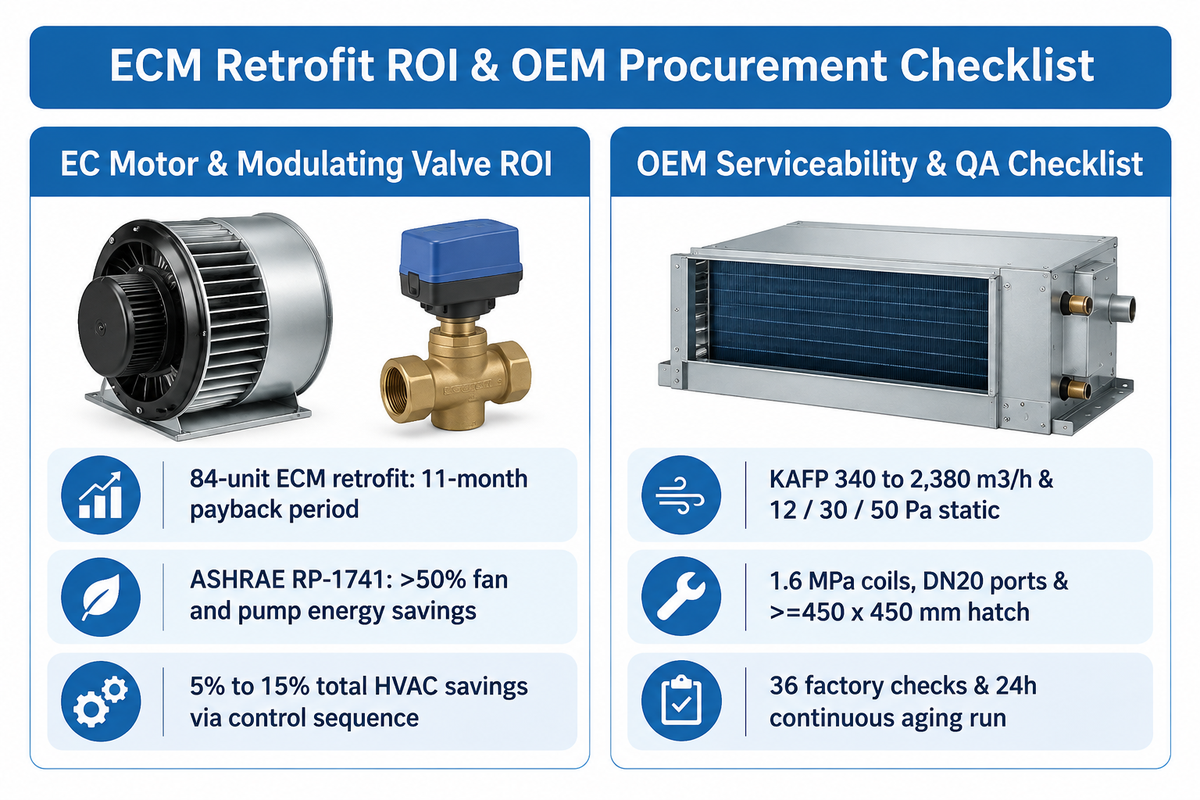
Facility teams are upgrading standard motor swaps to variable-speed EC fan and modulating 0-10V valve retrofits. The ASHRAE Handbook and CMHC bulletin split service life between core and cabinet, which guides these mid-life upgrades. ASHRAE Journal RP-1741 modeling confirms proportional air and water control uses over 50% less energy on FCU fans, cuts pump power over 50%, and trims total HVAC consumption 5% to 15% over on-off cycling.
Price Industries engineering notes explain why speed control delivers deep savings: buildings rarely run at full design-day load. Thus, significant energy savings and reduction in fan noise can be expected from EC motors. Converting PSC motors to EC motors during regular preventive maintenance cycles pays for itself through energy cost savings.
Hospital field retrofits prove pre-packaged spares shorten room downtime. ACHR News coverage of Boston Medical Center documents an 84-unit ECM rollout covering 68 vertical, 10 horizontal hideaway, and 6 vertical hideaway units. Pre-fab valve pockets let technicians slip in pre-piped valve trees. Global FCU market reporting in 2026 projects demand moving from USD 5.1 billion in 2025 toward USD 8.1 billion by 2035 at a 4.6% compound rate.
Qualify OEM spares documentation before issuing 2026–2027 retrofit purchase orders. Koven Air validates commercial hydronic units through 36 factory inspections, 24h continuous ageing tests, and coil working pressure ratings up to 1.6 MPa. Document three specs when sourcing spare coils, valves, or EC motors.
-
✔
Match coil header handing (left or right), DN20 connection threads, and 1.6 MPa working rating. -
✔
Match fan static rating (12 / 30 / 50 Pa) and airflow band (340–2,380 m³/h) to existing ductwork. -
✔
Specify actuator control signal (on/off 24V/220V or modulating 0–10V) and factory test certificates.
Key takeaway
Run the 4-Zone FCU Triage Sequence before opening ceilings, hold >=1% to 2% drain pitch and pH-neutral washes, and apply the 15-Year Core-vs-Cabinet Split Rule to upgrade cores inside 30-year chassis.
Frequently Asked Questions About Fan Coil Maintenance
How long does commercial fan coil unit maintenance take per unit?
Routine HVAC maintenance checks run under one hour on accessible vertical units, whereas deep in-place coil cleaning takes around 3.0 basic labor hours per unit on Homewyse estimates.
Concealed ceiling jobs lengthen when hatches measure under 450 by 450 mm. Staging filters floor by floor keeps multi-unit hotel schedules tight and avoids repeating setup time.
Are fan coil maintenance checks required by building codes?
ANSI/ASHRAE/ACCA Standard 180-2018 sets the consensus industry inspection standard referenced when municipal building or mechanical codes require commercial HVAC maintenance.
In addition, OSHA 29 CFR 1910.147 mandates physical lockout/tagout energy isolation and outside contractor safety notification in the workplace whenever crews service blower motors, electric heaters, or pressurized hydronic zone valves.
What is the difference between fan coil maintenance and central air handler maintenance?
Compact fan coil terminals are serviced above ceilings, whereas large central air handlers contain belt-driven fans and outside air dampers.
Commercial FCUs rely on sealed ball bearings and small DN20 zone control valves across dozens of rooms. By comparison, central air handling systems house multi-row coils and multi-stage filtration inside dedicated building mechanical rooms.
Do all fan coil units use a condensate pump?
No, most horizontal FCUs drain by gravity along 1% to 2% sloped DN20 piping.
Pumps appear mainly in ceiling cassettes or shallow soffits lacking gravity fall.
Should you use no-rinse or acidic coil cleaner on aluminum fan coil fins?
Use only pH-neutral or mild non-foaming indoor detergents safe on aluminum, and never apply acid or caustic outdoor cleaners indoors.
Concentrated hydrofluoric acid, ammonium bifluoride, and strong alkalis etch aluminum and release flammable hydrogen gas inside confined ceiling boxes. Leftover chemical foam settles inside wet condensate trays, pitting thin aluminum fins and corroding copper manifolds into pinhole water leaks. Low-pressure nylon brushing followed by clean water rinsing removes dust and grease safely without indoor gas hazards or shortened coil life.
How do you bleed trapped air from a hydronic fan coil unit?
Open the manual air vent on top of the coil header until steady water runs bubble-free.
To remove air locks, push the water through the dual valve purge ports in the reverse direction.
Can commercial buildings upgrade existing PSC fan coil motors to EC motors during maintenance?
Yes, facility teams can perform drop-in EC motor retrofits within intact cabinets, without pulling vertical pipe risers out of walls.
Pairing variable-speed EC motors with modulating water control valves saves more than 50% fan energy use under the ASHRAE RP-1741 model. Before ordering replacement kits, verify supply voltage (110V or 220V), cabinet external static rating (12, 30, or 50 Pa), and 0–10V thermostat control wiring compatibility so airflow and sound stay balanced.
References & Sources
- Chen, Lin & Granderson (2022), Fan Coil Unit Fault Detection & Energy Simulation (Energy and Buildings Vol. 263) ScienceDirect / Elsevier
- What’s Up with Duct Cleaning? Commercial HVAC Hygiene and IAQ Review American Industrial Hygiene Association (AIHA The Synergist)
- ANSI/ASHRAE/ACCA Standard 180-2018 Titles, Purposes and Scopes ASHRAE
- Reducing Costs of Affordable Housing: Two-Pipe Fan Coil Systems Canada Mortgage and Housing Corporation (CMHC)
- Low Delta-T Syndrome in Chilled Water Systems and PICV Control Analysis Flow Control Magazine
- Air Filter Static Pressure Drop Field Measurements HVAC School
- 2019 ASHRAE Handbook, HVAC Applications, Chapter 38: Economic Analyses and Service Life ASHRAE
- 29 CFR 1910.147, The Control of Hazardous Energy (Lockout/Tagout) Occupational Safety and Health Administration (OSHA)
- Lockout/Tagout eTool: Specific Energy Control Procedures and Circuitry Prohibition OSHA
- Fan Coil Units Get VSD: Commercial Motor Efficiency and NYSERDA Field Testing The ACHR News
- Commercial High-Rise Vertical Fan Coil Specification Benchmark Consulting-Specifying Engineer
- Understanding Fan Coil Components and Energy Modeling (ASHRAE RP-1741) ASHRAE Journal
- Boston Medical Center Sees Healthy Energy Savings With 84-Unit ECM Fan Coil Retrofit The ACHR News
Field Maintenance Perspective
Facility teams lose countless hours responding to comfort complaints due to overlooked valve stroke, concealed access hatches and drain slope tolerances during commissioning. The 4-Zone FCU Triage Sequence and 15-Year Core-vs-Cabinet Split Rule synthesize OEM hydronic test data, ASHRAE service life tables, and OSHA rules. Reviewed by the Koven Air Environment Technology Co., Ltd. technical team.
Related Articles
- Scroll and Screw Chiller Guide Selecting central chilled-water plant capacity for multi-zone building loops.
- Centrifugal Chiller Maintenance Checklist Aligning central chilled-water plant upkeep with terminal FCU service intervals.
Planning Replacement Fan Coil Coils or New Commercial Schedules?
Send your room airflow targets, static limits, 2-pipe or 4-pipe layout, and ceiling height constraints to check commercial models validated through 36 factory inspections and 24h continuous ageing tests.