Get in Touch with Koven Air Company


Centrifugal chiller maintenance covers compressors, heat exchangers, the refrigerant circuit and controls, with oil-system or magnetic-bearing work added for the installed design. A good service agreement names the work to be done, the shut-down and the readings. An annual visit alone does not define what the service agreement includes.
Oil-free equipment eliminates oil maintenance, but still needs heat-transfer and electrical maintenance. Likewise, a low annual fee can become expensive when tube cleaning, diagnostic access or return-to-service testing sits outside the quoted scope.
Updated November 2026
Maintenance planning at a glance
- Identify the bearing design, refrigerant and condenser type before comparing checklists.
- Separate operating checks, planned shutdown work and compressor overhaul.
- Price diagnostic access, consumables and restart testing explicitly.
- Compare performance at recorded load and water conditions.
Centrifugal chiller maintenance combines routine monitoring with model-specific service. Buy a defined service package with work performed, findings recorded and restart tests done.
Centrifugal chiller maintenance scope and checklist
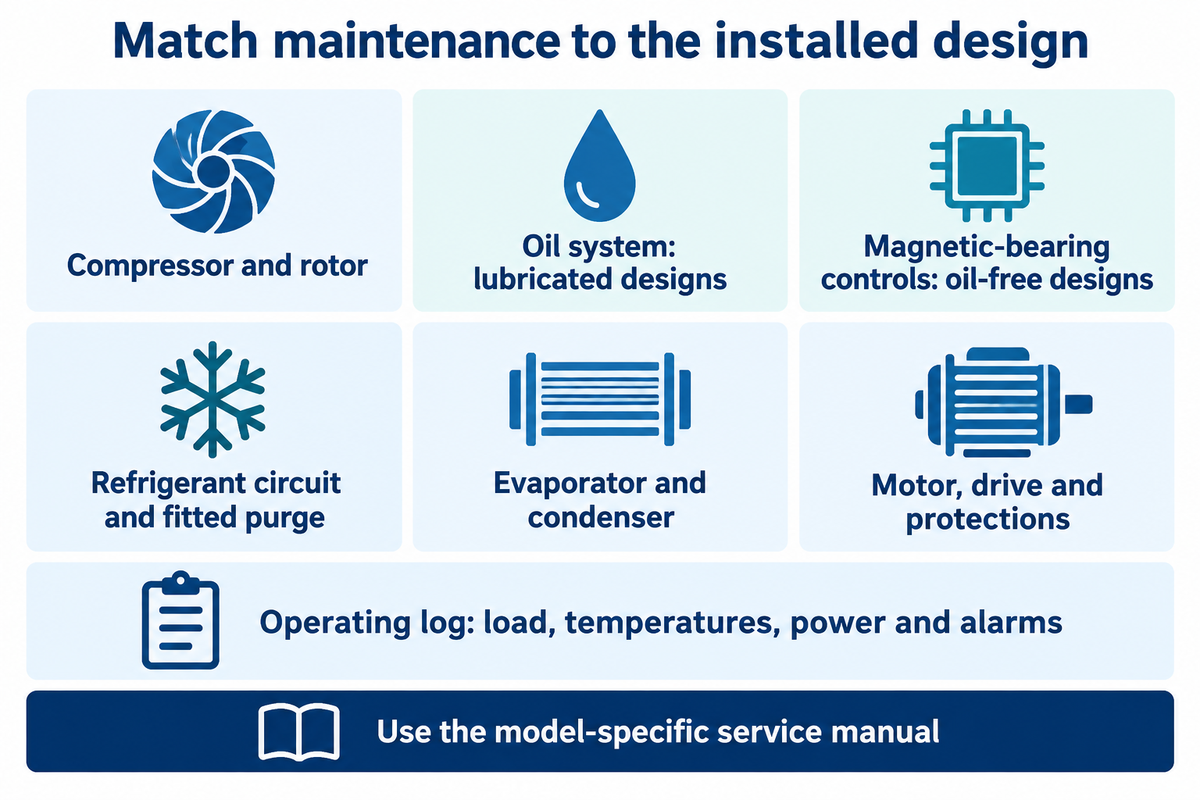
Start a centrifugal chiller maintenance checklist with the identification of the equipment and service manual. Different chiller types require different work: bearing design determines oil-related tasks. Heat-rejection work is determined by the condenser type. Refrigerant operating pressure adds to the variety. Operators record normal readings, while qualified technicians perform electrical testing, refrigerant work and internal mechanical inspection under approved procedures.
Keep the serial number, compressor model, refrigerant designation and the manual together. Replacement of the compressor or controller can change the applicable instructions even though the chiller cabinet looks unchanged. Our centrifugal chiller operating guide gives more detail.
| Work area | Applicability | Record or deliverable |
|---|---|---|
| Operating log | All designs | Load, water temperatures, pressures, power and alarm history |
| Compressor condition | Installed compressor and bearing type | Model-specific diagnostic findings and trend comparison |
| Lubrication system | Oil-lubricated machines | Oil condition, filter findings and required corrective work |
| Magnetic-bearing controls | Magnetic-bearing compressors | Controller diagnostics and fault history |
| Purge unit | Applicable low-pressure equipment | Purge activity and investigation of abnormal operation |
| Condenser | Water-cooled tubes or air-cooled coils | Condition findings and compatible cleaning method |
| Evaporator | Chilled-water heat exchanger | Flow, water quality and heat-transfer findings |
| Motor and drive | Installed electrical arrangement | Approved tests, connections and variable-speed drive cooling checks where fitted |
| Control and protection devices | Installed sensors and interlocks | Recorded functional checks and unresolved defects |
Low pressure systems merit their own purge checks. Air and other non-condensable gases can enter a system under sub-atmospheric pressure. A purge removes non-condensable gases, but a leak is still a leak and needs to be addressed. ASHRAE’s liquid-chilling systems chapter explains why a functioning purge does not replace leak detection and repair.
For a centrifugal water-cooled chiller, assign cooling-tower and water-treatment work separately from compressor service. The existing water-cooled chiller maintenance program accounts for a wider water-side shutdown work scope. An industrial plant with mechanical and water-treatment contractors needs both work scopes on its shutdown schedule.
Maintenance frequency and shutdown planning
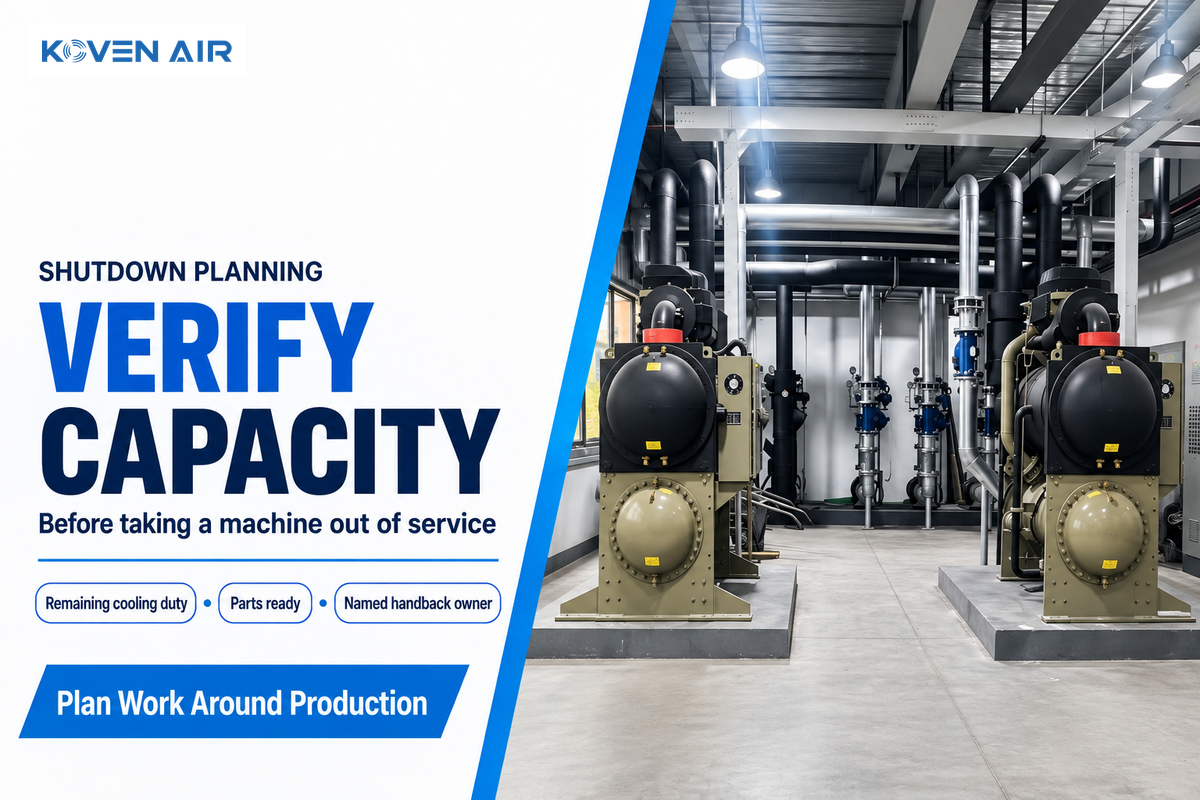
A practical maintenance schedule separates operating records kept daily from scheduled service visits, yearly tasks where specified and major overhauls. Each layer answers a different question. Are we operating normally? What condition is changing? What requires a shutdown? Are there internal wear issues? Calendar frequency alone can’t answer all four questions.
How often should a chiller be serviced?
Schedule chiller service annually based on the manufacturer’s requirements, with daily operating reports and periodic inspections based on the manufacturer’s timetable. Take earlier action if water quality, condition trends or alarms indicate a problem. Compressor overhaul is scheduled based on hours, age and condition; it shouldn’t be scheduled automatically as part of an annual service.
Mitsubishi Heavy Industries’ preventive-maintenance guide shows a good example. It gives 50,000 hours, or 7 years, whichever is earlier, for the compressor overhaul, and a 5-year recommendation for continuous year-round operation. Those recommendations are for that manufacturer’s program. Use the current recommendations for your compressors and equipment for setting the limits.
Condenser cleaning needs its own review. Water quality and chemical treatment affect how quickly deposits form, as explained in ASHRAE’s condenser maintenance guidance. A fixed cleaning date is convenient for scheduling labor, but advancing fouling may bring work forward.
Planning example: A process plant has two chillers and an eight-hour maintenance window. The operator has confirmed that one of the machines can carry the scheduled production load. Maintenance reserves the other machine for inspection, while procurement orders the required gaskets before the shutdown. A late delivery would consume the production window for mechanical work. The supervisor therefore separates the work that can be completed within the window from optional tube testing that requires a longer outage. If the remaining chiller cannot carry the actual load on the day, the shutdown moves or temporary cooling is arranged. The plan includes a named operator for handback.
Before intrusive work, the site and contractor coordinate isolation and stored-energy control. In applicable US worksites, OSHA’s hazardous energy standard defines those responsibilities. A control-panel stop command isn’t an energy-isolating device.
Oil-lubricated vs magnetic-bearing maintenance
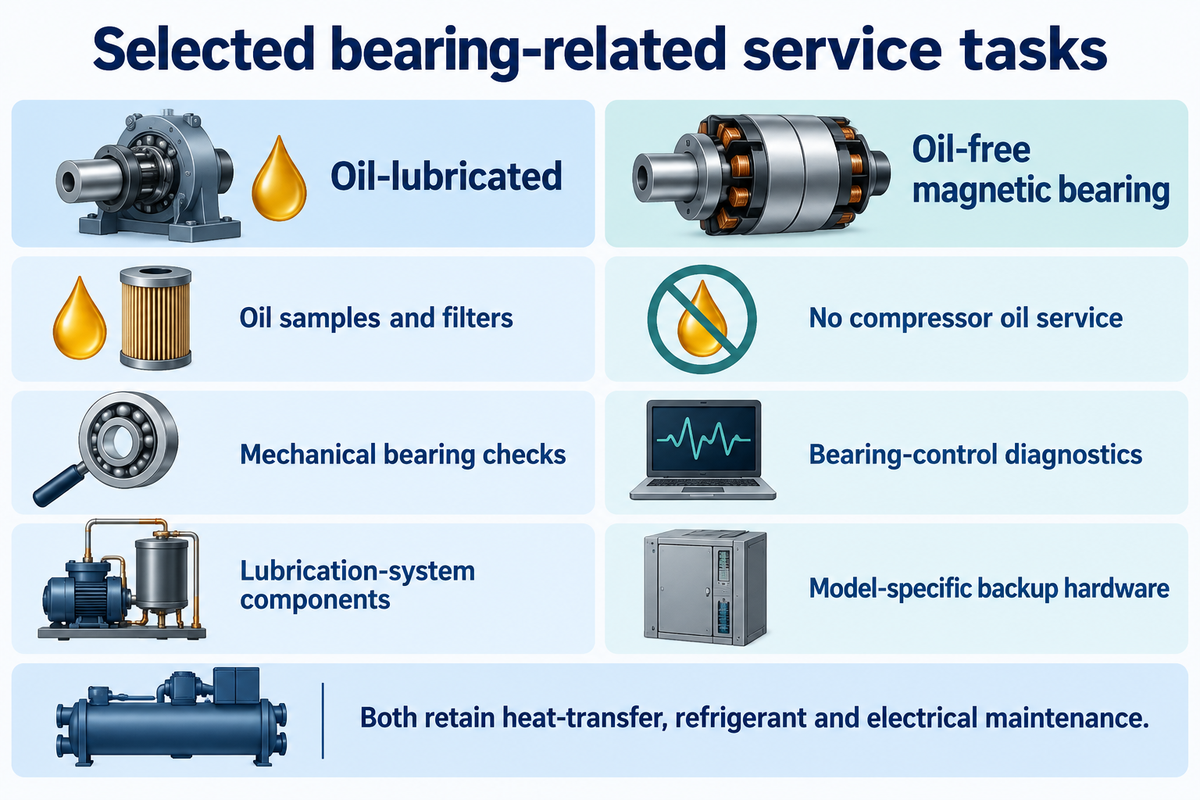
Magnetic-bearing maintenance removes compressor oil tasks and focuses on the bearing-control system and model-specific support hardware. Lubricated equipment retains the lubrication circuit, oil condition checks and mechanical bearing tasks. Compare the changed tasks individually.
“The oil-free system also eliminates the need for oil maintenance”
| Service item | Oil-lubricated compressor | Oil-free magnetic-bearing compressor |
|---|---|---|
| Compressor oil sample | Sample and interpret under the oil program | Not applicable to the oil-free compressor |
| Oil filter | Inspect or replace as specified | No compressor oil filter service |
| Oil pump and pressure | Check fitted pump and lubrication pressure | No compressor oil-pump task |
| Oil heater or cooler | Inspect the installed lubrication equipment | No oil heating or cooling circuit |
| Oil return components | Service the fitted return arrangement | No oil-return circuit |
| Main bearing assessment | Use specified mechanical condition checks | Review bearing-control and rotor-position diagnostics |
| Bearing controller | Not a magnetic-bearing work item | Specialist controller fault review |
| Backup support hardware | Follow the mechanical design’s requirements | Follow the specified touchdown and power-loss provisions |
| Overhaul work scope | Include lubrication-related components where required | Use the magnetic-compressor procedure and diagnostic access |
Heat is transferred by the evaporator and condenser. Regardless of how the rotor is supported, dirt on a heat exchanger reduces its capacity to move heat. An air-cooled machine also has coil and fan work; a water-cooled machine has condenser tubes and an external water system.
The magnetic-bearing chiller design guide explains the architecture. When evaluating magnetic-bearing chiller options, place the available service skills and replacement electronics next to the oil-maintenance savings. Eliminating lubrication work doesn’t eliminate the need for a qualified local technician.
Performance trends and maintenance triggers
Performance data are most useful when they indicate load, water flow and inlet temperatures. A change in a reading should first prompt an assessment of the operating conditions and the reliability of the sensor. Depending on the outcome of that assessment, data may indicate heat transfer problems, compressor problems or controls problems. A single temperature difference is insufficient to select a repair.
How to increase chiller efficiency?
Correct verified faults first: resolve water flow problems, maintain heat transfer surfaces, and address control or compressor faults found during qualified diagnosis. Compare electricity use at similar cooling duty and operating conditions. Include energy use by pumps and the cooling tower in your assessment of the entire plant, since a change that benefits the chiller may shift energy use to auxiliary equipment.
Starting with the machine’s own definitions for pressure and temperature is recommended. Maintain the position and measurement unit for the temperature sensor unchanged between readings. Water-side analysis can be aided with the condenser water supply guide. It includes cases that can influence chiller behavior upstream.
In their 2005 centrifugal-chiller fault-detection study, Jingtan Cui and Shengwei Wang used reference models and thresholds that accounted for measurement and model errors. The purchasing implication is straightforward: require the service report to explain its comparison basis, rather than supplying isolated alarm values.
3-Branch Service Selector
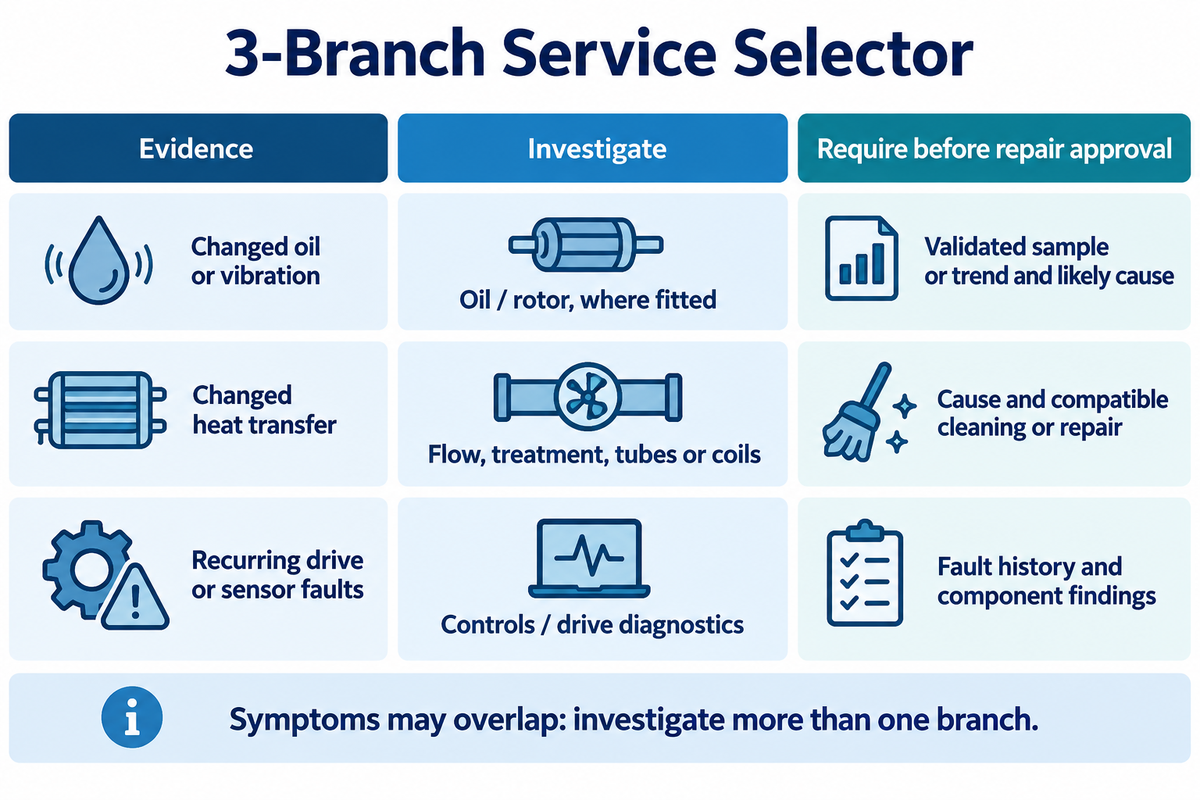
Match abnormal evidence to oil/rotor, heat-transfer or control/drive investigation; investigate more than one branch when symptoms overlap.
| Evidence to investigate | Initial service scope | Result needed before repair approval |
|---|---|---|
| Oil condition or mechanical vibration has changed | Oil/rotor investigation on applicable machines | Validated sample or trend, likely cause and proposed internal work |
| Heat-transfer performance has changed | Water flow, treatment, tube or coil condition; refrigerant-side checks as indicated | Cause assessment and suitable cleaning or repair method |
| Drive, sensor or bearing-control faults recur | Control/drive investigation with required diagnostic access | Fault history, measured findings and component-level recommendation |
Hypothetical diagnostic example: A facility receives a tube-cleaning proposal after a warmer operating day. The earlier log was taken at 45% load; the new reading was taken at 80% load with different condenser-water conditions. These readings reflect different operating conditions. The maintenance engineer holds the cleaning order while the contractor reviews flow and sensor readings and the available baseline to determine if deposits need removal. Procurement requests a diagnostic visit with a written report prior to awarding the larger work package. If the investigation confirms a water treatment issue, the treatment contractor would be part of the repair plan to address the deposit re-occurrence.
For low-pressure chillers, include purge behavior in the analysis. Normal-looking condenser pressure can coexist with continuing air ingress when the purge is removing the incoming gas. Retain fault history before alarms are cleared. Assess claimed energy savings against comparable operating records, so a change in load is not mistaken for more efficient operation.
Service contracts: scope, exclusions and consumables
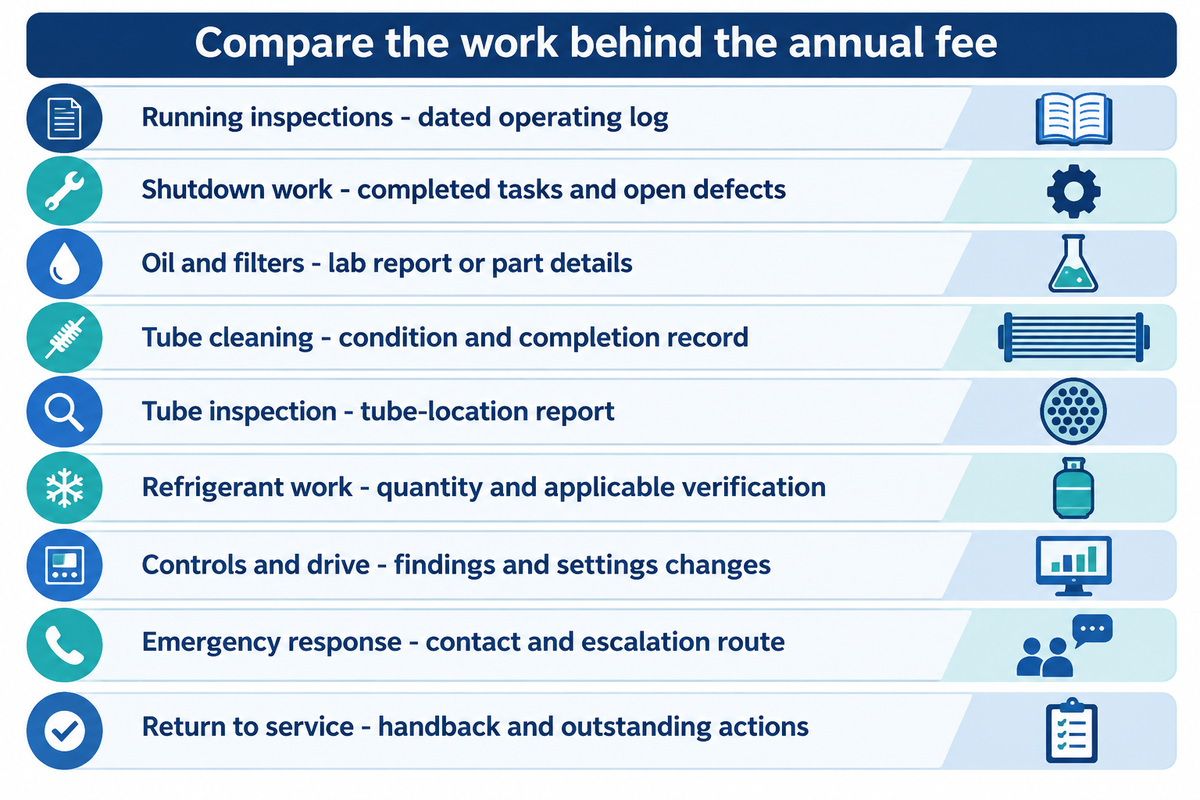
A chiller service contract should define which inspections, consumables, repairs and tests the annual price buys. Separate scheduled visits from callouts and major overhauls. Assign a frequency, responsible party and deliverable to each required task. Inspection-only and repair-inclusive proposals become comparable only when their exclusions are placed beside the price.
| Quote line | Specify in the request | Required closeout evidence |
|---|---|---|
| Running inspections | Visit count and operating conditions needed | Dated log and findings |
| Annual shutdown work | Task list, labor and access arrangements | Completed work record and open defects |
| Oil and filter work | Sampling, interpretation and replacement inclusions | Lab report or installed part details |
| Tube cleaning | Evaporator or condenser; method and gaskets | Condition record and cleaning completion |
| Tube inspection | Testing method, preparation and specialist fee | Tube-location report and disposition |
| Refrigerant work | Leak search, repairs, recovery and replacement refrigerant | Quantity and applicable repair-verification records |
| Controls and drive | Software access, electrical tests and replacement components | Diagnostic findings and settings-change record |
| Emergency response | Arrival commitment, coverage hours and travel charges | Named contact and escalation route |
| Return-to-service testing | Tests, available load and any seasonal revisit | Signed handback with outstanding actions |
Check the hidden constraints before accepting the bid: diagnostic licenses, spare part availability, tube-bundle access and the shutdown window. A technician who can attend immediately may require a specialist login or an unavailable control board. State who provides each item and whether waiting time is chargeable.
Define coverage for water treatment adjustment, refrigerant leaks, after-hours work and temporary cooling in the quotation. Assign responsibility for machine isolation and restart authorization before work starts. Include the actual technician’s model experience, the proposed brush or chemical method for the tubing, and any seal or gasket replacements. For equipment covered by 40 CFR 84.106, assign responsibility for the applicable refrigerant service records; coverage depends on refrigerant, charge and use conditions.
Maintenance cost and overhaul budgeting
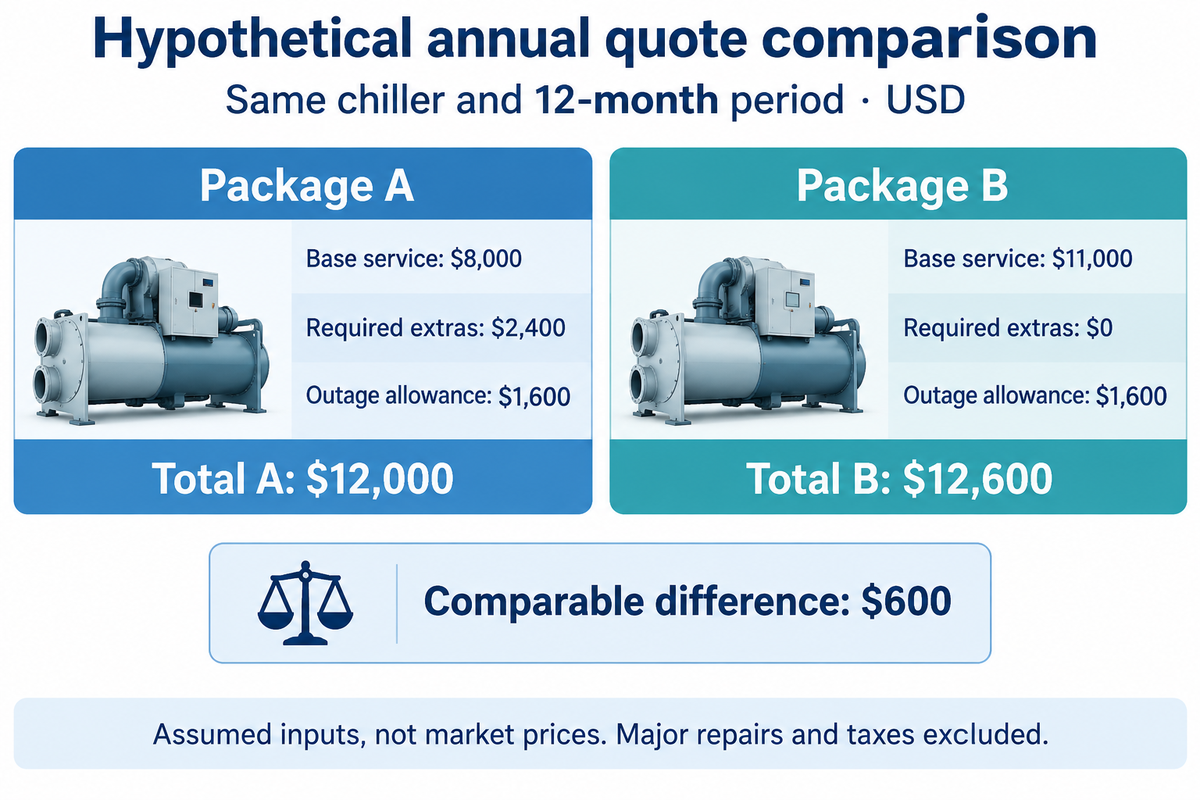
Budget centrifugal chiller maintenance as scheduled service plus required work not included in the base quote, and then add the cost of the planned outage. Keep major repairs in a separate allowance until their scope is known. For a fair comparison, use the same equipment list, service period, and production assumptions for every bidder.
Assumed inputs: Two proposals cover the same chiller for 12 months. Package A costs $8,000, but required additional work costs $2,400. Package B includes that work at $11,000. Both need the same shutdown, assigned a $1,600 cost. Major repairs and taxes aren’t included in this example.
| Cost item, USD | Package A | Package B |
|---|---|---|
| Base annual service | $8,000 | $11,000 |
| Missing required work | $2,400 | $0 |
| Same planned outage allowance | $1,600 | $1,600 |
| Comparable planned total | $12,000 | $12,600 |
In this hypothetical purchasing example, the finance manager initially sees a $3,000 difference between the base fees. Once the omitted work is added, Package A remains cheaper by $600. The maintenance manager then compares technician capability and the promised tests to assess what each package includes. If Package B offers a shorter outage, include a supported estimate of the time saved before changing the financial comparison. Procurement holds unpriced repairs outside the totals and procures unit rates for extras likely to be required.
For long-term budgeting, we recommend keeping overhaul allowances separate from annual maintenance fees. For tube-cleaning decisions, ASHRAE’s condenser guidance relates rising power costs from fouling to the labor cost of cleaning; use the plant’s operating evidence to assess that tradeoff. For an overhaul, obtain the inspection scope, replacement-parts basis and reassembly tests before treating the figure as a fixed price. Additional damage discovered during the course of the overhaul requires further approval and a revised completion date.
Service providers: manufacturer or independent contractor
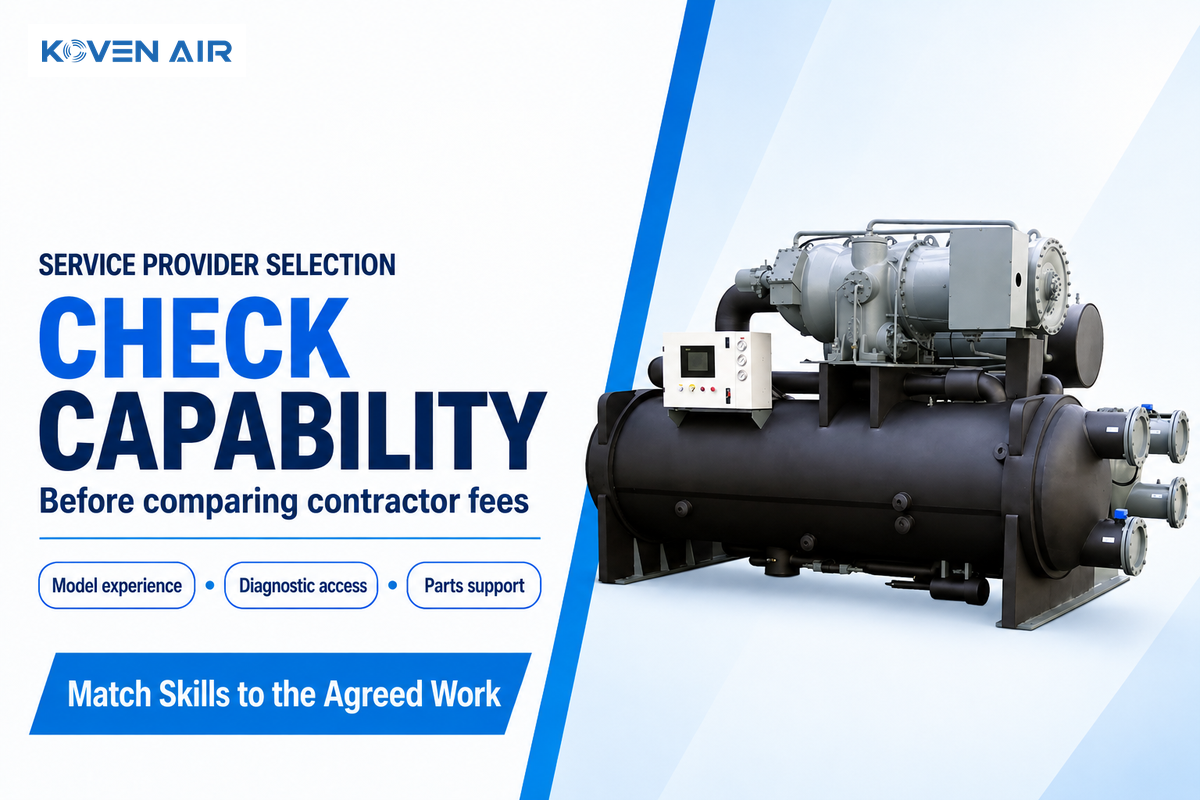
It’s recommended you hire a service provider who works on the same type of compressor, controller and drive onsite. Manufacturer support is useful for proprietary diagnostics or complex internal work. If the contractor’s techs don’t have the required tools and/or parts, using an independent contractor isn’t recommended. Evaluate the service providers’ fees only after checking the contractor’s capabilities.
For a Trane centrifugal chiller, the relevant question to ask is the service provider’s experience with that model and control generation. See ACHR News’ 2017 interviews with chiller-service contractors for information about the service contractor’s perspective on the need to assess equipment performance while it’s operating.
Refrigerant credentials also need the correct scope. The US Environmental Protection Agency’s Section 608 requirements distinguish Type II high-pressure work, Type III low-pressure work and Universal certification. “Centrifugal” describes the compressor, not a universal certification category.
If the plant requires arrival within four hours, specify that in the agreement, spelling out the coverage hours and escalation language. A remote specialist may quickly resolve a control problem, but a mechanical repair will still require an onsite visit by a qualified person. JH Kelly lists centrifugal chillers among the equipment it services, and provides teardown and rebuild on the US West Coast. Its local coverage and the assigned technician will determine whether it meets the needs of a given site. Koven Air provides equipment and technical assistance. Field maintenance may be arranged through a provider closest to the site.
Return-to-service checks after maintenance
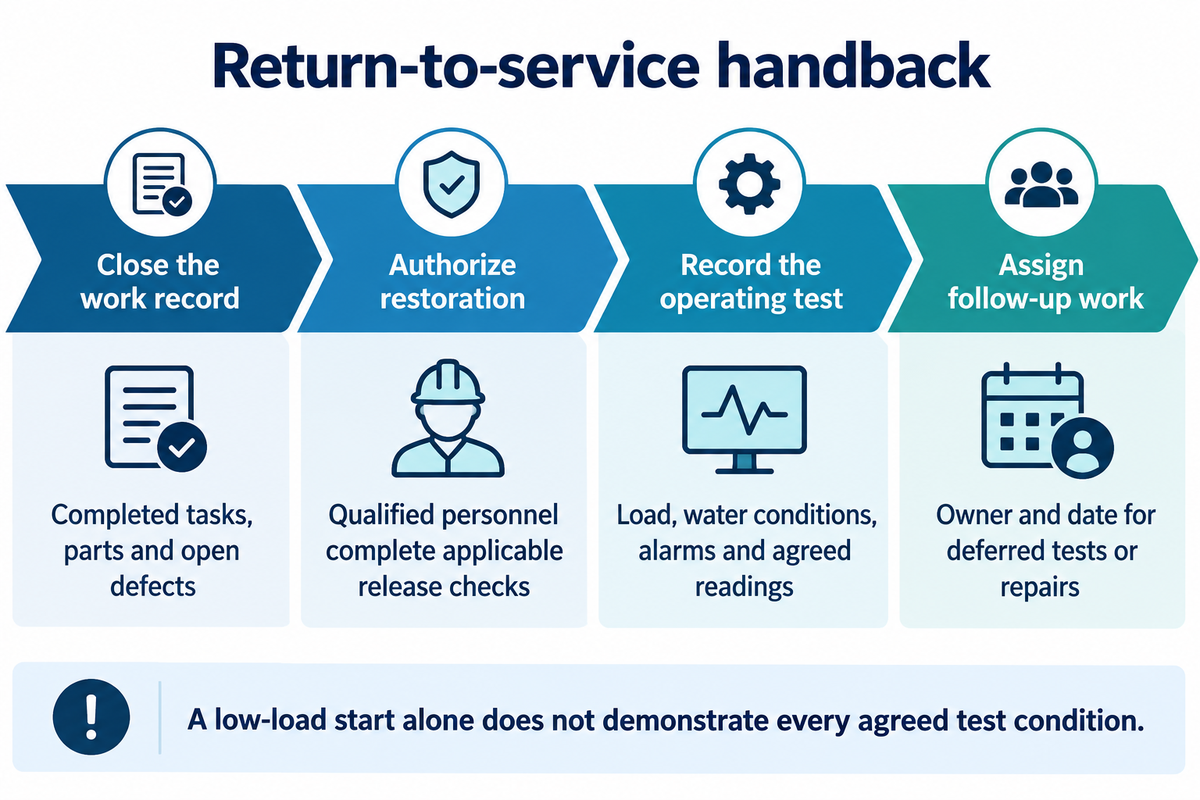
Return-to-service acceptance should confirm that the agreed work is complete, the equipment is ready for authorized energization, and the recorded operating checks demonstrate proper operation under the agreed test conditions. Assign unresolved defects prior to hand-back. A contract should identify any tests that require different seasonal conditions; a quiet start at low load is only one observation.
- Close the work record: identify completed tasks, replaced parts and open defects.
- Authorize restoration: qualified personnel complete the applicable isolation-release checks and notifications.
- Record the operating test: capture available load, water conditions, alarms and agreed performance readings.
- Assign follow-up work: name the owner and date for deferred tests or outstanding repairs.
Electrical tests and wiring checks are performed to the requirements of the equipment. The site receives the results of the checks, and not a generalized “electrical check.” In accordance with OSHA lockout/tagout requirements, the restoration of equipment to service includes equipment and personnel checks and notifications. The operating checklist doesn’t replace this process.
US refrigerant obligations also apply to the handback. Since January 1, 2026, 40 CFR 84.106 applies to equipment meeting its refrigerant, charge and use conditions. Repairs required under its leak-repair provisions need initial and follow-up verification. The records pertaining to verification and responsibility for follow-up must be documented when the requirement applies to the equipment.
For winter work, document which cooling tests could be conducted at the available load and which require a later visit. Seasonal testing, as described in ASHRAE’s commissioning guidance, can be used to address the agreed service acceptance scope. Routine maintenance need not become a whole-building commissioning project.
Monitoring and future serviceability

Remote monitoring improves access to the operating history, but the buyer must have a route from an alarm to a repair. Separate the ability to view data from the ability to perform diagnostics and change parameters. For new equipment, consider these in the context of energy efficiency, installation footprint and the cost of continued subscription, as well as local service capability.
A read-only dashboard enables a team to observe conditions without giving it control-setting access. Danfoss Turbocor Cloud Services, for example, provides a description of read-only compressor access and offers one- and two-year subscription plans. For either function, budget the subscription and technician’s diagnostic tools if both are needed.
When reviewing centrifugal chillers for new installation, provide the heating and cooling operating schedule, required cooling duty and access to the plant-room. For industrial refrigeration and process cooling, include the production shutdown window. Serviceability requirements should reach the equipment specification before a purchase order.
Frequently asked questions
What are the most common HVAC maintenance mistakes?
Common mistakes include using one checklist for every compressor design, comparing readings taken at different loads, treating an alarm reset as a repair, and excluding the cooling tower or controls from the investigation. Start with the machine manual, preserve operating context, and assign each defect to a specialist before accepting the work.
Should centrifugal chiller maintenance be done every year?
Review the maintenance program yearly and complete the manufacturer’s annual tasks where specified. Annual service doesn’t automatically include compressor dismantling. Inspections, oil analysis where applicable and internal overhaul address different conditions. Use the model’s instructions, accumulated operating hours and diagnostic findings to decide which work belongs in the next planned shutdown.
How often must condenser tubes be cleaned?
Clean condenser tubes at the prescribed service interval, or sooner if fouling warrants removal. Mitsubishi Heavy Industries includes tube cleaning in its annual maintenance program; actual cleaning needs also depend on water conditions. Compare heat-transfer trends under similar load and flow, inspect water-treatment results, and investigate changed performance. Select a compatible method for the tube construction. A brush suited to one bundle can damage another, so include the approved method in the work scope.
Does an oil-free centrifugal chiller need maintenance?
Yes. Heat exchangers, refrigerant integrity, drives and controls still need maintenance. Oil-free compressors remove oil-system work, while magnetic-bearing controls and backup hardware have their own requirements. Keep those specialist tasks in the service agreement alongside routine water-side and electrical work.
Should the evaporator be cleaned too?
Yes, when its condition and the equipment procedure call for cleaning. A closed chilled-water circuit still needs water-quality control and inspection. Start with the operating history and heat-transfer findings; flow or sensor problems can produce symptoms that cleaning won’t fix. If cleaning is required, include the compatible method, isolation arrangements and the checks needed afterward. Keep the evaporator and condenser as separate quote lines so the contractor’s price clearly identifies which heat exchanger receives the work.
Does a maintenance contract include refrigerant replacement?
Only when the agreement includes it. Leak detection, repair labor, recovery and replacement refrigerant can be priced separately. An inspection contract may cover finding a leak without paying for its repair. Read the refrigerant allowance and exclusions beside the annual fee.
Can an independent contractor maintain a magnetic-bearing chiller?
Yes, if the contractor has the model-specific training, diagnostic access and parts support needed for the agreed tasks. Routine water-side service and a complex bearing-control fault require different capabilities. Warranty conditions or restricted software may require manufacturer involvement for some work. The quotation should identify the technician, the supported compressor and controller models, and the escalation arrangement when the local team needs engineering help. Include the same capabilities in any renewal review, especially after a controller or compressor replacement.
Key takeaway
Buy centrifugal chiller maintenance by installed design, defined work and acceptance tests. Compare complete service costs after adding excluded work and the same outage assumptions.
Planning a chiller purchase or replacement?
Send Koven Air the cooling duty, operating hours, condenser-water conditions and available maintenance window. We can discuss equipment selection and technical documentation for your project. Discuss your centrifugal chiller specification.
This maintenance guide supports equipment and service planning. Intrusive mechanical, refrigerant and electrical work belongs to qualified personnel using the installed equipment’s current procedures.
References & Sources
- ASHRAE Handbook, 2020: Liquid-Chilling Systems, especially low-pressure auxiliaries.
- ASHRAE Handbook, 2024: Condensers, operation and maintenance.
- Occupational Safety and Health Administration: 29 CFR 1910.147, hazardous-energy control.
- U.S. Department of Energy: Magnetic-Bearing Chiller Compressors.
- Cui and Wang, 2005: A Model-Based Online Fault Detection and Diagnosis Strategy for Centrifugal Chiller Systems, Hong Kong Polytechnic University research record.
- ACHR News, 2017: HVACR Contractors Must Prioritize Chiller Maintenance, contractor interviews.
- U.S. Environmental Protection Agency: Section 608 Technician Certification Requirements.
- Electronic Code of Federal Regulations: 40 CFR 84.106, Leak Repair, current text reviewed November 2026.
- ASHRAE Handbook, 2023: HVAC Commissioning, seasonal testing.