Get in Touch with Koven Air Company


IEER vs SEER2 is a comparison of two different cooling-efficiency tests. IEER combines performance at four load points, while SEER2 measures seasonal cooling output against electricity use under its applicable test procedure. Use the same rating and test basis to compare equipment, then model the building’s operating conditions and electricity tariff to estimate cooling cost.
As for commercial rooftop buyers in the U.S., capacity and equipment class make the answer different. Some three-phase units below 65,000 Btu/h use SEER2 requirements that took effect in 2025. That matters when two quotes list different efficiency measures next to similar cabinets.
IEER vs SEER2 at a glance
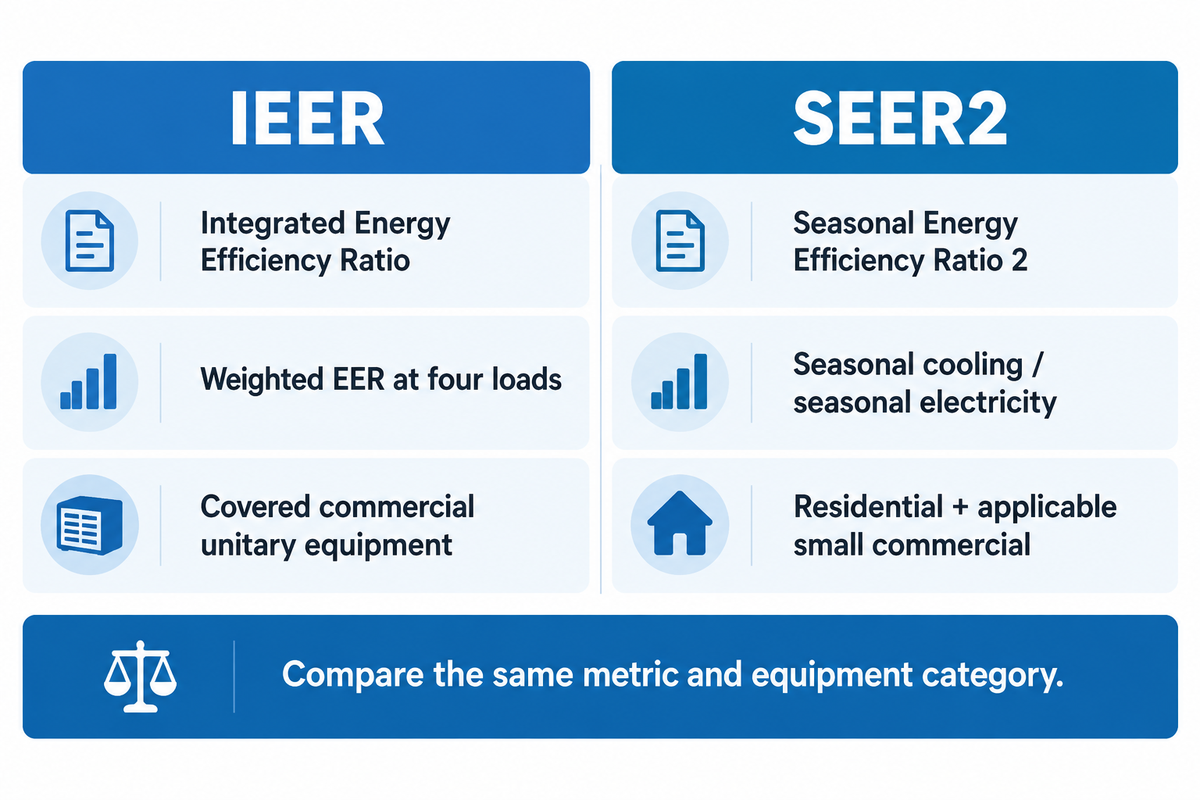
IEER shows integrated part-load cooling performance, while SEER2 details seasonal cooling performance for equipment using a separate test method. The key differences concern the category of equipment, the load assumptions, and the test conditions behind the number. The higher number equals a higher rated efficiency within the same metric and comparable equipment category.
| Comparison | IEER | SEER2 |
|---|---|---|
| Full name | Integrated Energy Efficiency Ratio | Seasonal Energy Efficiency Ratio 2 |
| Calculation basis | Weighted EER values at four specified loads and associated conditions | Seasonal cooling delivered divided by seasonal electricity under the applicable procedure |
| Common application | Covered commercial unitary air conditioners and heat pumps | Residential systems and applicable small commercial equipment |
| Useful buying question | How efficiently does this commercial unit operate across the rated load points? | How efficiently does this eligible system cool over the standardized cooling season? |
The ENERGY STAR technical glossary distinguishes integrated and seasonal methods. Think of an efficiency rating like miles per gallon: the test gives a common comparison, while the route determines consumption. For a rooftop purchase, first identify the equipment class on the submittal. Then compare like-rated candidates.
How IEER and SEER2 measure energy efficiency
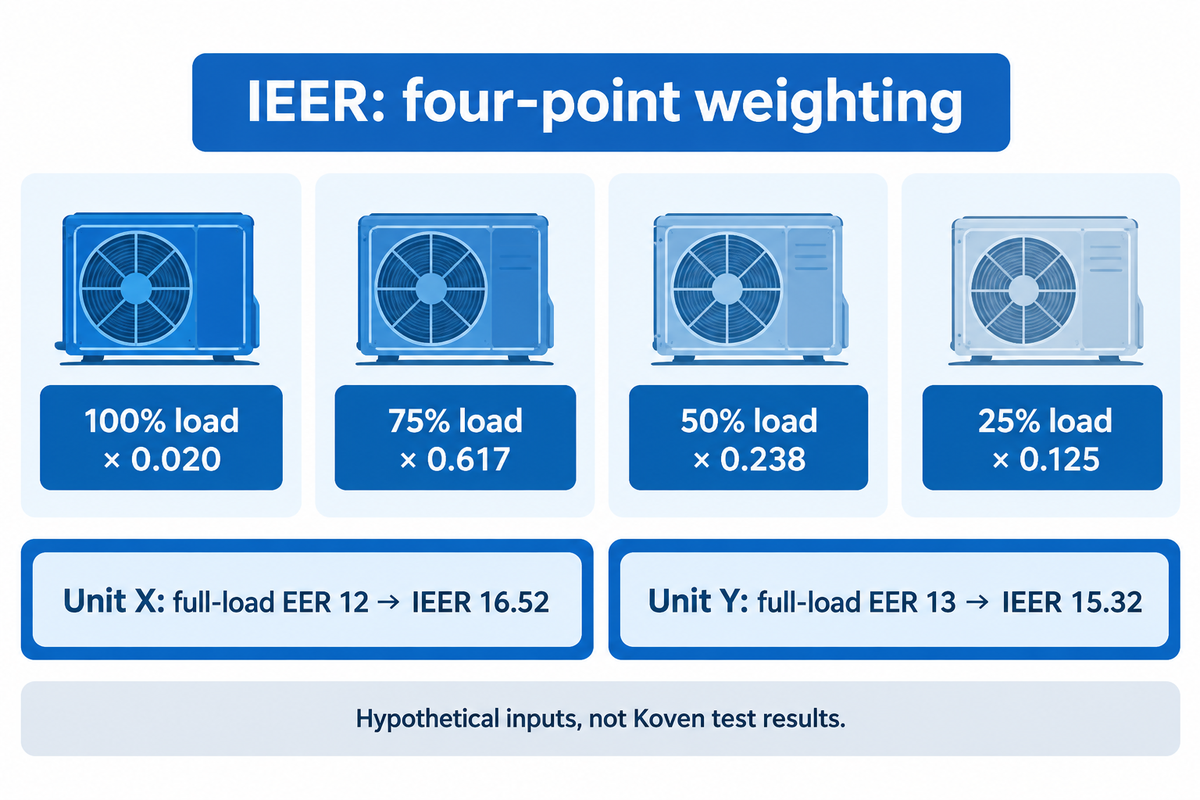
IEER combines EER at 100%, 75%, 50% and 25% load using fixed coefficients. SEER2 uses a seasonal procedure that accounts for changing cooling conditions and equipment behavior. While they both evaluate air conditioning system efficiency, they are designed to answer different questions.
The IEER equation reproduced in Consulting-Specifying Engineer’s technical explanation is:
IEER = 0.020A+0.617B + 0.238C + 0.125D, where A, B, C and D are the EER at the four load points.
The coefficients characterize the rating method, not your building’s operating-hour profile. A unit’s compressor staging and fan control influence the efficiency curve between full and reduced load.
Four-Point Load Lens: a worked comparison
Suppose we have two imaginary units rated for the same office load. At full load, Y is the more attractive one with an EER of 13 versus X’s 12. The owner assumes that the units will see extended stretches of lighter cooling, so the engineer performs the four-point calculation.
The fictional inputs below illustrate how the order may change; they aren’t tests of Koven units.
| Rated load | Weight | Unit X EER | Unit Y EER |
|---|---|---|---|
| 100% | 0.020 | 12 | 13 |
| 75% | 0.617 | 16 | 15 |
| 50% | 0.238 | 18 | 16 |
| 25% | 0.125 | 17 | 16 |
For Unit X: 0.020 × 12 + 0.617 × 16 + 0.238 × 18 + 0.125 × 17 = 16.521 IEER . This IEER calculation method is described in ANSI/AHRI Standard 340-360. Rounded to two decimal places, X wins 16.52 to 15.32, despite the fact that its full-load EER is lower. For this office, the engineer would recommend X for a building energy model while also checking peak-load performance and humidity control.
What’s the Difference Between SEER and SEER2?
SEER and SEER2 ratings use different test procedures. SEER2 accounts for updated testing requirements, including external static pressure for applicable ducted equipment, so an old SEER label shouldn’t be read as an identical current SEER2 label. AHRI explains the residential transition in 2023. When comparing SEER vs SEER2 on replacement proposals, ask for the current rated combination rather than adjusting the old number with a generic multiplier.
Can you convert IEER to SEER2?
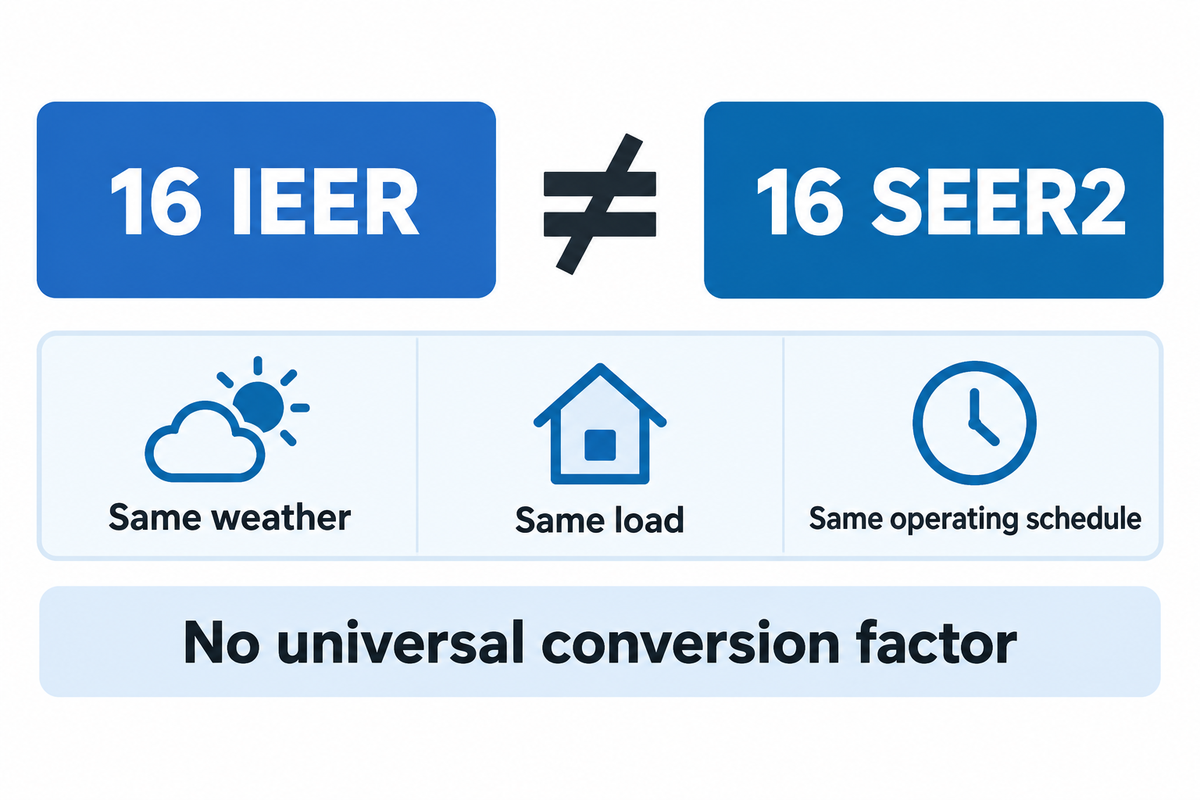
No single IEER-to-SEER2 conversion factor applies. Since the procedures employ different test conditions and equipment rules, a numerical ratio doesn’t translate to all products on the same footing. Compare matching ratings, or compare detailed equipment performance in one building model under identical weather, load and operating schedule.
16 IEER and 16 SEER2 use different test conditions and equipment rules, so equal numbers don’t mean equal cooling efficiency. Inquire as to which category each candidate falls into and what would make a supplier choose that metric. Even the same IEER can mask different performance between test points: The CSE article describes fixed- and variable-speed systems that have the same rating but behave differently in cycling.
For a new air conditioning system, give both bidders the same duty: occupied hours, design cooling load, required outdoor air and duct pressure. The comparison helps assess whether the cooling system is right for the building, not just whether two labels match.
Which rating applies to your rooftop unit?
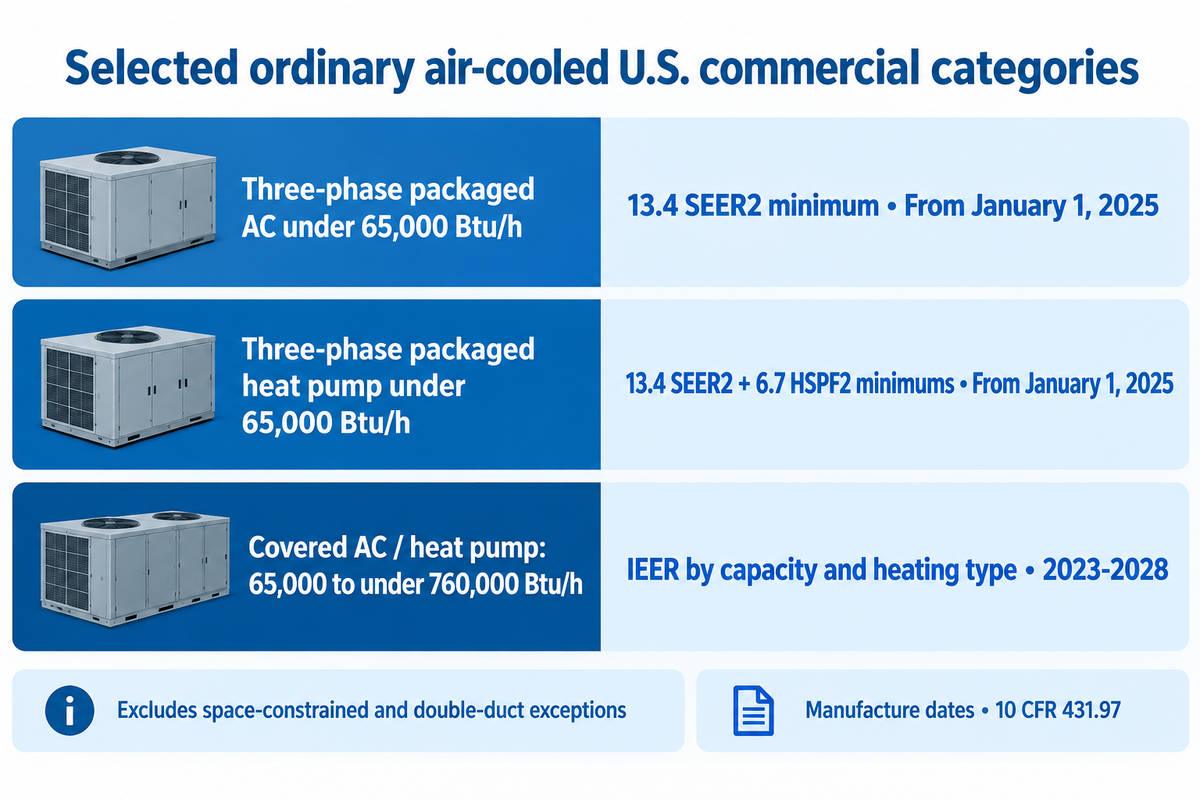
Below 65,000 Btu/h , applicable air-cooled three-phase commercial equipment uses SEER2 standards for manufacture from January 1, 2025. Covered ordinary air-cooled commercial package units at or above that boundary use IEER-based specifications through 2028. Capacity, phase, cooling method, heating configuration and equipment category determine the applicable row.
The current federal efficiency tables in 10 CFR 431.97 provide the starting point. AHRI separately explains the small three-phase commercial transition.
| Equipment and capacity | Relevant requirement | Manufacture period |
|---|---|---|
| Three-phase single-package AC, <65,000 Btu/h | 13.4 SEER2 minimum | From January 1, 2025 |
| Three-phase single-package heat pump, <65,000 Btu/h | 13.4 SEER2 and 6.7 HSPF2 minimums | From January 1, 2025 |
| Covered commercial package AC/heat pump, ≥65,000 and <760,000 Btu/h | IEER-based cooling requirements; values vary by capacity and heating type | January 1, 2023 to December 31, 2028 |
The rows shown omit those exceptions requiring space-constrained and double-duct solutions. There are separate categories for split systems and other categories of equipment. A separate review of dedicated outdoor-air units is also required; see AHRI 920 ratings for dedicated outdoor air.
Consider a small retail replacement where one bidder treats every rooftop as a large commercial unit, while another submits a three-phase single-package model below the threshold. The proper initial step is to evaluate rated capacity and category on each submittal. If the contenders are for different loads, work out sizing before comparing efficiency.
If they’re for the same small category, match SEER2 requirements and compare in the same installation environment.
Federal energy efficiency standards are only one procurement layer. Additional performance requirements may come from ENERGY STAR, a utility incentive program or the project specification. For instance, commercial criteria in ENERGY STAR list EER and IEER for several classes.
When selecting an AC or heat pump, record each requested qualification separately.
EER and EER2: peak cooling and heating limits
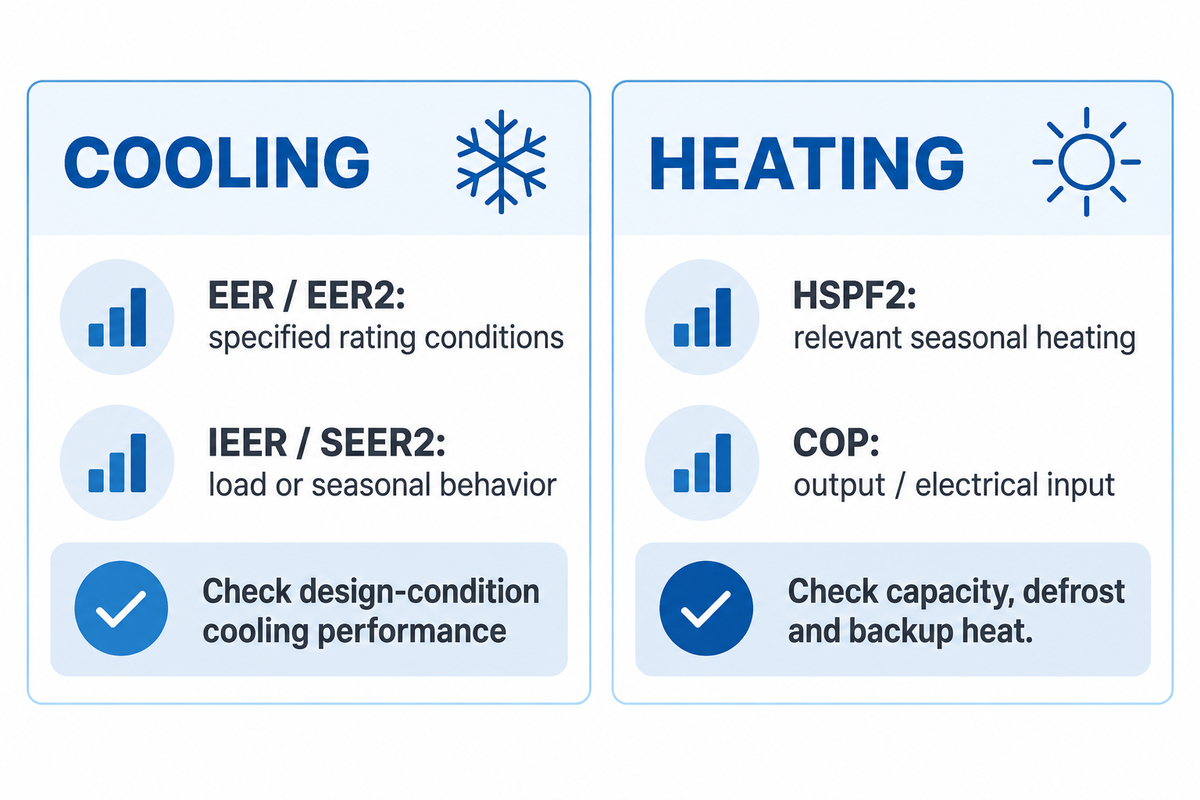
EER and EER2 explain cooling efficiency at specified rating conditions, whereas IEER and SEER2 communicate broader load/seasonal behavior. For a hot-afternoon capacity measurement consider the manufacturer’s performance under the design conditions for that project. For winter conditions consider the heating capacity and corresponding heating-efficiency number instead of a cooling number.
What is the difference between EER and EER2?
EER2 measures cooling efficiency according to the new applicable procedure; EER indicates the relevant old or other applicable rating basis. In a SEER vs EER comparison, seasonal performance and a specified operating point answer different questions. Keep full-load AC efficiency in the selection review even when a high seasonal number attracts attention.
Heat pump efficiency requires a separate winter check. HSPF2 ratings measure seasonal heating efficiency for relevant equipment; COP describes heating output relative to electrical input at a specified condition. Neither a higher SEER2 rating nor a strong IEER establishes cold-weather capacity.
Verify defrost behavior, backup heating and electrical requirements in the cold-climate heat pump performance guide before replacing a heating and cooling system.
Compare published rooftop data on the same basis
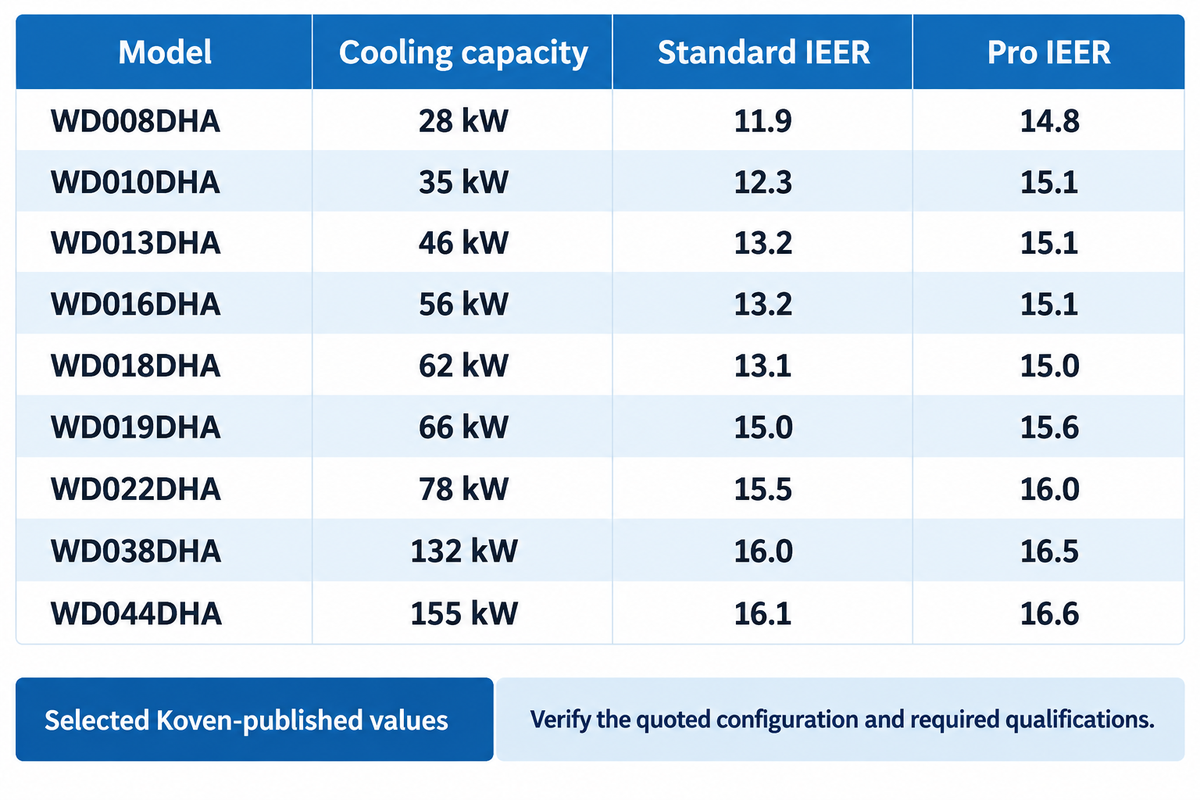
Compare rooftop specifications for the same model size and configuration before trying to compare across brands. The nine rows below come from Koven’s larger published selection table, which distinguishes Standard and Pro IEER values. Match each proposed rating to the corresponding model, airflow, external static pressure and heating section used by the supplier for their selection.
Below, published values for Koven commercial rooftop units are displayed. These demonstrate a comparison of manufacturer-published configurations, and certification and U.S. compliance are contingent upon the provided documents for the configuration quoted.
| Model | Cooling capacity | Standard IEER | Pro IEER |
|---|---|---|---|
| WD008DHA | 28 kW | 11.9 | 14.8 |
| WD010DHA | 35 kW | 12.3 | 15.1 |
| WD013DHA | 46 kW | 13.2 | 15.1 |
| WD016DHA | 56 kW | 13.2 | 15.1 |
| WD018DHA | 62 kW | 13.1 | 15.0 |
| WD019DHA | 66 kW | 15.0 | 15.6 |
| WD022DHA | 78 kW | 15.5 | 16.0 |
| WD038DHA | 132 kW | 16.0 | 16.5 |
| WD044DHA | 155 kW | 16.1 | 16.6 |
A useful quote request puts the rating beside the conditions that produced it. Federal commercial certification provisions likewise identify airflow, static pressure and relevant control settings in supplementary information.
| Ask each bidder for | Decision it resolves |
|---|---|
| Exact model, voltage/phase and rated cooling capacity | Correct equipment category and load match |
| Rating method, test edition and heating configuration | Whether the efficiency values share a basis |
| Airflow, external static pressure and part-load controls | Whether the selection fits the duct system and duty |
| Required listing, project qualifications and service support | Whether the offered configuration meets procurement requirements |
Is a higher IEER worth the price premium?
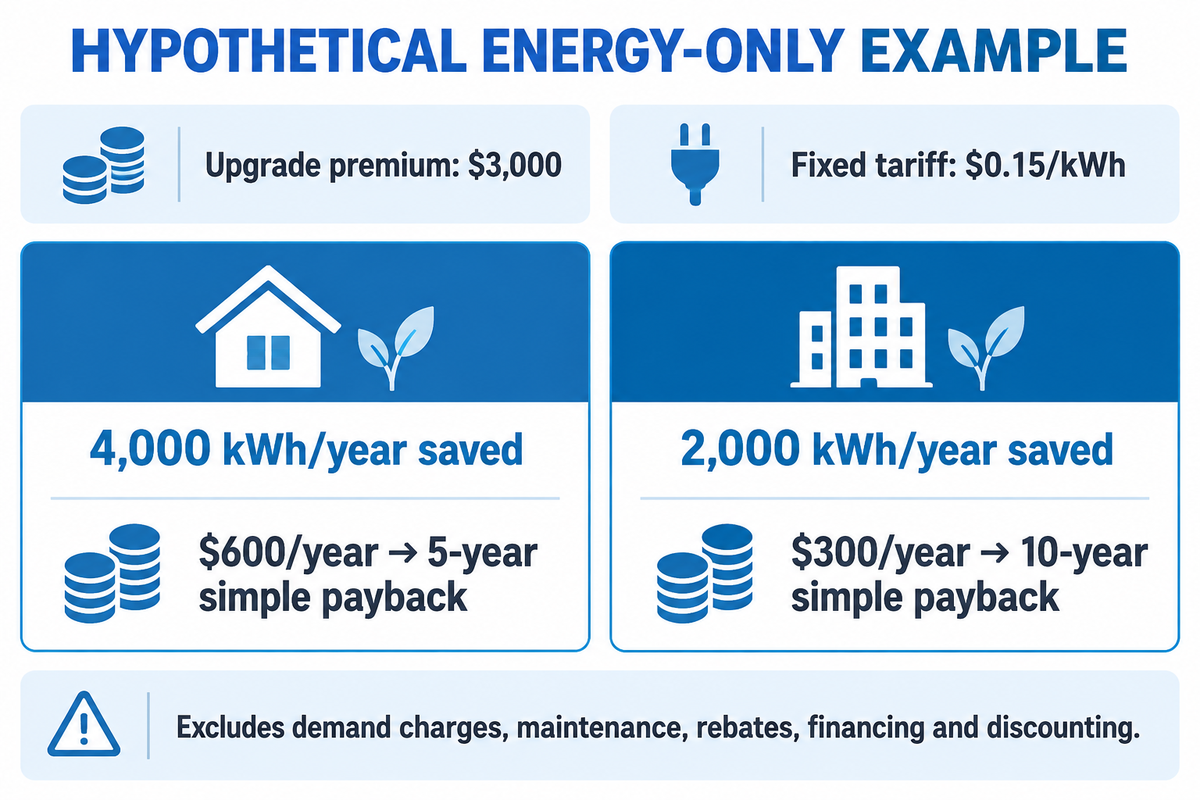
Payback gets tougher for a seldom-used hall, and easier for a heavily-used one. In the example below, payback on energy savings alone doubles from 5 to 10 years when annual savings halve. Compare building energy use, then apply the real tariff.
Units that cost more upfront require an operating-cost comparison, which considers annual kWh, peaks of demand, maintenance and installation; the rating provides one input.
For a deliberately simple example, assume an upgrade costs $3,000 more, electricity costs a fixed $0.15/kWh, and a separate site model predicts either 4,000 or 2,000 kWh/year saved. We’re calculating energy charges only, with no demand charges or time-of-use adjustments and no accounting for maintenance differences, rebates, financing, or discounting.
| Assumed annual electricity saved | Annual energy-charge saving | Simple payback |
|---|---|---|
| 4,000 kWh/year | 4,000 × $0.15 = $600/year | $3,000 ÷ $600 = 5 years |
| 2,000 kWh/year | 2,000 × $0.15 = $300/year | $3,000 ÷ $300 = 10 years |
The owner planning an active office and a seldom-used hall may make different purchasing decisions despite an identical equipment premium. The extended hours in the office might make the upgrade worthwhile earlier; the hall might give more importance to first cost and ease of service. An HVAC expert should use each building’s schedule in the energy model, then show how the calculated savings compare with the owner’s planned holding period.
DOE’s utility-rate guidance separates energy charges from demand and fixed charges. Its light-commercial purchasing guidance also explains why low-use applications and low energy rates can weaken lifecycle savings. For commercial energy bills, request the tariff calculation behind any promise of lower energy bills. Advanced meters typically track electricity consumption on an hourly or 15-minute basis, providing interval data for the operating-cost comparison.
Why installed HVAC efficiency can differ
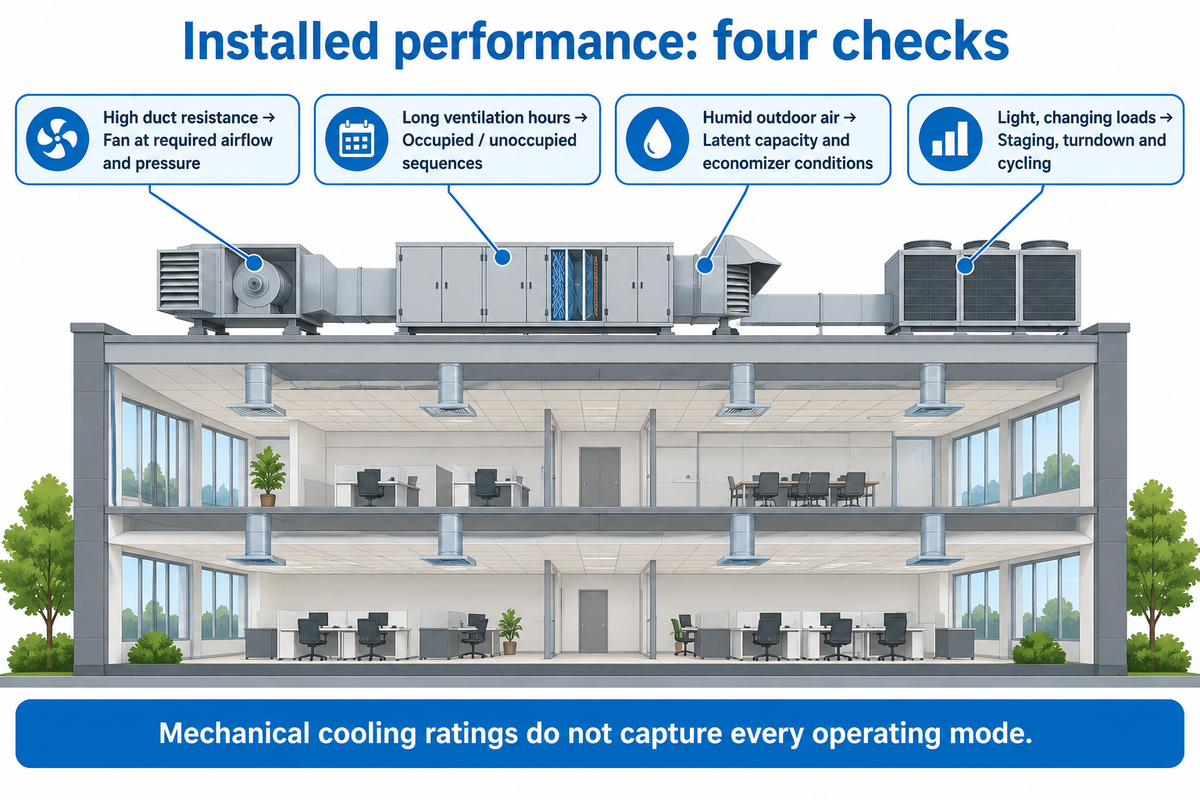
Installed HVAC efficiency changes with the building load, airflow, outdoor-air requirement and controls. An efficient cabinet can still use excessive electricity when the duct system restricts airflow or the economizer admits unsuitable air. Specify the operating conditions before ordering, then include airflow and control checks in commissioning.
PNNL’s economizer guidance describes the dependence on the rest of the HVAC system:
“Excessive vibration, rust, mold, fan failure, clogged intake-air screens, and clogged filters can all affect economizer operation.”
| Building condition | What to check | Practical consequence |
|---|---|---|
| High duct resistance | Fan selection at required airflow and pressure | Fan power and delivered airflow change |
| Long ventilation hours | Occupied/unoccupied fan and outdoor-air sequences | Energy use continues outside mechanical cooling |
| Humid outdoor air | Latent capacity and economizer enable conditions | Temperature control alone may leave moisture untreated |
| Light, changing loads | Staging, turndown and cycling behavior | Controls affect comfort and part-load operation |
Imagine an office replacing a worn rooftop unit while keeping the existing ducts. The owner selects a higher-rated model, but the return path remains restrictive and the outdoor-air damper stays open beyond the occupied schedule. The replacement decision should include a duct-pressure check and a control-sequence review. Otherwise, the new cabinet is being asked to solve a distribution and control problem. First size the rooftop unit for the building load, then write those commissioning tasks into the HVAC services scope.
There’s also a defined boundary in the rating itself: DOE’s final test-procedure rule explains that IEER excludes economizer-only cooling and cooling-season ventilation energy. Model those operating modes separately. Continue with packaged rooftop maintenance and replacement planning so filter, damper and sensor checks remain part of the operating plan.
What changes in 2029?
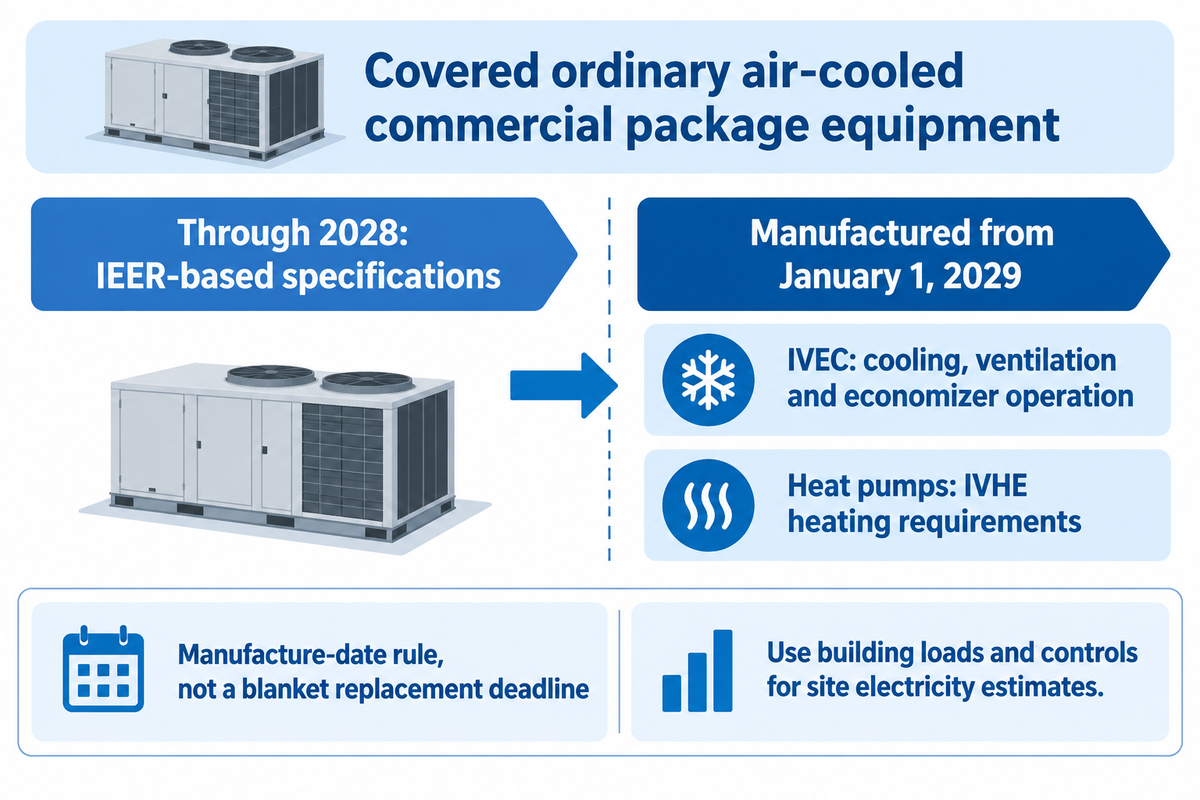
For covered ordinary air-cooled commercial package equipment manufactured from January 1, 2029, current federal rules introduce IVEC cooling requirements and, for heat pumps, IVHE heating requirements. If you buy products further in the future, note the production date, product category, and how the equipment is rated because IEER and IVEC use different calculations.
IVEC adds ventilation and economizer operation to the cooling assessment. The newer procedure also changes how annual performance and fan conditions are represented. Those changes address a practical gap in heating and cooling systems that spend part of the year moving air without mechanical cooling. The current federal table defines the categories and thresholds; the manufacture-date requirement doesn’t order owners to replace every installed unit in 2029.
A multi-site buyer can get ready by having suppliers specify on what basis each selection is rated and by retaining energy models that are linked to the actual building schedule. Don’t bring an IEER column from last year’s spreadsheet into a new comparison with just a new heading. IVEC remains a standardized average rating, so site electricity estimates require loads and controls for the building.
For a current project, compare commercial rooftop configurations with the Koven Air team. Send the design cooling and heating loads, airflow, external static pressure, power supply and outdoor-air requirement with the rating or qualification your specification calls for.
Discuss a rooftop unit selection
Frequently asked questions
What is a good EER for an air conditioner?
Choose the higher EER among units that meet the required cooling capacity at the same airflow and outdoor condition, while retaining the project’s minimum requirements.
Compare units that deliver the required cooling output at the same airflow and outdoor condition. Peak performance matters for a heavily loaded building, while seasonal behavior matters across the entire cooling season. Ask the supplier to identify the rated operating point and the performance at your design temperature. A category-specific comparison is more useful than a universal efficiency target.
What is a good SEER rating for a heat pump?
For a new heat pump in a SEER2-rated category, start with the minimum SEER2 requirements and compare the efficiency premium against the cooling duty and ownership period. Commercial rooftop heat pumps in IEER-rated categories need an IEER comparison instead.
A higher SEER rating describes better rated seasonal cooling on the same test basis. The right SEER2 choice also needs the correct capacity and installation conditions. Review winter heating separately, using the appropriate heating metric and capacity data. For a building with substantial winter demand, the required backup system and its operating cost can materially change the equipment decision.
Does the SEER rating reflect real-world performance at all times?
No.
SEER and SEER2 express standardized seasonal performance. The actual air conditioning system experiences changing weather, occupancy, duct resistance and maintenance conditions. Its rating measures efficiency on a defined basis that helps compare products, while a building model estimates consumption for a particular application. Use actual operating hours and load information when assessing the efficiency of air conditioners for your property.
Does IEER measure heating efficiency?
IEER measures cooling efficiency.
For heating, compare the applicable COP, HSPF2 or other required heating metric together with capacity at the design temperature. Defrost behavior and backup heat are separate selection inputs. Identify whether each performance figure describes heating or cooling before using it.
Is it worth going from 14 SEER to 16 SEER?
The 16-SEER option is the stronger candidate for a long cooling schedule; the lower-priced 14-SEER option can suit a lightly used space. Compare the actual installed price and modeled annual cost before paying the premium.
Both figures in that comparison must be legacy SEER ratings. A high SEER system can suit a long cooling schedule, while a lower-cost option may suit a lightly used space. To choose the right HVAC equipment, request an energy model using a typical cooling season for the location, then review maintenance and the utility tariff. Higher SEER2 ratings likewise deserve an economic comparison within their own rating system.
Is a higher SEER rating always better?
No. A higher comparable SEER rating means better rated seasonal cooling efficiency, but correct sizing, installation and operating cost decide the better purchase.
A lower SEER2 unit that’s correctly sized and installed can still be the more suitable purchase for a particular duty and budget. Choose capacity, humidity control and service support along with the efficiency level.
At what temperature does a heat pump become inefficient?
Heat pumps have no universal outdoor-temperature cutoff for inefficient operation: capacity and COP vary with outdoor temperature, supply conditions and equipment design.
Heat-pump capacity and COP vary with outdoor temperature, supply conditions and equipment design. Defrost and supplemental heating also affect electricity use. Ask for performance at the building’s winter design temperature and compare available heat with the heating load at that point. The equipment’s ability to heat the space and the cost of doing so are separate questions. For heating and air conditioning procurement, retain both seasonal cooling data and the winter performance schedule so one favorable label doesn’t dominate the selection.
References & Sources
- 10 CFR 431.97: commercial equipment efficiency requirements
- AHRI: small three-phase commercial AC and heat pumps
- ENERGY STAR: commercial product criteria and metric definitions
- Consulting-Specifying Engineer: equipment ratings and building energy performance (authors Eric Walthall and Ben Majerus, Danfoss)
- U.S. Department of Energy: utility-rate options
- PNNL: air-side economizer operation and maintenance
- DOE 2024 final test-procedure rule: IEER, IVEC and IVHE
- AHRI: the 2023 residential efficiency metrics transition
- 10 CFR 429.43: commercial HVAC certification and supplementary test information
- U.S. Department of Energy: purchasing efficient light-commercial equipment