
Get in Touch with Koven Air Company

Air handling units are modular HVAC devices that filter, heat, cool, and circulate conditioned air through a building’s ductwork in nearly every industrial and commercial building you’ve ever been in, keeping the indoor environment within its design parameters. They aren’t the same equipment as a residential air handler, a rooftop unit, or an air conditioner, and the overlapping nomenclature can send you down a rabbit hole researching the wrong equipment, since search results for those terms constantly overlap.
Quick answer: An air handling unit (AHU) is a modular HVAC device that filters, heats, cools, and circulates conditioned air through a building’s ductwork. Commercial and industrial AHUs split into six duty-specific configurations — commercial, cleanroom, hospital, heat-recovery, make-up-air, and ceiling-mounted — and the right one depends on your application, filtration requirement, and whether the unit needs to run on recirculated or 100% outdoor air. Run those three variables through the 6-Path AHU Decision Tree below to land on the correct configuration.
TL;DR
- Don’t oversize for a safety margin; otherwise, your compressor will work harder by cycling frequently and may eventually cause your coils to become damaged faster than running the AHU close to its actual load.
- There are two independent classification axes for an air handling unit: air-distribution (VAV, dual-duct or multi-zone) and build customization (packaged, semi-custom or custom-modular). Most buying guides only cover one of the two.
- No single AHU standard applies. Filtration, casing leakage, cleanroom rating, hospital ventilation, and energy efficiency are each handled separately, sometimes by different government bodies in different regions (EU vs. US).
- Fan and blower energy is unregulated in the US. There’s no federal standard that requires fans or blowers to be energy-efficient; buyers instead rely on voluntary AMCA-certified ratings.
- The European Union is ahead of the curve; its Ecodesign Regulation 1253/2014 mandates a minimum of 73% for heat-recovery effectiveness in rotary/plate-style heat exchangers and 68% in run-around heat exchangers – a preview of where US expectations may be headed, though no equivalent US mandate exists yet.
Quick Specs
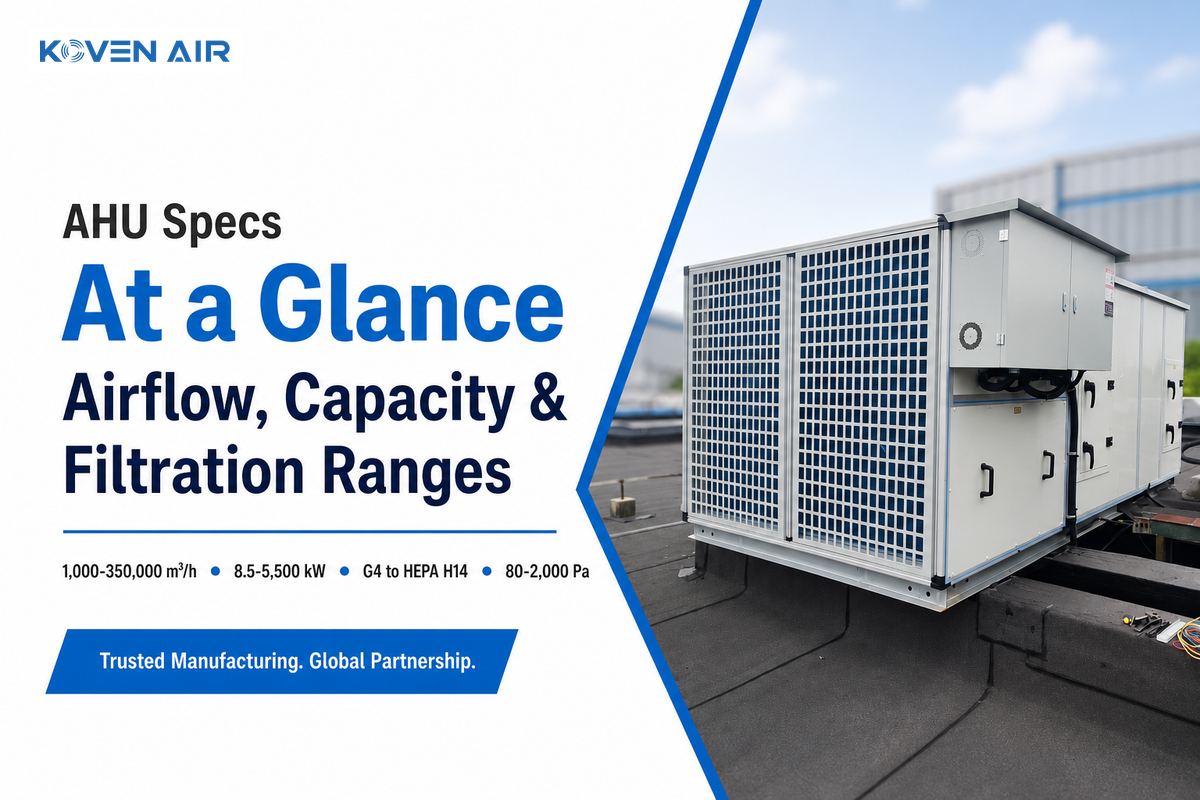
Skipping this range check is a common mistake at the RFQ stage, because pricing a project against the wrong band below wastes days of back-and-forth before anyone catches the mismatch; Koven’s own platform spans the full range across its six configurations and the filtration ceiling tracks the ISO 16890 filter efficiency classes.
| Airflow range | 1,000–350,000 m³/h across the six configurations |
| Cooling capacity | 8.5–5,500 kW depending on configuration and duty |
| Filtration ceiling | G4 (coarse) through HEPA H13–H14 (cleanroom/hospital duty) |
| External static pressure | 80–2,000 Pa, configuration-dependent |
| Typical service life | 20–30+ years with consistent maintenance access |
What Is an Air Handling Unit?
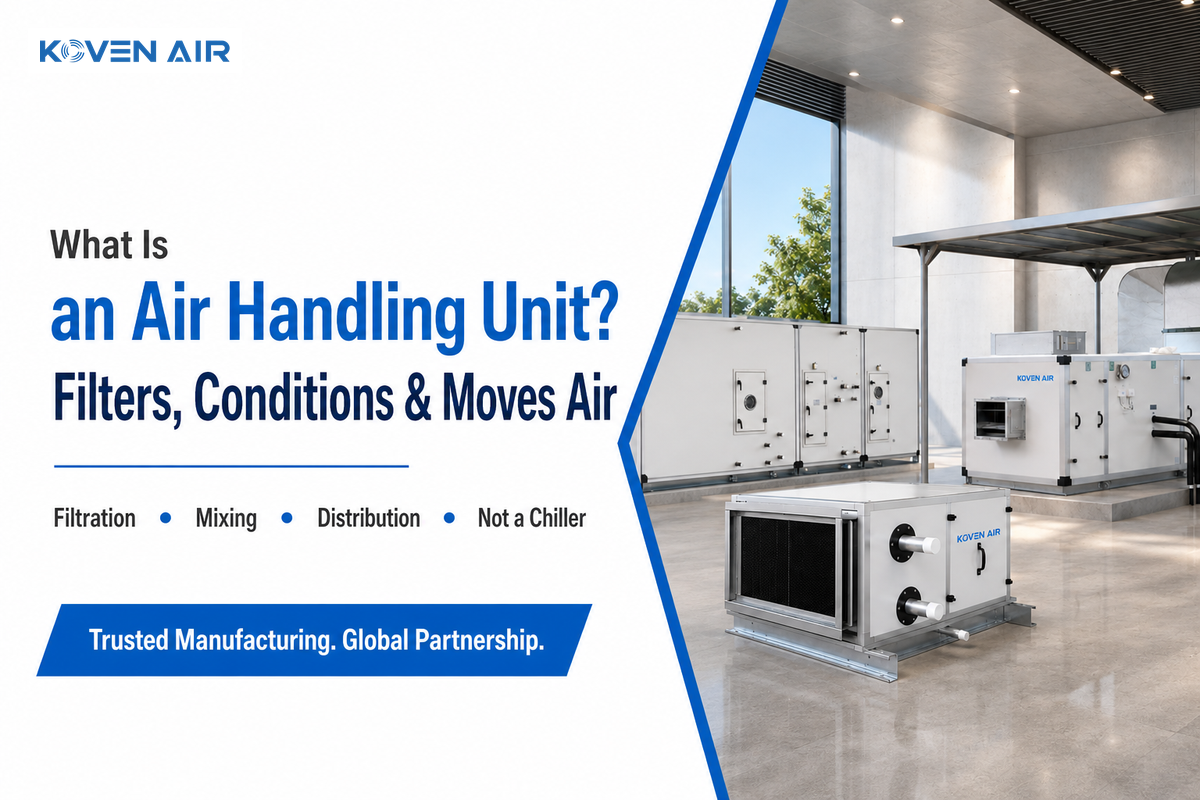
An air handling unit is a sheet-metal cabinet designed to filter, condition, and move air through a building’s ductwork. However, it’s not involved in generating heat or cooling within a building. Actual heating and cooling is handled by a chiller, boiler or DX-cooling unit providing thermal energy to the system. Its role is solely filtration, mixing and distribution.
Per the EPA’s own HVAC and indoor air quality guidance, it works alongside the rest of your HVAC system rather than replacing any part of it, and that’s exactly where the confusion sets in: HVAC is the umbrella term for the whole system, your air conditioner is the piece that actually produces cooling, and the AHU is what moves and conditions the air those other components have treated. Getting that distinction wrong is a common, avoidable mistake, and the risk isn’t just wasted research time: a buyer who treats the two as interchangeable can end up quoting an application against equipment rated for a fraction of the required airflow, a mix-up that costs a two-day re-quote once someone catches it, since residential air handlers rarely exceed 3,400 m³/h while commercial AHUs regularly clear 44,000 m³/h. The root cause is almost always the same search-term overlap described above, because Koven engineers each configuration against the project’s actual application and load rather than a generic residential assumption, and its equipment ships to 35 countries built that way.
Unfortunately, when searching for “air handler or air handler unit” you’ll get many results for a home HVAC system (a unit coupled with a heat pump). On the contrary, when searching for “air handling unit” and its variations (commercial AHU and building AHU), you’ll likely pull up results for manufacturer spec sheets designed for mechanical engineers, facility maintenance managers, and contractors. Your project likely needs a building air handling unit if it involves a cleanroom, named filtration standard or a mechanical room with multiple duct zones.
The 6-Path AHU Decision Tree, Which Type Do You Actually Need?
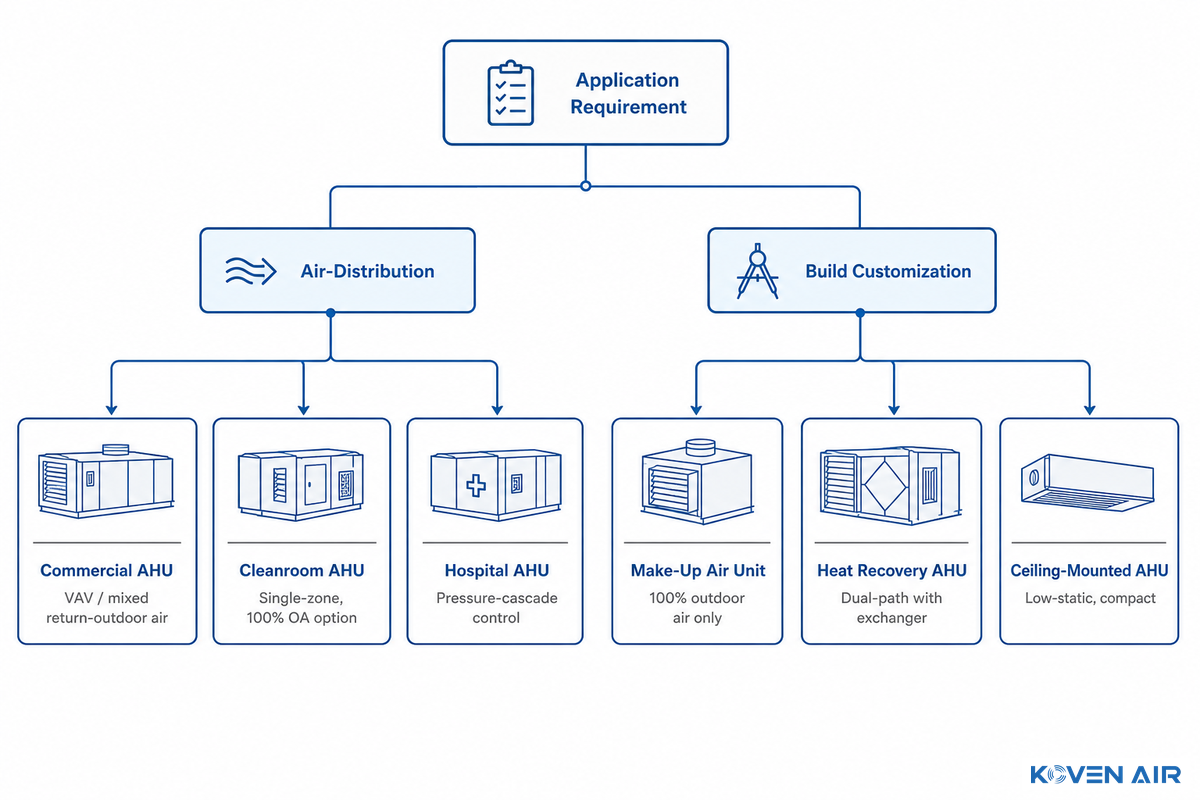
AHU taxonomy isn’t one list – it’s two independent axes that most buying guides collapse into one, which is exactly why buyers end up confused enough to ask strangers on engineering forums where to even start. One axis is air-distribution configuration: how the unit routes conditioned air to different zones (single-zone VAV, dual-duct, or multi-zone with separate hot/cold decks).
Its counterpart is build customization: how much of the unit is a pre-engineered catalog product versus an engineered-to-order assembly (packaged/rooftop, semi-custom modular, or fully custom air handling units built to one project’s exact requirements, including VFD retrofits documented in USPTO filings for older constant-volume units rated below 200 kW).
A real spec sheet answers both questions at once – as ASHRAE’s own equipment guidance notes, an AHU has no single defining number; it’s described by supply air temperature, volume, outdoor-air fraction, pressure, coil configuration, humidity control, and filtration together, not by one identifier.
| Configuration | Distribution axis | Customization axis | Best-fit application |
|---|---|---|---|
| Commercial AHU | VAV, mixed return/OA | Semi-custom modular | Offices, malls, public buildings |
| Cleanroom AHU | Single-zone, mixed or 100% OA | Custom modular | Pharma, biotech, semiconductor |
| Hospital AHU | Single-zone, pressure-cascade | Custom modular | Operating theatres, isolation rooms |
| Make-Up Air Unit | 100% outdoor air only | Semi-custom to custom | Process exhaust replacement, factories |
| Heat Recovery AHU | Dual-path with exchanger | Semi-custom modular | High fresh-air-load buildings, energy targets |
| Ceiling-Mounted AHU | Single-zone, low static | Packaged to semi-custom | Low plant-room height, compact installs |
Confusion at this exact decision point is common enough that engineers debate it openly rather than following a fixed rule – a facilities-side buyer on the r/MEPEngineering forum asked peers directly about semi-custom versus custom AHUs, weighing lead time, budget, and specialized filtration against each other rather than picking by a chart alone.
That’s the honest answer: the decision tree narrows your options fast, but the final call between adjacent configurations is a project-specific tradeoff, not a lookup.
⚠️ Important
Oversizing is not a safety margin – it is a failure mode.
Oversizing by 30% over the calculated load causes short-cycling, because the coil never reaches steady-state, which accelerates compressor and coil wear and degrades humidity control rather than protecting against under sizing. This pattern is documented independently across multiple HVAC-contractor sources, not just as manufacturer talking points.
The Mix-to-Discharge Airflow Sequence, How Air Actually Moves Through an AHU
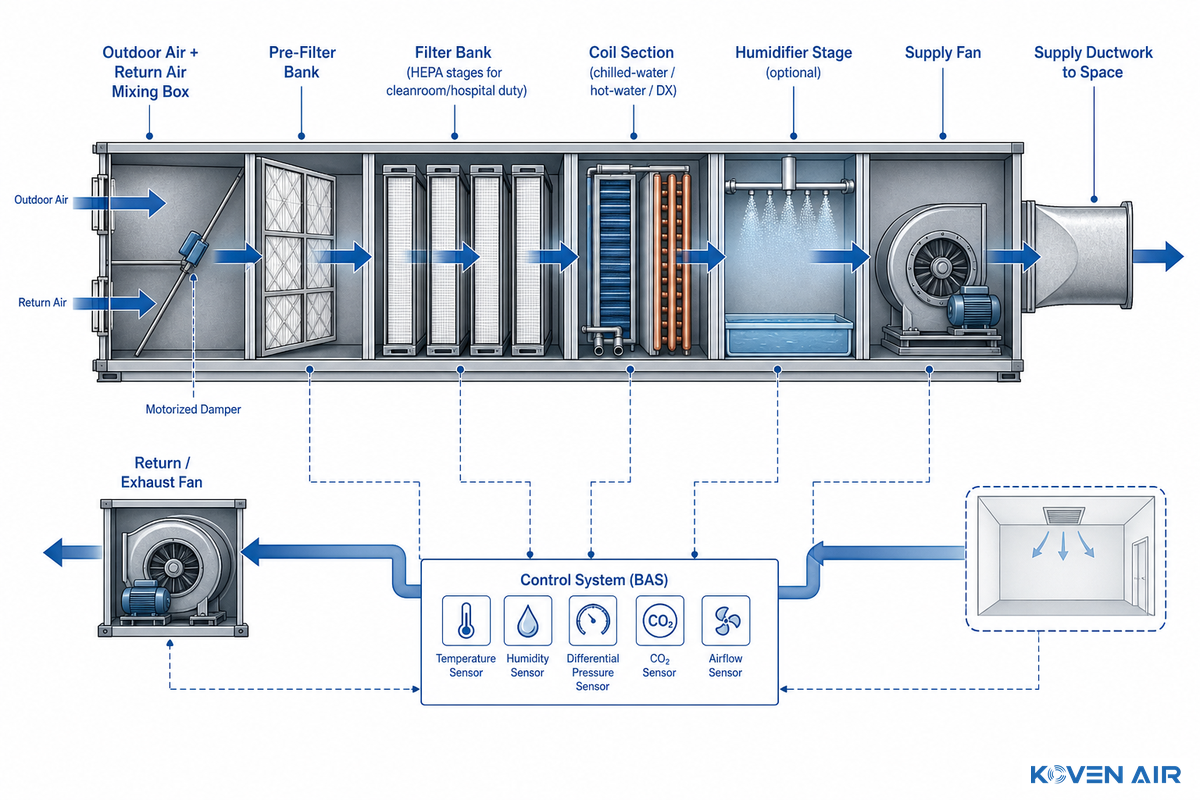
Air handling units are commonly documented as processing air through a fixed sequence, station by station, even though the exact station count and order shift with configuration. First, an air intake and mixing box with motorized dampers blends outside air with return air, setting the fresh-air ratio that governs indoor air quality and helps maintain indoor air quality throughout the space served. A common mistake at this stage is undersizing the pre-filter section, because a starved filter bank forces the downstream fan to work against higher static pressure than the coil was ever engineered to handle. Koven engineers each section to the calculated resistance documented in USPTO filings on airflow-matched fan retrofits rather than a rounded-up default, precisely to avoid that failure mode. That blended stream then passes through a filter bank, from coarse pre-filters up to HEPA stages in cleanroom or hospital duty, before reaching the coil section – a chilled-water or hot-water heating coil, or a direct-expansion evaporator tied to refrigeration-cycle equipment outside the unit – where it’s heated or cooled to the target discharge condition.
Some builds add a humidifier stage here to bring the air to the target moisture level. A supply fan then pushes the conditioned air into the supply ductwork, while a return or exhaust fan pulls air back from the space, and a control system running on setpoints and sensors keeps every stage of the air system matched to real-time demand rather than a fixed schedule – on most commercial HVAC equipment today, that control layer reports into the building’s wider building automation system (BAS) rather than running standalone.
At scale, that sequence has to survive far more than one room’s worth of tolerance. Koven itself has provided more than 100 of its own air handling units (AHUs) for Tesla’s 860,000m2 Shanghai Gigafactory site (which employs multiple mechanical contractors), where all of the Koven portion of supply air was validated via CFD simulation pre-build – and the Koven portion of the site maintained temperature accuracy to within 1°C, an incredibly tight tolerance only achievable when every mixing, filtering, and coil stage is sized from the actual load curve rather than simply being rounded up to the closest catalog box size.
AHU vs. RTU vs. FCU vs. Air Conditioner, Getting the Terminology Right
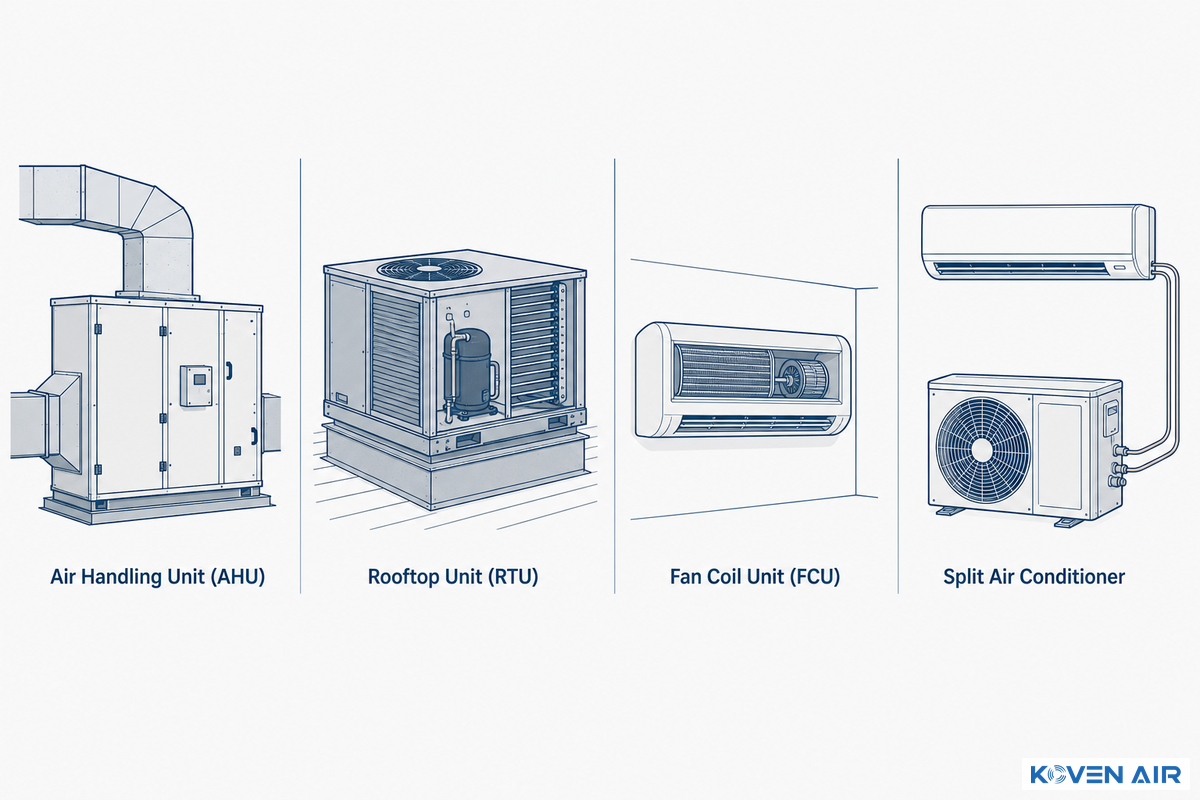
These three related types are often spoken about synonymously, leading to procurement mistakes. An AHU functions as an HVAC brain, and its counterparts often cause confusion. A rooftop unit is a self-contained AHU, typically capped around 85,000 m³/h, that houses the compressor, coils, filters, and fan within one outdoor cabinet, trading configurational flexibility for less floor space in mechanical rooms. FCU stands for a fan coil unit, a smaller piece of terminal equipment in individual zones that conditioned recirculated air – not a central system. “An air conditioner actually does the work of cooling or heating the air; an AC unit delivers that cool (or hot) air and filters it.
✔ Modular AHU — Advantages
- Configuration flexibility across 1,000–350,000 m³/h airflow, G4–H14 filtration, and static pressure
- Serves multiple zones from one central plant connection, up to 2,000 Pa external static pressure and 5,500 kW cooling capacity
- Filtration ceiling reaches HEPA for cleanroom/hospital duty
⚠ Modular AHU — Limitations
- Larger mechanical-room footprint than a packaged RTU
- Requires separate heating/cooling source equipment
- Longer lead time on custom-modular builds, commonly 8–14 weeks
Mixing up these categories at the RFQ stage is a common mistake, since each category carries its own filtration and performance basis, because each one is engineered around a different footprint and application, and Koven builds all three product lines rather than pushing every buyer toward one. We discussed the direct-expansion vs. chilled-water selection for individual components in our guide to air handler unit selection – check it out for a full component-by-component breakdown of the differences and an AHU/RTU/MAU comparison table.
The Cross-Standard Compliance Ledger, Which Standard Actually Governs Your AHU
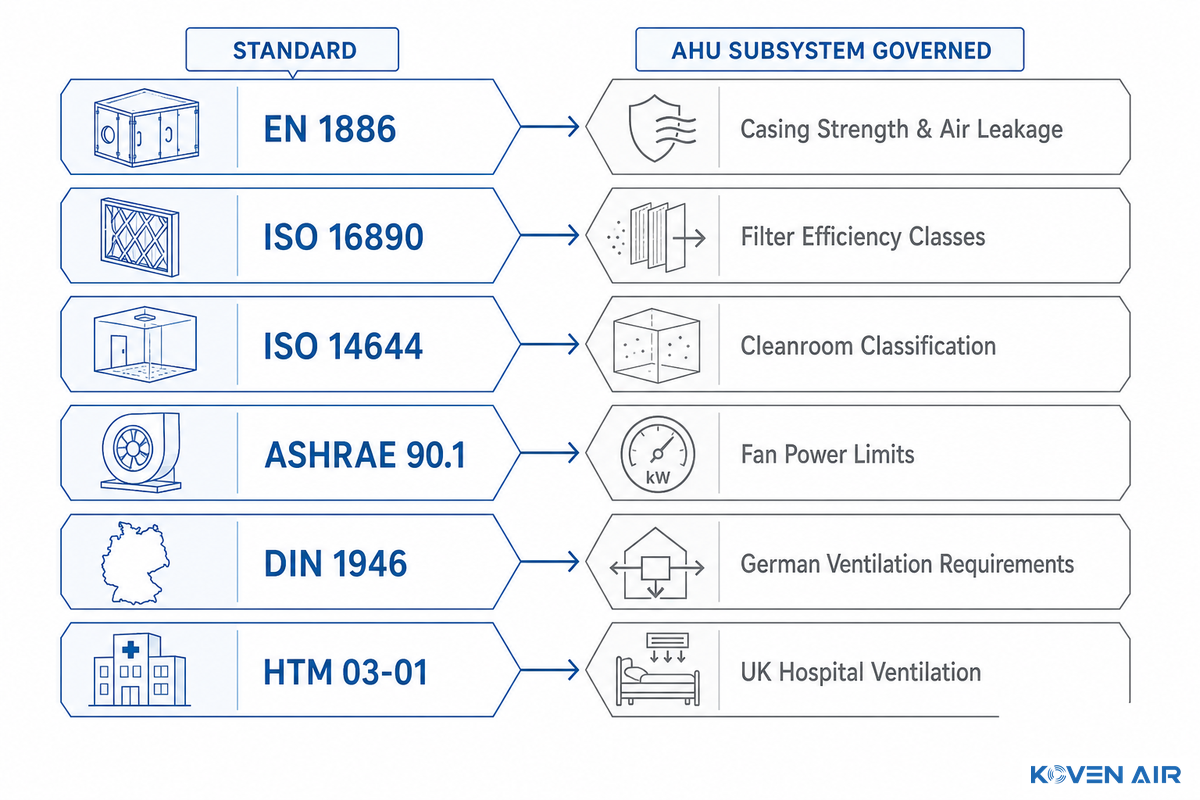
No single ISO or ASHRAE standard in the industry governs air handling units. The filtering, casing materials, cleanroom classification, requirements for hospital operation, infection control, energy efficiency, and fire safety standards are each dictated separately by different entities depending on whether the project is within Europe or the USA-using the wrong one on your spec sheet can result in costly rework.
| Standard Type | Governs | Applies when |
|---|---|---|
| ISO 16890 | Filter efficiency by PM class (ePM1/ePM2.5/ePM10) | Any project specifying filtration beyond coarse pre-filters — note: mid-revision as of 2025, confirm current edition |
| ISO 14644-1 | Cleanroom air cleanliness classes (ISO 1–9) | Pharma, biotech, semiconductor cleanroom AHUs |
| EN 1886 | Casing air leakage class (e.g. Class L1) | Any AHU where energy loss through casing leakage matters |
| ASHRAE 90.1 | Maximum fan power by airflow and application | US commercial building energy code compliance |
| ASHRAE 62.1-2025 | Minimum ventilation rates, indoor air quality | US commercial ventilation design baseline |
| ASHRAE/ASHE 170-2025 | Health care facility ventilation rates | US hospital and clinical-space AHUs |
| ASHRAE 241-2023 | Infectious aerosol control, IRMM operating mode | Health care and high-occupancy buildings targeting infection-risk mitigation |
| HTM-03-01 | UK hospital ventilation, pressure cascade design | UK health care projects specifically |
| DIN 1946 | Hygiene requirements for ventilation systems | Germany and DACH-region health care/hygiene-critical projects |
| EU Regulation 1253/2014 (Ecodesign) | Minimum heat-recovery effectiveness (73% rotary/plate, 68% run-around, 2018 figures) | EU-market AHUs with heat-recovery sections |
It’s also important to distinguish between certified performance data and code-mandated performance. AHRI 430/431 sets a performance standard for AHU fan performance in the US, and there’s AMCA certification for Fan Efficiency Grade (FEG) and Fan Energy Index (FEI) to verify performance, sound, and energy efficiency, since the US doesn’t currently mandate fan and blower energy-conservation standards.
Matching AHU Type to Application, Hospitals, Cleanrooms, Data Centers & Factories

Picking a configuration without checking it against the governing filtration standard is a common, expensive mistake, because a unit that passes commercial-duty testing can still fail a hospital or cleanroom inspection outright. Koven cross-checks each application against its matching standard before quoting, which is the structural reason the mapping below exists.
| Application | Best-fit configuration | Governing standard(s) |
|---|---|---|
| Pharma/biotech cleanroom | Cleanroom AHU | ISO 14644-1, ISO 16890 |
| Operating theatre / hospital (US) | Hospital AHU | ASHRAE/ASHE 170-2025, ASHRAE 241-2023 |
| Operating theatre / hospital (UK) | Hospital AHU | HTM-03-01 |
| Full-fresh-air process (electronics) | Make-Up Air Unit | ASHRAE 62.1-2025 |
| Mall / office / public building | Commercial AHU | ASHRAE 90.1, ASHRAE 62.1-2025 |
| High fresh-air load, energy targets | Heat Recovery AHU | EU Reg 1253/2014 (EU projects) |
In the case of the hospital, this isn’t a theoretical answer. When our own team supplied a Hospital AHU to a site within the operating theaters of our clients’ coastal hospital project in Indonesia (which is 200m from the sea, along a shoreline exposed to a corrosive environment with >80% ambient humidity) our Hospital configuration maintained the operating rooms between 19-24°C with 50-60% relative humidity, as well as automated control of formaldehyde, PM2.5, and CO2, along with an automated positive-negative pressure cascade. It’s this blend of precise humidity control alongside an automatic positive/negative pressure system that differentiate a hospital-grade AHU from a standard commercial unit, and why the standard/configuration has to be selected jointly, not sequentially.
Installing & Commissioning an AHU, What Determines Whether It Performs as Spec’d
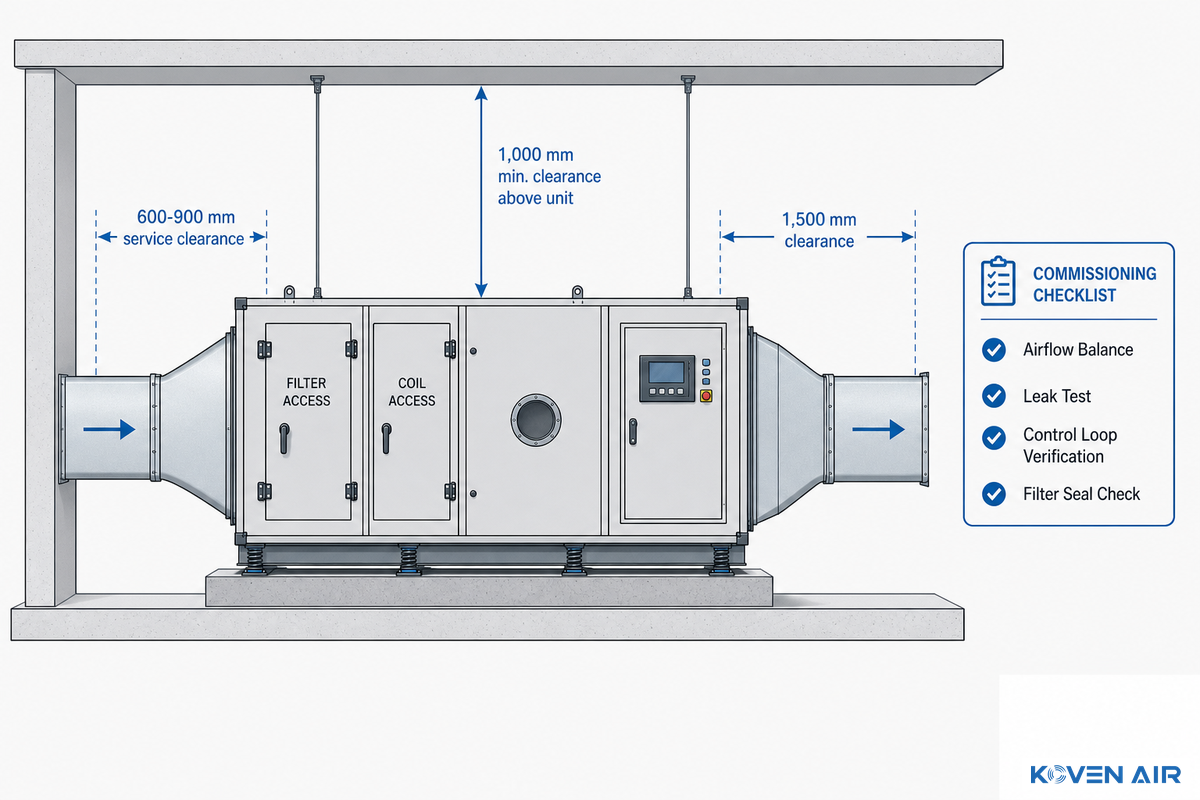
Even with the right AHU selected, a poorly installed and commissioned job can still lead to performance problems. Crane clearance — commonly 600–900 mm of working space per side on larger sectional units, and up to 1,500 mm around HEPA-stage access panels — has to be calculated before the unit hits the floor; sections that ship flat for field assembly rather than hoisting a single large box in place are only an advantage if mechanical-room access was already checked against component dimensions. Duct connections should be sequenced so static-pressure testing happens before final ceilings or walls close off access, and BMS points via BACnet MS/TP or Modbus RTU/TCP should be verified as active data points, not just wiring continuity.
Indeed, testing and commissioning itself is more than just a single test: per the original commissioning-process literature for air handling systems and the EPA’s own HVAC commissioning guidance, it’s a process of functional performance tests and testing-adjusting-balancing (TAB) that ensure a unit actually achieves design airflow and pressures under full system load (as defined by duct resistance), rather than just at a factory test bench (a distinction a great deal of original documentation on AHUs made for the field when we first standardized functional testing). We consider this to be the single most prevalent, preventable field error: mechanical room filter access clearance most often gets value-engineered out during construction, ultimately resulting in filter bypass and overstressed fans over years.
“The most expensive commissioning mistakes are the ones that never show up on a test report, a duct run sequenced before the static-pressure test, or a mechanical room where nobody checked whether a technician can actually reach the filter bank once the ceiling is closed in.”
On one of Koven’s own projects, a Ningbo (China) electronics-manufacturing facility’s makeup air unit operated 24/7 on full outdoor air and shipped in modular sections for site assembly – in lieu of a single crane-lifted container – cutting heating energy by roughly 50% while holding humidity at 45%, solely thanks to its steam-plate exchanger; that saving is a direct result of having choreographed the section-by-section sequence of the field-assembly plan from the factory.
Refer to our ceiling-mounted AHU installation guide for details concerning AHU installation clearances, air-stream jet throws, and low-static pressure duct run options.
Energy Efficiency & Controls at a Glance
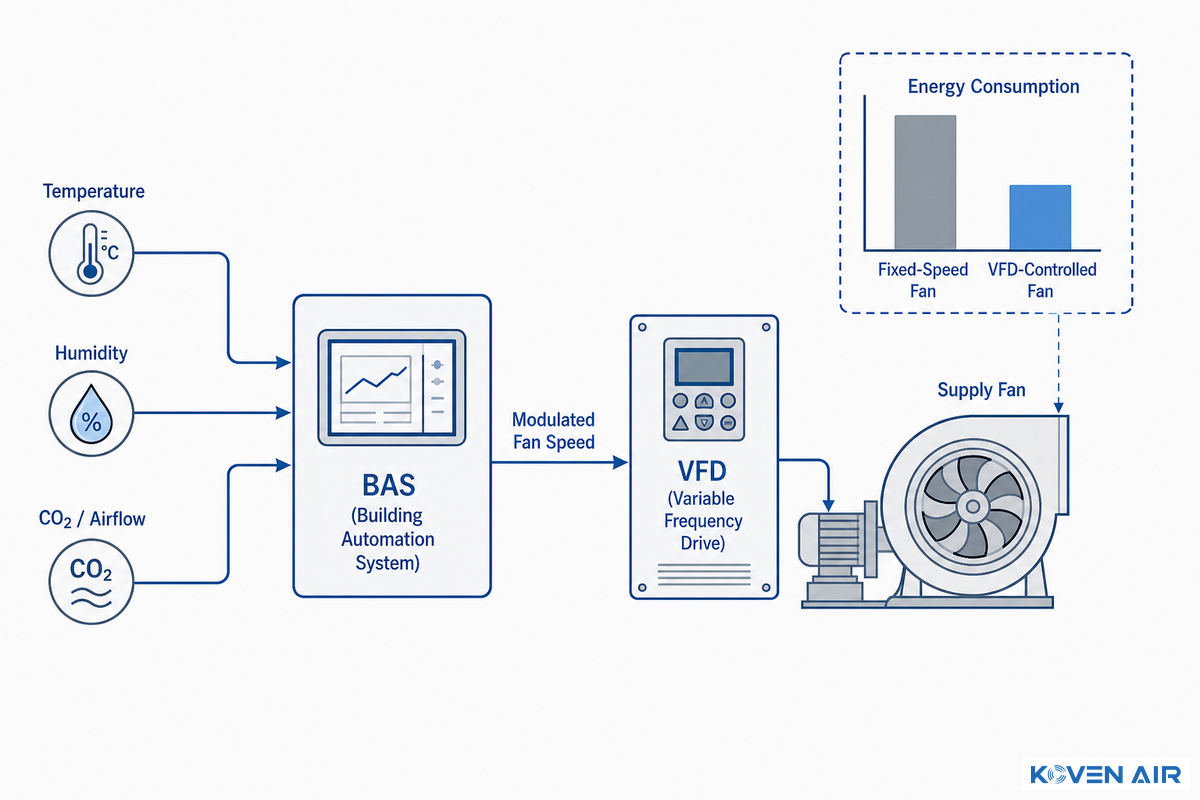
Buyers who get this wrong pay for it every month on the utility bill — VFD demand control has cut fan energy up to 40% on comparable commercial builds — because the three primary variables that influence AHU operating cost are the supply/return fan’s variable-frequency drive (VFD), its EC-motor or other high-efficiency type, and its heat-recovery section (since fans use approximately third-power proportional to airflow, the energy savings from even slight reductions in fan speed at part-load conditions are significant). Per the U.S. Department of Energy’s own standards status page, no federal DOE appliance-efficiency standard specifically targets AHU fans and blowers as a product category the way ASHRAE 90.1 caps whole-building fan power at the building-code level, so cross-vendor product comparisons ought to refer to a vendor’s voluntary AMCA certification for Fan Energy Index or Fan Efficiency Grade as the baseline measure, since assuming a federal minimum on a level playing field is often misleading. Koven quotes VFD savings up to 40% on its commercial application builds precisely because it certifies to that voluntary baseline rather than an assumed one. Our AHU Energy-Savings Estimator walks through savings estimates for a particular system configuration and operating pattern.
Industry Outlook, Where AHU Design Is Headed

Specifying to yesterday’s efficiency baseline, per the U.S. Department of Energy’s own tracking of fan and blower standards, is a costly mistake buyers won’t see until the next regulatory cycle catches up, because the nearest-term driver for changing AHU specification sheets is regulation rather than market demand. EU Ecodesign Regulation 1253/2014 has already mandated minimum heat-recovery effectiveness ratings of 73% for rotor/plate exchangers and 68% for run-around coil systems, referencing 2018 standards, and a pending update would set a project-specific minimum based on its winter design temperature, as a consistent 73% figure can actually be detrimental to energy-saving in warmer environments that prioritize reducing fan energy over heating energy by some means.
Koven tracks these regulatory shifts against its own certified product lines rather than reacting after the fact. Two demand-side trends are compounding this. Hyperscale data centre construct is skewed towards the modular, indirect-adiabatic style AHUs which capacity build out is achieved in modular blocks, rather than one giant AHU and Asia -based health/pharmaceutical build outs of clean rooms is adding on-demand, for HEPA-filtered AHUs following ISO 14644-1 Class 5-8 and real time-particle monitoring specifications on top of its air handlers by chip and biotech fabs. Vendor-activity in Aug-Oct 2025 mirrors this – Trane has just announced introduction of new, energy efficient AHUs, Carrier co-invested on an AI Analytics suite for its air handlers, and Daikin added manufacturing capacity in the Southeast Asian for regional supply.
The size estimates for AHUs are somewhat meaningful from one research shop to the next – proprietary 2025/2026 numbers fall some where broadly between $13B and $17B at present for the world and with mid-single-to-high single-digit CAGRs through the early 2030s-a spread wide enough that the size estimate is less critical than the direction-a steady story fueled by tightening regulations and demand from data centers and clean rooms, not a market in upheaval.
FAQ, Air Handling Units
Get answers to the frequently asked questions regarding air handling unit types, terminology and selection.
Q: What is the difference between an AHU and HVAC?
View Answer
HVAC is the umbrella term for a building’s entire heating, ventilation, and air conditioning system — the ductwork, chillers, boilers, thermostats, and controls working together. An air handling unit (AHU) is one physical component inside that system: the box that filters, heats or cools, and moves air into the ductwork. A large commercial building runs several AHUs, one per zone, under one overall HVAC plan.
Q: What is an air handling unit (AHU)?
View Answer
An air handling unit is a modular sheet-metal cabinet that mixes fresh and return air, filters it, passes it across a heating or cooling coil, and pushes it through ductwork with a fan. It does not generate heat or cooling itself — it is paired with a chiller, boiler, or DX condensing unit that supplies the energy, while the AHU’s job is filtration, conditioning, and distribution.
Q: What are the different types of air handling units?
View Answer
AHUs split along several independent axes at once: by cooling source (chilled-water vs. direct-expansion refrigerant), by airflow control (constant-volume vs. variable-air-volume), by fan arrangement (draw-through vs. blow-through), and by duty (commercial, cleanroom, hospital, heat-recovery, make-up-air, or ceiling-mounted). In practice, a single unit is described by combining two or three of these — for example, a chilled-water, VAV, cleanroom AHU.
Q: What’s the difference between an AHU and an air conditioner?
View Answer
An air conditioner produces cooling. An AHU doesn’t — it filters and distributes air that something else, like a chiller or a DX condenser, has already cooled or heated.
Q: Who needs a commercial/industrial AHU versus a residential air handler?
View Answer
A residential air handler and a commercial AHU share a name but not a spec sheet. Homeowners searching “air handler” are almost always looking at a small indoor unit paired with a heat pump or AC condenser, sized for a single house and rated in tons. Facilities managers, mechanical engineers, and contractors specifying equipment for an office building, hospital, factory, or cleanroom need a modular AHU built to a calculated airflow, external static pressure, and filtration class — a different category entirely, closer in scale and complexity to central plant equipment than to a residential split system. If your project has a mechanical room, ductwork serving multiple zones, or a filtration-class requirement, you’re in AHU territory, not air-handler territory.
Q: Does an air handling unit create its own heat or cooling?
View Answer
No. An AHU filters and moves air, and conditions it by passing it across a coil — but the heat or cooling itself comes from an external source: a chiller for chilled water, a boiler or electric element for heat, or a DX condensing unit for refrigerant-based cooling.
Confused on which configuration you need out of the six available?
Check out the AHU Configuration Finder – just answer three simple questions to see which AHU platform is right for your airflow, filtration, and application.
Why We Write This
Since 2007 Koven Air has produced all 6 AHU typologies in this chapter: commercial, cleanroom, hospital, heat recovery, make-up air and ceiling-mounted. We authored this post because most AHU purchasing guides attempt one classification taxonomy axis at a time, but buyers typically call us because they are attempting to compare incompatible “type” mental models simultaneously.
Its standards ledger & application mapping is built from information used internally by our own project engineering & commissioning team’s during active projects and cross-referenced against multiple sources (ASHRAE, ISO, & EU standards, etc.) instead of as a mere restatement of a competitor’s.
References & Sources
- Heating, Ventilation and Air-Conditioning Systems, Indoor Air Quality Design Tools for SchoolsU.S. Environmental Protection Agency
- ISO/FDIS 16890-1, Air Filters for General VentilationInternational Organization for Standardization
- How to Select EN ISO 16890 Rated Air Filter ClassesEurovent Association
- ASHRAE Standard 241, Control of Infectious AerosolsASHRAE
- Fans and Blowers, Energy Conservation Standards StatusU.S. Department of Energy
- Optimising AHU Performance with Smart Design for Net ZeroFläktGroup, citing EU Regulation 1253/2014
- A New Guide for Commissioning Air Handling SystemsAmerican Council for an Energy-Efficient Economy
Related Articles
- Koven Air Handling Unitsfull spec ranges, certifications, and quote request for all six AHU types covered in this guide
- Commercial Air Handling Units Explainedfull component breakdown, DX vs. chilled-water selection, and the complete AHU vs. RTU vs. MAU comparison table
- Ceiling-Mounted Air Handler Installation & Maintenanceclearance, jet-throw distance, and low-static routing specifics
- Make-Up Air Unit Guidesizing and selection for 100%-outdoor-air applications
- Fan Coil Unitsterminal zone-level conditioning versus central AHU distribution
- AHU Energy-Savings Estimatormodel fixed-speed vs. VFD fan energy for your airflow and schedule
- AHU Configuration Finderthree questions to match your project to one of six configurations
![Horizontal Fan Coil Unit Project Guide [Step-by-Step]](https://kovenair.com/wp-content/uploads/2026/09/horizontal-fan-coil-unit-guide-featured-1-768x512.png)



![Commercial Rooftop Unit Guide: Types, Sizing & Costs [2026]](https://kovenair.com/wp-content/uploads/2026/07/commercial-rooftop-unit-guide-featured-2-150x150.png)