Get in Touch with Koven Air Company

Updated October 2026
Radiant floor heat pumps are hydronic heating and cooling plants that circulate conditioned water through embedded slab tubing or subfloor plates. Radiant-floor heating commonly uses 25 to 35°C (77 to 95°F) water on low-resistance slabs, while higher floor-covering resistance can require 115 to 123°F (46.1 to 50.6°C) water. Radiant cooling utilizes chilled water which is controlled to stay above the room dew point.
Commercial engineers, mechanical contractors, and facility managers must determine the leaving water temperature of each slab assembly. They determine the size of buffer tanks and glycol pumps and evaluate the requirements for manifold loops and boiler-loop retrofit. First, what supply water temperature does each floor assembly require under floor covering thermal resistance limits? Second, how do you size buffer tanks, glycol solutions, and manifold circuits to prevent short cycling? Third, what does a contractor verify before retrofitting an existing boiler loop?
This engineering guide answers those questions using published hydronic formulas and code limits from ISO 11855 and the Uniform Mechanical Code. Each calculation gives model-specific ratings from data sheets and project assumptions, separated clearly in different configurations.
How do radiant floor heat pumps work in commercial hydronic systems?
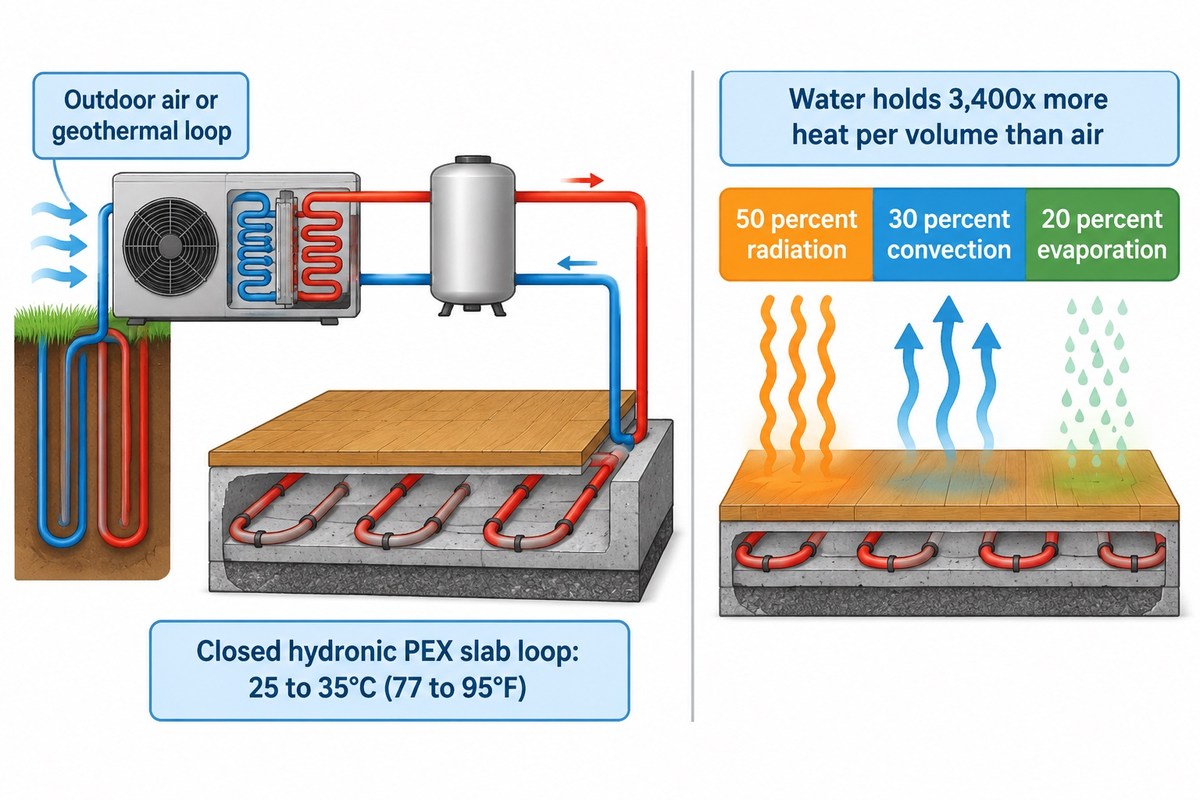
A radiant floor heat pump is a device that extracts thermal energy from outdoor air, groundwater, or closed geothermal loop. It transfers that energy to water via a heat exchanger and pumps it through a closed hydronic system. Warm water is circulated through cross-linked polyethylene (PEX) tubing embedded in concrete slabs or mounted under subfloor plates.
Unlike an air to air heat system that blows warm air through ductwork, hydronics uses water as the thermal carrier. Water holds approximately 3,400 times more heat per unit volume than air at standard room conditions. Thus, high heat capacity can be accomplished using small-diameter tubing across large commercial floor plates without bulky overhead air ducts.
Refer to radiant heating thermal comfort analysis for an estimate of human thermal transfer. It’s divided into approximately 50 percent radiation, 30 percent convection, and 20 percent evaporation. Heating the floor slab raises mean radiant temperature directly. Occupants of buildings feel comfortable when indoor air temperature is 2 to 4°F (1.1 to 2.2°C) lower than that of air-handling systems in forced-air buildings. Lower indoor air temperatures reduce envelope transmission losses in high-bay warehouses and aircraft hangars.
In a low-lift cycle with an efficiently operating compressor, the evaporating temperature occurs at the outdoor heat source and the condensing temperature occurs in the hydronic loop. Decreasing a heat pump’s leaving-water temperature lowers the compressor’s condensing temperature and lift. By contrast, a high-temperature boiler radiator loop is a high-lift combustion-system condition. In our air-to-water heat pump operation and sizing guide, we explain how a variable-speed compressor of a heat pump modulates across these pressures.
In the United States, 10 CFR Part 431 Subpart F defines federal test procedures and coefficient of performance (COP) metrics for commercial heat pumps. Radiant slabs commonly use 25 to 35°C (77 to 95°F) heating water, where lower water temperatures support high efficiency operation. A valid comparison between two heating solutions uses both the ambient source condition and the leaving-water rating point.
Can an air-to-water or water-source heat pump feed a radiant floor manifold directly?
Yes, an air to water heat pump or water to water unit can feed a radiant floor manifold directly, as long as loop flow and water volume remain within compressor limitations. A single-zone open warehouse slab with continuous flow often connects directly to the primary circulator without an intermediate mixing setup.
Multi-zone commercial systems and any residential homeowner project with room actuators need hydraulic decoupling when remaining flow or water volume can fall below operating limits. A series buffer tank adds water volume, while a primary-secondary separator decouples circuits. Either arrangement must maintain the heat pump’s required flow and minimum volume to protect the refrigerant loop from trips and short-cycling.
What supply water temperature do radiant floor heat pumps require by floor type?
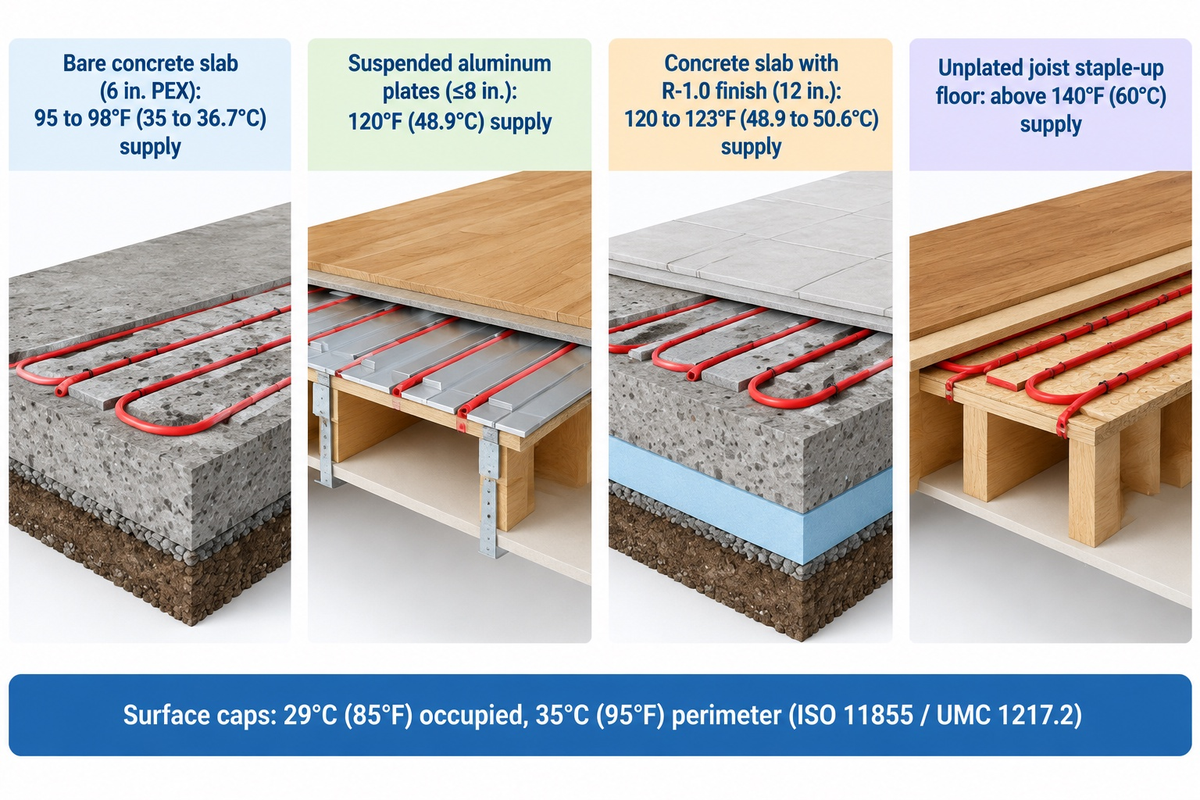
Bare structural concrete slabs with 6-inch PEX tube spacing typically require 95 to 98°F (35 to 36.7°C) supply water and 87.5°F (30.8°C) average water to deliver 20 Btu/hr·ft² (63.1 W/m²) into a 70°F room. Suspended aluminum-plate subfloors and R-1.0 slab coverings require 120 to 123°F (48.9 to 50.6°C) supply water.
International and North American standards set upper limits on floor surface temperature to protect occupant comfort and flooring materials. ISO 11855 / EN 1264 design standards cap general occupied floor surfaces at 29°C (85°F). Uniform Mechanical Code (UMC 2024) Section 1217.2 caps general occupied floors at 85°F (29°C) and permits 90°F (32°C) in bathrooms, foyers, and pool decks. It also allows 95°F (35°C) in perimeter zones up to 2.5 ft (762 mm) from exterior walls.
In published hydronic slab emitter curves, upward heat flux scales with the driving delta-T between average circuit water and indoor room air. Average circuit water is 87.5°F (30.8°C), which corresponds to 95 to 98°F (35 to 36.7°C) supply water.
Wider tube spacing and insulating floor finishes force supply water temperatures higher. Widening concrete slab tube spacing to 12 inches and adding an R-1.0 floor covering raises required driving delta-T to 42.5°F (23.6°C) at 20 Btu/hr·ft². Average water temperature climbs to 112.5°F (44.7°C), pushing required supply water to 120 to 123°F (48.9 to 50.6°C). Unplated joist staple-up floors can require water above 140°F (60°C).
9-Point Slab R-Value and Water-Temp Derating Matrix
| Floor Assembly Specification | Published Spacing Range | Covering R-Value Setting | Target Flux Benchmark | Required Driving Delta-T Value | Water Temperature Range | Standard Surface Limit | Source & Reference Scope |
|---|---|---|---|---|---|---|---|
| 1. Bare concrete slab (6 in. PEX) | 6 in. (150 mm) | R_ff = 0.0 (bare slab) | 20 Btu/hr·ft² (63.1 W/m²) | 17.5°F (9.7°C) | 87.5°F avg / 95–98°F supply (35–36.7°C) | 85°F (29°C) occupied cap | Caleffi slab curve / ISO 11855 |
| 2. Low-temperature screed floor | ≤12 in. (300 mm) | R_ff = 0.0 (bare screed) | 20 Btu/hr·ft² (63.1 W/m²) | 17.5°F (9.7°C) | 25–35°C (77–95°F) supply flow | 29°C (85°F) occupied cap | Alpha-Innotec / ISO 11855 |
| 3. Concrete slab with R-1.0 finish | 12 in. (300 mm) | R_ff = 1.0 (covering) | 20 Btu/hr·ft² (63.1 W/m²) | 42.5°F (23.6°C) | 112.5°F avg / 120–123°F supply (48.9–50.6°C) | 85°F (29°C) occupied cap | Caleffi high-R slab curve |
| 4. Suspended subfloor aluminum plates | ≤8 in. (200 mm) | ≤R-1.1 (subfloor + finish) | 15 Btu/hr·ft² (47.3 W/m²) | 45.0°F (25.0°C) | 115.0°F avg / 120°F supply (48.9°C) | 85°F (29°C) occupied cap | Caleffi plated subfloor curve |
| 5. Perimeter floor band (≤2.5 ft) | 6 in. (150 mm) | R_ff = 0.0 (perimeter) | 20 Btu/hr·ft² (63.1 W/m²) | 17.5°F (9.7°C) | 25–35°C (77–95°F) supply flow | 95°F (35°C) perimeter cap | UMC 1217.2 / ISO 11855 |
| 6. Bathroom / foyer / indoor pool deck | 6 in. (150 mm) | R_ff = 0.0 (wet-area tile) | 20 Btu/hr·ft² (63.1 W/m²) | 17.5°F (9.7°C) | 87.5°F avg / 95–98°F supply (35–36.7°C) | 90°F (32°C) wet-area cap | UMC 2024 Section 1217.2 |
| 7. Radiant floor cooling slab | 6 in. (150 mm) | R_ff = 0.0 (bare slab) | Sensible floor cooling | 2–3°F above dew point | Chilled water above 62°F (16.7°C) dew point | ≥19°C (66.2°F) cooling min | ISO 11855 / Energy Vanguard |
| 8. Unplated joist staple-up floor | ≤12 in. (300 mm) | R_ff > 1.1 (wood + carpet) | 15 Btu/hr·ft² (47.3 W/m²) | High thermal resistance | Above 140°F (60°C) supply required | 85°F (29°C) occupied cap | Caleffi unplated emitter note |
| 9. Legacy 180°F (82.2°C) panel radiator branch | N/A (panel emitter) | N/A (convective panel) | 27 percent of 180°F (82.2°C) rated output | 40°F (22.2°C) to room | 110°F (43.3°C) average heat pump water | Emitter-specific rating | Caleffi radiator derating curve |
How does floor covering R-value cap radiant heat pump efficiency?
Floor covering R-value caps radiant heat pump efficiency because every unit of thermal resistance above the PEX tubing insulates the heat emitter. Sub-slab insulation reduces downward heat loss, and its required R-value is determined by the slab heat loss and the applied code. Without adequate sub-slab insulation, downward heat loss increases and required water temperature increases.
Suspended underfloor tube-and-plate systems must keep tube spacing at 8 inches or less and floor resistance R_ff at 1.1 or less. That spacing delivers 15 Btu/hr·ft² (47.3 W/m²) with 115°F (46.1°C) average water and 120°F (48.9°C) supply water. Adding plush carpet and pad over wood subfloors raises required water temperature into a range where many low-temperature heat pumps lose efficiency or can’t meet the load.
Why should inverter heat pumps use outdoor reset curves instead of fixed mixing valves?
Use outdoor reset curves for inverter heat pumps because a boiler’s high flame temperature and thermostatic mixing of hot supply water to slab levels waste compressor electricity. Technical guidance on underfloor mixing highlights this common boiler carryover habit.
Generating 120°F (48.9°C) water only to mix it down to 95°F (35°C) forces the compressor to pay the higher condensing pressure penalty. Instead, configure the weather-compensation curve to modulate heated water directly across the 25 to 35°C (77 to 95°F) slab band as outdoor air drops. Reserve mixing valves for multi-temperature plants where high-temperature radiators and low-temperature radiant panels share one primary header.
How do you size buffer tanks and zone manifolds to prevent short-cycling?
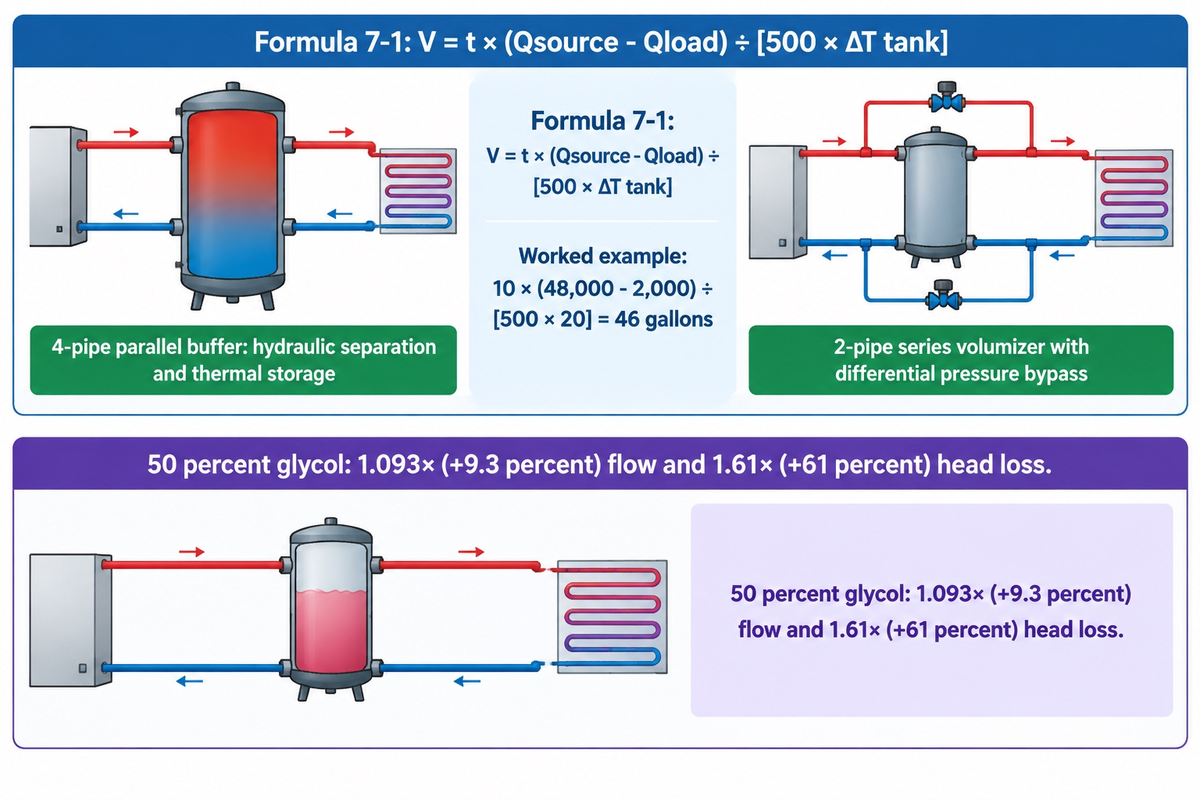
Size a buffer tank for hydronic heat pump to compensate for the difference between minimum compressor output and smallest active zone load over a 10 minute minimum run cycle. Caleffi’s Formula 7-1 states the volume of thermal buffer, in gallons, is equal to the run time in minutes, multiplied by the excess heat output in Btu/hr, and divided by [500 × tank temperature differential in °F].
Compressor runs shorter than 10 minutes, which is more than 6 starts per hour, can increase start-current stress and oil migration. Also, repeated short cycles can decrease seasonal efficiency. Design the controls to eliminate repeated short cycles, if possible. On mild days the unit should run in longer cycles and if winter design conditions are met, it should run continuously.
In Caleffi’s Design Details for Air-to-Water Heat Pumps, Formula 7-1 calculates required thermal buffer volume for pure water:
V = t × (Qsource − Qload) ÷ [500 × ΔT tank]
Consider Caleffi’s example of a 4-ton heat pump (48,000 Btu/hr, just below a commercial unit rated at 5 tons) with a 10 minute minimum cycle, serving a single 2,000 Btu/hr zone with a 20°F tank differential. The required buffer volume is 10 × (48,000 − 2,000) ÷ [500 × 20] = 46 gallons. Keep radiant supply water at or below 120°F (48.9°C) for efficient operation.
Cold-climate monobloc systems that circulate outdoor water need freeze protection, commonly through a propylene-glycol solution or an engineered drain-down strategy. At 120°F (48.9°C), hydronic fluid factor decreases from 493 for pure water to 479 for 30 percent glycol and 451 for 50 percent glycol, as per propylene glycol correction tables. A 50 percent glycol mix needs 493 ÷ 451 = 1.093× (+9.3 percent) higher flow rate for identical heat output. It also raises pipe friction head loss to 1.38 × (1.093)^1.75 = 1.61× (+61 percent) versus pure water.
When should you pipe a buffer tank in 2-pipe series vs 4-pipe parallel?
Use a 4-pipe parallel buffer tank to provide both hydraulic separation and thermal storage when primary heat-pump flow and secondary manifold flow differ. If flow in the secondary manifold exceeds flow in the primary heat-pump, water returning from the buffer tank can mix with the supply water and cool the water delivered to the floor.
A 2-pipe series volumizer on the return can help to minimize the dilution of supply water during balanced flows. A differential pressure bypass maintains the required minimum flow through the tank. As per the manufacturer, the tank can provide system water volume during defrost and single zone operation.
Do (Hydronic Zoning & Buffer Design)
- The volume of the buffer tank can be determined using Formula 7-1 with the smallest micro-zone load, and the minimum output of the compressor.
- During defrost and single zone operation, or to ensure the required flow, a high mass zone can be kept open or a properly sized differential bypass can be used.
- For solutions between 30 percent and 50 percent propylene glycol, the head and flow of the circulator should be set based on the solution’s design and actual viscosity, as opposed to using a fixed multiplier.
- Mark every manifold loop with exact PEX length and room area per UMC Section 1217.5.
Don’t (Common Field Errors)
- When a slab is divided into 8 to 12 small actuator zones, provide enough system volume and control capacity to ensure the compressor runs for at least its minimum run time.
- Do not use the pure-water fluid factor of 500 when determining GPM for glycol-filled monobloc loops.
- With a 4-pipe parallel buffer arrangement, balance the primary and secondary flows to avoid excessive return water mixing that causes leaving water temperature to be higher than the design temperature of the slab.
Air-to-water vs geothermal heat pumps vs boilers: performance and operating cost math
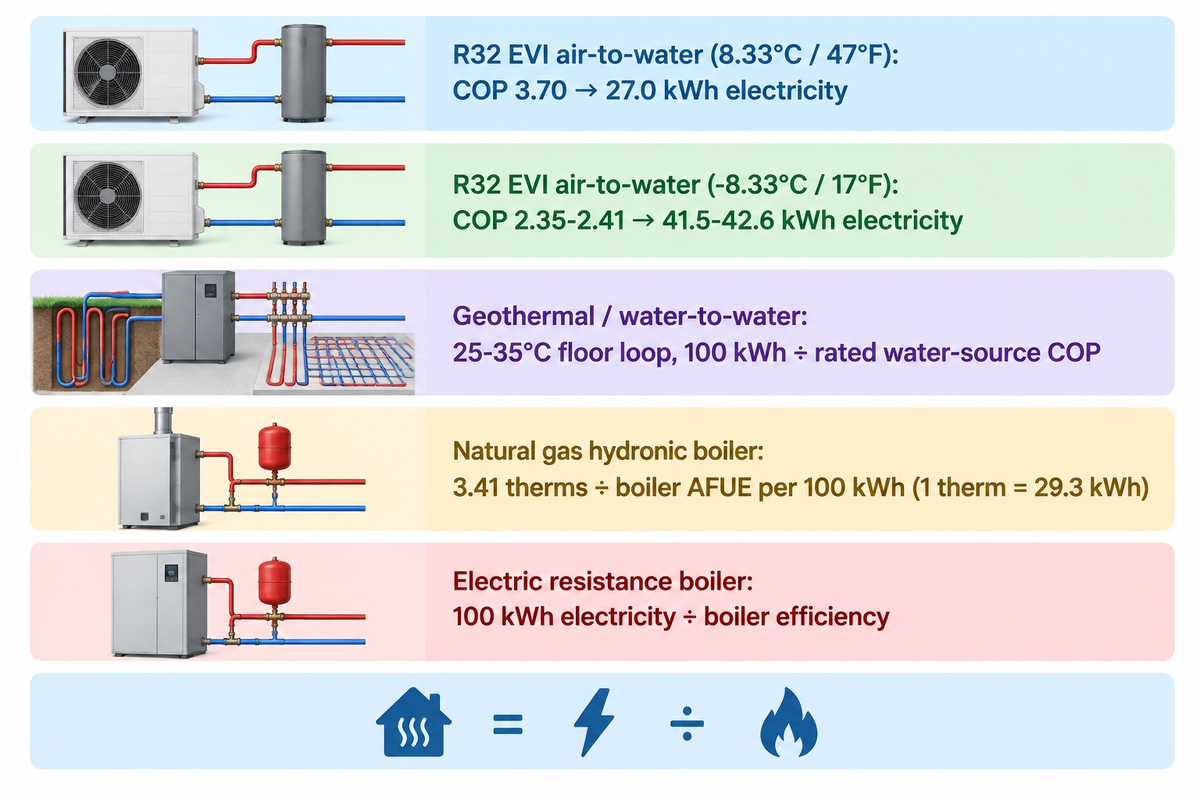
An R32 EVI air-to-water unit in this performance class reaches a rated heating COP of 3.70 at 47°F ambient air and 105°F leaving water. At −8.33°C (17°F) outdoor air and 40.56°C leaving water, rated COP is 2.8 (35.7 kWh of electricity per 100 kWh of heat).
An R32 EVI air-to-water unit in this performance class reaches a rated heating COP of 3.70 at 8.33°C (47°F) ambient air and 40.56°C (105°F) leaving water. At −8.33°C (17°F) ambient air, published COP is 2.8. R32 units in this scope are limited to about 50°C (122°F), while higher-temperature operation requires a suitable high-temperature air to water heat unit such as R290.
By comparison, both ground-coupled geothermal heat and water-to-water heat pumps exchange thermal energy with stable underground loops, as opposed to sub-freezing outside air. Water-source heat pumps maintain stable seasonal COPs without outdoor defrost cycles, as long as the entering-water conditions remain stable. That stability trades higher borefield drilling capital work for lower winter peak power draw.
| Hydronic Heat Source | Rated Leaving Water | Published Efficiency / Rating | Site Energy Input per 100 kWh Heat | Installed & Operating Cost Basis | Primary Engineering Constraint |
|---|---|---|---|---|---|
| R32 EVI air-to-water (8.33°C / 47°F ambient) | 40.56°C (105°F) leaving water | Rated COP 3.70 (035ZA–060ZA) | 27.0 kWh electricity (100 ÷ 3.70) | Multiply 27.0 kWh by local $/kWh tariff; request contractor quote for installed scope | Outdoor freeze protection and defrost buffer |
| R32 EVI air-to-water (−8.33°C / 17°F ambient) | 40.56°C (105°F) leaving water | Rated COP 2.8 (035ZA–060ZA) | 35.7 kWh electricity (100 ÷ 2.8) | Multiply 35.7 kWh by local $/kWh tariff; bivalent peaking below balance point | Sub-zero capacity derating and defrost volume |
| Geothermal / water-to-water heat pump | 25–35°C (77–95°F) floor loop | 10 CFR Part 431 Subpart F rated | 100 kWh ÷ rated water-source COP | Higher installed borefield drilling cost; steady winter kWh draw without outdoor defrost | Borefield space, drilling economics, groundwater permit |
| Natural gas hydronic boiler | 25–35°C mixed or 180°F (82.2°C) | 1 therm = 29.3 kWh thermal content | 3.41 therms ÷ boiler AFUE per 100 kWh | Multiply therms by local $/therm gas rate; lower equipment capex if gas service exists | Flue venting, carbon emissions, zero summer cooling |
| Electric resistance hydronic boiler | 25–60°C (77–140°F) supply | Direct electric resistance heating | 100 kWh electricity ÷ boiler efficiency | Compact indoor footprint; highest running kWh draw per 100 kWh delivered heat | High peak electrical amperage and utility demand |
Air-to-Water Heat Pump
Best suited for new construction systems and low temperature concrete slabs where borefield drilling is impractical. Requires outdoor freeze protection and bivalent backup sizing in cold climates.
Geothermal Water-to-Water
Geothermal or water-to-water heat pumps can be used for net zero projects with large, constant loads when borefield space and drilling costs are economical.
Condensing Gas Boiler
Retains low fuel costs when natural gas costs are low in comparison to electricity. A gas boiler often serves as a cold-snap peaking stage in bivalent plants and provides no summer cooling.
How does the electricity-to-gas price ratio change radiant floor heat pump payback?
One therm of natural gas equals 29.3 kWh of thermal energy. Multiply 29.3 kWh by the gas boiler’s seasonal efficiency and by your local electricity price per kWh, and then divide by the local natural gas price per therm to find the break-even heat pump COP.
Federal standards don’t set a fixed installed price per square foot for hydronic radiant floor heating or heat pumps. Total capital cost differs across concrete slab pouring, suspended aluminum transfer plates, manifold zone count, buffer piping, and geothermal loop drilling. Facility owners should request a site-specific contractor quote alongside utility tariff modeling. Keeping slab supply water near 95°F (35°C) allows a heat pump heating system to maximize COP, whereas 120°F (48.9°C) water under thick carpet raises power draw.
Can radiant floor heat pumps provide summer cooling without slab condensation?
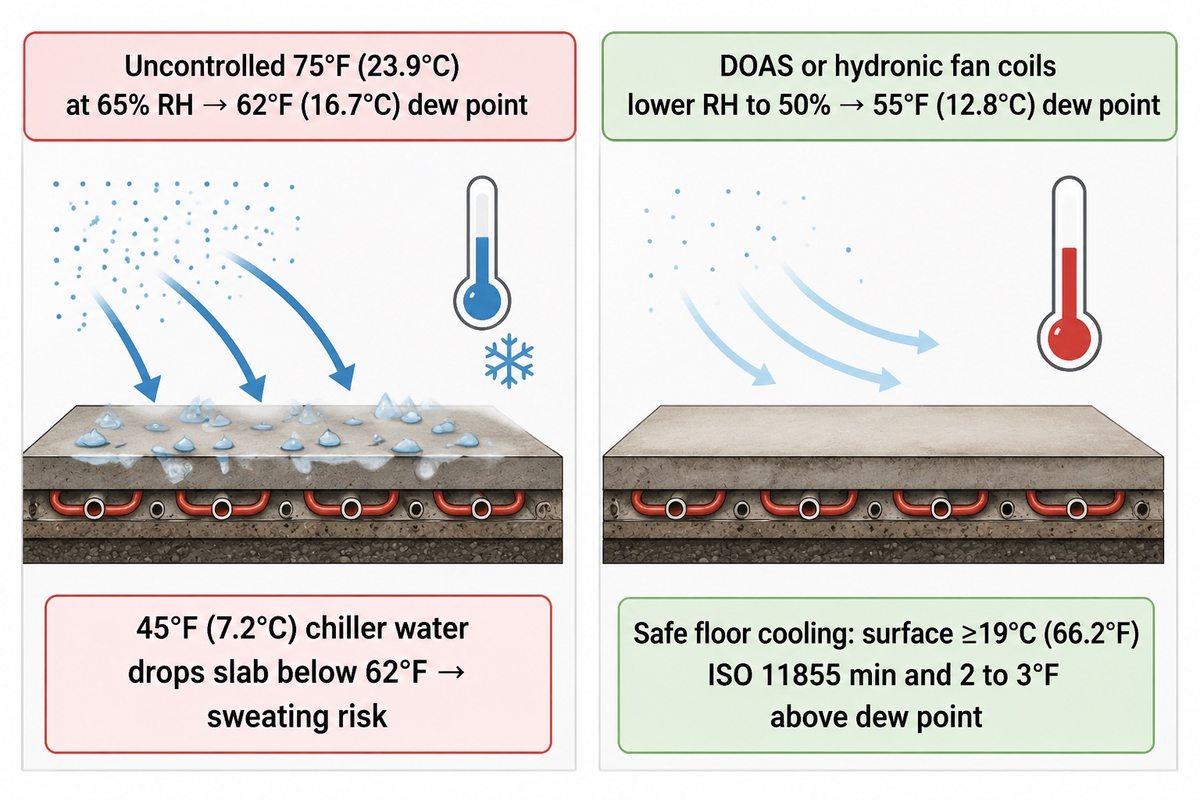
Reversible radiant floor heat pumps can provide sensible summer cooling only if floor surface temperature stays at least 2 to 3°F (1.1 to 1.7°C) above the room dew point. Floor surfaces must also stay at or above the 19°C (66.2°F) ISO 11855 minimum occupied cooling limit. Humid climates would require a separate system for dehumidification (air handlers or fan coil units).
At 75°F (23.9°C) and 65 percent relative humidity, indoor air has a dew point of about 62°F (16.7°C). Sending standard 45°F (7.2°C) chiller water into a floor slab drops the surface below 62°F. That cold surface causes immediate sweating, slip hazards, and mold growth.
ISO 11855 sets the minimum acceptable floor surface temperature for radiant cooling at 19°C (66.2°F) in occupied spaces. Cool air stratification reduces sensible cooling by a radiant floor in comparison to a chilled ceiling panel. Sunlit atrium or lobby floors that absorb direct solar radiation are the main exception.
Why must commercial radiant cooling pair with a DOAS or hydronic fan coil unit?
A radiant floor slab is a sensible-only heat exchanger. It has no condensate drain pan and can’t remove latent moisture from indoor air. In humid summer climates, pairing the floor loop with a dedicated outdoor air system (DOAS) or hydronic fan coil units for latent cooling lowers indoor relative humidity to 45 to 50 percent.
Lowering indoor relative humidity to 50 percent at 75°F (23.9°C) drops the room dew point to 55°F (12.8°C). That lower dew point allows chilled water controls to keep radiant cooling floor surfaces at 65°F (18.3°C) or higher. Within the scope of manufacturers referenced in this guide (an engineering reference rather than an exhaustive vendor directory), Koven Air manufactures commercial heat pump systems, reversible heat pump chiller configurations, fan coils, air handlers, and dehumidifiers. Arctic Heat Pumps publishes R32 EVI air-to-water specs, Alpha-Innotec publishes underfloor guides, and Caleffi supplies hydronic manifolds and manifold kit hardware.
What must engineers check before retrofitting a boiler radiant floor to a heat pump?
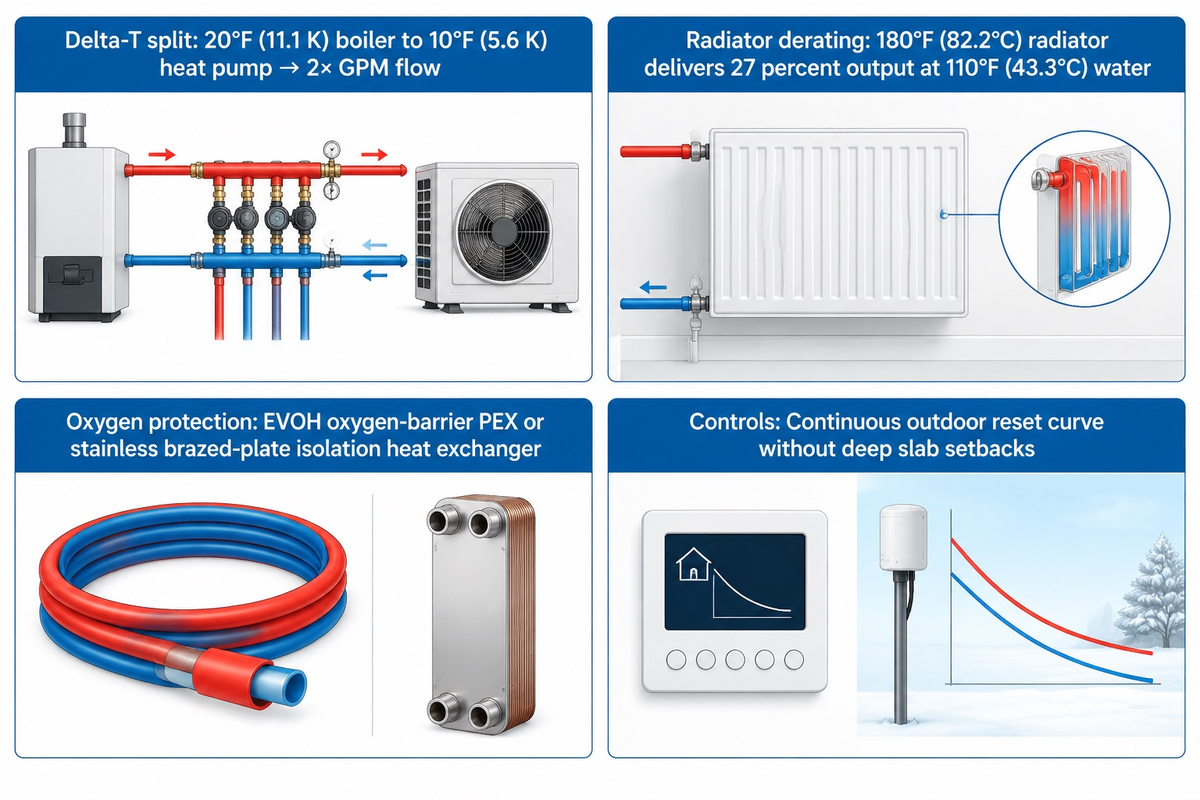
Before swapping a boiler, engineers need to determine the design supply temperature, assess tubing oxygen exposure, check manifold flow, account for defrost volume, and analyze radiator-branch output. Radiant floors often use 25 to 35°C (77 to 95°F) water, while radiator branches may require higher temperatures or emitter upgrades.
Mixed retrofits that combine heat pumps and radiant floors with steel panel radiators fail when radiator output falls at low water temperatures. In published radiator derating curves, a panel radiator sized at 180°F (82.2°C) average water delivers only 27 percent of its rated output at 110°F (43.3°C) average water. Those radiator branches must be upsized, swapped for fan coils, or served by a high-temperature heat pump.
Additional changes to habits are required when pairing pumps and radiant slabs during a retrofit. Both HeatingHelp hydronic practitioner discussions and Mittens Heat Pumps’ winter runtime analysis warn against deep nighttime thermostat setbacks on high-mass slabs. It takes hours to re-heat a cooled slab, forcing the use of maximum water temperature during the coldest part of the morning, triggering electric backup heat.
| Retrofit Category | Subsystem Type | Legacy Boiler Class | Heat Pump Design Option | Engineering Remediation Method |
|---|---|---|---|---|
| 1. Supply water temperature | Primary hydronic plant | 180°F (82.2°C) boiler header | 25–35°C (77–95°F) common slab range; model rating governs max outlet | Remove fixed mixing restriction, add aluminum transfer plates, or select R290 / bivalent stage |
| 2. Loop delta-T and flow | Manifold circulation loop | 20°F (11.1 K) boiler delta-T | 10°F (5.6 K) split requires 2× baseline GPM flow | Decouple with hydraulic separator or primary-secondary piping (about 3.4× pipe friction at 2× flow) |
| 3. Oxygen-barrier tubing | Embedded PEX floor pipe | Non-barrier PEX or polybutylene | EVOH oxygen-barrier PEX preferred with ferrous components | Install stainless brazed-plate isolation heat exchanger, dirt separator, and inhibitor |
| 4. Anti-short-cycle volume | Thermal buffer vessel | Low-mass header with micro-zones | Formula 7-1 buffer volume (46 gal in 4-ton / 10-min / 2,000 Btu/hr / 20°F example) | Add 2-pipe series volumiser or 4-pipe buffer tank with differential bypass valve |
| 5. Radiator branch output | Secondary panel emitters | Sized at 180°F (82.2°C) water | Delivers 27 percent rated output at 110°F (43.3°C) average water | Replace radiators with hydronic fan coil units or stage existing boiler for cold peaks |
| 6. Freeze protection fluid | Outdoor monobloc piping | Indoor pure water (factor 493) | 30 percent glycol (factor 479) or 50 percent glycol (factor 451 at 120°F) | Select circulator for 1.093× flow and 1.61× head loss at 50 percent glycol or use drain-down safeguards |
| 7. Weather reset controls | Thermostat & reset curve | Fixed setpoint with night setback | Continuous outdoor reset curve without deep slab setbacks | Disable deep night setback to avoid cold-dawn compressor spikes and backup electric heat |
| 8. Summer cooling dew point | Reversible chilled floor | Heating-only boiler plant | Floor surface ≥19°C (66.2°F) and 2–3°F above room dew point | Pair reversible chiller loop with DOAS or hydronic fan coils to hold 45 to 50 percent indoor RH |
| 9. Circuit identification | Manifold header balancing | Unlabeled legacy zone loops | Permanent loop-length and room-area tags per UMC 1217.5 | Measure circuit flow meters, balance zone actuators, and attach permanent UMC 1217.5 tags |
Why does switching from a boiler to a heat pump double required manifold flow rate?
Manifold flow is doubled when switching from a boiler to a heat pump and the system temperature split is cut in half, from a 20°F (11.1 K) drop on a boiler to a 10°F (5.6 K) split on heat-pump. Heat-pump condenser flow is set by the manufacturer’s temperature split, where a smaller split requires a higher flow.
Cutting ΔT in half from 20°F to 10°F requires twice the water flow rate (2× GPM) to transport the same Btu/hr load. Pipe friction head loss rises with about the 1.75 power of flow rate in smooth tubing circuits. If floor loops are unable to handle the full heat-pump flow, installers use hydraulic separators or other primary-secondary piping solutions to decouple the circuits.
2026 commercial hydronic heat pump outlook: low-GWP R290/R32 and seasonal commissioning
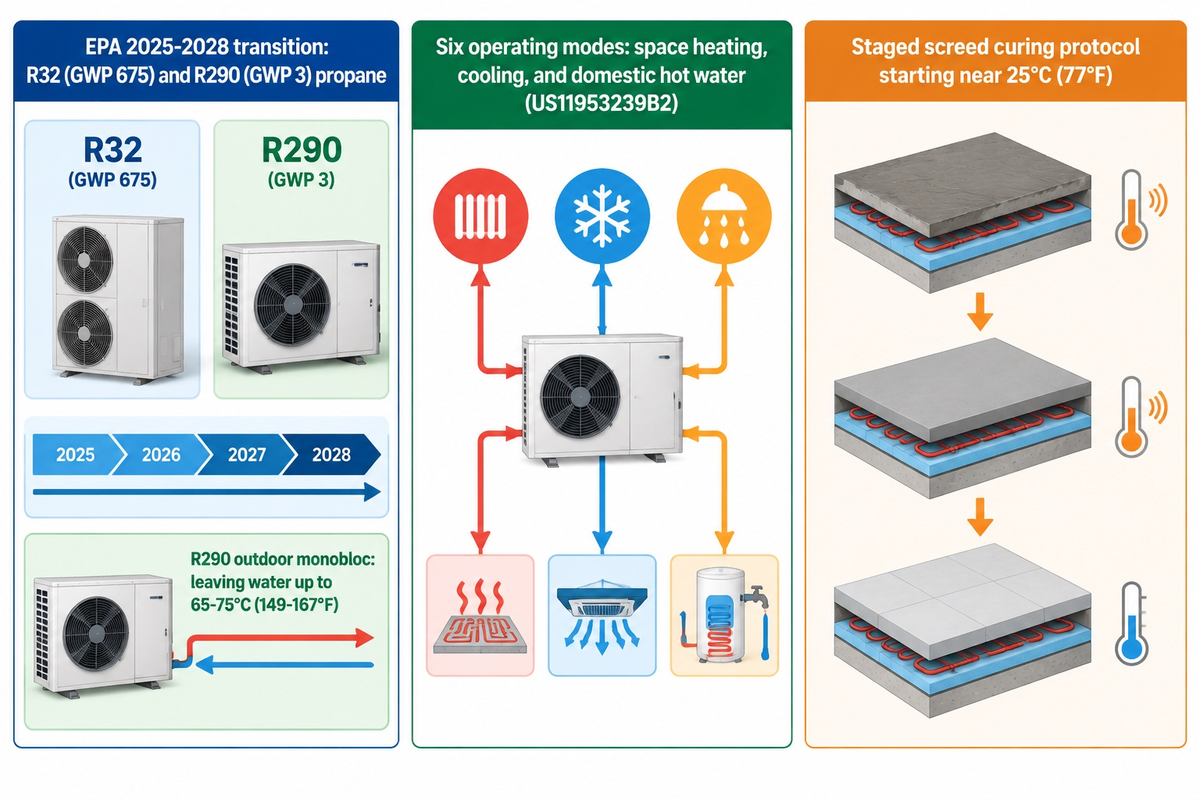
The U.S. EPA AIM Act and European F-Gas phase-down have driven hydronic commercial equipment to lower GWP refrigerants such as R32 (GWP 675) and R290 (GWP 0.02 under EU Regulation 2024/573) propane. Multi-mode controls integrate space heating and cooling with the domestic hot water in one plant.
The U.S. EPA Technology Transitions rule sets product-specific GWP limits and compliance dates between 2025 and 2028 for covered heat pumps and chillers. High-R radiant floor coverings can require supply water above 45°C (113°F). Some R290 monobloc units are rated for leaving-water temperatures up to 65–75°C (149–167°F), supporting higher-temperature radiator retrofits.
Because R290 is an A3 flammable refrigerant, outdoor monobloc units keep the sealed refrigerant circuit outside the building envelope. Clearance zones must be maintained around relief vents and building openings. Capacity-modulated heat pumps can control six operating modes to serve space heating, cooling, and heating domestic hot water, which uses a desuperheater heat recovery system.
Whether building a new house or commissioning a commercial warehouse, contractors must schedule slab heating startups before deep winter freezes arrive. Alpha-Innotec’s underfloor heating engineering guide notes that modern underfloor systems rarely need more than 35 degrees of flow temperature. On a new slab, hold the first heat-up until about 21 days after laying cement screed (EN 1264-4 allows 7 days at the earliest), then start low and raise the temperature in steps.
Frequently asked questions about radiant floor heat pumps
Do heat pumps work with radiant floor heating in cold climates?
Yes. Cold-climate EVI air-to-water and geothermal heat pumps serve radiant floors; bare slabs with 6-inch spacing use 95–98°F (35–36.7°C) water at 20 Btu/hr·ft², while design water temperature follows building heat loss and floor assembly.
Keeping leaving-water temperature low preserves compressor capacity when outdoor air drops below freezing. Published R32 enhanced vapor injection (EVI) air-to-water specifications maintain a COP of 2.8 at −8.33°C (17°F) ambient air while supplying 40.56°C (105°F) water. At 8.33°C (47°F) ambient air, rated COP reaches 3.70. In sub-zero regions, engineers pair outdoor monobloc units with propylene glycol or drain-down freeze protection, a defrost buffer tank, and a bivalent backup heater.
Should you set back the thermostat at night on a radiant floor heat pump?
No. Deep nighttime temperature setbacks degrade seasonal efficiency on high-mass concrete radiant slabs.
Concrete floor slabs have a high thermal inertia and take several hours to warm up or cool down. If the flow rate of the secondary manifold is higher than the flow rate of the primary heat-pump, return water will mix in the buffer supply and lower the temperature of the supply water to the floor. Continuous weather-compensated operation or a minor 1°C (2°F) setback keeps water temperature low and avoids auxiliary resistance heat.
Can one heat pump supply both radiant floor heating and domestic hot water?
Yes. An air-to-water or water-to-water heat pump can serve both loads using a 3-way diverter valve and an indirect DHW cylinder.
The heat pump follows an outdoor reset curve during normal space heating to supply 25 to 35°C (77 to 95°F) water to a low-temperature radiant floor manifold. When the domestic hot water tank calls for heat, a motorized 3-way valve directs the flow to the indirect water heater coil. It heats the domestic cylinder before returning to low-temperature floor heating.
What is the ideal PEX tube spacing for a heat pump radiant floor?
Specify 6-inch (150 mm) on-center PEX spacing in bare concrete slabs and ≤8-inch (200 mm) spacing in suspended aluminum plate subfloors.
On a bare slab at 70°F room air, 6-inch spacing keeps supply water at 95–98°F (35–36.7°C) for 20 Btu/hr·ft², maximizing heat pump COP.
Do air-to-water heat pumps need backup heat and what drives installed cost?
Cold-climate plants typically include an inline electric heater or bivalent boiler stage below the balance point, while installed cost is project-specific and requires a contractor quote.
Sizing the heat pump to the building balance point and staging backup heat during peak winter design hours prevents oversizing and mild-weather short-cycling. Federal tables don’t standardize installed hydronic radiant floor pricing because concrete pouring, suspended aluminum transfer plates, the number of zones in the building manifold, buffer piping, and geothermal drilling differ in the design and construction of commercial buildings.
Specify your commercial hydronic heat pump plant
Compare your leaving-water schedule for the slab, cooling dehumidification load, and your temperature envelope with the ranges of equipment offered by Koven Air. Provide your heat load, target supply and return temperatures and electrical service information to our engineering team. We will help you select compatible heat pump chillers, fan coil units, and dedicated outdoor air handlers.
Koven Air Environment Technology Co., Ltd. published this engineering guide. Named third-party data sheets, standards and patents belong to their respective owners. Koven Air manufactures commercial heat pumps, chillers, fan coil units, air handling units, and dehumidifiers; in-floor PEX tubing, manifolds, and slab installation kits are supplied by hydronic piping manufacturers.
References & Sources
- 10 CFR Part 431 Subpart F, Commercial Air Conditioners and Heat Pumps U.S. Department of Energy / Electronic Code of Federal Regulations.
- Technology Transitions: HFC Restrictions by Sector U.S. Environmental Protection Agency (AIM Act regulatory timeline 2025–2028).
- idronics #27: Heat Emitter Options for Air-to-Water Heat Pump Systems Caleffi Hydronic Solutions.
- Design Details for Air-to-Water Heat Pump Systems (Formula 7-1 Buffer Sizing) Caleffi Hydronic Solutions.
- ISO 11855: International Standard on Embedded Radiant Heating and Cooling Systems Bjarne W. Olesen, REHVA European HVAC Journal.
- Uniform Mechanical Code (UMC 2024) Section 1217.0: Radiant Heating and Cooling IAPMO / UpCodes.
- Fluid Factors: Propylene Glycol Flow and Head-Loss Corrections John Siegenthaler, P.E., PM Engineer.
- Optimizing the Performance of Radiant Heating Systems Peter C. D’Antonio, P.E., HPAC Engineering.
- R32 EVI Cold-Climate Air-to-Water Heat Pump Specifications (035ZA / 050ZA / 060ZA) Arctic Heat Pumps.
- US Patent US11953239B2: Integrated Demand Water Heating Using a Capacity Modulated Heat Pump Assigned to WaterFurnace International Inc. (2024).