Get in Touch with Koven Air Company

Koven Air · Industrial & Commercial Heat Pumps
Water Source Heat Pump Systems, Modular Scroll & Screw WSHP
Koven Air water source heat pump arrays swap boiler/chiller plant rooms for one big water loop of factory-modular units-each running well above the packaged-unit ceiling defining most of the water source heat pumps currently on the market.
Best for: hotels, high-rise mixed-use towers, university and campus energy stations, and hospitals sizing 20–500+ RT per unit on a shared water loop — not single-room residential replacements.
Request an Engineering Quote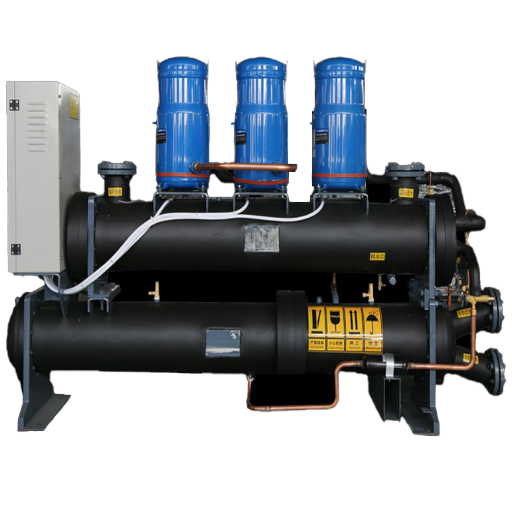
22–527 RT
Per-unit capacity range (scroll & screw)
5.6–6.1
Rated cooling COP
GB/T 19409-2013
Unit design & test standard
32.7% / 38.6%
Measured opex savings, 2 verified projects
36 & 40
Units deployed per project (largest cases)
2007
Manufacturing since (first screw chiller)
Why Facilities Choose Water Source Heat Pumps
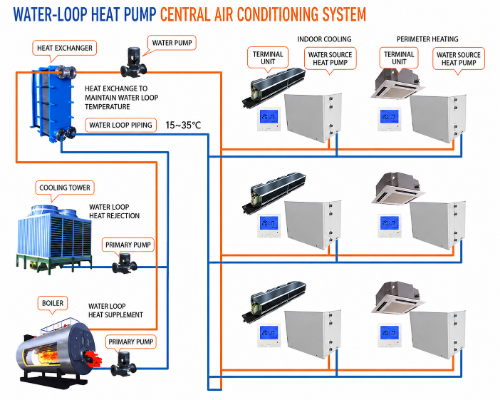
Water source heat pump systems circulate heat from zone to zone via a water loop instead of rejecting/absorbing it from ambient air. Each WSHP unit conditions its space individually, and the loop balances any difference, which explains why we see the same architecture for campus energy stations, hotel corridors, and high-rise mechanical floors from Daikin, Trane, and Koven Air.
Most buildings wind up with the same architecture for the same reason: The conventional plant room combines a boiler and an air-cooled or water-cooled chiller, a partnership that wastes energy anytime a zone require heating while another demands cooling; the two systems fight instead of complement. The WSHP loop turns that conflict into a benefit: The waste heat rejected by a zone being cooled is now the source for heating that will warm a room that needs heat, and the difference alone is the heat added or removed at the loop level.
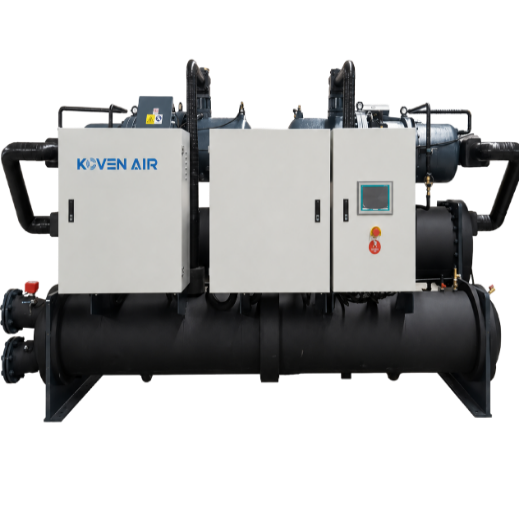
Koven Air has manufactured the architecture in two compressor family forms—scroll modules (KACWR series, 22-93 tons each) that you deploy by the ton in zones, and screw units (KASCMF series, up to 527 tons each) you apply at peak loads within the same loop. Both are certified to China’s national standard for WSHP, GB/T 19409-2013, which is a different rating methodology from North America’s AHRI Standard 600; we’ve had no occasion to check that these are numerically comparable and so we don’t show them as such anywhere here.
Why “modular array” beats “one big machine” for most WSHP applications
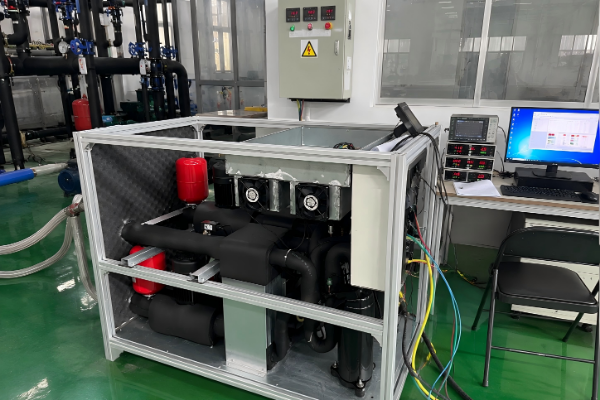
Concentrating a single large chiller plant has other drawbacks—losing the compressor means losing everything. The Koven WSHP array divides that risk, distributing as many as four individual scroll compressors in its 22- to 93-ton modules (25-33% capacity control); the failure of a compressor impacts a single zone but not the entire plant. Multistack’s MSR modular scroll product and Trane’s Thermafit MWS unit apply similar design principles, which is why “modular water source heat pump” is now an established product category and not some one-off Koven solution.
We based our factory on it, developing 18 automated production processes, robotic module subassembly, and a full chiller/heat pump performance testing lab. This is the reason each KACWR and KASCMF unit gets tested functionally before shipment—not merely to achieve model-line certification. This traceability answers a buyer’s worry of “Will this thing actually do what it says on the label,” and Section 5 shows what that translates to in real life.
We size WSHP arrays by walking the buyer through their zone load profile floor by floor, not by quoting a single tonnage number — a 300-room hotel and a 300,000-sqft office building both add up to a similar peak load, but the loop design and the scroll-versus-screw mix are completely different.
Field engineers we’ve worked alongside are candid that “heat pump” as a category has taken real criticism for reliability in forum discussions among HVAC and mechanical engineers — much of it rooted in single-unit residential and light-commercial failure reports rather than large modular arrays. The honest answer is that a modular array doesn’t eliminate compressor failure risk; it isolates it, which is a materially different risk profile than a single point of failure serving an entire building. We cover the redundancy math in Section 3 with two projects that have run 2-5 years without a building-wide outage.
This same architecture has been specified across a wider range of building types than either case study alone suggests — hospitals and healthcare facilities where simultaneous heating and cooling across departments is a hard requirement, business centers and mixed-tenant office towers, industrial parks with process areas alongside office space, schools and university campuses, gymnasiums and libraries with intermittent occupancy schedules, and data centers where the heat rejected from server rooms can be recovered rather than dumped to a cooling tower. The common thread across all of them isn’t building type — it’s a facility with multiple zones whose heating and cooling loads don’t move in lockstep, which is exactly the condition a shared water loop is built to exploit.
What doesn’t change across that range of applications is how we qualify a project before it reaches a spec sheet. Our pre-sale process run a parameter-accuracy verification against the actual zone load schedule — not a rule-of-thumb tonnage-per-square-foot estimate — because the two case studies in Section 3 show how differently a “similar size” building can actually load out depending on occupancy pattern, envelope, and process loads.
Koven Air WSHP Lineup — KACWR Scroll & KASCMF Screw
Buyers researching water source heat pump components and water source heat pump price ranges usually run into the same wall: most water source heat pump manufacturers publish a tonnage range and stop there. The two tables below give you the actual component-level breakdown – compressor count, refrigerant, capacity control staging – for both series, plus a water source heat pump diagram of how the duty split work in practice further down this section.
KACWR Scroll Series — Groundwater/Loop Operating Condition (R410A)
| Model family | Cooling capacity | Heating capacity | Compressors | Install |
|---|---|---|---|---|
| KACWR2024 | 78.5 kW (22 RT) | 85 kW | 2× scroll | Indoor / Outdoor (A2X) |
| KACWR3036 | 117.5 kW (33 RT) | 127.5 kW | 3× scroll | Indoor / Outdoor (A2X) |
| KACWR4048 | 156.5 kW (44 RT) | 170.5 kW | 4× scroll | Indoor / Outdoor (A2X) |
| KACWR2050 | 163.5 kW (46 RT) | 180 kW | 2× scroll | Indoor / Outdoor (A2X) |
| KACWR3075 | 245.3 kW (70 RT) | 265 kW | 3× scroll | Indoor / Outdoor (A2X) |
| KACWR40100 | 327 kW (93 RT) | 345 kW | 4× scroll | Indoor / Outdoor (A2X) |
Cooling COP 5.6, heating COP 4.3 at GB/T 19409-2013 nominal conditions (chilled water 12/7 C; cooling/well water 18/29 C) – the energy efficiency baseline every KACWR heating and cooling curve in this table is measured against. Capacity control staged 0-50-100% (2-compressor) to 0-25-50-75-100% (4-compressor), so part-load heating and cooling output tracks actual zone demand rather than cycling a single fixed-speed compressor. High-efficiency shell-and-tube evaporator and condenser coils in every unit are why that staged control translates into real energy efficiency gains rather than just quieter cycling. Optional built-in heat recovery module, 10-50 kW.
KASCMF Screw Series — Dual Heat/Cool Mode (R134a)
| Model range | Cooling capacity | Heating capacity | Compressors | Heat recovery |
|---|---|---|---|---|
| KASCMF105.1–265.1 | 367–839 kW (104–238 RT) | 384–868 kW | 1× semi-hermetic twin-screw | Optional, built-in |
| KASCMF210.2–530.2 | 734–1,852 kW (208–527 RT) | 767–1,913 kW | 2× semi-hermetic twin-screw | Optional, built-in |
Cooling COP 6.1, heating COP 4.9. Capacity control 100-75-50-25-0% per compressor. Designed to supplement scroll arrays at the peak load tail rather than as the sole heat source in most Koven-built projects.
Scroll vs. Screw, The Duty-Split Playbook
-
Base load, wide swing (hotel, dorm, mixed-use)Mix: Scroll array only, staged 25% stepsWhy: Fine-grained part-load matching; N+1 by design
-
High, steady peak (data hall, large plant)Mix: Screw units, 1–2 per zoneWhy: Fewer units to reach large single-zone tonnage
-
Campus/tower with both base and peakMix: Scroll for base + screw for peak (as built in Section 3)Why: Verified in both case studies below — lowest blended kW/RT
Engineering Note, Refrigerant & U.S. Regulatory Scope (Read Before Specifying for New U.S. Installations)
KACWR units use R410A (GWP 2,088) and KASCMF units use R134a (GWP 1,430). Both refrigerants are well over the 700 GWP limit for new equipment in the U.S. EPA’s AIM Act (which came into effect, phase-in from January 1, 2025). This is an industry-wide transition, not a Koven-specific gap – Carrier’s own 2026 Aquazone 50-series WSHP refresh moved to a lower-GWP refrigerant for the same reason. If you’re specifying new comfort-cooling equipment for a U.S. jurisdiction, confirm the current AIM Act sector deadline and any industrial-process exemptions that may apply to your application category with our engineering team prior to RFQ – the relevant refrigerant category and timeline depends on both.
Need help matching a model to your zone-by-zone load schedule?
Verified Project Performance — Two Large-Scale Deployments
Every WSHP product page in this category – Trane, Daikin, First Co, WaterFurnace – lists specifications. None of the three top-ranking pages we benchmarked publish a third-party-verified performance record from an actual building – that wall of spec-sheet-only marketing covers the risk a buyer is really taking when there’s no building attached to a “typical efficiency” claim.
Unlike every published WSHP case study we could find, both projects below have Koven Air units running in the field for multiple years, with independent commissioning data measured against the same efficiency metrics (COP, IPLV) that the U.S. Department of Energy uses to describe geothermal/water-source heat pump performance, not a projected estimate.
-
Case 1 — 300m-Class Mixed-Use Tower, 128,000 m²
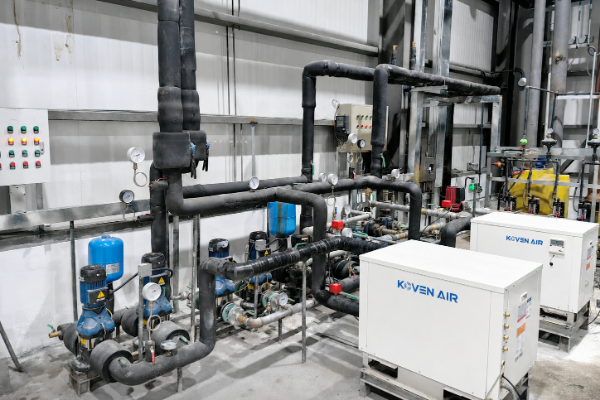
A Grade-A office, serviced apartment and retail podium tower replaced a planned centrifugal-chiller-plus-cooling-tower design (3 full mechanical floors of energy use) with a distributed KACWR40100A2 scroll array – one unit per floor zone, sharing a closed loop cooling water circuit supplied by 6 rooftop closed cooling towers, sized according to GB 50736-2012 / JGJ/T 271-2012 / JGJ 174-2010.
36 KACWR40100A2 units 7.5 Measured IPLV(C) 5.65 Cooling COP 32.7% Opex reduction 200+ Parking spaces freed 5 yrs Continuous operationAnnual utility and maintenance cost dropped from an estimated CNY 4.31M under the original boiler/chiller/tower design to a measured CNY 2.90M with the KACWR array – a result that was consistent across five full years of operation, not a single commissioning-week snapshot.
-
Case 2, University Campus Groundwater Energy Station, 250,000 m²
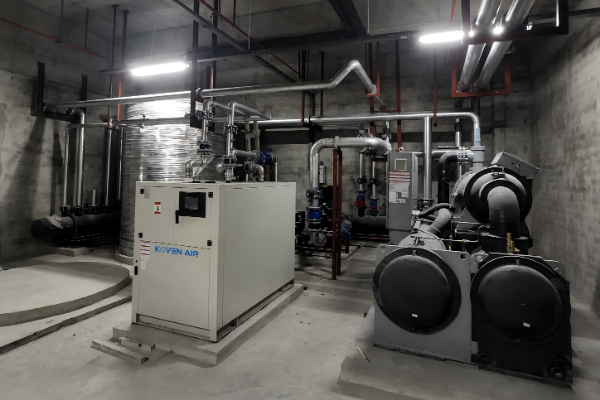
This new-build campus (with teaching facilities, library, student residences, a dining hall and athletics complex) uses three groundwater-powered energy stations utilizing KACWR3075A2 scroll units for base- and low-load duties were supplemented with screw units to handle peak load, sourcing groundwater at 14-16°C from a 80-120m deep aquifer to GB 50366-2009 (ground-source heat pump systems) and GB/T 51346-2019 (green campus evaluation).
32+8 Scroll + screw units 100% Reinjection rate 5.8/4.9 Cooling/Heating COP 38.6% Opex reduction 4,500t CO₂ reduction/yrOne hundred percent of the extracted groundwater was returned to the same aquifer by way of a reinjection system of desanding plus automatic backwash on 36 pairs of reinjection wells-the kind of detailed permitting and hydrogeological work never encountered in a boiler-and-chiller replacement.
Want the full engineering write-up for either project?
Request the Case Study Package →32.7% & 38.6% Measured multi-year operating-cost reduction across two independently designed, code-compliant deployments.
Koven Air’s engineers resolved both projects the same way: knowing the client’s actual constraint wasn’t merely “tonnage,” we designed around the application’s true load-shape and mechanical-room space limitations rather than applying a rule of thumb of one ton per thousand square feet. In practice, that meant a 327 kW (93 RT) unit on the tower and a 245 kW (70 RT) unit on the campus-distinct design decisions for distinct operational environments.
Source: client-provided commissioning & multi-year operating records; design codes GB 50736-2012 / JGJ/T 271-2012 / JGJ 174-2010 / GB 50366-2009Water Source Heat Pump vs. Boiler + Chiller Systems
A modular WSHP system isn’t the least costly option to acquire. Independent third-party industry reports on modular banks of chiller or heat pump modules suggest a first equipment cost some 20-30% higher than that of a single larger chiller with equivalent total output. We consider it our duty to inform you up front rather than letting you learn at the bid comparison stage.
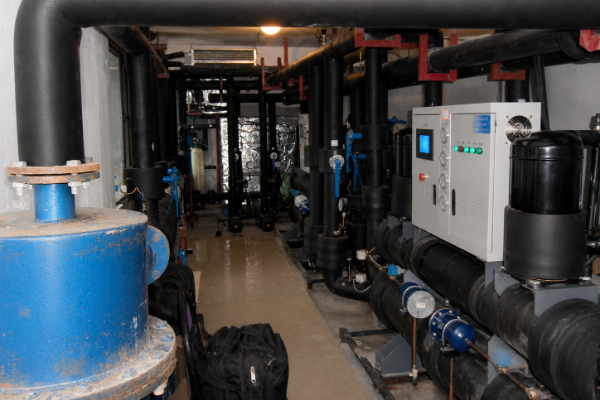
Boiler + Chiller (Two Systems) vs. Koven Air WSHP Array (One Loop)
| Factor | Boiler + Chiller | Koven Air WSHP Array |
|---|---|---|
| Simultaneous heat + cool across zones | Two independent systems, no heat sharing | Single loop, waste heat from cooling zones offsets heating load |
| Initial equipment cost (same total capacity) | Baseline | Typically 20–30% higher (independent industry data) |
| Case 1 measured annual opex | CNY 4.31M (original design estimate) | CNY 2.90M (measured, 5-yr average) |
| Case 2 measured annual opex | CNY 6.51M (municipal heat + air-cooled cooling) | CNY 4.00M (measured, 2-yr average) |
| Failure mode | Boiler or chiller loss = building-wide outage | Single-unit loss = one zone derated, array continues |
| Mechanical floor space | Full chiller plant + cooling tower footprint | Case 1: 3 fewer mechanical floors + 200 parking spaces recovered |
Understand that table: A higher upfront capital expenditure is a trade-off for lower overall energy consumption and an inherently fault-tolerant plant; the question of whether the trade clears your Hurdle Rate depends upon your expected hold time and local utility rates. It’s precisely this kind of scenario our engineering team evaluates with you to tailor the appropriate configuration.
Operations & Maintenance Responsibility, Read Before You Assume This Is a Product Defect
As with all water-loop HVAC systems, those using open or closed cooling tower loops (ours included) bring legionella risk-management obligations under ASHRAE 188-2021 and CDC Water Management Program guidelines-a responsibility that rests with building owners and operators, not equipment manufacturers. In many jurisdictions, regulatory reporting is also quite specific, requiring, for example, prompt notification (e.g., within 24 hours) to the local health department if legionella in a cooling tower exceeds 10&sup6; CFU/L on a unit in operation. For projects utilizing groundwater for supply and return (as in Case 2), aquifer recharge through reinjection wells is subject to EPA Underground Injection Control regulations and relevant state aquifer permitting requirements; Case 2’s 36 pairs of reinjection wells operate under such framework. Like the Legionella issue, this is a broad requirement applicable to any water-loop system-not exclusively to Koven Air equipment, but one that’s good to plan for in advance.
Another field-level honesty comment from our engineers: the water-side scale on a coaxial heat exchanger isn’t always knocked loose by a simple backflush on open-loop ground-source water systems high in mineral content – it’s why Case 2 specifies desanding and filtration ahead of the heat pump rather than descaling after the fact. Budgeting for periodic chemical descaling on open-loop installations, rather than assuming closed-loop-grade maintenance intervals, avoids the single most common performance-degradation complaint we see in field reports.
When doing total cost of ownership calculations, you also need to consider the distinctly different service lives for two major components: while the heat pump units are designed to last for 15-20 years, a properly-installed closed loop network or a well system with reinjection will be service-active for 40-50+ years. Averaging the two as if they’ll be replaced on the same depreciation schedule understates the true economic advantages of your loop-side investment.
Ready to see how this compares for your specific load profile?
Manufacturing Capability & Trusted By
Koven Air’s KACWR / KASCMF line currently doesn’t have AHRI Directory certification. However, all units are factory-tested per GB/T 19409-2013 standard test conditions, and our two verified case studies below carry independent, third-party commissioning reports covering IPLV, measured COP, and multi-year operating data (5 years for Case 1, 2 years for Case 2). We provide copies of these reports as an alternative to AHRI test reports for buyers purchasing from a non-AHRI-certified manufacturer and seeking North American procurement acceptance.
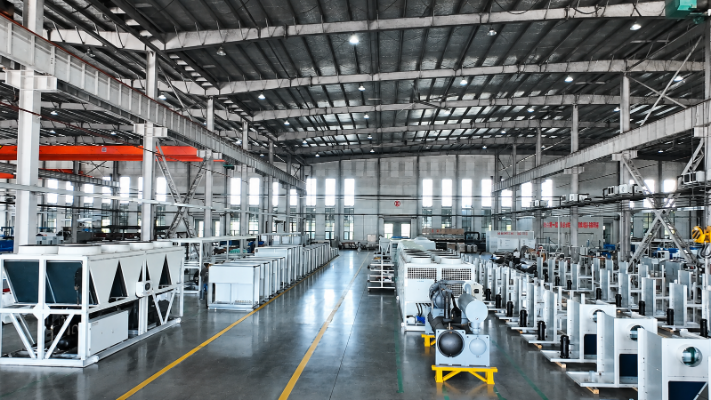
Factory Capability
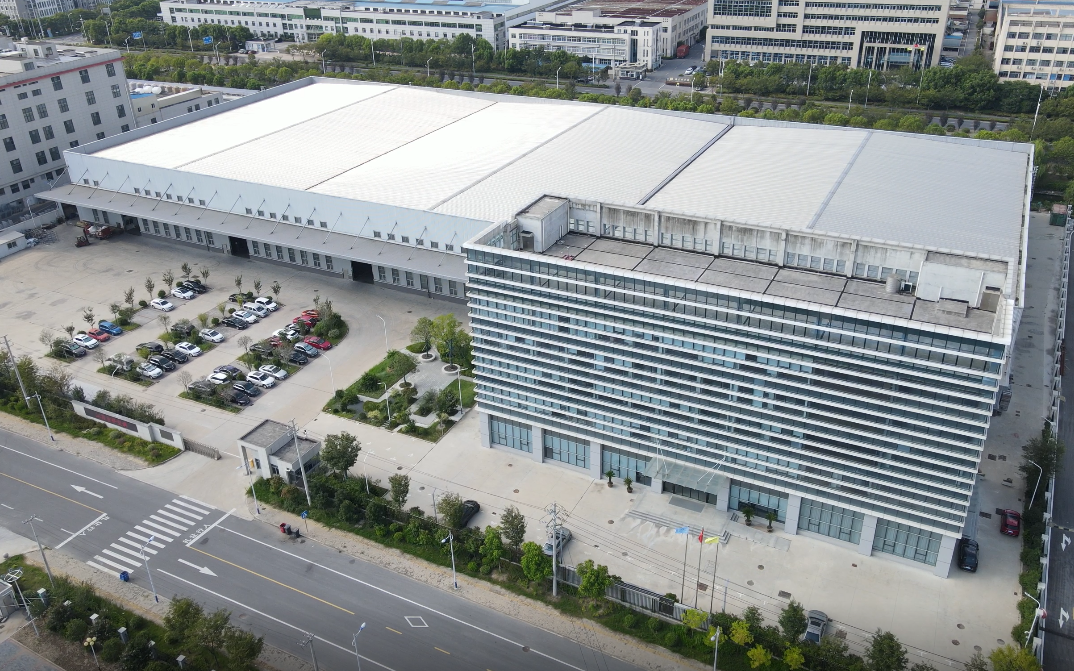
Koven Air began manufacturing chillers and heat pumps in 2007 with our first screw chiller. The Suzhou Industrial Park facility incorporates 18 automated standardized manufacturing processes.
20,000 sq. m facility
23 high-precision sheet-metal machining operations
Automated modular sub-assembly lines
400-point manufacturing traceability
36-point factory inspection
24-hour aging test prior to shipping
Specified For
Client project references by company records, with product shipped to over 35 countries including: Indonesia, Brazil, United States, South Africa, Mexico, Malaysia.
Procurement Guide: Pricing, Lead Time & After-Sales
Due to array configuration variability by project (number of units, scroll/screw mix, heat recovery options, indoor/outdoor rating), we don’t publish a price list. Here’s a breakdown of factors that influence your price quote:
- Unit Count and mix – a 36 unit scroll array and a 4 unit screw chiller providing same tonnage price very differently even at equivalent RT.
- Indoor/outdoor installation – outdoor A2X rated scroll units carry different housing & weatherproofing cost compared to indoor A2 rated scrolls.
- Heat recovery module – Optional internal heat recovery includes a shell-and-tube exchanger and controls with each unit.
- Scope of Certification & Paperwork – 3rd-party inspections, on-site witnessing and local drawings all add cost & lead time proportional to their scale.
Contact our engineers with your specific project zone loads and installation conditions for a detailed quotation.
Lead Time & Documentation, What to Ask For
Since each KACWR and KASCMF unit undergoes a 24-hour aging test in our performance lab prior to shipping, factory lead time is a function of the production queue and the unit count, not a static number we can quote you without an order in hand-request a project-specific lead time estimate along with your quotation rather than depending on a generic “X weeks” figure quoted on another project’s contract.
What we can guarantee regardless of order size: full factory test reports covering the same IPLV/COP metrics referenced in the DOE water-source heat pump test procedure, wiring diagrams that match your electrical standard, and installation and commissioning records accompany each order, and our technical staff are available to support on-site commissioning for projects above a certain threshold that we’ll confirm with you during the pre-sale review.
How We Work: Pre-Sale, In-Sale, After-Sale
01 PRE-SALE: Project design review, verification of parameter accuracy, and professional calculation review prior to unit quotation.
02 IN-SALE: Every unit is manufactured and tested in the factory prior to shipment; our technical experts provide on-site installation and commissioning assistance, making adjustments in the field as necessary to match the actual installation environment.
03 POST-SALE: Lifelong free technical service guidance, prompt resolution of issues within the warranty period, and regular professional training programs for engineering contractors and on-site engineers.
Have a spec question before requesting a full quote?
Refrigerant inside each unit absorbs heat from the water loop (heating mode) or rejects heat into it (cooling mode) through a coaxial heat exchanger, then a reversing valve and expansion device complete the cycle, the same basic refrigeration cycle as an air conditioner, except the water loop replaces outdoor air as the heat source or sink. This is why buyers searching for the best commercial water source heat pump for a specific site should evaluate loop design (boiler/tower vs. groundwater) alongside the unit itself, the working principle doesn’t change, but which loop configuration fits your site does.
Both use a water loop instead of outdoor air as the heat source/sink, and the terms overlap more than most vendor pages admit. “Geothermal” generally describes a closed-loop or open-loop ground/groundwater source, the configuration behind Case 2’s 32-scroll-plus-8-screw campus energy station; a boiler/cooling-tower loop WSHP, the configuration behind Case 1’s 36-unit tower deployment, uses mechanical equipment rather than the earth to condition the loop water. Koven Air builds both loop types on the same KACWR/KASCMF hardware, so the practical difference for a buyer is the loop design and site conditions available, not a different heat pump product line.
An ASHP rejects/absorbs heat directly to outdoor air, so its efficiency swings with outdoor temperature. A WSHP’s water loop stays in a much narrower temperature band year-round, which is why our rated cooling COP (5.6–6.1) holds more consistently across seasons than a typical air-source unit’s seasonal average, the same logic applies to the broader GSHP vs ASHP comparison, since a water-loop or ground-source system trades outdoor-air dependency for loop-design complexity.
No, only in the boiler/tower loop configuration (Case 1). A groundwater or closed-loop setup (Case 2) uses the earth or an aquifer instead.
Failure mode is what changes here, not necessarily overall reliability. A single large chiller centralizes 100% of capacity in one machine; lose it and the building lose cooling or heating entirely. A scroll array (2–4 compressors per unit, dozens of units per project) isolates failures to a fraction of total capacity. Both of our verified case studies have run multiple years without a building-wide outage.
Koven Air’s KACWR/KASCMF units are designed for a 15–20 year service life under normal operation. Loop-side infrastructure, buried piping, closed cooling towers, or reinjection wells, is designed for a much longer service life (40–50+ years for well-maintained closed-loop piping), so lifecycle cost comparisons should account for the two separately rather than amortizing them on one schedule.
Installed cost depends on unit count, scroll/screw mix, indoor vs. outdoor rating, and loop infrastructure (cooling towers vs. wellfield). As a category, modular WSHP arrays typically carry a 20–30% higher initial equipment cost than a single chiller of equivalent capacity, offset over the operating life by the opex savings shown in Section 3’s verified projects. Contact us for a project-specific estimate.
The three we tell buyers about directly: (1) higher day-one equipment cost than a single large chiller at equivalent capacity, (2) an open-loop or cooling-tower configuration adds Legionella water-treatment and regulatory-reporting responsibility for the building owner, and (3) groundwater configurations require reinjection well permitting that a boiler/chiller retrofit doesn’t need. None of these are unique to Koven Air, they apply to the WSHP category broadly, which is why we address all three directly in Section 4 rather than only in this FAQ.
Yes, a KACWR/KASCMF array doesn’t have to replace an existing plant outright. Because the loop is the shared resource, an existing boiler and cooling tower can stay in place as backup heat source/sink while the heat pump array handles day-to-day load, which is a common phased-retrofit path for facilities that want the opex benefit shown in Section 3 without a single-event plant replacement. Our engineering team reviews existing plant capacity during the pre-sale design phase to confirm this is viable for a given site.