
Get in Touch with Koven Air Company

![Commercial Rooftop Unit Guide: Types, Sizing & Costs [2026]](https://kovenair.com/wp-content/uploads/2026/07/commercial-rooftop-unit-guide-featured-2.png)
Quick Facts: Commercial Rooftop Units
| Typical Size Range | 2 to 150+ tons (24,000 to 1,800,000+ Btu/h) |
| Efficiency Metric | IEER (Integrated Energy Efficiency Ratio), minimum set by DOE 10 CFR 431.97, tiered by capacity |
| Standard Refrigerant (2026) | A2L types such as R-454B, now standard across current-generation lines from major manufacturers |
| Humidity Control | Cooling-based dehumidification only on standard units; active humidification needs an added module |
| Next Regulatory Milestone | IVEC/IVHE metrics replace IEER for units manufactured on/after January 1, 2029 |
An RTU – which stands for rooftop unit – is the undisputed champion of American commercial HVAC, that metal behemoth often found mounted on the roofs of stores, schools, offices, and warehouses. If you’re responsible for a building, sizing equipment, or looking to replace your existing rooftop unit, a simple definition isn’t enough-you need data to make informed decisions about the sizing, efficiency, costs, and regulations impacting commercial rooftop HVAC purchases. In this guide, we combine the latest Department of Energy reports, an active USPTO patent, and the experience of installing contractors (rather than manufacturers’ marketing materials) to provide the concrete numbers you need.
In This Guide
- A look at a commercial rooftop unit and how it works
- What’s the Difference Between an RTU and a Split System or Air Handling Unit?
- Most surprising rule: minimum efficiency levels are NOT a single number
- A real worked example for sizing your unit
- What changes for buyers before 2029
What Is a Commercial Rooftop Unit (RTU)? How It Works
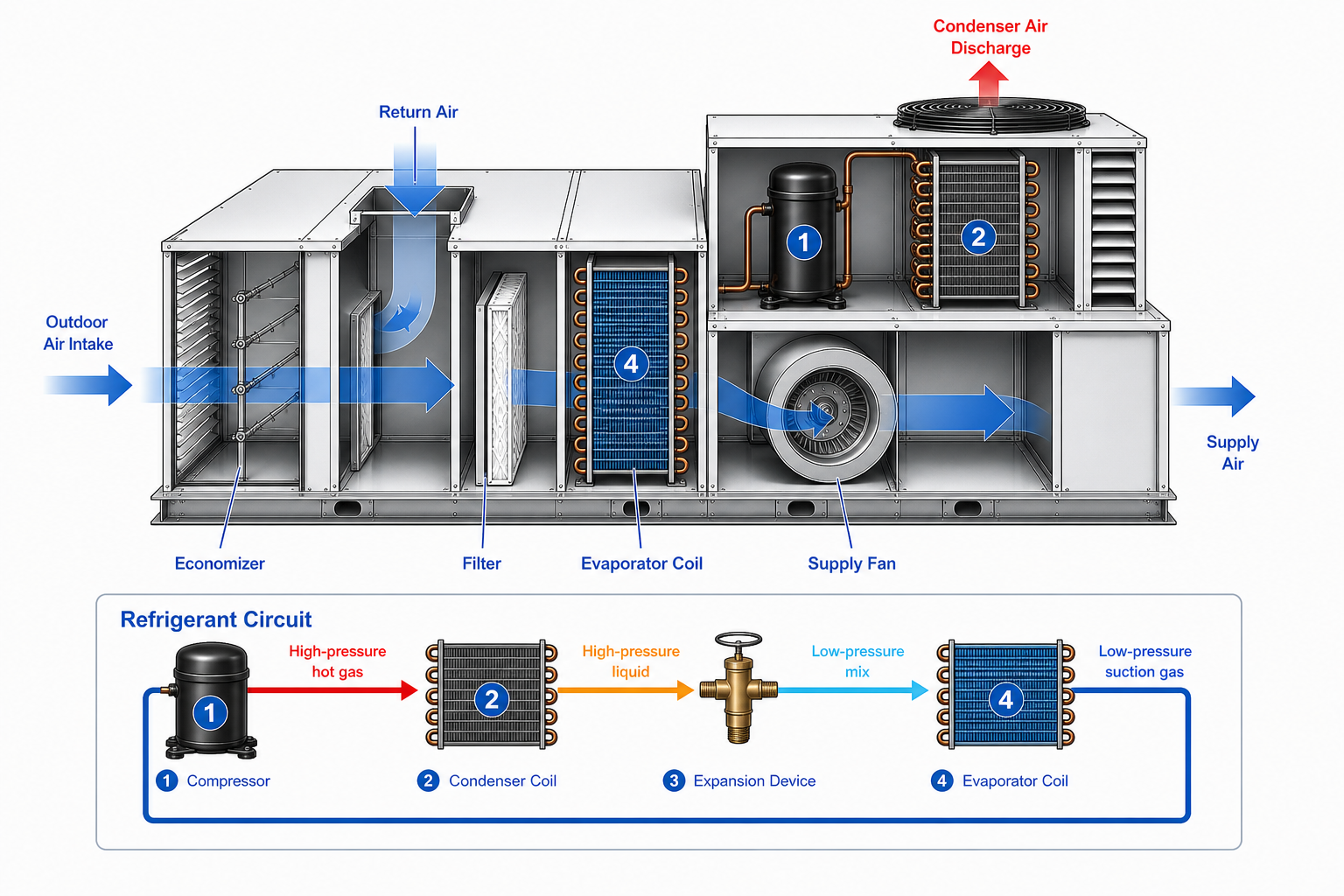
Commercial rooftop units are packaged HVAC systems where the compressor, condenser coil, evaporator coil, fans, and controls all sit in one outdoor cabinet, usually on the roof or a ground-level pad. Each unit ships pre-wired and pre-charged, so field work is limited to setting the curb and connecting ductwork, power, and controls before it delivers conditioned air to the building.
At the heart of any RTU is a direct-expansion (DX) refrigeration cycle. A compressor increase the pressure of refrigerant gas, which is then condensed by heat given off to the outdoor air by the condenser coil. An expansion device reduce the refrigerant pressure and temperature as it enters the evaporator coil. Here, a supply fan draws warm return air from the building over the cold coil, cooling the air and removing moisture. Also commonly included in the same cabinet: gas- or electric-resistance heating (or a reversing valve for a heat pump configuration), an outdoor air intake to allow for fresh air, filters, and an economizer that uses the cool outside air to cool instead of running the compressor when possible. The U.S. Department of Energy’s commercial buildings research program maintains a dynamic RTU testbed specifically to study this cycle under real operating conditions rather than idealized lab settings.
📐 Engineering Note
An packaged RTU simply means that all the operating components have been grouped together within a single unit and the DX (direct expansion) cooling loop will always be running a cooling cycle. By contrast, a “non-packaged” RTU needs an external source, such as a chilled water system for cooling or a boiler loop for heating. This requires a piping infrastructure with more pumps and another component failure source the packaged system doesn’t.
Building applications of RTUs often include a large flat roof-the traditional “retail box”, warehouse, single-story school, or office building-and may have multiple single-zone units serving individual multi-zone areas on a single roof as opposed to a central plant-thus reducing the consequence of failure from a single device.
Packaged RTU vs Split System vs Air Handling Unit
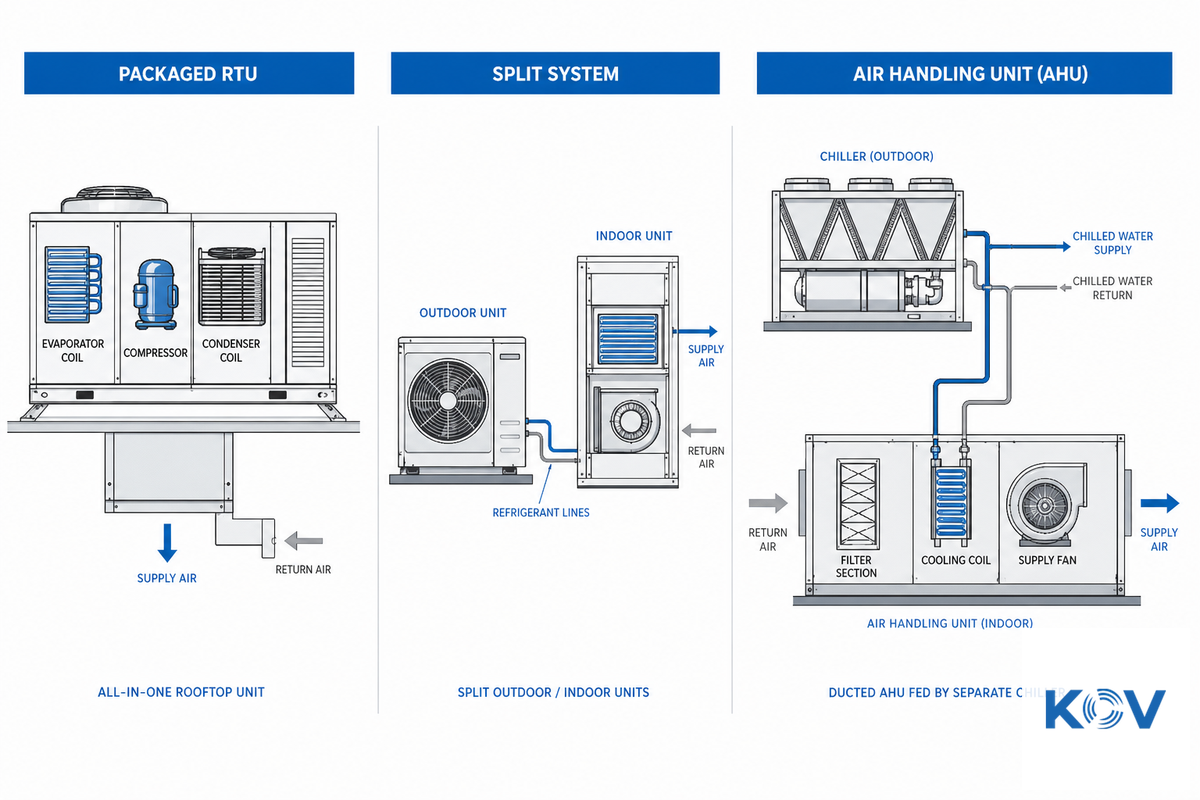
These three words get tossed around quite freely, but the equipment they represent really are fundamentally different configurations, and selecting the wrong category from the outset will only be a time waster when you start comparing brands. Let’s look at what these actually are.
| Factor | Packaged RTU | Split System | Air Handling Unit (AHU) |
|---|---|---|---|
| Compressor location | Integral, in the same cabinet | Outdoor condensing unit, separate from indoor coil | None — needs an external chiller or condensing unit |
| Typical location | Outdoors, roof or grade | Outdoor condenser + indoor air handler | Indoors, mechanical room or plenum |
| Ductwork routing | Single connection point on the roof | From indoor air handler location | From indoor unit, often longer runs |
| Refrigerant piping | None — factory-sealed circuit | Field-run line set between condenser and coil | Chilled-water piping, not refrigerant |
| Points of failure | Fewest — one sealed system | More — field refrigerant joints | Most — depends on separate chiller/boiler plant |
| Best-fit building type | Single-story, large flat roof (retail, schools, warehouses) | Zoned spaces, limited roof access | Multi-story buildings with a central plant |
| Native ventilation/outdoor air | Built-in intake standard | Usually needs a separate ventilation unit | Depends on system design |
| Active humidity control | Cooling-based dehumidification only, standard | Cooling-based dehumidification only, standard | Depends on coil design and controls |
| Typical install complexity | Lowest — crane-set and connect | Moderate — line set and refrigerant charging | Highest — tied to a central plant |
Where most people get hung up is the concept of humidity – since none of the three systems come standard with any sort of active humidifier, the water removed by a typical AC’s coil is an accidental by-product, not an added resource, to the cool air in the room. We’ll touch more on that in the humidity control section below, where we discuss how they can and can’t manage humidity. As one consulting-engineer analysis of applied-versus-packaged systems notes, the practical distinction matters most once you factor in code-year efficiency minimums, not just upfront equipment category.
How to Size a Commercial Rooftop Unit
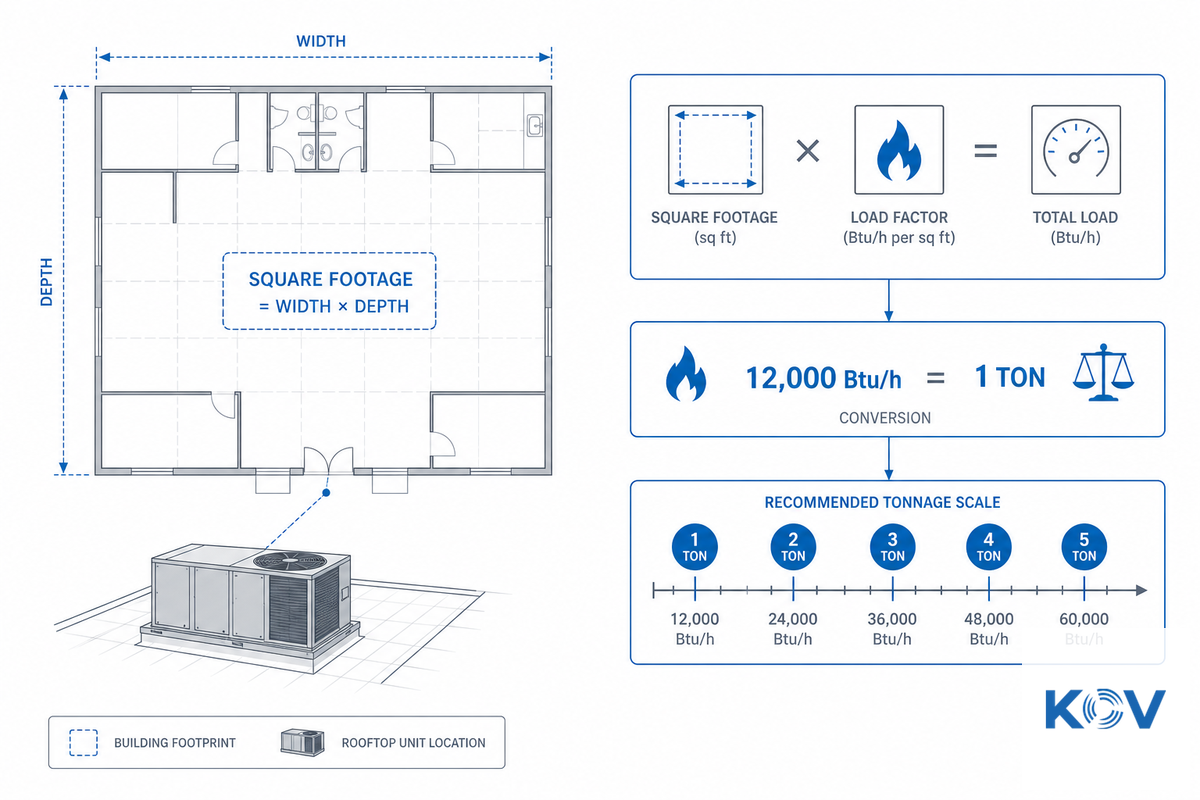
Sizing an RTU to your building’s square footage the wrong way in either direction costs money: undersizing leaves the space uncomfortable as the unit runs nonstop, while oversizing wastes energy through short-cycling and struggles to dehumidify. A square-feet-per-ton estimate is the fastest starting point, though it has real limits worth understanding first.
Rough Sizing Benchmarks by Building Type
- Common rule of thumb: approx. 350-400 sq ft per ton of A/C
- Retail: commonly cited around 300–350 sq ft per ton
- Warehouse (low occupancy, high ceiling): 400 sq ft / ton or looser, depends greatly on ceiling height and insulation
- Restaurant/kitchen – tight; sometimes under 300 sq. ft. per ton due to heat generated by cooking appliances
Consider a case: the same 22,000 sq ft warehouse could have been sized using 25 Btu/sq ft, yielding 22,000 × 25 = 550,000 Btu/h or approximately 45.8 tons (550,000 ÷ 12,000 Btu/h per ton). Use the shortcut 400 sq ft/ton on that building and get 22,000 ÷ 400 = 55 tons – about a 20% oversize factor before an engineer has considered insulation, windows, occupants, or equipment. DOE’s own research on common commercial RTU faults lists incorrect sizing among the recurring, real-world problems it catalogs in the field.
⚠️ Important
Although rules of thumb based on sq-ft-per-ton abound, industry load calculation methods (ACCA Manual J for homes, Manual N for buildings) were designed to avoid such errors-as they can be over 50% off for buildings that don’t conform to the basic assumptions of the rule, due to differences in ceiling height, insulation level, glass surface area, or indoor heat gains. Consider the numbers below a jumping-off point with your mechanical engineer, not a conclusion.
What goes wrong: technicians who fall into this shortcut bypass the real calculation and instead oversize “to be safe” (and as discussed previously, oversizing will decrease efficiency and humidity control rather than increasing protection against them).
Efficiency Ratings Explained, The DOE IEER Rule Most Guides Get Wrong
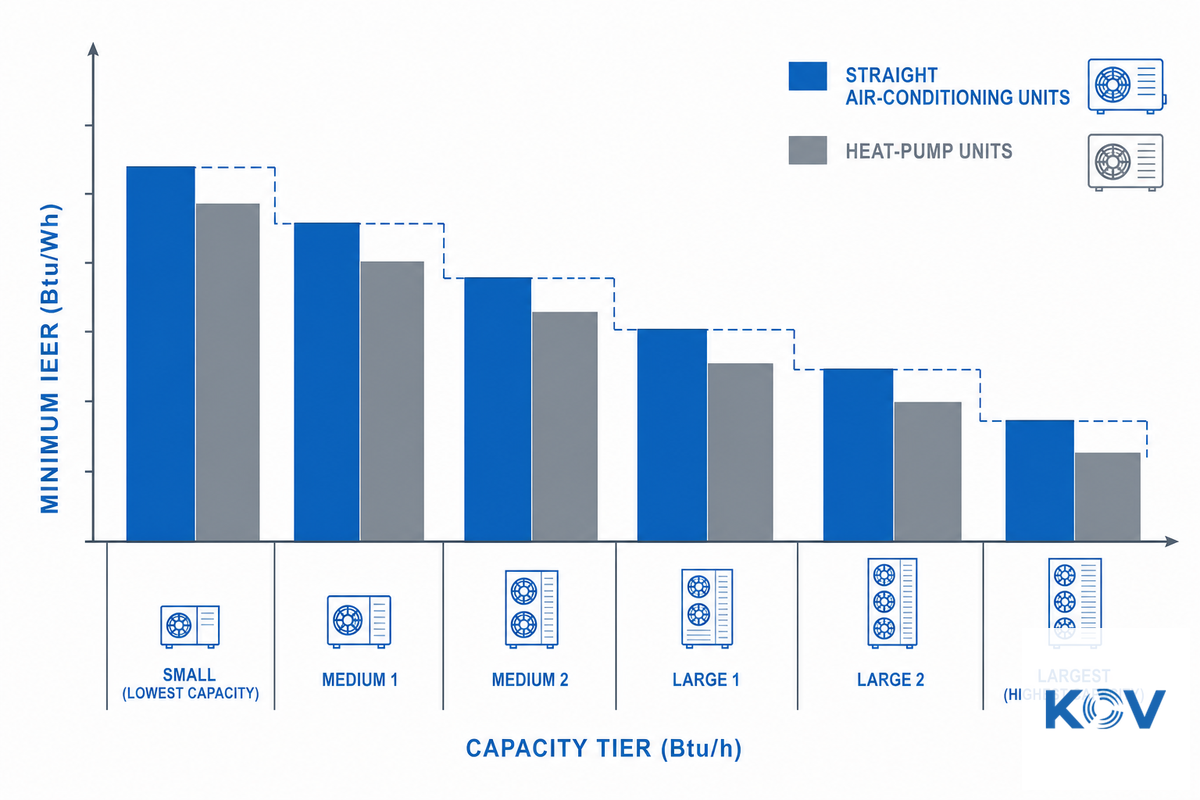
The way you typically see commercial RTU efficiency talked about is using the Integrated Energy Efficiency Ratio (IEER), the commercial counterpart to EER that, in part, takes a RTU’s performance in various part load conditions into consideration, rather than just the maximum 100% load. Most buyer’s guides tell you “the” IEER that any commercial RTU has to reach is one number – and that’s the biggest and single most inaccurate oversimplification of the commercial RTU story that’s everywhere online.
The federal regulation that governs DOE’s equipment standards is 10 CFR 431.97, which sets the minimum IEER by capacity in a sliding scale that goes down with increasing capacity – it’s not a single floor value for the entire product line. It also separates straight air-conditioning units from heat pumps into two distinct product types, each with its own minimum, a point that most buyer’s guides conflate into a single value.
| Cooling Capacity | Min. IEER (AC) | Min. IEER / COP (Heat Pump) |
|---|---|---|
| 65,000–135,000 Btu/h (~5.4–11.3 tons) | 14.8 | 14.1 / COP 3.4 |
| 135,000–240,000 Btu/h (~11.3–20 tons) | 14.2 | 13.5 / COP 3.3 |
| 240,000–760,000 Btu/h (~20–63 tons) | 13.2 | 12.5 / COP 3.2 |
Here’s a worked example: a straight-AC unit with 95,000 Btu/h of cooling capacity fits within the 65,000-to-135,000 Btu/h tier, where the federal minimum is 14.8 IEER – not the “>14” value commonly stated in several buyers’ guides. Its heat-pump counterpart at the same capacity only needs a 14.1 IEER (and 3.4 COP in cooling mode), so its federal floor is slightly lower than the straight-AC unit within the same capacity range. By comparison, a straight-AC unit with a 300,000 Btu/h capacity needs only to meet 13.2 IEER – significantly less stringently than a unit in a lower capacity tier. You only can directly compare two units’ IEER numbers after you confirm that they belong to the same equipment category and are in the same capacity tier – for instance, comparing a heat pump’s IEER against a straight-AC minimum compares two separate standards.
“Not always. Higher-efficiency units cost more upfront, so the right choice depends on your runtime hours, climate, and how long you plan to keep the equipment in service.”
The reason that this caveat is important is because the federal minimum is simply that – a minimum – not a target, and buying a unit that exceed the minimum by a significant margin will have a higher initial cost. Whether the higher upfront investment pays back will depend on how much the system will run, and the overall lifespan of the unit – and not simply on meeting the highest number on a product’s specifications sheet.
A couple of additional pieces of context are helpful here: units below the smallest IEER capacity range are rated based on SEER2/EER2 so not every system in the range of 2 tons up to 150 tons can be compared using only the IEER; please check your equipment’s specifications to ensure the appropriate metric is being used when comparing equipment from different manufacturers and at different capacities. Also, the majority of jurisdictions use the ASHRAE 90.1 standard, which adopts the same minimum performance ratings established by DOE; thus, saying a unit meets the 90.1 energy code typically implies that it also meets the relevant DOE minimum capacity requirement for that product tier.
Energy recovery: A few higher efficiency configurations may use energy recovery systems, which capture heat or cooling from air leaving the system and reuse it to help precondition incoming outdoor air. This can reduce the work that the compressor need to do to remove or add heat/coolness from the air, especially in systems with a high percentage of outdoor air intake.
When Standard RTUs Aren’t Enough: Humidity Control for Precision Environments
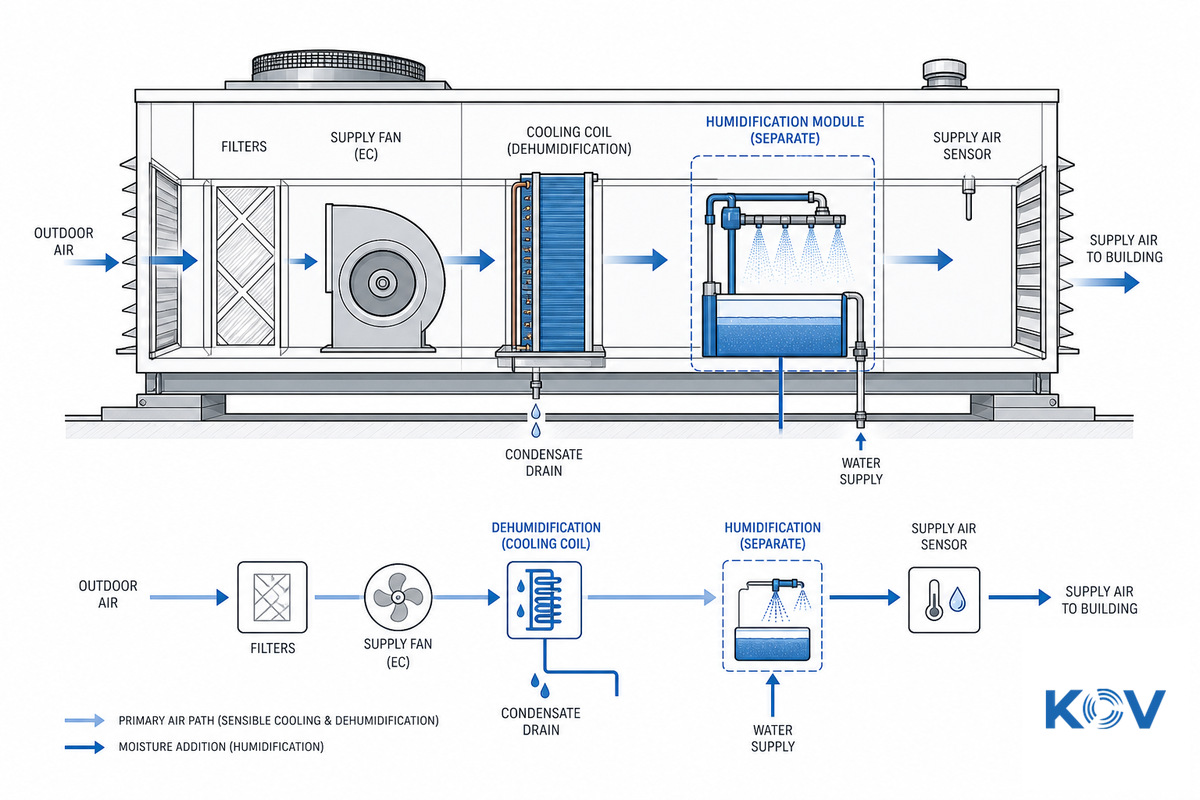
Every comparison above quietly assumes dehumidification and humidification are the same thing. They aren’t, and the difference changes what equipment a given building actually needs. A standard RTU removes moisture only as a side effect of cooling; it has no way to add moisture when a space needs it, and that gap matters most in precision environments.
RTUs’ Role in Temperature And Humidity Control, Explained By experts at HVAC Equipment Supplier and Koven Air: 5 factors driving commercial RTU price:
When a standard RTU’s evaporator coil operates, one of the functions it provides as a byproduct of the cooling process is dehumidification, as cold air releases moisture when chilled below the dew point. This process may contribute to dehumidification but only while the compressor is running, and it can’t compensate for situations where the environment need additional humidity, such as in dry winter conditions at a data center or clean room, or precise humidity management unrelated to the cooling cycle. A manufacturer FAQ from a major OEM explains that packaged rooftop units “can be used to dehumidify, but only for comfort cooling applications,” as active humidification is an entirely separate function.
This distinction is corroborated by the engineering field, beyond the marketing jargon. A U.S. patent (US 6,751,964 B2) details the process of adapting a preexisting packaged RTU with a desiccant-based add-on module specifically to include the humidity control capabilities that aren’t integral to the original unit-direct proof that active humidity control is appended to a standard RTU, rather than being an intrinsic component.
For the majority of comfort-cooling applications, including offices, retail spaces, and schools, this restriction has no significant impact. However, it’s of critical importance in precision environments such as data centers and server rooms, semiconductor and electronics manufacturing facilities, lithium-battery dry rooms, and areas dealing with humidity-sensitive materials like textiles or grain storage. Koven Air’s KA-WD series addresses this particular issue differently by integrating an electrode humidifier into the same cabinet as the cooling and heat-pump heating circuits, treating humidity as a fully integrated component rather than a bolt-on addition. If your project falls within the categories mentioned above, discover how an integrated temperature-and-humidity packaged unit manages both functions efficiently within a single system, as opposed to coupling a standard RTU with a standalone humidifier.
What Does a Commercial Rooftop Unit Cost?
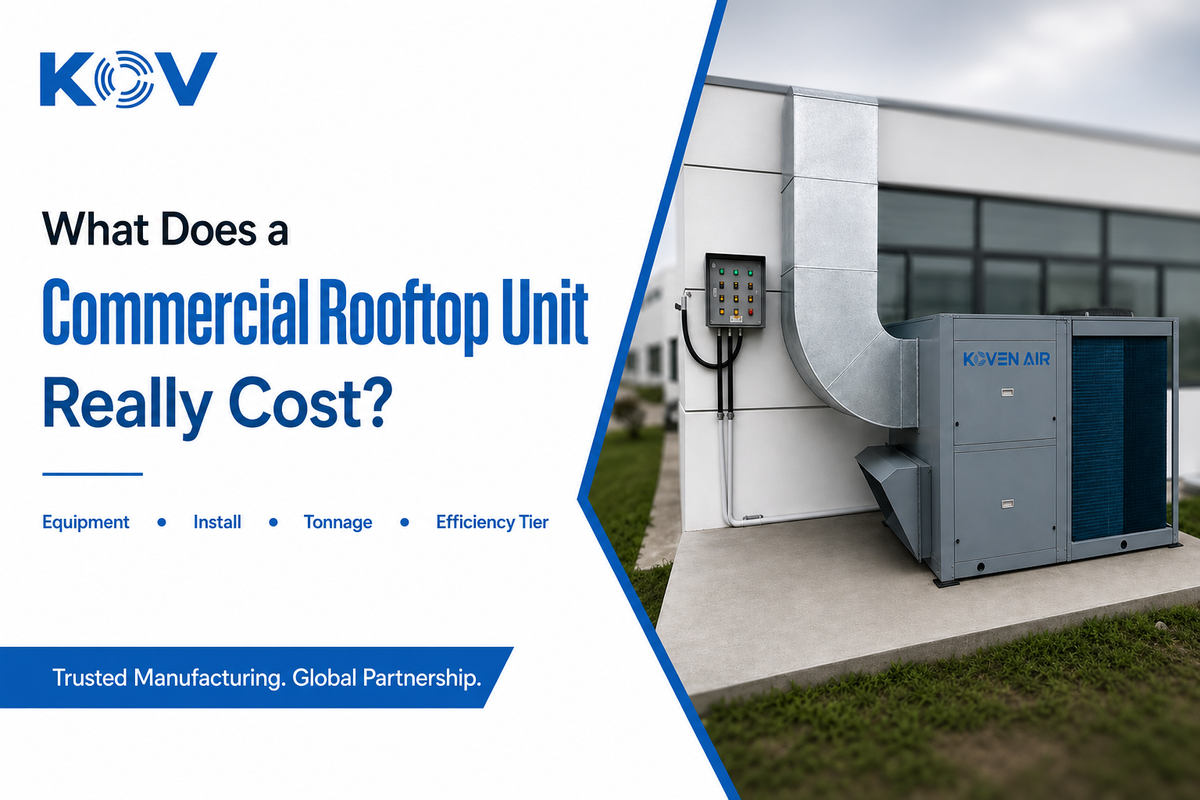
In honesty, there isn’t a universally applicable, published pricing list for commercial RTUs; approach any guide that offers a single price with skepticism. Equipment and installation expenses can vary considerably due to tonnage, efficiency standards, control configurations, and regional differences, making a one-size-fits-all figure inaccurate. However, we can identify the key variables that influence the overall cost.
Cost Factors to Ask About
- Tonnage/capacity – the larger the unit, the more expensive it will be, although not proportionally
- Efficiency tier – higher efficiency units that exceed their tier’s IEER threshold by a considerable margin come at a premium
- Controls package – simple electromechanical controls cost less than complex, building-automation-ready network controllers
- Curb and rigging – installation costs increase with the requirement for crane access and the structural curb work necessary
- Refrigerant type – ongoing industry changes associated with the A2L transition (covered in the Outlook section below) have impacted pricing as manufacturers update their production lines
- Region and labor market – installed costs will fluctuate depending on local contractor availability and the complexity of rooftop access
commercial landlords avoid telling their tenants how much replacement cost really is until it’s too late and it has failed. Any of us that have been on a call with a landlord and tenant over a cooling system know what that can mean. That’s why the argument exists to plan replacement cost on an ongoing budget line before your equipment has the opportunity to fail. A California ratepayer-funded market characterization study of the commercial RTU category reaches the same conclusion from the supply side: cost data across the market is fragmented enough that no single published figure tells the whole story.
Installation Requirements
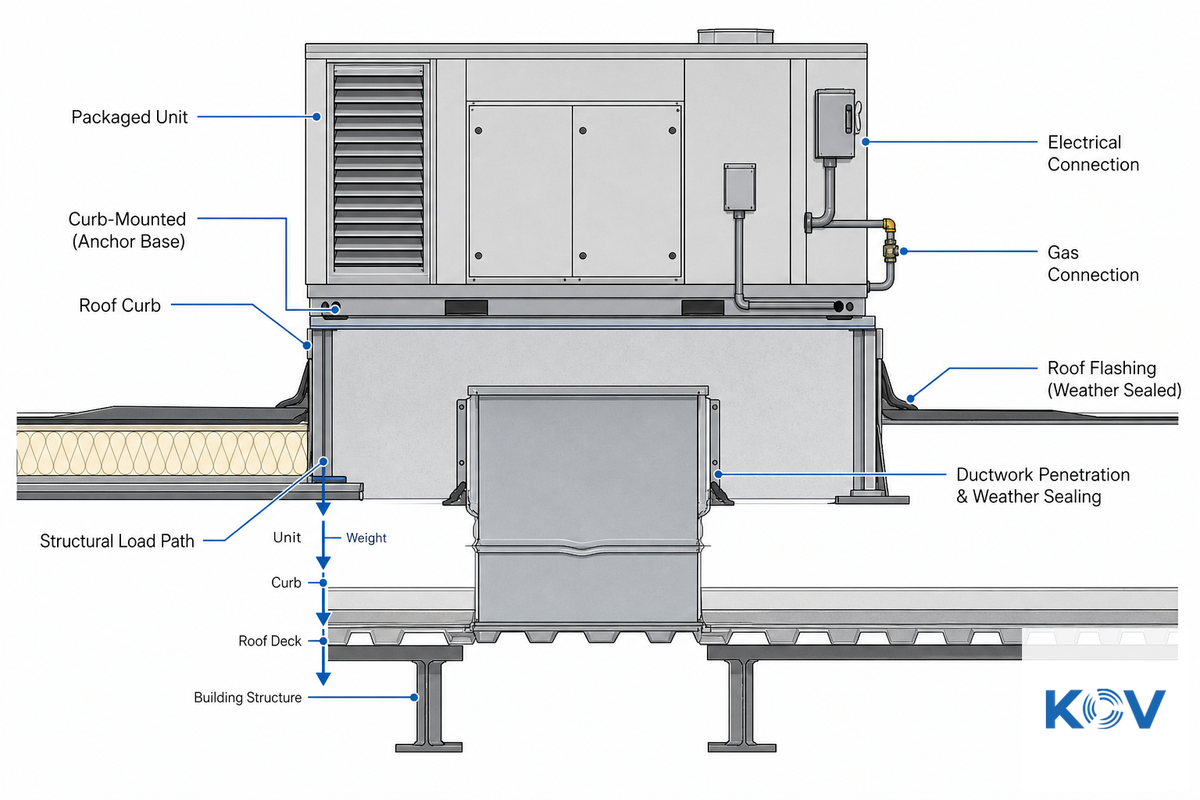
Packaged rooftop units (RTUs) come largely complete out of the factory, meaning installation is largely structural and connection work rather than a system built from components on the roof.
- Confirm your roof’s structural load capacity can handle the total operating weight of a curb-mounted unit – Under-supported roof sections are among the most frequent installation errors cited.
- Ensure the roof curb’s opening matches the dimensions of your replacement unit perfectly. Mismatched dimensions between an old curb and the footprint of your new unit are a common and easily avoidable error in the field.
- Coordinate access with cranes/rigging before your new unit arrives. Lifting to the roof always require a crane and should be scoped prior to the install day.
- Verify roof penetration ductwork connections and weather sealing. Weather stripping and old connections left bolted to the previous unit are the source of numerous leaks at replacement.
- Verify your electrical and gas hookups prior to unit delivery in accordance with the manufacturer’s submittals.
In some cases, depending on geometry, contractors will remove components, particularly coils, from old equipment for reuse. This can be a cost savings on a replacement project, and also helps reduce waste if the old coil geometry works. Discuss it with your contractor if it may apply. Installation and curb-mismatch errors are among the field issues DOE’s commercial RTU fault research catalogs as recurring across real installations.
Maintenance, Lifespan & Repair-vs-Replace
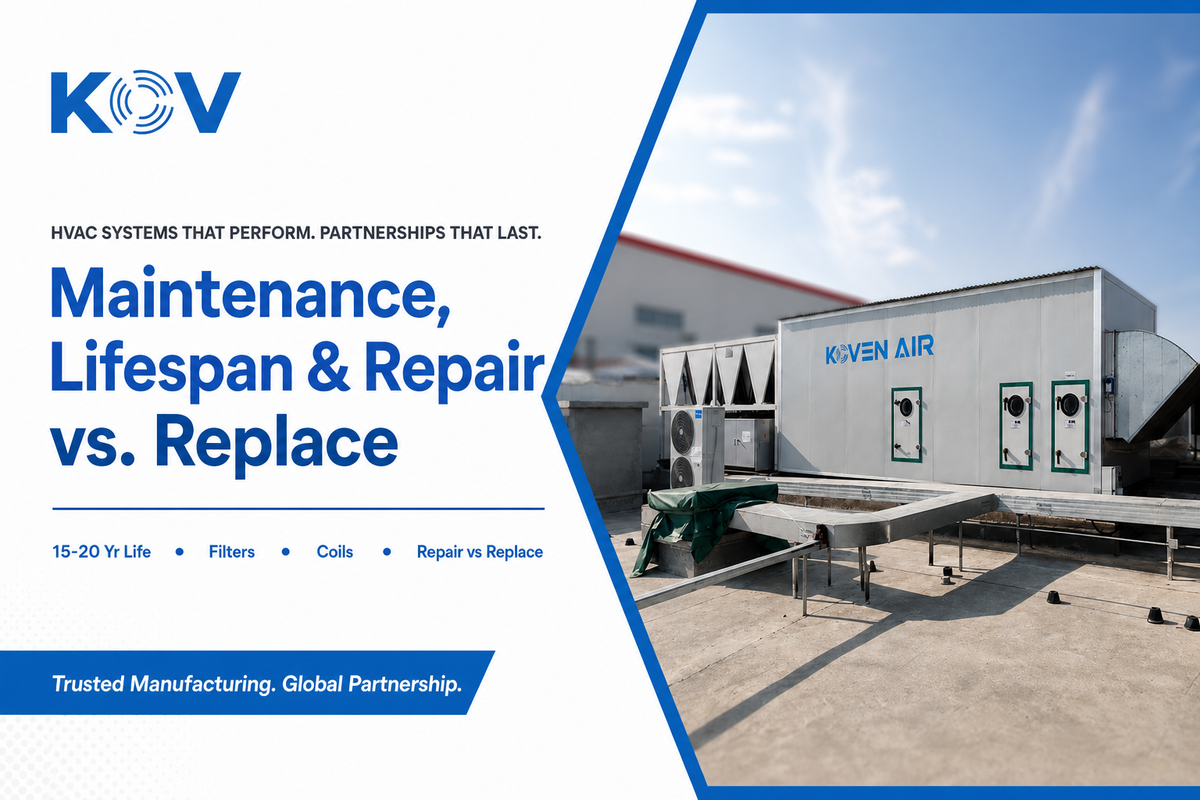
Well-maintained commercial rooftop equipment can typically last anywhere from 15 to 20 years. This assumes basic preventive maintenance is performed as recommended.
Skipping these basics is a common and expensive mistake, and the reason is straightforward: neglected filters and dirty coils force the compressor to run harder and hotter on every cycle, raising the real risk of a premature failure 5 to 10 years before the unit’s rated service life ends. Contractors see this in the field and in practice as the single most common failure pattern on rooftops that get skipped during a busy season. Koven Air provides routine coil and filter guidance to its own service customers because catching a dirty coil early is far cheaper than an emergency compressor replacement – a pattern also documented in DOE’s common commercial RTU fault research.
Quick Specs
| Filter checks/replacement | Quarterly, more often in dusty environments |
| Coil cleaning | 1–2 times per year |
| Full inspection/service | Annually, spring and fall for heat-pump units |
| Typical service life | 15–20 years with regular maintenance |
Selection of air filters on commercial equipment can be more complex than you might imagine. The right size filter for your commercial RTU not only impacts energy consumption but may also impact your equipment life between services as it directly affects the ability of the coils to stay clean.
When it’s time for replacement, a classic rule of thumb often used by contractors, particularly in the residential market but also widely used by contractors of all trades, is called the $5,000 rule. The rule simply states that if the unit’s age in years times the estimated cost of repair exceeds $5,000, then it’s more financially prudent to replace the unit than repair it. It isn’t unusual to find manufacturers even referencing the $5,000 rule in their homeowner guidance documents. While it may be a useful guideline to initiate discussions with your contractor, keep in mind that in recent years as refrigerants have evolved and prices have increased, the repair side of this equation may have changed, making a revised calculation or simply going with the lowest and best cost option on the market potentially the better way to go.
Industry Outlook: Refrigerant Transition & the 2029 Efficiency Shift
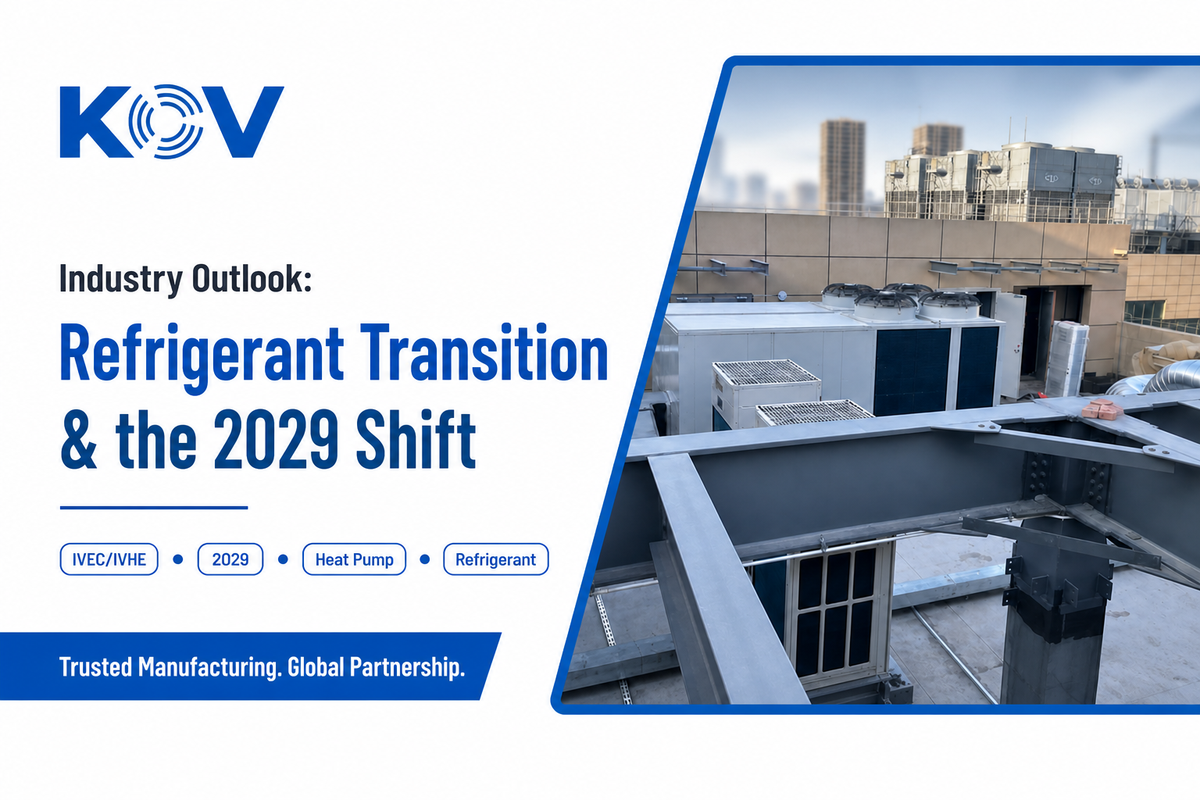
There are a couple of new government regulations that may impact your decision when buying commercial rooftop equipment now that you should be aware of before you sign your quote.
The first key point here: Refrigerant transition is a current event, not a future one. The refrigerant phase-down outlined in the EPA’s AIM Act has driven adoption of A2L refrigerants like R-454B among many of the leading OEMs in the current product lines. For the majority of today’s commercial RTU offerings, an A2L is the default refrigerant – it’s the norm, not an add-on.
So, be careful when you’re matching a quote to a dated specification.
Second – this is the part most buyer guides fail to touch upon entirely – in 2024, DOE issued a Direct Final Rule replacing IEER for federal compliance purposes with two new integrated efficiency metrics, IVEC (Integrated Ventilation, Economizer and Cooling Efficiency) and IVHE (Integrated Ventilation and Heating Efficiency), for products manufactured on or after Jan. 1, 2029. Manufacturers will be allowed to certify products under the new system beginning in May 2025. As opposed to IEER, these two metrics offer dedicated efficiency points for sophisticated, low-power-demand variable-speed supply fan operation, economizer malfunction detection, and off-cycle, reduced-ventilation mode use – rewarding sophisticated control over pure refrigerant cycle efficiencies. Based on DOE’s own modeling, the 2029 minimums for 5-to-20 ton heat-pump RTUs are expected to be approximately 15% tighter than the current IEER minimums.
For a buyer today: the implications of this are if you’re buying equipment with a 15 or 20 year life you may want to know if the control system and fan have sufficient range to be a top performer with an IVEC/IVHE metric style approach to ratings, or if the unit simply meets the minimum standard now for an IEER rating. Equipment tuned for the minimums of today’s standard might not perform as well compared to 2029 vintage equipment during their service life.
The risk of getting this wrong is real: buyers who ignore the mismatch often end up with equipment that becomes uncompetitive years earlier than expected, because the control platform’s fan and economizer hardware usually cannot be retrofitted to the new metric later. Koven Air provides model documentation that flags control-headroom explicitly, in the field and in practice, so buyers can compare specs like-for-like against the 2029 baseline instead of discovering the gap after a 10 year commitment. UL’s IVEC/IVHE testing program is already accepting submissions, so this isn’t a distant hypothetical for manufacturers.
Commercial Rooftop Unit FAQ
Q: What does RTU mean in HVAC?
View Answer
RTU, short for Rooftop Unit, is a self-contained HVAC system (see DOE’s commercial buildings research for how it’s studied) that was designed to live on the roof and includes both cooling and heating (and ventilation) capabilities all in one cabinet. Since all of the components are pre-wired and factory pre-charged, the work that needed to be done in the field consisted of connecting the power, the duct work and the controls to provide conditioned air to the building.
Q: How much does a commercial rooftop unit cost?
View Answer
There is no single published cost, because tonnage, efficiency tier, controls, curb and rigging requirements, refrigerant type, and local labor rates all move the price. Ask for bids that separate equipment cost from installation cost so you can compare real cost drivers, and treat any guide quoting one flat number with skepticism.
Q: What is the $5,000 rule for HVAC?
View Answer
This is an update-or-replace heuristic; you just multiply the unit’s age (in years) by the projected repair cost and if the product of the two numbers is greater than $5,000 (often referred to as the ‘magic’ number by HVAC technicians), a new unit generally offers more long-term value. It’s a standard tool but a few contractors believe the heuristic should be updated, thanks to refrigerant-transition efforts and recent inflation, which drive up the cost of repair.
Q: Can a commercial rooftop unit run without ductwork?
View Answer
No. Packaged RTUs rely on ductwork to deliver conditioned air into the building – without it, the unit has nowhere to discharge that air, and airflow to the occupied space stops entirely. This dependence on ductwork is a key difference between rooftop units and ductless mini-splits, which condition a room directly.
Q: How long does a commercial rooftop unit last?
View Answer
Generally, 15 to 20 years of operation can be expected from most commercial rooftop units if they’re properly maintained, which includes regular filter checks, yearly coil cleaning, and an annual overall system checkup. Neglected units are likely to experience failure well before the longer end of this lifespan.
Q: Do commercial rooftop units need humidity control?
View Answer
Standard RTUs dehumidify air as a side effect of cooling, but they can’t add humidity and only work while cooling runs. Data centers, semiconductor plants, lithium-battery dry rooms, and other humidity-sensitive facilities need more than that, which is why some manufacturers build a humidifier into the packaged cabinet instead of requiring a separate retrofit.
Ready to Talk Through Your Application?
The Koven Air team is equipped to evaluate your facility’s requirements if your building falls into any of the categories above that need specialized humidity control or if you would simply prefer a single, all-inclusive packaged unit to manage both temperature and humidity.
Why We Write This
Koven Air Environment Technology Co.,Ltd has manufactured HVACR equipment since 2007, including commercial rooftop units with integrated humidity control, and runs a heat-pump and chiller testing facility at its 20,000 square meter plant. This guide draws on federal efficiency standards, a U.S. patent, and field installation experience for a manufacturer-neutral view. More on our company. Reviewed by the Koven Air technical team.
References & Sources
- 10 CFR 431.97, Energy Conservation StandardsElectronic Code of Federal Regulations, U.S. Government Publishing Office
- Energy Conservation Standards for Air-Cooled Commercial Package Air Conditioners and Heat PumpsU.S. Department of Energy, Federal Register, September 30, 2024
- IVEC and IVHE Testing ServicesUL Solutions
- High-Efficiency Rooftop Unit (HE RTU) Focused Pilot, Final ReportCalNEXT (California ratepayer-funded HVAC market research program)
- US 6,751,964 B2, Desiccant-Based Dehumidification SystemUnited States Patent and Trademark Office
- Applied versus Packaged Rooftop Units, Does It Matter?Consulting-Specifying Engineer
- How to Choose the Proper Filter for Packaged Rooftop UnitsFacilitiesNet
Related Articles
- Commercial Rooftop Units with Integrated Humidity Control, Koven KA-WD Seriesour full product line for buyers who need temperature and humidity control in one cabinet
- All-Electric Heat Pump Rooftop Units for Cold-Climate Buildingsfor buyers evaluating electrification and decarbonization options
- About Koven Air Environment Technologyour manufacturing background and testing capabilities




![Liquid Desiccant Dehumidifier: How It Works [2026 Guide]](https://kovenair.com/wp-content/uploads/2026/07/liquid-desiccant-dehumidifier-guide-featured-150x150.png)


