Get in Touch with Koven Air Company

ISO Certified Manufacturing
Commercial Rooftop Unit
Commercial Rooftop Units With Integrated Humidity Control, Koven KA-WD Series (2.6–44 Ton)
Packaged temperature and humidity control in one cabinet, heat pump on every model, high part-load efficiency, and voltage built to your grid.
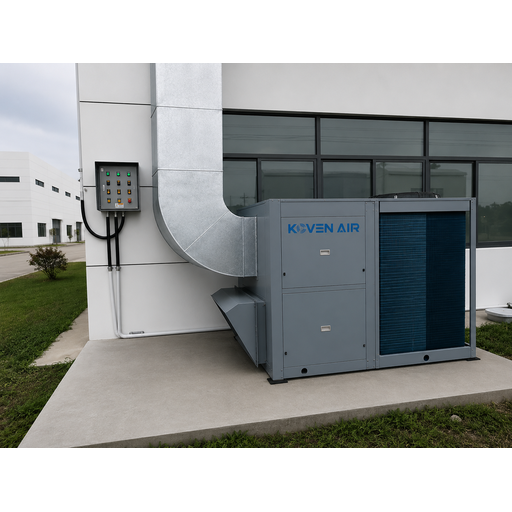
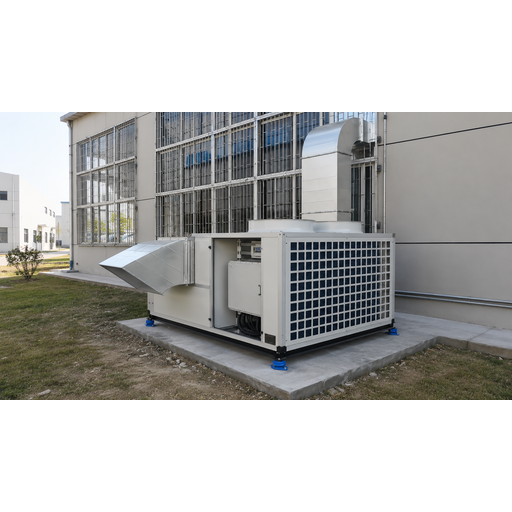
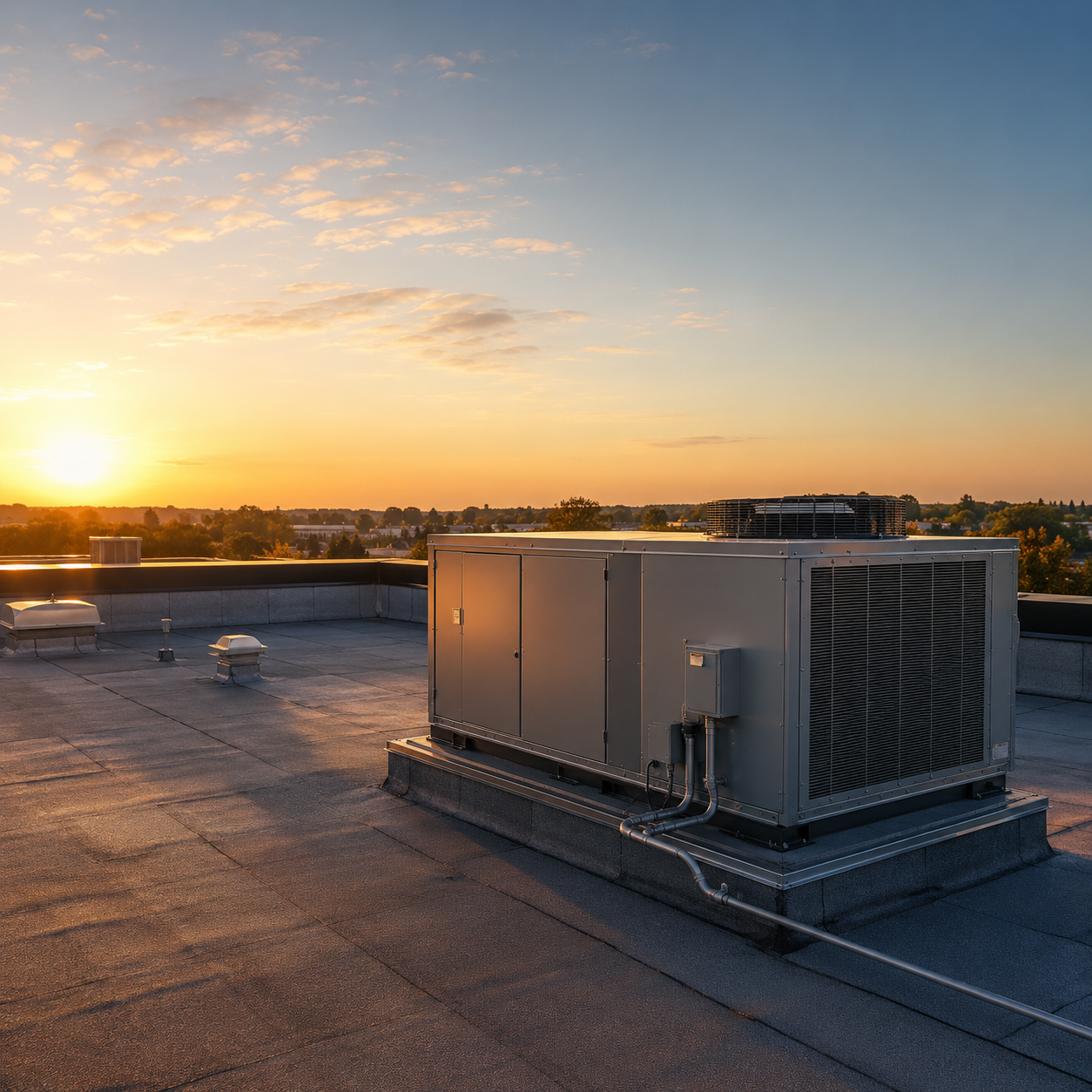
A commercial rooftop unit is a self-contained HVAC system, compressor, coils, fans, and controls in one weatherproof cabinet mounted on a roof curb or pad, ducted straight into the building. The Koven KA-WD line covers 2.6 to 44 nominal tons (9–155 kW cooling, roughly 30,700–528,900 Btu/h), and it does one thing most packaged rooftop units in this class can’t: it controls temperature and humidity from the same cabinet, with a heat pump on every model. This page give you the full 17-model spec matrix, an honest efficiency and total-cost-of-ownership breakdown against the US federal standard, the precision-environment applications where humidity control actually earns its keep, and a straight procurement guide on voltage, lead time, and after-sales.
Inside a single cabinet, a packaged rooftop unit draws return air from the space, mixes it with outdoor air for ventilation, conditions it, and pushes supply air back down the duct system, all the air conditioning, heat-pump heating and climate-control components live in one weatherproof box on the roof. An economizer damper lets the unit pull cool outdoor air for “free cooling” when the weather allow; higher-MERV filtration protects indoor air quality; and options such as energy recovery, hot gas reheat, a dedicated outdoor air system (DOAS) or makeup-air role, and single-zone or variable-air-volume (VAV) configurations tune the packaged unit to the building. Rated cooling capacity, full-load EER and part-load IEER together describe its energy efficiency, and because the whole HVAC assembly is self-contained, a rooftop-unit replacement or retrofit is far simpler than re-engineering a split system.
2.6–44 ton
Cooling 9–155 kW
IEER to 16.6
High-efficiency config
Heat pump
On every model
4–32 kg/h
Integrated humidifier
1–4 scroll
Staged part-load
Any voltage
380V std / configurable
Manufacturing since 2007
Koven Air in 35 countries
24-hour aging test + dedicated heat-pump lab
Lifetime free technical after-sales
The Humidity Blind Spot In Commercial Rooftop Units
Most packaged rooftop units only remove humidity as a side effect of cooling, and only while the compressor runs, they’ve no way to add moisture and no independent humidity control at all. That gap costs you comfort and process stability in two directions. In the field, technicians name the first failure plainly: “Cool temperatures and high humidity” is the classic sign of an oversized single-stage unit that short-cycles, satisfies the thermostat in a few minutes, and shuts off before it has wrung the water out of the air . As one installer put it, “The compressors won’t” stay on long enough to dehumidify the space. The US EPA sets the target this failure misses: indoor relative humidity should be held below 60% — ideally 30–50% — to prevent mold and protect the building (US EPA, Mold Course Ch.2).
Koven closes the gap from both sides. On the dehumidification side, KA-WD units stage one to four hermetic scroll compressors instead of slamming a single big compressor on and off, the machine matches part-load, runs longer at low load, and keeps pulling moisture instead of short-cycling. On the humidification side, an integrated electrode humidifier (4–32 kg/h) sits inside the same cabinet, so the unit can hold a relative-humidity setpoint upward as well as downward. That’s the difference between a rooftop unit that only cool and a rooftop unit that controls the room. Where dry or precise environments are non-negotiable, a topic we quantify further down, that in-cabinet humidifier stops being a nicety and become the reason the unit is specified. Unlike a cooling-only box that leaves the moisture problem to separate equipment, the KA-WD is engineered to hold the band because Koven pairs its in-house electrode humidifier (4–32 kg/h) with 1–4 staged compressors under one control, the trade-off most single-stage packaged units never resolve.
Koven KA-WD Model Selection Matrix, 2.6 To 44 Ton
Selecting a packaged rooftop unit starts with cooling load, then airflow (CFM) against the external static pressure your ductwork imposes, then how the efficiency metric is reported for that size. One caution first, straight from the roof: “Double and triple” check the voltage of the unit against your building service before it ships, a 380V/50Hz machine isn’t a 460V/60Hz machine, and Koven configures voltage per order rather than shipping a fixed catalog SKU. The full line below is real published spec, not marketing ranges. Note that efficiency is reported differently by size class under the US federal standard: units under 65,000 Btu/h are rated on SEER2/EER2, while units at or above 65,000 Btu/h are rated on IEER (eCFR 10 CFR 431.97)which is why the smallest KA-WD models show no IEER figure.
DATA SYNC
| Model | KA-Cooling kW | ≈ Tons | ≈ Btu/h | Heating kW | IEER std | IEER pro | Airflow CFM | ESP in.wg | Compressors |
|---|---|---|---|---|---|---|---|---|---|
| WD003DHA | 9 | 2.6 | 30,700 | 10 | — | — | 1,060 | 0.40 | 1 |
| WD004DHA | 14 | 4.0 | 47,800 | 15 | — | — | 1,650 | 0.40 | 1 |
| WD006DHA | 20 | 5.7 | 68,200 | 22 | — | — | 2,350 | 0.60 | 1 |
| WD008DHA | 28 | 8.0 | 95,500 | 30 | 11.9 | 14.8 | 3,300 | 0.60 | 1 |
| WD010DHA | 35 | 10.0 | 119,400 | 38 | 12.3 | 15.1 | 4,120 | 0.60 | 1 |
| WD013DHA | 46 | 13.1 | 156,900 | 49 | 13.2 | 15.1 | 5,415 | 0.72 | 2 |
| WD016DHA | 56 | 15.9 | 191,000 | 60 | 13.2 | 15.1 | 6,592 | 0.80 | 2 |
| WD018DHA | 62 | 17.6 | 211,500 | 66 | 13.1 | 15.0 | 7,299 | 0.80 | 2 |
| Model | KA-Cooling kW | ≈ Tons | ≈ Btu/h | Heating kW | IEER std | IEER pro | Airflow CFM | ESP in.wg | Compressors |
|---|---|---|---|---|---|---|---|---|---|
| WD019DHA | 66 | 18.8 | 225,200 | 70 | 15.0 | 15.6 | 7,770 | 0.80 | 2 |
| WD020DHA | 70 | 19.9 | 238,800 | 76 | 13.1 | 15.0 | 8,240 | 1.00 | 2 |
| WD022DHA | 78 | 22.2 | 266,100 | 83 | 15.5 | 16.0 | 9,182 | 1.00 | 2 |
| WD023DHA | 82 | 23.3 | 279,800 | 88 | 13.0 | 15.0 | 9,653 | 1.00 | 3 |
| WD026DHA | 93 | 26.4 | 317,300 | 99 | 13.3 | 15.3 | 10,948 | 1.20 | 3 |
| WD029DHA | 102 | 29.0 | 348,000 | 109 | 13.6 | 14.6 | 12,007 | 1.20 | 3–4 |
| WD038DHA | 132 | 37.5 | 450,400 | 141 | 16.0 | 16.5 | 15,539 | 1.40 | 4 |
| WD044DHA | 155 | 44.1 | 528,900 | 166 | 16.1 | 16.6 | 18,246 | 1.40 | 4 |
A quick read of the matrix: a 5-ton buyer maps to WD006, a 10-ton buyer to WD010, a 20-ton buyer to WD020, a 25-ton buyer to WD023. Every model carries full heating capacity as a heat pump (10–166 kW) matched to its rated cooling capacity, so there’s no “cooling-only vs. add heat later” decision to make. Airflow spans 1,060–18,246 CFM against 0.40–1.40 in.wg external static pressure, and every unit ships with a DN32 condensate drain and an electrode humidifier option. Voltage is 380V/3-phase as standard with other voltages configured to order, state your building service on the RFQ and the unit is built to it, rather than forcing a curb adapter or a step transformer onto a fixed SKU. A common mistake is sizing to a round tonnage and ignoring static pressure, which risks a unit that short-cycles; because Koven builds each of the 17 models to order with in-house precision sheet-metal work, the KA-WD is engineered to match your actual load, unlike a fixed catalog SKU. As a quick map, a 5 ton RTU corresponds to the WD006 and a 10 ton RTU to the WD010.
Koven KA-WD Vs. A Standard US Packaged RTU
The commercial rooftop hvac units that dominate a North American parking lot are excellent at comfort cooling and heating, and this table isn’t an attack on their build quality. It isolates the capabilities that differ, the ones that decide whether a room stays inside a humidity band and how the unit behaves at part load. Numbers are specific, not High/Medium/Low, and the federal baseline column is the actual US minimum for the size class from the Department of Energy standard (eCFR 10 CFR 431.97).
| Capability | Standard US packaged RTU | Koven KA-WD |
|---|---|---|
| Active humidification | None — dehumidifies only while cooling | Integrated electrode humidifier, 4–32 kg/h |
| Part-load staging | Often single-stage in light-commercial sizes | 1–4 hermetic scroll compressors |
| Heat pump | Optional / select model lines | Standard on every model (10–166 kW) |
| Cooling IEER (high-eff config) | Federal floor 13.0–14.8 by size class | Up to 16.6 (pro config) |
| Voltage | Fixed catalog SKU (e.g. 208/230V, 460V) | Configured to order, 380V std |
| Comparison table on the vendor page | Rare — specs split across model pages | One matrix, 17 models |
| After-sales | Dealer-mediated, terms vary | Lifetime free technical service |
| Precision-environment RH story | Generic “any building” | Data center / battery / granary specific |
| Capacity range | 2–150+ tons (broad) | 2.6–44 tons (small-to-mid + precision) |
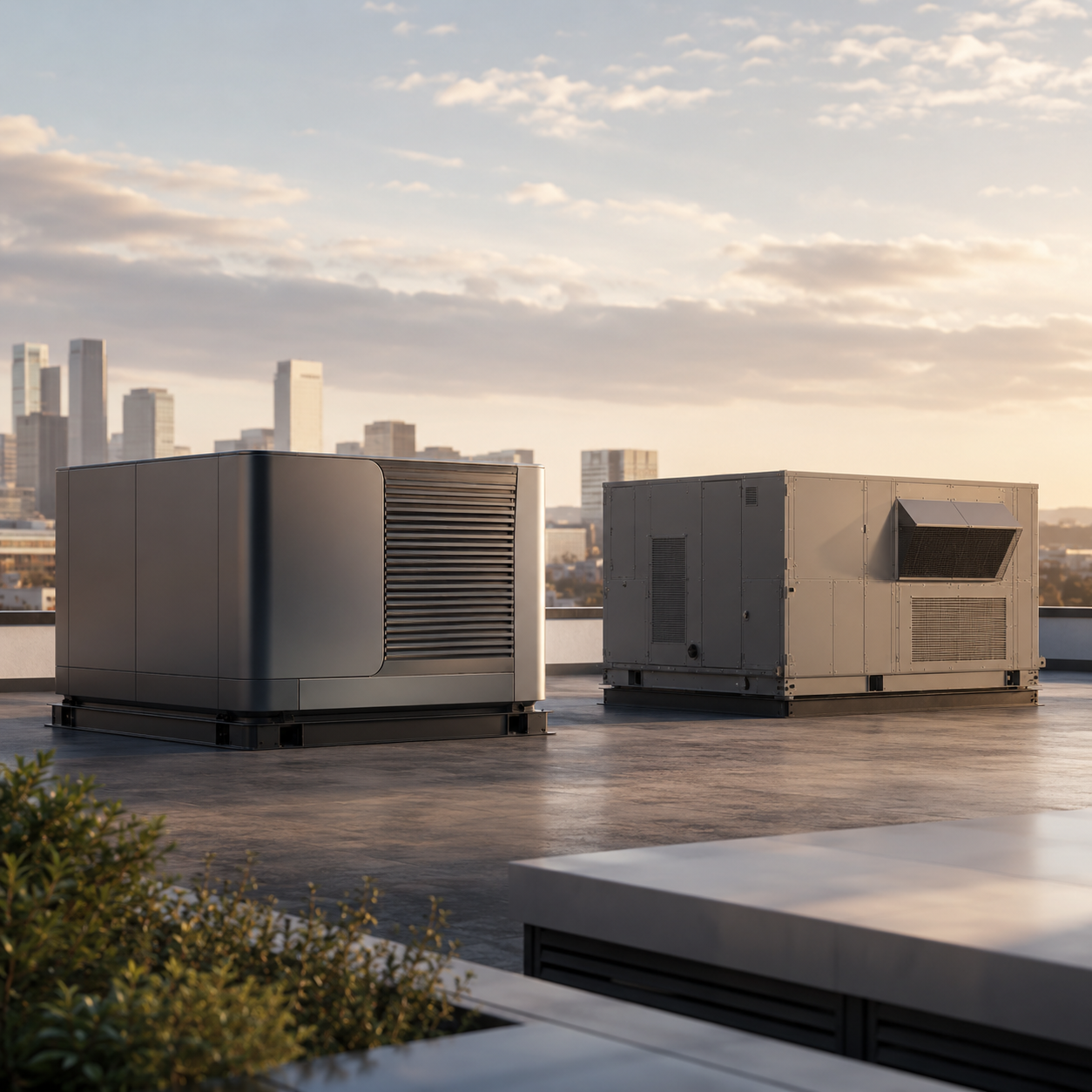
Read the last row honestly: the North-American majors go far past 44 tons, so a chiller-plant-scale job isn’t Koven’s fight. Koven’s ground is the small-to-mid commercial band where humidity control, heat-pump-standard, and configurable voltage change the outcome, and where a single comparison table beats clicking through six separate model pages to find a number nobody printed. One honest gap most brochures hide is that a spec you can’t compare is a spec you can’t trust; because Koven publishes all 17 models in one matrix with precision-measured numbers, the KA-WD is engineered to be checked line by line, whereas a standard RTU scatters its 15+ data points across six pages.
IEER Up To 16.6, What Part-Load Efficiency Really Saves
Precision Environment Control, 4 Segments Where RH Matters
This is where an in-cabinet humidifier stops being a feature and become a process requirement, a matter of precision cooling, not just comfort. The tolerances below aren’t comfort preferences, they’re hard limits set by the physics of the product being made or stored. The US Department of Energy even defines a distinct equipment category, the computer-room air conditioner, precisely by its integrated humidifier and combined temperature/humidity control (eCFR 10 CFR 431, DOE equipment definitions)the same capability the KA-WD builds into a rooftop package.
Segment
Humidity requirement
Why it fails without control
Lithium-battery dry room
Dew point around −40°C (roughly 1% RH or drier)
Moisture hydrolyzes the electrolyte salt — scrap cells
Semiconductor / cleanroom
Tight RH band, low variability
Static, film defects, photoresist instability
Data center (dry-season)
ASHRAE TC9.9: keep within 8–80% RH band
Below ~8% RH raises ESD risk on hardware
Granary / textile mill
Controlled RH to prevent mold / static
Spoilage, yarn breakage, dust ignition risk
The data-center row carries a useful contradiction: server halls actually have a wide humidity tolerance. ASHRAE’s TC9.9 guideline recommends 18–27°C with a maximum 60% RH but allows an 8–80% RH band, so most data centers run with little or no humidification (ASHRAE TC9.9, thermal guidelines). Active precision humidification earns its keep an order of magnitude further down, the lithium-battery dry room at below 1% RH, where Tesla, CATL, BYD and LG hold dew points near −40°C to keep electrode materials from reacting with water. Koven’s application brief for these segments is the same argument as the whole page: one cabinet that hold a room inside a humidity band, up or down, instead of a cooling-only box that leaves humidity to separate equipment.
Build Quality, Factory Testing & Compliance
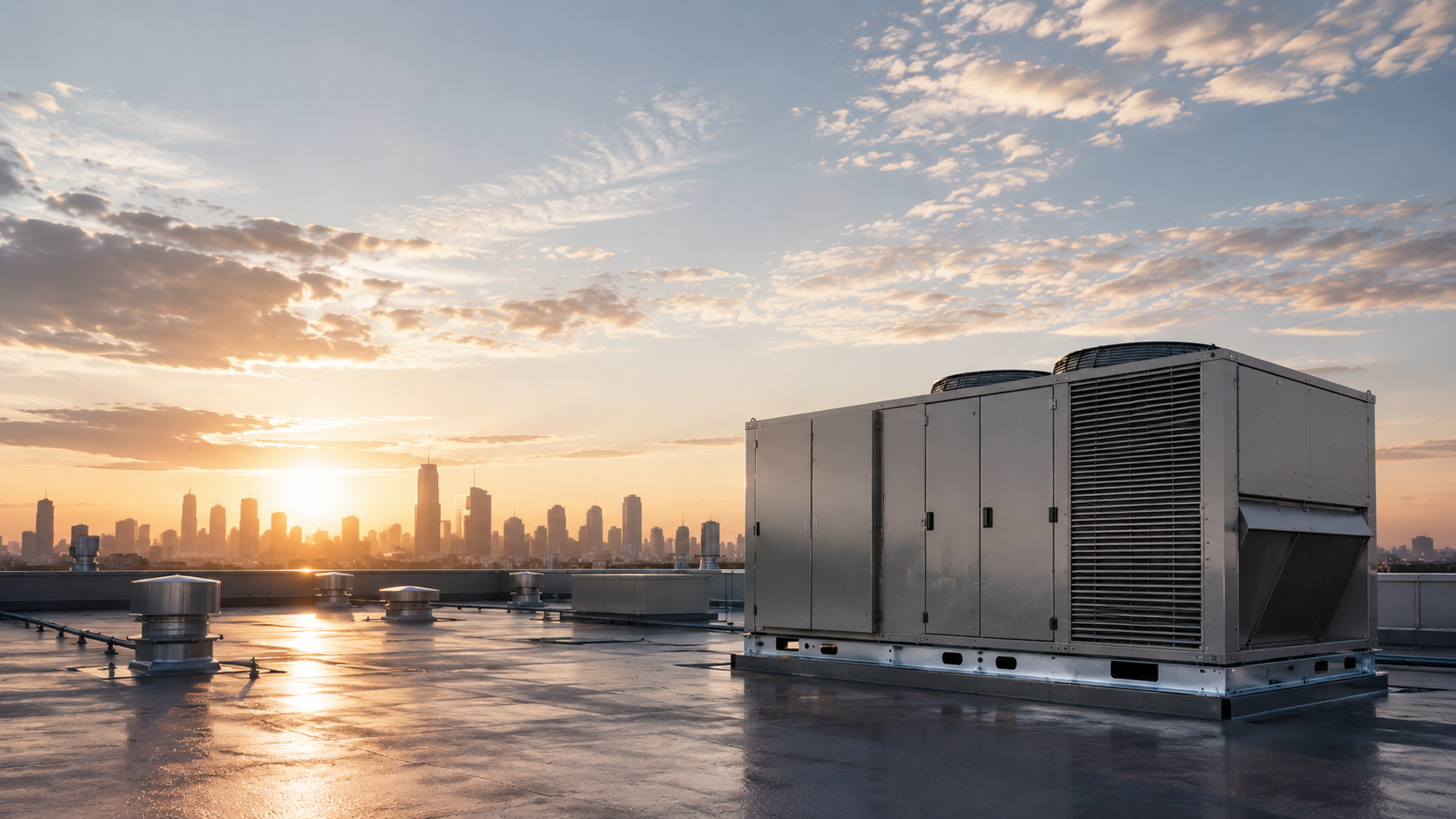
An honest word before the badges: Koven Air is a Chinese HVAC and commercial air conditioning manufacturer, and buyers are right to ask what stands behind an unfamiliar brand. The verifiable answer is the factory test regime, and the honest answer on market certifications is that they’re configured per destination market, not assumed. Koven runs a 20,000 m² plant with 400 process-traceability points, 36 factory inspection checkpoints, a 24-hour aging test on every build, and a dedicated chiller and heat-pump testing laboratory. That’s the quality-management backbone; the market paperwork is layered on top of it per project.
On the compliance questions that actually gate a purchase, the useful frame is regional. In the United States, covered commercial packaged equipment must be tested to the applicable Department of Energy procedure and certified to DOE, and workplace electrical equipment is expected to carry a Nationally Recognized Testing Laboratory (NRTL) mark such as UL or ETL (OSHA, NRTL Program). There is also a hard refrigerant line: since January 1, 2025 it is no longer permitted to import or manufacture new R-410A equipment for the US market, so US-bound units must ship on a low-GWP A2L refrigerant. For any North-American project, treat AHRI 340/360 performance rating, NRTL listing, DOE certification and the destination refrigerant as items to confirm on your specific configuration, ask us for the certified configuration your jurisdiction requires rather than taking a logo on a brochure. Koven’s quality system is documented and its certifications are provided against the destination market and application (ISO 9001, quality management systems). One real risk buyers fear is an opaque overseas supplier; because Koven documents 400 traceability points and runs a 24-hour aging test on every unit, the factory record is engineered to be audited, unlike a brand that hides behind a logo, and Koven delivers the certification package your jurisdiction requires rather than a generic export unit.
400
Process-traceability points
36
Factory inspection checks
24 h
Aging test per unit
Heat-pump lab
Dedicated test facility
Commercial Rooftop Unit Sizing & Efficiency Tools
KA-WD Rooftop Unit Model Selector
Pick your cooling load to find the matching Koven KA-WD packaged rooftop unit. Every model is a heat pump with an integrated humidifier option.
IEER vs. US Federal Floor Checker
See the DOE 2023 minimum IEER (10 CFR 431.97) for a given air-cooled commercial package size class, and how the Koven KA-WD high-efficiency configuration compares.
FAQ, Commercial Rooftop Units
A 5-ton rooftop unit is 60,000 Btu/h of nominal cooling (one ton = 12,000 Btu/h). In the Koven KA-WD line the closest match is the WD006 at 20 kW / roughly 68,200 Btu/h (about 5.7 tons), or the WD004 at 14 kW for a lighter 4-ton load. Because every KA-WD model is a heat pump, that 5-ton selection includes full heating capacity as standard, not as an add-on.
An oversized unit cool the air to the thermostat setpoint faster than it can remove moisture, then shuts off, a pattern called short cycling. Because dehumidification only happens while the coil runs cold, short cycles leave relative humidity high even when the temperature read correct. Staging multiple compressors, as the KA-WD does with one to four scrolls, keeps the coil running at low load so moisture removal continues instead of stopping.
A rooftop unit is a packaged, self-contained air conditioning system: the compressor, condenser, evaporator, fans and HVAC controls sit in one outdoor cabinet that needs only power and ductwork. An air handler move and conditions air but relies on a separate outdoor condensing unit or chiller for the refrigeration. The packaged RTU trades some design flexibility for simpler installation and a single point of service, the trade most light-commercial buildings prefer.
Longer than most owners assume. A California Public Utilities Commission study measured a median effective useful life of 24.9 years for packaged rooftop equipment, versus roughly 15–20 years in common planning assumptions and the ~4 years many owners expect. Preventive maintenance extends life another 20–35%. That long real horizon is exactly why part-load efficiency and humidity control, not the lowest sticker, drive the total cost of ownership.
It depends on the certified configuration, and Koven addresses that directly rather than glossing over it. US commercial installations require equipment tested to the Department of Energy procedure, typically a UL or ETL (NRTL) safety listing, and since January 2025 a low-GWP refrigerant rather than R-410A. Koven configures voltage, refrigerant and the certification package to the destination market, the practical step is to send your jurisdiction and specification so the right configuration is quoted, not a generic export unit.
Yes. Every KA-WD model is a heat pump with full heating capacity (10–166 kW), and every model offers the integrated electrode humidifier (4–32 kg/h depending on size). That combination, cooling, heat-pump heating, active humidification and staged dehumidification in one cabinet, is the core reason the line suits precision and process environments as well as standard commercial comfort.