Get in Touch with Koven Air Company

Rooftop Unit Data Center Cooling: How to Qualify a Packaged System

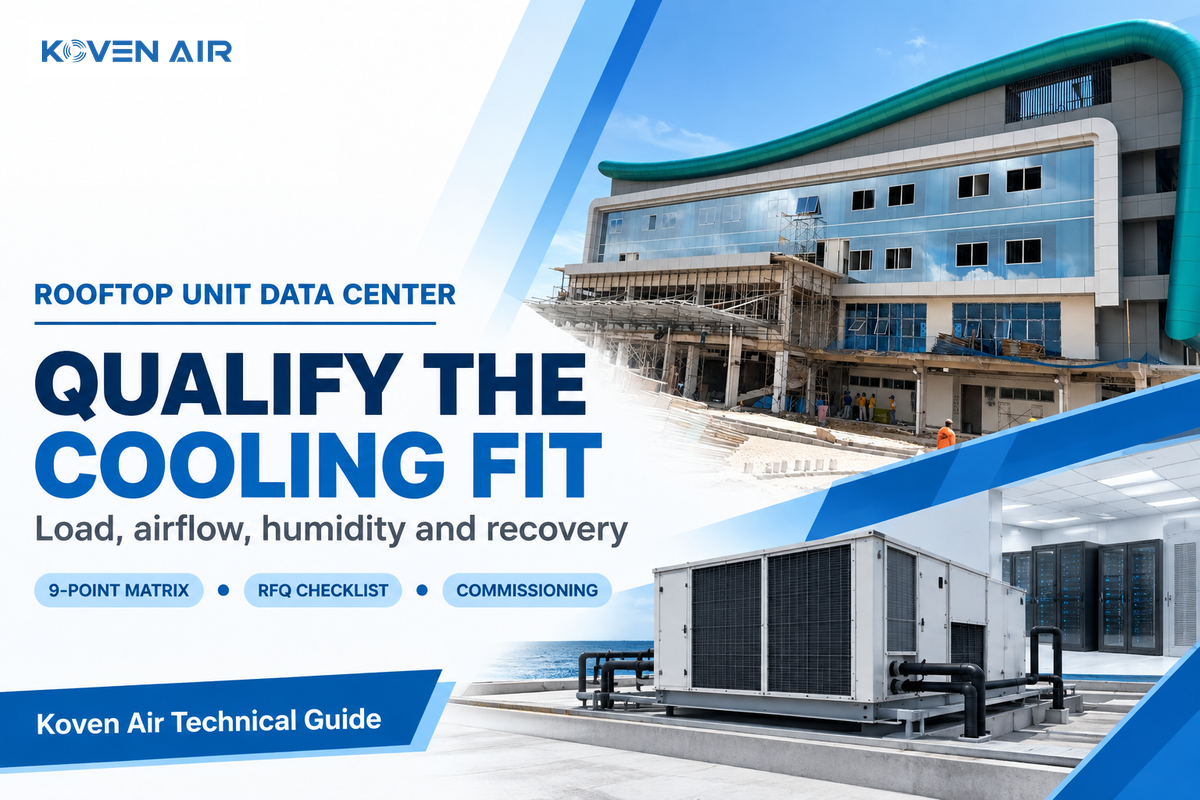
Can a rooftop unit cool a data center? A rooftop unit data center project must be evaluated against the actual IT load, airflow, humidity, controls, and redundancy plan. Sometimes. It depends on the IT heat profile, airflow path, humidity constraints, filtration, control strategy, service access and failure strategy. The word “rooftop” by itself is usually not the limiting factor. This guide outlines where a packaged rooftop unit can be utilized, when to evaluate a central chilled water plant and what to include in the equipment schedule.
Why a data center changes the rooftop-unit question
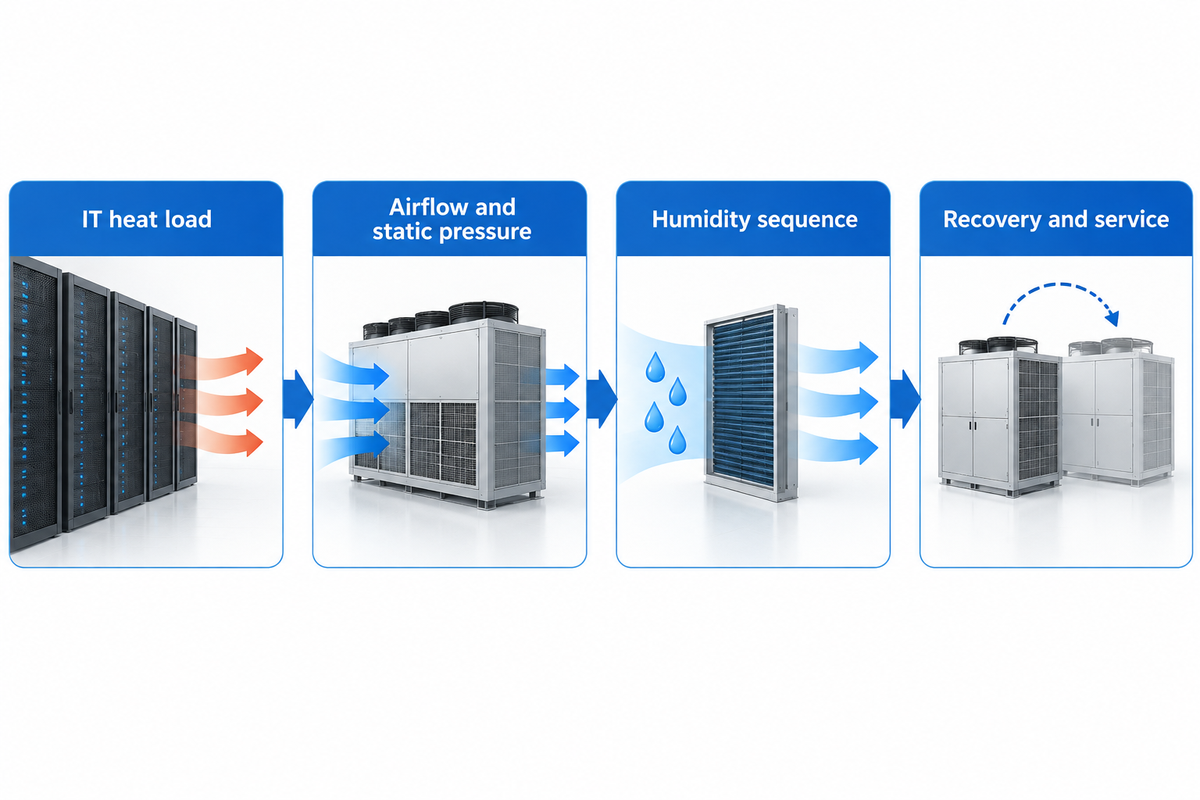
A comfort cooling project can accept a larger temperature swing and lower capacity for a shorter duration. See the commercial rooftop unit product context when comparing packaged options. A data center has a smaller operating envelope and requires continuous fan operation. The cooling system must remove and dissipate heat from the white space, move air through the rack, manage moisture and be recover from a fault, without making any assumptions.
It’s why nameplate tonnage is the first and lowest hurdle for systems consideration, and the design team also needs to know the entering and returning air temperatures and set points, as well as the airflow, external static pressure, filtration pressure drop, outdoor air requirement, the full load, peak load, and partial load conditions. State the sensible cooling duty and the expected temperature range for each operating mode before selecting equipment. A rooftop package can meet those needs, but only if the design requires it.
The U.S. Department of Energy’s data center design guidance addresses water side free cooling and chilled water plants at the central plant level. This doesn’t mean a central chilled water plant is always required. It means larger or faster growing data centers often evaluate a central plant to address the cooling load along with packages units.
When a rooftop unit can be a fit
1. The load is defined by operating mode, not one peak number
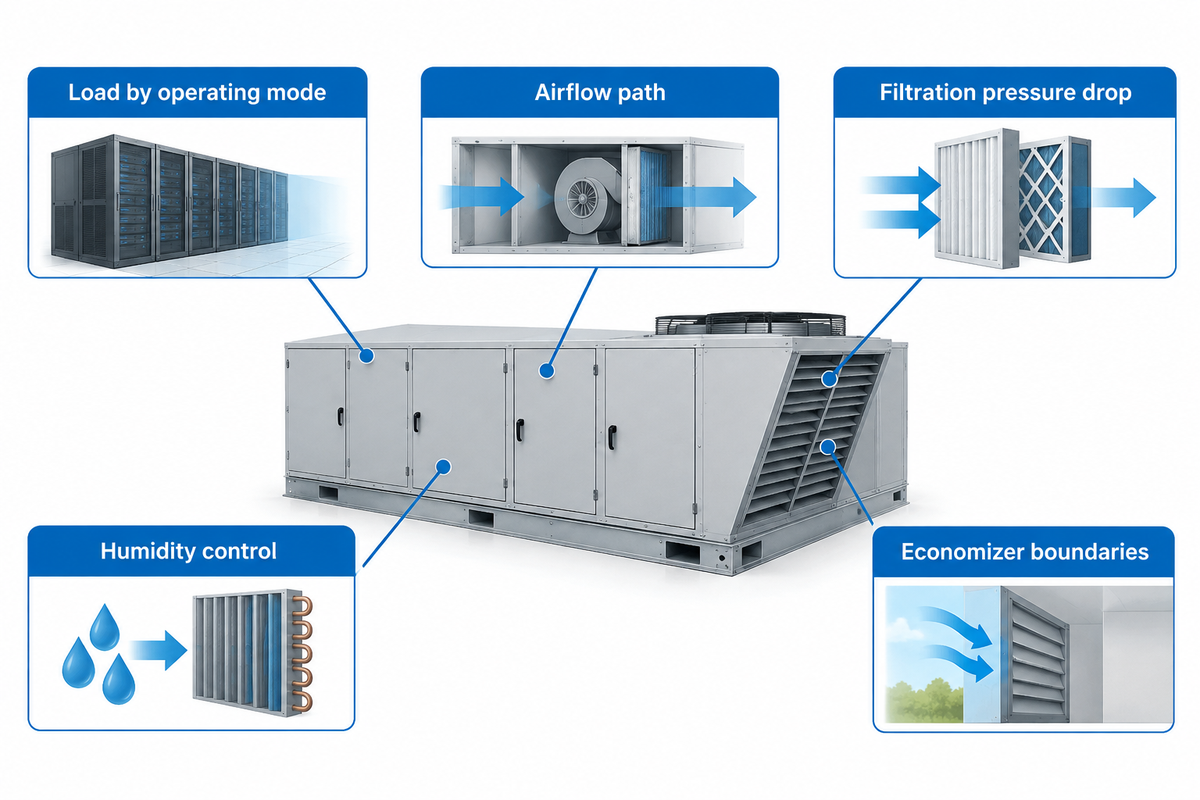
Begin with a load schedule that separates IT loads, lighting, people, UPS losses, battery rooms, and envelope heat. Use the commercial RTU range only after the load schedule is defined. Record expected loads at commissioning and at the first expansion and validate against credible peak. Check the unit at these loads. A unit that’s comfortable at a peak condition can cycle poorly and lose humidity control at a low load night condition.
2. Airflow and filtration match the rack layout
Map supply and return paths on the floor plan. Confirm the fan can deliver the required airflow at the actual external static pressure considering filters, dampers and ductwork. Define the class of filter, face velocity and provide information on replacement. The schedule should show the alarm for a rising filter pressure drop to ensure a dirty filter doesn’t become a problem without warning.
3. Humidity control is treated as a control sequence
Data center humidity is a system issue. There can be over-cooling and aggressive reheat, uncontrolled outside air and a missing dew point sequence. This can create problems even if the sensible capacity is adequate. Put limits on the temperature and dew point, location of the sensors, dehumidification and humidity control sequence and what happens if the humidity control sensor fails. If close humidity control is required of the space, low load behavior and latent capacity should be bid items.
4. Economizer operation is bounded by the environment
Air-side economizers decrease the need for compressors when outdoors conditions are better than indoor conditions. PNNL explains that an economizer uses outdoor air to lower the temperature and/or moisture of the air in a building. However, incorrect control can increase fan and cooling/heating energy. A data center sequence should limit enable humidity lockout, smoke or contaminant control, minimum outdoor air, damper proving and return to mechanical cooling.
5. Redundancy and service access are engineered together
Determine if redundancy is at the unit, electrical feeder, controls, fan, or cooling path level. A pair of rooftop units on the same electrical feeder doesn’t provide the same level of redundancy as units with independent power and controls. Provide safe, clear access to coils and filters, and plan paths for equipment removal. Anticipated maintenance shouldn’t require turning an access issue into an unplanned outage.
When to compare a central chilled-water or hybrid approach
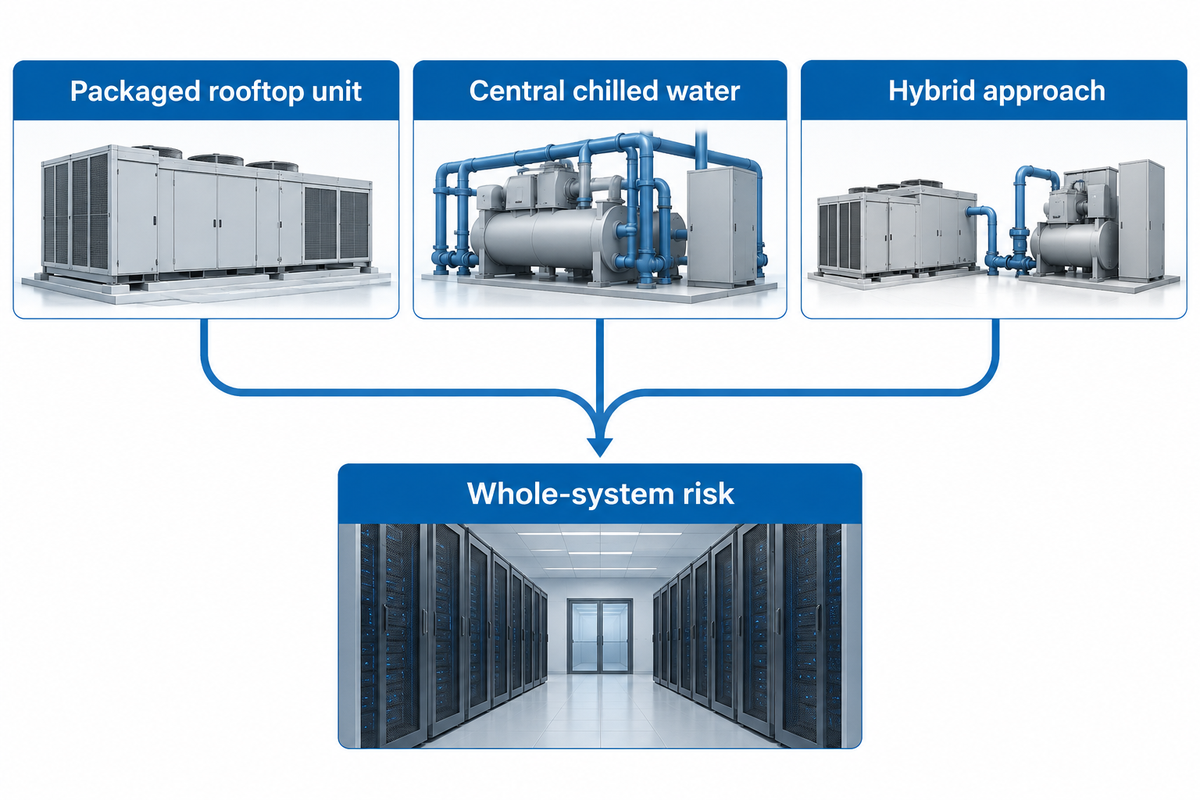
A central plant deserves a serious evaluation when rack density is high, the campus is growing in stages and a liquid cooling path is being considered. Compare the proposed package with Koven Air’s commercial rooftop unit family against the same design brief. A chilled water loop can support and provide a common control point for multiple air handlers. A hybrid arrangement can support a package unit for a less dense zone while a central plant serves a densely loaded zone.
When evaluating architectures, consider the same boundary conditions (installed electrical capacity, pump and fan energy, condensers or towers water, controls integration, maintenance labor and parts, roof structure, phasing, and the effect of a single component fault) and use the DOE guidance on data center cooling to assess water side efficiencies. This should be part of the initial analysis when a cooling tower is being proposed. DOE cooling-water efficiency guidance provides a public reference for comparing water-side options.
Decision rule: choose the architecture that gives the required cooling and recovery behavior at the lowest whole-system risk for the actual load profile. A rooftop package is a valid option when its limits are documented and tested; it is not a shortcut around load, airflow or redundancy engineering.
Rooftop unit data center selection matrix
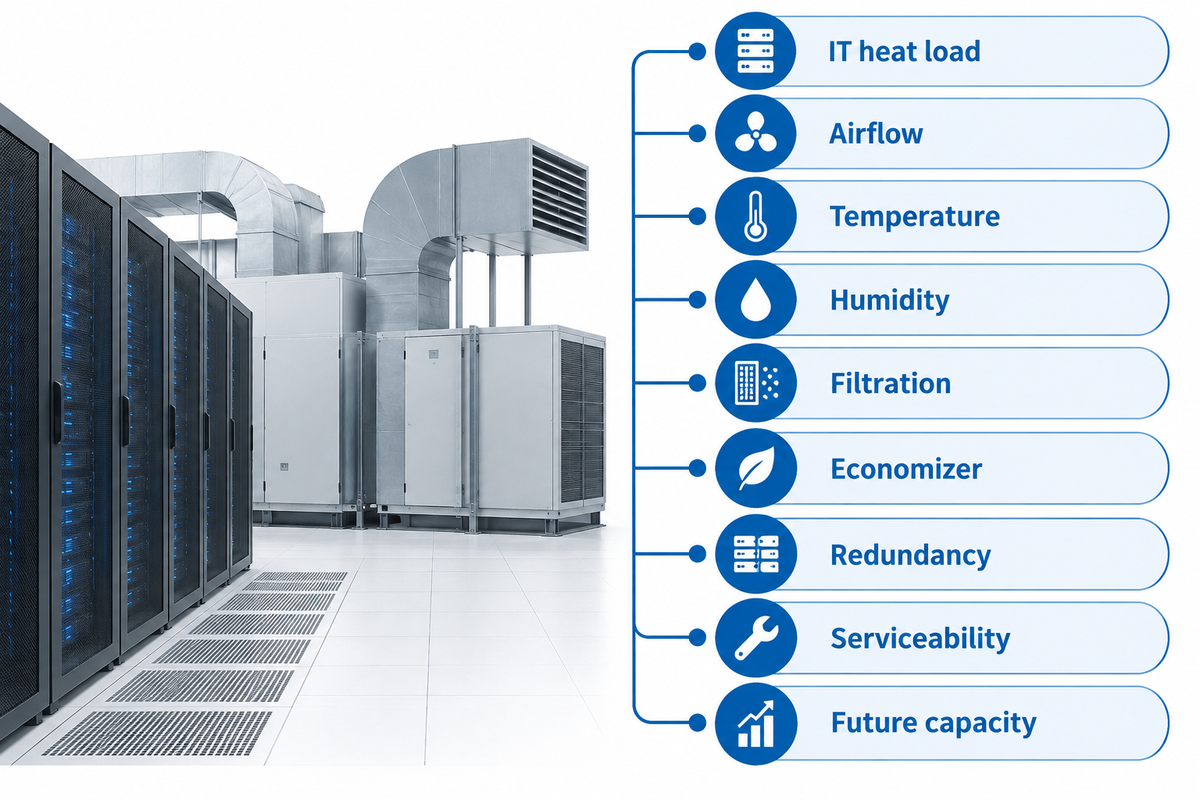
Use the matrix during the basis of design review. A “pass” means the project team has a written value, drawing or test method. A “fail” means that the project team doesn’t have the correct documentation. For the economizer row, compare the sequence with PNNL air-side economizer guidance before accepting the test method.
| Review item | What to document | Pass evidence |
|---|---|---|
| IT heat load | Normal, peak, start-up and expansion-stage heat rejection | Load model with assumptions and owner sign-off |
| Airflow | Supply and return volume at real external static pressure | Fan curve, duct calculation and TAB plan |
| Temperature | Supply, return and rack-inlet limits by operating mode | Sequence of operation and sensor map |
| Humidity | Dew point, latent load, reheat and low-load behavior | Control narrative plus functional test |
| Filtration | Filter class, pressure drop, access and alarm threshold | Submittal, access detail and alarm test |
| Economizer | Outdoor-air enable, lockout, damper proving and contamination response | Trend log from a witnessed test |
| Redundancy | Unit, power, controls and maintenance failure modes | Failure-mode table and recovery procedure |
| Serviceability | Roof access, coil cleaning, filter change and lifting route | Access drawing and maintenance walk-down |
| Future capacity | Expansion space, spare electrical capacity and controls points | Phasing plan with reserved interfaces |
Koven Air commercial rooftop context
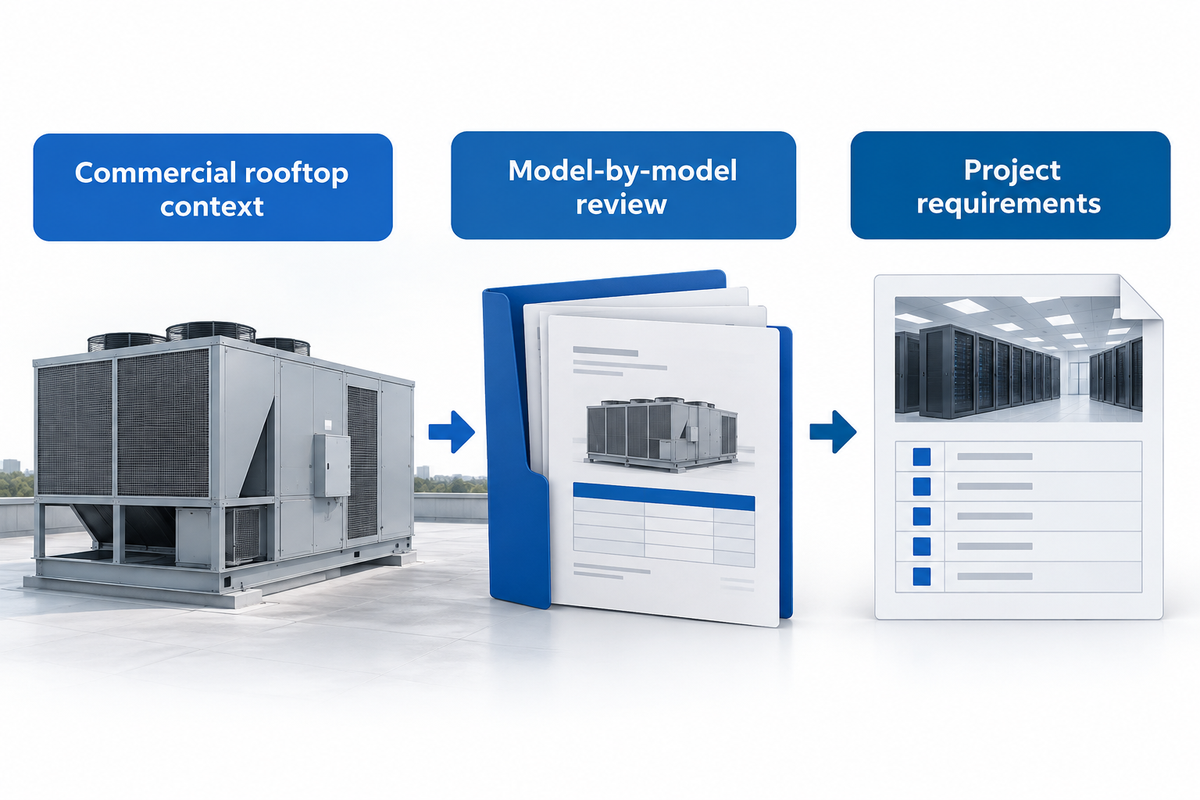
Koven Air says it manufactures heating, cooling and environmental-control equipment for commercial and industrial buildings. Its commercial rooftop webpage describes the KA-WD series as a configurable packaged unit that offers integrated control of temperature and humidity with heat-pump heating and voltage options. The webpage states that the unit has a range of 2.6 to 44 tons and IEER of up to 16.6. Those figures are the manufacturer’s published product information; the unit still needs to be checked against the project’s load, airflow, ambient design conditions and control sequence.
For a review of a product family, the next step is to send the load schedule, entering and leaving air conditions, static-pressure requirements, humidity limits, voltage, outdoor-air requirements and redundancy targets to the manufacturer. The commercial rooftop units page can then be used as the starting point for a model-by-model submittal review. For company background, see the Koven Air About Us page.
Commissioning checklist before handover
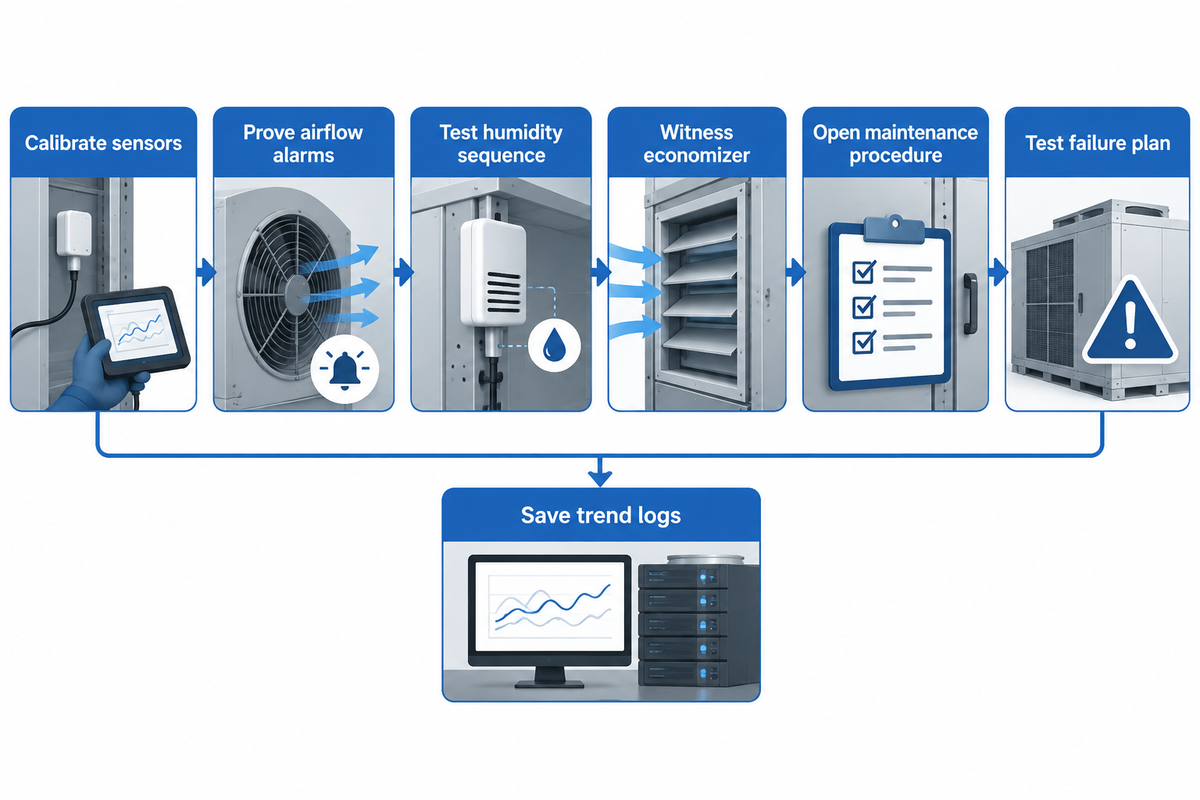
- Verify sensors against calibrated references and record their locations.
- Prove airflow and static-pressure alarms at design and reduced-load conditions.
- Test the humidity sequence for the dehumidification control, reheat control, high-humidity lockout and failure of sensor case.
- Witness the outdoor-air economizer, proving of dampers, and return to mechanical cooling.
- Open the planned maintenance procedure for changing filters, coil access, fan and belt inspections, and backup and backup of controls and spare parts.
- Test failure plan with owner: unit trip, loss of power, communication and feeder, and manual override.
- Save final trend logs and sequencing with as-built documentation. For thermal-efficiency context, also review ASHRAE data-center thermal-efficiency resources.
FAQ
Are rooftop units suitable for every data center?
Not really. They can house some low to medium density modular or edge applications, but the decision depends on the load, airflow, humidity, redundancy and expansion plan.
Is a higher IEER enough to prove data-center suitability?
No. Efficiency at a rating condition doesn’t prove airflow, controls, humidity, performance, filtration, service access, or failure recovery at the installed site.
Should a data center always use chilled water?
No. Packaged rooftop units cover one architecture to compare. Others could include a split system, direct-expansion unit, liquid-cooling unit, and a hybrid unit, to name a few, which can all be assessed against the same project requirements.
What should I send a rooftop-unit manufacturer for a quote?
Send load schedule, indoor design conditions, airflow and static pressure, outdoor-air requirements, filtration, voltage, controls, redundancy, roof constraints and commissioning requirements.
U.S. Department of Energy data-center design guidance; DOE cooling-water efficiency guidance; PNNL air-side economizer guidance; ASHRAE data-center thermal-efficiency resources; Koven Air About Us and commercial rooftop unit pages.
References & Sources: DOE data-center design guide; DOE cooling-water efficiency guidance; PNNL air-side economizer guidance; ASHRAE thermal-efficiency resources.
Factory Selection Support
Turn this guide into a usable HVAC RFQ package.
Share design conditions, airflow, temperature, humidity, process load, room use, and scope boundary. Koven Air can recommend a practical equipment route before quotation.
7equipment families
ISO / GMPcleanroom review
RFQscope comparison
What to prepare before quote
- Use settingCommercial building, cleanroom, hospital, data center, process area, or retrofit.
- Operating conditionsAirflow, load, temperature, humidity, static pressure, and duty hours.
- ConstraintsFootprint, access, hygiene class, material, controls, documentation, and delivery boundary.
Final equipment selection depends on local codes, project drawings, and confirmed site conditions.