Get in Touch with Koven Air Company

Heat Recovery AHU — Plate & Rotary-Wheel Energy Recovery
Capture the exhaust energy you would otherwise discard. Koven builds modular heat recovery air handling units (plate and rotary-wheel models, 2,000–42,000 m³/h) for hospitals, data centers, cleanrooms, and high-occupancy buildings.
Request a Quote & Sizing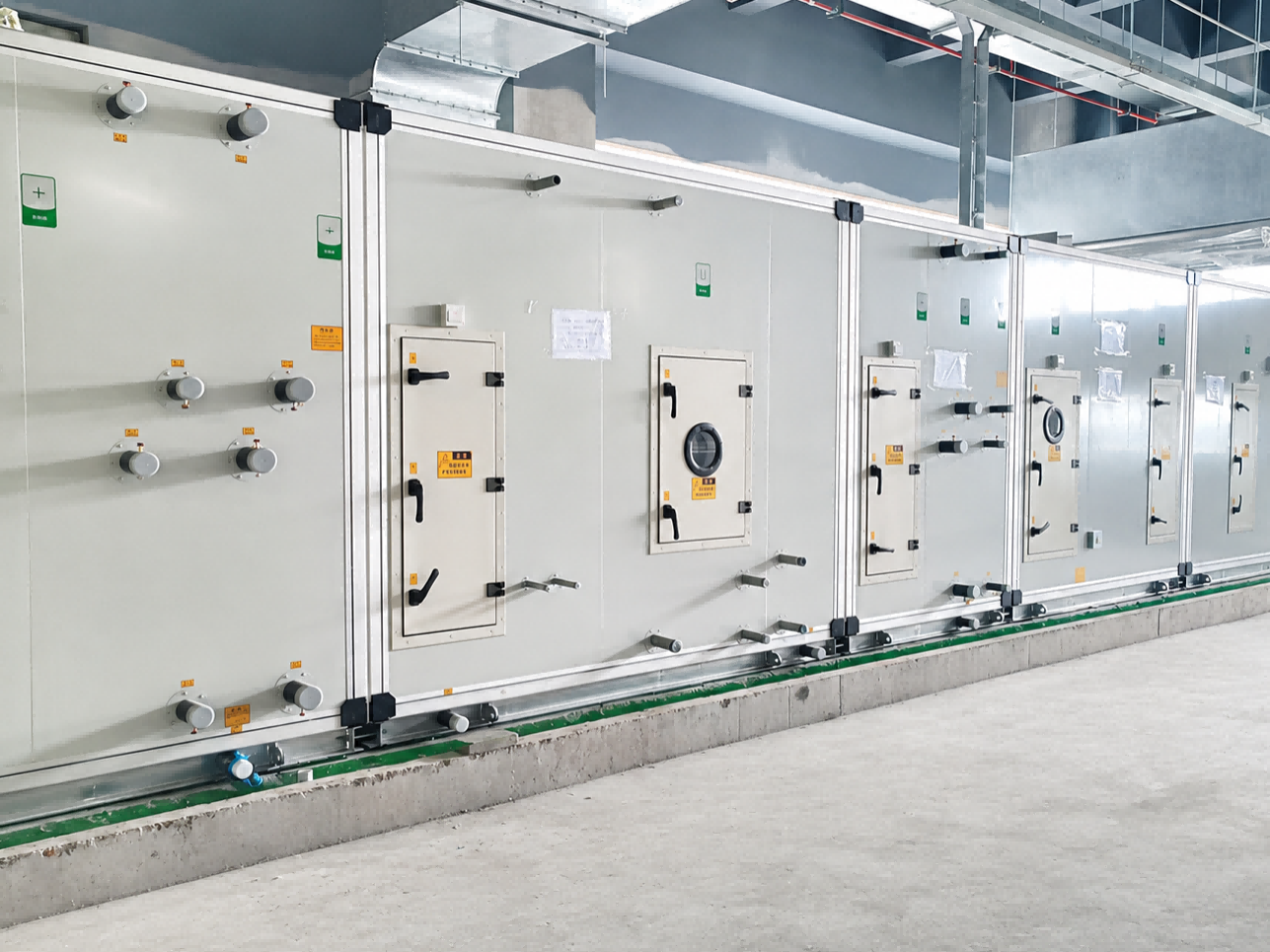
-
2,000–42,000
Airflow range, m³/h (plate + rotary) -
2 core types
Cross-flow plate & rotary enthalpy wheel -
3 / 4 / 5 m/s
Selectable wheel face velocity -
~50–90%
Recovery effectiveness by type -
9-section
Modular combined AHU build -
35 countries
Installed base · lifetime tech support
The real energy penalty of ventilating with 100% outdoor air
A heat recovery AHU exists to solve one expensive problem: the outdoor supply air entering the building needs to be heated in winter and cooled and dehumidified in summer – and for a code-compliant hospital or lab this single load is the plant’s largest one. A properly applied heat recovery air handling unit intercepts much of the exhaust energy and transfers it to the incoming supply so that the heating and cooling coils lift the air a much smaller temperature and humidity gap.
Here is the part most brochures skip: more recovery is not always better. Johnson Controls’ energy-wheel application guide wisely states “maximum heat transfer is not always necessary or desirable;” the wheel operating at maximum during a “free cooling” hour works against the economizer. ASHRAE acknowledges that the efficiencies published on a data sheet assume perfect conditions which, as anyone can attest, “do not always exist, due to positive building pressure, air leakage, fouling, condensation or frosting.” Therefore, a unit must be judged not by peak efficiency alone but also by its control, seal, and frost-preventive features. We apply that design discipline.
TECH DEFINITION
What a heat recovery AHU is, in two lines: a full air handling unit — mixing, filtration, coils, and fans — with a dedicated heat recovery system (a cross-flow plate recuperator or a rotary thermal wheel) added between the supply and exhaust air streams. It conditions fresh air and reclaims exhaust energy in a single packaged unit.
Koven Heat Recovery AHU Range
Every Koven heat recovery AHU is a modular, combined unit assembled from up to nine functional sections - including mixing, bag filter, cooling coil, heating coil, energy-recovery, fan, and supply. Your overall unit length is simply the sum of the sections your project requires; select your preferred recovery technology, and we will size the unit’s casing and coils to meet your airflow and duty.
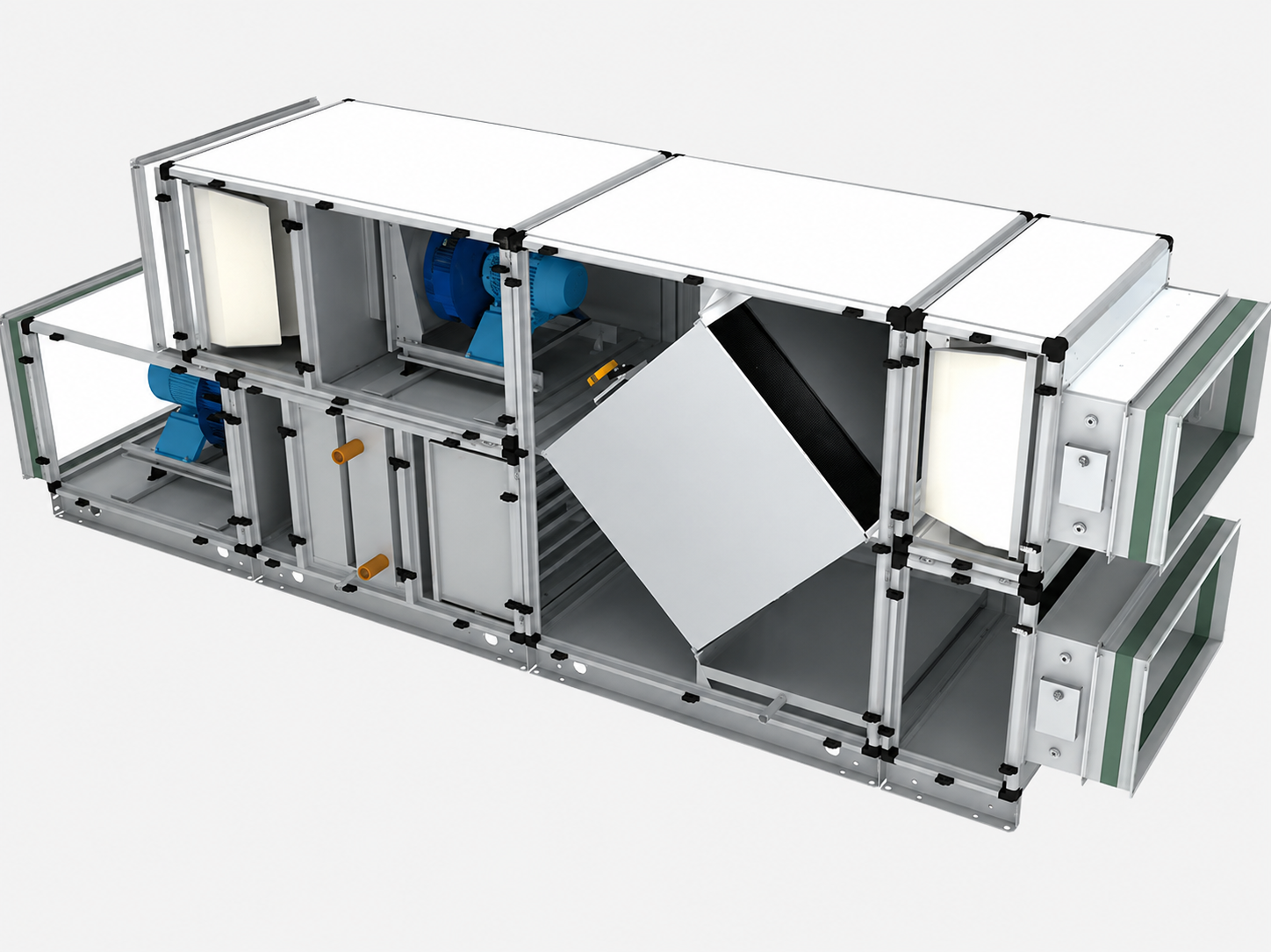
Plate (cross-flow) heat recovery AHU
Sensible-only aluminium plate recuperator with supply and exhaust entirely segregated - no cross-contamination risk, safer where that’s a concern.
- Airflow of 2,000–30,000 m³/h
- 12 models, from 0607 to 1427
- Recovery section length of 1,100–2,300 mm
- Best for hospitals, cleanrooms, labs (no mixing)
Rotary-wheel (enthalpy) heat recovery AHU
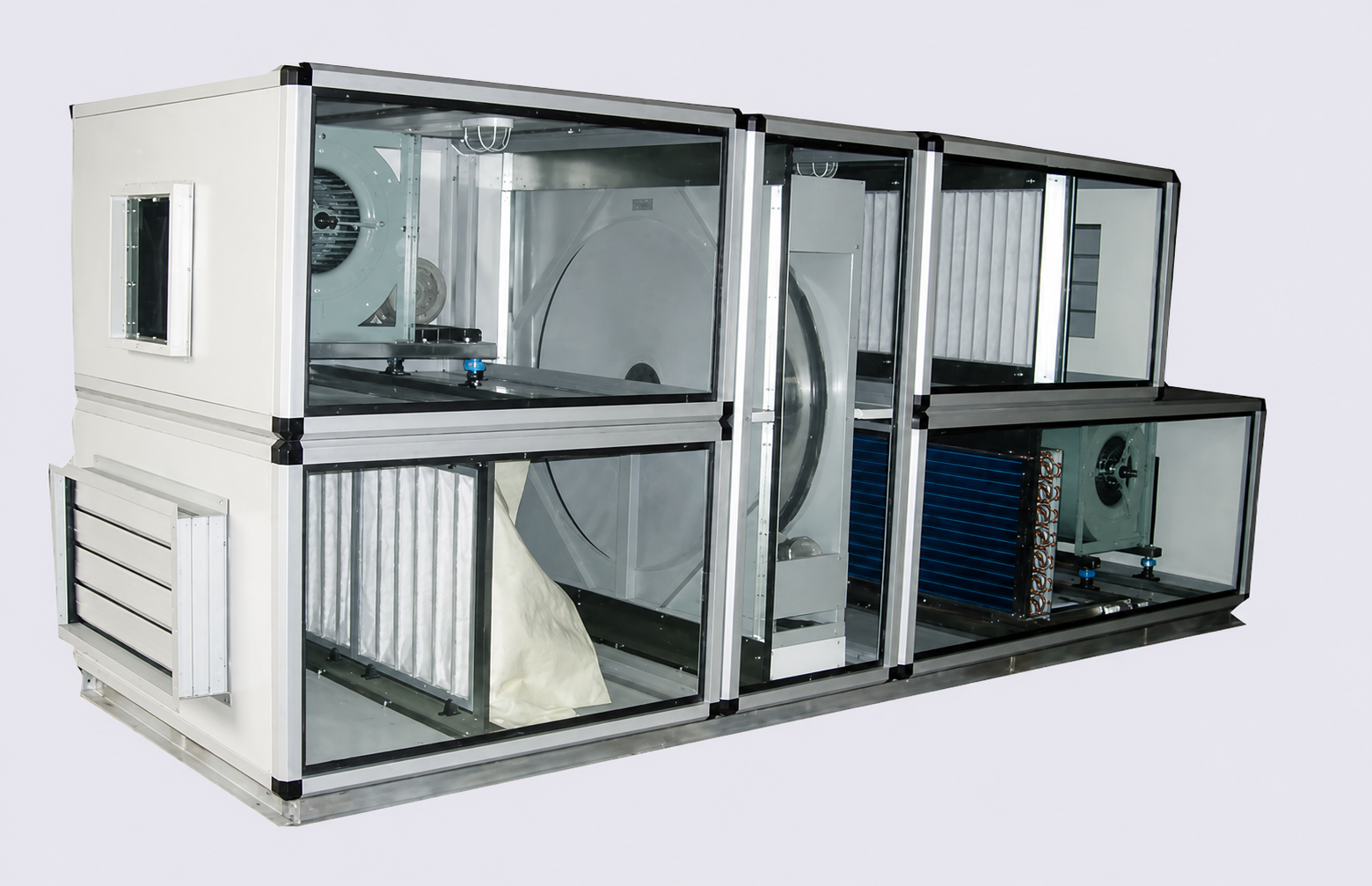
Rotating thermal wheel with aluminium plate - transfers sensible heat. Can be fitted with enthalpy or desiccant coating for latent recovery, delivering highest total energy recovery of the two types.
- Wheel diameter of 600–2,500 mm
- Airflow of 1,400–42,000 m³/h
- Face velocities available: 3, 4 or 5 m/s
- Best for data centers, malls, high-occupancy spaces, and humid climates
| Supply airflow (m³/h) | Model | Recovery section (mm) | Fan section (mm) |
|---|---|---|---|
| 2,000 | 0607 | 1,100 | 900 |
| 3,000 | 0609 | 1,100 | 900 |
| 4,000 | 0611 | 1,300 | 900 |
| 6,000 | 0714 | 1,400 | 900 |
| 8,000 | 0815 | 1,600 | 900 |
| 10,000 | 1014 | 1,900 | 900 |
| 13,000 | 1018 | 1,900 | 1,000 |
| 15,000 | 1119 | 1,900 | 1,100 |
| 18,000 | 1318 | 2,300 | 1,200 |
| 21,000 | 1320 | 2,300 | 1,300 |
| 25,000 | 1324 | 2,300 | 1,300 |
| 30,000 | 1427 | 2,300 | 1,500 |
| Wheel dia. (mm) | 3 m/s (m³/h) | 4 m/s (m³/h) | 5 m/s (m³/h) |
|---|---|---|---|
| 600 | 1,400 | 1,900 | 2,350 |
| 800 | 2,500 | 3,400 | 4,300 |
| 1,000 | 4,000 | 5,300 | 6,600 |
| 1,200 | 5,500 | 7,500 | 9,500 |
| 1,400 | 8,000 | 10,500 | 13,500 |
| 1,600 | 10,000 | 13,500 | 16,500 |
| 1,800 | 13,000 | 17,000 | 21,500 |
| 2,000 | 15,500 | 21,000 | 26,500 |
| 2,400 | 23,000 | 31,000 | 40,000 |
| 2,500 | 24,000 | 33,000 | 42,000 |
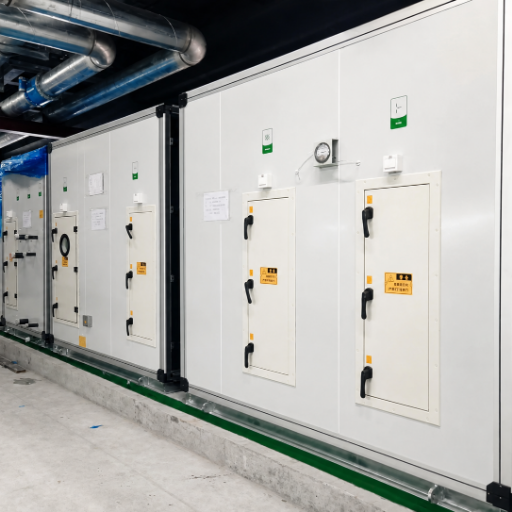
Plate vs Rotary vs Heat-Pipe — Choosing the Right Recovery Type
Your single most consequential choice on a heat recovery AHU is the recovery device itself, because it sets your possible recover (sensible only, or sensible plus latent), determines if your two streams will ever interact, and dictates the annual control strategy for your unit. This is our decision matrix that we take engineers through - with real numbers, not High/Medium/Low.
| Recovery type | Sensible effectiveness | Latent (moisture) | Cross-contamination | Typical fit |
|---|---|---|---|---|
| Cross-flow plate | 50–80% (counter-flow up to ~90%) | None (membrane core optional) | None — streams fully separated | Hospitals, cleanrooms, labs |
| Rotary enthalpy wheel | >80% | Yes — with enthalpy/desiccant coating | Small carryover — managed by purge sector | Data centers, malls, humid climates |
| Heat pipe | High, sensible only | None | None | Space-constrained sensible duties |
| Run-around loop | 45–65% | None | None — physically separate coils | Remote supply/exhaust, retrofit |
Recovery Efficiency & Energy Savings You Can Model
You don’t need to rely on faith in an effectiveness rating. Before your coils see any air, you can model the temperature of supply a wheel or a plate unit will achieve. Effectiveness (η), defined as the fraction of the available temperature (or enthalpy) difference recovered by the recovery, is calculated as:
Tsupply_after_recovery = Toutdoor + η × (Texhaust − Toutdoor)
For example, if outdoor air temperature is −5 °C, return air is 22 °C, and your wheel effectiveness is η = 0.75, the supply air leaves the recovery section at about −5 + 0.75 × 27 ≈ 15 °C. In this case, your heat coil will have to lift the air an additional 14°C, instead of 27°C - the recovery did better than half of the work! In the summer, the same wheel will pre-cool and pre-dry the incoming air, thus reducing your coil tonnage requirements.
Actual device performance ranges (based on laboratory testing) fall in these ranges: Cross-flow plate recovers provide 50% - 80% sensible efficiency, counter-flow plate efficiencies can approach 90% sensible efficiency. The rotary enthalpy wheel provides over 80% sensible efficiency with significant latent performance. Given that efficiency ratings tend to decline in real-world applications due to the accumulation of frost, contaminants, or pressure imbalances, we size on the condition the air will be in after the recovery process, not the optimum laboratory performance condition.
"The coils are sized based on the condition of the air post-recovery, not prior to it - and we always verify how the unit behaves in the transitional periods (shoulder seasons), since a wheel that cannot be slowed or bypassed can quickly waste all the valuable cooling benefit you have already paid to achieve within the building shell."
— Koven Air Engineering Team
Where Heat Recovery AHUs Deliver — Applications & Results
Your choice of recovery depends on the application. The chart below indicates where our installed base of Koven heat recovery air handling units can be found across 35 countries - and which technology we often win with.
| Healthcare | In hospital or healthcare applications, clinical spaces, and isolation facilities, supply and exhaust can never mix. |
| Cleanrooms | Contamination control is non-negotiable in cleanrooms and semiconductor/electronics plants. |
| Laboratories | Laboratory and pharmaceutical facilities maintain the segregation of the fume-laden exhaust air. |
| Data Centers | Data and server rooms must handle high sensible load while maintaining extremely narrow humidity windows. |
| High Occupancy | Areas with high occupancy and high latent load, such as malls, offices, gyms, libraries, and airports. |
| Agriculture | Humidity-sensitive environments, such as mushroom farms and granaries, are dependent on latent recovery. |
SYSTEM TRADE-OFF
Across these buildings the goal stays the same: to clean, temper, and potentially dehumidify a large volume of fresh air while recovering as much energy as possible from the exhaust stream. The decision to invest in latent (moisture) recovery is the key factor, along side the tolerance for any carryover. This critical trade-off determines the unit choice.
Engineered & Tested — Build Quality and Compliance
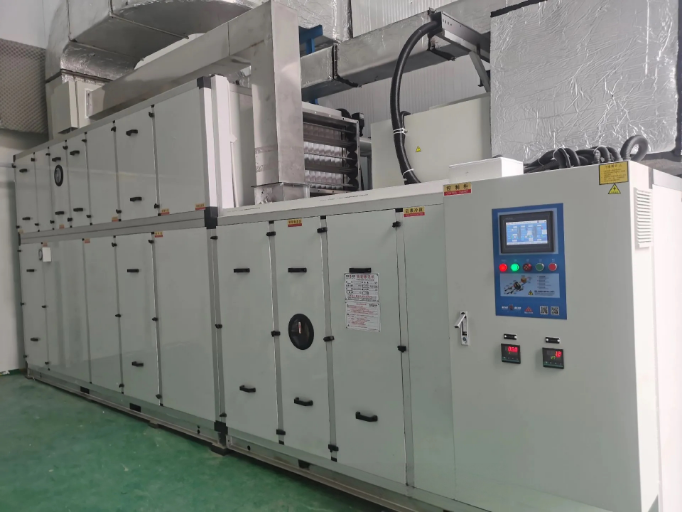
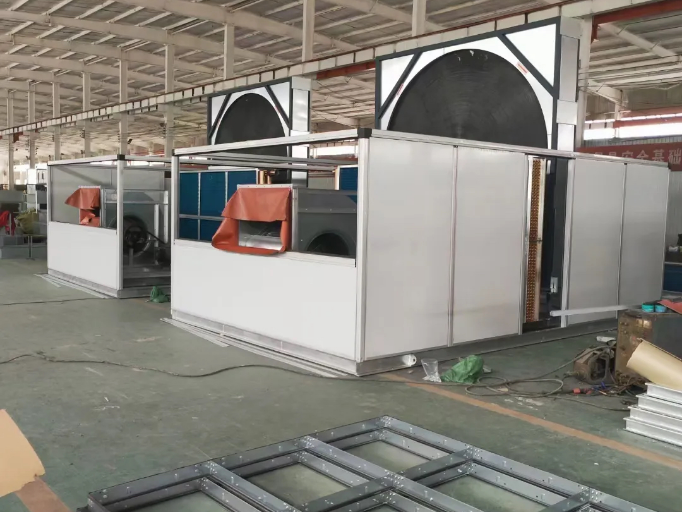
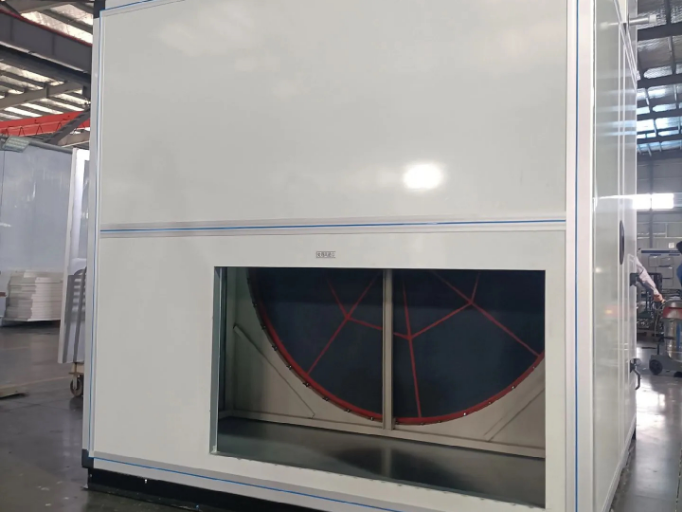
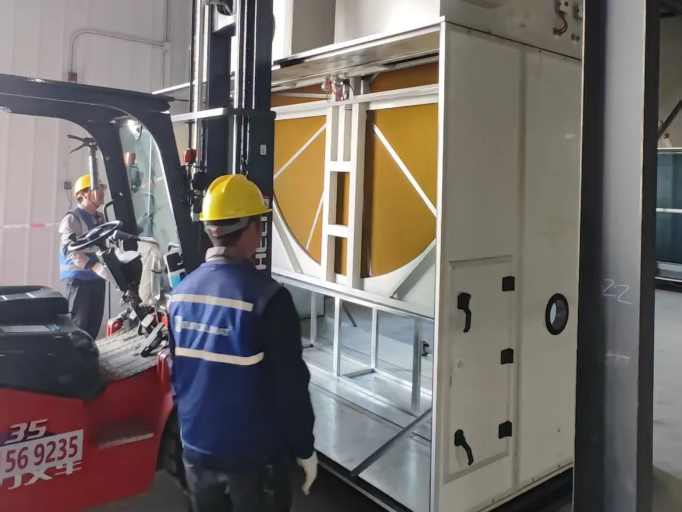
An imported AHU is only as effective as the manufacturer and the benchmarks against which it's measured. Koven Air has been producing environment control equipment since 2007, and exporting since 2010; the heat recovery line adheres to the same manufacturing standards and quality controls as our chillers and heat pumps.
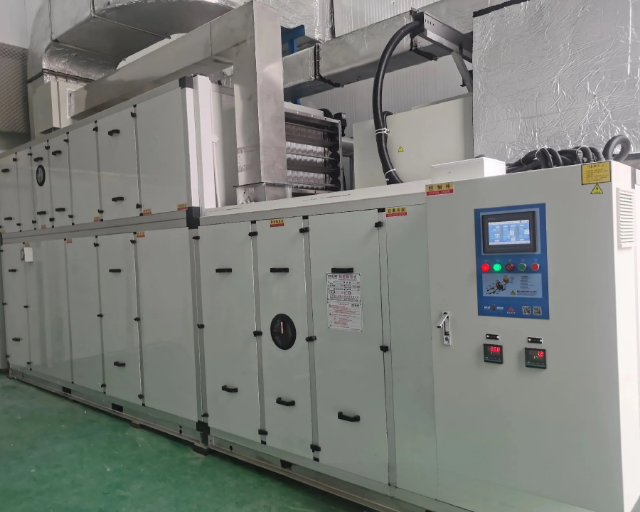
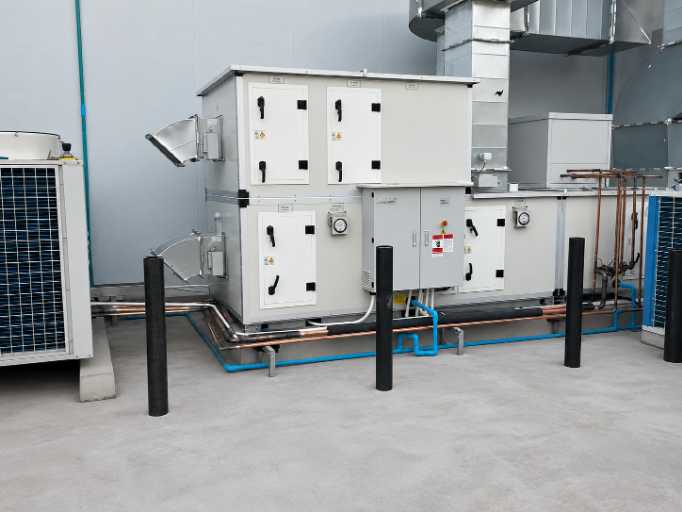
20,000 m²
Modern production facility
18
Standardized production processes
400-point
Process traceability per unit
36 + 24 h
Factory inspections & aging test
Air-to-air recovery performance is described by a universal language. We design and certify to: the ASHRAE Standard 84 method for testing air-to-air heat exchangers; the AHRI Standard 1060 framework for the performance ratings of energy-recovery equipment; and the European standard EN 308 test procedure. All our effectiveness, EATR, and pressure-drop values for equipment selections are referenced against these methods-with verification within our own chiller and heat pump testing lab-so that a consulting engineer can evaluate a Koven unit with the same standards as a European or North American product. All of our products are built to CE requirements for export markets.
Please note that the standards mentioned are used for designing and rating our equipment. The scope of certification for any given unit will be provided on the project submittal.
Need documentation for a submittal? Download the full compliance & test-method pack →
Heat Recovery AHU Engineering Tools
Heat Recovery AHU FAQ
Plate or rotary — which heat recovery type should I choose?
Select a cross-flow plate unit when supply and exhaust streams must never mix - hospitals, cleanrooms, labs - because a plate recuperator has zero carryover. Select a rotary enthalpy wheel when you need the highest total-energy recovery, including moisture (latent) recovery, in offices, malls, data centers and humid climates. The decision matrix and application table above map both to real duties.
Will a rotary wheel cross-contaminate exhaust into the supply air?
Some carryover of exhaust is inherent in a rotating wheel - this is measured by the Exhaust Air Transfer Ratio (EATR). This is controlled using a purge sector to flush the wheel before it enters the supply section, and a pressure bias to ensure any remaining leakage travels in the desired direction. Where carryover must be zero, the plate unit is the ideal solution.
What recovery efficiency can I actually expect?
By standard tested ranges: cross-flow plate recovers offer about 50-80% sensible heat (up to 90% in counter-flow configurations), and rotary enthalpy wheels can achieve more than 80% sensible plus latent recovery. Field effectiveness will typically be lower than the tested peak values due to issues such as frost and airside pressure imbalances, which we factor in when calculating the performance under the appropriate post-recovery condition (as per ASHRAE 84 / AHRI 1060 methods).
How do I size a heat recovery AHU by airflow?
To select a plate range, find the correct model for your supply airflow (2,000 m³/h → 0607, up to 30,000 m³/h → 1427). For a rotary range, choose a wheel diameter and then a face velocity (3, 4, or 5 m/s) that match your required airflow (up to 42,000 m³/h). Please provide us with your airflow schedule and duty, and our pre-sales engineers will return a shortlist of suitable models for your review.
Does heat recovery still work in very cold climates (frost)?
Yes, in frost protection conditions. We employ an automatic frost control mechanism that operates below a certain outdoor temperature to modulate the wheel speed or airflow, or apply preheat to prevent the formation of frost on the recovery section. This control sequence is defined during the project submittal, and is typically coupled with wheel-speed or bypass control strategies for use during milder weather.
What is the difference between an ERV, an HRV and a heat recovery AHU?
An HRV (Heat Recovery Ventilator) recovers sensible heat only, whereas an ERV (Energy Recovery Ventilator, or total-energy recovery ventilator) recovers both sensible heat and moisture. Both terms often refer to self-contained packaged units. A heat recovery AHU (Air Handling Unit) is a fully integrated system containing a air handling unit with built-in recovery, providing simultaneous filtration, coils, fan control, and recovery functionality within a single commercial/industrial unit, rather than an external recovery box.
Can Koven match a specified selection and what is the lead time?
Yes - Koven units are custom-built from modular components to align precisely with your specific airflow, recovery type, coil duty, filtration needs, and control requirements, as detailed in your Request for Quotation (RFQ). We provide a lead time estimate based on the finalized equipment selection; please share your project specification with us for a definitive quote and schedule.
What standards are Koven heat recovery AHUs designed and rated to?
Performance of our units is rigorously tested and rated to the ASHRAE Standard 84 test methodology, the AHRI Standard 1060 rating framework, and EN 308 standards, with independent in-house verification conducted in our test laboratory. All units are manufactured to CE requirements for global markets; the precise scope of certification for any given unit will be specified in the project submittal documents.


![Cleanroom Dry Cooling Coil: How It Works [2026 Guide]](https://kovenair.com/wp-content/uploads/2026/07/cleanroom-dry-cooling-coil-guide-featured-2-150x150.png)


